10/28/2024 1
CHAPTER - 4
Types of Decision Support
Systems
10/28/2024 2
Decision Support Systems Classification
The decision support systems can have a
classification across different types based
on multi-criteria.
10/28/2024 3
Decision Support Systems Classification
based on User Relationship
I. Active DSS: has the capability to build
decision guidelines that are developed to
support the decision making for
solutions to issues
II. Passive DSS is does not build decision
guidelines but only provides support to
the decision making process.
III. cooperative DSS provides the decision
maker the ability to execute changes
10/28/2024 4
DSS Classification based on Mode of
Assistance
Data-driven Decision Support System
Data-driven DSS involves the access and
manipulation of data that is structured and
which includes time series functionality
handling to fulfill the external and internal
data requirements of organizations as the
data is managed.
10/28/2024 5
Model-driven Decision Support System
A model-driven decision support systems is
a specially designed model patterned after
specific parameters and features defined by
the users to include the property of support
to decision making process through the
analysis of given situations.
It does not require a large demand for data
as there is minimal need for databases
10/28/2024 6
Communication-driven DSS
It relies on a network fusion and
electronic methods to integrate core
decision makers in given situations by
consolidating the decision makers into
one environment which has all the data,
information and resources that are needed
for decision making.
This model is now formally referred to as
Group Decision Support System (GDSS).
10/28/2024 7
Document-driven (DSS)
Document management became an
important feature for organizations to
manage and store relevant documents and
other materials such as photos and images,
and audio and video files.
An alternative that is used in the retrieval of
information is the text-based system which
is also considered as effective in mining
organizational data in identifying the
location of documents.
10/28/2024 8
Knowledge-driven DSS
knowledge-driven DSS which is
considered to have started from intelligent
decision support systems with a related
perspective that these are linked to
artificial intelligence.
Is computer-based reasoning system that
provides information, comprehension and
suggestions to users to support them in
decision-making
10/28/2024 9
Web-based DSS
web-based DSS and this is viewed as a
complex and sophisticated decision support
system that has expanded its ability with the
utilization of the worldwide web and
Internet as part of the processes for
supporting decision making.
This progress in the web-based decision
support systems caused a continued
technological advancement that has also
defined the Internet
10/28/2024 10
DSS Classification based on Scope
Enterprise-wide DSS provides support to
organizations and decision makers by
integrating large databases across different
locations in order for the decision makers to
have a view over all the data warehouses.
Desktop single user DSS, in comparison to the
enterprise-wide DSS, has a smaller foundation
and is typically limited to an individual user’s
personal computer with this DSS being
designed as a point of support for managers.
10/28/2024 11
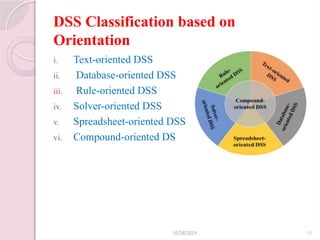
DSS Classification based on
Orientation
i. Text-oriented DSS
ii. Database-oriented DSS
iii. Rule-oriented DSS
iv. Solver-oriented DSS
v. Spreadsheet-oriented DSS
vi. Compound-oriented DS
10/28/2024 12
Contd.
A text-oriented DSS aids the decision-
making process with the storage of text-
based data that can then be accessed, utilized
and evaluated by the individual managers
and decision makers.
 database-oriented DSS involves the
storage of data and information across
different locations such as in regions which
then provides the decision makers access to
the data.
10/28/2024 13
Contd.
rule-oriented DSS provides a more intelligent
approach that incorporates the use of artificial
intelligence, which enables the leverage of rules
and processes to aid the decision makers in
suggested solutions coming from the knowledge
base.
solver-oriented DSS could be considered as
systems which are specialized as these involve
solvers which enable the analysis and development
of solutions in various areas subject areas including
finance, forecasting and optimization among many
others.
10/28/2024 14
Contd.
spreadsheet-oriented DSS provides
decision making support that require the
aspects of the development of creating,
extracting and improving knowledge.
 compound DSS is a category of DSS that
involves different orientation-based DSS
in combination in its application
10/28/2024 15
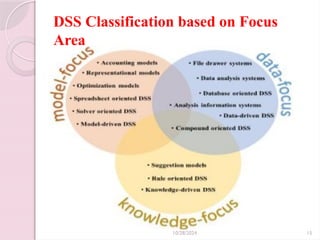
DSS Classification based on Focus
Area
10/28/2024 16
DSS Classification based onType
and Frequency of Decision Making
Institutional DSS: effectively for
programmed decisions that are executed on a
regular basis such as daily.
Ad-hoc DSS: is applicable in situations where
support for decision making is not considered
to be regular but in one-off situations.
The ad hoc DSS is meant to be used for
decisions which are not programmatic, and
the likelihood is that the data and information
in these situations are incomplete.
10/28/2024 17
END OF CHAPTER - 4
THANK YOU

Chapter 4 Types of Decision support system

  • 1.
    10/28/2024 1 CHAPTER -4 Types of Decision Support Systems
  • 2.
    10/28/2024 2 Decision SupportSystems Classification The decision support systems can have a classification across different types based on multi-criteria.
  • 3.
    10/28/2024 3 Decision SupportSystems Classification based on User Relationship I. Active DSS: has the capability to build decision guidelines that are developed to support the decision making for solutions to issues II. Passive DSS is does not build decision guidelines but only provides support to the decision making process. III. cooperative DSS provides the decision maker the ability to execute changes
  • 4.
    10/28/2024 4 DSS Classificationbased on Mode of Assistance Data-driven Decision Support System Data-driven DSS involves the access and manipulation of data that is structured and which includes time series functionality handling to fulfill the external and internal data requirements of organizations as the data is managed.
  • 5.
    10/28/2024 5 Model-driven DecisionSupport System A model-driven decision support systems is a specially designed model patterned after specific parameters and features defined by the users to include the property of support to decision making process through the analysis of given situations. It does not require a large demand for data as there is minimal need for databases
  • 6.
    10/28/2024 6 Communication-driven DSS Itrelies on a network fusion and electronic methods to integrate core decision makers in given situations by consolidating the decision makers into one environment which has all the data, information and resources that are needed for decision making. This model is now formally referred to as Group Decision Support System (GDSS).
  • 7.
    10/28/2024 7 Document-driven (DSS) Documentmanagement became an important feature for organizations to manage and store relevant documents and other materials such as photos and images, and audio and video files. An alternative that is used in the retrieval of information is the text-based system which is also considered as effective in mining organizational data in identifying the location of documents.
  • 8.
    10/28/2024 8 Knowledge-driven DSS knowledge-drivenDSS which is considered to have started from intelligent decision support systems with a related perspective that these are linked to artificial intelligence. Is computer-based reasoning system that provides information, comprehension and suggestions to users to support them in decision-making
  • 9.
    10/28/2024 9 Web-based DSS web-basedDSS and this is viewed as a complex and sophisticated decision support system that has expanded its ability with the utilization of the worldwide web and Internet as part of the processes for supporting decision making. This progress in the web-based decision support systems caused a continued technological advancement that has also defined the Internet
  • 10.
    10/28/2024 10 DSS Classificationbased on Scope Enterprise-wide DSS provides support to organizations and decision makers by integrating large databases across different locations in order for the decision makers to have a view over all the data warehouses. Desktop single user DSS, in comparison to the enterprise-wide DSS, has a smaller foundation and is typically limited to an individual user’s personal computer with this DSS being designed as a point of support for managers.
  • 11.
    10/28/2024 11 DSS Classificationbased on Orientation i. Text-oriented DSS ii. Database-oriented DSS iii. Rule-oriented DSS iv. Solver-oriented DSS v. Spreadsheet-oriented DSS vi. Compound-oriented DS
  • 12.
    10/28/2024 12 Contd. A text-orientedDSS aids the decision- making process with the storage of text- based data that can then be accessed, utilized and evaluated by the individual managers and decision makers.  database-oriented DSS involves the storage of data and information across different locations such as in regions which then provides the decision makers access to the data.
  • 13.
    10/28/2024 13 Contd. rule-oriented DSSprovides a more intelligent approach that incorporates the use of artificial intelligence, which enables the leverage of rules and processes to aid the decision makers in suggested solutions coming from the knowledge base. solver-oriented DSS could be considered as systems which are specialized as these involve solvers which enable the analysis and development of solutions in various areas subject areas including finance, forecasting and optimization among many others.
  • 14.
    10/28/2024 14 Contd. spreadsheet-oriented DSSprovides decision making support that require the aspects of the development of creating, extracting and improving knowledge.  compound DSS is a category of DSS that involves different orientation-based DSS in combination in its application
  • 15.
  • 16.
    10/28/2024 16 DSS Classificationbased onType and Frequency of Decision Making Institutional DSS: effectively for programmed decisions that are executed on a regular basis such as daily. Ad-hoc DSS: is applicable in situations where support for decision making is not considered to be regular but in one-off situations. The ad hoc DSS is meant to be used for decisions which are not programmatic, and the likelihood is that the data and information in these situations are incomplete.
  • 17.
    10/28/2024 17 END OFCHAPTER - 4 THANK YOU