Behavioral Approach
Chapter 4
Introduction
 The behavioral approach focuses exclusively on what leaders do and how they act. In
shifting the study of leadership to leader behaviors, the behavioral approach expanded
the research of leadership to include the actions of leaders toward followers in
various contexts.
Introduction
 Leadership is composed of two general kinds of behaviors.
Task behaviors- facilitate goal accomplishment: They help group members to achieve their
objectives.
Relationship behaviors- help followers feel comfortable with themselves, with each other, and
with the situation in which they find themselves.
The central purpose of the behavioral approach is to explain how leaders combine these two
kinds of behaviors to influence followers in their efforts to reach a goal.
Ohio state studies
 Researchers found that followers’ responses on the questionnaire clustered around two
general types of leader behaviors: initiating structure and consideration
 Initiating structure behaviors are essentially task behaviors, including such acts as
organizing work, giving structure to the work context, defining role responsibilities, and
scheduling work activities.
 Consideration behaviors are essentially relationship behaviors and include building
camaraderie, respect, trust, and liking between leaders and followers.
Ohio state studies
 The Ohio State studies viewed these two behaviors as distinct and independent.
 Many studies have been done to determine which leadership behavior is most effective in
a particular situation. In some contexts, high consideration has been found to be most
effective, but in other situations, high initiating structure is most effective.
The University of Michigan Studies
 Research at Michigan identified two types of leadership behaviors: employee orientation
and production orientation.
 Employee orientation is the behavior of leaders who approach subordinates with a
strong human relations emphasis. They take an interest in workers as human beings, value
their individuality, and give special attention to their personal needs.
 Production orientation consists of leadership behaviors that stress the technical and
production aspects of a job. From this orientation, workers are viewed as a means for
getting work accomplished.
The University of Michigan Studies
 Initial studies, conceptualized employee and production orientations as opposite
ends of a single continuum. Leaders who were oriented toward production were less
oriented toward employees vice versa.
 The researchers reconceptualized the two constructs, as in the Ohio State studies, as two
independent leadership orientations. Two behaviors are treated as independent
orientations, leaders are seen as being able to be oriented toward both production and
employees at the same time.
 Both Ohio State and the University of Michigan to determine how leaders could best
combine their task and relationship behaviors to maximize the impact of these behaviors
on the satisfaction and performance of followers.
Blake and Mouton’s Managerial
(Leadership) Grid
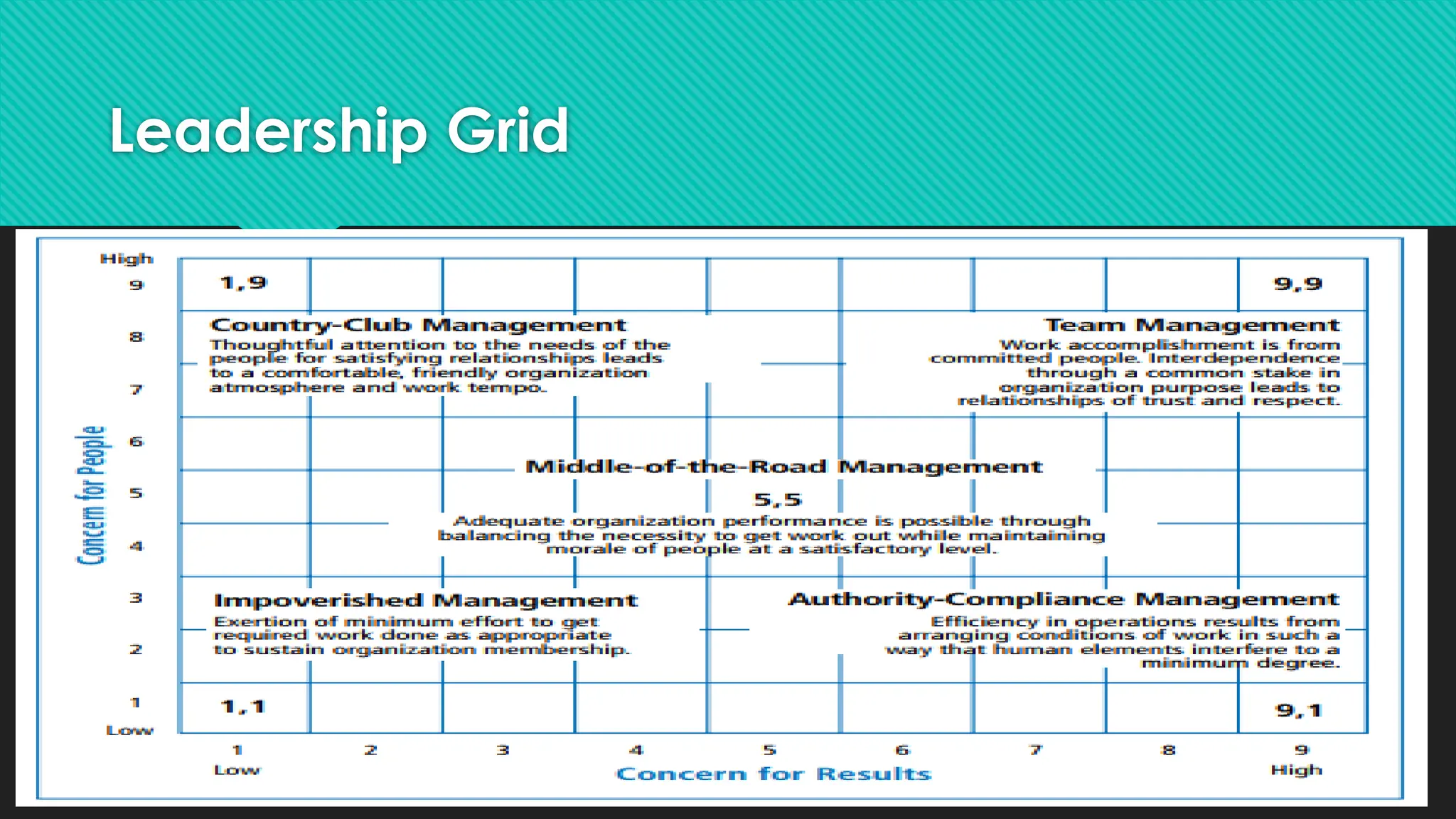
 Leaders help organizations to reach their purposes through two factors: concern for
production and concern for people.
 Concern for production refers to how a leader is concerned with achieving organizational
tasks.
 Concern for people refers to how a leader attends to the people in the organization who
are trying to achieve its goals.
Leadership Grid
Leadership Grid
 Authority–compliance (9,1)- leadership places heavy emphasis on task and job
requirements, and less emphasis on people, except to the extent that people
are tools for getting the job done. Communicating with subordinates is not
emphasized except for the purpose of giving instructions about the task.
This style is result driven, and people are regarded as tools to that end.
 Country-club Management (1,9) represents a low concern for task accomplishment
coupled with a high concern for interpersonal relationships. leaders stress the attitudes and
feelings of people, making sure the personal and social needs of followers are met.
Leadership Grid
 impoverished Management (1,1) - style is representative of a leader who is unconcerned
with both the task and interpersonal relationships. This type of leader goes through the
motions of being a leader but acts uninvolved and withdrawn.
 Middle-of-the-road Management (5,5)- leaders who are compromisers, who have an
intermediate concern for the task and an intermediate concern for the people
who do the task. They find a balance between taking people into account and still
emphasizing the work requirements.
Leadership Grid
 Team Management (9,9)- places a strong emphasis on both tasks and interpersonal
relationships. It promotes a high degree of participation and teamwork in the organization
and satisfies a basic need in employees to be involved and committed to their work.
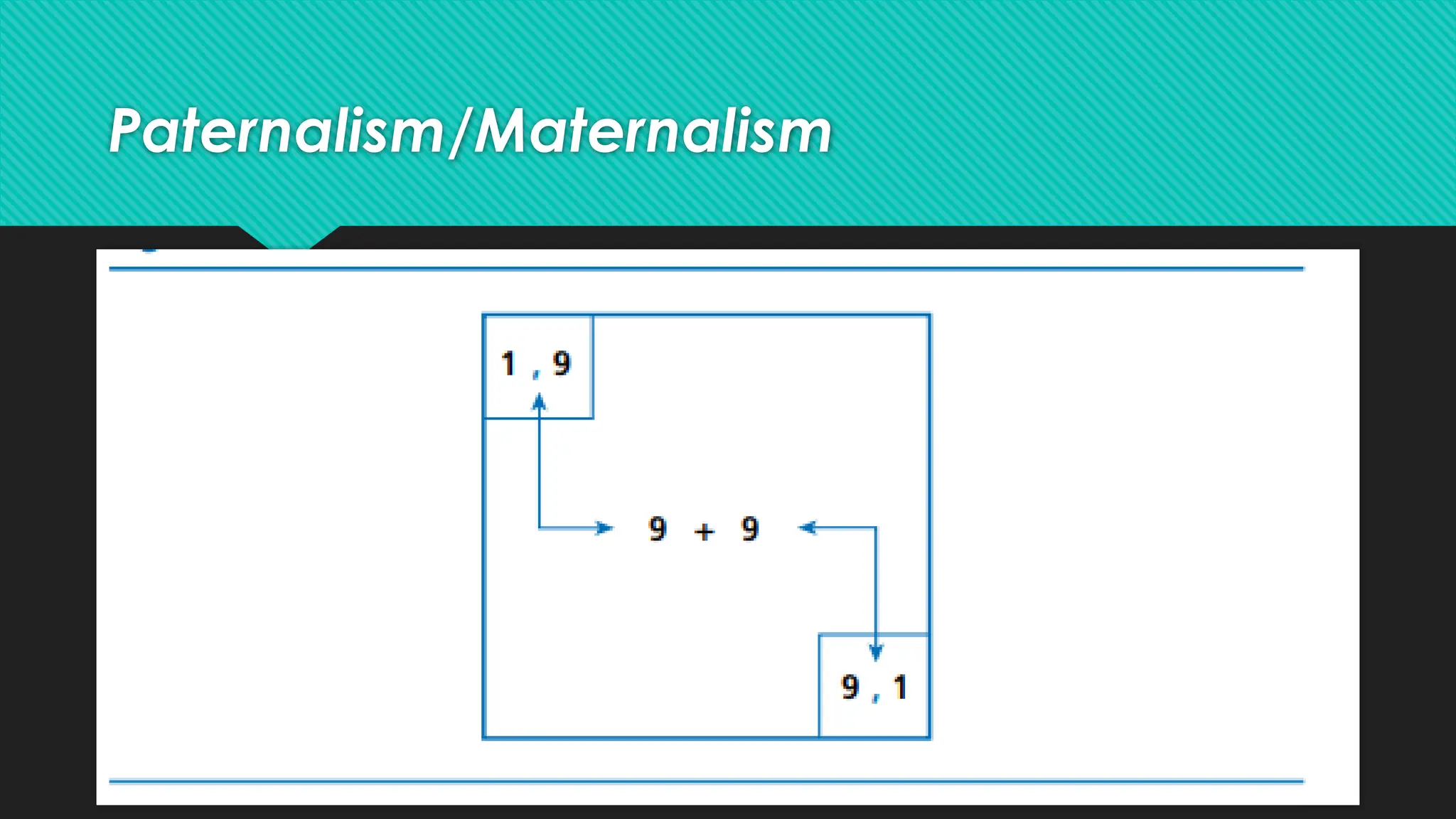
 Paternalism/Maternalism- Paternalism/maternalism refers to a leader who uses both 1,9
and 9,1 styles but does not integrate the two. This is the “benevolent dictator” who acts
graciously but does so for the purpose of goal accomplishment. In essence, the
paternalistic/maternalistic style treats people as if they were dissociated from the task.
Paternalism/Maternalism
Opportunism
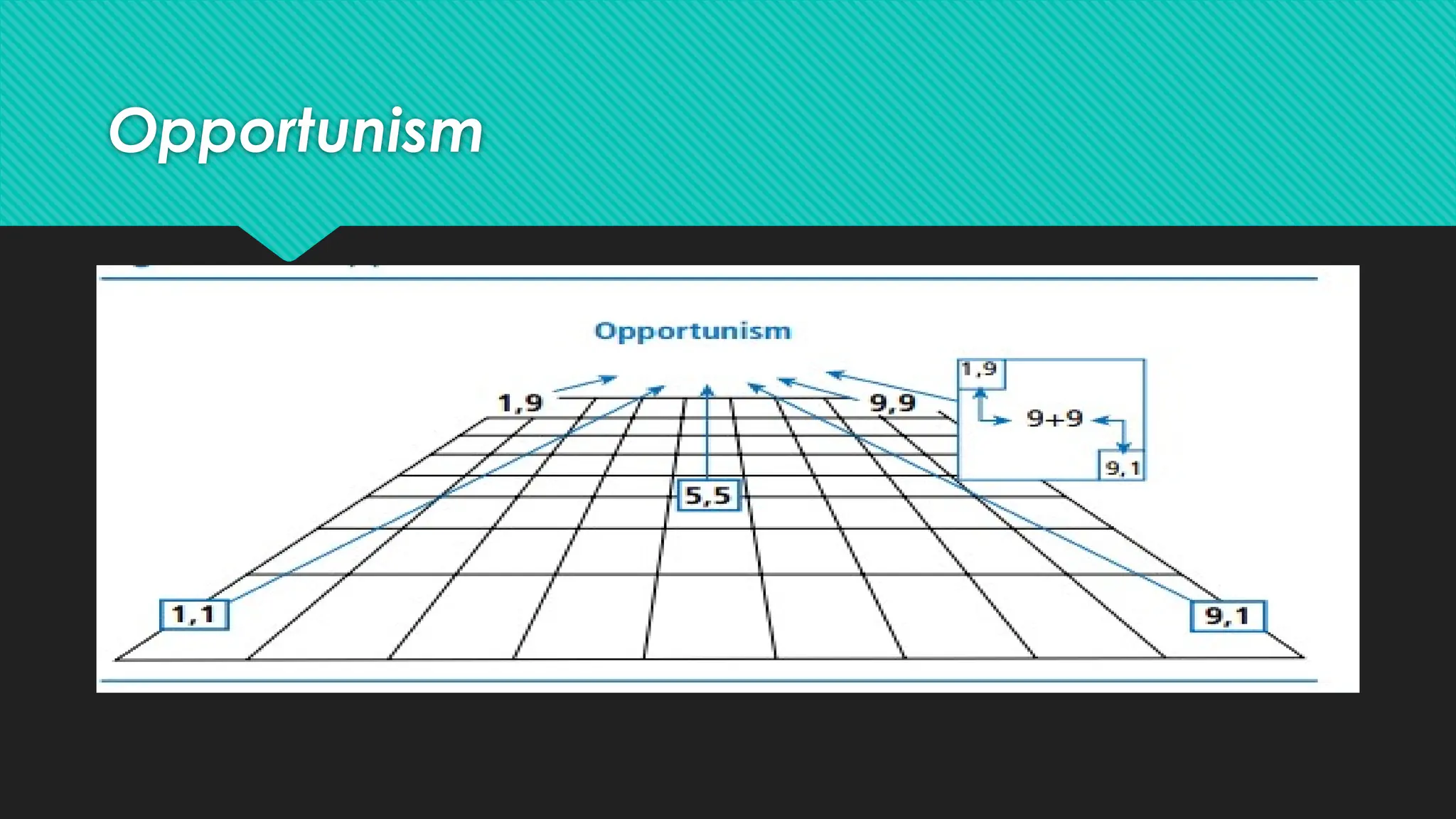
 Opportunism refers to a leader who uses any combination of the basic five styles for the
purpose of personal advancement. An opportunistic leader will adapt and shift his or her
leadership behavior to gain personal advantage, putting self-interest ahead of other
priorities. Both the performance and the effort of the leader are to realize personal gain.
Opportunism
How does behavioral approach work
 The behavioral approach works not by telling leaders how to behave, but by describing
the major components of their behavior.
 In some situations, leaders need to be more task oriented, whereas in others they need to
be more relationship oriented.
 It reminds leaders that their impact on others occurs through the tasks they perform as well
as in the relationships they create.
Strength
 The behavioral approach broadened the scope of leadership research to include the
behaviors of leaders and what they do in various situations.
 No longer was the focus of leadership on the personal characteristics of leaders.
 Wide range of studies on leadership behavior validates and gives credibility to the basic
tenets of the approach.
 the behavioral approach is heuristic. Leaders can learn a lot about themselves and how
they come across to others by trying to see their behaviors in light of the task and
relationship dimensions.
Critism
 The research on the behavioral approach has not adequately shown how leaders’
behaviors are associated with performance outcomes.
 Researchers have not been able to establish a consistent link between task and
relationship behaviors and outcomes such as morale, job satisfaction, and productivity.
 This approach has failed to find a universal style of leadership that could be effective in
almost every situation.
 It implies that the most effective leadership style is the high–high style. Certain situations
may require different leadership styles; some may be complex and require hightask
behavior, and others may be simple and require supportive behavior.
Situational Approach
Chapter 5
Introduction
 The situational approach focuses on leadership in situations.
 The premise of the theory is that different situations demand different kinds of leadership.
From this perspective, to be an effective leader requires that a person adapt his or her
style to the demands of different situations.
 The situational approach stresses that leadership is composed of both a directive and a
supportive dimension, and that each has to be applied appropriately in a given situation.
Introduction
 To determine what is needed in a particular situation, a leader must evaluate her or his
followers and assess how competent and committed they are to perform a given goal.
 Based on the assumption that followers’ skills and motivation vary over time.
 the essence of the situational approach demands that leaders match their style to the
competence and commitment of the followers.
Leadership style
 Directive behaviors help group members accomplish goals by giving directions,
establishing goals and methods of evaluation, setting timelines, defining roles, and
showing how the goals are to be achieved. Directive behaviors clarify, often with one-
way communication
 Supportive behaviors help group members feel comfortable about themselves, their
coworkers, and the situation. Supportive behaviors involve two-way communication and
responses that show social and emotional support to others.
Leadership style
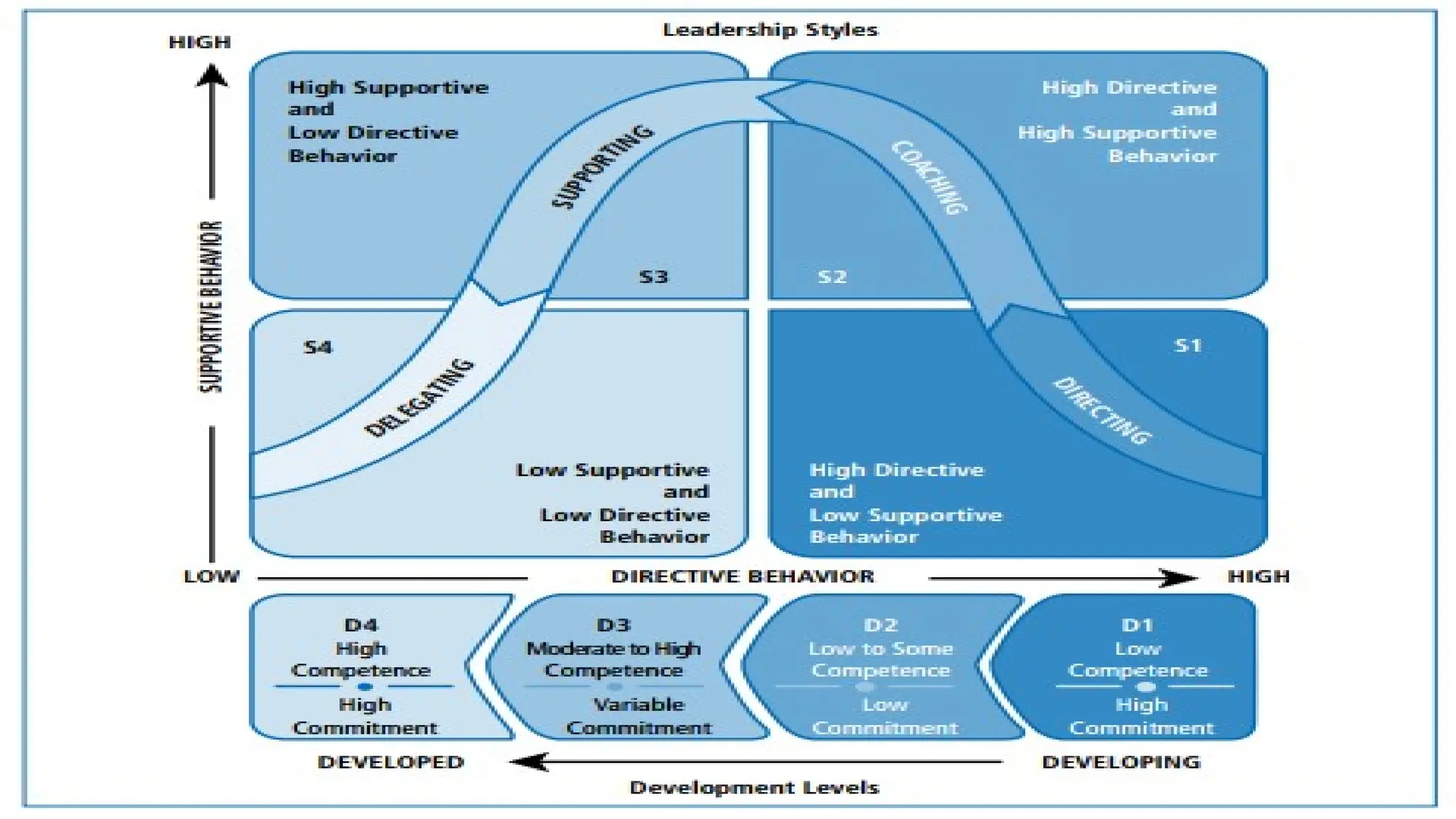
 Leadership styles can be classified further into four distinct categories of
directive and supportive behaviors
 (S1) is a high directive–low supportive style, which is also called a directing style. In this
approach, the leader focuses communication on goal achievement, and
spends a smaller amount of time using supportive behaviors.
 (S2) is called a coaching approach and is a high directive– high supportive style. In this
approach, the leader focuses communication on both achieving goals and meeting
followers’ socioemotional needs.
Leadership style
 (S3) is a supporting approach that requires that the leader take a high supportive–low
directive style. In this approach, the leader does not focus exclusively on goals but uses
supportive behaviors that bring out followers’ skills around the goal to be accomplished.
The supportive style includes listening, praising, asking for input, and giving feedback.
 S4 is called the low supportive–low directive style, or a delegating approach.
In this approach, the leader offers less goal input and social support, facilitating
followers’ confidence and motivation in reference to the goal.
Leadership styles
Strengths
 The first strength is that it has a history of usefulness in the marketplace.
 Situational Leadership is easy to understand, intuitively sensible, and easily applied in a
variety of settings.
 it has prescriptive value. It tells you what you should and should not do in various contexts.
 It emphasizes leader flexibility. The approach stresses that leaders need to find out about
their followers’ needs and then adapt their leadership style accordingly.
 Reminds us to treat each follower differently based on the goal at hand and to seek
opportunities to help followers learn new skills and become more confident in their work.
Critism
 Only a few research studies have been conducted to justify the assumptions and
propositions set forth by the approach.
 Ambiguous conceptualization in the model of followers’ development levels.
 How the model matches leader style with follower development levels. For example newly
hired teachers were more satisfied and performed better under principals who had highly
structured leadership styles, but that the performance of more experienced and mature
teachers was unrelated to the style their principals exhibited.
 How certain demographic characteristics (e.g., education, experience, age, and
gender) influence the leader–follower prescriptions of the model.

Chapter 4 & 5 Behavioral & situational Approach.pptx

  • 1.
  • 2.
    Introduction  The behavioralapproach focuses exclusively on what leaders do and how they act. In shifting the study of leadership to leader behaviors, the behavioral approach expanded the research of leadership to include the actions of leaders toward followers in various contexts.
  • 3.
    Introduction  Leadership iscomposed of two general kinds of behaviors. Task behaviors- facilitate goal accomplishment: They help group members to achieve their objectives. Relationship behaviors- help followers feel comfortable with themselves, with each other, and with the situation in which they find themselves. The central purpose of the behavioral approach is to explain how leaders combine these two kinds of behaviors to influence followers in their efforts to reach a goal.
  • 4.
    Ohio state studies Researchers found that followers’ responses on the questionnaire clustered around two general types of leader behaviors: initiating structure and consideration  Initiating structure behaviors are essentially task behaviors, including such acts as organizing work, giving structure to the work context, defining role responsibilities, and scheduling work activities.  Consideration behaviors are essentially relationship behaviors and include building camaraderie, respect, trust, and liking between leaders and followers.
  • 5.
    Ohio state studies The Ohio State studies viewed these two behaviors as distinct and independent.  Many studies have been done to determine which leadership behavior is most effective in a particular situation. In some contexts, high consideration has been found to be most effective, but in other situations, high initiating structure is most effective.
  • 6.
    The University ofMichigan Studies  Research at Michigan identified two types of leadership behaviors: employee orientation and production orientation.  Employee orientation is the behavior of leaders who approach subordinates with a strong human relations emphasis. They take an interest in workers as human beings, value their individuality, and give special attention to their personal needs.  Production orientation consists of leadership behaviors that stress the technical and production aspects of a job. From this orientation, workers are viewed as a means for getting work accomplished.
  • 7.
    The University ofMichigan Studies  Initial studies, conceptualized employee and production orientations as opposite ends of a single continuum. Leaders who were oriented toward production were less oriented toward employees vice versa.  The researchers reconceptualized the two constructs, as in the Ohio State studies, as two independent leadership orientations. Two behaviors are treated as independent orientations, leaders are seen as being able to be oriented toward both production and employees at the same time.  Both Ohio State and the University of Michigan to determine how leaders could best combine their task and relationship behaviors to maximize the impact of these behaviors on the satisfaction and performance of followers.
  • 8.
    Blake and Mouton’sManagerial (Leadership) Grid  Leaders help organizations to reach their purposes through two factors: concern for production and concern for people.  Concern for production refers to how a leader is concerned with achieving organizational tasks.  Concern for people refers to how a leader attends to the people in the organization who are trying to achieve its goals.
  • 9.
  • 10.
    Leadership Grid  Authority–compliance(9,1)- leadership places heavy emphasis on task and job requirements, and less emphasis on people, except to the extent that people are tools for getting the job done. Communicating with subordinates is not emphasized except for the purpose of giving instructions about the task. This style is result driven, and people are regarded as tools to that end.  Country-club Management (1,9) represents a low concern for task accomplishment coupled with a high concern for interpersonal relationships. leaders stress the attitudes and feelings of people, making sure the personal and social needs of followers are met.
  • 11.
    Leadership Grid  impoverishedManagement (1,1) - style is representative of a leader who is unconcerned with both the task and interpersonal relationships. This type of leader goes through the motions of being a leader but acts uninvolved and withdrawn.  Middle-of-the-road Management (5,5)- leaders who are compromisers, who have an intermediate concern for the task and an intermediate concern for the people who do the task. They find a balance between taking people into account and still emphasizing the work requirements.
  • 12.
    Leadership Grid  TeamManagement (9,9)- places a strong emphasis on both tasks and interpersonal relationships. It promotes a high degree of participation and teamwork in the organization and satisfies a basic need in employees to be involved and committed to their work.  Paternalism/Maternalism- Paternalism/maternalism refers to a leader who uses both 1,9 and 9,1 styles but does not integrate the two. This is the “benevolent dictator” who acts graciously but does so for the purpose of goal accomplishment. In essence, the paternalistic/maternalistic style treats people as if they were dissociated from the task.
  • 13.
  • 14.
    Opportunism  Opportunism refersto a leader who uses any combination of the basic five styles for the purpose of personal advancement. An opportunistic leader will adapt and shift his or her leadership behavior to gain personal advantage, putting self-interest ahead of other priorities. Both the performance and the effort of the leader are to realize personal gain.
  • 15.
  • 16.
    How does behavioralapproach work  The behavioral approach works not by telling leaders how to behave, but by describing the major components of their behavior.  In some situations, leaders need to be more task oriented, whereas in others they need to be more relationship oriented.  It reminds leaders that their impact on others occurs through the tasks they perform as well as in the relationships they create.
  • 17.
    Strength  The behavioralapproach broadened the scope of leadership research to include the behaviors of leaders and what they do in various situations.  No longer was the focus of leadership on the personal characteristics of leaders.  Wide range of studies on leadership behavior validates and gives credibility to the basic tenets of the approach.  the behavioral approach is heuristic. Leaders can learn a lot about themselves and how they come across to others by trying to see their behaviors in light of the task and relationship dimensions.
  • 18.
    Critism  The researchon the behavioral approach has not adequately shown how leaders’ behaviors are associated with performance outcomes.  Researchers have not been able to establish a consistent link between task and relationship behaviors and outcomes such as morale, job satisfaction, and productivity.  This approach has failed to find a universal style of leadership that could be effective in almost every situation.  It implies that the most effective leadership style is the high–high style. Certain situations may require different leadership styles; some may be complex and require hightask behavior, and others may be simple and require supportive behavior.
  • 19.
  • 20.
    Introduction  The situationalapproach focuses on leadership in situations.  The premise of the theory is that different situations demand different kinds of leadership. From this perspective, to be an effective leader requires that a person adapt his or her style to the demands of different situations.  The situational approach stresses that leadership is composed of both a directive and a supportive dimension, and that each has to be applied appropriately in a given situation.
  • 21.
    Introduction  To determinewhat is needed in a particular situation, a leader must evaluate her or his followers and assess how competent and committed they are to perform a given goal.  Based on the assumption that followers’ skills and motivation vary over time.  the essence of the situational approach demands that leaders match their style to the competence and commitment of the followers.
  • 22.
    Leadership style  Directivebehaviors help group members accomplish goals by giving directions, establishing goals and methods of evaluation, setting timelines, defining roles, and showing how the goals are to be achieved. Directive behaviors clarify, often with one- way communication  Supportive behaviors help group members feel comfortable about themselves, their coworkers, and the situation. Supportive behaviors involve two-way communication and responses that show social and emotional support to others.
  • 23.
    Leadership style  Leadershipstyles can be classified further into four distinct categories of directive and supportive behaviors  (S1) is a high directive–low supportive style, which is also called a directing style. In this approach, the leader focuses communication on goal achievement, and spends a smaller amount of time using supportive behaviors.  (S2) is called a coaching approach and is a high directive– high supportive style. In this approach, the leader focuses communication on both achieving goals and meeting followers’ socioemotional needs.
  • 24.
    Leadership style  (S3)is a supporting approach that requires that the leader take a high supportive–low directive style. In this approach, the leader does not focus exclusively on goals but uses supportive behaviors that bring out followers’ skills around the goal to be accomplished. The supportive style includes listening, praising, asking for input, and giving feedback.  S4 is called the low supportive–low directive style, or a delegating approach. In this approach, the leader offers less goal input and social support, facilitating followers’ confidence and motivation in reference to the goal.
  • 25.
  • 26.
    Strengths  The firststrength is that it has a history of usefulness in the marketplace.  Situational Leadership is easy to understand, intuitively sensible, and easily applied in a variety of settings.  it has prescriptive value. It tells you what you should and should not do in various contexts.  It emphasizes leader flexibility. The approach stresses that leaders need to find out about their followers’ needs and then adapt their leadership style accordingly.  Reminds us to treat each follower differently based on the goal at hand and to seek opportunities to help followers learn new skills and become more confident in their work.
  • 27.
    Critism  Only afew research studies have been conducted to justify the assumptions and propositions set forth by the approach.  Ambiguous conceptualization in the model of followers’ development levels.  How the model matches leader style with follower development levels. For example newly hired teachers were more satisfied and performed better under principals who had highly structured leadership styles, but that the performance of more experienced and mature teachers was unrelated to the style their principals exhibited.  How certain demographic characteristics (e.g., education, experience, age, and gender) influence the leader–follower prescriptions of the model.