CHAPTER 3
Cryptography
OVERVI
EW
• What is Cryptography?
• Symmetric Key Cryptography
• Asymmetric Key Cryptography
• Block and Stream Cipher
• Digital Signature and Message Digest
CRYPTOGR
APHY
• Cryptography deals with creating documents that can be
shared secretly over public communication channels
– Cryptology
• Kryptos (hidden or secret) and Logos (description) = secret speech / communication
• combination of cryptography and cryptanalysis
TYPICAL
SCENARIO
• Alice wants to send a “secret” message to Bob
• What are the possible problems?
– Data can be intercepted
• What are the ways to intercept this message?
• How to conceal the message?
– Encryption
CRYPTO
CORE
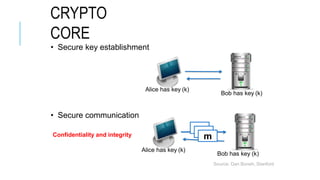
• Secure key establishment
• Secure communication
Alice has key (k)
Bob has key (k)
Alice has key (k)
m
m
m
Bob has key (k)
Source: Dan Boneh, Stanford
Confidentiality and integrity
IT CAN DO MUCH
MORE
• Digital Signatures
• Anonymous communication
• Anonymous digital cash
– Spending a digital coin without anyone knowing my identity
– Buy online anonymously?
• Elections and private auctions
– Finding the winner without actually knowing individual votes (privacy)
Source: Dan Boneh, Stanford
CIPHERS:
• Substitution cipher
– involves replacing an alphabet with another character of the same
alphabet set
– Can be mono-alphabetic (single set for substitution) or poly-
alphabetic system (multiple alphabetic sets)
• Example:
– Caesar cipher, a mono-alphabetic system in which each character is
replaced by the third character in succession
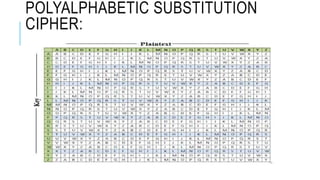
– Vigenere cipher, a poly-alphabetic cipher that uses a 26x26 table of
characters
SUBSTITUTION CIPHER:
substitution technique is one in which the letters of plaintext are replaced by other letters
or by numbers or symbols.
Types of Substitution Cipher:
Mono alphabetic Cipher
Polyalphabetic Substitution Cipher
Caesar Cipher
POLYALPHABETIC SUBSTITUTION
CIPHER:
TRANSPOSITION
CIPHER
• No letters are replaced, they are just rearranged.
• Rail Fence Cipher.
• Columnar Transposition Cipher.
ENCRYP
TION
• process of transforming plaintext to ciphertext using a
cryptographic key
• Used all around us
– In Application Layer – used in secure email, database sessions, and
messaging
– In session layer – using Secure Socket Layer (SSL) or Transport Layer
Security (TLS)
– In the Network Layer – using protocols such as IPSec
• Benefits of good encryption algorithm:
– Resistant to cryptographic attack
– They support variable and long key lengths and scalability
– They create an avalanche effect
– No export or import restrictions
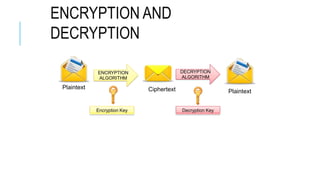
ENCRYPTION AND
DECRYPTION
Plaintext
ENCRYPTION
ALGORITHM
DECRYPTION
ALGORITHM
Ciphertext Plaintext
Encryption Key Decryption Key
SYMMETRIC KEY
ALGORITHM
• Uses a single key to both encrypt and decrypt information
• Also known as a secret-key algorithm
– The key must be kept a “secret” to maintain security
– This key is also known as a private key
• Follows the more traditional form of cryptography with key
lengths ranging from 40 to 256 bits.
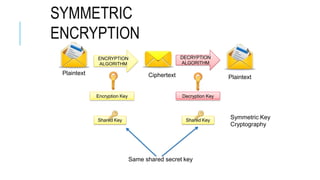
SYMMETRIC
ENCRYPTION
Plaintext
ENCRYPTION
ALGORITHM
DECRYPTION
ALGORITHM
Ciphertext Plaintext
Encryption Key Decryption Key
Same shared secret key
Shared Key Shared Key
Symmetric Key
Cryptography
SYMMETRIC KEY
ALGORITHM
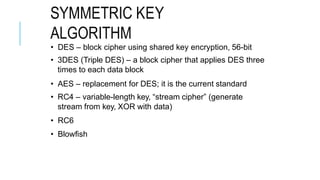
• DES – block cipher using shared key encryption, 56-bit
• 3DES (Triple DES) – a block cipher that applies DES three
times to each data block
• AES – replacement for DES; it is the current standard
• RC4 – variable-length key, “stream cipher” (generate
stream from key, XOR with data)
• RC6
• Blowfish
SYMMETRIC KEY
ALGORITHM
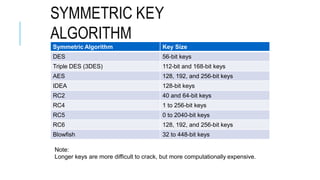
Symmetric Algorithm Key Size
DES 56-bit keys
Triple DES (3DES) 112-bit and 168-bit keys
AES 128, 192, and 256-bit keys
IDEA 128-bit keys
RC2 40 and 64-bit keys
RC4 1 to 256-bit keys
RC5 0 to 2040-bit keys
RC6 128, 192, and 256-bit keys
Blowfish 32 to 448-bit keys
Note:
Longer keys are more difficult to crack, but more computationally expensive.
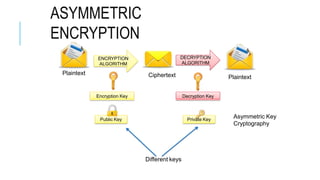
ASYMMETRIC
ENCRYPTION
Plaintext
ENCRYPTION
ALGORITHM
DECRYPTION
ALGORITHM
Ciphertext Plaintext
Encryption Key Decryption Key
Public Key Private Key
Asymmetric Key
Cryptography
Different keys
ASYMMETRIC KEY
ALGORITHM
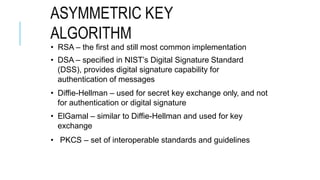
• RSA – the first and still most common implementation
• DSA – specified in NIST’s Digital Signature Standard
(DSS), provides digital signature capability for
authentication of messages
• Diffie-Hellman – used for secret key exchange only, and not
for authentication or digital signature
• ElGamal – similar to Diffie-Hellman and used for key
exchange
• PKCS – set of interoperable standards and guidelines
SYMMETRIC VS.
ASYMMETRIC KEY
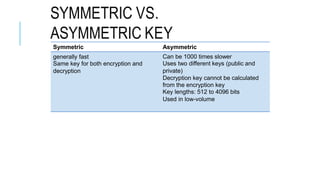
Symmetric
generally fast
Same key for both encryption and
decryption
Asymmetric
Can be 1000 times slower
Uses two different keys (public and
private)
Decryption key cannot be calculated
from the encryption key
Key lengths: 512 to 4096 bits
Used in low-volume

Chapter# 3 modified.pptx

  • 1.
  • 2.
    OVERVI EW • What isCryptography? • Symmetric Key Cryptography • Asymmetric Key Cryptography • Block and Stream Cipher • Digital Signature and Message Digest
  • 3.
    CRYPTOGR APHY • Cryptography dealswith creating documents that can be shared secretly over public communication channels – Cryptology • Kryptos (hidden or secret) and Logos (description) = secret speech / communication • combination of cryptography and cryptanalysis
  • 4.
    TYPICAL SCENARIO • Alice wantsto send a “secret” message to Bob • What are the possible problems? – Data can be intercepted • What are the ways to intercept this message? • How to conceal the message? – Encryption
  • 5.
    CRYPTO CORE • Secure keyestablishment • Secure communication Alice has key (k) Bob has key (k) Alice has key (k) m m m Bob has key (k) Source: Dan Boneh, Stanford Confidentiality and integrity
  • 6.
    IT CAN DOMUCH MORE • Digital Signatures • Anonymous communication • Anonymous digital cash – Spending a digital coin without anyone knowing my identity – Buy online anonymously? • Elections and private auctions – Finding the winner without actually knowing individual votes (privacy) Source: Dan Boneh, Stanford
  • 7.
    CIPHERS: • Substitution cipher –involves replacing an alphabet with another character of the same alphabet set – Can be mono-alphabetic (single set for substitution) or poly- alphabetic system (multiple alphabetic sets) • Example: – Caesar cipher, a mono-alphabetic system in which each character is replaced by the third character in succession – Vigenere cipher, a poly-alphabetic cipher that uses a 26x26 table of characters
  • 8.
    SUBSTITUTION CIPHER: substitution techniqueis one in which the letters of plaintext are replaced by other letters or by numbers or symbols. Types of Substitution Cipher: Mono alphabetic Cipher Polyalphabetic Substitution Cipher Caesar Cipher
  • 9.
  • 10.
    TRANSPOSITION CIPHER • No lettersare replaced, they are just rearranged. • Rail Fence Cipher. • Columnar Transposition Cipher.
  • 11.
    ENCRYP TION • process oftransforming plaintext to ciphertext using a cryptographic key • Used all around us – In Application Layer – used in secure email, database sessions, and messaging – In session layer – using Secure Socket Layer (SSL) or Transport Layer Security (TLS) – In the Network Layer – using protocols such as IPSec • Benefits of good encryption algorithm: – Resistant to cryptographic attack – They support variable and long key lengths and scalability – They create an avalanche effect – No export or import restrictions
  • 12.
  • 13.
    SYMMETRIC KEY ALGORITHM • Usesa single key to both encrypt and decrypt information • Also known as a secret-key algorithm – The key must be kept a “secret” to maintain security – This key is also known as a private key • Follows the more traditional form of cryptography with key lengths ranging from 40 to 256 bits.
  • 14.
    SYMMETRIC ENCRYPTION Plaintext ENCRYPTION ALGORITHM DECRYPTION ALGORITHM Ciphertext Plaintext Encryption KeyDecryption Key Same shared secret key Shared Key Shared Key Symmetric Key Cryptography
  • 15.
    SYMMETRIC KEY ALGORITHM • DES– block cipher using shared key encryption, 56-bit • 3DES (Triple DES) – a block cipher that applies DES three times to each data block • AES – replacement for DES; it is the current standard • RC4 – variable-length key, “stream cipher” (generate stream from key, XOR with data) • RC6 • Blowfish
  • 16.
    SYMMETRIC KEY ALGORITHM Symmetric AlgorithmKey Size DES 56-bit keys Triple DES (3DES) 112-bit and 168-bit keys AES 128, 192, and 256-bit keys IDEA 128-bit keys RC2 40 and 64-bit keys RC4 1 to 256-bit keys RC5 0 to 2040-bit keys RC6 128, 192, and 256-bit keys Blowfish 32 to 448-bit keys Note: Longer keys are more difficult to crack, but more computationally expensive.
  • 17.
    ASYMMETRIC ENCRYPTION Plaintext ENCRYPTION ALGORITHM DECRYPTION ALGORITHM Ciphertext Plaintext Encryption KeyDecryption Key Public Key Private Key Asymmetric Key Cryptography Different keys
  • 18.
    ASYMMETRIC KEY ALGORITHM • RSA– the first and still most common implementation • DSA – specified in NIST’s Digital Signature Standard (DSS), provides digital signature capability for authentication of messages • Diffie-Hellman – used for secret key exchange only, and not for authentication or digital signature • ElGamal – similar to Diffie-Hellman and used for key exchange • PKCS – set of interoperable standards and guidelines
  • 19.
    SYMMETRIC VS. ASYMMETRIC KEY Symmetric generallyfast Same key for both encryption and decryption Asymmetric Can be 1000 times slower Uses two different keys (public and private) Decryption key cannot be calculated from the encryption key Key lengths: 512 to 4096 bits Used in low-volume