Microbial
Growth
When microbes are provided with nutrients & required
environmental factors, they become metabolically active and
grow
1Lecturer:: Mohamed Ali. Bsc, M.Eng
College of Agriculture, University Of Hargeisa.
Chapter contents:
1- Bacterial Division/reproduction
2- Stages of Bacterial growth curve
3- Measurement of Microbial
growth
4- Environmental factors effect
microbial growth
2
 What is Microbial growth?
 involves an increase in the number of
cells rather than in the size of individual
cells.
 2 levels of growth:
1. A cell synthesizes new components,
increase its size
2. Increase number of cells in the
population
3
 increase in cellular constituents that
may result in:
increase in cell number
 e.g., when microorganisms reproduce by
budding or binary fission
increase in cell size
 e.g., some microorganisms have nuclear
divisions that are not accompanied by cell
divisions
 microbiologists usually study population
growth rather than growth of individual
cells
4
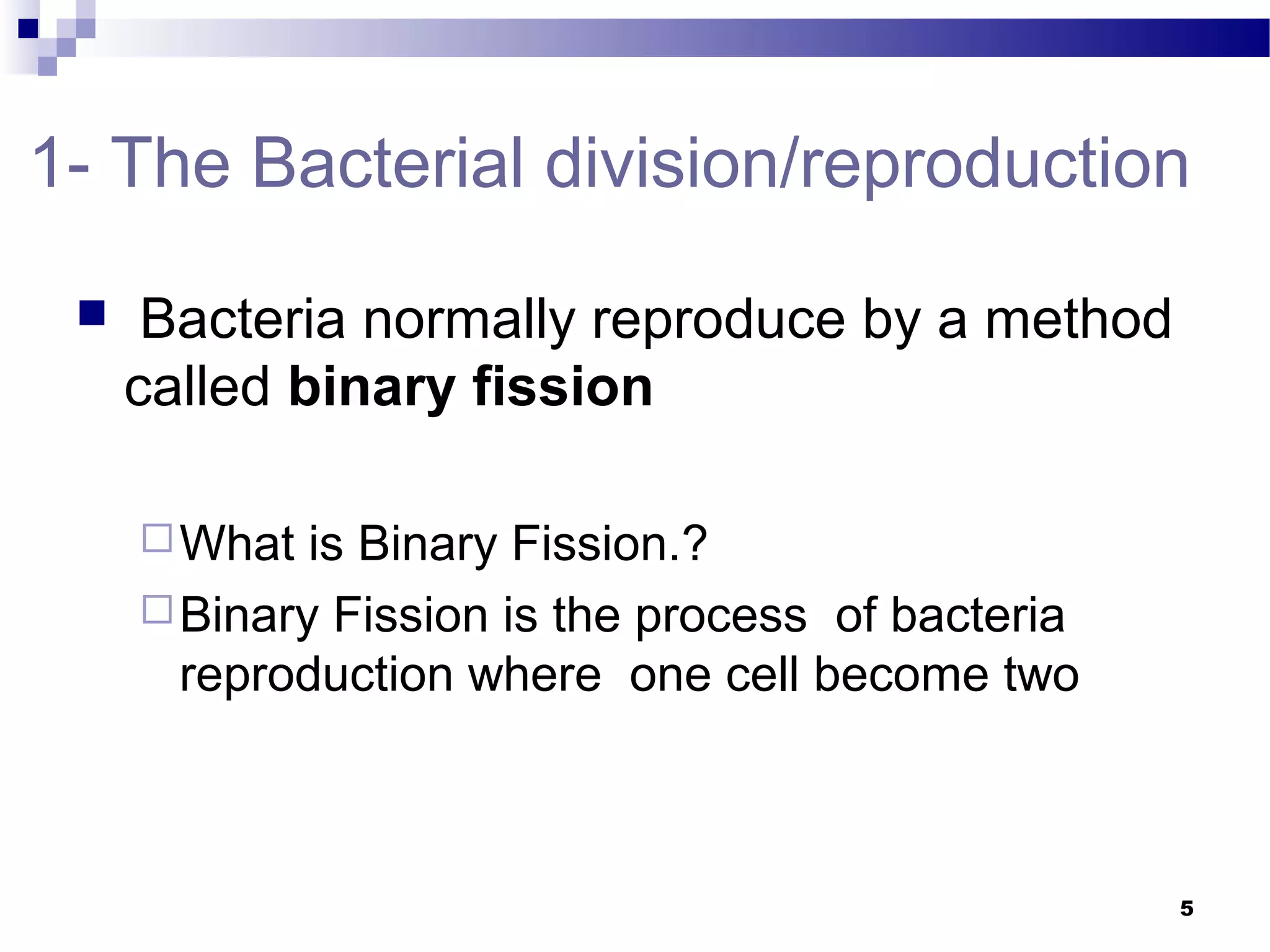
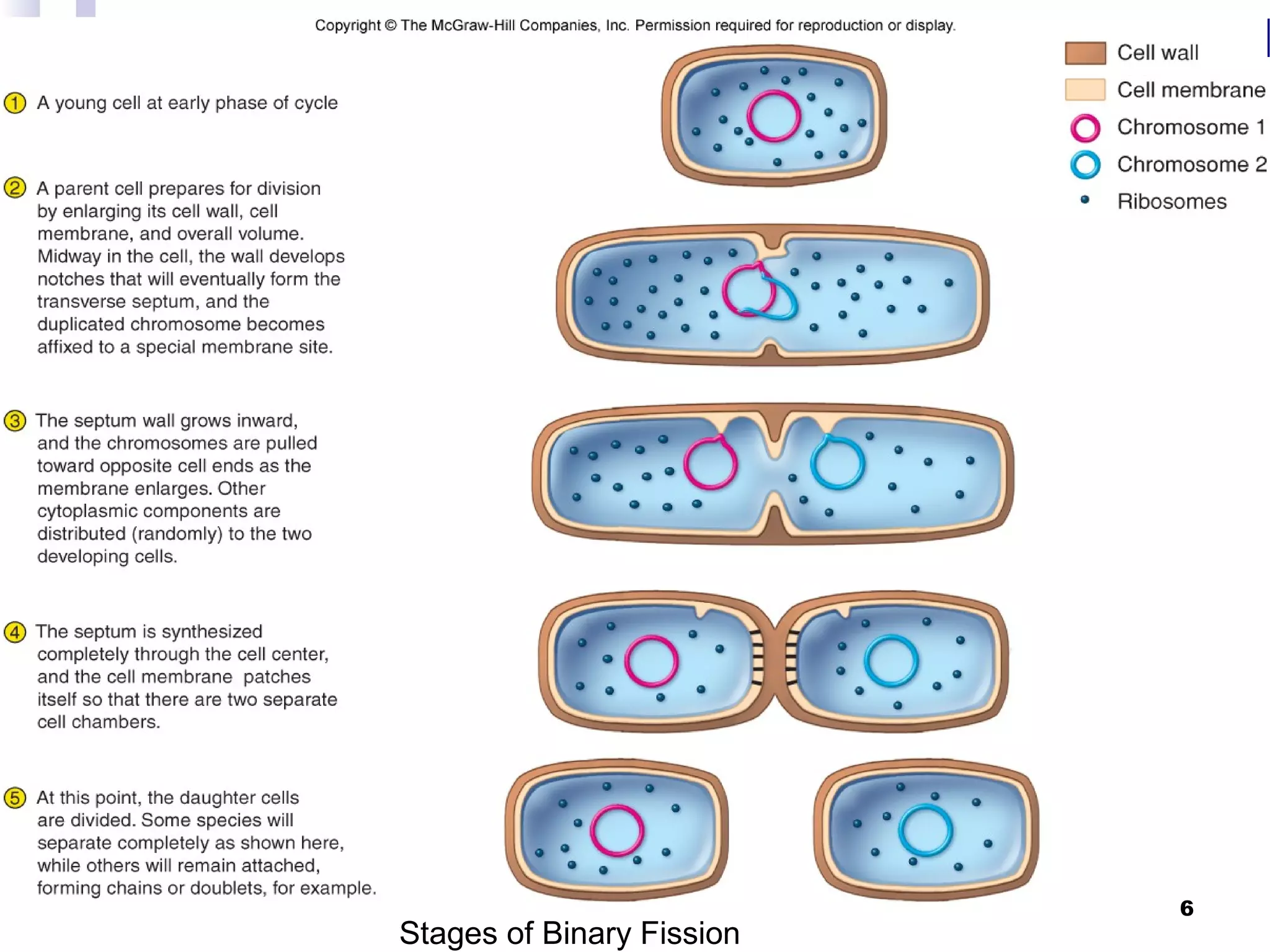
1- The Bacterial division/reproduction
 Bacteria normally reproduce by a method
called binary fission
What is Binary Fission.?
Binary Fission is the process of bacteria
reproduction where one cell become two
5
Stages of Binary Fission
6
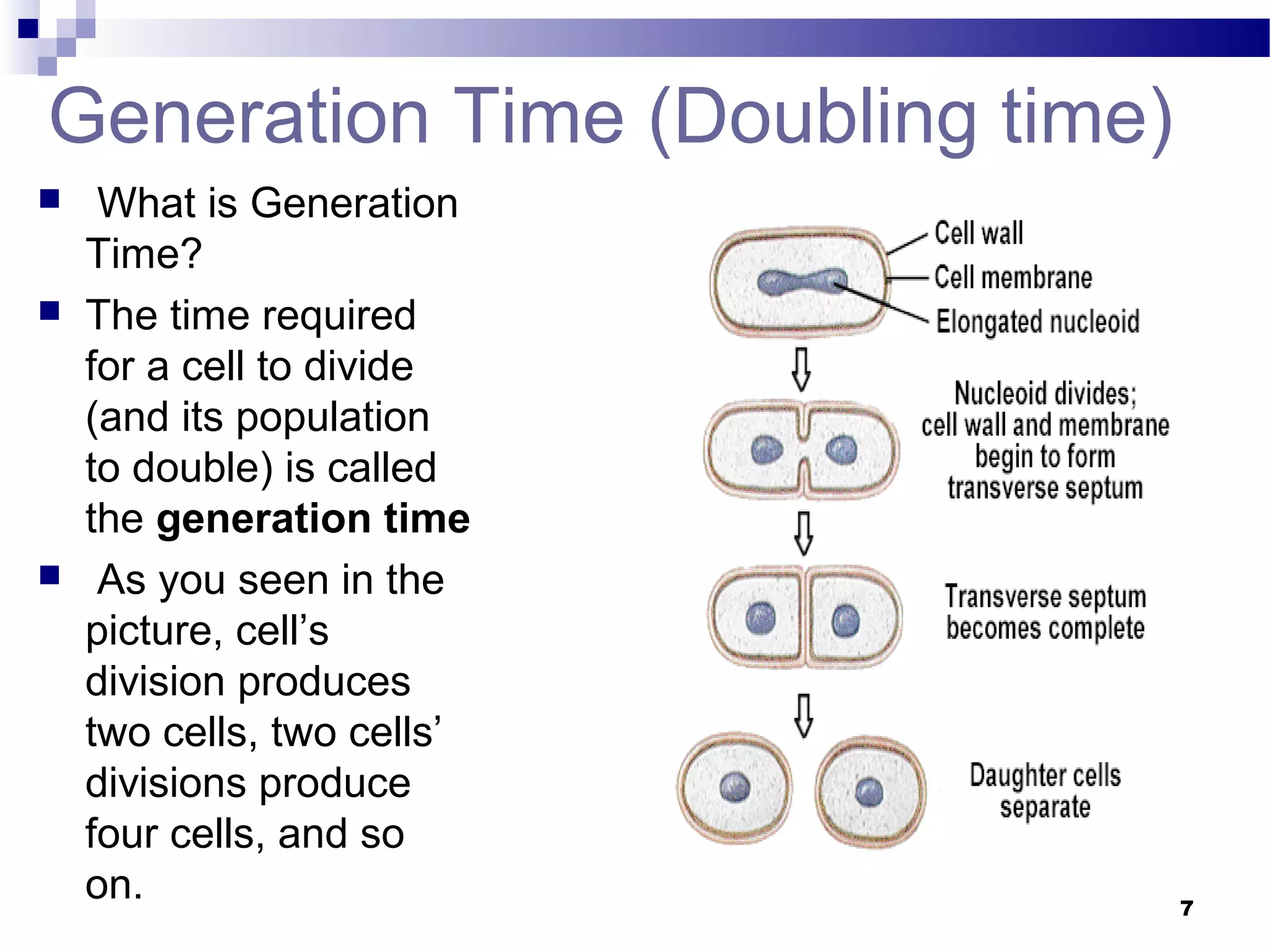
Generation Time (Doubling time)
 What is Generation
Time?
 The time required
for a cell to divide
(and its population
to double) is called
the generation time
 As you seen in the
picture, cell’s
division produces
two cells, two cells’
divisions produce
four cells, and so
on. 7
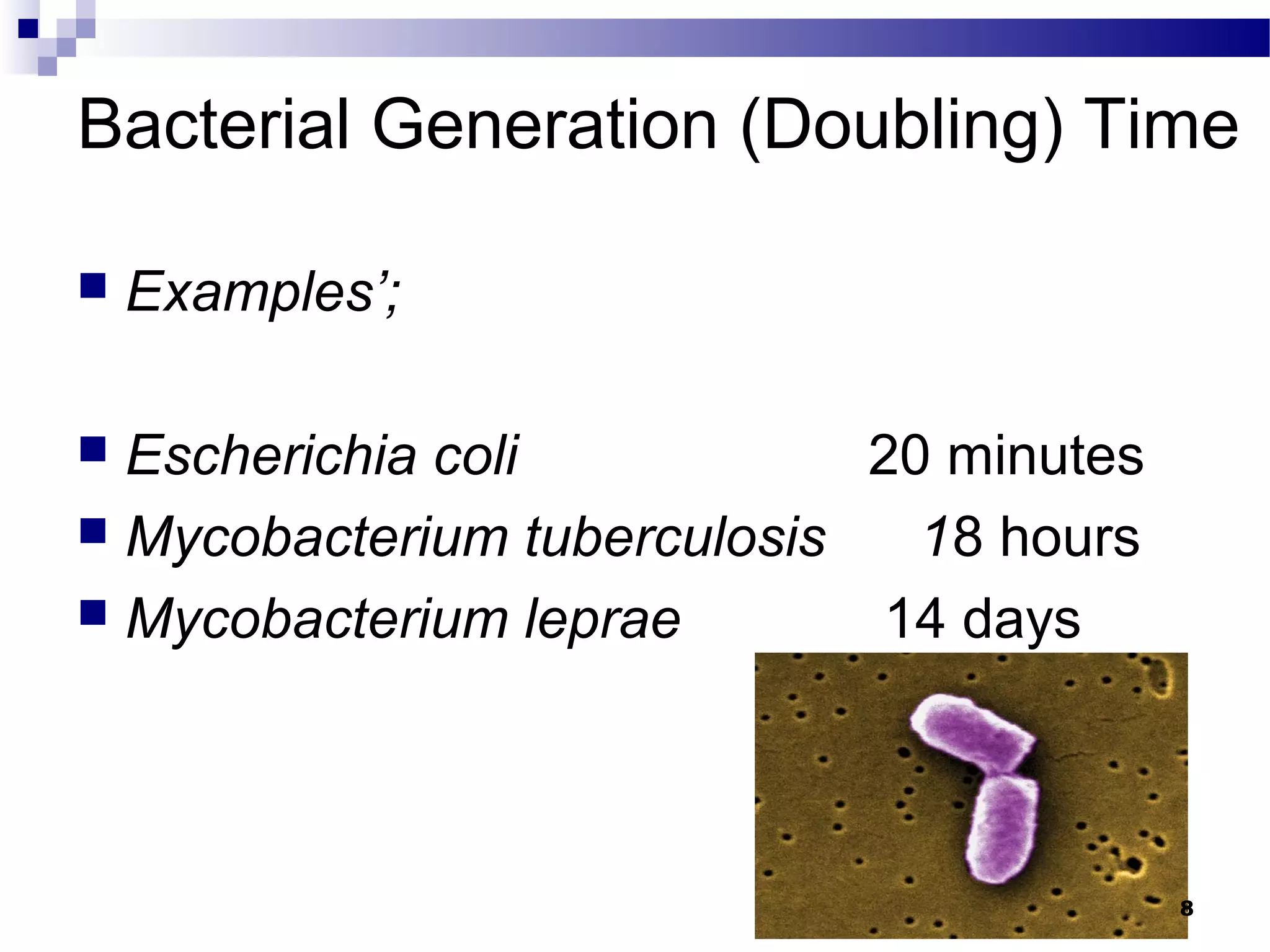
Bacterial Generation (Doubling) Time
 Examples’;
 Escherichia coli 20 minutes
 Mycobacterium tuberculosis 18 hours
 Mycobacterium leprae 14 days
8
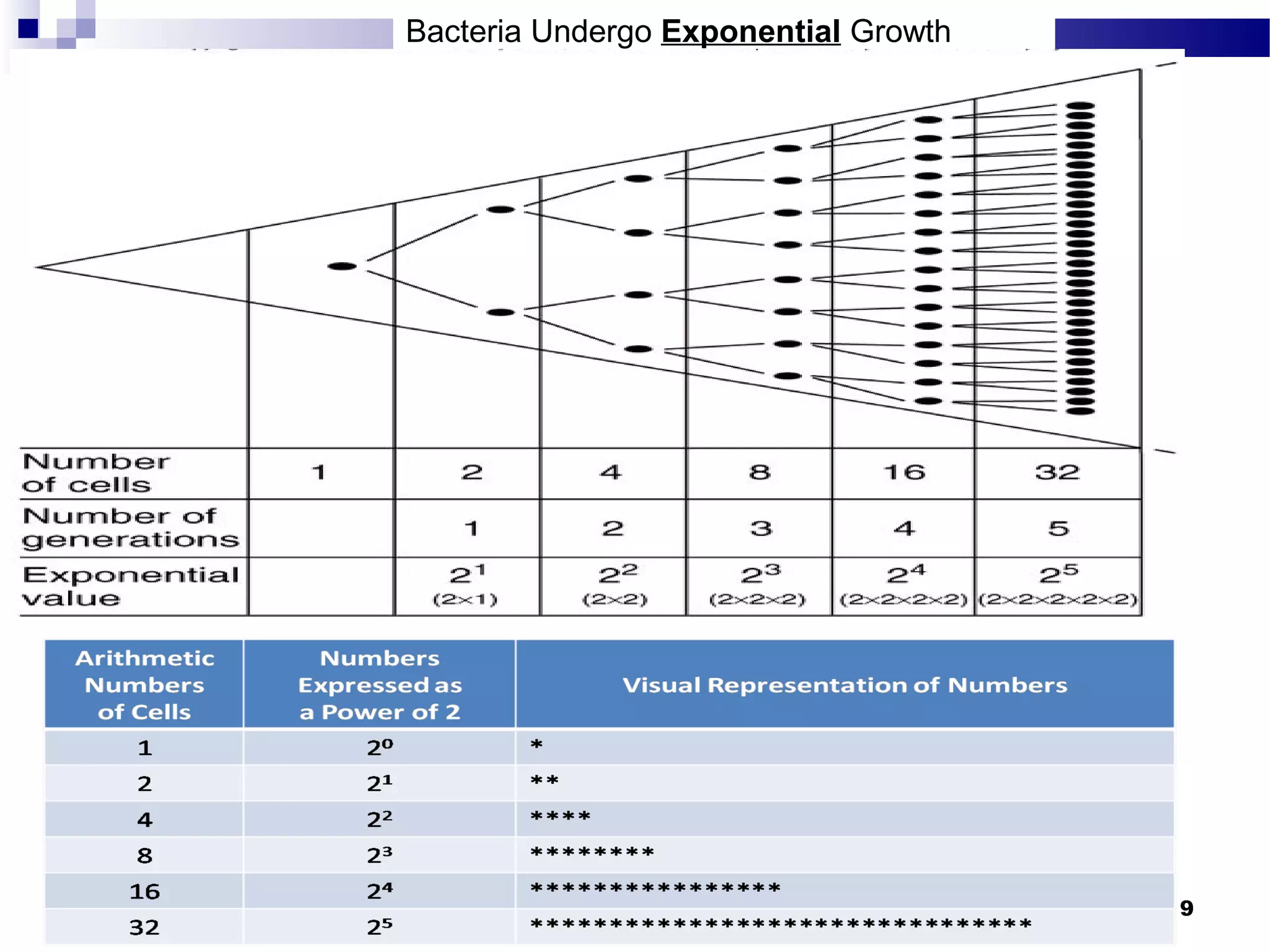
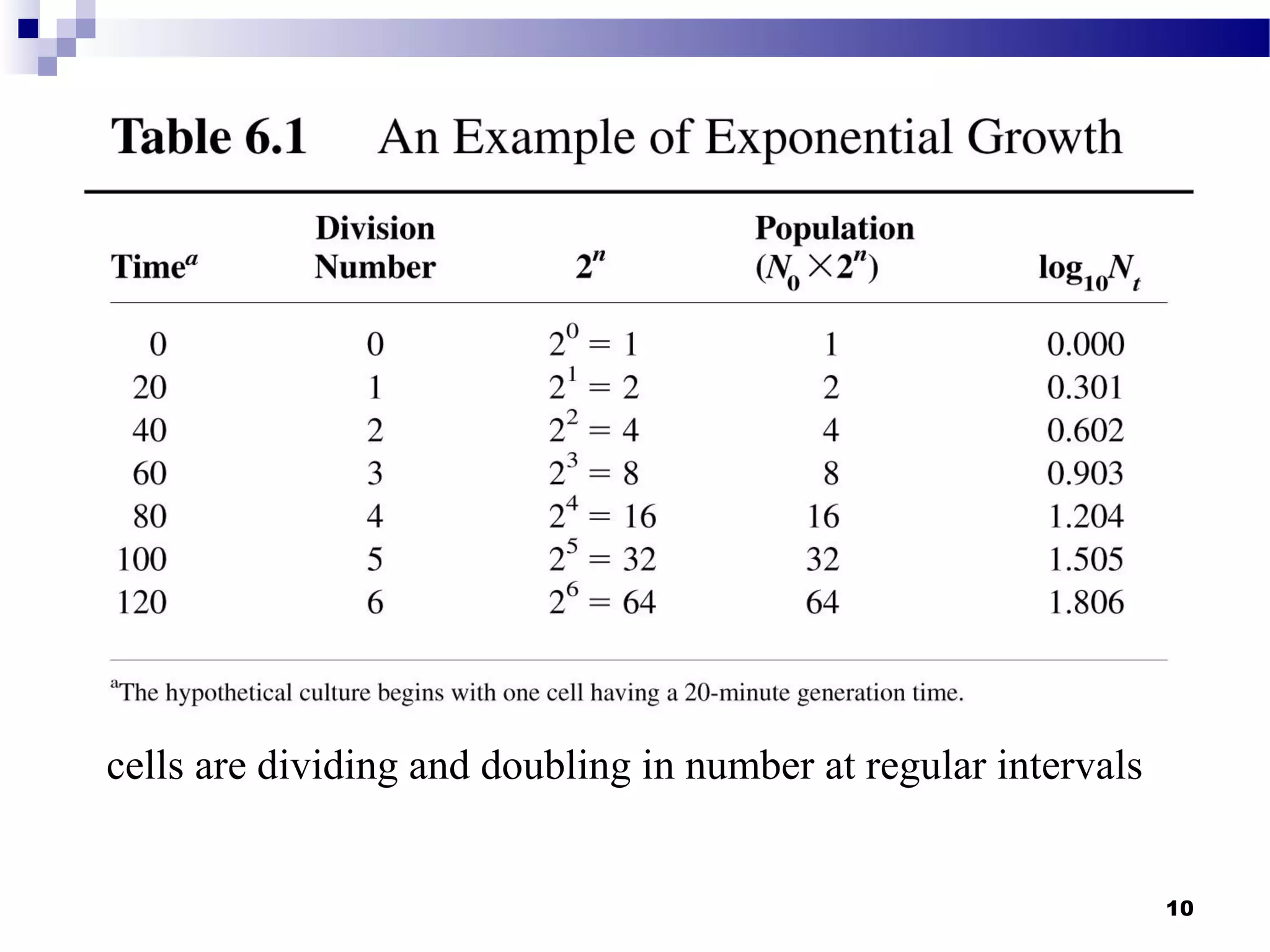
Bacteria Undergo Exponential Growth
9
cells are dividing and doubling in number at regular intervals
10
2-Stages in Bacterial Growth curve
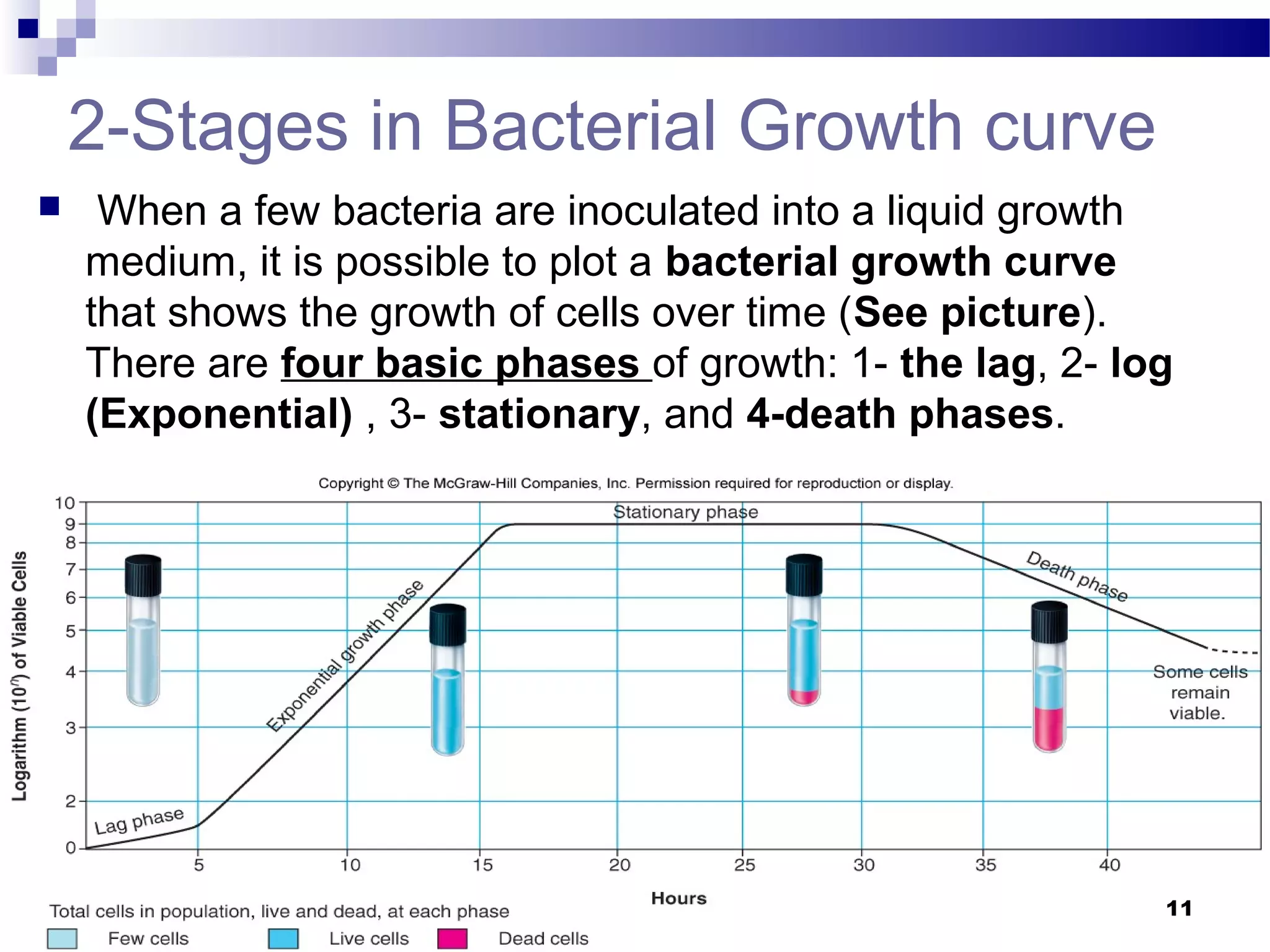
 When a few bacteria are inoculated into a liquid growth
medium, it is possible to plot a bacterial growth curve
that shows the growth of cells over time (See picture).
There are four basic phases of growth: 1- the lag, 2- log
(Exponential) , 3- stationary, and 4-death phases.
11
Stages of Bacterial growth curve
 Bacterial populations follow a sequential
series of growth phases: the lag, log,
stationary, and death phases.
 Knowledge of the bacterial growth curve is
critical to understanding population
dynamics and population control in the
course of infectious diseases, and in food
preservation .
12
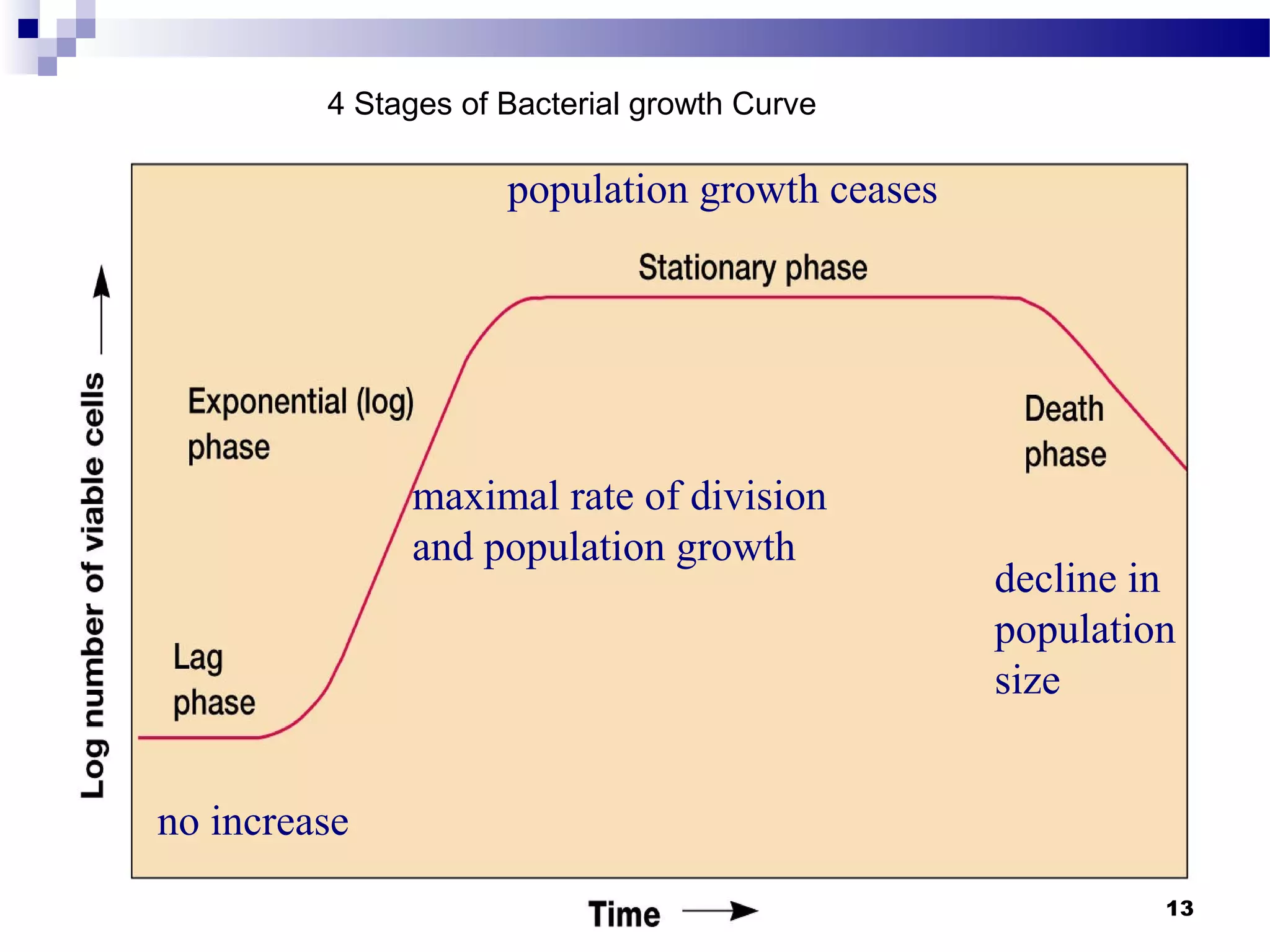
no increase
maximal rate of division
and population growth
population growth ceases
decline in
population
size
4 Stages of Bacterial growth Curve
13
a) Lag Phase
 Bacteria are first introduced into an environment
or media culture.
 Bacteria are trying to adapt to nutrients
 Lag phase-preparing to grow in size and synthesize
enzymes etc.
 varies in length
 in some cases can be very short or even absent
Stages of Bacteria growth Curve
14
b) Log (Exponential) Phase
 also called log phase
 rate of growth is constant
 Population number of cells undergoing
binary fission doubles at a constant
interval called generation time
 Continue as long as cells have adequate
nutrients & good environment
15
c) Stationary Phase
 If exponential growth continued
unchecked, startlingly large numbers of
cells could arise.
 In this stage microbial death is equal to microbial
growth e-g Death=growth.
16
Possible reasons for entry into
stationary phase
nutrient limitation
limited oxygen availability
toxic waste accumulation
critical population density reached
17
d) Death Phase
 Decline in the number of viable cells
 cells dying, usually at exponential rate
 Death; loss of ability to reproduce
 in some cases, death rate slows due to
accumulation of resistant cells
 Slower than log phase
18
3- Measurement of
Microbial Growth
 can measure changes in number of cells
in a population
 can measure changes in mass of
population
19
Measurement of Cell Numbers
 What are the lab equipment's used to
measure bacteria cell numbers?
 There are two types :-
 1- Direct cell counts:-
a) counting chambers
b) electronic counters
c) on membrane filters
 2- Viable cell counts
 plating methods (spread, pour plate)
 membrane filtration methods 20
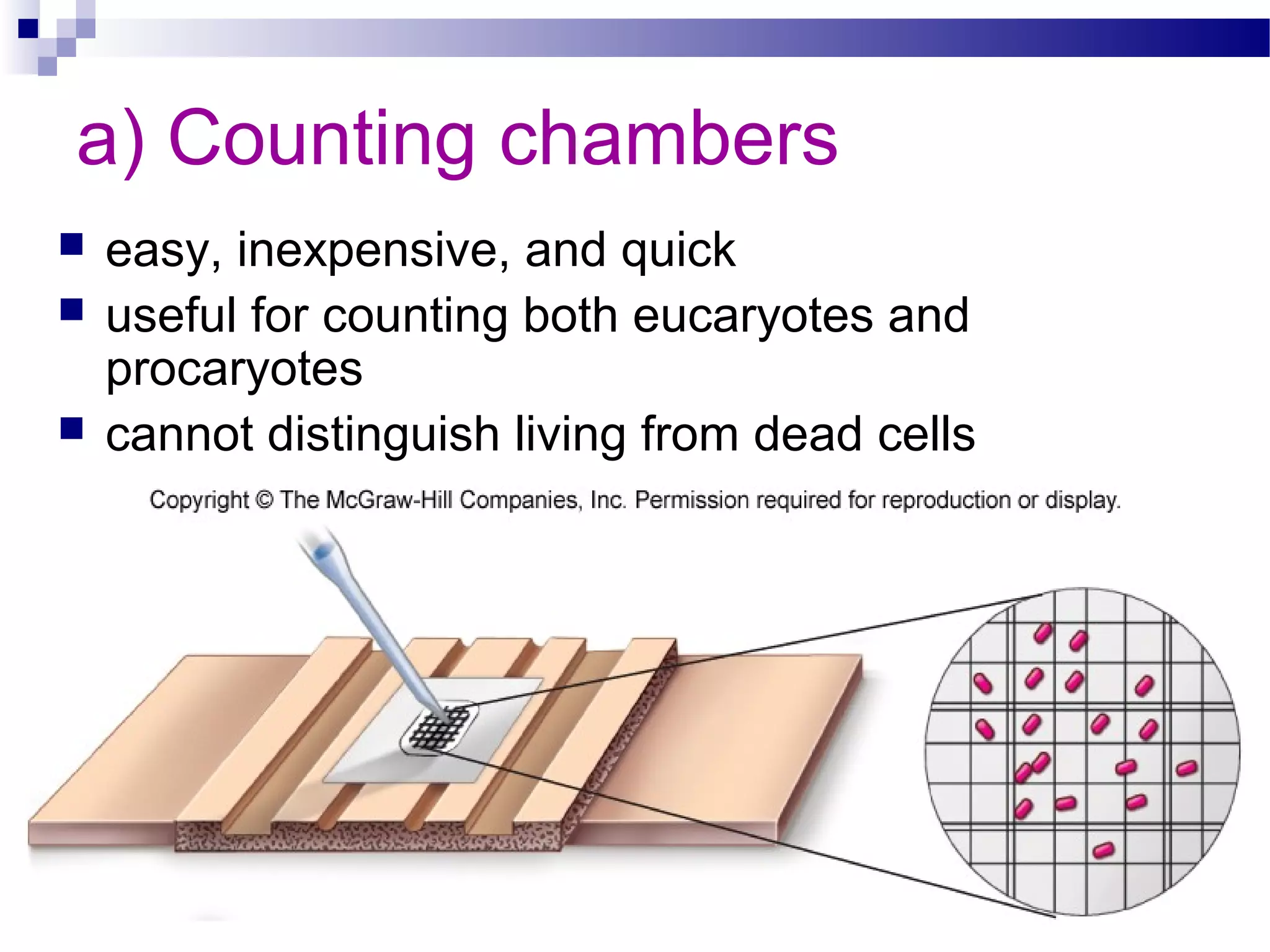
a) Counting chambers
 easy, inexpensive, and quick
 useful for counting both eucaryotes and
procaryotes
 cannot distinguish living from dead cells
21
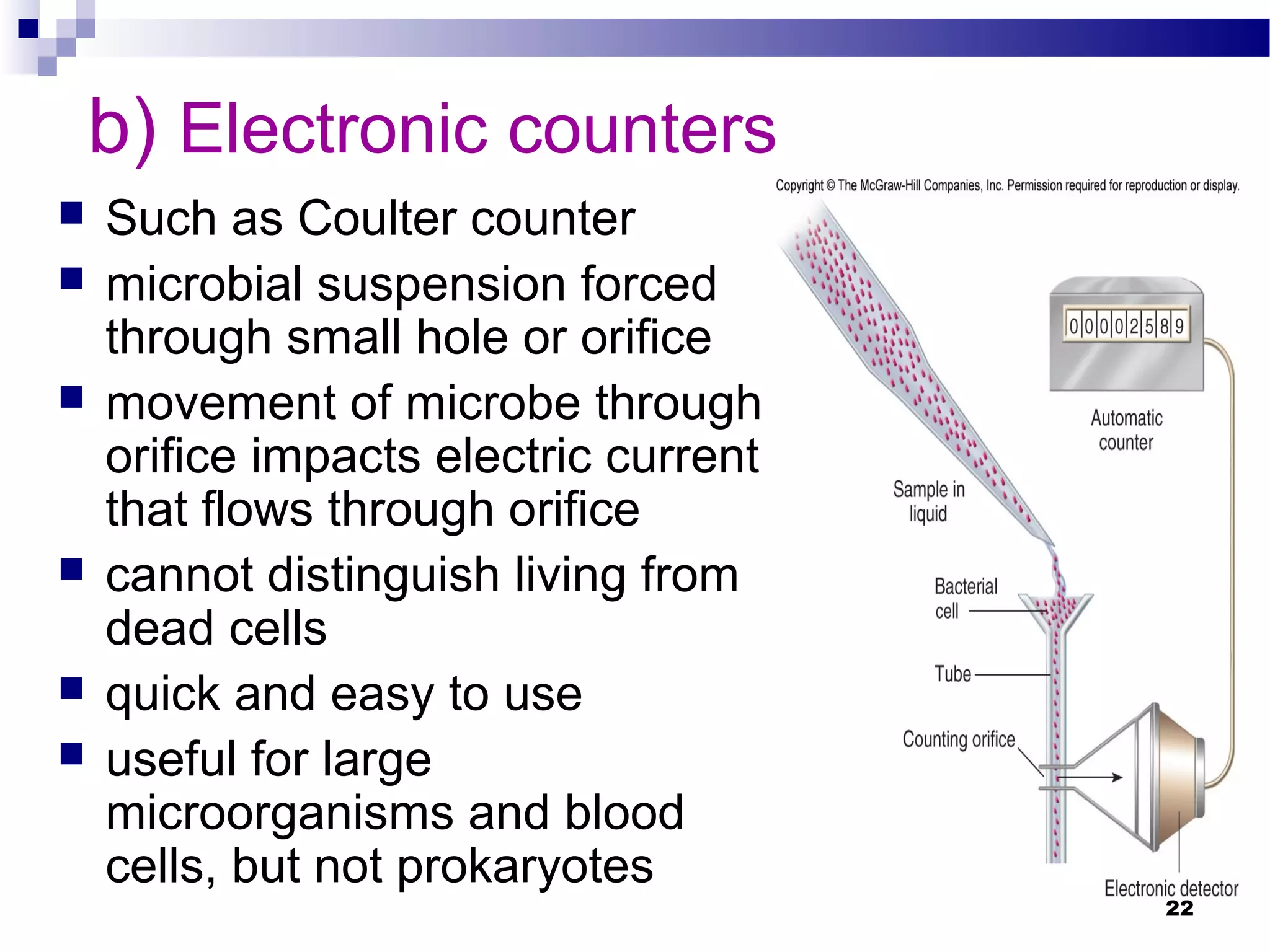
b) Electronic counters
 Such as Coulter counter
 microbial suspension forced
through small hole or orifice
 movement of microbe through
orifice impacts electric current
that flows through orifice
 cannot distinguish living from
dead cells
 quick and easy to use
 useful for large
microorganisms and blood
cells, but not prokaryotes
22
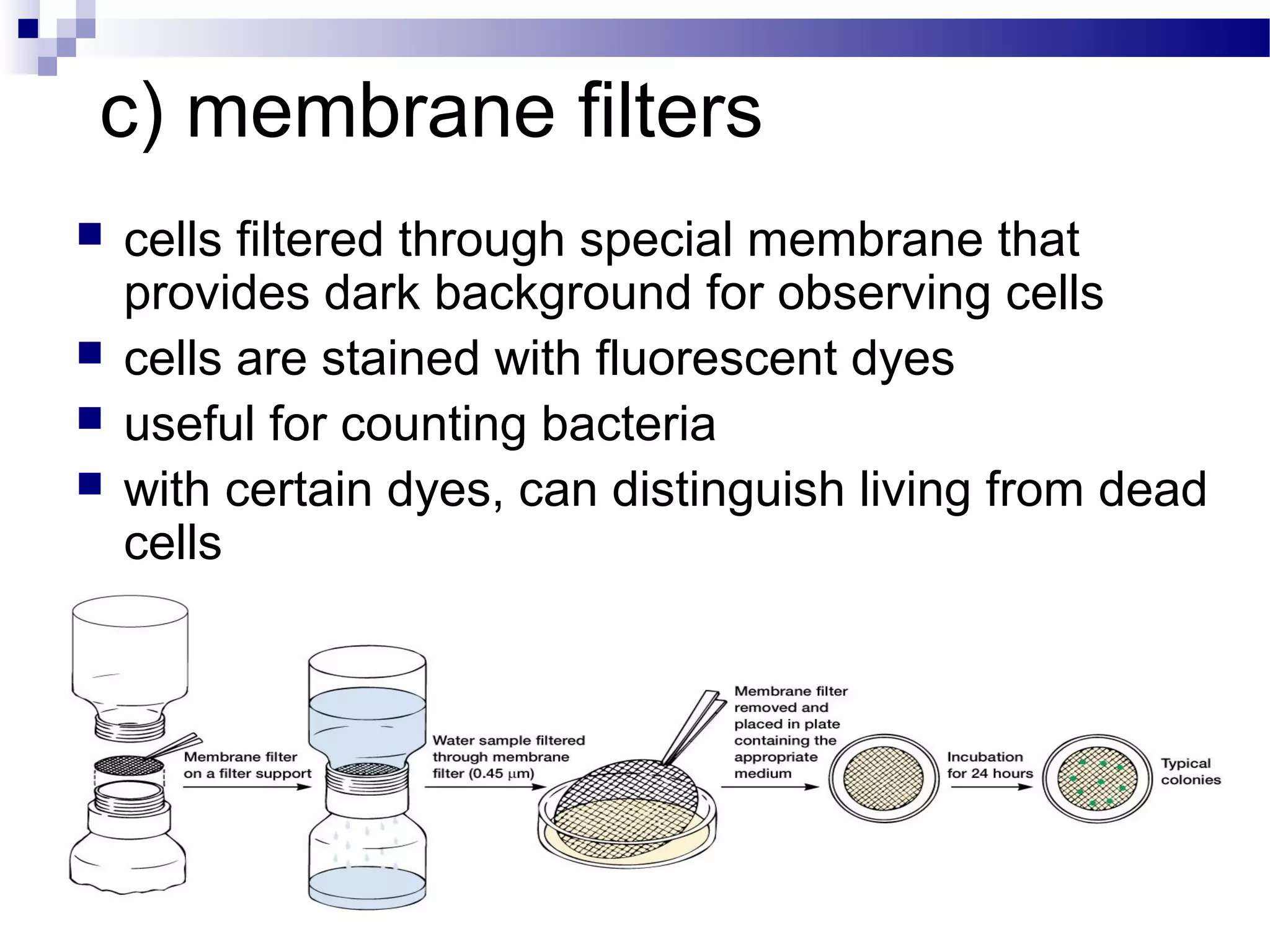
c) membrane filters
 cells filtered through special membrane that
provides dark background for observing cells
 cells are stained with fluorescent dyes
 useful for counting bacteria
 with certain dyes, can distinguish living from dead
cells
23
4- Important environmental factors
affect microbial growth
1.pH
2.Temperature
3.Gas requirement
4.Pressure
5.And other environmental factors e-g
radiation, water activities etc.
24
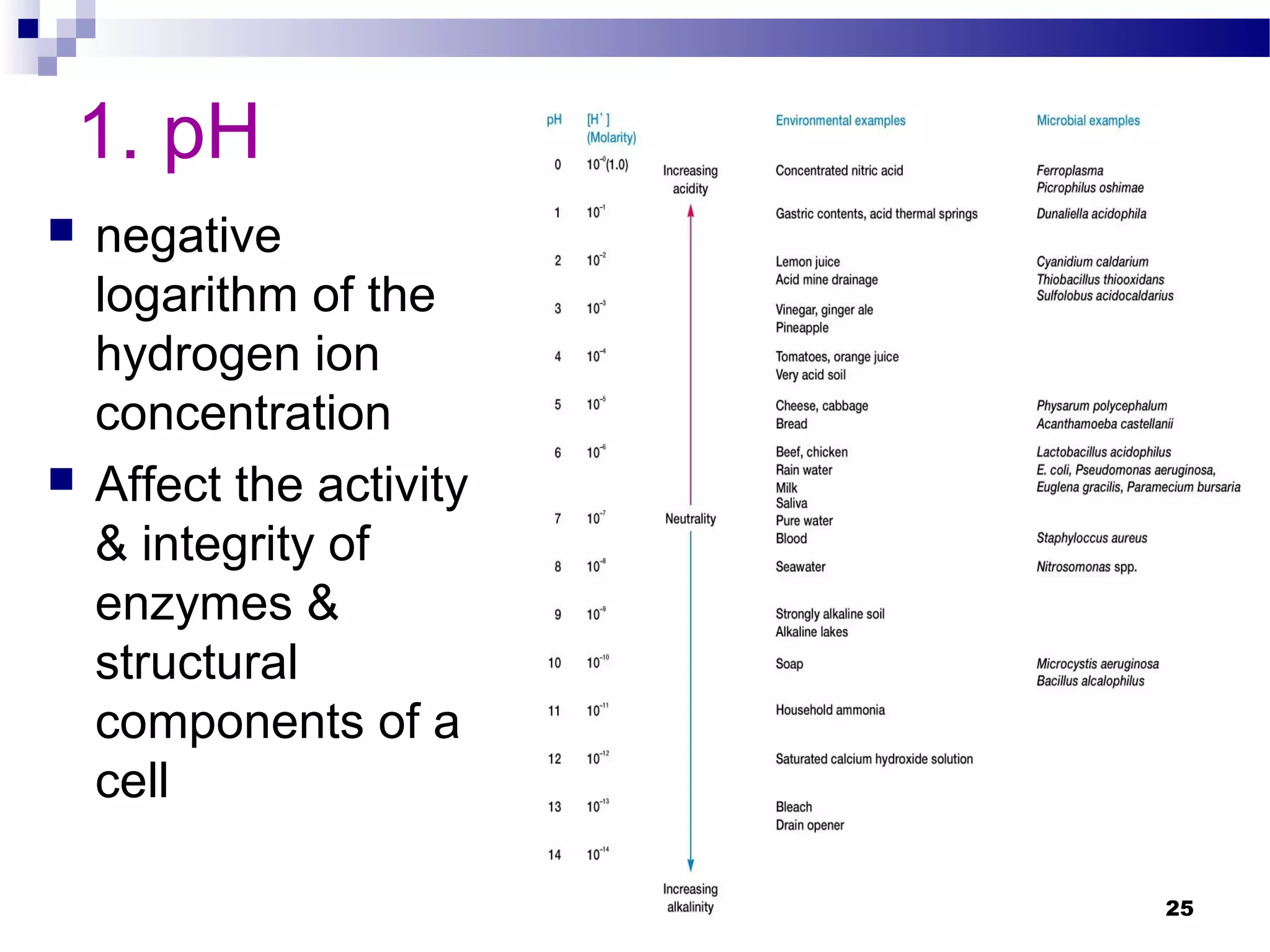
1. pH
 negative
logarithm of the
hydrogen ion
concentration
 Affect the activity
& integrity of
enzymes &
structural
components of a
cell
25
pH
 Optimum pH for most microbes ranges
approximately from 6 to 8
 acidophiles
growth optimum between pH 0 and pH 5.5
 neutrophiles
growth optimum between pH 5.5 and pH 7
 alkalophiles
growth optimum between pH8.5 and pH 11.5
26
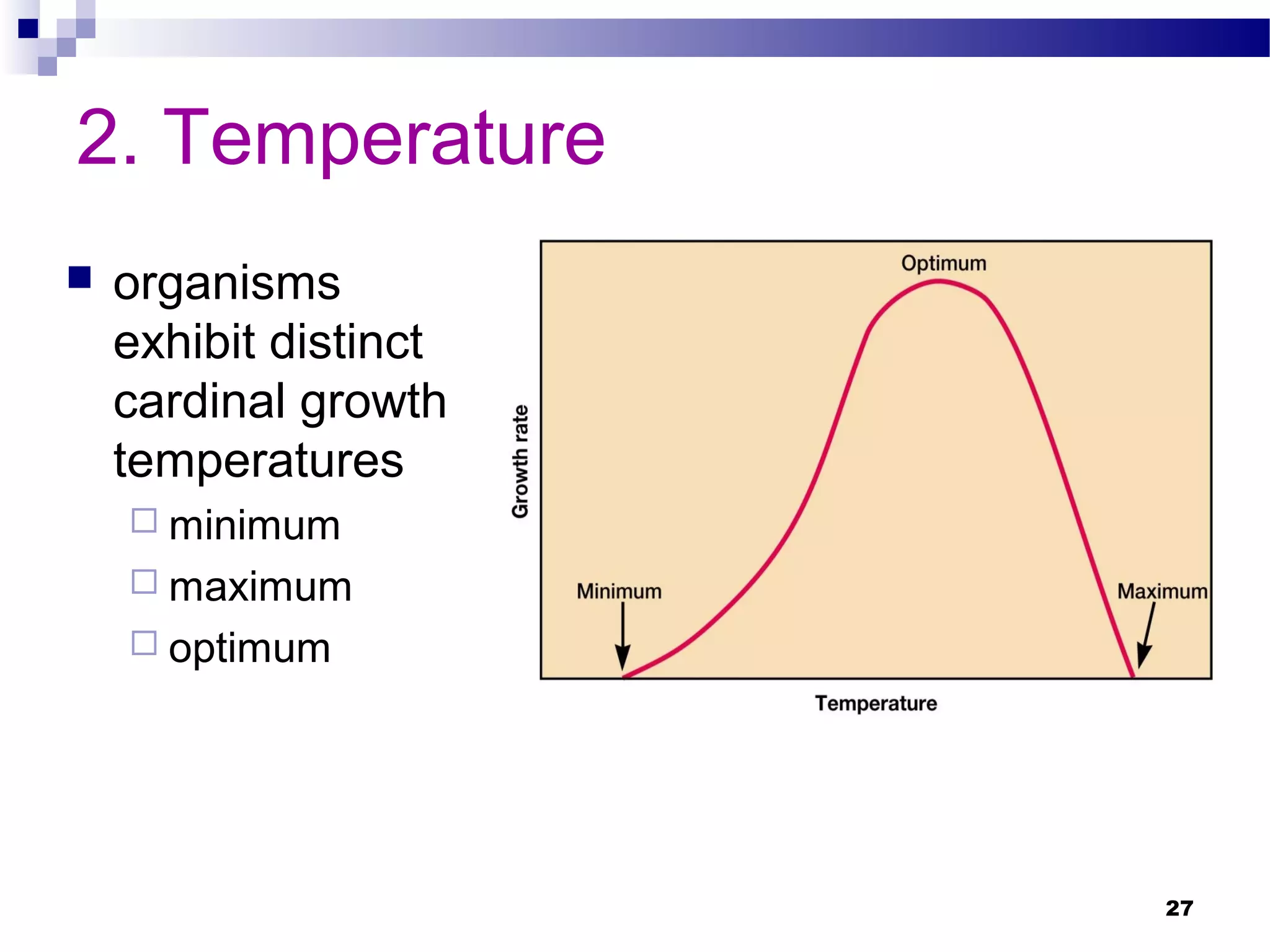
2. Temperature
 organisms
exhibit distinct
cardinal growth
temperatures
 minimum
 maximum
 optimum
27
28
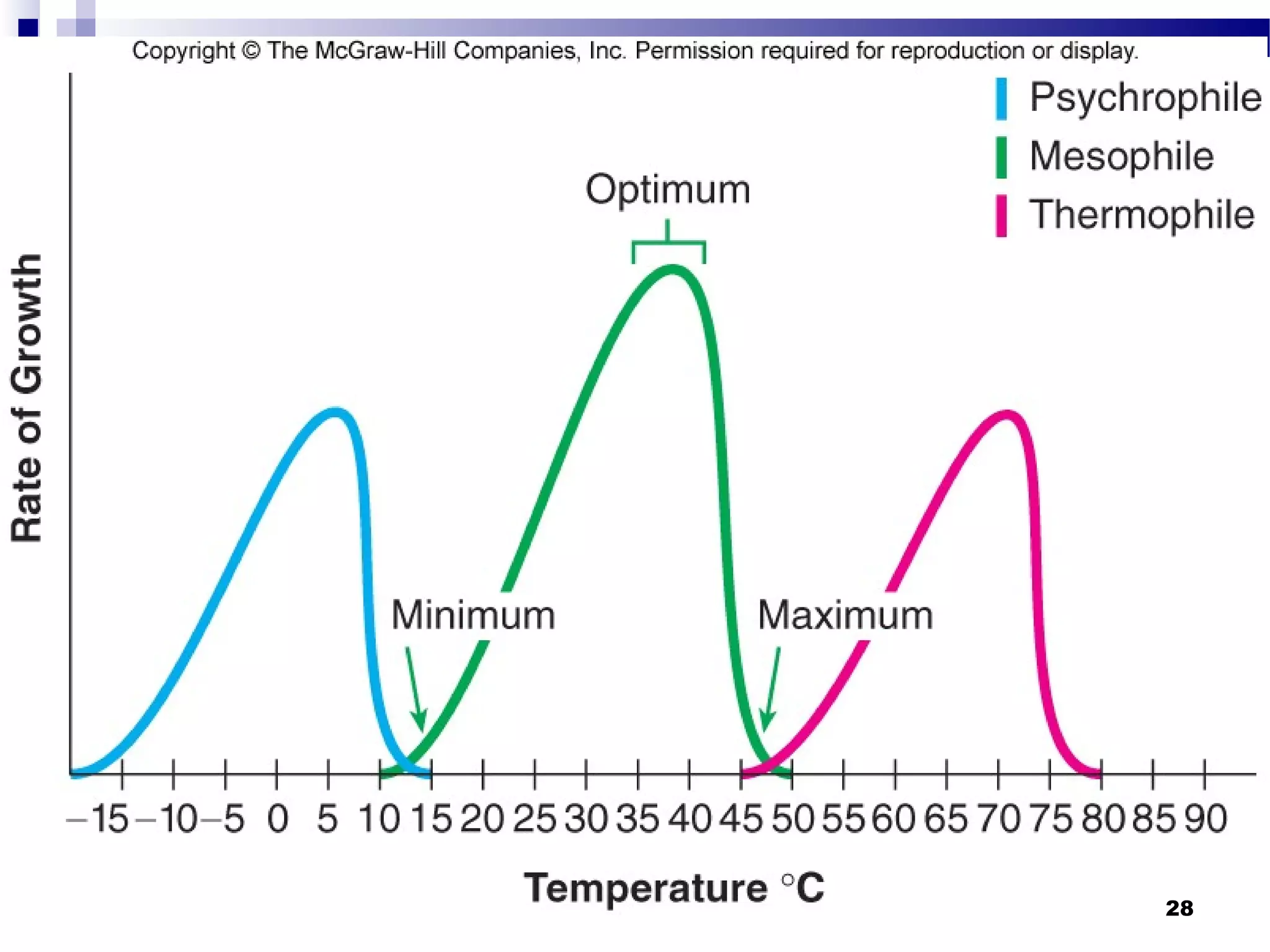
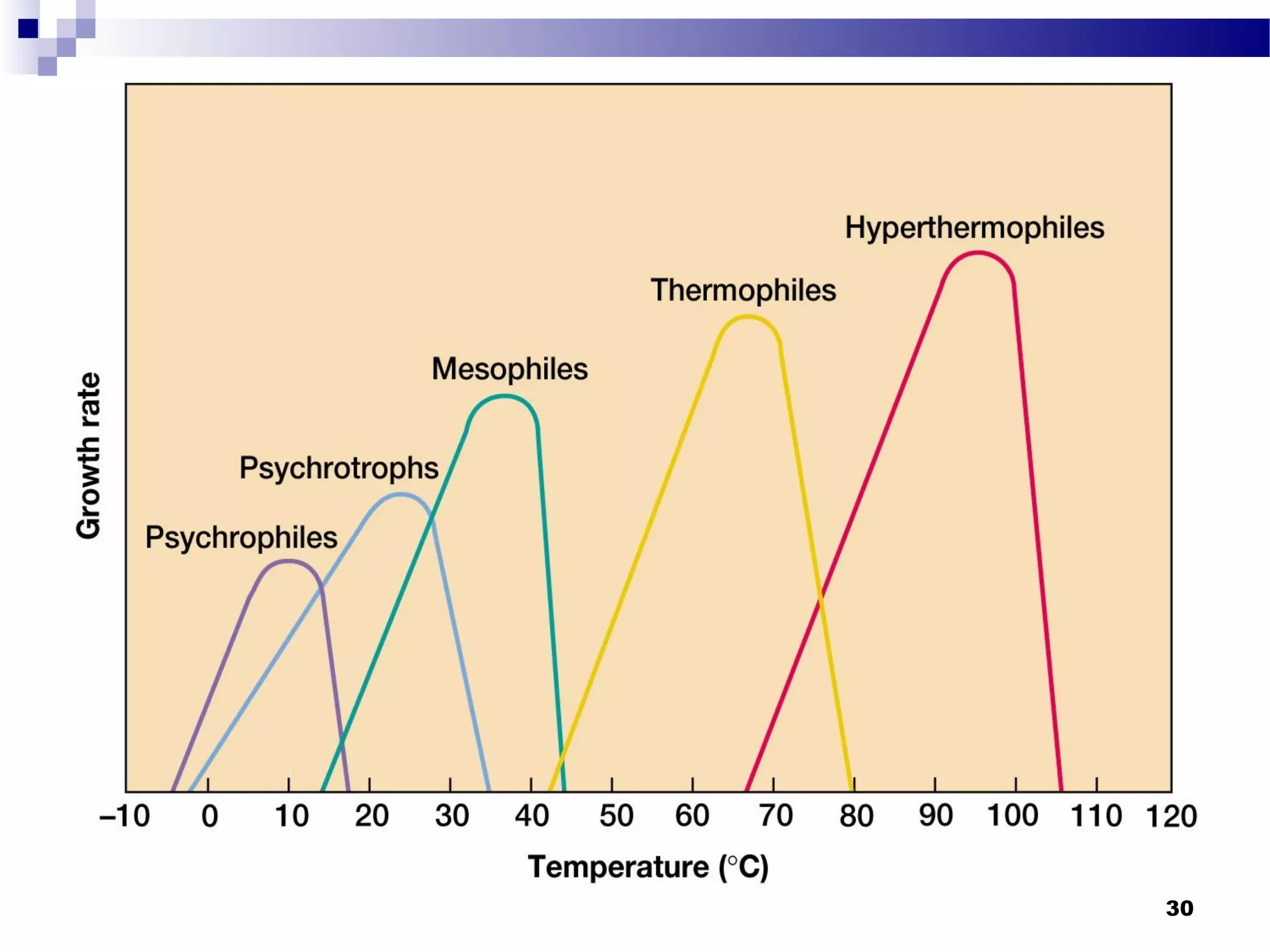
 Pychrophiles
 grow well at Oo
C
 optimum growth at 15o
C or lower
 (cold loving microbes )
 Cannot grow above 20o
C
 Psychrotroph
 can grow at 0-7o
C
 optimum between 20-30o
C,
 max around 35o
C
 Mesophiles
 growth optimum around 20-40o
C
 (moderate temp. loving microbes)
 Thermophiles
 Growth range is 45o
C and 80o
C
 optimum between 55-65o
C
 (heat loving microbes)
 Hyperthermophiles
 optimum growth between 80o
C and 100o
C
 May grow to temperatures of 120o
C
29
30
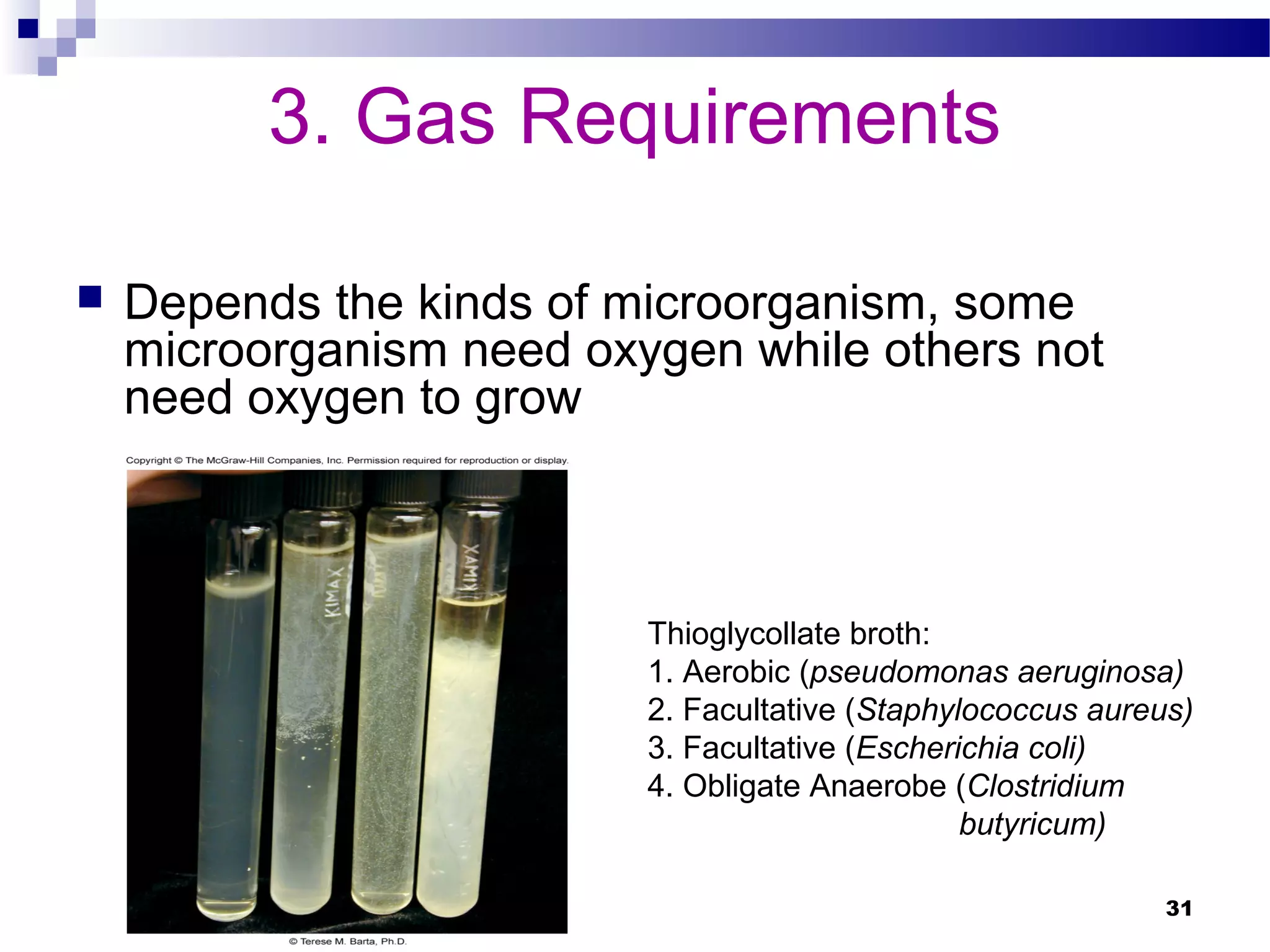
 Depends the kinds of microorganism, some
microorganism need oxygen while others not
need oxygen to grow
3. Gas Requirements
31
Thioglycollate broth:
1. Aerobic (pseudomonas aeruginosa)
2. Facultative (Staphylococcus aureus)
3. Facultative (Escherichia coli)
4. Obligate Anaerobe (Clostridium
butyricum)
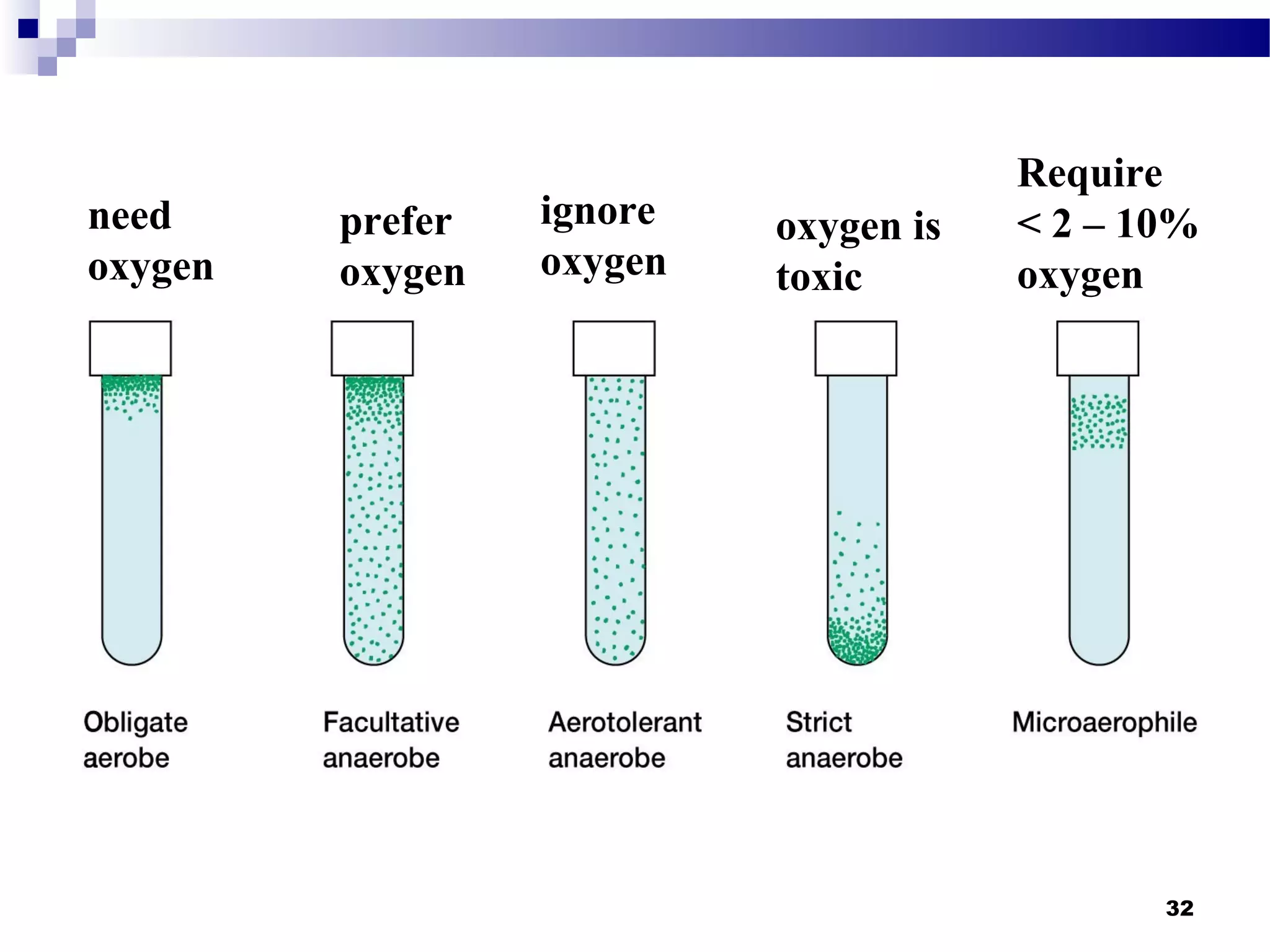
need
oxygen
prefer
oxygen
ignore
oxygen
oxygen is
toxic
Require
< 2 – 10%
oxygen
32
4. Pressure
 Microbes obtain almost all their nutrients
in solution from surrounding water
 barophile organisms
Adapted to life under high pressure
require or grow more rapidly in the
presence of increased pressure
Example : bottom dwellers in the ocean
33
Review Questions
1) What are the four stages of microbial growth? Explain
what happens each phase?
2) Name 3 direct methods use to measure microbial cell
numbers?
3) Name 2 methods used measure viable cell counts
4) What are the four environmental factors effect microbial
growth?
5) What is binary fission?
6) What is generation (doubling time)?
7) State 4 possible reasons why bacterial growth curve
entry into stationary phase?
8) How does pH effect microbial growth?
9) What is microbial growth? 34

Chapter 3 Microbial growth

  • 1.
    Microbial Growth When microbes areprovided with nutrients & required environmental factors, they become metabolically active and grow 1Lecturer:: Mohamed Ali. Bsc, M.Eng College of Agriculture, University Of Hargeisa.
  • 2.
    Chapter contents: 1- BacterialDivision/reproduction 2- Stages of Bacterial growth curve 3- Measurement of Microbial growth 4- Environmental factors effect microbial growth 2
  • 3.
     What isMicrobial growth?  involves an increase in the number of cells rather than in the size of individual cells.  2 levels of growth: 1. A cell synthesizes new components, increase its size 2. Increase number of cells in the population 3
  • 4.
     increase incellular constituents that may result in: increase in cell number  e.g., when microorganisms reproduce by budding or binary fission increase in cell size  e.g., some microorganisms have nuclear divisions that are not accompanied by cell divisions  microbiologists usually study population growth rather than growth of individual cells 4
  • 5.
    1- The Bacterialdivision/reproduction  Bacteria normally reproduce by a method called binary fission What is Binary Fission.? Binary Fission is the process of bacteria reproduction where one cell become two 5
  • 6.
  • 7.
    Generation Time (Doublingtime)  What is Generation Time?  The time required for a cell to divide (and its population to double) is called the generation time  As you seen in the picture, cell’s division produces two cells, two cells’ divisions produce four cells, and so on. 7
  • 8.
    Bacterial Generation (Doubling)Time  Examples’;  Escherichia coli 20 minutes  Mycobacterium tuberculosis 18 hours  Mycobacterium leprae 14 days 8
  • 9.
  • 10.
    cells are dividingand doubling in number at regular intervals 10
  • 11.
    2-Stages in BacterialGrowth curve  When a few bacteria are inoculated into a liquid growth medium, it is possible to plot a bacterial growth curve that shows the growth of cells over time (See picture). There are four basic phases of growth: 1- the lag, 2- log (Exponential) , 3- stationary, and 4-death phases. 11
  • 12.
    Stages of Bacterialgrowth curve  Bacterial populations follow a sequential series of growth phases: the lag, log, stationary, and death phases.  Knowledge of the bacterial growth curve is critical to understanding population dynamics and population control in the course of infectious diseases, and in food preservation . 12
  • 13.
    no increase maximal rateof division and population growth population growth ceases decline in population size 4 Stages of Bacterial growth Curve 13
  • 14.
    a) Lag Phase Bacteria are first introduced into an environment or media culture.  Bacteria are trying to adapt to nutrients  Lag phase-preparing to grow in size and synthesize enzymes etc.  varies in length  in some cases can be very short or even absent Stages of Bacteria growth Curve 14
  • 15.
    b) Log (Exponential)Phase  also called log phase  rate of growth is constant  Population number of cells undergoing binary fission doubles at a constant interval called generation time  Continue as long as cells have adequate nutrients & good environment 15
  • 16.
    c) Stationary Phase If exponential growth continued unchecked, startlingly large numbers of cells could arise.  In this stage microbial death is equal to microbial growth e-g Death=growth. 16
  • 17.
    Possible reasons forentry into stationary phase nutrient limitation limited oxygen availability toxic waste accumulation critical population density reached 17
  • 18.
    d) Death Phase Decline in the number of viable cells  cells dying, usually at exponential rate  Death; loss of ability to reproduce  in some cases, death rate slows due to accumulation of resistant cells  Slower than log phase 18
  • 19.
    3- Measurement of MicrobialGrowth  can measure changes in number of cells in a population  can measure changes in mass of population 19
  • 20.
    Measurement of CellNumbers  What are the lab equipment's used to measure bacteria cell numbers?  There are two types :-  1- Direct cell counts:- a) counting chambers b) electronic counters c) on membrane filters  2- Viable cell counts  plating methods (spread, pour plate)  membrane filtration methods 20
  • 21.
    a) Counting chambers easy, inexpensive, and quick  useful for counting both eucaryotes and procaryotes  cannot distinguish living from dead cells 21
  • 22.
    b) Electronic counters Such as Coulter counter  microbial suspension forced through small hole or orifice  movement of microbe through orifice impacts electric current that flows through orifice  cannot distinguish living from dead cells  quick and easy to use  useful for large microorganisms and blood cells, but not prokaryotes 22
  • 23.
    c) membrane filters cells filtered through special membrane that provides dark background for observing cells  cells are stained with fluorescent dyes  useful for counting bacteria  with certain dyes, can distinguish living from dead cells 23
  • 24.
    4- Important environmentalfactors affect microbial growth 1.pH 2.Temperature 3.Gas requirement 4.Pressure 5.And other environmental factors e-g radiation, water activities etc. 24
  • 25.
    1. pH  negative logarithmof the hydrogen ion concentration  Affect the activity & integrity of enzymes & structural components of a cell 25
  • 26.
    pH  Optimum pHfor most microbes ranges approximately from 6 to 8  acidophiles growth optimum between pH 0 and pH 5.5  neutrophiles growth optimum between pH 5.5 and pH 7  alkalophiles growth optimum between pH8.5 and pH 11.5 26
  • 27.
    2. Temperature  organisms exhibitdistinct cardinal growth temperatures  minimum  maximum  optimum 27
  • 28.
  • 29.
     Pychrophiles  growwell at Oo C  optimum growth at 15o C or lower  (cold loving microbes )  Cannot grow above 20o C  Psychrotroph  can grow at 0-7o C  optimum between 20-30o C,  max around 35o C  Mesophiles  growth optimum around 20-40o C  (moderate temp. loving microbes)  Thermophiles  Growth range is 45o C and 80o C  optimum between 55-65o C  (heat loving microbes)  Hyperthermophiles  optimum growth between 80o C and 100o C  May grow to temperatures of 120o C 29
  • 30.
  • 31.
     Depends thekinds of microorganism, some microorganism need oxygen while others not need oxygen to grow 3. Gas Requirements 31 Thioglycollate broth: 1. Aerobic (pseudomonas aeruginosa) 2. Facultative (Staphylococcus aureus) 3. Facultative (Escherichia coli) 4. Obligate Anaerobe (Clostridium butyricum)
  • 32.
  • 33.
    4. Pressure  Microbesobtain almost all their nutrients in solution from surrounding water  barophile organisms Adapted to life under high pressure require or grow more rapidly in the presence of increased pressure Example : bottom dwellers in the ocean 33
  • 34.
    Review Questions 1) Whatare the four stages of microbial growth? Explain what happens each phase? 2) Name 3 direct methods use to measure microbial cell numbers? 3) Name 2 methods used measure viable cell counts 4) What are the four environmental factors effect microbial growth? 5) What is binary fission? 6) What is generation (doubling time)? 7) State 4 possible reasons why bacterial growth curve entry into stationary phase? 8) How does pH effect microbial growth? 9) What is microbial growth? 34