






STERILIZATION
METHODS
INFECTION CONTROL IN THE MEDICAL OFFICE

Infection control has assumed a greater role in medicine
  and dentistry than ever before. The Centers for Disease
  Control (CDC) has issued guidelines for infection
  control in the the medical, surgical, dental, or podiatric
  office or clinic. Instrument sterilization is one of the
  most important parts of office infection control. The
  cardinal rule of infection control is "Do not disinfect
  when you can sterilize." The approach is to sterilize all
  reusable instruments contaminated with blood, or that
  have penetrated tissue or touched bone (universal
  sterilization). This is better than to sterilize some
  instruments and disinfect others and is the safest
  approach to prevent spreading disease to patients.
STERILIZATION IS A PROCESS INTENDED TO KILL
ALL MICROORGANISMS AND IS THE HIGHEST
LEVEL OF MICROBIAL KILL THAT CAN BE
ACHIEVED.


                       A process cannot be called a
                         sterilization process unless it
                         has been shown to be capable
                         of killing high numbers of
                         bacterial spores, the most
                         difficult of microorganisms to
                         kill. The CDC views steam
                         under pressure, dry
                         heat, chemical vapor and
                         ethylene oxide gas as
                         appropriate sterilization
                         methods.
To assure effective microbial kill with
 minimal instrument damage and
 protection to the staff performing the
 procedures, several steps must be
 performed:
 presoaking, cleaning, corrosion
 control and
 lubrication, packaging, sterilization
 and sterilization monitoring.
PRESOAKING
Usually, material allowed to dry on an instrument is
more difficult to remove. If cleaning is delayed, keep the
instruments wet in a holding solution. This may be a
mild detergent, or an instrument disinfectant or sterilant.
Do not presoak for more than a few hours, as the longer
instruments remain wet, the greater the chances for
corrosion of non-stainless items.Wear heavy utility
gloves when handling contaminated instruments and
mixing chemical solutions. Wear protective eyewear, a
mask and protective clothing to prevent contamination
from splashing of the solutions.
CLEANING
 The CDC and the Food and Drug Administration (FDA) state that
"Cleaning is the basic first step of all decontamination. You always
need to clean before you disinfect or sterilize." Patient debris and
body fluids must be removed from the instruments before
sterilization. Debris can insulate microorganisms from the sterilizing
agent, preventing direct contact and inactivation.Two approaches to
instrument cleaning are hand-scrubbing and ultrasonic cleaning.
Hand-scrubbing is directly contrary to one of the principles of
infection control (reduce direct contact with contaminated surfaces
as much as possible). Handscrubbing of contaminated instruments
can create spatter and aerosols and increase the chances for an
instrument puncture.When hand-scrubbing, minimize spattering by
scrubbing while the instruments are submerged and then rinse
thoroughly under tap water and dry. Drying is very important for
instruments that will be sterilized in an unsaturated chemical vapor
or in a dry heat sterilizer.
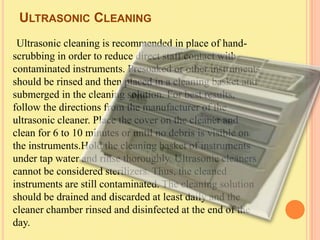
ULTRASONIC CLEANING
 Ultrasonic cleaning is recommended in place of hand-
scrubbing in order to reduce direct staff contact with
contaminated instruments. Presoaked or other instruments
should be rinsed and then placed in a cleaning basket and
submerged in the cleaning solution. For best results,
follow the directions from the manufacturer of the
ultrasonic cleaner. Place the cover on the cleaner and
clean for 6 to 10 minutes or until no debris is visible on
the instruments.Hold the cleaning basket of instruments
under tap water and rinse thoroughly. Ultrasonic cleaners
cannot be considered sterilizers. Thus, the cleaned
instruments are still contaminated. The cleaning solution
should be drained and discarded at least daily and the
cleaner chamber rinsed and disinfected at the end of the
day.
CORROSION CONTROL AND LUBRICATION


  Always dry cleaned instruments to be processed
 through a dry heat, chemical vapor or ethylene
 oxide gas sterilizer or packaged in a paper wrap.
 Drying reduces the chances of corrosion and
 rupture of the paper wrap. A rust inhibitor can be
 applied to non-stainless items to be processed
 through the steam autoclave.
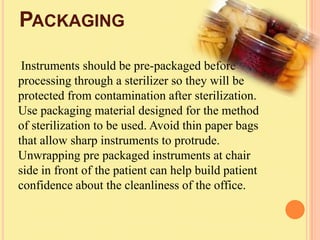
PACKAGING

 Instruments should be pre-packaged before
processing through a sterilizer so they will be
protected from contamination after sterilization.
Use packaging material designed for the method
of sterilization to be used. Avoid thin paper bags
that allow sharp instruments to protrude.
Unwrapping pre packaged instruments at chair
side in front of the patient can help build patient
confidence about the cleanliness of the office.
STERILIZATION TIME


Sterilization fails when the sterilizing agent--
  steam, hot air, or chemical vapor--does not
  contact the processed items for the appropriate
  length of time. Sterilization requires varying
  degrees of time, depending on the
  load, arrangement, packaging material, and
  temperature as well as the type of sterilizing
  agent. Follow the manufacturer's direction and
  define the proper sterilizing time by results of
  routine spore-testing.
STERILIZATION MONITORING

 Sterilization can be monitored by chemical
 indicators (color change) but effectiveness
 cannot. Chemical indicators are strips, tapes and
 markings on bags and pouches that change color
 or physical form after exposure to the sterilizing
 agent. They immediately indicate that the items
 have been processed through the sterilizer and
 have been exposed to heat, steam or chemical
 vapor. Since chemical indicators do not analyze
 for microbial kill, they should be used in
 conjunction with, but never as a replacement for
 spore-testing, which provides the main guarantee
 of sterilization.
BIOLOGICAL INDICATORS


 Biological indicators are the ultimate criteria for
 monitoring sterilization. The CDC states the
 proper functioning of sterilization cycles should
 be verified by the periodic use (at least weekly)
 of biologic indicators (i.e., spore tests). OSHA
 recommends following CDC guidelines for
 standard sterilization procedures.
Proper spore-testing in the medical, surgical, dental, or
podiatric office or clinic involves placing the appropriate
type of biological indicator (spore test) inside a normal
instrument pack, bag, or tray. Biological indicators
operate on the premise that destruction of heat-resistant
spores implies destruction of viruses and bacteria, which
are more easily inactivated. The biological indicator is
included in a sterilization load and subjected to the cycle.
It is then incubated in a nutrient medium and evaluated.It
is the responsibility of each the
medical, surgical, dental, or podiatric office or clinic to
assure their staff and patients that products at point-of-
use are sterile. Appropriate records should be kept to
document sterilization verification.
References
(1.) Department of Labor, Occupational Safety and Health
  Administration. 29CFR Part 1910.1030, Occupational
  exposure to bloodborne pathogens; final rule. Fed Reg
  1991,56:64004-182.
(2.) Infection control guidelines. Denver: Office
  Sterilization and Asepsis Procedures Research
  Foundation; 1992.
(3.) Office Sterilization and Asepsis Procedures Research
  Foundation. Infection control guidelines. Denver; 1991.
(4.) Centers for Disease Control. Recommended Infection-
  Control Practices. MMWR 1993; 42:1-10.
A. METHODS OF STERILIZATION
1. PHYSICAL METHODS


Steam   Thermal
Definition -- a self-locking apparatus
 for the sterilization of material by
 means of steam under pressure.
 Settings for general wrapped
 items:
 Temp. - 250oF Pressure -
 Time -- 30 min Setting -- Fast
 Exhaust & Dry
   Settings for bottled solutions:
   Always vent bottles to avoid bursting!
   Temp. - 250oF Pressure - 20 PSI
   Time -- 30 min Setting -- Slow Exhaust
 Setting for "Flashing" an unwrapped instrument:

   Temp. - 270oF Pressure
   Time -- 4-7 Min Setting -- Fast Exhaust
   Notes -- The above are general steam autoclave settings.
   Different models may operate with varying settings. Always
   refer to the appliance literature before operating a new piece
   of equipment.
Radiation
 Use on materials that cannot be sterilized by heat or chemicals

 Radiant energy destroys microorganisms

Filtration -- is a method utilizing filters capable of screening out
   microorganisms
2. CHEMICAL METHODS
 Ethylene Oxide Gas
 Colorless gas at room temperature

 Odor similar to ether

 Very toxic and irritating to skin and mucous membranes

 Microorganism destruction is caused by a chemical
  reaction
 Materials sterilized need to be aerated in well ventilated
  room or placed in an aerator.
 Length of time required for aeration depends on items
  sterilized.
 Effective sterilization is dependent on concentration of
  gas, exposure time, temperature, and relative humidity
 Hazardous chemical, use great care
   Cold Sterilization
    Instruments should be completely dry before soaking to
    prevent dilution
    Instrument soaking solution - 10-20 minute emersion
    only disinfects
    Incomplete destruction of spores, unless soak is for 10
    hours
    Examples: Instrument Germicide (Phenol and Ethyl
    alcohol), CidexTM (Glutaraldehyde)
    Most require thorough rinsing before using instrument
    Contact time required varies with product used
B. STERILIZATION SHELF LIFE OF
PACKAGED SUPPLIES
2. TWO (2) PACKAGING METHODS ARE STERILE
FOR UP TO SIX (6) MONTHS:


 MonarchR Instrument Canisters -- Special box system with
  single use filters for use in steam autoclaves
 Sterility Maintenance Covers -- Sealable plastic covers to place
  over freshly autoclaved and cooled packs to extend shelf life by
  diminishing air penetration
1. THE FOLLOWING WRAPPED ITEMS, IF
CAREFULLY MAINTAINED, ARE STERILE
FOR UP TO ONE (1) MONTH:


 Double cloth wrapped instruments
 Double paper wrapped instruments

 Inexpensive peel pouches for gauze sponges

 NalgeneR saline bottles
3. HEAT SEALED PACKAGES COMMERCIALLY
 PREPARED IN TUBE OR PEEL POUCH FORM MAY BE
 CONSIDERED STERILE FOR UP TO ONE   (1) YEAR.


C. Sterility Check List
BEFORE ASSUMING A PACK IS STERILE, ALWAYS
EVALUATE THE FOLLOWING BEFORE OPENING THE
PACK:


Expiration or sterilization date
Indicator color change
General condition of wrapper and how it
 had been stored
Always check for holes or moisture
 damage
Sterilization methods

Sterilization methods

  • 1.
  • 2.
    INFECTION CONTROL INTHE MEDICAL OFFICE Infection control has assumed a greater role in medicine and dentistry than ever before. The Centers for Disease Control (CDC) has issued guidelines for infection control in the the medical, surgical, dental, or podiatric office or clinic. Instrument sterilization is one of the most important parts of office infection control. The cardinal rule of infection control is "Do not disinfect when you can sterilize." The approach is to sterilize all reusable instruments contaminated with blood, or that have penetrated tissue or touched bone (universal sterilization). This is better than to sterilize some instruments and disinfect others and is the safest approach to prevent spreading disease to patients.
  • 3.
    STERILIZATION IS APROCESS INTENDED TO KILL ALL MICROORGANISMS AND IS THE HIGHEST LEVEL OF MICROBIAL KILL THAT CAN BE ACHIEVED. A process cannot be called a sterilization process unless it has been shown to be capable of killing high numbers of bacterial spores, the most difficult of microorganisms to kill. The CDC views steam under pressure, dry heat, chemical vapor and ethylene oxide gas as appropriate sterilization methods.
  • 4.
    To assure effectivemicrobial kill with minimal instrument damage and protection to the staff performing the procedures, several steps must be performed: presoaking, cleaning, corrosion control and lubrication, packaging, sterilization and sterilization monitoring.
  • 5.
    PRESOAKING Usually, material allowedto dry on an instrument is more difficult to remove. If cleaning is delayed, keep the instruments wet in a holding solution. This may be a mild detergent, or an instrument disinfectant or sterilant. Do not presoak for more than a few hours, as the longer instruments remain wet, the greater the chances for corrosion of non-stainless items.Wear heavy utility gloves when handling contaminated instruments and mixing chemical solutions. Wear protective eyewear, a mask and protective clothing to prevent contamination from splashing of the solutions.
  • 6.
    CLEANING The CDCand the Food and Drug Administration (FDA) state that "Cleaning is the basic first step of all decontamination. You always need to clean before you disinfect or sterilize." Patient debris and body fluids must be removed from the instruments before sterilization. Debris can insulate microorganisms from the sterilizing agent, preventing direct contact and inactivation.Two approaches to instrument cleaning are hand-scrubbing and ultrasonic cleaning. Hand-scrubbing is directly contrary to one of the principles of infection control (reduce direct contact with contaminated surfaces as much as possible). Handscrubbing of contaminated instruments can create spatter and aerosols and increase the chances for an instrument puncture.When hand-scrubbing, minimize spattering by scrubbing while the instruments are submerged and then rinse thoroughly under tap water and dry. Drying is very important for instruments that will be sterilized in an unsaturated chemical vapor or in a dry heat sterilizer.
  • 7.
    ULTRASONIC CLEANING Ultrasoniccleaning is recommended in place of hand- scrubbing in order to reduce direct staff contact with contaminated instruments. Presoaked or other instruments should be rinsed and then placed in a cleaning basket and submerged in the cleaning solution. For best results, follow the directions from the manufacturer of the ultrasonic cleaner. Place the cover on the cleaner and clean for 6 to 10 minutes or until no debris is visible on the instruments.Hold the cleaning basket of instruments under tap water and rinse thoroughly. Ultrasonic cleaners cannot be considered sterilizers. Thus, the cleaned instruments are still contaminated. The cleaning solution should be drained and discarded at least daily and the cleaner chamber rinsed and disinfected at the end of the day.
  • 8.
    CORROSION CONTROL ANDLUBRICATION Always dry cleaned instruments to be processed through a dry heat, chemical vapor or ethylene oxide gas sterilizer or packaged in a paper wrap. Drying reduces the chances of corrosion and rupture of the paper wrap. A rust inhibitor can be applied to non-stainless items to be processed through the steam autoclave.
  • 9.
    PACKAGING Instruments shouldbe pre-packaged before processing through a sterilizer so they will be protected from contamination after sterilization. Use packaging material designed for the method of sterilization to be used. Avoid thin paper bags that allow sharp instruments to protrude. Unwrapping pre packaged instruments at chair side in front of the patient can help build patient confidence about the cleanliness of the office.
  • 10.
    STERILIZATION TIME Sterilization failswhen the sterilizing agent-- steam, hot air, or chemical vapor--does not contact the processed items for the appropriate length of time. Sterilization requires varying degrees of time, depending on the load, arrangement, packaging material, and temperature as well as the type of sterilizing agent. Follow the manufacturer's direction and define the proper sterilizing time by results of routine spore-testing.
  • 11.
    STERILIZATION MONITORING Sterilizationcan be monitored by chemical indicators (color change) but effectiveness cannot. Chemical indicators are strips, tapes and markings on bags and pouches that change color or physical form after exposure to the sterilizing agent. They immediately indicate that the items have been processed through the sterilizer and have been exposed to heat, steam or chemical vapor. Since chemical indicators do not analyze for microbial kill, they should be used in conjunction with, but never as a replacement for spore-testing, which provides the main guarantee of sterilization.
  • 12.
    BIOLOGICAL INDICATORS Biologicalindicators are the ultimate criteria for monitoring sterilization. The CDC states the proper functioning of sterilization cycles should be verified by the periodic use (at least weekly) of biologic indicators (i.e., spore tests). OSHA recommends following CDC guidelines for standard sterilization procedures.
  • 13.
    Proper spore-testing inthe medical, surgical, dental, or podiatric office or clinic involves placing the appropriate type of biological indicator (spore test) inside a normal instrument pack, bag, or tray. Biological indicators operate on the premise that destruction of heat-resistant spores implies destruction of viruses and bacteria, which are more easily inactivated. The biological indicator is included in a sterilization load and subjected to the cycle. It is then incubated in a nutrient medium and evaluated.It is the responsibility of each the medical, surgical, dental, or podiatric office or clinic to assure their staff and patients that products at point-of- use are sterile. Appropriate records should be kept to document sterilization verification.
  • 14.
    References (1.) Department ofLabor, Occupational Safety and Health Administration. 29CFR Part 1910.1030, Occupational exposure to bloodborne pathogens; final rule. Fed Reg 1991,56:64004-182. (2.) Infection control guidelines. Denver: Office Sterilization and Asepsis Procedures Research Foundation; 1992. (3.) Office Sterilization and Asepsis Procedures Research Foundation. Infection control guidelines. Denver; 1991. (4.) Centers for Disease Control. Recommended Infection- Control Practices. MMWR 1993; 42:1-10.
  • 15.
    A. METHODS OFSTERILIZATION
  • 16.
    1. PHYSICAL METHODS Steam Thermal Definition -- a self-locking apparatus for the sterilization of material by means of steam under pressure.  Settings for general wrapped items: Temp. - 250oF Pressure - Time -- 30 min Setting -- Fast Exhaust & Dry
  • 17.
    Settings for bottled solutions: Always vent bottles to avoid bursting! Temp. - 250oF Pressure - 20 PSI Time -- 30 min Setting -- Slow Exhaust  Setting for "Flashing" an unwrapped instrument: Temp. - 270oF Pressure Time -- 4-7 Min Setting -- Fast Exhaust Notes -- The above are general steam autoclave settings. Different models may operate with varying settings. Always refer to the appliance literature before operating a new piece of equipment. Radiation  Use on materials that cannot be sterilized by heat or chemicals  Radiant energy destroys microorganisms Filtration -- is a method utilizing filters capable of screening out microorganisms
  • 18.
  • 19.
     Ethylene OxideGas  Colorless gas at room temperature  Odor similar to ether  Very toxic and irritating to skin and mucous membranes  Microorganism destruction is caused by a chemical reaction  Materials sterilized need to be aerated in well ventilated room or placed in an aerator.  Length of time required for aeration depends on items sterilized.  Effective sterilization is dependent on concentration of gas, exposure time, temperature, and relative humidity  Hazardous chemical, use great care
  • 20.
    Cold Sterilization Instruments should be completely dry before soaking to prevent dilution Instrument soaking solution - 10-20 minute emersion only disinfects Incomplete destruction of spores, unless soak is for 10 hours Examples: Instrument Germicide (Phenol and Ethyl alcohol), CidexTM (Glutaraldehyde) Most require thorough rinsing before using instrument Contact time required varies with product used
  • 21.
    B. STERILIZATION SHELFLIFE OF PACKAGED SUPPLIES
  • 22.
    2. TWO (2)PACKAGING METHODS ARE STERILE FOR UP TO SIX (6) MONTHS:  MonarchR Instrument Canisters -- Special box system with single use filters for use in steam autoclaves  Sterility Maintenance Covers -- Sealable plastic covers to place over freshly autoclaved and cooled packs to extend shelf life by diminishing air penetration
  • 23.
    1. THE FOLLOWINGWRAPPED ITEMS, IF CAREFULLY MAINTAINED, ARE STERILE FOR UP TO ONE (1) MONTH:  Double cloth wrapped instruments  Double paper wrapped instruments  Inexpensive peel pouches for gauze sponges  NalgeneR saline bottles
  • 24.
    3. HEAT SEALEDPACKAGES COMMERCIALLY PREPARED IN TUBE OR PEEL POUCH FORM MAY BE CONSIDERED STERILE FOR UP TO ONE (1) YEAR. C. Sterility Check List
  • 25.
    BEFORE ASSUMING APACK IS STERILE, ALWAYS EVALUATE THE FOLLOWING BEFORE OPENING THE PACK: Expiration or sterilization date Indicator color change General condition of wrapper and how it had been stored Always check for holes or moisture damage