Why do westudy sorting and searching
algorithms?
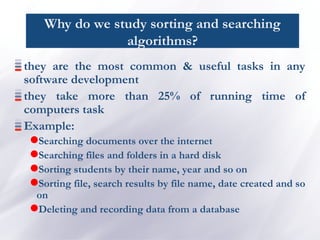
they are the most common & useful tasks in any
software development
they take more than 25% of running time of
computers task
Example:
Searching documents over the internet
Searching files and folders in a hard disk
Sorting students by their name, year and so on
Sorting file, search results by file name, date created and so
on
Deleting and recording data from a database
4.
Simple searching Algorithm
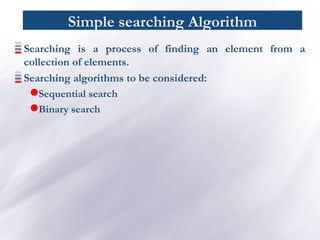
Searchingis a process of finding an element from a
collection of elements.
Searching algorithms to be considered:
Sequential search
Binary search
5.
Sequential Searching
It isnatural way of searching
The algorithm does not assume that the data is sorted.
Algorithm:
Search list from the beginning until key is found or end of list
reached.
Implementation:
int i;
bool found =false;
for(i=0;i<n;i++;)
if (DataElement[i]==key)
{
found=true;
break;
}
return (found);
6.
Example
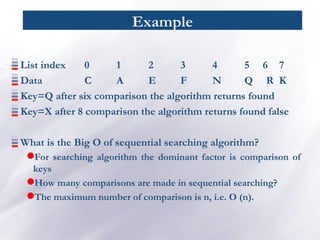
List index 01 2 3 4 5 6 7
Data C A E F N Q R K
Key=Q after six comparison the algorithm returns found
Key=X after 8 comparison the algorithm returns found false
What is the Big O of sequential searching algorithm?
For searching algorithm the dominant factor is comparison of
keys
How many comparisons are made in sequential searching?
The maximum number of comparison is n, i.e. O (n).
7.
Binary Searching
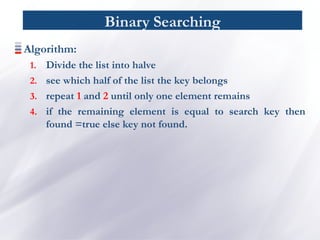
Algorithm:
1. Dividethe list into halve
2. see which half of the list the key belongs
3. repeat 1 and 2 until only one element remains
4. if the remaining element is equal to search key then
found =true else key not found.
8.
Implementation:
int Top =n-1,Bottom=0;middle;
bool found=false;
while (Top>bottom)
{
Middle=(Top+Bottom)/2;
if( dataElement[middle]<key)
Bottom=middle+1;
else
Top=middle;
}
if (dataElement[top]==key)
found =true;
return found;
9.
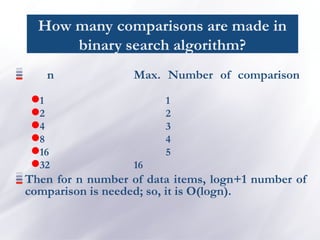
How many comparisonsare made in
binary search algorithm?
n Max. Number of comparison
1 1
2 2
4 3
8 4
16 5
32 16
Then for n number of data items, logn+1 number of
comparison is needed; so, it is O(logn).
10.
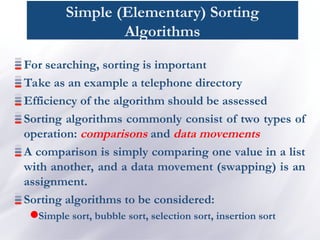
Simple (Elementary) Sorting
Algorithms
Forsearching, sorting is important
Take as an example a telephone directory
Efficiency of the algorithm should be assessed
Sorting algorithms commonly consist of two types of
operation: comparisons and data movements
A comparison is simply comparing one value in a list
with another, and a data movement (swapping) is an
assignment.
Sorting algorithms to be considered:
Simple sort, bubble sort, selection sort, insertion sort
11.
Simple Sort Algorithm
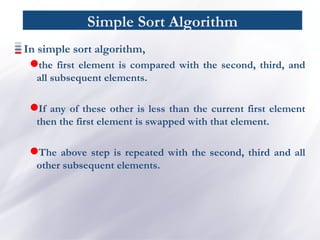
Insimple sort algorithm,
the first element is compared with the second, third, and
all subsequent elements.
If any of these other is less than the current first element
then the first element is swapped with that element.
The above step is repeated with the second, third and all
other subsequent elements.
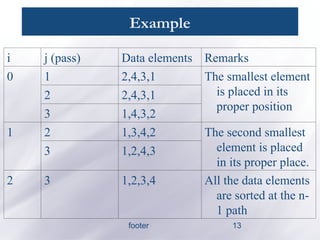
Example
i j (pass)Data elements Remarks
0 1 2,4,3,1 The smallest element
is placed in its
proper position
2 2,4,3,1
3 1,4,3,2
1 2 1,3,4,2 The second smallest
element is placed
in its proper place.
3 1,2,4,3
2 3 1,2,3,4 All the data elements
are sorted at the n-
1 path
13
footer
14.
Algorithm Analysis
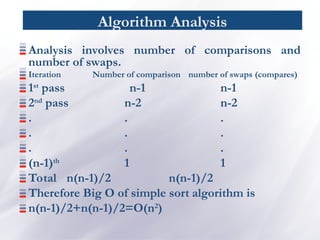
Analysis involvesnumber of comparisons and
number of swaps.
Iteration Number of comparison number of swaps (compares)
1st
pass n-1 n-1
2nd
pass n-2 n-2
. . .
. . .
. . .
(n-1)th
1 1
Total n(n-1)/2 n(n-1)/2
Therefore Big O of simple sort algorithm is
n(n-1)/2+n(n-1)/2=O(n2
)
15.
Bubble Sort Algorithm
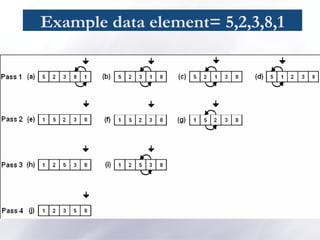
Ita method which uses the interchanging of adjacent pair of
element in the array.
After each pass through the data one element (the largest or
smallest element) will be moved down to the end of the
array in its proper place.
Implementation:
for (int i = 0; i < n-1; i++)
for (int j = n-1; j > i; --j)
if (data[j] < data[j-1])
swap(data[j],data[j-1]);
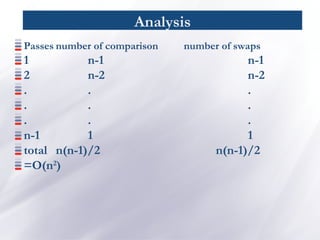
Analysis
Passes number ofcomparison number of swaps
1 n-1 n-1
2 n-2 n-2
. . .
. . .
. . .
n-1 1 1
total n(n-1)/2 n(n-1)/2
=O(n2
)
18.
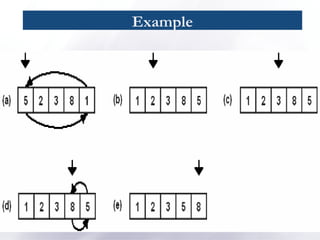
Selection Sort Algorithm
Itis in many ways similar to both simple and bubble
algorithm.
Rather than swapping the neighbors continuously as the
algorithm traverses the sub array to be sorted, as done in
the bubble sort case, this algorithm finds the minimum
element of the sub array and swaps it with the pivot
elements.
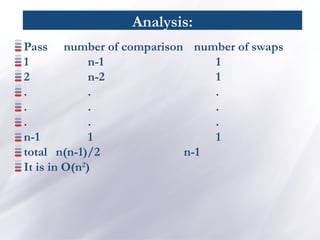
Analysis:
Pass number ofcomparison number of swaps
1 n-1 1
2 n-2 1
. . .
. . .
. . .
n-1 1 1
total n(n-1)/2 n-1
It is in O(n2
)
22.
Insertion Sort Algorithm
Aseach element in the list is examined it is put into
its proper place among the elements that have been
examined ( and put in correct order).
When the last element is put into its proper position
the list is sorted and the algorithm is done.
It behaves in the worst case like the inefficient
bubble sort and selection sort algorithms.
But in many average case it performs better.
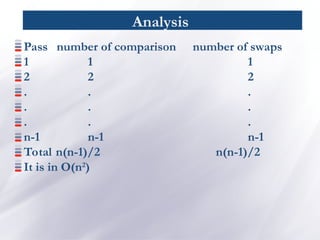
Analysis
Pass number ofcomparison number of swaps
1 1 1
2 2 2
. . .
. . .
. . .
n-1 n-1 n-1
Total n(n-1)/2 n(n-1)/2
It is in O(n2
)
25.
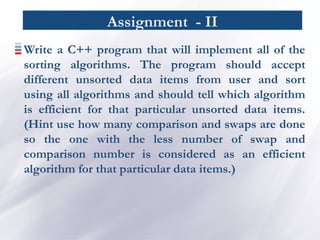
Assignment - II
Writea C++ program that will implement all of the
sorting algorithms. The program should accept
different unsorted data items from user and sort
using all algorithms and should tell which algorithm
is efficient for that particular unsorted data items.
(Hint use how many comparison and swaps are done
so the one with the less number of swap and
comparison number is considered as an efficient
algorithm for that particular data items.)
![Sequential Searching
It is natural way of searching
The algorithm does not assume that the data is sorted.
Algorithm:
Search list from the beginning until key is found or end of list
reached.
Implementation:
int i;
bool found =false;
for(i=0;i<n;i++;)
if (DataElement[i]==key)
{
found=true;
break;
}
return (found);](https://image.slidesharecdn.com/chapter3-elementarysearchingandsortingalgorithms-250415173820-e1b97e3d/85/Chapter-3-Elementary-Searching-and-Sorting-Algorithms-ppt-5-320.jpg)
![Implementation:
int Top =n-1, Bottom=0;middle;
bool found=false;
while (Top>bottom)
{
Middle=(Top+Bottom)/2;
if( dataElement[middle]<key)
Bottom=middle+1;
else
Top=middle;
}
if (dataElement[top]==key)
found =true;
return found;](https://image.slidesharecdn.com/chapter3-elementarysearchingandsortingalgorithms-250415173820-e1b97e3d/85/Chapter-3-Elementary-Searching-and-Sorting-Algorithms-ppt-8-320.jpg)
![Implementation:
void swap( dataType x, dataType y)
{
dataType temp;
temp=x;
x=y;
y=temp;
}
for (i=0;i<=n-2;i++)
for(j=i+1;j<=n-1;j++)
if(dataElement[i]>dataElement[j])
Swap(dataElement[i],dtataElement[j]);](https://image.slidesharecdn.com/chapter3-elementarysearchingandsortingalgorithms-250415173820-e1b97e3d/85/Chapter-3-Elementary-Searching-and-Sorting-Algorithms-ppt-12-320.jpg)
![Bubble Sort Algorithm
It a method which uses the interchanging of adjacent pair of
element in the array.
After each pass through the data one element (the largest or
smallest element) will be moved down to the end of the
array in its proper place.
Implementation:
for (int i = 0; i < n-1; i++)
for (int j = n-1; j > i; --j)
if (data[j] < data[j-1])
swap(data[j],data[j-1]);](https://image.slidesharecdn.com/chapter3-elementarysearchingandsortingalgorithms-250415173820-e1b97e3d/85/Chapter-3-Elementary-Searching-and-Sorting-Algorithms-ppt-15-320.jpg)
![Implementation
for (i=0; i<=n-2;i++)
{
min_index=i;
for (j=(i+1); j<=n-1;j++)
if (dataElement[j] <= dataElement[min_index])
min_index=j;
swap (dataElement[i],dataElement[min_index]);
}](https://image.slidesharecdn.com/chapter3-elementarysearchingandsortingalgorithms-250415173820-e1b97e3d/85/Chapter-3-Elementary-Searching-and-Sorting-Algorithms-ppt-19-320.jpg)
![Implementation
for (i=1;i<=n-1;i++)
{
inserted =false;
j=i;
while ((j>=1) && (inserted == false))
{
If (dataElement[j]<dataElement[j-1])
Swap(dataElement[j],dataElement[j-1]);
else
inserted=true;
j--
}
}](https://image.slidesharecdn.com/chapter3-elementarysearchingandsortingalgorithms-250415173820-e1b97e3d/85/Chapter-3-Elementary-Searching-and-Sorting-Algorithms-ppt-23-320.jpg)