Essentials of Fire Fighting
Seventh Edition
Chapter 21
Maintenance and Testing
Responsibilities
21–2

Learning Objective 1
Describe equipment maintenance
procedures.
21–3
Equipment Maintenance
•
•
•
•
•
Equipment must be ready to perform at its
optimal level
Established maintenance program will
ensure equipment is fully operational
Cleaning some tools requires different
solvents
Some equipment only requires mild soap
Refer to manufacturer’s user manual and
safety data sheets for solvents and follow
policies and procedures
21–4
Maintaining Power Plants And Electrical
Generators
Inspect and
maintain
generators and
lighting equipment
regularly
Review
manufacturer’s
service manual for
specific directions
(Cont.)
21–5
Maintaining Power Plants And Electrical
Generators
•
•
•
•
Inspect for damage, corrosion, carbon accumulation,
and cracks
Make sure wire has a tight connection
Replace if damaged, if service manual recommends
replacement, or if there are signs of arcing
Ensure proper gap prior to installing
Spark plugs
• Check and identify signs of fuel leaks
Carburetor
(Cont.)
21–6
Maintaining Power Plants And Electrical
Generators
•
•
•
•
•
Make sure fuel is fresh
Fuel mixture may separate or degrade over time
Check level and fill as needed
Inspect to ensure it is not contaminated
Discard contaminated fuel in approved manner
Fuel
• Check level and fill as needed
Oil
(Cont.)
21–7
Maintaining Power Plants And Electrical
Generators
•
•
•
•
•
Start and run required tests
Consult manual if a problem is found
Only qualified personnel should perform
repair work
Avoid starting under a load
Do not run for a long time without a
load
Power plant/generator
(Cont.)
21–8
Maintaining Power Plants And Electrical
Generators
Clean work
area and return
all tools and
equipment to
the proper area
Document
maintenance
on appropriate
forms or
records
(Cont.)
21–9
CAUTION
Always start and operate all gas- or
diesel-powered equipment in a well-
ventilated area.
21–10
Maintaining Power Plants And Electrical
Generators
Some types of equipment and
maintenance are not your responsibility
Driver/operator
typically inspects and
maintains apparatus
electrical systems
and apparatus-
mounted lights and
generators
Detailed maintenance
and modification of
lighting equipment
must be performed by
qualified technicians
21–11
REVIEW QUESTION
What are three of the items that
firefighters should check when
maintaining power plants and electrical
generators?
21–12
Maintaining Power Rescue Tools
•
•
Review manufacturer’s service manual for
specific directions
Inspect at the beginning of each shift and
make sure they start (Cont.)
21–13
Maintaining Power Rescue Tools
•
•
•
•
•
•
•
•
Make sure all parts and support items are easily
accessible
Keep battery packs fully charged
Keep pneumatic air cylinders fully charged
Check all fluid levels
Use only recommended types of lubricants,
hydraulic fluids, and fuel grades
Inspect saw, chisel, and cutter blades regularly;
replace blades that are worn or damaged
Check all electrical components for cuts or other
damage
Make sure all protective guards are functional
and in place
(Cont.)
21–14
Maintaining Power Rescue Tools
•
•
•
•
•
•
Inspect hydraulic supply hoses for damage
Inspect hydraulic hose couplings to ensure
they are clean and functional
Inspect pneumatic supply hoses for
damage
Inspect pneumatic hose couplings to
ensure they are clean and functional
Clean the work area and return all tools and
equipment to the proper areas
Document maintenance on appropriate
forms or records
21–15
REVIEW QUESTION
What are three of the general
guidelines for maintaining power
rescue tools?
21–16
Maintaining Portable Lighting Equipment
Inspect cords for
•
•
•
Damaged insulation
Exposed wiring
Missing or bent
prongs
(Cont.)
21–17
Maintaining Portable Lighting Equipment
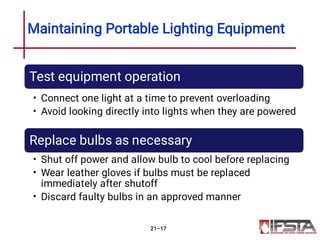
Test equipment operation
•
•
Connect one light at a time to prevent overloading
Avoid looking directly into lights when they are powered
Replace bulbs as necessary
•
•
•
Shut off power and allow bulb to cool before replacing
Wear leather gloves if bulbs must be replaced
immediately after shutoff
Discard faulty bulbs in an approved manner
21–18
REVIEW QUESTION
When inspecting electrical cords,
what characteristics should be
noted?
21–19

Learning Objective 2
Explain the process of service
testing fire hose.
21–20
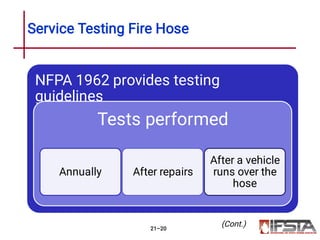
Service Testing Fire Hose
NFPA 1962 provides testing
guidelines
Tests performed
Annually After repairs
After a vehicle
runs over the
hose
(Cont.)
21–21
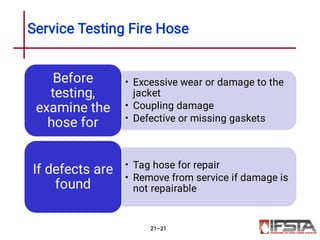
Service Testing Fire Hose
•
•
•
Excessive wear or damage to the
jacket
Coupling damage
Defective or missing gaskets
Before
testing,
examine the
hose for
•
•
Tag hose for repair
Remove from service if damage is
not repairable
If defects are
found
21–22
Test Site Preparation
•
•
•
•
•
•
•
Test site area should
Be paved
Have enough room to lay the hose in
straight lines and free of kinks, bends, or
twists
Be protected from vehicular traffic
Be well lit, if testing is done at night
Be smooth and free from rocks and
debris
Have a slight grade to aid in water
drainage
Have a water source sufficient for
charging the hose
21–23
Service Testing Equipment
Hose-testing machine, portable pump, or pumper equipped
with pressure gauges calibrated in the last 12 months
Hose-test gate valve
Belt tie-in or rope hose tool
(Cont.)
21–24
Service Testing Equipment
Means of recording hose numbers and test results
Tags or other means to identify sections that fail
Nozzles with shutoff valves or a test cap with a bleeder
valve
Means of marking each length with the year of the test
21–25
REVIEW QUESTIONS
What type of location should be
used to service test fire hose?
What equipment or tools are
needed to service test fire hose?
21–26
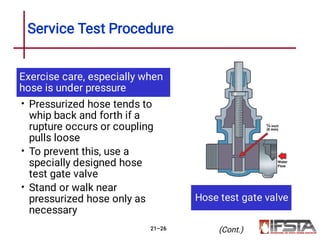
Service Test Procedure
Exercise care, especially when
hose is under pressure
•
•
•
Pressurized hose tends to
whip back and forth if a
rupture occurs or coupling
pulls loose
To prevent this, use a
specially designed hose
test gate valve
Stand or walk near
pressurized hose only as
necessary
Hose test gate valve
(Cont.)
21–27
CAUTION
All personnel operating in the area of
the pressurized hose should wear at
least a helmet as a safety precaution.
21–28
Service Test Procedure
•
•
•
•
•
•
When using a pumper, connect hoses to
discharges on the side opposite the pump panel
Close all valves slowly
Test lengths should not exceed 300 feet (100 m)
Laying large-diameter hose flat before charging
helps prevent unnecessary wear
Stand away from the discharge valve connection
when charging
Keep area as dry as possible when filling and
discharging air from the hose
21–29
Indicators Of Removal From Service
Leaks
Hose
rupturing/bursting
Couplings loosening
or separating from
the hose
21–30
NOTE
Some damage to fire hose may not
require its removal from service. If a
coupling has loosened or a leak occurs
close to a coupling, the hose may be cut
to remove the damaged location and a
new coupling attached (also called
recoupling).
21–31
Recording Procedures
Can be kept on cards, logs, sheets, or computers
Should include
•
•
•
•
•
•
•
Information on the date of purchase
Name of manufacturer
Date and results of periodic testing
Remarks concerning testing
Date and type of repairs performed
Unusual features
Causes of failure if any (Cont.)
21–32
Recording Procedures
Records kept as part of the complete
equipment inventory
Records indicate
•
•
•
•
•
Disposition of the hose
Assigned location
Engine
Engine compartment
Rack storage (Cont.)
21–33
Recording Procedures
•
•
•
•
Document
according to
SOPs
Test results
Damage
Repairs made
If hose is removed
from service
21–34
REVIEW QUESTIONS
What are some general guidelines
for effective service testing of fire
hose?
What information should fire hose
service testing records include?
21–35
QUESTIONS
Are there any questions about this content?

Chapter 21 PowerPoint.pdf

  • 1.
    Essentials of FireFighting Seventh Edition Chapter 21 Maintenance and Testing Responsibilities
  • 2.
    21–2 Learning Objective 1 Describeequipment maintenance procedures.
  • 3.
    21–3 Equipment Maintenance • • • • • Equipment mustbe ready to perform at its optimal level Established maintenance program will ensure equipment is fully operational Cleaning some tools requires different solvents Some equipment only requires mild soap Refer to manufacturer’s user manual and safety data sheets for solvents and follow policies and procedures
  • 4.
    21–4 Maintaining Power PlantsAnd Electrical Generators Inspect and maintain generators and lighting equipment regularly Review manufacturer’s service manual for specific directions (Cont.)
  • 5.
    21–5 Maintaining Power PlantsAnd Electrical Generators • • • • Inspect for damage, corrosion, carbon accumulation, and cracks Make sure wire has a tight connection Replace if damaged, if service manual recommends replacement, or if there are signs of arcing Ensure proper gap prior to installing Spark plugs • Check and identify signs of fuel leaks Carburetor (Cont.)
  • 6.
    21–6 Maintaining Power PlantsAnd Electrical Generators • • • • • Make sure fuel is fresh Fuel mixture may separate or degrade over time Check level and fill as needed Inspect to ensure it is not contaminated Discard contaminated fuel in approved manner Fuel • Check level and fill as needed Oil (Cont.)
  • 7.
    21–7 Maintaining Power PlantsAnd Electrical Generators • • • • • Start and run required tests Consult manual if a problem is found Only qualified personnel should perform repair work Avoid starting under a load Do not run for a long time without a load Power plant/generator (Cont.)
  • 8.
    21–8 Maintaining Power PlantsAnd Electrical Generators Clean work area and return all tools and equipment to the proper area Document maintenance on appropriate forms or records (Cont.)
  • 9.
    21–9 CAUTION Always start andoperate all gas- or diesel-powered equipment in a well- ventilated area.
  • 10.
    21–10 Maintaining Power PlantsAnd Electrical Generators Some types of equipment and maintenance are not your responsibility Driver/operator typically inspects and maintains apparatus electrical systems and apparatus- mounted lights and generators Detailed maintenance and modification of lighting equipment must be performed by qualified technicians
  • 11.
    21–11 REVIEW QUESTION What arethree of the items that firefighters should check when maintaining power plants and electrical generators?
  • 12.
    21–12 Maintaining Power RescueTools • • Review manufacturer’s service manual for specific directions Inspect at the beginning of each shift and make sure they start (Cont.)
  • 13.
    21–13 Maintaining Power RescueTools • • • • • • • • Make sure all parts and support items are easily accessible Keep battery packs fully charged Keep pneumatic air cylinders fully charged Check all fluid levels Use only recommended types of lubricants, hydraulic fluids, and fuel grades Inspect saw, chisel, and cutter blades regularly; replace blades that are worn or damaged Check all electrical components for cuts or other damage Make sure all protective guards are functional and in place (Cont.)
  • 14.
    21–14 Maintaining Power RescueTools • • • • • • Inspect hydraulic supply hoses for damage Inspect hydraulic hose couplings to ensure they are clean and functional Inspect pneumatic supply hoses for damage Inspect pneumatic hose couplings to ensure they are clean and functional Clean the work area and return all tools and equipment to the proper areas Document maintenance on appropriate forms or records
  • 15.
    21–15 REVIEW QUESTION What arethree of the general guidelines for maintaining power rescue tools?
  • 16.
    21–16 Maintaining Portable LightingEquipment Inspect cords for • • • Damaged insulation Exposed wiring Missing or bent prongs (Cont.)
  • 17.
    21–17 Maintaining Portable LightingEquipment Test equipment operation • • Connect one light at a time to prevent overloading Avoid looking directly into lights when they are powered Replace bulbs as necessary • • • Shut off power and allow bulb to cool before replacing Wear leather gloves if bulbs must be replaced immediately after shutoff Discard faulty bulbs in an approved manner
  • 18.
    21–18 REVIEW QUESTION When inspectingelectrical cords, what characteristics should be noted?
  • 19.
    21–19 Learning Objective 2 Explainthe process of service testing fire hose.
  • 20.
    21–20 Service Testing FireHose NFPA 1962 provides testing guidelines Tests performed Annually After repairs After a vehicle runs over the hose (Cont.)
  • 21.
    21–21 Service Testing FireHose • • • Excessive wear or damage to the jacket Coupling damage Defective or missing gaskets Before testing, examine the hose for • • Tag hose for repair Remove from service if damage is not repairable If defects are found
  • 22.
    21–22 Test Site Preparation • • • • • • • Testsite area should Be paved Have enough room to lay the hose in straight lines and free of kinks, bends, or twists Be protected from vehicular traffic Be well lit, if testing is done at night Be smooth and free from rocks and debris Have a slight grade to aid in water drainage Have a water source sufficient for charging the hose
  • 23.
    21–23 Service Testing Equipment Hose-testingmachine, portable pump, or pumper equipped with pressure gauges calibrated in the last 12 months Hose-test gate valve Belt tie-in or rope hose tool (Cont.)
  • 24.
    21–24 Service Testing Equipment Meansof recording hose numbers and test results Tags or other means to identify sections that fail Nozzles with shutoff valves or a test cap with a bleeder valve Means of marking each length with the year of the test
  • 25.
    21–25 REVIEW QUESTIONS What typeof location should be used to service test fire hose? What equipment or tools are needed to service test fire hose?
  • 26.
    21–26 Service Test Procedure Exercisecare, especially when hose is under pressure • • • Pressurized hose tends to whip back and forth if a rupture occurs or coupling pulls loose To prevent this, use a specially designed hose test gate valve Stand or walk near pressurized hose only as necessary Hose test gate valve (Cont.)
  • 27.
    21–27 CAUTION All personnel operatingin the area of the pressurized hose should wear at least a helmet as a safety precaution.
  • 28.
    21–28 Service Test Procedure • • • • • • Whenusing a pumper, connect hoses to discharges on the side opposite the pump panel Close all valves slowly Test lengths should not exceed 300 feet (100 m) Laying large-diameter hose flat before charging helps prevent unnecessary wear Stand away from the discharge valve connection when charging Keep area as dry as possible when filling and discharging air from the hose
  • 29.
    21–29 Indicators Of RemovalFrom Service Leaks Hose rupturing/bursting Couplings loosening or separating from the hose
  • 30.
    21–30 NOTE Some damage tofire hose may not require its removal from service. If a coupling has loosened or a leak occurs close to a coupling, the hose may be cut to remove the damaged location and a new coupling attached (also called recoupling).
  • 31.
    21–31 Recording Procedures Can bekept on cards, logs, sheets, or computers Should include • • • • • • • Information on the date of purchase Name of manufacturer Date and results of periodic testing Remarks concerning testing Date and type of repairs performed Unusual features Causes of failure if any (Cont.)
  • 32.
    21–32 Recording Procedures Records keptas part of the complete equipment inventory Records indicate • • • • • Disposition of the hose Assigned location Engine Engine compartment Rack storage (Cont.)
  • 33.
    21–33 Recording Procedures • • • • Document according to SOPs Testresults Damage Repairs made If hose is removed from service
  • 34.
    21–34 REVIEW QUESTIONS What aresome general guidelines for effective service testing of fire hose? What information should fire hose service testing records include?
  • 35.
    21–35 QUESTIONS Are there anyquestions about this content?