All Rights Reserved
Microeconomics
© Oxford University Press Malaysia, 2008
1– 1
PRODUCTION
POSSIBLITY CURVE
2
CHAPTER
All Rights Reserved
Microeconomics
© Oxford University Press Malaysia, 2008
1– 2
All Rights Reserved
Microeconomics
© Oxford University Press Malaysia, 2008
1– 4
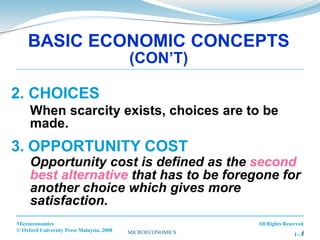
2. CHOICES
When scarcity exists, choices are to be
made.
3. OPPORTUNITY COST
Opportunity cost is defined as the second
best alternative that has to be foregone for
another choice which gives more
satisfaction.
4
MICROECONOMICS
BASIC ECONOMIC CONCEPTS
(CON’T)
All Rights Reserved
Microeconomics
© Oxford University Press Malaysia, 2008
1– 5
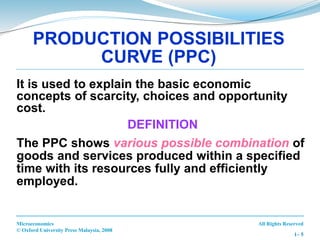
It is used to explain the basic economic
concepts of scarcity, choices and opportunity
cost.
DEFINITION
The PPC shows various possible combination of
goods and services produced within a specified
time with its resources fully and efficiently
employed.
PRODUCTION POSSIBILITIES
CURVE (PPC)
All Rights Reserved
Microeconomics
© Oxford University Press Malaysia, 2008
1– 6
1. Economy is in full employment and
full production capacity (full
efficiency).
2. Resources available are fixed and
limited.
ASSUMPTIONS OF
PRODUCTION POSSIBILITIES
CURVE (PPC)
All Rights Reserved
Microeconomics
© Oxford University Press Malaysia, 2008
1– 7
THE ASSUMPTIONS OF
PRODUCTION POSSIBILITIES
CURVE (PPC) (CON’T)
3. The state of technology does not
change throughout production.
4. It is assumed that the country is
only producing two goods.
All Rights Reserved
Microeconomics
© Oxford University Press Malaysia, 2008
1– 8
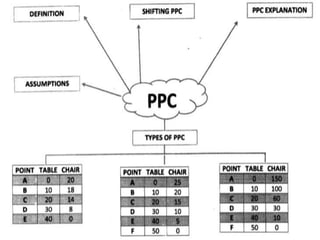
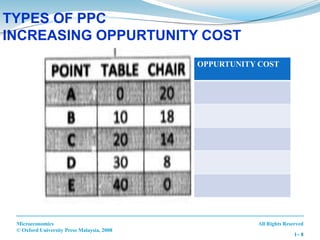
TYPES OF PPC
INCREASING OPPURTUNITY COST
OPPURTUNITY COST
All Rights Reserved
Microeconomics
© Oxford University Press Malaysia, 2008
1– 9
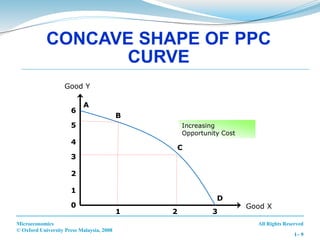
Good Y
Good X
Increasing
Opportunity Cost
4
2
1
3
5
0
1 2 3
6
A
B
C
D
CONCAVE SHAPE OF PPC
CURVE
All Rights Reserved
Microeconomics
© Oxford University Press Malaysia, 2008
1– 10
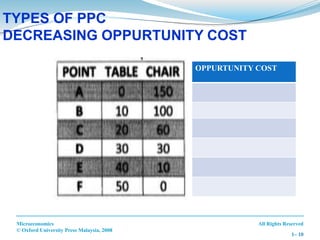
TYPES OF PPC
DECREASING OPPURTUNITY COST
OPPURTUNITY COST
All Rights Reserved
Microeconomics
© Oxford University Press Malaysia, 2008
1– 11
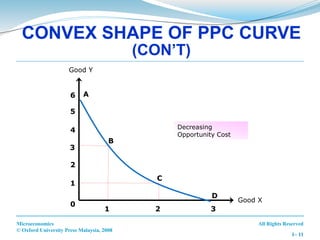
Good Y
Good X
Decreasing
Opportunity Cost
1 2 3
4
2
1
3
5
0
6 A
B
C
D
CONVEX SHAPE OF PPC CURVE
(CON’T)
All Rights Reserved
Microeconomics
© Oxford University Press Malaysia, 2008
1– 12
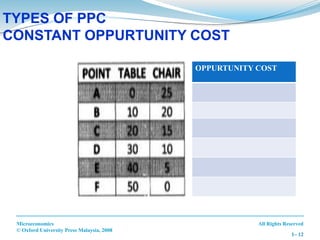
TYPES OF PPC
CONSTANT OPPURTUNITY COST
OPPURTUNITY COST
All Rights Reserved
Microeconomics
© Oxford University Press Malaysia, 2008
1– 13
13
MICROECONOMICS
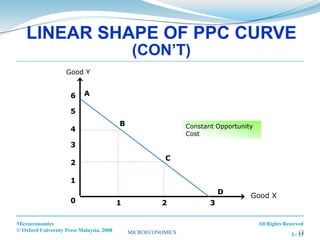
Good Y
Good X
Constant Opportunity
Cost
4
2
1
3
5
0 1 2 3
6 A
B
C
D
LINEAR SHAPE OF PPC CURVE
(CON’T)
All Rights Reserved
Microeconomics
© Oxford University Press Malaysia, 2008
1– 14
Consumer Goods (million)
Defence Goods (million)
PRODUCTION POSSIBILITIES
CURVE (PPC) (CON’T)
North Korea
produces two
products—defence
goods and
consumer goods
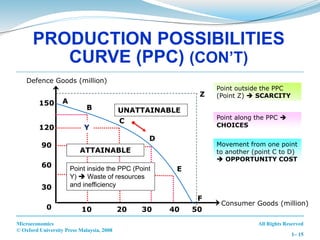
If North Korea is at point C on the
PPC, it can produce the combination
of 120 million defence goods and
20 million units of consumer goods
Point D shows production of 90
million defence goods and 30
million units of consumer goods
D
C
B
E
If it allocates its resources to
defence goods, it will produce at
Point A
If it allocates its resources to
consumer goods, it will produce at
Point F
A
F
40 50
0 10 20 30
90
60
120
150
30
All Rights Reserved
Microeconomics
© Oxford University Press Malaysia, 2008
1– 15
Point along the PPC 
CHOICES
Point outside the PPC
(Point Z)  SCARCITY
UNATTAINABLE
PRODUCTION POSSIBILITIES
CURVE (PPC) (CON’T)
Movement from one point
to another (point C to D)
 OPPORTUNITY COST
Defence Goods (million)
Consumer Goods (million)
F
Z
D
C
A
B
E
120
40
60
50
30
90
150
0 10 20 30
Y
ATTAINABLE
Point inside the PPC (Point
Y)  Waste of resources
and inefficiency
All Rights Reserved
Microeconomics
© Oxford University Press Malaysia, 2008
1– 16
Defence Goods (million)
Consumer Goods (million)
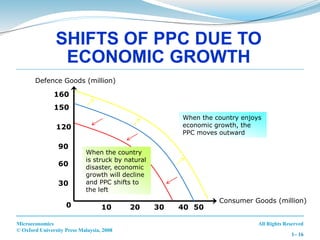
When the country enjoys
economic growth, the
PPC moves outward
120
40
60
50
30
90
150
160
0 10 20 30
SHIFTS OF PPC DUE TO
ECONOMIC GROWTH
When the country
is struck by natural
disaster, economic
growth will decline
and PPC shifts to
the left
All Rights Reserved
Microeconomics
© Oxford University Press Malaysia, 2008
1– 17
Consumer Goods (million)
Defence Goods (million)
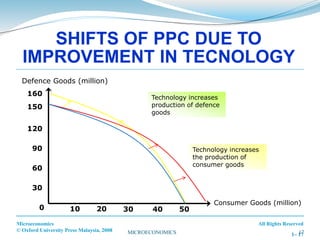
Technology increases
production of defence
goods
Technology increases
the production of
consumer goods
40 50
10 20 30
120
60
30
90
150
160
0
17
MICROECONOMICS
SHIFTS OF PPC DUE TO
IMPROVEMENT IN TECNOLOGY
All Rights Reserved
Microeconomics
© Oxford University Press Malaysia, 2008
1– 18
Defence Goods (million)
Consumer Goods (million)
40 50
120
60
30
90
150
160
0 10 20 30
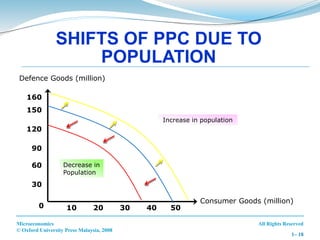
Decrease in
Population
Increase in population
SHIFTS OF PPC DUE TO
POPULATION
All Rights Reserved
Microeconomics
© Oxford University Press Malaysia, 2008
1– 19
FUNDAMENTAL ECONOMIC
QUESTIONS
1. WHAT TO PRODUCE ?
Depends on the what type of goods and
services to produce.
2 HOW TO PRODUCE ?
Depends on the cheapest method of production.
3. FOR WHOM TO PRODUCE ?
Depends on the distribution of income
All Rights Reserved
Microeconomics
© Oxford University Press Malaysia, 2008
1– 20
All Rights Reserved
Microeconomics
© Oxford University Press Malaysia, 2008
1– 21

CHAPTER 2 : PRODUCTION POSSIBILITY CURVE

  • 1.
    All Rights Reserved Microeconomics ©Oxford University Press Malaysia, 2008 1– 1 PRODUCTION POSSIBLITY CURVE 2 CHAPTER
  • 2.
    All Rights Reserved Microeconomics ©Oxford University Press Malaysia, 2008 1– 2
  • 3.
    All Rights Reserved Microeconomics ©Oxford University Press Malaysia, 2008 1– 4 2. CHOICES When scarcity exists, choices are to be made. 3. OPPORTUNITY COST Opportunity cost is defined as the second best alternative that has to be foregone for another choice which gives more satisfaction. 4 MICROECONOMICS BASIC ECONOMIC CONCEPTS (CON’T)
  • 4.
    All Rights Reserved Microeconomics ©Oxford University Press Malaysia, 2008 1– 5 It is used to explain the basic economic concepts of scarcity, choices and opportunity cost. DEFINITION The PPC shows various possible combination of goods and services produced within a specified time with its resources fully and efficiently employed. PRODUCTION POSSIBILITIES CURVE (PPC)
  • 5.
    All Rights Reserved Microeconomics ©Oxford University Press Malaysia, 2008 1– 6 1. Economy is in full employment and full production capacity (full efficiency). 2. Resources available are fixed and limited. ASSUMPTIONS OF PRODUCTION POSSIBILITIES CURVE (PPC)
  • 6.
    All Rights Reserved Microeconomics ©Oxford University Press Malaysia, 2008 1– 7 THE ASSUMPTIONS OF PRODUCTION POSSIBILITIES CURVE (PPC) (CON’T) 3. The state of technology does not change throughout production. 4. It is assumed that the country is only producing two goods.
  • 7.
    All Rights Reserved Microeconomics ©Oxford University Press Malaysia, 2008 1– 8 TYPES OF PPC INCREASING OPPURTUNITY COST OPPURTUNITY COST
  • 8.
    All Rights Reserved Microeconomics ©Oxford University Press Malaysia, 2008 1– 9 Good Y Good X Increasing Opportunity Cost 4 2 1 3 5 0 1 2 3 6 A B C D CONCAVE SHAPE OF PPC CURVE
  • 9.
    All Rights Reserved Microeconomics ©Oxford University Press Malaysia, 2008 1– 10 TYPES OF PPC DECREASING OPPURTUNITY COST OPPURTUNITY COST
  • 10.
    All Rights Reserved Microeconomics ©Oxford University Press Malaysia, 2008 1– 11 Good Y Good X Decreasing Opportunity Cost 1 2 3 4 2 1 3 5 0 6 A B C D CONVEX SHAPE OF PPC CURVE (CON’T)
  • 11.
    All Rights Reserved Microeconomics ©Oxford University Press Malaysia, 2008 1– 12 TYPES OF PPC CONSTANT OPPURTUNITY COST OPPURTUNITY COST
  • 12.
    All Rights Reserved Microeconomics ©Oxford University Press Malaysia, 2008 1– 13 13 MICROECONOMICS Good Y Good X Constant Opportunity Cost 4 2 1 3 5 0 1 2 3 6 A B C D LINEAR SHAPE OF PPC CURVE (CON’T)
  • 13.
    All Rights Reserved Microeconomics ©Oxford University Press Malaysia, 2008 1– 14 Consumer Goods (million) Defence Goods (million) PRODUCTION POSSIBILITIES CURVE (PPC) (CON’T) North Korea produces two products—defence goods and consumer goods If North Korea is at point C on the PPC, it can produce the combination of 120 million defence goods and 20 million units of consumer goods Point D shows production of 90 million defence goods and 30 million units of consumer goods D C B E If it allocates its resources to defence goods, it will produce at Point A If it allocates its resources to consumer goods, it will produce at Point F A F 40 50 0 10 20 30 90 60 120 150 30
  • 14.
    All Rights Reserved Microeconomics ©Oxford University Press Malaysia, 2008 1– 15 Point along the PPC  CHOICES Point outside the PPC (Point Z)  SCARCITY UNATTAINABLE PRODUCTION POSSIBILITIES CURVE (PPC) (CON’T) Movement from one point to another (point C to D)  OPPORTUNITY COST Defence Goods (million) Consumer Goods (million) F Z D C A B E 120 40 60 50 30 90 150 0 10 20 30 Y ATTAINABLE Point inside the PPC (Point Y)  Waste of resources and inefficiency
  • 15.
    All Rights Reserved Microeconomics ©Oxford University Press Malaysia, 2008 1– 16 Defence Goods (million) Consumer Goods (million) When the country enjoys economic growth, the PPC moves outward 120 40 60 50 30 90 150 160 0 10 20 30 SHIFTS OF PPC DUE TO ECONOMIC GROWTH When the country is struck by natural disaster, economic growth will decline and PPC shifts to the left
  • 16.
    All Rights Reserved Microeconomics ©Oxford University Press Malaysia, 2008 1– 17 Consumer Goods (million) Defence Goods (million) Technology increases production of defence goods Technology increases the production of consumer goods 40 50 10 20 30 120 60 30 90 150 160 0 17 MICROECONOMICS SHIFTS OF PPC DUE TO IMPROVEMENT IN TECNOLOGY
  • 17.
    All Rights Reserved Microeconomics ©Oxford University Press Malaysia, 2008 1– 18 Defence Goods (million) Consumer Goods (million) 40 50 120 60 30 90 150 160 0 10 20 30 Decrease in Population Increase in population SHIFTS OF PPC DUE TO POPULATION
  • 18.
    All Rights Reserved Microeconomics ©Oxford University Press Malaysia, 2008 1– 19 FUNDAMENTAL ECONOMIC QUESTIONS 1. WHAT TO PRODUCE ? Depends on the what type of goods and services to produce. 2 HOW TO PRODUCE ? Depends on the cheapest method of production. 3. FOR WHOM TO PRODUCE ? Depends on the distribution of income
  • 19.
    All Rights Reserved Microeconomics ©Oxford University Press Malaysia, 2008 1– 20
  • 20.
    All Rights Reserved Microeconomics ©Oxford University Press Malaysia, 2008 1– 21