chapter 2
Memory Construction
• • Step 15 How to Remember Names and Faces • Step 16 How
to Remember Directions • Step 17 How to Remember
Spellings • Step 18 How to Remember Countries and Their
Capitals • Step 19 Learning a Foreign Language • Step 20 How
to Remember Your Past • Step 21 How to Remember the
Elements • Step 22 Develop Your Declarative Memory • Step
23 The Dominic System I • Step 24 How to Remember Jokes •
Step 25 How to Remember Fiction • Step 26 Read Faster and
Remember More • Step 27 How to Remember Quotations •
Step 28 Memory and Mind Maps® • Step 29 How to
Remember Speeches and Presentations • Step 30 The Art of
Revision and Maximizing Recall
15 How to Remember Names and Faces
• “Forgive your enemies, but never forget their names.” JOHN F.
KENNEDY (1917–63)
• HANG OVER-Remain suspended or unsettled
• Discern-recognize or find out.
• Of all the concerns that people have shared with me about their
memory, putting names to faces is number one on the list. As
humans we have an inbuilt mechanism for recognizing faces (this
is probably an evolutionary hangover from the time when we
needed to discern our friends from our enemies). If remembering
a face presents no difficulty, then why is it that so many of us have
a problem when it comes to remembering names? There’s a very
simple answer: our names do not describe our faces.
Cont’d
• Portray-describe (someone or something) in a
particular way.
• My first name is Dominic, but this does not help
to portray my face to you. And the matter is not
made easier by the fact that I share my surname
– O’Brien– with tens of thousands of others
around the world. Imagine trying to memorize
one hundred people in a room whose names
were just Bob, Mary, Michael or Jane.
Cont’d
• Embarrassment-a feeling of self-consciousness, shame, or
awkwardness.
• What are the most effective ways of ensuring you never experience
that embarrassing moment at a party, which we’ve all suffered at
some time, when you are forced to ask, “Sorry, what was your name
again?” 30 seconds after being introduced to someone? The most
important thing is to recognize that we tend to associate a person
with a particular place. Think of a time when you have bumped into
someone in the street whose face is very familiar but whose name
escapes you. What is the first thing you do to try to recall who this
person is? You ask yourself, “Where do I know this person from?” It
is the place that will release most of the memories connected with
this person including, hopefully, his or her name.
Cont’d
• very serious about studying, reading, learning,
etc. a studious child.
• One trick I use to memorize people for the first
time is to designate a place for each of them. I
do this by imagining where I might expect to
find this person. Let’s say you are being
introduced to a lady at a party and for some
reason you think that she looks like a librarian.
Perhaps she has a studious air about her.
Cont’d
• Now you have prepared a location for her. You are
told that her name is “Margaret”. Now think of
someone that you know of called Margaret (a
relative, friend, actress, politician, or whoever) and
picture her at your local library. The first Margaret
you think of is the ex British Prime Minister,
Margaret Thatcher so you imagine her working at
the library. The next time you see this lady’s face
you will be able to retrace her name in the following
way: FACE LIBRARY THATCHER SCENE MARGARET
Cont’d
• This may seem like a lengthy process to connect
the face to the name, but remember that your
brain recalls information in a flash as long as
there is chain of associated connections for it to
travel along.
• Someone who is hook-nosed has a large nose
that curves out from the face.
• A beak is the hard, pointed structure sticking
out from a bird's face.
Cont’d
• If I meet someone whose features are particularly
striking, instead of associating that person with a
place, I sometimes find it is easier to connect their
name directly to their physical appearance. For
example, you are introduced to a man called Peter
Byrd and immediately you connect his name with
his face as he has a rather hooked nose (a bit like a
bird’s beak). Your brain can now make more
connections and quickly seizes on “Pet”, short for
Peter, and there you have your link: Pet Bird.
Cont’d
• I find the best way to tackle a complicated
surname is to break it down into syllables and
then turn these syllables into images. Names,
like numbers, need to be translated into
images so that our brains can digest them. Our
brains thrive on making connections, so when
we are confronted with a name that doesn’t
represent a face, then the answer is to forge
an artificial link between the two.
Cont’d
• Agility-the ability to think and draw
conclusions quickly; intellectual acuity.
• The phrase "her braids poking out" typically
refers to someone's braids being visible or
sticking out from under something, like a hat,
hood, or other covering. It suggests that the
braids are partially hidden but still noticeable,
giving a casual, slightly playful or relaxed
impression.
Cont’d
• Braids are a hairstyle where three or more
sections of hair are interwoven to create a
woven pattern. This style can range from
simple to intricate and has cultural
significance in many parts of the world.
Braiding can also help protect hair from
damage, and the styles can vary in size,
tightness, and complexity, including box
braids, cornrows, and French braids.
Cont’d
• Your observation that "she has rosy cheeks" suggests she may
be physically exerted or emotionally engaged, and imagining
her flushed from singing adds a layer of vividness. It paints a
picture of someone deeply involved in their performance,
perhaps experiencing the joy, passion, or effort of the moment.
The flush could symbolize both physical exertion and emotional
intensity.
• "Physically exerted" means someone is putting in significant
physical effort, which can lead to signs like sweating, increased
heart rate, or flushed skin. In your example, it implies that the
person may be working hard, such as singing energetically,
which could cause her to become flushed or out of breath.
Cont’d
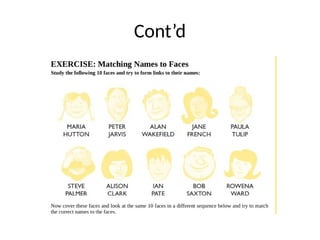
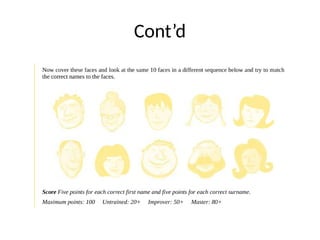
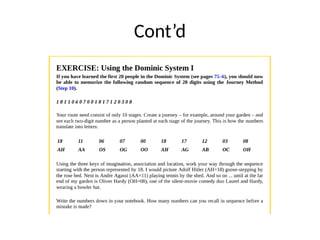
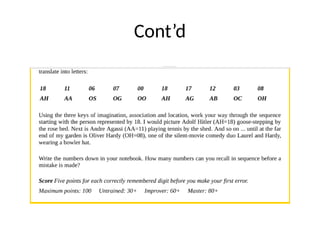
• The following exercise will give you a chance to try out your
brain’s agility in making links. You can use any of the
techniques described in this step: that is, place a person in a
familiar location, or identify physical resemblances, or
distinctive characteristics of a name or face to make
associations and form memorable images. For example, how
might you commit Maria Hutton to memory? The surname
“Hutton” sounds to me like “hat on”, so I picture Maria Hutton
wearing a hat, with her braids poking out. I notice that she has
rosy cheeks, so I imagine she is flushed from singing the line
“I’ve just met a girl named Maria” from the musical, West Side
Story. This will remind me of her first name.
Cont’d
Cont’d
16 How to Remember Directions
• Predicament-a difficult, unpleasant, or embarrassing situation.
• passer-by-a person who happens to be going past something,
especially on foot.
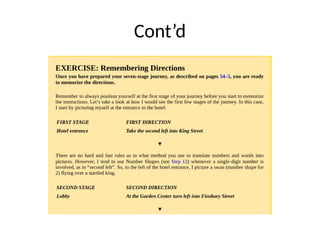
• Does the following predicament sound familiar to you? You are in an
unfamiliar area and you’re late for an appointment. You stop to ask a
passer-by for directions, and will have to rely on your memory, as
you do not have a pen and paper to hand. The passer-by bombards
you with a sequence of directions that you know you are going to
forget unless you hear them repeated several times. But you don’t
have time for this, and you decide to take a chance that you will
remember the directions to get you to your destination. Of course, it
is likely that you’ll need to stop again a couple of miles down the
street and ask someone else for further directions.
Cont’d
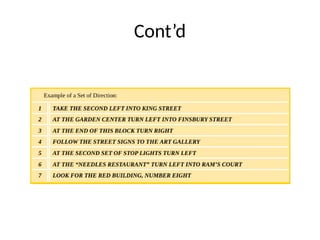
• However, by applying a simple memory
technique you need only listen to a set of
directions once. Let’s imagine you are lost in
an American town and a sympathetic stranger
gives you the following set of directions:
Cont’d
Cont’d
• At first glance this may appear to be too much
information to absorb all in one go. However,
if you have been working through the
exercises in this book so far, you should
already be feeling confident about your
progress, particularly when it comes to
memorizing a sequence of just seven pieces of
information.
Cont’d
• Backdrop-the setting or background for a scene, event,
or situation.
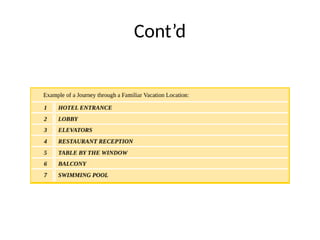
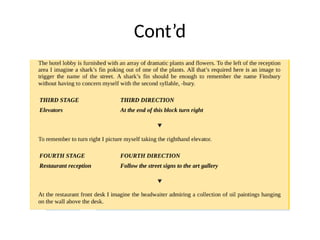
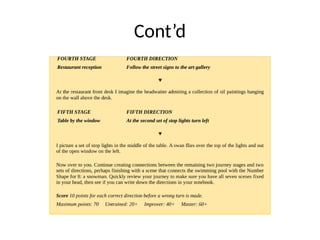
• This is how I tackle memorizing directions: I regard them
as a sequence of shopping items, say, and I use the
Journey Method to store them quickly. Naturally, you
need to have your journey pre-prepared. As there are
seven individual directions, you need a short journey of
just seven stages, which you can use to store the
information. For example, you could use a favourite
vacation destination as your backdrop for the journey.
Cont’d
Cont’d
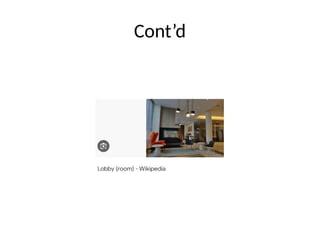
• Lobby-a room providing a space out of which
one or more other rooms or corridors lead,
typically one near the entrance of a public
building.
Cont’d
Cont’d
• Startled-feeling or showing sudden shock or
alarm.
• by the window. would be understood to
meaning in the vicinity or nearby the window.
Cont’d
Cont’d
Cont’d
Cont’d
17 How to Remember Spellings
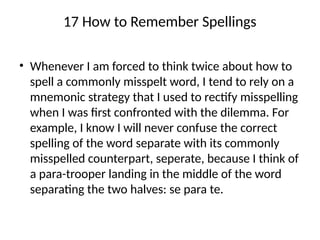
• Whenever I am forced to think twice about how to
spell a commonly misspelt word, I tend to rely on a
mnemonic strategy that I used to rectify misspelling
when I was first confronted with the dilemma. For
example, I know I will never confuse the correct
spelling of the word separate with its commonly
misspelled counterpart, seperate, because I think of
a para-trooper landing in the middle of the word
separating the two halves: se para te.
Cont’d
Cont’d
Cont’d
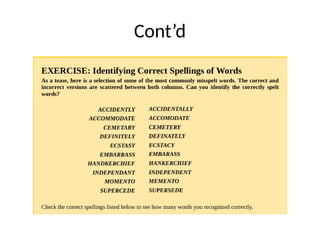
• The trick is to look out for connections between
certain patterns of letters and the meanings of the
words. Then use visualization and association to
make those connections memorable. For example,
notice the symmetry of the three Es in the word c
E m E t E ry. They stick out like gravestones. I put
my hand in my pocket to pull out my handkerchief.
I use my memory to remind me that a memento,
not a momento, is a reminder.
Cont’d
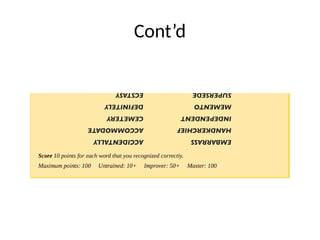
• The mechanism on which memory works and
thrives is association. Somewhere, in any word
you care to think of, there is a link to be forged
between the spelling and the meaning of a
word. If you didn’t fair too well on your first
attempt at that list of 10 words, then read
through them again, this time spotting any
little connection that will ensure you get the
spelling right.
18 How to Remember Countries and Their
Capitals
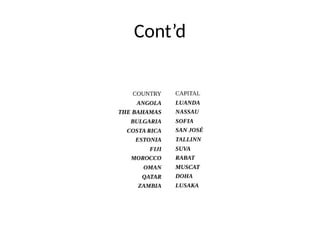
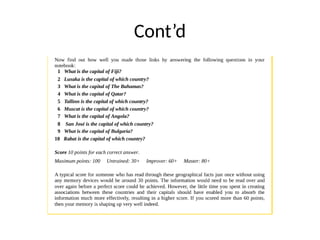
• In Steps 3 and 4 we looked at the use of mnemonics
as an aid to help us remember anything from the
colours of the spectrum to the order of the nine
planets. (Can you still remember them?) And so it
follows that mnemonics can be used to memorize a
whole array of geographical facts. If I had been
introduced to the world of mnemonics when I was
at school, I might have found the whole process of
learning much more enjoyable.
Cont’d
• If only my geography teacher had pointed out that
one way to remember that Canberra is the capital of
Australia is to look at the shape of the country.
Australia is shaped somewhat like a camera, which
helps me to remember its capital, Canberra.
• If my teacher had said that the way to remember the
difference between the Arctic and Antarctic was to
think of looking up at an arch and down at an ant,
then I might have found their geographical positions
less confusing.
Cont’d
• Drudgery-hard menial or dull work.
• Mnemonics are a great way to remove the
drudgery of learning by rote as they provide chains
of links between pieces of information that can
easily be retraced and therefore recalled at a later
date. It’s almost as if short-term memory is
bypassed as the data gets transferred straight into
long-term memory where it is cemented with
vivid, symbolic, associated imagery.
Cont’d
• Inn-a house providing accommodation, food,
and drink, especially for travellers.
Cont’d
Cont’d
Cont’d
19 Learning a Foreign Language
• Whether you need to learn another language
for business or travel, want to help your
children study a second language, or just want
basic conversational skills in another language,
this step reveals how it is possible to learn
foreign words at a rapid pace.
Cont’d
• The key is to create an image by finding a common link
between the sound of a foreign word and its meaning in
your own language. For example, bacon is Speck in
German. To make a link, picture a slice of bacon with an
unsavoury looking speck on it.
• To make this method even more effective we need a
place to store these images for instant retrieval. In many
languages, we will also need to know the gender of each
noun. My Gender Zones method enables us to perform
both these functions simultaneously.
Gender Zones
• In languages with two genders such as Spanish or French,
Gender Zones provide two discrete geographical regions in
your mind where everything is either masculine or feminine.
For example, any French word that is masculine I would place
in my home county of Surrey, England. Any feminine word I
would place in another county, Cornwall. Both regions must be
familiar to you to make this method work. For example, by
fixing my mind on a certain hospital in Surrey, I know that
hospital in French is masculine, un hôpital. To remember that
post office is a feminine word, la poste, I think of a specific post
office in Cornwall. Once I remind myself of these places I will
never confuse the gender of the two words.
Cont’d
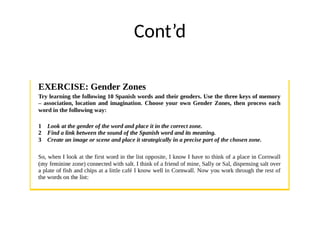
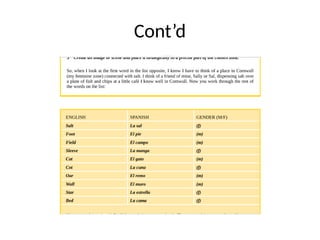
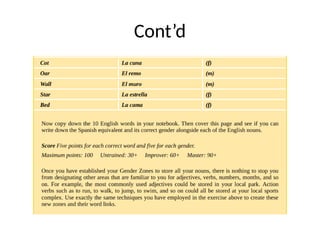
• These Gender Zones also act as filing systems
for storing your linked images. For example,
the French for sea is mer, which sounds to me
like “mayor”. I picture a mayor in full regalia
swimming in the sea off the coast of Cornwall,
and now I have performed two tasks in one
image. I know that sea is mer, and feminine,
because I have placed the image in Cornwall
(my feminine zone).
Cont’d
Cont’d
Cont’d
Cont’d
• This text is about learning new words in
another language using pictures and
imagination.
• Imagine you're learning how to say "bacon" in
German, which is "Speck." To help you
remember, you imagine a piece of bacon with
a tiny spot (or "speck") on it. This way, every
time you think of bacon, you'll remember
"Speck."
Cont’d
• Now, in some languages, words can be either
"boy" or "girl" words. To help remember
which is which, you imagine two places. One
place is for boy words and the other is for girl
words. For example, if you're learning French
and "hospital" is a boy word, you imagine a
hospital in a boy-place, like a town you know.
If "post office" is a girl word, you imagine it in
a different place, like a girl-town.
Cont’d
• By imagining these pictures and places, it
becomes easier to remember both the word
and if it’s for a boy or a girl.
Cont’d
• Hello, everyone!
• Today, I'm going to talk about how we can learn new words from different languages! It's like a
fun game where we use our imagination to help us remember things.
• Let’s say I want to learn the word for "bacon" in German. In German, "bacon" is called "Speck."
But how do I remember that? Here's a trick: I imagine a yummy slice of bacon with a little spot
or speck on it! When I think of that picture, I remember "Speck" is bacon.
• Some languages also have boy words and girl words. So, to remember which is which, we use
special places in our imagination! I pretend there are two places: one is for boy words, and the
other is for girl words.
• For example:
• In French, the word for "hospital" is a boy word. So, I imagine a hospital in a boy-place, like a
cool city.
• The word for "post office" is a girl word. So, I imagine a post office in a girl-place, like a park
with flowers.
• By using pictures and different places, I can remember the words faster and easier. It’s like
building a world in my head full of fun stories!
• Thank you for listening to my fun way of learning words!
20 How to Remember Your Past
• How far back in your past can you remember?
Very few people can remember anything of
the first year of their life, and most can
remember only from the age of three or four
onward. Thus, the few memories that we have
of our childhood are very precious to us.
Cont’d
• We attach great significance to these first
memories, setting each one as some kind of
milestone in our early life. Whatever it is that
has fixed them in our minds, these memories
play a major role in shaping us – they are part
of who we are.
Cont’d
• One method I use to return to memories from
the past is what I call “Time Travel”. The idea is
to return to a location from your past, which
will trigger a series of memories. The location
could be a school, a relative’s house, or a
village you once lived in.
Cont’d
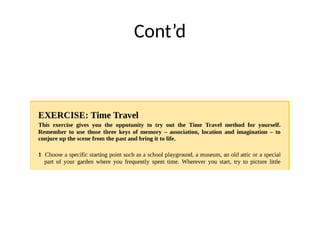
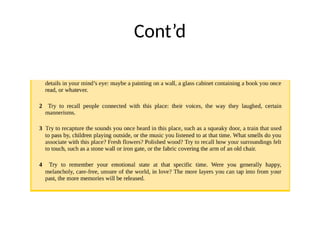
• In the following exercise you can try out this
method for yourself. Your aim is to return to a
particular location and time in your past, so
that you can release and enrich your
memories.
Cont’d
• This is a beneficial exercise for the memory in itself, and
you may decide to spend five or 10 minutes a day
working on a specific place and time from your past. You
should notice that each time you return to the scene
you will be starting with a clearer overview of that time
gone by. As your associations with that particular place
and time strengthen, you will find that one memory will
trigger another. You may also find that memories will
pop into your dreams, and pieces of the mental jigsaw
puzzle that were once lost may now be restored.
Cont’d
Cont’d
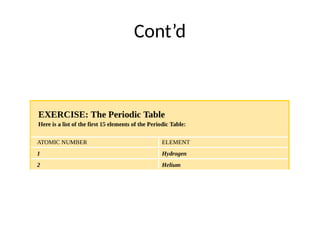
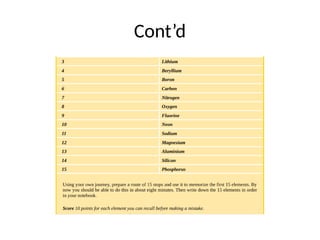
21 How to Remember the Elements
• A few years ago I made a television commercial in Florida
on the subject of memory. I was asked to illustrate the
power of my techniques by training two school children,
aged around 11 years old, to memorize the first 30
elements of the Periodic Table. Neither child had been
taught any memory techniques before, and yet after
about 20 minutes both children were able to recite the
correct order of the elements backward and forward,
and if they were asked, for example, “What is the atomic
number of Phosphorus?” they were able to give the
correct answer, “15”.
Cont’d
• To teach the children how to memorize the elements, I took them on a
short journey around the television studios, stopping at suitable places
where I asked them to imagine the different elements coming to life. We
started at the front gates of the studios where they imagined a small
explosion taking place. This would help them to remember the first
element, Hydrogen. We continued along our route, stopping at each
stage to make an association. At the fourth stop, they couldn’t think of
an association for Beryllium (the fourth element), so instead I asked
them to picture a little old lady named Beryl doing some knitting in the
editing suite (the fourth stop). At the tenth stop (the recording studio),
they pictured a flashing neon sign above the door, and so on. By the end
of our journey we had converted all 30 elements into meaningful scenes
which were easily recalled, and the journey preserved the order of this
list.
Cont’d
Cont’d
22 Develop Your Declarative Memory
• In this step we are going to look at how developing
our “declarative” or conscious memory can speed
up our ability to absorb new information. Let’s say
you wish to learn a new sport or discipline, such as
tennis or yoga. You will spend the first lesson
converting what your instructor, DVD or workbook
is telling you into physical actions. The conscious
effort you make to memorize the order of these
instructions is known as declarative memory.
Cont’d
• In time, your actions become automatic and
there is no longer any conscious act of recall. But
memory still plays its part – the kind known as
reflexive memory (learning by repetition).
However, wouldn’t it be easier if your declarative
memory was able to absorb and recall all these
commands in an instant? Think how much
sooner you could acquire this new skill if you
could learn every piece of advice accurately.
Cont’d
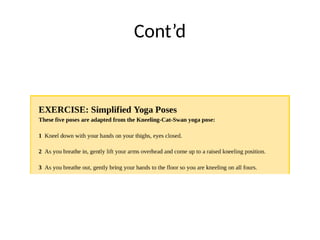
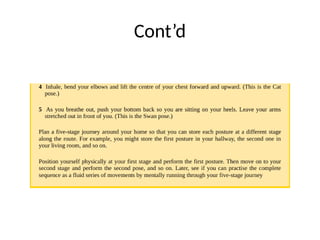
• The Journey Method can radically improve the efficiency of
your declarative memory. It gives you the best possible start if
you are learning a new discipline, especially one that involves
many moves to make in sequence. In the exercise opposite I
am going to show you how a sequence of yoga moves can be
stored quickly into long-term memory using a short journey.
By initially performing each posture in a different room or area
of your home you will implant the physical memory of each
posture as well as fix the order of the moves in your mind. So
when you come to practise the sequence as a whole, your
journey will remind you of the order.
Cont’d
Cont’d
23 The Dominic System I
• In Steps 12 and 13 we looked at simple
systems to translate numbers into pictures
using Number Shapes and Number Rhymes.
These mnemonic devices are a great
introduction to learning what I call the
“language” of numbers, and I use them for
memorizing anything involving a single-digit
number.
Cont’d
• However, when I began memorizing much
larger numbers for competitions I realized that
I needed a method that would allow me to
recognize numbers instantly as pictures, to the
point where I could read through and make
sense of a sequence of 100 digits, say, in much
the same way as I am able to read through
and understand a sentence composed of 100
letters grouped into words.
Cont’d
• Thus the Dominic System was born. Dominic
stands for: Decipherment Of Mnemonically
Interpreted Numbers Into Characters. This
system is more complex than Number Shapes
or Number Rhymes. However, if you invest a
little time in learning it, you will find it a much
more efficient method of converting numbers
into symbolic images.
Cont’d
• With the Dominic System any two-digit number (and of
course, there are 100 of them from 00 to 99) can be
translated into a person. Why turn numbers into people? For
the simple reason that people, especially ones who are
familiar to me and vivid in character, are so much easier to
remember than numbers. Why not choose objects instead
of people? Because I find people are more flexible than
objects. They can be imagined in almost any situation and
they react in countless ways to different environments.
Throw a custard pie at a chair and not much happens, but
throw one at a person and you are bound to get a response.
HOW DOES IT WORK?
• To start with, in your notebook, write the 100
numbers from 00 to 99 in a column. You will need
three more columns: Letters/Person/Action and
Prop (see page 75 for reference). You will see why in
a moment. Then take a look at any of these
numbers that may have significance for you. For
example, 10 instantly makes me think of a British
Prime Minister because that’s where he or she lives,
at 10 Downing Street. Perhaps 49 triggers a player
from the “49ers” American Superbowl team.
Cont’d
• When I see 57 I automatically think of my Godfather
because I was born in 1957. It doesn’t matter how
you get there as long as the number always leads
you to that particular person. Once you have
exhausted this line of investigation, then the next
step is to assign letters to the remaining two-digit
numbers (the ones which you can’t immediately
convert into people). To do this you will need to
assign all the digits to letters of the alphabet,
following a standard set of conversions.
Cont’d
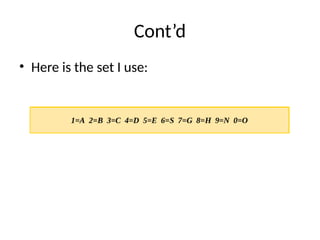
• Here is the set I use:
Cont’d
• Numbers 1 to 5 and 7 and 8 are paired with
the letters that match their positions in the
alphabet. O represents zero because they look
the same. S is paired with six because six has a
strong “S” sound. N represents 9 because the
word nine contains two “N”s.
Cont’d
• Once you have learnt this simple sequence, numbers can be
paired together to form the initials of various people. These
might include friends, relatives, politicians, comedians, actors,
sportsmen and women, even infamous villains. Let’s see how
this might work. Take any two-digit combination, such as 72.
By translating this number into its equivalent letters from the
Dominic Alphabet you get GB (7=G, 2=B). Who can you think
of that has the initials GB? George Bush perhaps? George Bush
now becomes your key image, or rather, key person, for the
number 72. The number 40 translates into DO (4=D, 0=O),
which just happens to be my own initials.
Cont’d
• It is not necessary for you to conjure up a
perfect photographic image of these people,
you just need to recognize them for what they
represent. The best way to do this is to assign
an action and prop to each person. George
Bush’s action and prop combination is waving
the American flag. Dominic O’Brien’s action
and prop combination is dealing out playing
cards.
Cont’d
• Now all of a sudden numbers become meaningful.
We have breathed life into them and they begin to
take on a personality of their own. In the advanced
section of this book I will be showing you how you
can use the Dominic System to memorize groups of
four or more numbers by combining the characters.
But before we get to that stage it’s a good idea to
start with the first few combinations of two-digit
numbers to get a feel for how this system works.
Cont’d
Cont’d
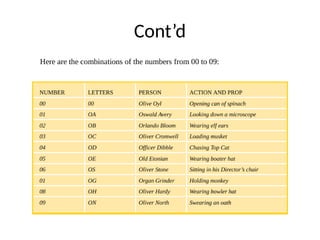
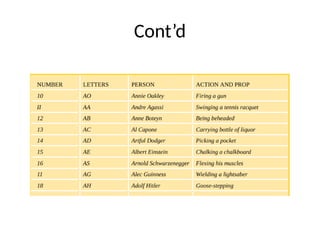
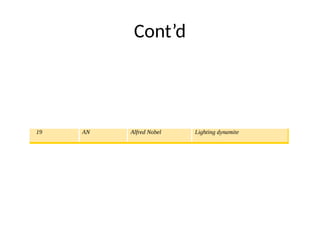
• I have suggested a name, action and prop for
each set of initials. Either transfer my
examples to the list in your notebook or create
your own characters, and commit each one to
memory. Now move on to the next 10
numbers (10 to 19). Again, use the characters I
have suggested or think up your own.
Cont’d
Cont’d
Cont’d
• The Dominic System is a key memory method which
we will primarily use in conjunction with the Journey
Method. I will introduce you to the Dominic System
gradually, at a pace designed in relation to this 52-
step course. And as I do so, I encourage you to take
the time and effort to learn each set of initials which
will eventually give you a relatively simple language
of 100 people. This system will ensure that
ultimately you end up with an amazingly efficient
facility for memorizing numerical information.
Cont’d
Cont’d
24 How to Remember Jokes
• Why is it that we so often struggle to
remember jokes? Well, when we listen to
jokes we are usually so busy enjoying them
that we don’t give a moment’s thought to
committing them to memory. Summarizing a
joke visually, either by translating it into a
scene or by linking it imaginatively with an
appropriate image, is one way to fix it more
firmly in our minds.
Cont’d
• In theory, we have only to recall the image and the joke will
spring back to life – assuming that it’s a memorable joke in the
first place. But how can we be sure of recollecting our visual
trigger? Imagine you find yourself chatting with a friend about
the circus, and deep in the back of your mind lies a joke about
a lion tamer. You attempted, many months ago, to commit this
joke to memory by linking it with a vivid image of the lion
tamer swallowed by the lion– a fate which only just escapes
him in the joke itself. But because you have forgotten that you
once heard and tried to memorize this joke, your friend’s
references to circuses are not enough to trigger the memory of
the image. And so you miss the opportunity to amuse.
Cont’d
• What, then, can we do to ensure that the joke
we once memorized springs to mind exactly
when we want it? The answer is that we must
consciously build a repertoire of jokes and
rehearse them from time to time until they all
become second nature to us.
Cont’d
• Whatever memory technique is used thus becomes a kind
of scaffolding: it is useful for the preparatory stage –
building the repertoire – but can be discarded once the
whole body of jokes is well established in our mind. To
build your repertoire, use the Journey Method (see Step
10). Say your house or apartment has 10 rooms; you might
add to this a friend’s house or apartment to give you 20
rooms, or 20 positions, in your overall journey. Attach an
image to each new joke that you learn, and place each
image mentally in the next room you come to, going
around the houses in your pre-determined sequence.
Cont’d
• Tell five different people each new joke, soon
after you have heard it: this also helps to fix
the memory. And from time to time rehearse
your whole repertoire of 20 jokes once you
have filled both houses. In time these jokes
will become as familiar to you as the alphabet,
and you will be able to summon up any of
them whenever the occasion arises.
Cont’d
25 How to Remember Fiction
• Reading novels is a great pastime for vacations. Our
various commitments can make it hard to grab more
than half an hour or so at a time, and then perhaps
not more than two or three times per week. So it’s
easy to forget the beginning of the book before you
are half-way through. Plot connections can pass you
by. You may fail to understand motivation that has
been set up many pages back. You may completely
miss the point of one or more sub-plots, even if the
main plot is well within your grasp.
cont’d
• “No, I can follow even complex plots pretty well,”
you may protest. But how long do you keep all but
the most rudimentary details in your head
afterwards? A month or two? Six months? If for so
little time, that’s a pity because you are missing
out on the retrospective enjoyment to be gained
from your reading. Using memory discipline will
make your reading something you can appreciate
in retrospect as well as in the present.
Words to be…you know what to do
• Rudimentary
• Pity
• retrospective
• Rudimentary: Basic or simple, dealing with the most fundamental parts of something.
• Pity: A feeling of sadness or compassion for someone else's suffering or misfortune.
• Retrospective: Looking back at or reviewing past events or experiences.
• characters’ predicaments
• summon up
• almost fits, the bill.
• go astray
• Characters' predicaments: The difficult or problematic situations that characters in a story
are facing.
• Summon up: To gather or bring forth, often used for emotions or energy (e.g., "summon up
courage").
• Almost fits the bill: It’s close to being right or suitable, but not perfect.
• Go astray: To become lost, go off course, or make a mistake.
Cont’d
• Few people would want to go to the trouble of learning a
novel by the Journey Method, but there’s no reason why you
shouldn’t develop a Mind Map (Step 28) to help you get your
bearings. The most useful technique, though, is to invest the
book with imaginative energy. Picture the scenes and
encounters as vividly as you can. Try to empathize with
characters’ predicaments. To help you imagine a particular
figure in terms of their appearance, personality or life
circumstances, summon up someone you know who fits, or
almost fits, the bill. Use places you know to help you visualize
the settings, if this helps. Or if the location is exotic, borrow
from what you have seen in magazines or on the television.
Cont’d
• Where many readers go astray is in imagining
that a novel is to be experienced only for as
long as you’re reading it. In fact, your recall
will be better if you let the characters and
their situations live for a while in your head
after you have put the book down. Imagine
what it feels like to be a character in this book
Cont’d
Cont’d
26 Read Faster and Remember More
• We live in an age of information. There simply isn’t
enough time in the day to read every word in every
piece of media presented to us. The good news is
that we don’t need to read every single word on a
page to understand its content. In fact, by focusing
on key words, you can comprehend and store the
information just as efficiently as you would if you
read the text word for word, thus speeding up your
reading. So, you could say that speed reading is a
speed memorization technique.
THE PRINCIPLES OF SPEED READING
• THE PRINCIPLES OF SPEED READING The
average reading speed is a little more than 200
words per minute for the average student with
varying rates of comprehension. However, this
speed can be increased – in excess of 1,000
words per minute with practice – by following
these inextricably linked keys of speed
reading:
Cont’d
• Use a pointer. Although it may seem unnatural
to begin with, using some form of pointer,
such as a pen or your finger, helps the eye
glide smoothly along the line. This allows you
to develop a continuous rhythm, without
distraction. Read a whole passage – or a short
article – without breaking off, reading each
sentence only once and taking in only the
essentials.
Cont’d
• If you give your full attention, you will not
need to back-track: minor words need not
detain you. Keep up a smooth, steady pace,
and try increasing the speed with which you
move the pointer.
Cont’d
Cont’d
Words for the next topic
• Nodding terms-not fully developed relation ship.
• Verbatim-in exactly the same words as were used originally.
• Leeway-freedom
• Repertoire-collection
• Phraseology-a particular mode of expression
27 How to Remember Quotations
• To be able to slip into your ordinary conversation a quote
from a writer such as Oscar Wilde or Mark Twain or a thinker
such as Albert Einstein or Ralph Waldo Emerson is a sure way
to impress or to give you the advantage in a debate. But
quotations are so slippery! And there’s no point in half-
remembering a quotation, or giving up half-way through or
not remembering who said it, as that’s certain to undermine
the impression you want to give of being on nodding terms
with the great and good – at least through their writings. In
this step we look at ways in which useful or inspiring
quotations can be memorized for long-term retention.
Cont’d
• As with jokes, the best way to fix a quote in
your memory is to associate it with a vivid
image. But there are two differences to bear in
mind. First, with quotations you need to be
able to recall the text verbatim (although with
foreign quotations there will usually be some
leeway over the translation). And second, you
will need to remember who it was who wrote
or uttered the remark in the first place.
Cont’d
• You may find that the best way to store quotes is to build a repertoire
of them using the Journey Method, following the advice given for
remembering jokes (Step 24). As we’re dealing with the written word,
a book store or local library makes an ideal location for your journey –
you could even place each quote in the relevant department within
the building. If you can, devise an image that fuses the author of the
quote with its content, and store this in the appropriate stage of your
journey, as part of your quotation repertoire. Further aspects might
be memorized to help you to reconstruct the particular phraseology
of the quote. Now let’s take an example, and see how you might
approach it. The following quote is from Sir Winston Churchill: “A
pessimist sees the difficulty in every opportunity; an optimist sees the
opportunity in every difficulty.”
Cont’d
• The first step is to find a key image which summarizes the
essence of the quote. Now the classic image in this quote is
the glass that the optimist would describe as half-full, the
pessimist as half-empty. So you picture Churchill – rotund and
enjoying a cigar – holding a half-full glass (of Scotch perhaps)
with an optimistic expression on his face. The “Win” of
Winston links with optimism and further reinforces the
message. You might notice that the two opposing views are a
mirror image of each other (“the difficulty in every
opportunity … the opportunity in every difficulty”), and
imagine Churchill reflected in the mirror-like surface of the
glass.
Cont’d
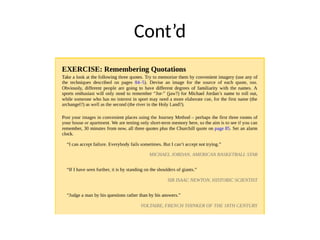
• If you are unfamiliar with the author of the
quote, and thus have to remember a name
that is devoid of associations for you, you
might break the surname down into syllables
and memorize one or more of these, using
your own imagination in following any of the
associational links I have previously described
in this book.
Cont’d
Cont’d
28 Memory and Mind Maps ®
• Mind Mapping offers a simplified
diagrammatic overview of a subject and is an
ideal way to present information in a visual
form that your brain can easily grasp. It is a
useful technique for recording a summary of
what you have read in a book, newspaper or
magazine or heard in a lecture or in a TV or
radio program.
Cont’d
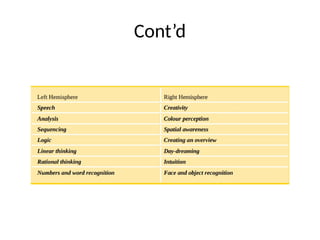
• Mind-Maps ® were invented in the 1960s by my friend
and colleague, Tony Buzan. Tony saw Mind Maps as a
way of utilizing the left and right hemispheres of the
brain simultaneously, in cooperation with each other.
The analytical, logical left brain understands and
assesses the information; while the imaginative,
intuitive right brain finds a visual form in which to
present it. Below is a summary of the different
processes associated with each hemisphere, to help
you understand how Mind Mapping works.
Cont’d
Cont’d
• A Mind Map is a good way to represent the
relative importance of different topics – and to
appraise them or remind yourself of them at a
glance. The central themes are clearly defined
and all extraneous information is eliminated.
You can see the whole picture and the key
details all at the same time.
Cont’d
Cont’d
Cont’d
cont’d
• So how would you go about Mind Mapping, say, a
lecture? The speaker might follow an eccentric
order of presentation – he or she might start with a
minor point to grab your attention and build up
slowly to the main point, or state it first, followed
by a series of qualifications. As you construct your
Mind Map you need to be flexible enough to
accommodate such shifts of emphasis. You may not
know what the key points are until the lecture is
over.
Cont’d
• Many people will choose to do a draft in pen or pencil
before producing a finalized version in colour. By creating
simple graphic images within the Mind Map (don’t worry, no
artistic expertise is required), you help to make key points
vivid and memorable. And by using different colours of ink
or pencil, you can emphasize the different strands of subject
matter to help you “read” the Mind Map more speedily or
more effectively – which makes the device an excellent
revision tool. It is also a useful way to prepare an essay, to
reduce a manual, workbook or article to a simpler, clearer
form, or to clarify your ideas about any kind of project.
Cont’d
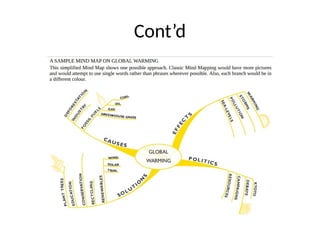
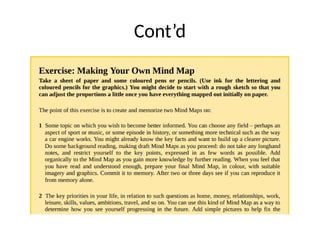
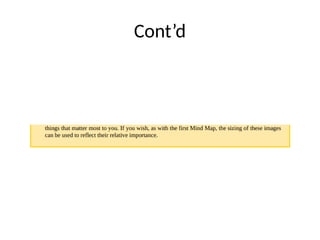
• When you choose to commit a Mind Map to memory,
the spatial aspects help you to cement the contents
there. The idea is to absorb and recall the whole map,
as you would recall a place you know, or a map of
where you live. Let’s say you want to remember the
effects of global warming. Picture the branch at the
top right-hand side of the map, and read off, in your
memory, the key words positioned there. Any
pictorial symbol you have placed alongside will
further help you with the process of recollection.
Cont’d
• Intimidating: Causing fear or making someone feel nervous.
• Roving eye contact: Constantly moving your eyes around
the room, looking at different people.
• Stage fright: Feeling nervous or scared when performing in
front of people.
• Notorious: Well-known for something bad or negative.
• Expectant audience: A group of people who are eagerly
waiting and expecting something to happen.
• Panic: A sudden, overwhelming feeling of fear or anxiety
that makes it hard to think or act calmly.
29 How to Remember Speeches and
Presentations
• For some people the thought of standing up in front of
even a small audience and saying a few words can be
highly intimidating. The best presentations or speeches
are well prepared and delivered from memory, the
speaker maintaining roving eye contact with the
audience. But nerves can undermine the pleasure of
giving or hearing such speeches, not least because stage
fright is a notorious memory thief: confronting an
expectant audience, even the best-rehearsed of
speechmakers may suddenly find that their mind has
gone completely blank. Panic!
Cont’d
• USING A MIND MAP
• One of the most effective ways to prepare a speech or presentation is to get
all your ideas down onto a Mind Map, as described in the previous step. You
then fix this set of cues in your mind and proceed in a logical order through
the diagram – for example, clockwise, starting at upper left, or whatever
seems the most natural order to you. The key images and/or words that you
plot on your map become prompts for whatever you want to say. By the time
you give your speech, the map will be thoroughly familiar to you. Even while
you were devising it in the first place, it will have started to imprint itself in
your mind; and then you will have reinforced the memory every time you
studied it subsequently. Of course, just before it’s time for you to make the
speech it’s wise to steal a few moments at least to have a final look – and, if
there is time, rehearse the stages of the speech in your head using the Mind
Map itself to check afterwards that you haven’t omitted any of your points.
Cont’d
• The beauty of using a Mind Map to prepare a
speech is that it will give you confidence. You know
that literally you have the whole speech mapped
out in your mind in a familiar image, and that you
can travel around your image at will. Confidence is
self-reinforcing. Just knowing that you are well
equipped helps you to do a good job; and this in
turn increases your confidence even more next
time you are faced with a similar challenge.
Cont’d
• A crib sheet is a set of notes or information used to help
someone remember something, especially for cheating on
an exam. It's also known as a cheat sheet.
• Opt-to make a choice
• Of course, in many speechmaking situations no one would
be surprised or disappointed if you held a crib-sheet in
your hand and glanced at it from time to time whenever
you needed a prompt. Holding a single sheet with your
Mind Map on it is certainly going to give a better
impression than sheaves of notes which you have to rifle
through to find your place.
Cont’d
• USING THE JOURNEY METHOD Another way to
prepare a note-free delivery is to write down the
key words of your speech and convert them by
association to memorable images which you then
place at different stages along a chosen route using
the Journey Method (see Step 10). You might opt to
use your own house or apartment, or the walk from
your home to the train station. Further guidance on
using this technique is given with an example,
opposite.
Cont’d
Cont’d
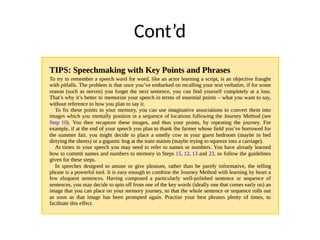
• This text provides tips for remembering key points and phrases in a speech:
• Focus on Main Points: Instead of memorizing the entire speech word-for-
word, focus on the main points to avoid getting stuck if you forget a line.
• Use Visual Associations: Imagine vivid images for each point and place
them in specific mental locations (using the "Journey Method") to help you
remember the flow of your speech.
• Recall Names and Numbers: If your speech includes names or numbers,
use memory techniques you've learned to keep them in mind.
• Include Strong Phrases: For speeches meant to entertain, memorize a few
powerful sentences. Place an image in your memory journey to trigger
these phrases.
• Practice: Rehearse these key phrases often to ensure they come naturally
during your speech.
30 The Art of Revision and Maximizing Recall
• So far in this book we have looked at various mnemonic techniques
for memorizing a range of information including PINs, short
shopping lists, directions, foreign vocabulary, quotations and short
speeches. Most of these techniques involve the three keys of
association, location and imagination. In particular, using the
Journey Method, based on familiar locations, appears to bridge the
gap between short-and long-term retention. It’s as though the data
bypasses short-term memory, allowing more information to go
straight into the long-term memory bank. These memory techniques
remove the drudgery of traditional methods of rote learning, which
in comparison can be slow, repetitive and less efficient. But to
ensure that information remains in your long-term memory, it’s
essential to know when and how often to review it.
EBBINGHAUS AND THE RECALL CURVE
• One of the first people to carry out experiments on human memory
was the German philosopher Hermann Ebbinghaus (1850–1909).
He devised a way of testing memory using a series of nonsense
syllables – seemingly meaningless, unmemorable syllables, for
example: DAJ. He would read through a list of 20 such items several
times until he was able to memorize the exact sequence. He then
measured his retention of the list after varying time periods. This
was probably the first ever formal learning curve. Ebbinghaus
observed that, for a series of information, data near the beginning
and end of the list was easier to recall than that in the middle.
These tendencies are known as the Primacy and Recency effects
respectively, and a U-shaped curve graphically illustrated the
findings.
Cont’d
• Ebbinghaus also discovered that the best way
to maintain maximum recall was to review
data regularly until what he called
“overlearning” had been achieved. To
consolidate your memory of stored data you
need to know when to review it. Here is my
suggested schedule of review times, which I
find works extremely well for most types of
material:
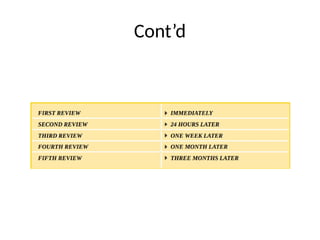
Cont’d
Cont’d
• You can follow this “rule of five” with some of
the exercises in this book. The exercise itself
will provide the first review stage. You can
then return to it after the suggested time
periods and re-test yourself to ensure that the
data remains in your long-term memory.
summary
• To keep information in your long-term
memory, reviewing it at specific intervals is
key. This concept is based on Hermann
Ebbinghaus's research on memory, which
showed that we forget things quickly unless we
review them regularly. Ebbinghaus found that
information at the beginning and end of a list
is easier to remember (called the Primacy and
Recency effects), while the middle is harder.
Cont’d
• To maximize recall, he discovered that frequent review—especially right
after learning and then spaced over time—can lead to "overlearning,"
where information becomes well-stored in long-term memory.
• Here’s a simple “rule of five” for review:
• Review right after learning.
• Review after 24 hours.
• Review after 1 week.
• Review after 1 month.
• Review after a few months.
• Following these spaced intervals helps transfer information to long-term
memory, making it much easier to recall when you need it. The author
recommends applying this to the exercises in the book for optimal
memory retention.
CHAPTER-2(Memory Construction) memo.pptx

CHAPTER-2(Memory Construction) memo.pptx

  • 1.
  • 2.
    • • Step15 How to Remember Names and Faces • Step 16 How to Remember Directions • Step 17 How to Remember Spellings • Step 18 How to Remember Countries and Their Capitals • Step 19 Learning a Foreign Language • Step 20 How to Remember Your Past • Step 21 How to Remember the Elements • Step 22 Develop Your Declarative Memory • Step 23 The Dominic System I • Step 24 How to Remember Jokes • Step 25 How to Remember Fiction • Step 26 Read Faster and Remember More • Step 27 How to Remember Quotations • Step 28 Memory and Mind Maps® • Step 29 How to Remember Speeches and Presentations • Step 30 The Art of Revision and Maximizing Recall
  • 3.
    15 How toRemember Names and Faces • “Forgive your enemies, but never forget their names.” JOHN F. KENNEDY (1917–63) • HANG OVER-Remain suspended or unsettled • Discern-recognize or find out. • Of all the concerns that people have shared with me about their memory, putting names to faces is number one on the list. As humans we have an inbuilt mechanism for recognizing faces (this is probably an evolutionary hangover from the time when we needed to discern our friends from our enemies). If remembering a face presents no difficulty, then why is it that so many of us have a problem when it comes to remembering names? There’s a very simple answer: our names do not describe our faces.
  • 4.
    Cont’d • Portray-describe (someoneor something) in a particular way. • My first name is Dominic, but this does not help to portray my face to you. And the matter is not made easier by the fact that I share my surname – O’Brien– with tens of thousands of others around the world. Imagine trying to memorize one hundred people in a room whose names were just Bob, Mary, Michael or Jane.
  • 5.
    Cont’d • Embarrassment-a feelingof self-consciousness, shame, or awkwardness. • What are the most effective ways of ensuring you never experience that embarrassing moment at a party, which we’ve all suffered at some time, when you are forced to ask, “Sorry, what was your name again?” 30 seconds after being introduced to someone? The most important thing is to recognize that we tend to associate a person with a particular place. Think of a time when you have bumped into someone in the street whose face is very familiar but whose name escapes you. What is the first thing you do to try to recall who this person is? You ask yourself, “Where do I know this person from?” It is the place that will release most of the memories connected with this person including, hopefully, his or her name.
  • 6.
    Cont’d • very seriousabout studying, reading, learning, etc. a studious child. • One trick I use to memorize people for the first time is to designate a place for each of them. I do this by imagining where I might expect to find this person. Let’s say you are being introduced to a lady at a party and for some reason you think that she looks like a librarian. Perhaps she has a studious air about her.
  • 7.
    Cont’d • Now youhave prepared a location for her. You are told that her name is “Margaret”. Now think of someone that you know of called Margaret (a relative, friend, actress, politician, or whoever) and picture her at your local library. The first Margaret you think of is the ex British Prime Minister, Margaret Thatcher so you imagine her working at the library. The next time you see this lady’s face you will be able to retrace her name in the following way: FACE LIBRARY THATCHER SCENE MARGARET
  • 8.
    Cont’d • This mayseem like a lengthy process to connect the face to the name, but remember that your brain recalls information in a flash as long as there is chain of associated connections for it to travel along. • Someone who is hook-nosed has a large nose that curves out from the face. • A beak is the hard, pointed structure sticking out from a bird's face.
  • 9.
    Cont’d • If Imeet someone whose features are particularly striking, instead of associating that person with a place, I sometimes find it is easier to connect their name directly to their physical appearance. For example, you are introduced to a man called Peter Byrd and immediately you connect his name with his face as he has a rather hooked nose (a bit like a bird’s beak). Your brain can now make more connections and quickly seizes on “Pet”, short for Peter, and there you have your link: Pet Bird.
  • 10.
    Cont’d • I findthe best way to tackle a complicated surname is to break it down into syllables and then turn these syllables into images. Names, like numbers, need to be translated into images so that our brains can digest them. Our brains thrive on making connections, so when we are confronted with a name that doesn’t represent a face, then the answer is to forge an artificial link between the two.
  • 11.
    Cont’d • Agility-the abilityto think and draw conclusions quickly; intellectual acuity. • The phrase "her braids poking out" typically refers to someone's braids being visible or sticking out from under something, like a hat, hood, or other covering. It suggests that the braids are partially hidden but still noticeable, giving a casual, slightly playful or relaxed impression.
  • 12.
    Cont’d • Braids area hairstyle where three or more sections of hair are interwoven to create a woven pattern. This style can range from simple to intricate and has cultural significance in many parts of the world. Braiding can also help protect hair from damage, and the styles can vary in size, tightness, and complexity, including box braids, cornrows, and French braids.
  • 13.
    Cont’d • Your observationthat "she has rosy cheeks" suggests she may be physically exerted or emotionally engaged, and imagining her flushed from singing adds a layer of vividness. It paints a picture of someone deeply involved in their performance, perhaps experiencing the joy, passion, or effort of the moment. The flush could symbolize both physical exertion and emotional intensity. • "Physically exerted" means someone is putting in significant physical effort, which can lead to signs like sweating, increased heart rate, or flushed skin. In your example, it implies that the person may be working hard, such as singing energetically, which could cause her to become flushed or out of breath.
  • 14.
    Cont’d • The followingexercise will give you a chance to try out your brain’s agility in making links. You can use any of the techniques described in this step: that is, place a person in a familiar location, or identify physical resemblances, or distinctive characteristics of a name or face to make associations and form memorable images. For example, how might you commit Maria Hutton to memory? The surname “Hutton” sounds to me like “hat on”, so I picture Maria Hutton wearing a hat, with her braids poking out. I notice that she has rosy cheeks, so I imagine she is flushed from singing the line “I’ve just met a girl named Maria” from the musical, West Side Story. This will remind me of her first name.
  • 15.
  • 16.
  • 17.
    16 How toRemember Directions • Predicament-a difficult, unpleasant, or embarrassing situation. • passer-by-a person who happens to be going past something, especially on foot. • Does the following predicament sound familiar to you? You are in an unfamiliar area and you’re late for an appointment. You stop to ask a passer-by for directions, and will have to rely on your memory, as you do not have a pen and paper to hand. The passer-by bombards you with a sequence of directions that you know you are going to forget unless you hear them repeated several times. But you don’t have time for this, and you decide to take a chance that you will remember the directions to get you to your destination. Of course, it is likely that you’ll need to stop again a couple of miles down the street and ask someone else for further directions.
  • 18.
    Cont’d • However, byapplying a simple memory technique you need only listen to a set of directions once. Let’s imagine you are lost in an American town and a sympathetic stranger gives you the following set of directions:
  • 19.
  • 20.
    Cont’d • At firstglance this may appear to be too much information to absorb all in one go. However, if you have been working through the exercises in this book so far, you should already be feeling confident about your progress, particularly when it comes to memorizing a sequence of just seven pieces of information.
  • 21.
    Cont’d • Backdrop-the settingor background for a scene, event, or situation. • This is how I tackle memorizing directions: I regard them as a sequence of shopping items, say, and I use the Journey Method to store them quickly. Naturally, you need to have your journey pre-prepared. As there are seven individual directions, you need a short journey of just seven stages, which you can use to store the information. For example, you could use a favourite vacation destination as your backdrop for the journey.
  • 22.
  • 23.
    Cont’d • Lobby-a roomproviding a space out of which one or more other rooms or corridors lead, typically one near the entrance of a public building.
  • 24.
  • 25.
    Cont’d • Startled-feeling orshowing sudden shock or alarm. • by the window. would be understood to meaning in the vicinity or nearby the window.
  • 26.
  • 27.
  • 28.
  • 29.
  • 30.
    17 How toRemember Spellings • Whenever I am forced to think twice about how to spell a commonly misspelt word, I tend to rely on a mnemonic strategy that I used to rectify misspelling when I was first confronted with the dilemma. For example, I know I will never confuse the correct spelling of the word separate with its commonly misspelled counterpart, seperate, because I think of a para-trooper landing in the middle of the word separating the two halves: se para te.
  • 31.
  • 32.
  • 33.
    Cont’d • The trickis to look out for connections between certain patterns of letters and the meanings of the words. Then use visualization and association to make those connections memorable. For example, notice the symmetry of the three Es in the word c E m E t E ry. They stick out like gravestones. I put my hand in my pocket to pull out my handkerchief. I use my memory to remind me that a memento, not a momento, is a reminder.
  • 34.
    Cont’d • The mechanismon which memory works and thrives is association. Somewhere, in any word you care to think of, there is a link to be forged between the spelling and the meaning of a word. If you didn’t fair too well on your first attempt at that list of 10 words, then read through them again, this time spotting any little connection that will ensure you get the spelling right.
  • 35.
    18 How toRemember Countries and Their Capitals • In Steps 3 and 4 we looked at the use of mnemonics as an aid to help us remember anything from the colours of the spectrum to the order of the nine planets. (Can you still remember them?) And so it follows that mnemonics can be used to memorize a whole array of geographical facts. If I had been introduced to the world of mnemonics when I was at school, I might have found the whole process of learning much more enjoyable.
  • 36.
    Cont’d • If onlymy geography teacher had pointed out that one way to remember that Canberra is the capital of Australia is to look at the shape of the country. Australia is shaped somewhat like a camera, which helps me to remember its capital, Canberra. • If my teacher had said that the way to remember the difference between the Arctic and Antarctic was to think of looking up at an arch and down at an ant, then I might have found their geographical positions less confusing.
  • 37.
    Cont’d • Drudgery-hard menialor dull work. • Mnemonics are a great way to remove the drudgery of learning by rote as they provide chains of links between pieces of information that can easily be retraced and therefore recalled at a later date. It’s almost as if short-term memory is bypassed as the data gets transferred straight into long-term memory where it is cemented with vivid, symbolic, associated imagery.
  • 38.
    Cont’d • Inn-a houseproviding accommodation, food, and drink, especially for travellers.
  • 39.
  • 40.
  • 41.
  • 42.
    19 Learning aForeign Language • Whether you need to learn another language for business or travel, want to help your children study a second language, or just want basic conversational skills in another language, this step reveals how it is possible to learn foreign words at a rapid pace.
  • 43.
    Cont’d • The keyis to create an image by finding a common link between the sound of a foreign word and its meaning in your own language. For example, bacon is Speck in German. To make a link, picture a slice of bacon with an unsavoury looking speck on it. • To make this method even more effective we need a place to store these images for instant retrieval. In many languages, we will also need to know the gender of each noun. My Gender Zones method enables us to perform both these functions simultaneously.
  • 44.
    Gender Zones • Inlanguages with two genders such as Spanish or French, Gender Zones provide two discrete geographical regions in your mind where everything is either masculine or feminine. For example, any French word that is masculine I would place in my home county of Surrey, England. Any feminine word I would place in another county, Cornwall. Both regions must be familiar to you to make this method work. For example, by fixing my mind on a certain hospital in Surrey, I know that hospital in French is masculine, un hôpital. To remember that post office is a feminine word, la poste, I think of a specific post office in Cornwall. Once I remind myself of these places I will never confuse the gender of the two words.
  • 45.
    Cont’d • These GenderZones also act as filing systems for storing your linked images. For example, the French for sea is mer, which sounds to me like “mayor”. I picture a mayor in full regalia swimming in the sea off the coast of Cornwall, and now I have performed two tasks in one image. I know that sea is mer, and feminine, because I have placed the image in Cornwall (my feminine zone).
  • 46.
  • 47.
  • 48.
  • 49.
    Cont’d • This textis about learning new words in another language using pictures and imagination. • Imagine you're learning how to say "bacon" in German, which is "Speck." To help you remember, you imagine a piece of bacon with a tiny spot (or "speck") on it. This way, every time you think of bacon, you'll remember "Speck."
  • 50.
    Cont’d • Now, insome languages, words can be either "boy" or "girl" words. To help remember which is which, you imagine two places. One place is for boy words and the other is for girl words. For example, if you're learning French and "hospital" is a boy word, you imagine a hospital in a boy-place, like a town you know. If "post office" is a girl word, you imagine it in a different place, like a girl-town.
  • 51.
    Cont’d • By imaginingthese pictures and places, it becomes easier to remember both the word and if it’s for a boy or a girl.
  • 52.
    Cont’d • Hello, everyone! •Today, I'm going to talk about how we can learn new words from different languages! It's like a fun game where we use our imagination to help us remember things. • Let’s say I want to learn the word for "bacon" in German. In German, "bacon" is called "Speck." But how do I remember that? Here's a trick: I imagine a yummy slice of bacon with a little spot or speck on it! When I think of that picture, I remember "Speck" is bacon. • Some languages also have boy words and girl words. So, to remember which is which, we use special places in our imagination! I pretend there are two places: one is for boy words, and the other is for girl words. • For example: • In French, the word for "hospital" is a boy word. So, I imagine a hospital in a boy-place, like a cool city. • The word for "post office" is a girl word. So, I imagine a post office in a girl-place, like a park with flowers. • By using pictures and different places, I can remember the words faster and easier. It’s like building a world in my head full of fun stories! • Thank you for listening to my fun way of learning words!
  • 53.
    20 How toRemember Your Past • How far back in your past can you remember? Very few people can remember anything of the first year of their life, and most can remember only from the age of three or four onward. Thus, the few memories that we have of our childhood are very precious to us.
  • 54.
    Cont’d • We attachgreat significance to these first memories, setting each one as some kind of milestone in our early life. Whatever it is that has fixed them in our minds, these memories play a major role in shaping us – they are part of who we are.
  • 55.
    Cont’d • One methodI use to return to memories from the past is what I call “Time Travel”. The idea is to return to a location from your past, which will trigger a series of memories. The location could be a school, a relative’s house, or a village you once lived in.
  • 56.
    Cont’d • In thefollowing exercise you can try out this method for yourself. Your aim is to return to a particular location and time in your past, so that you can release and enrich your memories.
  • 57.
    Cont’d • This isa beneficial exercise for the memory in itself, and you may decide to spend five or 10 minutes a day working on a specific place and time from your past. You should notice that each time you return to the scene you will be starting with a clearer overview of that time gone by. As your associations with that particular place and time strengthen, you will find that one memory will trigger another. You may also find that memories will pop into your dreams, and pieces of the mental jigsaw puzzle that were once lost may now be restored.
  • 58.
  • 59.
  • 60.
    21 How toRemember the Elements • A few years ago I made a television commercial in Florida on the subject of memory. I was asked to illustrate the power of my techniques by training two school children, aged around 11 years old, to memorize the first 30 elements of the Periodic Table. Neither child had been taught any memory techniques before, and yet after about 20 minutes both children were able to recite the correct order of the elements backward and forward, and if they were asked, for example, “What is the atomic number of Phosphorus?” they were able to give the correct answer, “15”.
  • 61.
    Cont’d • To teachthe children how to memorize the elements, I took them on a short journey around the television studios, stopping at suitable places where I asked them to imagine the different elements coming to life. We started at the front gates of the studios where they imagined a small explosion taking place. This would help them to remember the first element, Hydrogen. We continued along our route, stopping at each stage to make an association. At the fourth stop, they couldn’t think of an association for Beryllium (the fourth element), so instead I asked them to picture a little old lady named Beryl doing some knitting in the editing suite (the fourth stop). At the tenth stop (the recording studio), they pictured a flashing neon sign above the door, and so on. By the end of our journey we had converted all 30 elements into meaningful scenes which were easily recalled, and the journey preserved the order of this list.
  • 62.
  • 63.
  • 64.
    22 Develop YourDeclarative Memory • In this step we are going to look at how developing our “declarative” or conscious memory can speed up our ability to absorb new information. Let’s say you wish to learn a new sport or discipline, such as tennis or yoga. You will spend the first lesson converting what your instructor, DVD or workbook is telling you into physical actions. The conscious effort you make to memorize the order of these instructions is known as declarative memory.
  • 65.
    Cont’d • In time,your actions become automatic and there is no longer any conscious act of recall. But memory still plays its part – the kind known as reflexive memory (learning by repetition). However, wouldn’t it be easier if your declarative memory was able to absorb and recall all these commands in an instant? Think how much sooner you could acquire this new skill if you could learn every piece of advice accurately.
  • 66.
    Cont’d • The JourneyMethod can radically improve the efficiency of your declarative memory. It gives you the best possible start if you are learning a new discipline, especially one that involves many moves to make in sequence. In the exercise opposite I am going to show you how a sequence of yoga moves can be stored quickly into long-term memory using a short journey. By initially performing each posture in a different room or area of your home you will implant the physical memory of each posture as well as fix the order of the moves in your mind. So when you come to practise the sequence as a whole, your journey will remind you of the order.
  • 67.
  • 68.
  • 69.
    23 The DominicSystem I • In Steps 12 and 13 we looked at simple systems to translate numbers into pictures using Number Shapes and Number Rhymes. These mnemonic devices are a great introduction to learning what I call the “language” of numbers, and I use them for memorizing anything involving a single-digit number.
  • 70.
    Cont’d • However, whenI began memorizing much larger numbers for competitions I realized that I needed a method that would allow me to recognize numbers instantly as pictures, to the point where I could read through and make sense of a sequence of 100 digits, say, in much the same way as I am able to read through and understand a sentence composed of 100 letters grouped into words.
  • 71.
    Cont’d • Thus theDominic System was born. Dominic stands for: Decipherment Of Mnemonically Interpreted Numbers Into Characters. This system is more complex than Number Shapes or Number Rhymes. However, if you invest a little time in learning it, you will find it a much more efficient method of converting numbers into symbolic images.
  • 72.
    Cont’d • With theDominic System any two-digit number (and of course, there are 100 of them from 00 to 99) can be translated into a person. Why turn numbers into people? For the simple reason that people, especially ones who are familiar to me and vivid in character, are so much easier to remember than numbers. Why not choose objects instead of people? Because I find people are more flexible than objects. They can be imagined in almost any situation and they react in countless ways to different environments. Throw a custard pie at a chair and not much happens, but throw one at a person and you are bound to get a response.
  • 73.
    HOW DOES ITWORK? • To start with, in your notebook, write the 100 numbers from 00 to 99 in a column. You will need three more columns: Letters/Person/Action and Prop (see page 75 for reference). You will see why in a moment. Then take a look at any of these numbers that may have significance for you. For example, 10 instantly makes me think of a British Prime Minister because that’s where he or she lives, at 10 Downing Street. Perhaps 49 triggers a player from the “49ers” American Superbowl team.
  • 74.
    Cont’d • When Isee 57 I automatically think of my Godfather because I was born in 1957. It doesn’t matter how you get there as long as the number always leads you to that particular person. Once you have exhausted this line of investigation, then the next step is to assign letters to the remaining two-digit numbers (the ones which you can’t immediately convert into people). To do this you will need to assign all the digits to letters of the alphabet, following a standard set of conversions.
  • 75.
    Cont’d • Here isthe set I use:
  • 76.
    Cont’d • Numbers 1to 5 and 7 and 8 are paired with the letters that match their positions in the alphabet. O represents zero because they look the same. S is paired with six because six has a strong “S” sound. N represents 9 because the word nine contains two “N”s.
  • 77.
    Cont’d • Once youhave learnt this simple sequence, numbers can be paired together to form the initials of various people. These might include friends, relatives, politicians, comedians, actors, sportsmen and women, even infamous villains. Let’s see how this might work. Take any two-digit combination, such as 72. By translating this number into its equivalent letters from the Dominic Alphabet you get GB (7=G, 2=B). Who can you think of that has the initials GB? George Bush perhaps? George Bush now becomes your key image, or rather, key person, for the number 72. The number 40 translates into DO (4=D, 0=O), which just happens to be my own initials.
  • 78.
    Cont’d • It isnot necessary for you to conjure up a perfect photographic image of these people, you just need to recognize them for what they represent. The best way to do this is to assign an action and prop to each person. George Bush’s action and prop combination is waving the American flag. Dominic O’Brien’s action and prop combination is dealing out playing cards.
  • 79.
    Cont’d • Now allof a sudden numbers become meaningful. We have breathed life into them and they begin to take on a personality of their own. In the advanced section of this book I will be showing you how you can use the Dominic System to memorize groups of four or more numbers by combining the characters. But before we get to that stage it’s a good idea to start with the first few combinations of two-digit numbers to get a feel for how this system works.
  • 80.
  • 81.
    Cont’d • I havesuggested a name, action and prop for each set of initials. Either transfer my examples to the list in your notebook or create your own characters, and commit each one to memory. Now move on to the next 10 numbers (10 to 19). Again, use the characters I have suggested or think up your own.
  • 82.
  • 83.
  • 84.
    Cont’d • The DominicSystem is a key memory method which we will primarily use in conjunction with the Journey Method. I will introduce you to the Dominic System gradually, at a pace designed in relation to this 52- step course. And as I do so, I encourage you to take the time and effort to learn each set of initials which will eventually give you a relatively simple language of 100 people. This system will ensure that ultimately you end up with an amazingly efficient facility for memorizing numerical information.
  • 85.
  • 86.
  • 87.
    24 How toRemember Jokes • Why is it that we so often struggle to remember jokes? Well, when we listen to jokes we are usually so busy enjoying them that we don’t give a moment’s thought to committing them to memory. Summarizing a joke visually, either by translating it into a scene or by linking it imaginatively with an appropriate image, is one way to fix it more firmly in our minds.
  • 88.
    Cont’d • In theory,we have only to recall the image and the joke will spring back to life – assuming that it’s a memorable joke in the first place. But how can we be sure of recollecting our visual trigger? Imagine you find yourself chatting with a friend about the circus, and deep in the back of your mind lies a joke about a lion tamer. You attempted, many months ago, to commit this joke to memory by linking it with a vivid image of the lion tamer swallowed by the lion– a fate which only just escapes him in the joke itself. But because you have forgotten that you once heard and tried to memorize this joke, your friend’s references to circuses are not enough to trigger the memory of the image. And so you miss the opportunity to amuse.
  • 89.
    Cont’d • What, then,can we do to ensure that the joke we once memorized springs to mind exactly when we want it? The answer is that we must consciously build a repertoire of jokes and rehearse them from time to time until they all become second nature to us.
  • 90.
    Cont’d • Whatever memorytechnique is used thus becomes a kind of scaffolding: it is useful for the preparatory stage – building the repertoire – but can be discarded once the whole body of jokes is well established in our mind. To build your repertoire, use the Journey Method (see Step 10). Say your house or apartment has 10 rooms; you might add to this a friend’s house or apartment to give you 20 rooms, or 20 positions, in your overall journey. Attach an image to each new joke that you learn, and place each image mentally in the next room you come to, going around the houses in your pre-determined sequence.
  • 91.
    Cont’d • Tell fivedifferent people each new joke, soon after you have heard it: this also helps to fix the memory. And from time to time rehearse your whole repertoire of 20 jokes once you have filled both houses. In time these jokes will become as familiar to you as the alphabet, and you will be able to summon up any of them whenever the occasion arises.
  • 92.
  • 93.
    25 How toRemember Fiction • Reading novels is a great pastime for vacations. Our various commitments can make it hard to grab more than half an hour or so at a time, and then perhaps not more than two or three times per week. So it’s easy to forget the beginning of the book before you are half-way through. Plot connections can pass you by. You may fail to understand motivation that has been set up many pages back. You may completely miss the point of one or more sub-plots, even if the main plot is well within your grasp.
  • 94.
    cont’d • “No, Ican follow even complex plots pretty well,” you may protest. But how long do you keep all but the most rudimentary details in your head afterwards? A month or two? Six months? If for so little time, that’s a pity because you are missing out on the retrospective enjoyment to be gained from your reading. Using memory discipline will make your reading something you can appreciate in retrospect as well as in the present.
  • 95.
    Words to be…youknow what to do • Rudimentary • Pity • retrospective • Rudimentary: Basic or simple, dealing with the most fundamental parts of something. • Pity: A feeling of sadness or compassion for someone else's suffering or misfortune. • Retrospective: Looking back at or reviewing past events or experiences. • characters’ predicaments • summon up • almost fits, the bill. • go astray • Characters' predicaments: The difficult or problematic situations that characters in a story are facing. • Summon up: To gather or bring forth, often used for emotions or energy (e.g., "summon up courage"). • Almost fits the bill: It’s close to being right or suitable, but not perfect. • Go astray: To become lost, go off course, or make a mistake.
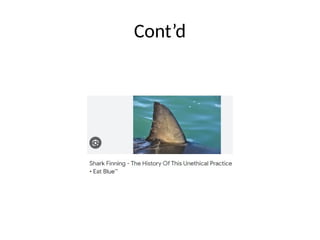
  • 96.
    Cont’d • Few peoplewould want to go to the trouble of learning a novel by the Journey Method, but there’s no reason why you shouldn’t develop a Mind Map (Step 28) to help you get your bearings. The most useful technique, though, is to invest the book with imaginative energy. Picture the scenes and encounters as vividly as you can. Try to empathize with characters’ predicaments. To help you imagine a particular figure in terms of their appearance, personality or life circumstances, summon up someone you know who fits, or almost fits, the bill. Use places you know to help you visualize the settings, if this helps. Or if the location is exotic, borrow from what you have seen in magazines or on the television.
  • 97.
    Cont’d • Where manyreaders go astray is in imagining that a novel is to be experienced only for as long as you’re reading it. In fact, your recall will be better if you let the characters and their situations live for a while in your head after you have put the book down. Imagine what it feels like to be a character in this book
  • 98.
  • 99.
  • 100.
    26 Read Fasterand Remember More • We live in an age of information. There simply isn’t enough time in the day to read every word in every piece of media presented to us. The good news is that we don’t need to read every single word on a page to understand its content. In fact, by focusing on key words, you can comprehend and store the information just as efficiently as you would if you read the text word for word, thus speeding up your reading. So, you could say that speed reading is a speed memorization technique.
  • 101.
    THE PRINCIPLES OFSPEED READING • THE PRINCIPLES OF SPEED READING The average reading speed is a little more than 200 words per minute for the average student with varying rates of comprehension. However, this speed can be increased – in excess of 1,000 words per minute with practice – by following these inextricably linked keys of speed reading:
  • 102.
    Cont’d • Use apointer. Although it may seem unnatural to begin with, using some form of pointer, such as a pen or your finger, helps the eye glide smoothly along the line. This allows you to develop a continuous rhythm, without distraction. Read a whole passage – or a short article – without breaking off, reading each sentence only once and taking in only the essentials.
  • 103.
    Cont’d • If yougive your full attention, you will not need to back-track: minor words need not detain you. Keep up a smooth, steady pace, and try increasing the speed with which you move the pointer.
  • 104.
  • 105.
  • 106.
    Words for thenext topic • Nodding terms-not fully developed relation ship. • Verbatim-in exactly the same words as were used originally. • Leeway-freedom • Repertoire-collection • Phraseology-a particular mode of expression
  • 107.
    27 How toRemember Quotations • To be able to slip into your ordinary conversation a quote from a writer such as Oscar Wilde or Mark Twain or a thinker such as Albert Einstein or Ralph Waldo Emerson is a sure way to impress or to give you the advantage in a debate. But quotations are so slippery! And there’s no point in half- remembering a quotation, or giving up half-way through or not remembering who said it, as that’s certain to undermine the impression you want to give of being on nodding terms with the great and good – at least through their writings. In this step we look at ways in which useful or inspiring quotations can be memorized for long-term retention.
  • 108.
    Cont’d • As withjokes, the best way to fix a quote in your memory is to associate it with a vivid image. But there are two differences to bear in mind. First, with quotations you need to be able to recall the text verbatim (although with foreign quotations there will usually be some leeway over the translation). And second, you will need to remember who it was who wrote or uttered the remark in the first place.
  • 109.
    Cont’d • You mayfind that the best way to store quotes is to build a repertoire of them using the Journey Method, following the advice given for remembering jokes (Step 24). As we’re dealing with the written word, a book store or local library makes an ideal location for your journey – you could even place each quote in the relevant department within the building. If you can, devise an image that fuses the author of the quote with its content, and store this in the appropriate stage of your journey, as part of your quotation repertoire. Further aspects might be memorized to help you to reconstruct the particular phraseology of the quote. Now let’s take an example, and see how you might approach it. The following quote is from Sir Winston Churchill: “A pessimist sees the difficulty in every opportunity; an optimist sees the opportunity in every difficulty.”
  • 110.
    Cont’d • The firststep is to find a key image which summarizes the essence of the quote. Now the classic image in this quote is the glass that the optimist would describe as half-full, the pessimist as half-empty. So you picture Churchill – rotund and enjoying a cigar – holding a half-full glass (of Scotch perhaps) with an optimistic expression on his face. The “Win” of Winston links with optimism and further reinforces the message. You might notice that the two opposing views are a mirror image of each other (“the difficulty in every opportunity … the opportunity in every difficulty”), and imagine Churchill reflected in the mirror-like surface of the glass.
  • 111.
    Cont’d • If youare unfamiliar with the author of the quote, and thus have to remember a name that is devoid of associations for you, you might break the surname down into syllables and memorize one or more of these, using your own imagination in following any of the associational links I have previously described in this book.
  • 112.
  • 113.
  • 114.
    28 Memory andMind Maps ® • Mind Mapping offers a simplified diagrammatic overview of a subject and is an ideal way to present information in a visual form that your brain can easily grasp. It is a useful technique for recording a summary of what you have read in a book, newspaper or magazine or heard in a lecture or in a TV or radio program.
  • 115.
    Cont’d • Mind-Maps ®were invented in the 1960s by my friend and colleague, Tony Buzan. Tony saw Mind Maps as a way of utilizing the left and right hemispheres of the brain simultaneously, in cooperation with each other. The analytical, logical left brain understands and assesses the information; while the imaginative, intuitive right brain finds a visual form in which to present it. Below is a summary of the different processes associated with each hemisphere, to help you understand how Mind Mapping works.
  • 116.
  • 117.
    Cont’d • A MindMap is a good way to represent the relative importance of different topics – and to appraise them or remind yourself of them at a glance. The central themes are clearly defined and all extraneous information is eliminated. You can see the whole picture and the key details all at the same time.
  • 118.
  • 119.
  • 120.
  • 121.
    cont’d • So howwould you go about Mind Mapping, say, a lecture? The speaker might follow an eccentric order of presentation – he or she might start with a minor point to grab your attention and build up slowly to the main point, or state it first, followed by a series of qualifications. As you construct your Mind Map you need to be flexible enough to accommodate such shifts of emphasis. You may not know what the key points are until the lecture is over.
  • 122.
    Cont’d • Many peoplewill choose to do a draft in pen or pencil before producing a finalized version in colour. By creating simple graphic images within the Mind Map (don’t worry, no artistic expertise is required), you help to make key points vivid and memorable. And by using different colours of ink or pencil, you can emphasize the different strands of subject matter to help you “read” the Mind Map more speedily or more effectively – which makes the device an excellent revision tool. It is also a useful way to prepare an essay, to reduce a manual, workbook or article to a simpler, clearer form, or to clarify your ideas about any kind of project.
  • 123.
    Cont’d • When youchoose to commit a Mind Map to memory, the spatial aspects help you to cement the contents there. The idea is to absorb and recall the whole map, as you would recall a place you know, or a map of where you live. Let’s say you want to remember the effects of global warming. Picture the branch at the top right-hand side of the map, and read off, in your memory, the key words positioned there. Any pictorial symbol you have placed alongside will further help you with the process of recollection.
  • 124.
    Cont’d • Intimidating: Causingfear or making someone feel nervous. • Roving eye contact: Constantly moving your eyes around the room, looking at different people. • Stage fright: Feeling nervous or scared when performing in front of people. • Notorious: Well-known for something bad or negative. • Expectant audience: A group of people who are eagerly waiting and expecting something to happen. • Panic: A sudden, overwhelming feeling of fear or anxiety that makes it hard to think or act calmly.
  • 125.
    29 How toRemember Speeches and Presentations • For some people the thought of standing up in front of even a small audience and saying a few words can be highly intimidating. The best presentations or speeches are well prepared and delivered from memory, the speaker maintaining roving eye contact with the audience. But nerves can undermine the pleasure of giving or hearing such speeches, not least because stage fright is a notorious memory thief: confronting an expectant audience, even the best-rehearsed of speechmakers may suddenly find that their mind has gone completely blank. Panic!
  • 126.
    Cont’d • USING AMIND MAP • One of the most effective ways to prepare a speech or presentation is to get all your ideas down onto a Mind Map, as described in the previous step. You then fix this set of cues in your mind and proceed in a logical order through the diagram – for example, clockwise, starting at upper left, or whatever seems the most natural order to you. The key images and/or words that you plot on your map become prompts for whatever you want to say. By the time you give your speech, the map will be thoroughly familiar to you. Even while you were devising it in the first place, it will have started to imprint itself in your mind; and then you will have reinforced the memory every time you studied it subsequently. Of course, just before it’s time for you to make the speech it’s wise to steal a few moments at least to have a final look – and, if there is time, rehearse the stages of the speech in your head using the Mind Map itself to check afterwards that you haven’t omitted any of your points.
  • 127.
    Cont’d • The beautyof using a Mind Map to prepare a speech is that it will give you confidence. You know that literally you have the whole speech mapped out in your mind in a familiar image, and that you can travel around your image at will. Confidence is self-reinforcing. Just knowing that you are well equipped helps you to do a good job; and this in turn increases your confidence even more next time you are faced with a similar challenge.
  • 128.
    Cont’d • A cribsheet is a set of notes or information used to help someone remember something, especially for cheating on an exam. It's also known as a cheat sheet. • Opt-to make a choice • Of course, in many speechmaking situations no one would be surprised or disappointed if you held a crib-sheet in your hand and glanced at it from time to time whenever you needed a prompt. Holding a single sheet with your Mind Map on it is certainly going to give a better impression than sheaves of notes which you have to rifle through to find your place.
  • 129.
    Cont’d • USING THEJOURNEY METHOD Another way to prepare a note-free delivery is to write down the key words of your speech and convert them by association to memorable images which you then place at different stages along a chosen route using the Journey Method (see Step 10). You might opt to use your own house or apartment, or the walk from your home to the train station. Further guidance on using this technique is given with an example, opposite.
  • 130.
  • 131.
    Cont’d • This textprovides tips for remembering key points and phrases in a speech: • Focus on Main Points: Instead of memorizing the entire speech word-for- word, focus on the main points to avoid getting stuck if you forget a line. • Use Visual Associations: Imagine vivid images for each point and place them in specific mental locations (using the "Journey Method") to help you remember the flow of your speech. • Recall Names and Numbers: If your speech includes names or numbers, use memory techniques you've learned to keep them in mind. • Include Strong Phrases: For speeches meant to entertain, memorize a few powerful sentences. Place an image in your memory journey to trigger these phrases. • Practice: Rehearse these key phrases often to ensure they come naturally during your speech.

  • 132.
    30 The Artof Revision and Maximizing Recall • So far in this book we have looked at various mnemonic techniques for memorizing a range of information including PINs, short shopping lists, directions, foreign vocabulary, quotations and short speeches. Most of these techniques involve the three keys of association, location and imagination. In particular, using the Journey Method, based on familiar locations, appears to bridge the gap between short-and long-term retention. It’s as though the data bypasses short-term memory, allowing more information to go straight into the long-term memory bank. These memory techniques remove the drudgery of traditional methods of rote learning, which in comparison can be slow, repetitive and less efficient. But to ensure that information remains in your long-term memory, it’s essential to know when and how often to review it.

  • 133.
    EBBINGHAUS AND THERECALL CURVE • One of the first people to carry out experiments on human memory was the German philosopher Hermann Ebbinghaus (1850–1909). He devised a way of testing memory using a series of nonsense syllables – seemingly meaningless, unmemorable syllables, for example: DAJ. He would read through a list of 20 such items several times until he was able to memorize the exact sequence. He then measured his retention of the list after varying time periods. This was probably the first ever formal learning curve. Ebbinghaus observed that, for a series of information, data near the beginning and end of the list was easier to recall than that in the middle. These tendencies are known as the Primacy and Recency effects respectively, and a U-shaped curve graphically illustrated the findings.
  • 134.
    Cont’d • Ebbinghaus alsodiscovered that the best way to maintain maximum recall was to review data regularly until what he called “overlearning” had been achieved. To consolidate your memory of stored data you need to know when to review it. Here is my suggested schedule of review times, which I find works extremely well for most types of material:
  • 135.
  • 136.
    Cont’d • You canfollow this “rule of five” with some of the exercises in this book. The exercise itself will provide the first review stage. You can then return to it after the suggested time periods and re-test yourself to ensure that the data remains in your long-term memory.
  • 137.
    summary • To keepinformation in your long-term memory, reviewing it at specific intervals is key. This concept is based on Hermann Ebbinghaus's research on memory, which showed that we forget things quickly unless we review them regularly. Ebbinghaus found that information at the beginning and end of a list is easier to remember (called the Primacy and Recency effects), while the middle is harder.
  • 138.
    Cont’d • To maximizerecall, he discovered that frequent review—especially right after learning and then spaced over time—can lead to "overlearning," where information becomes well-stored in long-term memory. • Here’s a simple “rule of five” for review: • Review right after learning. • Review after 24 hours. • Review after 1 week. • Review after 1 month. • Review after a few months. • Following these spaced intervals helps transfer information to long-term memory, making it much easier to recall when you need it. The author recommends applying this to the exercises in the book for optimal memory retention.