HUMAN RESOURCE MGT.
ACQUISITION
The acquisition of information related to the
jobs in the organization it is done in job analysis.
Usually, this is executed in organizations that have
already existed for quite some time. The reason for
this practice is that since these companies have
existed for a number of years, and they have more or
less actual work experiences based on the job titles or
positions, therefore, they adequate knowledge
concerning the said Jobs.
JOB ANALYSIS
- is the procedure of
determining the duties
and skill requirements
of the job and the kind
of person who should
be hired for it (Dessler,
2010).
How to conduct a job analysis?
1. GATHER INFORMATION ABOUT A POSITION
Observe and interview employees currently in the job position.
2. EVALUATE THE IMPORTANCE OF EACH TASK AND COMPETENCY.
Once you gain an understanding of which competencies are needed
to perform each job, you can rank the difficulty of each task and skill set.
3. RESEARCH INDUSTRY STANDARDS
Find data about the positions on your job analysis to make sure you are
aligned with the current workforce.
4. REVISE JOB DESCRIPTIONS AND STANDARDS
Once you've observed and figured out the most important
competencies needed to perform a job, set up a list of every task and skill set.
5. USE DATA TO MAKE CHANGES
Look at your organization as a whole. Decide if the right tasks are
assigned to the right jobs based on your analysis.
WHAT METHODS CAN YOU USE TO CONDUCT
A JOB ANALYSIS?
Interviews: Asking an employee to give details about their job is one
way to create an accurate job description.
Observations: An employer may also choose to watch as employees
complete their jobs, noting the tasks they complete and the skills needed for
those tasks.
Surveys: Some employers will use a survey to find out how often a certain
task is completed or how much a skill set is used.
Work logs: Employers may request a written account of daily work for a
certain period of time.
THE FOLLOWING INFORMATION CAN BE
COLLECTED THROUGH JOB ANALYSIS:
1.Specific tasks activities
A job analyst can obtain information of the
different tasks required by a job such as painting,
drafting, writing, teaching, encoding, and cleaning
skills. Additional includes how this tasks are done, the
specific time they are performed, and the reasons
why they should be performed.
2. Required behavior on the job
Information about the behavior required
in the performance of various jobs such as
communicating, writing, computing, driving,
forklifting, among others.
3. Required job standards
The job analyst can also gather the
information regarding the performance levels
or standards by the job. This is needed to
evaluate the performance of the employee.
4. Knowledge, tools, and equipment used
Information on the tools and equipment
used by the employee can be gathered during
the job analysis. Knowledge of software
application, accounting procedures, and law,
among others is also taken into account.
5. Work conditions
These includes the physical aspects
of the job such as work schedules, physical
environment.
6. Personal characteristics and
requirements
These include the educational
background, training or experience, as
well as type of personality, attitudes,
values and physical characteristics
needed for the position
JOB ANALYSIS PROCESS
1. Formulation of objectives
In this step, the firm identifies and
formulates the goals of the job analysis.
It determines how the job analysis will be
used.
2. Selection of jobs
Last organizations usually have many
jobs. Since job analysis is a time-
consuming process, jobs to be analyzed
are carefully selected.
3. Application of job analysis
techniques
There are many techniques that can be
used in conducting a job analysis. Proper
selection of the appropriate techniques will
be less costly for the organization.
4. Actual conduct of job analysis
The actual data gathering needs
considerable time and effort since the data
include the features of the job, the proper
attitude towards the job, and the
characteristics of the employee who will
perform the job.
JOB ANALYSIS PROCESS
5. Preparation of the job description and
job specification
After data gathering comes to write the
job description for each job analyzed.
BENEFITS OF CONDUCTING A
JOB ANALYSIS
Recognize necessary skills and
tasks
Create evaluation methods
Determine salaries and promotion
criteria
Guide employee training and
development
Update hiring processes
JOB DESCRIPTION
is a written summary of the
particular job. It provides a clear
overview of what the job is all
about and minimizes
inconsistencies in the actual job
and what is actually written.
JOB SPECIFICATION
is a part of a job description. It is
found in the lower part of the job
description and contains the
educational qualifications, skills,
experience and traits that a job
holder should have in order to
become effective in the job.
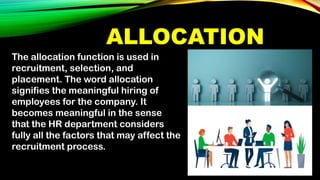
ALLOCATION
The allocation function is used in
recruitment, selection, and
placement. The word allocation
signifies the meaningful hiring of
employees for the company. It
becomes meaningful in the sense
that the HR department considers
fully all the factors that may affect the
recruitment process.
RECRUITMENT
Proper allocation entails
placing the employees in the
right department and making
sure they are equipped with
the right skills and experience
for the job.
THE FOLLOWING ARE THE MAIN
STEPS IN RECRUITMENT:
1. Planning and approval
based on HR planning
The recruitment function
starts with the management
decision to recruit based on
the findings taken from HR
planning sessions.
2. Position announcement/
Job posting
Once the job vacancies
are identified, the step is to
choose between external
and internal recruitment. In
terms of percentages, the
right combination of
external and internal hiring
always raises an issue.
3. Recruitment strategies
There are various
techniques on how to recruit
applicants. There are two
sources of recruitment:
internal and external.
Chapter 2 Human Resource Management.pptx

Chapter 2 Human Resource Management.pptx

  • 1.
  • 2.
    ACQUISITION The acquisition ofinformation related to the jobs in the organization it is done in job analysis. Usually, this is executed in organizations that have already existed for quite some time. The reason for this practice is that since these companies have existed for a number of years, and they have more or less actual work experiences based on the job titles or positions, therefore, they adequate knowledge concerning the said Jobs.
  • 3.
    JOB ANALYSIS - isthe procedure of determining the duties and skill requirements of the job and the kind of person who should be hired for it (Dessler, 2010).
  • 4.
    How to conducta job analysis? 1. GATHER INFORMATION ABOUT A POSITION Observe and interview employees currently in the job position. 2. EVALUATE THE IMPORTANCE OF EACH TASK AND COMPETENCY. Once you gain an understanding of which competencies are needed to perform each job, you can rank the difficulty of each task and skill set. 3. RESEARCH INDUSTRY STANDARDS Find data about the positions on your job analysis to make sure you are aligned with the current workforce. 4. REVISE JOB DESCRIPTIONS AND STANDARDS Once you've observed and figured out the most important competencies needed to perform a job, set up a list of every task and skill set.
  • 5.
    5. USE DATATO MAKE CHANGES Look at your organization as a whole. Decide if the right tasks are assigned to the right jobs based on your analysis.
  • 7.
    WHAT METHODS CANYOU USE TO CONDUCT A JOB ANALYSIS? Interviews: Asking an employee to give details about their job is one way to create an accurate job description. Observations: An employer may also choose to watch as employees complete their jobs, noting the tasks they complete and the skills needed for those tasks. Surveys: Some employers will use a survey to find out how often a certain task is completed or how much a skill set is used. Work logs: Employers may request a written account of daily work for a certain period of time.
  • 8.
    THE FOLLOWING INFORMATIONCAN BE COLLECTED THROUGH JOB ANALYSIS: 1.Specific tasks activities A job analyst can obtain information of the different tasks required by a job such as painting, drafting, writing, teaching, encoding, and cleaning skills. Additional includes how this tasks are done, the specific time they are performed, and the reasons why they should be performed. 2. Required behavior on the job Information about the behavior required in the performance of various jobs such as communicating, writing, computing, driving, forklifting, among others.
  • 9.
    3. Required jobstandards The job analyst can also gather the information regarding the performance levels or standards by the job. This is needed to evaluate the performance of the employee. 4. Knowledge, tools, and equipment used Information on the tools and equipment used by the employee can be gathered during the job analysis. Knowledge of software application, accounting procedures, and law, among others is also taken into account.
  • 10.
    5. Work conditions Theseincludes the physical aspects of the job such as work schedules, physical environment. 6. Personal characteristics and requirements These include the educational background, training or experience, as well as type of personality, attitudes, values and physical characteristics needed for the position
  • 11.
    JOB ANALYSIS PROCESS 1.Formulation of objectives In this step, the firm identifies and formulates the goals of the job analysis. It determines how the job analysis will be used. 2. Selection of jobs Last organizations usually have many jobs. Since job analysis is a time- consuming process, jobs to be analyzed are carefully selected. 3. Application of job analysis techniques There are many techniques that can be used in conducting a job analysis. Proper selection of the appropriate techniques will be less costly for the organization. 4. Actual conduct of job analysis The actual data gathering needs considerable time and effort since the data include the features of the job, the proper attitude towards the job, and the characteristics of the employee who will perform the job.
  • 12.
    JOB ANALYSIS PROCESS 5.Preparation of the job description and job specification After data gathering comes to write the job description for each job analyzed.
  • 13.
    BENEFITS OF CONDUCTINGA JOB ANALYSIS Recognize necessary skills and tasks Create evaluation methods Determine salaries and promotion criteria Guide employee training and development Update hiring processes
  • 14.
    JOB DESCRIPTION is awritten summary of the particular job. It provides a clear overview of what the job is all about and minimizes inconsistencies in the actual job and what is actually written.
  • 15.
    JOB SPECIFICATION is apart of a job description. It is found in the lower part of the job description and contains the educational qualifications, skills, experience and traits that a job holder should have in order to become effective in the job.
  • 16.
    ALLOCATION The allocation functionis used in recruitment, selection, and placement. The word allocation signifies the meaningful hiring of employees for the company. It becomes meaningful in the sense that the HR department considers fully all the factors that may affect the recruitment process.
  • 17.
    RECRUITMENT Proper allocation entails placingthe employees in the right department and making sure they are equipped with the right skills and experience for the job.
  • 18.
    THE FOLLOWING ARETHE MAIN STEPS IN RECRUITMENT: 1. Planning and approval based on HR planning The recruitment function starts with the management decision to recruit based on the findings taken from HR planning sessions.
  • 19.
    2. Position announcement/ Jobposting Once the job vacancies are identified, the step is to choose between external and internal recruitment. In terms of percentages, the right combination of external and internal hiring always raises an issue.
  • 20.
    3. Recruitment strategies Thereare various techniques on how to recruit applicants. There are two sources of recruitment: internal and external.