CHAPTER 2: EARTH’S INTERNAL PROCESSESS AND
CRUSTAL DEFORMATION
OBJECTIVES
1. ILLUSTRATE THE
CHARACTERISTICS
OF THE INTERNAL
LAYERS OF THE
EARTH
2. RECOGNIZE THE
PRESENCE OF
DISCONTINUITIES
BETWEEN EACH
INTERNAL LAYER OF
EARTH
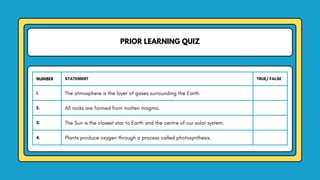
PRIOR LEARNING QUIZ
NUMBER STATEMENT TRUE/ FALSE
1. The atmosphere is the layer of gases surrounding the Earth.
2. All rocks are formed from molten magma.
3. The Sun is the closest star to Earth and the centre of our solar system.
4. Plants produce oxygen through a process called photosynthesis.
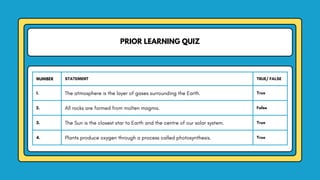
PRIOR LEARNING QUIZ
NUMBER STATEMENT TRUE/ FALSE
1. The atmosphere is the layer of gases surrounding the Earth. True
2. All rocks are formed from molten magma. False
3. The Sun is the closest star to Earth and the centre of our solar system. True
4. Plants produce oxygen through a process called photosynthesis. True
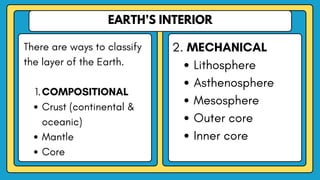
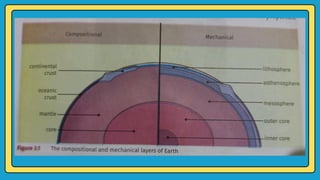
EARTH’S INTERIOR
There are ways to classify
the layer of the Earth.
1.COMPOSITIONAL
Crust (continental &
oceanic)
Mantle
Core
2. MECHANICAL
Lithosphere
Asthenosphere
Mesosphere
Outer core
Inner core
THE COMPOSITIONAL LAYERS OF
EARTH
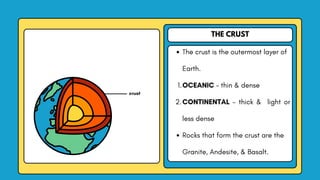
THE CRUST
The crust is the outermost layer of
Earth.
1.OCEANIC - thin & dense
2.CONTINENTAL - thick & light or
less dense
Rocks that form the crust are the
Granite, Andesite, & Basalt.
crust
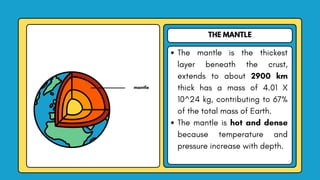
THE MANTLE
The mantle is the thickest
layer beneath the crust,
extends to about 2900 km
thick has a mass of 4.01 X
10^24 kg, contributing to 67%
of the total mass of Earth.
The mantle is hot and dense
because temperature and
pressure increase with depth.
mantle
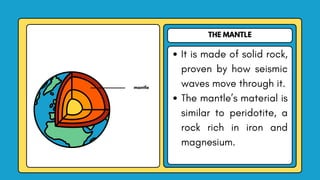
THE MANTLE
It is made of solid rock,
proven by how seismic
waves move through it.
The mantle’s material is
similar to peridotite, a
rock rich in iron and
magnesium.
mantle
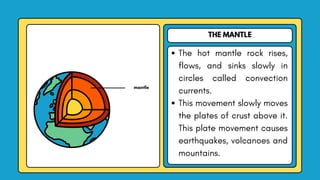
THE MANTLE
The hot mantle rock rises,
flows, and sinks slowly in
circles called convection
currents.
This movement slowly moves
the plates of crust above it.
This plate movement causes
earthquakes, volcanoes and
mountains.
mantle
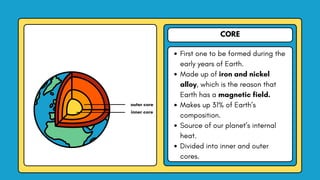
CORE
First one to be formed during the
early years of Earth.
Made up of iron and nickel
alloy, which is the reason that
Earth has a magnetic field.
Makes up 31% of Earth’s
composition.
Source of our planet’s internal
heat.
Divided into inner and outer
cores.
outer core
inner core
THE MECHANICAL LAYERS OF
EARTH
THE EARTH HAS TWO KINDS OF LAYERS:
COMPOSITIONAL LAYERS (CRUST, MANTLE,
AND CORE) AND MECHANICAL LAYERS,
WHICH ARE BASED ON HOW STRONG OR
SOFT THE LAYERS ARE. THE FIVE
MECHANICAL LAYERS ARE:
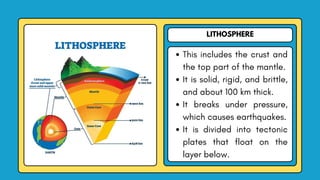
LITHOSPHERE
This includes the crust and
the top part of the mantle.
It is solid, rigid, and brittle,
and about 100 km thick.
It breaks under pressure,
which causes earthquakes.
It is divided into tectonic
plates that float on the
layer below.
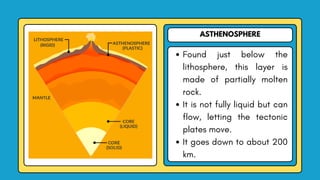
ASTHENOSPHERE
Found just below the
lithosphere, this layer is
made of partially molten
rock.
It is not fully liquid but can
flow, letting the tectonic
plates move.
It goes down to about 200
km.
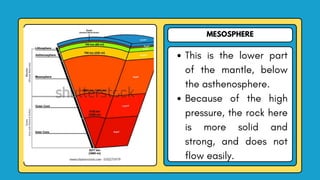
MESOSPHERE
This is the lower part
of the mantle, below
the asthenosphere.
Because of the high
pressure, the rock here
is more solid and
strong, and does not
flow easily.
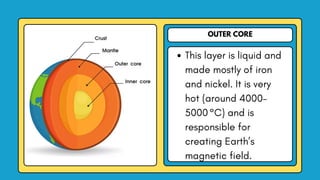
OUTER CORE
This layer is liquid and
made mostly of iron
and nickel. It is very
hot (around 4000–
5000°C) and is
responsible for
creating Earth’s
magnetic field.
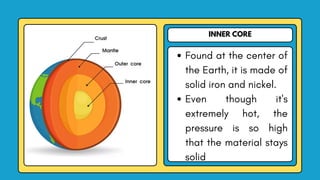
INNER CORE
Found at the center of
the Earth, it is made of
solid iron and nickel.
Even though it's
extremely hot, the
pressure is so high
that the material stays
solid
BOUNDARIES OR SEISMIC
DISCONTINUITIES
SEISMIC WAVES TRAVEL THROUGH EARTH’S LAYERS AND
CHANGE SPEED DEPENDING ON THE MATERIAL.
THEY MOVE FASTER IN SOLIDS AND SLOWER IN LIQUIDS.
THE QUICK CHANGE IN SEISMIC VELOCITIES IN A
BOUNDARY IS CALLED SEISMIC DISCONTINUITIES,
REVEAL BOUNDARIES BETWEEN LAYERS.
KEY BOUNDARIES INCLUDE THE MOHOROVIČIĆ
DISCONTINUITY (CRUST-MANTLE), THE CORE-MANTLE
BOUNDARY, AND THE INNER CORE-OUTER CORE
BOUNDARY.
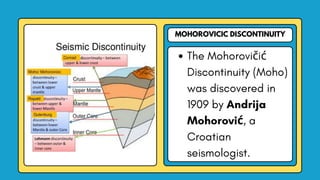
MOHOROVICIC DISCONTINUITY
The Mohorovičić
Discontinuity (Moho)
was discovered in
1909 by Andrija
Mohorović, a
Croatian
seismologist.
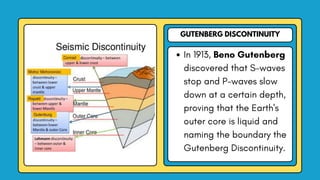
GUTENBERG DISCONTINUITY
In 1913, Beno Gutenberg
discovered that S-waves
stop and P-waves slow
down at a certain depth,
proving that the Earth's
outer core is liquid and
naming the boundary the
Gutenberg Discontinuity.
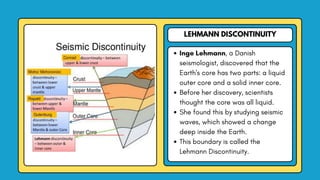
LEHMANN DISCONTINUITY
Inge Lehmann, a Danish
seismologist, discovered that the
Earth's core has two parts: a liquid
outer core and a solid inner core.
Before her discovery, scientists
thought the core was all liquid.
She found this by studying seismic
waves, which showed a change
deep inside the Earth.
This boundary is called the
Lehmann Discontinuity.
THANK YOU!

CHAPTER 2 EARTH’S INTERNAL PROCESSESS AND CRUSTAL DEFORMATION.pdf

  • 1.
    CHAPTER 2: EARTH’SINTERNAL PROCESSESS AND CRUSTAL DEFORMATION
  • 2.
    OBJECTIVES 1. ILLUSTRATE THE CHARACTERISTICS OFTHE INTERNAL LAYERS OF THE EARTH 2. RECOGNIZE THE PRESENCE OF DISCONTINUITIES BETWEEN EACH INTERNAL LAYER OF EARTH
  • 3.
    PRIOR LEARNING QUIZ NUMBERSTATEMENT TRUE/ FALSE 1. The atmosphere is the layer of gases surrounding the Earth. 2. All rocks are formed from molten magma. 3. The Sun is the closest star to Earth and the centre of our solar system. 4. Plants produce oxygen through a process called photosynthesis.
  • 4.
    PRIOR LEARNING QUIZ NUMBERSTATEMENT TRUE/ FALSE 1. The atmosphere is the layer of gases surrounding the Earth. True 2. All rocks are formed from molten magma. False 3. The Sun is the closest star to Earth and the centre of our solar system. True 4. Plants produce oxygen through a process called photosynthesis. True
  • 5.
    EARTH’S INTERIOR There areways to classify the layer of the Earth. 1.COMPOSITIONAL Crust (continental & oceanic) Mantle Core 2. MECHANICAL Lithosphere Asthenosphere Mesosphere Outer core Inner core
  • 7.
  • 8.
    THE CRUST The crustis the outermost layer of Earth. 1.OCEANIC - thin & dense 2.CONTINENTAL - thick & light or less dense Rocks that form the crust are the Granite, Andesite, & Basalt. crust
  • 9.
    THE MANTLE The mantleis the thickest layer beneath the crust, extends to about 2900 km thick has a mass of 4.01 X 10^24 kg, contributing to 67% of the total mass of Earth. The mantle is hot and dense because temperature and pressure increase with depth. mantle
  • 10.
    THE MANTLE It ismade of solid rock, proven by how seismic waves move through it. The mantle’s material is similar to peridotite, a rock rich in iron and magnesium. mantle
  • 11.
    THE MANTLE The hotmantle rock rises, flows, and sinks slowly in circles called convection currents. This movement slowly moves the plates of crust above it. This plate movement causes earthquakes, volcanoes and mountains. mantle
  • 12.
    CORE First one tobe formed during the early years of Earth. Made up of iron and nickel alloy, which is the reason that Earth has a magnetic field. Makes up 31% of Earth’s composition. Source of our planet’s internal heat. Divided into inner and outer cores. outer core inner core
  • 13.
  • 14.
    THE EARTH HASTWO KINDS OF LAYERS: COMPOSITIONAL LAYERS (CRUST, MANTLE, AND CORE) AND MECHANICAL LAYERS, WHICH ARE BASED ON HOW STRONG OR SOFT THE LAYERS ARE. THE FIVE MECHANICAL LAYERS ARE:
  • 15.
    LITHOSPHERE This includes thecrust and the top part of the mantle. It is solid, rigid, and brittle, and about 100 km thick. It breaks under pressure, which causes earthquakes. It is divided into tectonic plates that float on the layer below.
  • 16.
    ASTHENOSPHERE Found just belowthe lithosphere, this layer is made of partially molten rock. It is not fully liquid but can flow, letting the tectonic plates move. It goes down to about 200 km.
  • 17.
    MESOSPHERE This is thelower part of the mantle, below the asthenosphere. Because of the high pressure, the rock here is more solid and strong, and does not flow easily.
  • 18.
    OUTER CORE This layeris liquid and made mostly of iron and nickel. It is very hot (around 4000– 5000°C) and is responsible for creating Earth’s magnetic field.
  • 19.
    INNER CORE Found atthe center of the Earth, it is made of solid iron and nickel. Even though it's extremely hot, the pressure is so high that the material stays solid
  • 20.
  • 21.
    SEISMIC WAVES TRAVELTHROUGH EARTH’S LAYERS AND CHANGE SPEED DEPENDING ON THE MATERIAL. THEY MOVE FASTER IN SOLIDS AND SLOWER IN LIQUIDS. THE QUICK CHANGE IN SEISMIC VELOCITIES IN A BOUNDARY IS CALLED SEISMIC DISCONTINUITIES, REVEAL BOUNDARIES BETWEEN LAYERS. KEY BOUNDARIES INCLUDE THE MOHOROVIČIĆ DISCONTINUITY (CRUST-MANTLE), THE CORE-MANTLE BOUNDARY, AND THE INNER CORE-OUTER CORE BOUNDARY.
  • 22.
    MOHOROVICIC DISCONTINUITY The Mohorovičić Discontinuity(Moho) was discovered in 1909 by Andrija Mohorović, a Croatian seismologist.
  • 23.
    GUTENBERG DISCONTINUITY In 1913,Beno Gutenberg discovered that S-waves stop and P-waves slow down at a certain depth, proving that the Earth's outer core is liquid and naming the boundary the Gutenberg Discontinuity.
  • 24.
    LEHMANN DISCONTINUITY Inge Lehmann,a Danish seismologist, discovered that the Earth's core has two parts: a liquid outer core and a solid inner core. Before her discovery, scientists thought the core was all liquid. She found this by studying seismic waves, which showed a change deep inside the Earth. This boundary is called the Lehmann Discontinuity.
  • 25.