Course Title: Research Methodology
Conducted by
Babor Ahmad
Assistant Professor and Chairman (Acting),
Dept. of Economics, Dhaka International University (DIU)
Contact: baboraswapon@gmail.com or +8801705943381
Chapter 2: Defining the Research Problem
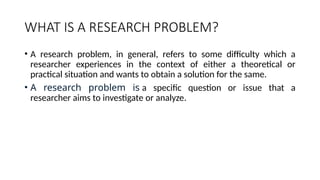
WHAT IS A RESEARCH PROBLEM?
• A research problem, in general, refers to some difficulty which a
researcher experiences in the context of either a theoretical or
practical situation and wants to obtain a solution for the same.
• A research problem is a specific question or issue that a
researcher aims to investigate or analyze.
Conditions for Research Problem
• There must be an individual (or a group or an organisation), let us call it ‘I,’ to whom the problem can be
attributed. The individual or the organisation, as the case may be, occupies an environment, say ‘N’, which is
defined by values of the uncontrolled variables, Yj .
• There must be at least two courses of action, say C1 and C2 , to be pursued. A course of action is defined by
one or more values of the controlled variables. For example, the number of items purchased at a specified
time is said to be one course of action.
• There must be at least two possible outcomes, say O1 and O2 , of the course of action, of which one should
be preferable to the other. In other words, this means that there must be at least one outcome that the
researcher wants, i.e., an objective.
• The courses of action available must provides some chance of obtaining the objective, but they cannot
provide the same chance, otherwise the choice would not matter. In simple words, we can say that the
choices must have unequal efficiencies for the desired outcomes.
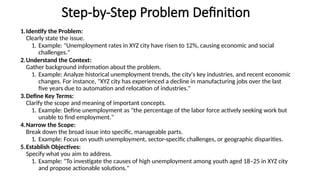
Step-by-Step Problem Definition
1.Identify the Problem:
Clearly state the issue.
1. Example: "Unemployment rates in XYZ city have risen to 12%, causing economic and social
challenges."
2.Understand the Context:
Gather background information about the problem.
1. Example: Analyze historical unemployment trends, the city's key industries, and recent economic
changes. For instance, "XYZ city has experienced a decline in manufacturing jobs over the last
five years due to automation and relocation of industries."
3.Define Key Terms:
Clarify the scope and meaning of important concepts.
1. Example: Define unemployment as "the percentage of the labor force actively seeking work but
unable to find employment."
4.Narrow the Scope:
Break down the broad issue into specific, manageable parts.
1. Example: Focus on youth unemployment, sector-specific challenges, or geographic disparities.
5.Establish Objectives:
Specify what you aim to address.
1. Example: "To investigate the causes of high unemployment among youth aged 18–25 in XYZ city
and propose actionable solutions."
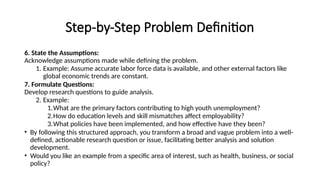
Step-by-Step Problem Definition
6. State the Assumptions:
Acknowledge assumptions made while defining the problem.
1. Example: Assume accurate labor force data is available, and other external factors like
global economic trends are constant.
7. Formulate Questions:
Develop research questions to guide analysis.
2. Example:
1.What are the primary factors contributing to high youth unemployment?
2.How do education levels and skill mismatches affect employability?
3.What policies have been implemented, and how effective have they been?
• By following this structured approach, you transform a broad and vague problem into a well-
defined, actionable research question or issue, facilitating better analysis and solution
development.
• Would you like an example from a specific area of interest, such as health, business, or social
policy?
For Review Questions
See the Chapter 2 in Text Book:
Kothari, C. R. (2004). Research methodology: Methods and
techniques. New Age International. (Any Latest Edition).
Chapter 2: Defining The Research Problem.pptx

Chapter 2: Defining The Research Problem.pptx

  • 1.
    Course Title: ResearchMethodology Conducted by Babor Ahmad Assistant Professor and Chairman (Acting), Dept. of Economics, Dhaka International University (DIU) Contact: baboraswapon@gmail.com or +8801705943381
  • 2.
    Chapter 2: Definingthe Research Problem
  • 3.
    WHAT IS ARESEARCH PROBLEM? • A research problem, in general, refers to some difficulty which a researcher experiences in the context of either a theoretical or practical situation and wants to obtain a solution for the same. • A research problem is a specific question or issue that a researcher aims to investigate or analyze.
  • 4.
    Conditions for ResearchProblem • There must be an individual (or a group or an organisation), let us call it ‘I,’ to whom the problem can be attributed. The individual or the organisation, as the case may be, occupies an environment, say ‘N’, which is defined by values of the uncontrolled variables, Yj . • There must be at least two courses of action, say C1 and C2 , to be pursued. A course of action is defined by one or more values of the controlled variables. For example, the number of items purchased at a specified time is said to be one course of action. • There must be at least two possible outcomes, say O1 and O2 , of the course of action, of which one should be preferable to the other. In other words, this means that there must be at least one outcome that the researcher wants, i.e., an objective. • The courses of action available must provides some chance of obtaining the objective, but they cannot provide the same chance, otherwise the choice would not matter. In simple words, we can say that the choices must have unequal efficiencies for the desired outcomes.
  • 10.
    Step-by-Step Problem Definition 1.Identifythe Problem: Clearly state the issue. 1. Example: "Unemployment rates in XYZ city have risen to 12%, causing economic and social challenges." 2.Understand the Context: Gather background information about the problem. 1. Example: Analyze historical unemployment trends, the city's key industries, and recent economic changes. For instance, "XYZ city has experienced a decline in manufacturing jobs over the last five years due to automation and relocation of industries." 3.Define Key Terms: Clarify the scope and meaning of important concepts. 1. Example: Define unemployment as "the percentage of the labor force actively seeking work but unable to find employment." 4.Narrow the Scope: Break down the broad issue into specific, manageable parts. 1. Example: Focus on youth unemployment, sector-specific challenges, or geographic disparities. 5.Establish Objectives: Specify what you aim to address. 1. Example: "To investigate the causes of high unemployment among youth aged 18–25 in XYZ city and propose actionable solutions."
  • 11.
    Step-by-Step Problem Definition 6.State the Assumptions: Acknowledge assumptions made while defining the problem. 1. Example: Assume accurate labor force data is available, and other external factors like global economic trends are constant. 7. Formulate Questions: Develop research questions to guide analysis. 2. Example: 1.What are the primary factors contributing to high youth unemployment? 2.How do education levels and skill mismatches affect employability? 3.What policies have been implemented, and how effective have they been? • By following this structured approach, you transform a broad and vague problem into a well- defined, actionable research question or issue, facilitating better analysis and solution development. • Would you like an example from a specific area of interest, such as health, business, or social policy?
  • 13.
    For Review Questions Seethe Chapter 2 in Text Book: Kothari, C. R. (2004). Research methodology: Methods and techniques. New Age International. (Any Latest Edition).