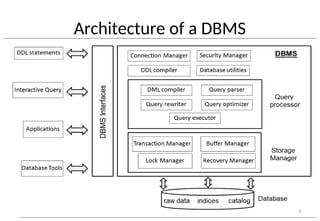
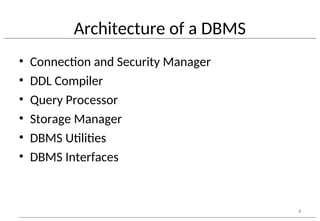
Connection and SecurityManager
• Connection manager provides facilities to setup a
database connection (locally or through a network)
– verifies logon credentials and returns a connection
handle
– database connection can either run as single process or
as thread within a process
• Security manager verifies whether a user has the
right privileges
– read versus write access
5
6.
DDL Compiler
• Compilesthe data definitions specified in DDL
• Ideally 3 DDLs (internal/logical/external data model)
• DDL compiler first parses the DDL definitions and checks
their syntactical correctness
• DDL compiler then translates the data definitions to an
internal format and generates errors if required
• Upon successful compilation, DDL compiler registers the
data definitions in the catalog
6
7.
Query processor
• Queryprocessor assists in the execution of database
queries such as retrieval, insertion, update or
removal of data
• Key components:
– DML compiler
– Query parser
– Query rewriter
– Query optimizer
– Query executor
7
8.
DML Compiler
• DMLcompiler compiles the DML statements
• Procedural DML
– DML explicitly specifies how to navigate in the database
– record-at-a-time DML
– no query processor
• Declarative DML
– DML specifies what data should be retrieved or what changes
should be made
– set-at-a-time DML
– query processor
8
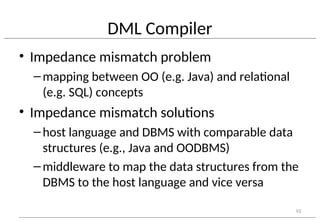
DML Compiler
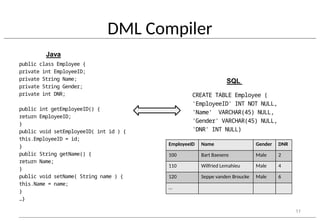
• Impedancemismatch problem
–mapping between OO (e.g. Java) and relational
(e.g. SQL) concepts
• Impedance mismatch solutions
–host language and DBMS with comparable data
structures (e.g., Java and OODBMS)
–middleware to map the data structures from the
DBMS to the host language and vice versa
10
11.
DML Compiler
11
public classEmployee {
private int EmployeeID;
private String Name;
private String Gender;
private int DNR;
public int getEmployeeID() {
return EmployeeID;
}
public void setEmployeeID( int id ) {
this.EmployeeID = id;
}
public String getName() {
return Name;
}
public void setName( String name ) {
this.Name = name;
}
…}
CREATE TABLE Employee (
'EmployeeID' INT NOT NULL,
'Name' VARCHAR(45) NULL,
'Gender' VARCHAR(45) NULL,
'DNR' INT NULL)
Java
SQL
EmployeeID Name Gender DNR
100 Bart Baesens Male 2
110 Wilfried Lemahieu Male 4
120 Seppe vanden Broucke Male 6
…
12.
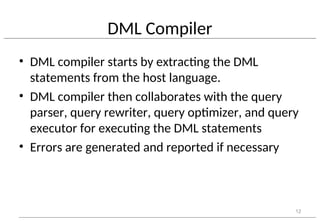
DML Compiler
• DMLcompiler starts by extracting the DML
statements from the host language.
• DML compiler then collaborates with the query
parser, query rewriter, query optimizer, and query
executor for executing the DML statements
• Errors are generated and reported if necessary
12
13.
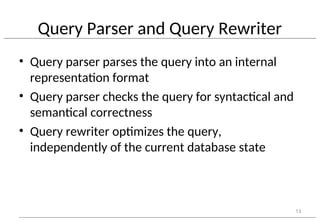
Query Parser andQuery Rewriter
• Query parser parses the query into an internal
representation format
• Query parser checks the query for syntactical and
semantical correctness
• Query rewriter optimizes the query,
independently of the current database state
13
14.
Query Optimizer
• Queryoptimizer optimizes the query based upon the current
database state (based upon e.g. predefined indexes)
• Query optimizer comes up with various query execution plans
and evaluates their cost in terms of estimated
– number of I/O operations
– CPU processing cost
– execution time
• Estimates based on catalog information combined with
statistical inference
• Query optimizer is a key competitive asset of a DBMS
14
15.
Query executor
• Resultof the query optimization is a final
execution plan
• Query executor takes care of the actual execution
by calling on the storage manager to retrieve the
data requested
15
16.
Storage manager
• Storagemanager governs physical file access and
supervises the correct and efficient storage of data
• Storage manager consists of
– transaction manager
– buffer manager
– lock manager
– recovery manager
16
17.
Transaction manager
• Transactionmanager supervises execution of database
transactions
– a database transaction is a sequence of read/write operations
considered to be an atomic unit
• Transaction manager creates a schedule with interleaved
read/write operations
• Transaction manager guarantees ACID properties
• COMMIT a transaction upon successful execution and
ROLLBACK a transaction upon unsuccessful execution
17
18.
Buffer Manager
• Buffermanager manages buffer memory of the DBMS
• Buffer manager intelligently caches data in the buffer
• Example strategies:
– Data locality: data recently retrieved is likely to be retrieved again
– 20/80 law: 80% of the transactions read or write only 20% of the
data
• Buffer manager needs to adopt smart replacement strategy
in case buffer is full
• Buffer manager needs to interact with lock manager
18
19.
Lock Manager
• Lockmanager provides concurrency control
which ensures data integrity at all times
• Two types of locks: read and write locks
• Lock manager is responsible for assigning,
releasing, and recording locks in the catalog
• Lock manager makes use of a locking protocol
which describes the locking rules, and a lock
table with the lock information
19
20.
Recovery Manager
• Recoverymanager supervises the correct
execution of database transactions
• Recovery manager keeps track of all database
operations in a log file
• Recovery manager will be called upon to undo
actions of aborted transactions or during crash
recovery
20
Categorization of DBMSs
•Categorization based on data model
• Categorization based on degree of simultaneous
access
• Categorization based on architecture
• Categorization based on usage
24
25.
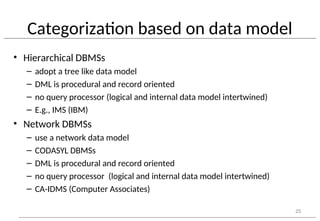
Categorization based ondata model
• Hierarchical DBMSs
– adopt a tree like data model
– DML is procedural and record oriented
– no query processor (logical and internal data model intertwined)
– E.g., IMS (IBM)
• Network DBMSs
– use a network data model
– CODASYL DBMSs
– DML is procedural and record oriented
– no query processor (logical and internal data model intertwined)
– CA-IDMS (Computer Associates)
25
26.
Categorization based ondata model
• Relational DBMSs
– use the relational data model
– currently the most popular in industry
– SQL (declarative and set oriented)
– query processor
– strict separation between the logical and internal data
model
– E.g., MySQL (open source, Oracle), Oracle DBMS
(Oracle), DB2 (IBM), Microsoft SQL (Microsoft)
26
27.
Categorization based ondata model
• Object-Oriented DBMSs (OODBMS)
– based upon the OO data model
– No impedance mismatch in combination with OO host
language
– E.g., db4o (open source, Versant), Caché (Intersystems)
GemStone/S (GemTalk Systems)
– only successfull in niche markets, due to their
complexity
27
28.
Categorization based ondata model
• Object-Relational DBMSs (ORDBMSs)
– also referred to as extended relational DBMSs
(ERDBMSs)
– use a relational model extended with OO concepts
– DML is SQL (declarative and set oriented)
– E.g., Oracle DBMS (Oracle), DB2 (IBM), Microsoft SQL
(Microsoft)
28
29.
Categorization based ondata model
• XML DBMSs
– use the XML data model to store data
– Native XML DBMSs (e.g., BaseX, eXist) map the tree
structure of an XML document to a physical storage
structure
– XML-enabled DBMSs (e.g., Oracle, IBM DB2) are
existing DBMSs that are extended with facilities to
store XML data
29
30.
Categorization based ondata model
• NoSQL DBMSs
– targeted at storing big and unstructured data
– can be classified into key-value stores, column-
oriented databases and graph databases
– focus on scalability and the ability to cope with
irregular or highly volatile data structures
– E.g., Apache Hadoop, MongoDB, Neo4j
30
31.
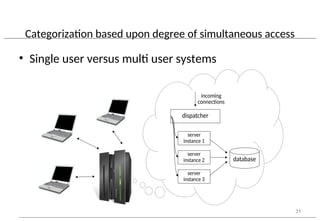
Categorization based upondegree of simultaneous access
• Single user versus multi user systems
31
database
server
instance 1
dispatcher
incoming
connections
server
instance 3
server
instance 2
32.
Categorization based onarchitecture
• Centralized DBMS architecture
– data is maintained on a centralized server
• Client server DBMS architecture
– active clients request services from passive servers
– fat server versus fat client variant
• n-tier DBMS architecture
– client with GUI functionality, application server with
applications, database server with DBMS and database,
and web server for web based access
32
33.
Categorization based onarchitecture
• Cloud DBMS architecture
– DBMS and database are hosted by a third-party cloud
provider
– E.g., Apache Cassandra project and Google’s BigTable
• Federated DBMS
– provides a uniform interface to multiple underlying
data sources
– hides the underlying storage details to facilitate data
access
33
34.
Categorization based onarchitecture
• in-memory DBMS
– stores all data in internal memory instead of slower
external storage (e.g., disk)
– often used for real-time purposes
– E.g., HANA (SAP)
34
35.
Categorization based onusage
• On-line transaction processing (OLTP)
– focus on managing operational or transactional data
– database server must be able to process lots of simple transactions
per unit of time
– DBMS must have good support for processing a high volume of short,
simple queries
• On-line analytical processing (OLAP)
– focus on using operational data for tactical or strategical decision
making
– limited number of users formulates complex queries
– DBMS should support efficient processing of complex queries which
often come in smaller volumes
35
36.
Categorization based onusage
• Big Data & Analytics
– NoSQL databases
– focus on more flexible, or even schema-less, database
structures
– store unstructured information such as emails, text
documents, Twitter tweets, Facebook posts, etc.
• Multimedia
– Multimedia DBMSs provide storage of multimedia data such
as text, images, audio, video, 3D games, etc.
– should also provide content-based query facilities
36
37.
Categorization Based onUsage
• Spatial applications
– spatial DBMSs support storage and querying of spatial
data (both 2D and 3D)
– Geographical Information Systems (GIS)
• Sensoring
– sensor DBMSs manage sensor data such as biometric
data from wearables, or telematics data
37
38.
Categorization based onusage
• Mobile
– Mobile DBMSs run on smartphones, tablets or other mobile
devices.
– should always be online, have a small footprint and be able to
deal with limited processing power, storage and battery life
• Open source
– code of open source DBMSs is publicly available and can be
extended by anyone
– See www.sourceforge.net
– E.g., MySQL (Oracle)
38
![DML Compiler
import java.sql.*;
public class JDBCExample1 {
public static void main(String[] args) {
try {
System.out.println("Loading JDBC driver...");
Class.forName("com.mysql.jdbc.Driver");
System.out.println("JDBC driver loaded!");
} catch (ClassNotFoundException e) {
throw new RuntimeException(e);
}
String url =
"jdbc:mysql://localhost:3306/employeeschema";
String username = "root";
String password = "mypassword123";
String query = "select E.Name, D.DName" +
"from employee E, department D" +
"where E.DNR=D.DNR;";
Connection connection = null;
Statement stmt=null;
9
try {
System.out.println("Connecting to database");
connection = DriverManager.getConnection(url,
username, password);
System.out.println("MySQL Database connected!");
stmt = connection.createStatement();
ResultSet rs = stmt.executeQuery(query);
while (rs.next()) {
System.out.print(rs.getString(1));
System.out.print(" ");
System.out.println(rs.getString(2));
}
stmt.close();
} catch (SQLException e) {
System.out.println(e.toString());
} finally {
System.out.println("Closing the connection.");
if (connection != null) {
try {
connection.close();
} catch (SQLException ignore) {}}}}](https://image.slidesharecdn.com/chapter2architectureandclassificationofdbms-250312025210-e74c8508/85/Chapter-2-Architecture-and-Classification-of-DBMS-ppt-9-320.jpg)