Chapter 18 Distributed software engineering 1
Chapter 18 – Distributed software engineering
Lecture 1
Chapter 18 Distributed software engineering 2
Topics covered
 Distributed systems issues
 Client–server computing
 Architectural patterns for distributed systems
 Software as a service
Distributed systems
Distributed system characteristics
Chapter 18 Distributed software engineering 5
Distributed systems issues
 Distributed systems are more complex than systems that
run on a single processor.
 Complexity arises because different parts of the system
are independently managed as is the network.
 There is no single authority in charge of the system so
top-down control is impossible.
Chapter 18 Distributed software engineering 6
Design issues
 Transparency To what extent should the distributed system appear
to the user as a single system?
 Openness Should a system be designed using standard protocols
that support interoperability?
 ScalabilityHow can the system be constructed so that it is scalable?
 Security How can usable security policies be defined and
implemented?
 Quality of service How should the quality of servicebe specified.
 Failure management How can system failures be detected,
contained and repaired?
Chapter 18 Distributed software engineering 7
Transparency
 Ideally, users should not be aware that a system is
distributed and services should be independent of
distribution characteristics.
 In practice, this is impossible because parts of the
system are independently managed and because of
network delays.
 Often better to make users aware of distribution so that they can
cope with problems
 To achieve transparency, resources should be abstracted
and addressed logically rather than physically.
Middleware maps logical to physical resources.
Chapter 18 Distributed software engineering 8
Openness
 Open distributed systems are systems that are built
according to generally accepted standards.
 Components from any supplier can be integrated into the
system and can inter-operate with the other system
components.
 Openness implies that system components can be
independently developed in any programming language
and, if these conform to standards, they will work with
other components.
 Web service standards for service-oriented architectures
were developed to be open standards.
Chapter 18 Distributed software engineering 9
Scalability
 The scalability of a system reflects its ability to deliver a
high quality service as demands on the system increase
 Size It should be possible to add more resources to a system to
cope with increasing numbers of users.
 Distribution It should be possible to geographically disperse the
components of a system without degrading its performance.
 ManageabilityIt should be possible to manage a system as it
increases in size, even if parts of the system are located in
independent organizations.
 There is a distinction between scaling-up and scaling-
out. Scaling up is more powerful system; scaling out is
more system instances.
Chapter 18 Distributed software engineering 10
Security
 When a system is distributed, the number of ways that
the system may be attacked is significantly increased,
compared to centralized systems.
 If a part of the system is successfully attacked then the
attacker may be able to use this as a ‘back door’ into
other parts of the system.
 Difficulties in a distributed system arise because different
organizations may own parts of the system. These
organizations may have mutually incompatible security
policies and security mechanisms.
Chapter 18 Distributed software engineering 11
Types of attack
 The types of attack that a distributed system must
defend itself against are:
 Interception, where communications between parts of the
system are intercepted by an attacker so that there is a loss of
confidentiality.
 Interruption, where system services are attacked and cannot be
delivered as expected.
• Denial of service attacks involve bombarding a node with illegitimate
service requests so that it cannot deal with valid requests.
 Modification, where data or services in the system are changed
by an attacker.
 Fabrication, where an attacker generates information that should
not exist and then uses this to gain some privileges.
Chapter 18 Distributed software engineering 12
Quality of service
 The quality of service (QoS) offered by a distributed
system reflects the system’s ability to deliver its services
dependably and with a response time and throughput
that is acceptable to its users.
 Quality of service is particularly critical when the system
is dealing with time-critical data such as sound or video
streams.
 In these circumstances, if the quality of service falls below a
threshold value then the sound or video may become so
degraded that it is impossible to understand.
Chapter 18 Distributed software engineering 13
Failure management
 In a distributed system, it is inevitable that failures will
occur, so the system has to be designed to be resilient to
these failures.
“You know that you have a distributed system when the
crash of a system that you’ve never heard of stops you
getting any work done.”
 Distributed systems should include mechanisms for
discovering if a component of the system has failed,
should continue to deliver as many services as possible
in spite of that failure and, as far as possible,
automatically recover from the failure.
Chapter 18 Distributed software engineering 14
Models of interaction
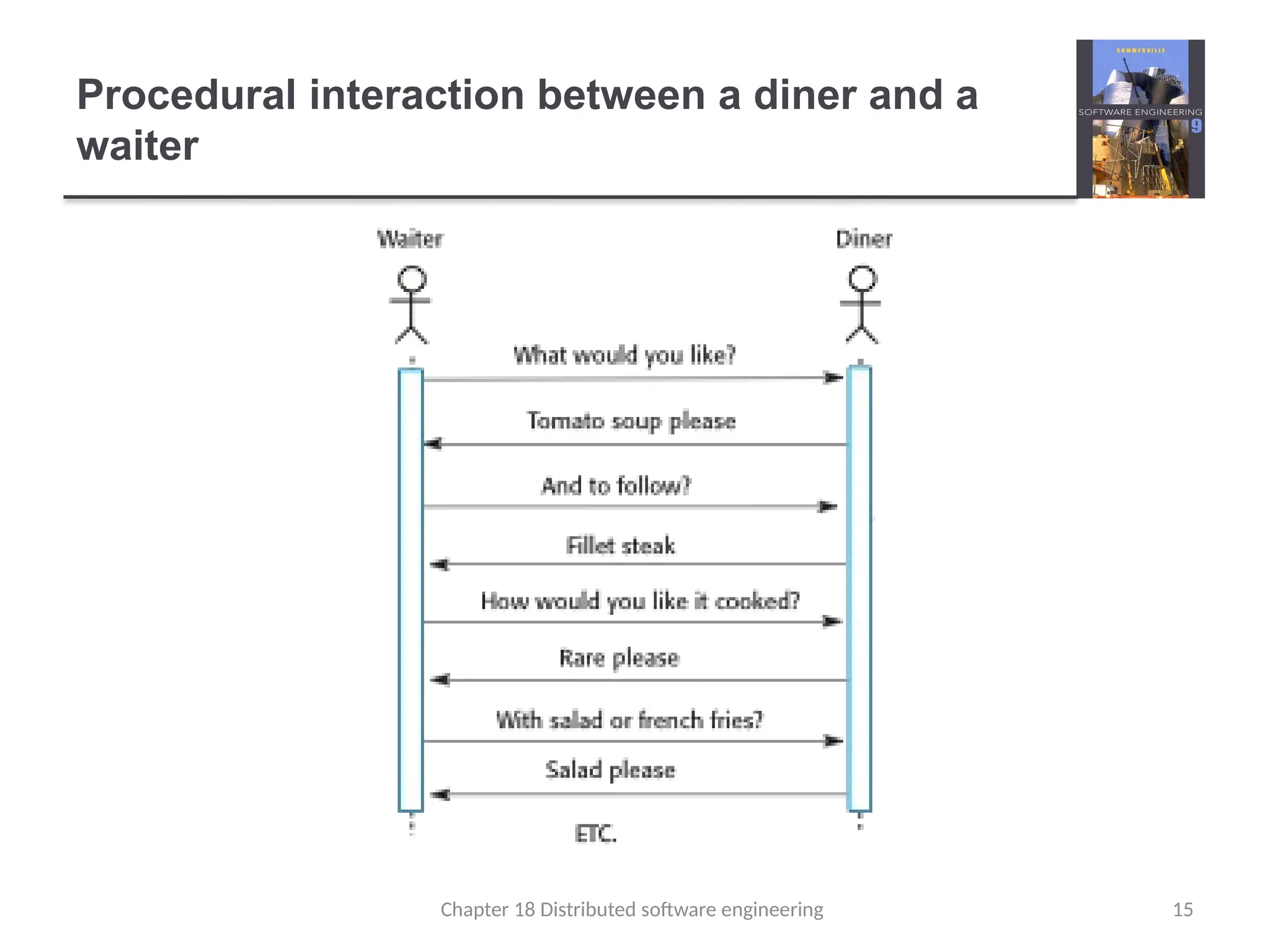
 Two types of interaction between components in a
distributed system
 Procedural interaction, where one computer calls on a known
service offered by another computer and waits for a response.
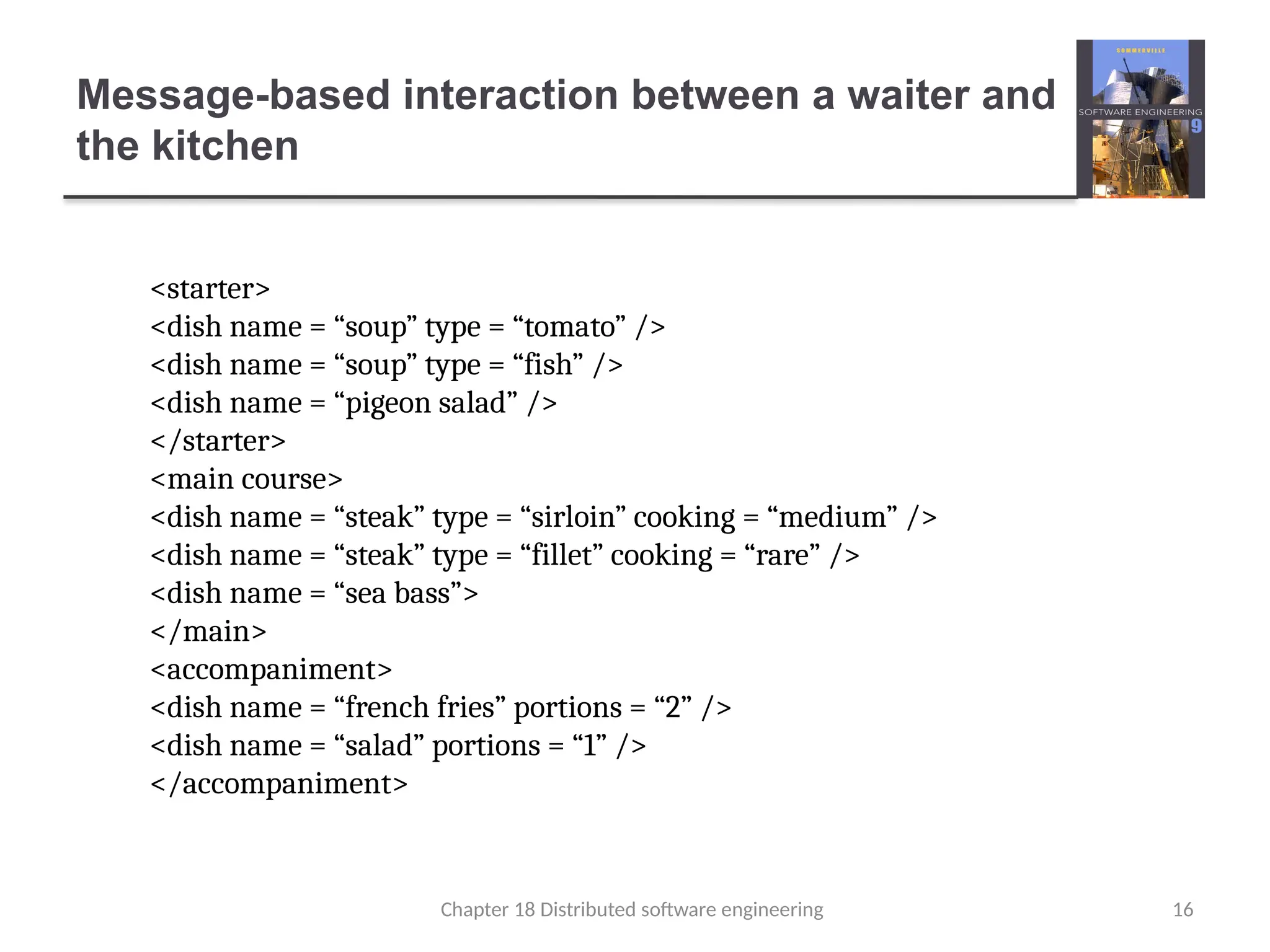
 Message-based interaction, involves the sending computer
sending information about what is required to another computer.
There is no necessity to wait for a response.
Chapter 18 Distributed software engineering 15
Procedural interaction between a diner and a
waiter
Chapter 18 Distributed software engineering 16
Message-based interaction between a waiter and
the kitchen
<starter>
<dish name = “soup” type = “tomato” />
<dish name = “soup” type = “fish” />
<dish name = “pigeon salad” />
</starter>
<main course>
<dish name = “steak” type = “sirloin” cooking = “medium” />
<dish name = “steak” type = “fillet” cooking = “rare” />
<dish name = “sea bass”>
</main>
<accompaniment>
<dish name = “french fries” portions = “2” />
<dish name = “salad” portions = “1” />
</accompaniment>
Chapter 18 Distributed software engineering 17
Remote procedure calls
 Procedural communication in a distributed system is
implemented using remote procedure calls (RPC).
 In a remote procedure call, one component calls another
component as if it was a local procedure or method. The
middleware in the system intercepts this call and passes
it to a remote component.
 This carries out the required computation and, via the
middleware, returns the result to the calling component.
 A problem withRPCs is that the caller and the callee
need to be available at the time of the communication,
and they must know how to refer to each other.
Chapter 18 Distributed software engineering 18
Message passing
 Message-based interaction normally involves one
component creating a message that details the services
required from another component.
 Through the system middleware, this is sent to the
receiving component.
 The receiver parses the message, carries out the
computations and creates a message for the sending
component with the required results.
 In a message-based approach, it is not necessary for the
sender and receiver of the message to be aware of each
other. They simple communicate with the middleware.
Chapter 18 Distributed software engineering 19
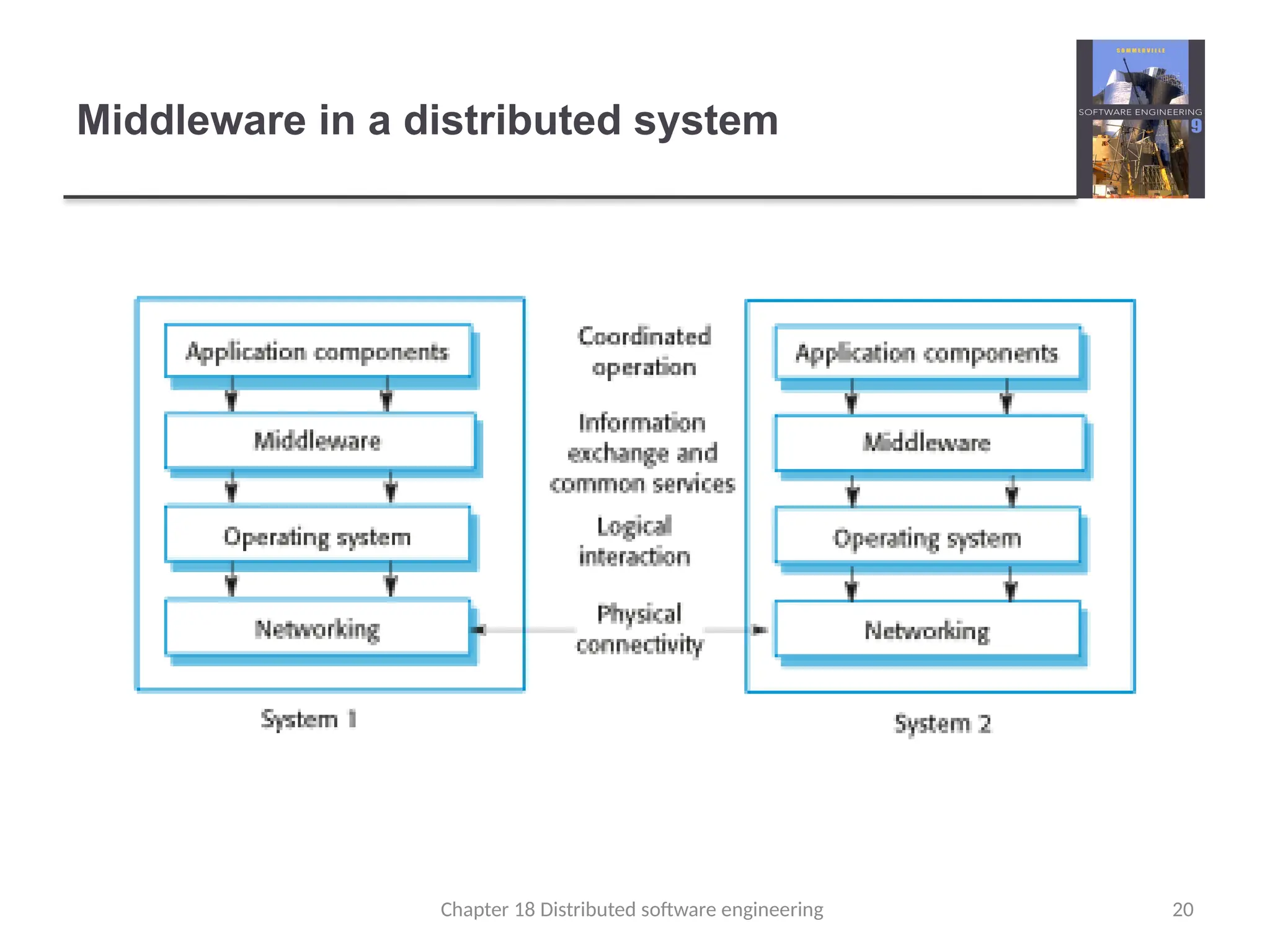
Middleware
 The components in a distributed system may be
implemented in different programming languages and
may execute on completely different types of processor.
Models of data, information representation and protocols
for communication may all be different.
 Middleware is software that can manage these diverse
parts, and ensure that they can communicate and
exchange data.
Chapter 18 Distributed software engineering 20
Middleware in a distributed system
Chapter 18 Distributed software engineering 21
Middleware support
 Interaction support, where the middleware coordinates
interactions between different components in the system
 The middleware provides location transparency in that it isn’t
necessary for components to know the physical locations of
other components.
 The provision of common services, where the
middleware provides reusable implementations of
services that may be required by several components in
the distributed system.
 By using these common services, components can easily inter-
operate and provide user services in a consistent way.
Chapter 18 Distributed software engineering 22
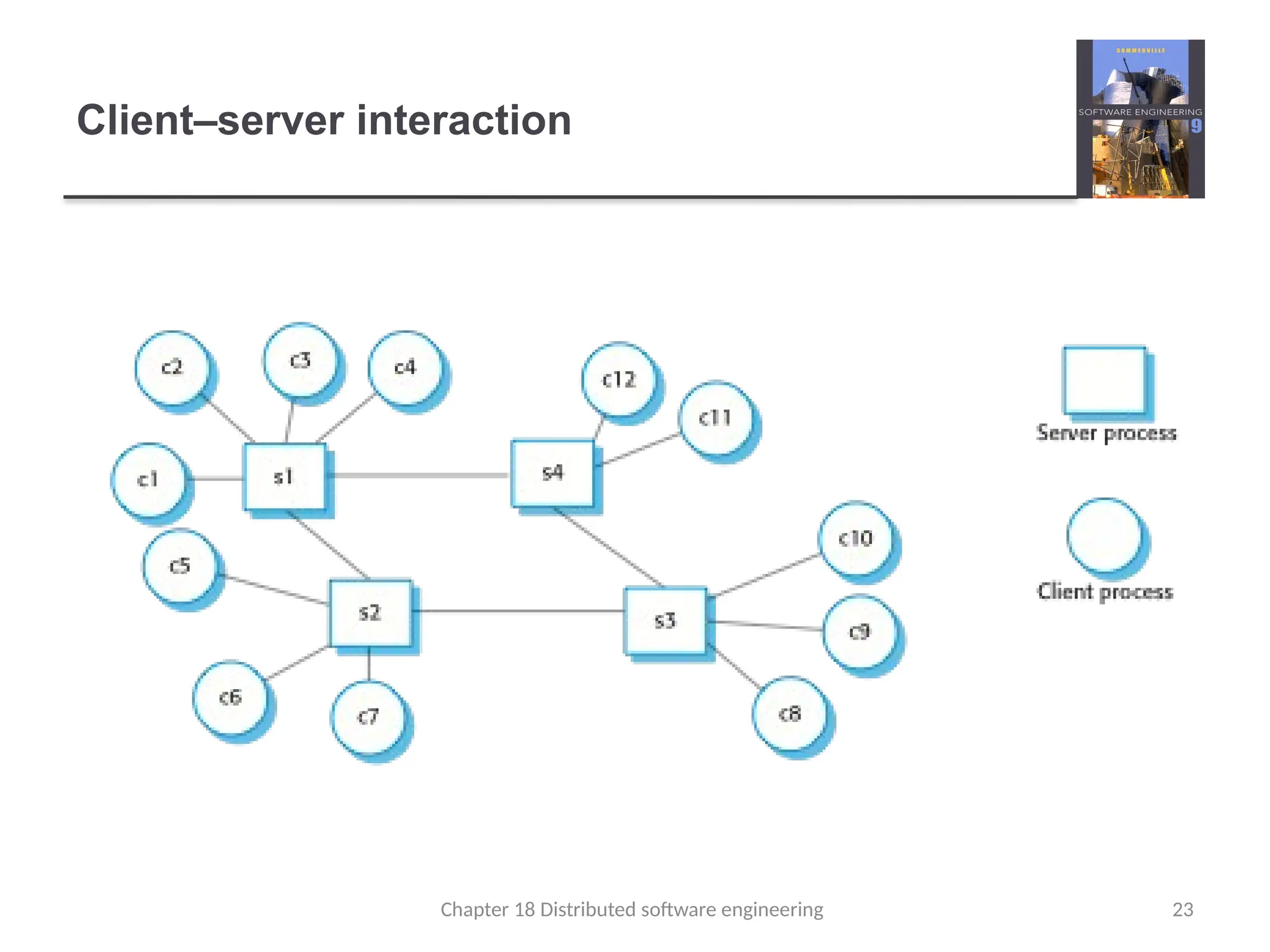
Client-server computing
 Distributed systems that are accessed over the Internet
are normally organized as client-server systems.
 In a client-server system, the user interacts with a
program running on their local computer (e.g. a web
browser or phone-based application). This interacts with
another program running on a remote computer (e.g. a
web server).
 The remote computer provides services, such as access
to web pages, which are available to external clients.
Chapter 18 Distributed software engineering 23
Client–server interaction
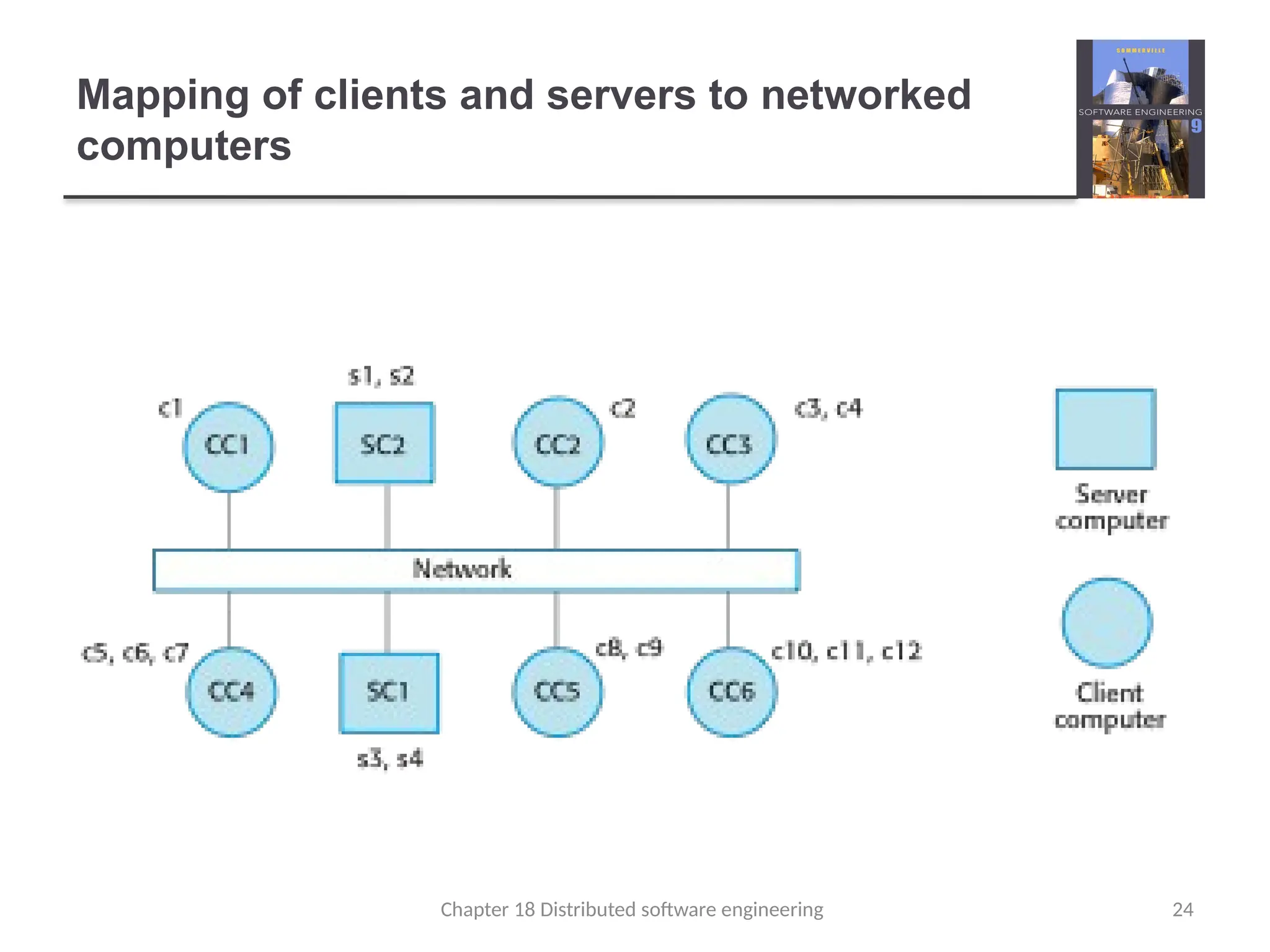
Chapter 18 Distributed software engineering 24
Mapping of clients and servers to networked
computers
Chapter 18 Distributed software engineering 25
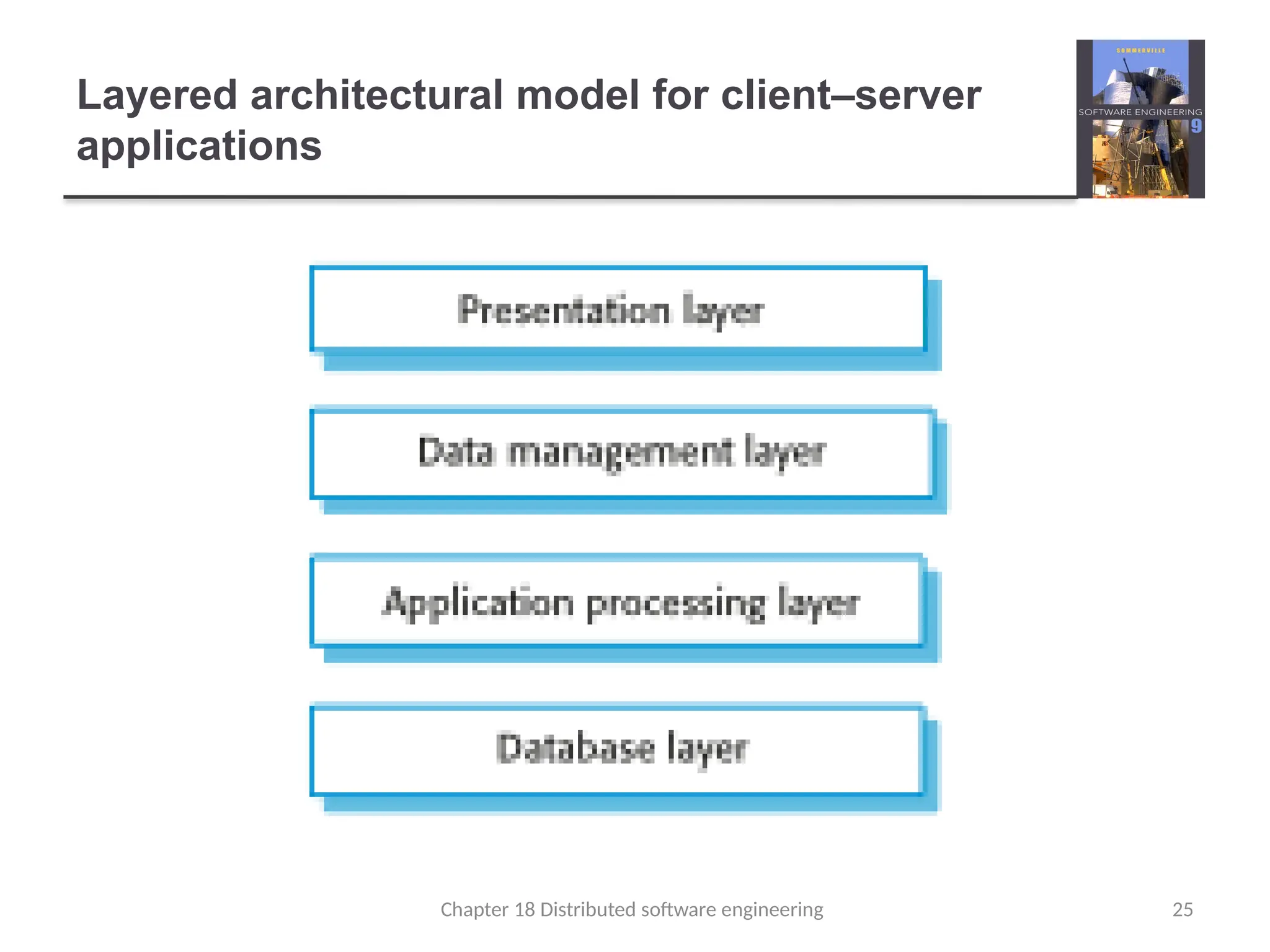
Layered architectural model for client–server
applications
Key points
Chapter 18 Distributed software engineering 27
Chapter 18 – Distributed software engineering
Lecture 2
Chapter 18 Distributed software engineering 28
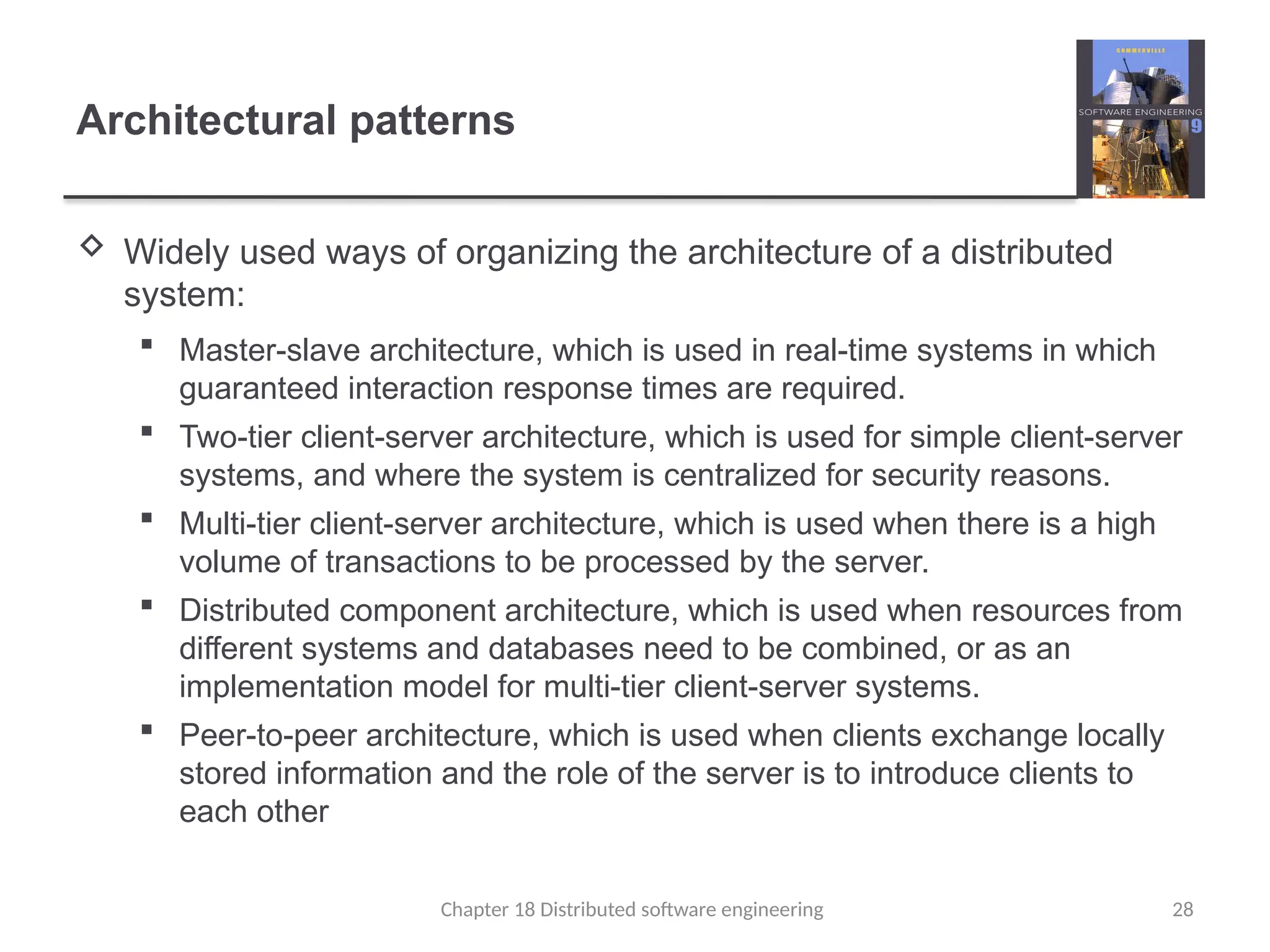
Architectural patterns
 Widely used ways of organizing the architecture of a distributed
system:
 Master-slave architecture, which is used in real-time systems in which
guaranteed interaction response times are required.
 Two-tier client-server architecture, which is used for simple client-server
systems, and where the system is centralized for security reasons.
 Multi-tier client-server architecture, which is used when there is a high
volume of transactions to be processed by the server.
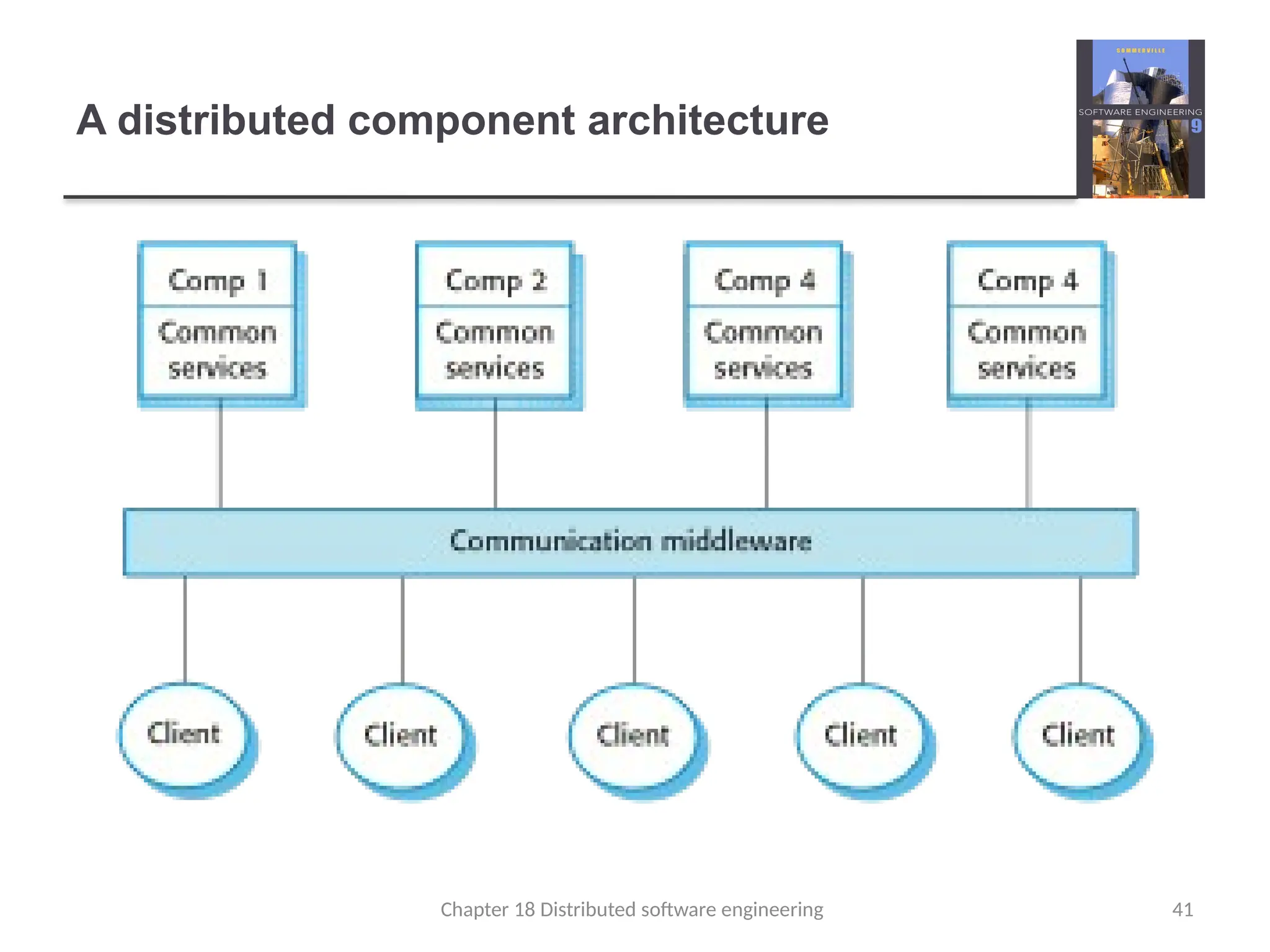
 Distributed component architecture, which is used when resources from
different systems and databases need to be combined, or as an
implementation model for multi-tier client-server systems.
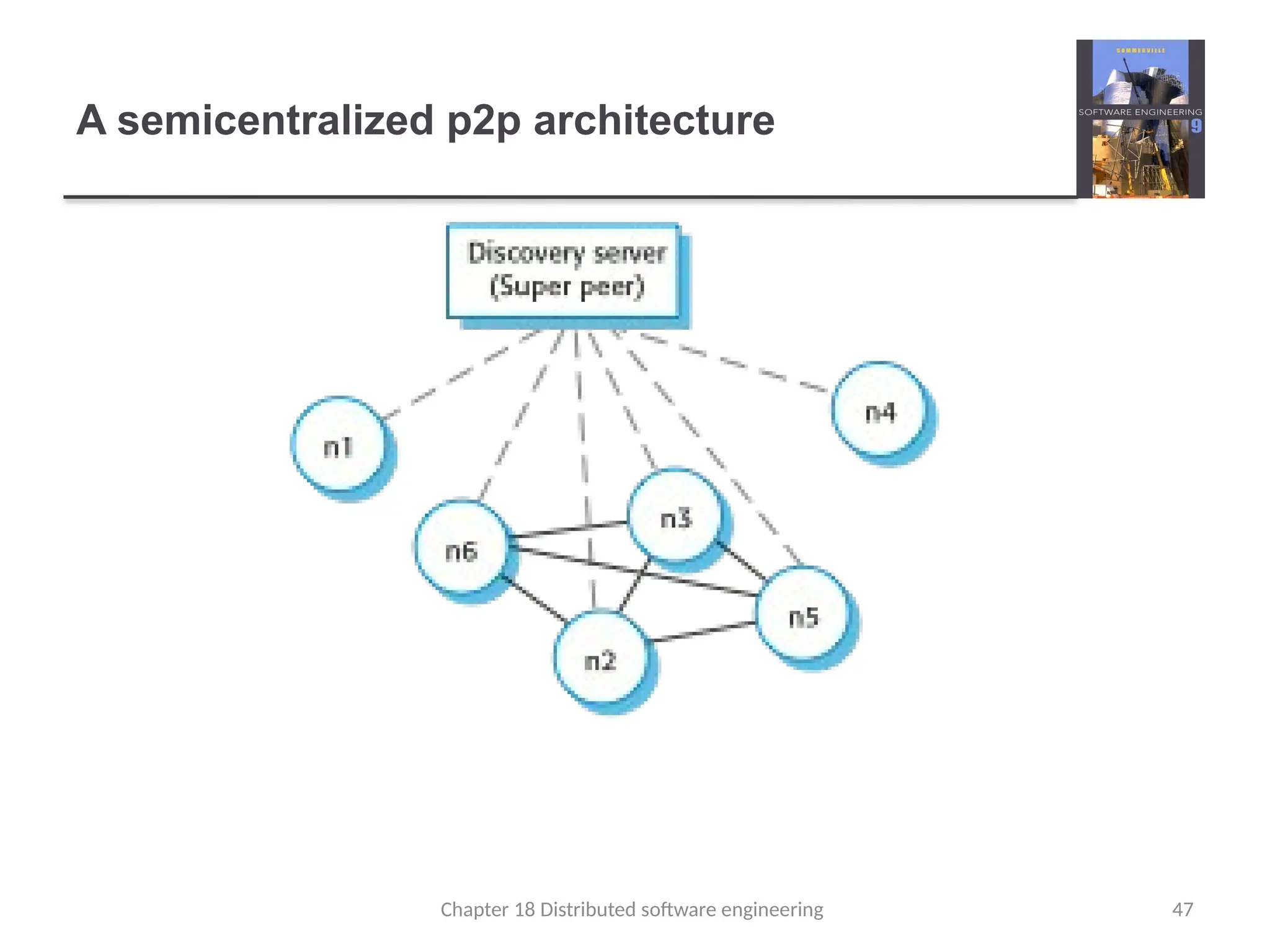
 Peer-to-peer architecture, which is used when clients exchange locally
stored information and the role of the server is to introduce clients to
each other
Chapter 18 Distributed software engineering 29
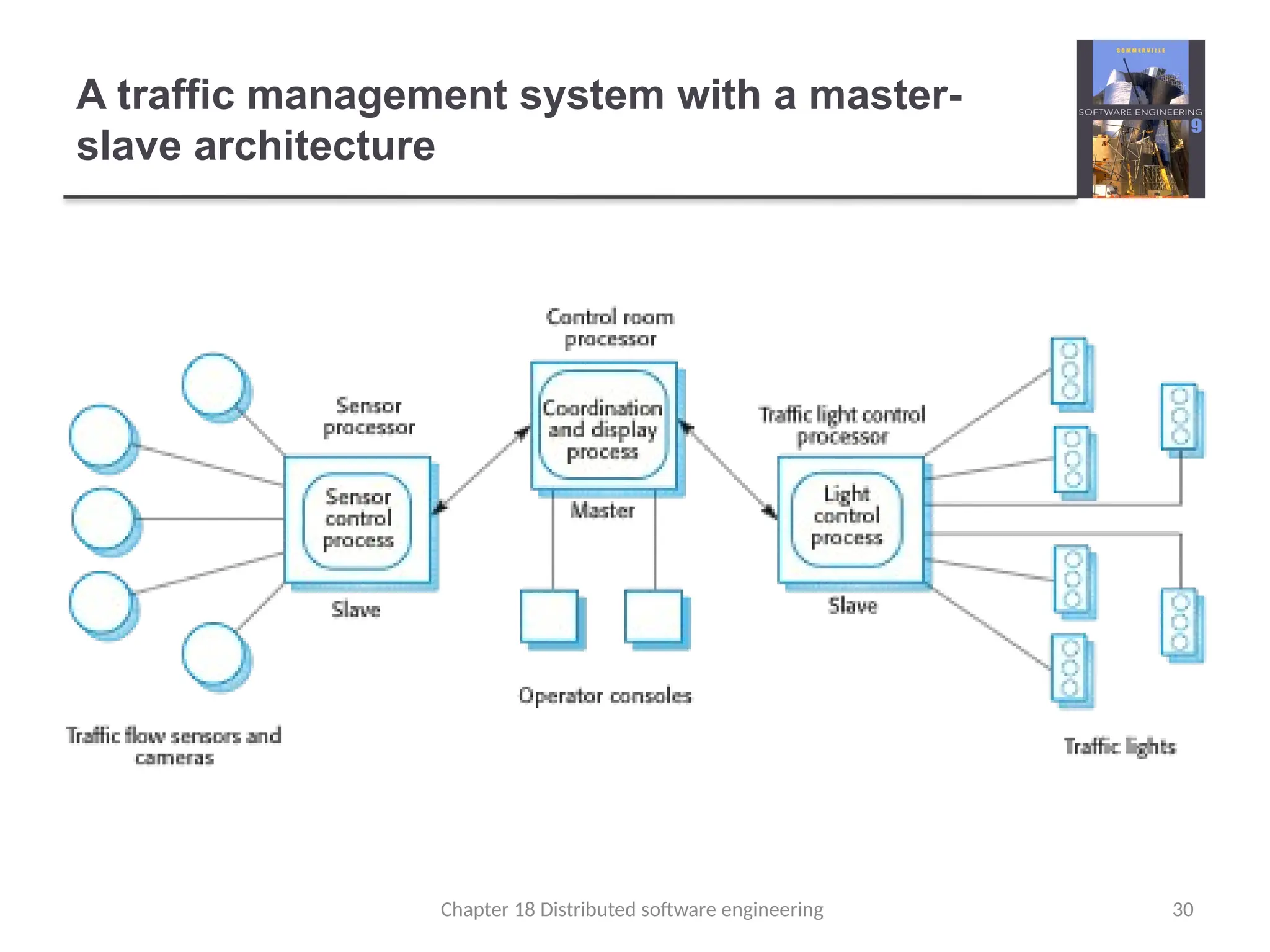
Master-slave architectures
 Master-slave architectures are commonly used in real-
time systems where there may be separate processors
associated with data acquisition from the system’s
environment, data processing and computation and
actuator management.
 The ‘master’ process is usually responsible for
computation, coordination and communications and it
controls the ‘slave’ processes.
 ‘Slave’ processes are dedicated to specific actions, such
as the acquisition of data from an array of sensors.
Chapter 18 Distributed software engineering 30
A traffic management system with a master-
slave architecture
Chapter 18 Distributed software engineering 31
Two-tier client server architectures
 In a two-tier client-server architecture, the system is
implemented as a single logical server plus an indefinite
number of clients that use that server.
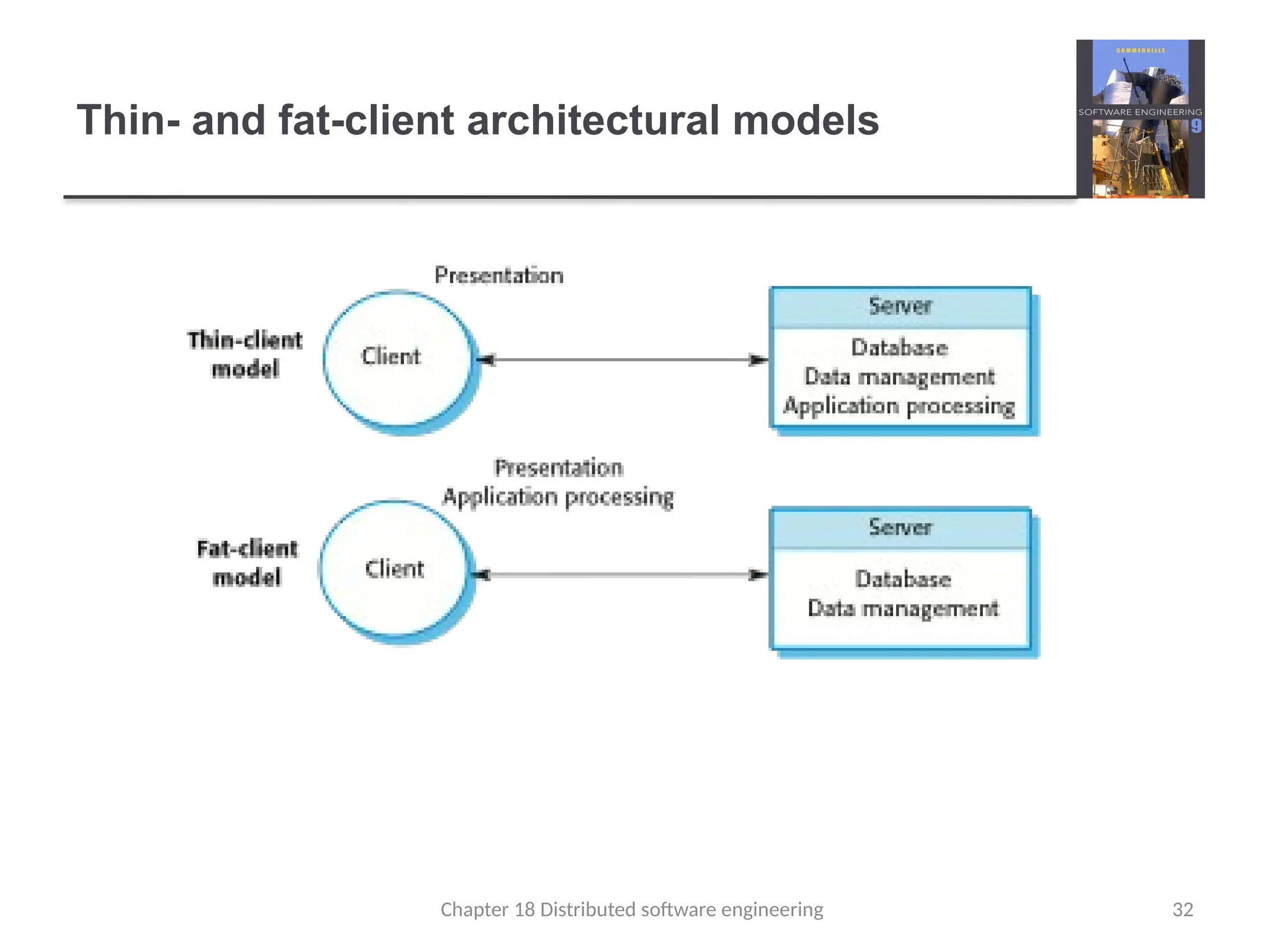
 Thin-client model, where the presentation layer is implemented
on the client and all other layers (data management, application
processing and database) are implemented on a server.
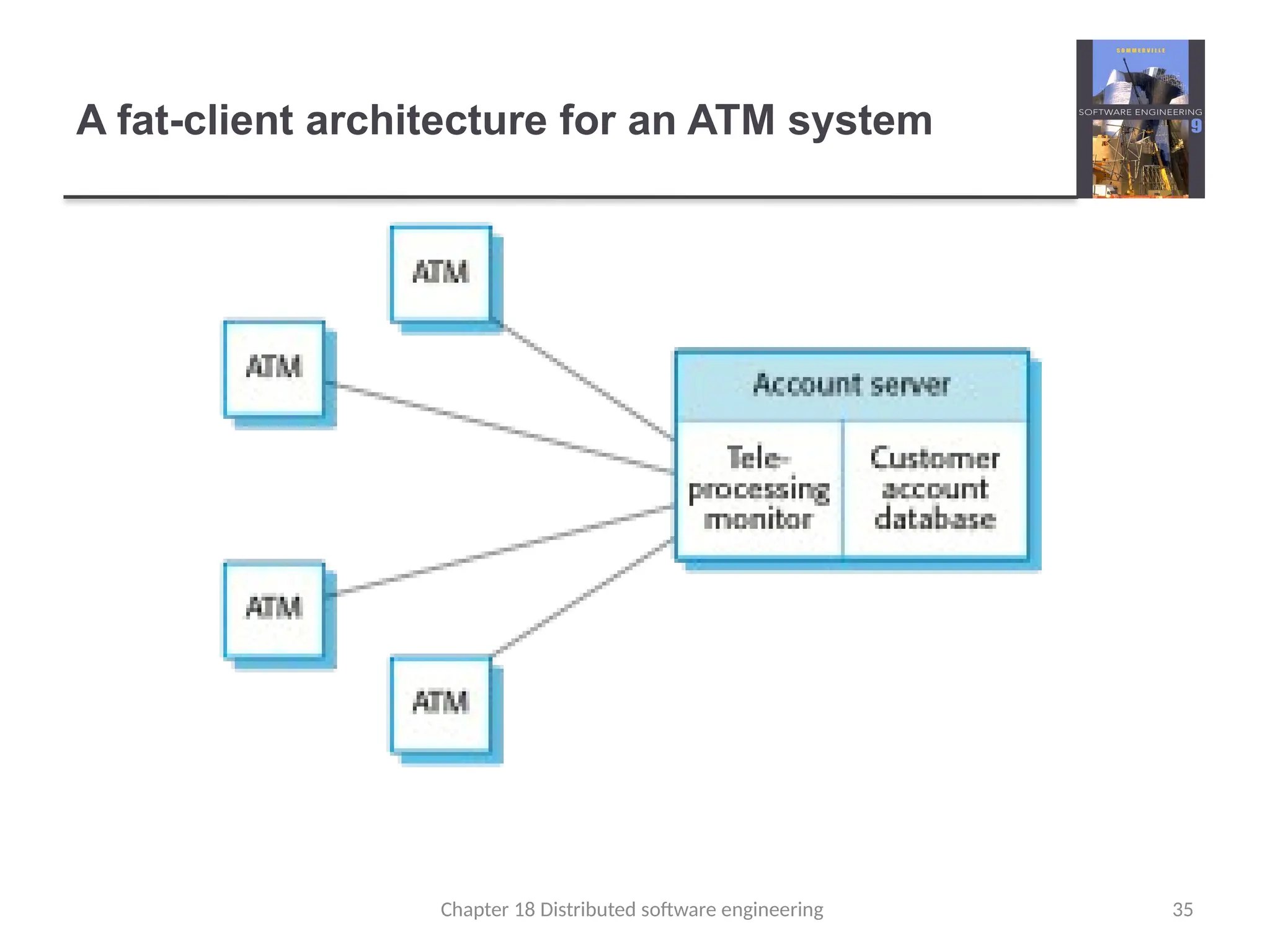
 Fat-client model, where some or all of the application processing
is carried out on the client. Data management and database
functions are implemented on the server.
Chapter 18 Distributed software engineering 32
Thin- and fat-client architectural models
Thin client model
Fat client model
Chapter 18 Distributed software engineering 35
A fat-client architecture for an ATM system
Chapter 18 Distributed software engineering 36
Multi-tier client-server architectures
 In a ‘multi-tier client–server’ architecture, the different
layers of the system, namely presentation, data
management, application processing, and database, are
separate processes that may execute on different
processors.
 This avoids problems with scalability and performance if
a thin-client two-tier model is chosen, or problems of
system management if a fat-client model is used.
Chapter 18 Distributed software engineering 37
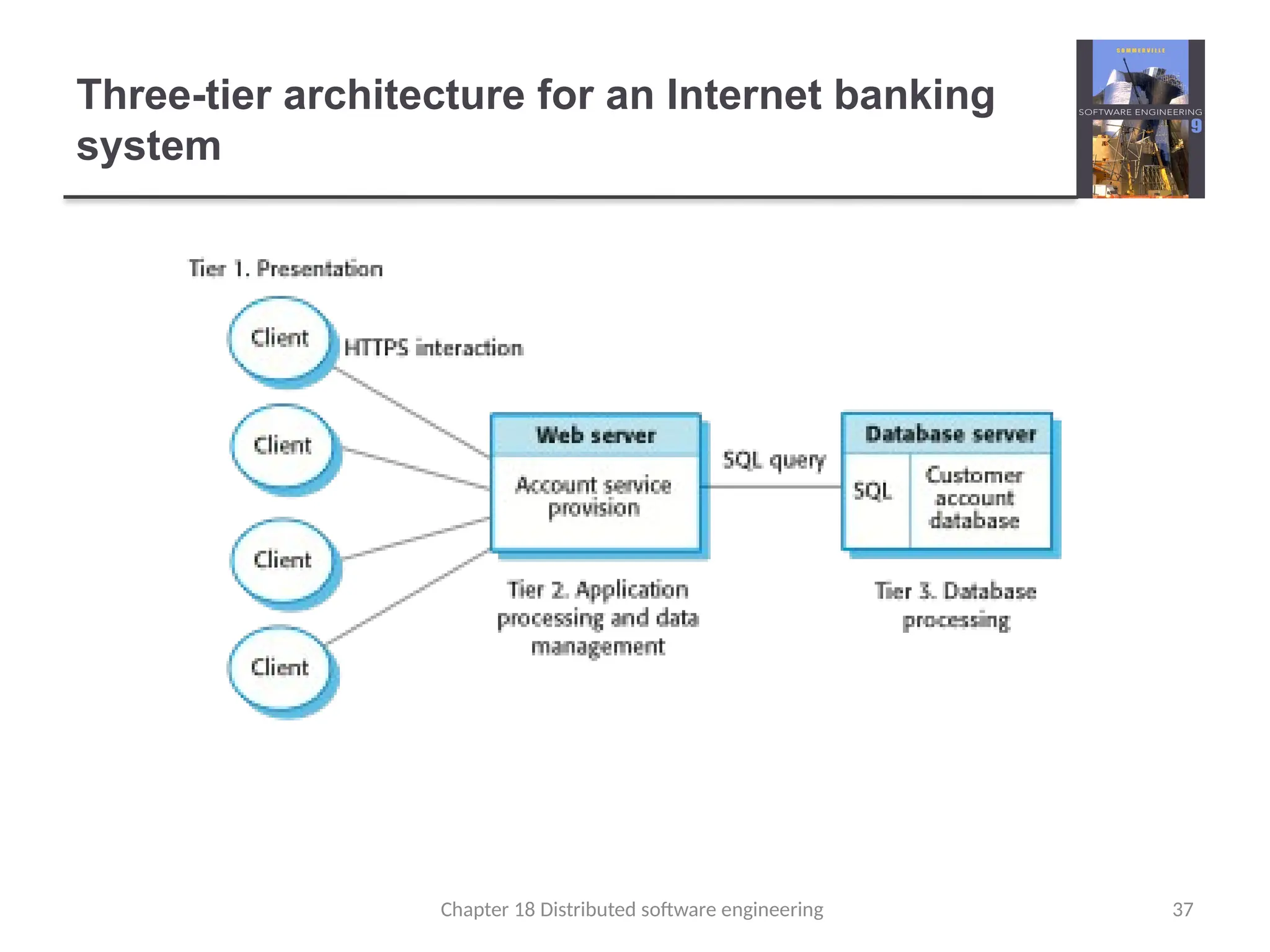
Three-tier architecture for an Internet banking
system
Chapter 18 Distributed software engineering 38
Use of client–server architectural patterns
Architecture Applications
Two-tier client–server
architecture with thin clients
Legacy system applications that are used when
separating application processing and data management
is impractical. Clients may access these as services, as
discussed in Section 18.4.
Computationally intensive applications such as compilers
with little or no data management.
Data-intensive applications (browsing and querying) with
nonintensive application processing. Browsing the Web is
the most common example of a situation where this
architecture is used.
Chapter 18 Distributed software engineering 39
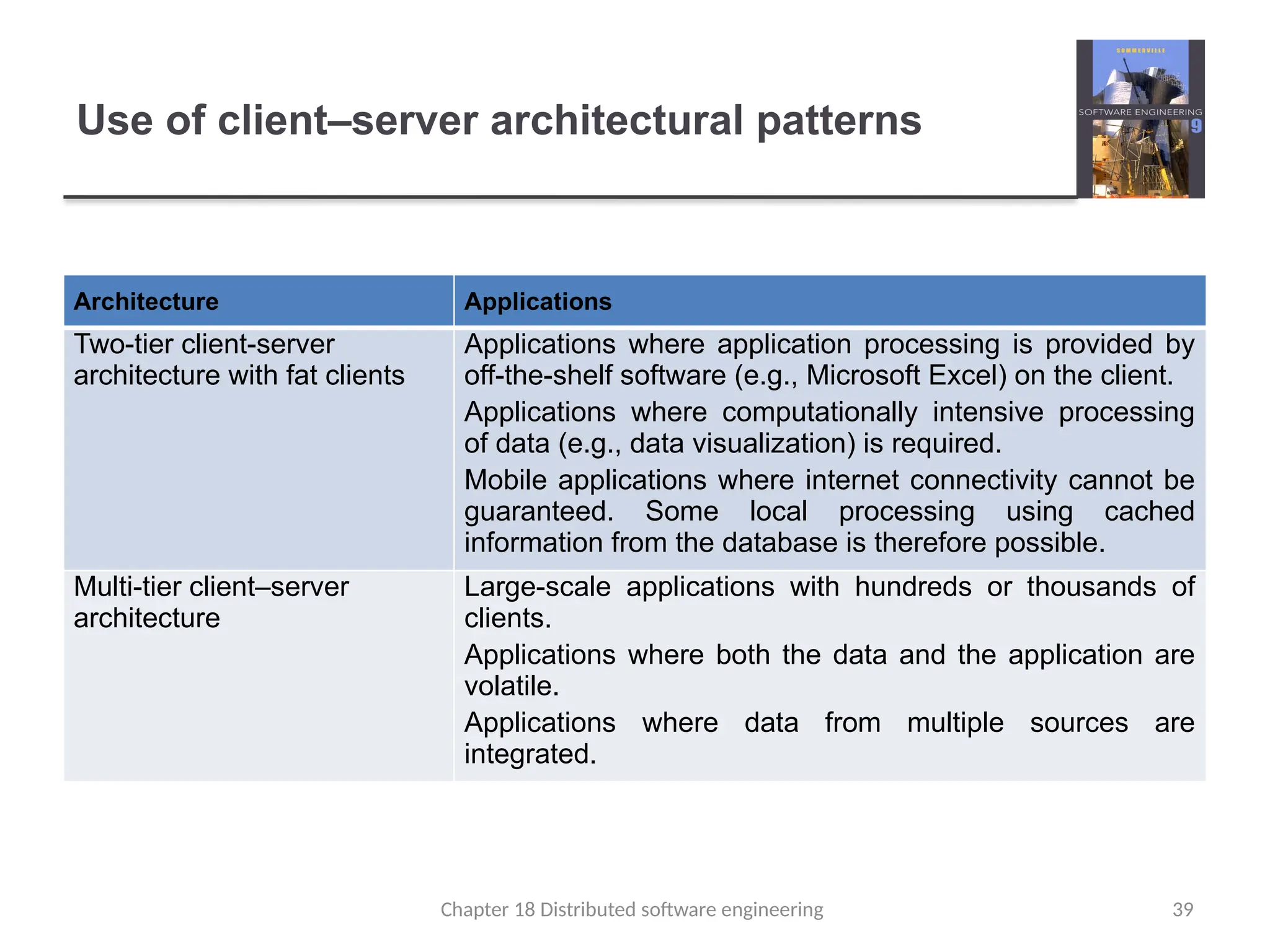
Use of client–server architectural patterns
Architecture Applications
Two-tier client-server
architecture with fat clients
Applications where application processing is provided by
off-the-shelf software (e.g., Microsoft Excel) on the client.
Applications where computationally intensive processing
of data (e.g., data visualization) is required.
Mobile applications where internet connectivity cannot be
guaranteed. Some local processing using cached
information from the database is therefore possible.
Multi-tier client–server
architecture
Large-scale applications with hundreds or thousands of
clients.
Applications where both the data and the application are
volatile.
Applications where data from multiple sources are
integrated.
Distributed component architectures
Chapter 18 Distributed software engineering 41
A distributed component architecture
Chapter 18 Distributed software engineering 42
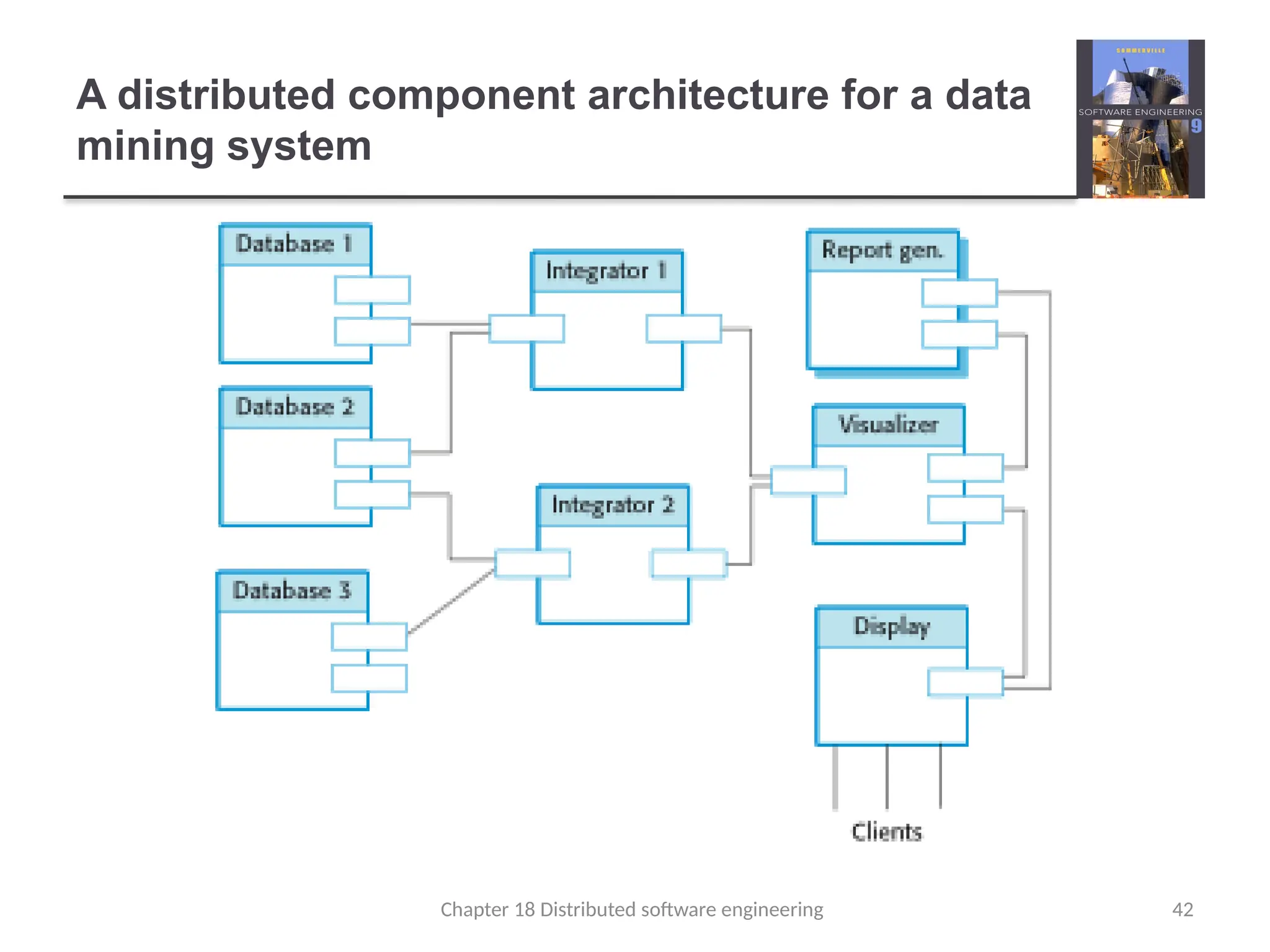
A distributed component architecture for a data
mining system
Chapter 18 Distributed software engineering 43
Distributed component architecture
disadvantages
 Distributed component architectures suffer from two
major disadvantages:
 They are more complex to design than client–server systems.
Distributed component architectures are difficult for people to
visualize and understand.
 Standardized middleware for distributed component systems has
never been accepted by the communityDifferent vendors, such
as Microsoft and Sun, have developed different, incompatible
middleware.
 As a result of these problems, service-oriented
architectures are replacing distributed component
architectures in many situations.
Peer-to-peer architectures
P2p architectural models
Chapter 18 Distributed software engineering 46
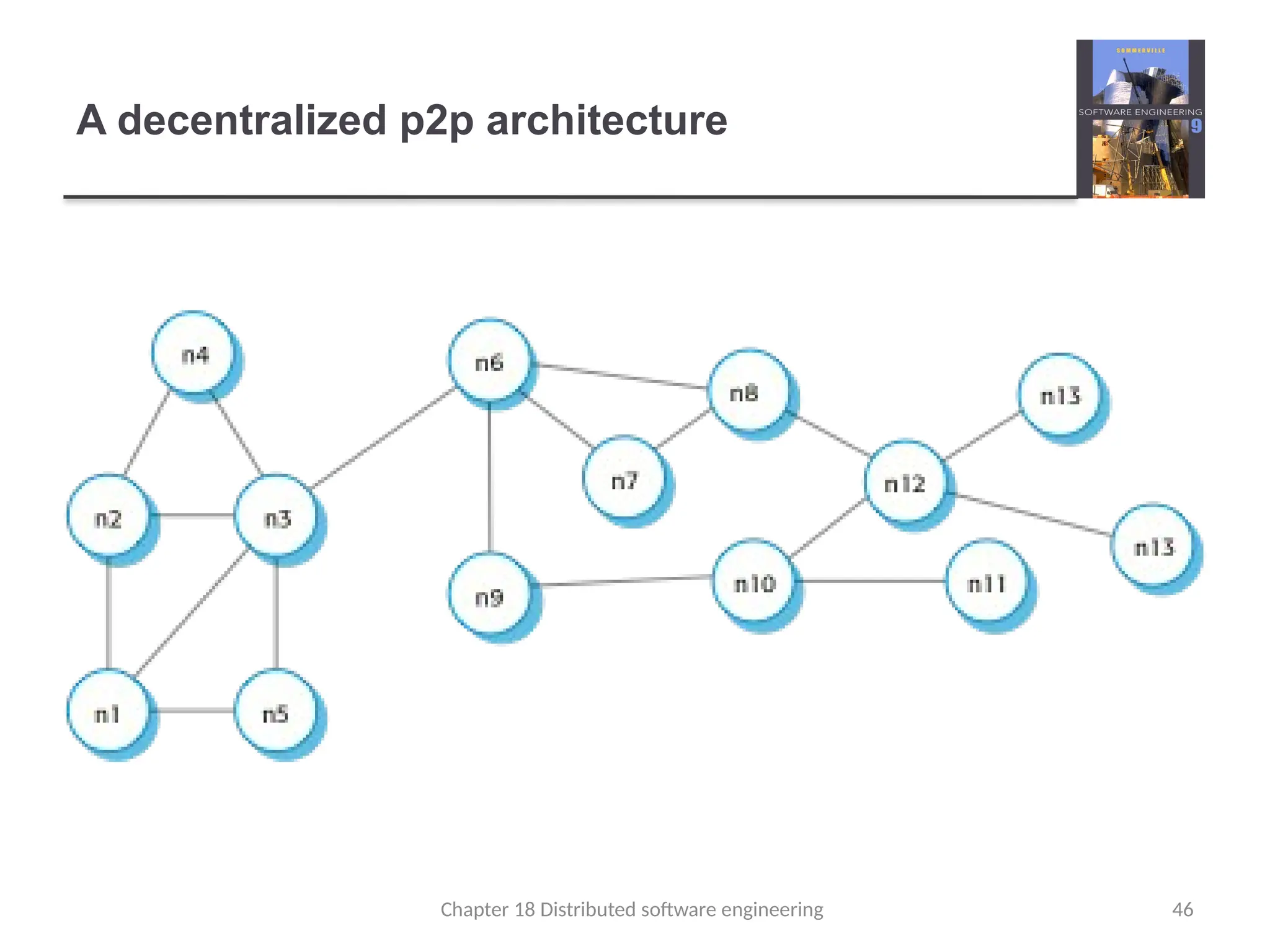
A decentralized p2p architecture
Chapter 18 Distributed software engineering 47
A semicentralized p2p architecture
Chapter 18 Distributed software engineering 48
Software as a service
 Software as a service (SaaS) involves hosting the
software remotely and providing access to it over the
Internet.
 Software is deployed on a server (or more commonly a number
of servers) and is accessed through a web browser. It is not
deployed on a local PC.
 The software is owned and managed by a software provider,
rather than the organizations using the software.
 Users may pay for the software according to the amount of use
they make of it or through an annual or monthly subscription.
Chapter 18 Distributed software engineering 49
Key elements of SaaS
 Software is deployed on a server (or more commonly a
number of servers) and is accessed through a web
browser. It is not deployed on a local PC.
 The software is owned and managed by a software
provider, rather than the organizations using the
software.
 Users may pay for the software according to the amount
of use they make of it or through an annual or monthly
subscription. Sometimes, the software is free for anyone
to use but users must then agree to accept
advertisements, which fund the software service.
Chapter 18 Distributed software engineering 50
SaaS and SOA
 Software as a service is a way of providing functionality
on a remote server with client access through a web
browser. The server maintains the user’s data and state
during an interaction session. Transactions are usually
long transactions e.g. editing a document.
 Service-oriented architecture is an approach to
structuring a software system as a set of separate,
stateless services. These may be provided by multiple
providers and may be distributed. Typically, transactions
are short transactions where a service is called, does
something then returns a result.
Chapter 18 Distributed software engineering 51
Implementation factors for SaaS
 Configurability How do you configure the software for the
specific requirements of each organization?
 Multi-tenancy How do you present each user of the
software with the impression that they are working with
their own copy of the system while, at the same time,
making efficient use of system resources?
 ScalabilityHow do you design the system so that it can
be scaled to accommodate an unpredictably large
number of users?
Chapter 18 Distributed software engineering 52
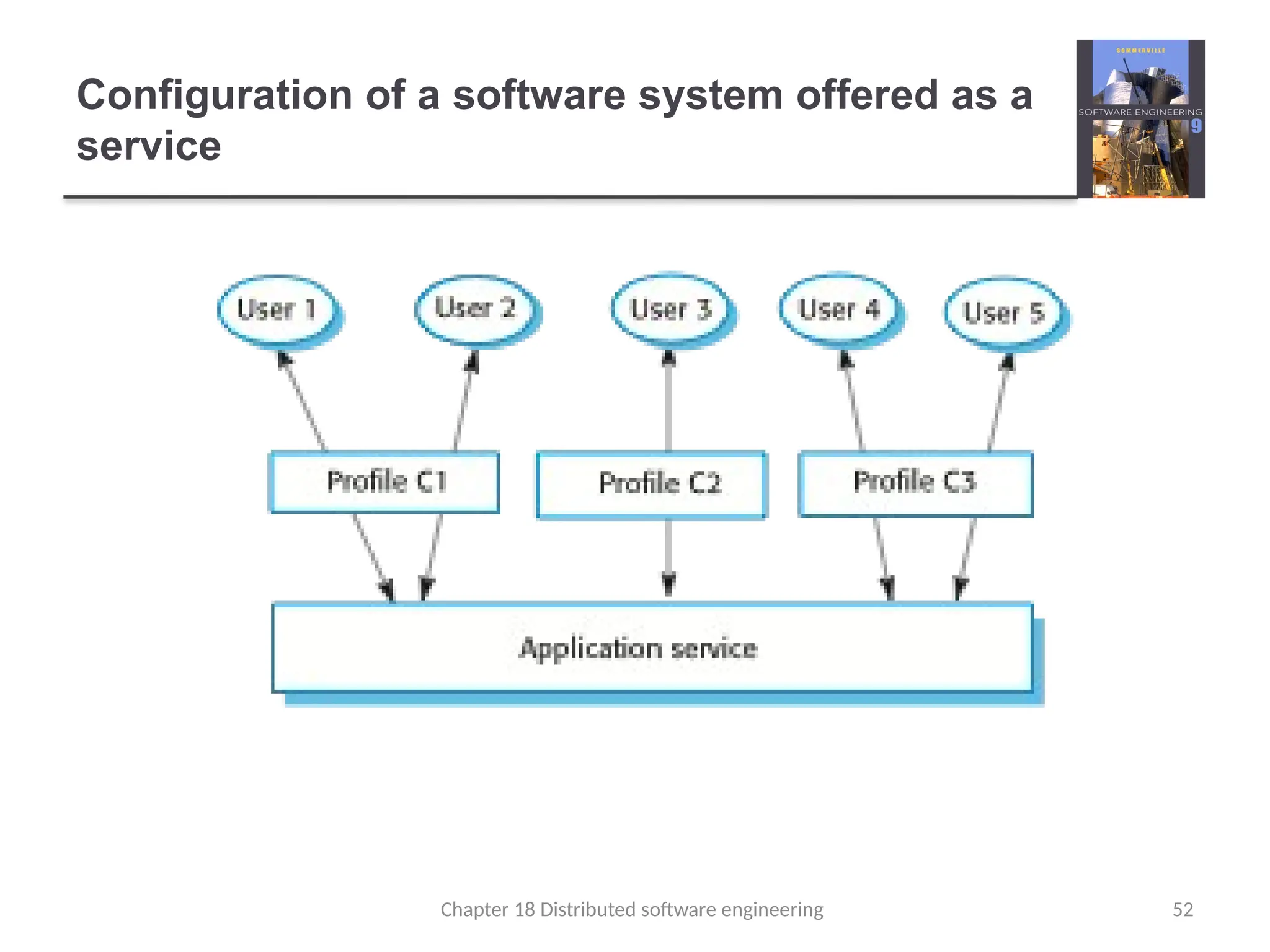
Configuration of a software system offered as a
service
Chapter 18 Distributed software engineering 53
Service configuration
 Branding, where users from each organization, are presented
with an interface that reflects their own organization.
 Business rules and workflows, where each organization
defines its own rules that govern the use of the service and its
data.
 Database extensions, where each organization defines how
the generic service data model is extended to meet its specific
needs.
 Access control, where service customers create individual
accounts for their staff and define the resources and functions
that are accessible to each of their users.
Chapter 18 Distributed software engineering 54
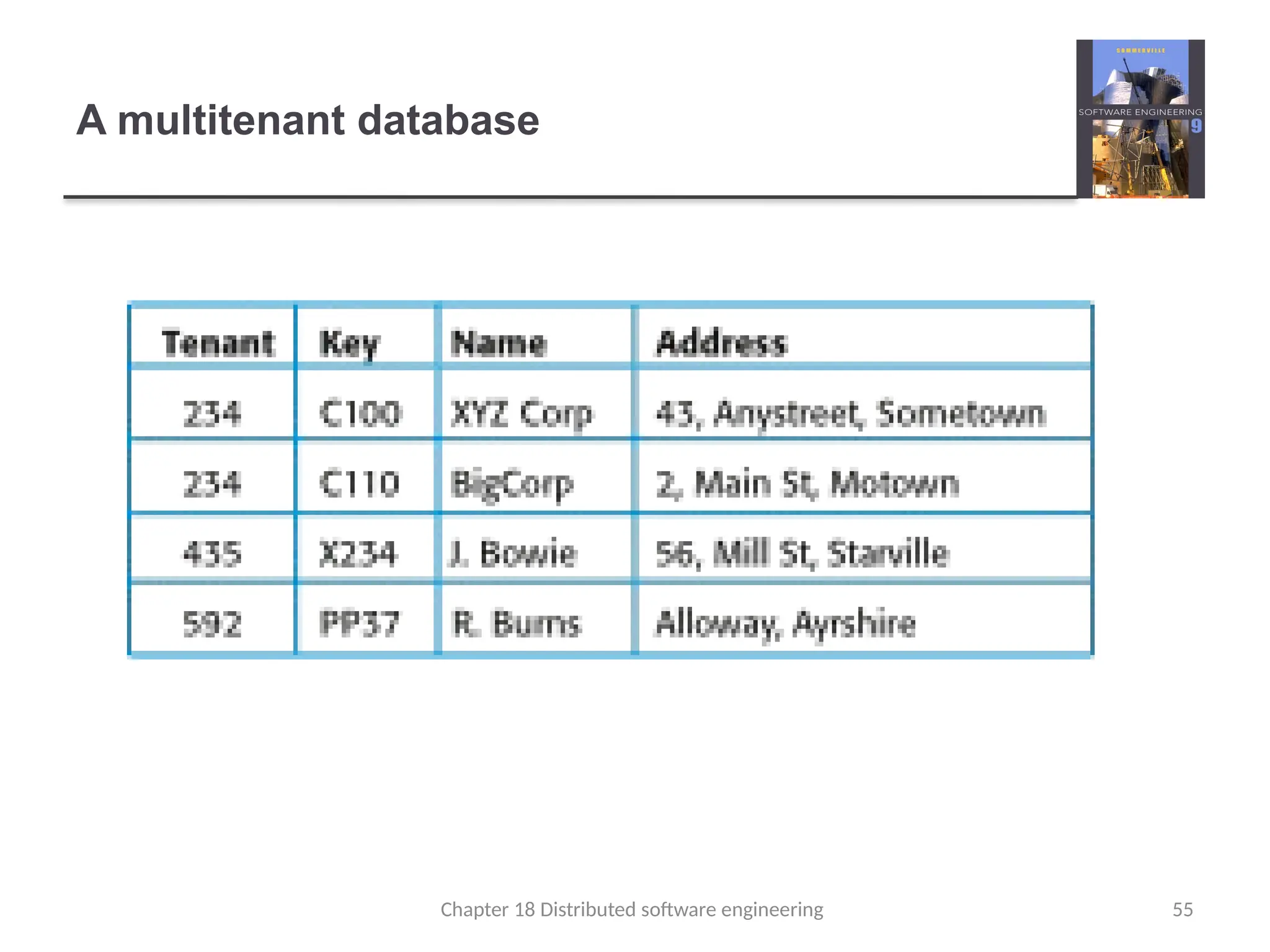
Multi-tenancy
 Multi-tenancy is a situation in which many different users
access the same system and the system architecture is
defined to allow the efficient sharing of system
resources.
 It must appear to each user that they have the sole use
of the system.
 Multi-tenancy involves designing the system so that
there is an absolute separation between the system
functionality and the system data.
Chapter 18 Distributed software engineering 55
A multitenant database
Chapter 18 Distributed software engineering 56
Scaleability
 Develop applications where each component is implemented
as a simple stateless service that may be run on any server.
 Design the system using asynchronous interaction so that the
application does not have to wait for the result of an
interaction (such as a read request).
 Manage resources, such as network and database
connections, as a pool so that no single server is likely to run
out of resources.
 Design your database to allow fine-grain locking. That is, do
not lock out whole records in the database when only part of a
record is in use.
Chapter 18 Distributed software engineering 57
Key points
 Architectural patterns for distributed systems include master-
slave architectures, two-tier and multi-tier client-server
architectures, distributed component architectures and peer-
to-peer architectures.
 Distributed component systems require middleware to handle
component communications and to allow components to be
added to and removed from the system.
 Peer-to-peer architectures are decentralized with no
distinguished clients and servers. Computations can be
distributed over many systems in different organizations.
 Software as a service is a way of deploying applications as
thin client- server systems, where the client is a web browser.
Chapter 18 of Softaware Engineering by Iam Somerville Text Book

  • 1.
    Chapter 18 Distributedsoftware engineering 1 Chapter 18 – Distributed software engineering Lecture 1
  • 2.
    Chapter 18 Distributedsoftware engineering 2 Topics covered  Distributed systems issues  Client–server computing  Architectural patterns for distributed systems  Software as a service
  • 3.
  • 4.
  • 5.
    Chapter 18 Distributedsoftware engineering 5 Distributed systems issues  Distributed systems are more complex than systems that run on a single processor.  Complexity arises because different parts of the system are independently managed as is the network.  There is no single authority in charge of the system so top-down control is impossible.
  • 6.
    Chapter 18 Distributedsoftware engineering 6 Design issues  Transparency To what extent should the distributed system appear to the user as a single system?  Openness Should a system be designed using standard protocols that support interoperability?  ScalabilityHow can the system be constructed so that it is scalable?  Security How can usable security policies be defined and implemented?  Quality of service How should the quality of servicebe specified.  Failure management How can system failures be detected, contained and repaired?
  • 7.
    Chapter 18 Distributedsoftware engineering 7 Transparency  Ideally, users should not be aware that a system is distributed and services should be independent of distribution characteristics.  In practice, this is impossible because parts of the system are independently managed and because of network delays.  Often better to make users aware of distribution so that they can cope with problems  To achieve transparency, resources should be abstracted and addressed logically rather than physically. Middleware maps logical to physical resources.
  • 8.
    Chapter 18 Distributedsoftware engineering 8 Openness  Open distributed systems are systems that are built according to generally accepted standards.  Components from any supplier can be integrated into the system and can inter-operate with the other system components.  Openness implies that system components can be independently developed in any programming language and, if these conform to standards, they will work with other components.  Web service standards for service-oriented architectures were developed to be open standards.
  • 9.
    Chapter 18 Distributedsoftware engineering 9 Scalability  The scalability of a system reflects its ability to deliver a high quality service as demands on the system increase  Size It should be possible to add more resources to a system to cope with increasing numbers of users.  Distribution It should be possible to geographically disperse the components of a system without degrading its performance.  ManageabilityIt should be possible to manage a system as it increases in size, even if parts of the system are located in independent organizations.  There is a distinction between scaling-up and scaling- out. Scaling up is more powerful system; scaling out is more system instances.
  • 10.
    Chapter 18 Distributedsoftware engineering 10 Security  When a system is distributed, the number of ways that the system may be attacked is significantly increased, compared to centralized systems.  If a part of the system is successfully attacked then the attacker may be able to use this as a ‘back door’ into other parts of the system.  Difficulties in a distributed system arise because different organizations may own parts of the system. These organizations may have mutually incompatible security policies and security mechanisms.
  • 11.
    Chapter 18 Distributedsoftware engineering 11 Types of attack  The types of attack that a distributed system must defend itself against are:  Interception, where communications between parts of the system are intercepted by an attacker so that there is a loss of confidentiality.  Interruption, where system services are attacked and cannot be delivered as expected. • Denial of service attacks involve bombarding a node with illegitimate service requests so that it cannot deal with valid requests.  Modification, where data or services in the system are changed by an attacker.  Fabrication, where an attacker generates information that should not exist and then uses this to gain some privileges.
  • 12.
    Chapter 18 Distributedsoftware engineering 12 Quality of service  The quality of service (QoS) offered by a distributed system reflects the system’s ability to deliver its services dependably and with a response time and throughput that is acceptable to its users.  Quality of service is particularly critical when the system is dealing with time-critical data such as sound or video streams.  In these circumstances, if the quality of service falls below a threshold value then the sound or video may become so degraded that it is impossible to understand.
  • 13.
    Chapter 18 Distributedsoftware engineering 13 Failure management  In a distributed system, it is inevitable that failures will occur, so the system has to be designed to be resilient to these failures. “You know that you have a distributed system when the crash of a system that you’ve never heard of stops you getting any work done.”  Distributed systems should include mechanisms for discovering if a component of the system has failed, should continue to deliver as many services as possible in spite of that failure and, as far as possible, automatically recover from the failure.
  • 14.
    Chapter 18 Distributedsoftware engineering 14 Models of interaction  Two types of interaction between components in a distributed system  Procedural interaction, where one computer calls on a known service offered by another computer and waits for a response.  Message-based interaction, involves the sending computer sending information about what is required to another computer. There is no necessity to wait for a response.
  • 15.
    Chapter 18 Distributedsoftware engineering 15 Procedural interaction between a diner and a waiter
  • 16.
    Chapter 18 Distributedsoftware engineering 16 Message-based interaction between a waiter and the kitchen <starter> <dish name = “soup” type = “tomato” /> <dish name = “soup” type = “fish” /> <dish name = “pigeon salad” /> </starter> <main course> <dish name = “steak” type = “sirloin” cooking = “medium” /> <dish name = “steak” type = “fillet” cooking = “rare” /> <dish name = “sea bass”> </main> <accompaniment> <dish name = “french fries” portions = “2” /> <dish name = “salad” portions = “1” /> </accompaniment>
  • 17.
    Chapter 18 Distributedsoftware engineering 17 Remote procedure calls  Procedural communication in a distributed system is implemented using remote procedure calls (RPC).  In a remote procedure call, one component calls another component as if it was a local procedure or method. The middleware in the system intercepts this call and passes it to a remote component.  This carries out the required computation and, via the middleware, returns the result to the calling component.  A problem withRPCs is that the caller and the callee need to be available at the time of the communication, and they must know how to refer to each other.
  • 18.
    Chapter 18 Distributedsoftware engineering 18 Message passing  Message-based interaction normally involves one component creating a message that details the services required from another component.  Through the system middleware, this is sent to the receiving component.  The receiver parses the message, carries out the computations and creates a message for the sending component with the required results.  In a message-based approach, it is not necessary for the sender and receiver of the message to be aware of each other. They simple communicate with the middleware.
  • 19.
    Chapter 18 Distributedsoftware engineering 19 Middleware  The components in a distributed system may be implemented in different programming languages and may execute on completely different types of processor. Models of data, information representation and protocols for communication may all be different.  Middleware is software that can manage these diverse parts, and ensure that they can communicate and exchange data.
  • 20.
    Chapter 18 Distributedsoftware engineering 20 Middleware in a distributed system
  • 21.
    Chapter 18 Distributedsoftware engineering 21 Middleware support  Interaction support, where the middleware coordinates interactions between different components in the system  The middleware provides location transparency in that it isn’t necessary for components to know the physical locations of other components.  The provision of common services, where the middleware provides reusable implementations of services that may be required by several components in the distributed system.  By using these common services, components can easily inter- operate and provide user services in a consistent way.
  • 22.
    Chapter 18 Distributedsoftware engineering 22 Client-server computing  Distributed systems that are accessed over the Internet are normally organized as client-server systems.  In a client-server system, the user interacts with a program running on their local computer (e.g. a web browser or phone-based application). This interacts with another program running on a remote computer (e.g. a web server).  The remote computer provides services, such as access to web pages, which are available to external clients.
  • 23.
    Chapter 18 Distributedsoftware engineering 23 Client–server interaction
  • 24.
    Chapter 18 Distributedsoftware engineering 24 Mapping of clients and servers to networked computers
  • 25.
    Chapter 18 Distributedsoftware engineering 25 Layered architectural model for client–server applications
  • 26.
  • 27.
    Chapter 18 Distributedsoftware engineering 27 Chapter 18 – Distributed software engineering Lecture 2
  • 28.
    Chapter 18 Distributedsoftware engineering 28 Architectural patterns  Widely used ways of organizing the architecture of a distributed system:  Master-slave architecture, which is used in real-time systems in which guaranteed interaction response times are required.  Two-tier client-server architecture, which is used for simple client-server systems, and where the system is centralized for security reasons.  Multi-tier client-server architecture, which is used when there is a high volume of transactions to be processed by the server.  Distributed component architecture, which is used when resources from different systems and databases need to be combined, or as an implementation model for multi-tier client-server systems.  Peer-to-peer architecture, which is used when clients exchange locally stored information and the role of the server is to introduce clients to each other
  • 29.
    Chapter 18 Distributedsoftware engineering 29 Master-slave architectures  Master-slave architectures are commonly used in real- time systems where there may be separate processors associated with data acquisition from the system’s environment, data processing and computation and actuator management.  The ‘master’ process is usually responsible for computation, coordination and communications and it controls the ‘slave’ processes.  ‘Slave’ processes are dedicated to specific actions, such as the acquisition of data from an array of sensors.
  • 30.
    Chapter 18 Distributedsoftware engineering 30 A traffic management system with a master- slave architecture
  • 31.
    Chapter 18 Distributedsoftware engineering 31 Two-tier client server architectures  In a two-tier client-server architecture, the system is implemented as a single logical server plus an indefinite number of clients that use that server.  Thin-client model, where the presentation layer is implemented on the client and all other layers (data management, application processing and database) are implemented on a server.  Fat-client model, where some or all of the application processing is carried out on the client. Data management and database functions are implemented on the server.
  • 32.
    Chapter 18 Distributedsoftware engineering 32 Thin- and fat-client architectural models
  • 33.
  • 34.
  • 35.
    Chapter 18 Distributedsoftware engineering 35 A fat-client architecture for an ATM system
  • 36.
    Chapter 18 Distributedsoftware engineering 36 Multi-tier client-server architectures  In a ‘multi-tier client–server’ architecture, the different layers of the system, namely presentation, data management, application processing, and database, are separate processes that may execute on different processors.  This avoids problems with scalability and performance if a thin-client two-tier model is chosen, or problems of system management if a fat-client model is used.
  • 37.
    Chapter 18 Distributedsoftware engineering 37 Three-tier architecture for an Internet banking system
  • 38.
    Chapter 18 Distributedsoftware engineering 38 Use of client–server architectural patterns Architecture Applications Two-tier client–server architecture with thin clients Legacy system applications that are used when separating application processing and data management is impractical. Clients may access these as services, as discussed in Section 18.4. Computationally intensive applications such as compilers with little or no data management. Data-intensive applications (browsing and querying) with nonintensive application processing. Browsing the Web is the most common example of a situation where this architecture is used.
  • 39.
    Chapter 18 Distributedsoftware engineering 39 Use of client–server architectural patterns Architecture Applications Two-tier client-server architecture with fat clients Applications where application processing is provided by off-the-shelf software (e.g., Microsoft Excel) on the client. Applications where computationally intensive processing of data (e.g., data visualization) is required. Mobile applications where internet connectivity cannot be guaranteed. Some local processing using cached information from the database is therefore possible. Multi-tier client–server architecture Large-scale applications with hundreds or thousands of clients. Applications where both the data and the application are volatile. Applications where data from multiple sources are integrated.
  • 40.
  • 41.
    Chapter 18 Distributedsoftware engineering 41 A distributed component architecture
  • 42.
    Chapter 18 Distributedsoftware engineering 42 A distributed component architecture for a data mining system
  • 43.
    Chapter 18 Distributedsoftware engineering 43 Distributed component architecture disadvantages  Distributed component architectures suffer from two major disadvantages:  They are more complex to design than client–server systems. Distributed component architectures are difficult for people to visualize and understand.  Standardized middleware for distributed component systems has never been accepted by the communityDifferent vendors, such as Microsoft and Sun, have developed different, incompatible middleware.  As a result of these problems, service-oriented architectures are replacing distributed component architectures in many situations.
  • 44.
  • 45.
  • 46.
    Chapter 18 Distributedsoftware engineering 46 A decentralized p2p architecture
  • 47.
    Chapter 18 Distributedsoftware engineering 47 A semicentralized p2p architecture
  • 48.
    Chapter 18 Distributedsoftware engineering 48 Software as a service  Software as a service (SaaS) involves hosting the software remotely and providing access to it over the Internet.  Software is deployed on a server (or more commonly a number of servers) and is accessed through a web browser. It is not deployed on a local PC.  The software is owned and managed by a software provider, rather than the organizations using the software.  Users may pay for the software according to the amount of use they make of it or through an annual or monthly subscription.
  • 49.
    Chapter 18 Distributedsoftware engineering 49 Key elements of SaaS  Software is deployed on a server (or more commonly a number of servers) and is accessed through a web browser. It is not deployed on a local PC.  The software is owned and managed by a software provider, rather than the organizations using the software.  Users may pay for the software according to the amount of use they make of it or through an annual or monthly subscription. Sometimes, the software is free for anyone to use but users must then agree to accept advertisements, which fund the software service.
  • 50.
    Chapter 18 Distributedsoftware engineering 50 SaaS and SOA  Software as a service is a way of providing functionality on a remote server with client access through a web browser. The server maintains the user’s data and state during an interaction session. Transactions are usually long transactions e.g. editing a document.  Service-oriented architecture is an approach to structuring a software system as a set of separate, stateless services. These may be provided by multiple providers and may be distributed. Typically, transactions are short transactions where a service is called, does something then returns a result.
  • 51.
    Chapter 18 Distributedsoftware engineering 51 Implementation factors for SaaS  Configurability How do you configure the software for the specific requirements of each organization?  Multi-tenancy How do you present each user of the software with the impression that they are working with their own copy of the system while, at the same time, making efficient use of system resources?  ScalabilityHow do you design the system so that it can be scaled to accommodate an unpredictably large number of users?
  • 52.
    Chapter 18 Distributedsoftware engineering 52 Configuration of a software system offered as a service
  • 53.
    Chapter 18 Distributedsoftware engineering 53 Service configuration  Branding, where users from each organization, are presented with an interface that reflects their own organization.  Business rules and workflows, where each organization defines its own rules that govern the use of the service and its data.  Database extensions, where each organization defines how the generic service data model is extended to meet its specific needs.  Access control, where service customers create individual accounts for their staff and define the resources and functions that are accessible to each of their users.
  • 54.
    Chapter 18 Distributedsoftware engineering 54 Multi-tenancy  Multi-tenancy is a situation in which many different users access the same system and the system architecture is defined to allow the efficient sharing of system resources.  It must appear to each user that they have the sole use of the system.  Multi-tenancy involves designing the system so that there is an absolute separation between the system functionality and the system data.
  • 55.
    Chapter 18 Distributedsoftware engineering 55 A multitenant database
  • 56.
    Chapter 18 Distributedsoftware engineering 56 Scaleability  Develop applications where each component is implemented as a simple stateless service that may be run on any server.  Design the system using asynchronous interaction so that the application does not have to wait for the result of an interaction (such as a read request).  Manage resources, such as network and database connections, as a pool so that no single server is likely to run out of resources.  Design your database to allow fine-grain locking. That is, do not lock out whole records in the database when only part of a record is in use.
  • 57.
    Chapter 18 Distributedsoftware engineering 57 Key points  Architectural patterns for distributed systems include master- slave architectures, two-tier and multi-tier client-server architectures, distributed component architectures and peer- to-peer architectures.  Distributed component systems require middleware to handle component communications and to allow components to be added to and removed from the system.  Peer-to-peer architectures are decentralized with no distinguished clients and servers. Computations can be distributed over many systems in different organizations.  Software as a service is a way of deploying applications as thin client- server systems, where the client is a web browser.