1- 1
Copyright © 2012 Pearson Education, Inc.
Publishing as Prentice Hall
i t ’s good and
good for you
Chapter 1
Marketing:
Creating and Capturing Customer Value
1- 2
Copyright © 2012 Pearson Education, Inc.
Publishing as Prentice Hall
Creating and Capturing Customer
Value
• What Is Marketing?
• Understand the Marketplace and Customer Needs
• Designing a Customer-Driven Marketing Strategy
• Preparing an Integrated Marketing Plan and Program
• Building Customer Relationships
• Capturing Value from Customers
• The Changing Marketing Landscape
Topic Outline
1- 3
Copyright © 2012 Pearson Education, Inc.
Publishing as Prentice Hall
What Is Marketing?
Marketing is a process by which companies
create value for customers and build
strong customer relationships to capture
value from customers in return
1- 4
Copyright © 2012 Pearson Education, Inc.
Publishing as Prentice Hall
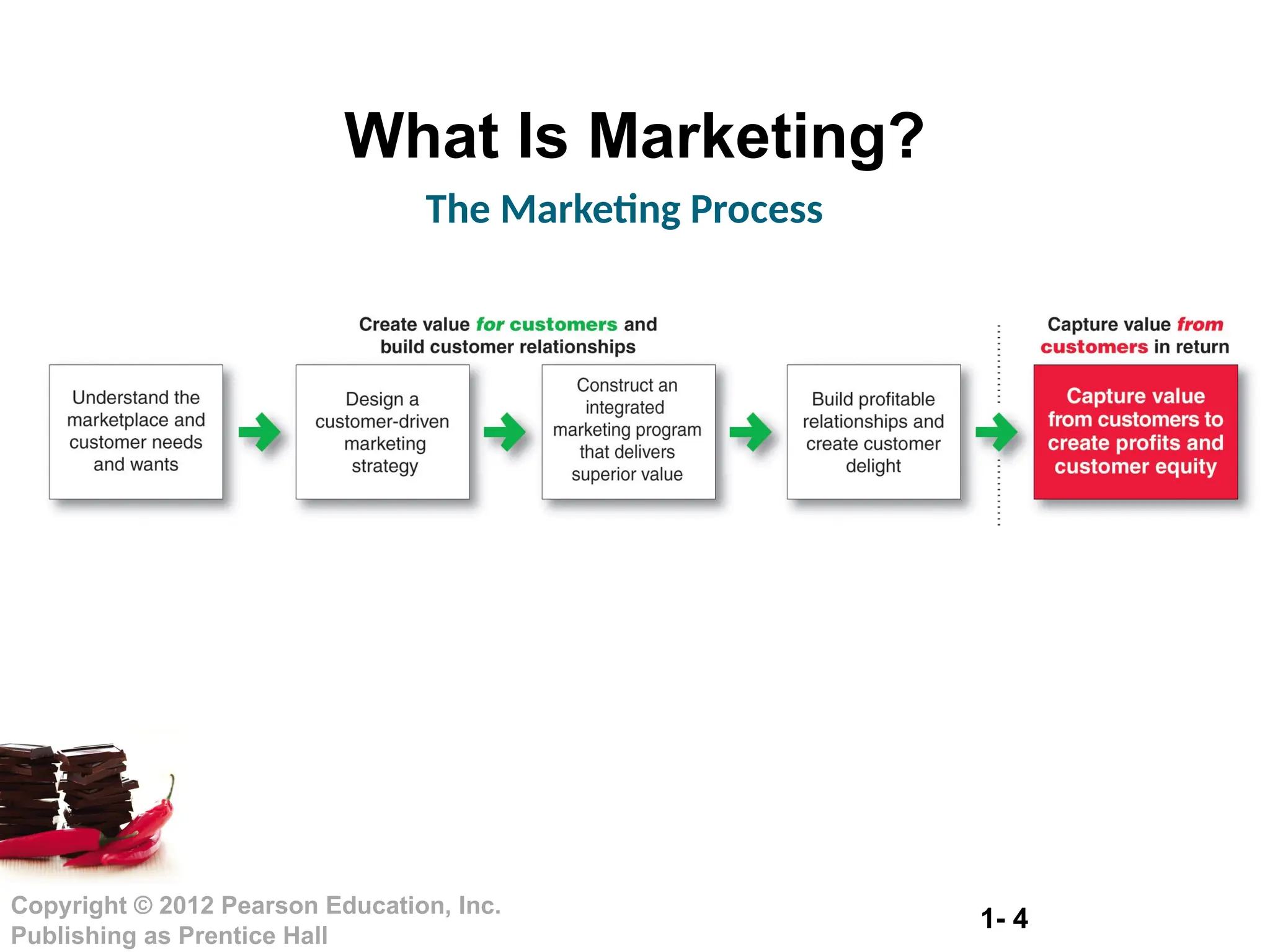
What Is Marketing?
The Marketing Process
1- 5
Copyright © 2012 Pearson Education, Inc.
Publishing as Prentice Hall
Understanding the Marketplace
and Customer Needs
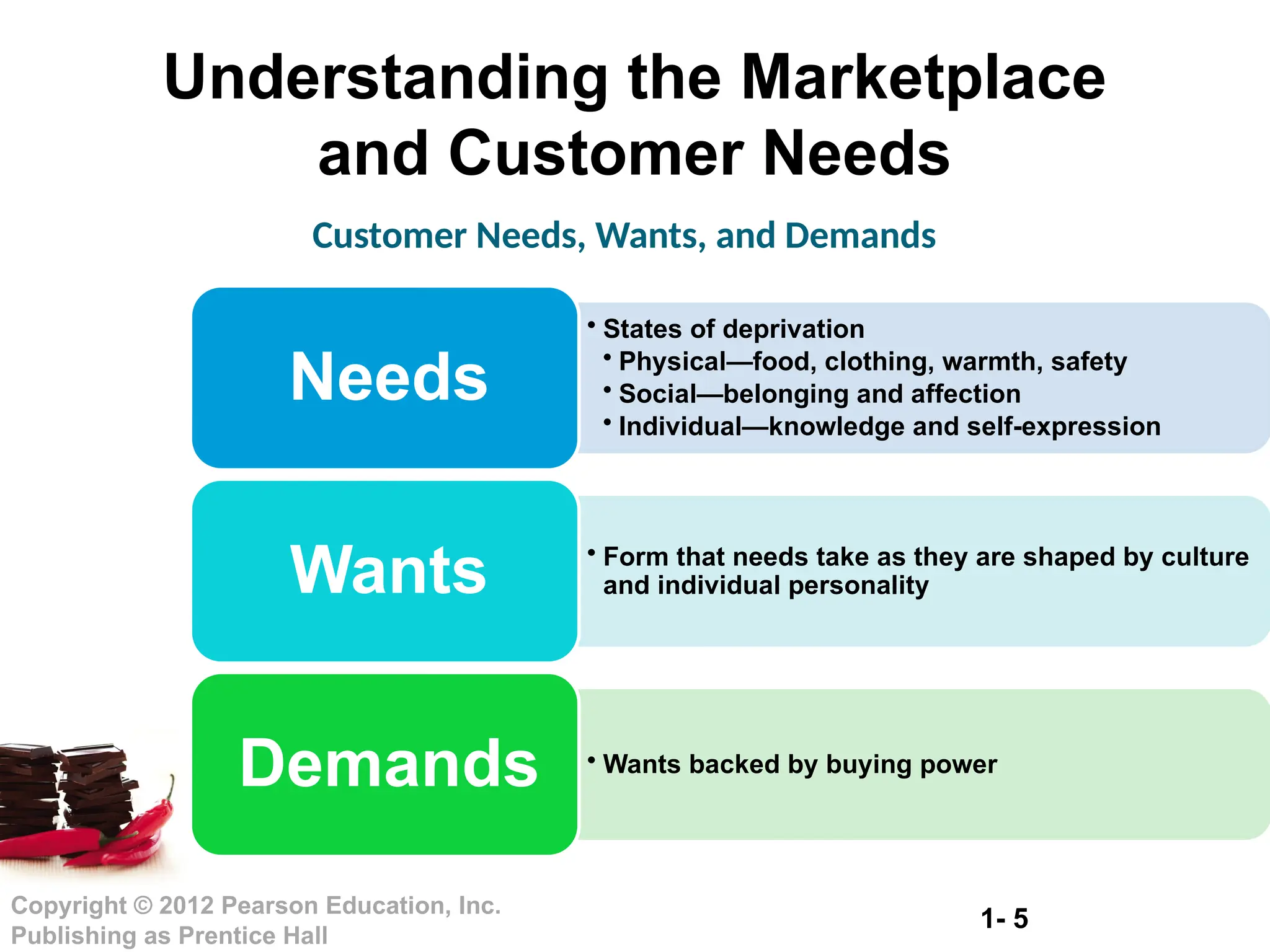
• States of deprivation
• Physical—food, clothing, warmth, safety
• Social—belonging and affection
• Individual—knowledge and self-expression
Needs
• Form that needs take as they are shaped by culture
and individual personality
Wants
• Wants backed by buying power
Demands
Customer Needs, Wants, and Demands
1- 6
Copyright © 2012 Pearson Education, Inc.
Publishing as Prentice Hall
Understanding the Marketplace
and Customer Needs
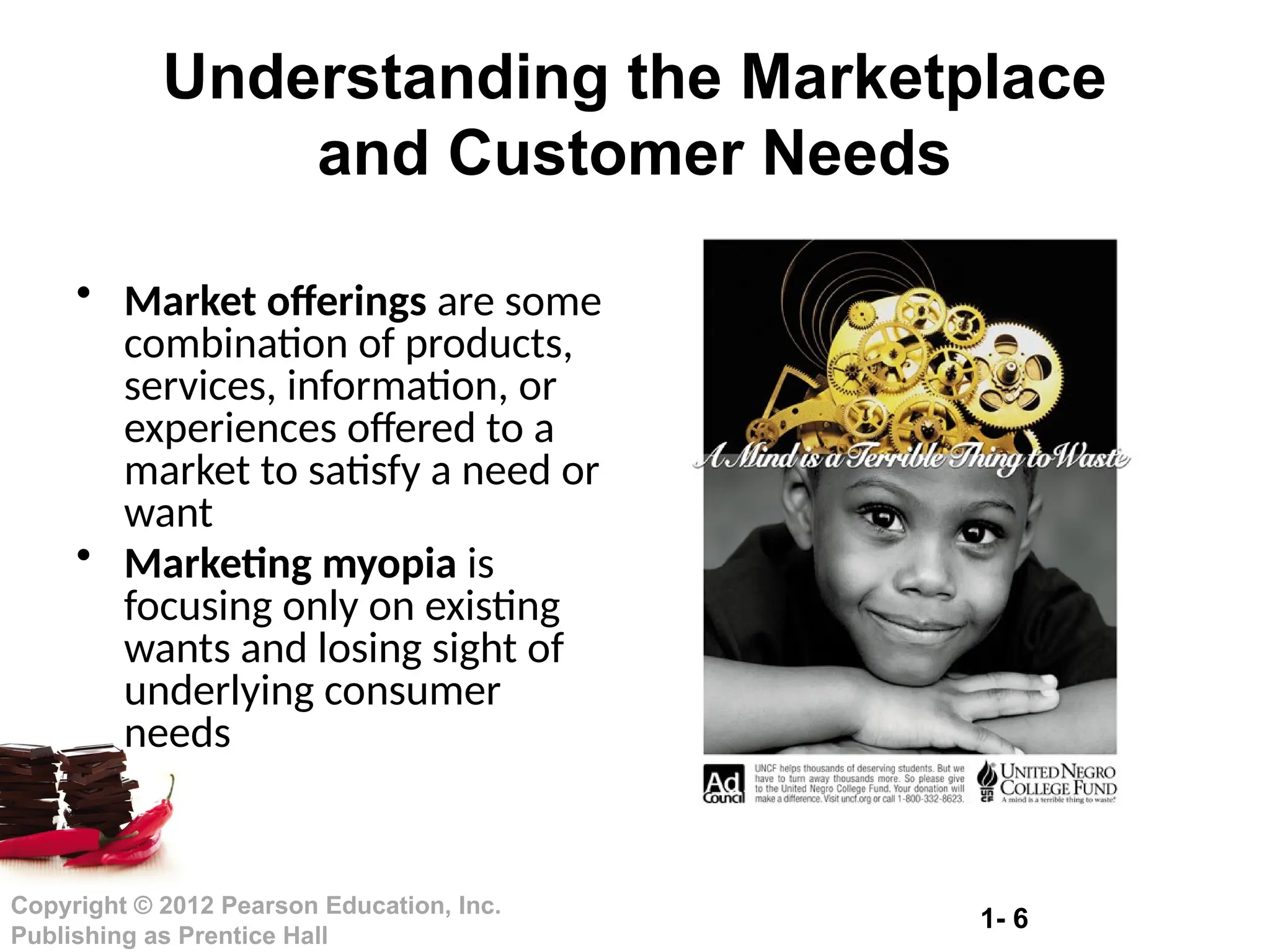
• Market offerings are some
combination of products,
services, information, or
experiences offered to a
market to satisfy a need or
want
• Marketing myopia is
focusing only on existing
wants and losing sight of
underlying consumer
needs
1- 7
Copyright © 2012 Pearson Education, Inc.
Publishing as Prentice Hall
Understanding the Marketplace
and Customer Needs
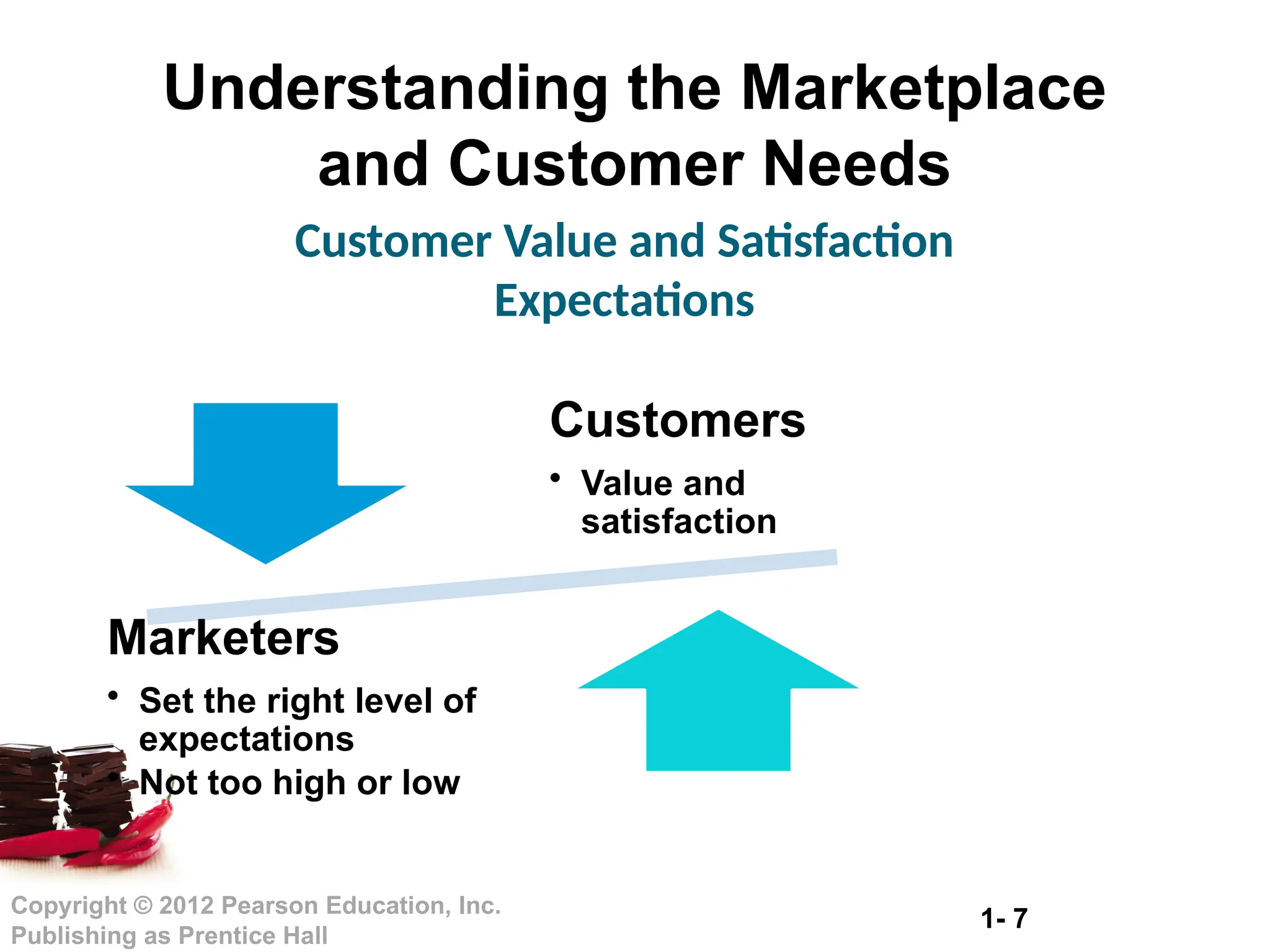
Customer Value and Satisfaction
Expectations
Customers
• Value and
satisfaction
Marketers
• Set the right level of
expectations
• Not too high or low
1- 8
Copyright © 2012 Pearson Education, Inc.
Publishing as Prentice Hall
Exchange is the act of obtaining a desired
object from someone by offering
something in return
Understanding the Marketplace
and Customer Needs
1- 9
Copyright © 2012 Pearson Education, Inc.
Publishing as Prentice Hall
Understanding the Marketplace
and Customer Needs
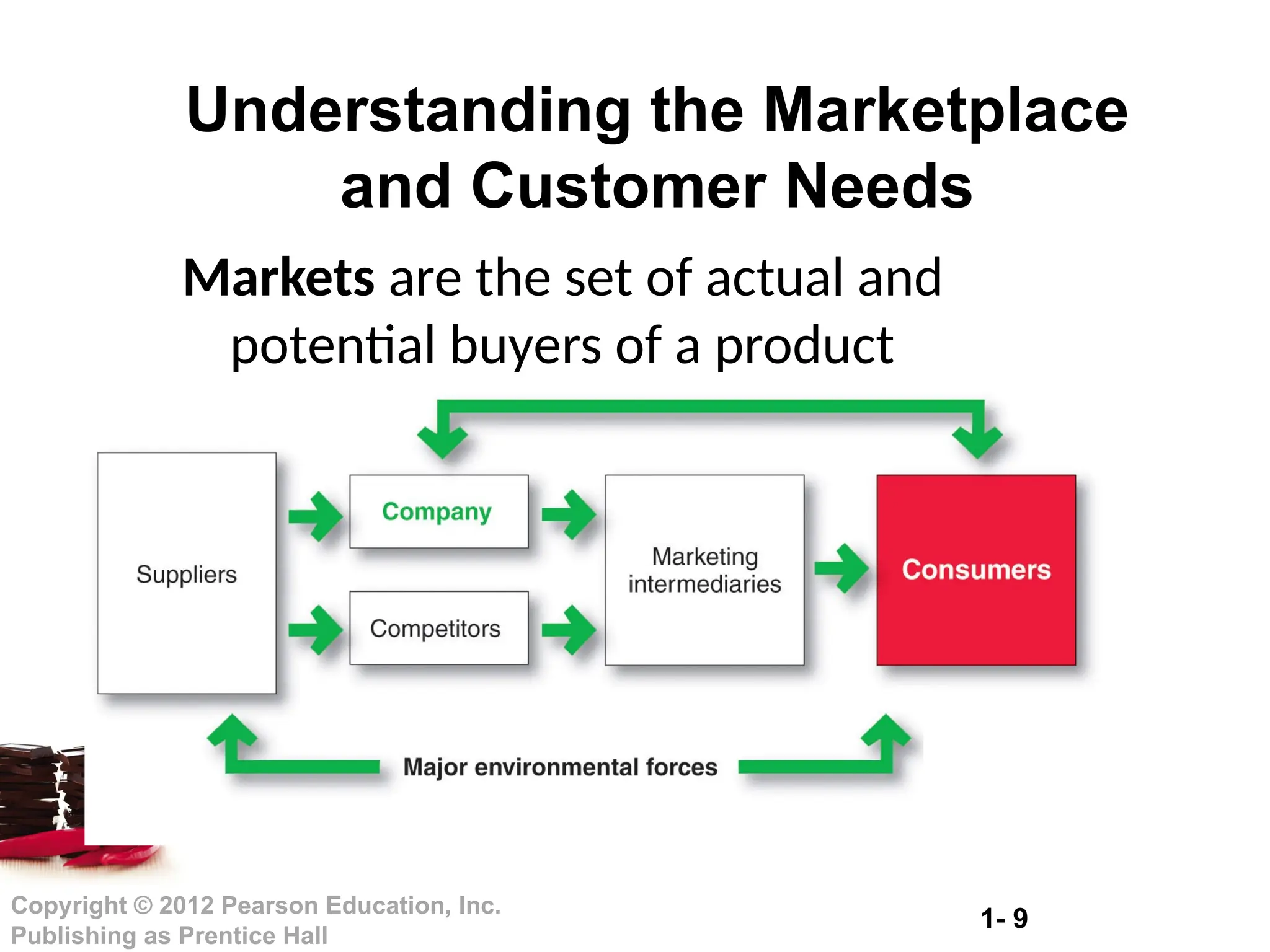
Markets are the set of actual and
potential buyers of a product
1- 10
Copyright © 2012 Pearson Education, Inc.
Publishing as Prentice Hall
Designing a Customer-Driven
Marketing Strategy
Marketing management is the art and
science of choosing target markets and
building profitable relationships with them
– What customers will we serve?
– How can we best serve these customers?
1- 11
Copyright © 2012 Pearson Education, Inc.
Publishing as Prentice Hall
Designing a Customer-Driven
Marketing Strategy
Market segmentation refers to dividing the
markets into segments of customers
Target marketing refers to which segments to
go after
Selecting Customers to Serve
1- 12
Copyright © 2012 Pearson Education, Inc.
Publishing as Prentice Hall
Designing a Customer-Driven
Marketing Strategy
Choosing a Value Proposition
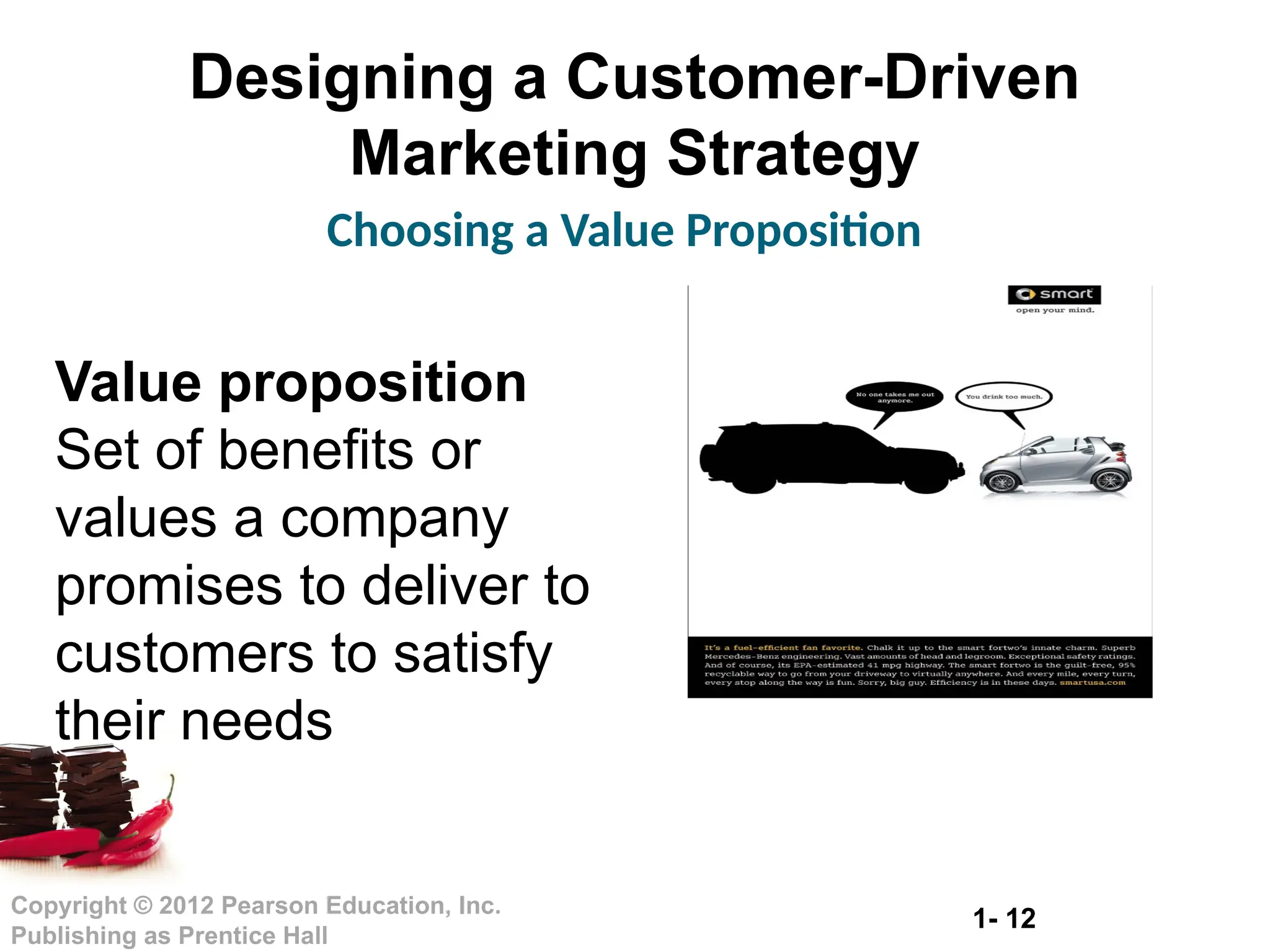
Value proposition
Set of benefits or
values a company
promises to deliver to
customers to satisfy
their needs
1- 13
Copyright © 2012 Pearson Education, Inc.
Publishing as Prentice Hall
Designing a Customer-Driven
Marketing Strategy
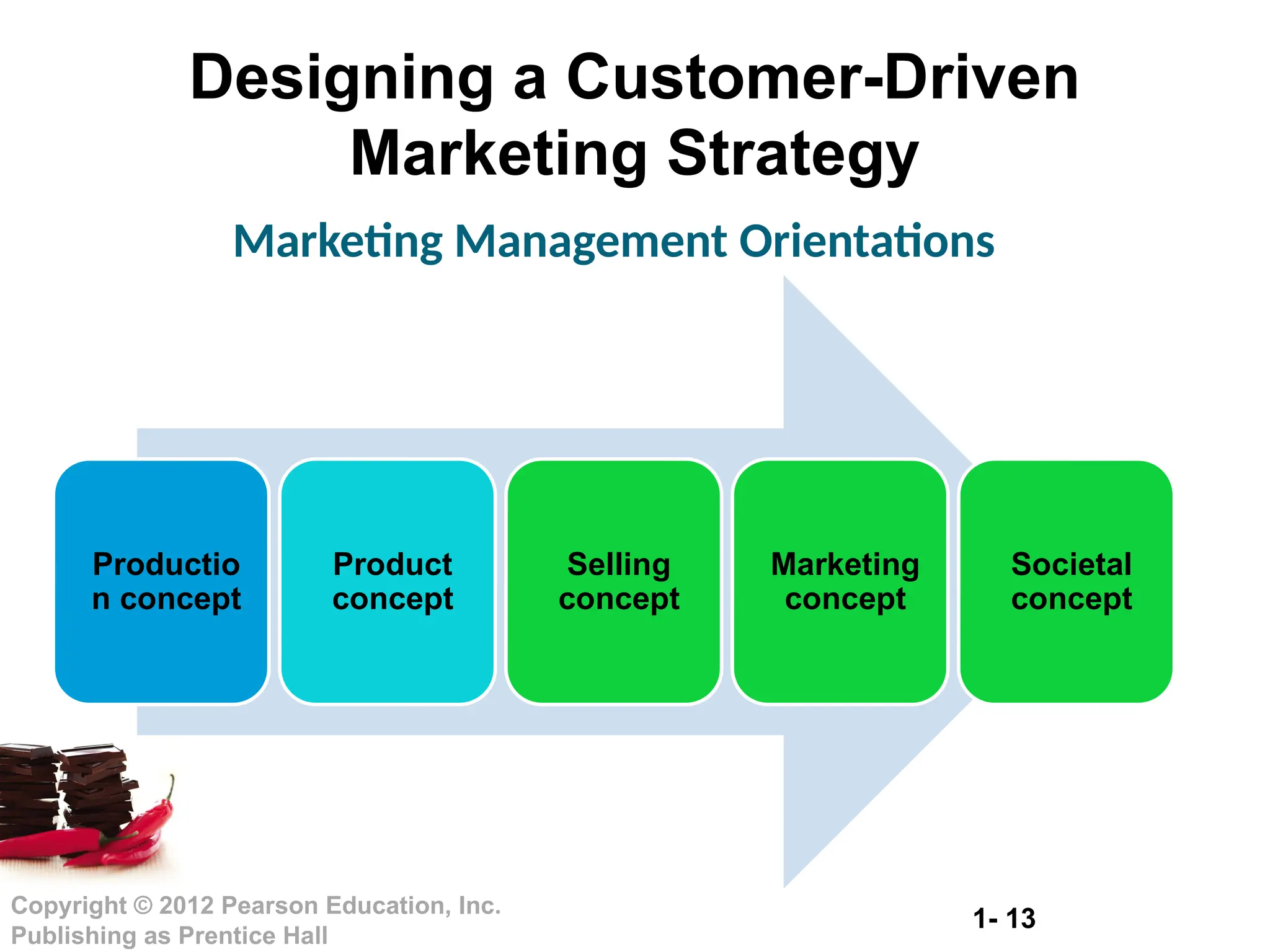
Productio
n concept
Product
concept
Selling
concept
Marketing
concept
Societal
concept
Marketing Management Orientations
1- 14
Copyright © 2012 Pearson Education, Inc.
Publishing as Prentice Hall
Designing a Customer-Driven
Marketing Strategy
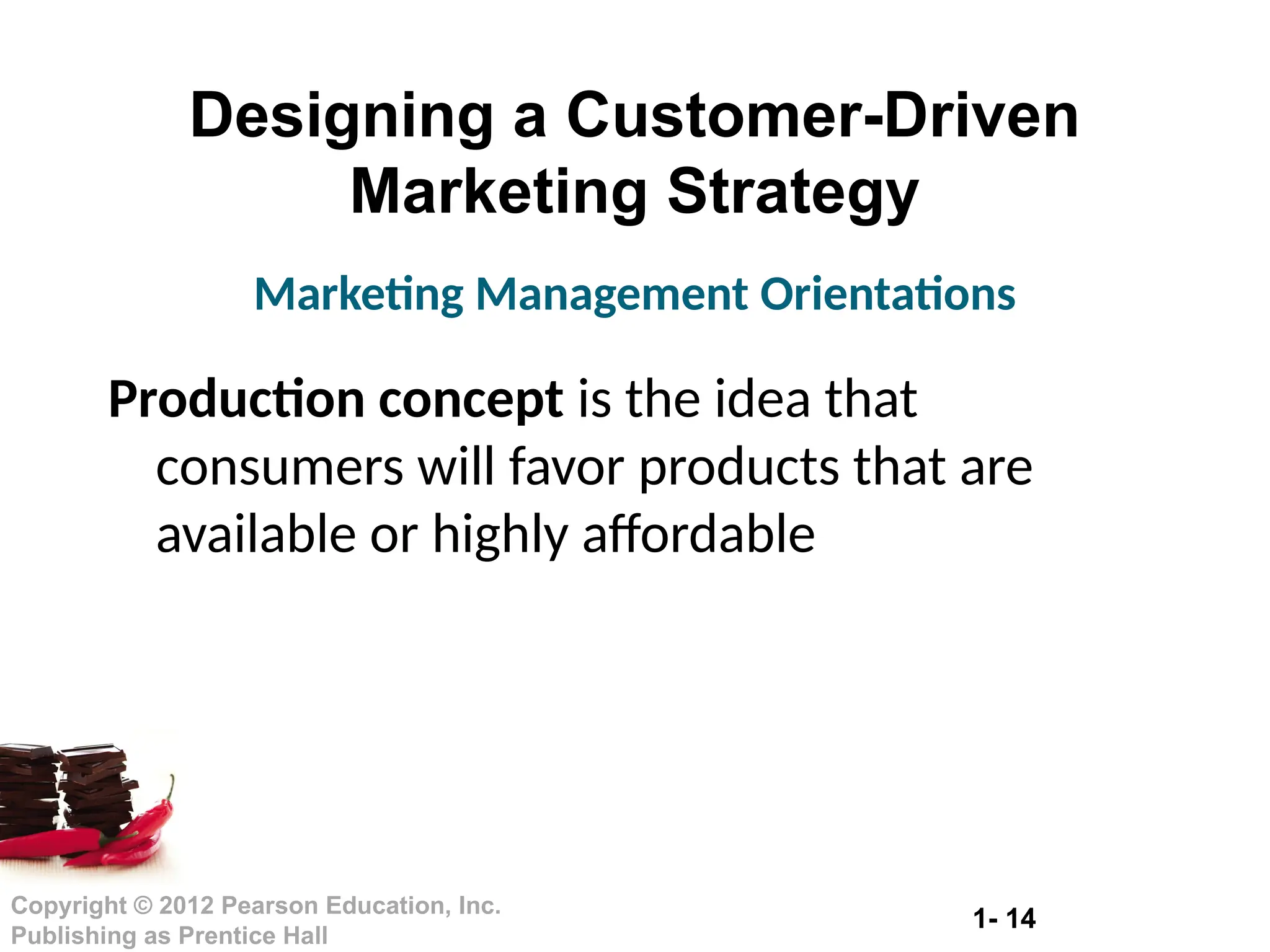
Production concept is the idea that
consumers will favor products that are
available or highly affordable
Marketing Management Orientations
1- 15
Copyright © 2012 Pearson Education, Inc.
Publishing as Prentice Hall
Designing a Customer-Driven
Marketing Strategy
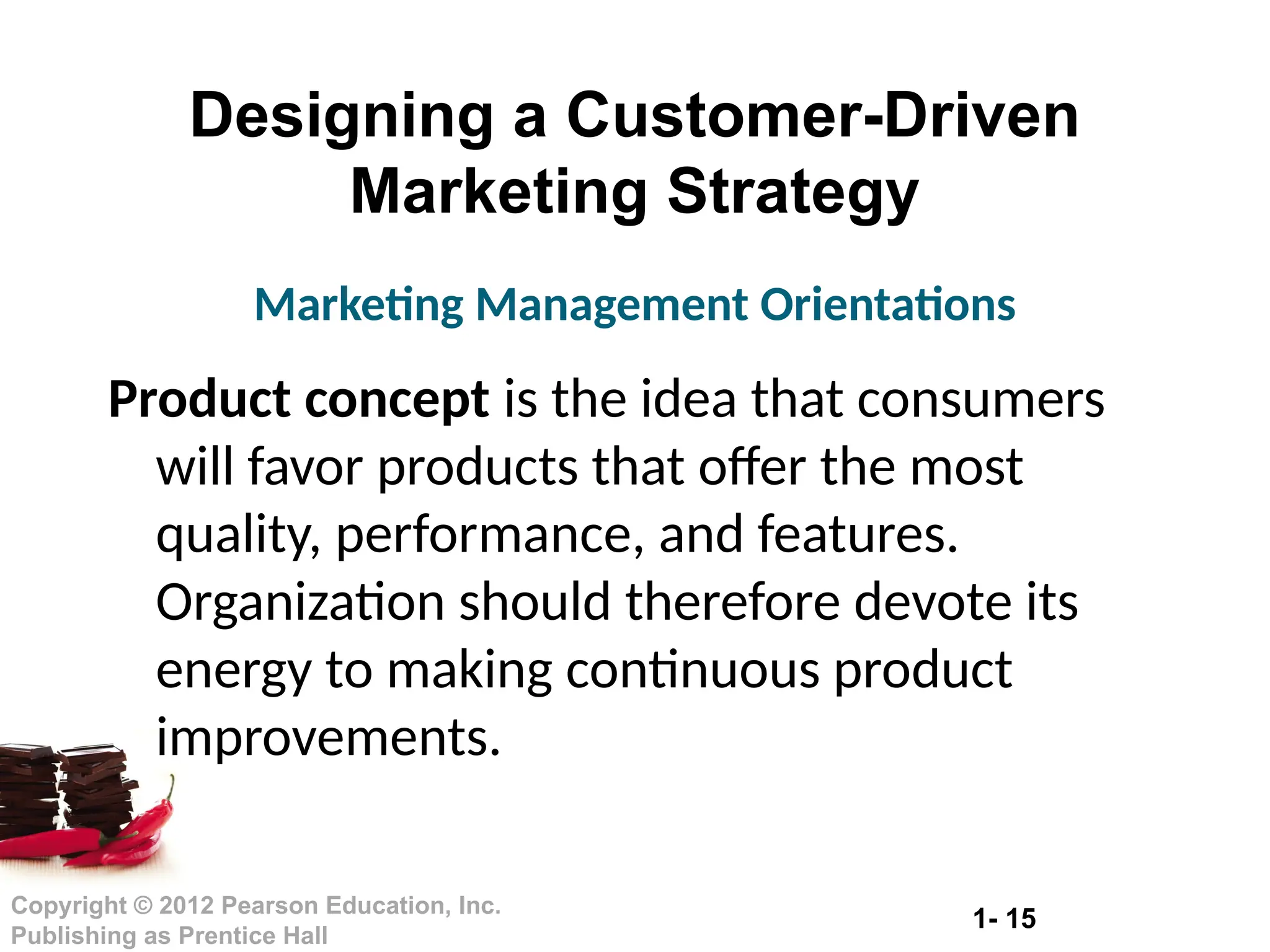
Product concept is the idea that consumers
will favor products that offer the most
quality, performance, and features.
Organization should therefore devote its
energy to making continuous product
improvements.
Marketing Management Orientations
1- 16
Copyright © 2012 Pearson Education, Inc.
Publishing as Prentice Hall
Designing a Customer-Driven
Marketing Strategy
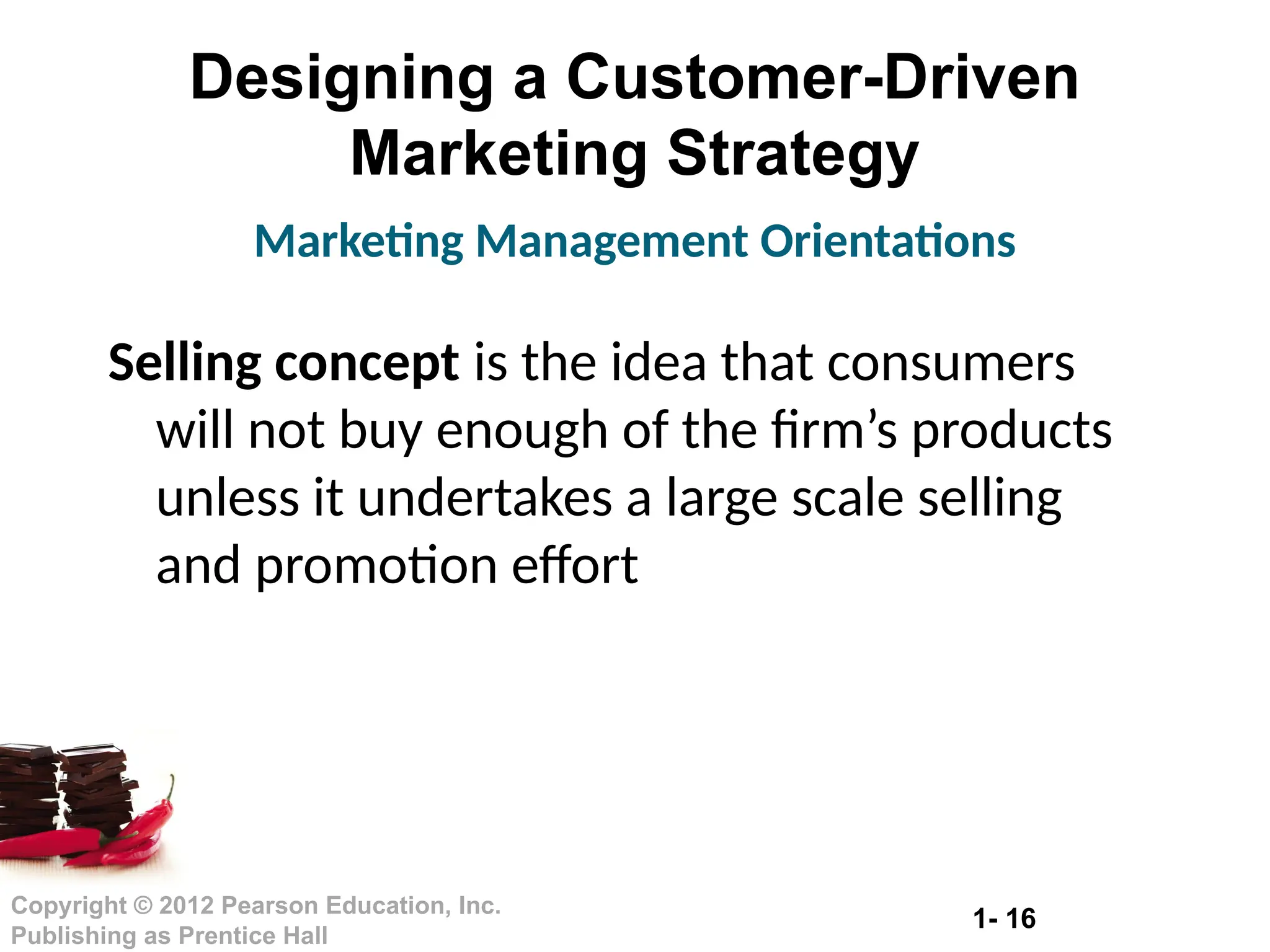
Selling concept is the idea that consumers
will not buy enough of the firm’s products
unless it undertakes a large scale selling
and promotion effort
Marketing Management Orientations
1- 17
Copyright © 2012 Pearson Education, Inc.
Publishing as Prentice Hall
Designing a Customer-Driven
Marketing Strategy
Marketing Management Orientations
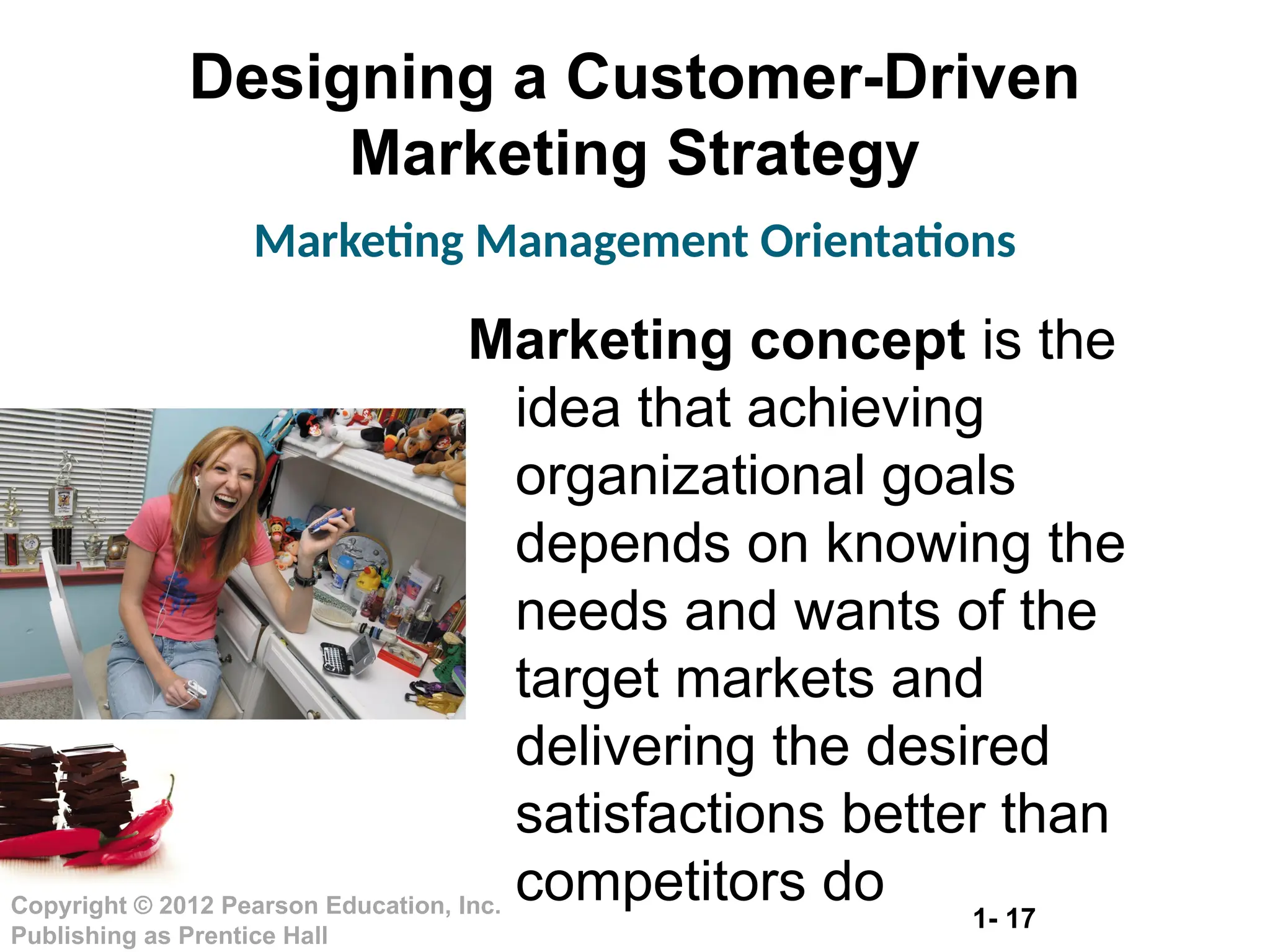
Marketing concept is the
idea that achieving
organizational goals
depends on knowing the
needs and wants of the
target markets and
delivering the desired
satisfactions better than
competitors do
1- 18
Copyright © 2012 Pearson Education, Inc.
Publishing as Prentice Hall
Designing a Customer-Driven
Marketing Strategy
Marketing Management Orientations
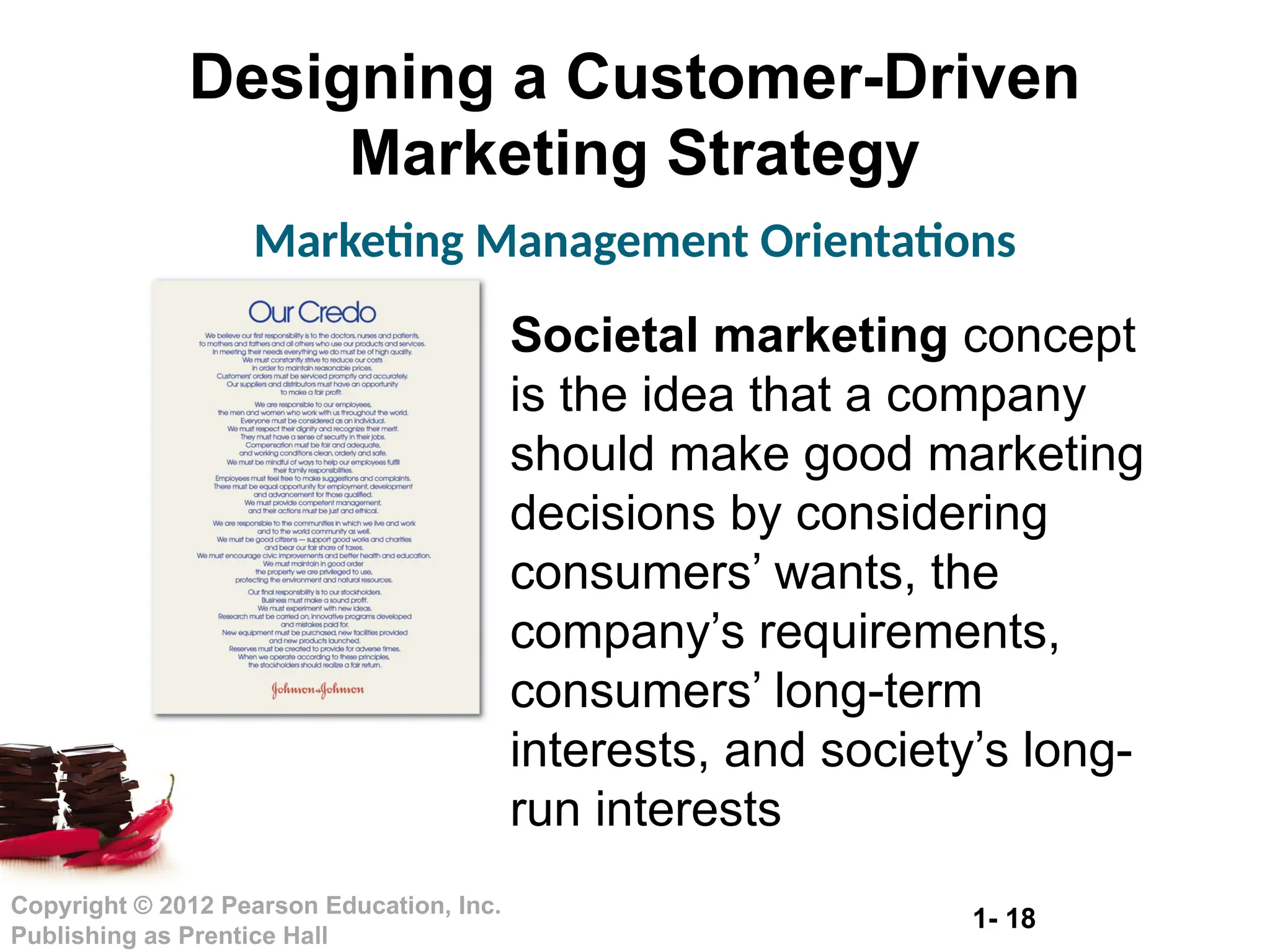
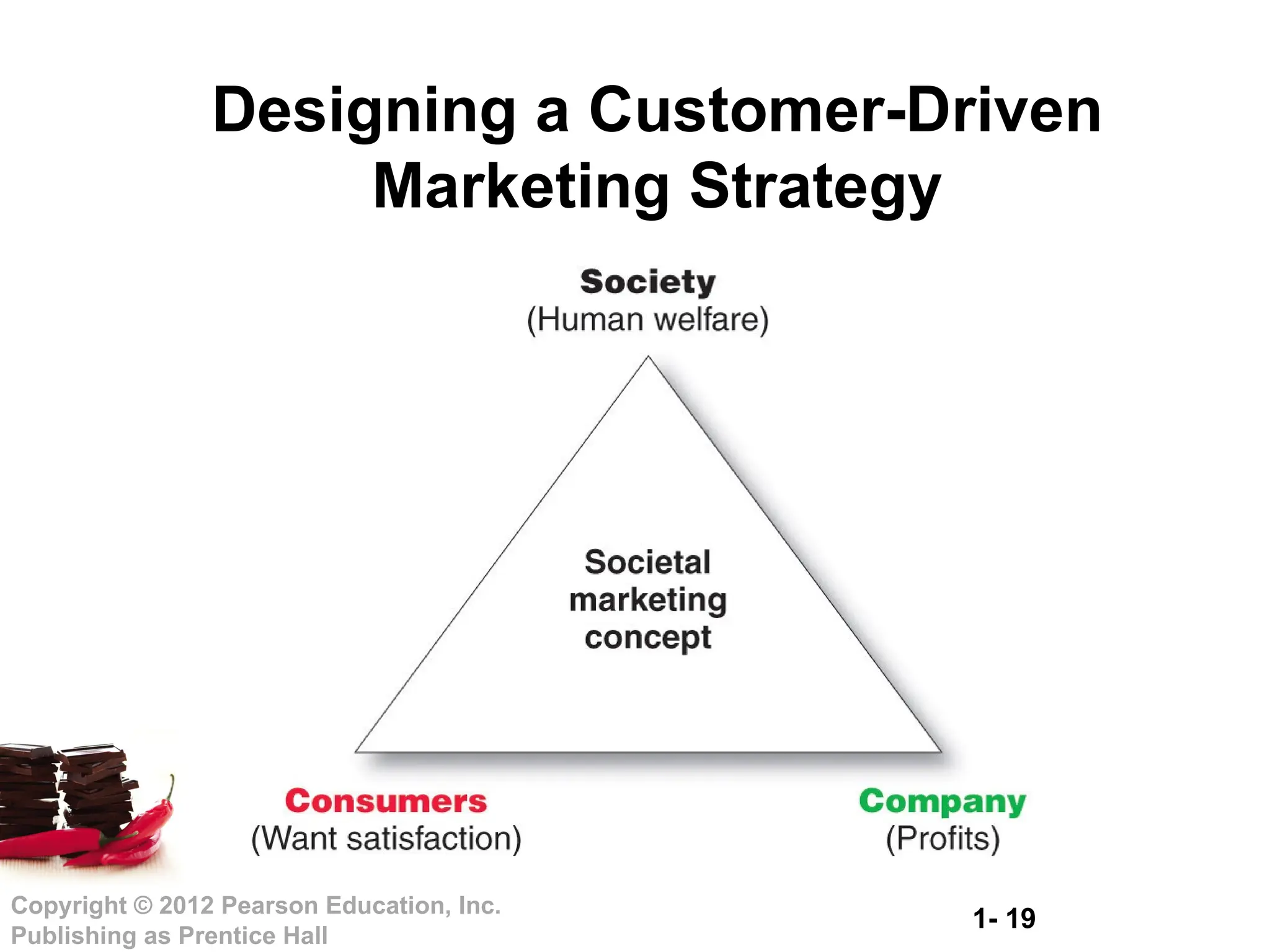
Societal marketing concept
is the idea that a company
should make good marketing
decisions by considering
consumers’ wants, the
company’s requirements,
consumers’ long-term
interests, and society’s long-
run interests
1- 19
Copyright © 2012 Pearson Education, Inc.
Publishing as Prentice Hall
Designing a Customer-Driven
Marketing Strategy
1- 20
Copyright © 2012 Pearson Education, Inc.
Publishing as Prentice Hall
The marketing mix: set of tools (four Ps) the
firm uses to implement its marketing
strategy. It includes product, price,
promotion, and place.
Integrated marketing program:
comprehensive plan that communicates
and delivers the intended value to chosen
customers.
Preparing an Integrated Marketing
Plan and Program
1- 21
Copyright © 2012 Pearson Education, Inc.
Publishing as Prentice Hall
Building Customer Relationships
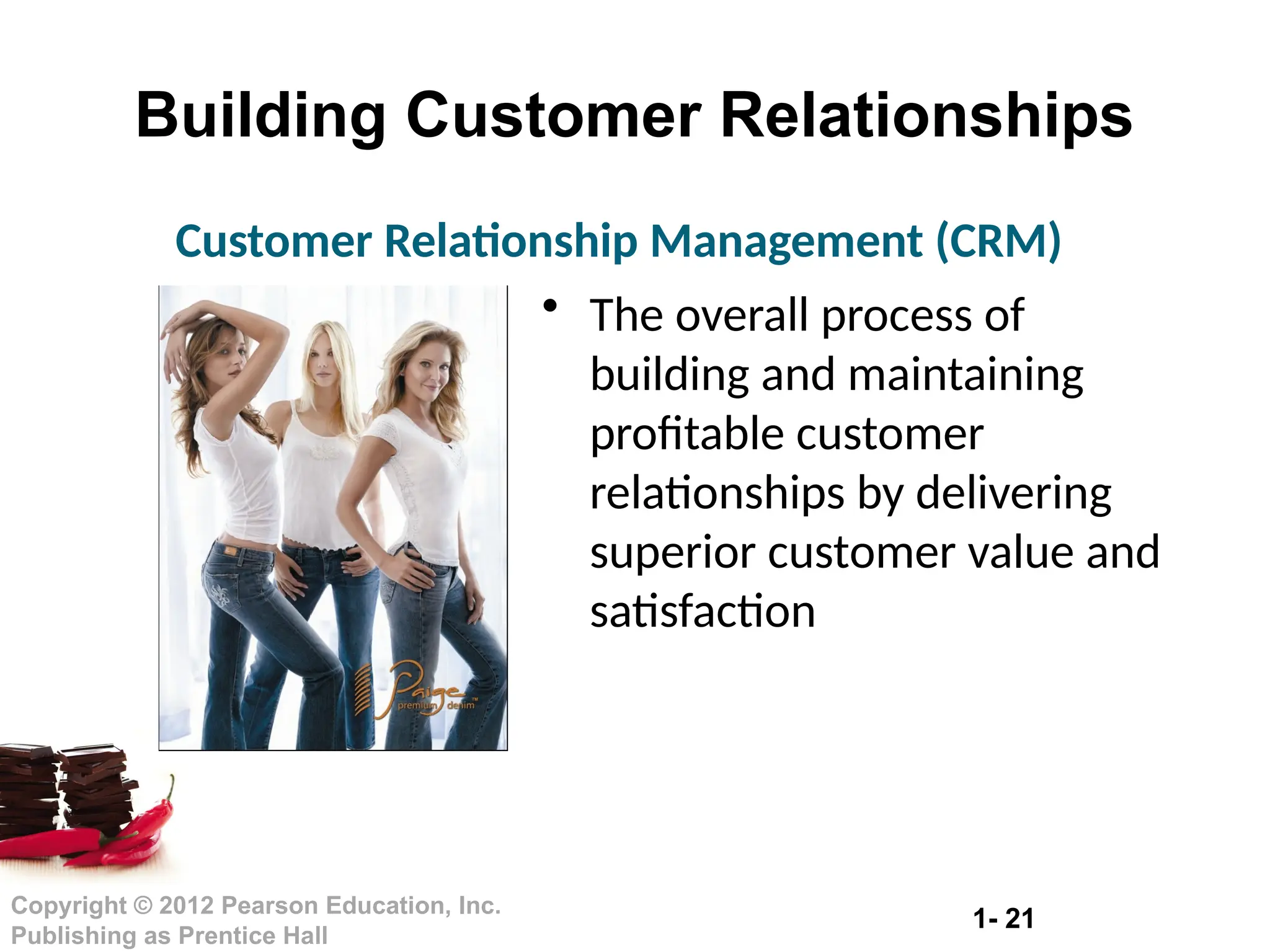
• The overall process of
building and maintaining
profitable customer
relationships by delivering
superior customer value and
satisfaction
Customer Relationship Management (CRM)
1- 22
Copyright © 2012 Pearson Education, Inc.
Publishing as Prentice Hall
Building Customer Relationships
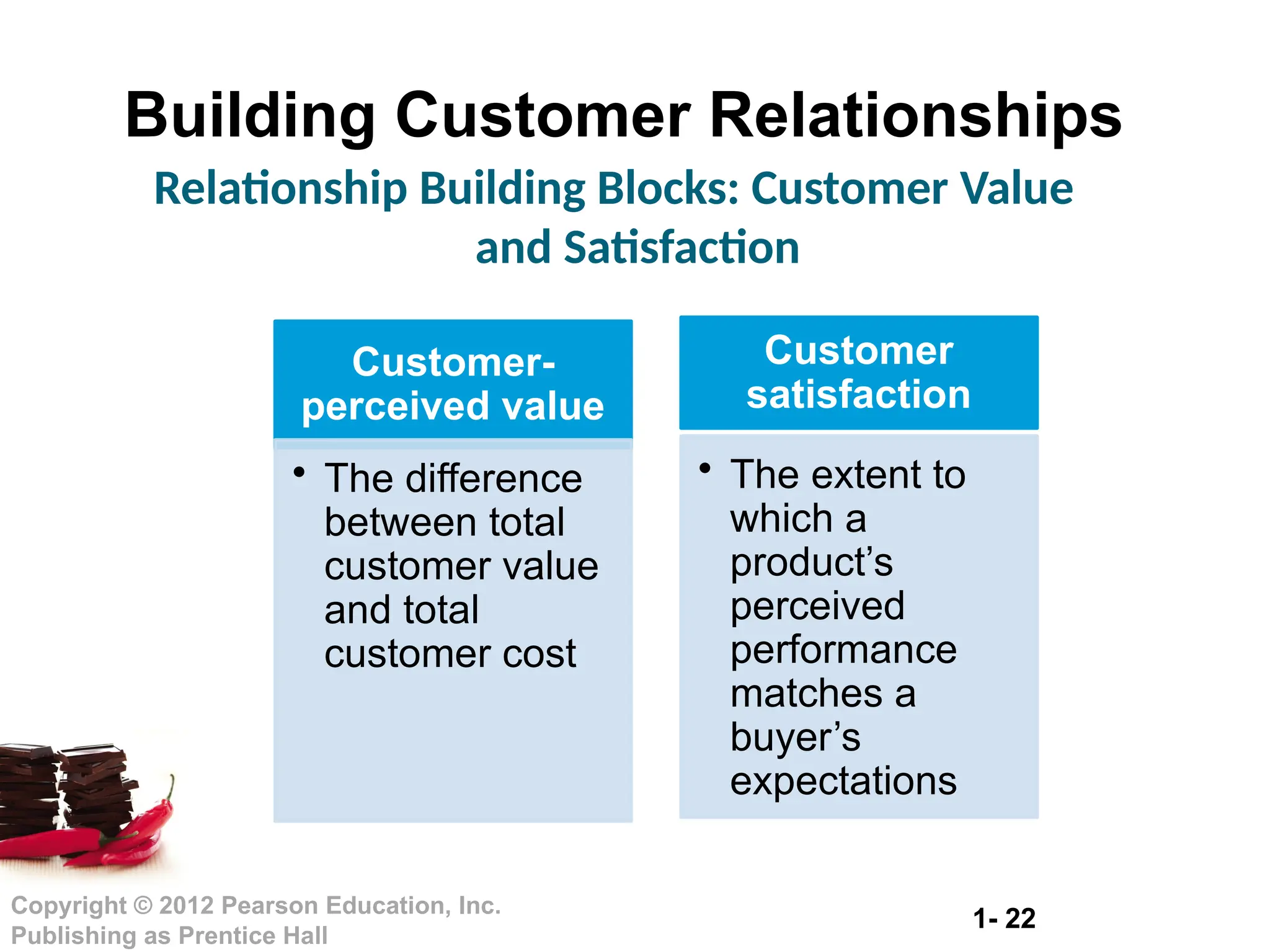
Relationship Building Blocks: Customer Value
and Satisfaction
Customer-
perceived value
• The difference
between total
customer value
and total
customer cost
Customer
satisfaction
• The extent to
which a
product’s
perceived
performance
matches a
buyer’s
expectations
1- 23
Copyright © 2012 Pearson Education, Inc.
Publishing as Prentice Hall
Building Customer Relationships
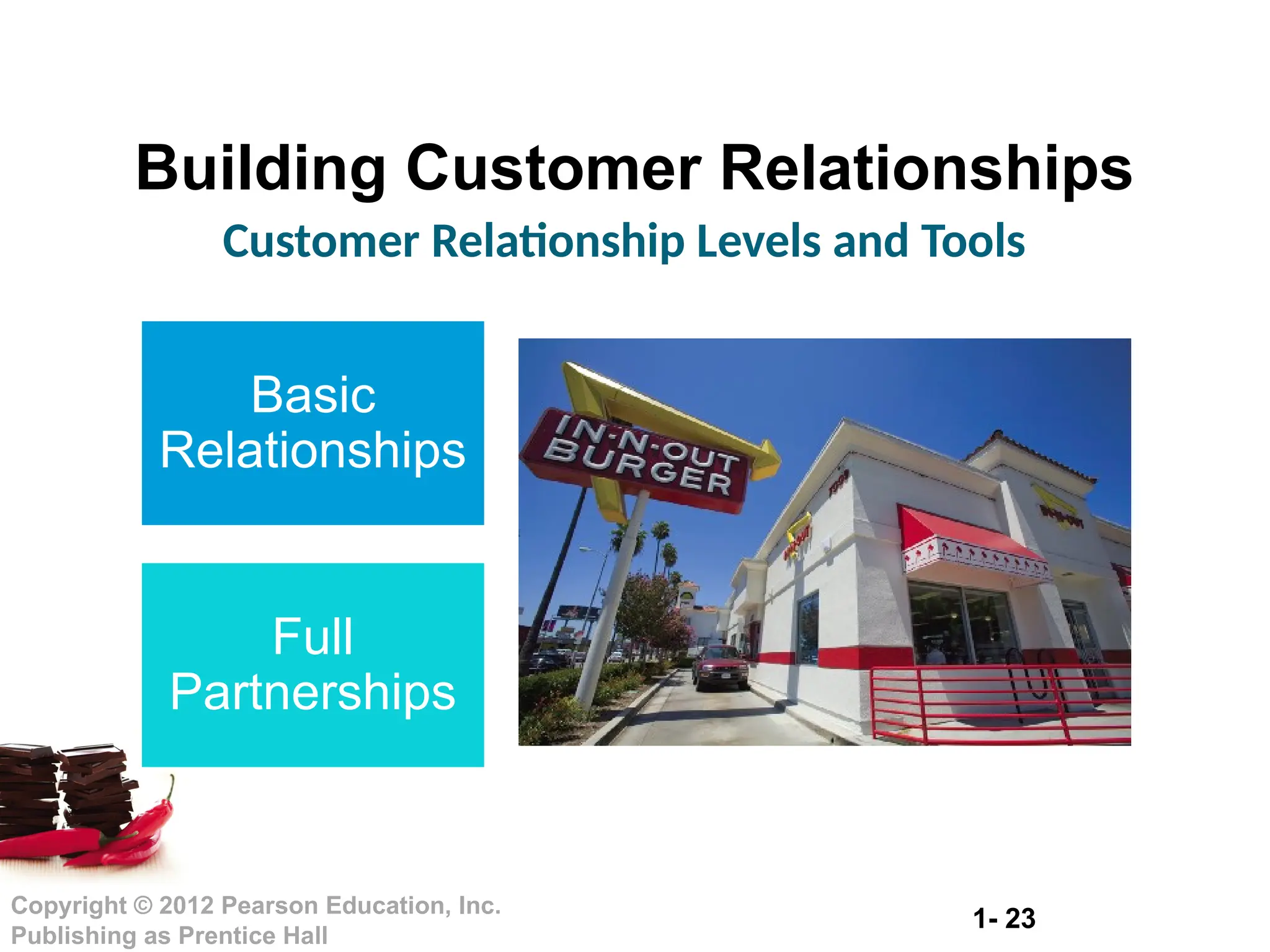
Customer Relationship Levels and Tools
Basic
Relationships
Full
Partnerships
1- 24
Copyright © 2012 Pearson Education, Inc.
Publishing as Prentice Hall
Building Customer Relationships
• Relating with more carefully selected
customers uses selective relationship
management to target fewer, more
profitable customers
• Relating more deeply and interactively by
incorporating more interactive two way
relationships through blogs, Websites,
online communities and social networks
The Changing Nature of Customer
Relationships
1- 25
Copyright © 2012 Pearson Education, Inc.
Publishing as Prentice Hall
Building Customer Relationships
Customer-managed relationships
Marketing relationships in which
customers, empowered by today’s new
digital technologies, interact with
companies and with each other to shape
their relationships with brands.
The Changing Nature of Customer
Relationships
1- 26
Copyright © 2012 Pearson Education, Inc.
Publishing as Prentice Hall
Partner relationship management involves
working closely with partners in other
company departments and outside the
company to jointly bring greater value to
customers
Building Customer Relationships
1- 27
Copyright © 2012 Pearson Education, Inc.
Publishing as Prentice Hall
Building Customer Relationships
• Partners inside the company is every
function area interacting with customers
– Electronically
– Cross-functional teams
• Partners outside the company is how
marketers connect with their suppliers,
channel partners, and competitors by
developing partnerships
Partner Relationship Management
1- 28
Copyright © 2012 Pearson Education, Inc.
Publishing as Prentice Hall
Building Customer Relationships
• Supply chain is a channel that stretches
from raw materials to components to final
products to final buyers
• Supply chain management
Partner Relationship Management
1- 29
Copyright © 2012 Pearson Education, Inc.
Publishing as Prentice Hall
Capturing Value from Customers
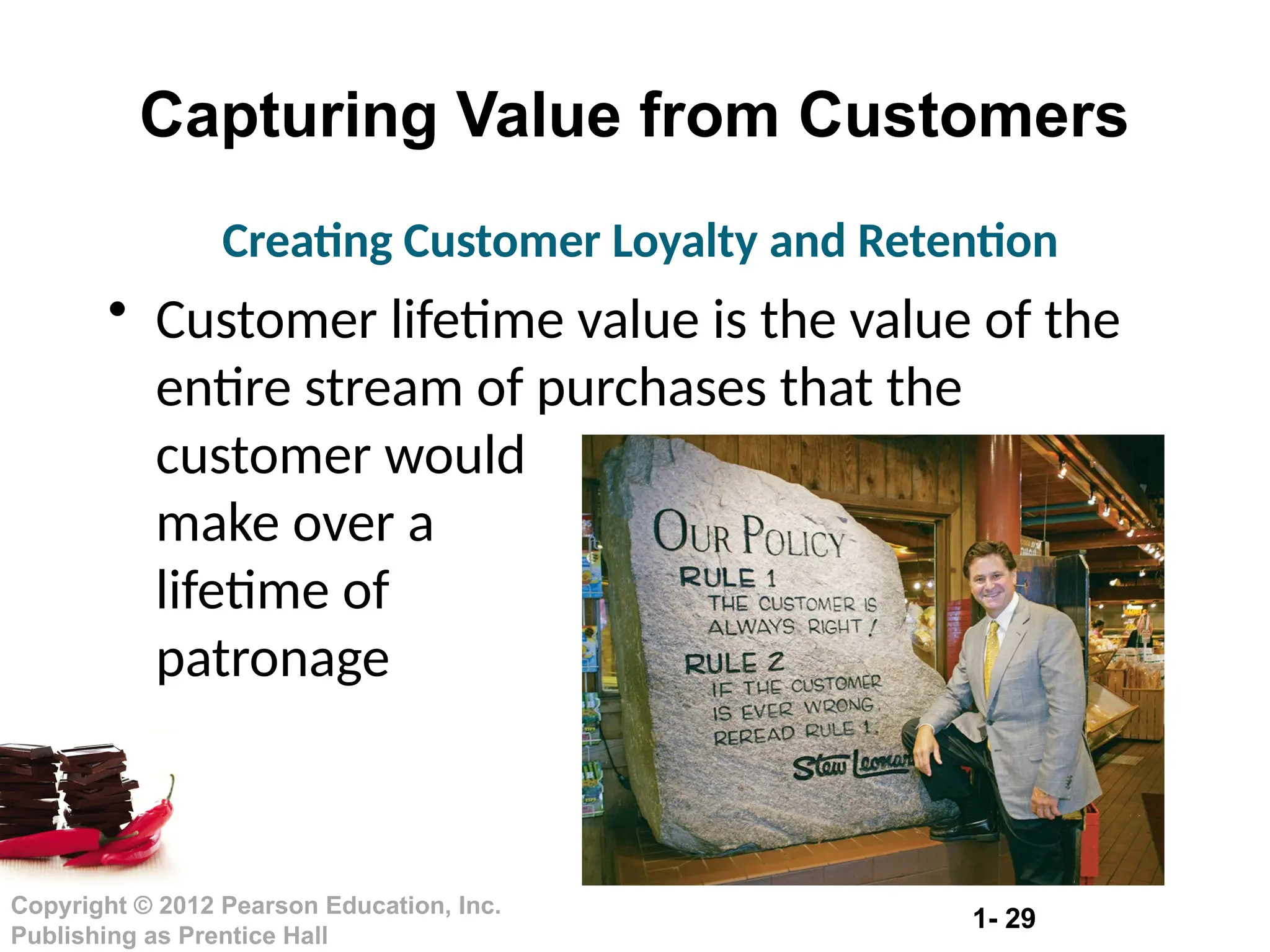
• Customer lifetime value is the value of the
entire stream of purchases that the
customer would
make over a
lifetime of
patronage
Creating Customer Loyalty and Retention
1- 30
Copyright © 2012 Pearson Education, Inc.
Publishing as Prentice Hall
Capturing Value from Customers
Share of customer is the portion of the
customer’s purchasing that a company gets
in its product categories
Growing Share of Customer
1- 31
Copyright © 2012 Pearson Education, Inc.
Publishing as Prentice Hall
Capturing Value from
Customers
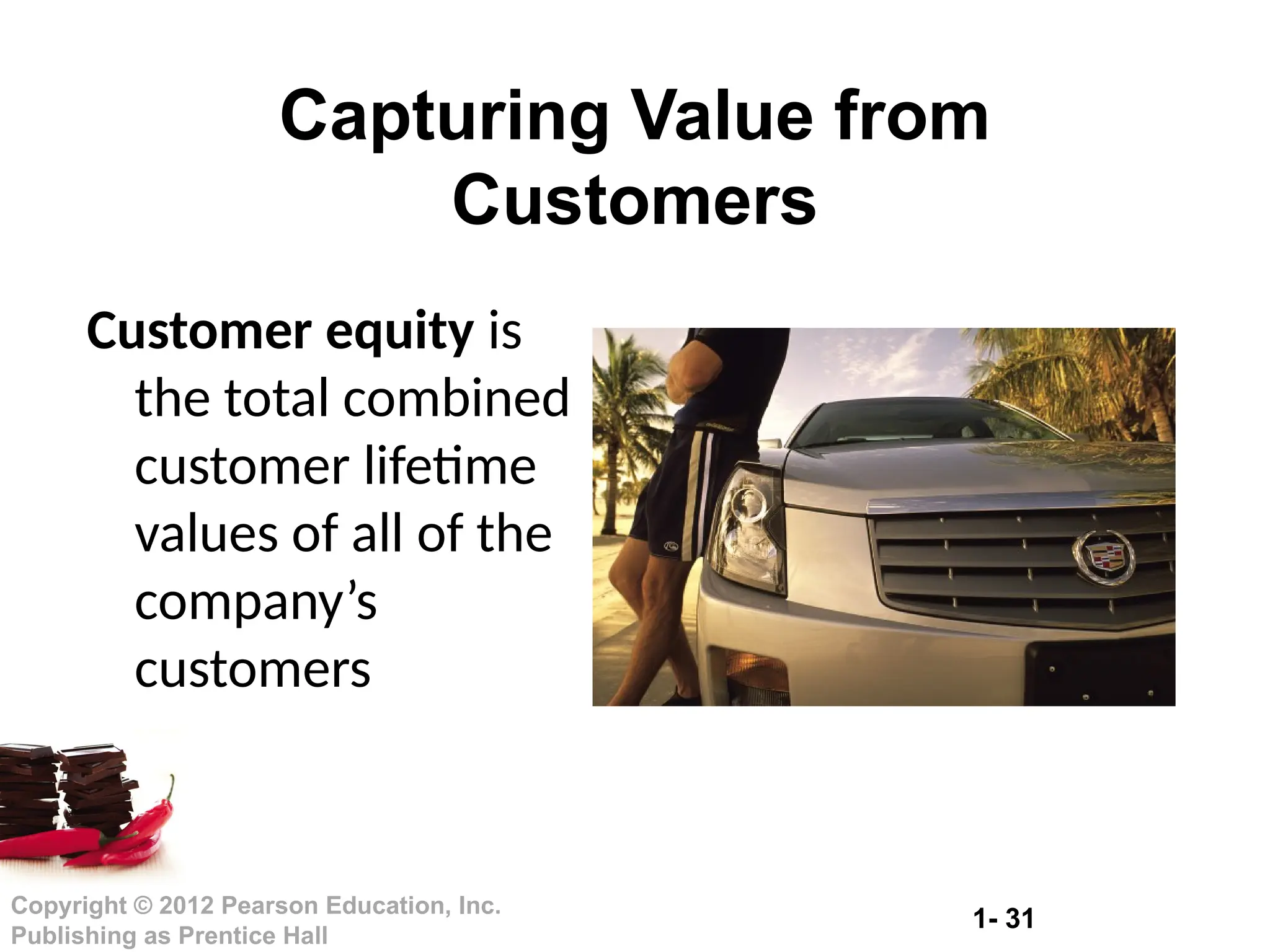
Customer equity is
the total combined
customer lifetime
values of all of the
company’s
customers
1- 32
Copyright © 2012 Pearson Education, Inc.
Publishing as Prentice Hall
Capturing Value from Customers
• Right relationships with the right customers
involves treating customers as assets that
need to be managed and maximized
• Different types of customers require
different relationship management
strategies
Building Customer Equity
1- 33
Copyright © 2012 Pearson Education, Inc.
Publishing as Prentice Hall
The Changing Marketing
Landscape
Uncertain Economic Environment
• New consumer frugality (Self – denial)
• Marketers focus on value for the customer
1- 34
Copyright © 2012 Pearson Education, Inc.
Publishing as Prentice Hall
The Changing Marketing
Landscape
Digital Age
• People are connected continuously to people
and information worldwide
• Marketers have great new tools to
communicate with customers
• Internet + mobile communication devices
creates environment for online marketing
1- 35
Copyright © 2012 Pearson Education, Inc.
Publishing as Prentice Hall
The Changing Marketing
Landscape
• Rapid Globalization
• Sustainable Marketing
• Not-for-Profit Marketing
1- 36
Copyright © 2012 Pearson Education, Inc.
Publishing as Prentice Hall
So, What Is Marketing?
Pulling It All Together
1- 37
Copyright © 2012 Pearson Education, Inc.
Publishing as Prentice Hall
All rights reserved. No part of this publication may be reproduced, stored in a
retrieval system, or transmitted, in any form or by any means, electronic,
mechanical, photocopying, recording, or otherwise, without the prior written
permission of the publisher. Printed in the United States of America.
Copyright © 2012 Pearson Education, Inc.
Publishing as Prentice Hall

Chapter-1-Creating-and-Capturing-Customer-Value.pptx

  • 1.
    1- 1 Copyright ©2012 Pearson Education, Inc. Publishing as Prentice Hall i t ’s good and good for you Chapter 1 Marketing: Creating and Capturing Customer Value
  • 2.
    1- 2 Copyright ©2012 Pearson Education, Inc. Publishing as Prentice Hall Creating and Capturing Customer Value • What Is Marketing? • Understand the Marketplace and Customer Needs • Designing a Customer-Driven Marketing Strategy • Preparing an Integrated Marketing Plan and Program • Building Customer Relationships • Capturing Value from Customers • The Changing Marketing Landscape Topic Outline
  • 3.
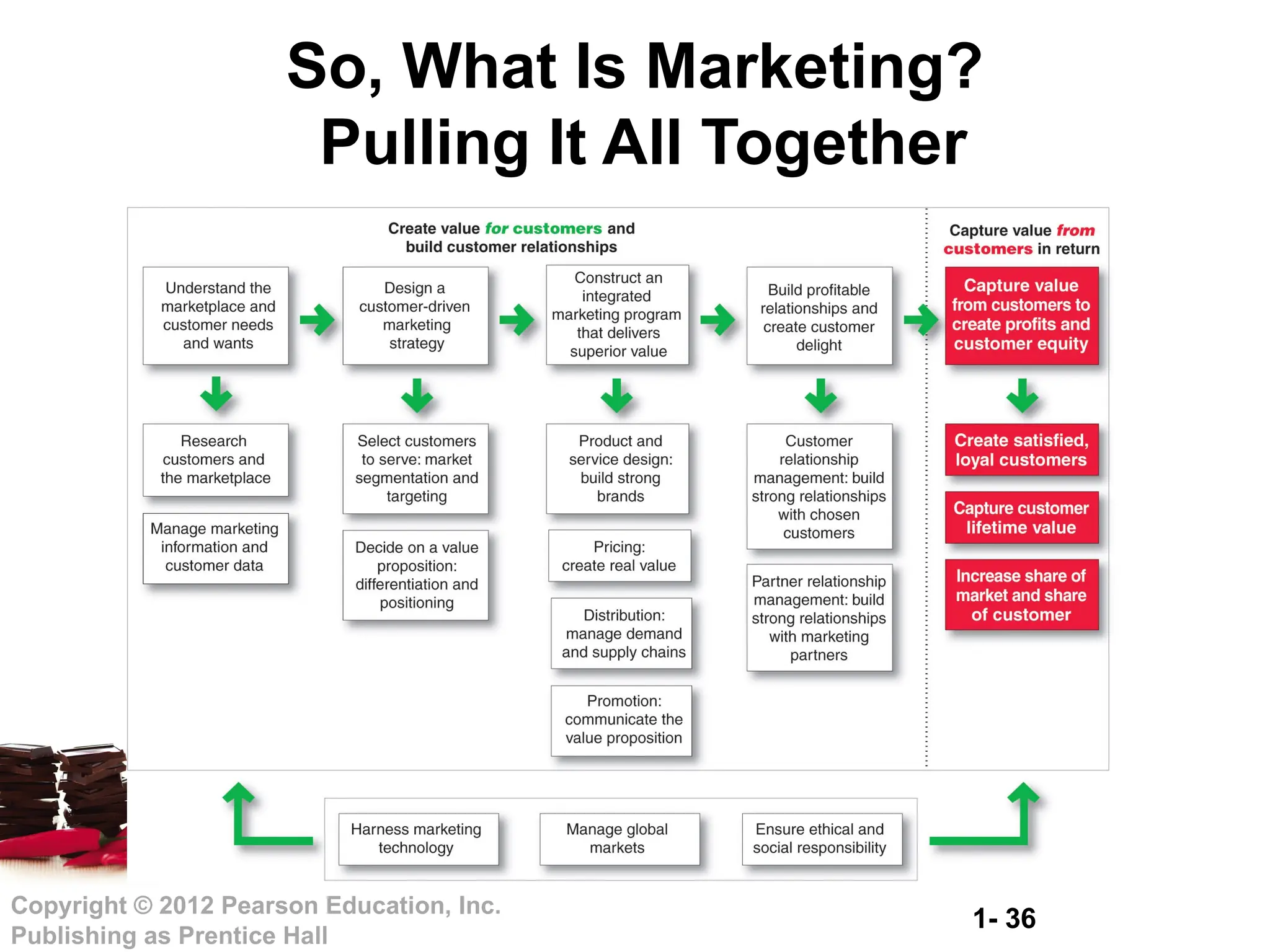
    1- 3 Copyright ©2012 Pearson Education, Inc. Publishing as Prentice Hall What Is Marketing? Marketing is a process by which companies create value for customers and build strong customer relationships to capture value from customers in return
  • 4.
    1- 4 Copyright ©2012 Pearson Education, Inc. Publishing as Prentice Hall What Is Marketing? The Marketing Process
  • 5.
    1- 5 Copyright ©2012 Pearson Education, Inc. Publishing as Prentice Hall Understanding the Marketplace and Customer Needs • States of deprivation • Physical—food, clothing, warmth, safety • Social—belonging and affection • Individual—knowledge and self-expression Needs • Form that needs take as they are shaped by culture and individual personality Wants • Wants backed by buying power Demands Customer Needs, Wants, and Demands
  • 6.
    1- 6 Copyright ©2012 Pearson Education, Inc. Publishing as Prentice Hall Understanding the Marketplace and Customer Needs • Market offerings are some combination of products, services, information, or experiences offered to a market to satisfy a need or want • Marketing myopia is focusing only on existing wants and losing sight of underlying consumer needs
  • 7.
    1- 7 Copyright ©2012 Pearson Education, Inc. Publishing as Prentice Hall Understanding the Marketplace and Customer Needs Customer Value and Satisfaction Expectations Customers • Value and satisfaction Marketers • Set the right level of expectations • Not too high or low
  • 8.
    1- 8 Copyright ©2012 Pearson Education, Inc. Publishing as Prentice Hall Exchange is the act of obtaining a desired object from someone by offering something in return Understanding the Marketplace and Customer Needs
  • 9.
    1- 9 Copyright ©2012 Pearson Education, Inc. Publishing as Prentice Hall Understanding the Marketplace and Customer Needs Markets are the set of actual and potential buyers of a product
  • 10.
    1- 10 Copyright ©2012 Pearson Education, Inc. Publishing as Prentice Hall Designing a Customer-Driven Marketing Strategy Marketing management is the art and science of choosing target markets and building profitable relationships with them – What customers will we serve? – How can we best serve these customers?
  • 11.
    1- 11 Copyright ©2012 Pearson Education, Inc. Publishing as Prentice Hall Designing a Customer-Driven Marketing Strategy Market segmentation refers to dividing the markets into segments of customers Target marketing refers to which segments to go after Selecting Customers to Serve
  • 12.
    1- 12 Copyright ©2012 Pearson Education, Inc. Publishing as Prentice Hall Designing a Customer-Driven Marketing Strategy Choosing a Value Proposition Value proposition Set of benefits or values a company promises to deliver to customers to satisfy their needs
  • 13.
    1- 13 Copyright ©2012 Pearson Education, Inc. Publishing as Prentice Hall Designing a Customer-Driven Marketing Strategy Productio n concept Product concept Selling concept Marketing concept Societal concept Marketing Management Orientations
  • 14.
    1- 14 Copyright ©2012 Pearson Education, Inc. Publishing as Prentice Hall Designing a Customer-Driven Marketing Strategy Production concept is the idea that consumers will favor products that are available or highly affordable Marketing Management Orientations
  • 15.
    1- 15 Copyright ©2012 Pearson Education, Inc. Publishing as Prentice Hall Designing a Customer-Driven Marketing Strategy Product concept is the idea that consumers will favor products that offer the most quality, performance, and features. Organization should therefore devote its energy to making continuous product improvements. Marketing Management Orientations
  • 16.
    1- 16 Copyright ©2012 Pearson Education, Inc. Publishing as Prentice Hall Designing a Customer-Driven Marketing Strategy Selling concept is the idea that consumers will not buy enough of the firm’s products unless it undertakes a large scale selling and promotion effort Marketing Management Orientations
  • 17.
    1- 17 Copyright ©2012 Pearson Education, Inc. Publishing as Prentice Hall Designing a Customer-Driven Marketing Strategy Marketing Management Orientations Marketing concept is the idea that achieving organizational goals depends on knowing the needs and wants of the target markets and delivering the desired satisfactions better than competitors do
  • 18.
    1- 18 Copyright ©2012 Pearson Education, Inc. Publishing as Prentice Hall Designing a Customer-Driven Marketing Strategy Marketing Management Orientations Societal marketing concept is the idea that a company should make good marketing decisions by considering consumers’ wants, the company’s requirements, consumers’ long-term interests, and society’s long- run interests
  • 19.
    1- 19 Copyright ©2012 Pearson Education, Inc. Publishing as Prentice Hall Designing a Customer-Driven Marketing Strategy
  • 20.
    1- 20 Copyright ©2012 Pearson Education, Inc. Publishing as Prentice Hall The marketing mix: set of tools (four Ps) the firm uses to implement its marketing strategy. It includes product, price, promotion, and place. Integrated marketing program: comprehensive plan that communicates and delivers the intended value to chosen customers. Preparing an Integrated Marketing Plan and Program
  • 21.
    1- 21 Copyright ©2012 Pearson Education, Inc. Publishing as Prentice Hall Building Customer Relationships • The overall process of building and maintaining profitable customer relationships by delivering superior customer value and satisfaction Customer Relationship Management (CRM)
  • 22.
    1- 22 Copyright ©2012 Pearson Education, Inc. Publishing as Prentice Hall Building Customer Relationships Relationship Building Blocks: Customer Value and Satisfaction Customer- perceived value • The difference between total customer value and total customer cost Customer satisfaction • The extent to which a product’s perceived performance matches a buyer’s expectations
  • 23.
    1- 23 Copyright ©2012 Pearson Education, Inc. Publishing as Prentice Hall Building Customer Relationships Customer Relationship Levels and Tools Basic Relationships Full Partnerships
  • 24.
    1- 24 Copyright ©2012 Pearson Education, Inc. Publishing as Prentice Hall Building Customer Relationships • Relating with more carefully selected customers uses selective relationship management to target fewer, more profitable customers • Relating more deeply and interactively by incorporating more interactive two way relationships through blogs, Websites, online communities and social networks The Changing Nature of Customer Relationships
  • 25.
    1- 25 Copyright ©2012 Pearson Education, Inc. Publishing as Prentice Hall Building Customer Relationships Customer-managed relationships Marketing relationships in which customers, empowered by today’s new digital technologies, interact with companies and with each other to shape their relationships with brands. The Changing Nature of Customer Relationships
  • 26.
    1- 26 Copyright ©2012 Pearson Education, Inc. Publishing as Prentice Hall Partner relationship management involves working closely with partners in other company departments and outside the company to jointly bring greater value to customers Building Customer Relationships
  • 27.
    1- 27 Copyright ©2012 Pearson Education, Inc. Publishing as Prentice Hall Building Customer Relationships • Partners inside the company is every function area interacting with customers – Electronically – Cross-functional teams • Partners outside the company is how marketers connect with their suppliers, channel partners, and competitors by developing partnerships Partner Relationship Management
  • 28.
    1- 28 Copyright ©2012 Pearson Education, Inc. Publishing as Prentice Hall Building Customer Relationships • Supply chain is a channel that stretches from raw materials to components to final products to final buyers • Supply chain management Partner Relationship Management
  • 29.
    1- 29 Copyright ©2012 Pearson Education, Inc. Publishing as Prentice Hall Capturing Value from Customers • Customer lifetime value is the value of the entire stream of purchases that the customer would make over a lifetime of patronage Creating Customer Loyalty and Retention
  • 30.
    1- 30 Copyright ©2012 Pearson Education, Inc. Publishing as Prentice Hall Capturing Value from Customers Share of customer is the portion of the customer’s purchasing that a company gets in its product categories Growing Share of Customer
  • 31.
    1- 31 Copyright ©2012 Pearson Education, Inc. Publishing as Prentice Hall Capturing Value from Customers Customer equity is the total combined customer lifetime values of all of the company’s customers
  • 32.
    1- 32 Copyright ©2012 Pearson Education, Inc. Publishing as Prentice Hall Capturing Value from Customers • Right relationships with the right customers involves treating customers as assets that need to be managed and maximized • Different types of customers require different relationship management strategies Building Customer Equity
  • 33.
    1- 33 Copyright ©2012 Pearson Education, Inc. Publishing as Prentice Hall The Changing Marketing Landscape Uncertain Economic Environment • New consumer frugality (Self – denial) • Marketers focus on value for the customer
  • 34.
    1- 34 Copyright ©2012 Pearson Education, Inc. Publishing as Prentice Hall The Changing Marketing Landscape Digital Age • People are connected continuously to people and information worldwide • Marketers have great new tools to communicate with customers • Internet + mobile communication devices creates environment for online marketing
  • 35.
    1- 35 Copyright ©2012 Pearson Education, Inc. Publishing as Prentice Hall The Changing Marketing Landscape • Rapid Globalization • Sustainable Marketing • Not-for-Profit Marketing
  • 36.
    1- 36 Copyright ©2012 Pearson Education, Inc. Publishing as Prentice Hall So, What Is Marketing? Pulling It All Together
  • 37.
    1- 37 Copyright ©2012 Pearson Education, Inc. Publishing as Prentice Hall All rights reserved. No part of this publication may be reproduced, stored in a retrieval system, or transmitted, in any form or by any means, electronic, mechanical, photocopying, recording, or otherwise, without the prior written permission of the publisher. Printed in the United States of America. Copyright © 2012 Pearson Education, Inc. Publishing as Prentice Hall

Editor's Notes

  • #3 Note to Instructor: Discussion Question Ask students for examples of either national or local companies that are excellent at marketing and ask how they reflect the definition given in this slide.
  • #4 This important figure shows marketing in a nutshell! By creating value for customers, marketers capture value from customers in return. This five-step process forms the marketing framework for the rest of the chapter and the remainder of the book.
  • #7 Note to Instructor: Ask students what online retailers deliver exceptional value and satisfaction. Discussion Question Why do marketer’s not always understand customer needs? How can they better identify customer needs? Marketer’s often work in a vacuum and do not consider the customer’s needs as much as they should. Future chapters will talk about market research and marketing information, important tools for understanding customer’s needs. Students might be familiar with survey research or focus groups as techniques for gathering information or they might be asked for their zip code when they purchase in certain retailers
  • #8 Note to Instructor: Marketing consists of actions taken to build and maintain desirable exchange relationships with target audiences involving a product, service, idea, or other object. Beyond simply attracting new customers and creating transactions, the goal is to retain customers and grow their business with the company.
  • #9 Arrows represent relationships that must be developed and managed to create customer value and profitable customer relationships.
  • #10 Now that the company fully understands its consumers and the marketplace, it must decide which customers it will serve and how it will bring them value.
  • #11 Note to Instructor:
  • #18 Discussion Questions What companies can you identify with social Marketing? What do these companies do that ties to the societal marketing concept? Students might be familiar with many different companies that practice societal marketing through their Corporate Social Responsibility (CSR) initiatives. Students might be familiar with local retailers who are also involved in societal marketing. (Target, TOMS shoes). They will note that these companies donate, contribute, or offer services to charities and not-for-profit organizations.
  • #19 Note to Instructor This slide shows companies should balance three considerations in setting their marketing strategies. Johnson & Johnson does this well. Johnson & Johnson would rather take a big loss than ship a bad batch of one of its products. Consider the tragic tampering case in which eight people died in 1982 from swallowing cyanide-laced capsules of Tylenol, a Johnson & Johnson brand. Although Johnson & Johnson believed that the pills had been altered in only a few stores, they recalled all of their product and launched an information campaign to instruct and reassure consumers. The recall cost the company $100 million in earnings. In the long run, however, the company’s swift recall of Tylenol strengthened consumer confidence and loyalty, and today Tylenol remains one of the nation’s leading brands of pain reliever. Discussion Question Ask students about other companies that have had serious problems with their products? How have these companies bounced back?
  • #23 Note to Instructor Basic Relationships are often used by a company with many low-margin customers . For example, Procter & Gamble does not phone or call on all of its Tide consumers to get to know them personally. Instead, P&G creates relationships through brand-building advertising, sales promotions, and its Tide FabricCare Network Web site (www.Tide.com). Full Partnerships are used in markets with few customers and high margins, sellers want to create full partnerships with key customers. For example, P&G customer teams work closely with Wal-Mart, Safeway, and other large retailers. Discussion Question Ask students what frequency or club marketing programs they belong to and why?
  • #24 Note to Instructor This will be a point for a lively discussion. Discussion Question Ask students how marketers have used facebook, myspace, linkedin or other social networks for marketing purposes. Ask them about YouTube and how that has changed marketing.
  • #25 Note to Instructor This will be a point for a lively discussion. Discussion Question Ask students how marketers have used facebook, myspace, linkedin or other social networks for marketing purposes. Ask them about YouTube and how that has changed marketing.
  • #29 Note to Instructor Stew Leonard’s is an interesting example. Stew Leonard, who operates a highly profitable four-store supermarket in Connecticut and New York, says that he sees $50,000 flying out of his store every time he sees a sulking customer. Why? Because his average customer spends about $100 a week, shops 50 weeks a year, and remains in the area for about 10 years. If the marketing process, the company creates value for target customers and builds strong relationships with them. To keep customers coming back, Stew Leonard’s has created the “Disneyland of dairy stores.” Rule 1—the customer is always right. Rule 2—If the customer is ever wrong, reread Rule 1. You can find videos of Leonard’s stores on youtube.com which will give the students an idea of the atmosphere. Discussion Question Ask students if they know of other retailers build this kind of exciting environment.
  • #32 Note to Instructor
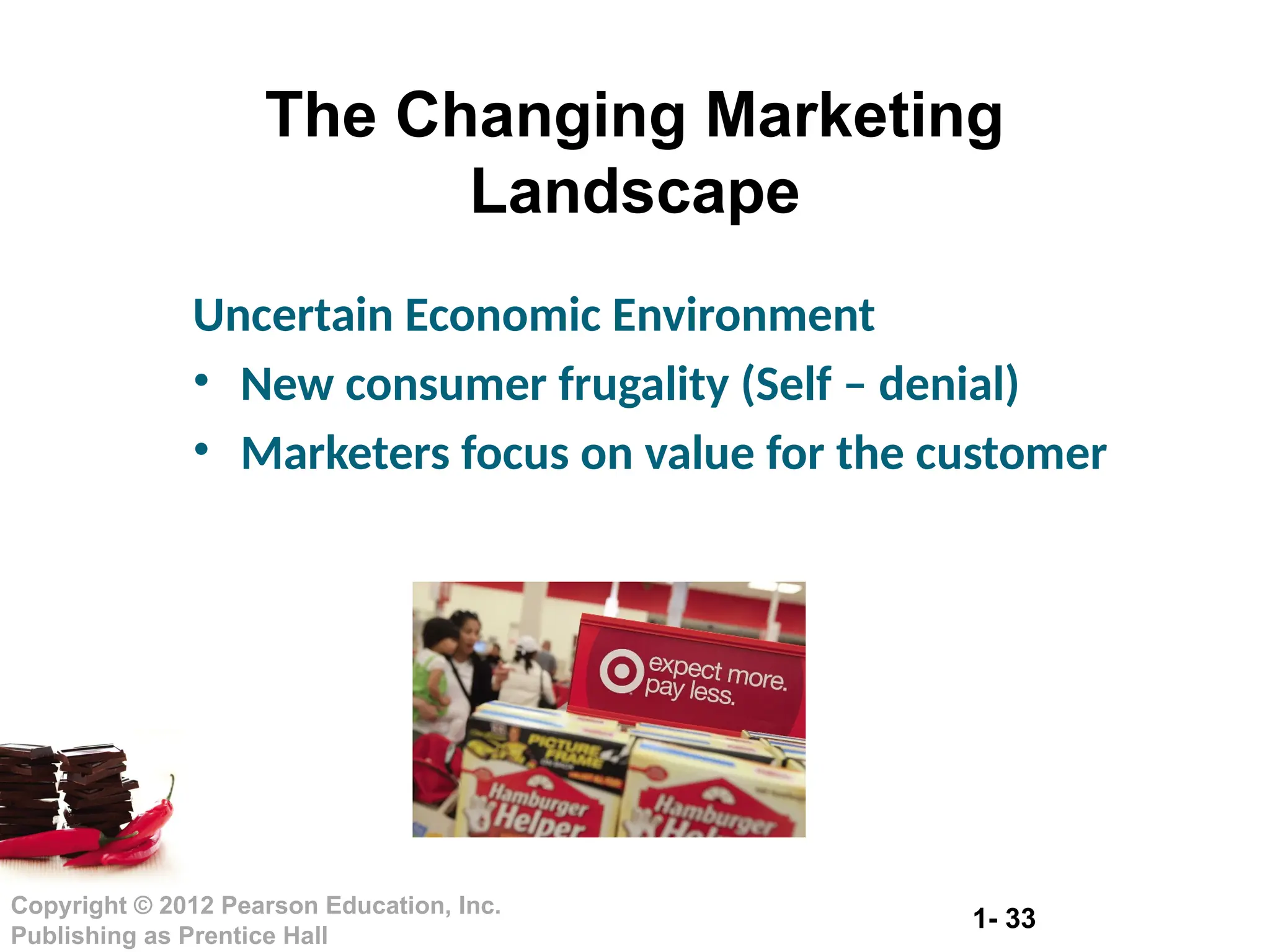
  • #33 Notes to Instructor Target focus changes to the ‘pay less’ part of the slogan, adjusting prices to compete with WalMart. This is a good slide to prompt discussion on personal observations and experiences.
  • #34 Notes to Instructor
  • #35 Notes to Instructor