Firmansyah.profess@gmail.com
2018
Eclipse Vert.x
Chapter 05
Service Discovery, Resilience
and Stability Patterns
01. Service Discovery
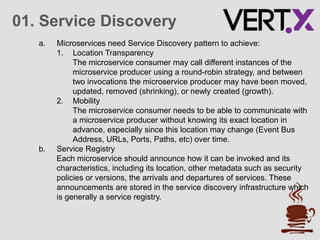
a. Microservices need Service Discovery pattern to achieve:
1. Location Transparency
The microservice consumer may call different instances of the
microservice producer using a round-robin strategy, and between
two invocations the microservice producer may have been moved,
updated, removed (shrinking), or newly created (growth).
2. Mobility
The microservice consumer needs to be able to communicate with
a microservice producer without knowing its exact location in
advance, especially since this location may change (Event Bus
Address, URLs, Ports, Paths, etc) over time.
b. Service Registry
Each microservice should announce how it can be invoked and its
characteristics, including its location, other metadata such as security
policies or versions, the arrivals and departures of services. These
announcements are stored in the service discovery infrastructure which
is generally a service registry.
01. Service Discovery
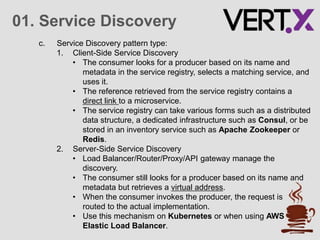
c. Service Discovery pattern type:
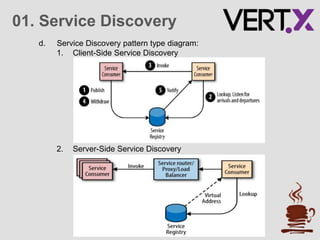
1. Client-Side Service Discovery
• The consumer looks for a producer based on its name and
metadata in the service registry, selects a matching service, and
uses it.
• The reference retrieved from the service registry contains a
direct link to a microservice.
• The service registry can take various forms such as a distributed
data structure, a dedicated infrastructure such as Consul, or be
stored in an inventory service such as Apache Zookeeper or
Redis.
2. Server-Side Service Discovery
• Load Balancer/Router/Proxy/API gateway manage the
discovery.
• The consumer still looks for a producer based on its name and
metadata but retrieves a virtual address.
• When the consumer invokes the producer, the request is
routed to the actual implementation.
• Use this mechanism on Kubernetes or when using AWS
Elastic Load Balancer.
01. Service Discovery
d. Service Discovery pattern type diagram:
1. Client-Side Service Discovery
2. Server-Side Service Discovery
01. Service Discovery
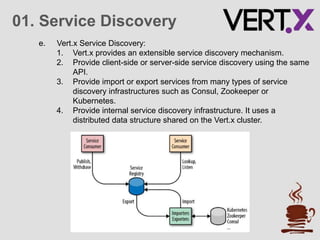
e. Vert.x Service Discovery:
1. Vert.x provides an extensible service discovery mechanism.
2. Provide client-side or server-side service discovery using the same
API.
3. Provide import or export services from many types of service
discovery infrastructures such as Consul, Zookeeper or
Kubernetes.
4. Provide internal service discovery infrastructure. It uses a
distributed data structure shared on the Vert.x cluster.
02. Service Discovery Demo
a. Create a directory called “chapter05”
b. Generate the project structure using maven
inside chapter05 folder:
mvn io.fabric8:vertx-maven-plugin:1.0.5:setup 
-DprojectGroupId=io.vertx.chapter05 
-DprojectArtifactId=http-micro01-vertx-app 
-Dverticle=io.vertx.chapter05.HttpMicro01 
-Ddependencies=vertx-service-discovery,web,rx,
vertx-hazelcast
c. Modify io.vertx.chapter05.HttpMicro01 java file
d. Run HttpMicro01 application
mvn compile vertx:run 
-Dvertx.runArgs="-cluster -
Djava.net.preferIPv4Stack=true"
02. Service Discovery Demo
e. Create a directory called “consumer” inside
“chapter05” folder
f. Generate the project structure using maven
inside consumer folder:
mvn io.fabric8:vertx-maven-plugin:1.0.5:setup 
-DprojectGroupId=io.vertx.chapter05 
-DprojectArtifactId=http-micro02-vertx-app 
-Dverticle=io.vertx.chapter05.HttpMicro02 
-Ddependencies=vertx-service-discovery,web,rx,
vertx-hazelcast,web-client
g. Modify io.vertx.chapter05.HttpMicro02 java file
h. Run HttpMicro02 application
mvn compile vertx:run 
-Dvertx.runArgs="-cluster -
Djava.net.preferIPv4Stack=true"
03. Resilience and Stability
a. Managing Failures Pattern:
1. Every interaction between microservices will eventually fail in some
way, and you need to be prepared for that failure. Failure can take
different forms, ranging from various network errors to semantic
errors. Reactive microservices are responsible for managing
failures locally and must avoid propagating the failure to another
microservice.
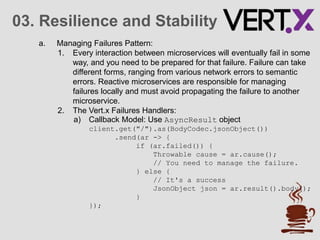
2. The Vert.x Failures Handlers:
a) Callback Model: Use AsyncResult object
client.get("/").as(BodyCodec.jsonObject())
.send(ar -> {
if (ar.failed()) {
Throwable cause = ar.cause();
// You need to manage the failure.
} else {
// It's a success
JsonObject json = ar.result().body();
}
});
03. Resilience and Stability
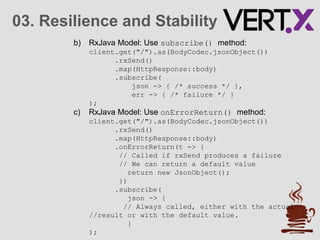
b) RxJava Model: Use subscribe() method:
client.get("/").as(BodyCodec.jsonObject())
.rxSend()
.map(HttpResponse::body)
.subscribe(
json -> { /* success */ },
err -> { /* failure */ }
);
c) RxJava Model: Use onErrorReturn() method:
client.get("/").as(BodyCodec.jsonObject())
.rxSend()
.map(HttpResponse::body)
.onErrorReturn(t -> {
// Called if rxSend produces a failure
// We can return a default value
return new JsonObject();
})
.subscribe(
json -> {
// Always called, either with the actual
//result or with the default value.
}
);
03. Resilience and Stability
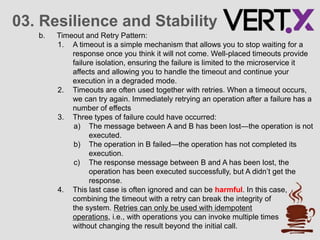
b. Timeout and Retry Pattern:
1. A timeout is a simple mechanism that allows you to stop waiting for a
response once you think it will not come. Well-placed timeouts provide
failure isolation, ensuring the failure is limited to the microservice it
affects and allowing you to handle the timeout and continue your
execution in a degraded mode.
2. Timeouts are often used together with retries. When a timeout occurs,
we can try again. Immediately retrying an operation after a failure has a
number of effects
3. Three types of failure could have occurred:
a) The message between A and B has been lost—the operation is not
executed.
b) The operation in B failed—the operation has not completed its
execution.
c) The response message between B and A has been lost, the
operation has been executed successfully, but A didn’t get the
response.
4. This last case is often ignored and can be harmful. In this case,
combining the timeout with a retry can break the integrity of
the system. Retries can only be used with idempotent
operations, i.e., with operations you can invoke multiple times
without changing the result beyond the initial call.
03. Resilience and Stability
c. Circuit Breakers:
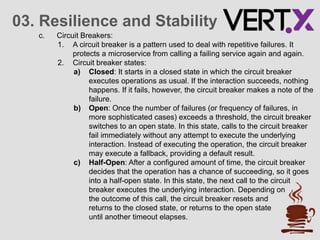
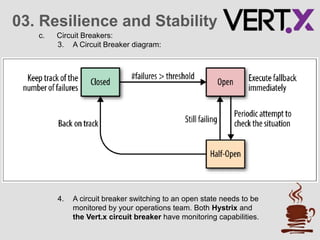
1. A circuit breaker is a pattern used to deal with repetitive failures. It
protects a microservice from calling a failing service again and again.
2. Circuit breaker states:
a) Closed: It starts in a closed state in which the circuit breaker
executes operations as usual. If the interaction succeeds, nothing
happens. If it fails, however, the circuit breaker makes a note of the
failure.
b) Open: Once the number of failures (or frequency of failures, in
more sophisticated cases) exceeds a threshold, the circuit breaker
switches to an open state. In this state, calls to the circuit breaker
fail immediately without any attempt to execute the underlying
interaction. Instead of executing the operation, the circuit breaker
may execute a fallback, providing a default result.
c) Half-Open: After a configured amount of time, the circuit breaker
decides that the operation has a chance of succeeding, so it goes
into a half-open state. In this state, the next call to the circuit
breaker executes the underlying interaction. Depending on
the outcome of this call, the circuit breaker resets and
returns to the closed state, or returns to the open state
until another timeout elapses.
03. Resilience and Stability
c. Circuit Breakers:
3. A Circuit Breaker diagram:
4. A circuit breaker switching to an open state needs to be
monitored by your operations team. Both Hystrix and
the Vert.x circuit breaker have monitoring capabilities.
03. Resilience and Stability
d. Health Checks and Failovers:
1. A health check is an API provided by a microservice indicating its state.
It tells the caller whether or not the service is healthy (die, crash, etc.).
2. Note that calling a healthy microservice does not guarantee a success
either. A health check merely indicates that the microservice is running,
not that it will accurately handle your request or that the network will
deliver its answer.
3. Different levels of Health Checks:
a) Readiness Check: Used at deployment time to determine when the
microservice is ready to serve requests (when everything has been
initialized correctly).
b) Liveness Checks: Used to detect misbehaviors and indicate
whether the microservice is able to handle requests successfully.
When a liveness check cannot be executed because the targeted
microservice does not respond, the microservice has probably
crashed.
4. Failover Strategy: Vert.x offers a built-in failover, which is triggered when
a node from the cluster dies and don’t need a custom health check
as the Vert.x cluster pings nodes periodically. When Vert.x loses
track of a node, Vert.x chooses a healthy node of the cluster and
redeploys the dead part.
Thank You!
Any questions? You can find me at
firmansyah.profess@gmail.com
Credits
PPT: ALLPPT.com
Music: https://www.bensound.com
Chapter 05: Eclipse Vert.x - Service Discovery, Resilience and Stability Patterns

Chapter 05: Eclipse Vert.x - Service Discovery, Resilience and Stability Patterns

  • 1.
    Firmansyah.profess@gmail.com 2018 Eclipse Vert.x Chapter 05 ServiceDiscovery, Resilience and Stability Patterns
  • 2.
    01. Service Discovery a.Microservices need Service Discovery pattern to achieve: 1. Location Transparency The microservice consumer may call different instances of the microservice producer using a round-robin strategy, and between two invocations the microservice producer may have been moved, updated, removed (shrinking), or newly created (growth). 2. Mobility The microservice consumer needs to be able to communicate with a microservice producer without knowing its exact location in advance, especially since this location may change (Event Bus Address, URLs, Ports, Paths, etc) over time. b. Service Registry Each microservice should announce how it can be invoked and its characteristics, including its location, other metadata such as security policies or versions, the arrivals and departures of services. These announcements are stored in the service discovery infrastructure which is generally a service registry.
  • 3.
    01. Service Discovery c.Service Discovery pattern type: 1. Client-Side Service Discovery • The consumer looks for a producer based on its name and metadata in the service registry, selects a matching service, and uses it. • The reference retrieved from the service registry contains a direct link to a microservice. • The service registry can take various forms such as a distributed data structure, a dedicated infrastructure such as Consul, or be stored in an inventory service such as Apache Zookeeper or Redis. 2. Server-Side Service Discovery • Load Balancer/Router/Proxy/API gateway manage the discovery. • The consumer still looks for a producer based on its name and metadata but retrieves a virtual address. • When the consumer invokes the producer, the request is routed to the actual implementation. • Use this mechanism on Kubernetes or when using AWS Elastic Load Balancer.
  • 4.
    01. Service Discovery d.Service Discovery pattern type diagram: 1. Client-Side Service Discovery 2. Server-Side Service Discovery
  • 5.
    01. Service Discovery e.Vert.x Service Discovery: 1. Vert.x provides an extensible service discovery mechanism. 2. Provide client-side or server-side service discovery using the same API. 3. Provide import or export services from many types of service discovery infrastructures such as Consul, Zookeeper or Kubernetes. 4. Provide internal service discovery infrastructure. It uses a distributed data structure shared on the Vert.x cluster.
  • 6.
    02. Service DiscoveryDemo a. Create a directory called “chapter05” b. Generate the project structure using maven inside chapter05 folder: mvn io.fabric8:vertx-maven-plugin:1.0.5:setup -DprojectGroupId=io.vertx.chapter05 -DprojectArtifactId=http-micro01-vertx-app -Dverticle=io.vertx.chapter05.HttpMicro01 -Ddependencies=vertx-service-discovery,web,rx, vertx-hazelcast c. Modify io.vertx.chapter05.HttpMicro01 java file d. Run HttpMicro01 application mvn compile vertx:run -Dvertx.runArgs="-cluster - Djava.net.preferIPv4Stack=true"
  • 7.
    02. Service DiscoveryDemo e. Create a directory called “consumer” inside “chapter05” folder f. Generate the project structure using maven inside consumer folder: mvn io.fabric8:vertx-maven-plugin:1.0.5:setup -DprojectGroupId=io.vertx.chapter05 -DprojectArtifactId=http-micro02-vertx-app -Dverticle=io.vertx.chapter05.HttpMicro02 -Ddependencies=vertx-service-discovery,web,rx, vertx-hazelcast,web-client g. Modify io.vertx.chapter05.HttpMicro02 java file h. Run HttpMicro02 application mvn compile vertx:run -Dvertx.runArgs="-cluster - Djava.net.preferIPv4Stack=true"
  • 8.
    03. Resilience andStability a. Managing Failures Pattern: 1. Every interaction between microservices will eventually fail in some way, and you need to be prepared for that failure. Failure can take different forms, ranging from various network errors to semantic errors. Reactive microservices are responsible for managing failures locally and must avoid propagating the failure to another microservice. 2. The Vert.x Failures Handlers: a) Callback Model: Use AsyncResult object client.get("/").as(BodyCodec.jsonObject()) .send(ar -> { if (ar.failed()) { Throwable cause = ar.cause(); // You need to manage the failure. } else { // It's a success JsonObject json = ar.result().body(); } });
  • 9.
    03. Resilience andStability b) RxJava Model: Use subscribe() method: client.get("/").as(BodyCodec.jsonObject()) .rxSend() .map(HttpResponse::body) .subscribe( json -> { /* success */ }, err -> { /* failure */ } ); c) RxJava Model: Use onErrorReturn() method: client.get("/").as(BodyCodec.jsonObject()) .rxSend() .map(HttpResponse::body) .onErrorReturn(t -> { // Called if rxSend produces a failure // We can return a default value return new JsonObject(); }) .subscribe( json -> { // Always called, either with the actual //result or with the default value. } );
  • 10.
    03. Resilience andStability b. Timeout and Retry Pattern: 1. A timeout is a simple mechanism that allows you to stop waiting for a response once you think it will not come. Well-placed timeouts provide failure isolation, ensuring the failure is limited to the microservice it affects and allowing you to handle the timeout and continue your execution in a degraded mode. 2. Timeouts are often used together with retries. When a timeout occurs, we can try again. Immediately retrying an operation after a failure has a number of effects 3. Three types of failure could have occurred: a) The message between A and B has been lost—the operation is not executed. b) The operation in B failed—the operation has not completed its execution. c) The response message between B and A has been lost, the operation has been executed successfully, but A didn’t get the response. 4. This last case is often ignored and can be harmful. In this case, combining the timeout with a retry can break the integrity of the system. Retries can only be used with idempotent operations, i.e., with operations you can invoke multiple times without changing the result beyond the initial call.
  • 11.
    03. Resilience andStability c. Circuit Breakers: 1. A circuit breaker is a pattern used to deal with repetitive failures. It protects a microservice from calling a failing service again and again. 2. Circuit breaker states: a) Closed: It starts in a closed state in which the circuit breaker executes operations as usual. If the interaction succeeds, nothing happens. If it fails, however, the circuit breaker makes a note of the failure. b) Open: Once the number of failures (or frequency of failures, in more sophisticated cases) exceeds a threshold, the circuit breaker switches to an open state. In this state, calls to the circuit breaker fail immediately without any attempt to execute the underlying interaction. Instead of executing the operation, the circuit breaker may execute a fallback, providing a default result. c) Half-Open: After a configured amount of time, the circuit breaker decides that the operation has a chance of succeeding, so it goes into a half-open state. In this state, the next call to the circuit breaker executes the underlying interaction. Depending on the outcome of this call, the circuit breaker resets and returns to the closed state, or returns to the open state until another timeout elapses.
  • 12.
    03. Resilience andStability c. Circuit Breakers: 3. A Circuit Breaker diagram: 4. A circuit breaker switching to an open state needs to be monitored by your operations team. Both Hystrix and the Vert.x circuit breaker have monitoring capabilities.
  • 13.
    03. Resilience andStability d. Health Checks and Failovers: 1. A health check is an API provided by a microservice indicating its state. It tells the caller whether or not the service is healthy (die, crash, etc.). 2. Note that calling a healthy microservice does not guarantee a success either. A health check merely indicates that the microservice is running, not that it will accurately handle your request or that the network will deliver its answer. 3. Different levels of Health Checks: a) Readiness Check: Used at deployment time to determine when the microservice is ready to serve requests (when everything has been initialized correctly). b) Liveness Checks: Used to detect misbehaviors and indicate whether the microservice is able to handle requests successfully. When a liveness check cannot be executed because the targeted microservice does not respond, the microservice has probably crashed. 4. Failover Strategy: Vert.x offers a built-in failover, which is triggered when a node from the cluster dies and don’t need a custom health check as the Vert.x cluster pings nodes periodically. When Vert.x loses track of a node, Vert.x chooses a healthy node of the cluster and redeploys the dead part.
  • 14.
    Thank You! Any questions?You can find me at firmansyah.profess@gmail.com Credits PPT: ALLPPT.com Music: https://www.bensound.com