Machinery Dynamics
(Basic of Mechanical Vibrations)
Shi Jianguo
Tel: 13904180821
School of Mechanical Engineering
Liaoning Technical University
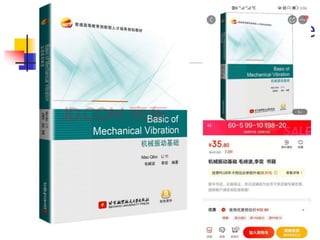
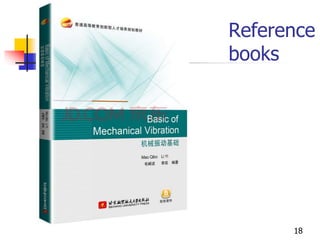
Reference
books
2
Before we get started…
 Who should study this course
 Students majoring in Mechanical Design
manufacturing and automation
 Course property: Professional compulsory
course
 课程性质:专业必修课
 When the course begin?
 Autumn 2021
3
Today’s Objectives
Students will be able to:
 Understand the
 Identify the
 Identify the
 Identify the
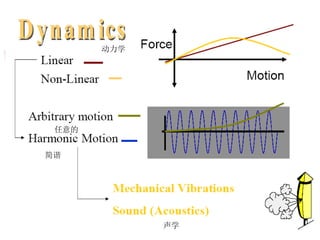
动力学
任意的
简谐
声学
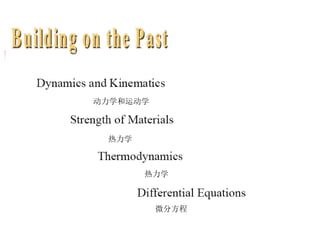
热力学
微分方程
热力学
动力学和运动学
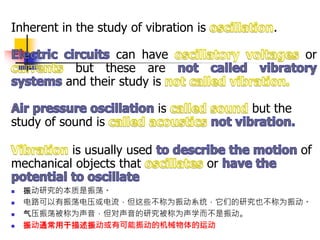
Inherent in the study of vibration is .
can have or
but these are
and their study is
is but the
study of sound is
is usually used of
mechanical objects that or
 振动研究的本质是振荡。
 电路可以有振荡电压或电流,但这些不称为振动系统,它们的研究也不称为振动。
 气压振荡被称为声音,但对声音的研究被称为声学而不是振动。
 振动通常用于描述振动或有可能振动的机械物体的运动
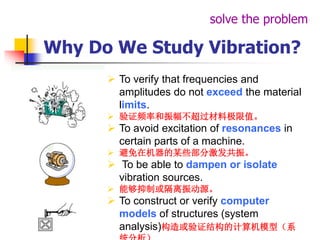
Why Do We Study Vibration?
 To verify that frequencies and
amplitudes do not exceed the material
limits.
 验证频率和振幅不超过材料极限值。
 To avoid excitation of resonances in
certain parts of a machine.
 避免在机器的某些部分激发共振。
 To be able to dampen or isolate
vibration sources.
 能够抑制或隔离振动源。
 To construct or verify computer
models of structures (system
analysis)构造或验证结构的计算机模型(系
solve the problem
About this Course
 This course is an introduction to the dynamics
and vibrations of mechanical systems.
 本课程介绍机械系统的动力学和振动。
 After this course, students will be able to
evaluate free and forced vibration of linear
singe- and multi-degree of freedom models of
mechanical systems and matrix eigenvalue
problems.
 本课程结束后,学生将能够评估机械系统的线性单自由度和多自
由度模型的自由振动和受迫振动以及矩阵特征值问题。
10
Course Objectives
 The purpose of the course is to develop the skills
needed to design and analyze mechanical systems in
which vibration problems are typically encountered.
 本课程的目的是培养设计和分析通常遇到振动问题的机械系统所需的技能。
 These skills include analytical and numerical
techniques that allow the student to model the
system, analyze the system performance and
employ the necessary design changes.
 这些技能包括分析和数值技术,允许学生对系统建模、分析系统性能并采用必
要的设计变更。
 Emphasis is placed on developing a thorough
understanding of how the changes in system
parameters affect the system response.
 重点在于深入了解系统参数的变化如何影响系统响应。
11
Course Objectives (Contd)
 To understand the fundamentals of Vibration
Theory;
 了解振动理论的基本原理;
 To be able to mathematically model real-
world mechanical vibration problems;
 能够对真实世界的机械振动问题进行数学建模;
 To use computer software programs to
investigate and understand vibration
problems.
 使用计算机软件程序解决振动问题。
12
Catalog Description目录说明
 Analytical methods for solution of typical
vibration and balancing problems in engines
and other mechanical systems.
 解决发动机和其他机械系统中典型振动和平衡问题的分析方法。
 Special emphasis on dampers and absorbers
for vibration reduction.
 特别强调减振器和吸振器。
 Free and forced vibrations of mechanical
systems with lumped masses, springs, and
dampers are the primary emphasis.
 具有集中质量、弹簧和阻尼器的机械系统的自由振动和强迫振动是主要重点。
13
Course Outcomes 课程成果
 Upon completion of this course the student will be able to:
 完成本课程后,学生将能够:
 1. Derive the equations of motion of single and multi-degree of
freedom systems, using Newton's Laws and energy methods.
 1.使用牛顿定律和能量法推导单自由度和多自由度系统的运动方程。
 2. Determine the natural frequencies and mode shapes of single
and multi-degree of freedom systems.
 2.确定单自由度和多自由度系统的固有频率和振型。
 3. Evaluate the dynamic response of single and multi-degree of
freedom systems under impulse loadings, harmonic loadings, and
general periodic excitation.
 3.评估单自由度和多自由度系统在脉冲载荷、谐波载荷和一般周期激励下的动态响应。
 4. Apply modal analysis and orthogonality conditions to establish
the dynamic characteristics of multi-degree of freedom systems.
 4.应用模态分析和正交条件建立多自由度系统的动态特性。
 5. Simulate the dynamic response of the vibration system to initial
conditions and external excitations.
 5.模拟振动系统对初始条件和外部激励的动态响应。 14
Course Outcomes (Contd)
 This course contributes to (for students):
本课程有助于(学生):
 An ability to apply knowledge of
mathematics, science and engineering;
 应用数学、科学和工程知识的能力;
 An ability to identify, formulate, and solve
engineering problems.
 识别、制定和解决工程问题的能力。
15
Course Outcomes (Contd)
16
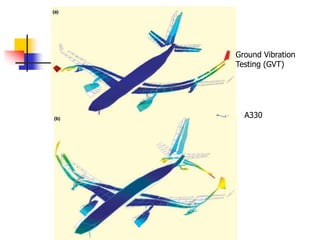
A330
Ground Vibration
Testing (GVT)
Reference
books
18
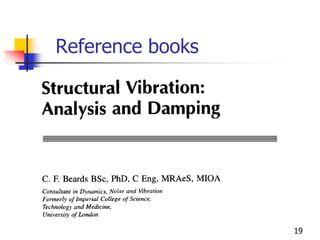
Reference books
19
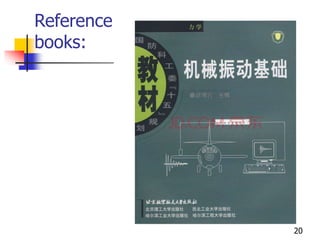
Reference
books:
20
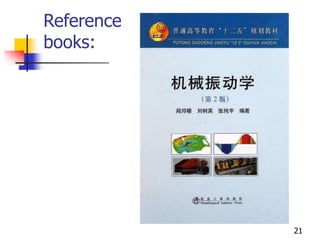
Reference
books:
21
Mechanical Vibrations: The Framework
机械振动:框架
 How has this topic, Mechanical Vibrations, come to be?机械
振动这一主题是如何产生的?
 Just like many other topics in Engineering:
 A physical system is given to you (you have a problem to solve)
 给你一个物理系统(你有一个问题要解决)
 You generate an abstraction of that actual system (problem)
 In other words, you generate a model of the system
生成实际系统(问题)的抽象 换句话说,您将生成系统的模型
 You apply the laws of physics to get the equations that govern the time
evolution of the model
 应用物理定律,得到控制模型时间演化的方程
 You solve the differential equations to find the solution of interest
 Post-processing might be necessary…
你通过解微分方程来找到感兴趣的解 后处理可能是必要的…
22
Course Overview 课程概述
 Chapter 1 Introduction
 Introduction of mechanical vibrations
 Definition and basic concepts of vibration
 Modeling
 Newton's second law
 Equations of motion
23
In this chapter: The importance of vibration will be
discussed and some necessary background information
given.将讨论振动的重要性,并提供一些必要的背景信息。
第一章导言
机械振动导论
振动的定义和基本概念
建模
牛顿第二定律
运动方程
Course Overview (Contd)
 Chapter 2 Free vibration of a single-degree-
of-freedom system
 The basic mechanical components
 Free vibration of undamped systems
 Rotary systems
 Springs connected in series or in parallel
 Modelling using energy method
 Viscously damped systems
 Evaluating damping ratio from measurements (Logarithmic
decrement)
 Summary: the effects of damping on an unforced SDOF system
 MATLAB examples for free vibration of SDOF systems
24
第2章单自由度系统的自由振动
基本机械部件
无阻尼系统的自由振动
旋转系统
串联或并联的弹簧
能量法建模
粘阻尼系统
根据测量值评估阻尼比(对数衰减)
总结:阻尼对非受迫单自由度系统的影响
单自由度系统自由振动的MATLAB算例
Course Overview (Contd)
 Chapter 3 Harmonic excitation of SDOF
systems
 Harmonic excitation
 Complex analysis
 Undamped SDOF system with harmonic excitation
 Damped SDOF system with harmonic excitation
 Harmonic base excitation
 Transmissibility of vibration
 Rotating unbalance
 MATLAB examples for forced SDOF system
25
第三章单自由度系统的谐波激励
谐波激励
复杂分析
谐波激励的无阻尼单自由度系统
谐波激励的阻尼单自由度系统
谐波基极激励
振动传递率
旋转不平衡
强迫单自由度系统的MATLAB实例
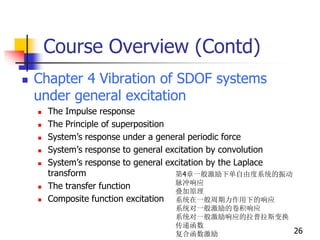
Course Overview (Contd)
 Chapter 4 Vibration of SDOF systems
under general excitation
 The Impulse response
 The Principle of superposition
 System’s response under a general periodic force
 System’s response to general excitation by convolution
 System’s response to general excitation by the Laplace
transform
 The transfer function
 Composite function excitation
26
第4章一般激励下单自由度系统的振动
脉冲响应
叠加原理
系统在一般周期力作用下的响应
系统对一般激励的卷积响应
系统对一般激励响应的拉普拉斯变换
传递函数
复合函数激励
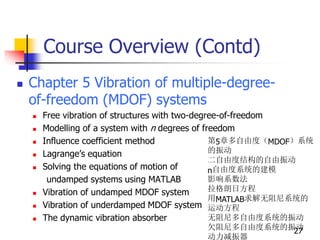
Course Overview (Contd)
 Chapter 5 Vibration of multiple-degree-
of-freedom (MDOF) systems
 Free vibration of structures with two-degree-of-freedom
 Modelling of a system with n degrees of freedom
 Influence coefficient method
 Lagrange’s equation
 Solving the equations of motion of
undamped systems using MATLAB
 Vibration of undamped MDOF system
 Vibration of underdamped MDOF system
 The dynamic vibration absorber
27
第5章多自由度(MDOF)系统
的振动
二自由度结构的自由振动
n自由度系统的建模
影响系数法
拉格朗日方程
用MATLAB求解无阻尼系统的
运动方程
无阻尼多自由度系统的振动
欠阻尼多自由度系统的振动
动力减振器
Course Overview (Contd)
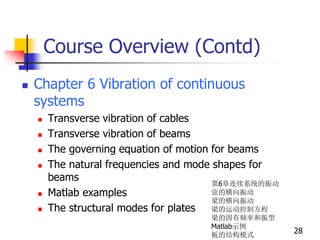
 Chapter 6 Vibration of continuous
systems
 Transverse vibration of cables
 Transverse vibration of beams
 The governing equation of motion for beams
 The natural frequencies and mode shapes for
beams
 Matlab examples
 The structural modes for plates
28
第6章连续系统的振动
弦的横向振动
梁的横向振动
梁的运动控制方程
梁的固有频率和振型
Matlab示例
板的结构模式
Reports and Exams
 During the course, students take two reports
and one final exam.
 Both reports are based on the first and
second chapter of the textbook.
 The final exam will be closed book. One
page (A4, front and back) of handwritten
notes will be allowed at the final exam.
29
在课程中,学生参加两次报告和一次期末考试。
这两份报告都以教科书的第一章和第二章为基础。
期末考试将闭卷进行。期末考试允许一页(A4,正面
和背面)的手写笔记。
Grading
 Homework 30%
 Report 20%
 Final Exam 50%
 Total 100%
30
MATLAB and Simulink
 Integrated into every chapter in the text
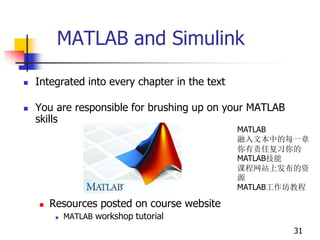
 You are responsible for brushing up on your MATLAB
skills
 Resources posted on course website
 MATLAB workshop tutorial
31
MATLAB
融入文本中的每一章
你有责任复习你的
MATLAB技能
课程网站上发布的资
源
MATLAB工作坊教程
This Course…
 Be active, pay attention, ask questions
 A rather intense class
 The most important thing is taking care of homework
 Reading the text is important
 The class builds on itself – essential to start strong and keep up
 Your feedback is important
 Provide feedback – both during and at end of the semester
32
相当紧张的课
最重要的是做好家庭作业
阅读课文很重要
课程建立在自身的基础上——这对于坚强起步和
不断进步至关重要
要积极,注意,问问题
你的反馈很重要
在学期中和学期末提供反馈
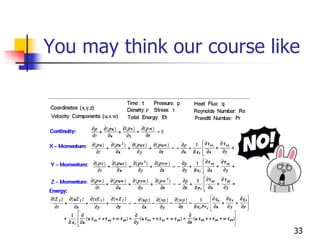
You may think our course like
33
You may think our course like
34
Actually, our course
35
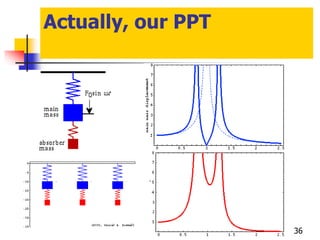
Actually, our PPT
36
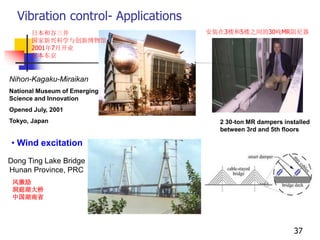
Vibration control- Applications
Nihon-Kagaku-Miraikan
National Museum of Emerging
Science and Innovation
Opened July, 2001
Tokyo, Japan 2 30-ton MR dampers installed
between 3rd and 5th floors
Dong Ting Lake Bridge
Hunan Province, PRC
• Wind excitation
37
日本和谷三井
国家新兴科学与创新博物馆
2001年7月开业
日本东京
安装在3楼和5楼之间的30吨MR阻尼器
风激励
洞庭湖大桥
中国湖南省
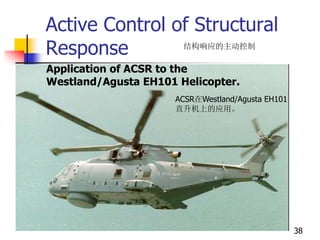
Application of ACSR to the
Westland/Agusta EH101 Helicopter.
Active Control of Structural
Response
38
结构响应的主动控制
ACSR在Westland/Agusta EH101
直升机上的应用。
The end

Chaper 0 Overview-mechanical vibration.ppt

  • 1.
    Machinery Dynamics (Basic ofMechanical Vibrations) Shi Jianguo Tel: 13904180821 School of Mechanical Engineering Liaoning Technical University
  • 2.
  • 3.
    Before we getstarted…  Who should study this course  Students majoring in Mechanical Design manufacturing and automation  Course property: Professional compulsory course  课程性质:专业必修课  When the course begin?  Autumn 2021 3
  • 4.
    Today’s Objectives Students willbe able to:  Understand the  Identify the  Identify the  Identify the
  • 6.
  • 7.
  • 8.
    Inherent in thestudy of vibration is . can have or but these are and their study is is but the study of sound is is usually used of mechanical objects that or  振动研究的本质是振荡。  电路可以有振荡电压或电流,但这些不称为振动系统,它们的研究也不称为振动。  气压振荡被称为声音,但对声音的研究被称为声学而不是振动。  振动通常用于描述振动或有可能振动的机械物体的运动
  • 9.
    Why Do WeStudy Vibration?  To verify that frequencies and amplitudes do not exceed the material limits.  验证频率和振幅不超过材料极限值。  To avoid excitation of resonances in certain parts of a machine.  避免在机器的某些部分激发共振。  To be able to dampen or isolate vibration sources.  能够抑制或隔离振动源。  To construct or verify computer models of structures (system analysis)构造或验证结构的计算机模型(系 solve the problem
  • 10.
    About this Course This course is an introduction to the dynamics and vibrations of mechanical systems.  本课程介绍机械系统的动力学和振动。  After this course, students will be able to evaluate free and forced vibration of linear singe- and multi-degree of freedom models of mechanical systems and matrix eigenvalue problems.  本课程结束后,学生将能够评估机械系统的线性单自由度和多自 由度模型的自由振动和受迫振动以及矩阵特征值问题。 10
  • 11.
    Course Objectives  Thepurpose of the course is to develop the skills needed to design and analyze mechanical systems in which vibration problems are typically encountered.  本课程的目的是培养设计和分析通常遇到振动问题的机械系统所需的技能。  These skills include analytical and numerical techniques that allow the student to model the system, analyze the system performance and employ the necessary design changes.  这些技能包括分析和数值技术,允许学生对系统建模、分析系统性能并采用必 要的设计变更。  Emphasis is placed on developing a thorough understanding of how the changes in system parameters affect the system response.  重点在于深入了解系统参数的变化如何影响系统响应。 11
  • 12.
    Course Objectives (Contd) To understand the fundamentals of Vibration Theory;  了解振动理论的基本原理;  To be able to mathematically model real- world mechanical vibration problems;  能够对真实世界的机械振动问题进行数学建模;  To use computer software programs to investigate and understand vibration problems.  使用计算机软件程序解决振动问题。 12
  • 13.
    Catalog Description目录说明  Analyticalmethods for solution of typical vibration and balancing problems in engines and other mechanical systems.  解决发动机和其他机械系统中典型振动和平衡问题的分析方法。  Special emphasis on dampers and absorbers for vibration reduction.  特别强调减振器和吸振器。  Free and forced vibrations of mechanical systems with lumped masses, springs, and dampers are the primary emphasis.  具有集中质量、弹簧和阻尼器的机械系统的自由振动和强迫振动是主要重点。 13
  • 14.
    Course Outcomes 课程成果 Upon completion of this course the student will be able to:  完成本课程后,学生将能够:  1. Derive the equations of motion of single and multi-degree of freedom systems, using Newton's Laws and energy methods.  1.使用牛顿定律和能量法推导单自由度和多自由度系统的运动方程。  2. Determine the natural frequencies and mode shapes of single and multi-degree of freedom systems.  2.确定单自由度和多自由度系统的固有频率和振型。  3. Evaluate the dynamic response of single and multi-degree of freedom systems under impulse loadings, harmonic loadings, and general periodic excitation.  3.评估单自由度和多自由度系统在脉冲载荷、谐波载荷和一般周期激励下的动态响应。  4. Apply modal analysis and orthogonality conditions to establish the dynamic characteristics of multi-degree of freedom systems.  4.应用模态分析和正交条件建立多自由度系统的动态特性。  5. Simulate the dynamic response of the vibration system to initial conditions and external excitations.  5.模拟振动系统对初始条件和外部激励的动态响应。 14
  • 15.
    Course Outcomes (Contd) This course contributes to (for students): 本课程有助于(学生):  An ability to apply knowledge of mathematics, science and engineering;  应用数学、科学和工程知识的能力;  An ability to identify, formulate, and solve engineering problems.  识别、制定和解决工程问题的能力。 15
  • 16.
  • 17.
  • 18.
  • 19.
  • 20.
  • 21.
  • 22.
    Mechanical Vibrations: TheFramework 机械振动:框架  How has this topic, Mechanical Vibrations, come to be?机械 振动这一主题是如何产生的?  Just like many other topics in Engineering:  A physical system is given to you (you have a problem to solve)  给你一个物理系统(你有一个问题要解决)  You generate an abstraction of that actual system (problem)  In other words, you generate a model of the system 生成实际系统(问题)的抽象 换句话说,您将生成系统的模型  You apply the laws of physics to get the equations that govern the time evolution of the model  应用物理定律,得到控制模型时间演化的方程  You solve the differential equations to find the solution of interest  Post-processing might be necessary… 你通过解微分方程来找到感兴趣的解 后处理可能是必要的… 22
  • 23.
    Course Overview 课程概述 Chapter 1 Introduction  Introduction of mechanical vibrations  Definition and basic concepts of vibration  Modeling  Newton's second law  Equations of motion 23 In this chapter: The importance of vibration will be discussed and some necessary background information given.将讨论振动的重要性,并提供一些必要的背景信息。 第一章导言 机械振动导论 振动的定义和基本概念 建模 牛顿第二定律 运动方程
  • 24.
    Course Overview (Contd) Chapter 2 Free vibration of a single-degree- of-freedom system  The basic mechanical components  Free vibration of undamped systems  Rotary systems  Springs connected in series or in parallel  Modelling using energy method  Viscously damped systems  Evaluating damping ratio from measurements (Logarithmic decrement)  Summary: the effects of damping on an unforced SDOF system  MATLAB examples for free vibration of SDOF systems 24 第2章单自由度系统的自由振动 基本机械部件 无阻尼系统的自由振动 旋转系统 串联或并联的弹簧 能量法建模 粘阻尼系统 根据测量值评估阻尼比(对数衰减) 总结:阻尼对非受迫单自由度系统的影响 单自由度系统自由振动的MATLAB算例
  • 25.
    Course Overview (Contd) Chapter 3 Harmonic excitation of SDOF systems  Harmonic excitation  Complex analysis  Undamped SDOF system with harmonic excitation  Damped SDOF system with harmonic excitation  Harmonic base excitation  Transmissibility of vibration  Rotating unbalance  MATLAB examples for forced SDOF system 25 第三章单自由度系统的谐波激励 谐波激励 复杂分析 谐波激励的无阻尼单自由度系统 谐波激励的阻尼单自由度系统 谐波基极激励 振动传递率 旋转不平衡 强迫单自由度系统的MATLAB实例
  • 26.
    Course Overview (Contd) Chapter 4 Vibration of SDOF systems under general excitation  The Impulse response  The Principle of superposition  System’s response under a general periodic force  System’s response to general excitation by convolution  System’s response to general excitation by the Laplace transform  The transfer function  Composite function excitation 26 第4章一般激励下单自由度系统的振动 脉冲响应 叠加原理 系统在一般周期力作用下的响应 系统对一般激励的卷积响应 系统对一般激励响应的拉普拉斯变换 传递函数 复合函数激励
  • 27.
    Course Overview (Contd) Chapter 5 Vibration of multiple-degree- of-freedom (MDOF) systems  Free vibration of structures with two-degree-of-freedom  Modelling of a system with n degrees of freedom  Influence coefficient method  Lagrange’s equation  Solving the equations of motion of undamped systems using MATLAB  Vibration of undamped MDOF system  Vibration of underdamped MDOF system  The dynamic vibration absorber 27 第5章多自由度(MDOF)系统 的振动 二自由度结构的自由振动 n自由度系统的建模 影响系数法 拉格朗日方程 用MATLAB求解无阻尼系统的 运动方程 无阻尼多自由度系统的振动 欠阻尼多自由度系统的振动 动力减振器
  • 28.
    Course Overview (Contd) Chapter 6 Vibration of continuous systems  Transverse vibration of cables  Transverse vibration of beams  The governing equation of motion for beams  The natural frequencies and mode shapes for beams  Matlab examples  The structural modes for plates 28 第6章连续系统的振动 弦的横向振动 梁的横向振动 梁的运动控制方程 梁的固有频率和振型 Matlab示例 板的结构模式
  • 29.
    Reports and Exams During the course, students take two reports and one final exam.  Both reports are based on the first and second chapter of the textbook.  The final exam will be closed book. One page (A4, front and back) of handwritten notes will be allowed at the final exam. 29 在课程中,学生参加两次报告和一次期末考试。 这两份报告都以教科书的第一章和第二章为基础。 期末考试将闭卷进行。期末考试允许一页(A4,正面 和背面)的手写笔记。
  • 30.

    Grading  Homework 30% Report 20%  Final Exam 50%  Total 100% 30
  • 31.
    MATLAB and Simulink Integrated into every chapter in the text  You are responsible for brushing up on your MATLAB skills  Resources posted on course website  MATLAB workshop tutorial 31 MATLAB 融入文本中的每一章 你有责任复习你的 MATLAB技能 课程网站上发布的资 源 MATLAB工作坊教程
  • 32.
    This Course…  Beactive, pay attention, ask questions  A rather intense class  The most important thing is taking care of homework  Reading the text is important  The class builds on itself – essential to start strong and keep up  Your feedback is important  Provide feedback – both during and at end of the semester 32 相当紧张的课 最重要的是做好家庭作业 阅读课文很重要 课程建立在自身的基础上——这对于坚强起步和 不断进步至关重要 要积极,注意,问问题 你的反馈很重要 在学期中和学期末提供反馈
  • 33.
    You may thinkour course like 33
  • 34.
    You may thinkour course like 34
  • 35.
  • 36.
  • 37.
    Vibration control- Applications Nihon-Kagaku-Miraikan NationalMuseum of Emerging Science and Innovation Opened July, 2001 Tokyo, Japan 2 30-ton MR dampers installed between 3rd and 5th floors Dong Ting Lake Bridge Hunan Province, PRC • Wind excitation 37 日本和谷三井 国家新兴科学与创新博物馆 2001年7月开业 日本东京 安装在3楼和5楼之间的30吨MR阻尼器 风激励 洞庭湖大桥 中国湖南省
  • 38.
    Application of ACSRto the Westland/Agusta EH101 Helicopter. Active Control of Structural Response 38 结构响应的主动控制 ACSR在Westland/Agusta EH101 直升机上的应用。
  • 39.