Chapter 1
Marketing in a Changing World:
Creating Customer Value and
Satisfaction
PRINCIPLES OF MARKETING
Eighth Edition
Philip Kotler and Gary Armstrong
What is Marketing?
• Process by which individuals and
groups obtain what they need and
want through creating and
exchanging products and value with
others.
• More simply: Marketing is the
delivery of customer satisfaction at a
profit.
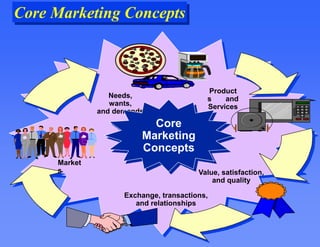
Core Marketing Concepts
Product
s and
Services
Value, satisfaction,
and quality
Needs,
wants,
and demands
Exchange, transactions,
and relationships
Market
s
Core
Marketing
Concepts
What Motivates a Consumer
to Take Action?
• Needs - state of felt deprivation for basic
items such as food and clothing and complex
needs such as for belonging. i.e. I am thirsty
• Wants - form that a human need takes as
shaped by culture and individual personality.
i.e. I want a Coca-Cola.
• Demands - human wants backed by buying
power. i.e. I have money to buy a Coca-Cola.
What Will Satisfy Consumer’s
Needs and Wants?
• Products - anything
that can be offered to a
market for attention,
acquisition, use or
consumption and that
might satisfy a need or
want.
• Examples: persons,
places, organizations,
activities, and ideas.
• Services - activities or
benefits offered for
sale that are
essentially intangible
and don’t result in the
ownership of anything.
• Examples: banking,
airlines, haircuts, and
hotels.
How Do Consumers Choose
Choose Among Products and
Services?
• Customer Value - benefit that the customer
gains from owning and using a product
compared to the cost of obtaining the
product.
• Customer Satisfaction - depends on the
product’s perceived performance in
delivering value relative to a buyer’s
expectations. Linked to Quality and Total
Quality Management (TQM).
How do Consumers Obtain
Products and Services?
• Exchanges - act of obtaining a desired object from
someone by offering something in return.
• Transactions - trade of values between parties.
Usually involves money and a response.
• Relationships - building long-term relationships
with consumers, distributors, dealers, and
suppliers.
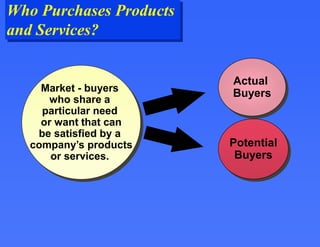
Who Purchases Products
and Services?
Market - buyers
who share a
particular need
or want that can
be satisfied by a
company’s products
or services.
Actual
Buyers
Potential
Buyers
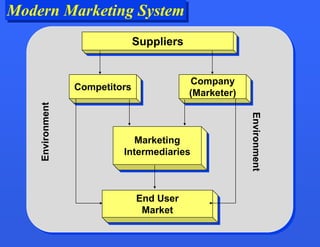
Modern Marketing System
Suppliers
End User
Market
Marketing
Intermediaries
Competitors
Company
(Marketer)
Environment
Environment
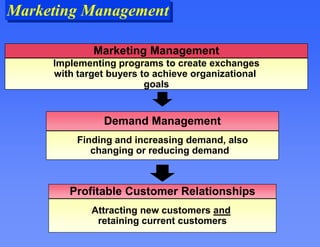
Marketing Management
Implementing programs to create exchanges
with target buyers to achieve organizational
goals
Finding and increasing demand, also
changing or reducing demand
Demand Management
Attracting new customers and
retaining current customers
Profitable Customer Relationships
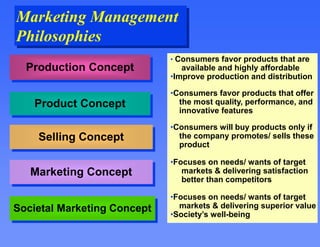
Marketing Management
Philosophies
Production Concept
Product Concept
Selling Concept
Marketing Concept
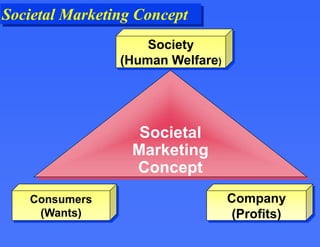
Societal Marketing Concept
• Consumers favor products that are
available and highly affordable
•Improve production and distribution
•Consumers favor products that offer
the most quality, performance, and
innovative features
•Consumers will buy products only if
the company promotes/ sells these
product
•Focuses on needs/ wants of target
markets & delivering satisfaction
better than competitors
•Focuses on needs/ wants of target
markets & delivering superior value
•Society’s well-being
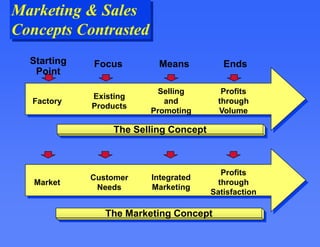
Marketing & Sales
Concepts Contrasted
Factory
Existing
Products
Selling
and
Promoting
Profits
through
Volume
Market
Customer
Needs
Integrated
Marketing
Profits
through
Satisfaction
The Selling Concept
The Marketing Concept
Starting
Point
Focus Means Ends
Societal Marketing Concept
Society
(Human Welfare)
Consumers
(Wants)
Company
(Profits)
Societal
Marketing
Concept
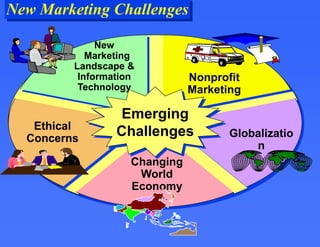
Emerging
Challenges
Nonprofit
Marketing
New
Marketing
Landscape &
Information
Technology
Ethical
Concerns Globalizatio
n
Changing
World
Economy
New Marketing Challenges

chap1 (2).ppt

  • 1.
    Chapter 1 Marketing ina Changing World: Creating Customer Value and Satisfaction PRINCIPLES OF MARKETING Eighth Edition Philip Kotler and Gary Armstrong
  • 2.
    What is Marketing? •Process by which individuals and groups obtain what they need and want through creating and exchanging products and value with others. • More simply: Marketing is the delivery of customer satisfaction at a profit.
  • 3.
    Core Marketing Concepts Product sand Services Value, satisfaction, and quality Needs, wants, and demands Exchange, transactions, and relationships Market s Core Marketing Concepts
  • 4.
    What Motivates aConsumer to Take Action? • Needs - state of felt deprivation for basic items such as food and clothing and complex needs such as for belonging. i.e. I am thirsty • Wants - form that a human need takes as shaped by culture and individual personality. i.e. I want a Coca-Cola. • Demands - human wants backed by buying power. i.e. I have money to buy a Coca-Cola.
  • 5.
    What Will SatisfyConsumer’s Needs and Wants? • Products - anything that can be offered to a market for attention, acquisition, use or consumption and that might satisfy a need or want. • Examples: persons, places, organizations, activities, and ideas. • Services - activities or benefits offered for sale that are essentially intangible and don’t result in the ownership of anything. • Examples: banking, airlines, haircuts, and hotels.
  • 6.
    How Do ConsumersChoose Choose Among Products and Services? • Customer Value - benefit that the customer gains from owning and using a product compared to the cost of obtaining the product. • Customer Satisfaction - depends on the product’s perceived performance in delivering value relative to a buyer’s expectations. Linked to Quality and Total Quality Management (TQM).
  • 7.
    How do ConsumersObtain Products and Services? • Exchanges - act of obtaining a desired object from someone by offering something in return. • Transactions - trade of values between parties. Usually involves money and a response. • Relationships - building long-term relationships with consumers, distributors, dealers, and suppliers.
  • 8.
    Who Purchases Products andServices? Market - buyers who share a particular need or want that can be satisfied by a company’s products or services. Actual Buyers Potential Buyers
  • 9.
    Modern Marketing System Suppliers EndUser Market Marketing Intermediaries Competitors Company (Marketer) Environment Environment
  • 10.
    Marketing Management Marketing Management Implementingprograms to create exchanges with target buyers to achieve organizational goals Finding and increasing demand, also changing or reducing demand Demand Management Attracting new customers and retaining current customers Profitable Customer Relationships
  • 11.
    Marketing Management Philosophies Production Concept ProductConcept Selling Concept Marketing Concept Societal Marketing Concept • Consumers favor products that are available and highly affordable •Improve production and distribution •Consumers favor products that offer the most quality, performance, and innovative features •Consumers will buy products only if the company promotes/ sells these product •Focuses on needs/ wants of target markets & delivering satisfaction better than competitors •Focuses on needs/ wants of target markets & delivering superior value •Society’s well-being
  • 12.
    Marketing & Sales ConceptsContrasted Factory Existing Products Selling and Promoting Profits through Volume Market Customer Needs Integrated Marketing Profits through Satisfaction The Selling Concept The Marketing Concept Starting Point Focus Means Ends
  • 13.
    Societal Marketing Concept Society (HumanWelfare) Consumers (Wants) Company (Profits) Societal Marketing Concept
  • 14.