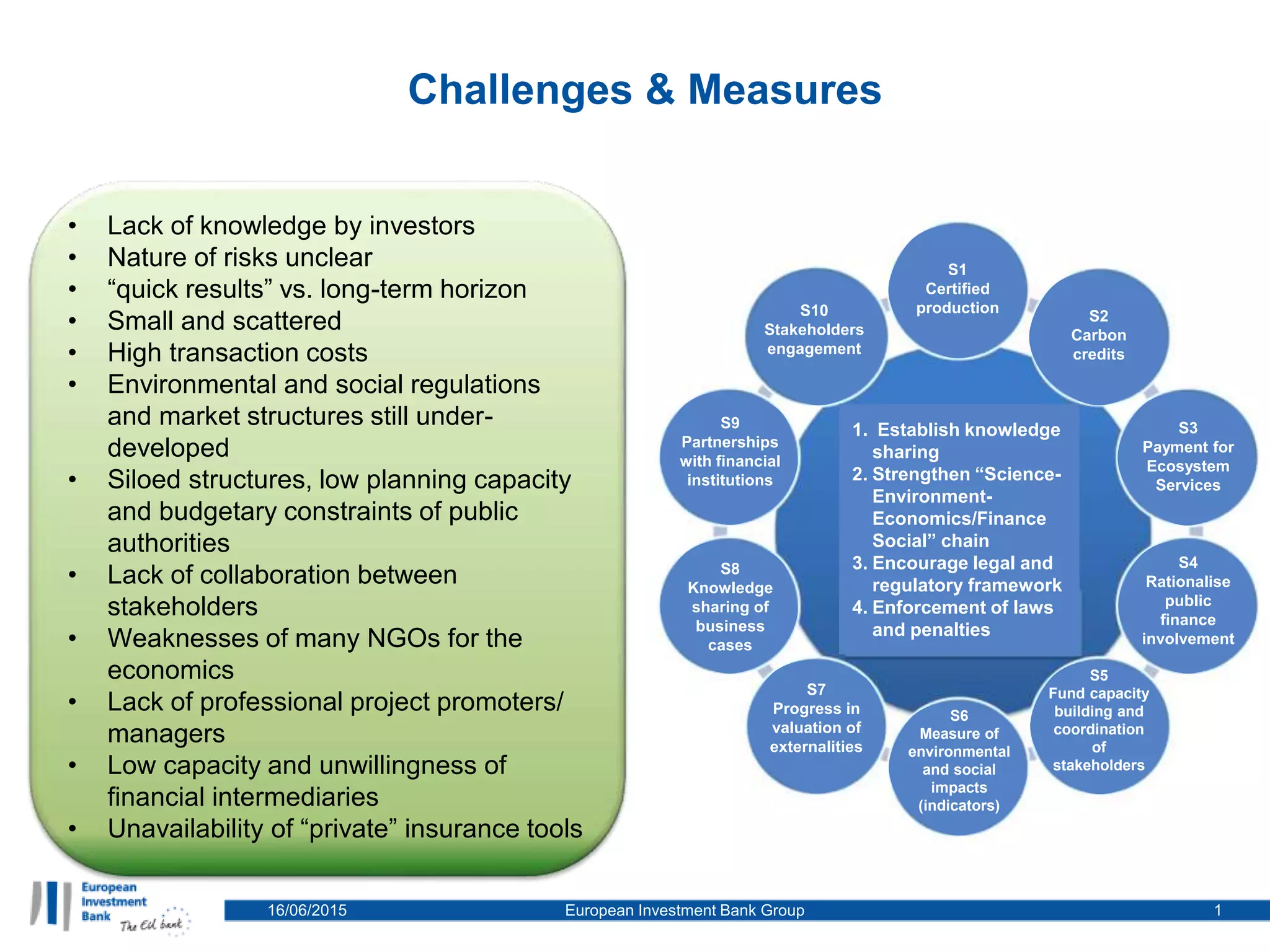
Challenges & Measures
• Lack of knowledge by investors
• Nature of risks unclear
• “quick results” vs. long-term horizon
• Small and scattered
• High transaction costs
• Environmental and social regulations
and market structures still under-
developed
• Siloed structures, low planning capacity
and budgetary constraints of public
authorities
• Lack of collaboration between
stakeholders
• Weaknesses of many NGOs for the
economics
• Lack of professional project promoters/
managers
• Low capacity and unwillingness of
financial intermediaries
• Unavailability of “private” insurance tools
16/06/2015 European Investment Bank Group 1
1. Establish knowledge
sharing
2. Strengthen “Science-
Environment-
Economics/Finance
Social” chain
3. Encourage legal and
regulatory framework
4. Enforcement of laws
and penalties
S1
Certified
production
S2
Carbon
credits
S3
Payment for
Ecosystem
Services
S4
Rationalise
public
finance
involvement
S5
Fund capacity
building and
coordination
of
stakeholders
S6
Measure of
environmental
and social
impacts
(indicators)
S7
Progress in
valuation of
externalities
S8
Knowledge
sharing of
business
cases
S9
Partnerships
with financial
institutions
S10
Stakeholders
engagement

Unlocking Capital for Land Use and Conservation Projects: Challenges and Measures – European Investment Bank

  • 1.
    Challenges & Measures •Lack of knowledge by investors • Nature of risks unclear • “quick results” vs. long-term horizon • Small and scattered • High transaction costs • Environmental and social regulations and market structures still under- developed • Siloed structures, low planning capacity and budgetary constraints of public authorities • Lack of collaboration between stakeholders • Weaknesses of many NGOs for the economics • Lack of professional project promoters/ managers • Low capacity and unwillingness of financial intermediaries • Unavailability of “private” insurance tools 16/06/2015 European Investment Bank Group 1 1. Establish knowledge sharing 2. Strengthen “Science- Environment- Economics/Finance Social” chain 3. Encourage legal and regulatory framework 4. Enforcement of laws and penalties S1 Certified production S2 Carbon credits S3 Payment for Ecosystem Services S4 Rationalise public finance involvement S5 Fund capacity building and coordination of stakeholders S6 Measure of environmental and social impacts (indicators) S7 Progress in valuation of externalities S8 Knowledge sharing of business cases S9 Partnerships with financial institutions S10 Stakeholders engagement

Editor's Notes

  • #2  There are 10 E&S Standards which establish the E&S requirements that the EIB promoter is to meet throughout the life of an EIB supported operation. The E&S Standards help promoters manage E&S impacts and risks and improve their E&S performance through the implementation of sound environmental and social practices, transparency and accountability Human rights, climate change and biodiversity cut across all the standards and are reflected in each of the 10 standards. There is one overarching Standard which is Standard 1 and sets the requirement for the assessment and management of E&S risks and impacts. This is followed by 3 environmental standards on pollution abatement and prevention, biodiversity and ecosystems and climate change. Standard 5 n cultural heritage deals with both tangible and intangible cultural heritage. Standards 6 to 10 are the 5 social standards covering issues of involuntary resettlement and economic displacement, rights and interests of vulnerable groups (which includes non-discrimination), labour issues, occupational and public health, safety and security and finally stakeholder engagement and public participation.