CHALLENGESINSOFTWAREDEVELOPMENT
PROJECTSKEYISSUESIMPACTINGTIMELINES
ANDQUALITY
Software development projects often face numerous challenges
that disrupt timelines, hinder quality, and inflate costs. This eBook
highlights some of the most common issues faced by business
owners and teams and provides insights into how these challeng-
es can be mitigated.
POOR REQUIREMENTS
GATHERING AND DOCUMENTATION
Incomplete or unclear requirements are among the
top reasons for project delays. When requirements
are inadequately documented, teams struggle to
understand project goals, leading to:
Misaligned expectations
between stakeholders.
Increased rework due to
gaps in understanding.
Time wasted clarifying
details mid-development.
WHAT YOU CAN DO:
A well-documented requirement serves as a blueprint.
Invest time in workshops with stakeholders to capture
comprehensive and unambiguous requirements.
Regularly update documentation as project goals
evolve.
SCOPE CREEP IN
DEVELOPMENT PROJECTS
Scope creep occurs when additional features and
changes are introduced without proper assessment
of their impact. This can lead to:
Extended timelines and ballooning budgets.
Distracted teams losing sight of original project goals.
Reduced morale due to constant shifts in priorities.
WHAT YOU CAN DO:
Establish a strong change management process. Use
project management tools to track agreed-upon fea-
tures and timelines, and assess the implications of new
requests before approval.
INEFFICIENT TESTING
PROCESSES
A lack of streamlined testing can lead to significant
delays and overlooked bugs, resulting in:
Poor user experience and
product dissatisfaction
.
Unanticipated costs due to
fixing defects in later
stages.
Frequent rollbacks in
production environments.
WHAT YOU CAN DO:
Adopt automated testing frameworks to quickly identi-
fy and resolve issues. Set up clear testing stages (unit,
integration, regression) and ensure robust test cover-
age to prevent bugs from slipping through the cracks.
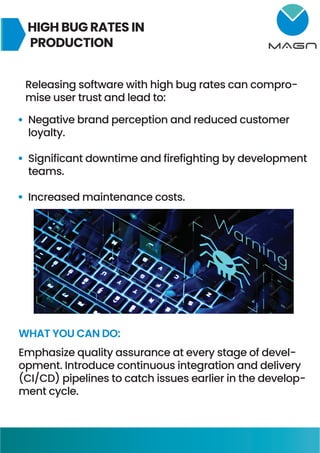
HIGH BUG RATES IN
PRODUCTION
Releasing software with high bug rates can compro-
mise user trust and lead to:
Negative brand perception and reduced customer
loyalty.
Significant downtime and firefighting by development
teams.
Increased maintenance costs.
WHAT YOU CAN DO:
Emphasize quality assurance at every stage of devel-
opment. Introduce continuous integration and delivery
(CI/CD) pipelines to catch issues earlier in the develop-
ment cycle.
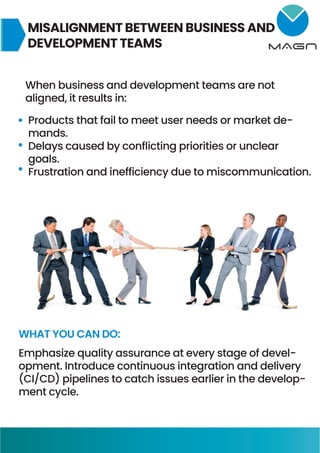
MISALIGNMENT BETWEEN BUSINESS AND
DEVELOPMENT TEAMS
When business and development teams are not
aligned, it results in:
Products that fail to meet user needs or market de-
mands.
Delays caused by conflicting priorities or unclear
goals.
Frustration and inefficiency due to miscommunication.
WHAT YOU CAN DO:
Emphasize quality assurance at every stage of devel-
opment. Introduce continuous integration and delivery
(CI/CD) pipelines to catch issues earlier in the develop-
ment cycle.
LOW ADOPTION OF DEVOPS
PRACTICES
Without DevOps practices, teams face:
Slower release cycles due to
manual processes.
Increased likelihood of errors
during deployment.
Inefficiency in collaboration
between development and
operations.
WHAT YOU CAN DO:
Adopt automated testing frameworks to quickly identi-
fy and resolve issues. Set up clear testing stages (unit,
integration, regression) and ensure robust test cover-
age to prevent bugs from slipping through the cracks.
LACK OF CODE QUALITY
STANDARDS
Without clear code quality standards, teams
experience:
Difficulty maintaining and
scaling the codebase.
Increased likelihood of intro-
ducing bugs.
Reduced productivity due to
inconsistent practices.
WHAT YOU CAN DO:
Introduce coding guidelines and perform regular code
reviews. Use tools like linters and static code analysis to
enforce standards and maintain a clean, scalable
codebase.
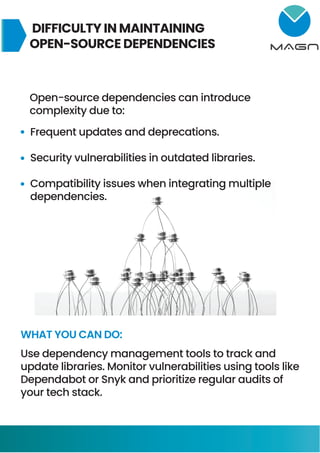
DIFFICULTY IN MAINTAINING
OPEN-SOURCE DEPENDENCIES
Frequent updates and deprecations.
Security vulnerabilities in outdated libraries.
Compatibility issues when integrating multiple
dependencies.
WHAT YOU CAN DO:
Use dependency management tools to track and
update libraries. Monitor vulnerabilities using tools like
Dependabot or Snyk and prioritize regular audits of
your tech stack.
Open-source dependencies can introduce
complexity due to:
TACKLING THESE CHALLENGES FOR
SUCCESSFUL PROJECT DELIVERY!
Achieving success in software development requires
addressing these challenges head-on. With the right
strategies, tools, and expertise, you can streamline
your processes, improve collaboration, and deliver
high-quality products on time.
CONTACT US
Website
www.magintel.com | www.magintel.com.au

CHALLENGES IN SOFTWARE DEVELOPMENT PROJECTS

  • 1.
    CHALLENGESINSOFTWAREDEVELOPMENT PROJECTSKEYISSUESIMPACTINGTIMELINES ANDQUALITY Software development projectsoften face numerous challenges that disrupt timelines, hinder quality, and inflate costs. This eBook highlights some of the most common issues faced by business owners and teams and provides insights into how these challeng- es can be mitigated.
  • 2.
    POOR REQUIREMENTS GATHERING ANDDOCUMENTATION Incomplete or unclear requirements are among the top reasons for project delays. When requirements are inadequately documented, teams struggle to understand project goals, leading to: Misaligned expectations between stakeholders. Increased rework due to gaps in understanding. Time wasted clarifying details mid-development. WHAT YOU CAN DO: A well-documented requirement serves as a blueprint. Invest time in workshops with stakeholders to capture comprehensive and unambiguous requirements. Regularly update documentation as project goals evolve.
  • 3.
    SCOPE CREEP IN DEVELOPMENTPROJECTS Scope creep occurs when additional features and changes are introduced without proper assessment of their impact. This can lead to: Extended timelines and ballooning budgets. Distracted teams losing sight of original project goals. Reduced morale due to constant shifts in priorities. WHAT YOU CAN DO: Establish a strong change management process. Use project management tools to track agreed-upon fea- tures and timelines, and assess the implications of new requests before approval.
  • 4.
    INEFFICIENT TESTING PROCESSES A lackof streamlined testing can lead to significant delays and overlooked bugs, resulting in: Poor user experience and product dissatisfaction . Unanticipated costs due to fixing defects in later stages. Frequent rollbacks in production environments. WHAT YOU CAN DO: Adopt automated testing frameworks to quickly identi- fy and resolve issues. Set up clear testing stages (unit, integration, regression) and ensure robust test cover- age to prevent bugs from slipping through the cracks.
  • 5.
    HIGH BUG RATESIN PRODUCTION Releasing software with high bug rates can compro- mise user trust and lead to: Negative brand perception and reduced customer loyalty. Significant downtime and firefighting by development teams. Increased maintenance costs. WHAT YOU CAN DO: Emphasize quality assurance at every stage of devel- opment. Introduce continuous integration and delivery (CI/CD) pipelines to catch issues earlier in the develop- ment cycle.
  • 6.
    MISALIGNMENT BETWEEN BUSINESSAND DEVELOPMENT TEAMS When business and development teams are not aligned, it results in: Products that fail to meet user needs or market de- mands. Delays caused by conflicting priorities or unclear goals. Frustration and inefficiency due to miscommunication. WHAT YOU CAN DO: Emphasize quality assurance at every stage of devel- opment. Introduce continuous integration and delivery (CI/CD) pipelines to catch issues earlier in the develop- ment cycle.
  • 7.
    LOW ADOPTION OFDEVOPS PRACTICES Without DevOps practices, teams face: Slower release cycles due to manual processes. Increased likelihood of errors during deployment. Inefficiency in collaboration between development and operations. WHAT YOU CAN DO: Adopt automated testing frameworks to quickly identi- fy and resolve issues. Set up clear testing stages (unit, integration, regression) and ensure robust test cover- age to prevent bugs from slipping through the cracks.
  • 8.
    LACK OF CODEQUALITY STANDARDS Without clear code quality standards, teams experience: Difficulty maintaining and scaling the codebase. Increased likelihood of intro- ducing bugs. Reduced productivity due to inconsistent practices. WHAT YOU CAN DO: Introduce coding guidelines and perform regular code reviews. Use tools like linters and static code analysis to enforce standards and maintain a clean, scalable codebase.
  • 9.
    DIFFICULTY IN MAINTAINING OPEN-SOURCEDEPENDENCIES Frequent updates and deprecations. Security vulnerabilities in outdated libraries. Compatibility issues when integrating multiple dependencies. WHAT YOU CAN DO: Use dependency management tools to track and update libraries. Monitor vulnerabilities using tools like Dependabot or Snyk and prioritize regular audits of your tech stack. Open-source dependencies can introduce complexity due to:
  • 10.
    TACKLING THESE CHALLENGESFOR SUCCESSFUL PROJECT DELIVERY! Achieving success in software development requires addressing these challenges head-on. With the right strategies, tools, and expertise, you can streamline your processes, improve collaboration, and deliver high-quality products on time. CONTACT US Website www.magintel.com | www.magintel.com.au