Challenges in HIV prevention
Presented BY:- Tashfeen Ahmad
ADAM UNIVERSITY SCHOOL OF MEDICINE
8th semester
Content
• Introduction
• Context body
• Conclusion
• References
Introduction
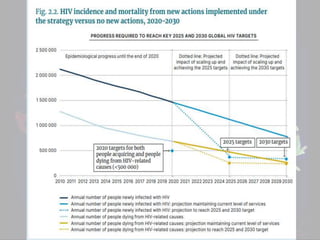
 June 1981 first Case of AIDS.
 past 40 years, 77.3 million HIV
infections
 40.1 million [33.6–48.6 million]
Deaths
 In 2017:-
 < 1 million died of AIDS-related
causes
 about 1.8 million acquired.
 In 2020 :-
 estimated 1.5 million (UI 1.0 to 2.0
million) people acquired HIV
 people living with HIV globally to
37.7 million (UI 30.2 to 45.1 million
Currently, for every two people who
go on treatment for HIV and AIDS,
five People become infected.
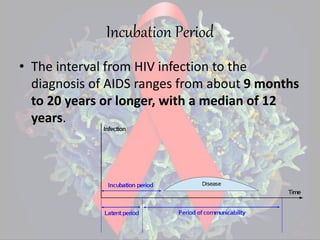
Incubation Period
• The interval from HIV infection to the
diagnosis of AIDS ranges from about 9 months
to 20 years or longer, with a median of 12
years.
Failure to implement the strategy
Diagnosis:- 87% in
the Netherlands to 11% in
Yemen
Treatment coverage:- ranged
from 71% in Switzerland to 3%
in Afghanistan
Viral suppression:- 68% in
Switzerland and 7% in China.
Awareness of getting infection
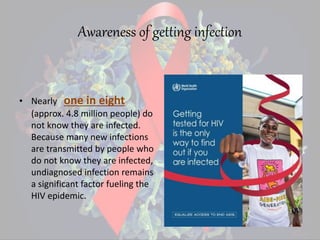
• Nearly one in eight
(approx. 4.8 million people) do
not know they are infected.
Because many new infections
are transmitted by people who
do not know they are infected,
undiagnosed infection remains
a significant factor fueling the
HIV epidemic.
Fear for Testing
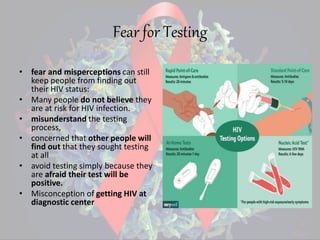
• fear and misperceptions can still
keep people from finding out
their HIV status:
• Many people do not believe they
are at risk for HIV infection.
• misunderstand the testing
process,
• concerned that other people will
find out that they sought testing
at all
• avoid testing simply because they
are afraid their test will be
positive.
• Misconception of getting HIV at
diagnostic center
Not Receiving Ongoing Treatment
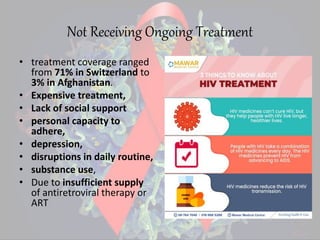
• treatment coverage ranged
from 71% in Switzerland to
3% in Afghanistan.
• Expensive treatment,
• Lack of social support
• personal capacity to
adhere,
• depression,
• disruptions in daily routine,
• substance use,
• Due to insufficient supply
of antiretroviral therapy or
ART
Low socioeconomic status
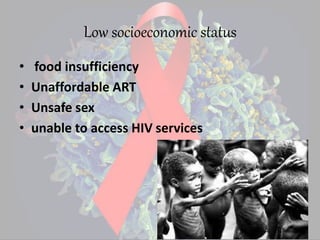
• food insufficiency
• Unaffordable ART
• Unsafe sex
• unable to access HIV services
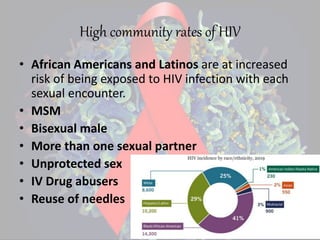
High community rates of HIV
• African Americans and Latinos are at increased
risk of being exposed to HIV infection with each
sexual encounter.
• MSM
• Bisexual male
• More than one sexual partner
• Unprotected sex
• IV Drug abusers
• Reuse of needles
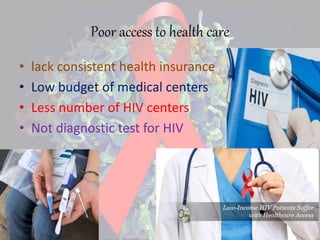
Poor access to health care
• lack consistent health insurance
• Low budget of medical centers
• Less number of HIV centers
• Not diagnostic test for HIV
Limited Resources for HIV Prevention
• Inadequate funds
• Less volunteers for spreading awareness
• Lack of importance from govt. in many countries
• Lack of diagnostic kits
• Insufficient AIDS center
• Insufficient production of contraceptive items
• Lack of injecting materials
• High prices of treatment
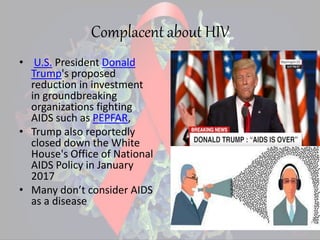
Complacent about HIV
• U.S. President Donald
Trump's proposed
reduction in investment
in groundbreaking
organizations fighting
AIDS such as PEPFAR,
• Trump also reportedly
closed down the White
House's Office of National
AIDS Policy in January
2017
• Many don’t consider AIDS
as a disease
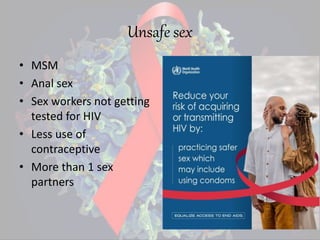
Unsafe sex
• MSM
• Anal sex
• Sex workers not getting
tested for HIV
• Less use of
contraceptive
• More than 1 sex
partners
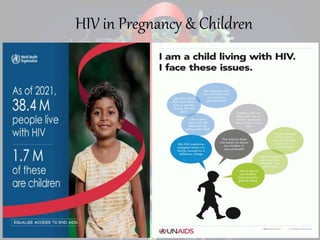
HIV in Pregnancy & Children
Conclusion
• First and foremost is failure to implement of the
strategy so we need to focus on the new
methods to achieve goals.
• Govt. should consider HIV/AIDS a major
problem.
• Spread awareness so more and more people get
to know about HIV/AIDS and its complications.
• Then we need to raise funds for HIV/AIDS
programs and centers to control spread and treat
infected.
• Scaling up production of preventive tools.
References
• Barriers and facilitators of access to HIV prevention, care, and treatment services among people living with HIV in Kerman,
Iran: a qualitative study Zahra Jaafari1, Willi McFarland2, Sana Eybpoosh3, Seyed Vahid Ahmadi Tabatabaei4, Mehdi Shafiei
Bafti5, Ebrahim Ranjbar6 and Hamid Sharifi1*
• World health statistics 2020: monitoring health for the SDGs, sustainable development goals. Geneva: World Health
Organization; 2020. Licence: CC BY-NC-SA 3.0 IGO.
• World health statistics 2022: monitoring health for the SDGs, sustainable development goals. Geneva: World Health
Organization; 2022. Licence: CC BY-NC-SA 3.0 IGO.
• World health statistics 2019: monitoring health for the SDGs, sustainable development goals. Geneva: World Health
Organization; 2019. Licence: CC BY-NC-SA 3.0 IGO.
• n Global health sector strategies on, respectively, HIV, viral hepatitis and sexually transmitted infections for the period 2022-
2030. Geneva: World Health Organization; 2022. Licence: CC BY-NC-SA 3.0 IGO.
• Lucie Seyler, BMBCh, DTM&H,Department of Internal Medicine andInfectious Diseases, HIV ReferenceCenter, UZ Brussel,
Laarbeeklaan 101,1090 Brussels, Belgium,phone: +32 2 477 6001,email: lucie.seyler@uzbrussel.beReceived: October 15,
2018.Accepted: October 16, 2018.Published online: October 31, 2018.Conflict of interest: LS, PL, andSDA have participated
in advisoryboards for Gilead, Janssens, MSD,and ViiV Healthcare.Pol Arch Intern Med. 2018;128 (10): 609-
616doi:10.20452/pamw.4357Copyright by Medycyna Praktyczna,Kraków 2018
• Jaafari et al. BMC Health Services Research (2022) 22:1097 https://doi.org/10.1186/s12913-022-08483-4
• Prof Michael H Merson,Duke Global Health Institute,Box 90519, Duke University,Durham, NC 27708, USA
• https://doi.org/10.1016/j.cct.2021.106402
• https://www.hsph.harvard.edu/news/features/progress-challenges-in-tackling-pediatric-hivaids/
QUESTIONS?

Challenges in HIV prevention.pptx

  • 1.
    Challenges in HIVprevention Presented BY:- Tashfeen Ahmad ADAM UNIVERSITY SCHOOL OF MEDICINE 8th semester
  • 2.
    Content • Introduction • Contextbody • Conclusion • References
  • 3.
    Introduction  June 1981first Case of AIDS.  past 40 years, 77.3 million HIV infections  40.1 million [33.6–48.6 million] Deaths  In 2017:-  < 1 million died of AIDS-related causes  about 1.8 million acquired.  In 2020 :-  estimated 1.5 million (UI 1.0 to 2.0 million) people acquired HIV  people living with HIV globally to 37.7 million (UI 30.2 to 45.1 million Currently, for every two people who go on treatment for HIV and AIDS, five People become infected.
  • 5.
    Incubation Period • Theinterval from HIV infection to the diagnosis of AIDS ranges from about 9 months to 20 years or longer, with a median of 12 years.
  • 6.
    Failure to implementthe strategy Diagnosis:- 87% in the Netherlands to 11% in Yemen Treatment coverage:- ranged from 71% in Switzerland to 3% in Afghanistan Viral suppression:- 68% in Switzerland and 7% in China.
  • 7.
    Awareness of gettinginfection • Nearly one in eight (approx. 4.8 million people) do not know they are infected. Because many new infections are transmitted by people who do not know they are infected, undiagnosed infection remains a significant factor fueling the HIV epidemic.
  • 8.
    Fear for Testing •fear and misperceptions can still keep people from finding out their HIV status: • Many people do not believe they are at risk for HIV infection. • misunderstand the testing process, • concerned that other people will find out that they sought testing at all • avoid testing simply because they are afraid their test will be positive. • Misconception of getting HIV at diagnostic center
  • 9.
    Not Receiving OngoingTreatment • treatment coverage ranged from 71% in Switzerland to 3% in Afghanistan. • Expensive treatment, • Lack of social support • personal capacity to adhere, • depression, • disruptions in daily routine, • substance use, • Due to insufficient supply of antiretroviral therapy or ART
  • 10.
    Low socioeconomic status •food insufficiency • Unaffordable ART • Unsafe sex • unable to access HIV services
  • 11.
    High community ratesof HIV • African Americans and Latinos are at increased risk of being exposed to HIV infection with each sexual encounter. • MSM • Bisexual male • More than one sexual partner • Unprotected sex • IV Drug abusers • Reuse of needles
  • 12.
    Poor access tohealth care • lack consistent health insurance • Low budget of medical centers • Less number of HIV centers • Not diagnostic test for HIV
  • 13.
    Limited Resources forHIV Prevention • Inadequate funds • Less volunteers for spreading awareness • Lack of importance from govt. in many countries • Lack of diagnostic kits • Insufficient AIDS center • Insufficient production of contraceptive items • Lack of injecting materials • High prices of treatment
  • 14.
    Complacent about HIV •U.S. President Donald Trump's proposed reduction in investment in groundbreaking organizations fighting AIDS such as PEPFAR, • Trump also reportedly closed down the White House's Office of National AIDS Policy in January 2017 • Many don’t consider AIDS as a disease
  • 15.
    Unsafe sex • MSM •Anal sex • Sex workers not getting tested for HIV • Less use of contraceptive • More than 1 sex partners
  • 16.
    HIV in Pregnancy& Children
  • 17.
    Conclusion • First andforemost is failure to implement of the strategy so we need to focus on the new methods to achieve goals. • Govt. should consider HIV/AIDS a major problem. • Spread awareness so more and more people get to know about HIV/AIDS and its complications. • Then we need to raise funds for HIV/AIDS programs and centers to control spread and treat infected. • Scaling up production of preventive tools.
  • 18.
    References • Barriers andfacilitators of access to HIV prevention, care, and treatment services among people living with HIV in Kerman, Iran: a qualitative study Zahra Jaafari1, Willi McFarland2, Sana Eybpoosh3, Seyed Vahid Ahmadi Tabatabaei4, Mehdi Shafiei Bafti5, Ebrahim Ranjbar6 and Hamid Sharifi1* • World health statistics 2020: monitoring health for the SDGs, sustainable development goals. Geneva: World Health Organization; 2020. Licence: CC BY-NC-SA 3.0 IGO. • World health statistics 2022: monitoring health for the SDGs, sustainable development goals. Geneva: World Health Organization; 2022. Licence: CC BY-NC-SA 3.0 IGO. • World health statistics 2019: monitoring health for the SDGs, sustainable development goals. Geneva: World Health Organization; 2019. Licence: CC BY-NC-SA 3.0 IGO. • n Global health sector strategies on, respectively, HIV, viral hepatitis and sexually transmitted infections for the period 2022- 2030. Geneva: World Health Organization; 2022. Licence: CC BY-NC-SA 3.0 IGO. • Lucie Seyler, BMBCh, DTM&H,Department of Internal Medicine andInfectious Diseases, HIV ReferenceCenter, UZ Brussel, Laarbeeklaan 101,1090 Brussels, Belgium,phone: +32 2 477 6001,email: lucie.seyler@uzbrussel.beReceived: October 15, 2018.Accepted: October 16, 2018.Published online: October 31, 2018.Conflict of interest: LS, PL, andSDA have participated in advisoryboards for Gilead, Janssens, MSD,and ViiV Healthcare.Pol Arch Intern Med. 2018;128 (10): 609- 616doi:10.20452/pamw.4357Copyright by Medycyna Praktyczna,Kraków 2018 • Jaafari et al. BMC Health Services Research (2022) 22:1097 https://doi.org/10.1186/s12913-022-08483-4 • Prof Michael H Merson,Duke Global Health Institute,Box 90519, Duke University,Durham, NC 27708, USA • https://doi.org/10.1016/j.cct.2021.106402 • https://www.hsph.harvard.edu/news/features/progress-challenges-in-tackling-pediatric-hivaids/
  • 20.