PROJECT STATUS: FINAL SUBMISSION


   PROJECT TITLE: REMAND CHILDREN
              RESTORATION PROJECT
  TEAM LEADER: MS.TESSY SHOSOWEN
 IMPACTED UNDERPRIVILEGED GROUP
                         OF YOUTH:
                                 I.
REMANDED, ABANDONED, DISABLED, A
                      NDHOMELESS
                                NUMBER OF PEOPLE IN THE TEAM: 2
           VOLUNTEERING HOURS SPENT:  7 HOURS/DAY, 5DAYS/WEEK
                          NUMBER OF YOUTH/PEOPLE IMPACTED: 700
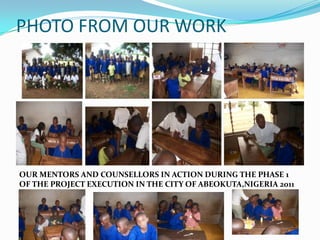
PHOTO FROM OUR WORK


OUR MENTORS AND COUNSELLORS IN ACTION DURING THE PHASE 1
OF THE PROJECT EXECUTION IN THE CITY OF ABEOKUTA,NIGERIA 2011
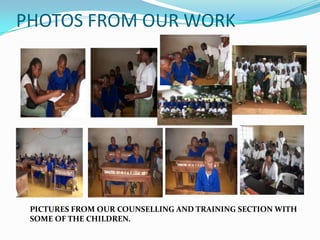
PHOTOS FROM OUR WORK


 PICTURES FROM OUR COUNSELLING AND TRAINING SECTION WITH
 SOME OF THE CHILDREN.
•What is your project/action?
   Remand homes were established by the Nigerian government, in the main cities of the country, to care
    for abandoned children, aged from three months to eight years old, as well as ”beyond parental
    control” children.
   Presently (2011), the remand homes are sometimes used as a dumping ground for children that do not
    fit anywhere else. The poor living conditions at the remand homes constitute a violation of the
    children s right to health, nutrition, education, and recreation.

   Lack of appropriate medical treatment can be seen in the children s skin rashes and sores. In some
    cases, the older children do not go to school nor do receive any education at the remand home.
   Supervision at these homes is minimal, there is no privacy and the children are often exposed to
    abuse, often kept under lock and key, forced to sleep in beds without mattresses, or with very old and
    dirty mattresses and pillows. Malnutrition manifests itself in the smaller children, showing in their
    inability to walk or sit, motor retardation, muscle atrophy, lack of teeth and problems with hair and
    skin.

   They wash their clothes, carry water, light fires of wood when kerosene is not available; they can
    spend years doing these and other tasks without having the opportunity of performing activities
    suitable for their age group.
   However, our project aim is to give unaccompanied children (mainly children from the streets, first-
    time offenders, and children who are orphaned, abandoned or have been affected by armed conflict)
    counseling, education, training and support to empower them to become self-reliant. Since 2010 we
    have been running vocational training centre and Abeokuta Remand Home and it is expected to benefit
    over 50,000 youth through psychosocial support, technical education and business skills training
    followed by apprenticeship and industrial placements, which will include
    housing, training, feeding, medication and post-vocational support. In the long run, we hope to
    guarantee employment and mitigate the youth’s susceptibility to risks related to
    poverty, marginalization and deviant behavior.
•What is the target group you are helping and why?

 Our target group are remanded, isolated, abandoned, and
  disable youths, and children,. These groups lack the
  advantages and opportunities that are enjoyed by us and others
  in our world. They are often deprived of rights and opportunities
  in life so many of them feel frustrated and end up committing
  suicide. So we see this program as an opportunity to bring
  sanity into their lives.
•What did you want to achieve and what are the actual results regarding people engaged in the
  action, volunteering hours invested by the team for project development
  and implementation, and how many people have been impacted?
 The campaign is working to build a better bottom line for youths, and children in the remand home
   across Nigeria to transform their lives via skill building, counseling, education, training and support
   to empower them to become self-reliant. We are about:
   • Building community demand for results, by mobilizing residents and stakeholders around an equity
   agenda, creating opportunity for youths and children and transforming neighborhoods. The
   campaign is about higher aspirations, and about providing both the expectation of a better future
   and the connections and collective power to pursue it.
   • Creating new connections to systems and organizations by creating new avenues and approaches
   for interacting with systems that otherwise pose barrier.
   • Transforming the environment to sustain the change, creating family-centered, equitable, results-
   focused systems that work for all young people.

   IMPACT
   The project began in 2010 as a Nigerian youth-led project under Rainbow Gate Foundation Nigeria
    that provides counseling, education, training and support to empower youth and children in remand
    homes to become self-reliant Since our inception, we have successfully trained and impacted over
    700 youths and children. Over 100 of our students have started numerous social enterprises in
    Nigeria. Our Students have directly impacted over 2,000 depressed communities and created tens of
    thousands of naira in value for their community, and have already started to replicate their innovative
    solutions in Nigeria.
   Results
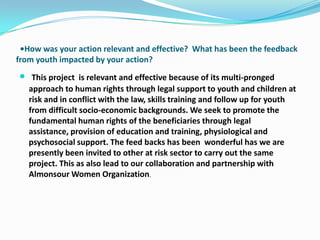
   Over 700 youths and children, led by 27 Mentors, at 24 diverse partner homes in six geographic
    clusters across Nigeria are currently participating under this project. Even though the curriculum
    only launched on March 4 of 2010, already Scholars at 12 of the 24 partner homes have started to
    create social enterprises in their communities ranging from a vegetable selling business to increase
    nutrition among the student body to a social enterprise that trains widows in the community to make
    jewelry as a source of income. Furthermore, over 300 children are now gradually been transform and
    engaged in educational activities across the partner homes
•How was your action relevant and effective? What has been the feedback
from youth impacted by your action?

 This project is relevant and effective because of its multi-pronged
   approach to human rights through legal support to youth and children at
   risk and in conflict with the law, skills training and follow up for youth
   from difficult socio-economic backgrounds. We seek to promote the
   fundamental human rights of the beneficiaries through legal
   assistance, provision of education and training, physiological and
   psychosocial support. The feed backs has been wonderful has we are
   presently been invited to other at risk sector to carry out the same
   project. This as also lead to our collaboration and partnership with
   Almonsour Women Organization.
•Was your action/project innovative? Are there any similar projects/actions already
on local or global level? Please describe.
 Rather than building a single highly powerful Remand home or developing a
  leadership or social entrepreneurship program outside of the formal education
  system we works within existing Remand homes. we take the most effective
  components (namely the curriculum, mentoring, and empowerment) of top social
  organization and programs around the world and brings them to existing Remand
    homes across Nigeria. Within these homes we are able to accomplish a similar
    mission to a leadership academy or social entrepreneurship program; however, we
    incorporate the creation of a social enterprise, social change curriculum, and long-
    term mentoring into the education system itself. Our approach allows us to:
   1. Reach a much larger number of abandoned children and youths; and
   2. build the capacity of the home system from within.
   Unlike other organizations, our program introduces a practical component of
    student-run social enterprises. The experience Scholars gain with social
    entrepreneurship equips the next generation to identify opportunities to address
    community challenges in effective, innovative, and sustainable ways.
   In the region were we serve, we are presently the only one operating such project.
    Globally there are other organizations doing the same. However, our methodology
    has been found effective in this region.
•Is there potential to go with this project/action further? Could you bring this
idea on regional or even global level?

 There is a great opportunity to take this project globally. However, In order to
  grow , we need funds and staff to work with the project ,partners to support
  expanded training, technical assistance and program support for effective
  sustainability efforts implemented through this program. We need to strengthen
  value for Network volunteers, and create conditions for broad based financial
  support.
TEAM MEMBERS
 MR MICHAEL IYANRO
 MS TESSY SHOSOWEN

[Challenge:Future] REMAND CHILDREN RESTORATION PROJECT

  • 1.
    PROJECT STATUS: FINALSUBMISSION PROJECT TITLE: REMAND CHILDREN RESTORATION PROJECT TEAM LEADER: MS.TESSY SHOSOWEN IMPACTED UNDERPRIVILEGED GROUP OF YOUTH: I. REMANDED, ABANDONED, DISABLED, A NDHOMELESS NUMBER OF PEOPLE IN THE TEAM: 2 VOLUNTEERING HOURS SPENT: 7 HOURS/DAY, 5DAYS/WEEK NUMBER OF YOUTH/PEOPLE IMPACTED: 700
  • 2.
    PHOTO FROM OURWORK OUR MENTORS AND COUNSELLORS IN ACTION DURING THE PHASE 1 OF THE PROJECT EXECUTION IN THE CITY OF ABEOKUTA,NIGERIA 2011
  • 3.
    PHOTOS FROM OURWORK PICTURES FROM OUR COUNSELLING AND TRAINING SECTION WITH SOME OF THE CHILDREN.
  • 4.
    •What is yourproject/action?  Remand homes were established by the Nigerian government, in the main cities of the country, to care for abandoned children, aged from three months to eight years old, as well as ”beyond parental control” children.  Presently (2011), the remand homes are sometimes used as a dumping ground for children that do not fit anywhere else. The poor living conditions at the remand homes constitute a violation of the children s right to health, nutrition, education, and recreation.  Lack of appropriate medical treatment can be seen in the children s skin rashes and sores. In some cases, the older children do not go to school nor do receive any education at the remand home.  Supervision at these homes is minimal, there is no privacy and the children are often exposed to abuse, often kept under lock and key, forced to sleep in beds without mattresses, or with very old and dirty mattresses and pillows. Malnutrition manifests itself in the smaller children, showing in their inability to walk or sit, motor retardation, muscle atrophy, lack of teeth and problems with hair and skin.  They wash their clothes, carry water, light fires of wood when kerosene is not available; they can spend years doing these and other tasks without having the opportunity of performing activities suitable for their age group.  However, our project aim is to give unaccompanied children (mainly children from the streets, first- time offenders, and children who are orphaned, abandoned or have been affected by armed conflict) counseling, education, training and support to empower them to become self-reliant. Since 2010 we have been running vocational training centre and Abeokuta Remand Home and it is expected to benefit over 50,000 youth through psychosocial support, technical education and business skills training followed by apprenticeship and industrial placements, which will include housing, training, feeding, medication and post-vocational support. In the long run, we hope to guarantee employment and mitigate the youth’s susceptibility to risks related to poverty, marginalization and deviant behavior.
  • 5.
    •What is thetarget group you are helping and why?  Our target group are remanded, isolated, abandoned, and disable youths, and children,. These groups lack the advantages and opportunities that are enjoyed by us and others in our world. They are often deprived of rights and opportunities in life so many of them feel frustrated and end up committing suicide. So we see this program as an opportunity to bring sanity into their lives.
  • 6.
    •What did youwant to achieve and what are the actual results regarding people engaged in the action, volunteering hours invested by the team for project development and implementation, and how many people have been impacted?  The campaign is working to build a better bottom line for youths, and children in the remand home across Nigeria to transform their lives via skill building, counseling, education, training and support to empower them to become self-reliant. We are about: • Building community demand for results, by mobilizing residents and stakeholders around an equity agenda, creating opportunity for youths and children and transforming neighborhoods. The campaign is about higher aspirations, and about providing both the expectation of a better future and the connections and collective power to pursue it. • Creating new connections to systems and organizations by creating new avenues and approaches for interacting with systems that otherwise pose barrier. • Transforming the environment to sustain the change, creating family-centered, equitable, results- focused systems that work for all young people.  IMPACT  The project began in 2010 as a Nigerian youth-led project under Rainbow Gate Foundation Nigeria that provides counseling, education, training and support to empower youth and children in remand homes to become self-reliant Since our inception, we have successfully trained and impacted over 700 youths and children. Over 100 of our students have started numerous social enterprises in Nigeria. Our Students have directly impacted over 2,000 depressed communities and created tens of thousands of naira in value for their community, and have already started to replicate their innovative solutions in Nigeria.  Results  Over 700 youths and children, led by 27 Mentors, at 24 diverse partner homes in six geographic clusters across Nigeria are currently participating under this project. Even though the curriculum only launched on March 4 of 2010, already Scholars at 12 of the 24 partner homes have started to create social enterprises in their communities ranging from a vegetable selling business to increase nutrition among the student body to a social enterprise that trains widows in the community to make jewelry as a source of income. Furthermore, over 300 children are now gradually been transform and engaged in educational activities across the partner homes
  • 7.
    •How was youraction relevant and effective? What has been the feedback from youth impacted by your action?  This project is relevant and effective because of its multi-pronged approach to human rights through legal support to youth and children at risk and in conflict with the law, skills training and follow up for youth from difficult socio-economic backgrounds. We seek to promote the fundamental human rights of the beneficiaries through legal assistance, provision of education and training, physiological and psychosocial support. The feed backs has been wonderful has we are presently been invited to other at risk sector to carry out the same project. This as also lead to our collaboration and partnership with Almonsour Women Organization.
  • 8.
    •Was your action/projectinnovative? Are there any similar projects/actions already on local or global level? Please describe.  Rather than building a single highly powerful Remand home or developing a leadership or social entrepreneurship program outside of the formal education system we works within existing Remand homes. we take the most effective components (namely the curriculum, mentoring, and empowerment) of top social organization and programs around the world and brings them to existing Remand homes across Nigeria. Within these homes we are able to accomplish a similar mission to a leadership academy or social entrepreneurship program; however, we incorporate the creation of a social enterprise, social change curriculum, and long- term mentoring into the education system itself. Our approach allows us to:  1. Reach a much larger number of abandoned children and youths; and  2. build the capacity of the home system from within.  Unlike other organizations, our program introduces a practical component of student-run social enterprises. The experience Scholars gain with social entrepreneurship equips the next generation to identify opportunities to address community challenges in effective, innovative, and sustainable ways.  In the region were we serve, we are presently the only one operating such project. Globally there are other organizations doing the same. However, our methodology has been found effective in this region.
  • 9.
    •Is there potentialto go with this project/action further? Could you bring this idea on regional or even global level?  There is a great opportunity to take this project globally. However, In order to grow , we need funds and staff to work with the project ,partners to support expanded training, technical assistance and program support for effective sustainability efforts implemented through this program. We need to strengthen value for Network volunteers, and create conditions for broad based financial support.
  • 10.
    TEAM MEMBERS  MRMICHAEL IYANRO  MS TESSY SHOSOWEN