Zero Waste World
An opportunity worth 1 trillion euros in search for new solutions
Sotiris Makrygiannis
Entrepreneur, Inventor, Philosopher
Disclaimer
● This is not a scientific analysis of the subject of food waste
○ is a summary of a personal conclusions on the questions:
■ Can I reduce my food waste?
■ How we will feed 10 billion people in the next 50 years?
■ What circular economy solutions for food waste are emerging?
● Data for this presentation from free sources such google
○ Reference articles as links in the presentation
● Intention for publishing is to stimulate, make you aware of a problem so we could:
○ Initiate research in behavioural, cultural aspects related to new food distribution models
○ To raise awareness to every level that we must aim for a zero food waste society
○ To find Co-Founders that want to monetize this 1 trillion euros business area
● Transfer my worry that we need urgently to solve this critical area now
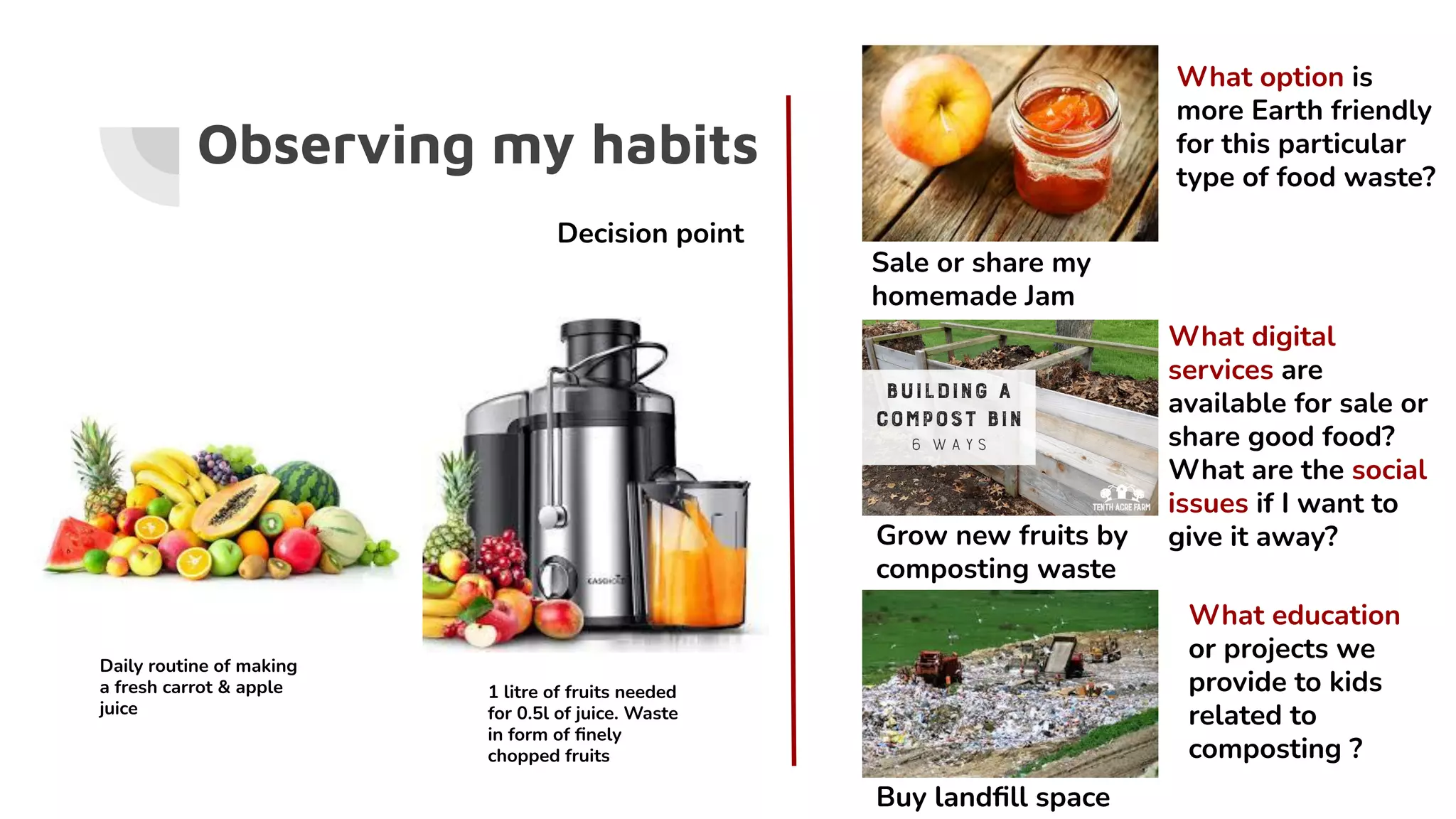
Observing my habits
Buy landfill space
Grow new fruits by
composting waste
Sale or share my
homemade Jam
What option is
more Earth friendly
for this particular
type of food waste?
Daily routine of making
a fresh carrot & apple
juice
Decision point
1 litre of fruits needed
for 0.5l of juice. Waste
in form of finely
chopped fruits
What digital
services are
available for sale or
share good food?
What are the social
issues if I want to
give it away?
What education
or projects we
provide to kids
related to
composting ?
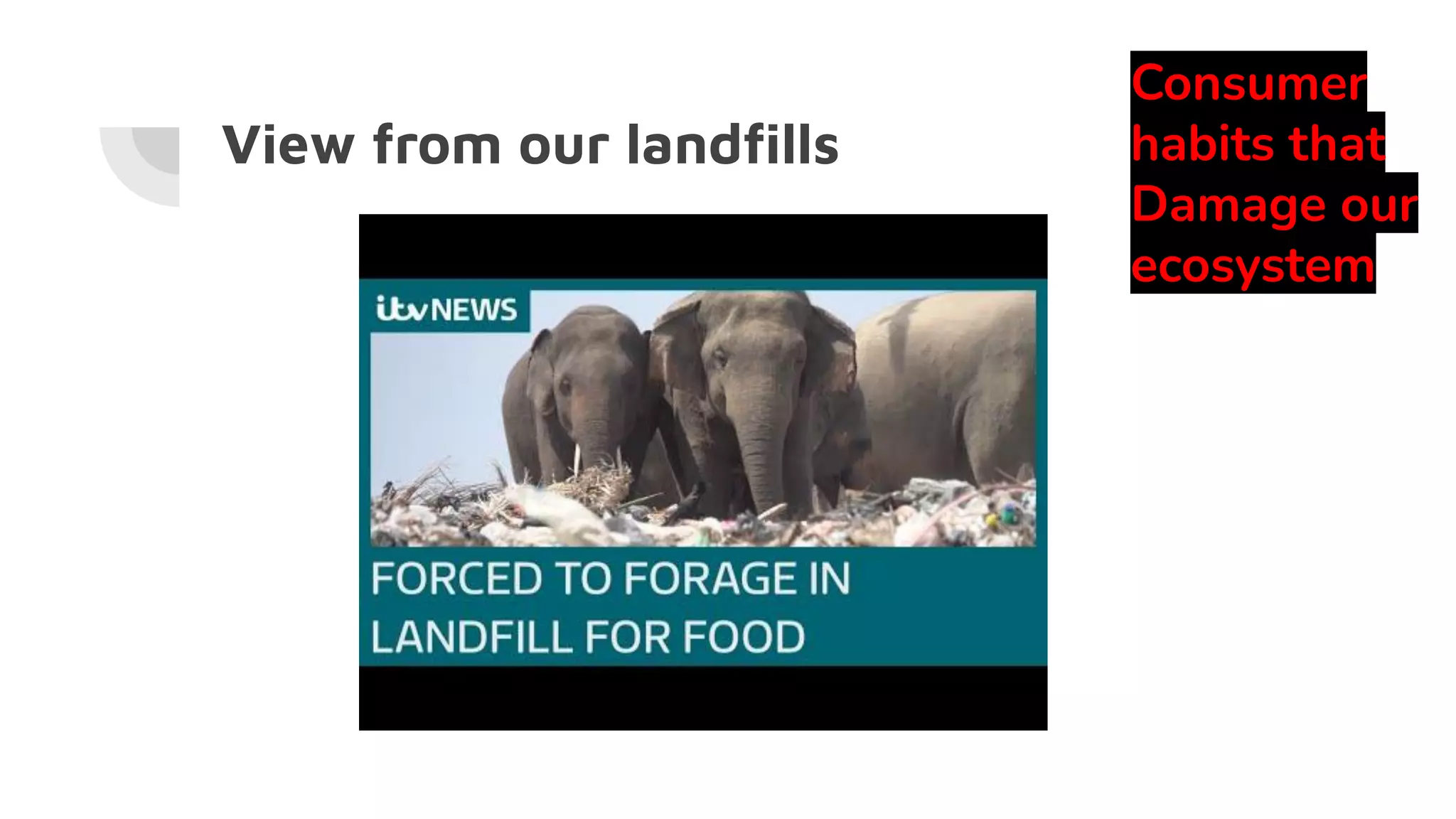
View from our landfills
Consumer
habits that
Damage our
ecosystem
Global data, yearly average for 7 billion
● Each Household produces 90 kg of food related waste
● Each Restaurant, bakery produces 90 kg of food waste
● Supermarkets, fruit shops produce 90 kg of food waste
● Farming also produce food waste in various forms
Can we calculate the outcome in 50 years?
2 billion households x 90kg waste x 50 years = insanely big
number that will come at high cost in terms of land needed for
disposal, contribute methane gas that leads to climate change.
Plus an ethical issue. Why many are still hungry, while we throw
away good eatable food?
1.9 billion without enough food
Every year we are throwing away 1.3 billion tonnes of food that can be eaten.
At same time we have 1.9 billion people close to food poverty.
Would be possible to redirect the “wasted food” to people at need? How?
Is a demand supply problem mixed with social taboos, consumer behavioural
patterns and economic policies to overcome. All issues easy to solve with
technology, awareness campaigns, education programs .
What are we
leaving behind
for the next
Generation?
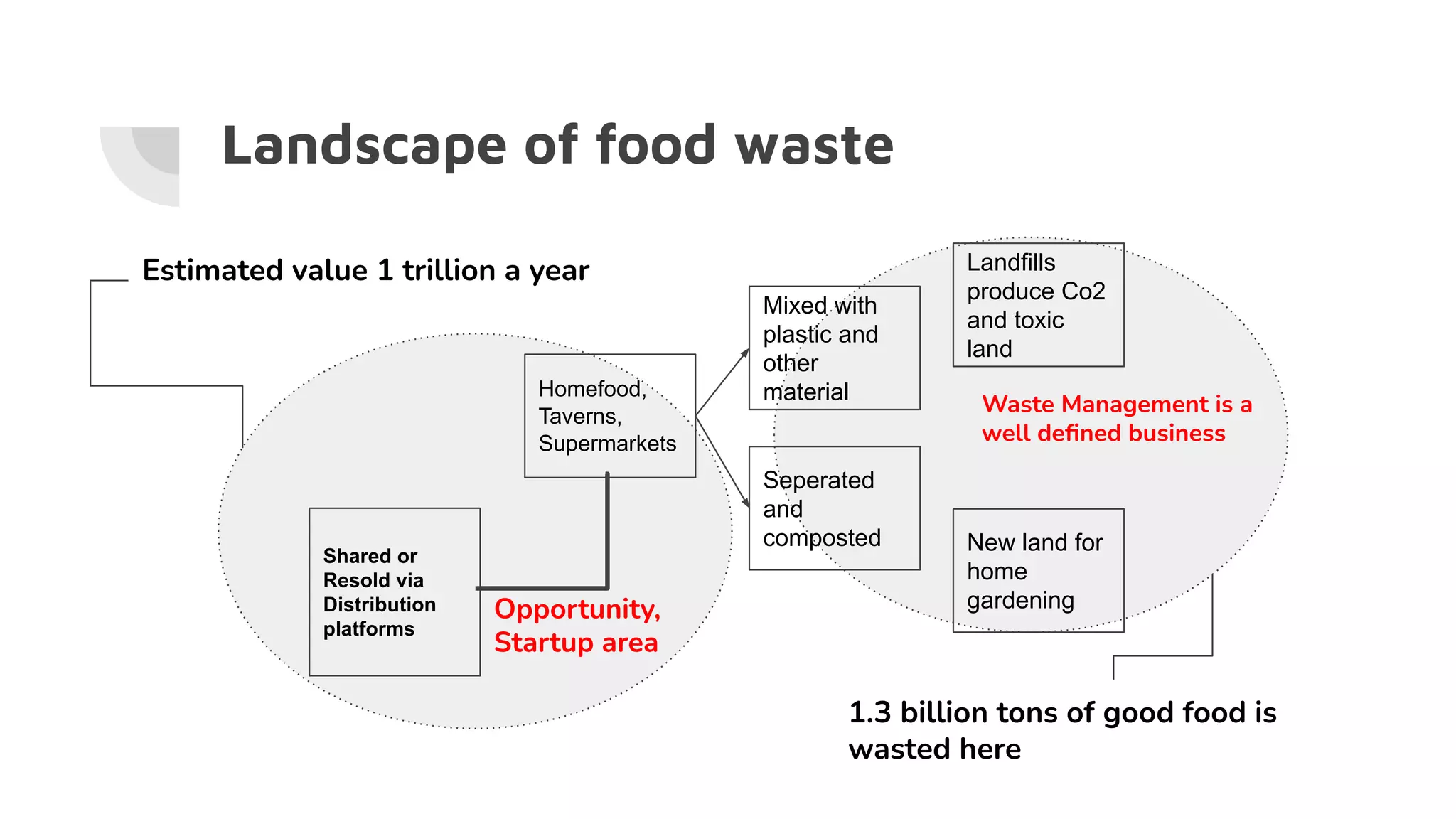
Landscape of food waste
Homefood,
Taverns,
Supermarkets
Mixed with
plastic and
other
material
Seperated
and
composted
Landfills
produce Co2
and toxic
land
New land for
home
gardening
Shared or
Resold via
Distribution
platforms
Opportunity,
Startup area
Waste Management is a
well defined business
1.3 billion tons of good food is
wasted here
Estimated value 1 trillion a year
Supermarket “best before” solution
● Platform sells food items that “best before day” is
past or about to expire
○ Food is eatable as the “best before” is a
recommendation not actual expiration day
○ “Best before” ensures a level of freshness, taste but still
eatable, with nutritional value for humans
● At heavily discounted prices and delivery at home
● Food partners make little revenue instead of writing
off product costs
● Price conscious consumers get good offers Fiksu
Hot Startup based in Finland, my reference
country for Green and Circular economy
ideas, innovation, cultural habits
Restaurant zero waste efforts
● Sells food items that they cannot use
as quality might be slight less then
what their want to offer
● They compost inside the building and
provide land to farmers
● Everything that comes inside as food, is
either used or recycled in proper way
thus zero waste in food
Run by Europeans immigrants
Helsinki, Finland top restaurant
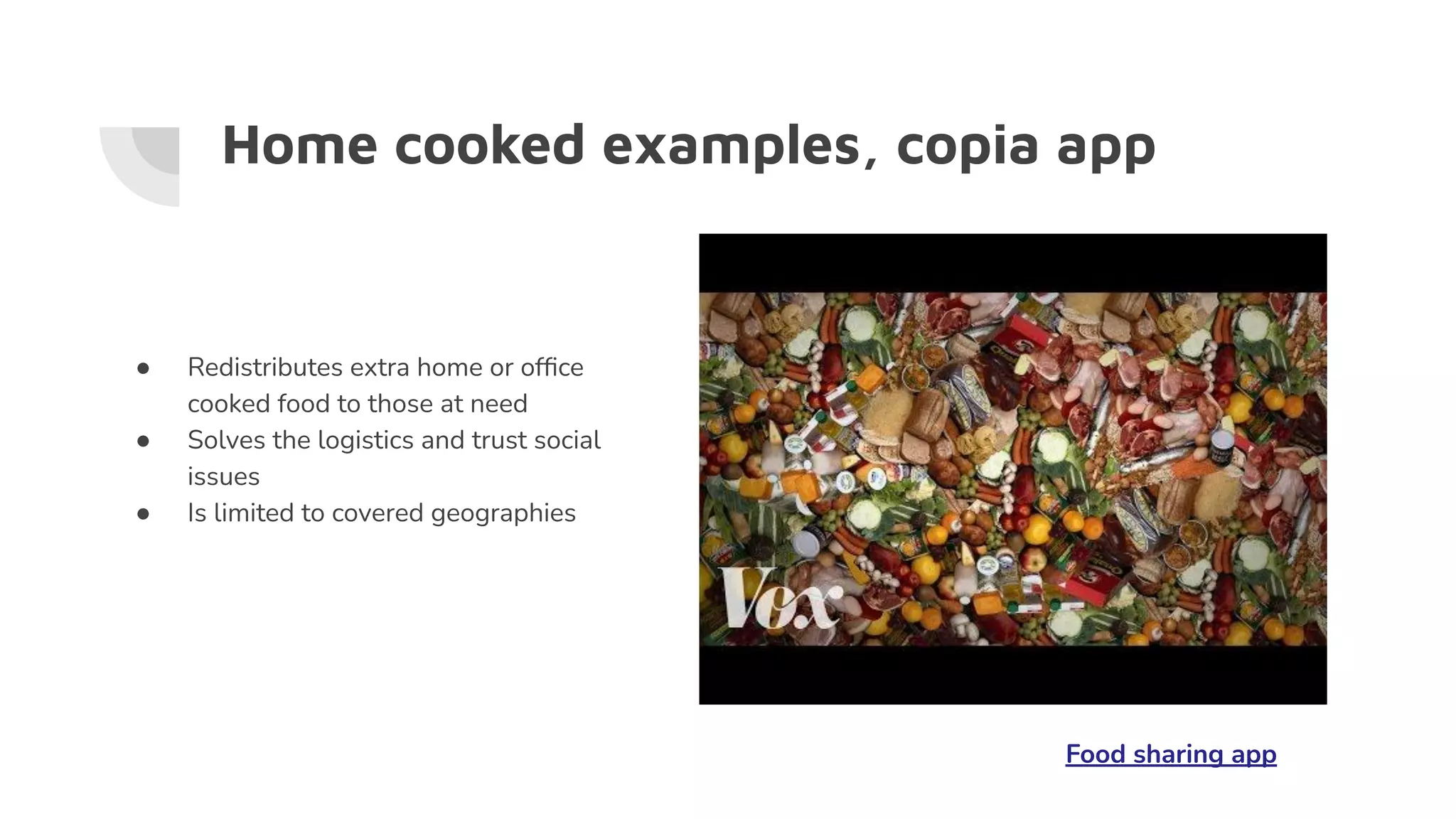
Home cooked examples, copia app
Food sharing app
● Redistributes extra home or office
cooked food to those at need
● Solves the logistics and trust social
issues
● Is limited to covered geographies
Research and innovation in farming
Finnish research institute VTT has developed a solution for producing Food packaging out of Food
Waste.
One day the Orange juice, contained in a bottle, that you buy from the supermarket could be made out of
the orange peel waste that was produced for creating your Fresh juice.
A perfect example of research that enable circular economy
Summary of observations
● No UBER like startup yet on the food waste zero market
○ In reality this problem is like UBER, item A needs to go to location B, upon request and availability of service
○ Social issues like trust over the quality needs to be solved as UBER solved the safety perception of their service
■ Finns have made successful social experiments with huge success, the restaurant day
○ Behaviour change by increased awareness that such option is available to phones, as UBER did in early phases
○ Like UBER, profiles of home chefs need to pass some standards, checks and balances must be in place
○ Like UBER disrupted the taxi business area, Restaurant owners could argue over food safety issues
● Educational curriculums should be updated with training and projects so all homes have a compost
○ Older generations should be informed and take responsibility on what they are leaving behind to their kids
○ Culinary traditions should be studied to find & share recipes that reduce waste. Example Greek spoon sweets
● Circular economy is emerging with brilliant examples such of IKEA but not strongly in food industry
○ Opportunity for company trainings, process consultants enabled by regulation, like the laws of France
● Digital services are geographically limited, start ups not able to scale up globally
○ Due to differences in supplier chains, postal services, local understanding
○ No single unified food distribution platform that enables Supermarkets, Home Cooked & Restaurants to list and sell or donate eatable food
○ WOLT or other local Food Delivery services could expand operations to cover this area as they have the delivery capability
○ Nordics are not selling well their know how, cultural habits enabled by their unique Environmental conscience
○ Opportunity for franchising of successful models by expanding with local partners.
○ Need of annual conference to bring Research, Startups, Policy makers together.
○ Worth mentioning that World Food Organization is not investing much on startup ideas and EU Horizon projects are not commercialized
● Area surely to become a new multi billion euro business as 1 trillion a year worth of food is wasted
○ World needs leaders that care about global problems and have the courage to solve them
Thank you
You have a vision how to solve the problem? I'm looking for a co founder deep in UX/UI, raising VC
funds & ambition for a global impact. Impress me with your first email
If you liked the presentation, please do share freely to increase awareness
Final thoughts : “10 billion people will need lots of food and earth resources are limited and heavily polluted.
Food quality, the taste is not as it used to be, has deteriorate due to mass production and chemicals. Is also
scary to know that humans are omnivore. Thus there is even a risk to return to cannibalistic behaviours if major
food disruptions occur locally or globally. Consequentialism philosophy is based on such cannibalistic event.
Plus the ethical question, why we let people go hungry when food is available? What food quality/quantity are
leaving for the next 100 years , to our grandchildren? Is our collective duty to give to the Next generation a
better world, so please start to be aware of the food waste and change your consumer behaviour. I believe in
our collective wisdom, If more brains are activate to think, the faster the problem will be resolved”

Zero waste wolrd

  • 1.
    Zero Waste World Anopportunity worth 1 trillion euros in search for new solutions Sotiris Makrygiannis Entrepreneur, Inventor, Philosopher
  • 2.
    Disclaimer ● This isnot a scientific analysis of the subject of food waste ○ is a summary of a personal conclusions on the questions: ■ Can I reduce my food waste? ■ How we will feed 10 billion people in the next 50 years? ■ What circular economy solutions for food waste are emerging? ● Data for this presentation from free sources such google ○ Reference articles as links in the presentation ● Intention for publishing is to stimulate, make you aware of a problem so we could: ○ Initiate research in behavioural, cultural aspects related to new food distribution models ○ To raise awareness to every level that we must aim for a zero food waste society ○ To find Co-Founders that want to monetize this 1 trillion euros business area ● Transfer my worry that we need urgently to solve this critical area now
  • 3.
    Observing my habits Buylandfill space Grow new fruits by composting waste Sale or share my homemade Jam What option is more Earth friendly for this particular type of food waste? Daily routine of making a fresh carrot & apple juice Decision point 1 litre of fruits needed for 0.5l of juice. Waste in form of finely chopped fruits What digital services are available for sale or share good food? What are the social issues if I want to give it away? What education or projects we provide to kids related to composting ?
  • 4.
    View from ourlandfills Consumer habits that Damage our ecosystem
  • 5.
    Global data, yearlyaverage for 7 billion ● Each Household produces 90 kg of food related waste ● Each Restaurant, bakery produces 90 kg of food waste ● Supermarkets, fruit shops produce 90 kg of food waste ● Farming also produce food waste in various forms Can we calculate the outcome in 50 years? 2 billion households x 90kg waste x 50 years = insanely big number that will come at high cost in terms of land needed for disposal, contribute methane gas that leads to climate change. Plus an ethical issue. Why many are still hungry, while we throw away good eatable food?
  • 6.
    1.9 billion withoutenough food Every year we are throwing away 1.3 billion tonnes of food that can be eaten. At same time we have 1.9 billion people close to food poverty. Would be possible to redirect the “wasted food” to people at need? How? Is a demand supply problem mixed with social taboos, consumer behavioural patterns and economic policies to overcome. All issues easy to solve with technology, awareness campaigns, education programs . What are we leaving behind for the next Generation?
  • 7.
    Landscape of foodwaste Homefood, Taverns, Supermarkets Mixed with plastic and other material Seperated and composted Landfills produce Co2 and toxic land New land for home gardening Shared or Resold via Distribution platforms Opportunity, Startup area Waste Management is a well defined business 1.3 billion tons of good food is wasted here Estimated value 1 trillion a year
  • 8.
    Supermarket “best before”solution ● Platform sells food items that “best before day” is past or about to expire ○ Food is eatable as the “best before” is a recommendation not actual expiration day ○ “Best before” ensures a level of freshness, taste but still eatable, with nutritional value for humans ● At heavily discounted prices and delivery at home ● Food partners make little revenue instead of writing off product costs ● Price conscious consumers get good offers Fiksu Hot Startup based in Finland, my reference country for Green and Circular economy ideas, innovation, cultural habits
  • 9.
    Restaurant zero wasteefforts ● Sells food items that they cannot use as quality might be slight less then what their want to offer ● They compost inside the building and provide land to farmers ● Everything that comes inside as food, is either used or recycled in proper way thus zero waste in food Run by Europeans immigrants Helsinki, Finland top restaurant
  • 10.
    Home cooked examples,copia app Food sharing app ● Redistributes extra home or office cooked food to those at need ● Solves the logistics and trust social issues ● Is limited to covered geographies
  • 11.
    Research and innovationin farming Finnish research institute VTT has developed a solution for producing Food packaging out of Food Waste. One day the Orange juice, contained in a bottle, that you buy from the supermarket could be made out of the orange peel waste that was produced for creating your Fresh juice. A perfect example of research that enable circular economy
  • 12.
    Summary of observations ●No UBER like startup yet on the food waste zero market ○ In reality this problem is like UBER, item A needs to go to location B, upon request and availability of service ○ Social issues like trust over the quality needs to be solved as UBER solved the safety perception of their service ■ Finns have made successful social experiments with huge success, the restaurant day ○ Behaviour change by increased awareness that such option is available to phones, as UBER did in early phases ○ Like UBER, profiles of home chefs need to pass some standards, checks and balances must be in place ○ Like UBER disrupted the taxi business area, Restaurant owners could argue over food safety issues ● Educational curriculums should be updated with training and projects so all homes have a compost ○ Older generations should be informed and take responsibility on what they are leaving behind to their kids ○ Culinary traditions should be studied to find & share recipes that reduce waste. Example Greek spoon sweets ● Circular economy is emerging with brilliant examples such of IKEA but not strongly in food industry ○ Opportunity for company trainings, process consultants enabled by regulation, like the laws of France ● Digital services are geographically limited, start ups not able to scale up globally ○ Due to differences in supplier chains, postal services, local understanding ○ No single unified food distribution platform that enables Supermarkets, Home Cooked & Restaurants to list and sell or donate eatable food ○ WOLT or other local Food Delivery services could expand operations to cover this area as they have the delivery capability ○ Nordics are not selling well their know how, cultural habits enabled by their unique Environmental conscience ○ Opportunity for franchising of successful models by expanding with local partners. ○ Need of annual conference to bring Research, Startups, Policy makers together. ○ Worth mentioning that World Food Organization is not investing much on startup ideas and EU Horizon projects are not commercialized ● Area surely to become a new multi billion euro business as 1 trillion a year worth of food is wasted ○ World needs leaders that care about global problems and have the courage to solve them
  • 13.
    Thank you You havea vision how to solve the problem? I'm looking for a co founder deep in UX/UI, raising VC funds & ambition for a global impact. Impress me with your first email If you liked the presentation, please do share freely to increase awareness Final thoughts : “10 billion people will need lots of food and earth resources are limited and heavily polluted. Food quality, the taste is not as it used to be, has deteriorate due to mass production and chemicals. Is also scary to know that humans are omnivore. Thus there is even a risk to return to cannibalistic behaviours if major food disruptions occur locally or globally. Consequentialism philosophy is based on such cannibalistic event. Plus the ethical question, why we let people go hungry when food is available? What food quality/quantity are leaving for the next 100 years , to our grandchildren? Is our collective duty to give to the Next generation a better world, so please start to be aware of the food waste and change your consumer behaviour. I believe in our collective wisdom, If more brains are activate to think, the faster the problem will be resolved”