Learning Outcomes
At theend of lecture, you are able to understand:
• Aetiology of chalazion
• Clinical features of chalazion
• Fate of chalazion
• Complications of chalazion
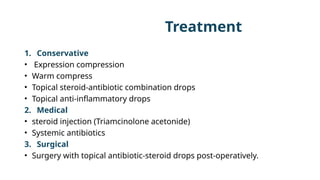
• Treatment of chalazion
Aetiology
• Obstruction oforifice of Meibomian gland by:
> infection
> Unknown cause
• Accumulation of sebaceous secretion within acini of gland.
Precipitating Factors:
1. Blepharitis
2. Diabetes mellitus
3. Seborrhoea
6.
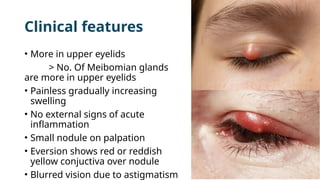
Clinical features
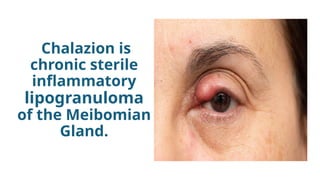
• Morein upper eyelids
> No. Of Meibomian glands
are more in upper eyelids
• Painless gradually increasing
swelling
• No external signs of acute
inflammation
• Small nodule on palpation
• Eversion shows red or reddish
yellow conjuctiva over nodule
• Blurred vision due to astigmatism
7.
Fate of chalazion
1.Spontaneous complete resolution
2. Liquify to form thin fibrous sac containing glairy fluid
called Meibomia/chalazion cyst .
3. Fibrosed into hard nodule
4. Calcification
5. Infection and suppuration
6. Burst and present as fleshy mass
8.
Complications
• Mechanical ptosis
>mechanical weight of chalazion
• Astigmatism and blurring of vision due to
> mechanical pressure over 12’o clock position of
cornea