





Chapter 19: The Insurance Industry
Presented By:
SANAULLAH
ZOHAIB AHMED
TAHIR ZAMAN
Money and Banking in Pakistan
6th edition
By: S.A Meenai
1
INTRODUCTION
• Discussing the History of Insurance industry
• Challenges faced by the industry
• Performance of insurance industry.
• Contribution of different insurance companies to
insurance industry.
2
OUTCOMES
• Insurance industry introduction and brief history.
• Financial performance of insurance companies.
• Contribution of insurance companies to over all growth
of insurance industry.
• Types of insurance companies.
• Working of insurance companies.
• Reinsurance company in Pakistan.
3
4
Insurance Sector Of Pakistan
• The insurance sector in Pakistan comprises of:
• one general re-insurance company
• Five life insurance companies
• 52 non life insurance companies (General insurance companies)
• Three Takaful companies (2009)
5
Life Insurance Companies
Life insurance is a contract where by the
Insurer , in consideration of a premium paid
either in lump sum or in periodic installment
Undertakes to pay an annuity certain sum of money
Either on death of the insured or an expiry of a certain
No of years which ever is earlier.
6
7
8
General Insurance Company
General insurance or non-life insurance policies,
including automobile and homeowners policies, provide
payments depending on the loss from a particular
financial event. General insurance is typically defined as
any insurance that is not determined to be life insurance.
9
10
11
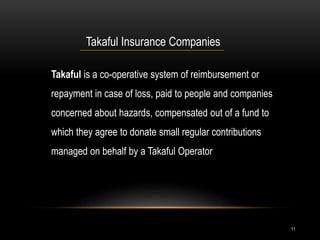
Takaful Insurance Companies
Takaful is a co-operative system of reimbursement or
repayment in case of loss, paid to people and companies
concerned about hazards, compensated out of a fund to
which they agree to donate small regular contributions
managed on behalf by a Takaful Operator
12
13
14
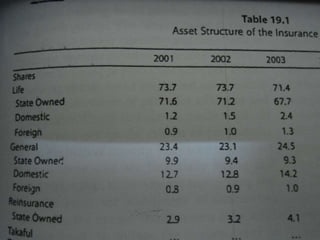
• Since FY 2003 the number of foreign companies in both
life and general Insurance has decreased
• To attract/ retain the foreign investment in insurance
sector, SECP has devised some strategies
• 2003-09 Assets are increased from Rs.150 to Rs.450 b
• 2007-11 Capital adequacy ratio has increased from Rs.300
to Rs.500 b
15
• 2002-07 Reserves and net earnings increased from Rs.10 to Rs.60 b due
to increase in profitability level in insurance sector
• 2003-08 ROI increased from 15% to 50% due to buoyancy of the stock
market and insurance industry associated capital gains
• No ceiling on level of equity investments by insurance companies.
• Greater portion of investment in government securities (T-bills and PIBs).
• Insurance companies can replace DFIs.
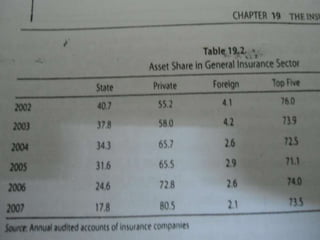
General insurance companies performing better than life
insurance companies in recent years.
Net premium of these companies has tripled during 2002-07 .
At the end of 2007 net premium amounted to Rs. 23 billion.
• Insurance business in Pakistan has a relatively high risk profit.
Claim ratio stood 65% in 2007.
• Claim ratio has continued to rise during 2008 and 2009.
17
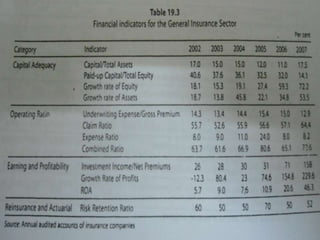
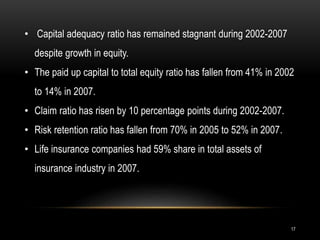
• Capital adequacy ratio has remained stagnant during 2002-2007
despite growth in equity.
• The paid up capital to total equity ratio has fallen from 41% in 2002
to 14% in 2007.
• Claim ratio has risen by 10 percentage points during 2002-2007.
• Risk retention ratio has fallen from 70% in 2005 to 52% in 2007.
• Life insurance companies had 59% share in total assets of
insurance industry in 2007.
18
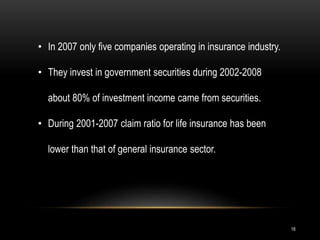
• In 2007 only five companies operating in insurance industry.
• They invest in government securities during 2002-2008
about 80% of investment income came from securities.
• During 2001-2007 claim ratio for life insurance has been
lower than that of general insurance sector.
19
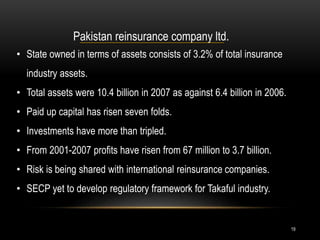
Pakistan reinsurance company ltd.
• State owned in terms of assets consists of 3.2% of total insurance
industry assets.
• Total assets were 10.4 billion in 2007 as against 6.4 billion in 2006.
• Paid up capital has risen seven folds.
• Investments have more than tripled.
• From 2001-2007 profits have risen from 67 million to 3.7 billion.
• Risk is being shared with international reinsurance companies.
• SECP yet to develop regulatory framework for Takaful industry.
20
21

Ch#19 the Insurance Industry Pakistan

  • 1.
    Chapter 19: TheInsurance Industry Presented By: SANAULLAH ZOHAIB AHMED TAHIR ZAMAN Money and Banking in Pakistan 6th edition By: S.A Meenai 1
  • 2.
    INTRODUCTION • Discussing theHistory of Insurance industry • Challenges faced by the industry • Performance of insurance industry. • Contribution of different insurance companies to insurance industry. 2
  • 3.
    OUTCOMES • Insurance industryintroduction and brief history. • Financial performance of insurance companies. • Contribution of insurance companies to over all growth of insurance industry. • Types of insurance companies. • Working of insurance companies. • Reinsurance company in Pakistan. 3
  • 4.
    4 Insurance Sector OfPakistan • The insurance sector in Pakistan comprises of: • one general re-insurance company • Five life insurance companies • 52 non life insurance companies (General insurance companies) • Three Takaful companies (2009)
  • 5.
    5 Life Insurance Companies Lifeinsurance is a contract where by the Insurer , in consideration of a premium paid either in lump sum or in periodic installment Undertakes to pay an annuity certain sum of money Either on death of the insured or an expiry of a certain No of years which ever is earlier.
  • 6.
  • 7.
  • 8.
    8 General Insurance Company Generalinsurance or non-life insurance policies, including automobile and homeowners policies, provide payments depending on the loss from a particular financial event. General insurance is typically defined as any insurance that is not determined to be life insurance.
  • 9.
  • 10.
  • 11.
    11 Takaful Insurance Companies Takafulis a co-operative system of reimbursement or repayment in case of loss, paid to people and companies concerned about hazards, compensated out of a fund to which they agree to donate small regular contributions managed on behalf by a Takaful Operator
  • 12.
  • 13.
  • 14.
    14 • Since FY2003 the number of foreign companies in both life and general Insurance has decreased • To attract/ retain the foreign investment in insurance sector, SECP has devised some strategies • 2003-09 Assets are increased from Rs.150 to Rs.450 b • 2007-11 Capital adequacy ratio has increased from Rs.300 to Rs.500 b
  • 15.
    15 • 2002-07 Reservesand net earnings increased from Rs.10 to Rs.60 b due to increase in profitability level in insurance sector • 2003-08 ROI increased from 15% to 50% due to buoyancy of the stock market and insurance industry associated capital gains • No ceiling on level of equity investments by insurance companies. • Greater portion of investment in government securities (T-bills and PIBs).
  • 16.
    • Insurance companiescan replace DFIs. General insurance companies performing better than life insurance companies in recent years. Net premium of these companies has tripled during 2002-07 . At the end of 2007 net premium amounted to Rs. 23 billion. • Insurance business in Pakistan has a relatively high risk profit. Claim ratio stood 65% in 2007. • Claim ratio has continued to rise during 2008 and 2009.
  • 17.
    17 • Capital adequacyratio has remained stagnant during 2002-2007 despite growth in equity. • The paid up capital to total equity ratio has fallen from 41% in 2002 to 14% in 2007. • Claim ratio has risen by 10 percentage points during 2002-2007. • Risk retention ratio has fallen from 70% in 2005 to 52% in 2007. • Life insurance companies had 59% share in total assets of insurance industry in 2007.
  • 18.
    18 • In 2007only five companies operating in insurance industry. • They invest in government securities during 2002-2008 about 80% of investment income came from securities. • During 2001-2007 claim ratio for life insurance has been lower than that of general insurance sector.
  • 19.
    19 Pakistan reinsurance companyltd. • State owned in terms of assets consists of 3.2% of total insurance industry assets. • Total assets were 10.4 billion in 2007 as against 6.4 billion in 2006. • Paid up capital has risen seven folds. • Investments have more than tripled. • From 2001-2007 profits have risen from 67 million to 3.7 billion. • Risk is being shared with international reinsurance companies. • SECP yet to develop regulatory framework for Takaful industry.
  • 20.
  • 21.