Greek Peopardy

1    2         3             4    5
6    7         8             9    10
11   12       13             14   15
16   17       18             19   20
21   22       23             24   25
              Back to Main
1) Which of the following is
           incorrect about ancient Greece?
a) Geography played a major role in shaping Greek history.
b) Ancient Greeks heavily influenced Eastern Civilization.
c) Burst of Greek creativity was known as the Classical Age.
d) Greek Classical Age began about 500 BC (over 2,500 years ago)


                             Back to Peopardy
1) Which of the following is
           incorrect about ancient Greece?
a) Geography played a major role in shaping Greek history.
b) Ancient Greeks heavily influenced Eastern Civilization.
c) Burst of Greek creativity was known as the Classical Age.
d) Greek Classical Age began about 500 BC (over 2,500 years ago)


                             Back to Peopardy
2) From 750 BC – 500 BC
       what was true of Greek City-States?
a) Wealth spread to more citizens
b) Opening of power to more citizens
c) Power went from 1st Noble Landowners  2nd Monarchy  3rd Middle Class
d) Both A & B
e) Both B & C


                                Back to Peopardy
3) What reason did the book give for why
     Greeks started to colonize overseas?
a) Greek gods told them to do so
b) To educate non-thinkers
c) Greece lacked food-producing lands
d) Idea: Better to attack others than be attacked
e) To learn more from outsiders


                       Back to Peopardy
4) Which of the following is FALSE about
             Athens and Sparta?
a) They were Greek allies during the Peloponnesian
    War against Persia.
b) Athenians were more warrior-like than Spartans.
c) Sparta is where democracy began
d) All the above are true
e) All the above are false


                       Back to Peopardy
5) Which of the following are least likely
        to want a democracy?
a)   Nobles
b)   Soldiers
c)   Farmers
d)   Slave
e)   Artisans (skilled workers like carpenters)


                        Back to Peopardy
6) Solon’s liberal reform included all except?
a) Allowed Athenian Assembly to speak on big decisions.
b) Freed those sold into slavery due to debt
c) Made it easier to become a citizen
d) All the above are true
e) All the above are false


                             Back to Peopardy
7) What was the biggest reason why citizens
  could participate in Athenian Democracy?
a) No woman could participate in government
b) Citizens had the time to participate because slaves did all the work
c) King demanded that citizens participate
d) Weather was mostly good
e) All reasons are equal


                                 Back to Peopardy
8) All are true of Spartans EXCEPT
a) Life and society was dominated by military
b) Girls expected to be warrior producing machines
c) Youth lived under rigid physical discipline
d) Society had great concern for individual & political rights


                            Back to Peopardy
9) When a large number of citizens took direct
part in day to day government affairs it is called?
a) Direct Democracy
b) Partial Democracy
c) Social Democracy
d) Daily Democracy
e) Representative Democracy


                      Back to Peopardy
10) What was NOT mentioned at Pericles’ Funeral Oration?
 a) Man should not be bothered with public life.
 b) He stressed the rights of people.
 c) Power rested “not of a minority, but the whole people.”
 d) citizens do NOT put private affairs before affairs of the state.


                              Back to Peopardy
11) What word can best be described as a lover of wisdom?
 a) Philosopher
 b) Scientist
 c) Stoic
 d) Socratic
 e) Preacher


                         Back to Peopardy
12) Socrates, Plato and Aristotle had all the
          following in common EXCEPT:
a) They were philosophers
b) They were writers
c) They were teachers
d) All of the above
e) None of the above


                      Back to Peopardy
13) All of the following are
         true about Philosophers EXCEPT
a) searched for laws of how the universe operated.
b) respected the idea that events were caused by gods.
c) questioned how government and society should work
d) applied observation and reason to determine why things happened


                              Back to Peopardy
14) Following the Peloponnesian War why did
   many young Athenians start to follow Sophists:
a) Athens lost the war to the Sophist, therefore had to accept their religion

b) Sophists belief to question traditional values made sense to the young
   who viewed the old values as the cause of losing the war to Sparta.

c) Young Athenians won the war but gained little wealth and thus joined
   Sophists in their new tax plan to restructure the wealth of society.

d) Young Athenians felt winning the war should free them of duty,
   which is also a central theme of Sophists.


                                 Back to Peopardy
15) Who am I? I was a stonemason and philosopher who
criticized Sophists. People know my opinion because one
 of my students wrote about what I said. I never wrote
down anything. I wasn’t interested in writing but rather
wandering the marketplace in Athens and asking people
            my famous conversational starter:
               “What is the greatest good?”
a) Plato
b) Pericles
c) Zeno
d) Aristotle
e) Socrates

                        Back to Peopardy
16) Who am I? I might very well be the best student of
all-time. Well, I certainly had the best teacher one could
 ask for. I was very disturbed when he was sentenced to
death for the most heinous accusations. He was accused
  of corrupting the minds of youth. None of which was
     true. Rather my teacher enlightened my mind to
wonderful ideas and thoughts. I famously wrote many of
  my teacher’s ideas in a book known as the Republic.
                        Who am I?
a) Plato
b) Pericles
c) Mr P
d) Aristotle
e) Socrates
                          Back to Peopardy
17) According to Plato’s teachings
         what led to true knowledge?
a) Faith
b) Experiences of the senses
c) Reading lots of books
d) Listening to wise teachers
e) Reason


                       Back to Peopardy
18) Aristotle believed this allowed people to reach
  their full potential and achieve the ‘good life’
a) school
b) owning property
c) slavery
d) city-state
e) religion


                      Back to Peopardy
19) What did Aristotle proclaim
           in his teaching about life?
a) People should do whatever they want
b) Success is determined by wealth
c) To live life in moderation is to live a false life
d) All the above are correct
e) All the above are incorrect


                         Back to Peopardy
20) Which of the following Greek events are
   in CORRECT chronological order?
a) Empire Alexander  Pericles’ Funeral Oration  Socrates’ Trial  Plato Academy
b) Aristotle tutors Alexander  Peloponnesian War  Hellenistic Age  Stoicism
c) Plato Republic written  Solon’s rule  Roman Empire  Hellenistic Age
d) Socrates’ Trial  Plato Academy  Aristotle tutors Alexander  Hellenistic Age
e) Pericles War  King Phillip II defeats Greeks  Socrates’ Trial  Hellenistic Age


                                     Back to Peopardy
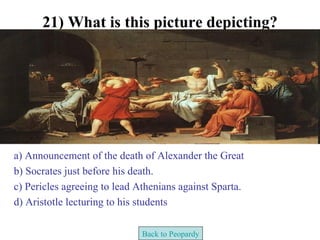
21) What is this picture depicting?


a) Announcement of the death of Alexander the Great
b) Socrates just before his death.
c) Pericles agreeing to lead Athenians against Sparta.
d) Aristotle lecturing to his students

                              Back to Peopardy
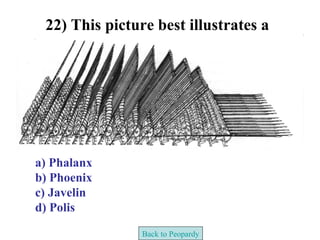
22) This picture best illustrates a


a) Phalanx
b) Phoenix
c) Javelin
d) Polis

                Back to Peopardy
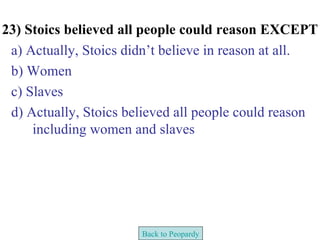
23) Stoics believed all people could reason EXCEPT
 a) Actually, Stoics didn’t believe in reason at all.
 b) Women
 c) Slaves
 d) Actually, Stoics believed all people could reason
     including women and slaves


                       Back to Peopardy
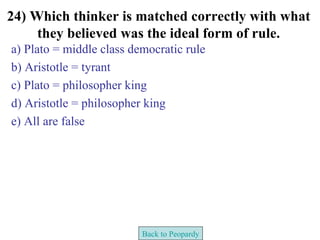
24) Which thinker is matched correctly with what
     they believed was the ideal form of rule.
a) Plato = middle class democratic rule
b) Aristotle = tyrant
c) Plato = philosopher king
d) Aristotle = philosopher king
e) All are false


                          Back to Peopardy
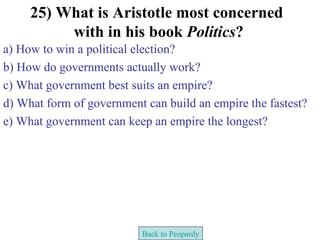
25) What is Aristotle most concerned
          with in his book Politics?
a) How to win a political election?
b) How do governments actually work?
c) What government best suits an empire?
d) What form of government can build an empire the fastest?
e) What government can keep an empire the longest?


                          Back to Peopardy

Ch1 s1 Greek Jeopardy

  • 1.
    Greek Peopardy 1 2 3 4 5 6 7 8 9 10 11 12 13 14 15 16 17 18 19 20 21 22 23 24 25 Back to Main
  • 2.
    1) Which ofthe following is incorrect about ancient Greece? a) Geography played a major role in shaping Greek history. b) Ancient Greeks heavily influenced Eastern Civilization. c) Burst of Greek creativity was known as the Classical Age. d) Greek Classical Age began about 500 BC (over 2,500 years ago) Back to Peopardy
  • 3.
    1) Which ofthe following is incorrect about ancient Greece? a) Geography played a major role in shaping Greek history. b) Ancient Greeks heavily influenced Eastern Civilization. c) Burst of Greek creativity was known as the Classical Age. d) Greek Classical Age began about 500 BC (over 2,500 years ago) Back to Peopardy
  • 4.
    2) From 750BC – 500 BC what was true of Greek City-States? a) Wealth spread to more citizens b) Opening of power to more citizens c) Power went from 1st Noble Landowners  2nd Monarchy  3rd Middle Class d) Both A & B e) Both B & C Back to Peopardy
  • 5.
    3) What reasondid the book give for why Greeks started to colonize overseas? a) Greek gods told them to do so b) To educate non-thinkers c) Greece lacked food-producing lands d) Idea: Better to attack others than be attacked e) To learn more from outsiders Back to Peopardy
  • 6.
    4) Which ofthe following is FALSE about Athens and Sparta? a) They were Greek allies during the Peloponnesian War against Persia. b) Athenians were more warrior-like than Spartans. c) Sparta is where democracy began d) All the above are true e) All the above are false Back to Peopardy
  • 7.
    5) Which ofthe following are least likely to want a democracy? a) Nobles b) Soldiers c) Farmers d) Slave e) Artisans (skilled workers like carpenters) Back to Peopardy
  • 8.
    6) Solon’s liberalreform included all except? a) Allowed Athenian Assembly to speak on big decisions. b) Freed those sold into slavery due to debt c) Made it easier to become a citizen d) All the above are true e) All the above are false Back to Peopardy
  • 9.
    7) What wasthe biggest reason why citizens could participate in Athenian Democracy? a) No woman could participate in government b) Citizens had the time to participate because slaves did all the work c) King demanded that citizens participate d) Weather was mostly good e) All reasons are equal Back to Peopardy
  • 10.
    8) All aretrue of Spartans EXCEPT a) Life and society was dominated by military b) Girls expected to be warrior producing machines c) Youth lived under rigid physical discipline d) Society had great concern for individual & political rights Back to Peopardy
  • 11.
    9) When alarge number of citizens took direct part in day to day government affairs it is called? a) Direct Democracy b) Partial Democracy c) Social Democracy d) Daily Democracy e) Representative Democracy Back to Peopardy
  • 12.
    10) What wasNOT mentioned at Pericles’ Funeral Oration? a) Man should not be bothered with public life. b) He stressed the rights of people. c) Power rested “not of a minority, but the whole people.” d) citizens do NOT put private affairs before affairs of the state. Back to Peopardy
  • 13.
    11) What wordcan best be described as a lover of wisdom? a) Philosopher b) Scientist c) Stoic d) Socratic e) Preacher Back to Peopardy
  • 14.
    12) Socrates, Platoand Aristotle had all the following in common EXCEPT: a) They were philosophers b) They were writers c) They were teachers d) All of the above e) None of the above Back to Peopardy
  • 15.
    13) All ofthe following are true about Philosophers EXCEPT a) searched for laws of how the universe operated. b) respected the idea that events were caused by gods. c) questioned how government and society should work d) applied observation and reason to determine why things happened Back to Peopardy
  • 16.
    14) Following thePeloponnesian War why did many young Athenians start to follow Sophists: a) Athens lost the war to the Sophist, therefore had to accept their religion b) Sophists belief to question traditional values made sense to the young who viewed the old values as the cause of losing the war to Sparta. c) Young Athenians won the war but gained little wealth and thus joined Sophists in their new tax plan to restructure the wealth of society. d) Young Athenians felt winning the war should free them of duty, which is also a central theme of Sophists. Back to Peopardy
  • 17.
    15) Who amI? I was a stonemason and philosopher who criticized Sophists. People know my opinion because one of my students wrote about what I said. I never wrote down anything. I wasn’t interested in writing but rather wandering the marketplace in Athens and asking people my famous conversational starter: “What is the greatest good?” a) Plato b) Pericles c) Zeno d) Aristotle e) Socrates Back to Peopardy
  • 18.
    16) Who amI? I might very well be the best student of all-time. Well, I certainly had the best teacher one could ask for. I was very disturbed when he was sentenced to death for the most heinous accusations. He was accused of corrupting the minds of youth. None of which was true. Rather my teacher enlightened my mind to wonderful ideas and thoughts. I famously wrote many of my teacher’s ideas in a book known as the Republic. Who am I? a) Plato b) Pericles c) Mr P d) Aristotle e) Socrates Back to Peopardy
  • 19.
    17) According toPlato’s teachings what led to true knowledge? a) Faith b) Experiences of the senses c) Reading lots of books d) Listening to wise teachers e) Reason Back to Peopardy
  • 20.
    18) Aristotle believedthis allowed people to reach their full potential and achieve the ‘good life’ a) school b) owning property c) slavery d) city-state e) religion Back to Peopardy
  • 21.
    19) What didAristotle proclaim in his teaching about life? a) People should do whatever they want b) Success is determined by wealth c) To live life in moderation is to live a false life d) All the above are correct e) All the above are incorrect Back to Peopardy
  • 22.
    20) Which ofthe following Greek events are in CORRECT chronological order? a) Empire Alexander  Pericles’ Funeral Oration  Socrates’ Trial  Plato Academy b) Aristotle tutors Alexander  Peloponnesian War  Hellenistic Age  Stoicism c) Plato Republic written  Solon’s rule  Roman Empire  Hellenistic Age d) Socrates’ Trial  Plato Academy  Aristotle tutors Alexander  Hellenistic Age e) Pericles War  King Phillip II defeats Greeks  Socrates’ Trial  Hellenistic Age Back to Peopardy
  • 23.
    21) What isthis picture depicting? a) Announcement of the death of Alexander the Great b) Socrates just before his death. c) Pericles agreeing to lead Athenians against Sparta. d) Aristotle lecturing to his students Back to Peopardy
  • 24.
    22) This picturebest illustrates a a) Phalanx b) Phoenix c) Javelin d) Polis Back to Peopardy
  • 25.
    23) Stoics believedall people could reason EXCEPT a) Actually, Stoics didn’t believe in reason at all. b) Women c) Slaves d) Actually, Stoics believed all people could reason including women and slaves Back to Peopardy
  • 26.
    24) Which thinkeris matched correctly with what they believed was the ideal form of rule. a) Plato = middle class democratic rule b) Aristotle = tyrant c) Plato = philosopher king d) Aristotle = philosopher king e) All are false Back to Peopardy
  • 27.
    25) What isAristotle most concerned with in his book Politics? a) How to win a political election? b) How do governments actually work? c) What government best suits an empire? d) What form of government can build an empire the fastest? e) What government can keep an empire the longest? Back to Peopardy