Recommended
PPTX
Wey_FinIFRS_5e_PPT_Ch03.pptxilhkljkjbjbbh
PPT
أبسط المعلومات المالية باللغة الانجليزية عرض محاسبية2.ppt
PPT
ch03 Introduction to accounting Conepts.ppt
PPTX
very important notetaking presentation useful much.pptx
PPT
NSU EMB 501 Accounting Ch03
PPT
Financial_Accounting_chapter_03.ppt
PPT
Accounting 201 intro to accounting ch03.ppt
PPT
PPTX
Lecture slides_Chapter 3 _ 4.pptx
PPT
rtrtrtrtrtrtrtrtrtrtrtrtrtrtrtrtrtrtr.ppt
PPTX
Adjusting the Accounts Adjusting Entries
PPTX
Accounting Principles, 12th ch3
PDF
PPTX
principles of accounting adjusting entries.pptx
PPTX
principles of accounting adjusting entriew.pptx
PPT
Chapter three of drugs supply management
PPT
accounting adjusting entries chapter 3.ppt
DOCX
Accrual Accounting ConceptsKimmel ● Weygandt ● KiesoAccounti.docx
DOCX
4-‹#›Accrual Accounting ConceptsKimmel ● Weygandt .docx
PDF
PPTX
Ch_03_Adjusting the Accounts Edited.ppt.pptx
PPTX
chapter 3 fundamental accounting .pptx
PPT
DOC
DEFERRALS AND ACCRUALS notes for lecture
PPT
DOCX
Chapter 4 THE ADJUSTMENT PROCESSPrinciples of Accounting, Vo
DOCX
study objectivesAfter studying this chapter, you should be a.docx
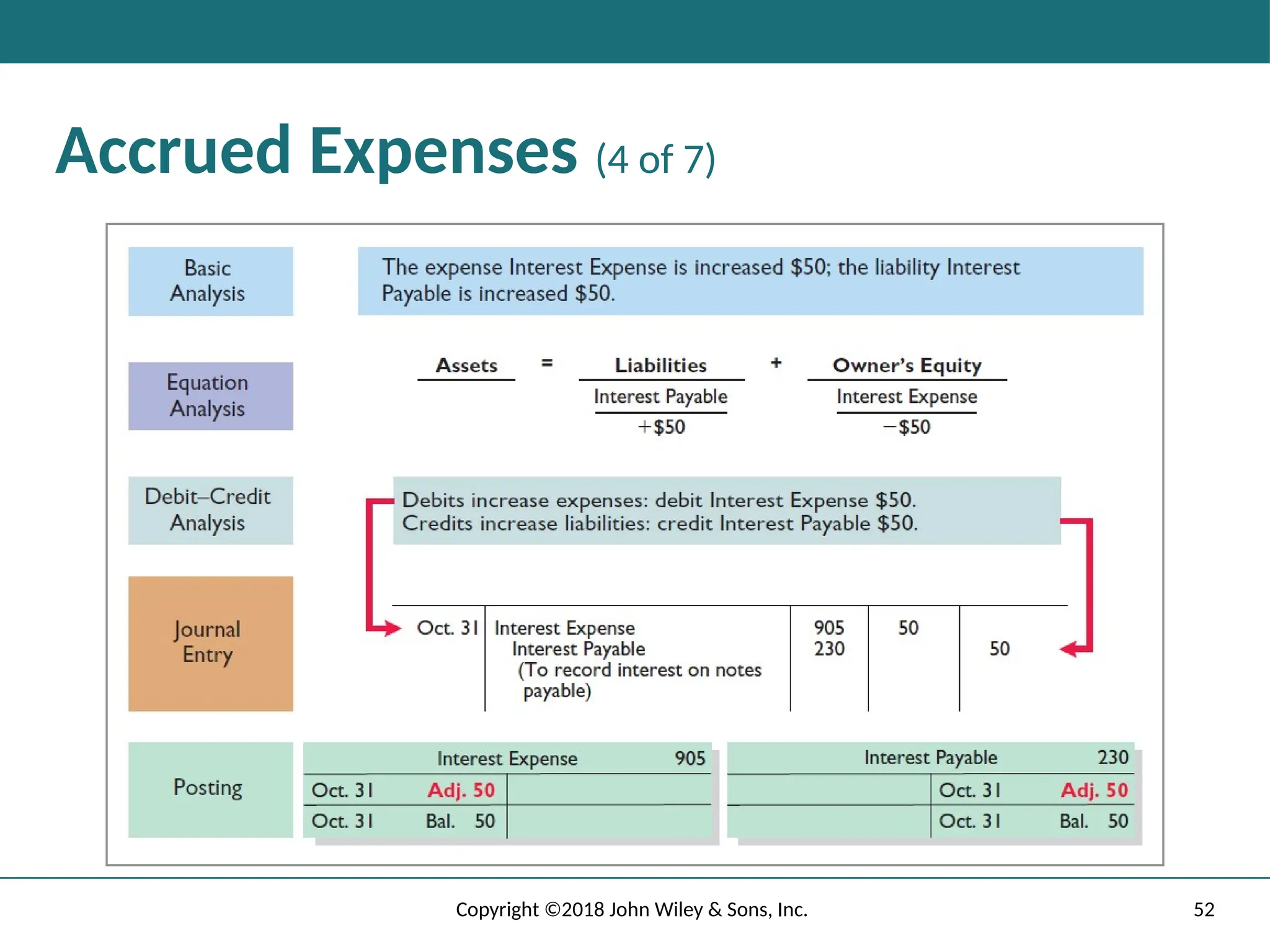
PPT
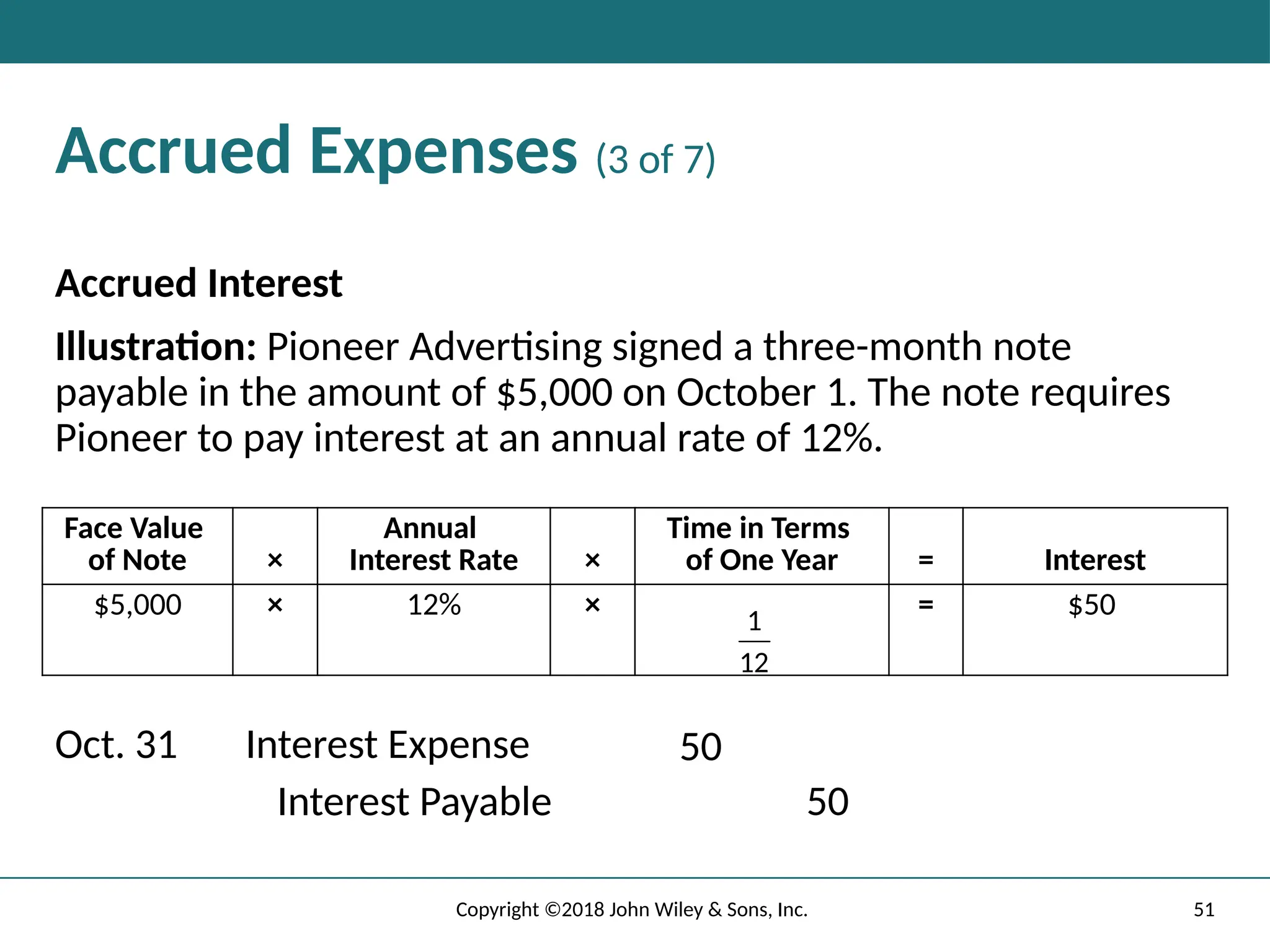
PPTX
ch04.pptx chapter 3 adjusting entreis at end of period
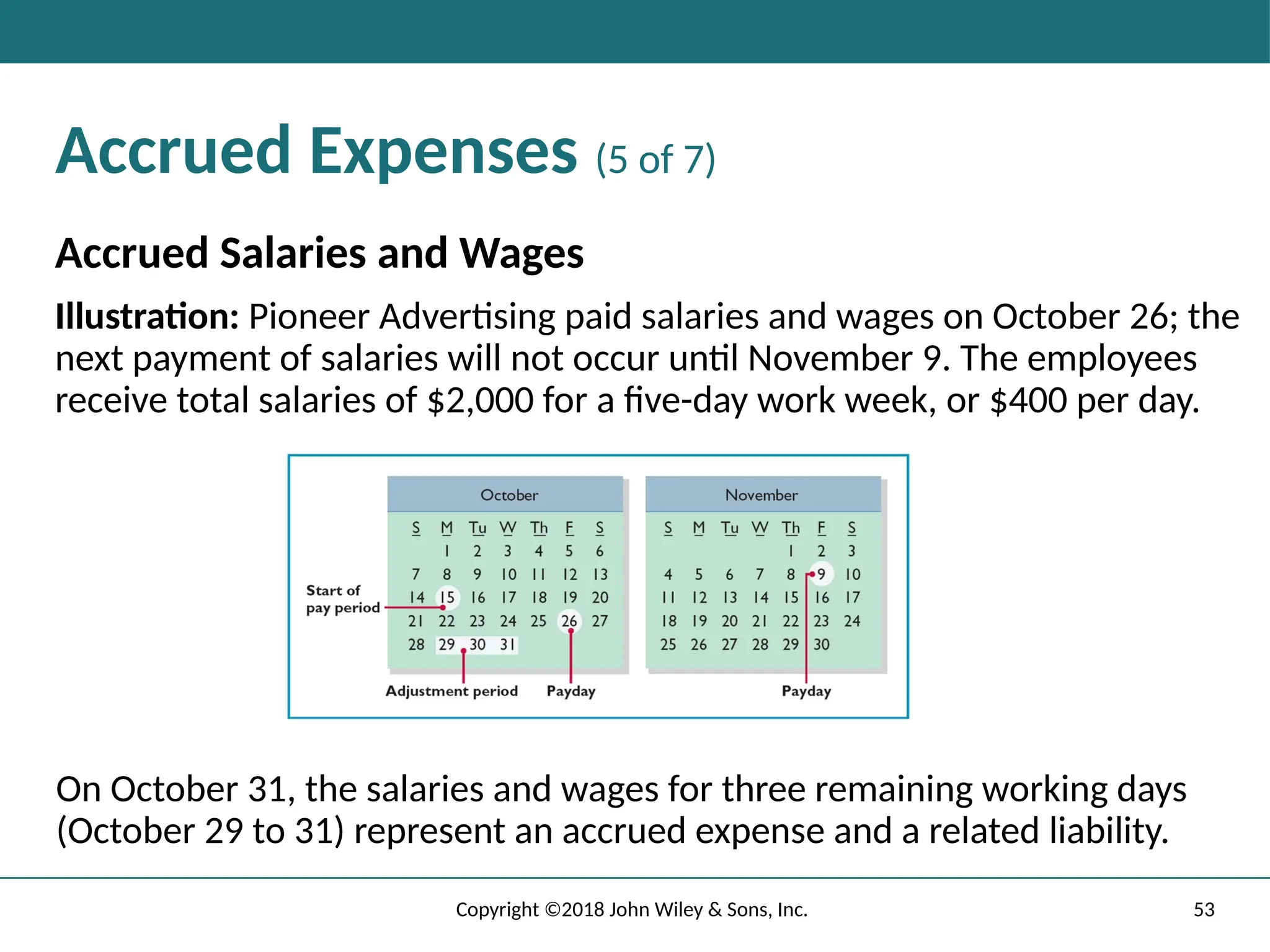
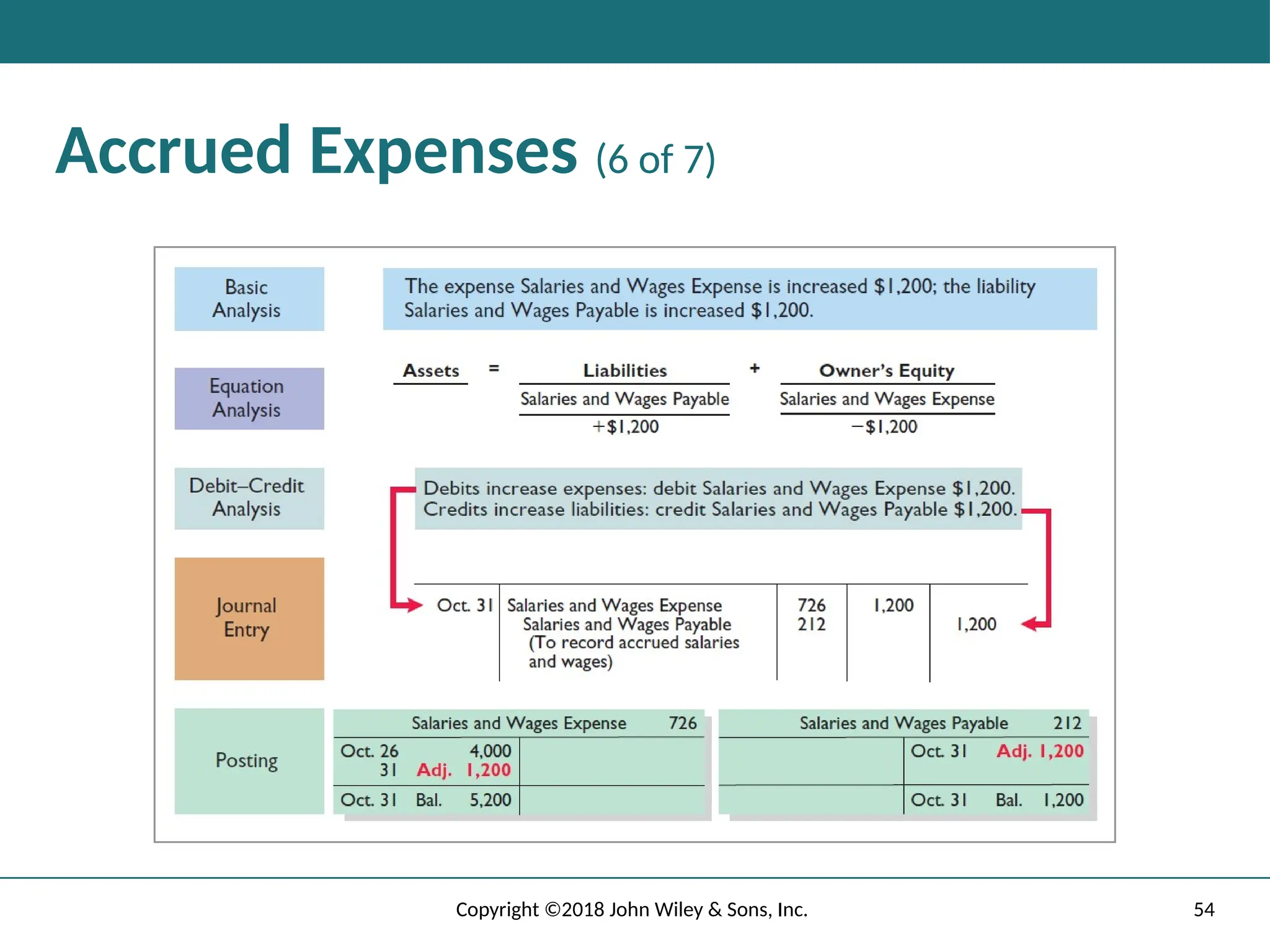
PPTX
ch01.pptx chapter 1 accounting in action
More Related Content
PPTX
Wey_FinIFRS_5e_PPT_Ch03.pptxilhkljkjbjbbh
PPT
أبسط المعلومات المالية باللغة الانجليزية عرض محاسبية2.ppt
PPT
ch03 Introduction to accounting Conepts.ppt
PPTX
very important notetaking presentation useful much.pptx
PPT
NSU EMB 501 Accounting Ch03
PPT
Financial_Accounting_chapter_03.ppt
PPT
Accounting 201 intro to accounting ch03.ppt
PPT
Similar to ch03.pptx chapter 3 adjusting accounts at end of period
PPTX
Lecture slides_Chapter 3 _ 4.pptx
PPT
rtrtrtrtrtrtrtrtrtrtrtrtrtrtrtrtrtrtr.ppt
PPTX
Adjusting the Accounts Adjusting Entries
PPTX
Accounting Principles, 12th ch3
PDF
PPTX
principles of accounting adjusting entries.pptx
PPTX
principles of accounting adjusting entriew.pptx
PPT
Chapter three of drugs supply management
PPT
accounting adjusting entries chapter 3.ppt
DOCX
Accrual Accounting ConceptsKimmel ● Weygandt ● KiesoAccounti.docx
DOCX
4-‹#›Accrual Accounting ConceptsKimmel ● Weygandt .docx
PDF
PPTX
Ch_03_Adjusting the Accounts Edited.ppt.pptx
PPTX
chapter 3 fundamental accounting .pptx
PPT
DOC
DEFERRALS AND ACCRUALS notes for lecture
PPT
DOCX
Chapter 4 THE ADJUSTMENT PROCESSPrinciples of Accounting, Vo
DOCX
study objectivesAfter studying this chapter, you should be a.docx
PPT
More from rabieharoun1
PPTX
ch04.pptx chapter 3 adjusting entreis at end of period
PPTX
ch01.pptx chapter 1 accounting in action
PPTX
ch10.pptx plant assets and intangible assets & natural resources
PDF
PDF
DOC
DOC
mid-term revision 2022 2nd term.doc
PDF
DOCX
PDF
PDF
PDF
PDF
PDF
ch01-tb-principles-of-accounting.pdf
PDF
ch07-tb-principles-of-accounting.pdf
PDF
DOC
DOC
DOC
PDF
Recently uploaded
PDF
Best 7 Sites to Buy Verified Venmo Accounts With Zero ....pdf
PDF
J Hamilton - Pensions UK V1 27.11.2025 (1).pdf
DOCX
5 Simple Steps to Purchase Telegram Accounts For Best Service Topusapro.docx
PDF
Pension-Protection-Fund-Purple-Book-2025-accessible (1).pdf
PDF
Updated-costings-on-changes-to-PPF-compensation-levels---with-31-March-2025-f...
PPTX
Con Keating's slides from Pension PlayPen budget comments
PDF
_How to Safely Buy Instagram Accounts in 2025.pdf
PDF
Dr. Alexander Everest - A Sustainability Strategist
PDF
How To Buy, Verified Wise Account in 2026.pdf
PDF
LCP-Pension-Submisson-CDC-Superfund-December-2025.pdf
PDF
Chris Elwell Woburn - A Seasoned IT Executive
PDF
How to Buy Snapchat Account( 9.7) A Step-by-Step Guide ....pdf
PDF
Best Platforms to Buy Verified Wise Accounts in the USA.pdf
PPTX
Smart Solutions for Work with Flexible iPad Rental
PDF
Pengelolaan SDM Terintegrasi Berbasis Manajemen Risiko 2025
PDF
Where to Buy Verified Chime Accounts for Quick ....pdf
PDF
Unlock the Power of Leadership: The Electrolux Manufacturing System (EMS) Way
PDF
Zaid Alsikafi - A Chicago-Based Investor
DOCX
Guide to Safely Buy a Verified Binance Account Today.docx
PPTX
Project Management Tools for Faster, Smarter Execution
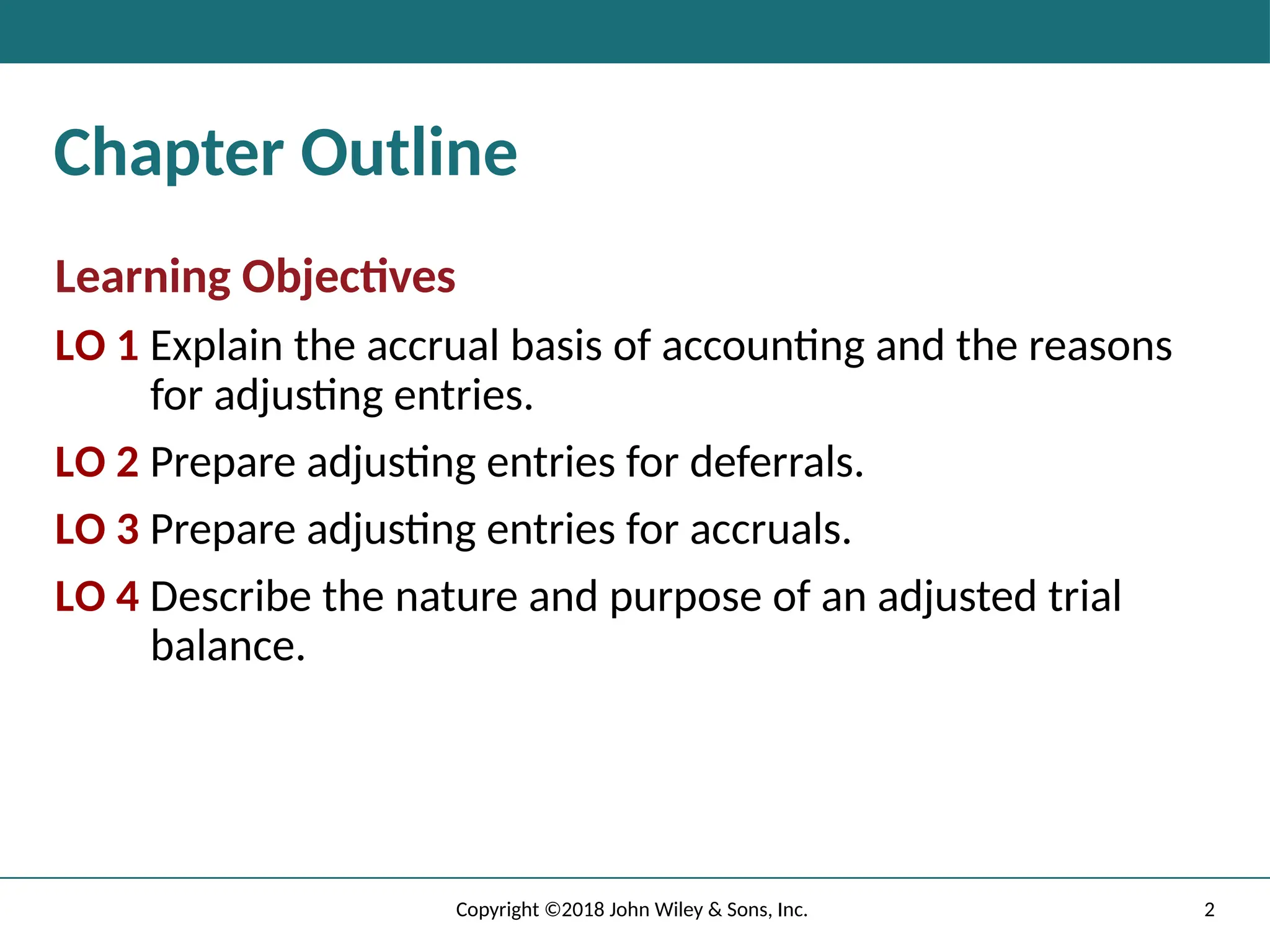
ch03.pptx chapter 3 adjusting accounts at end of period 1. 2. Chapter Outline
Learning Objectives
LO 1 Explain the accrual basis of accounting and the reasons
for adjusting entries.
LO 2 Prepare adjusting entries for deferrals.
LO 3 Prepare adjusting entries for accruals.
LO 4 Describe the nature and purpose of an adjusted trial
balance.
2
Copyright ©2018 John Wiley & Sons, Inc.
3. 3
Copyright ©2018 John Wiley & Sons, Inc.
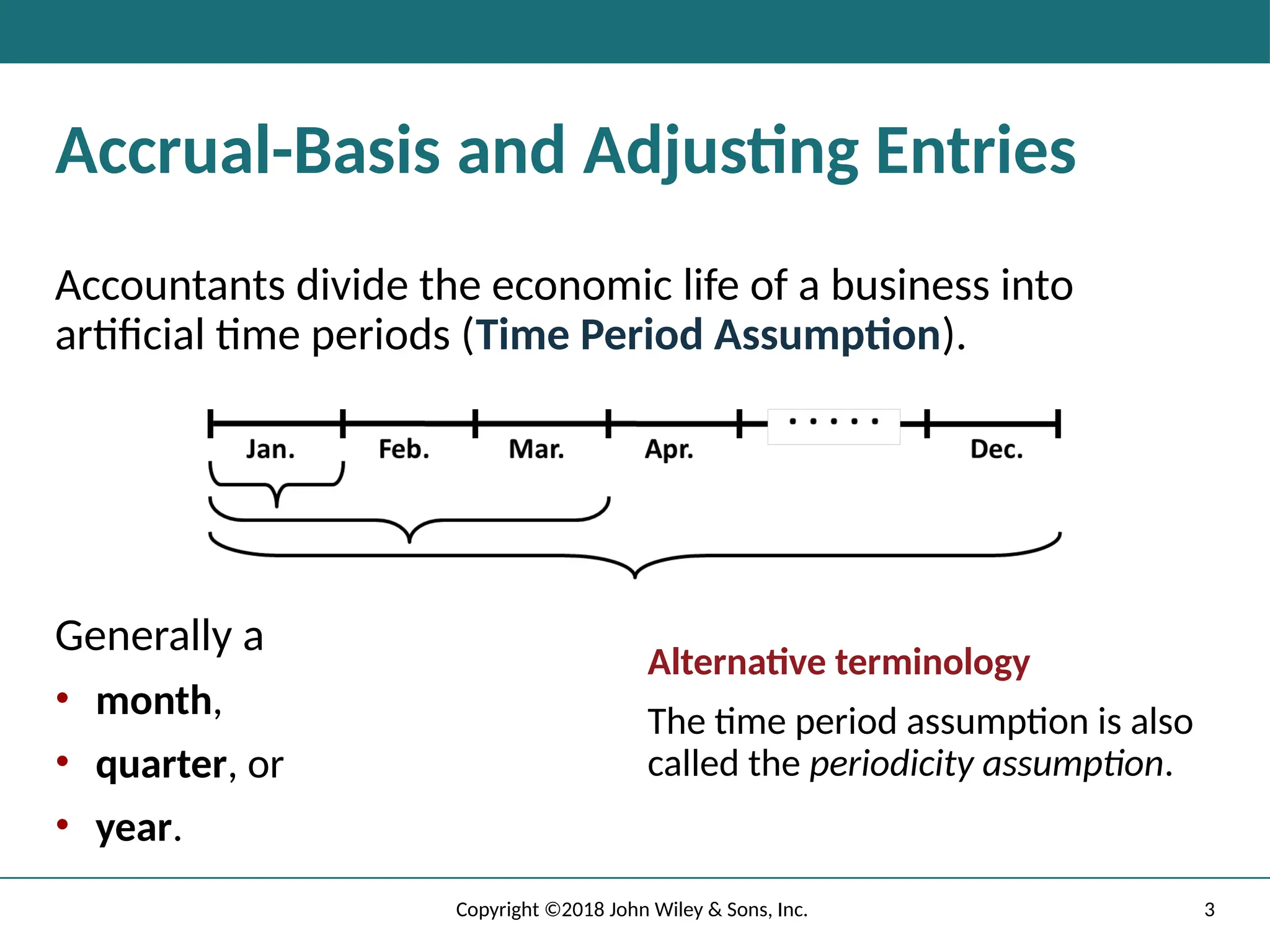
Accrual-Basis and Adjusting Entries
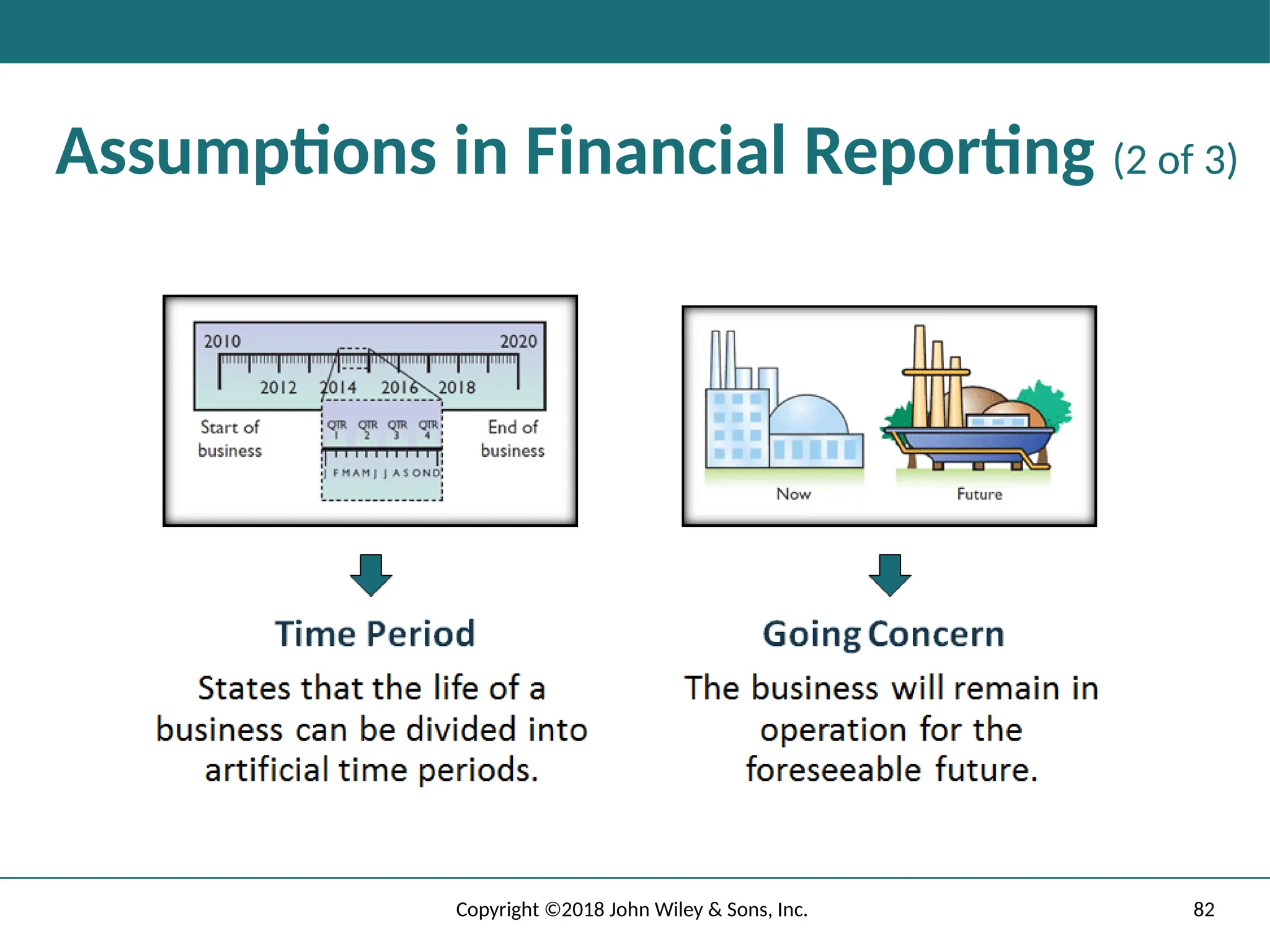
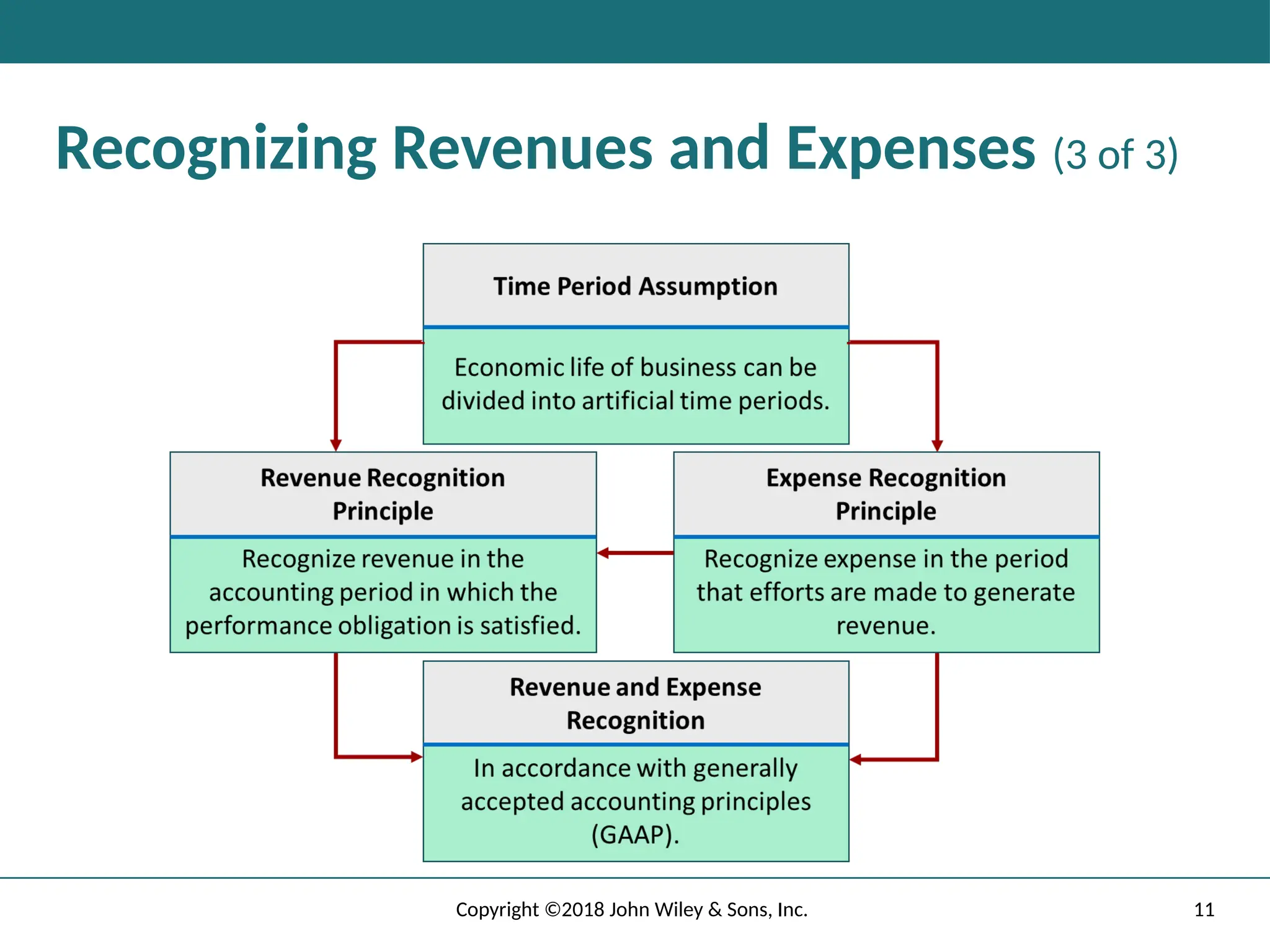
Accountants divide the economic life of a business into
artificial time periods (Time Period Assumption).
Generally a
• month,
• quarter, or
• year.
Alternative terminology
The time period assumption is also
called the periodicity assumption.
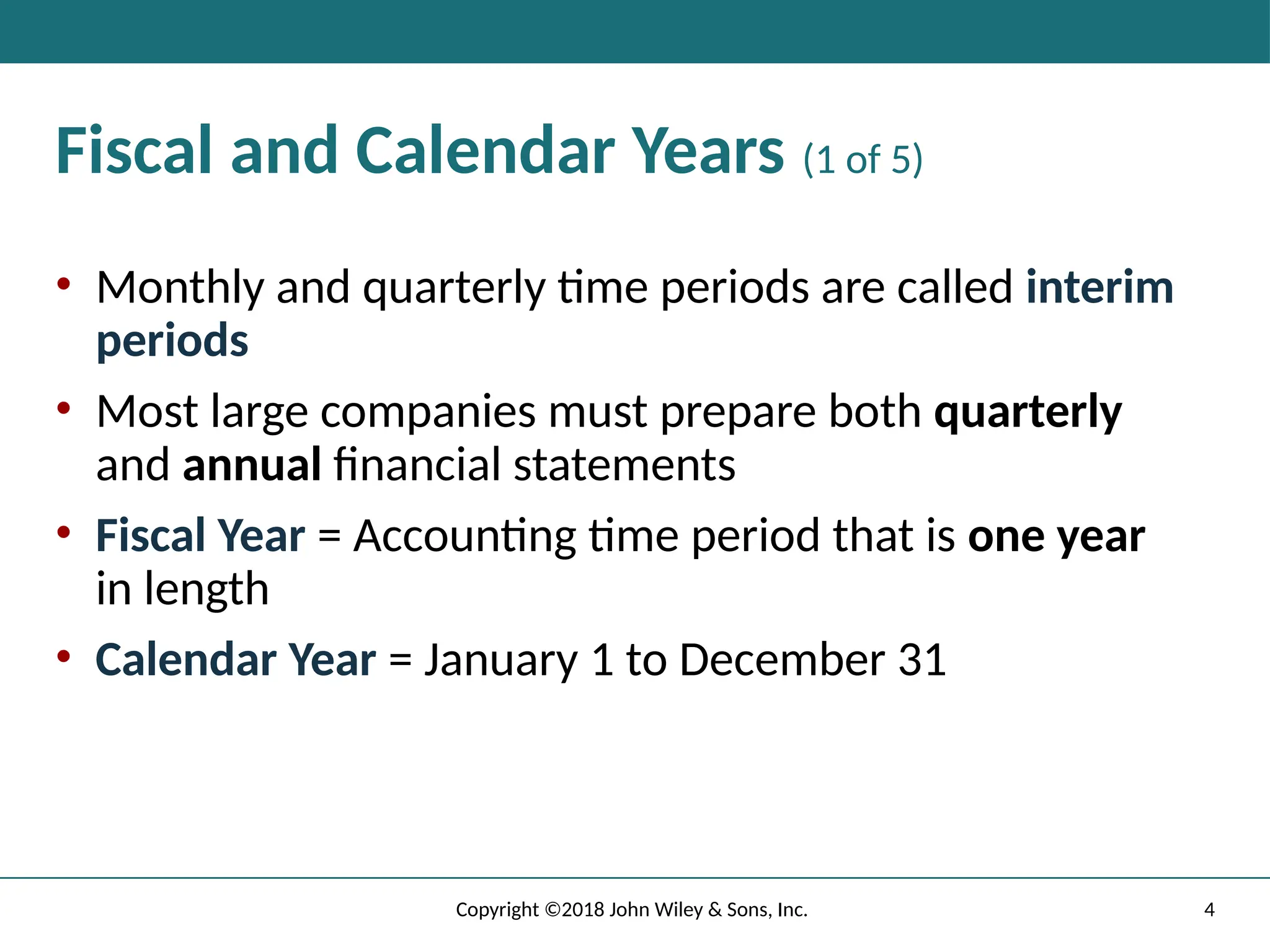
4. Fiscal and Calendar Years (1 of 5)
• Monthly and quarterly time periods are called interim
periods
• Most large companies must prepare both quarterly
and annual financial statements
• Fiscal Year = Accounting time period that is one year
in length
• Calendar Year = January 1 to December 31
4
Copyright ©2018 John Wiley & Sons, Inc.
5. 5
Copyright ©2018 John Wiley & Sons, Inc.
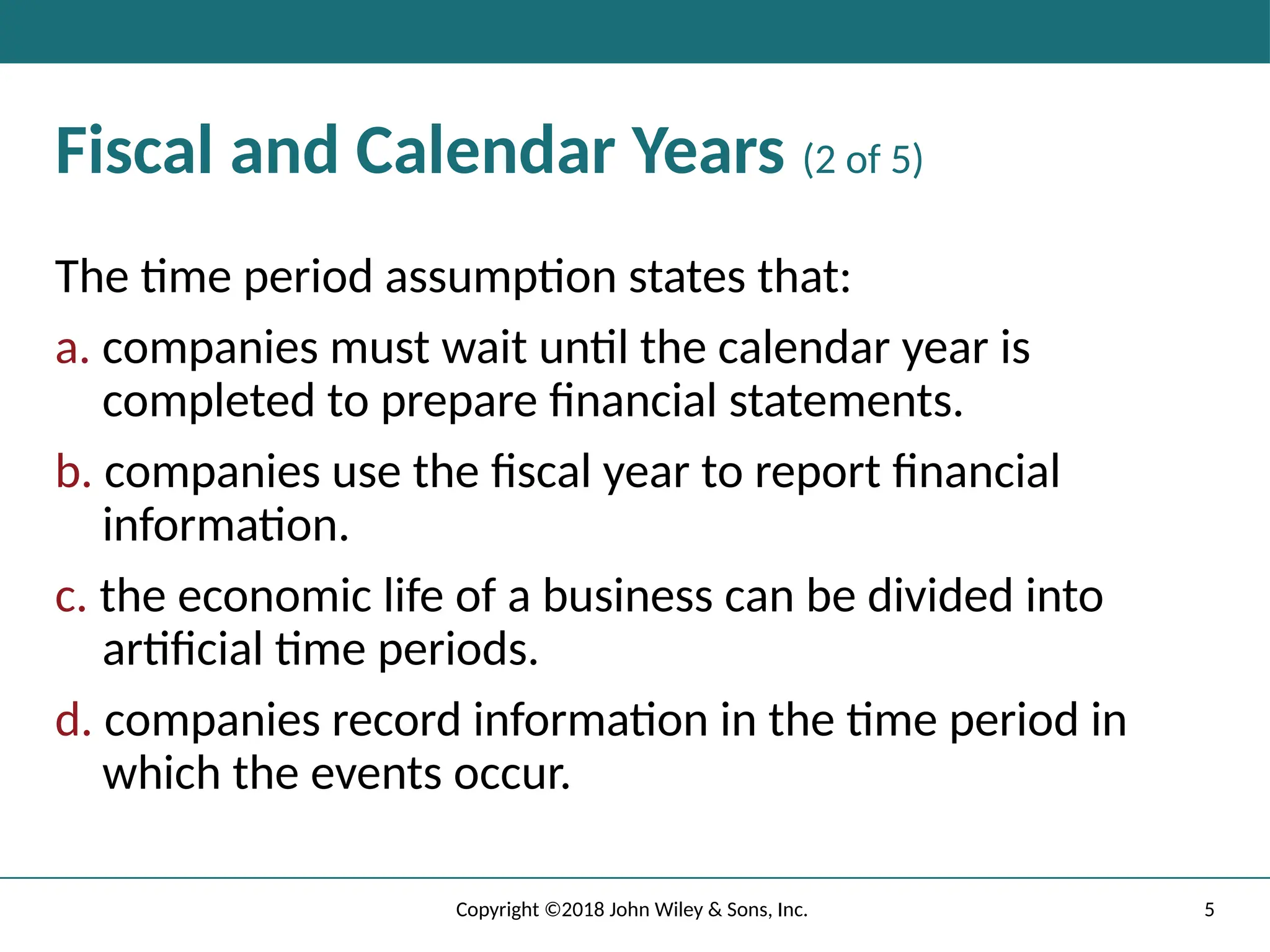
Fiscal and Calendar Years (2 of 5)
The time period assumption states that:
a. companies must wait until the calendar year is
completed to prepare financial statements.
b. companies use the fiscal year to report financial
information.
c. the economic life of a business can be divided into
artificial time periods.
d. companies record information in the time period in
which the events occur.
6. 6
Copyright ©2018 John Wiley & Sons, Inc.
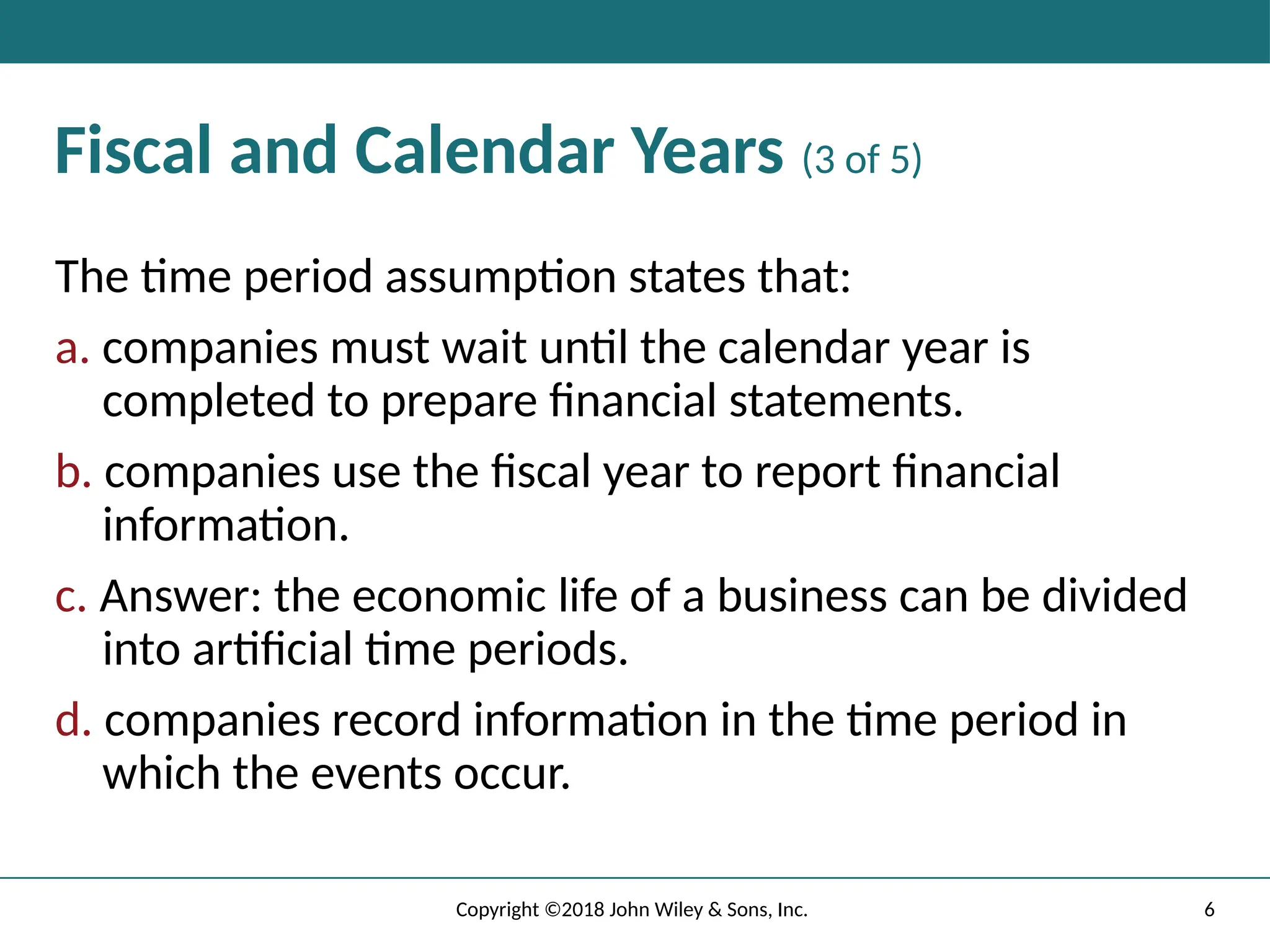
Fiscal and Calendar Years (3 of 5)
The time period assumption states that:
a. companies must wait until the calendar year is
completed to prepare financial statements.
b. companies use the fiscal year to report financial
information.
c. Answer: the economic life of a business can be divided
into artificial time periods.
d. companies record information in the time period in
which the events occur.
7. 7
Copyright ©2018 John Wiley & Sons, Inc.
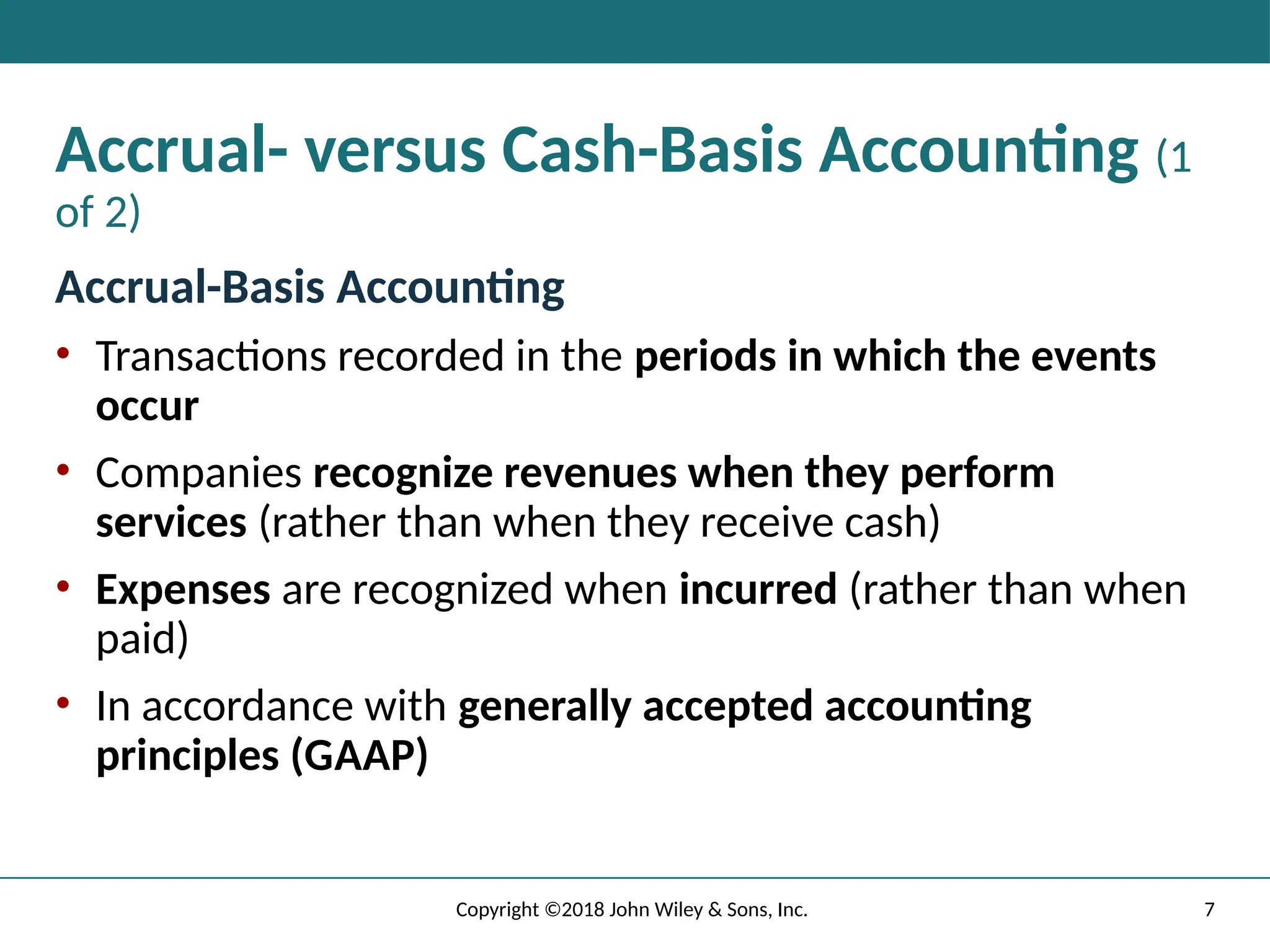
Accrual- versus Cash-Basis Accounting (1
of 2)
Accrual-Basis Accounting
• Transactions recorded in the periods in which the events
occur
• Companies recognize revenues when they perform
services (rather than when they receive cash)
• Expenses are recognized when incurred (rather than when
paid)
• In accordance with generally accepted accounting
principles (GAAP)
8. 8
Copyright ©2018 John Wiley & Sons, Inc.
Accrual- versus Cash-Basis Accounting (2
of 2)
Cash-Basis Accounting
• Revenues recognized when cash is received
• Expenses recognized when cash is paid
• Cash-basis accounting is not in accordance with generally
accepted accounting principles (GAAP)
9. 9
Copyright ©2018 John Wiley & Sons, Inc.
Recognizing Revenues and Expenses (1 of 3)
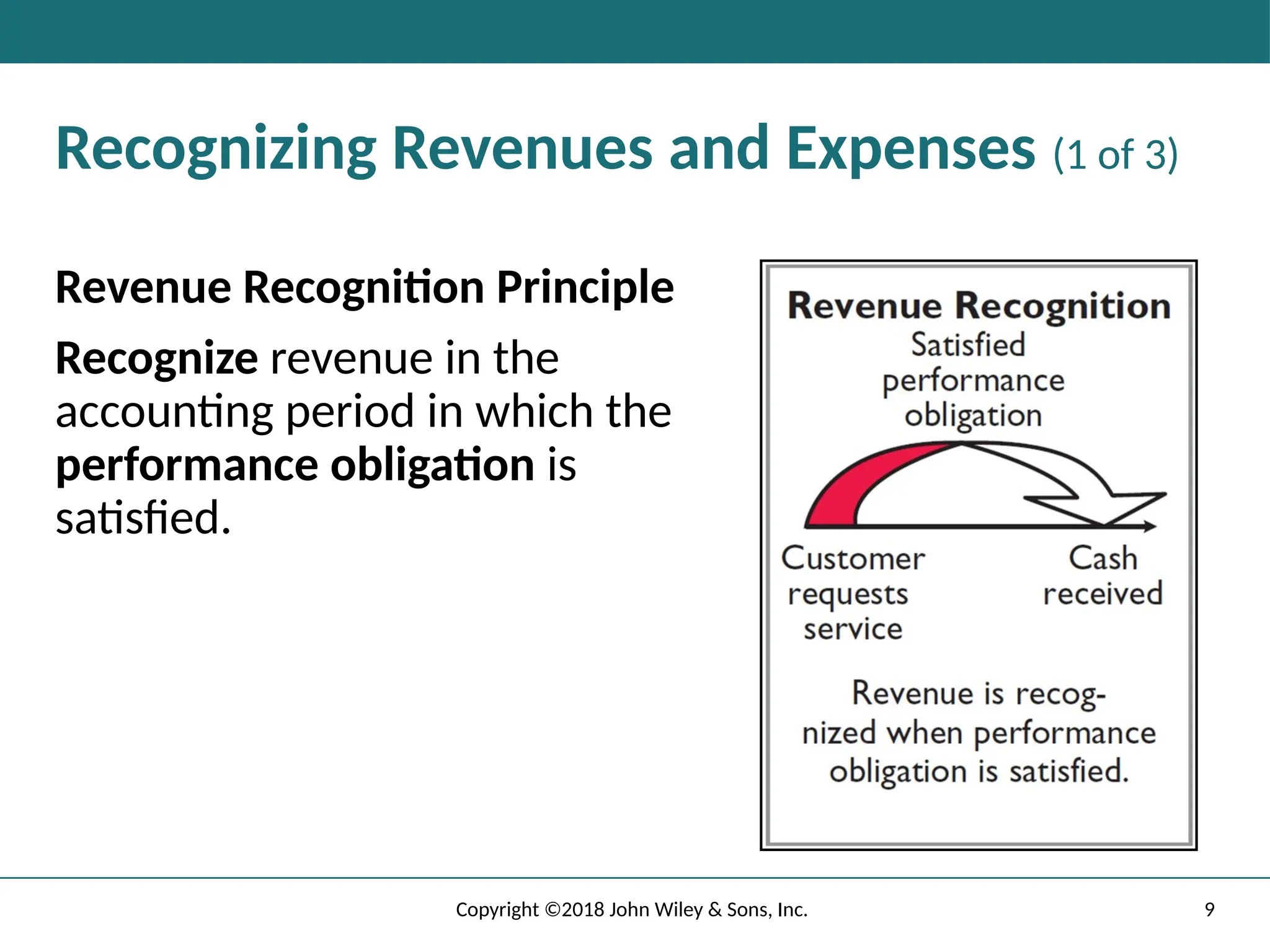
Revenue Recognition Principle
Recognize revenue in the
accounting period in which the
performance obligation is
satisfied.
10. 10
Copyright ©2018 John Wiley & Sons, Inc.
Recognizing Revenues and Expenses (2 of 3)
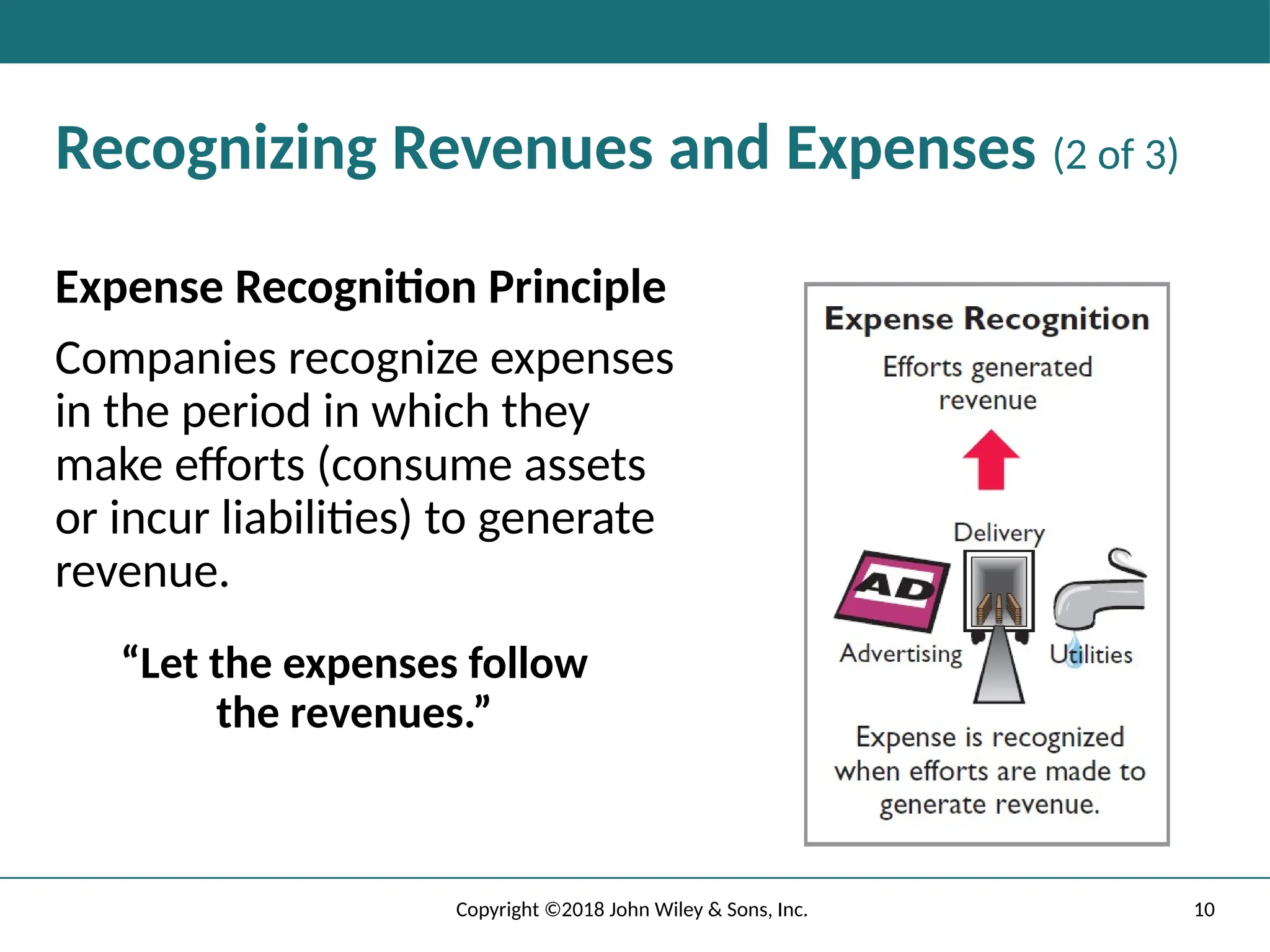
Expense Recognition Principle
Companies recognize expenses
in the period in which they
make efforts (consume assets
or incur liabilities) to generate
revenue.
“Let the expenses follow
the revenues.”
11. 12. 12
Copyright ©2018 John Wiley & Sons, Inc.
Fiscal and Calendar Years (4 of 5)
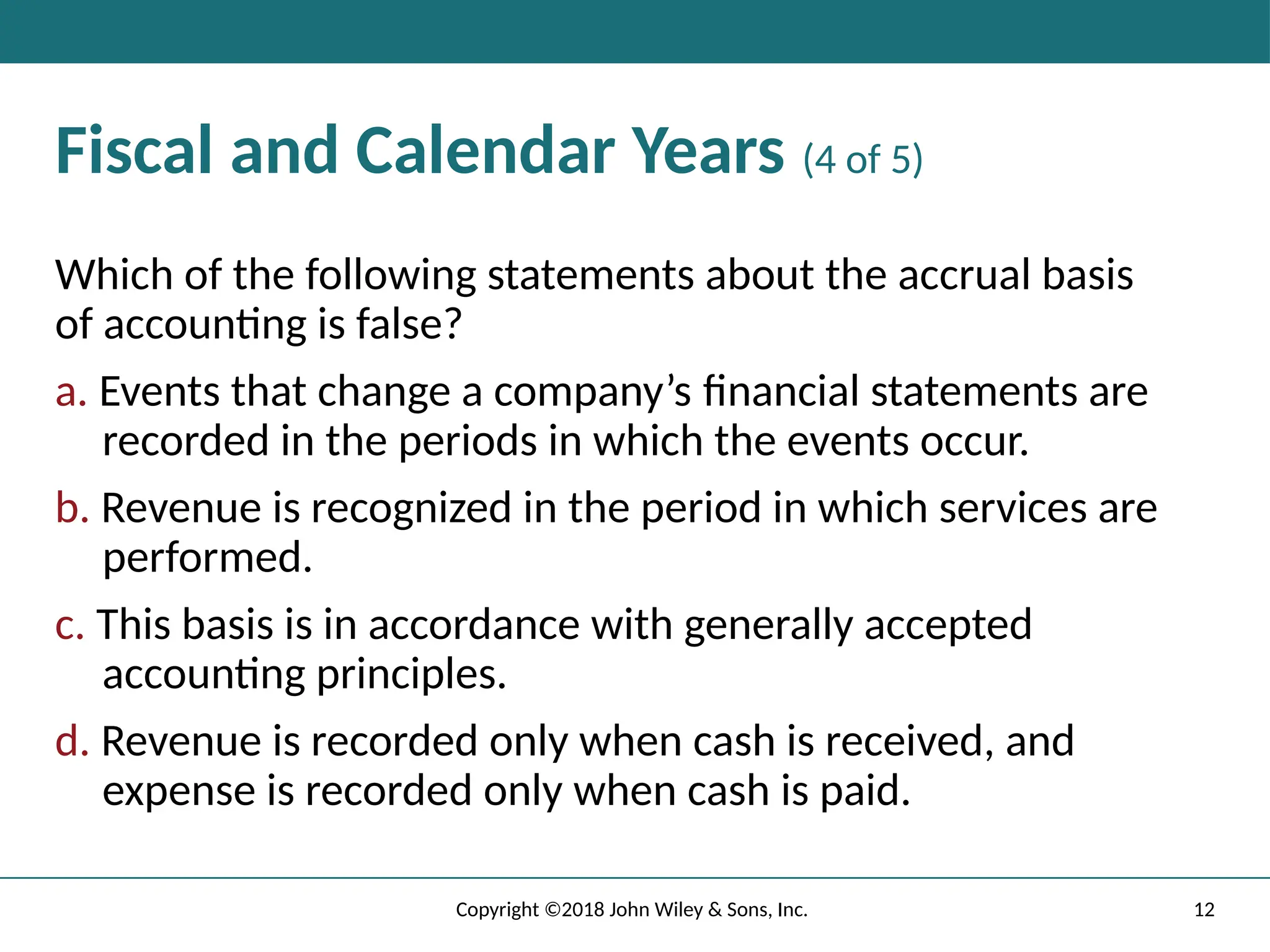
Which of the following statements about the accrual basis
of accounting is false?
a. Events that change a company’s financial statements are
recorded in the periods in which the events occur.
b. Revenue is recognized in the period in which services are
performed.
c. This basis is in accordance with generally accepted
accounting principles.
d. Revenue is recorded only when cash is received, and
expense is recorded only when cash is paid.
13. 13
Copyright ©2018 John Wiley & Sons, Inc.
Fiscal and Calendar Years (5 of 5)
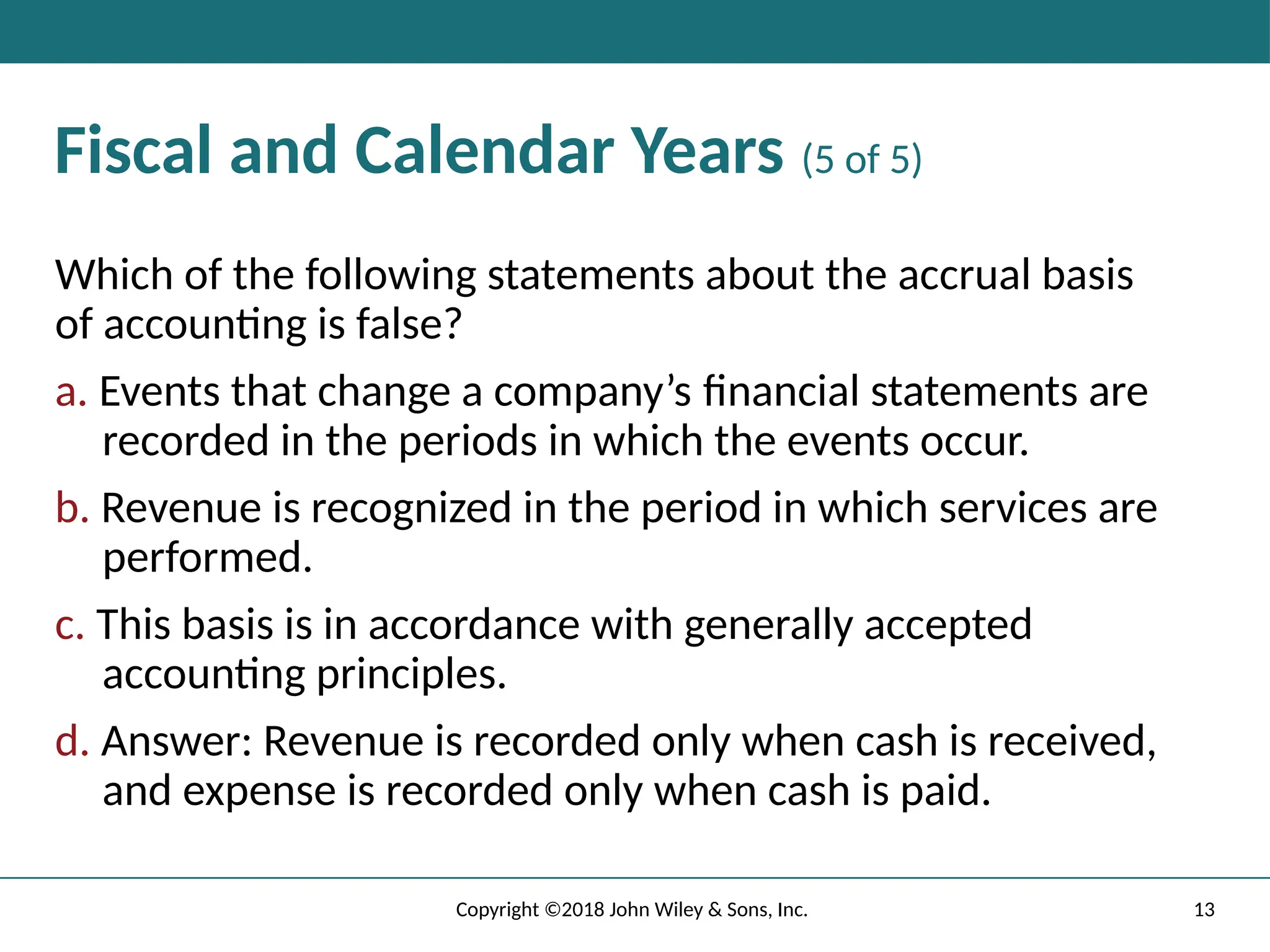
Which of the following statements about the accrual basis
of accounting is false?
a. Events that change a company’s financial statements are
recorded in the periods in which the events occur.
b. Revenue is recognized in the period in which services are
performed.
c. This basis is in accordance with generally accepted
accounting principles.
d. Answer: Revenue is recorded only when cash is received,
and expense is recorded only when cash is paid.
14. The Need for Adjusting Entries (1 of 3)
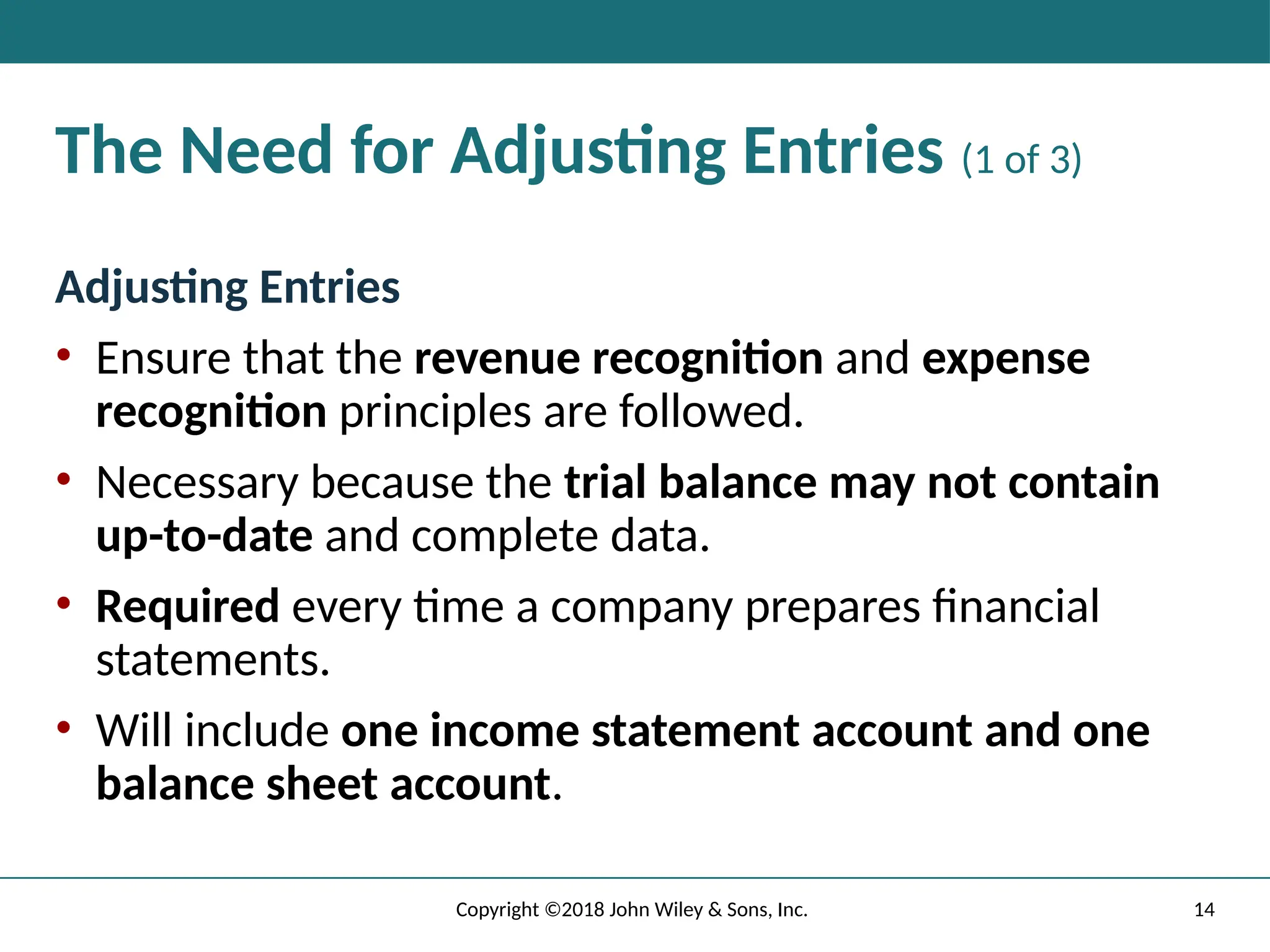
Adjusting Entries
• Ensure that the revenue recognition and expense
recognition principles are followed.
• Necessary because the trial balance may not contain
up-to-date and complete data.
• Required every time a company prepares financial
statements.
• Will include one income statement account and one
balance sheet account.
14
Copyright ©2018 John Wiley & Sons, Inc.
15. 15
Copyright ©2018 John Wiley & Sons, Inc.
The Need for Adjusting Entries (2 of 3)
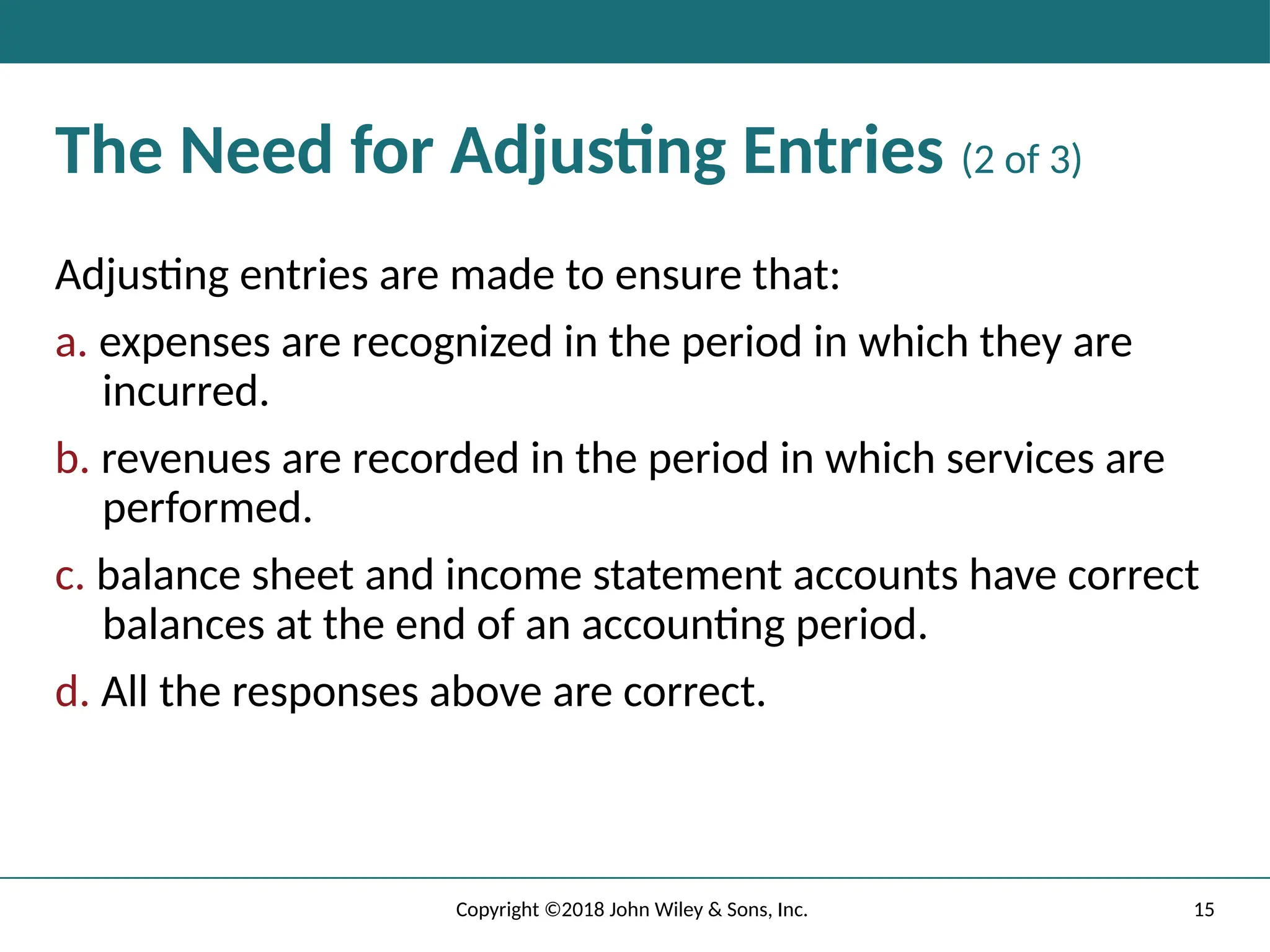
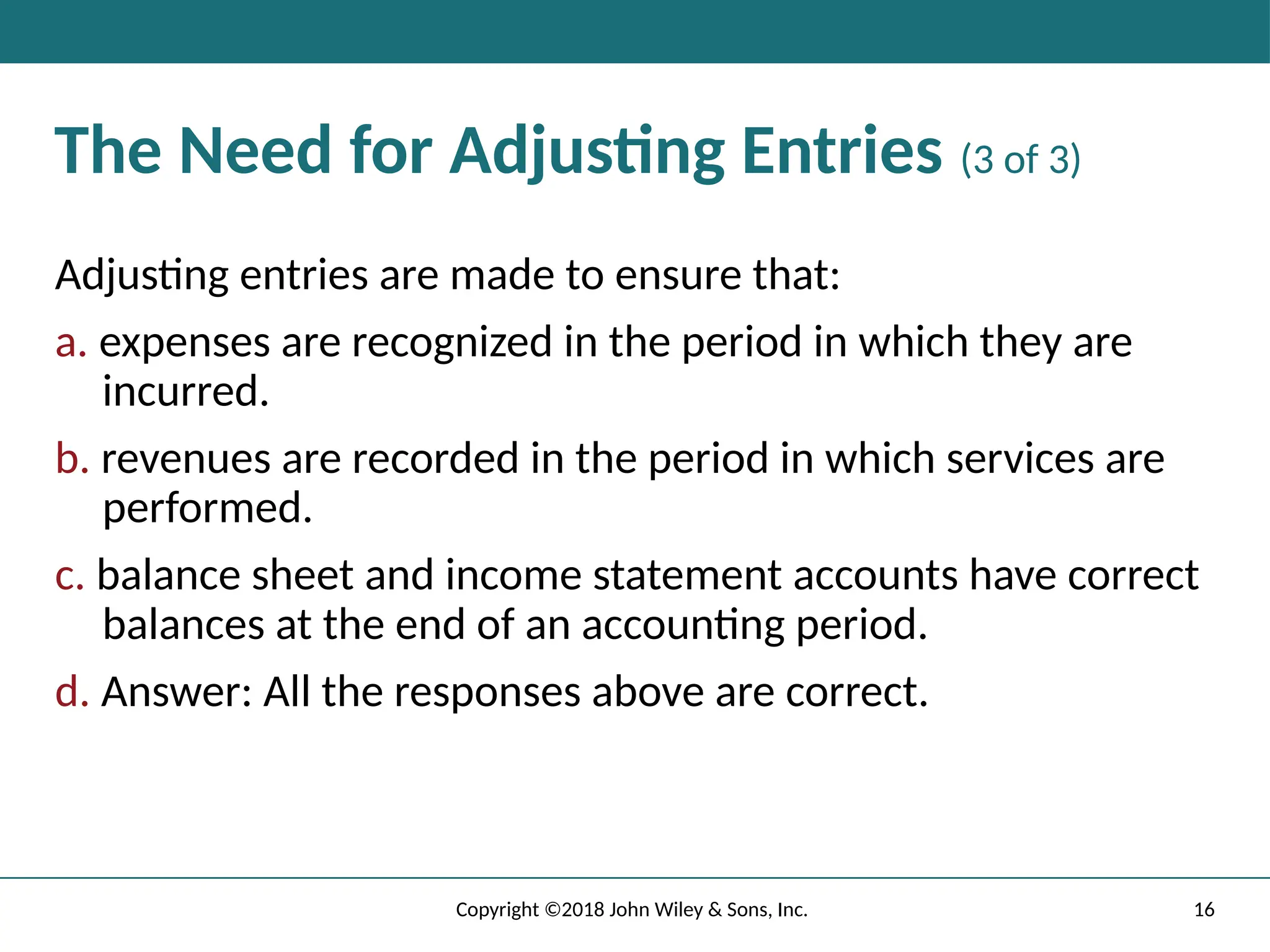
Adjusting entries are made to ensure that:
a. expenses are recognized in the period in which they are
incurred.
b. revenues are recorded in the period in which services are
performed.
c. balance sheet and income statement accounts have correct
balances at the end of an accounting period.
d. All the responses above are correct.
16. 16
Copyright ©2018 John Wiley & Sons, Inc.
The Need for Adjusting Entries (3 of 3)
Adjusting entries are made to ensure that:
a. expenses are recognized in the period in which they are
incurred.
b. revenues are recorded in the period in which services are
performed.
c. balance sheet and income statement accounts have correct
balances at the end of an accounting period.
d. Answer: All the responses above are correct.
17. 17
Copyright ©2018 John Wiley & Sons, Inc.
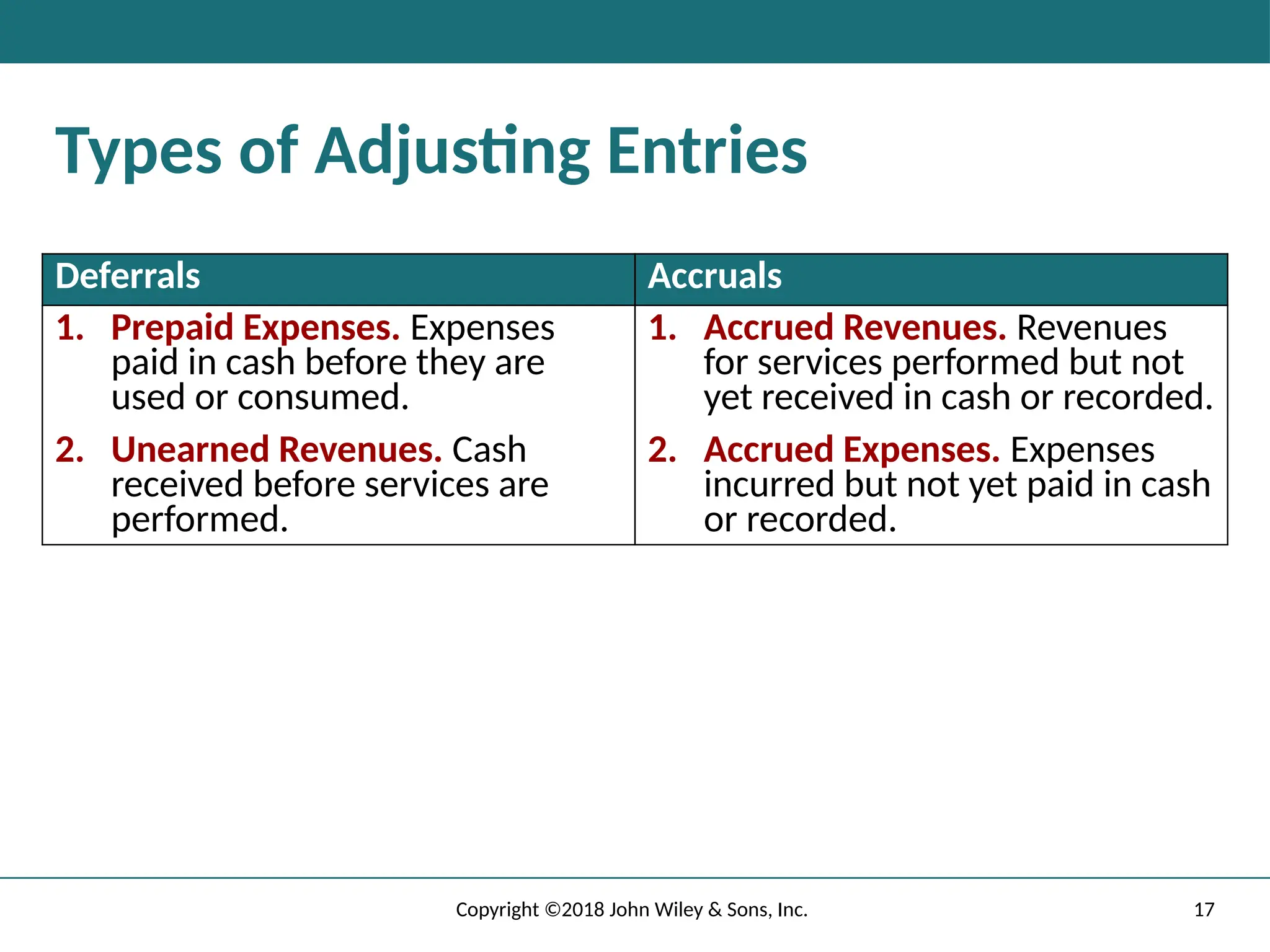
Types of Adjusting Entries
Deferrals Accruals
1. Prepaid Expenses. Expenses
paid in cash before they are
used or consumed.
2. Unearned Revenues. Cash
received before services are
performed.
1. Accrued Revenues. Revenues
for services performed but not
yet received in cash or recorded.
2. Accrued Expenses. Expenses
incurred but not yet paid in cash
or recorded.
18. 18
Copyright ©2018 John Wiley & Sons, Inc.
Do It! 1: Timing Concepts (1 of 2)
Below is a list of timing concepts in the
left column, with a description of the
concept in the right column. There are
more descriptions provided than
concepts. Match the description to the
concept
1. [blank] Accrual-basis accounting.
2. [blank] Calendar year.
3. [blank] Time period assumption.
4. [blank] Expense recognition principle.
(a) Monthly and quarterly time periods.
(b) Efforts (expenses) should be recognized in the
period in which a company uses assets or
incurs liabilities to generate results
(revenues).
(c) Accountants divide the economic life of a
business into artificial time periods.
(d) Companies record revenues when they
receive cash and record expenses when they
pay out cash.
(e) An accounting time period that starts on
January 1 and ends on December 31.
(f) Companies record transactions in the period in
which the events occur.
19. 19
Copyright ©2018 John Wiley & Sons, Inc.
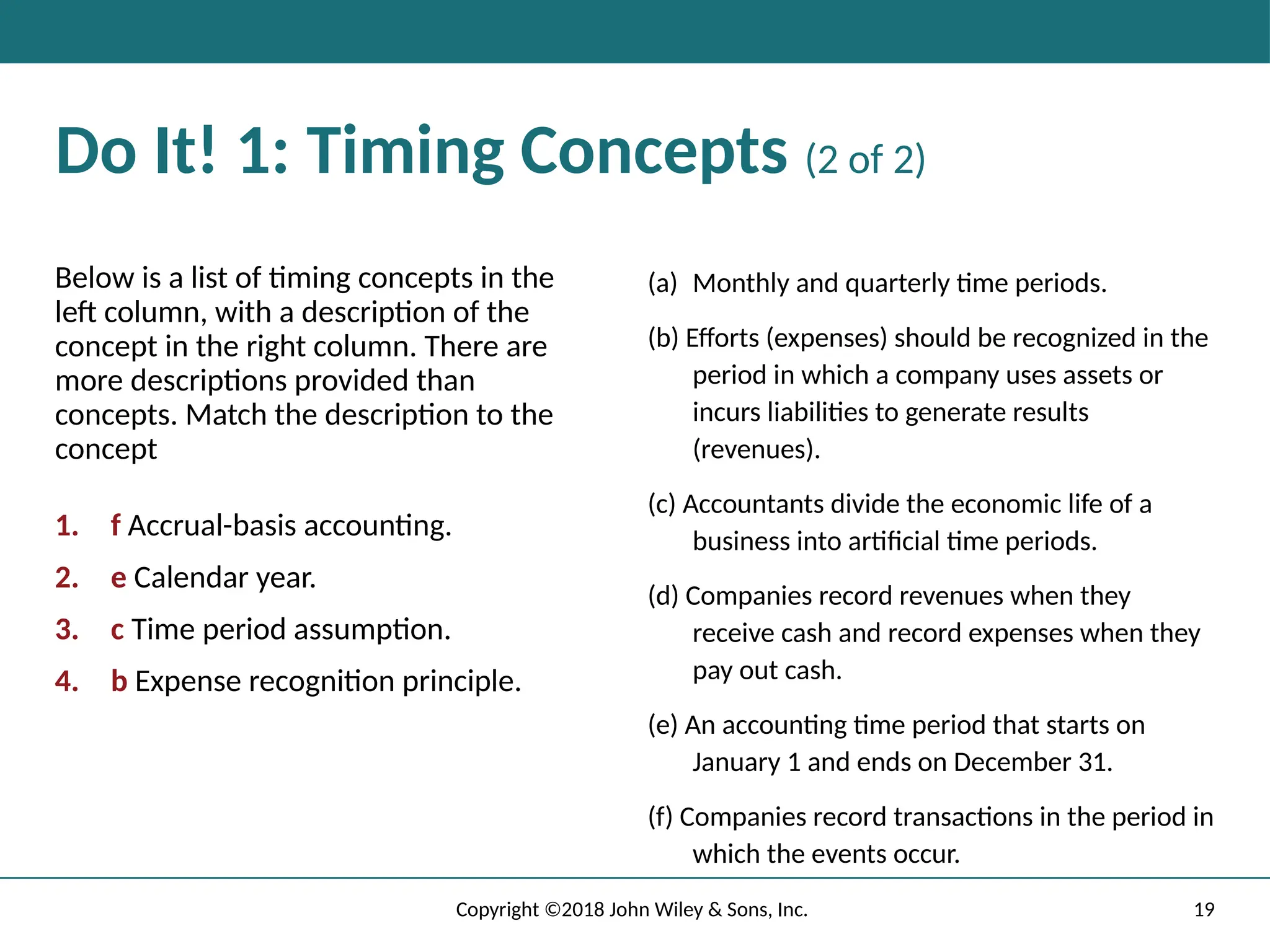
Do It! 1: Timing Concepts (2 of 2)
Below is a list of timing concepts in the
left column, with a description of the
concept in the right column. There are
more descriptions provided than
concepts. Match the description to the
concept
1. f Accrual-basis accounting.
2. e Calendar year.
3. c Time period assumption.
4. b Expense recognition principle.
(a) Monthly and quarterly time periods.
(b) Efforts (expenses) should be recognized in the
period in which a company uses assets or
incurs liabilities to generate results
(revenues).
(c) Accountants divide the economic life of a
business into artificial time periods.
(d) Companies record revenues when they
receive cash and record expenses when they
pay out cash.
(e) An accounting time period that starts on
January 1 and ends on December 31.
(f) Companies record transactions in the period in
which the events occur.
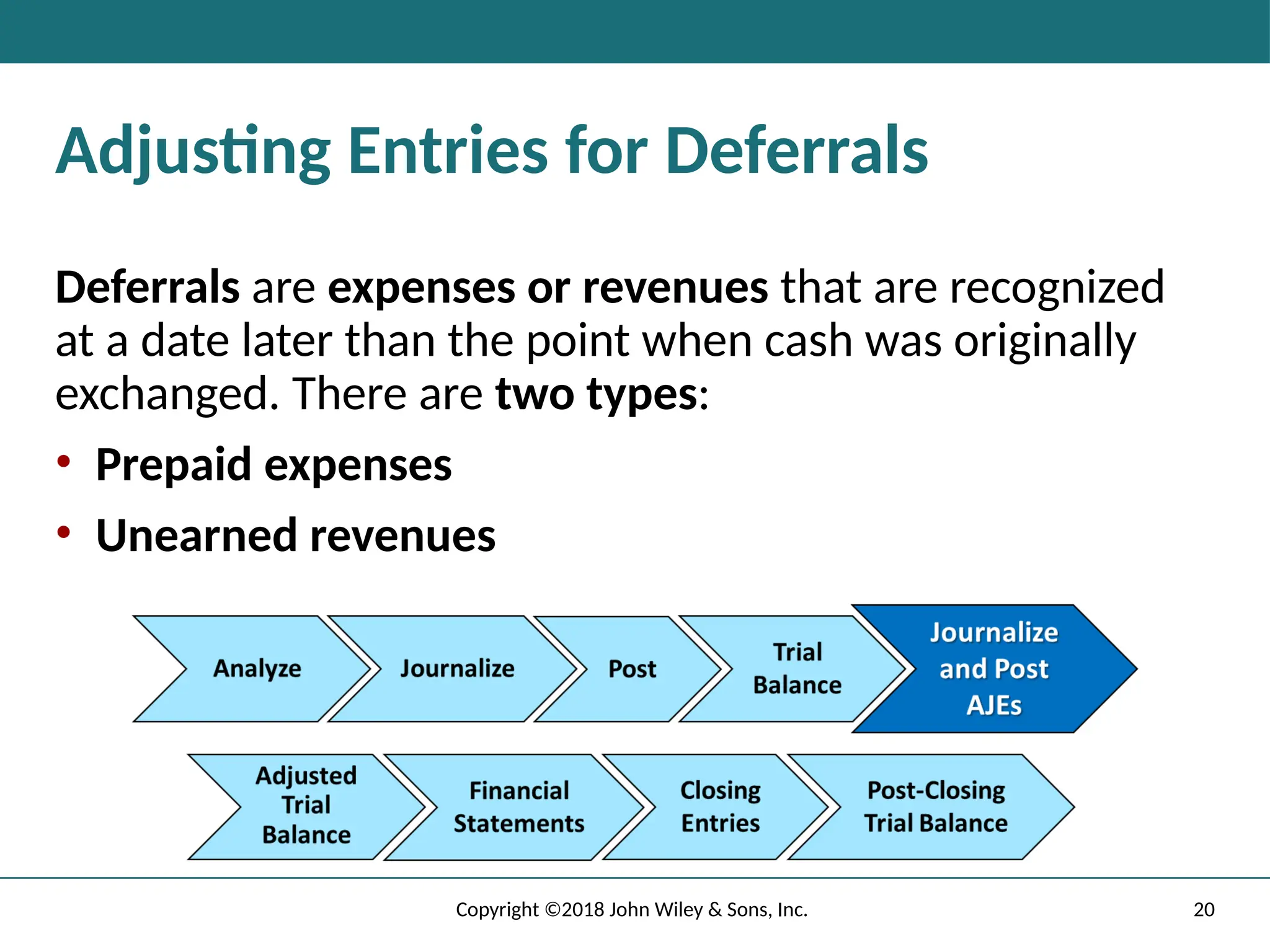
20. 20
Copyright ©2018 John Wiley & Sons, Inc.
Adjusting Entries for Deferrals
Deferrals are expenses or revenues that are recognized
at a date later than the point when cash was originally
exchanged. There are two types:
• Prepaid expenses
• Unearned revenues
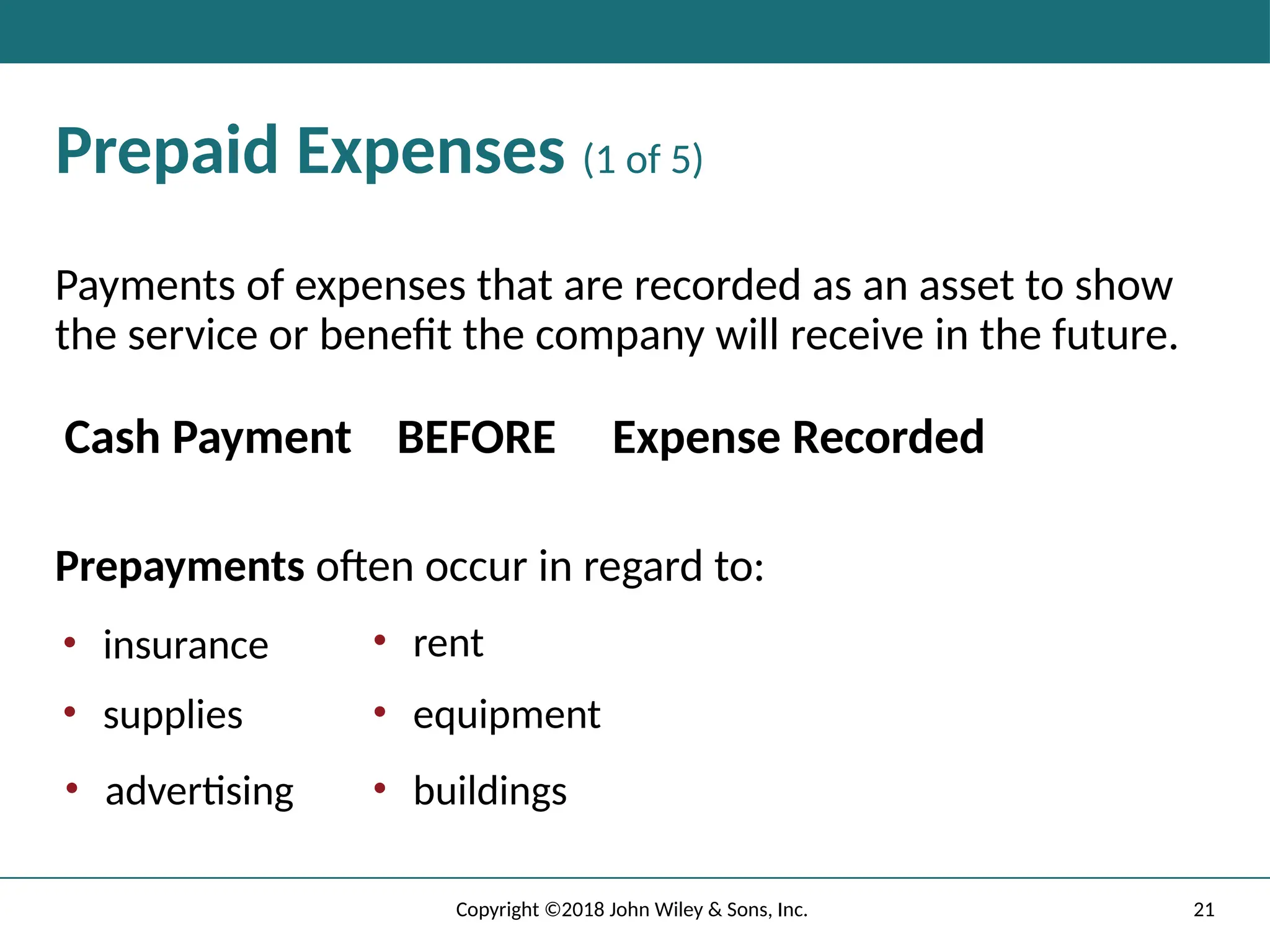
21. 21
Copyright ©2018 John Wiley & Sons, Inc.
Prepaid Expenses (1 of 5)
Payments of expenses that are recorded as an asset to show
the service or benefit the company will receive in the future.
Cash Payment BEFORE Expense Recorded
Prepayments often occur in regard to:
• insurance
• supplies
• advertising
• rent
• equipment
• buildings
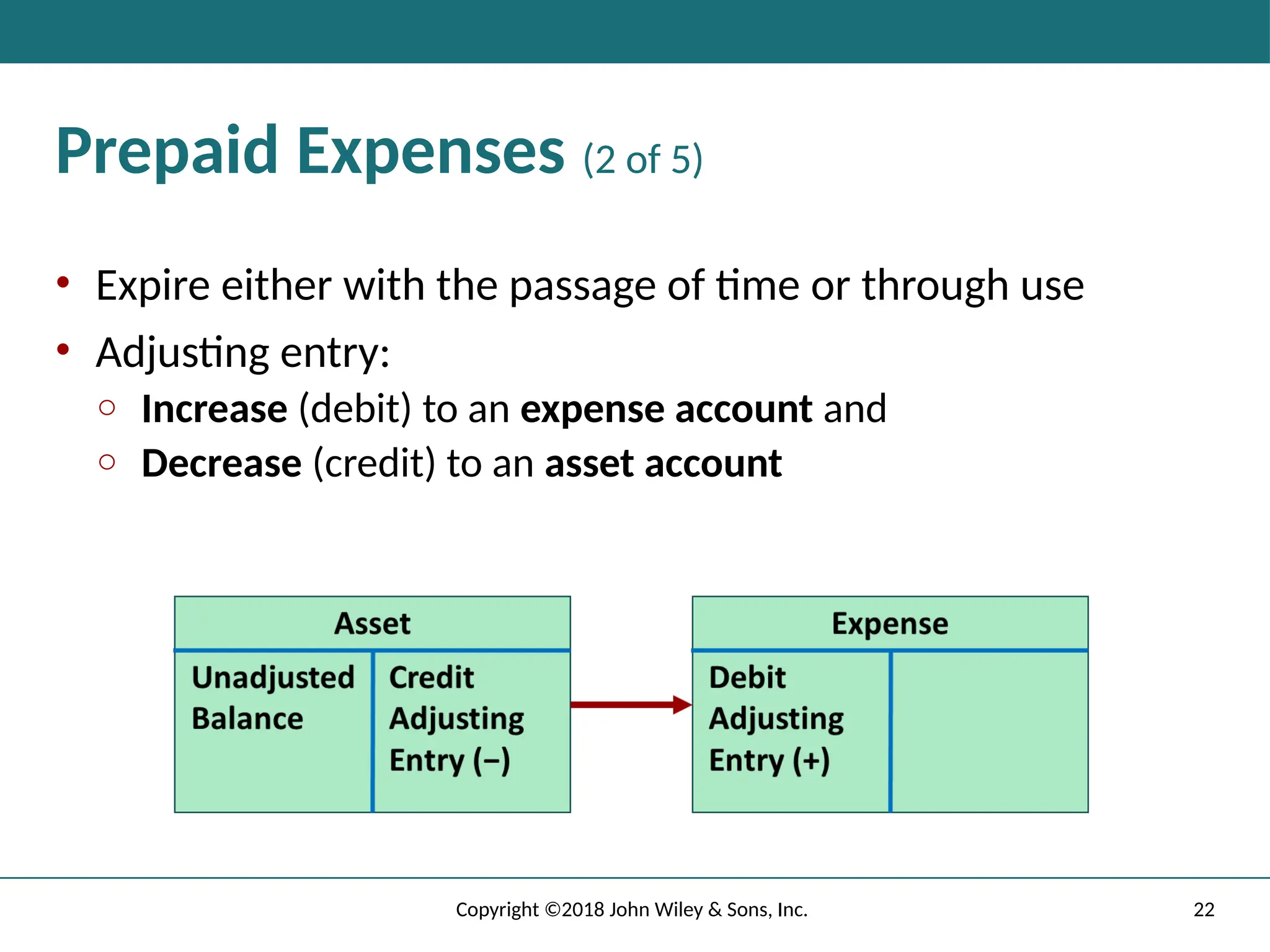
22. 22
Copyright ©2018 John Wiley & Sons, Inc.
Prepaid Expenses (2 of 5)
• Expire either with the passage of time or through use
• Adjusting entry:
o Increase (debit) to an expense account and
o Decrease (credit) to an asset account
23. 24. 24
Copyright ©2018 John Wiley & Sons, Inc.
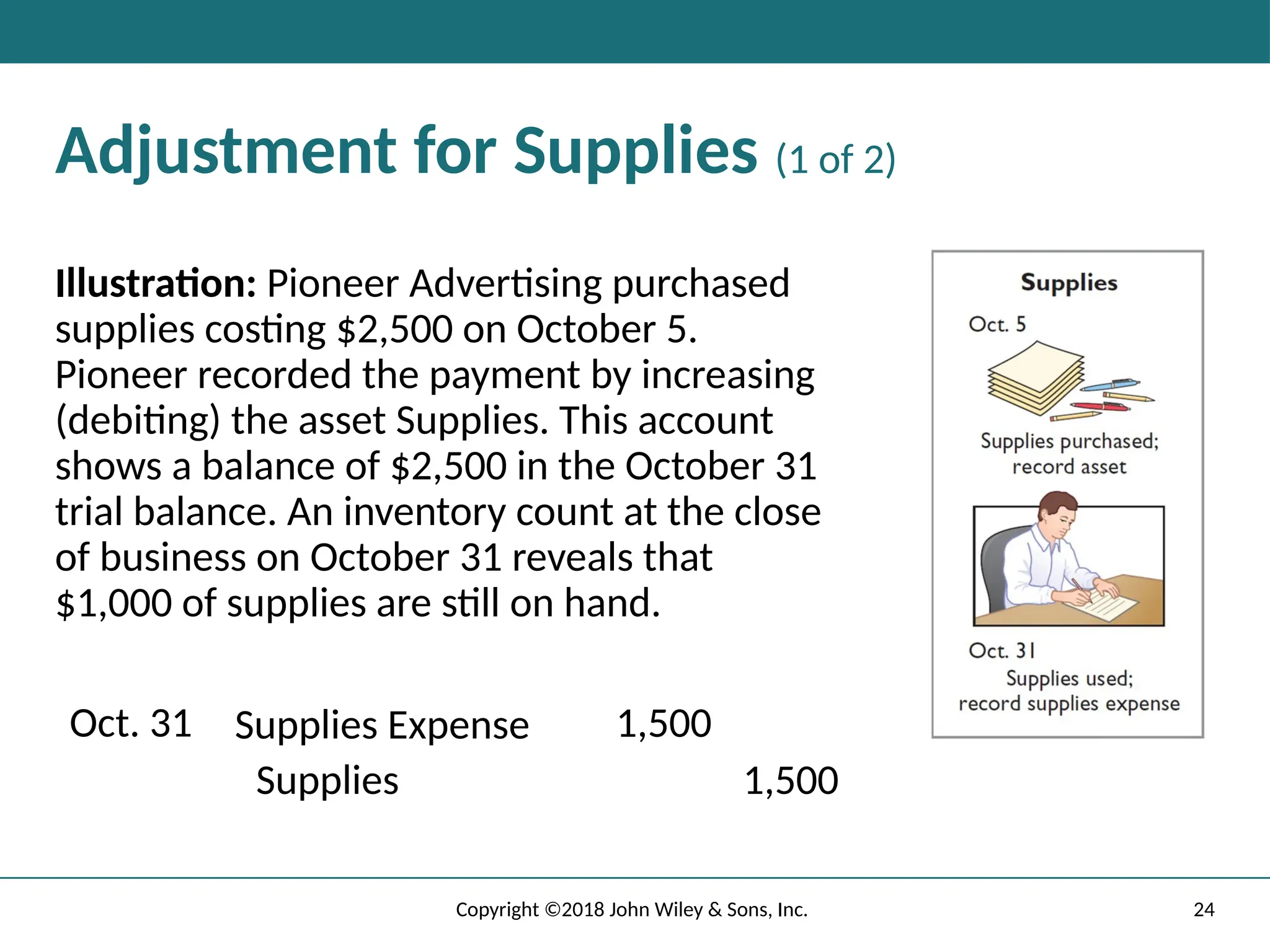
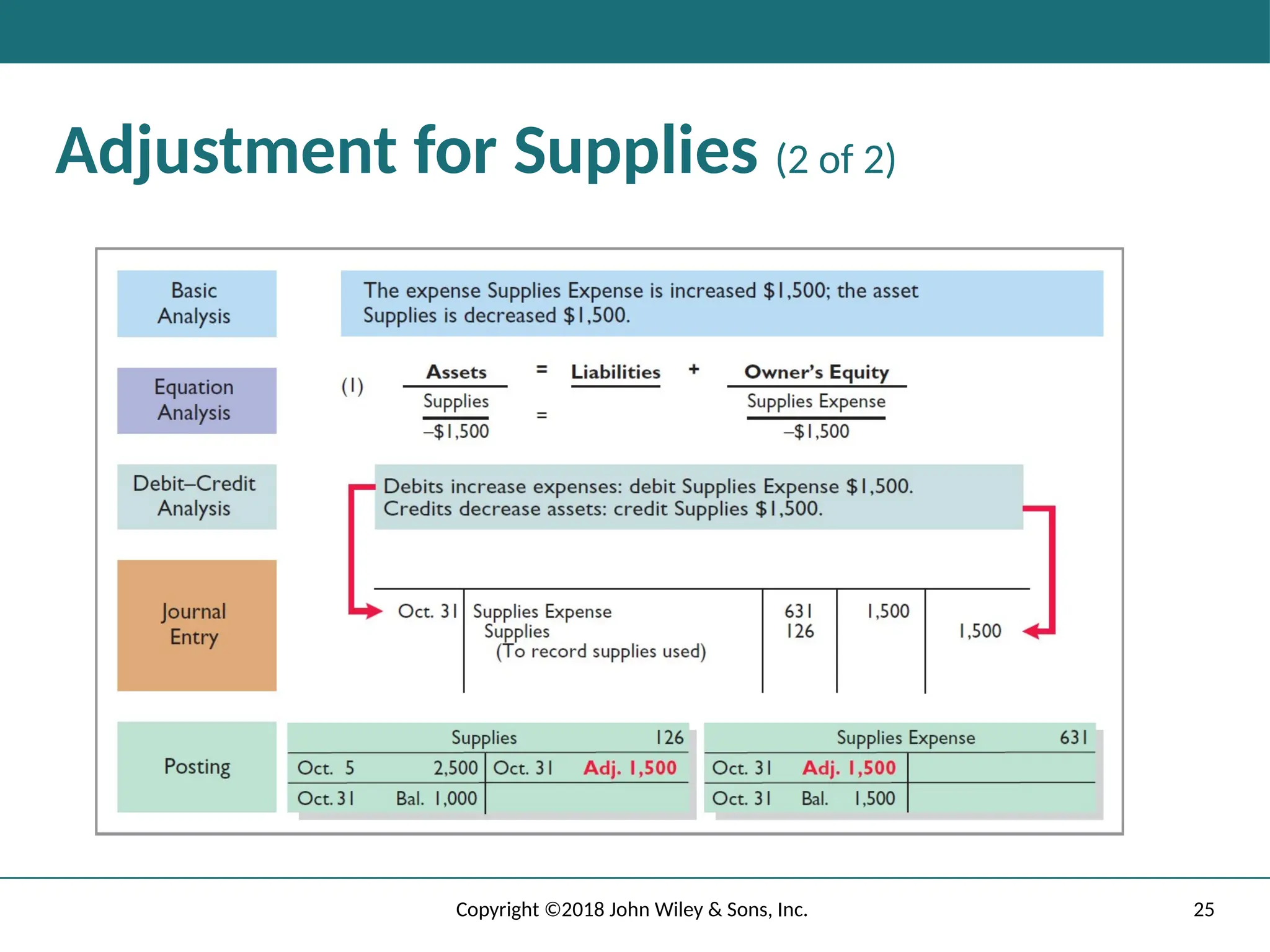
Adjustment for Supplies (1 of 2)
Illustration: Pioneer Advertising purchased
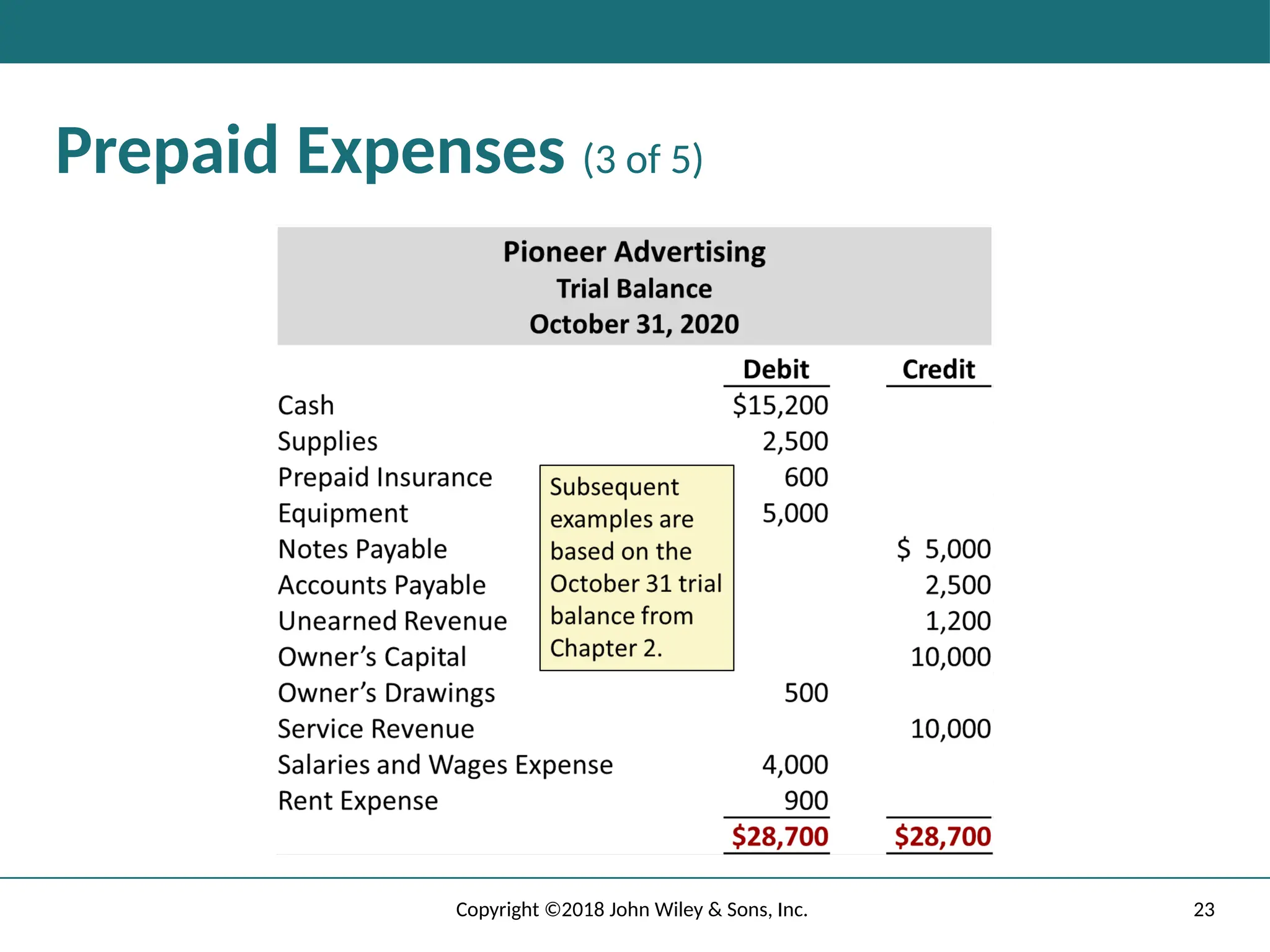
supplies costing $2,500 on October 5.
Pioneer recorded the payment by increasing
(debiting) the asset Supplies. This account
shows a balance of $2,500 in the October 31
trial balance. An inventory count at the close
of business on October 31 reveals that
$1,000 of supplies are still on hand.
Oct. 31 Supplies Expense 1,500
Supplies 1,500
25. 26. 26
Copyright ©2018 John Wiley & Sons, Inc.
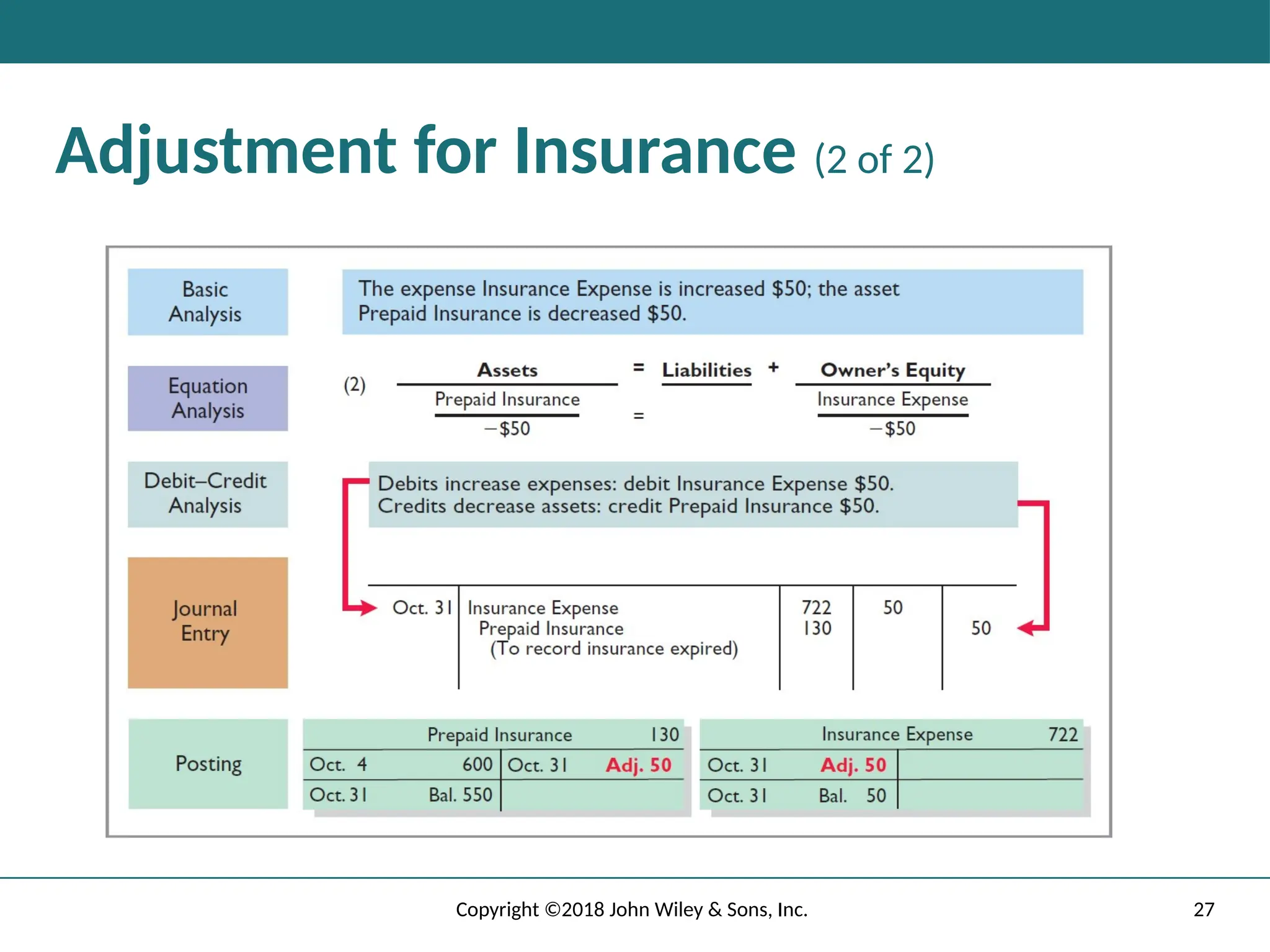
Adjustment for Insurance (1 of 2)
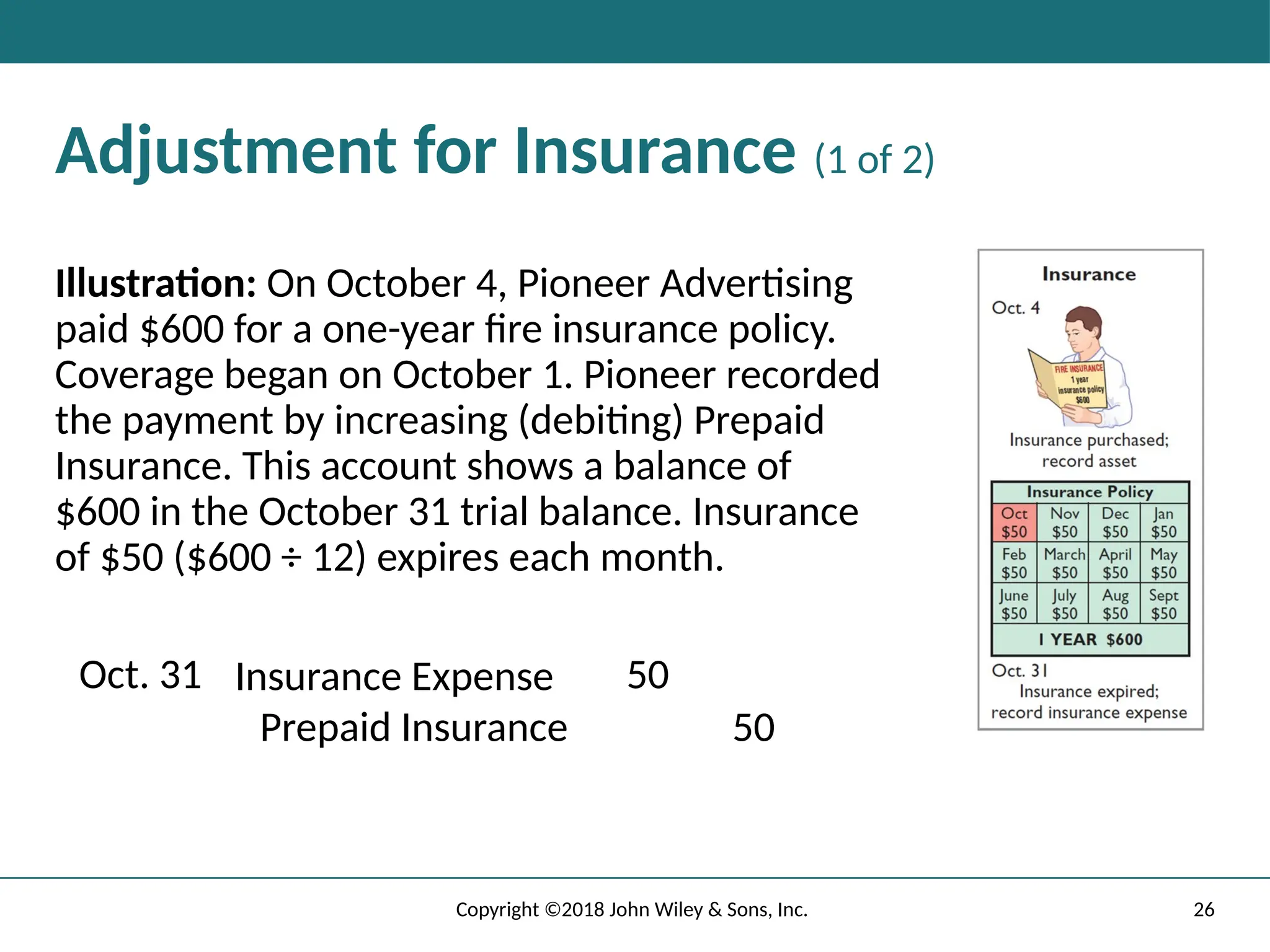
Illustration: On October 4, Pioneer Advertising
paid $600 for a one-year fire insurance policy.
Coverage began on October 1. Pioneer recorded
the payment by increasing (debiting) Prepaid
Insurance. This account shows a balance of
$600 in the October 31 trial balance. Insurance
of $50 ($600 ÷ 12) expires each month.
Oct. 31 Insurance Expense 50
Prepaid Insurance 50
27. 28. 28
Copyright ©2018 John Wiley & Sons, Inc.
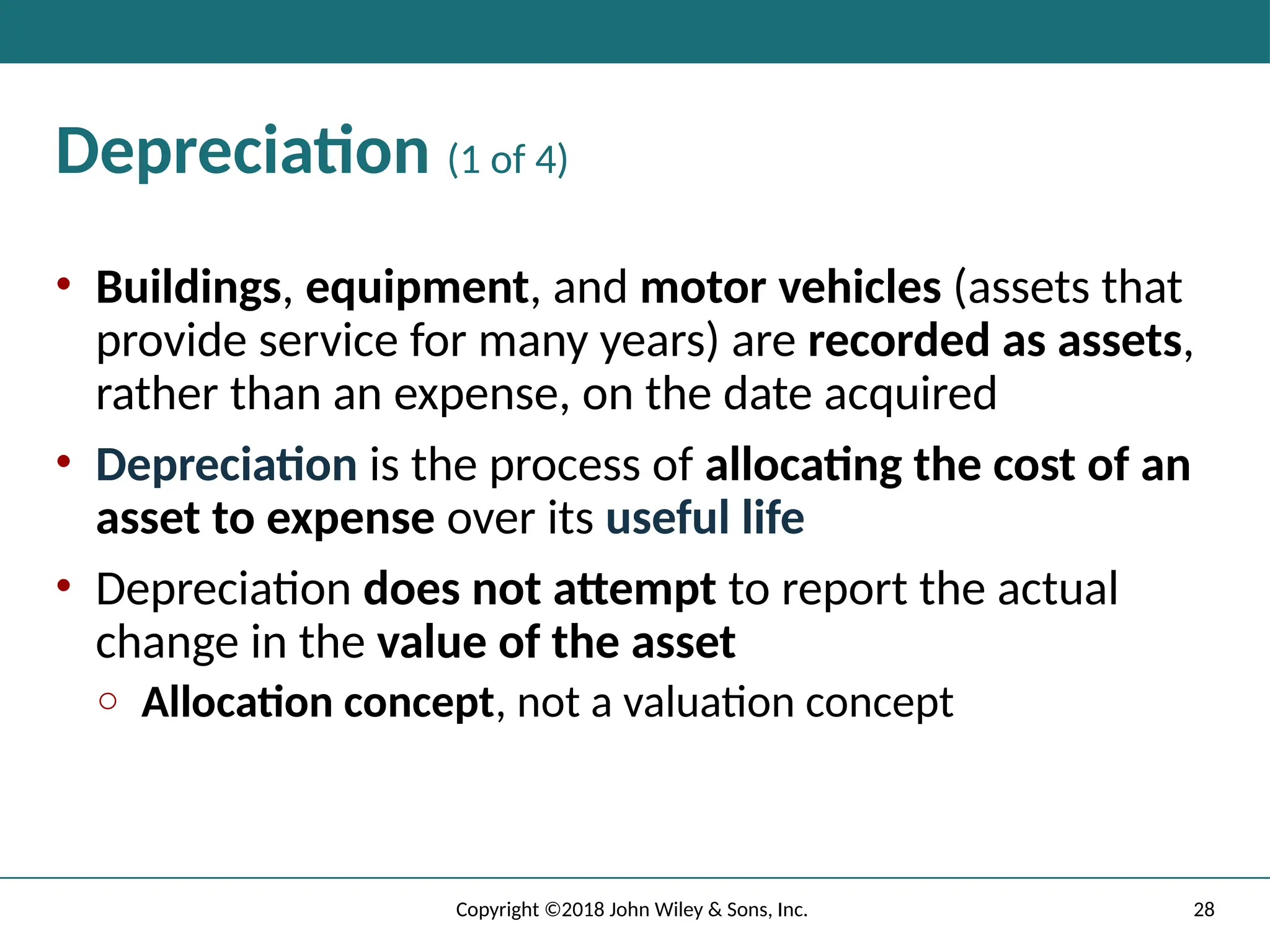
Depreciation (1 of 4)
• Buildings, equipment, and motor vehicles (assets that
provide service for many years) are recorded as assets,
rather than an expense, on the date acquired
• Depreciation is the process of allocating the cost of an
asset to expense over its useful life
• Depreciation does not attempt to report the actual
change in the value of the asset
o Allocation concept, not a valuation concept
29. 29
Copyright ©2018 John Wiley & Sons, Inc.
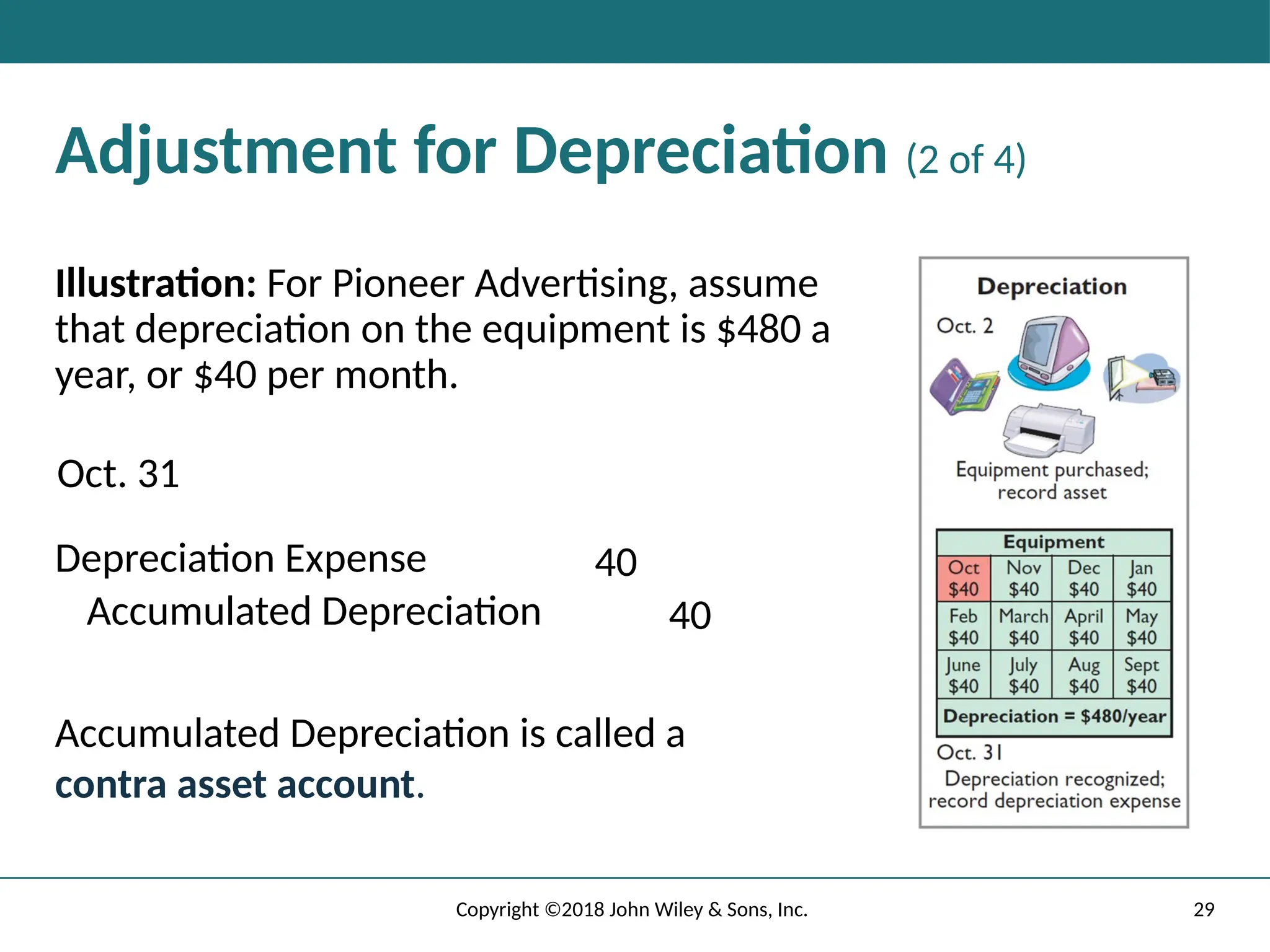
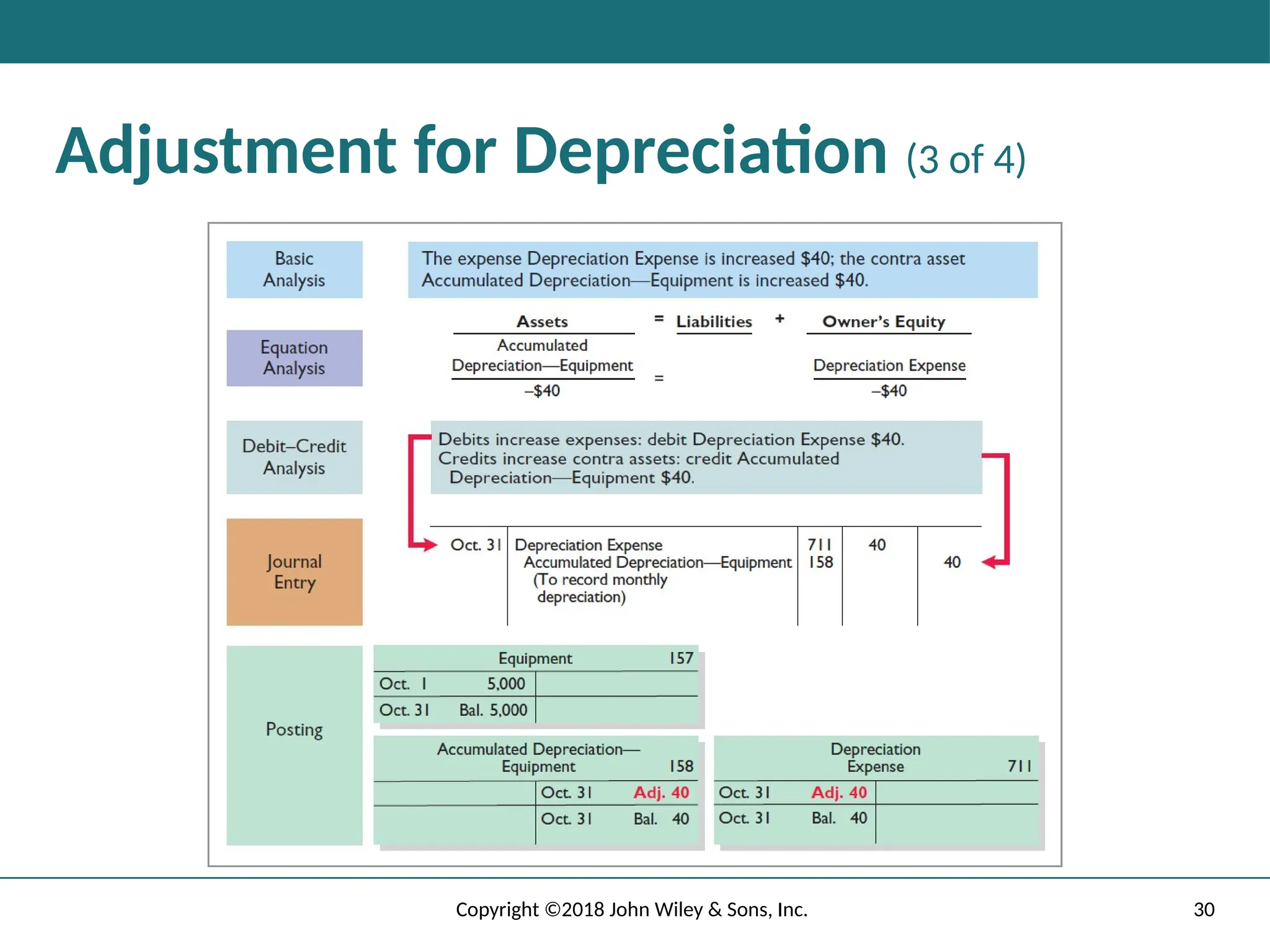
Adjustment for Depreciation (2 of 4)
Illustration: For Pioneer Advertising, assume
that depreciation on the equipment is $480 a
year, or $40 per month.
Oct. 31
Depreciation Expense 40
Accumulated Depreciation 40
Accumulated Depreciation is called a
contra asset account.
30. 31. 31
Copyright ©2018 John Wiley & Sons, Inc.
Depreciation (4 of 4)
Statement Presentation
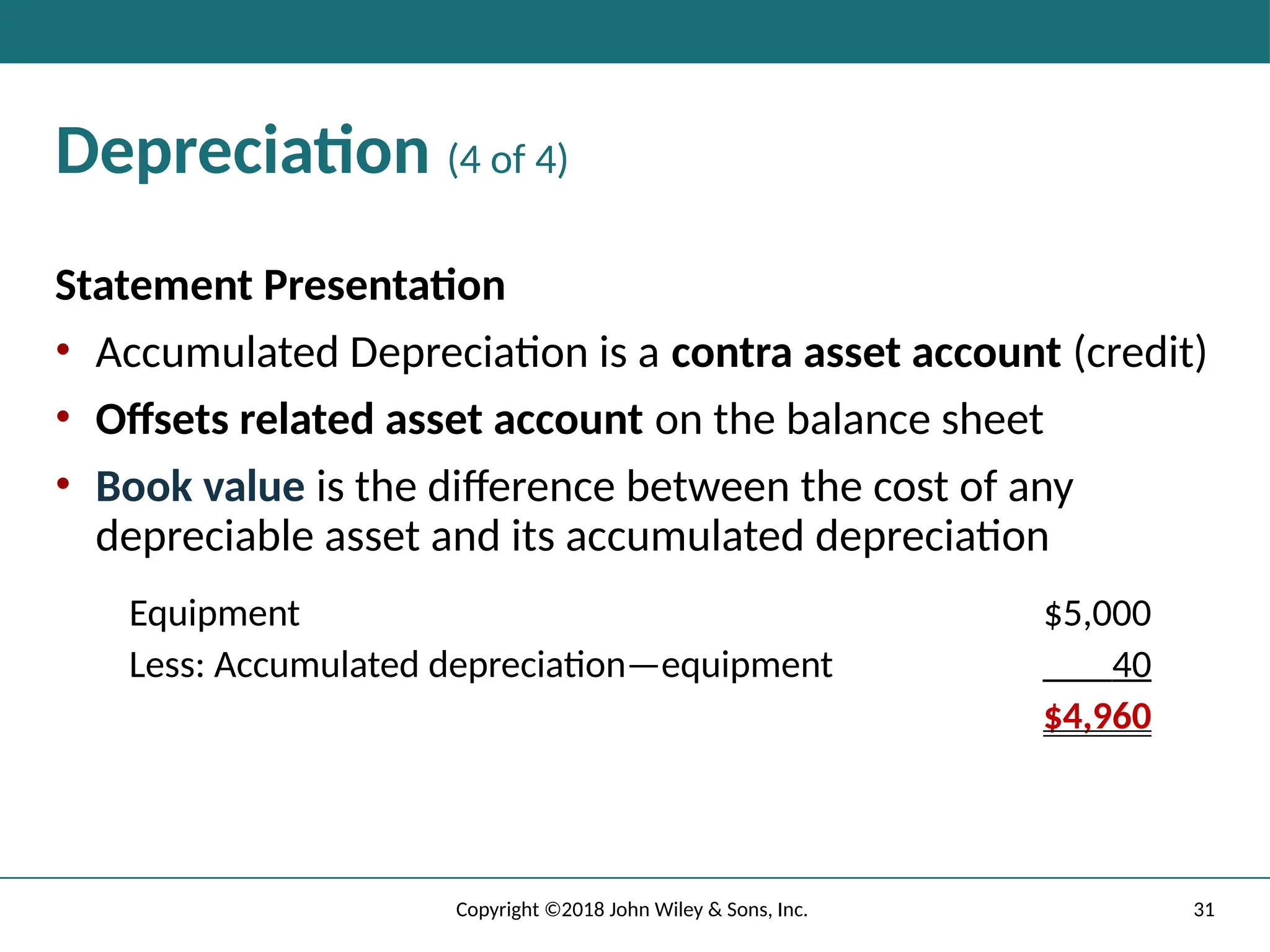
• Accumulated Depreciation is a contra asset account (credit)
• Offsets related asset account on the balance sheet
• Book value is the difference between the cost of any
depreciable asset and its accumulated depreciation
Equipment $5,000
Less: Accumulated depreciation—equipment 40
$4,960
32. 32
Copyright ©2018 John Wiley & Sons, Inc.
Prepaid Expenses (4 of 5)
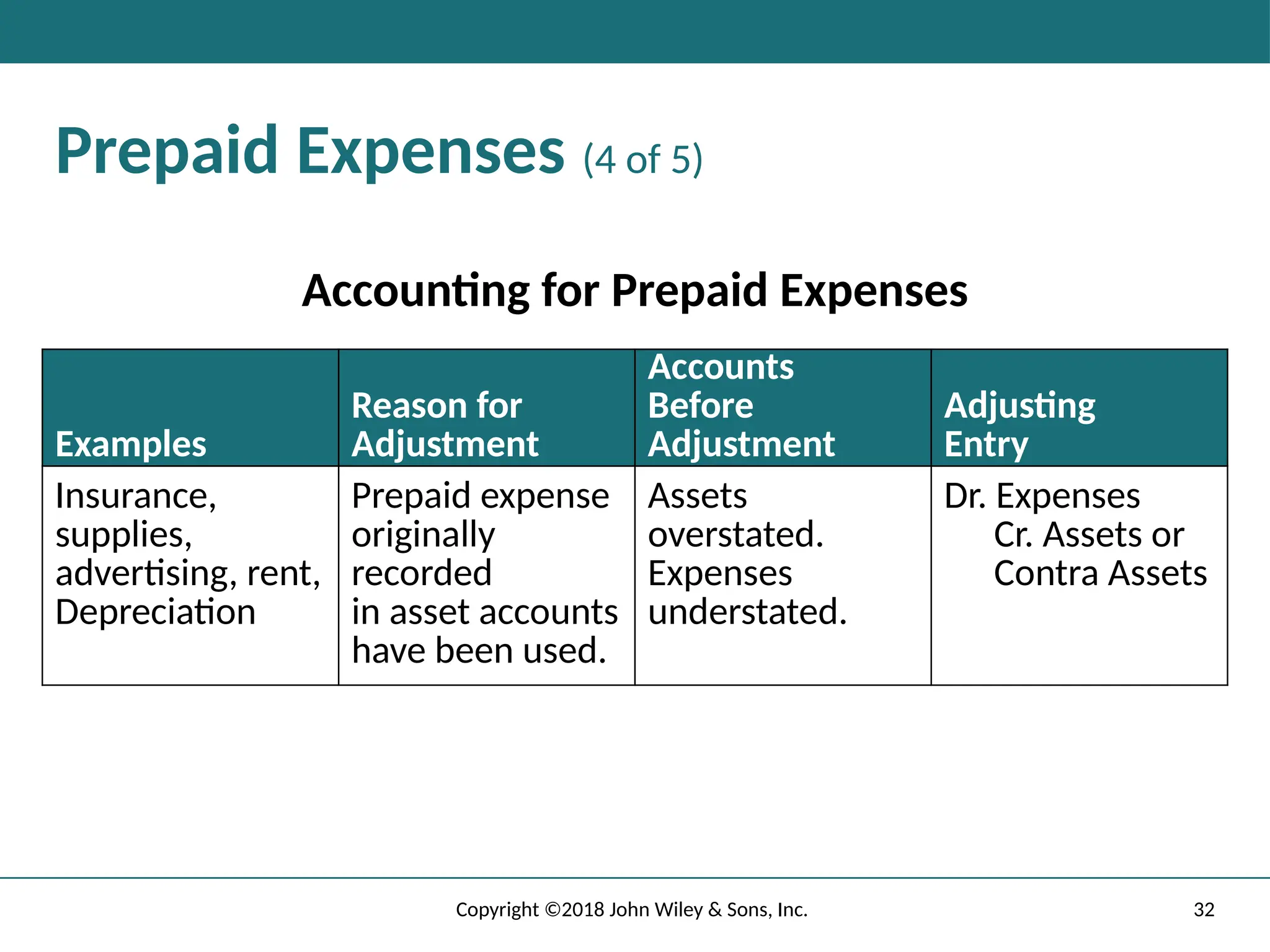
Accounting for Prepaid Expenses
Examples
Reason for
Adjustment
Accounts
Before
Adjustment
Adjusting
Entry
Insurance,
supplies,
advertising, rent,
Depreciation
Prepaid expense
originally
recorded
in asset accounts
have been used.
Assets
overstated.
Expenses
understated.
Dr. Expenses
Cr. Assets or
Contra Assets
33. 33
Copyright ©2018 John Wiley & Sons, Inc.
Unearned Revenues (1 of 5)
Receipt of cash that is recorded as a liability because the
service has not been performed.
Cash receipt BEFORE revenue recorded
Unearned revenues often occur in regard to:
• Rent
• Airline tickets
• Magazine subscriptions
• Customer deposits
34. 34
Copyright ©2018 John Wiley & Sons, Inc.
Unearned Revenues (2 of 5)
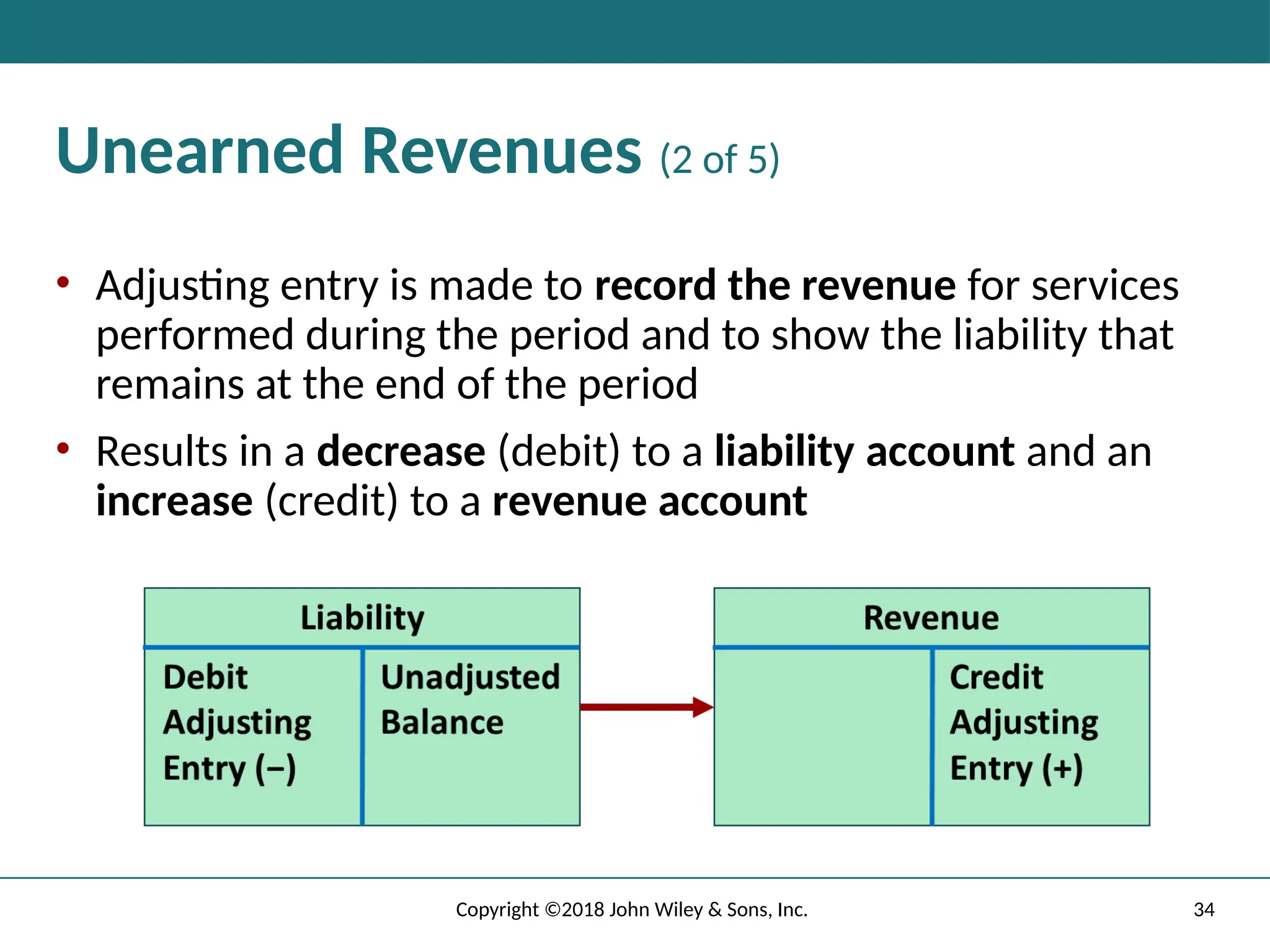
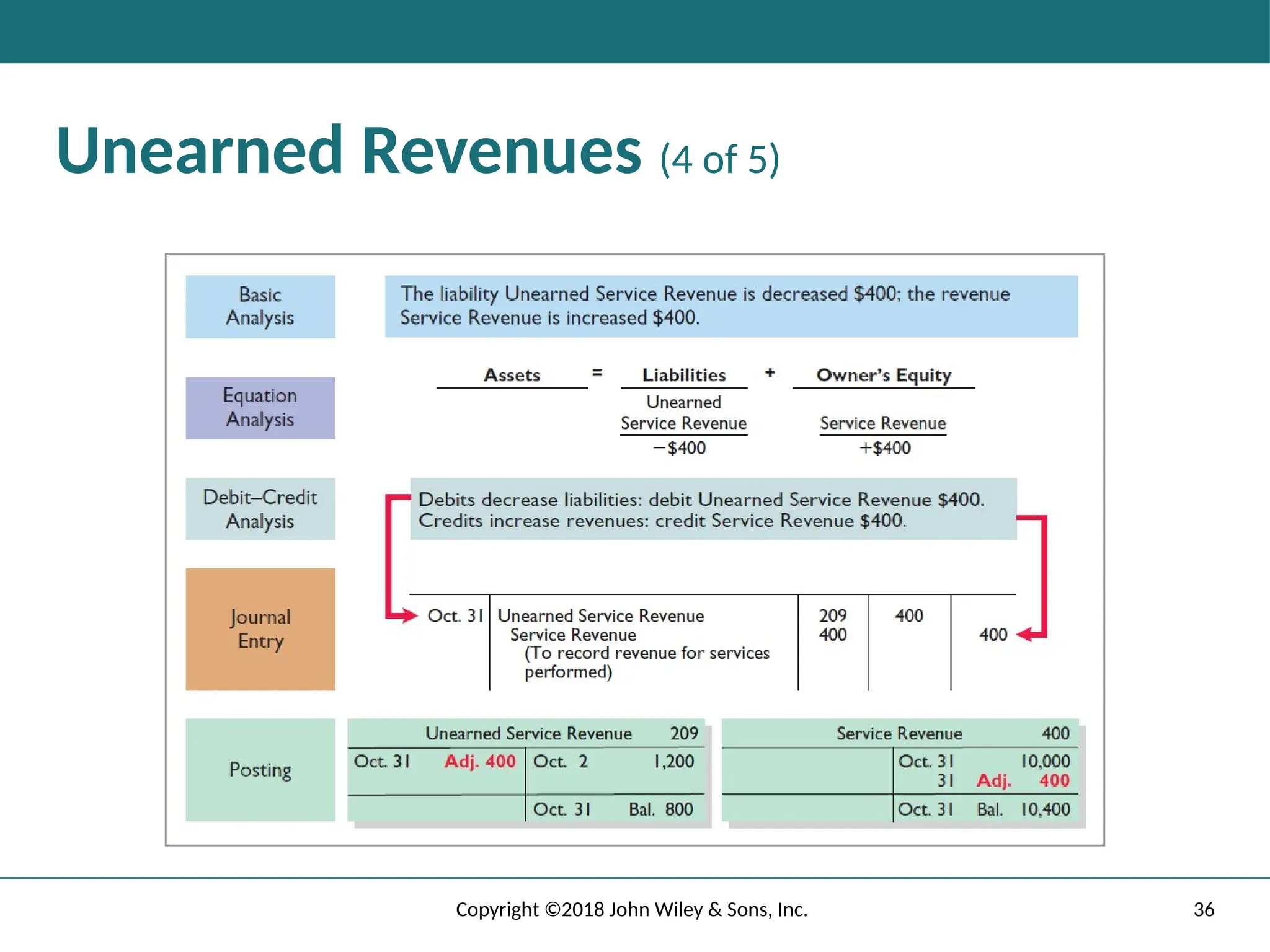
• Adjusting entry is made to record the revenue for services
performed during the period and to show the liability that
remains at the end of the period
• Results in a decrease (debit) to a liability account and an
increase (credit) to a revenue account
35. 35
Copyright ©2018 John Wiley & Sons, Inc.
Unearned Revenues (3 of 5)
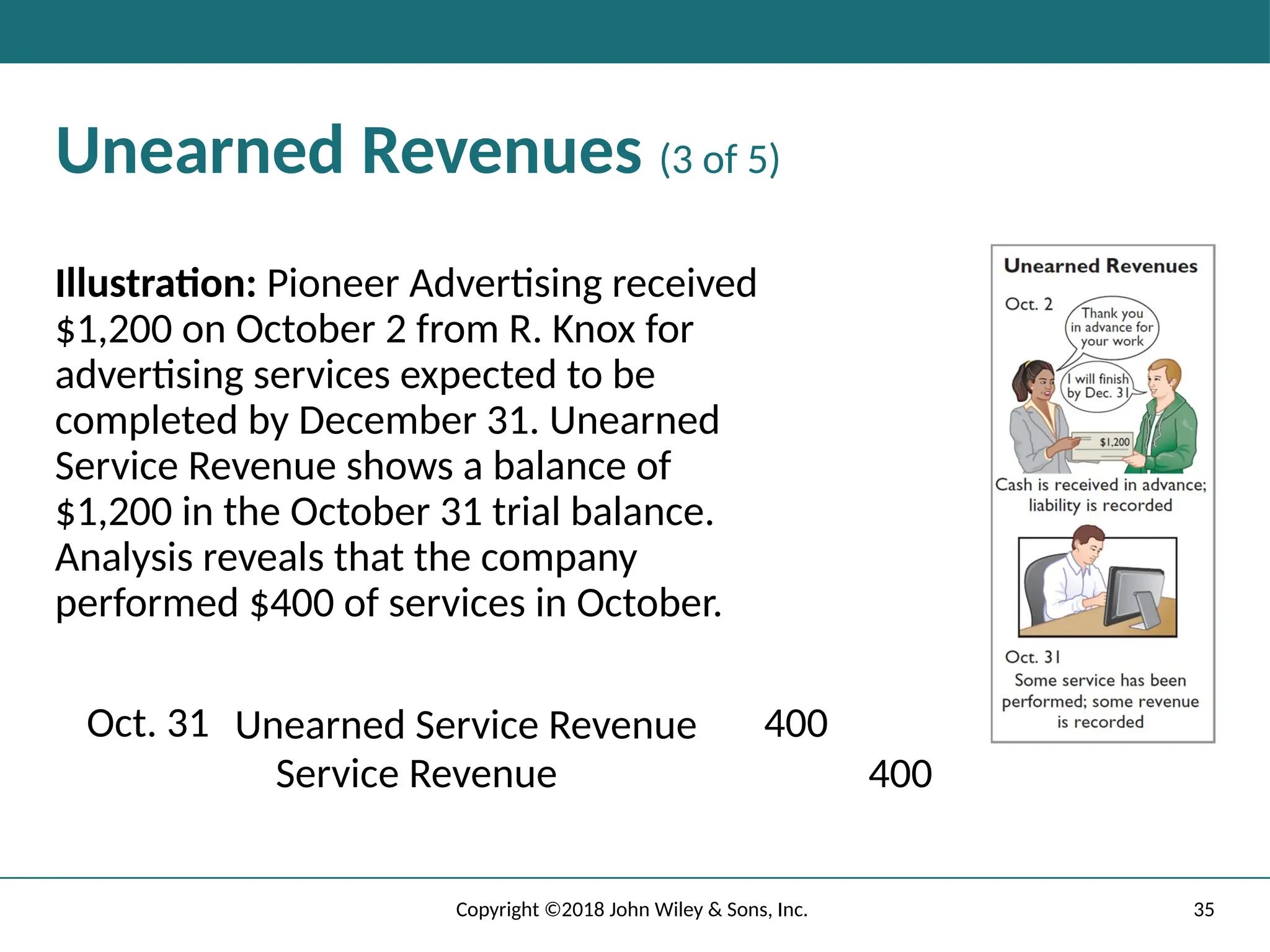
Illustration: Pioneer Advertising received
$1,200 on October 2 from R. Knox for
advertising services expected to be
completed by December 31. Unearned
Service Revenue shows a balance of
$1,200 in the October 31 trial balance.
Analysis reveals that the company
performed $400 of services in October.
Oct. 31 Unearned Service Revenue 400
Service Revenue 400
36. 37. 37
Copyright ©2018 John Wiley & Sons, Inc.
Unearned Revenues (5 of 5)
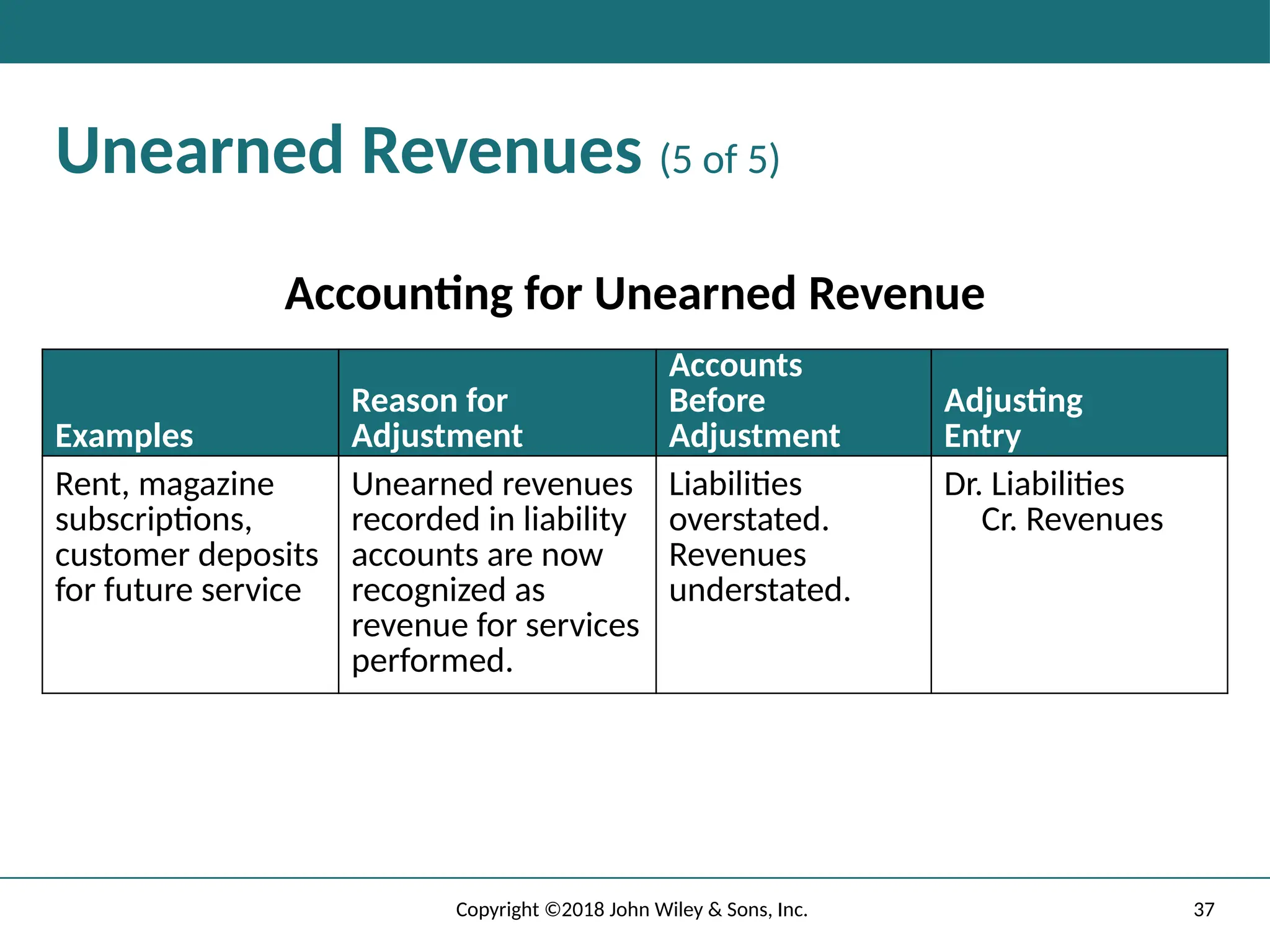
Accounting for Unearned Revenue
Examples
Reason for
Adjustment
Accounts
Before
Adjustment
Adjusting
Entry
Rent, magazine
subscriptions,
customer deposits
for future service
Unearned revenues
recorded in liability
accounts are now
recognized as
revenue for services
performed.
Liabilities
overstated.
Revenues
understated.
Dr. Liabilities
Cr. Revenues
38. 38
Copyright ©2018 John Wiley & Sons, Inc.
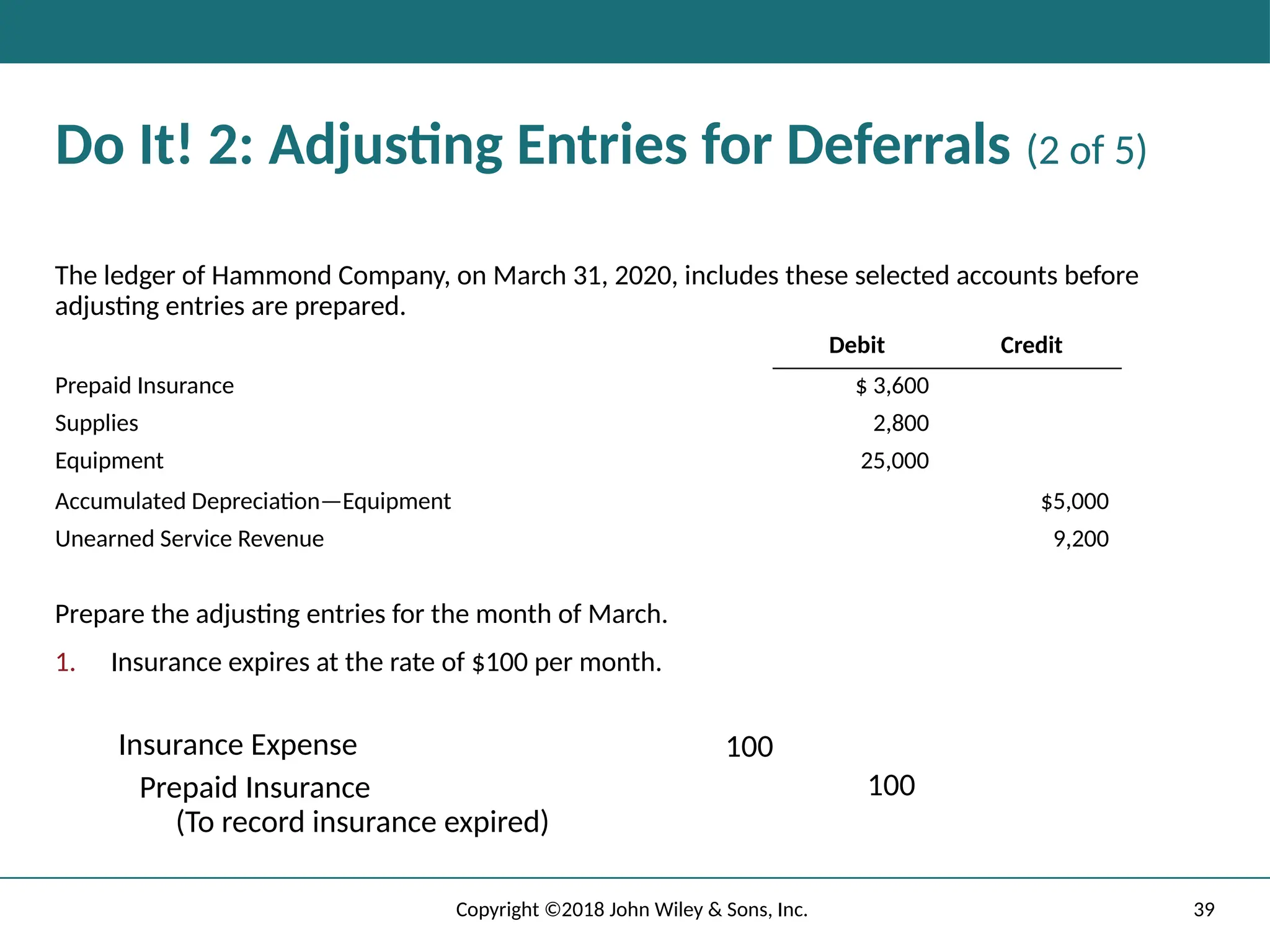
Do It! 2: Adjusting Entries for Deferrals (1 of 5)
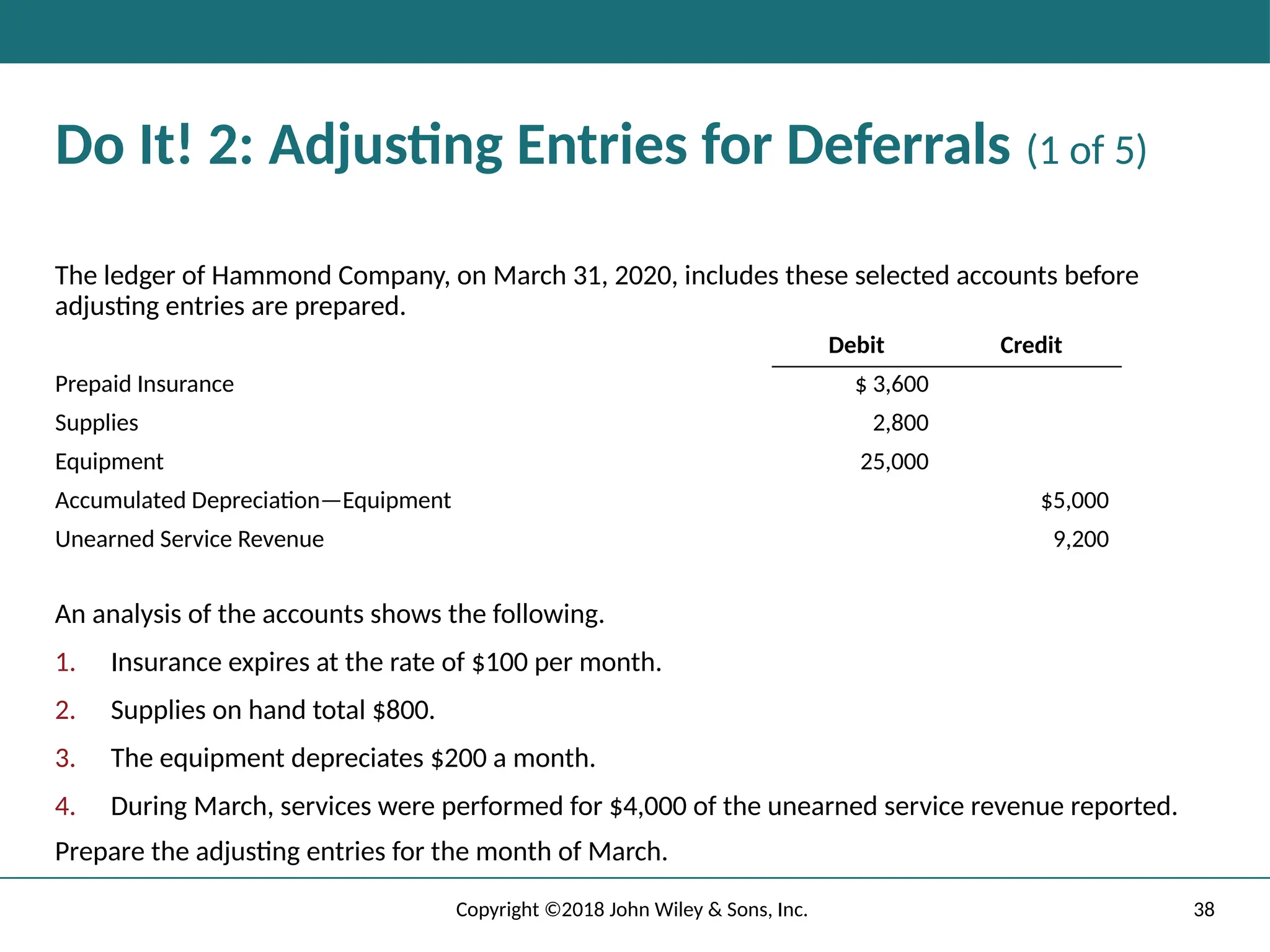
The ledger of Hammond Company, on March 31, 2020, includes these selected accounts before
adjusting entries are prepared.
Debit Credit
Prepaid Insurance $ 3,600
Supplies 2,800
Equipment 25,000
Accumulated Depreciation—Equipment $5,000
Unearned Service Revenue 9,200
An analysis of the accounts shows the following.
1. Insurance expires at the rate of $100 per month.
2. Supplies on hand total $800.
3. The equipment depreciates $200 a month.
4. During March, services were performed for $4,000 of the unearned service revenue reported.
Prepare the adjusting entries for the month of March.
39. 39
Copyright ©2018 John Wiley & Sons, Inc.
Do It! 2: Adjusting Entries for Deferrals (2 of 5)
The ledger of Hammond Company, on March 31, 2020, includes these selected accounts before
adjusting entries are prepared.
Debit Credit
Prepaid Insurance $ 3,600
Supplies 2,800
Equipment 25,000
Accumulated Depreciation—Equipment $5,000
Unearned Service Revenue 9,200
Prepare the adjusting entries for the month of March.
1. Insurance expires at the rate of $100 per month.
Insurance Expense 100
Prepaid Insurance
(To record insurance expired)
100
40. 40
Copyright ©2018 John Wiley & Sons, Inc.
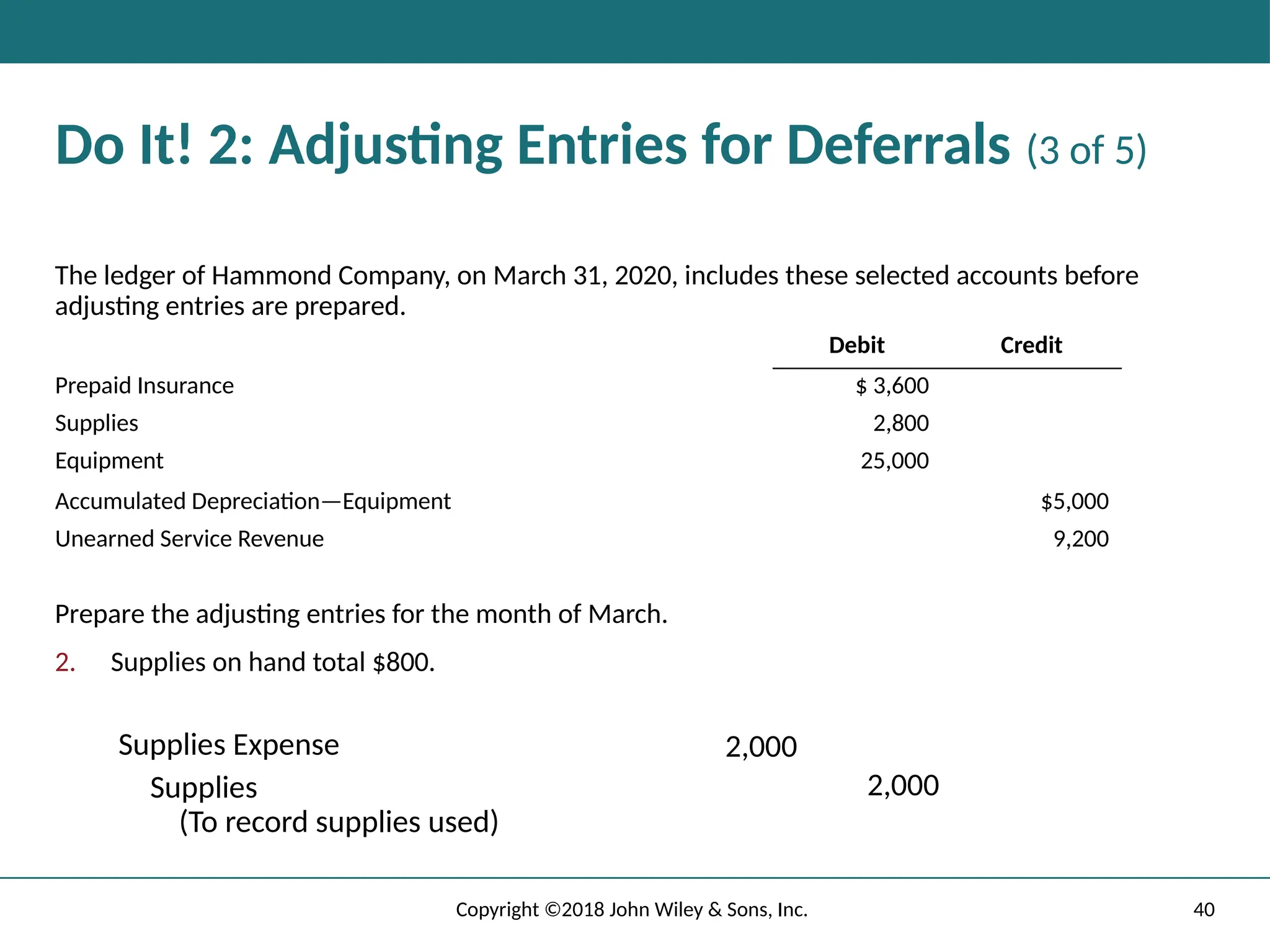
Do It! 2: Adjusting Entries for Deferrals (3 of 5)
The ledger of Hammond Company, on March 31, 2020, includes these selected accounts before
adjusting entries are prepared.
Debit Credit
Prepaid Insurance $ 3,600
Supplies 2,800
Equipment 25,000
Accumulated Depreciation—Equipment $5,000
Unearned Service Revenue 9,200
Prepare the adjusting entries for the month of March.
2. Supplies on hand total $800.
Supplies Expense 2,000
Supplies
(To record supplies used)
2,000
41. 41
Copyright ©2018 John Wiley & Sons, Inc.
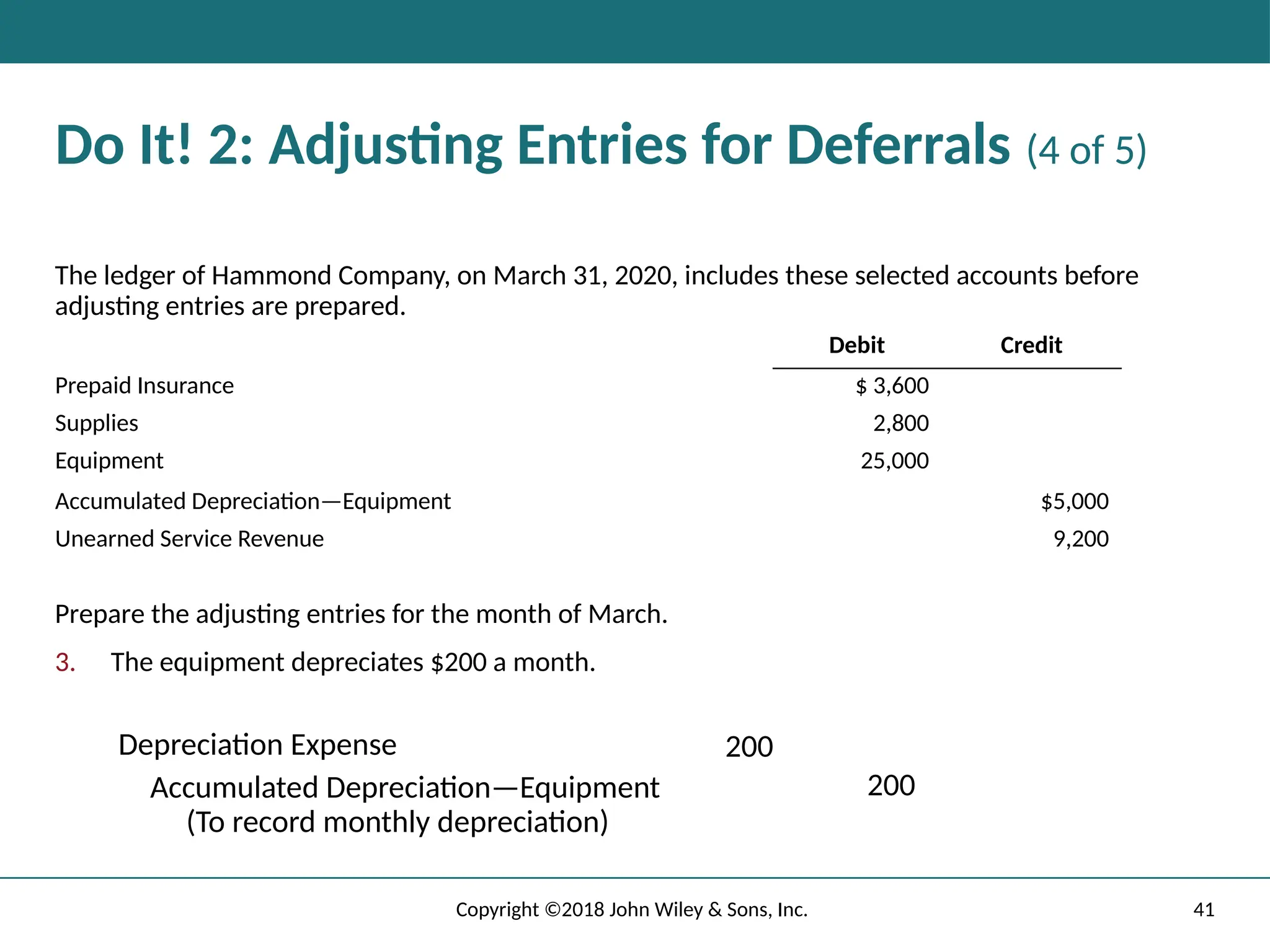
Do It! 2: Adjusting Entries for Deferrals (4 of 5)
The ledger of Hammond Company, on March 31, 2020, includes these selected accounts before
adjusting entries are prepared.
Debit Credit
Prepaid Insurance $ 3,600
Supplies 2,800
Equipment 25,000
Accumulated Depreciation—Equipment $5,000
Unearned Service Revenue 9,200
Prepare the adjusting entries for the month of March.
3. The equipment depreciates $200 a month.
Depreciation Expense 200
Accumulated Depreciation—Equipment
(To record monthly depreciation)
200
42. 42
Copyright ©2018 John Wiley & Sons, Inc.
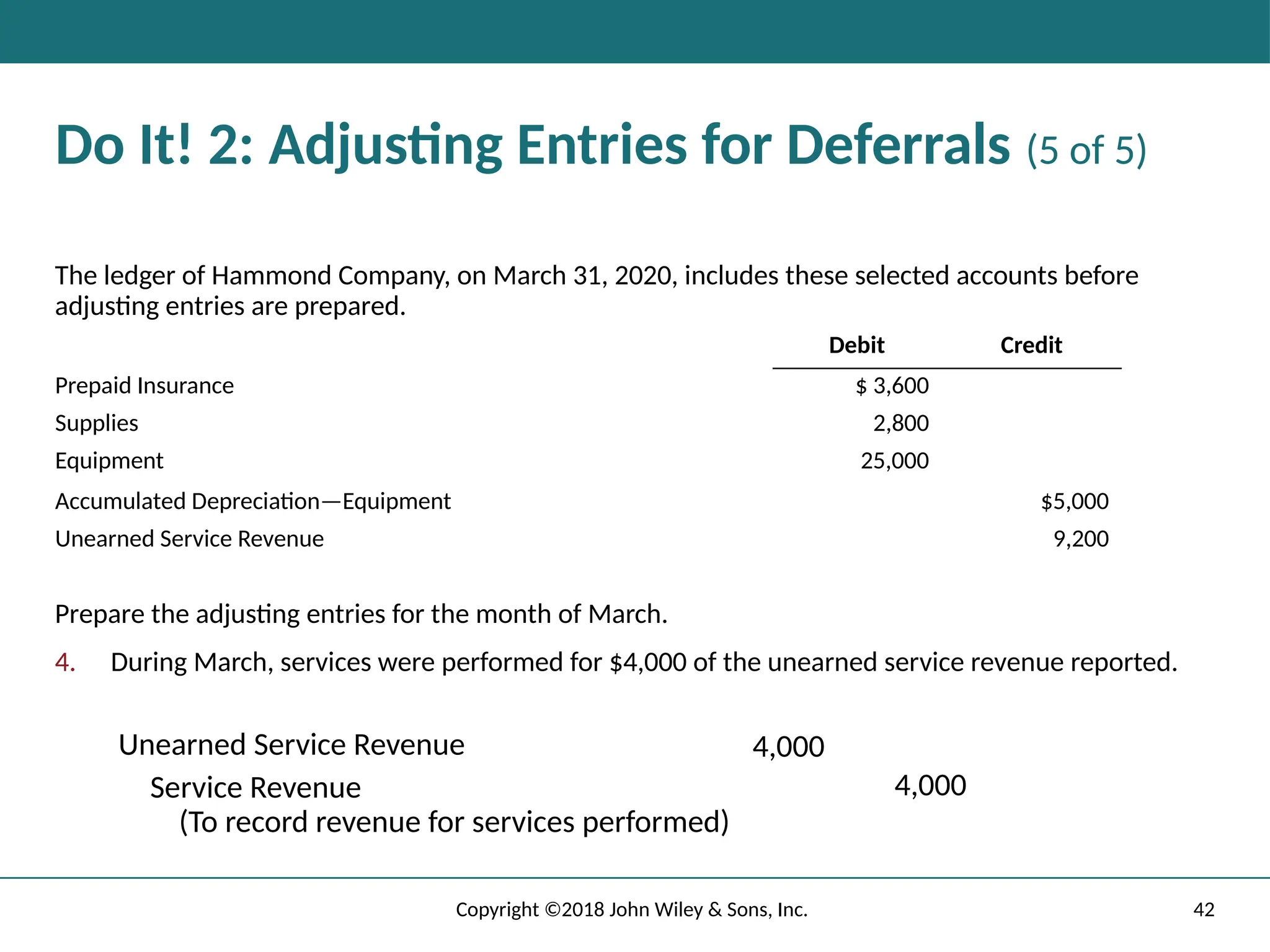
Do It! 2: Adjusting Entries for Deferrals (5 of 5)
The ledger of Hammond Company, on March 31, 2020, includes these selected accounts before
adjusting entries are prepared.
Debit Credit
Prepaid Insurance $ 3,600
Supplies 2,800
Equipment 25,000
Accumulated Depreciation—Equipment $5,000
Unearned Service Revenue 9,200
Prepare the adjusting entries for the month of March.
4. During March, services were performed for $4,000 of the unearned service revenue reported.
Unearned Service Revenue 4,000
Service Revenue
(To record revenue for services performed)
4,000
43. 43
Copyright ©2018 John Wiley & Sons, Inc.
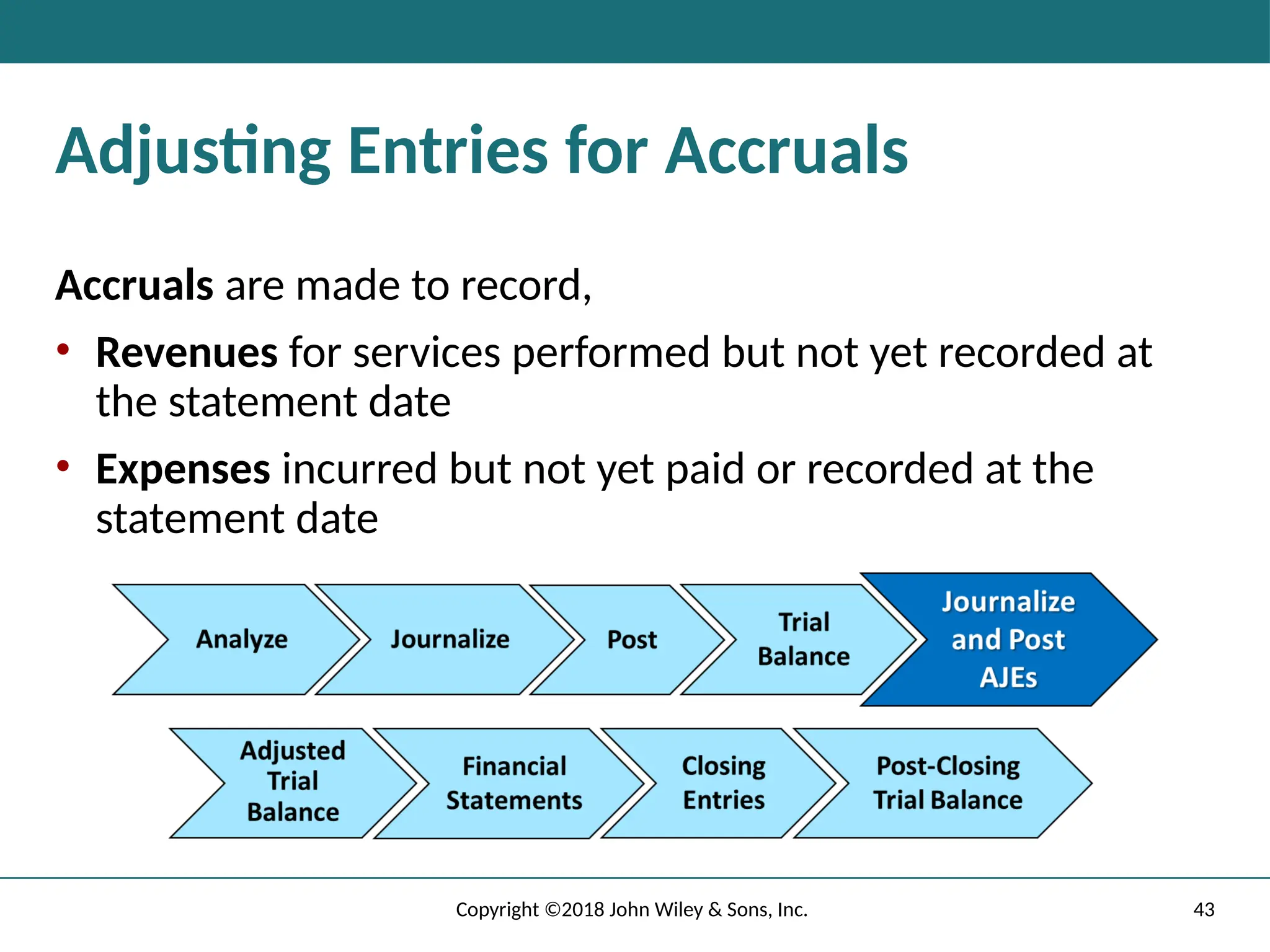
Adjusting Entries for Accruals
Accruals are made to record,
• Revenues for services performed but not yet recorded at
the statement date
• Expenses incurred but not yet paid or recorded at the
statement date
44. 44
Copyright ©2018 John Wiley & Sons, Inc.
Accrued Revenues (1 of 5)
Revenues for services performed but not yet received in cash
or recorded.
Revenue recorded BEFORE cash receipt
Accrued revenues often occur in regard to:
• Rent
• Interest
• Services
45. 45
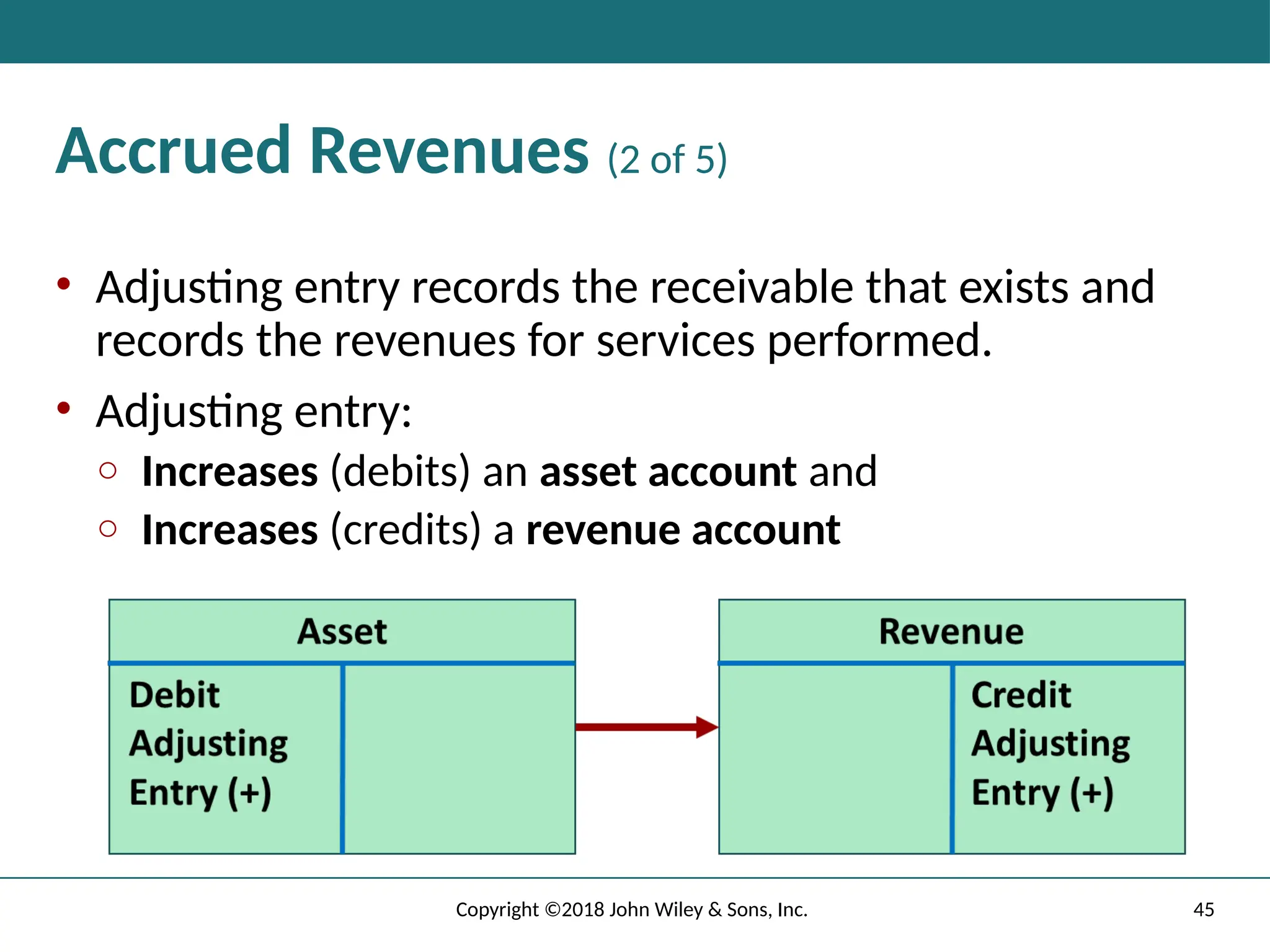
Copyright ©2018 John Wiley & Sons, Inc.
Accrued Revenues (2 of 5)
• Adjusting entry records the receivable that exists and
records the revenues for services performed.
• Adjusting entry:
o Increases (debits) an asset account and
o Increases (credits) a revenue account
46. 46
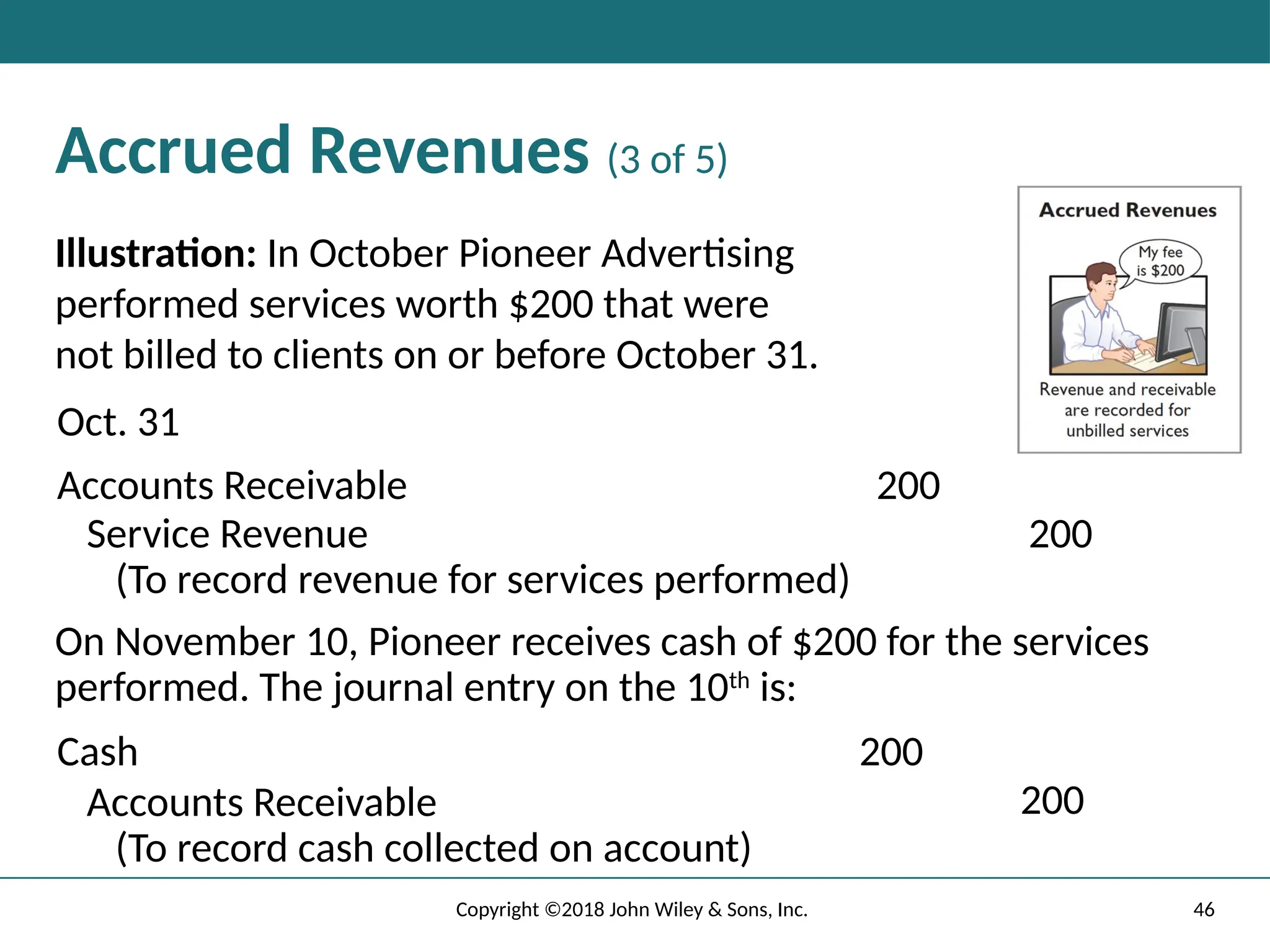
Copyright ©2018 John Wiley & Sons, Inc.
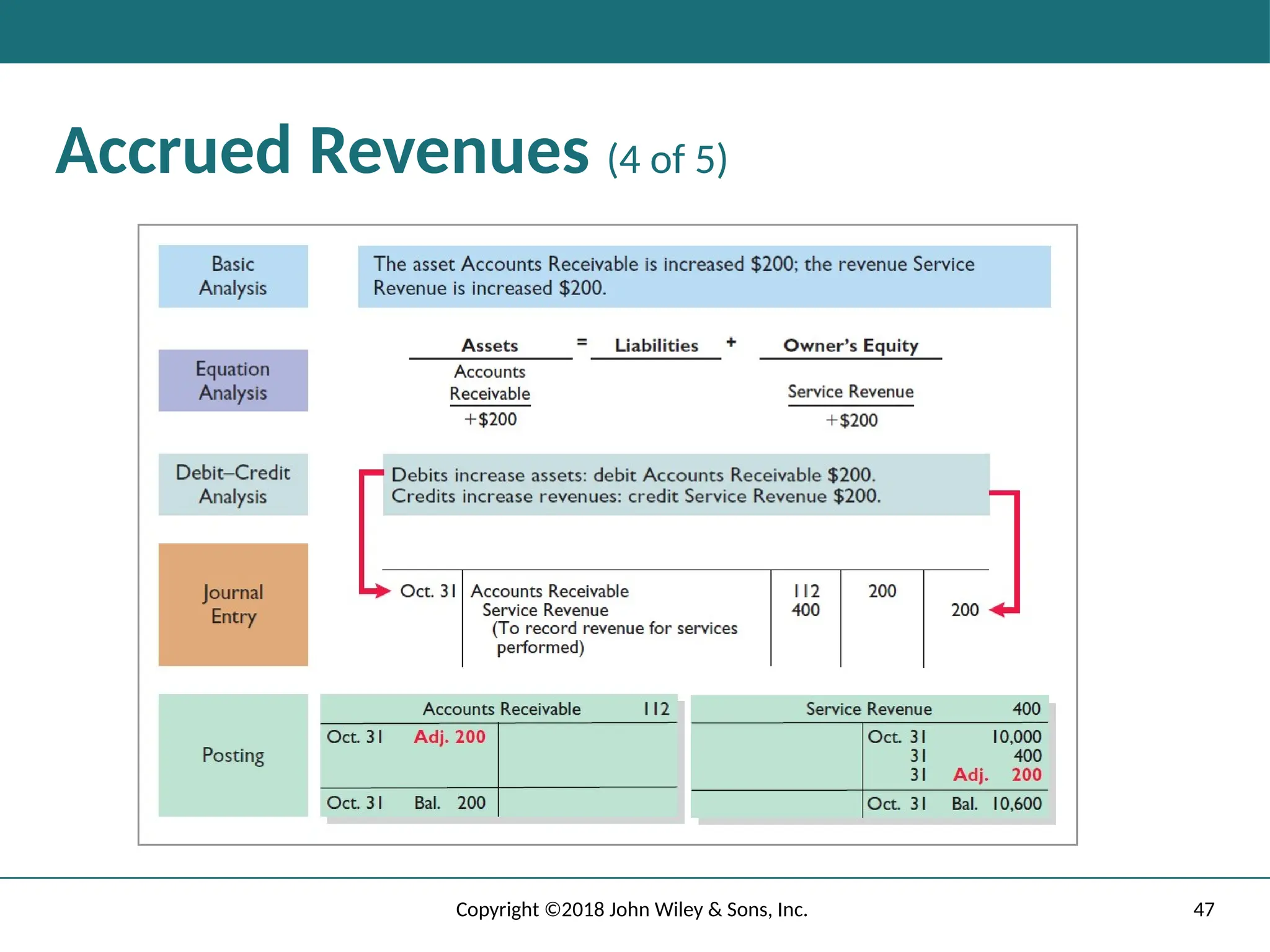
Accrued Revenues (3 of 5)
Illustration: In October Pioneer Advertising
performed services worth $200 that were
not billed to clients on or before October 31.
Oct. 31
Accounts Receivable 200
Service Revenue
(To record revenue for services performed)
200
On November 10, Pioneer receives cash of $200 for the services
performed. The journal entry on the 10th
is:
Cash 200
Accounts Receivable
(To record cash collected on account)
200
47. 48. 48
Copyright ©2018 John Wiley & Sons, Inc.
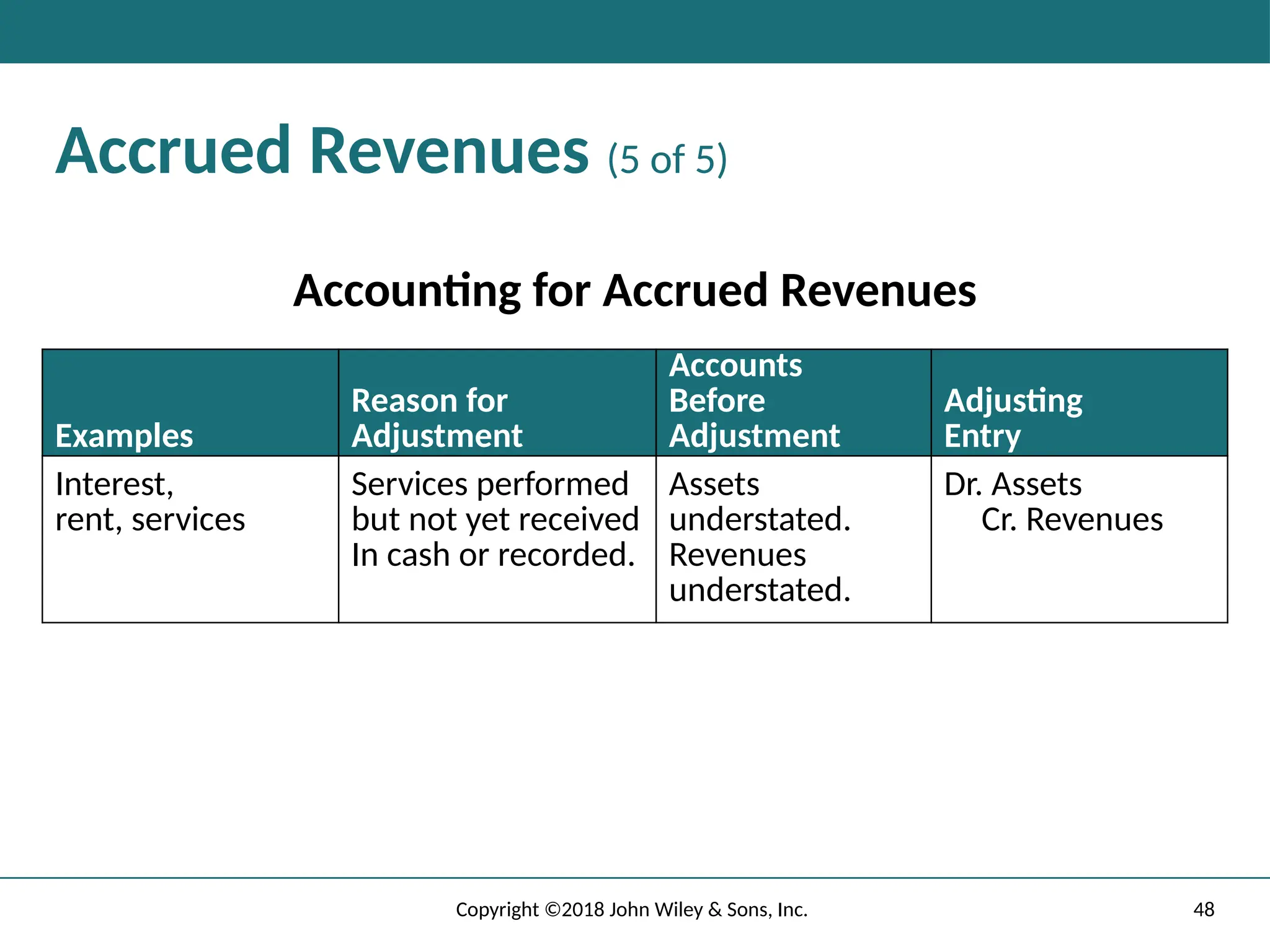
Accrued Revenues (5 of 5)
Accounting for Accrued Revenues
Examples
Reason for
Adjustment
Accounts
Before
Adjustment
Adjusting
Entry
Interest,
rent, services
Services performed
but not yet received
In cash or recorded.
Assets
understated.
Revenues
understated.
Dr. Assets
Cr. Revenues
49. 49
Copyright ©2018 John Wiley & Sons, Inc.
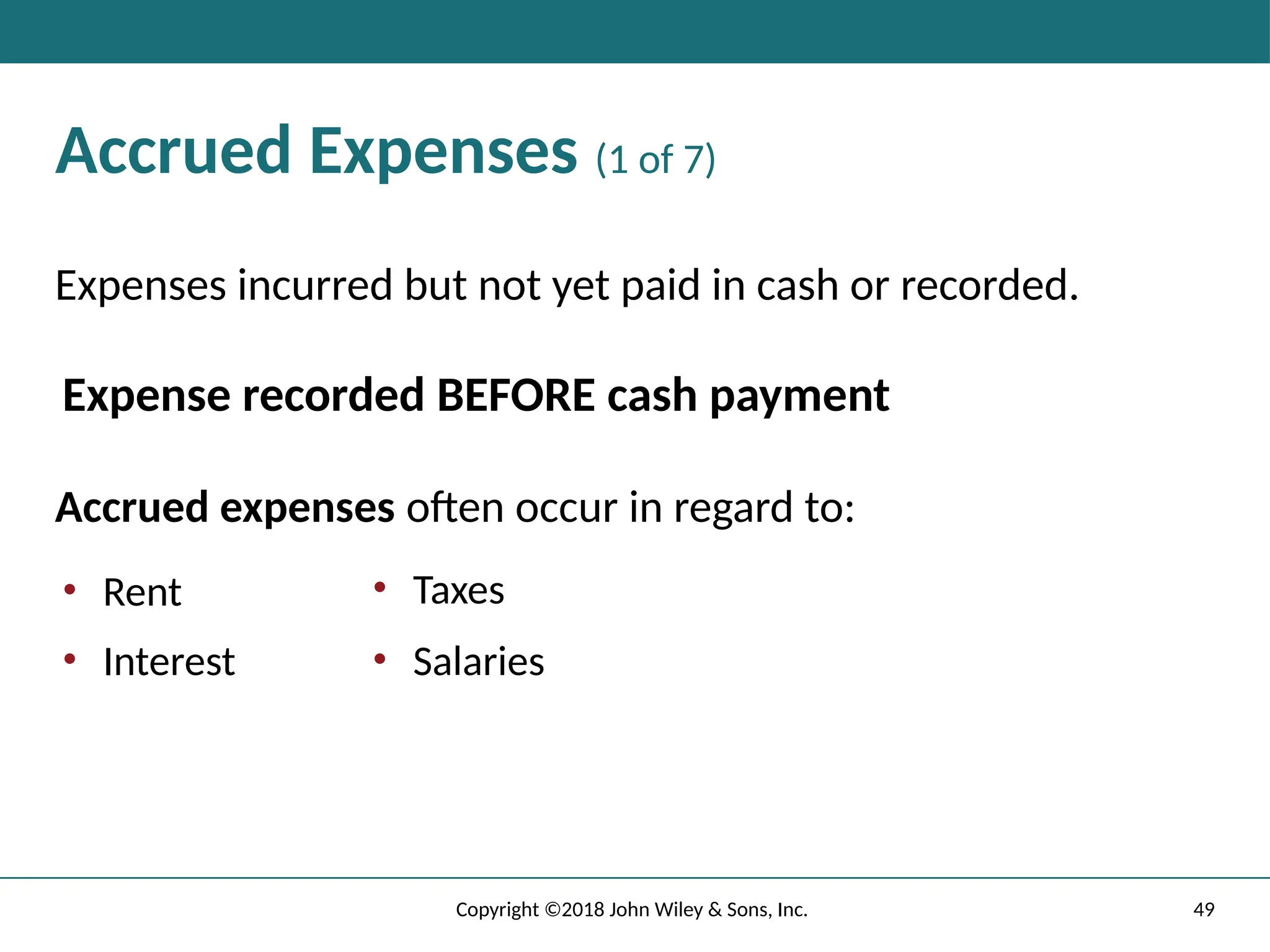
Accrued Expenses (1 of 7)
Expenses incurred but not yet paid in cash or recorded.
Expense recorded BEFORE cash payment
Accrued expenses often occur in regard to:
• Rent
• Interest
• Taxes
• Salaries
50. 50
Copyright ©2018 John Wiley & Sons, Inc.
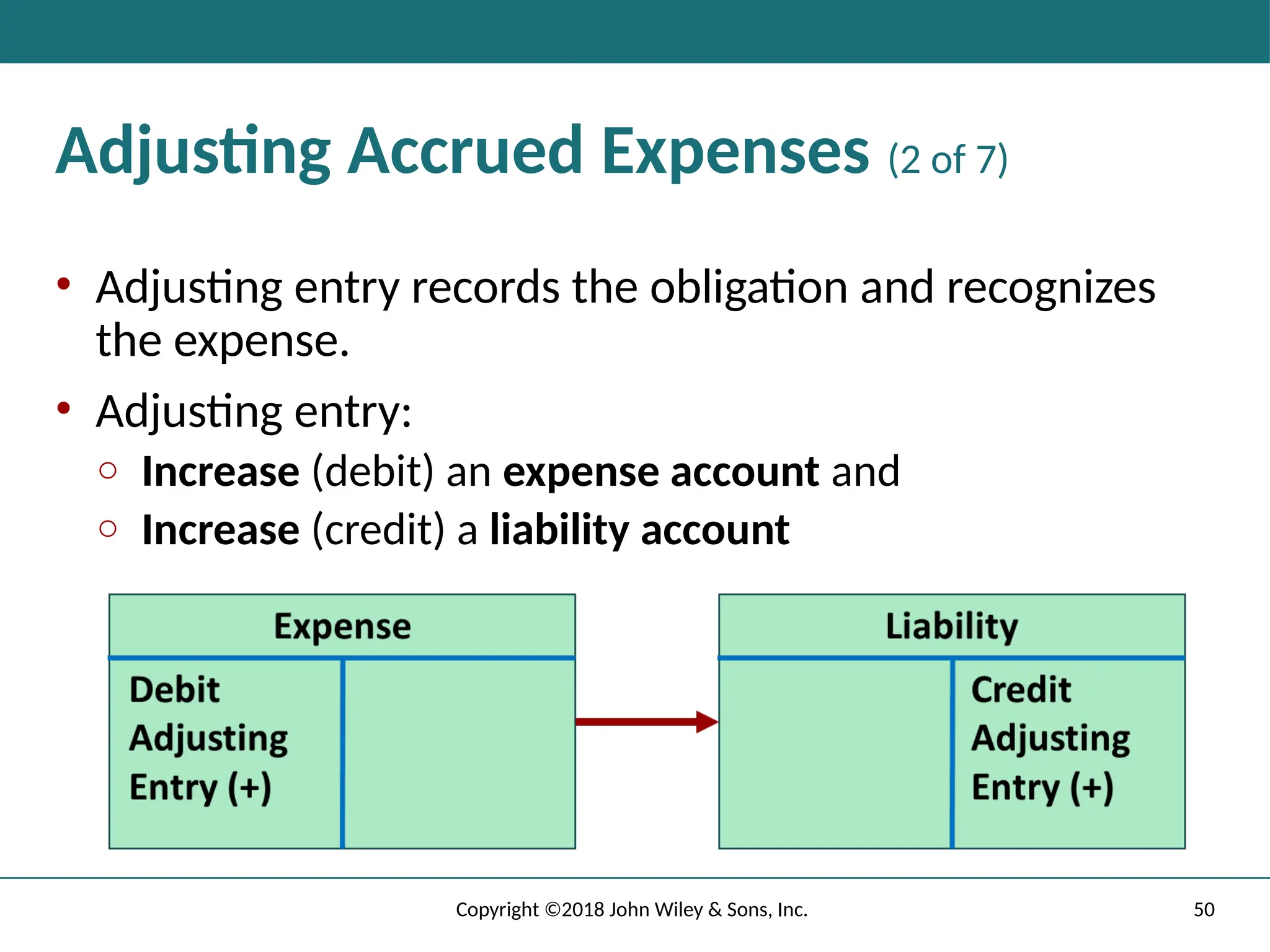
Adjusting Accrued Expenses (2 of 7)
• Adjusting entry records the obligation and recognizes
the expense.
• Adjusting entry:
o Increase (debit) an expense account and
o Increase (credit) a liability account
51. 51
Copyright ©2018 John Wiley & Sons, Inc.
Accrued Expenses (3 of 7)
Accrued Interest
Illustration: Pioneer Advertising signed a three-month note
payable in the amount of $5,000 on October 1. The note requires
Pioneer to pay interest at an annual rate of 12%.
Face Value
of Note ×
Annual
Interest Rate ×
Time in Terms
of One Year = Interest
$5,000 × 12% × = $50
Oct. 31 Interest Expense 50
Interest Payable 50
1
12
52. 53. 53
Copyright ©2018 John Wiley & Sons, Inc.
Accrued Expenses (5 of 7)
Accrued Salaries and Wages
Illustration: Pioneer Advertising paid salaries and wages on October 26; the
next payment of salaries will not occur until November 9. The employees
receive total salaries of $2,000 for a five-day work week, or $400 per day.
On October 31, the salaries and wages for three remaining working days
(October 29 to 31) represent an accrued expense and a related liability.
54. 55. 55
Copyright ©2018 John Wiley & Sons, Inc.
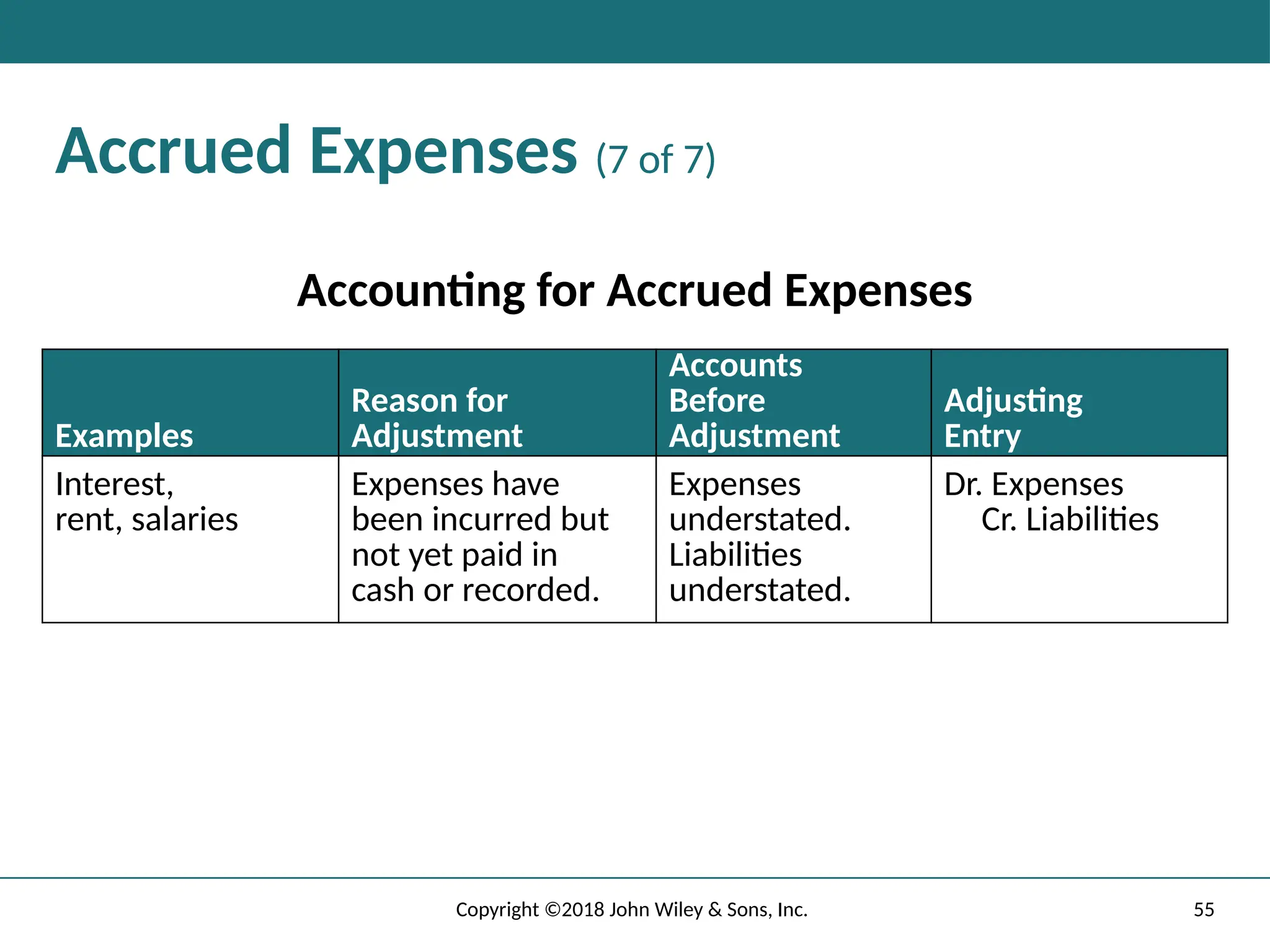
Accrued Expenses (7 of 7)
Accounting for Accrued Expenses
Examples
Reason for
Adjustment
Accounts
Before
Adjustment
Adjusting
Entry
Interest,
rent, salaries
Expenses have
been incurred but
not yet paid in
cash or recorded.
Expenses
understated.
Liabilities
understated.
Dr. Expenses
Cr. Liabilities
56. 56
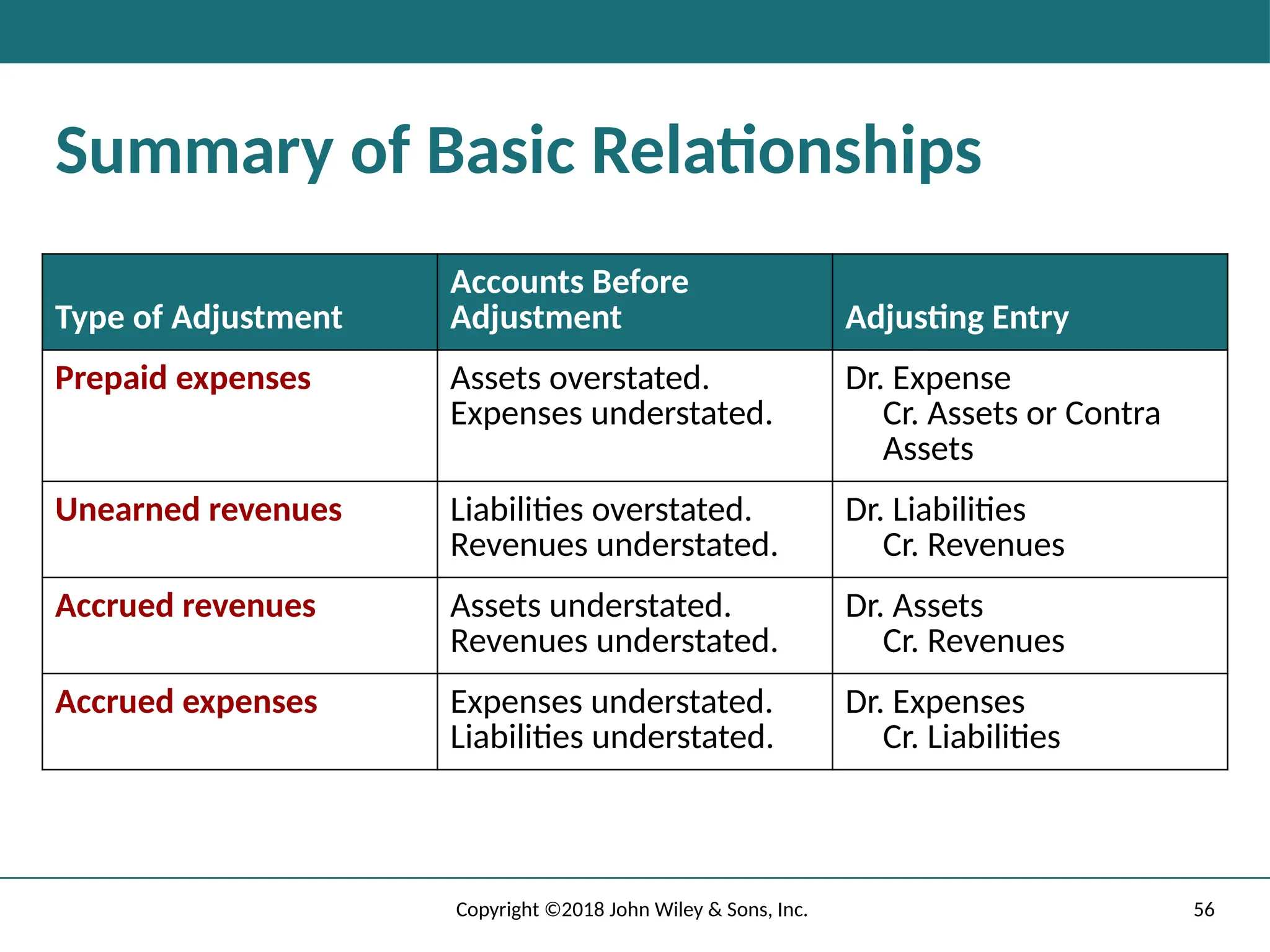
Copyright ©2018 John Wiley & Sons, Inc.
Summary of Basic Relationships
Type of Adjustment
Accounts Before
Adjustment Adjusting Entry
Prepaid expenses Assets overstated.
Expenses understated.
Dr. Expense
Cr. Assets or Contra
Assets
Unearned revenues Liabilities overstated.
Revenues understated.
Dr. Liabilities
Cr. Revenues
Accrued revenues Assets understated.
Revenues understated.
Dr. Assets
Cr. Revenues
Accrued expenses Expenses understated.
Liabilities understated.
Dr. Expenses
Cr. Liabilities
57. 57
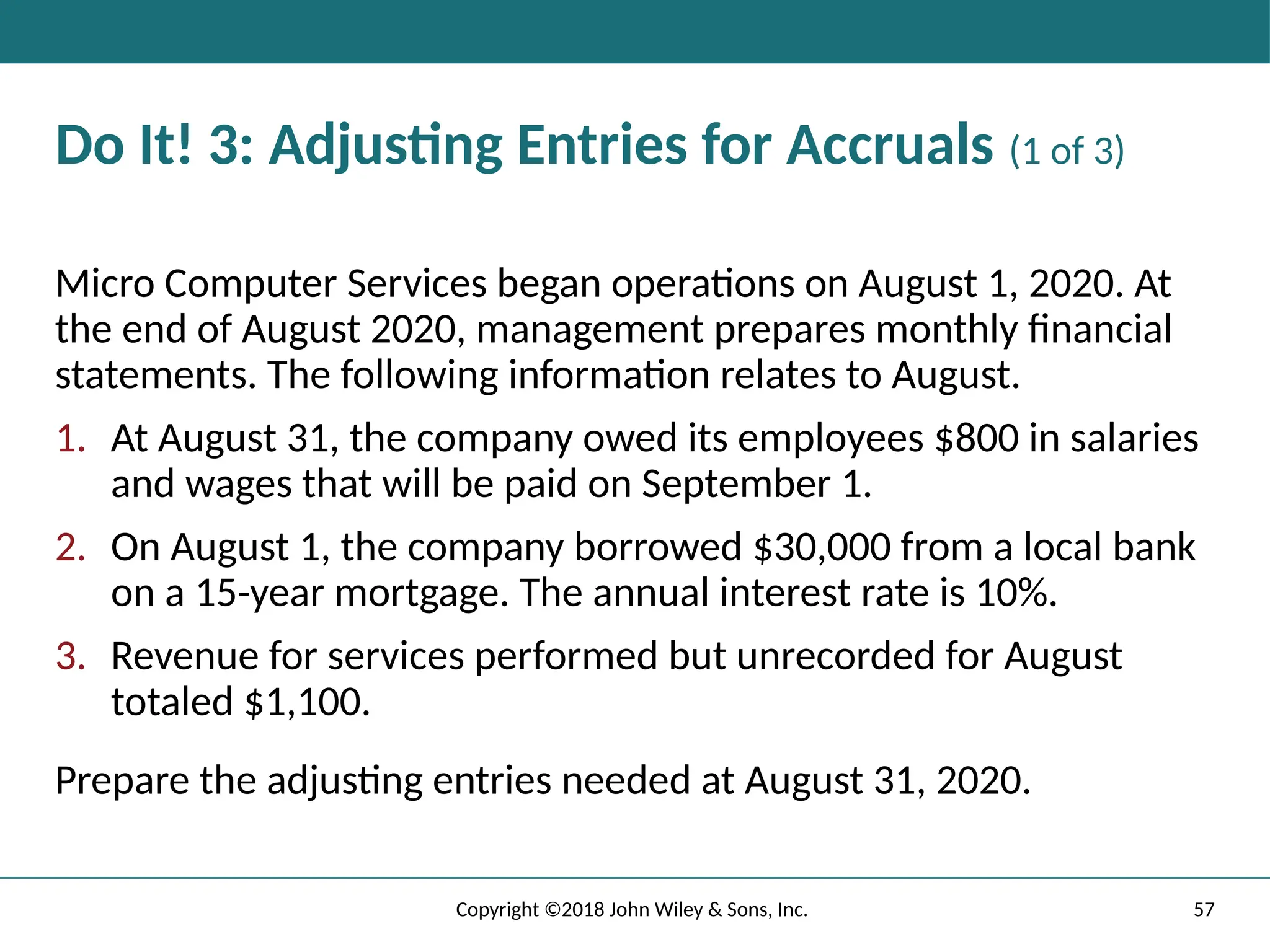
Copyright ©2018 John Wiley & Sons, Inc.
Do It! 3: Adjusting Entries for Accruals (1 of 3)
Micro Computer Services began operations on August 1, 2020. At
the end of August 2020, management prepares monthly financial
statements. The following information relates to August.
1. At August 31, the company owed its employees $800 in salaries
and wages that will be paid on September 1.
2. On August 1, the company borrowed $30,000 from a local bank
on a 15-year mortgage. The annual interest rate is 10%.
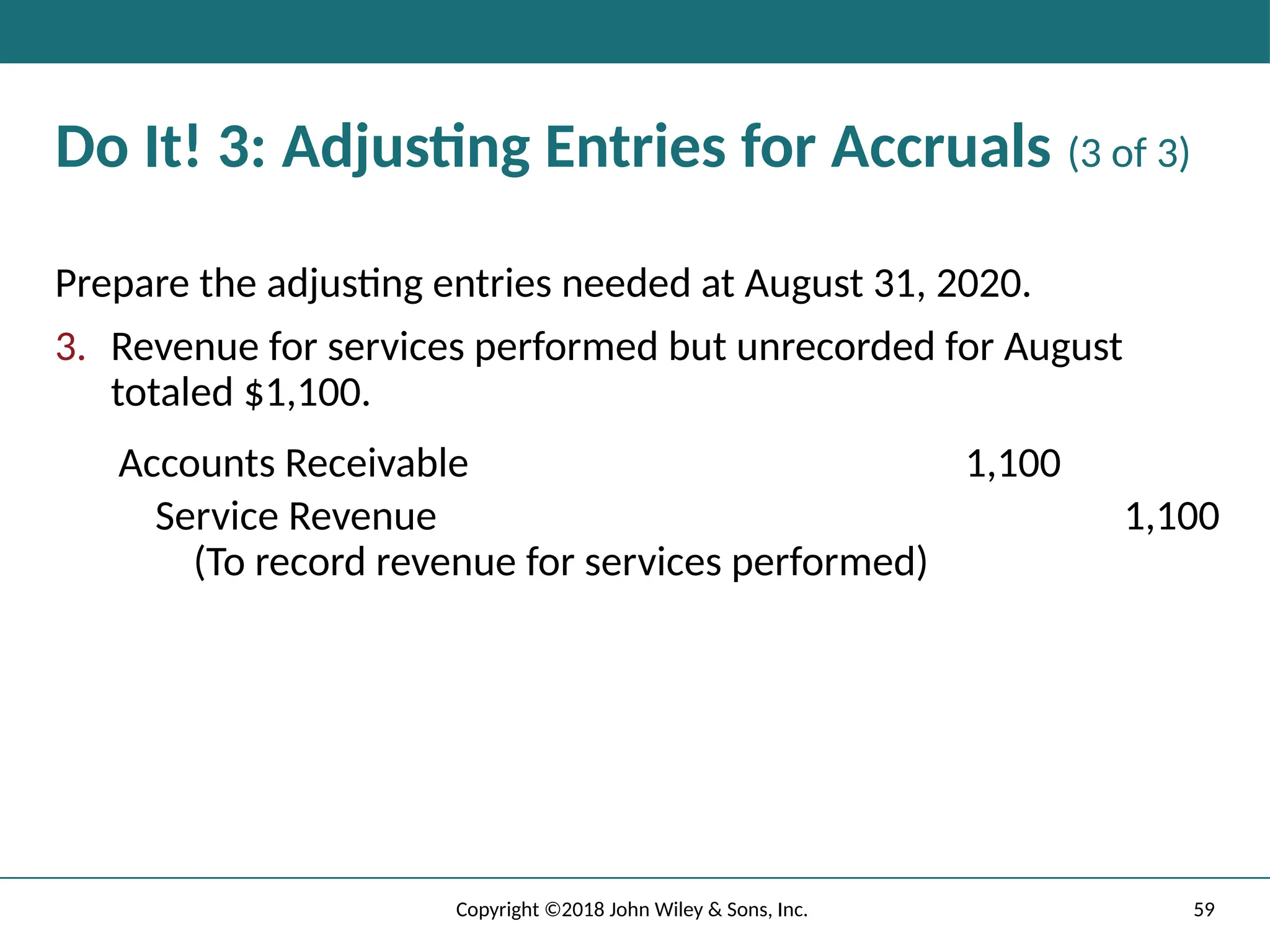
3. Revenue for services performed but unrecorded for August
totaled $1,100.
Prepare the adjusting entries needed at August 31, 2020.
58. 58
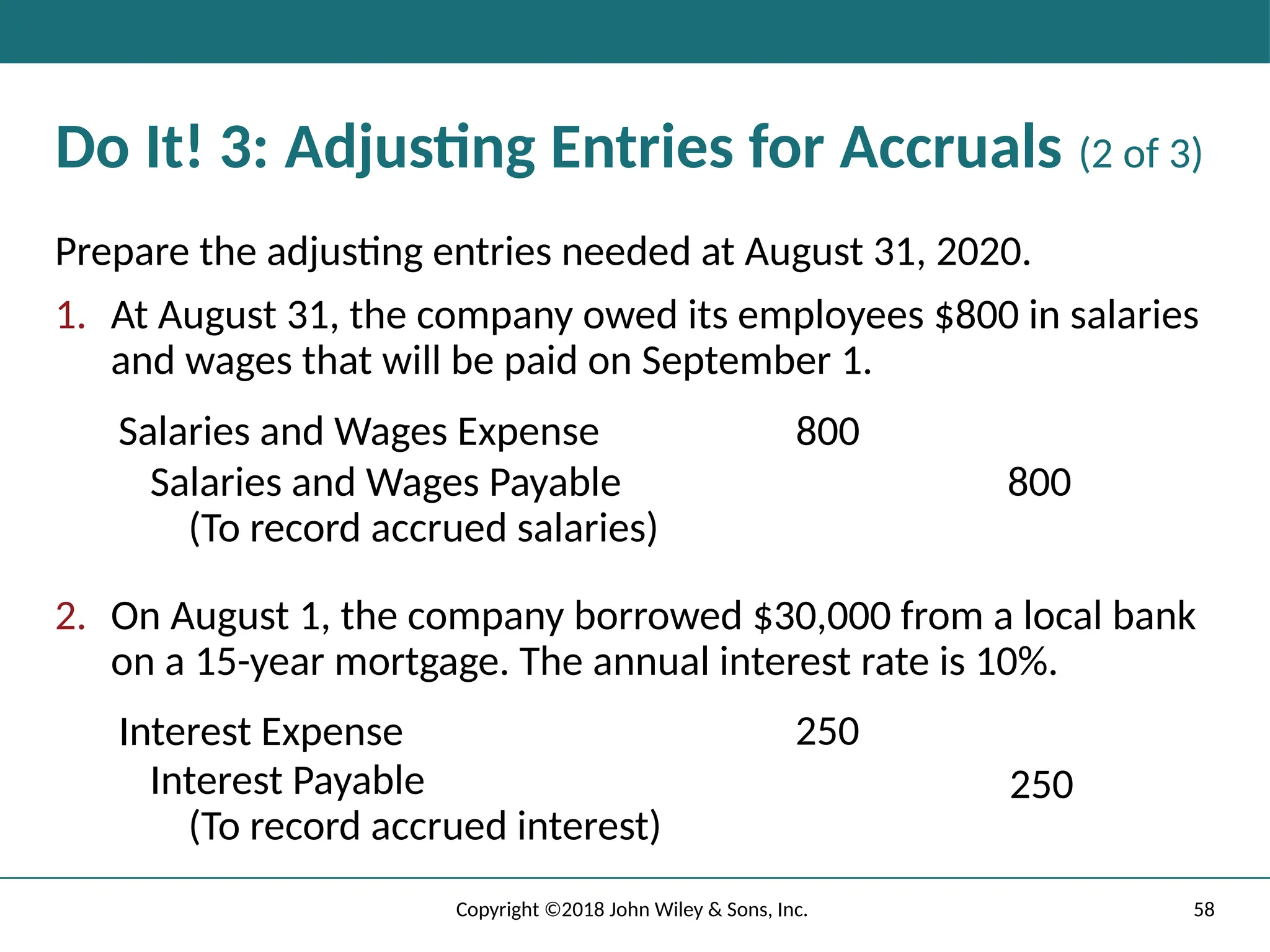
Copyright ©2018 John Wiley & Sons, Inc.
Do It! 3: Adjusting Entries for Accruals (2 of 3)
Prepare the adjusting entries needed at August 31, 2020.
1. At August 31, the company owed its employees $800 in salaries
and wages that will be paid on September 1.
Salaries and Wages Expense 800
Salaries and Wages Payable
(To record accrued salaries)
800
2. On August 1, the company borrowed $30,000 from a local bank
on a 15-year mortgage. The annual interest rate is 10%.
Interest Expense 250
Interest Payable
(To record accrued interest)
250
59. 59
Copyright ©2018 John Wiley & Sons, Inc.
Do It! 3: Adjusting Entries for Accruals (3 of 3)
Prepare the adjusting entries needed at August 31, 2020.
3. Revenue for services performed but unrecorded for August
totaled $1,100.
Accounts Receivable 1,100
Service Revenue
(To record revenue for services performed)
1,100
60. 60
Copyright ©2018 John Wiley & Sons, Inc.
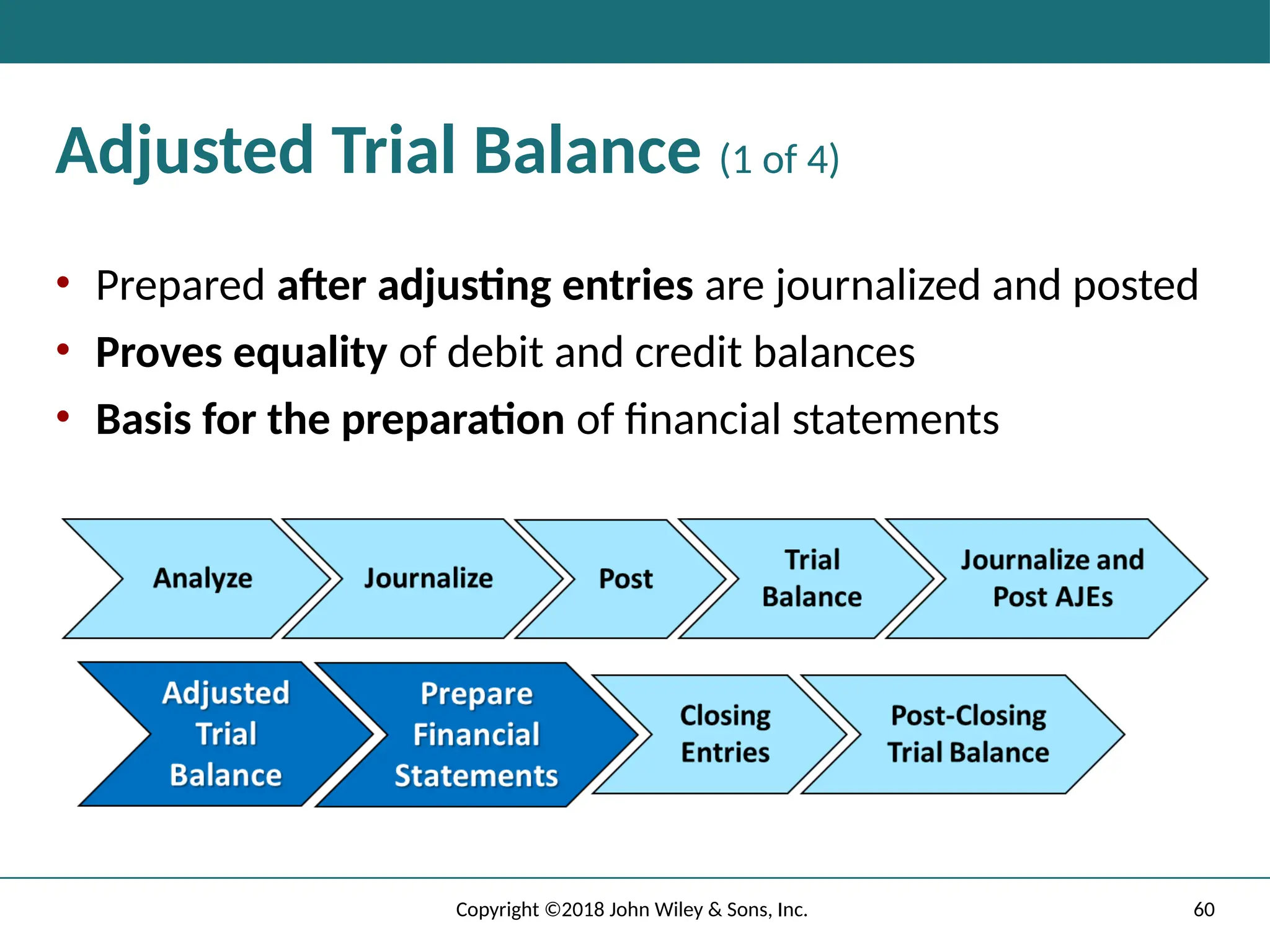
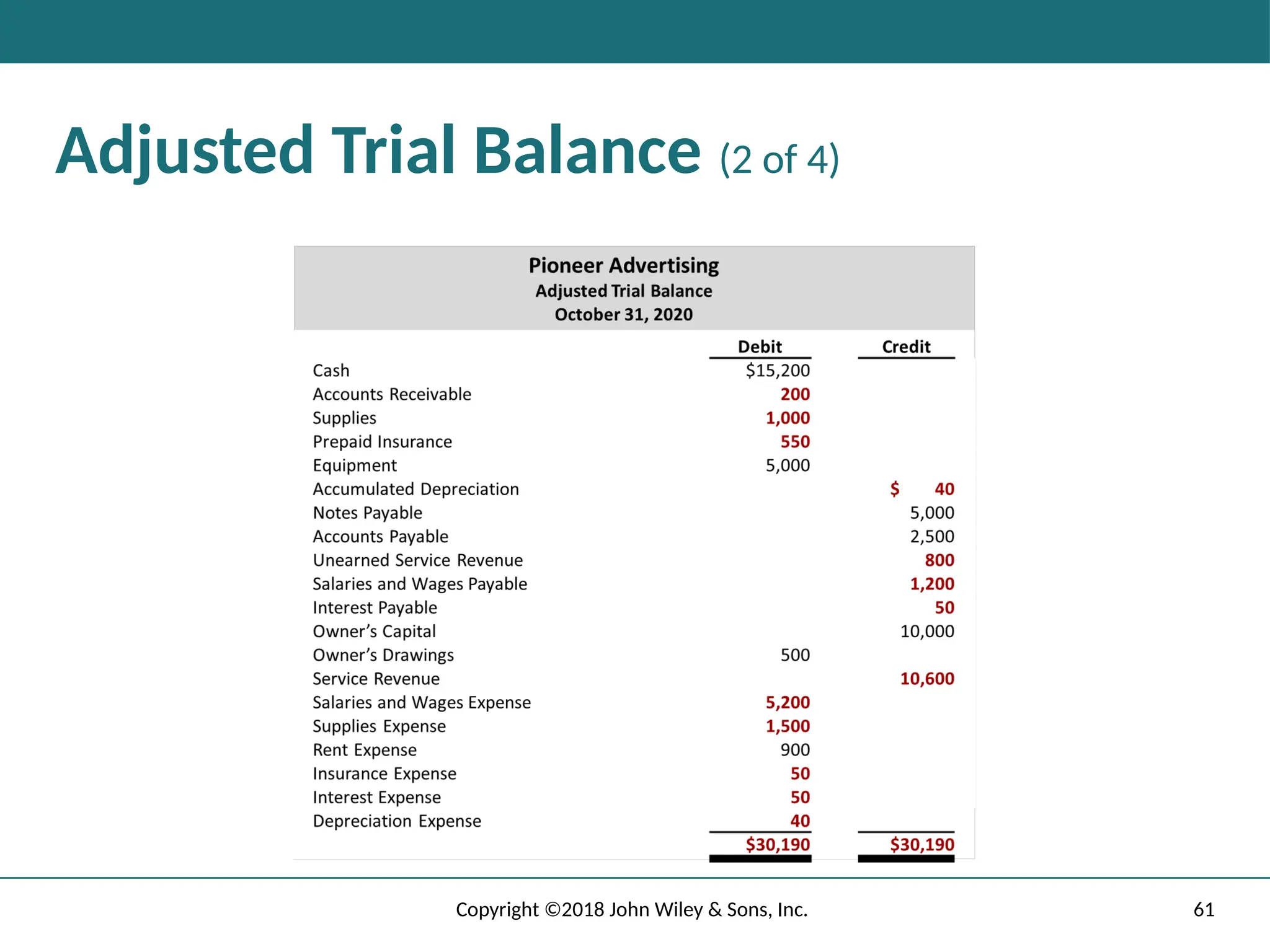
Adjusted Trial Balance (1 of 4)
• Prepared after adjusting entries are journalized and posted
• Proves equality of debit and credit balances
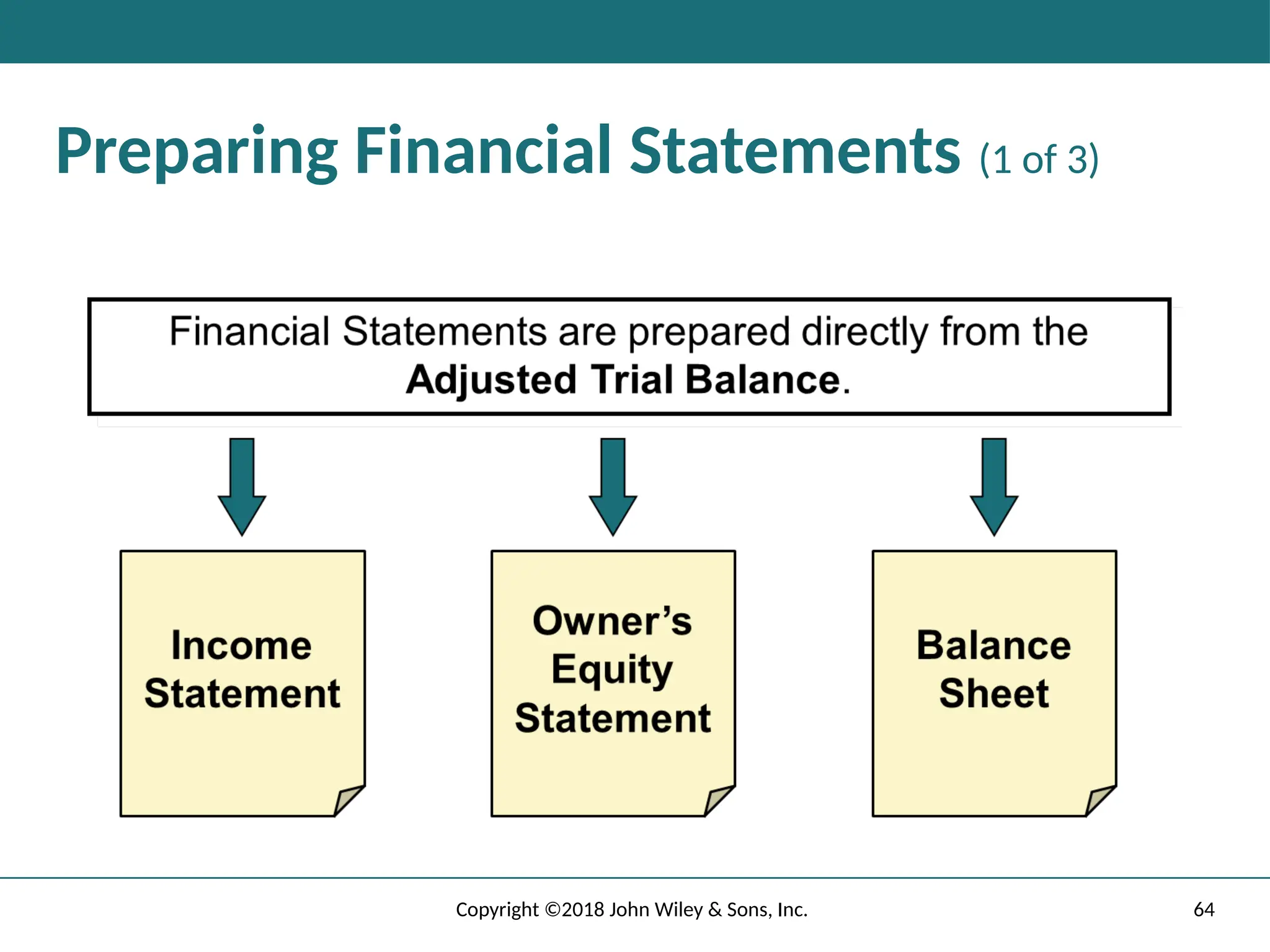
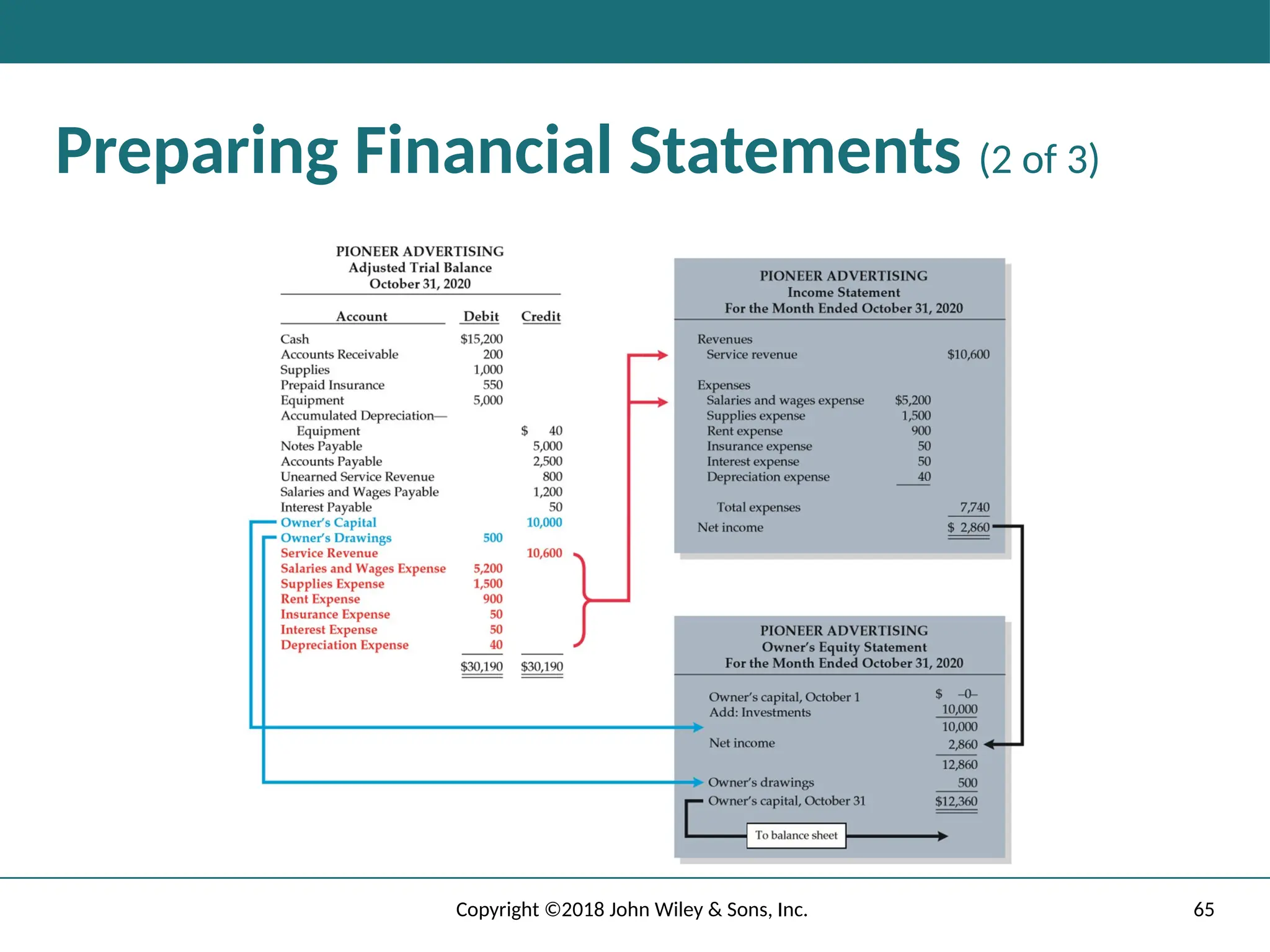
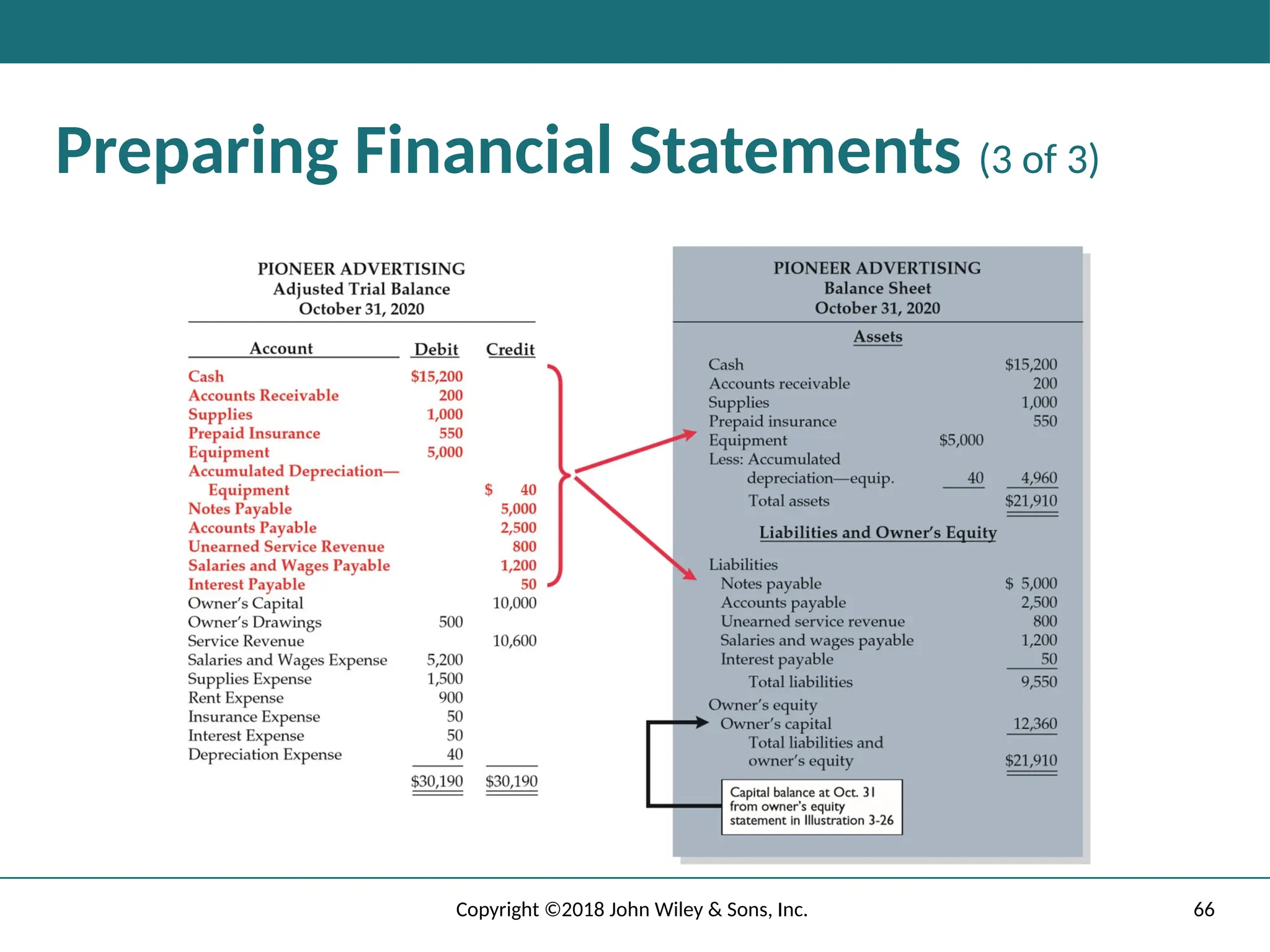
• Basis for the preparation of financial statements
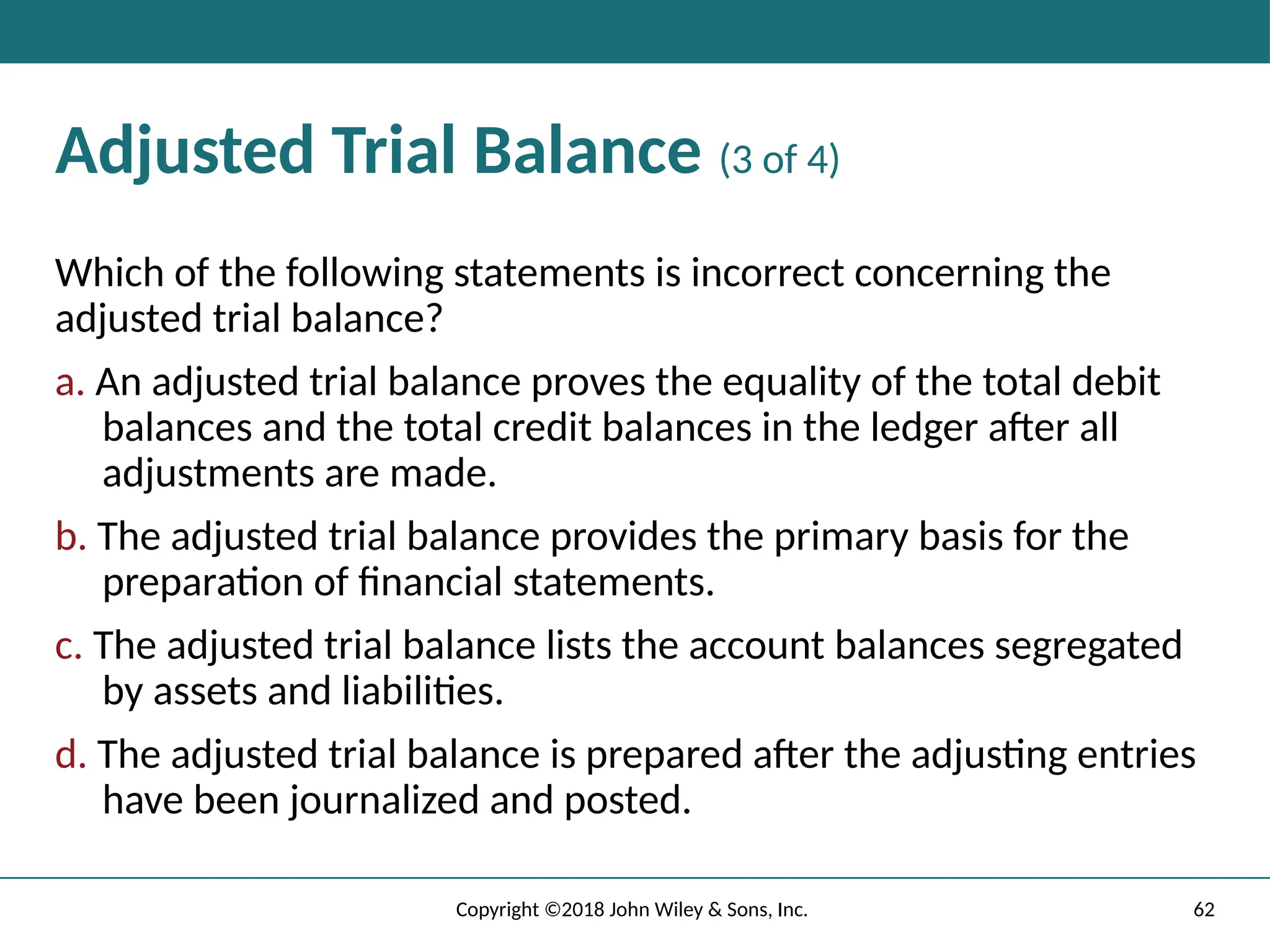
61. 62. Adjusted Trial Balance (3 of 4)
Which of the following statements is incorrect concerning the
adjusted trial balance?
a. An adjusted trial balance proves the equality of the total debit
balances and the total credit balances in the ledger after all
adjustments are made.
b. The adjusted trial balance provides the primary basis for the
preparation of financial statements.
c. The adjusted trial balance lists the account balances segregated
by assets and liabilities.
d. The adjusted trial balance is prepared after the adjusting entries
have been journalized and posted.
62
Copyright ©2018 John Wiley & Sons, Inc.
63. Adjusted Trial Balance (4 of 4)
Which of the following statements is incorrect concerning the
adjusted trial balance?
a. An adjusted trial balance proves the equality of the total debit
balances and the total credit balances in the ledger after all
adjustments are made.
b. The adjusted trial balance provides the primary basis for the
preparation of financial statements.
c. Answer: The adjusted trial balance lists the account balances
segregated by assets and liabilities.
d. The adjusted trial balance is prepared after the adjusting entries
have been journalized and posted.
63
Copyright ©2018 John Wiley & Sons, Inc.
64. 65. 66. 67. 67
Copyright ©2018 John Wiley & Sons, Inc.
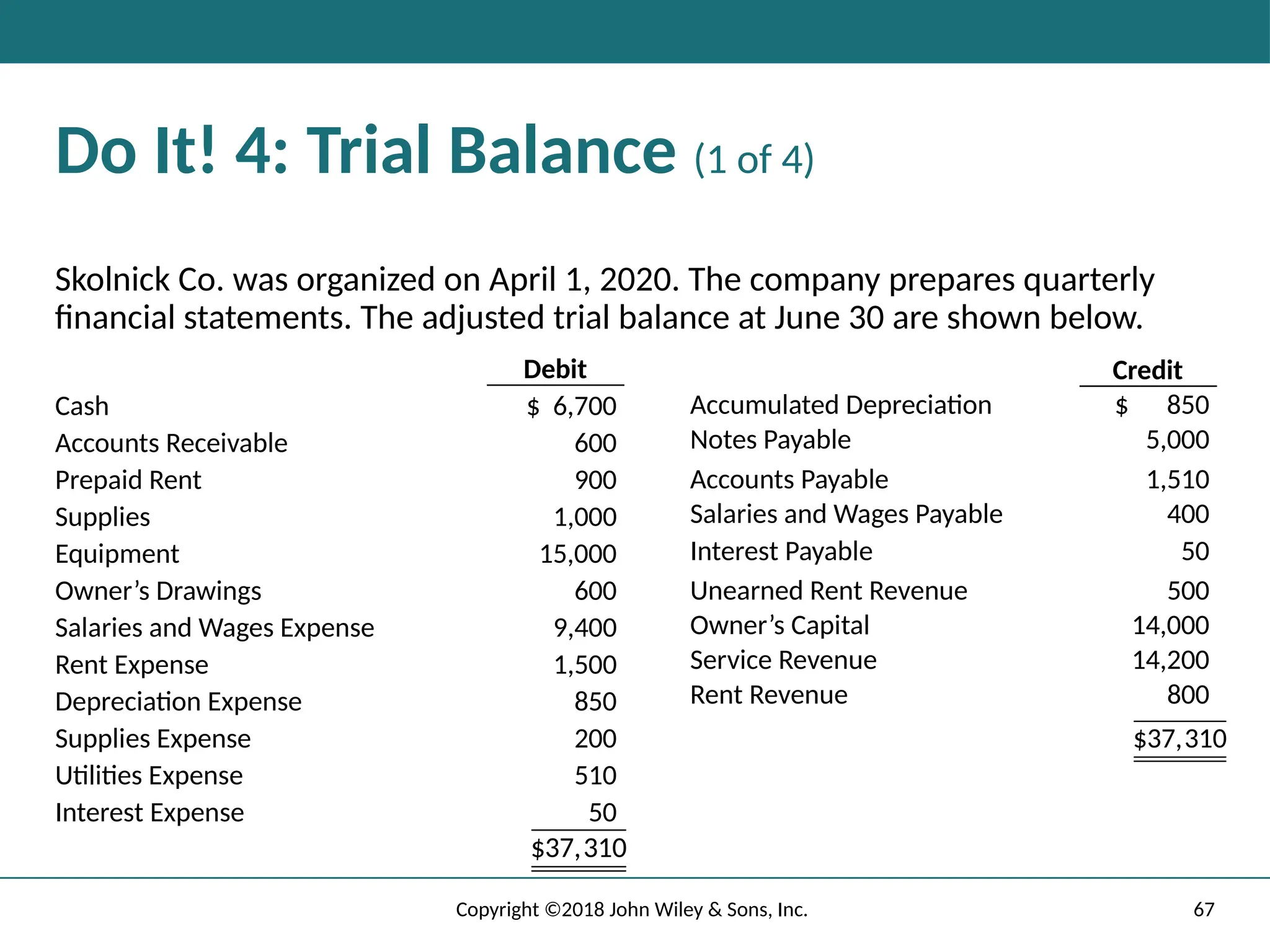
Do It! 4: Trial Balance (1 of 4)
Skolnick Co. was organized on April 1, 2020. The company prepares quarterly
financial statements. The adjusted trial balance at June 30 are shown below.
Debit
Cash $ 6,700
Accounts Receivable 600
Prepaid Rent 900
Supplies 1,000
Equipment 15,000
Owner’s Drawings 600
Salaries and Wages Expense 9,400
Rent Expense 1,500
Depreciation Expense 850
Supplies Expense 200
Utilities Expense 510
Interest Expense 50
$37,310 double border
$37,310
Credit
Accumulated Depreciation $ 850
Notes Payable 5,000
Accounts Payable 1,510
Salaries and Wages Payable 400
Interest Payable 50
Unearned Rent Revenue 500
Owner’s Capital 14,000
Service Revenue 14,200
Rent Revenue 800
$37,310 double border
$37,310
68. 68
Copyright ©2018 John Wiley & Sons, Inc.
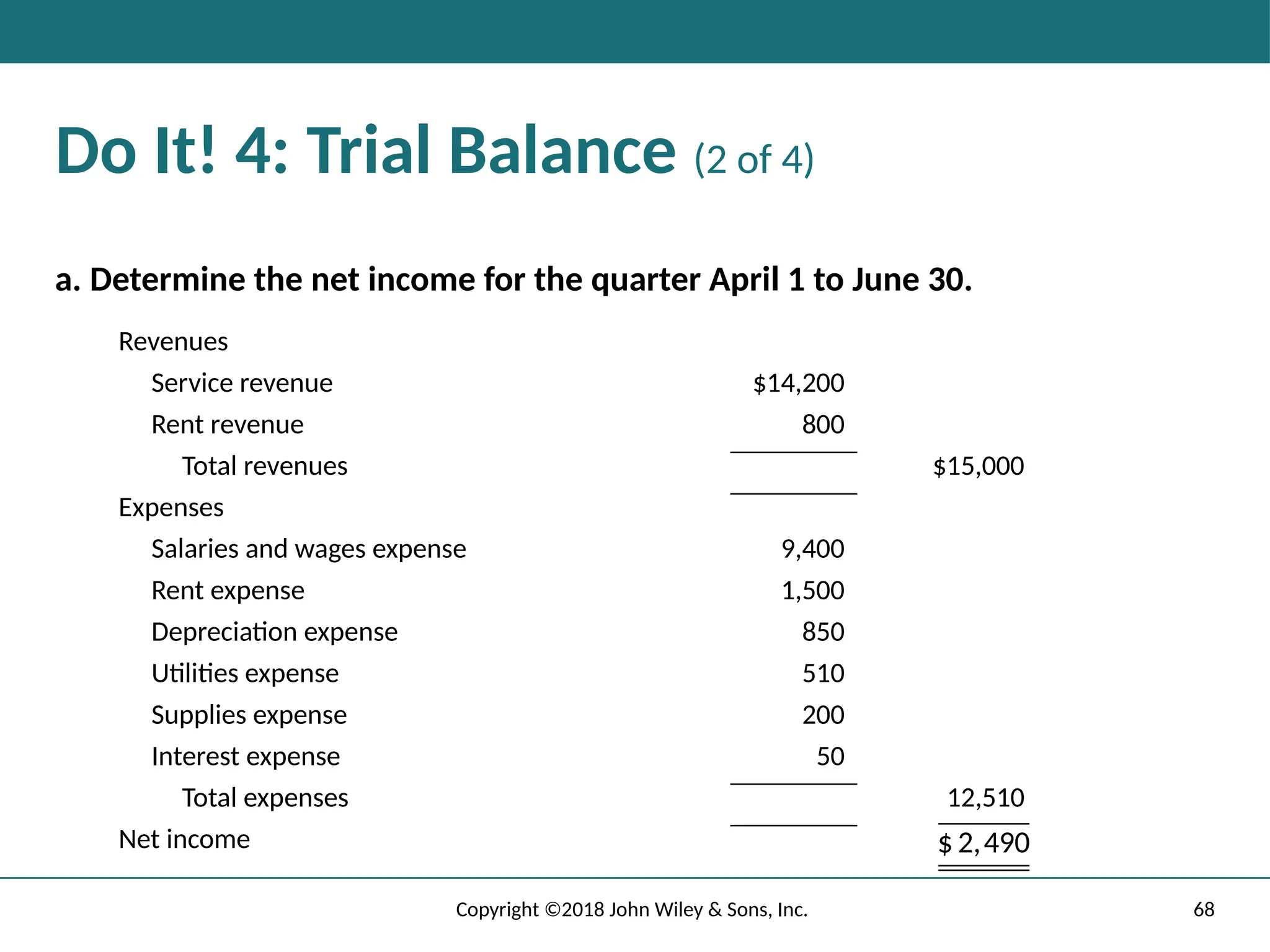
Do It! 4: Trial Balance (2 of 4)
a. Determine the net income for the quarter April 1 to June 30.
Revenues
Service revenue $14,200
Rent revenue 800
Total revenues $15,000
Expenses
Salaries and wages expense 9,400
Rent expense 1,500
Depreciation expense 850
Utilities expense 510
Supplies expense 200
Interest expense 50
Total expenses 12,510
Net income $2,490 double border
$ 2,490
69. 69
Copyright ©2018 John Wiley & Sons, Inc.
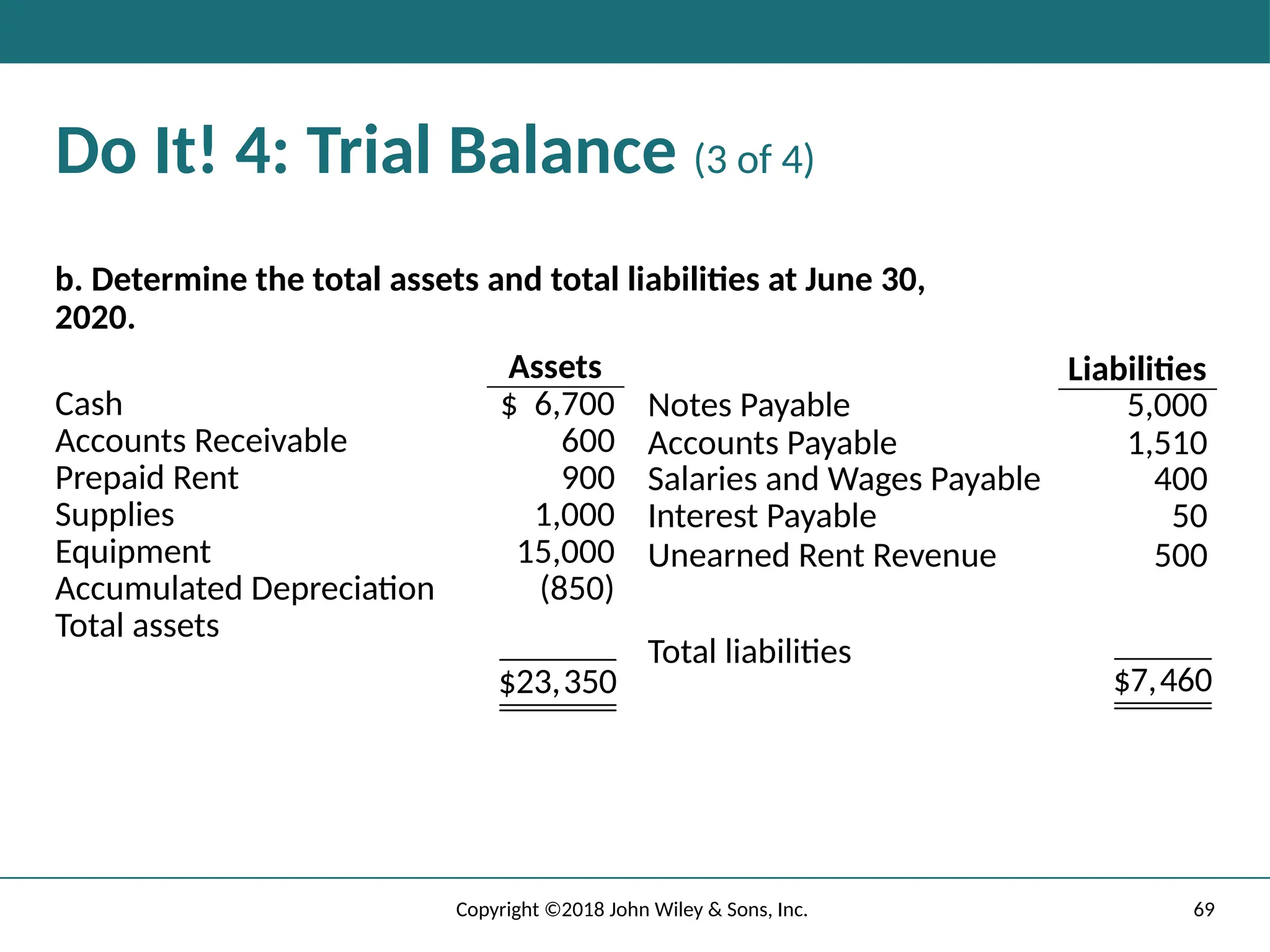
Do It! 4: Trial Balance (3 of 4)
b. Determine the total assets and total liabilities at June 30,
2020.
Assets
Cash $ 6,700
Accounts Receivable 600
Prepaid Rent 900
Supplies 1,000
Equipment 15,000
Accumulated Depreciation (850)
Total assets $23,350 double border
$23,350
Liabilities
Notes Payable 5,000
Accounts Payable 1,510
Salaries and Wages Payable 400
Interest Payable 50
Unearned Rent Revenue 500
blank
Total liabilities $37,310 double border
$7,460
70. 70
Copyright ©2018 John Wiley & Sons, Inc.
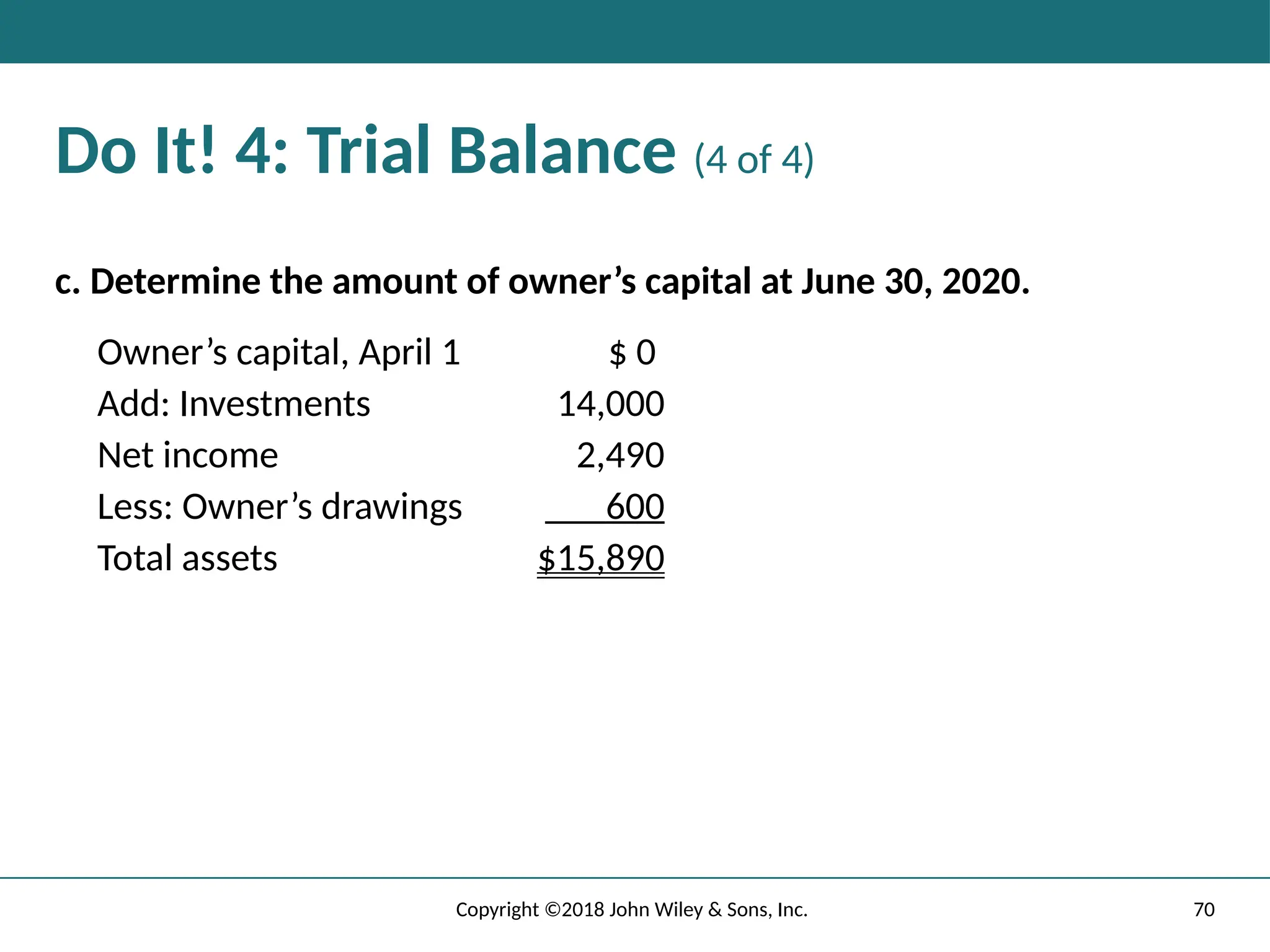
Do It! 4: Trial Balance (4 of 4)
c. Determine the amount of owner’s capital at June 30, 2020.
Owner’s capital, April 1 $ 0
Add: Investments 14,000
Net income 2,490
Less: Owner’s drawings 600
Total assets $15,890
71. 71
Copyright ©2018 John Wiley & Sons, Inc.
Appendix 3A: Alternative Treatment of
Deferrals
• When a company prepays an expense, it debits that
amount to an expense account
• When it receives payment for future services, it credits
the amount to a revenue account
72. 72
Copyright ©2018 John Wiley & Sons, Inc.
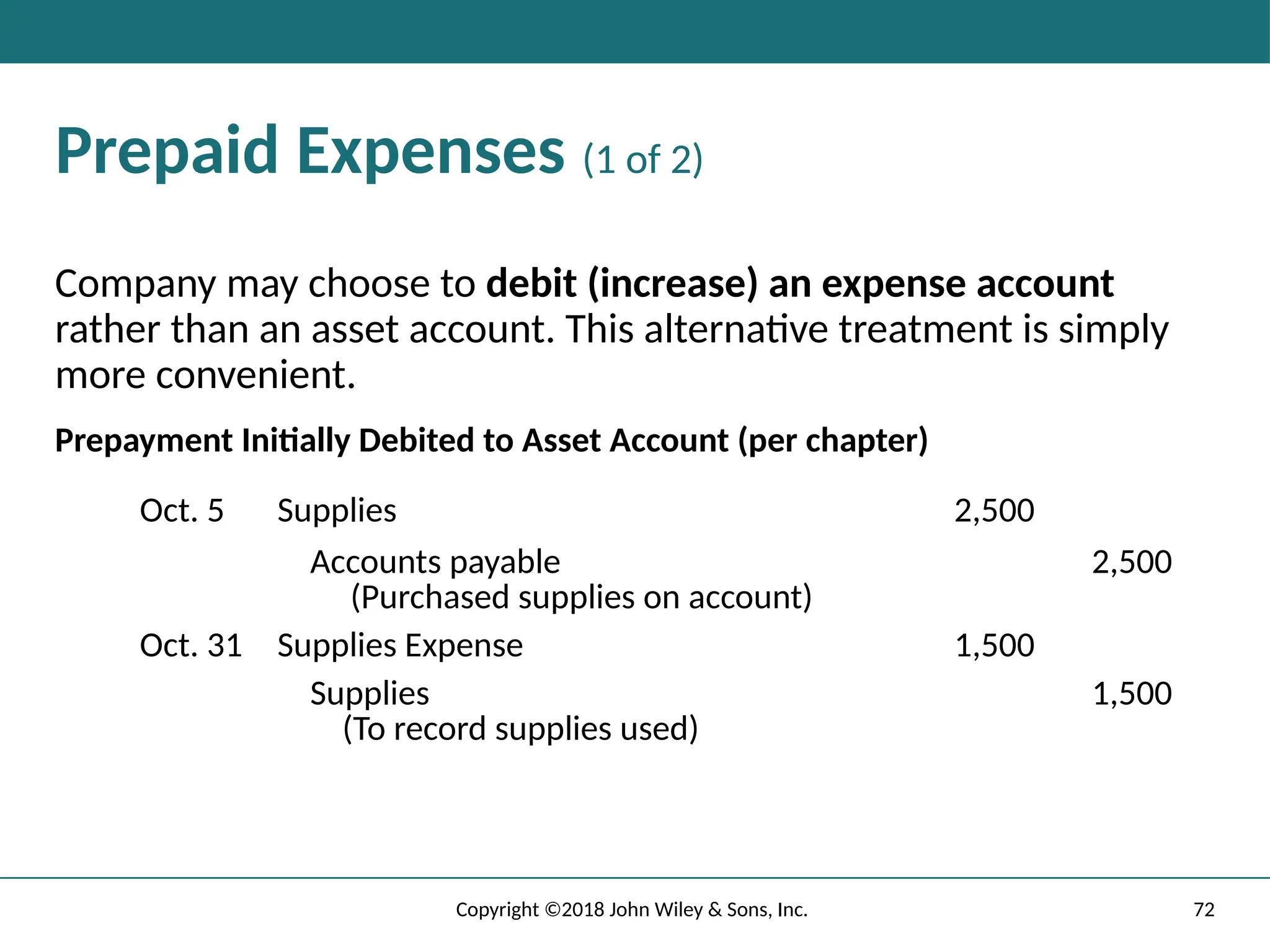
Prepaid Expenses (1 of 2)
Company may choose to debit (increase) an expense account
rather than an asset account. This alternative treatment is simply
more convenient.
Prepayment Initially Debited to Asset Account (per chapter)
Oct. 5 Supplies 2,500
Accounts payable
(Purchased supplies on account)
2,500
Oct. 31 Supplies Expense 1,500
Supplies
(To record supplies used)
1,500
73. 73
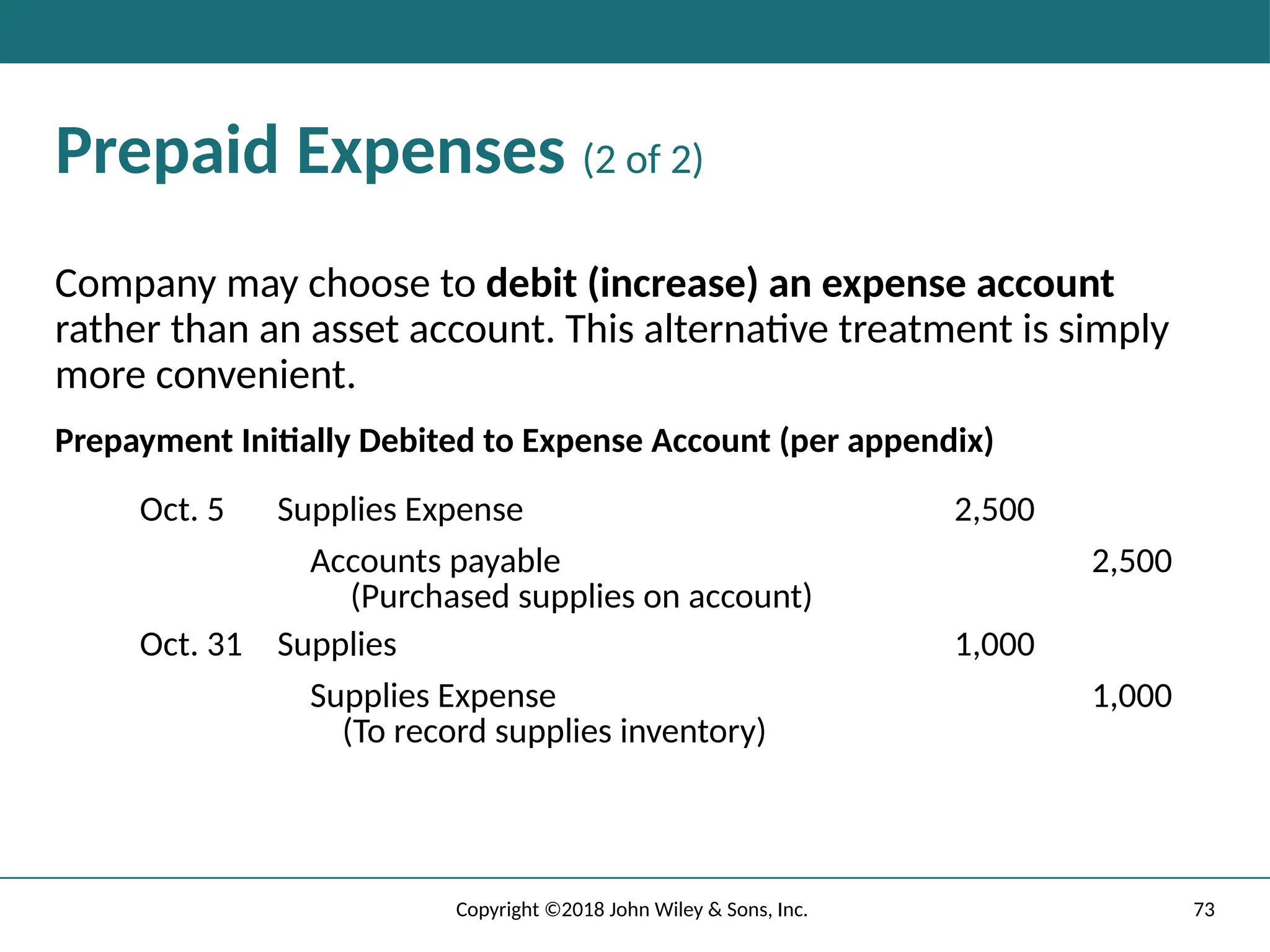
Copyright ©2018 John Wiley & Sons, Inc.
Prepaid Expenses (2 of 2)
Company may choose to debit (increase) an expense account
rather than an asset account. This alternative treatment is simply
more convenient.
Prepayment Initially Debited to Expense Account (per appendix)
Oct. 5 Supplies Expense 2,500
Accounts payable
(Purchased supplies on account)
2,500
Oct. 31 Supplies 1,000
Supplies Expense
(To record supplies inventory)
1,000
74. 74
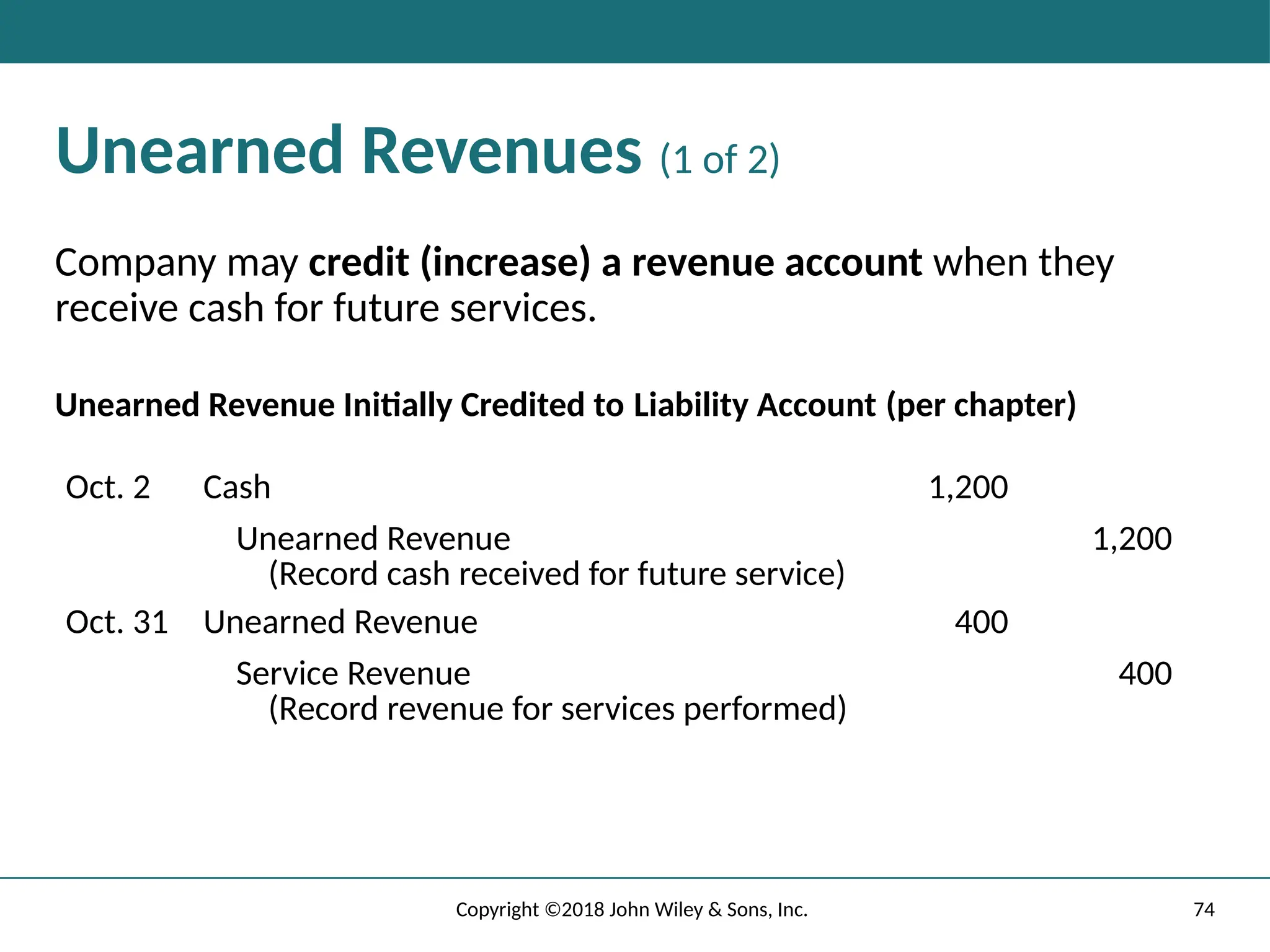
Copyright ©2018 John Wiley & Sons, Inc.
Unearned Revenues (1 of 2)
Company may credit (increase) a revenue account when they
receive cash for future services.
Unearned Revenue Initially Credited to Liability Account (per chapter)
Oct. 2 Cash 1,200
Unearned Revenue
(Record cash received for future service)
1,200
Oct. 31 Unearned Revenue 400
Service Revenue
(Record revenue for services performed)
400
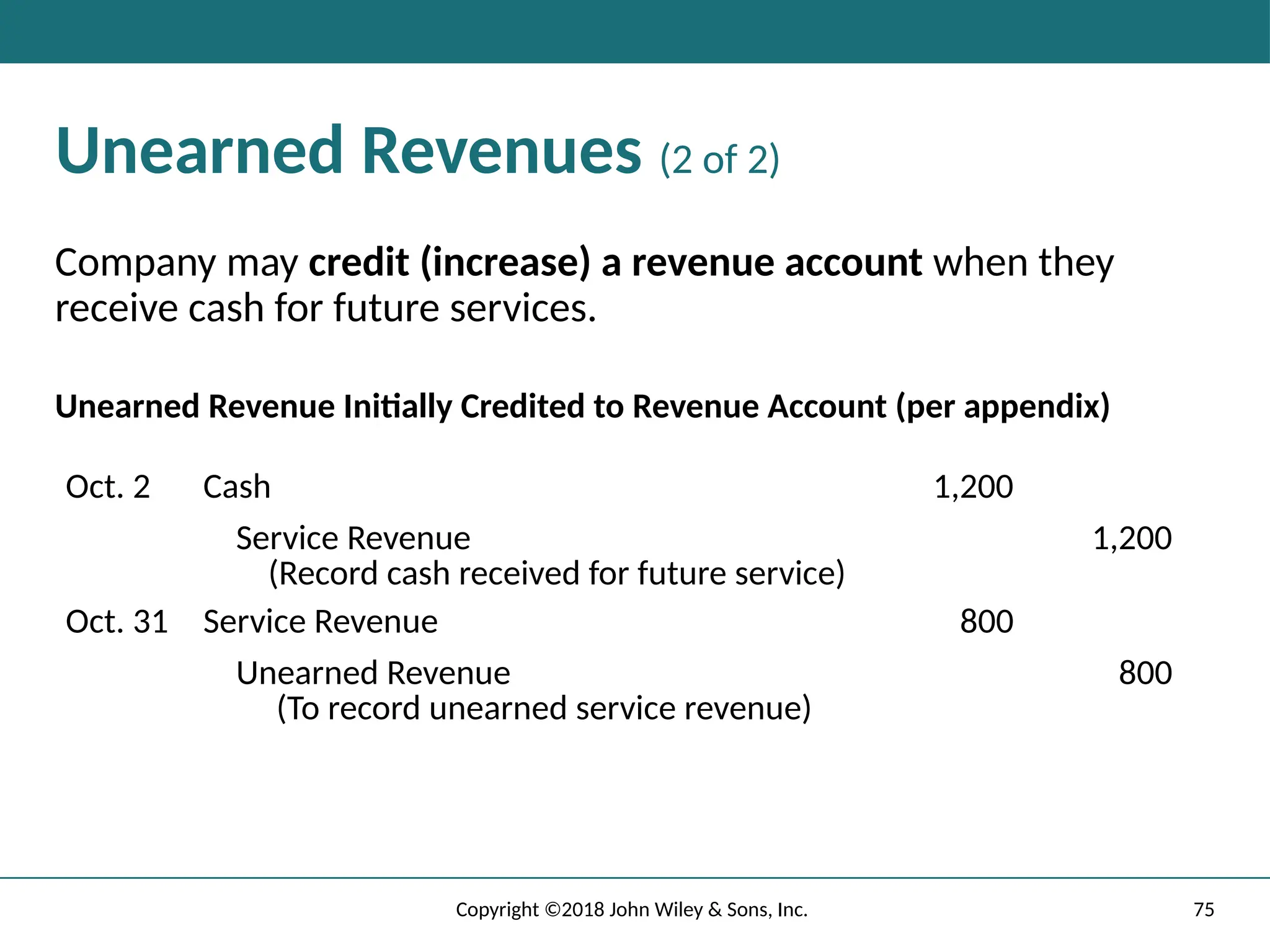
75. 75
Copyright ©2018 John Wiley & Sons, Inc.
Unearned Revenues (2 of 2)
Company may credit (increase) a revenue account when they
receive cash for future services.
Unearned Revenue Initially Credited to Revenue Account (per appendix)
Oct. 2 Cash 1,200
Service Revenue
(Record cash received for future service)
1,200
Oct. 31 Service Revenue 800
Unearned Revenue
(To record unearned service revenue)
800
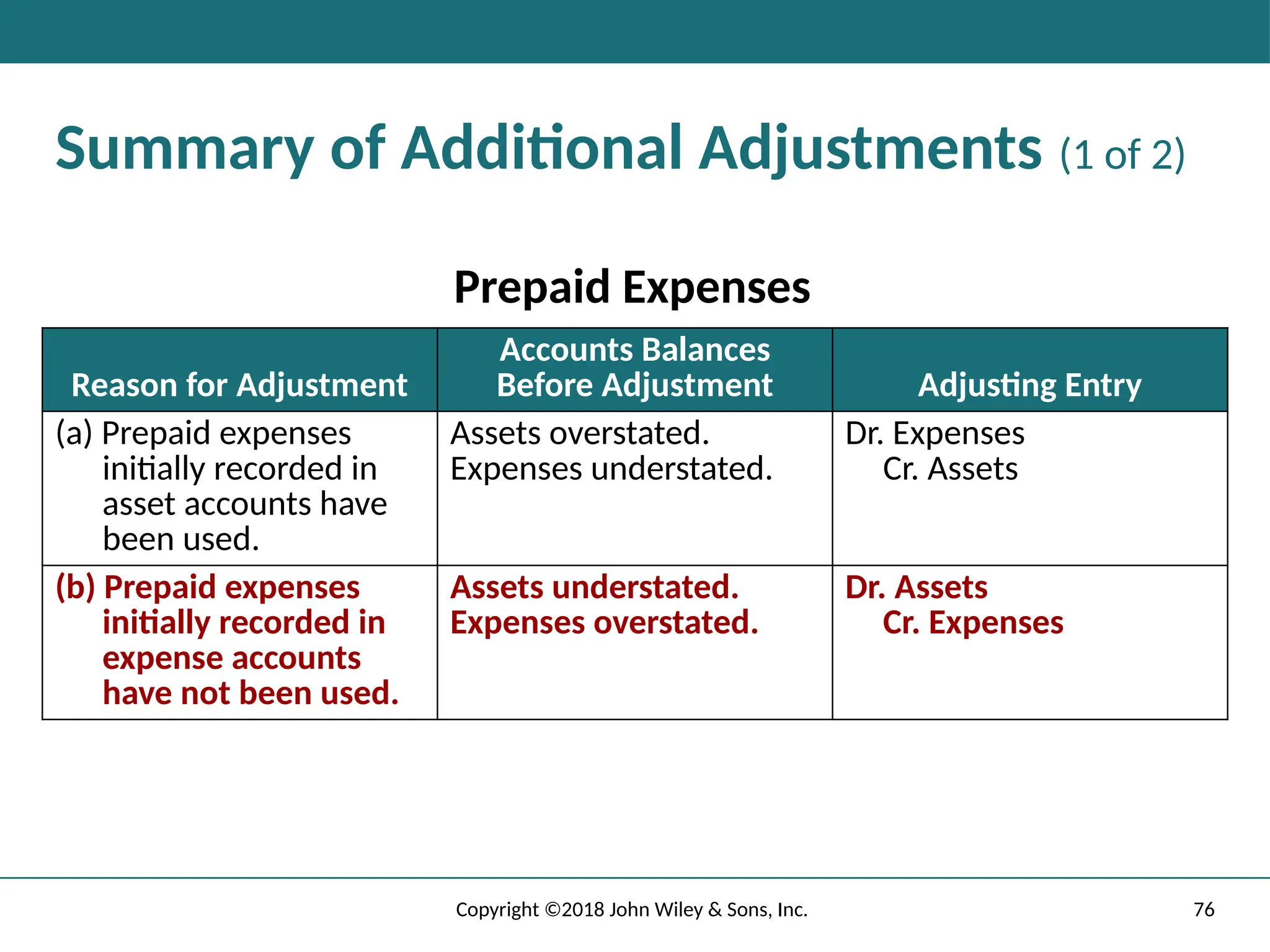
76. 76
Copyright ©2018 John Wiley & Sons, Inc.
Summary of Additional Adjustments (1 of 2)
Prepaid Expenses
Reason for Adjustment
Accounts Balances
Before Adjustment Adjusting Entry
(a) Prepaid expenses
initially recorded in
asset accounts have
been used.
Assets overstated.
Expenses understated.
Dr. Expenses
Cr. Assets
(b) Prepaid expenses
initially recorded in
expense accounts
have not been used.
Assets understated.
Expenses overstated.
Dr. Assets
Cr. Expenses
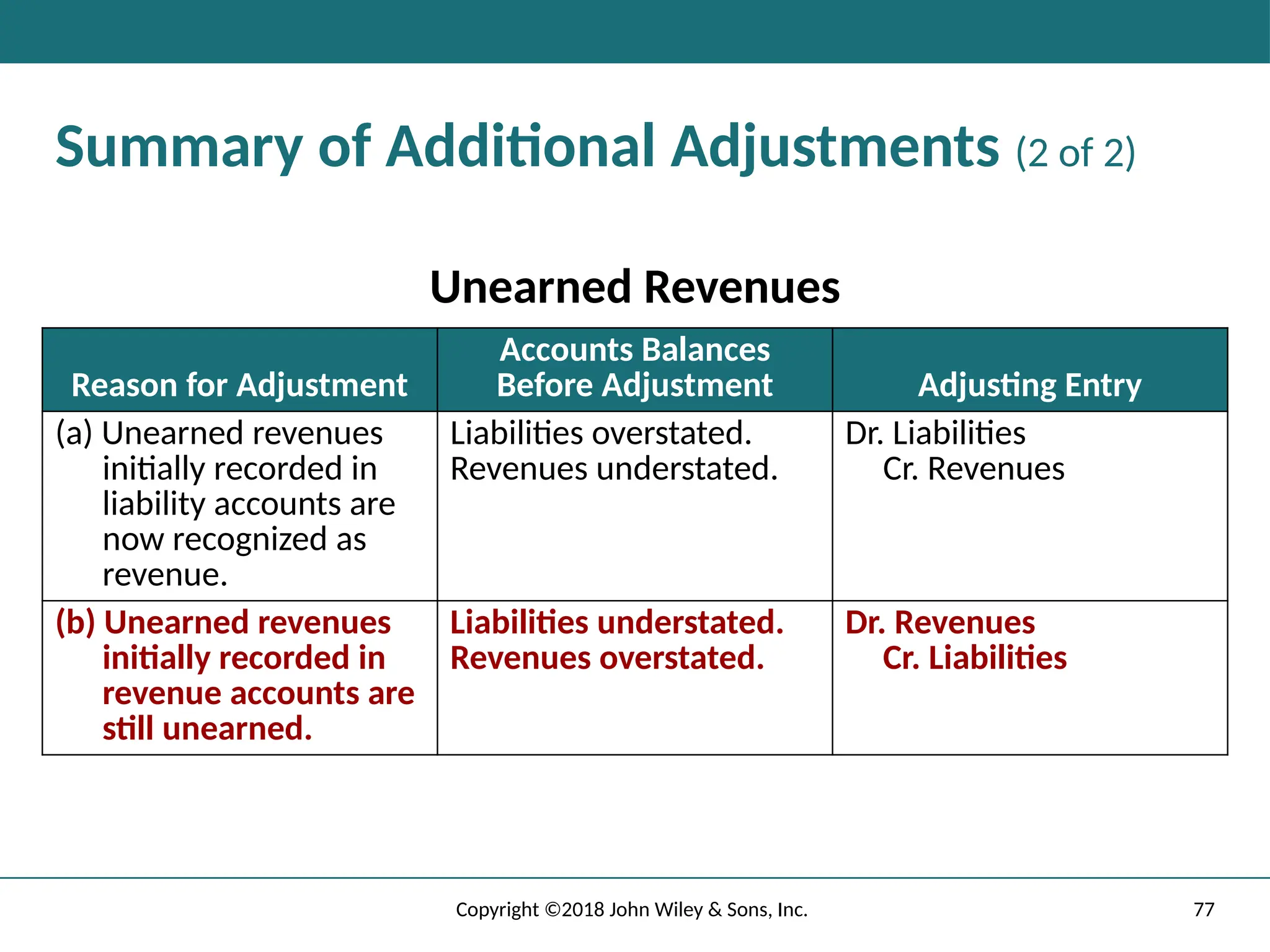
77. 77
Copyright ©2018 John Wiley & Sons, Inc.
Summary of Additional Adjustments (2 of 2)
Unearned Revenues
Reason for Adjustment
Accounts Balances
Before Adjustment Adjusting Entry
(a) Unearned revenues
initially recorded in
liability accounts are
now recognized as
revenue.
Liabilities overstated.
Revenues understated.
Dr. Liabilities
Cr. Revenues
(b) Unearned revenues
initially recorded in
revenue accounts are
still unearned.
Liabilities understated.
Revenues overstated.
Dr. Revenues
Cr. Liabilities
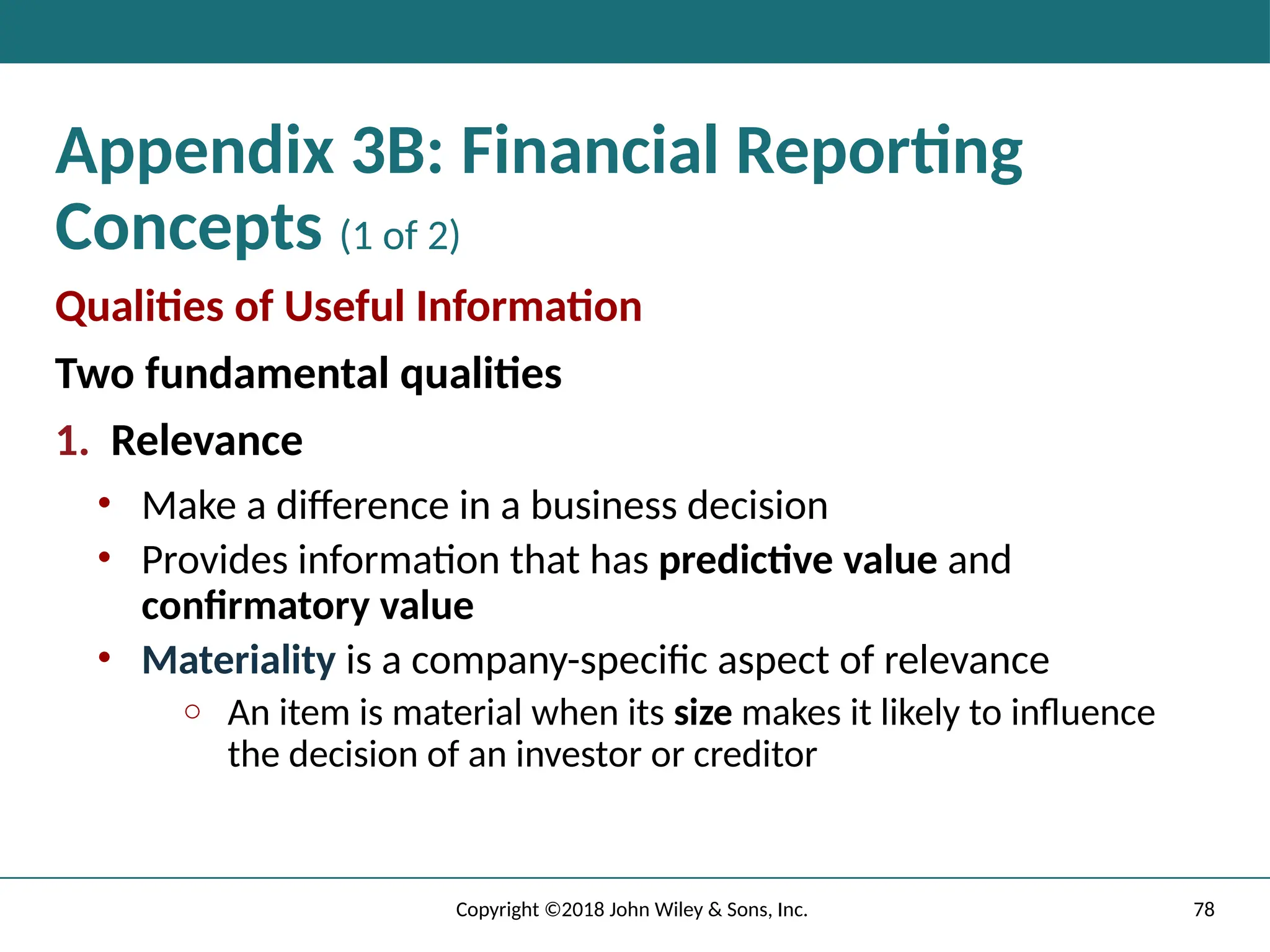
78. Appendix 3B: Financial Reporting
Concepts (1 of 2)
Qualities of Useful Information
Two fundamental qualities
1. Relevance
• Make a difference in a business decision
• Provides information that has predictive value and
confirmatory value
• Materiality is a company-specific aspect of relevance
o An item is material when its size makes it likely to influence
the decision of an investor or creditor
78
Copyright ©2018 John Wiley & Sons, Inc.
79. 79
Copyright ©2018 John Wiley & Sons, Inc.
Appendix 3B: Financial Reporting
Concepts (2 of 2)
Two fundamental qualities
2. Faithful Representation
• Information accurately depicts what really happened.
• Information must be
o complete (nothing important has been omitted)
o neutral (is not biased toward one position or another)
o free from error
80. 80
Copyright ©2018 John Wiley & Sons, Inc.
Qualities of Useful Information
Enhancing Qualities
• Comparability results when different companies use the
same accounting principles.
• Consistency means that a company uses the same
accounting principles and methods from year to year.
• Information is verifiable if independent observers, using the
same methods, obtain similar results.
• For accounting information to have relevance, it must be
timely.
• Information has the quality of understandability if it is
presented in a clear and concise fashion.
81. 82. 83. 83
Copyright ©2018 John Wiley & Sons, Inc.
Assumptions in Financial Reporting (3 of 3)
Measurement Principles
• Historical Cost
• Or cost principle, dictates that companies record assets at
their cost.
• Fair Value
• Indicates that assets and liabilities should be reported at fair
value (the price received to sell an asset or settle a liability).
84. 84
Copyright ©2018 John Wiley & Sons, Inc.
Principles of Financial Reporting
• Revenue Recognition Principle
• Requires that companies recognize revenue in the
accounting period in which the performance obligation is
satisfied.
• Expense Recognition Principle
• Dictates that companies recognize expense in the period in
which they make efforts to generate revenue. Thus, expenses
follow revenues.
• Full Disclosure Principle
• Requires that companies disclose all circumstances and events
that would make a difference to financial statement users.
85. 85
Copyright ©2018 John Wiley & Sons, Inc.
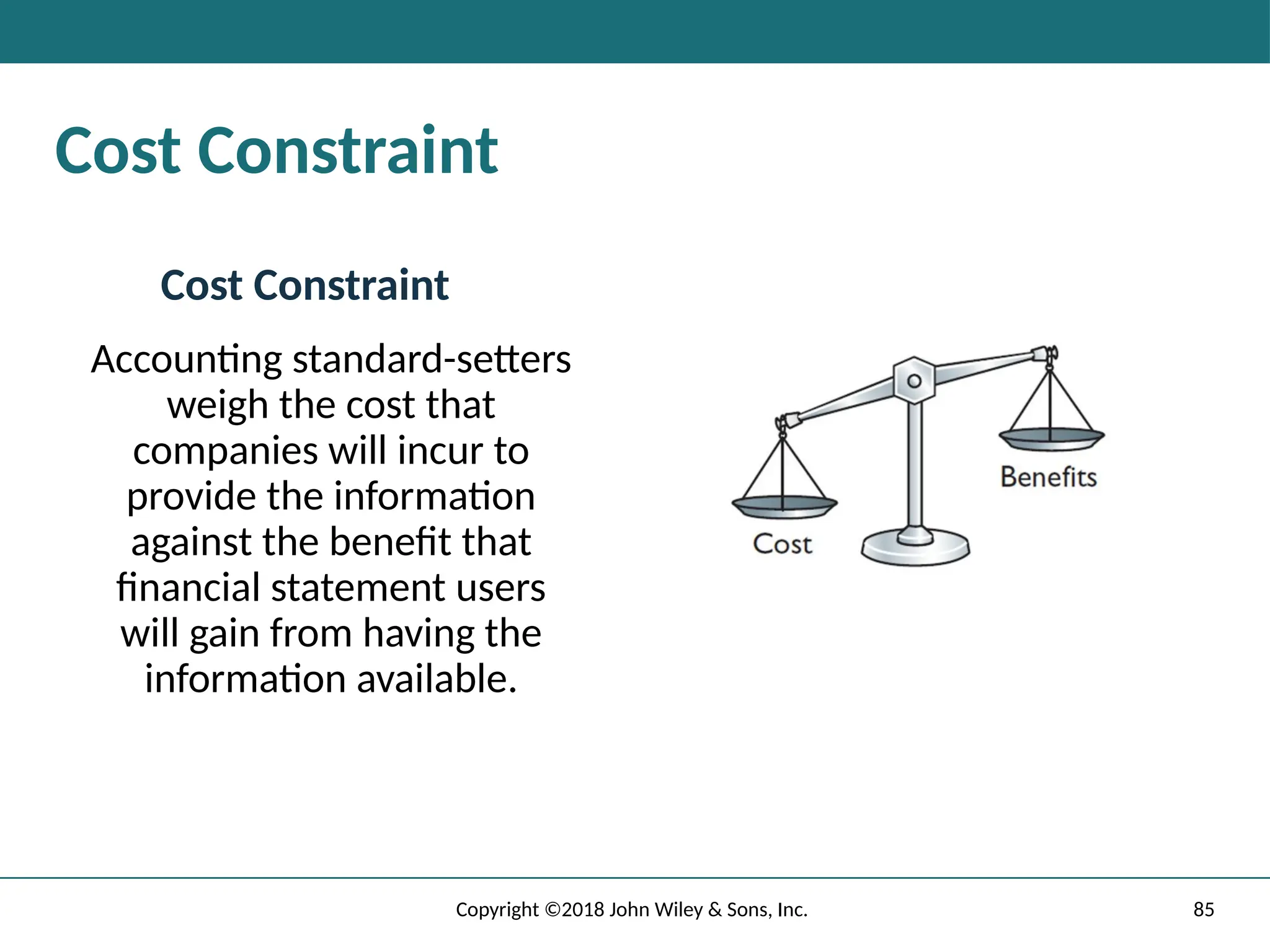
Cost Constraint
Cost Constraint
Accounting standard-setters
weigh the cost that
companies will incur to
provide the information
against the benefit that
financial statement users
will gain from having the
information available.
86. 86
Copyright ©2018 John Wiley & Sons, Inc.
A Look at IFRS (1 of 5)
Key Points
Similarities
• Companies applying IFRS also use accrual-basis accounting to
ensure that they record transactions that change a company’s
financial statements in the period in which events occur.
• Similar to GAAP, cash-basis accounting is not in accordance with
IFRS.
• IFRS also divides the economic life of companies into artificial
time periods. Under both GAAP and IFRS, this is referred to as
the time period assumption.
87. 87
Copyright ©2018 John Wiley & Sons, Inc.
A Look at IFRS (2 of 5)
Key Points
Similarities
• The general revenue recognition principle required by GAAP that
is used in this textbook is similar to that used under IFRS.
• Revenue recognition fraud is a major issue in U.S. financial
reporting. The same situation occurs in other countries, as
evidenced by revenue recognition breakdowns at Dutch software
company Baan NV, Japanese electronics giant NEC, and Dutch
grocer Ahold NV.
88. 88
Copyright ©2018 John Wiley & Sons, Inc.
A Look at IFRS (3 of 5)
Key Points
Differences
• Under IFRS, revaluation (using fair value) of items such as land and
buildings is permitted. IFRS allows depreciation based on revaluation of
assets, which is not permitted under GAAP.
• The terminology used for revenues and gains, and expenses and losses,
differs somewhat between IFRS and GAAP. For example, income under
IFRS includes both revenues, which arise during the normal course of
operating activities, and gains, which arise from activities outside of
the normal sales of goods and services. The term income is not used
this way under GAAP. Instead, under GAAP income refers to the net
difference between revenues and expenses.
89. 89
Copyright ©2018 John Wiley & Sons, Inc.
A Look at IFRS (4 of 5)
Key Points
Differences
• Under IFRS, expenses include both those costs incurred in the normal
course of operations as well as losses that are not part of normal
operations. This is in contrast to GAAP, which defines each separately.
90. 90
Copyright ©2018 John Wiley & Sons, Inc.
A Look at IFRS (5 of 5)
Looking to the Future
The IASB and FASB are completing a joint project on revenue recognition.
The purpose of this project is to develop comprehensive guidance on
when to recognize revenue. It is hoped that this approach will lead to
more consistent accounting in this area.
91. 91
Copyright ©2018 John Wiley & Sons, Inc.
Copyright
Copyright © 2018 John Wiley & Sons, Inc.
All rights reserved. Reproduction or translation of this work beyond that permitted in
Section 117 of the 1976 United States Act without the express written permission of the
copyright owner is unlawful. Request for further information should be addressed to the
Permissions Department, John Wiley & Sons, Inc. The purchaser may make back-up copies
for his/her own use only and not for distribution or resale. The Publisher assumes no
responsibility for errors, omissions, or damages, caused by the use of these programs or
from the use of the information contained herein.
![18
Copyright ©2018 John Wiley & Sons, Inc.
Do It! 1: Timing Concepts (1 of 2)
Below is a list of timing concepts in the
left column, with a description of the
concept in the right column. There are
more descriptions provided than
concepts. Match the description to the
concept
1. [blank] Accrual-basis accounting.
2. [blank] Calendar year.
3. [blank] Time period assumption.
4. [blank] Expense recognition principle.
(a) Monthly and quarterly time periods.
(b) Efforts (expenses) should be recognized in the
period in which a company uses assets or
incurs liabilities to generate results
(revenues).
(c) Accountants divide the economic life of a
business into artificial time periods.
(d) Companies record revenues when they
receive cash and record expenses when they
pay out cash.
(e) An accounting time period that starts on
January 1 and ends on December 31.
(f) Companies record transactions in the period in
which the events occur.](https://image.slidesharecdn.com/ch03-250524215335-d3e6487f/75/ch03-pptx-chapter-3-adjusting-accounts-at-end-of-period-18-2048.jpg)