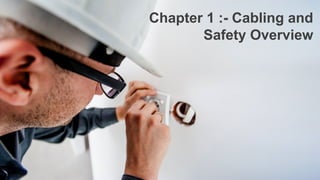
Chapter 1 :- Cabling and
Safety Overview
Sections & Objectives
Chapter 1 :- Cabling and Safety Overview
• Learn about the Cabling Industry
• Examine Safety Codes and Standards
• Discuss Safety Around Electricity
• Discuss Lab and Workplace Safety Practices
• Learn about Personal Safety Equipment
Analog
Telephony
A telephone network needs a cable run between each residence or business and a
central telephone office With the popularization of the telephone, the quality of the
connection became important. At the same time, the need to standardize installation
practices, equipment, and materials was realized.
Voice/telephone Cabling typically consists of two wires, These two wires are twisted
around each other to prevent signals from one pair leaking into the other. This type
of wiring is called twisted-pair.
Structured Cabling
The concept of using a single wiring scheme to handle all voice, data, and other
services like video is called structured cabling.
Structured cabling also includes all the devices that cable is pulled through, the
equipment to which the cable is terminated, and electronic devices that connect
users and resources.
Emerging Cable Technologies
Fiber-optic is a type of cable that uses pulses of light to
transmit data through glass threads.
Wireless uses radio or microwave signals as a tool for
transmitting data or voice.
High-speed access technologies:
•Cable TV has great potential as a bandwidth delivery
mechanism.
•Digital Subscriber Line (DSL) is a group of technologies that
uses carrier signals on the existing wires of the telephone
system to carry high-speed digital data.
Cost of poor cabling
The job of the cable installer is to provide good,
technically accurate cabling between all of the
communications devices that make up the
network
It is more economical for customers to pay a
little more up front to make sure the job is done
right, conforms to standards, and is scalable
Network administrators waste time
troubleshooting problems caused by poor
installation
Safety Codes
Employee safety - Stay alert, think ahead,
and wear appropriate protective gear to
help stay safe
Workplace safety - Work with others in a
way that does not endanger them
Public safety - Take precaution in all work
conditions
Electrical Safety
Keep an eye out for abnormal circumstances such as
circuit breaker boxes with the covers removed, frayed or
loose cords, and damaged equipment.
Pay particular attention to other devices and other
workers in the work area.
Never touch a cable that might be "live" with both
handsbecause a complete circuit could be formed.
Always keep one hand off of the cable.
Electrical Safety
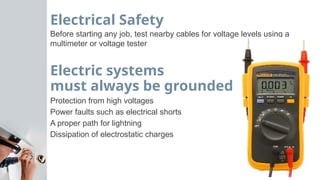
Before starting any job, test nearby cables for voltage levels using a
multimeter or voltage tester
Electric systems
must always be grounded
Protection from high voltages
Power faults such as electrical shorts
A proper path for lightning
Dissipation of electrostatic charges
Electrical Safety
Six Feet of Separation Rule
Allow 6 feet, or 1.8 m, between voice and data cabling
and high-voltage wiring.
The noise from electrical circuits or devices, known as
electromagnetic interference (EMI), can interfere with
data signals, thus distorting them and causing general
communications problems.
It minimizes the possibility of accidental contact with
hazardous voltages.
Electrostatic Discharge
Electrostatic discharge (ESD), more
commonly known as static electricity, can be
the most damaging and uncontrollable form
of electricity.
Static electricity shocks can be disastrous for
computers.
Good grounding and bonding can prevent
damage from static electricity because they
pass static bursts to the ground.
Work Area Safety
Survey work area beforehand
Ask building supervisor if you could come in
contact with dangerous materials
(chemicals, asbestos, or lead)
Keep area clean and neat
Locate fire extinguishers
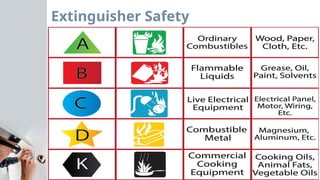
Extinguisher Safety
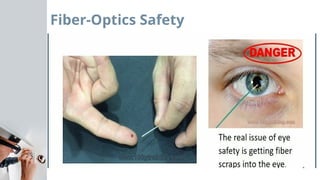
Fiber-Optics Safety
First Aid Kit
Every work area should
have a first aid kit
available
Periodically check that
it is fully stocked
Make sure that it
contains an eye wash
cup for debris
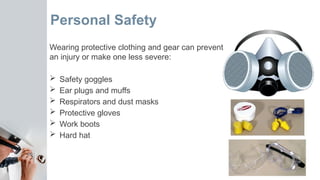
Personal Safety
Wearing protective clothing and gear can prevent
an injury or make one less severe:
 Safety goggles
 Ear plugs and muffs
 Respirators and dust masks
 Protective gloves
 Work boots
 Hard hat
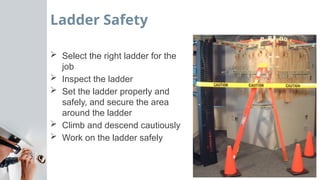
Ladder Safety
 Select the right ladder for the
job
 Inspect the ladder
 Set the ladder properly and
safely, and secure the area
around the ladder
 Climb and descend cautiously
 Work on the ladder safely
Safety Rules
Follow all national, industry, and workplace safety rules.
Training is essential when working with electricity, power tools, or
any other potential hazardous equipment
Use safety equipment.
Be alert and act professionally.
Stay current on issues related to safety and health in the
workplace.
Chapter Summary

Ch01 - Cabling and Safety Overviewv.pptx

  • 1.
    Chapter 1 :-Cabling and Safety Overview
  • 2.
    Sections & Objectives Chapter1 :- Cabling and Safety Overview • Learn about the Cabling Industry • Examine Safety Codes and Standards • Discuss Safety Around Electricity • Discuss Lab and Workplace Safety Practices • Learn about Personal Safety Equipment
  • 3.
    Analog Telephony A telephone networkneeds a cable run between each residence or business and a central telephone office With the popularization of the telephone, the quality of the connection became important. At the same time, the need to standardize installation practices, equipment, and materials was realized. Voice/telephone Cabling typically consists of two wires, These two wires are twisted around each other to prevent signals from one pair leaking into the other. This type of wiring is called twisted-pair. Structured Cabling The concept of using a single wiring scheme to handle all voice, data, and other services like video is called structured cabling. Structured cabling also includes all the devices that cable is pulled through, the equipment to which the cable is terminated, and electronic devices that connect users and resources.
  • 4.
    Emerging Cable Technologies Fiber-opticis a type of cable that uses pulses of light to transmit data through glass threads. Wireless uses radio or microwave signals as a tool for transmitting data or voice. High-speed access technologies: •Cable TV has great potential as a bandwidth delivery mechanism. •Digital Subscriber Line (DSL) is a group of technologies that uses carrier signals on the existing wires of the telephone system to carry high-speed digital data.
  • 5.
    Cost of poorcabling The job of the cable installer is to provide good, technically accurate cabling between all of the communications devices that make up the network It is more economical for customers to pay a little more up front to make sure the job is done right, conforms to standards, and is scalable Network administrators waste time troubleshooting problems caused by poor installation
  • 6.
    Safety Codes Employee safety- Stay alert, think ahead, and wear appropriate protective gear to help stay safe Workplace safety - Work with others in a way that does not endanger them Public safety - Take precaution in all work conditions
  • 7.
    Electrical Safety Keep aneye out for abnormal circumstances such as circuit breaker boxes with the covers removed, frayed or loose cords, and damaged equipment. Pay particular attention to other devices and other workers in the work area. Never touch a cable that might be "live" with both handsbecause a complete circuit could be formed. Always keep one hand off of the cable.
  • 8.
    Electrical Safety Before startingany job, test nearby cables for voltage levels using a multimeter or voltage tester Electric systems must always be grounded Protection from high voltages Power faults such as electrical shorts A proper path for lightning Dissipation of electrostatic charges
  • 9.
    Electrical Safety Six Feetof Separation Rule Allow 6 feet, or 1.8 m, between voice and data cabling and high-voltage wiring. The noise from electrical circuits or devices, known as electromagnetic interference (EMI), can interfere with data signals, thus distorting them and causing general communications problems. It minimizes the possibility of accidental contact with hazardous voltages.
  • 10.
    Electrostatic Discharge Electrostatic discharge(ESD), more commonly known as static electricity, can be the most damaging and uncontrollable form of electricity. Static electricity shocks can be disastrous for computers. Good grounding and bonding can prevent damage from static electricity because they pass static bursts to the ground.
  • 11.
    Work Area Safety Surveywork area beforehand Ask building supervisor if you could come in contact with dangerous materials (chemicals, asbestos, or lead) Keep area clean and neat Locate fire extinguishers
  • 12.
  • 13.
  • 14.
    First Aid Kit Everywork area should have a first aid kit available Periodically check that it is fully stocked Make sure that it contains an eye wash cup for debris
  • 15.
    Personal Safety Wearing protectiveclothing and gear can prevent an injury or make one less severe:  Safety goggles  Ear plugs and muffs  Respirators and dust masks  Protective gloves  Work boots  Hard hat
  • 16.
    Ladder Safety  Selectthe right ladder for the job  Inspect the ladder  Set the ladder properly and safely, and secure the area around the ladder  Climb and descend cautiously  Work on the ladder safely
  • 17.
    Safety Rules Follow allnational, industry, and workplace safety rules. Training is essential when working with electricity, power tools, or any other potential hazardous equipment Use safety equipment. Be alert and act professionally. Stay current on issues related to safety and health in the workplace.
  • 18.