This document presents a thesis analyzing the stability margin of superconducting cables for the High Luminosity Large Hadron Collider (HiLumi-LHC) project at CERN. It uses both zero-dimensional and one-dimensional numerical models to simulate the electro-thermal behavior of Nb3Sn cables during a quench induced by beam losses. The results show the quench energy for the Nb3Sn inner triplet quadrupole magnet is significantly different than for the existing NbTi magnets. Comparisons with NbTi cables highlight differences in quench performance between impregnated Nb3Sn cables and non-impregnated NbTi cables in their typical operating conditions.
![Sommario
Al CERN (Centro Europeo per la Ricerca Nucleare), tra il 1998 e il 2008, è stato
costruito il più grande e più potente collimatore di particelle del mondo. LHC
(Large Hadron Collider) è la più grande infrastruttura scientifica mai realizzata per
esplorare le nuove frontiere della fisica ad alta energia e coinvolge una comunità di
7000 scienziati da oltre 60 paesi. Le particelle accelerate vengono fatte collidere tra
loro ad una velocità prossima a quella della luce. Questo processo permette di com-
prende le interazioni tra le diverse particelle e fornisce degli straordinari indizi sulle
legge fondamentali della natura. Dopo le ultime incredibili scoperte, riguardanti il
bosone di Higgs ed i penta-quarks, un ulteriore avanzamento tecnologico è neces-
sario. Al fine di incrementare il proprio potenziale di ricerca, l’ LCH avrà bisogno
di un forte aggiornamento, intorno al 2020, per aumentare la propria luminosità
(rateo di collisioni) di un fattore 10 rispetto al valore di progettazione originale (da
300 a 3000 fb−1
).Per una macchina così complessa ed ottimizzata come l’ LHC, un
aggiornamento di questo tipo richiede un accurato studio ed oltre 10 anni di im-
plementazione. L’obiettivo del progetto High Luminosity - Large Hadron Collider
include la progettazione di un nuovo sistema magnetico e 16 quadrupoli supercon-
duttori inner triplet low-β devono essere sostituiti al fine di raggiungere un campo
magnetico di picco di circa 12 T. Un così alto valore di campo magnetico rende nec-
essario l’utilizzo di magneti superconduttori avvolti con cavi Rutherford in Nb3Sn,
al posto degli attuali in NbTi.
Il livello di quench di questi magneti (ovvero l’energia massima che il cavo può
sopportare senza transire definitivamente allo stato normale) è un valore chiave per
la protezione dalle perdite dovute al fascio, ed è prevedibile che sia significativamente
diverso dai valori analizzati e misurati per magneti in NbTi dell’ LHC. In questo
lavoro abbiamo applicato un modello numerico zero e mono-dimensionale di un cavo
Rutherford multifilamentare dei magneti quadrupolari low-β, chiamati MQXF [1],
per simulare le instabilità termo-elettriche durante un quench indotto dalle perdite
del fascio. La deposizione di calore nel cavo superconduttore dovuta a tali perdite
i](https://image.slidesharecdn.com/1d70407d-94a9-4ad5-8282-7558b7edcd7f-170222141405/75/CERN-THESIS-2016-081-3-2048.jpg)
![è stata ottenuta attraverso computazioni eseguite con il codice FLUKA [2]. Per le
proprietà materiali ed il modello superconduttivo è stata usata la parametrizzazione
della superficie critica del Nb3Sn usato ad ITER [3].
Nel modello zero-dimensionale, l’intero cavo è rappresentato da un singolo ele-
mento termico caratterizzato da temperatura uniforme e proprietà termiche omoge-
nee. Per queste analisi è stato utilizzato il codice CryoSoft ZERODEE [4].
Incrementando il livello di complessità del modello, si prendono in consider-
azione i domini termico, elettrico ed idraulico. Trascurando la sezione del cavo
rispetto alla sua lunghezza, è possibile utilizzare un modello mono-dimensionale.
La modellizzazione e le simulazioni sono state portare a termite attraverso il codice
CryoSoft THEA [5][6], che permette non solo di analizzare i fenomeni termici di
scambio di calore, ma anche la redistribuzione delle correnti tra i diversi filamenti
e la fluido-dinamica dell’ elio liquido che circonda il cavo. Per la parametrizzazione
termica ed elettrica sono stati utilizzati i dati presentati in [7], mentre per lo scambio
termico tra il bagno d’elio e il cavo si fa riferimento al modello empirico sviluppato
da [8].
Per il codice THEA, sono stati effettuati numerosi studi di convergenza riguardanti
il passo di integrazione temporale, la mesh e la tolleranza, con l’obiettivo di non
perdere informazioni critiche durante le simulazioni.
Due diversi approcci allo studio del margine di stabilità sono stati effettuati:
uno basato sull’analisi del singolo filamento ed un altro tenendo conto della totalità
dei 40 filamenti dei quali è composto il cavo Rutherford. I risultati di questi due
modelli sono stati confrontati al fine di determinare gli effetti di ridistribuzione di
calore e corrente. Inoltre è stato studiato l’impatto dell’introduzione di un nucleo
resistivo inserito tra i due strati del cavo Rutherford.
Gli andamenti delle temperature e delle correnti sono stati analizzati per ogni
filamento, sia nello spazio che nel tempo, al fine comprendere meglio il comporta-
mento del cavo durante la fase di quench o recovery.
Viene infine presentato un confronto tra i valori di quench ottenuti per un
conduttore in Nb3Sn nelle condizioni operative del quadrupolo inner triplet low-β
(MQXF) di Hi-Lumi LHC, e quelli per un cavo Rutherford in NbTi del quadrupolo
(MQ) dell’ LHC [9]. Sono state evidenziate le differenze e le analogie delle prestazioni
di quench dei cavi impregnati per i magneti in Nb3Sn e quelli non impregnati per i
magneti in NbTi, nelle rispettive condizioni di lavoro.
ii](https://image.slidesharecdn.com/1d70407d-94a9-4ad5-8282-7558b7edcd7f-170222141405/75/CERN-THESIS-2016-081-4-2048.jpg)
![Abstract
At CERN (European Organization for Nuclear Research), between 1998 and 2008,
the world’s largest and most powerful particle collider has been built. The LHC
(Large Hadron Collider) is the biggest scientific instrument ever built to explore the
new high-energy physic frontiers and it gathers a global user community of 7,000
scientists from all over 60 countries. The accelerated particles are made to collide
together approaching the speed of light. This process allows to understand how the
particles interact and provides insights into the fundamental laws of nature. After
the latest amazing discoveries concerning the Higgs boson and the penta-quarks,
another step forward is needed. To extend its discovery potential, the LHC will
need a major upgrade around 2020 to increase its luminosity (rate of collisions)
by a factor of 10 beyond the original design value (from 300 to 3000 fb−1
). As
a highly complex and optimised machine, such an upgrade of the LHC must be
carefully studied and requires about 10 years to implement. The scope of the Large
Hadron Collider High Luminosity Project includes a new magnetic design and 16
superconducting inner triplet low-β quadrupoles have to be replaced to reach a
magnetic peak field of about 12 T. Such a high value of magnetic field requires the
use of superconducting magnets wound with Nb3Sn Rutherford cables, instead of
the actual ones made in NbTi.
The quench level of these magnets (i.e. the maximum energy that a cable can
tolerate without quenching) is a key value required to set magnet protection from
beam losses, and is expected to be significantly different from the computed and
measured levels of the LHC NbTi magnets. In this work, we applied both zero and
one-dimensional numerical model of multi-strand Rutherford cables of the low-β
quadrupole magnets, called MQXF [1], to simulate the electro-thermal instabilities
of a beam-induced quench. The heat deposition on the superconducting cable due
to the beam losses was obtained with computations performed with the FLUKA
code [2]. For the material properties and superconducting model, the ITER Nb3Sn
critical surface parameterization has been used [3].
iii](https://image.slidesharecdn.com/1d70407d-94a9-4ad5-8282-7558b7edcd7f-170222141405/75/CERN-THESIS-2016-081-5-2048.jpg)
![In the zero-dimensional model, the whole cable is lumped into a single thermal
component characterised by uniform temperature and homogenised thermal prop-
erties. For thes analyses the CryoSoft ZERODEE [4] code has been used.
Increasing the level of complexity of the model, thermal, electric and hydraulic
domains are taken into account. Neglecting the cable cross section in comparison
with the longitudinal dimension, a one-dimensional model has been considered. The
modelling and the simulations are carried out by means of the CryoSoft THEA [5][6]
code, that allows to examine not only the thermal phenomena of heat exchange,
but also the currents redistribution between different strands and the fluid-dynamic
behaviour of the liquid Helium surrounding the cable. For the thermal and electric
parameterization the data from [7] have been used, while for the heat exchange
between the helium bath and the cable the empirical model presented in [8] is
considered.
For the THEA code several studies of convergence concerning integration time
steps, mesh and tolerance have been carried out, aiming not to lose critical infor-
mation during the simulations.
Two kinds of investigation of the stability margin have been performed, one
based on the analysis of the single strand, and the other accounting for all the 40
strands of the multi-strand Rutherford cable. The results of these two models are
compared to analyse the effects of heat and current redistribution. The impact on
quench energy of a resistive core embedded between the two layers of the Rutherford
cables is also studied.
The trends of the temperatures and the currents are analysed for each strand
both in the space and in the time, in order to better understand the behaviour of
the cable during the quench or the recovery phase.
A comparison between the quench energy values obtained for the Nb3Sn con-
ductor in the working conditions of the Hi-Lumi LHC inner triplet low-β quadrupole
(MQXF) and those of the NbTi Rutherford cable of the LHC main quadrupole mag-
net (MQ) [9] is presented. The differences and similarities in quench performance
between the impregnated cables for Nb3Sn magnets and the non-impregnated ones
for NbTi magnets at their respective typical working conditions in superconducting
accelerator magnets are highlighted.
iv](https://image.slidesharecdn.com/1d70407d-94a9-4ad5-8282-7558b7edcd7f-170222141405/75/CERN-THESIS-2016-081-6-2048.jpg)
![List of Figures
1.1 Representation of the CERN accelerator chain . . . . . . . . . . . . . 2
2.1 Historic plot of resistance versus temperature for mercury, from the
1911 Onnes experiment, shows the superconducting transition at 4.20
K. . . . . . . . . . . . . . . . . . . . . . . . . . . . . . . . . . . . . . 6
2.2 Diagram of the Meissner-Ochsenfeld effect. Magnetic field lines, rep-
resented as arrows, are excluded from a superconductor when it is
below its critical temperature. . . . . . . . . . . . . . . . . . . . . . . 7
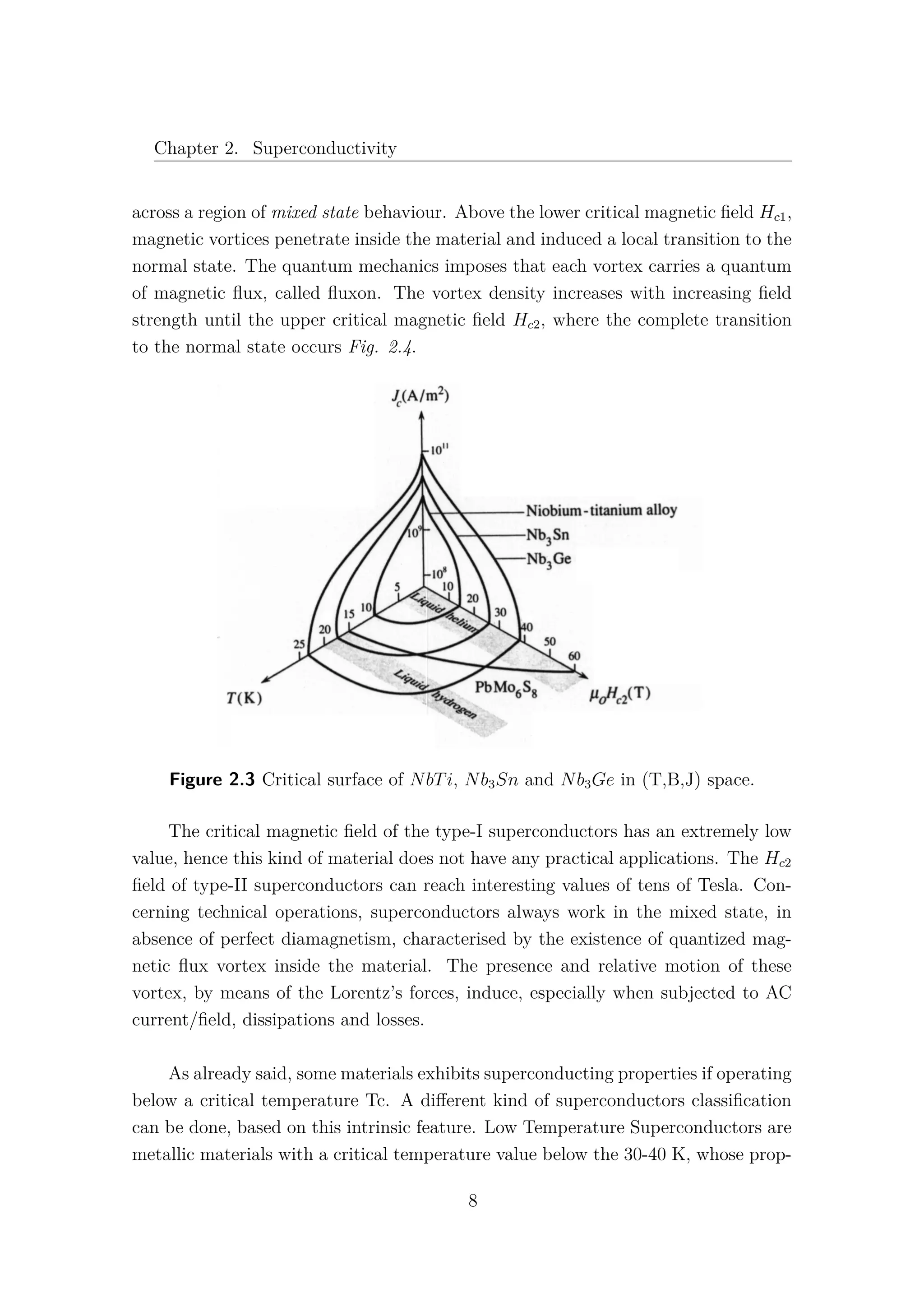
2.3 Critical surface of NbTi, Nb3Sn and Nb3Ge in (T,B,J) space. . . . . 8
2.4 Comparison between the H-T diagram of type-I (a) and type-II (b)
superconductor. . . . . . . . . . . . . . . . . . . . . . . . . . . . . . 9
2.5 Two of the most severely damage interconnections in the LHC sector
3-4. . . . . . . . . . . . . . . . . . . . . . . . . . . . . . . . . . . . . . 10
2.6 Spectrum of energy perturbations as a function of the characteristic
time of energy deposition [10]. . . . . . . . . . . . . . . . . . . . . . . 11
2.7 An event tree for the evolution of an external energy input. The
stability design and analysis are concentrated on the shaded area [10]. 12
2.8 The qualitative evolution of the temperature in a superconducting
cable for an energy perturbation just below and just above the energy
margin. . . . . . . . . . . . . . . . . . . . . . . . . . . . . . . . . . . 13
2.9 The location of the BLMs outside the cryostat in the LHC tunnel. . . 14
3.1 The MQXF real cross section. . . . . . . . . . . . . . . . . . . . . . . 16
3.2 The MQXF model cross section. The superconducting coils are high-
lighted in red. . . . . . . . . . . . . . . . . . . . . . . . . . . . . . . . 17
3.3 Schematic of an accelerator dipole. . . . . . . . . . . . . . . . . . . . 17
3.4 Magnetic flux density in the coil. . . . . . . . . . . . . . . . . . . . . 18
3.5 Nb3Sn Rutherford cable for MQXF front view . . . . . . . . . . . . . 18
viii](https://image.slidesharecdn.com/1d70407d-94a9-4ad5-8282-7558b7edcd7f-170222141405/75/CERN-THESIS-2016-081-10-2048.jpg)
![List of Figures
6.9 Comparison between different amounts of copper for the 1-strand and
the 40-strand models for MQXF Nb3Sn cable: Quench energies vs.
Heating time at the operating current, with non-uniform heat depo-
sition. . . . . . . . . . . . . . . . . . . . . . . . . . . . . . . . . . . . 52
6.10 Comparison between different values of thermal conductivity for the
1-strand and the 40-strand models for MQXF Nb3Sn cable: Quench
energies vs. Heating time at the operating current, with non-uniform
heat deposition. . . . . . . . . . . . . . . . . . . . . . . . . . . . . . . 53
6.11 MQ NbTi: Quench energies vs. Heating time at the operating cur-
rent , for the 36-strand model with uniform (blue curve), non-uniform
PEAK (red curve) and non-uniform MEAN (green curve) heat depo-
sition. . . . . . . . . . . . . . . . . . . . . . . . . . . . . . . . . . . . 54
6.12 Comparison between the presence and the absence of interstitial he-
lium, replaced with glass-epoxy, for the 1-strand model for MQ NbTi
cable: Quench energies vs. Heating time at the operating current,
with non-uniform heat deposition. . . . . . . . . . . . . . . . . . . . . 55
6.13 Comparison between the presence and the absence of interstitial he-
lium, replaced with glass-epoxy, for the 36-strand model for MQ NbTi
cable: Quench energies vs. Heating time at the operating current,
with non-uniform heat deposition. . . . . . . . . . . . . . . . . . . . . 56
6.14 Comparison between different values of glass-epoxy area for the 40-
strand model for QXF Nb3Sn cable: Quench energies vs. Heating
time at the operating current, with non-uniform heat deposition. . . . 56
6.15 Representation of the 1-D cored model. . . . . . . . . . . . . . . . . . 57
6.16 Comparison between cored and non-cored QXF Nb3Sn cable at 100%
of operating current : Quench energies vs. Heating time at the oper-
ating current, with non-uniform heat deposition. . . . . . . . . . . . . 58
6.17 Comparison between cored and non-cored QXF Nb3Sn cable at 25%
of operating current : Quench energies vs. Heating time at the oper-
ating current, with non-uniform heat deposition. . . . . . . . . . . . . 58
6.18 Comparison between non-cored and cored with and without the core
heat capacity: Quench energies vs. Heating time at the operating
current, with non-uniform heat deposition. . . . . . . . . . . . . . . . 59
8.1 Stability of the Minimum Quench Energy in terms of maximum inte-
gration time steps. [Thermal component] . . . . . . . . . . . . . . . 63
xi](https://image.slidesharecdn.com/1d70407d-94a9-4ad5-8282-7558b7edcd7f-170222141405/75/CERN-THESIS-2016-081-13-2048.jpg)
![List of Figures
8.2 Minimum Quench Energy as a function of heat disturbance duration,
with different maximum integration time steps. [Thermal component] 63
8.3 Stability of the Minimum Quench Energy in terms of minimum inte-
gration time steps. [Thermal component] . . . . . . . . . . . . . . . 64
8.4 Minimum Quench Energy as a function of heat disturbance duration,
with different minimum integration time steps. [Thermal component] 65
8.5 Stability of the Minimum Quench Energy in terms of maximum inte-
gration time steps. [Thermal and electric components] . . . . . . . . 66
8.6 Minimum Quench Energy as a function of heat disturbance duration,
with different maximum integration time steps. [Thermal and electric
components] . . . . . . . . . . . . . . . . . . . . . . . . . . . . . . . . 66
8.7 Stability of the Minimum Quench Energy in terms of minimum inte-
gration time steps. [Thermal and electric components] . . . . . . . . 67
8.8 Minimum Quench Energy as a function of heat disturbance duration,
with different minimum integration time steps. [Thermal and electric
components] . . . . . . . . . . . . . . . . . . . . . . . . . . . . . . . . 68
8.9 Stability of the Minimum Quench Energy in terms of tolerance. [Ther-
mal component] . . . . . . . . . . . . . . . . . . . . . . . . . . . . . 69
8.10 Stability of the Minimum Quench Energy in terms of tolerance. [Ther-
mal and electric components] . . . . . . . . . . . . . . . . . . . . . . 70
8.11 Stability of the Minimum Quench Energy in terms of mesh element
number . [Thermal component] . . . . . . . . . . . . . . . . . . . . . 71
8.12 Stability of the Minimum Quench Energy in terms of mesh element
number for long heat disturbance . [Thermal and Electric compo-
nents] . . . . . . . . . . . . . . . . . . . . . . . . . . . . . . . . . . . 72
8.13 Stability of the Minimum Quench Energy in terms of error control.
[Thermal component] . . . . . . . . . . . . . . . . . . . . . . . . . . 73
8.14 Stability of the Minimum Quench Energy in terms of error control.
[Thermal and electric components] . . . . . . . . . . . . . . . . . . . 74
xii](https://image.slidesharecdn.com/1d70407d-94a9-4ad5-8282-7558b7edcd7f-170222141405/75/CERN-THESIS-2016-081-14-2048.jpg)
![1. European Organization for
Nuclear Research
“At CERN, the European Organization for Nuclear Research, physicists and
engineers are probing the fundamental structure of the universe. They use the world’s
largest and most complex scientific instruments to study the basic constituents of
matter - the fundamental particles. The particles are made to collide together at
close to the speed of light. The process gives the physicists clues about how the
particles interact, and provides insights into the fundamental laws of nature” [11].
Established in 1954, located in Geneva - Switzerland, nowadays it is the the largest
particle physics laboratory ever built. It counts 22 member states and co-operations
with almost every state in the world. Birthplace of the World Wide Web, it has
accomplished many scientific achievements, last of them the discovery of the Higgs
boson (Nobel prize in 2013) and the penta-quarks (2015). CERN is not only one of
the most important research centre of the world, but it also represent the joint of
diverse cultures and languages, the hard work and the passion over the differences.
A virtuous and peaceful example of international collaboration with an unique aim:
Science.
1](https://image.slidesharecdn.com/1d70407d-94a9-4ad5-8282-7558b7edcd7f-170222141405/75/CERN-THESIS-2016-081-15-2048.jpg)
![Chapter 1. European Organization for
Nuclear Research
1.1 Large Hadron Collider - LHC
“The Large Hadron Collider (LHC) is the world’s largest and most powerful
particle accelerator. It first started up on 10 September 2008, and remains the latest
addition to CERN’s accelerator complex. The LHC consists of a 27-kilometre ring of
superconducting magnets with a number of accelerating structures to boost the energy
of the particles along the way”[11]. Through the complex system of accelerator,
shown in Fig. 1.1 the particle beams can reach the record energy of 6.5 TeV per
beam (May 2015):
• Linac 2 accelerates the protons to the energy of 50 MeV
• Proton Synchrotron Booster (PSB) accelerates the protons to energy of 1.4
GeV
• Proton Synchrotron (PS)accelerates the protons to the energy of 25 GeV
• Super Proton Synchrotron (SPS) accelerates the protons to the energy of 450
GeV
• Large Hadron Collider (LHC) accelerates the protons to the energy of 6.5 TeV
Figure 1.1 Representation of the CERN accelerator chain
2](https://image.slidesharecdn.com/1d70407d-94a9-4ad5-8282-7558b7edcd7f-170222141405/75/CERN-THESIS-2016-081-16-2048.jpg)
![1.2. High Luminosity Large Hadron Collider
HiLumi-LHC
In order to provide the magnetic fields, necessary to the bending and the confine-
ment of the beam, 1600 superconducting magnets are installed and over 95 tonnes
of liquid Helium are needed to maintain the system at the operating temperature of
1.9 K (−271.25°C) The particles travel inside the pipes, in opposite directions, with
a velocity equal to the 99,9999991% of the speed of light. The energies are so high
that the collision between the two beams is able to reproduce the characteristics of
the first instants of the universe after the Big Bang. To modify the particles velocity
(v) and trajectory, the electric (E) and the magnetic (B) fields have to be used:
F = q(E + v × B) (1.1)
where F is the electromagnetic force and q the charge of the particle. Therefore,
in the LHC tunnel there are three main elements:
• Radio Frequency (RF) cavities increase the particle energy at every turn, based
on an alternating electrical potential which acts on the particles as an accel-
erating field
• Dipole Magnets (MB) generate the magnetic field able to bend the particle
beam, maintaining it in the reference trajectory
• Quadrupole Magnets (MQ) focus or defocus the particles onto the reference
orbit, preventing them from diverging from the center of the beam pipe
Through the detectors, ALICE, ATLAS and CMS, it is possible to trace and
analyse the particles generated by the high energies impacts.
1.2 High Luminosity Large Hadron Collider
HiLumi-LHC
In scattering theory and accelerator physics, luminosity (L) is the ratio of the
number of events detected (N) in a certain time (t) to the interaction cross-section
(σ) [12]:
3](https://image.slidesharecdn.com/1d70407d-94a9-4ad5-8282-7558b7edcd7f-170222141405/75/CERN-THESIS-2016-081-17-2048.jpg)
![Chapter 1. European Organization for
Nuclear Research
L =
1
σ
dN
dt
(1.2)
The aim of the HiLumi project is to introduce the necessary changes in the LHC
to increase its luminosity by a factor ten, from 300 to 3000 fb−1
, providing a bet-
ter chance to see rare processes and improving statistically marginal measurements.
With this kind of upgrade, the LHC will push the limits of human knowledge, en-
abling physicists to go beyond the Standard Model and its Higgs boson. Exiting
and unknown phenomena, like dark matter and the supersymmetry, could be stud-
ied and analysed, opening the doors to unbelievable improvement in science and
technology. CERN will devote 950 million CHF of its budget over a period of 10
years to the development of the High-Luminosity LHC.
“But upgrading such a large scale, complex piece of machinery is a challenging
procedure that will take a decade to complete. The process hinges on a number of
innovative technologies [...] cutting-edge 11-13T superconducting magnets, compact
and ultra-precise superconducting radio-frequency cavities for beam rotation, as well
as 300-m-long, high-power superconducting links with zero energy dissipation” [11].
A key factor is the development of the new magnetic system. Among the mag-
nets that will be replaced are the 16 superconducting inner triplet low-β quadrupole,
the so called MQXF, placed in proximity of the ATLAS and CMS detectors. Due
to the high values of the magnetic field (about 12 T), it will be necessary the use of
the Nb3Sn superconducting coils, instead of the actual NbTi magnets. The quench
level of these magnets (i.e. the maximum energy that a cable can tolerate without
quenching) is a fundamental value required to set magnet protection from beam
losses, and is expected to be significantly different from the computed and measured
levels of the LHC Nb-Ti magnets.
4](https://image.slidesharecdn.com/1d70407d-94a9-4ad5-8282-7558b7edcd7f-170222141405/75/CERN-THESIS-2016-081-18-2048.jpg)
![2. Superconductivity
2.1 Brief history of superconductivity
On the 10th of July 1908, Heike Kamerlingh Onnes, professor at the Leiden
University, produced for the first time liquefied helium, reaching the temperature
of 4.2 K (-269 ◦
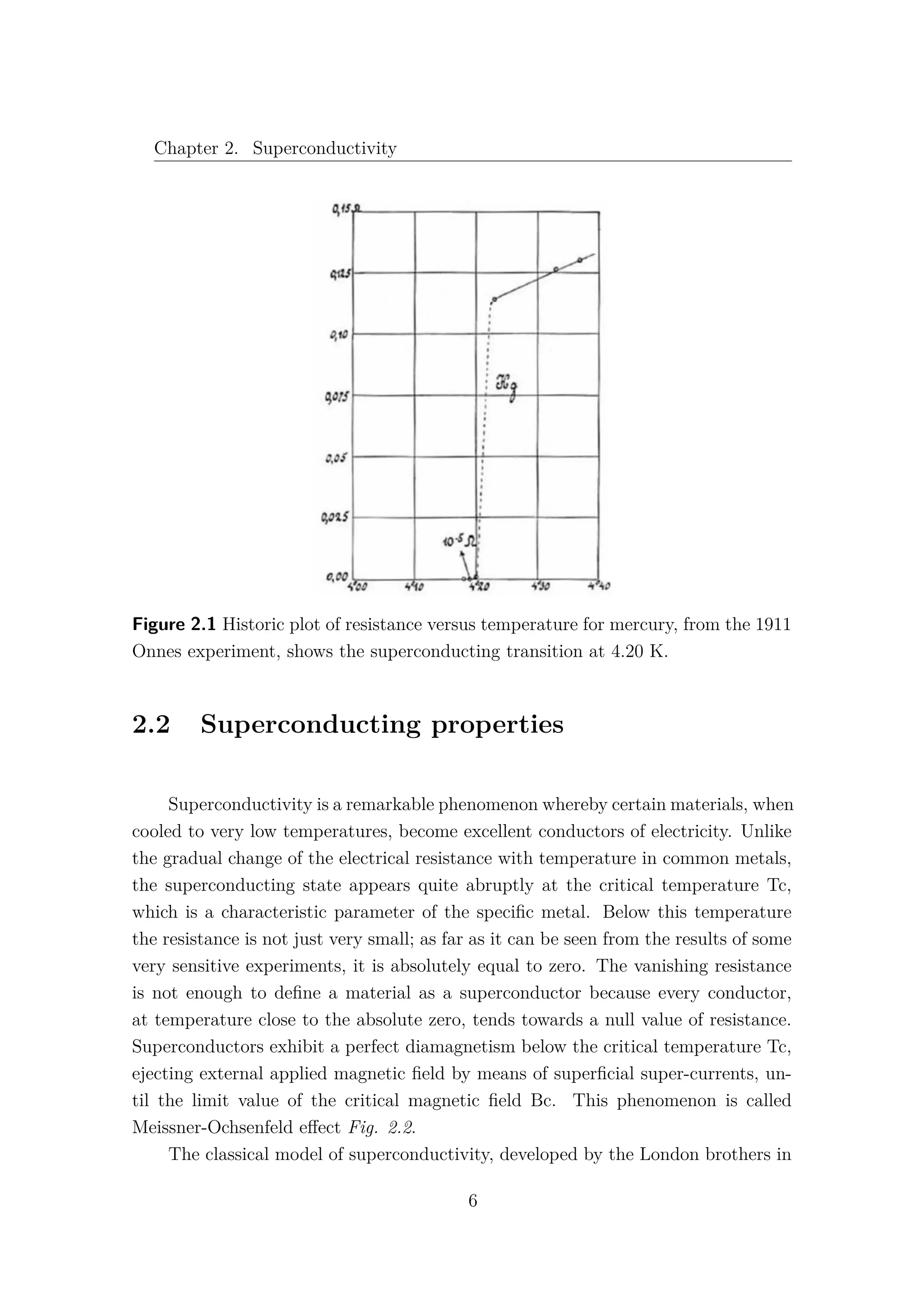
C). After three years he noted “Kwik nagenoeg nul” : Quick [silver]
near-enough null. Analysing the behaviour of the electrical resistance at cryogenic
temperature he noticed that: “Mercury has passed into a new state, which on account
of its extraordinary electrical properties, may be called the superconducting state” [13]
characterised by a not measurable value of electrical resistance as shown Fig. 2.1.
This transition occur under a critical temperature Tc, different for each material.
The next milestone occurred in 1933 when Meissner and Ochsenfeld discov-
ered that a material in superconducting state expels the magnetic field, becoming a
perfect diamagnetic material [14]. The first phenomenological theory of supercon-
ductivity ables to explain the Maissner effect, was developed by the London brothers
in 1935, through the formulation of the weel-known London’s equations [15].
A quantum explanation was proposed in 1957 by Bardeen, Cooper and Schri-
effer: the so-called BCS theory [16]. In 1962, the first commercial superconducting
wire, a niobium-titanium alloy, was developed by researchers at Westinghouse, al-
lowing the construction of the first practical superconducting magnet. In 1986 it was
discovered the superconductivity in a lanthanum-based cuprate perovskite material,
with a transition temperature of 35 K [17]. Just a year later, replacing the lan-
thanum with yttrium (YBCO), the critical temperature of 92 K was reached [18].
In 2001 these particular properties have been discovered in magnesium diboride
(MgB2), that has proven to be an inexpensive and useful superconducting material
with a critical temperature of 35 K [19].
5](https://image.slidesharecdn.com/1d70407d-94a9-4ad5-8282-7558b7edcd7f-170222141405/75/CERN-THESIS-2016-081-19-2048.jpg)
![2.2. Superconducting properties
Figure 2.2 Diagram of the Meissner-Ochsenfeld effect. Magnetic field lines, repre-
sented as arrows, are excluded from a superconductor when it is below its critical
temperature.
1935 [15], can explain these two basic characteristics of the superconductors through
the following equations. This model does not take into account quantum phenomena
e does not allow the existence of the fluxons.
E = µ0λ2 ∂J
∂t
⇒ null resistivity
µ0λ2
× J = −B ⇒ Meissner-Ochsenfeld effect
Another critical parameter of superconductivity is the critical current density
that a material can carry without exhibit a transition to the normal state. Unlike
the critical temperature and the magnetic field, the critical current is not a intrinsic
feature of the material, but it is depend on the thermal and mechanical treatment
induced in the cable. These three properties are related to each other by the critical
surface in (T,B,J) space, which is characteristic of the considered material Fig. 2.3.
Superconductivity prevails everywhere below this surface, with normal resistivity
everywhere above it.
Depending on the magnetic behaviour, superconductors are classified in two
categories: type-I and type-II. Several elements present a type-I superconductivity
and exhibit the properties explained above. Type-II superconductors are typically
alloys and compounds, and they present a gradual transition the the normal state
7](https://image.slidesharecdn.com/1d70407d-94a9-4ad5-8282-7558b7edcd7f-170222141405/75/CERN-THESIS-2016-081-21-2048.jpg)
![2.2. Superconducting properties
Figure 2.4 Comparison between the H-T diagram of type-I (a) and type-II (b)
superconductor.
erties can be explained through the BCS theory [16]. This quantum theory analyse
the superconducting phenomena introducing the so-called Cooper pairs: two elec-
trons, linked by a electron-phonon coupling, can flow through the crystal lattice
without interaction and consequent loss of energy. In the 1986 a new kind a super-
conductors, based on copper oxide layers CuO2, has been discovered. These ceramic
materials do not follow the BCS theory and exhibit very high values of critical tem-
perature (90-100 K). They can be called High Temperature Superconductors. Of
course the HTS open the doors to new applications of the superconductivity, re-
stricted until that moment by prohibitive temperature and cooling. The possibility
of using liquid Nitrogen, instead of Hydrogen or Helium, abruptly reduces the oper-
ating cost. However, HTS superconductors like Bi2Sr2CaCu2O8 (first generation)
and Y Ba2Cu3O7 (second generation) are characterised by complex manufacturing
and substantial costs. An "hybrid" material is the magnesium diboride (MgB2),
that is a BCS superconductor with a critical temperature of 39 K. It is obtained by
common and cheap material and has strong and feasible possibilities of implementa-
tion in several fields, like the current leads for the LHC or HVDC cable for electric
transmission through the grid.
The analyses carried out in this dissertation are focussed on NbTi and Nb3Sn,
both type-II LTS superconductors operating at the temperature of super-fluid liquid
Helium of 1.9 K. It is no difficult to understand that, at this demanding condition,
9](https://image.slidesharecdn.com/1d70407d-94a9-4ad5-8282-7558b7edcd7f-170222141405/75/CERN-THESIS-2016-081-23-2048.jpg)
![2.3. Stability
cable with respect to external disturbances. Insufficient stability and large external
disturbances were the key issues in the failure of the early experiments on supercon-
ducting magnets. It has since become understood that a superconducting magnet is
always subject to a series of energy inputs of very different natures, time-scales, and
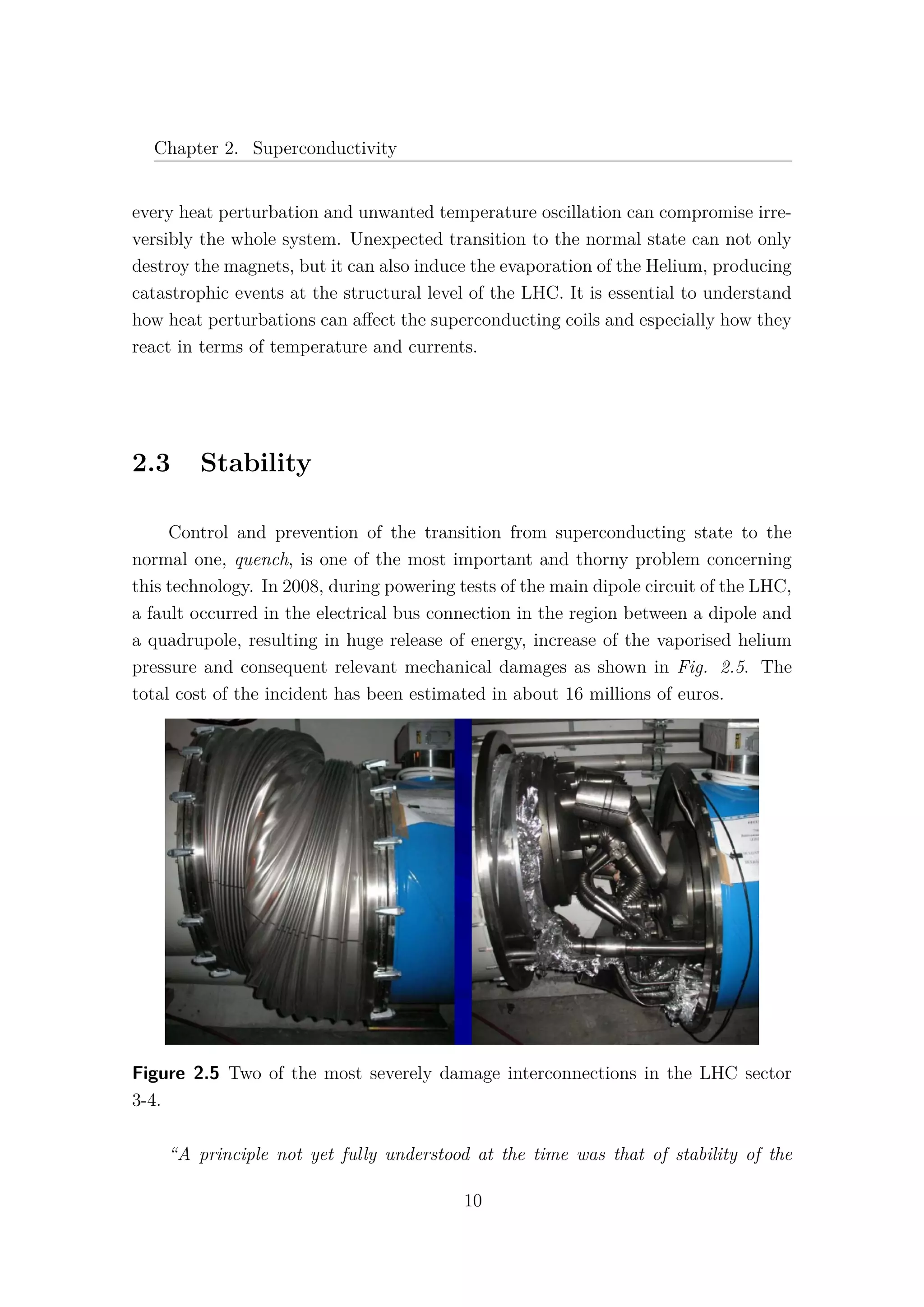
magnitudes, the so-called disturbance spectrum” [10] Fig. 2.6.
Figure 2.6 Spectrum of energy perturbations as a function of the characteristic time
of energy deposition [10].
At cryogenic temperatures almost all the materials have a small heat capacity,
and the difference between the operating temperature Top and the temperature at
which current sharing starts Tcs must be kept small for reason of costs. The energy
introduction and the consequent temperature increase can be sufficient to take the
superconducting material above the critical conditions, inducing a normal zone prop-
agation and Joule heating generation. If not prevented by other mechanisms, the
temperature in the normal zone increases and the normal front propagates, inducing
an irreversible thermal runaway process that lead the complete loss of superconduc-
tivity in the magnet: a quench Fig. 2.7.
The stability margin is the minimum energy density that an external source
needs to provide to the cable to cause a thermal runaway. A relevant source of
disturbance in the operation of an accelerator magnet is the heat released on the su-
perconducting wires by the losses due to the shower of secondary particles generated
by particles lost from the beam [9]. The impact of protons with magnet components
11](https://image.slidesharecdn.com/1d70407d-94a9-4ad5-8282-7558b7edcd7f-170222141405/75/CERN-THESIS-2016-081-25-2048.jpg)
![Chapter 2. Superconductivity
Figure 2.7 An event tree for the evolution of an external energy input. The stability
design and analysis are concentrated on the shaded area [10].
12](https://image.slidesharecdn.com/1d70407d-94a9-4ad5-8282-7558b7edcd7f-170222141405/75/CERN-THESIS-2016-081-26-2048.jpg)
![2.3. Stability
produces a flux of secondary particles that is measured by Beam Loss Monitors in-
stalled outside the magnet cryostats [20]. The modelization of this particular kind
of losses is presented in the section 5.5.
The evolution of the temperature is governed by a transient heat balance, ex-
plained in the section 5.1, containing the following term:
• external heat perturbation
• Joule heating generation
• heat capacity - enthalpy of the cable
• heat conduction along the cable and through the different strands
• heat exchange with the coolant
The combination of these five factors allows to determine the evolution of the
system and the possibility of quench or recovery Fig. 2.8
Figure 2.8 The qualitative evolution of the temperature in a superconducting cable
for an energy perturbation just below and just above the energy margin.
A protection system, called Beam Loss Monitoring System Fig. 2.9, has been
installed around the ring to monitor the lost particles and take corrective actions in
case of the beam losses exceeds a threshold. The aim of this system is to predict a
beam induced quench and dump the beam, avoiding destructive phenomena concern-
ing the not controlled quenching of the magnets. The effective value of the quench
13](https://image.slidesharecdn.com/1d70407d-94a9-4ad5-8282-7558b7edcd7f-170222141405/75/CERN-THESIS-2016-081-27-2048.jpg)
![Chapter 2. Superconductivity
limits is essential for the efficient operation of the BLMs, hence of the LHC. Several
studies have been carried out about the calculation of the quench limits, however a
complete and accurate analysis of these phenomena is extremely complicated and
even today the values of the stability margins for the LHC superconducting magnets
are affected by substantial uncertainties.
Figure 2.9 The location of the BLMs outside the cryostat in the LHC tunnel.
According with [21] three main regimes can be distinguished in the study of the
thermal behaviour of NbTi cables subjected to beam losses:
• short duration of losses [< 1ms]: the quench limit is determined by the en-
thalpy margin of the cable, without contribution from liquid helium
• intermediate duration of losses [1ms−1s]: the interstitial helium plays a crucial
role because of its large heat capacity
• stady-state losses [> 1s]: the heat is constantly removed with a rate deter-
mined by the thermal properties of the cable insulation
The most recent and detailed analysis for the beam-induced quench level of the
LHC has been performed through a "pseudo-experimental" approach presented in
[22], based on the reconstruction of the energy introduced in the magnet at quench
by means of the Beam Loss Monitors and FLUKA simulations [2].
14](https://image.slidesharecdn.com/1d70407d-94a9-4ad5-8282-7558b7edcd7f-170222141405/75/CERN-THESIS-2016-081-28-2048.jpg)
![3. Nb3Sn inner triplet - MQXF
“The High Luminosity LHC (HL-LHC) project is aimed at implementing the
necessary changes in the LHC to increase its integrated luminosity by a factor ten.
Among the magnets that will be replaced are the 16 superconducting inner triplet
(low-β) quadrupoles placed around the two high luminosity interaction regions (AT-
LAS and CMS experiments) [...] The resulting conductor peak field of about 12 T
will require the use of Nb3Sn superconducting coils. We present in this document the
design HL-LHC low-β quadrupole magnets, called MQXF, focusing in particular on
superconductor characteristics, coil lay-out, support structure concept, and quench
protection system.” [1]
3.1 Design and magnetic field
“The first function of a (superconducting) magnet is to guide and steer the
particle, i.e. to keep it in orbit in a circular accelerator or to just bend in a transfer
line. The second main function is focusing the beam, thus providing it with the
necessary stability in the plane perpendicular to the trajectory” [23].
The aim of the HiLumi-LHC low-β quadrupole magnets is to collimate the
beam, in order to optimise its intensity and dimension. A cross section of the MQXF
is shown in Fig. 3.1 and Fig. 3.2, where the superconducting coils are highlighted in
red. In contrast to classical electromagnets, the field in a superconducting accelera-
tor magnet is mainly produced by the current in the conductor. Very schematically,
these particular kind of magnets for large scale accelerators consist of a coil wound,
with characteristic racetrack configuration as shown inFig. 3.3, around the bore
which delimits the vacuum chamber hosting the beam.The large Lorentz forces that
are experienced by the coil (hundreds of tons per meter) cannot be reacted by the
winding alone and hence the force is transferred to a structure that guarantees me-
chanical stability and rigidity. The iron yoke that surrounds this assembly closes
15](https://image.slidesharecdn.com/1d70407d-94a9-4ad5-8282-7558b7edcd7f-170222141405/75/CERN-THESIS-2016-081-29-2048.jpg)
![Chapter 3. Nb3Sn inner triplet - MQXF
the magnetic circuit, shielding the surroundings from stray fields and providing a
marginal gain of magnetic field in the bore. In addition, it can have a structural
function in reacting or transferring the Lorentz forces from the coil to an external
cylinder. Finally, the magnet is enclosed in a cryostat that provides the thermal
barrier features necessary for cooling the magnet to the operating temperature.
Figure 3.1 The MQXF real cross section.
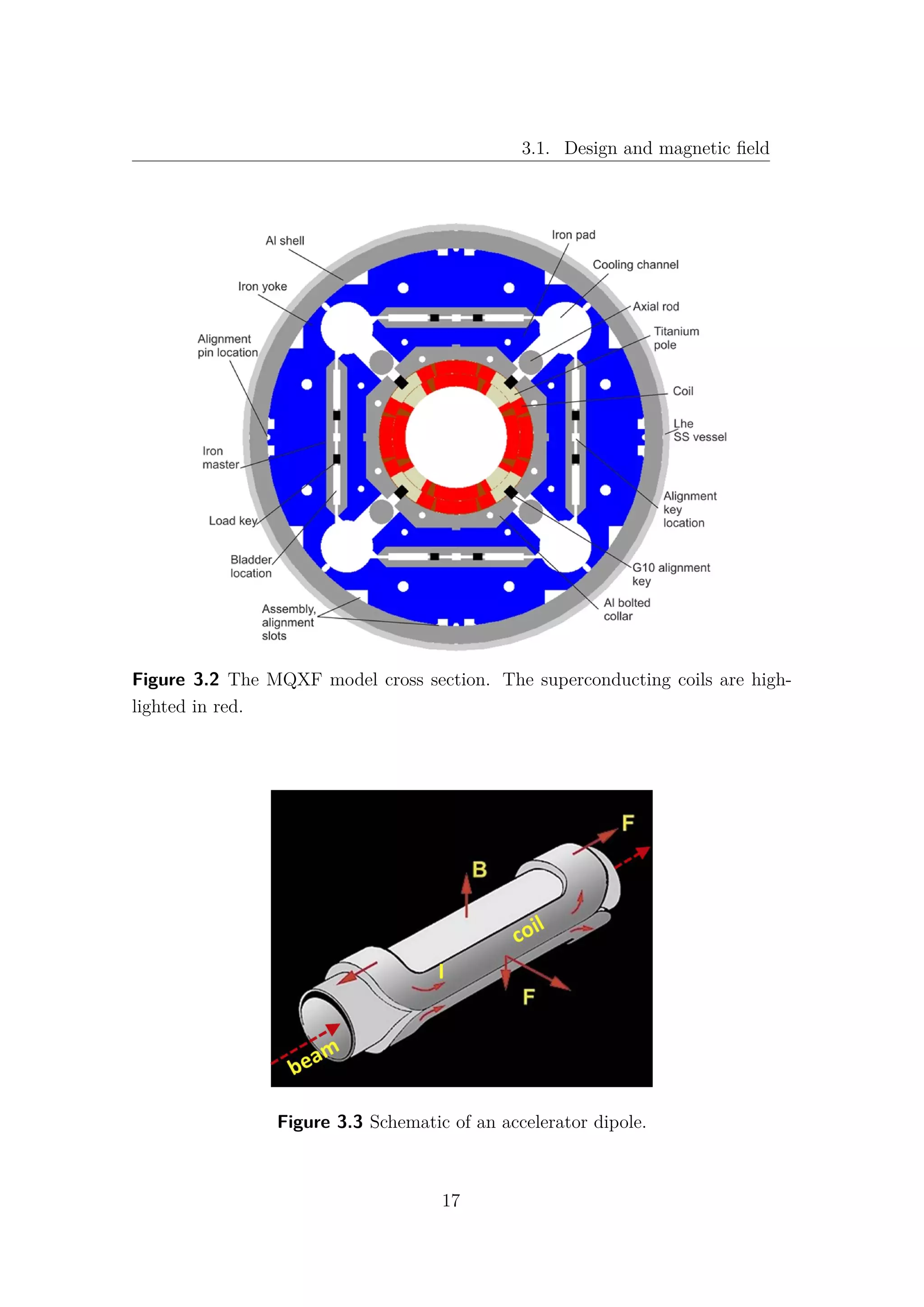
In Fig. 3.4 the magnetic field density in the coil at nominal current is plotted.
At nominal current the peak field in the coil reaches 11.42 T. The analyses of this
dissertation in focussed on the middle-plane inner layer cable. As Fig. 3.4 the
magnetic field along the cable is strongly variable: 9.78 T to 2.42 T at the nominal
current of 16470 A [24]. The simulations have been performed using the hypothesis
of linear magnetic field variation, as better explained in 5.4.
16](https://image.slidesharecdn.com/1d70407d-94a9-4ad5-8282-7558b7edcd7f-170222141405/75/CERN-THESIS-2016-081-30-2048.jpg)
![3.2. Conductor characteristic
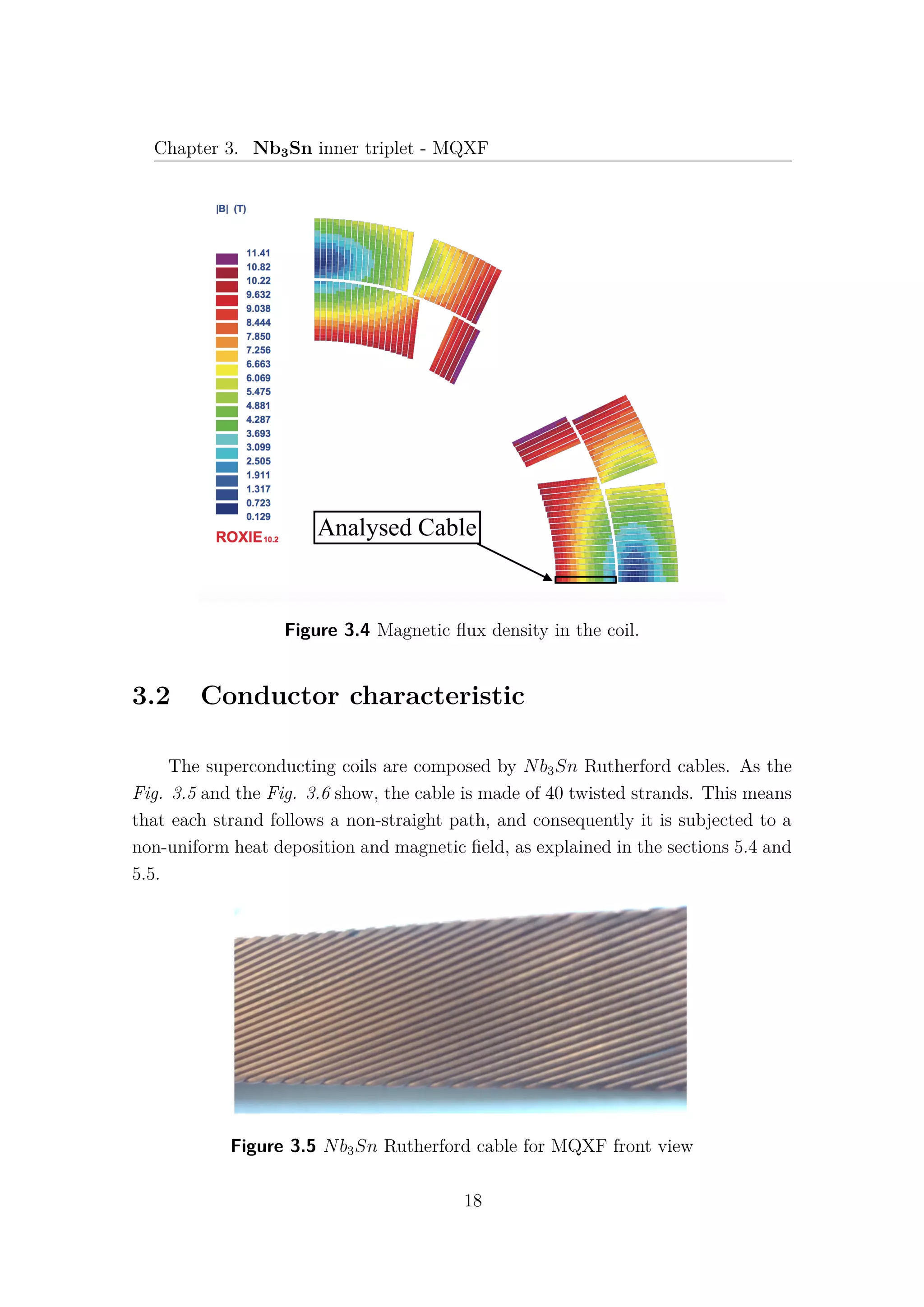
Figure 3.6 Nb3Sn Rutherford cable for MQXF cross section
The main geometric parameters of the cable and its nominal operating condition
are illustrated in Table 3.1.
MQXF v2 cable parameters
Cable Data
Cable mid-thickness [mm] 1.525
Keystone angle [deg] 0.4
Cable width [mm] 18.15
Insulator thickness [mm] 0.145
Number of strands 40
Strand diameter [mm] 0.850
Cu/NonCu 1.20
Transposition pitch [mm] 109
Operating Parameters
Peak Field [T] 11.4
Current [kA] 16.47
Temperature [K] 1.9
Table 3.1 MQXF geometrical and operating parameters
The strands are surrounded by a glass fiber insulator, Glass-Epoxy. It is impor-
tant to highlight that, differently from the NbTi cables, Nb3Sn coils are impregnated
with epoxy resin. The resin fills the spaces between strands and prevents the pene-
tration of the interstitial helium. Therefore there is no internal cooling in the cable,
and the heat occurs through the epoxy glass and the resin. This insulating config-
uration implies a drastic reduction of the stability margin, especially at fast time
scale.
19](https://image.slidesharecdn.com/1d70407d-94a9-4ad5-8282-7558b7edcd7f-170222141405/75/CERN-THESIS-2016-081-33-2048.jpg)
![4. The 0-D Approach
Neglecting the longitudinal cable dimensions, the details of the helium flow and
the current distribution, a Zero-Dimentional model can be applied to describe the
electro-thermal transients occurring at quench. Moreover, the strands in the cable
cross-section are lumped into a single thermal component characterised by uniform
temperature and homogenised thermal properties. For this kind of analysis the
ZERODEE Software [4] has been used. The cable, the insulator and the Helium
bath are taken into account as three different elements and the set of equations
solved by the program is the following:
AStCSt
dTSt
dt
= ˙qSt + ˙qJoule − pSt,HehSt,He(TSt − THe) − pSt,JahSt,Ja(Tst − TJa)
(4.1a)
AJaCJa
dTJa
dt
= −pJa,HehJa,He(TJa − THe) − pSt,JahSt,Ja(TJa − TSt) (4.1b)
AHeCHe
dTHe
dt
= −pSt,HehSt,He(TSt − THe) − pJa,HehJa,He(TJa − THe) (4.1c)
List of symbols used in the (4.1) equation
Ai [m2
] cross section of the i-th component
ρi [Kg/m3
] density of the i-th component
Ci [J/KgK] specific heat of the i-th component
Ti [K] temperature of the i-th component
˙qSt [W/m] external heat input per unit lenght
˙qJoule [W/m] generated Joule power per unit leght
pij [m] contact perimeter between the i-th and the j-th component
hij [W/m2
K] heat transfer coefficient between the i-th and the j-th component
Table 4.1 List of symbols used in the (4.1) equation
20](https://image.slidesharecdn.com/1d70407d-94a9-4ad5-8282-7558b7edcd7f-170222141405/75/CERN-THESIS-2016-081-34-2048.jpg)
![5. The 1-D Approach
Increasing the level of complexity of the model, three different domains are
analysed: thermal, electric and hydraulic elements are taken into account. Neglect-
ing the cable cross section in comparison with the longitudinal dimension, a 1-D
model can be considered. A schematic representation of the model conditions and
parameters is shown in Fig. 5.1.
Figure 5.1 One-dimensional model overview
The analysed cable is four metres long, but, thanks to the symmetry condition
on the left side, just half cable can be considered. So, with regard to the simulation,
the length of the cable is Lcable = 2 m. The heat disturbance starts at t = 0, with a
duration Qτ , affecting the first half of the cable, from x = 0 to x = 1 m. The details
of the heat deposition distribution, both in time and in space, will be discussed in
section 5.5. The modelling and the simulations are carried out by means of the
THEA [5] software. Acronym of Thermal Hydraulic Electric Analysis, this CryoSoft
package allows to carry out one-dimensional analyses involving these three different
domains. Basically, it allows to take into account not only the thermal phenomena
of heat exchange, but also the current redistribution between strands and the fluid-
dynamic behaviour of the liquid Helium. A detailed description of the three models
is presented below.
24](https://image.slidesharecdn.com/1d70407d-94a9-4ad5-8282-7558b7edcd7f-170222141405/75/CERN-THESIS-2016-081-38-2048.jpg)
![5.1. Thermal model
5.1 Thermal model
The thermal model is described using N thermal elements: the number of the
strands and the glass-epoxy. The strand is considered as a homogenous composite of
Nb3Sn and Cu with uniform temperature in the cross section. Neglecting the trans-
verse dimension the thermal model can be described through the one dimensional
heat equation (5.1) [6]:
AiρiCi
∂Ti
∂t
−
∂Ti
∂x
(Aiki
∂Ti
∂x
) = ˙qSt + ˙qJoule +
N
j=1,j=i
(Tj − Ti)
Hij
+
M
h=1
pihhih(Th − Ti)
(5.1)
List of symbols used in the (5.1) equation
Ai [m2
] cross section of the i-th component
ρi [Kg/m3
] density of the i-th component
Ci [J/KgK] specific heat of the i-th component
ki [W/mK] thermal conductivity of the i-th component
Ti [K] temperature of the i-th component
˙qSt [W/m] external heat input per unit lenght
˙qJoule [W/m] generated Joule power per unit leght
Hij [Km/W] thermal resistance between i-th and j-th component
pih [m] wetted perimeter between the i-th and the h-th component
hih [W/m2
K] heat transfer coefficient between the i-th and the h-th component
N number of thermal element = Nstrand + 1
M number of hydraulic element = 1
Table 5.1 List of symbols used in the (5.1) equation
The penultimate term of the right hand side of the (5.1) represent the heat
exchange between thermal elements, while the last one indicate the heat exchange
with the hydraulic elements.
As Fig. 5.2 shows the heat exchange can occur between:
• adjacent and non-adjacent strands
25](https://image.slidesharecdn.com/1d70407d-94a9-4ad5-8282-7558b7edcd7f-170222141405/75/CERN-THESIS-2016-081-39-2048.jpg)
![Chapter 5. The 1-D Approach
• strands and glass-epoxy
• glass-epoxy and Helium bath (hydraulic element)
Figure 5.2 Thermal model representation
Is important to underline that there is NO contact between the strands and the
Helium bath, and the heat exchange can occur only by means of the glass-epoxy.
5.1.1 Heat exchange between strands
The heat exchange between different strands is governed by the presence of
thermal resistances Hij. An accurate analysis and explanation of this phenomenon is
presented in [7] (in the section 2.5). For this analysis, the LCH 01 cable is considered,
with the thermal conductance between adjacent strands λth−A = 5000 W
Km2 and the
cross contact between non-adjacent strands λth−C = 2500 W
Km2
∗
. Starting from these
conductances is possible to calculate the thermal resistances:
Hij =
lij
λijAij
(5.2)
where lij is the length of the contact between the strands i-th and j-th, and Aij is
the total cross section contact between the strands i-th and j-th. As explained in [7]
the contact area between strands can be calculated by a linear fit, for non-adjacent
∗
The real values of the contact thermal conductances for Nb3Sn are still unknown, but in
the next chapters it is demonstrated that the variation of these parameters should not affect the
stability margin of the cable in a relevant way
26](https://image.slidesharecdn.com/1d70407d-94a9-4ad5-8282-7558b7edcd7f-170222141405/75/CERN-THESIS-2016-081-40-2048.jpg)
![5.1. Thermal model
strands Ac = 1.55−0.058x[mm2
] and for adjacent strands Aa = 461−11.9x[mm2
/m],
where x is the cable width position [mm]. Choosing a value of x equal to the cable
width divided by two, the results shown in Table 5.2 have been obtained.
Aa [mm2
/m] 353.01
Ac [mm] 1.024
Table 5.2 Contact area between strands in x = w/2
The total cross section contact Aij between the i-th and the j-th strands assumes
two different values for adjacent and non-adjacent strands.
Aij =
Aalij for adjacent strands
2Aclij/Lp for non-adjacent strands
It’s important to note that non-adjacent strands overlap two times in a twist
pitch Lp
5.1.2 Heat exchange between strand and glass-epoxy
The model of the heat exchange between the strands and the glass-epoxy is
shown in Fig. 5.3.
Figure 5.3 Heat exchange between strand and glass-epoxy representation
Each strand is surrounded by a crown of insulator, with an area equal to
AGE =
AGE−tot
40
= 4.98 · 10−6
m2
27](https://image.slidesharecdn.com/1d70407d-94a9-4ad5-8282-7558b7edcd7f-170222141405/75/CERN-THESIS-2016-081-41-2048.jpg)
![Chapter 5. The 1-D Approach
The total area of glass-epoxy is calculated through the difference between the
whole area of the cable and the sum of each strand area
AGE−tot = ACable − ASt = hw − 40πr2
where h is the cable mid-thickness, w is the cable width and r is the radius of
a strand.
The contact perimeter is the strand circumference and the thermal resistance
is calculated as follow
HSt−GE =
r
KSt
+ t
KGE
2πr
where KSt and KGE are the thermal conductivity of the strand and the glass-
epoxy, and t is the half-thickness of the insulator crown. Is important to highlight
that the contact thermal resistance between the strand and the glass-epoxy is un-
known, and is not taken into account. †
5.1.3 The heat exchange between glass-epoxy and Helium
bath
As the Fig. 3.2 shows, the Helium bath is located in the internal zone of the
quadrupole, therefore only the thin face of inner layer cables is in contact with
the liquid Helium. The heat transfer coefficient (HTC) between the cable and the
coolant is computed using empirical correlation. It is based on experimental data of
[8], calculating the HTC from experimental curve of power extracted in steady state
from the whole cable by the helium bath, through the little face: Qestr(T). This
power is then normalised to the thin surface of the stack involved in the thermal
exchange. The normalised power Qface is used for the HTCHeBath, expressed in
[W/m2
K].
HTCHeBath =
Qface
∆TAface
†
In the next chapters it is demonstrated that the variation of the amount of glass-epoxy does
not affect the stability margin of the cable in a relevant way. It is licit to suppose that the value
of the thermal resistance between the strands and the insulator, should not be relevant as regard
the stability of the system.
28](https://image.slidesharecdn.com/1d70407d-94a9-4ad5-8282-7558b7edcd7f-170222141405/75/CERN-THESIS-2016-081-42-2048.jpg)
![5.2. Hydraulic model
where ∆T is the difference between the stack wall and the He bath temperature,
in [K], and Aface is the surface of the stack involved in the heat exchange, expressed
in [m2
].
5.1.4 Thermal boundary and initial conditions
As far as the boundary conditions are concerned, a symmetry condition is im-
posed on the left side (x = 0):
∂T
∂t
= 0
while on the right side (x = Lcable) the temperature is kept constant
T = 1.9 K
Finally, before the introduction of the heat disturbance, at t = 0 the tempera-
ture is uniform and equal to 1.9K in the whole cable.
5.2 Hydraulic model
The hydraulic model is described by non-conservative form of the flow equation
[6]:
ρh
∂Vh
∂t
+
ρhVh
Ah
∂Vh
∂x
+ Ah
∂ph
∂x
−
ρhV 2
h
A2
h
∂Ah
∂x
= −AhFh −
H
k=1,k=h
(Γν
hk − νΓρ
hk) (5.3a)
Ah
∂ph
∂t
+ Vh
∂ph
∂x
+ ρh + c2
h
∂Vh
∂x
=
H
k=1,k=h
c2
hΓρ
hk + ϕh Γe
hkΓν
hk − hh −
ν2
h
2
Γρ
hk
+ ϕhVhFh + ϕh ˙qh + ϕh ˙qcf,h
(5.3b)
AhρhCh
∂Th
∂t
+ AhVhCh
∂Th
∂x
+ ρhϕhChTh
∂Vh
∂x
=
VhFh −
H
k=1,k=h
Γe
hkΓν
hk − hh −
ν2
h
2
− ρhChTh)Γρ
hk + ˙qh + ˙qcf,h (5.3c)
29](https://image.slidesharecdn.com/1d70407d-94a9-4ad5-8282-7558b7edcd7f-170222141405/75/CERN-THESIS-2016-081-43-2048.jpg)
![Chapter 5. The 1-D Approach
List of symbols used in the (5.3) equation
Ah [m2
] cross section of the channel
ρh [Kg/m3
] density
Ch [J/KgK] specific heat at constant volume
ch [m/s] isentropic sound speed
Fh [Kg/m2
s2
] friction force per unit of volume
ϕh Gruneisen parameter
˙qh [W/m] heat through convection
˙qcf,h [W/m] heat through counterflow
hh [J/Kg] specific enthalpy
ph [Pa] pressure
Th [K] temperature
Vh [m3
/s] volumetric flow
vh [m/s] velocity of the coolant in the channel
Table 5.3 List of symbols used in the (5.1) equation
where the quantities Γρ
hk, Γν
hk and Γe
hk are the distributed sources of mass,
momentum and stagnantion enthalpy per unit length of the channel, operating from
(or into) h to (or from) the k channels. Geometrical parameters of the model are
constant in time and space, and the friction factor model is based on Katheder
model [25].
5.2.1 Hydraulic boundary and initial conditions
A closed pipe condition is set on the left side of the cable:
Vh = 0
while on the right side a reservoir condition has been chosen, imposing constant
temperature and pressure:
Th = 1.9 K
ph = 1.3 bar
30](https://image.slidesharecdn.com/1d70407d-94a9-4ad5-8282-7558b7edcd7f-170222141405/75/CERN-THESIS-2016-081-44-2048.jpg)
![5.3. Electric model
5.3 Electric model
The electrical model describes the cable as formed by E electrical elements
characterised by longitudinal, mutual and self, inductances [6].In Fig. 5.4 the con-
nection between strands of the electric model is represented. The voltage balance
equation along the cable can be written in matrix form as follows:
L
∂T
∂t
+ RI −
∂
∂x
(C−1 ∂I
∂x
) = ∆Vext (5.5)
Figure 5.4 Electrical model representation
List of symbols used in the (5.5) equation
L inductance per unit length matrix
I current array
R parallel resistances array
C transverse condictivities per unit length aray
∆Vext
external voltage array
Table 5.4 List of symbols used in the (5.5) equation
Each strand is considered as an electric element, where the current density in
the cross section is assumed constant. The electric model is coupled with the thermal
31](https://image.slidesharecdn.com/1d70407d-94a9-4ad5-8282-7558b7edcd7f-170222141405/75/CERN-THESIS-2016-081-45-2048.jpg)
![Chapter 5. The 1-D Approach
one, in order to take into account the dependance of the electric parameters on the
temperature, the ˙qJoule generated by the current flow and the current redistribution
along the cable between different strands, depending both on the magnetic field
and on the temperature profiles. Indeed the currents tend to redistribute towards
regions of low field and temperature, and they try to avoid the zones where these
two parameters take the maximal values.
5.3.1 Mutual and self-inductance
The inductance per unit length matrix is defined as follows:
L =
lij . . . liNstrand
...
...
...
lNstrandj . . . lNstrandNstrand
(5.6)
where lij is a mutual-inductance if i = j or a self-inductance if i = j. The
analysis of inductance of circuits made up of straight elements with negligible cross
section is presented in [26]. Applying the general formula for the self-inductance of
a round wire, and neglecting the ratio between the arithmetic mean distance of the
points of the cross section and the cable length, the following formula is obtained:
lij =
µ0
2π
ln
2Li
ρi
−
3
4
for i = j (5.7)
While the mutual-inductance between two parallel straight filaments is given
by:
lij =
µ0
2π
ln
Li
dij
+ 1 +
L2
i
d2
ij
− 1 +
L2
i
d2
ij
+
dij
Li
for i = j (5.8)
The distance between the i − th and j − th strands is calculated as follows:
dij = (xi − xj)2 + (yi − yj)2 (5.9)
32](https://image.slidesharecdn.com/1d70407d-94a9-4ad5-8282-7558b7edcd7f-170222141405/75/CERN-THESIS-2016-081-46-2048.jpg)
![5.3. Electric model
List of symbols used in the (5.7) and (5.8) equations
ρi [m] 4.25 · 10−4
strand radius
Lp [m] 0.109 twist pitch
Li [m] 3Lp filament length
dij [m] eq.(5.9) distance between the strands
µ0 [H/m] 1.25663... · 10−6
vacuum permeability
Table 5.5 List of symbols used in the (5.7) and (5.8) equations
The strands follow the numeration shows in Fig. 5.5, therefore the x and y
coordinates values are given by:
Figure 5.5 Representation of the strands numeration
xi = 2ρ(i − 1); yi = 2ρ if i ≤
Nstrand
2
xi = 2ρ(Nstrand − i); yi = 0 if i ≥
Nstrand
2
This is true only if the complete model of the Rutherford cable is considered.
A numerical calculation of the inductance between two strands i and j of a volume
Vi and Vj is fully treated in [27].
33](https://image.slidesharecdn.com/1d70407d-94a9-4ad5-8282-7558b7edcd7f-170222141405/75/CERN-THESIS-2016-081-47-2048.jpg)
![Chapter 5. The 1-D Approach
5.3.2 Conductance calculation
The conductance per unit length matrix is defined as follows:
C =
0 gij . . . giNstrand
gij
...
...
...
...
...
... gij
gNstrandj . . . gij 0
(5.11)
Obviously, the conductance of a strand with itself is equal to zero. Depending on
the strands position and taking into account the Fig. 5.5, the electric conductance
can be:
gij =
gc if |i − j| = 1 or |i − j| = Nstrand − 1
ga if |i − j| ≥ 1
where gc is the conductance for non-adjacent strands and ga is the conductance
for adjacent strands , calculated as follows:
gc =
2
LpRc
ga =
2(Nstrand − 1)
LpRa
The contact resistances for adjacent and non-adjacent strands, Rc and Ra, have
been chosen with the same values of the NbTi cables [9], in accord to [7]: Rc = 40µΩ
and Ra = 320µΩ. ‡
‡
The real values of the contact resistances for Nb3Sn are still unknown, but in the next chapters
it is demonstrated that the variation of these parameters should not affect the stability margin of
the cable in a relevant way
34](https://image.slidesharecdn.com/1d70407d-94a9-4ad5-8282-7558b7edcd7f-170222141405/75/CERN-THESIS-2016-081-48-2048.jpg)
![5.4. Magnetic field distribution
5.3.3 Electric boundary and initial conditions
Both in the left side (x = 0) and the right side (x = Lcable) all the strands are
shorted together and the voltage differences are, by definition, equal to zero. At t = 0
the current is uniformly distributed in each strand with the value of Itot/Nstrand.
5.4 Magnetic field distribution
As Fig. 5.6 shows, the magnetic field has a non-uniform distribution along the
magnet. Each strand of inner-layer middle-plane cable is subjected to a variable
field from 9.78 T to 2.42 T, following a linear behaviour shown in Fig. 5.6.
Figure 5.6 Linear magnetic field function along different strands
The profile of the field is the same for every strand, shifted on the space by
a length of s = LP /Nstrand. It is important to underline, that the values of the
magnetic field are depending on the current imposed in the cable, as Table 5.6
shows [28].
The function chosen for the magnetic field profile of the i − th strand is:
35](https://image.slidesharecdn.com/1d70407d-94a9-4ad5-8282-7558b7edcd7f-170222141405/75/CERN-THESIS-2016-081-49-2048.jpg)
![Chapter 5. The 1-D Approach
Values of magnetic field as a function of the operating current percentage
[Iop = 16.47kA]
I/Iop Bmax[T] Bmin[T]
100% 9.78 2.42
75% 7.48 1.85
50% 5.11 1.26
25% 2.63 0.65
Table 5.6 Values of magnetic field as a function of the operating current percentage
Bi(x) =
Bmax − Bmin
Lp
2
(x − cf,i −
Lp
4
) −
Lp
2
x − cf,i − Lp
4
Lp
2
+
1
2
(−1)
x−cf,i−
Lp
4
Lp
2
−1
2
+
Bmax + Bmin
2
(5.12)
where the indicates the FLOOR function and cf,i is the shift coefficient,
calculated as follows:
cf,i =
(i − 1)Lp
Nstrand
(5.13)
5.5 Heat disturbance
The heat deposition on the superconducting cable due to the beam losses is
obtained by means of the FLUKA code [2]. It has been calculated that the value
of the energy disturbance is maximum at the close vicinity of the bore and that
decreases at larger distances. From the maps of heat deposition over the magnet
cross-section, the longitudinal profile of the disturbance along each cable length
36](https://image.slidesharecdn.com/1d70407d-94a9-4ad5-8282-7558b7edcd7f-170222141405/75/CERN-THESIS-2016-081-50-2048.jpg)
![5.5. Heat disturbance
has been computed. The curves have been approximated by an exponential low,
characterised by consecutive increases and decays of the deposited energy (5.14), as
it is shown in Fig. 5.7.
Figure 5.7 Profile of the heat deposition along different strands
Qi(x) = Qext,iSxSt
exp(EcA(x − cf,i)
exp(EcAdLp)
(5.14)
A = (−1)
2x
Lp
d =
2x/Lp + 1
2
where cf,i is the shift coefficient already presented in (5.13), Ec in a coefficient
depending on the cable position (for middle-plane cables Ec = −53.3) [29], the
indicate the FLOOR function, Qext is the peak value of the heat disturbance
introduced by the user and the functions Sx and St are smoothing coefficient in space
(5.15) and time (5.16). The energy disturbance profile does not start or end sharply,
and it is worth to explain the smoothing of the heat deposition function, both in
the space and in the time. Considering a fall distance ∆x = (QXend − QXbegin)/200,
37](https://image.slidesharecdn.com/1d70407d-94a9-4ad5-8282-7558b7edcd7f-170222141405/75/CERN-THESIS-2016-081-51-2048.jpg)
![Chapter 5. The 1-D Approach
where QXend and QXbegin are the extremities of the heated zone, the smoothing start
at x1 = QXbegin + ∆x/2 x2 = QXend + ∆x/2:
Sx =
1 if x ≤ x1
1 − x−x1
x2−x2
if x1 < x ≤ x2
(5.15)
On the left side there is no smoothing, due to the symmetry condition. Heating
always starts at t = 0 and increase its value from 0 W/m to Qext in ∆t = Qτ /10,
where Qτ is the heating time set by the user. When the time becomes greater then
Qτ − ∆t/2 the function starts to decrease until Qτ + ∆t/2, when it is set equal to
0 W/m again.
St =
t
∆t
if 0 < t ≤ ∆t
1 if ∆t < t ≤ Qτ − ∆t/2
1 − t−(Qτ −∆t/2)
(Qτ +∆t/2)−(Qτ −∆t/2)
if Qτ − ∆t/2 < t ≤ Qτ + ∆t/2
(5.16)
The horizontal red line in (5.14) represents the integral mean value of the
function and it is useful to understand the quantity of energy introduced in the
system.
5.6 Temperature and Current distributions
The use of the CryoSoft code THEA [5] allows to analyse with accuracy the
distribution of temperature and current for each strand in both time and space.
This feature permits a precise investigation of these parameters along the cable and
a better comprehension of the behaviour of the strands in a specific configuration of
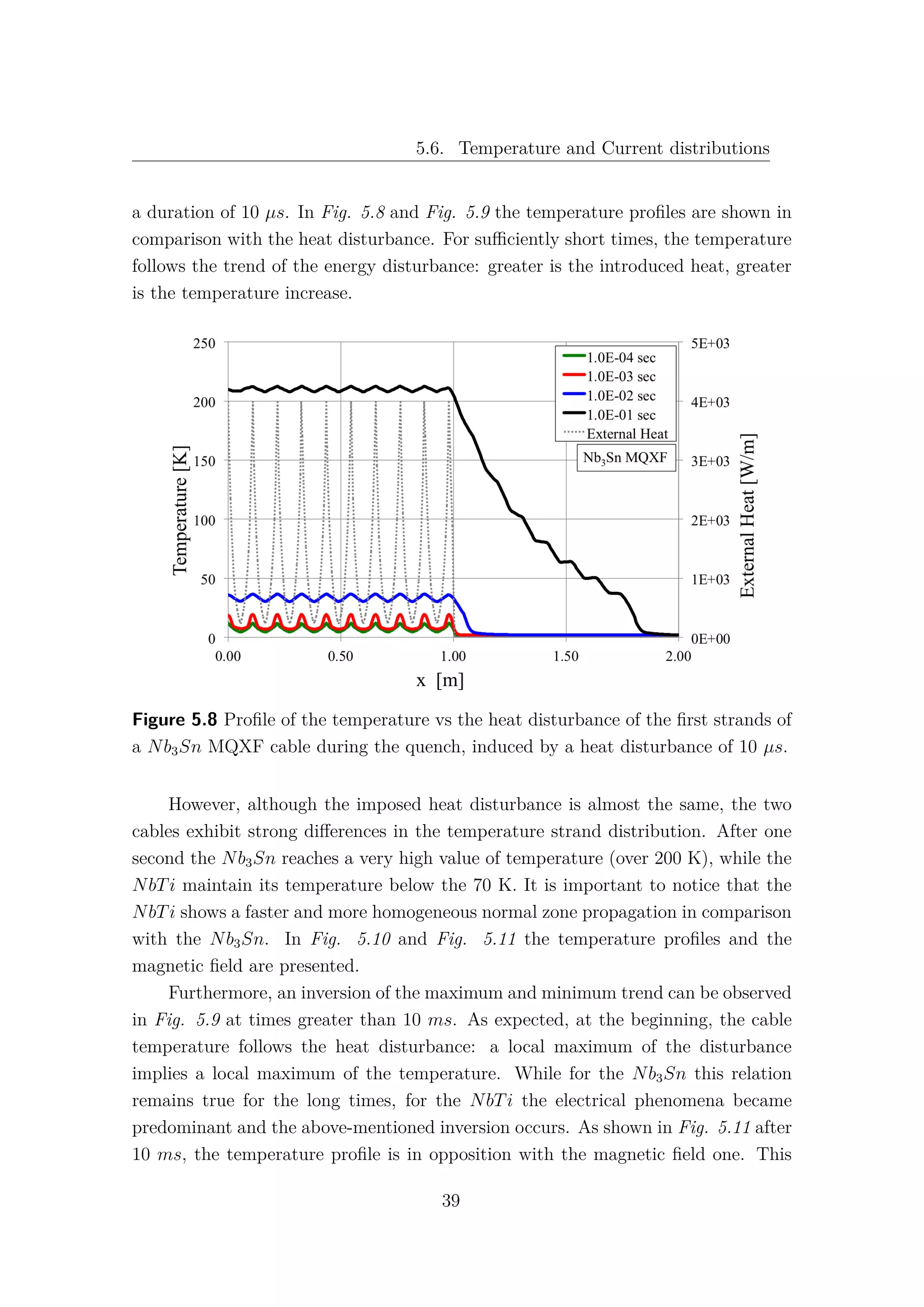
magnetic field and heat deposition. In this section the phenomena that occur during
a quench in the first strand of the NbTi and Nb3Sn cables have been analysed, in
terms of temperature and current, in function of the strand length, at different
instants of time. The same power disturbance has been induced in both cables for
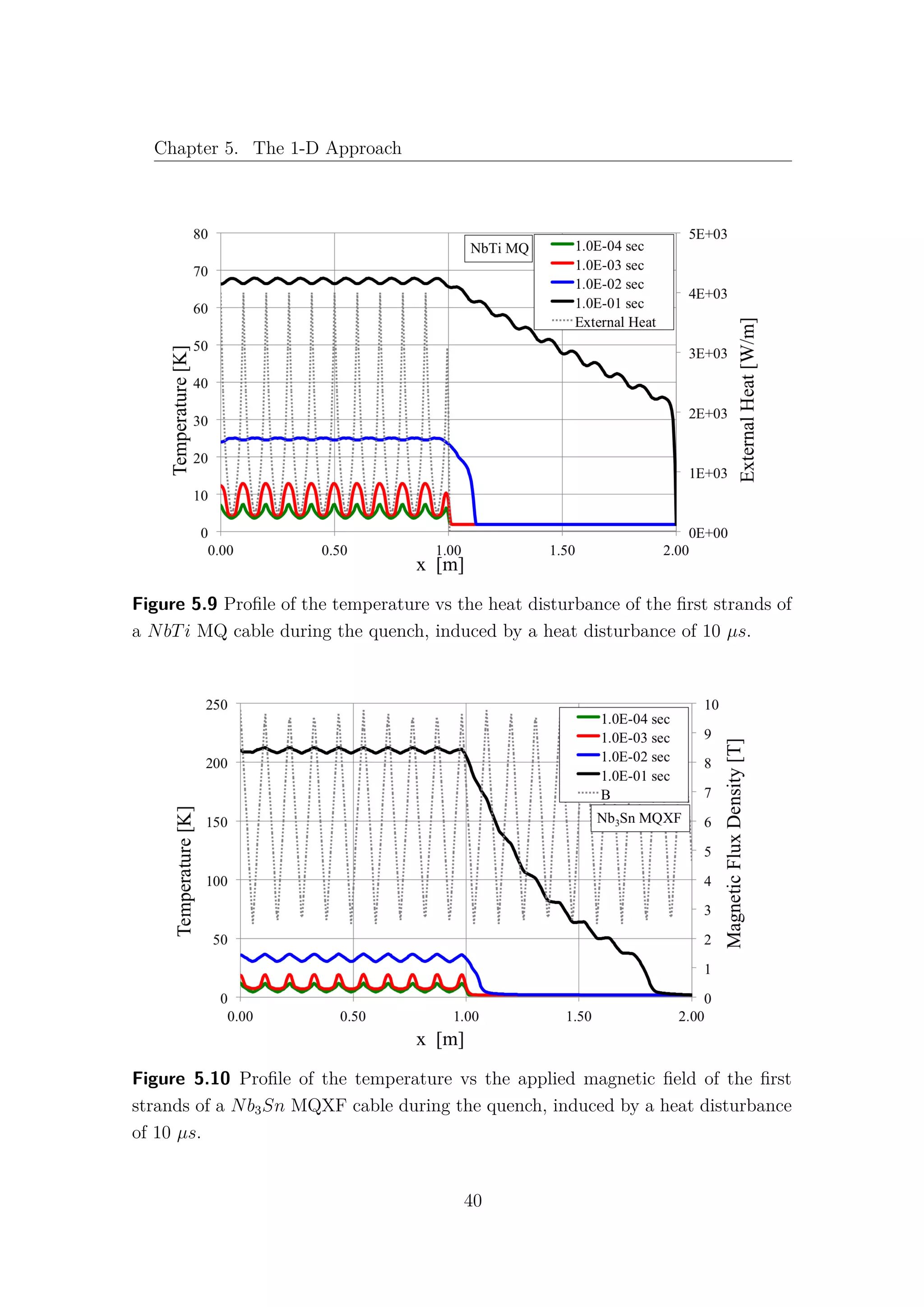
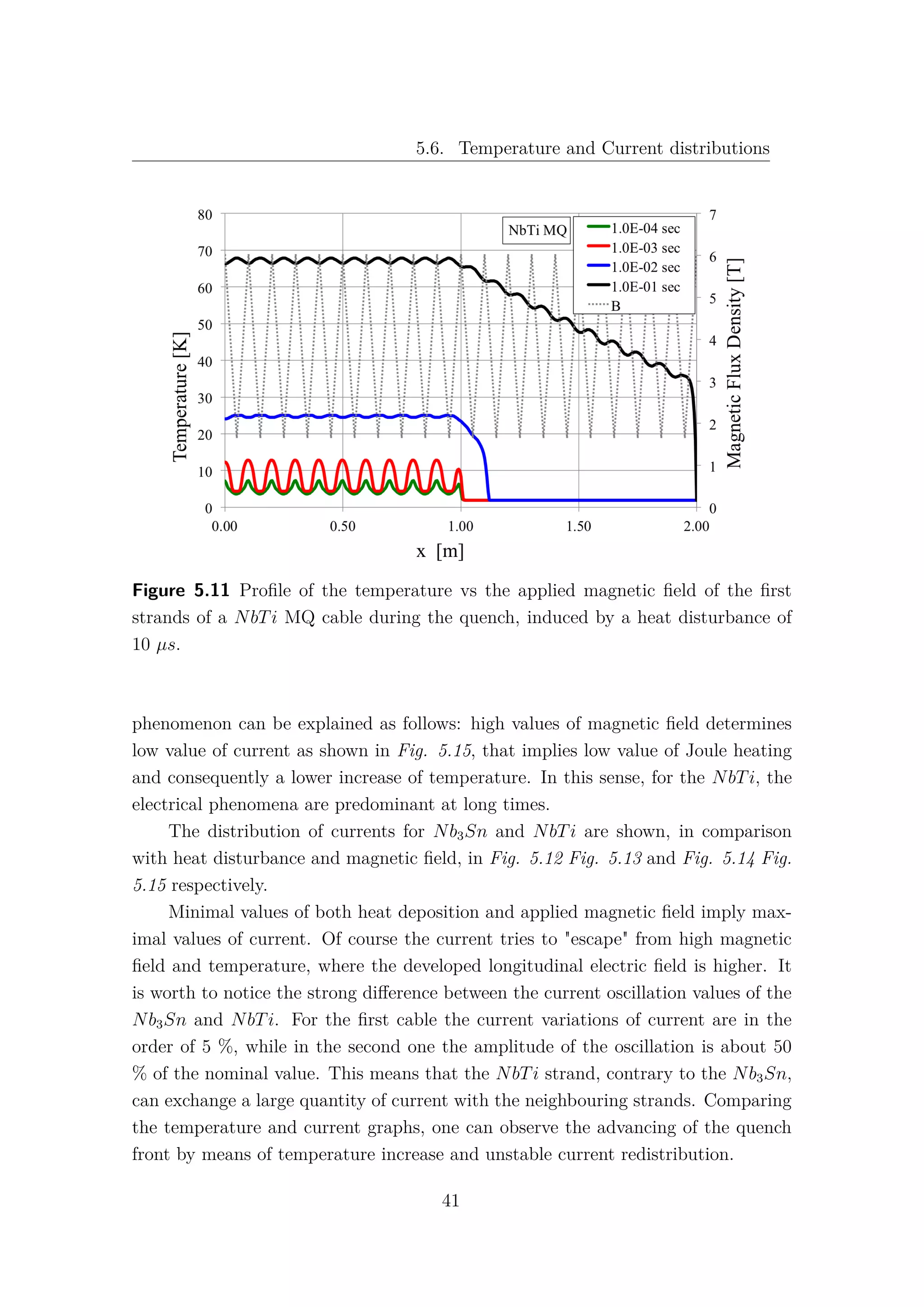
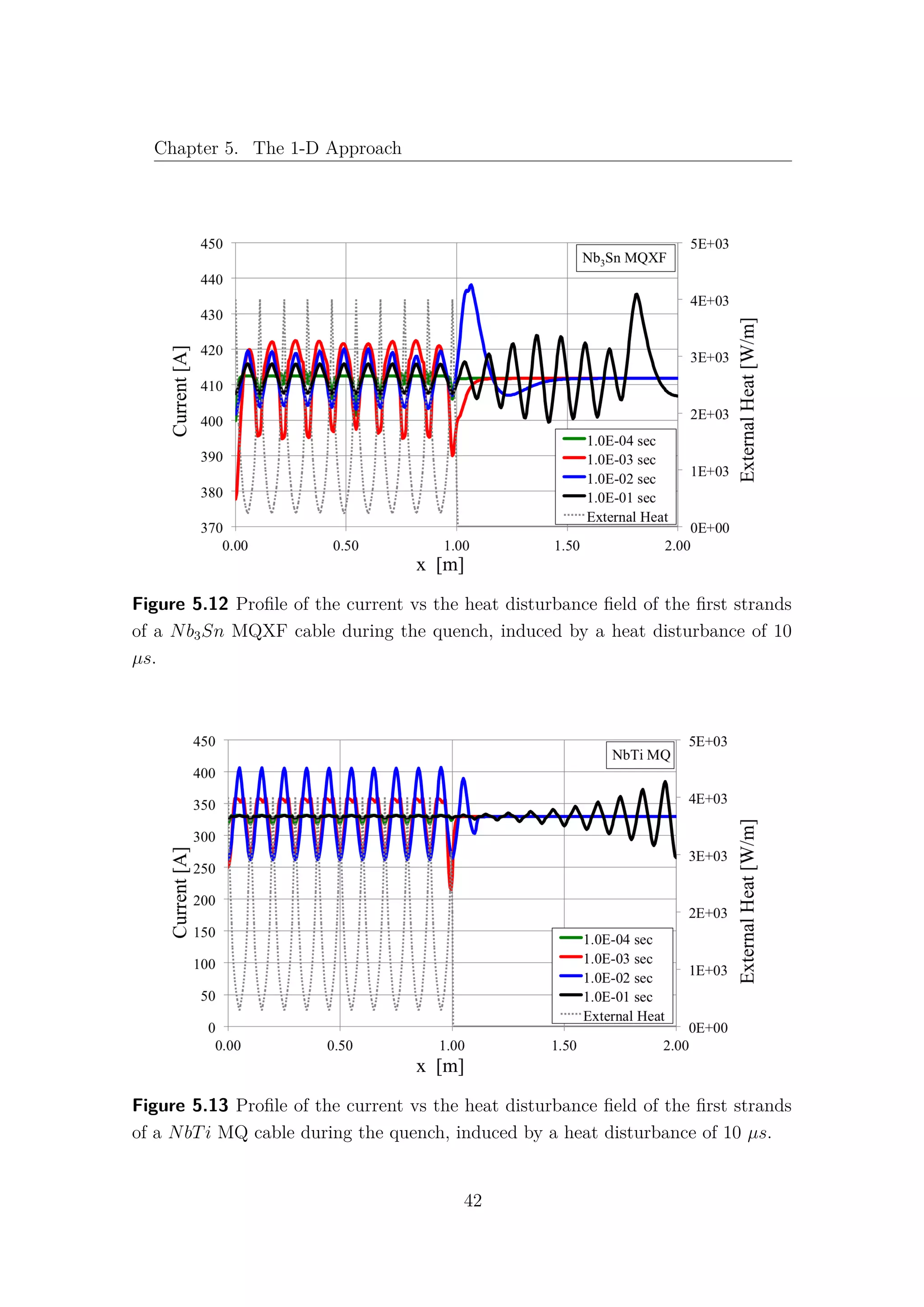
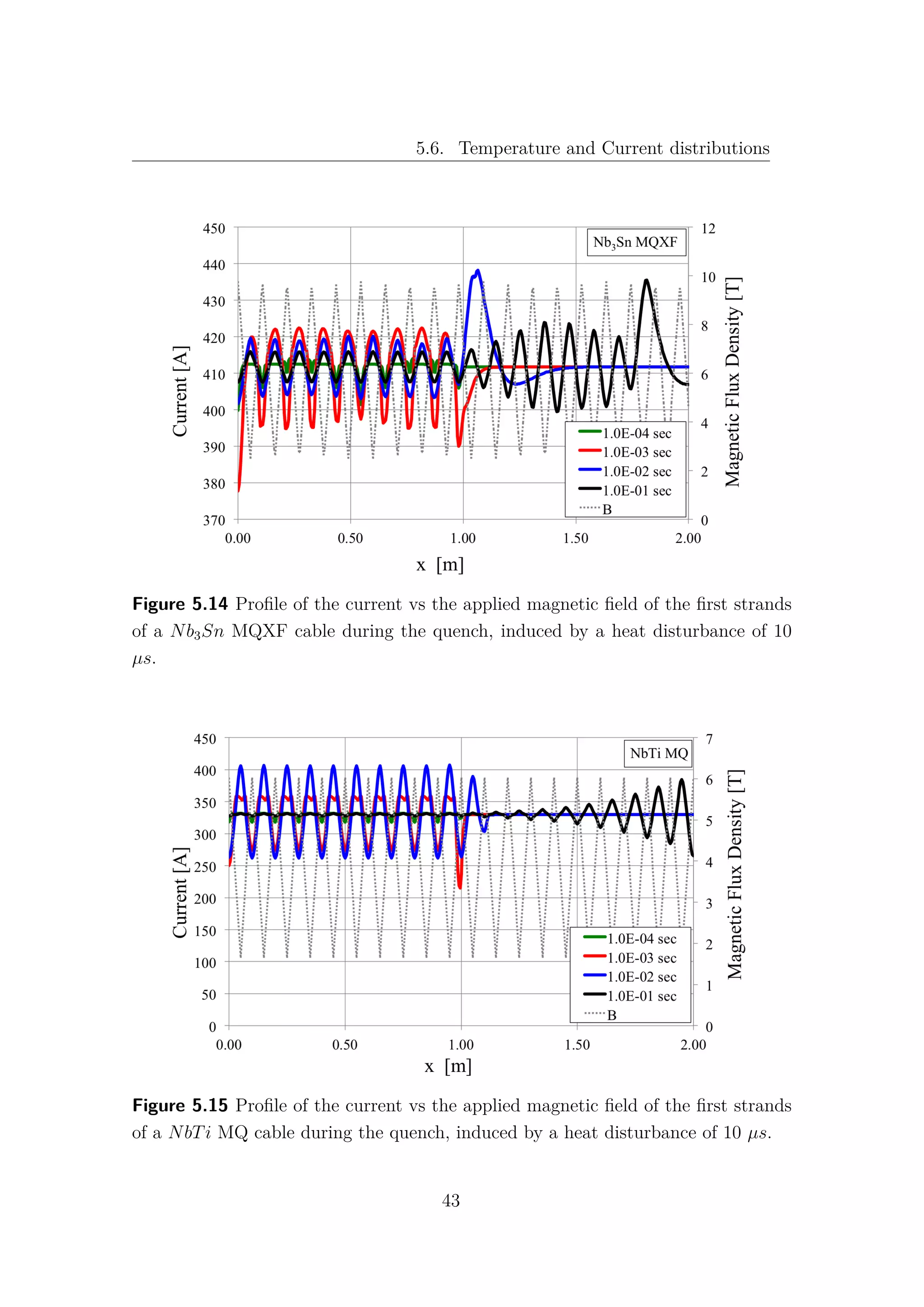
38](https://image.slidesharecdn.com/1d70407d-94a9-4ad5-8282-7558b7edcd7f-170222141405/75/CERN-THESIS-2016-081-52-2048.jpg)
![Chapter 6. The 1-D model results
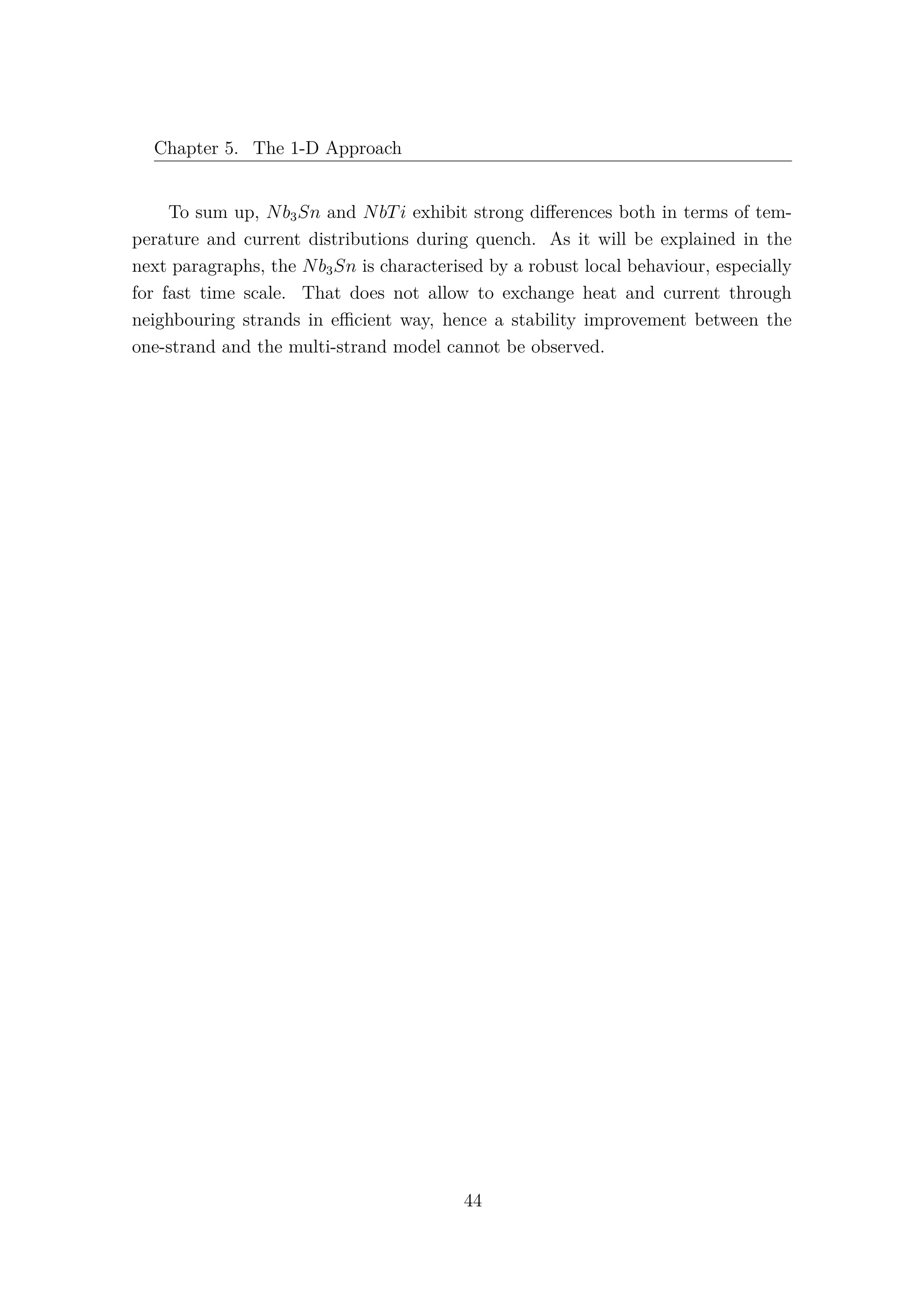
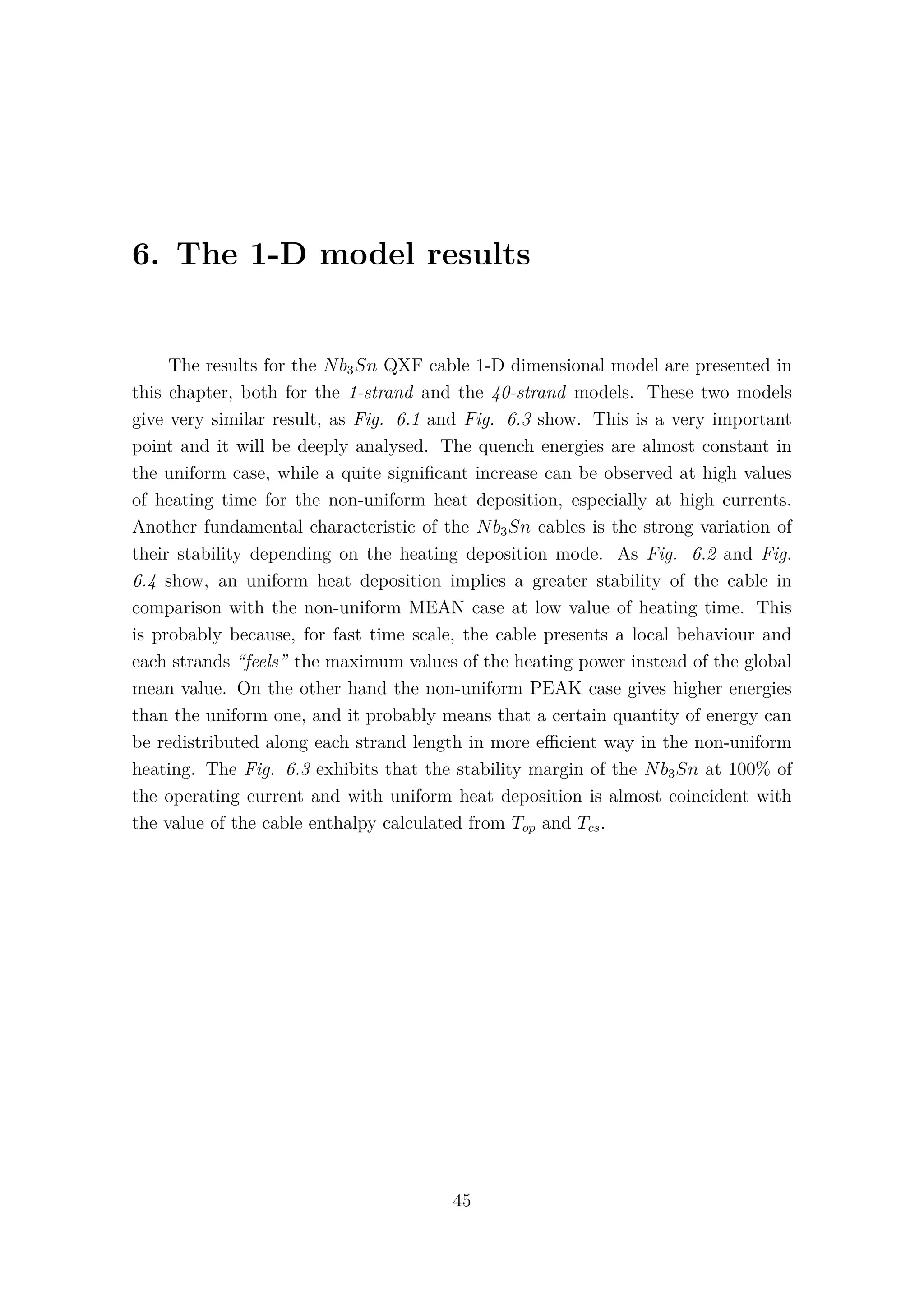
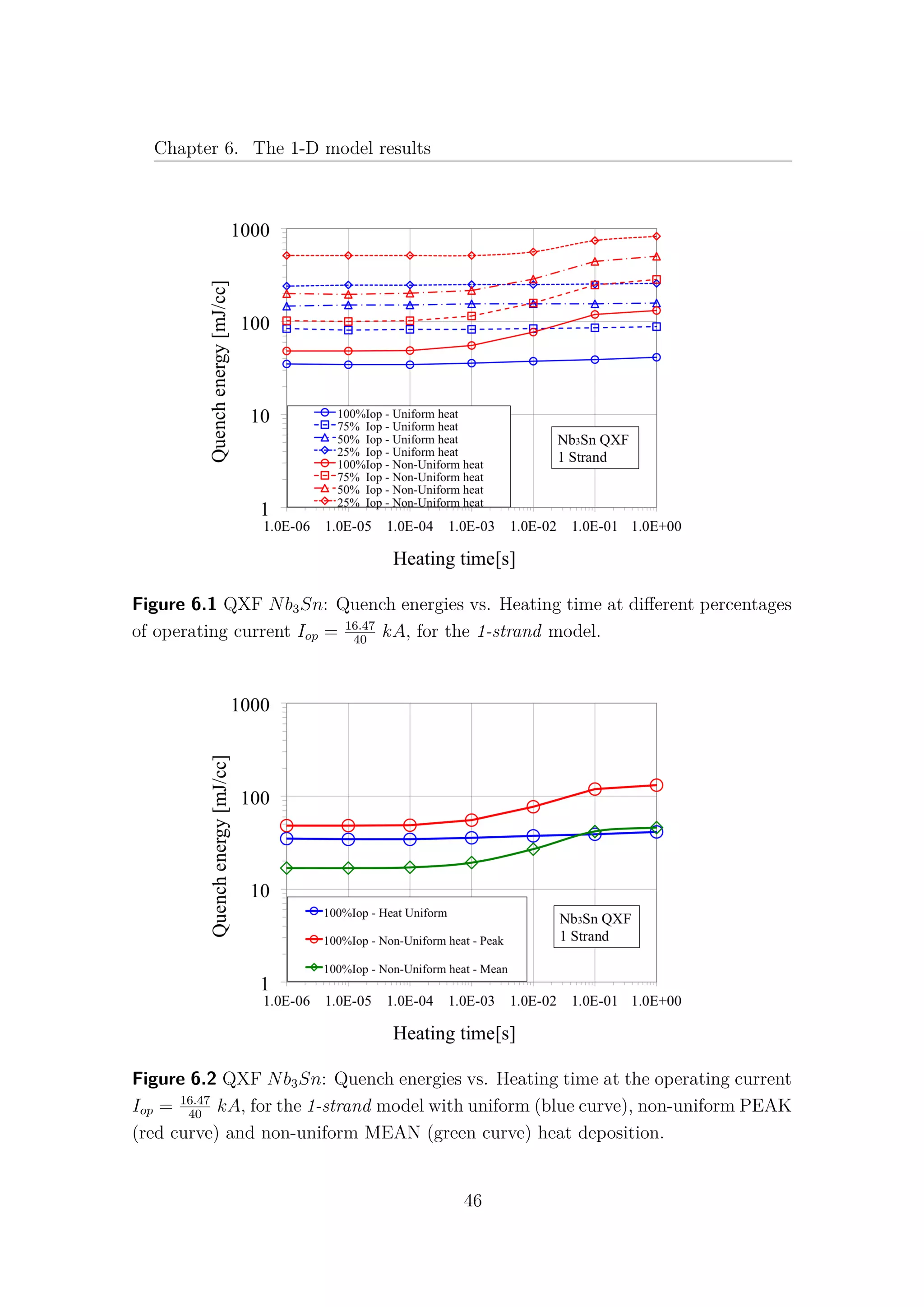
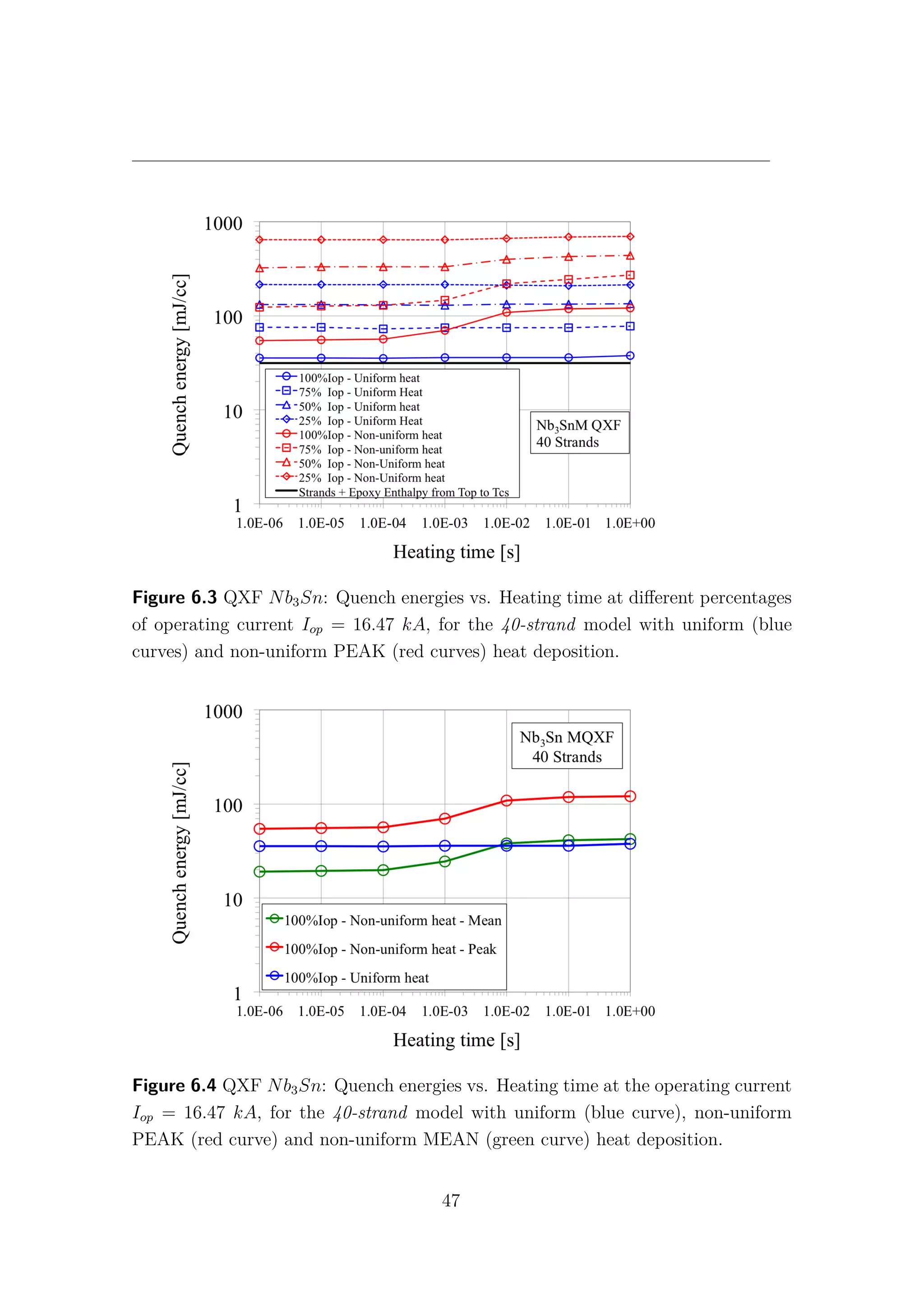
6.1 Nb3Sn and NbTi cables comparison
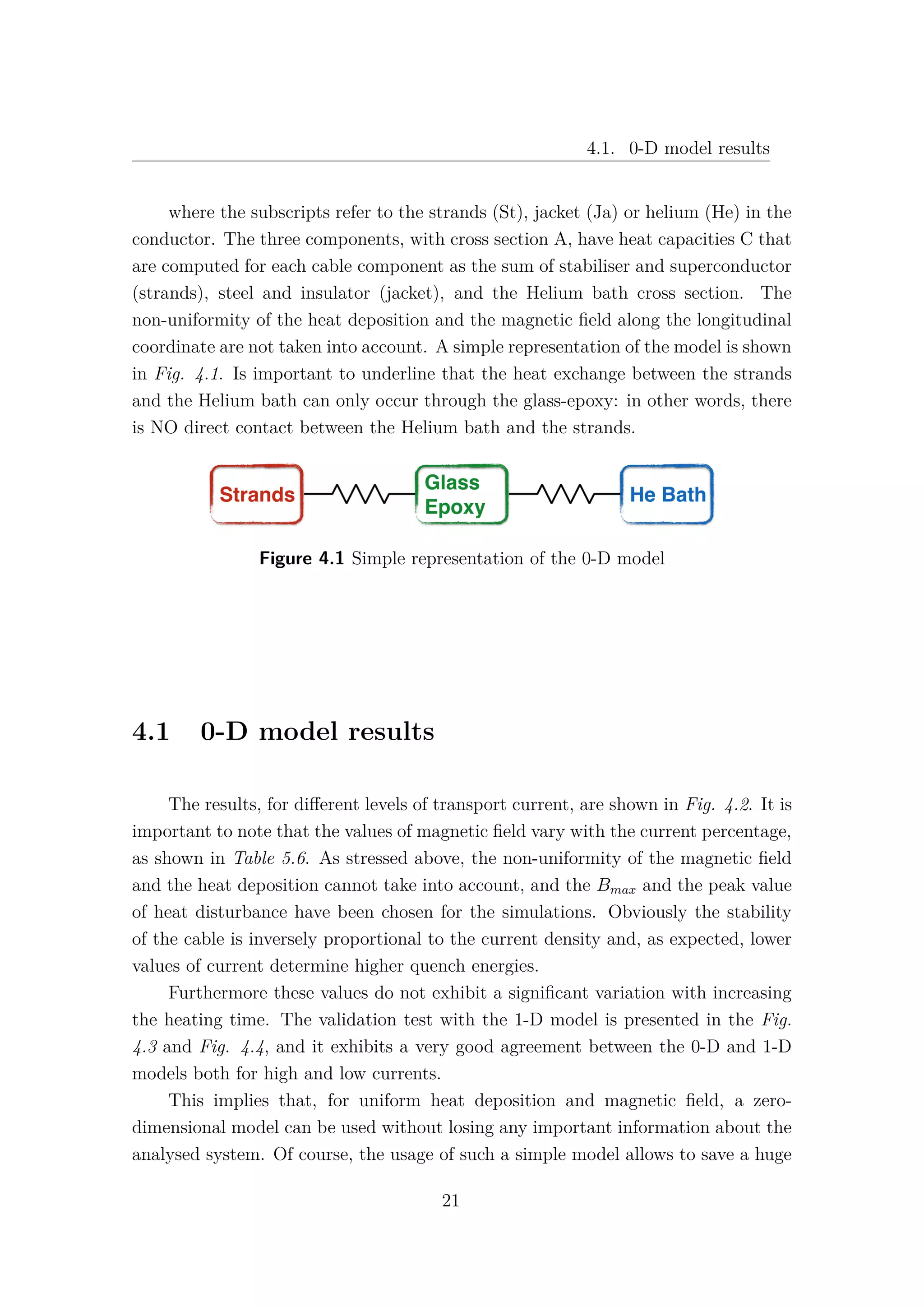
The comparison between the Hi-Lumi LHC QXF Nb3Sn and the LHC MQ
NbTi cables is presented in this section. The data and the results for the LHC
NbTi cables are taken from [9] and [30]. It is important to underline that, while in
the QXF Nb3Sn cable there is no contact between the strands and the helium bath,
in the MQ NbTi one, not only the strands are in direct contact with the helium
bath, but they are also surrounded by the so-called interstitial helium. Therefore,
it is obvious that for high values of heating time, where the heat exchange with
the helium becomes predominant, the typical quench energies increase of the NbTi
cannot be observed in the Nb3Sn cable. In Table 6.1 the main data and operating
parameters of both cables are shown. While the current density ratios are almost
the same, the Nb3Sn has a double temperature margin with respect to the NbTi.
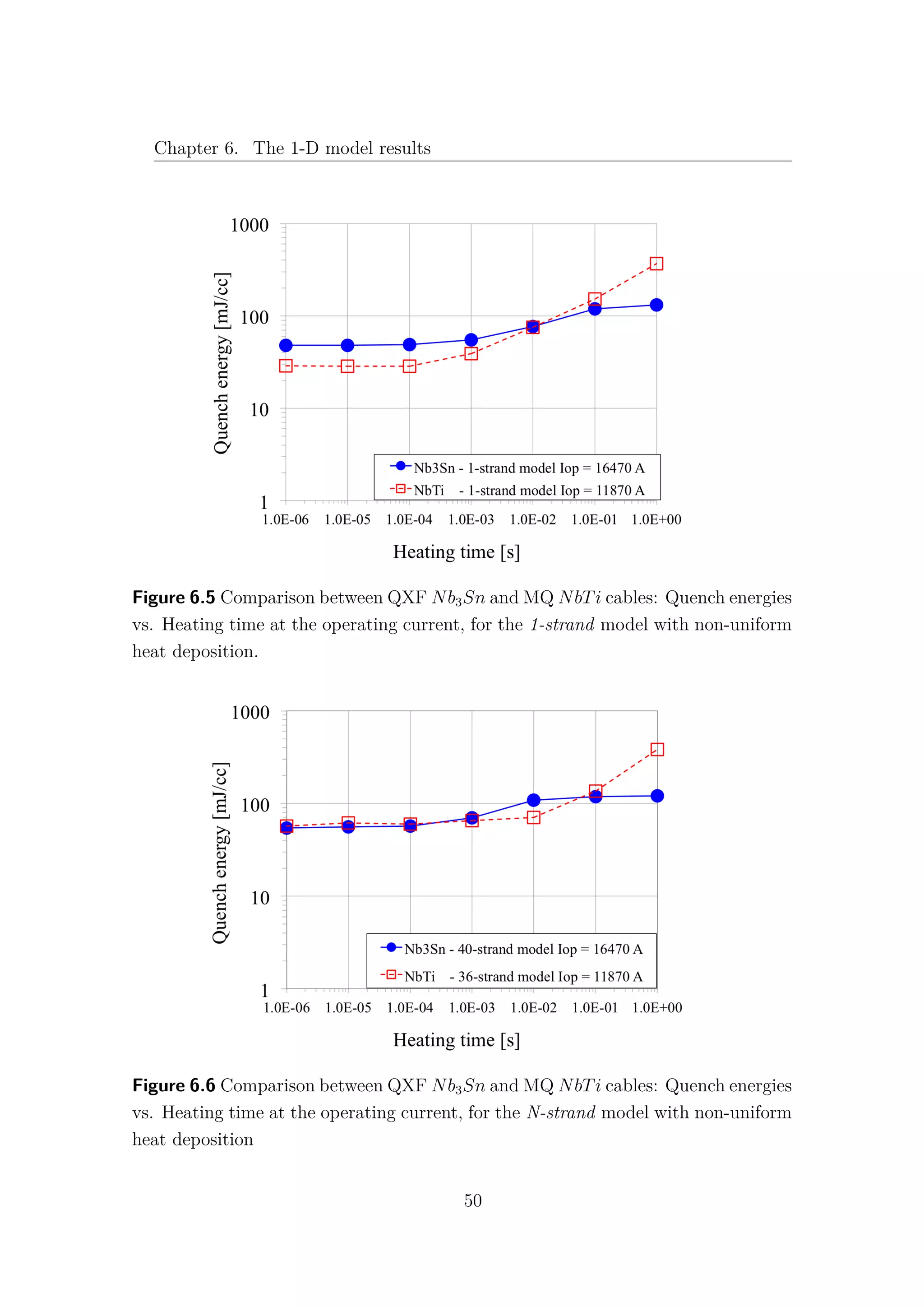
In fact, for the 1 − strand analysis Fig. 6.5, an increase of 70% of quench energies
can be observed in the Nb3Sn in comparison with the NbTi cable at fast heating
time. However, when the complete model is taken into account, with 40 strands for
the Nb3Sn and with 36 strands for the NbTi, this gap is closed and both cables
exhibit the same quench energies for low values of heating time Fig. 6.6. It is quite
surprising that, despite the more demanding operating conditions, the simulations
for the MQXF Nb3Sn cables give comparable quench energies with the actual LHC
MQ NbTi cables, at least for low energy pulse duration.
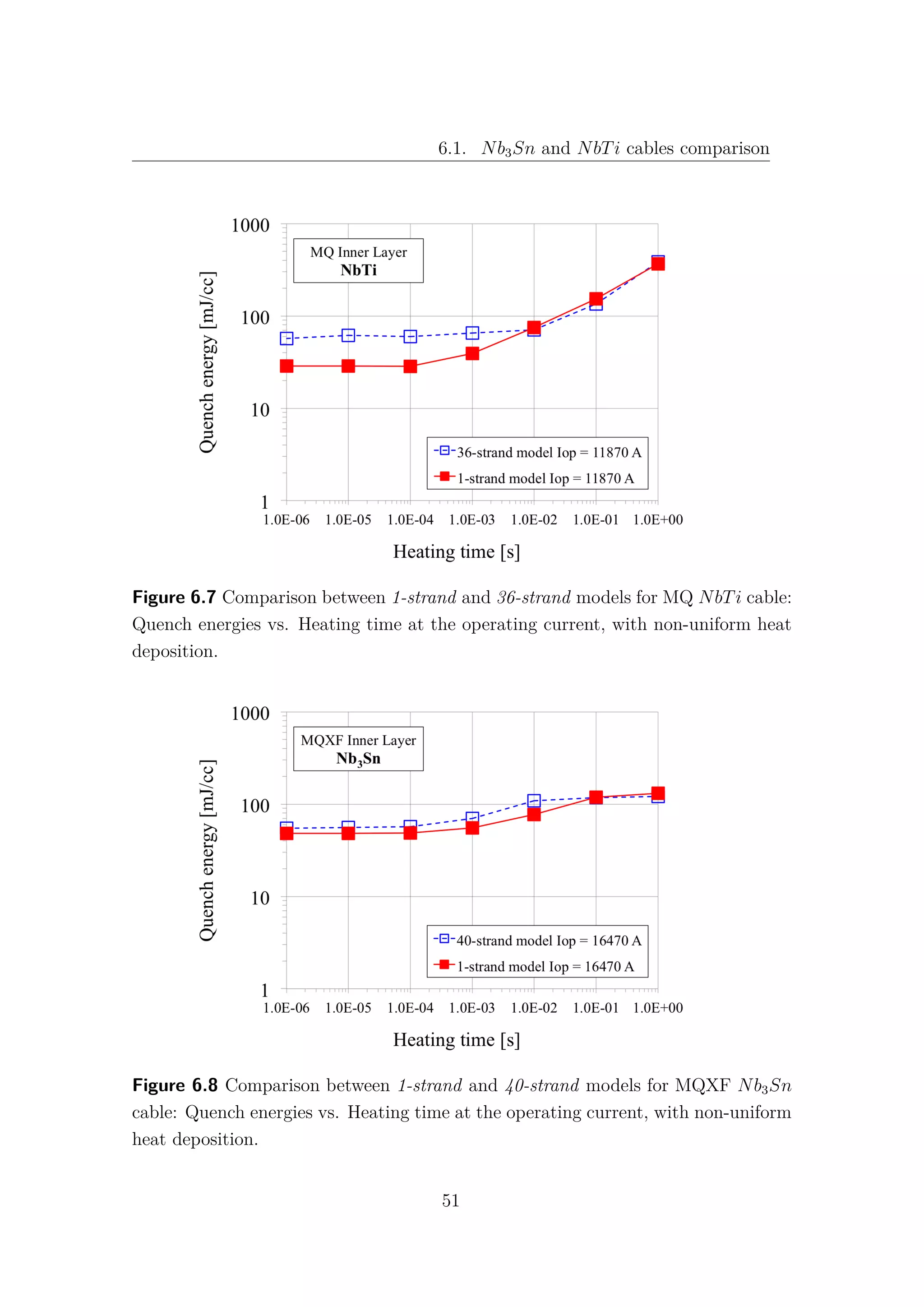
The obvious question is: “Why does the Nb3Sn cable lose its advantage in the
N-strand model?”. Unfortunately the answer is not so obvious! As shown in Fig.
6.7, the NbTi exhibits an increase of Quench Energies about 200% from the 1-strand
to the 36-strand model. This means that the presence of other strands allows a good
sharing of heat and current, increasing the stability of the cable.
A very different behaviour can be observed in the Nb3Sn, (see Fig. 6.8), where
the difference between the two models results barely 10%. The Nb3Sn exhibits
a local behaviour and the communication between different strands seems to be,
somehow, inhibited.
48](https://image.slidesharecdn.com/1d70407d-94a9-4ad5-8282-7558b7edcd7f-170222141405/75/CERN-THESIS-2016-081-62-2048.jpg)
![6.1. Nb3Sn and NbTi cables comparison
Nb3Sn NbTi
Cable data
Strand diameter [mm] 0.850 0.825
Number of strands 40 36
Cu/nonCu 1.20 1.95
Transposition pitch [mm] 109 100
Width [mm] 18.15 15.1
Operating conditions
Total current [kA] 16.47 11.87
Current density [kA/mm2
] 1.6 1.8
Peak magnetic field [T] 11.4 6.85
Temperature [K] 1.9 1.9
Tcs − Top[K] 5.34 2.89
Tc − Top[K] 10.94 5.04
Jop/Jc 0.472 0.465
Table 6.1 Comparison between HiLumi LHC QXF Nb3Sn and LHC MQ NbTi
cables
49](https://image.slidesharecdn.com/1d70407d-94a9-4ad5-8282-7558b7edcd7f-170222141405/75/CERN-THESIS-2016-081-63-2048.jpg)
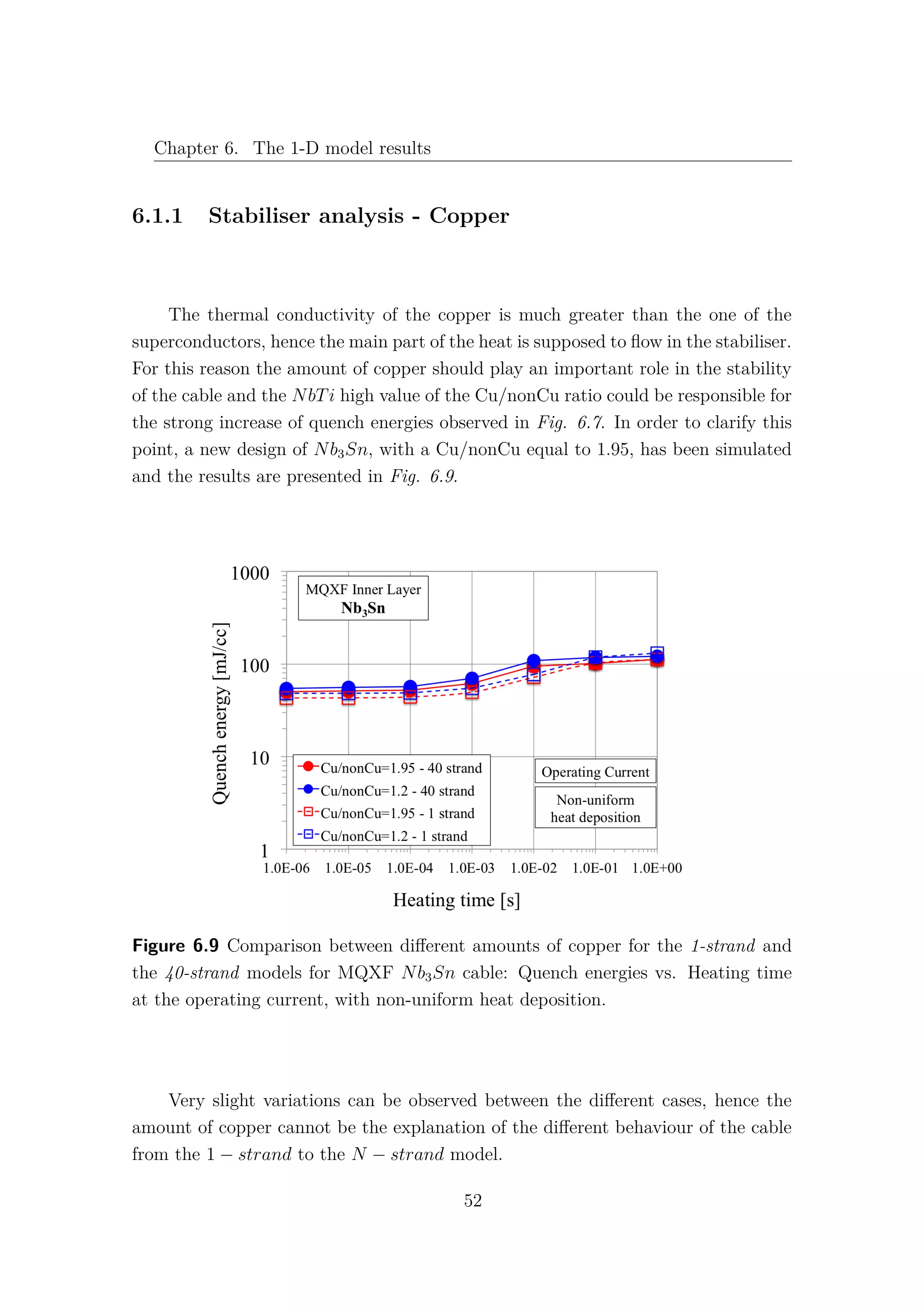
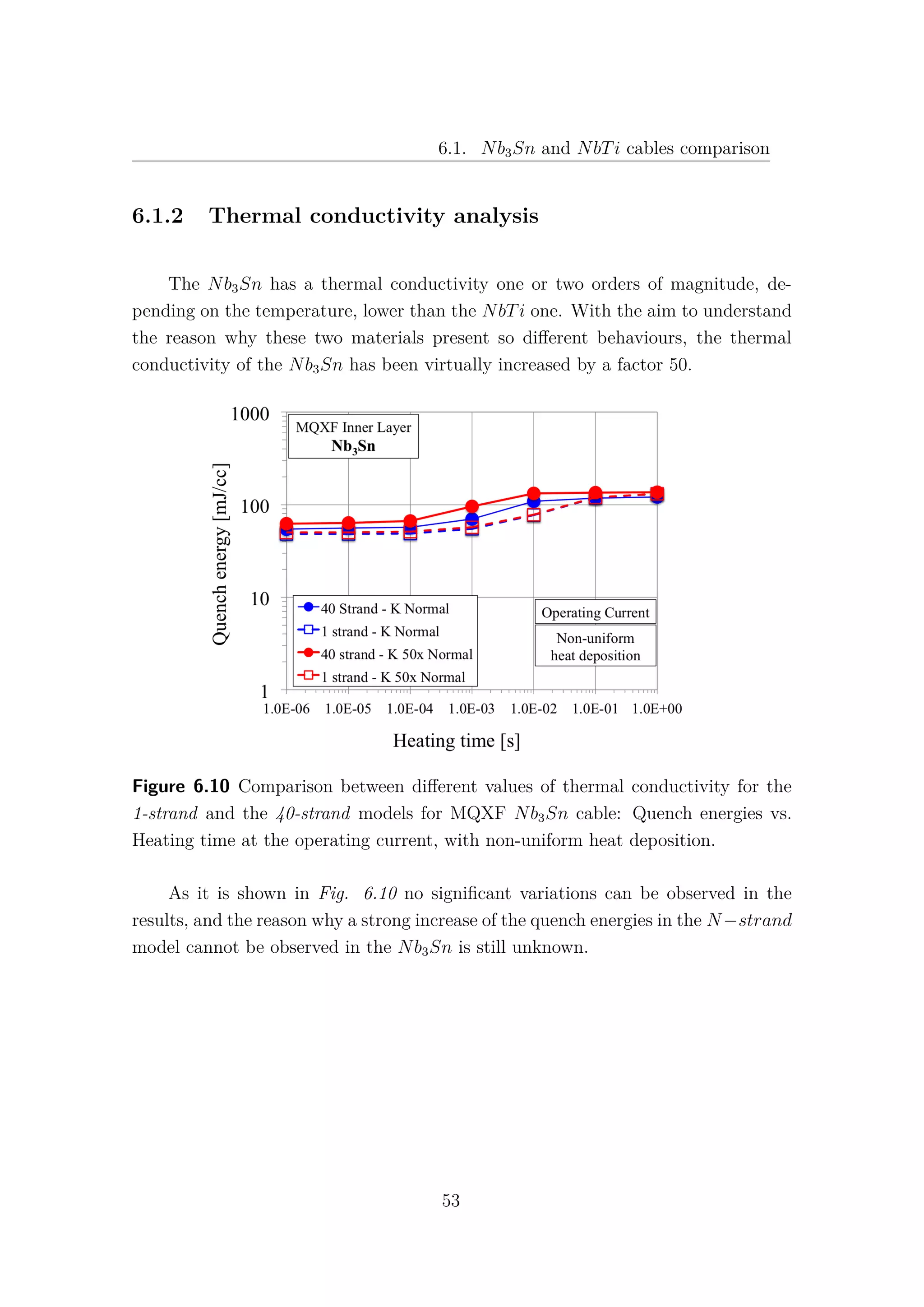
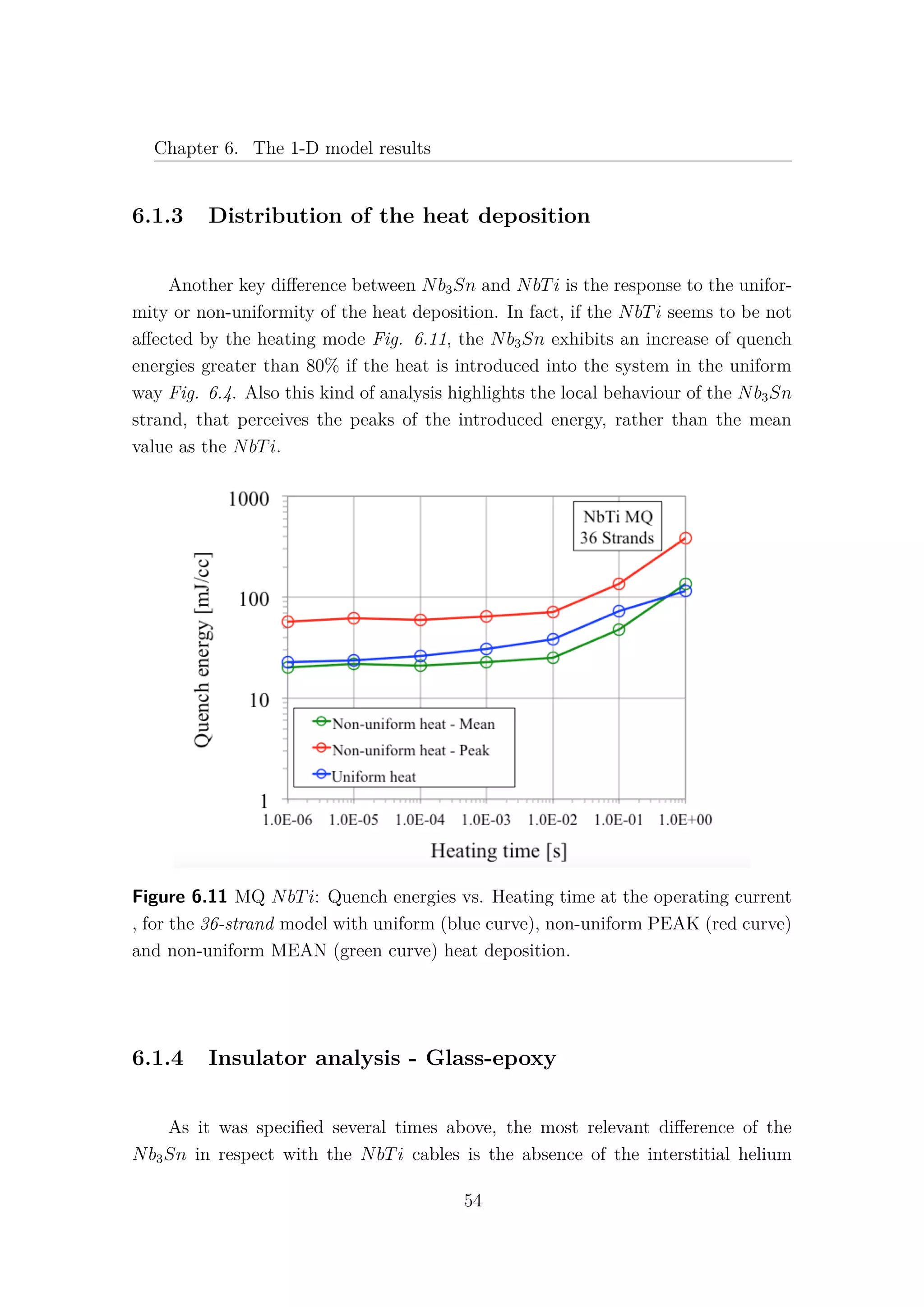
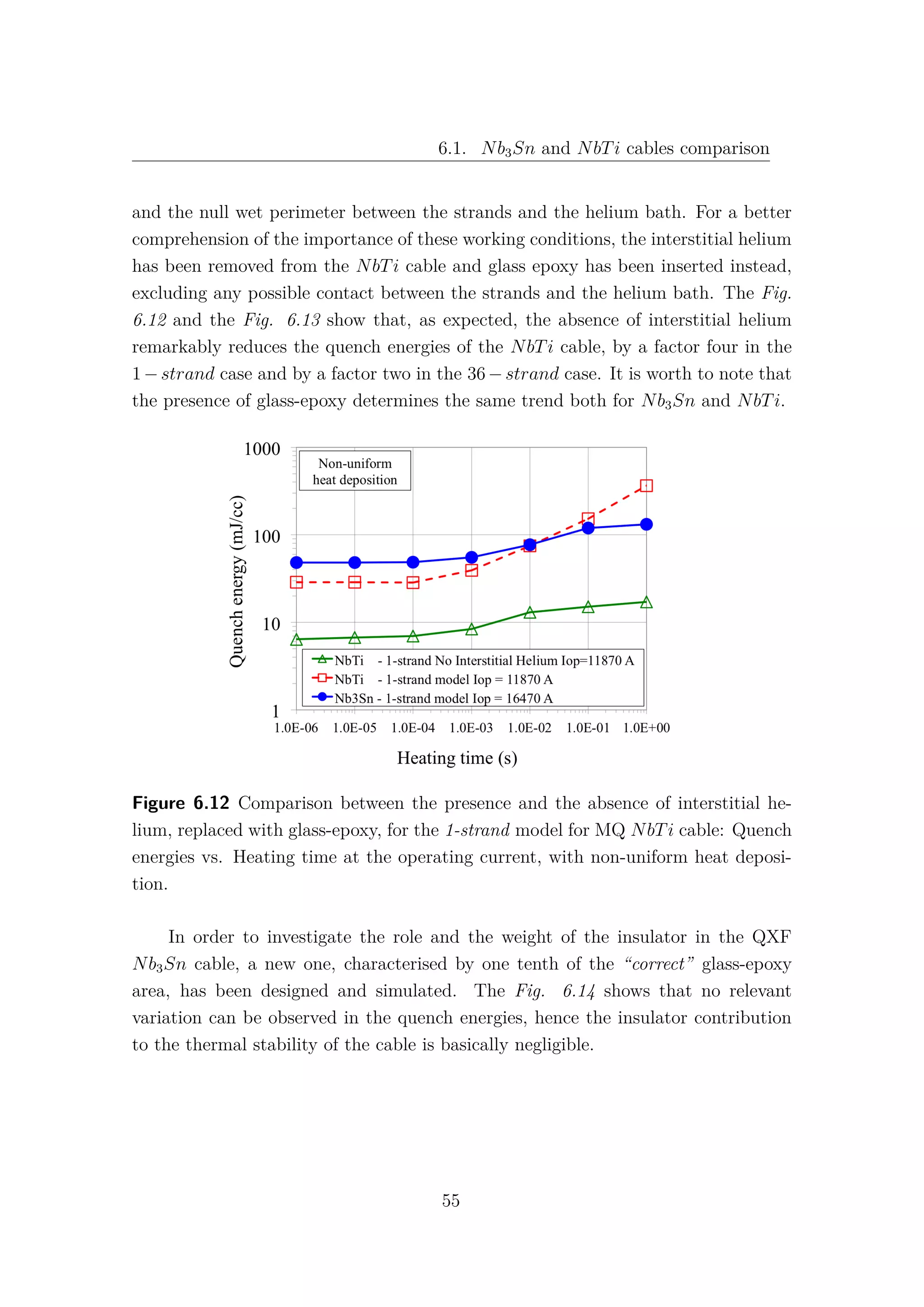
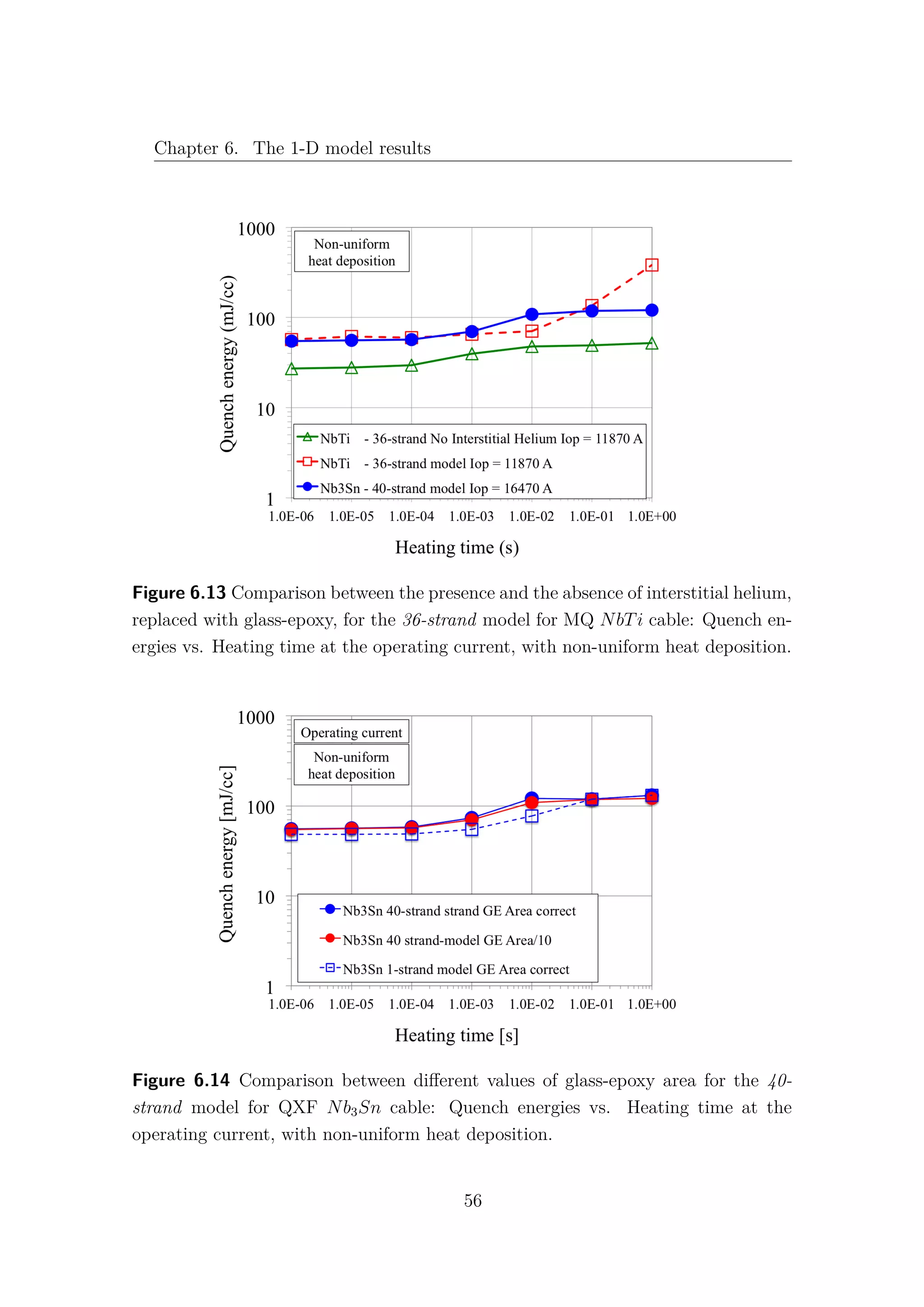
![6.2. Nb3Sn cored cable
6.2 Nb3Sn cored cable
Increasing the level of complexity of the model, a stainless steel core 25µm
thick and 12mm wide has been introduced as a new thermal element [1]. Due to the
very high electric resistance of the core, the current is assumed not to flow in the
longitudinal direction, therefore the core is not implemented as an electric element.
According to [7] (section 4.1.2), the presence of the core induces a relevant increase
of thermal and electrical resistances between non-adjacent strands: λth−C = 500 W
Km2
and Rc = 10000 µΩ. It is important to note that non-adjacent strands can exchange
heat only through the core and the insulator, as it is shown in Fig. 6.15. The
adjacent strands heat exchange is not affected by the presence of the core.
Figure 6.15 Representation of the 1-D cored model.
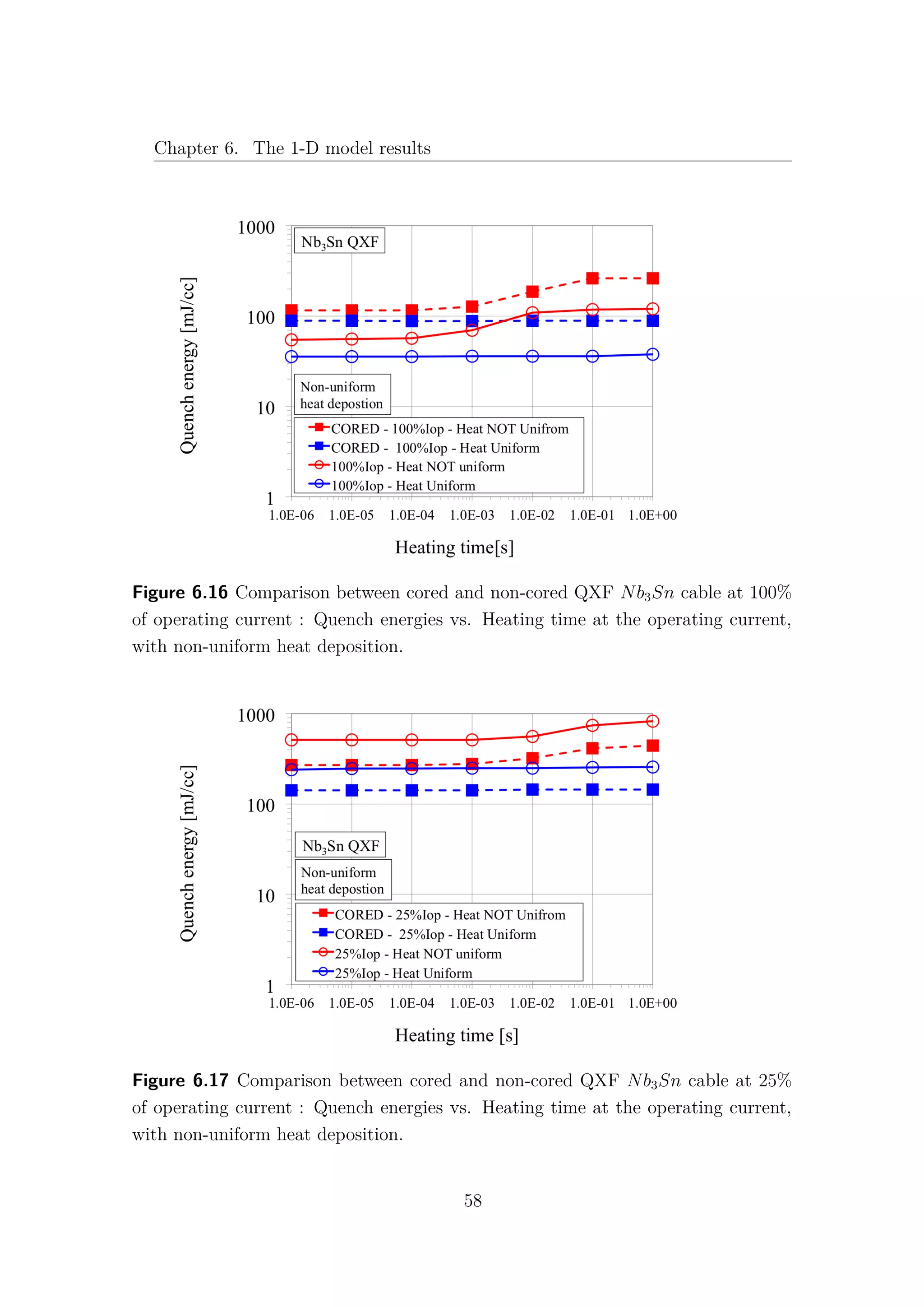
As expected, a lower stability of the cored cable is obtained at the 25% of
the operating current Fig. 6.17, but surprisingly, at full current, the cored cable
exhibits higher quench energies than the non-cored cable Fig. 6.16. Basically the
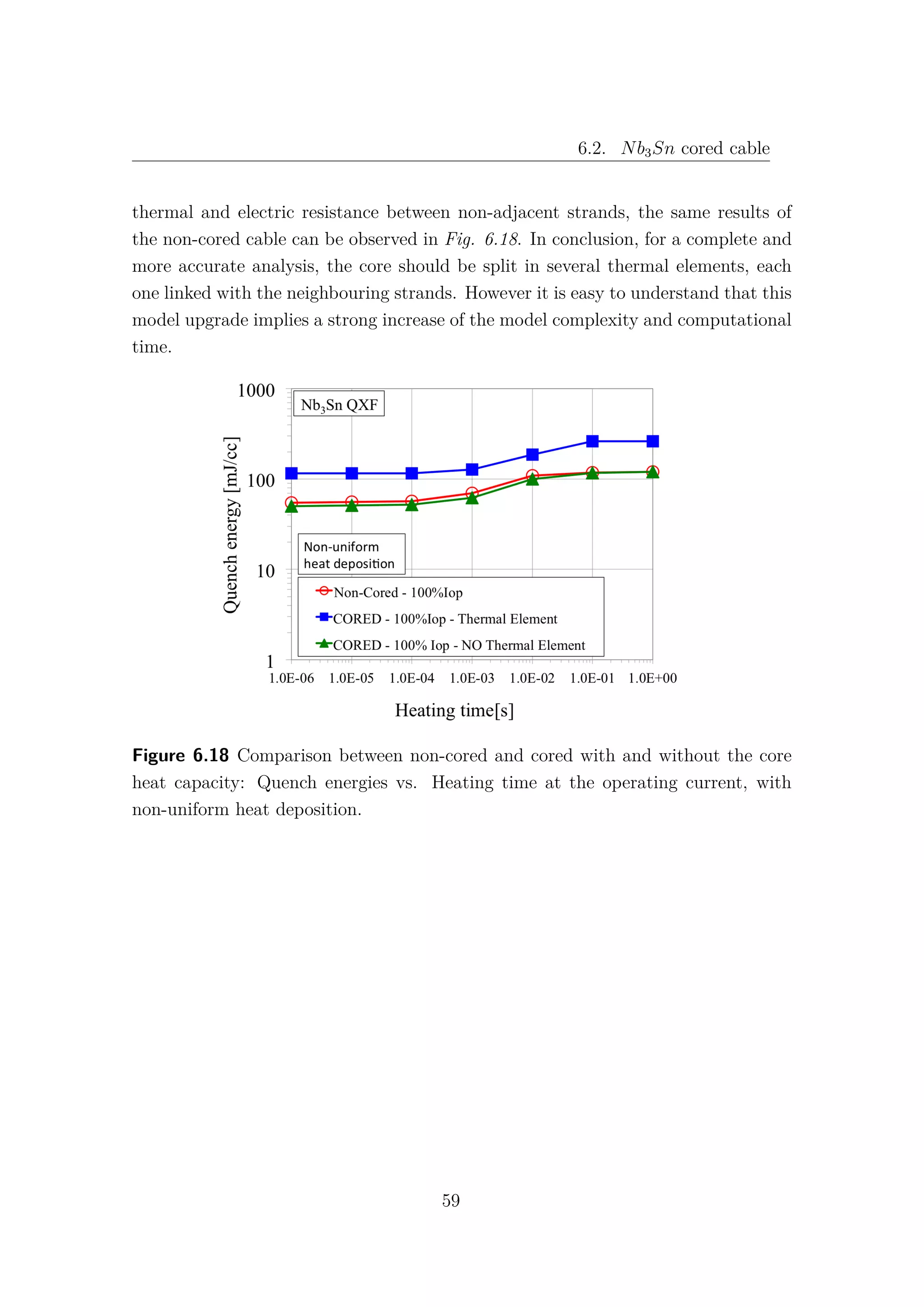
core represent a link between the strands: at high currents it is a bridge, while at
low currents it behaves like a wall. This strange results are due to the heat capacity
of the core. Simulating the core as a single thermal element, each strand can use
the whole heat capacity of the core for the heat exchange, and this represent an
overestimate of the core role. Removing the heat capacity of the core, i.e. it is
not considered as a thermal element anymore, and keeping the high values for the
57](https://image.slidesharecdn.com/1d70407d-94a9-4ad5-8282-7558b7edcd7f-170222141405/75/CERN-THESIS-2016-081-71-2048.jpg)
![8.2. Thermal component
Figure 8.1 Stability of the Minimum Quench Energy in terms of maximum integra-
tion time steps. [Thermal component]
Figure 8.2 Minimum Quench Energy as a function of heat disturbance duration,
with different maximum integration time steps. [Thermal component]
63](https://image.slidesharecdn.com/1d70407d-94a9-4ad5-8282-7558b7edcd7f-170222141405/75/CERN-THESIS-2016-081-77-2048.jpg)
![Chapter 8. Appendix A - Convergence studies
8.2.2 Minimum integration time step
In order to study the variations of the results due to the different minimum time
steps, equal values for minimum and maximum steps have been set. These values
are chosen from 1.0E-9 seconds to one tenth of the heat disturbance duration. The
results are shown in Fig. 8.3 and Fig. 8.4.
In this case, the variation of the MQE is more evident and not negligible. This is the
demonstration that, if the evolution of the system is not followed using the correct
time steps, important errors can occur.
Figure 8.3 Stability of the Minimum Quench Energy in terms of minimum integra-
tion time steps. [Thermal component]
64](https://image.slidesharecdn.com/1d70407d-94a9-4ad5-8282-7558b7edcd7f-170222141405/75/CERN-THESIS-2016-081-78-2048.jpg)
![8.3. Thermal and Electric components
Figure 8.4 Minimum Quench Energy as a function of heat disturbance duration,
with different minimum integration time steps. [Thermal component]
8.3 Thermal and Electric components
Taking into account the thermo-electric components the system can be analysed
in a more accurate way. Three strands have been simulated, where both thermal and
electric time constants, characteristic of the process, are considered. The procedure
for the time integration analysis is the same as presented above for maximum and
minimum steps. The results for this multi-strand investigation are shown in the Fig.
8.5, Fig. 8.6, Fig. 8.7 and Fig. 8.8.
8.3.1 Maximum integration time step
As the Fig. 8.5 and the Fig. 8.6 exhibit, there is no significant variation with
respect to the “only thermal” case. For thermo-electric simulations the variations,
which occurred for a different integration maximum time step, are comparable to
the maximum error due to the convergence criterion.
65](https://image.slidesharecdn.com/1d70407d-94a9-4ad5-8282-7558b7edcd7f-170222141405/75/CERN-THESIS-2016-081-79-2048.jpg)
![Chapter 8. Appendix A - Convergence studies
Figure 8.5 Stability of the Minimum Quench Energy in terms of maximum integra-
tion time steps. [Thermal and electric components]
Figure 8.6 Minimum Quench Energy as a function of heat disturbance duration,
with different maximum integration time steps. [Thermal and electric components]
66](https://image.slidesharecdn.com/1d70407d-94a9-4ad5-8282-7558b7edcd7f-170222141405/75/CERN-THESIS-2016-081-80-2048.jpg)
![8.3. Thermal and Electric components
8.3.2 Minimum integration time step
As expected, the results for the minimum steps are the same of the previous case:
a flat behaviour of the Minimum Quench Energy can be observed until a certain
value of minimum step, and then an unavoidable drop occurs. These similarities
between the thermal and thermo-electric analyses imply that the characteristic time
constants of the thermal exchange are smaller in comparison with electric ones. This
means that the process is dominated by the thermal exchange, which is, as just said,
faster than the electrical phenomena.
Figure 8.7 Stability of the Minimum Quench Energy in terms of minimum integra-
tion time steps. [Thermal and electric components]
67](https://image.slidesharecdn.com/1d70407d-94a9-4ad5-8282-7558b7edcd7f-170222141405/75/CERN-THESIS-2016-081-81-2048.jpg)
![Chapter 8. Appendix A - Convergence studies
Figure 8.8 Minimum Quench Energy as a function of heat disturbance duration,
with different minimum integration time steps. [Thermal and electric components]
According to the results presented above, the “standard” values for the max-
imum and minimum integration time steps can be defined. The suggested values,
varying during the simulation time evolution, are shown in Table 8.2.
Simulation Time Minimum time step Maximum time step
from 0.0 sec to 1.0E-5 sec 1.0E-8 sec 1.0E-7 sec
from 1.0E-5 sec to 1.0E-3 sec 1.0E-7 sec 1.0E-6 sec
from 1.0E-3 sec to END 1.0E-6 sec 1.0E-5 sec
Table 8.2 Standard values for maximum and minimum integration time steps
The choice of bigger step values could represent a risk in terms of simulation’s
reliability. The maximum achievable step is limited to 1.0E-5 seconds, in order to
avoid errors due to a coarse time evaluation of the system∗
. On the other hand, a
selection of smaller steps or a not incremental choice, implies a huge consumption
of computational time and memory.
∗
The maximum time step of 1.0E-5 seconds represent an advice, rather than a limit. If the
simulations are too time consuming, this value can be modified, e.g. it can be chosen equal to
1.0E-3 seconds, with the consciousness that some informations could be lost.
68](https://image.slidesharecdn.com/1d70407d-94a9-4ad5-8282-7558b7edcd7f-170222141405/75/CERN-THESIS-2016-081-82-2048.jpg)
![8.4. Tolerance
8.4 Tolerance
The tolerance is the: “relative error to be achieved at each time step during time
integration, used to control the time step” [5] . This means that the importance of
integration time steps cannot be analysed without paying attention to the used
tolerance. Therefore, using the standard values of the Table 8.2, a study on the
influence of the tolerance parameter, both for thermal case and for thermo-electric
one, has been carried out. The results are presented in the Fig. 8.9 and Fig. 8.10.
Figure 8.9 Stability of the Minimum Quench Energy in terms of tolerance. [Thermal
component]
As Fig. 8.9 and Fig. 8.10, except for very short disturbance, the curves are
perfectly overlapped. This means that, with our choice of time steps, a results
deviation due to the tolerance cannot be observed. However, the gradual increasing
of the tolerance value is suggested, as it is shown in Table 8.3.
69](https://image.slidesharecdn.com/1d70407d-94a9-4ad5-8282-7558b7edcd7f-170222141405/75/CERN-THESIS-2016-081-83-2048.jpg)
![Chapter 8. Appendix A - Convergence studies
Figure 8.10 Stability of the Minimum Quench Energy in terms of tolerance. [Ther-
mal and electric components]
Simulation Time Tolerance
from 0.0 sec to 1.0E-5 sec 1.0E-7 sec
from 1.0E-5 sec to 1.0E-3 sec 1.0E-6 sec
from 1.0E-3 sec to END 1.0E-5 sec
Table 8.3 Standard values for tolerance
70](https://image.slidesharecdn.com/1d70407d-94a9-4ad5-8282-7558b7edcd7f-170222141405/75/CERN-THESIS-2016-081-84-2048.jpg)
![8.5. Mesh dimension
8.5 Mesh dimension
Once it has been understood how to deal with time parameters, it is necessary
to analyse spacial dimension convergence. The number of mesh elements, or the size
of a mesh element, represents a problem similar to the integration time steps one: if
a too big mesh element is used, critical information can be lost. On the other hand,
if a too dense mesh is chosen a huge quantity of simulation time is needed. With the
aim of avoiding these inconveniences another convergence study has been performed,
analysing the stability of the minimum quench energy in terms of the size of mesh
elements. The size of a mesh element is given by this obvious correlation
Dx =
L
n
(8.1)
where s is the size of the element, n is the number of elements and L is the length
of the system (in our simulation L = 2 m). The results of this analysis are shown,
for thermal and thermo-electric components, in the Fig. 8.11 and in the Fig. 8.12.
Figure 8.11 Stability of the Minimum Quench Energy in terms of mesh element
number . [Thermal component]
An increase of the minimum quench energy with increasing number of elements
can be observed, especially for higher value of disturbance time. However, these
71](https://image.slidesharecdn.com/1d70407d-94a9-4ad5-8282-7558b7edcd7f-170222141405/75/CERN-THESIS-2016-081-85-2048.jpg)
![Chapter 8. Appendix A - Convergence studies
Figure 8.12 Stability of the Minimum Quench Energy in terms of mesh element
number for long heat disturbance . [Thermal and Electric components]
variations are in the same order of magnitude as the simulation precision (5%)
and therefore can be considered acceptable. In conclusion, a large number of mesh
elements are not required, unless we need a high accuracy of results. Obviously, the
more we increase the number of the mesh elements, the more the computational
time becomes elevated.
8.6 Error control
Finally, another parameter that is strongly correlated with the computational
time of our processes is to be taken into account. If the Error Controll is ON: “at
each time step a check is performed to verify that the integration error is below the
specified Tolerance. If this is not the case the time step is changed and the integration
is tried again, iterating until the tolerance error is reached [...] The iteration can
significantly increase CPU time.” [5] As written in Table 8.1, the previous analyses
are performed with the activated error control. Now, it is important to verify if
72](https://image.slidesharecdn.com/1d70407d-94a9-4ad5-8282-7558b7edcd7f-170222141405/75/CERN-THESIS-2016-081-86-2048.jpg)
![8.6. Error control
the chain of this strong control system can be broken, and consequentially save a
large amount of computational time. Also for this last analysis the thermal and the
thermo-electric cases are taken into account, both with the parameters of the Table
8.2.
The Fig. 8.13 and the Fig. 8.14 are the demonstration that, under the afore-
mentioned operating condition, there is no need to check the integration error at
each time step; therefore a remarkable amount of computational can be saved time
without losing any important information.
Figure 8.13 Stability of the Minimum Quench Energy in terms of error control.
[Thermal component]
73](https://image.slidesharecdn.com/1d70407d-94a9-4ad5-8282-7558b7edcd7f-170222141405/75/CERN-THESIS-2016-081-87-2048.jpg)
![Chapter 8. Appendix A - Convergence studies
Figure 8.14 Stability of the Minimum Quench Energy in terms of error control.
[Thermal and electric components]
74](https://image.slidesharecdn.com/1d70407d-94a9-4ad5-8282-7558b7edcd7f-170222141405/75/CERN-THESIS-2016-081-88-2048.jpg)
![9. Appendix B - Hitchhiker’s guide
to the Linux and LxPlus galaxy
If you are reading this “guide” you are probably working with (or for, depending
on the points of view) Luca Bottura and Marco Breschi. I’m writing these few lines
just to explain what I have done and what you could (NOT should) do in order
to avoid some annoying problems concerning disconnections from LxPlus cluster,
disappeared NOHUP processes from somewhere and similar stuff, that probably
will drive you crazy in a couple of days. First of all an LxPlus account is not
thought for long and intense simulation: “The service is intended for interactive
work [...] Jobs consuming lots of CPU for extended periods of time will be killed
automatically”.You will notice (or, if you are reading this secret guide, you have
already noticed it) that if you try to run a simulation for a whole night, when you
are in your warm bed, sleeping deeply, or in the pub, drinking your cold beer, this
simulation will unavoidably CRASH!
DON’T PANIC: the solution is just right here! You should use the nohup
command.
nohup ./ program . exe &
Caution! You will never see anymore the outputs on your screen, but all those
lines are saved in a file called something.out. After few hours of simulation this file
can easily reach a huge dimension and it could create several problems, due to the
annoying memory limit of LxPlus account. You can ask politely to the Desk Service
to enlarge your memory space to reach the maximum limit of 10Gb (“if you need
more, you can create personal workspace on AFS”), but, in any case, I strongly
recommend you to not to create this .out file. It’s just a nice, huge and useless text
file on your folder and you can avoid it using the command below:
nohup ./ program . exe 2%>1 null &
75](https://image.slidesharecdn.com/1d70407d-94a9-4ad5-8282-7558b7edcd7f-170222141405/75/CERN-THESIS-2016-081-89-2048.jpg)


![Bibliography
[1] E. Cavanna and et al, Design of the Nb3Sn Inner Triplet. FP7 High Luminosity
Large Hadron Collider Design Study, 04 September 2015.
[2] G. Battistoni and F. Cerruti, The FLUKA code: description and bench-
marking. Proc. Hadronic Shower Simul. Workshop, FermiLab,AIP, 2007.
[3] L. Bottura, JC Parameterization for ITER Nb3Sn Production. 2008.
[4] L. Bottura, CryoSoft Code ZeroDee v. 1.3. January 2001.
[5] L. Bottura, CryoSoft code THEA v. 2.2. December 2013.
[6] L. Bottura, C. Rosso, and M. Breschi, A general model for thermal, hydraulic
and electric analysis of superconducting cable. Workshop on Computation of
tHermo-hydrAulic Transient in Superconductors, Frascati, Italy, September 6,
2000.
[7] G. Willering, Stability of superconducting Rutherford cables for accelerator mag-
nets. PhD Dissertation, University of Twente, The Netherlands, 2009.
[8] P. P. Granieri, Heat Trasnfer between the Superconducting Cables of the LHC
Accelerator Magnets and the Superfluid Helium Bath. PhD Dissertation, Ecole
Polythechnique Fèdèrale de Lausanne, Suisse, 2012.
[9] M. Breschi, A. Bevilacqua, L. Bottura, and P. P. Granieri, Analysis of beam-
induced quenches of the LHC cables with a multi-strand model. , IEEE Trans-
action on applied Superconductivity , vol. 25, 4700405, August 10, 2014.
[10] L. Bottura, “Cable stability,” CERN Yellow Report CERN-2014-005, pp.401-
451.
[11] http://home.cern.
[12] W. Herr and B. Muratori, Concept of luminosity. CERN Accelerator School: In-
termediate Course on Accelerator Physics, Zeuthen, Germany, 15-26 Sep 2003.
80](https://image.slidesharecdn.com/1d70407d-94a9-4ad5-8282-7558b7edcd7f-170222141405/75/CERN-THESIS-2016-081-94-2048.jpg)
![Bibliography
[13] H. K. Onnes, Notes. Phys. Lab. Univ. Leiden, 1911.
[14] W. Meissner and R. Ochsenfeld, Ein neuer Effekt bei Eintritt der Supraleit-
fähigkeit. Naturwissenschaften, 1933.
[15] H. L. F. London, “The electromagnetic equations of the supraconductor,” Pro-
ceedings of the Royal Society A: Mathematical, Physical and Engineering Sci-
ences, 1935.
[16] J. Bardeen, L. N. Cooper, and J. R. Schrieffer, Theory of Superconductivity.
1957.
[17] J. G. Bednorz and K. A. Müller, Possible high Tc superconductivity in the
BaLaCuO system. Zeitschrift für Physik B Condensed Matter, June 1986.
[18] M. K. Wu and et al., Superconductivity at 93 K in a New Mixed Phase YBaCuO
Compound System at Ambient Pressure. 1987.
[19] S. Bud’ko, G. Lapertot, C. Petrovic, C. E. Cunningham, N. Anderson, and
P. Canfield, “Boron isotope effect in superconducting mgb2,” 26 February 2001.
[20] A. Priebe, “Quench tests of lhc magnets with beam: studies on beam loss
development and determination of quench levels,” Ph. D. Dissertation, Ecole
Polytechnique Federale de Lausanne, Lausanne, Switzerland, 2014.
[21] J. B. Jeanneret, L. O. D. Leroy, and T. Trenkler, “Quench levels and transient
beam losses in lhc magnets,” LHC Project Report 44, 1996.
[22] B. Auchmann and et al., “Testing beam-induced quench levels of lhc supercon-
ducting magnets,” Phys. Rev. ST Accel. Beams 18, 061002, 2015.
[23] L. Rossi and L. Bottura, “Superconducting magnets for particle accelerators,”
Reviews of Accelerator Science and Technology Vol. 5 (2012) 51–89. World
Scientific Publishing Company.
[24] S. Bermudez, MQXF 2nd generation design. Joint HiLumi LHC-LARP Annual
Meeting/24th LARP Collaboration Meeting, 12th May, 2015.
[25] H. Katheder, Optimum thermohydraulic operation regime for cable in conduit
superconducotrs (CICS). Cryogenics 34, pp.595-598, 1994.
81](https://image.slidesharecdn.com/1d70407d-94a9-4ad5-8282-7558b7edcd7f-170222141405/75/CERN-THESIS-2016-081-95-2048.jpg)
![Bibliography
[26] F. Grover, Inductance Calculations. Ed. by Dover Publicatio, New York: Mi-
neola, 2004.
[27] M. Calvi, M. Breschi, and P. Ribani, Analysis of the inductance coefficients
in multistrand cables: analytical, numerical and experimental resutls. IEEE
Transaction on applied superconductivity 15, 2005.
[28] S. Bermudez, Private Communication. CERN, 2015.
[29] M. Massimini, Electrical and thermal analysis of superconducting wires and
LHC cables. Master degree dissertation, University of Bologna, Italy, 2013.
[30] A. Bevilacqua, Stability Analysis of the LHC superconducting cables with a
Multi-Strand model. Internal CERN Report, 26th February 2015.
82](https://image.slidesharecdn.com/1d70407d-94a9-4ad5-8282-7558b7edcd7f-170222141405/75/CERN-THESIS-2016-081-96-2048.jpg)


