Bernard S. Bagaya, PhD
Lecturer
Dept. Immun & Mol. Biol
Sch. Biomedical Sciences
MakCHS Organs, Tissues
and Cells of the
Immune
System
Lillian Namuli, MSc.
Teaching Assistant
Immunology
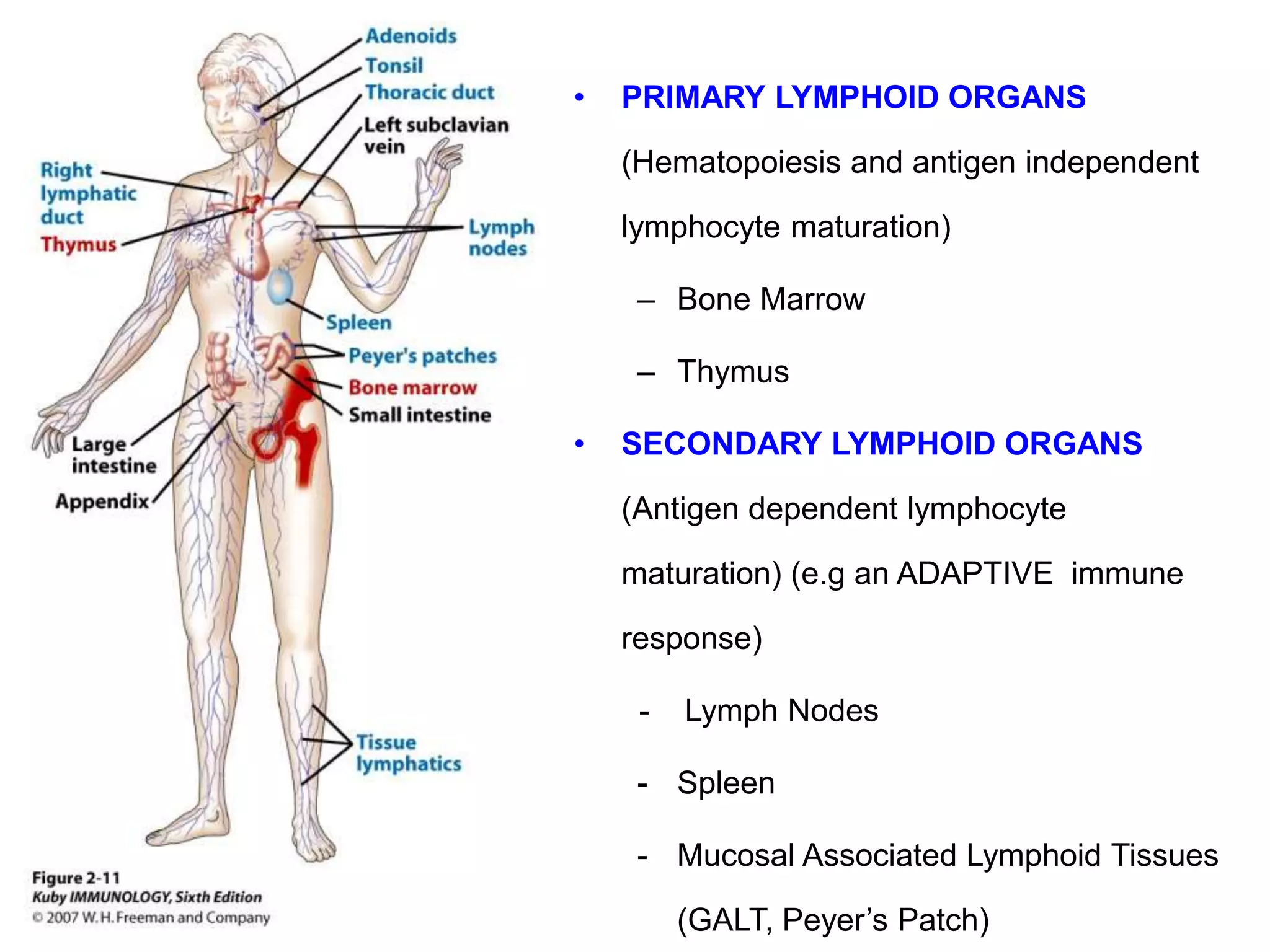
• PRIMARY LYMPHOID ORGANS
(Hematopoiesis and antigen independent
lymphocyte maturation)
– Bone Marrow
– Thymus
• SECONDARY LYMPHOID ORGANS
(Antigen dependent lymphocyte
maturation) (e.g an ADAPTIVE immune
response)
- Lymph Nodes
- Spleen
- Mucosal Associated Lymphoid Tissues
(GALT, Peyer’s Patch)
The Bone marrow
• Soft tissue in center of
bones
• Site of hematopoiesis in
mammals; all blood cells
originate in the bone
marrow
• Rich in hematopoietic
stem cells – progenitors
of all immune cells
• Site of B cell development
The Thymus
• Located behind the
sternum, in front of heart
• Two identically sized lobes
• Larger in childhood, shrinks
in adulthood
• T cell precursors migrate
from bone marrow to
thymus
• Site for T cell differentiation
and maturation
• Also synthesizes hormones
(thymosin, thymolin) that
influence lymphocytes in
blood stream
The Lymphatic system
The Lyphatic System
-collects and transports particulates
to lymph nodes for
filtering/sampling
Lymph node
- first organized lymphoid
structure to encounter Ag
that enter tissue spaces
- filters tissues
The Lymph nodes
• Distributed widely in the body
• Highly packed with lymphocytes (B and T cell follicles),
APCs (Macrophages and Dentritic cells)
• Trap and filter particulates from tissues, hence located
along lymphatic vessels
• Rich network of blood capillaries; bring in and take out
immune cells and effector molecules
• Optimal environment for antigen encounter, antigen
presentation, activation, proliferation, TH cell help
• Cortex (outer layer) is packed with B cells and Germinal
centers (differentiating/proliferating B cells)
• Medulla contains plasma cells secreting antibodies
Spleen – filters blood
The spleen
The spleen
• Filters particulates in blood
• Consists of the red pulp and white pulp
• White pulp packed with B lymphocytes and T
cells; the PALS contains mostly T-cells
• Antigen activated B cells proliferate and form
Germinal centers in White pulp
GALT
The Germinal Center (GC)
GCs: Site of B cell antigen-dependent proliferation,
somatic hypermutation and affinity maturation
• GCs are anatomically distinct structures within
secondary lymphoid organs
• Formed by packing of rapidly proliferating B
cells
• Rich in antigen/antigen-laden APCs
• Consists of the Light zone and the Dark zone
– Dark zone- rapidly dividing B cells (Centrocytes)
– Light Zone- B cells undergoing affinity selection
(centroblasts), FDCs, Th-cells.
Classification of cells
Hematopoietic
stem cells
Cells in Innate and Adaptive Immunity
Different types of Blood Cells Occur in a Homeostatic state in
blood
Lymphoid
Cells
Naive lymphocytes (B cells, T cells, NK/Null cells)
look identical (6μm).
How can they be distinguished from
each other?
 Cell Surface Molecules
Cluster of Differentiation (CD) e.g CD4, CD8
 Functions (secreting soluble
factors)
CD19, B220
B cells
- Part of the Adaptive immunity
- Originate/develop in Bone Marrow (humans, mice)
- recognizes antigen directly by cognate interaction with membrane
bound antibody (BCR)
- becomes antibody producing plasma cells or Memory B cell
Memory cells
Total B cells: CD45+, B220+, CD19+, CD20+
Naive B cells: CD19+, IgD+/IgM+, CD10+
Mature B cells: CD19+, CD20-, IgG+
Memory B cells: CD19+, CD27+, IgM+
A few B cell markers used in flow cytometry
T cells- originates in the BM, matures in the thymus &
circulates via blood to secondary lymphoid organs
- T cells recognize Ag only when it is bound to MHC on
the surface of APC
- CD4 TH cells secrete cytokines
- CD8 TC cells kills aberrant self cells
- Both CD4 TH and CD8 TC cells have long term memory
NK cells
• Part of Innate Immunity
•expresses CD16 and CD56 receptors
• Highly Cytotoxic; kills virus infected cells and
tumor cells
• kills antibody bound cells - ADCC
• secrete soluble factors (cytokines) responsible
for immune activation
Ly49H
Virus Infected
Tumor cell
Activation of NK cells
Antibody Dependent Cellular Cytotoxicity
(ADCC)
IFN-γ
Myeloid cells
http://www.whfreeman.com/immunology6e/
- blood
Granulocyte-monocyte
progenitors (BM)
differentiate into
promonocyte
leave BM to enter into
circulation
differentiate into mature
monocytes
Migrate into tissues to
become tissue-specific
macrophages
resident
wandering
Hematopoeitic Stem
cells (BM)
- tissues
1. Phagocytosis
2. Ag presentation
3. Cytokine production
Dendritic Cells (DCs)
Antigen presenting cells
• Good at antigen
capturing, Processing,
Presentation
• Secretion of cytokines
Myeloid cells
(contd)
- granulocytes
- first cells to respond to inflammation
- Excellent at phagocytosis
- Produces chemokines
that attract other cells
- antiparasitic, allergy
(energy reservoir
for the cell)
- allergic response, heavy metal toxicity
Functions of the Immune System
Reconnaissance/Surveillance
Recognition of foreign/abnormal
Activation of mediator
Effector function

Cells of the Immune System.pptx

  • 1.
    Bernard S. Bagaya,PhD Lecturer Dept. Immun & Mol. Biol Sch. Biomedical Sciences MakCHS Organs, Tissues and Cells of the Immune System Lillian Namuli, MSc. Teaching Assistant Immunology
  • 2.
    • PRIMARY LYMPHOIDORGANS (Hematopoiesis and antigen independent lymphocyte maturation) – Bone Marrow – Thymus • SECONDARY LYMPHOID ORGANS (Antigen dependent lymphocyte maturation) (e.g an ADAPTIVE immune response) - Lymph Nodes - Spleen - Mucosal Associated Lymphoid Tissues (GALT, Peyer’s Patch)
  • 3.
    The Bone marrow •Soft tissue in center of bones • Site of hematopoiesis in mammals; all blood cells originate in the bone marrow • Rich in hematopoietic stem cells – progenitors of all immune cells • Site of B cell development
  • 4.
    The Thymus • Locatedbehind the sternum, in front of heart • Two identically sized lobes • Larger in childhood, shrinks in adulthood • T cell precursors migrate from bone marrow to thymus • Site for T cell differentiation and maturation • Also synthesizes hormones (thymosin, thymolin) that influence lymphocytes in blood stream
  • 5.
    The Lymphatic system TheLyphatic System -collects and transports particulates to lymph nodes for filtering/sampling
  • 6.
    Lymph node - firstorganized lymphoid structure to encounter Ag that enter tissue spaces - filters tissues
  • 7.
    The Lymph nodes •Distributed widely in the body • Highly packed with lymphocytes (B and T cell follicles), APCs (Macrophages and Dentritic cells) • Trap and filter particulates from tissues, hence located along lymphatic vessels • Rich network of blood capillaries; bring in and take out immune cells and effector molecules • Optimal environment for antigen encounter, antigen presentation, activation, proliferation, TH cell help • Cortex (outer layer) is packed with B cells and Germinal centers (differentiating/proliferating B cells) • Medulla contains plasma cells secreting antibodies
  • 8.
    Spleen – filtersblood The spleen
  • 9.
    The spleen • Filtersparticulates in blood • Consists of the red pulp and white pulp • White pulp packed with B lymphocytes and T cells; the PALS contains mostly T-cells • Antigen activated B cells proliferate and form Germinal centers in White pulp
  • 10.
  • 14.
  • 15.
    GCs: Site ofB cell antigen-dependent proliferation, somatic hypermutation and affinity maturation • GCs are anatomically distinct structures within secondary lymphoid organs • Formed by packing of rapidly proliferating B cells • Rich in antigen/antigen-laden APCs • Consists of the Light zone and the Dark zone – Dark zone- rapidly dividing B cells (Centrocytes) – Light Zone- B cells undergoing affinity selection (centroblasts), FDCs, Th-cells.
  • 16.
  • 17.
    Cells in Innateand Adaptive Immunity
  • 18.
    Different types ofBlood Cells Occur in a Homeostatic state in blood
  • 19.
  • 20.
    Naive lymphocytes (Bcells, T cells, NK/Null cells) look identical (6μm).
  • 21.
    How can theybe distinguished from each other?  Cell Surface Molecules Cluster of Differentiation (CD) e.g CD4, CD8  Functions (secreting soluble factors)
  • 22.
  • 23.
    B cells - Partof the Adaptive immunity - Originate/develop in Bone Marrow (humans, mice) - recognizes antigen directly by cognate interaction with membrane bound antibody (BCR) - becomes antibody producing plasma cells or Memory B cell Memory cells
  • 24.
    Total B cells:CD45+, B220+, CD19+, CD20+ Naive B cells: CD19+, IgD+/IgM+, CD10+ Mature B cells: CD19+, CD20-, IgG+ Memory B cells: CD19+, CD27+, IgM+ A few B cell markers used in flow cytometry
  • 25.
    T cells- originatesin the BM, matures in the thymus & circulates via blood to secondary lymphoid organs - T cells recognize Ag only when it is bound to MHC on the surface of APC - CD4 TH cells secrete cytokines - CD8 TC cells kills aberrant self cells - Both CD4 TH and CD8 TC cells have long term memory
  • 26.
    NK cells • Partof Innate Immunity •expresses CD16 and CD56 receptors • Highly Cytotoxic; kills virus infected cells and tumor cells • kills antibody bound cells - ADCC • secrete soluble factors (cytokines) responsible for immune activation
  • 27.
  • 28.
    Antibody Dependent CellularCytotoxicity (ADCC) IFN-γ
  • 32.
  • 33.
  • 34.
    - blood Granulocyte-monocyte progenitors (BM) differentiateinto promonocyte leave BM to enter into circulation differentiate into mature monocytes Migrate into tissues to become tissue-specific macrophages resident wandering Hematopoeitic Stem cells (BM)
  • 35.
    - tissues 1. Phagocytosis 2.Ag presentation 3. Cytokine production
  • 39.
    Dendritic Cells (DCs) Antigenpresenting cells • Good at antigen capturing, Processing, Presentation • Secretion of cytokines
  • 40.
  • 41.
    - first cellsto respond to inflammation - Excellent at phagocytosis - Produces chemokines that attract other cells
  • 42.
  • 43.
    (energy reservoir for thecell) - allergic response, heavy metal toxicity
  • 45.
    Functions of theImmune System Reconnaissance/Surveillance Recognition of foreign/abnormal Activation of mediator Effector function