Cell Phone Cost Comparison
Timeline
Ross Vish
Aug 22, 2017
The cellular phone has dramatically changed how we
communicate, and it has connected us more than ever before.
While ​cell phones​ are now must-have devices, they weren’t always
as accessible. Previously, their high cost made them more of a
status symbol than a standard, everyday tool.
So how much did cell phones cost over the years?
This cell phone timeline takes you on a tour of the modern cell
phone, from that first call ​on a New York City sidewalk in 1973​ to
the feature-packed smartphones of today and tomorrow.
Cell Phone Prices Over the Years
1960s-1980s: Motorola Leads the
Industry
Early Prototypes:​ Ten years before the first portable cell phone
was sold commercially, Motorola was working to find a way to
turn military-style radio phones into consumer devices. Its
research from the ’60s and ’70s resulted in the first successful
demonstration of a handheld mobile phone in 1973. But the phone
was huge; it measured 11 inches tall and weighed about 2.5
pounds.
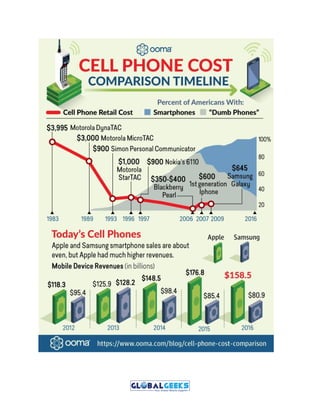
Motorola DynaTAC ($3,995):​ It took a decade after the first
cell phone demonstration for one to become available
commercially. The Motorola DynaTAC hit the market in 1983 with
a hefty price tag of $3,995. By today’s standards, the DynaTAC
was woefully basic — you only had 30 minutes of talk time and
six-hour battery life.
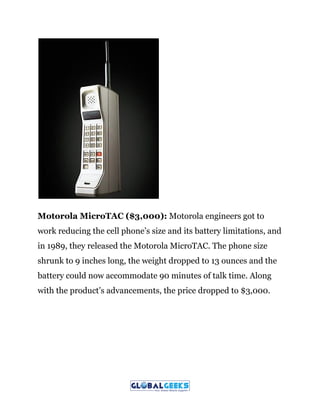
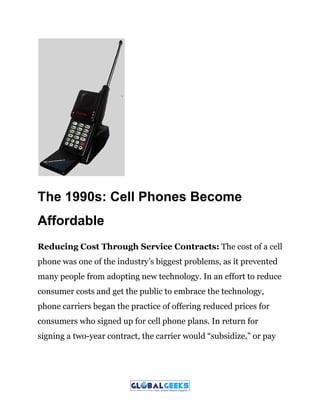
Motorola MicroTAC ($3,000):​ Motorola engineers got to
work reducing the cell phone’s size and its battery limitations, and
in 1989, they released the Motorola MicroTAC. The phone size
shrunk to 9 inches long, the weight dropped to 13 ounces and the
battery could now accommodate 90 minutes of talk time. Along
with the product’s advancements, the price dropped to $3,000.
The 1990s: Cell Phones Become
Affordable
Reducing Cost Through Service Contracts:​ The cost of a cell
phone was one of the industry’s biggest problems, as it prevented
many people from adopting new technology. In an effort to reduce
consumer costs and get the public to embrace the technology,
phone carriers began the practice of offering reduced prices for
consumers who signed up for cell phone plans. In return for
signing a two-year contract, the carrier would “subsidize,” or pay
for, part of the cost of the phone. This was a precursor to today’s
cell phone device deals that come with a service contract.
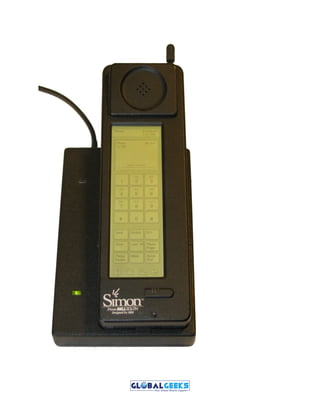
Simon Personal Communicator ($900):​ In 1993, an early
precursor to the modern smartphone debuted. BellSouth and IBM
collaborated on the Simon Personal Communicator, a PDA-like
device that was the first to have a touchscreen interface. It could
send and receive email, which was groundbreaking. It had
autocorrect, fax capability, a calendar, and to-do lists, plus a
sketch pad that could be used with the included stylus. But IBM’s
Simon was ahead of its time and sold fewer than 50,000 devices.
Motorola StarTAC ($1,000):​ Consumers wanted small and
portable cell phones, so in 1996 Motorola released the StarTAC
with a price tag of $1,000. It was 3.1 ounces and not much bigger
than the size of a man’s wallet. It also further pushed the
flip-phone design by having the entire device fold in half like a
clamshell. It used a lithium-ion battery, which shrunk battery size
while accommodating a longer talk time. Also, the StarTAC was
one of the first devices to accommodate text messages or SMS.
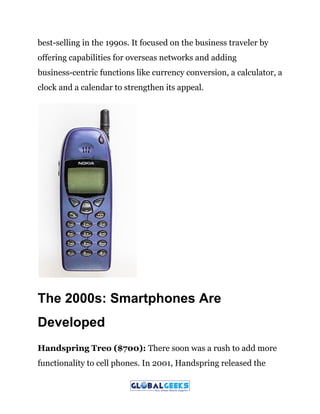
Nokia’s 6110 ($900):​ Released in 1997, the Nokia cost $900
upfront, and its price was $200 when purchased with a cell
service contract. This lower price point made the phone one of the
best-selling in the 1990s. It focused on the business traveler by
offering capabilities for overseas networks and adding
business-centric functions like currency conversion, a calculator, a
clock and a calendar to strengthen its appeal.
The 2000s: Smartphones Are
Developed
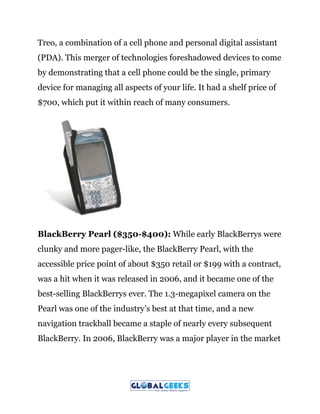
Handspring Treo ($700): ​There soon was a rush to add more
functionality to cell phones. In 2001, Handspring released the
Treo, a combination of a cell phone and personal digital assistant
(PDA). This merger of technologies foreshadowed devices to come
by demonstrating that a cell phone could be the single, primary
device for managing all aspects of your life. It had a shelf price of
$700, which put it within reach of many consumers.
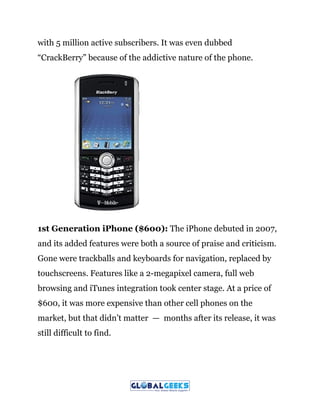
BlackBerry Pearl ($350-$400):​ While early BlackBerrys were
clunky and more pager-like, the BlackBerry Pearl, with the
accessible price point of about $350 retail or $199 with a contract,
was a hit when it was released in 2006, and it became one of the
best-selling BlackBerrys ever. The 1.3-megapixel camera on the
Pearl was one of the industry’s best at that time, and a new
navigation trackball became a staple of nearly every subsequent
BlackBerry. In 2006, BlackBerry was a major player in the market
with 5 million active subscribers. It was even dubbed
“CrackBerry” because of the addictive nature of the phone.
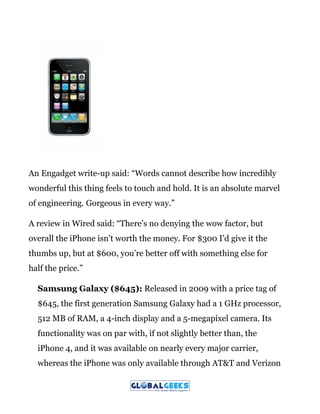
1st Generation iPhone ($600):​ The iPhone debuted in 2007,
and its added features were both a source of praise and criticism.
Gone were trackballs and keyboards for navigation, replaced by
touchscreens. Features like a 2-megapixel camera, full web
browsing and iTunes integration took center stage. At a price of
$600, it was more expensive than other cell phones on the
market, but that didn’t matter — months after its release, it was
still difficult to find.
An Engadget write-up said: “Words cannot describe how incredibly
wonderful this thing feels to touch and hold. It is an absolute marvel
of engineering. Gorgeous in every way.”
A review in Wired said: “There’s no denying the wow factor, but
overall the iPhone isn’t worth the money. For $300 I’d give it the
thumbs up, but at $600, you’re better off with something else for
half the price.”
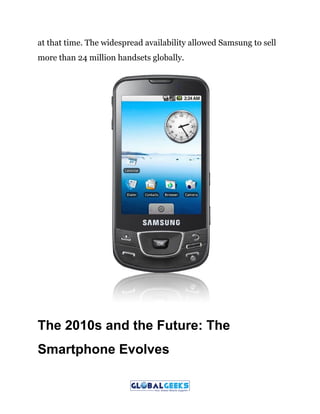
Samsung Galaxy ($645):​ Released in 2009 with a price tag of
$645, the first generation Samsung Galaxy had a 1 GHz processor,
512 MB of RAM, a 4-inch display and a 5-megapixel camera. Its
functionality was on par with, if not slightly better than, the
iPhone 4, and it was available on nearly every major carrier,
whereas the iPhone was only available through AT&T and Verizon
at that time. The widespread availability allowed Samsung to sell
more than 24 million handsets globally.
The 2010s and the Future: The
Smartphone Evolves
In 2013, smartphones overtook “dumb” phones in worldwide
sales. Today, phones are no longer simply devices used to talk to
another person. They are all-inclusive personal computers. They
track the number of steps we take, they connect us to our social
networks and they give us entertainment and games. They
connect us to our office and ​small business phone​ lines using the
Ooma app. And they connect us to our homes with the emergence
of smart-home technology.
Apple vs. Samsung:​ To this day, Apple and Samsung continue
to dominate the market. As of 2017, both companies were
neck-and-neck in terms of unit sales. But Apple was making twice
as much revenue from mobile devices than Samsung. In part, this
is due to Samsung flooding the market with a shocking 31 new
devices in 2016, as compared to Apple’s three new phones in the
same year.
Changing Device Design:​ Looking to the future, we see
modular phones like the Moto Z gaining traction. With these
phones, customers buy the components and can daily add and
subtract parts, almost like LEGOs. We’re also seeing
advancements in phone screens. Predictions include flexible
screens (Apple iWatch, Samsung), curved displays (LG G-Flex,
Samsung Galaxy Round) and self-healing displays (LG G-Flex).
Functionality Advancements:​ We are also seeing medical and
health functionality being added to smartphones. As healthcare
costs continue to rise, the tech industry is looking at ways to both
profit from the health sector and offer consumers low-cost health
solutions. For example, the smartphone Changhong H2 can
measure body fat, and it has a molecular scanner that can tell you
the sweetness of strawberry or confirm the authenticity of the
medication you’re taking.
While the future of smartphones has yet to be written, one thing is
certain: We’ve come a long way from the 2.5-pound cell phone of
three decades ago. In a recent study, 50% of people think
smartphones as we know them will be obsolete in just five years
because we will have innovated beyond what we currently
recognize them to be. Each and every member of family​ ​buy an
iPhone​ or Samsung phone or any other brand as a basic need.
With change happening at such a rapid pace, who knows where
we’ll end up after the next 30 years of innovation.

Cell phone cost comparison timeline

  • 1.
    Cell Phone CostComparison Timeline Ross Vish Aug 22, 2017 The cellular phone has dramatically changed how we communicate, and it has connected us more than ever before. While ​cell phones​ are now must-have devices, they weren’t always as accessible. Previously, their high cost made them more of a status symbol than a standard, everyday tool. So how much did cell phones cost over the years? This cell phone timeline takes you on a tour of the modern cell phone, from that first call ​on a New York City sidewalk in 1973​ to the feature-packed smartphones of today and tomorrow.
  • 3.
    Cell Phone PricesOver the Years 1960s-1980s: Motorola Leads the Industry Early Prototypes:​ Ten years before the first portable cell phone was sold commercially, Motorola was working to find a way to turn military-style radio phones into consumer devices. Its research from the ’60s and ’70s resulted in the first successful demonstration of a handheld mobile phone in 1973. But the phone was huge; it measured 11 inches tall and weighed about 2.5 pounds. Motorola DynaTAC ($3,995):​ It took a decade after the first cell phone demonstration for one to become available commercially. The Motorola DynaTAC hit the market in 1983 with a hefty price tag of $3,995. By today’s standards, the DynaTAC was woefully basic — you only had 30 minutes of talk time and six-hour battery life.
  • 4.
    Motorola MicroTAC ($3,000):​Motorola engineers got to work reducing the cell phone’s size and its battery limitations, and in 1989, they released the Motorola MicroTAC. The phone size shrunk to 9 inches long, the weight dropped to 13 ounces and the battery could now accommodate 90 minutes of talk time. Along with the product’s advancements, the price dropped to $3,000.
  • 5.
    The 1990s: CellPhones Become Affordable Reducing Cost Through Service Contracts:​ The cost of a cell phone was one of the industry’s biggest problems, as it prevented many people from adopting new technology. In an effort to reduce consumer costs and get the public to embrace the technology, phone carriers began the practice of offering reduced prices for consumers who signed up for cell phone plans. In return for signing a two-year contract, the carrier would “subsidize,” or pay
  • 6.
    for, part ofthe cost of the phone. This was a precursor to today’s cell phone device deals that come with a service contract. Simon Personal Communicator ($900):​ In 1993, an early precursor to the modern smartphone debuted. BellSouth and IBM collaborated on the Simon Personal Communicator, a PDA-like device that was the first to have a touchscreen interface. It could send and receive email, which was groundbreaking. It had autocorrect, fax capability, a calendar, and to-do lists, plus a sketch pad that could be used with the included stylus. But IBM’s Simon was ahead of its time and sold fewer than 50,000 devices.
  • 8.
    Motorola StarTAC ($1,000):​Consumers wanted small and portable cell phones, so in 1996 Motorola released the StarTAC with a price tag of $1,000. It was 3.1 ounces and not much bigger than the size of a man’s wallet. It also further pushed the flip-phone design by having the entire device fold in half like a clamshell. It used a lithium-ion battery, which shrunk battery size while accommodating a longer talk time. Also, the StarTAC was one of the first devices to accommodate text messages or SMS. Nokia’s 6110 ($900):​ Released in 1997, the Nokia cost $900 upfront, and its price was $200 when purchased with a cell service contract. This lower price point made the phone one of the
  • 9.
    best-selling in the1990s. It focused on the business traveler by offering capabilities for overseas networks and adding business-centric functions like currency conversion, a calculator, a clock and a calendar to strengthen its appeal. The 2000s: Smartphones Are Developed Handspring Treo ($700): ​There soon was a rush to add more functionality to cell phones. In 2001, Handspring released the
  • 10.
    Treo, a combinationof a cell phone and personal digital assistant (PDA). This merger of technologies foreshadowed devices to come by demonstrating that a cell phone could be the single, primary device for managing all aspects of your life. It had a shelf price of $700, which put it within reach of many consumers. BlackBerry Pearl ($350-$400):​ While early BlackBerrys were clunky and more pager-like, the BlackBerry Pearl, with the accessible price point of about $350 retail or $199 with a contract, was a hit when it was released in 2006, and it became one of the best-selling BlackBerrys ever. The 1.3-megapixel camera on the Pearl was one of the industry’s best at that time, and a new navigation trackball became a staple of nearly every subsequent BlackBerry. In 2006, BlackBerry was a major player in the market
  • 11.
    with 5 millionactive subscribers. It was even dubbed “CrackBerry” because of the addictive nature of the phone. 1st Generation iPhone ($600):​ The iPhone debuted in 2007, and its added features were both a source of praise and criticism. Gone were trackballs and keyboards for navigation, replaced by touchscreens. Features like a 2-megapixel camera, full web browsing and iTunes integration took center stage. At a price of $600, it was more expensive than other cell phones on the market, but that didn’t matter — months after its release, it was still difficult to find.
  • 12.
    An Engadget write-upsaid: “Words cannot describe how incredibly wonderful this thing feels to touch and hold. It is an absolute marvel of engineering. Gorgeous in every way.” A review in Wired said: “There’s no denying the wow factor, but overall the iPhone isn’t worth the money. For $300 I’d give it the thumbs up, but at $600, you’re better off with something else for half the price.” Samsung Galaxy ($645):​ Released in 2009 with a price tag of $645, the first generation Samsung Galaxy had a 1 GHz processor, 512 MB of RAM, a 4-inch display and a 5-megapixel camera. Its functionality was on par with, if not slightly better than, the iPhone 4, and it was available on nearly every major carrier, whereas the iPhone was only available through AT&T and Verizon
  • 13.
    at that time.The widespread availability allowed Samsung to sell more than 24 million handsets globally. The 2010s and the Future: The Smartphone Evolves
  • 14.
    In 2013, smartphonesovertook “dumb” phones in worldwide sales. Today, phones are no longer simply devices used to talk to another person. They are all-inclusive personal computers. They track the number of steps we take, they connect us to our social networks and they give us entertainment and games. They connect us to our office and ​small business phone​ lines using the Ooma app. And they connect us to our homes with the emergence of smart-home technology. Apple vs. Samsung:​ To this day, Apple and Samsung continue to dominate the market. As of 2017, both companies were neck-and-neck in terms of unit sales. But Apple was making twice as much revenue from mobile devices than Samsung. In part, this is due to Samsung flooding the market with a shocking 31 new devices in 2016, as compared to Apple’s three new phones in the same year. Changing Device Design:​ Looking to the future, we see modular phones like the Moto Z gaining traction. With these phones, customers buy the components and can daily add and subtract parts, almost like LEGOs. We’re also seeing advancements in phone screens. Predictions include flexible
  • 15.
    screens (Apple iWatch,Samsung), curved displays (LG G-Flex, Samsung Galaxy Round) and self-healing displays (LG G-Flex). Functionality Advancements:​ We are also seeing medical and health functionality being added to smartphones. As healthcare costs continue to rise, the tech industry is looking at ways to both profit from the health sector and offer consumers low-cost health solutions. For example, the smartphone Changhong H2 can measure body fat, and it has a molecular scanner that can tell you the sweetness of strawberry or confirm the authenticity of the medication you’re taking. While the future of smartphones has yet to be written, one thing is certain: We’ve come a long way from the 2.5-pound cell phone of three decades ago. In a recent study, 50% of people think smartphones as we know them will be obsolete in just five years because we will have innovated beyond what we currently recognize them to be. Each and every member of family​ ​buy an iPhone​ or Samsung phone or any other brand as a basic need. With change happening at such a rapid pace, who knows where we’ll end up after the next 30 years of innovation.