www.chinaeconomicindicator
中国港口发展报告 China Ports Development Report 2011 2
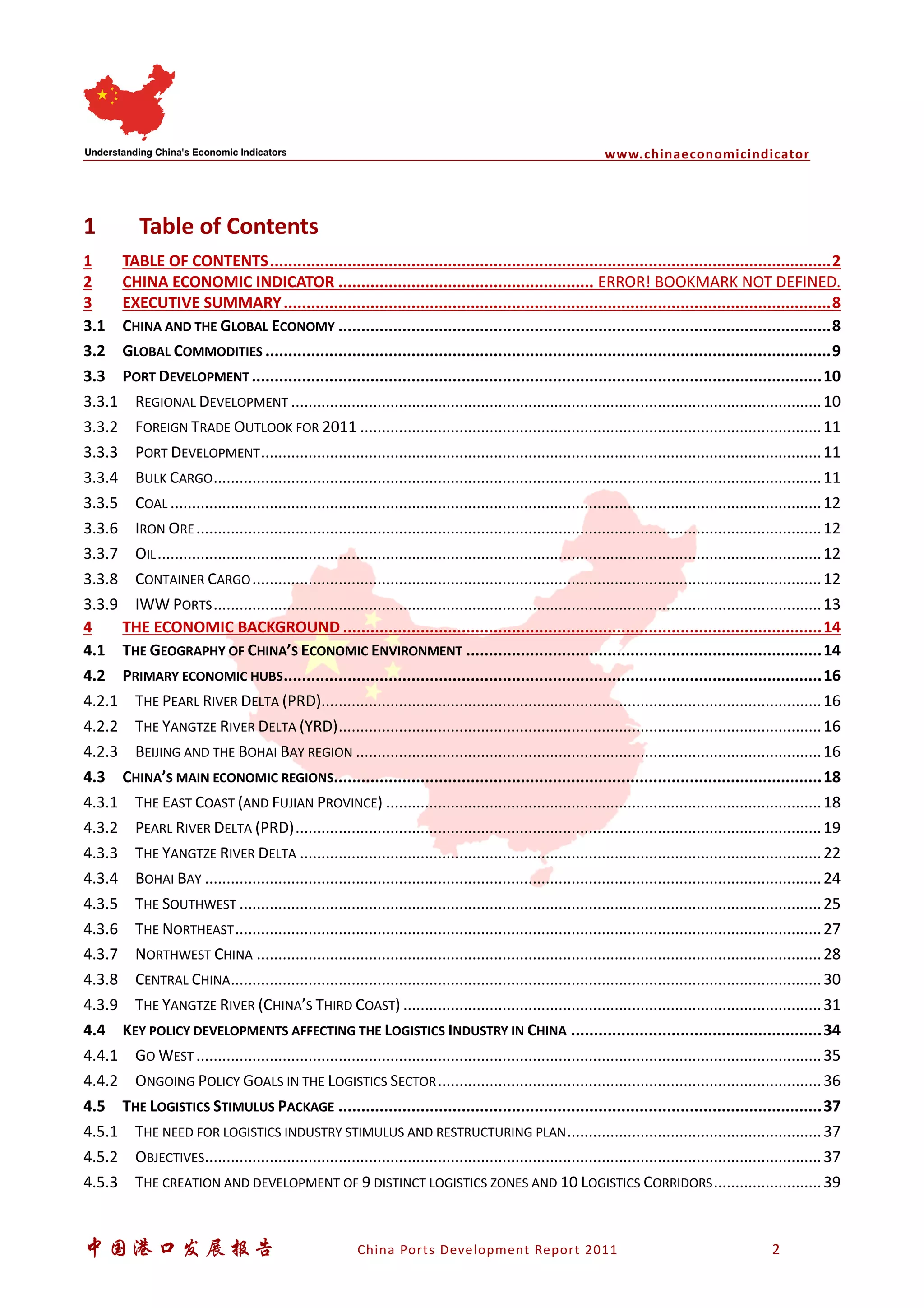
1 Table of Contents
1 TABLE OF CONTENTS...........................................................................................................................2
2 CHINA ECONOMIC INDICATOR ........................................................ ERROR! BOOKMARK NOT DEFINED.
3 EXECUTIVE SUMMARY........................................................................................................................8
3.1 CHINA AND THE GLOBAL ECONOMY ............................................................................................................8
3.2 GLOBAL COMMODITIES ............................................................................................................................9
3.3 PORT DEVELOPMENT .............................................................................................................................10
3.3.1 REGIONAL DEVELOPMENT ...........................................................................................................................10
3.3.2 FOREIGN TRADE OUTLOOK FOR 2011 ...........................................................................................................11
3.3.3 PORT DEVELOPMENT..................................................................................................................................11
3.3.4 BULK CARGO.............................................................................................................................................11
3.3.5 COAL .......................................................................................................................................................12
3.3.6 IRON ORE.................................................................................................................................................12
3.3.7 OIL..........................................................................................................................................................12
3.3.8 CONTAINER CARGO....................................................................................................................................12
3.3.9 IWW PORTS.............................................................................................................................................13
4 THE ECONOMIC BACKGROUND .........................................................................................................14
4.1 THE GEOGRAPHY OF CHINA’S ECONOMIC ENVIRONMENT ..............................................................................14
4.2 PRIMARY ECONOMIC HUBS......................................................................................................................16
4.2.1 THE PEARL RIVER DELTA (PRD)....................................................................................................................16
4.2.2 THE YANGTZE RIVER DELTA (YRD)................................................................................................................16
4.2.3 BEIJING AND THE BOHAI BAY REGION ............................................................................................................16
4.3 CHINA’S MAIN ECONOMIC REGIONS...........................................................................................................18
4.3.1 THE EAST COAST (AND FUJIAN PROVINCE) .....................................................................................................18
4.3.2 PEARL RIVER DELTA (PRD)..........................................................................................................................19
4.3.3 THE YANGTZE RIVER DELTA .........................................................................................................................22
4.3.4 BOHAI BAY ...............................................................................................................................................24
4.3.5 THE SOUTHWEST .......................................................................................................................................25
4.3.6 THE NORTHEAST........................................................................................................................................27
4.3.7 NORTHWEST CHINA ...................................................................................................................................28
4.3.8 CENTRAL CHINA.........................................................................................................................................30
4.3.9 THE YANGTZE RIVER (CHINA’S THIRD COAST) .................................................................................................31
4.4 KEY POLICY DEVELOPMENTS AFFECTING THE LOGISTICS INDUSTRY IN CHINA .......................................................34
4.4.1 GO WEST .................................................................................................................................................35
4.4.2 ONGOING POLICY GOALS IN THE LOGISTICS SECTOR.........................................................................................36
4.5 THE LOGISTICS STIMULUS PACKAGE ..........................................................................................................37
4.5.1 THE NEED FOR LOGISTICS INDUSTRY STIMULUS AND RESTRUCTURING PLAN...........................................................37
4.5.2 OBJECTIVES...............................................................................................................................................37
4.5.3 THE CREATION AND DEVELOPMENT OF 9 DISTINCT LOGISTICS ZONES AND 10 LOGISTICS CORRIDORS.........................39
www.chinaeconomicindicator
中国港口发展报告 China Ports Development Report 2011 3
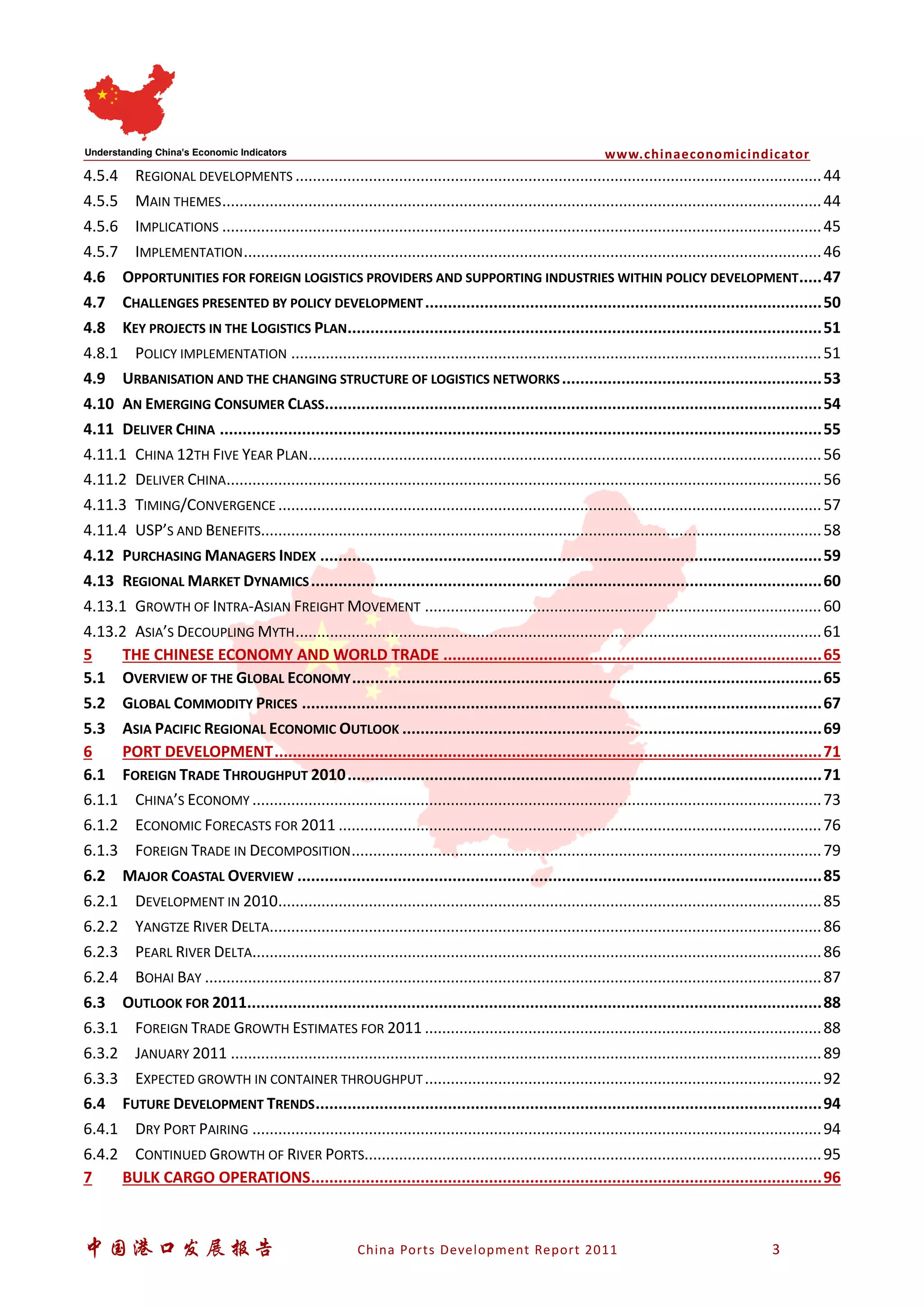
4.5.4 REGIONAL DEVELOPMENTS ..........................................................................................................................44
4.5.5 MAIN THEMES...........................................................................................................................................44
4.5.6 IMPLICATIONS ...........................................................................................................................................45
4.5.7 IMPLEMENTATION......................................................................................................................................46
4.6 OPPORTUNITIES FOR FOREIGN LOGISTICS PROVIDERS AND SUPPORTING INDUSTRIES WITHIN POLICY DEVELOPMENT.....47
4.7 CHALLENGES PRESENTED BY POLICY DEVELOPMENT.......................................................................................50
4.8 KEY PROJECTS IN THE LOGISTICS PLAN........................................................................................................51
4.8.1 POLICY IMPLEMENTATION ...........................................................................................................................51
4.9 URBANISATION AND THE CHANGING STRUCTURE OF LOGISTICS NETWORKS.........................................................53
4.10 AN EMERGING CONSUMER CLASS.............................................................................................................54
4.11 DELIVER CHINA ....................................................................................................................................55
4.11.1 CHINA 12TH FIVE YEAR PLAN.......................................................................................................................56
4.11.2 DELIVER CHINA..........................................................................................................................................56
4.11.3 TIMING/CONVERGENCE ..............................................................................................................................57
4.11.4 USP’S AND BENEFITS..................................................................................................................................58
4.12 PURCHASING MANAGERS INDEX ..............................................................................................................59
4.13 REGIONAL MARKET DYNAMICS................................................................................................................60
4.13.1 GROWTH OF INTRA-ASIAN FREIGHT MOVEMENT ............................................................................................60
4.13.2 ASIA’S DECOUPLING MYTH..........................................................................................................................61
5 THE CHINESE ECONOMY AND WORLD TRADE ...................................................................................65
5.1 OVERVIEW OF THE GLOBAL ECONOMY.......................................................................................................65
5.2 GLOBAL COMMODITY PRICES ..................................................................................................................67
5.3 ASIA PACIFIC REGIONAL ECONOMIC OUTLOOK ............................................................................................69
6 PORT DEVELOPMENT........................................................................................................................71
6.1 FOREIGN TRADE THROUGHPUT 2010........................................................................................................71
6.1.1 CHINA’S ECONOMY ....................................................................................................................................73
6.1.2 ECONOMIC FORECASTS FOR 2011 ................................................................................................................76
6.1.3 FOREIGN TRADE IN DECOMPOSITION.............................................................................................................79
6.2 MAJOR COASTAL OVERVIEW ...................................................................................................................85
6.2.1 DEVELOPMENT IN 2010..............................................................................................................................85
6.2.2 YANGTZE RIVER DELTA................................................................................................................................86
6.2.3 PEARL RIVER DELTA....................................................................................................................................86
6.2.4 BOHAI BAY ...............................................................................................................................................87
6.3 OUTLOOK FOR 2011..............................................................................................................................88
6.3.1 FOREIGN TRADE GROWTH ESTIMATES FOR 2011 ............................................................................................88
6.3.2 JANUARY 2011 .........................................................................................................................................89
6.3.3 EXPECTED GROWTH IN CONTAINER THROUGHPUT............................................................................................92
6.4 FUTURE DEVELOPMENT TRENDS...............................................................................................................94
6.4.1 DRY PORT PAIRING ....................................................................................................................................94
6.4.2 CONTINUED GROWTH OF RIVER PORTS..........................................................................................................95
7 BULK CARGO OPERATIONS................................................................................................................96
www.chinaeconomicindicator
中国港口发展报告 China Ports Development Report 2011 4
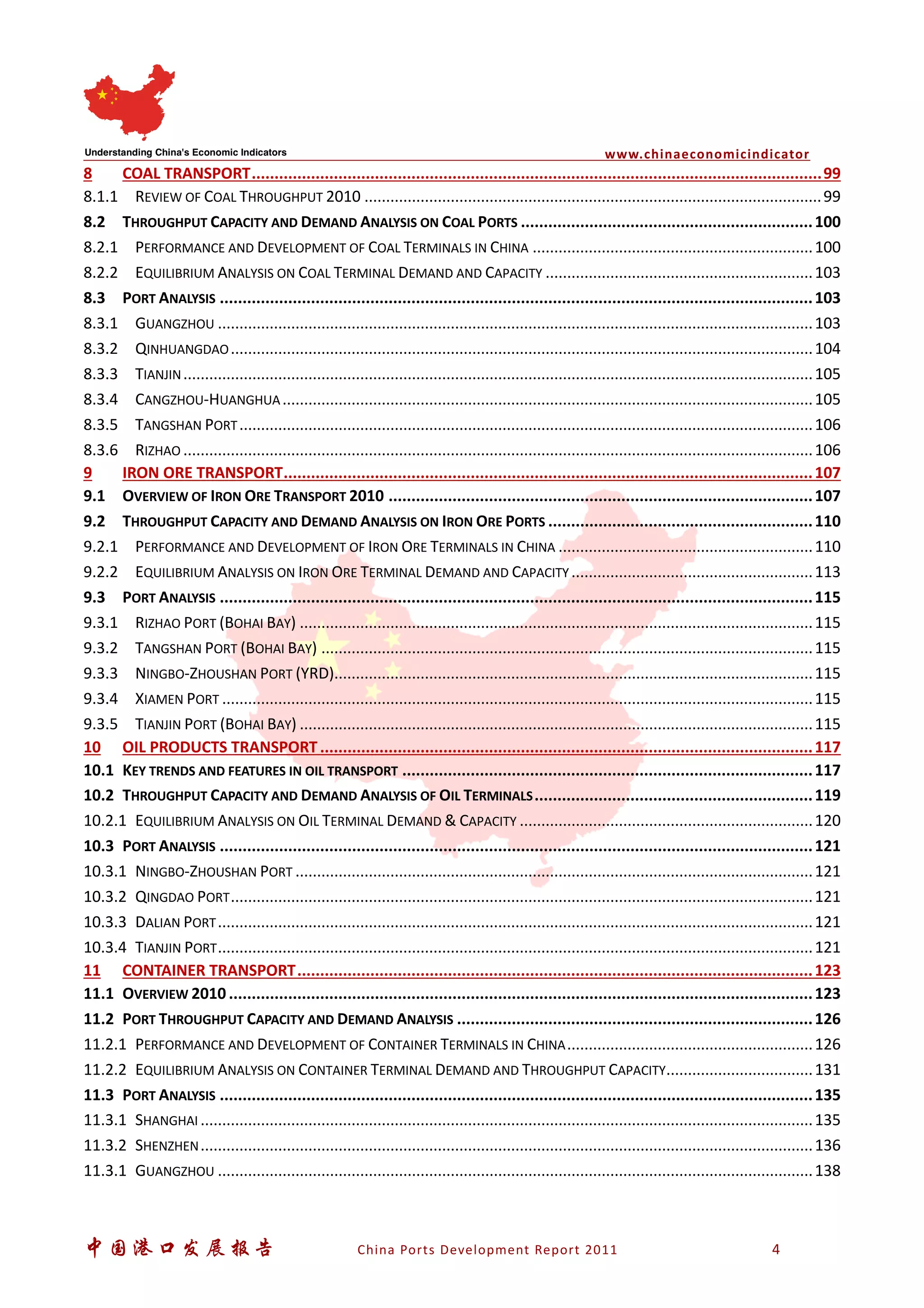
8 COAL TRANSPORT.............................................................................................................................99
8.1.1 REVIEW OF COAL THROUGHPUT 2010 ..........................................................................................................99
8.2 THROUGHPUT CAPACITY AND DEMAND ANALYSIS ON COAL PORTS ................................................................100
8.2.1 PERFORMANCE AND DEVELOPMENT OF COAL TERMINALS IN CHINA .................................................................100
8.2.2 EQUILIBRIUM ANALYSIS ON COAL TERMINAL DEMAND AND CAPACITY ..............................................................103
8.3 PORT ANALYSIS ..................................................................................................................................103
8.3.1 GUANGZHOU ..........................................................................................................................................103
8.3.2 QINHUANGDAO.......................................................................................................................................104
8.3.3 TIANJIN..................................................................................................................................................105
8.3.4 CANGZHOU-HUANGHUA...........................................................................................................................105
8.3.5 TANGSHAN PORT.....................................................................................................................................106
8.3.6 RIZHAO ..................................................................................................................................................106
9 IRON ORE TRANSPORT....................................................................................................................107
9.1 OVERVIEW OF IRON ORE TRANSPORT 2010 .............................................................................................107
9.2 THROUGHPUT CAPACITY AND DEMAND ANALYSIS ON IRON ORE PORTS ..........................................................110
9.2.1 PERFORMANCE AND DEVELOPMENT OF IRON ORE TERMINALS IN CHINA ...........................................................110
9.2.2 EQUILIBRIUM ANALYSIS ON IRON ORE TERMINAL DEMAND AND CAPACITY ........................................................113
9.3 PORT ANALYSIS ..................................................................................................................................115
9.3.1 RIZHAO PORT (BOHAI BAY) .......................................................................................................................115
9.3.2 TANGSHAN PORT (BOHAI BAY) ..................................................................................................................115
9.3.3 NINGBO-ZHOUSHAN PORT (YRD)...............................................................................................................115
9.3.4 XIAMEN PORT .........................................................................................................................................115
9.3.5 TIANJIN PORT (BOHAI BAY) .......................................................................................................................115
10 OIL PRODUCTS TRANSPORT............................................................................................................117
10.1 KEY TRENDS AND FEATURES IN OIL TRANSPORT ..........................................................................................117
10.2 THROUGHPUT CAPACITY AND DEMAND ANALYSIS OF OIL TERMINALS.............................................................119
10.2.1 EQUILIBRIUM ANALYSIS ON OIL TERMINAL DEMAND & CAPACITY ....................................................................120
10.3 PORT ANALYSIS ..................................................................................................................................121
10.3.1 NINGBO-ZHOUSHAN PORT ........................................................................................................................121
10.3.2 QINGDAO PORT.......................................................................................................................................121
10.3.3 DALIAN PORT..........................................................................................................................................121
10.3.4 TIANJIN PORT..........................................................................................................................................121
11 CONTAINER TRANSPORT.................................................................................................................123
11.1 OVERVIEW 2010 ................................................................................................................................123
11.2 PORT THROUGHPUT CAPACITY AND DEMAND ANALYSIS ..............................................................................126
11.2.1 PERFORMANCE AND DEVELOPMENT OF CONTAINER TERMINALS IN CHINA.........................................................126
11.2.2 EQUILIBRIUM ANALYSIS ON CONTAINER TERMINAL DEMAND AND THROUGHPUT CAPACITY..................................131
11.3 PORT ANALYSIS ..................................................................................................................................135
11.3.1 SHANGHAI ..............................................................................................................................................135
11.3.2 SHENZHEN..............................................................................................................................................136
11.3.1 GUANGZHOU ..........................................................................................................................................138
www.chinaeconomicindicator
中国港口发展报告 China Ports Development Report 2011 5
11.3.2 QINGDAO...............................................................................................................................................140
11.3.3 NINGBO-ZHOUSHAN ................................................................................................................................141
11.3.4 TIANJIN PORT..........................................................................................................................................143
11.3.5 XIAMEN PORT .........................................................................................................................................144
11.3.6 DALIAN PORT..........................................................................................................................................146
11.3.7 LIANYUNGANG PORT ................................................................................................................................146
11.3.8 SUZHOU PORT.........................................................................................................................................147
11.3.9 YINGKOU PORT........................................................................................................................................147
11.3.10 YANTAI PORT ......................................................................................................................................147
11.3.11 QUANZHOU PORT................................................................................................................................147
11.3.12 FUZHOU PORT.....................................................................................................................................148
11.3.13 ZHONGSHAN PORT...............................................................................................................................148
12 INLAND PORTS................................................................................................................................149
12.1 INTRODUCTION ..................................................................................................................................149
12.2 CONTENT OF THE NATIONAL PLAN FOR INLAND WATERWAYS AND PORTS........................................................149
12.2.1 A PORT NETWORK OF 28 MAJOR INLAND PORTS ............................................................................................150
12.3 PERFORMANCE OF INLAND PORTS 2010..................................................................................................151
12.4 YANGTZE RIVER..................................................................................................................................153
12.4.1 YANGTZE RIVER OVERVIEW .......................................................................................................................153
12.4.2 REVIEW OF 2010.....................................................................................................................................154
12.4.3 OUTLOOK FOR 2011 ................................................................................................................................157
12.4.4 YANGTZE RIVER MAJOR PORTS ..................................................................................................................158
12.5 PEARL RIVER WATERS..........................................................................................................................167
12.5.1 MAJOR PORTS IN THE REGION....................................................................................................................167
12.5.2 REGIONAL PORT PERFORMANCE.................................................................................................................168
12.6 THE BEIJING-HANGZHOU GRAND CANAL AND HUAIHE RIVER WATERS ...........................................................171
12.6.1 MAJOR PORTS IN THE REGION....................................................................................................................171
12.6.2 REGIONAL PORT PERFORMANCE.................................................................................................................171
12.7 THE HEILONGJIANG RIVER AND SONG-LIAO WATERS ..................................................................................174
12.7.1 MAJOR PORTS IN THE REGION....................................................................................................................174
12.7.2 REGIONAL PORT PERFORMANCE AND FUTURE PLANS.....................................................................................174
13 PORT DEVELOPMENTS....................................................................................................................176
13.1 INFRASTRUCTURE OVERVIEW.................................................................................................................176
13.2 STRUCTURE OF PORT INVESTMENT ..........................................................................................................178
13.3 OVERVIEW OF PORT DEVELOPMENT.........................................................................................................179
13.3.1 ATTEMPTS TO RATIONALISE THE PATTERN OF TERMINALS IN PORT REGIONS ......................................................179
13.3.2 CONSTRUCTION OF CONTAINER TERMINALS .................................................................................................179
13.3.3 COAL TERMINAL CONSTRUCTION................................................................................................................180
13.3.4 CRUDE OIL TERMINAL CONSTRUCTION ........................................................................................................181
13.3.5 IRON ORE TERMINALS...............................................................................................................................182
13.3.6 BULK TERMINAL PROJECTS ........................................................................................................................183
www.chinaeconomicindicator
中国港口发展报告 China Ports Development Report 2011 6
13.3.7 MULTI-PURPOSE TERMINALS.....................................................................................................................183
13.3.8 LIQUID CHEMICAL TERMINALS....................................................................................................................184
13.3.9 CONSTRUCTION OF EMERGING TRANSPORT SYSTEM TERMINALS......................................................................184
13.3.10 ADDITIONAL MISCELLANEOUS PORT PROJECTS ...................................................................................186
13.3.11 DEVELOPMENT OF INLAND PORTS 2009............................................................................................187
14 APPENDIX.......................................................................................................................................189
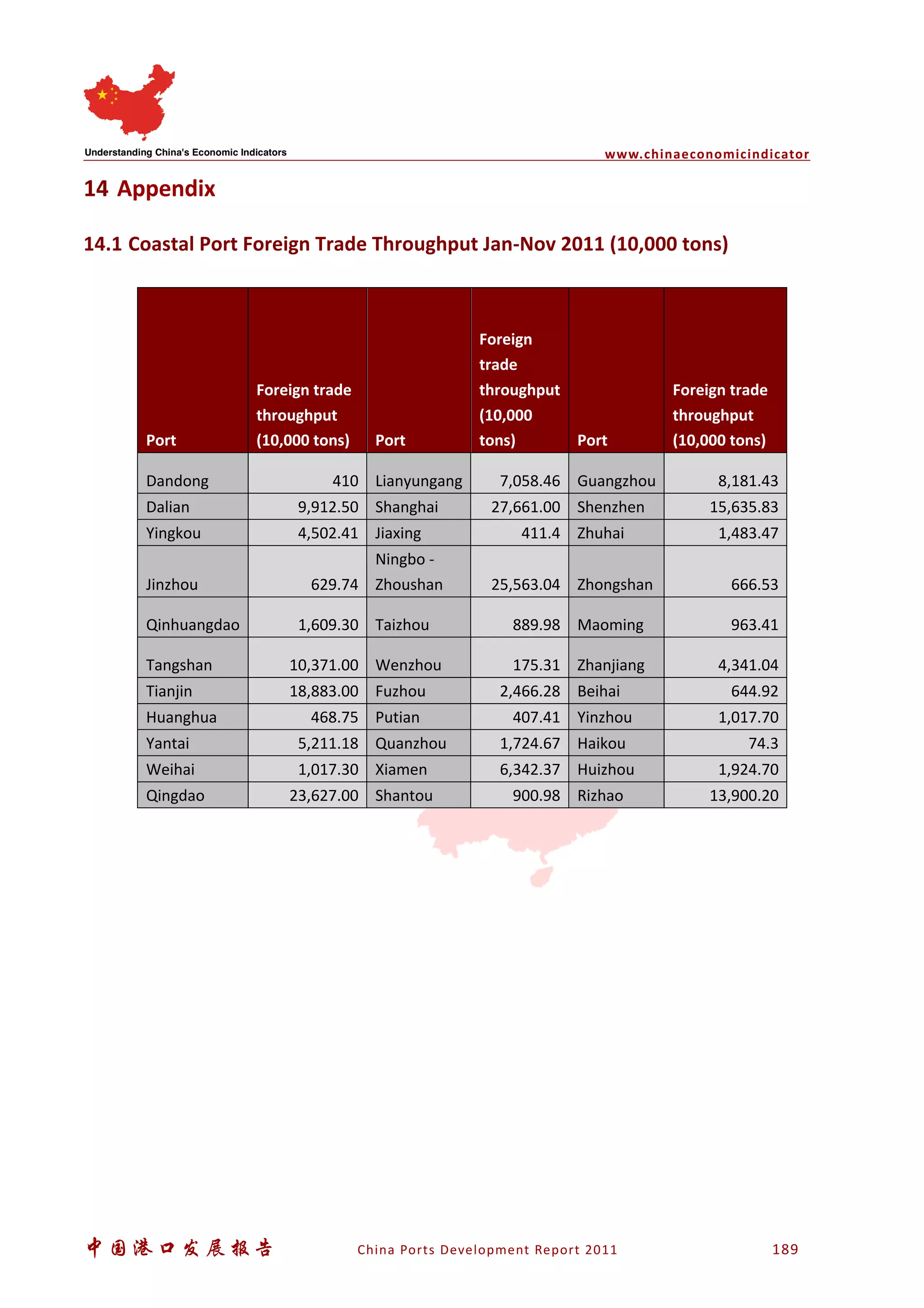
14.1 COASTAL PORT FOREIGN TRADE THROUGHPUT JAN-NOV 2011 (10,000 TONS) ...............................................189
14.2 YANGTZE RIVER MAINLINE PORT THROUGHPUTS JAN-NOV 2010 .................................................................190
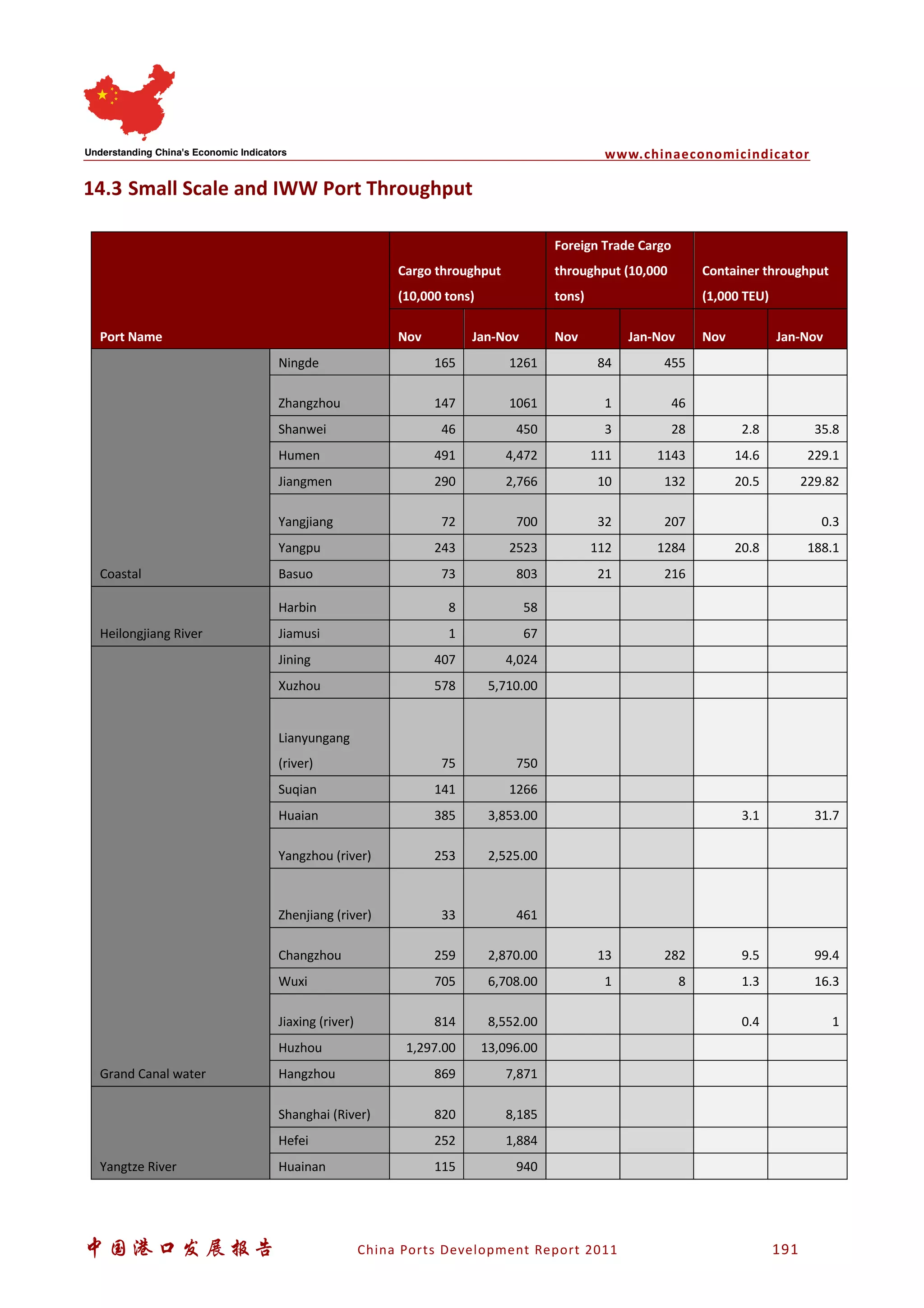
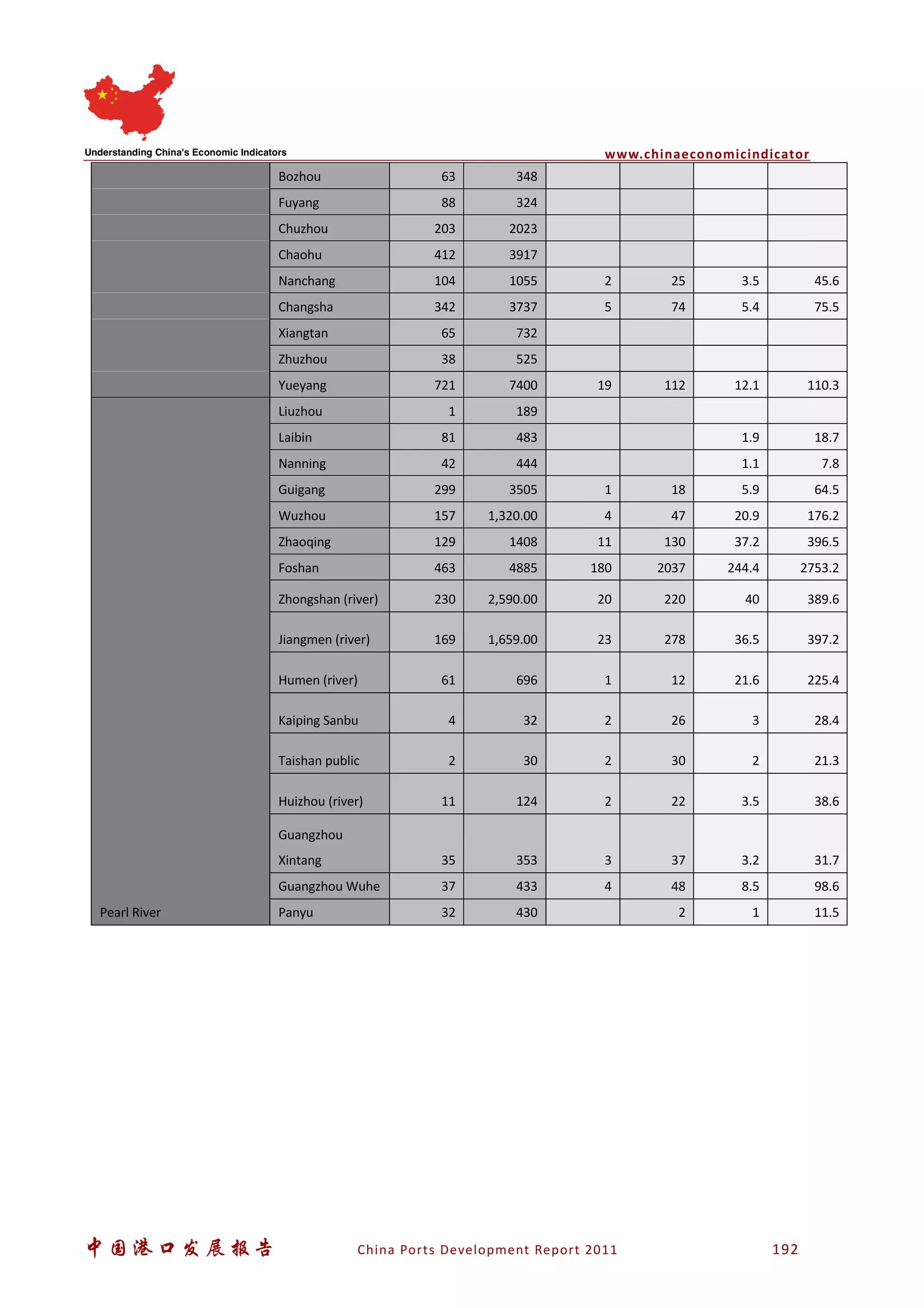
14.3 SMALL SCALE AND IWW PORT THROUGHPUT...........................................................................................191
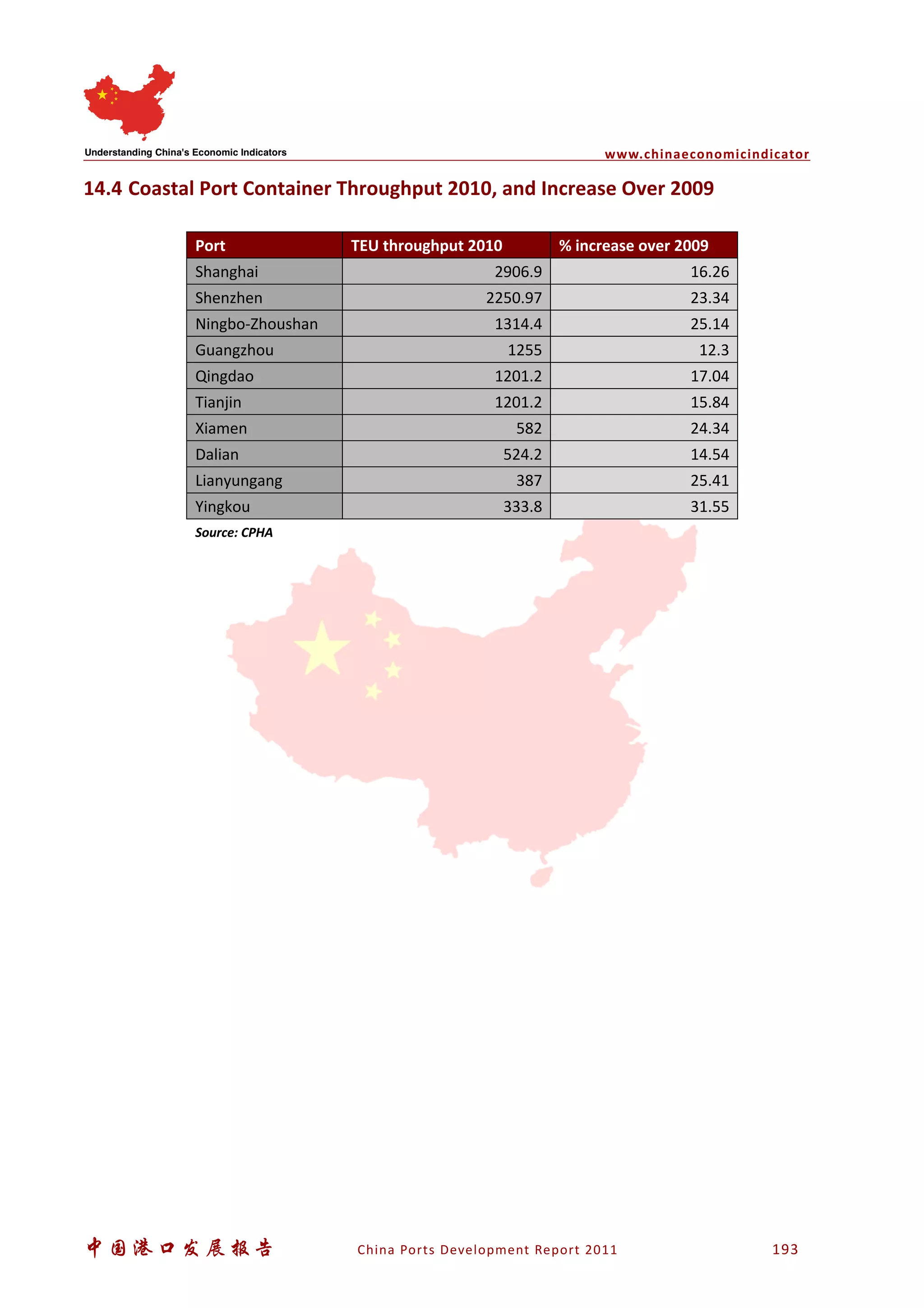
14.4 COASTAL PORT CONTAINER THROUGHPUT 2010, AND INCREASE OVER 2009 ..................................................193
14.5 COASTAL PORT CONTAINER THROUGHPUT 2006-10...................................................................................194
14.6 COASTAL PORT THROUGHPUT JANUARY 2011...........................................................................................195
14.7 IWW PORT THROUGHPUT JANUARY 2011...............................................................................................196
14.8 COASTAL PORT CONTAINER THROUGHPUT (10,000 TEU) JANUARY 2011 ......................................................196
14.9 FOREIGN TRADE THROUGHPUT COASTAL PORTS JANUARY 2011 ...................................................................197
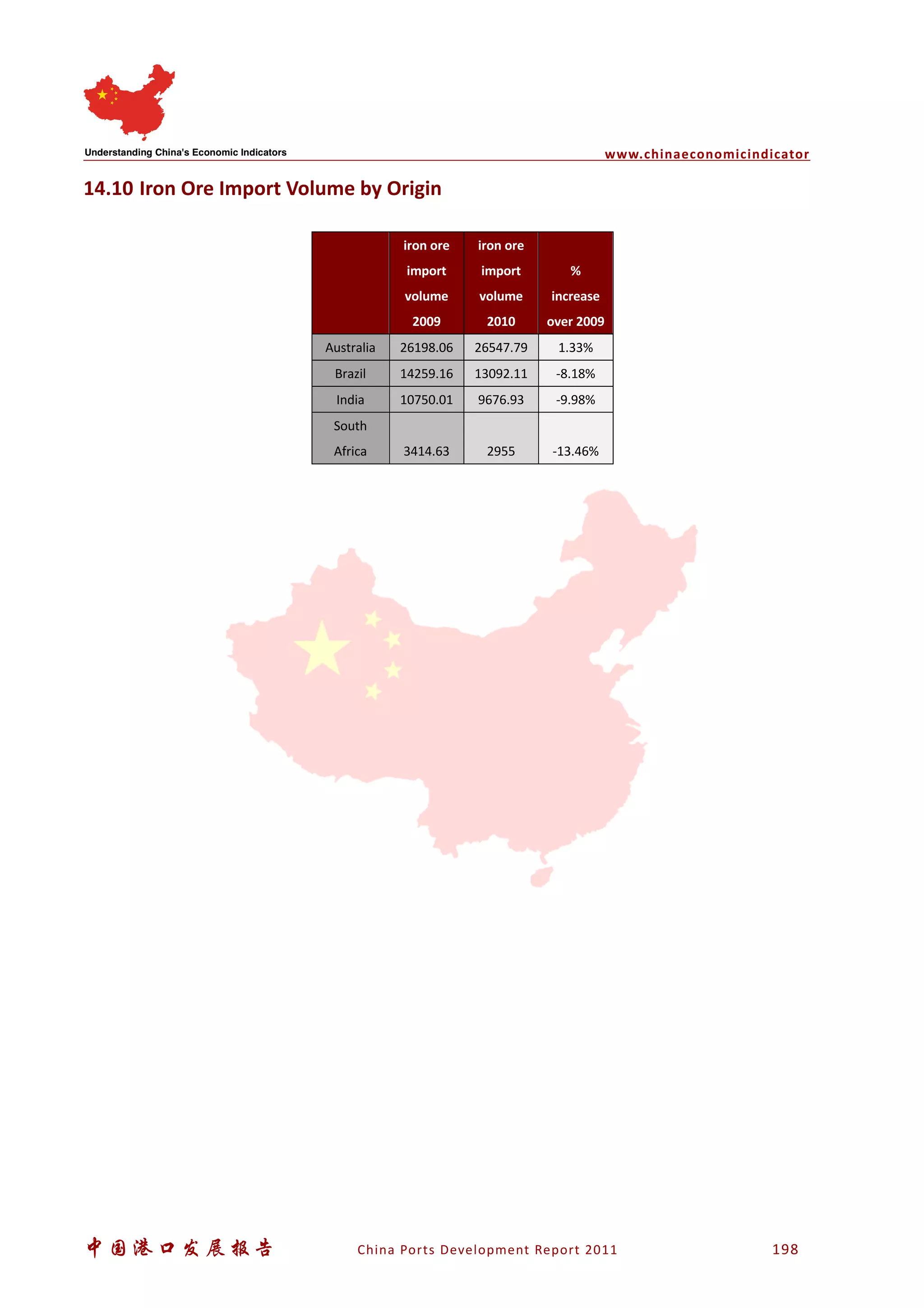
14.10 IRON ORE IMPORT VOLUME BY ORIGIN................................................................................................198
15 DISCLAIMER....................................................................................................................................199
www.chinaeconomicindicator
中国港口发展报告 China Ports Development Report 2011 7
2 China Economic Indicator
China Economic Indicator gathers business intelligence and provides analysis as well as general business
services for international organisations working or interested in the Greater China and East Asia markets.
Business services include company establishment, customised research, sales and marketing, and client
representation.
Our researchers and analysts collectively have decades of experience on the ground in Mainland China,
both living and working; not just in the developed east, but throughout the vast hinterland that represents
the real opportunities in the coming decades.
In addition, all of our researchers and analysts, Western and Chinese, are fluent and literate in both
Mandarin Chinese and English.
China Economic Indicator can help you understand the most dynamic and challenging market in the world
as well as provide strategic, on the ground practical assistance in entering the market either through
translation, relationship building, company incorporation, market research, or sales and marketing.
Previous clients have included the Terminal Operators Conference (TOC), Transport Intelligence, Airline
Cargo Management, Informa publications such as Cargo Systems and International Freight Weekly, China
Federation of Logistics and Purchasing (CFLP) and the China Ports and Harbours Association, among
others.
For more information contact info@chinaintelligenceonline.com
Or visit us online at www.chinaeconomicindicator
Follow us on Twitter at @sintelligence
www.chinaeconomicindicator
中国港口发展报告 China Ports Development Report 2011 8
3 Executive Summary
3.1 China and the Global Economy
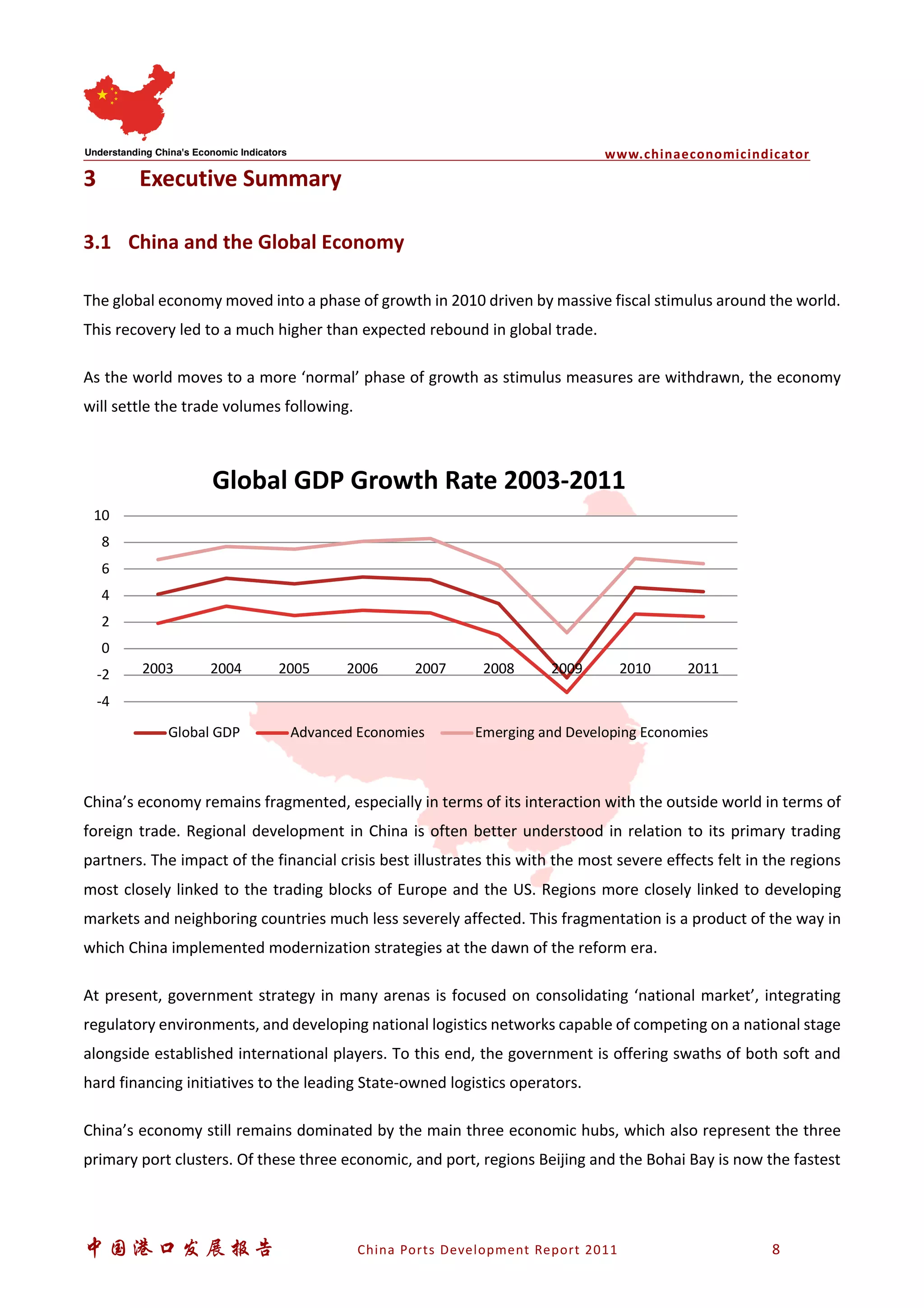
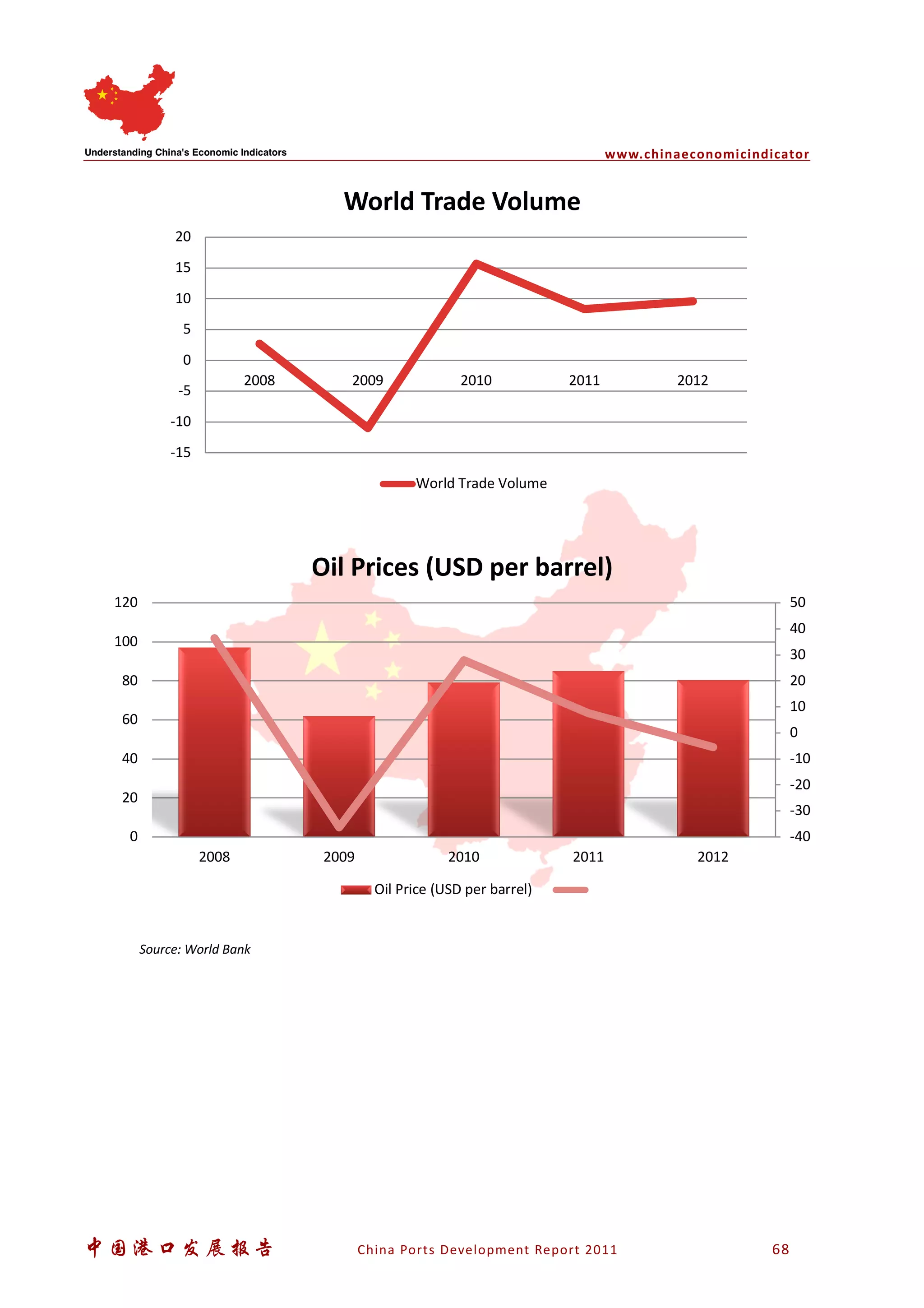
The global economy moved into a phase of growth in 2010 driven by massive fiscal stimulus around the world.
This recovery led to a much higher than expected rebound in global trade.
As the world moves to a more ‘normal’ phase of growth as stimulus measures are withdrawn, the economy
will settle the trade volumes following.
China’s economy remains fragmented, especially in terms of its interaction with the outside world in terms of
foreign trade. Regional development in China is often better understood in relation to its primary trading
partners. The impact of the financial crisis best illustrates this with the most severe effects felt in the regions
most closely linked to the trading blocks of Europe and the US. Regions more closely linked to developing
markets and neighboring countries much less severely affected. This fragmentation is a product of the way in
which China implemented modernization strategies at the dawn of the reform era.
At present, government strategy in many arenas is focused on consolidating ‘national market’, integrating
regulatory environments, and developing national logistics networks capable of competing on a national stage
alongside established international players. To this end, the government is offering swaths of both soft and
hard financing initiatives to the leading State-owned logistics operators.
China’s economy still remains dominated by the main three economic hubs, which also represent the three
primary port clusters. Of these three economic, and port, regions Beijing and the Bohai Bay is now the fastest
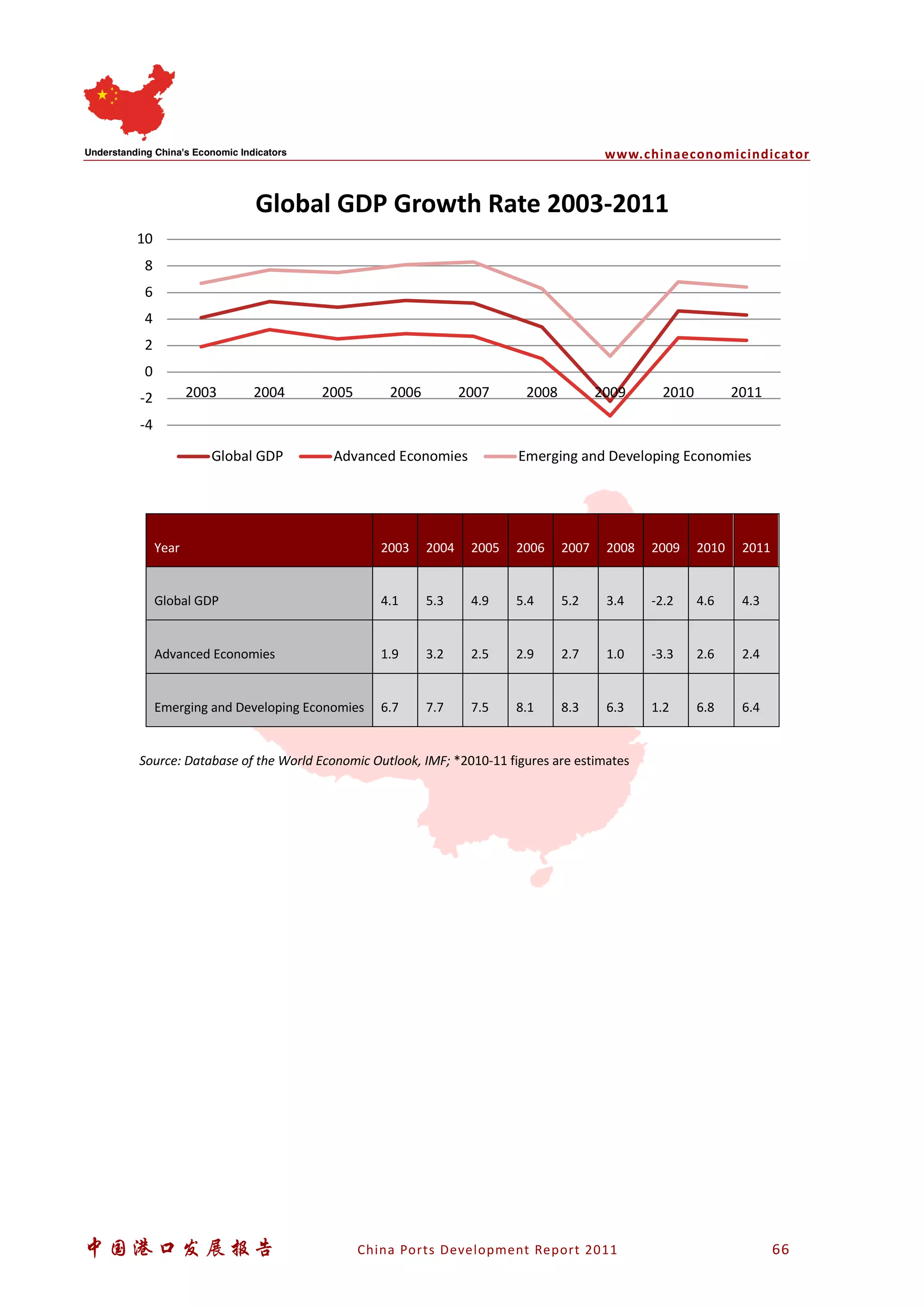
-4
-2
0
2
4
6
8
10
2003 2004 2005 2006 2007 2008 2009 2010 2011
Global GDP Growth Rate 2003-2011
Global GDP Advanced Economies Emerging and Developing Economies
www.chinaeconomicindicator
中国港口发展报告 China Ports Development Report 2011 9
growing in both throughput and GDP. This said, river traffic growth outstripped coastal growth indicating a
rise in transfer traffic as industry relocates further toward the hinterland in line with the ‘Go-West’ strategy
and rising disposable incomes inland.
In 2010, China’s economy continued to grow impressively. In part buoyed by massive domestic stimulus
spending; in part by a nascent global economic recovery.
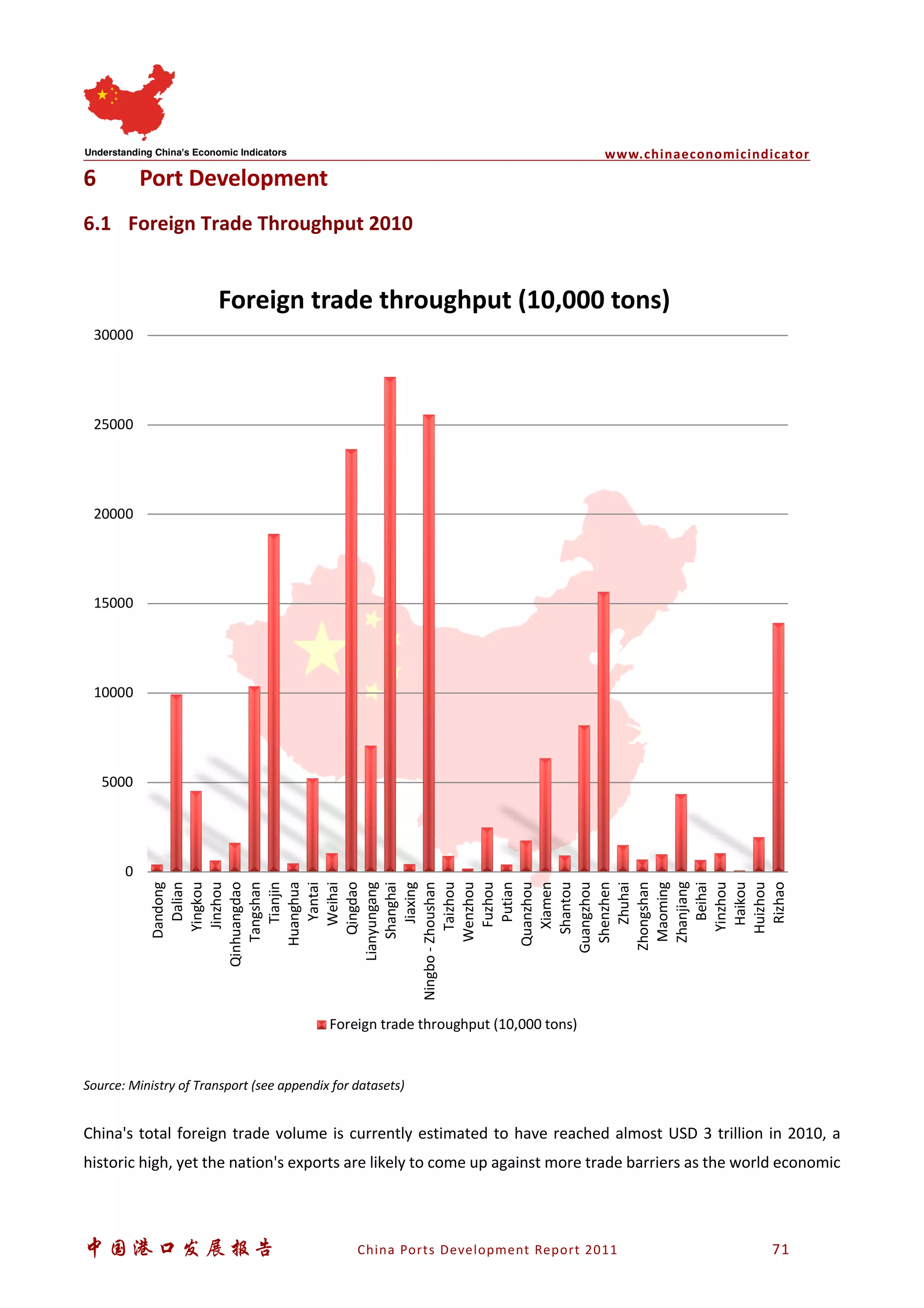
Foreign trade volume is estimated to have reached almost USD 3 trillion in 2010. Compared with 2009, the
nation's foreign trade growth in 2010 represents a rise of 31.5 percent, well above the global average level of
11.4 percentage points. Import growth rate over the period was greater than export growth rate.
As GDP continues to grow, so does China’s emerging consumer class. It is estimated that by 2015 China will be
home to 150m consumers with levels of income close to USD 40,000/year. This will make China one of the
largest consumer markets in the world.
Building on this, and in line with Beijing’s desire to address trade imbalances and optimize logistics’ chain
efficiency the government is actively working to promote consumer interest in foreign products. This project
will work closely with manufacturers, shippers and logistics providers.
Despite a massive growth in regional trade development in Asia over the past 30 years, the financial crisis
highlighted China’s dependence on the developed markets of Europe, the US and Japan. This dependence
unmasked the fact that much of the growth of inter-Asian trade over the past few decades has been driven by
the geographic distribution of manufacturing chains across the region.
3.2 Global Commodities
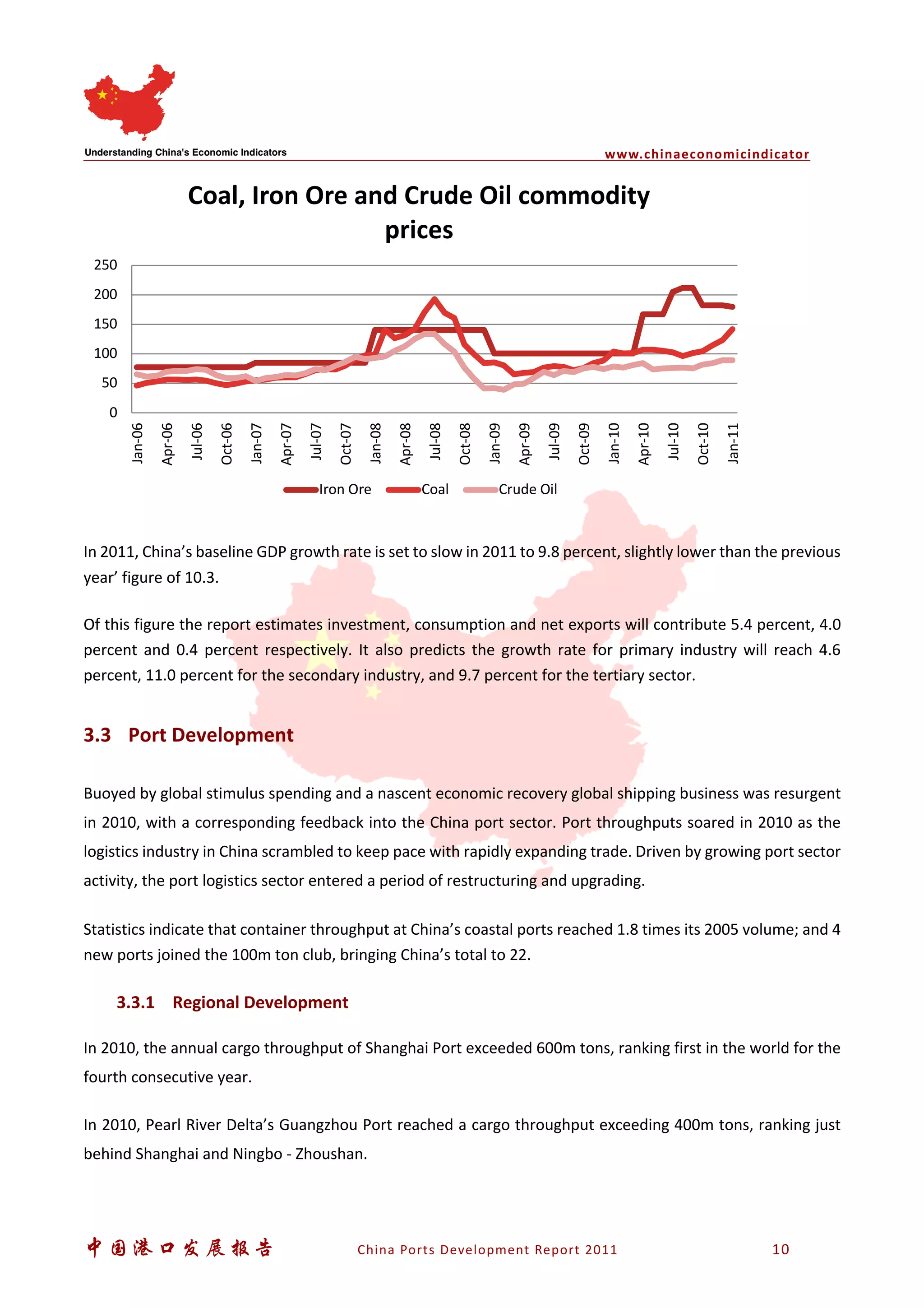
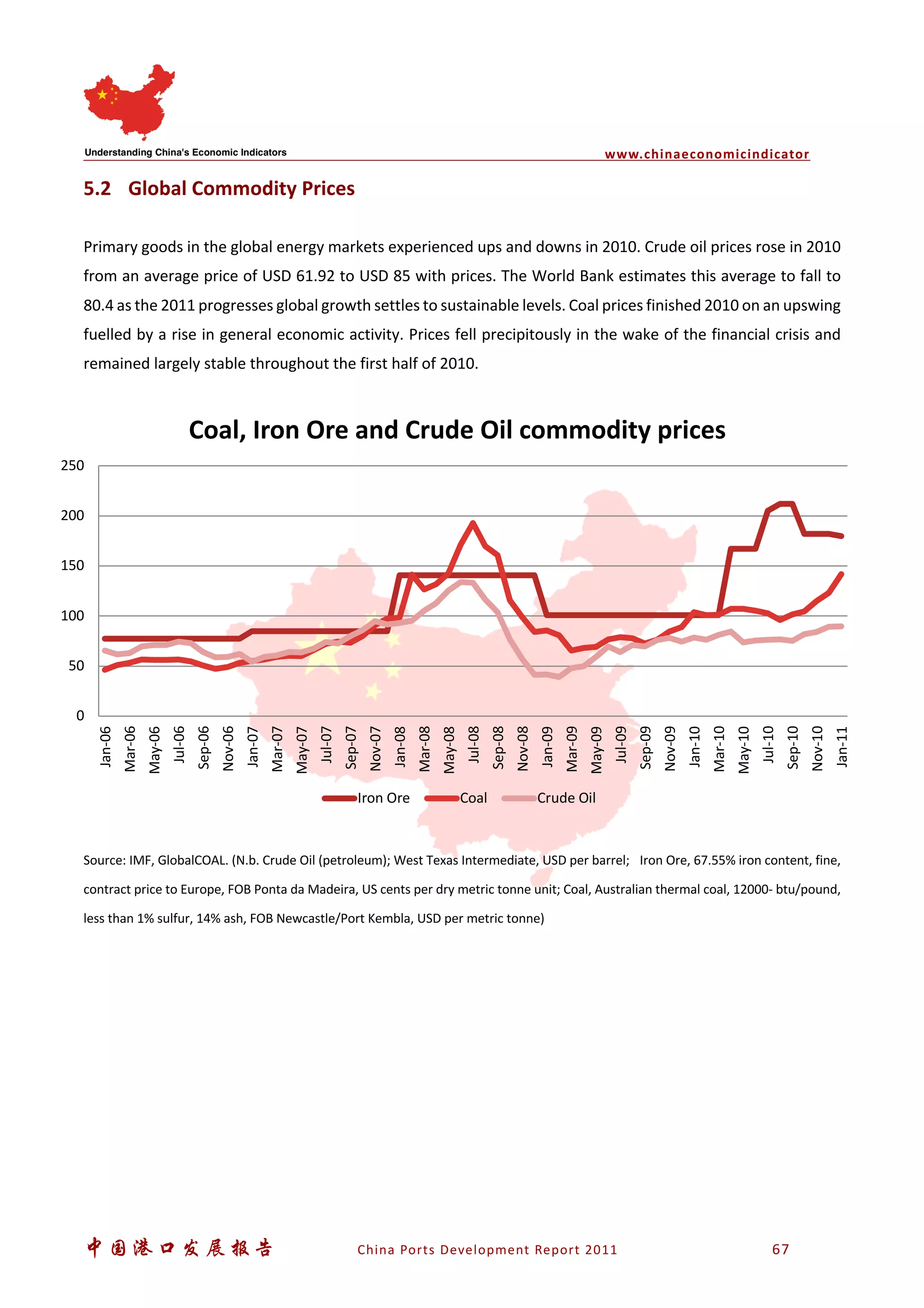
Global commodity prices ended the year on a surge leading a reduction in the rate of growth for coal, and a
net contraction in iron ore imports. High prices and measures by China to restrict energy intensive industries
and introduce emission control measures will most likely restrict commodity growth in 2011 to single figures.
www.chinaeconomicindicator
中国港口发展报告 China Ports Development Report 2011 10
In 2011, China’s baseline GDP growth rate is set to slow in 2011 to 9.8 percent, slightly lower than the previous
year’ figure of 10.3.
Of this figure the report estimates investment, consumption and net exports will contribute 5.4 percent, 4.0
percent and 0.4 percent respectively. It also predicts the growth rate for primary industry will reach 4.6
percent, 11.0 percent for the secondary industry, and 9.7 percent for the tertiary sector.
3.3 Port Development
Buoyed by global stimulus spending and a nascent economic recovery global shipping business was resurgent
in 2010, with a corresponding feedback into the China port sector. Port throughputs soared in 2010 as the
logistics industry in China scrambled to keep pace with rapidly expanding trade. Driven by growing port sector
activity, the port logistics sector entered a period of restructuring and upgrading.
Statistics indicate that container throughput at China’s coastal ports reached 1.8 times its 2005 volume; and 4
new ports joined the 100m ton club, bringing China’s total to 22.
3.3.1 Regional Development
In 2010, the annual cargo throughput of Shanghai Port exceeded 600m tons, ranking first in the world for the
fourth consecutive year.
In 2010, Pearl River Delta’s Guangzhou Port reached a cargo throughput exceeding 400m tons, ranking just
behind Shanghai and Ningbo - Zhoushan.
0
50
100
150
200
250
Jan-06
Apr-06
Jul-06
Oct-06
Jan-07
Apr-07
Jul-07
Oct-07
Jan-08
Apr-08
Jul-08
Oct-08
Jan-09
Apr-09
Jul-09
Oct-09
Jan-10
Apr-10
Jul-10
Oct-10
Jan-11
Coal, Iron Ore and Crude Oil commodity
prices
Iron Ore Coal Crude Oil
www.chinaeconomicindicator
中国港口发展报告 China Ports Development Report 2011 11
Data for 2010 indicates that ports in the Bohai region, on aggregate grew quicker than the national average.
This growth was in large past driven by Tangshan port where throughput 224m tons; an increase of 42 percent.
3.3.2 Foreign Trade Outlook for 2011
In January, ports above designated size, completed a cargo throughput of 736m tons, an increase of 13.3
percent. Coastal ports completed 514m tons; while river ports reached a throughput of 222m tons.
In January, port container throughput reached 13.505m TEU, up 17.6 percent. Coastal ports completed
12,219,000 TEU, river ports 1,286,000 TEU.
China's foreign trade is expected to maintain steady growth in 2011, but growth will fall compared with 2010.
Overall, imports will fare better than exports, and trade surplus will be essentially flat with 2010.
3.3.3 Port Development
The annual increase in the handling capacity of coastal ports exceeded 500m tons from 2005 to 2010,
prompted by a surge in transport demand and thus coastal port construction. The development of industries
such as petrochemicals, steel, electricity power generation, grain, and oil in the years after 2002 has led to a
surge in related port infrastructure construction.
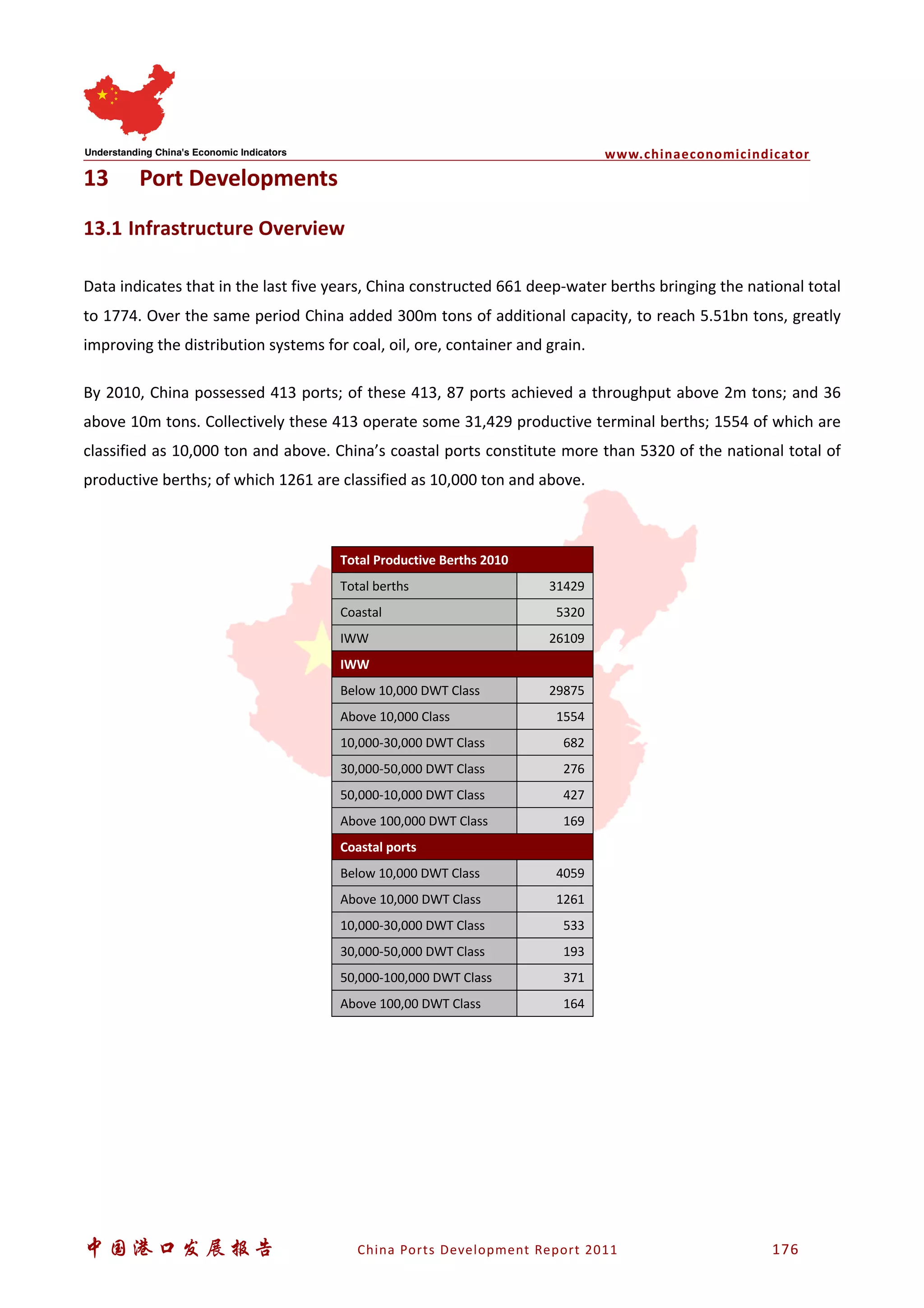
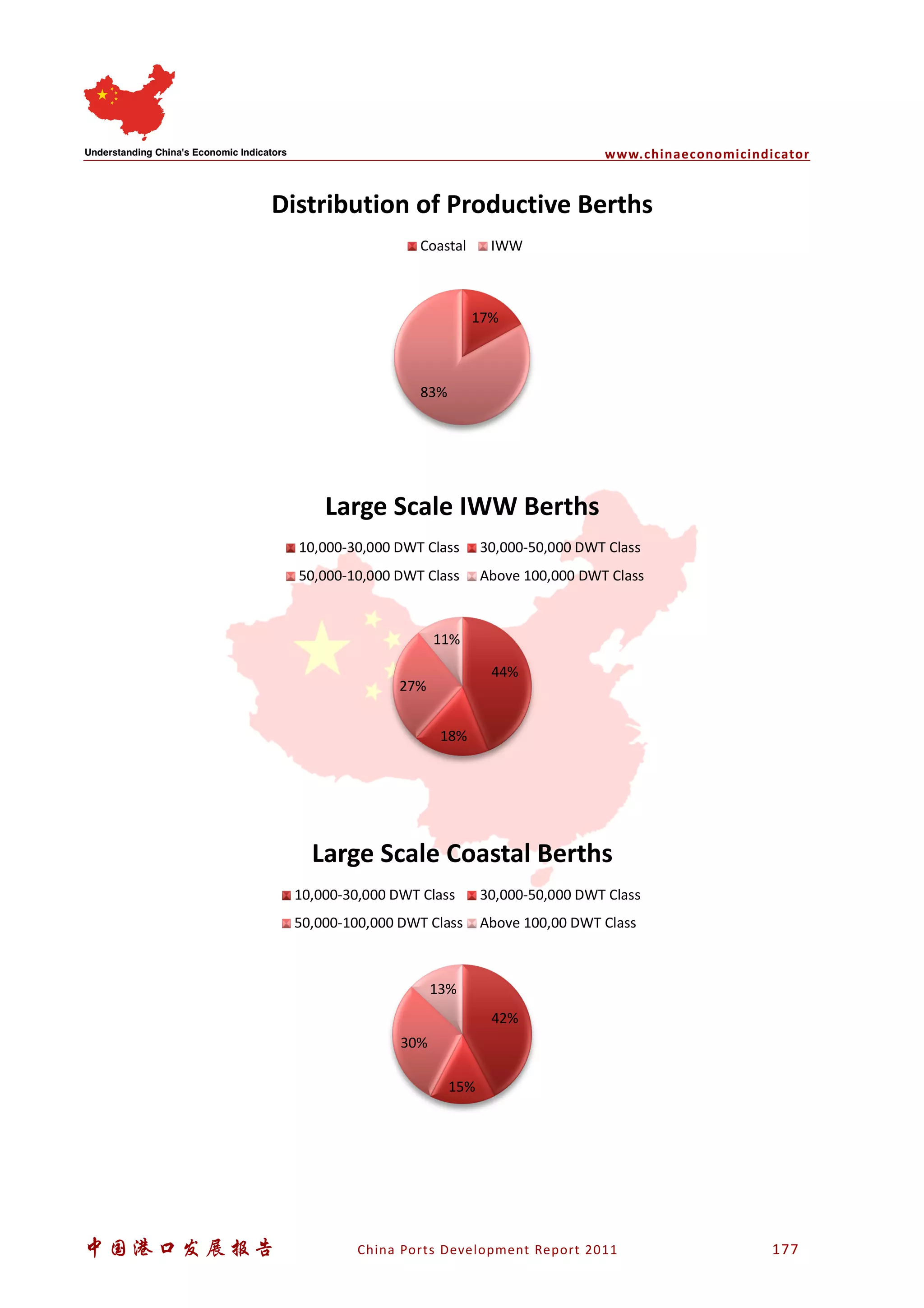
By 2010, China possessed 413 ports; of these 413, 87 ports achieved a throughput above 2m tons; and 36
above 10m tons. Collectively these 413 operate some 31,429 productive terminal berths; 1554 of which are
classified as 10,000 ton and above. China’s coastal ports constitute more than 5320 of the national total of
productive berths; of which 1261 are classified as 10,000 ton and above.
In general, river throughput growth tends to be higher than coastal throughput growth indicating the
increasing importance of the hinterland in economic development and the growth of transfer business.
Another noticeable trend into the future will be the ‘pairing’ of inland dry ports with coastal neighbours to
further drive hinterland development.
3.3.4 Bulk Cargo
Dry bulk cargo continues to dominate in terms of China’s port logistics, comprising greater than 60 percent of
China’s total port cargo throughput. 2010 saw rising growth in port throughput as the domestic demand for
commodities continued to grow driven by China’s ongoing competitive advantage in the manufacturing sector.
Coupled to the port throughput growth there was also an accompanying growth in port efficiency.
www.chinaeconomicindicator
中国港口发展报告 China Ports Development Report 2011 12
3.3.5 Coal
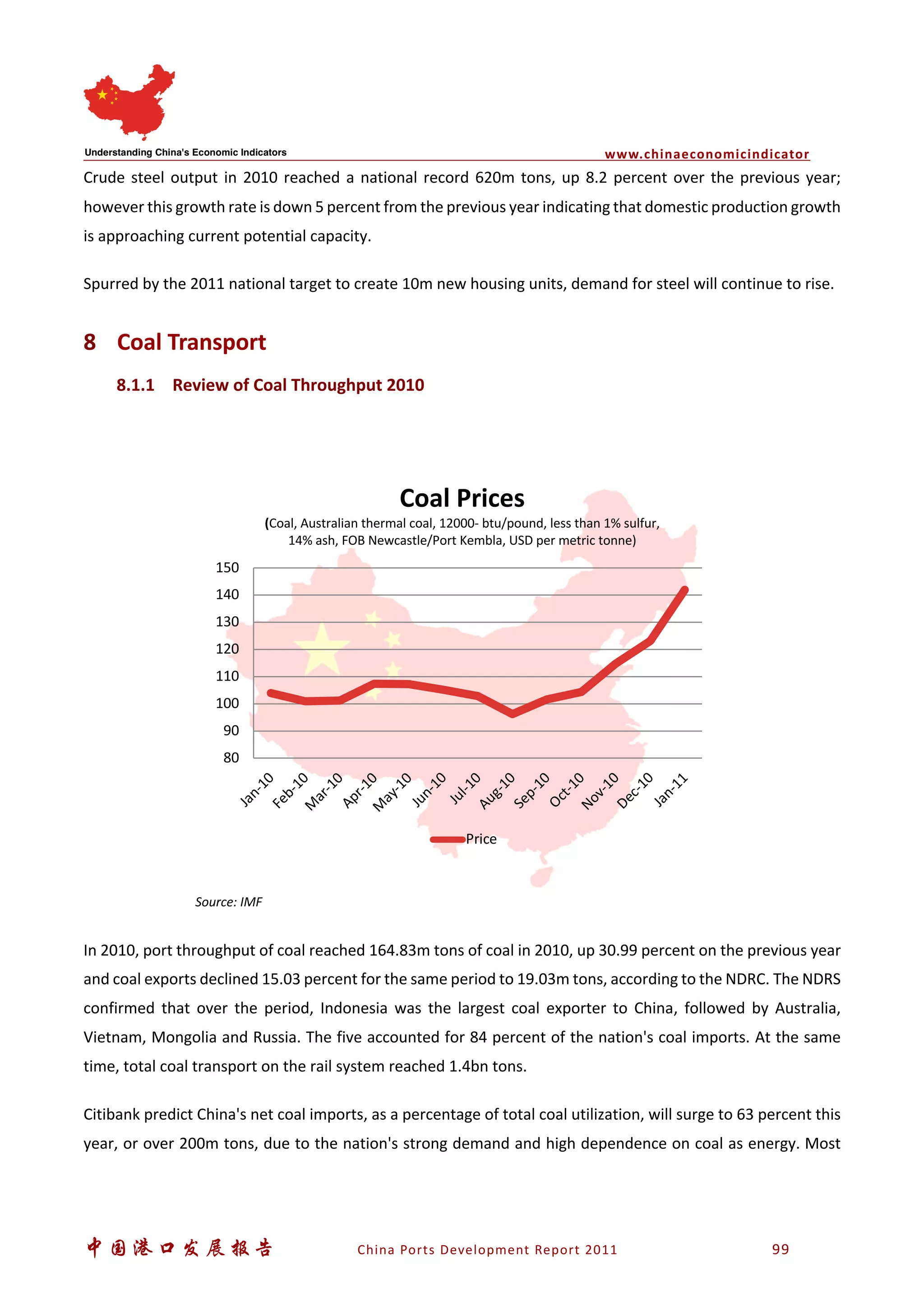
In 2010, port throughput of coal reached 164.83m tons of coal in 2010, up 30.99 percent on the previous year
and coal exports declined 15.03 percent for the same period to 19.03m tons, according to the NDRC.
3.3.6 Iron Ore
Responding to domestic investment, and the growth of infrastructure projects, iron ore imports rebounded
sharply in 2009; however this surge was short lived, with 2010 marking the first decrease in net iron ore import
volume in 12 years.
3.3.7 Oil
China dependence on imported oil deepened in 2010 as imports grew 17.5 percent reaching a record 4.79m
barrels a day in December. However, growth is expected to slow to 10 percent as the economy shifts toward
a more sustainable level of growth and new refineries come online.
3.3.8 Container Cargo
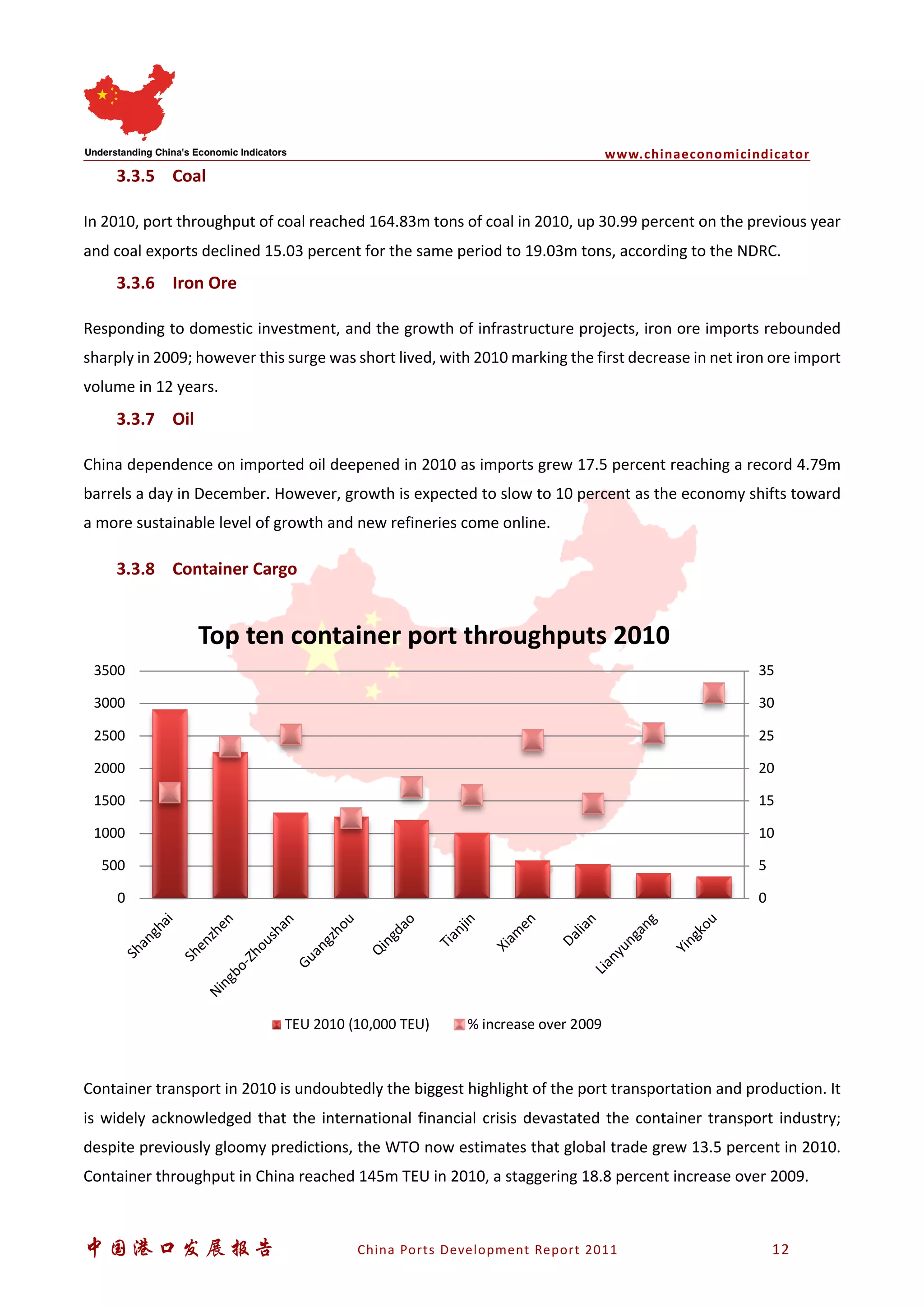
Container transport in 2010 is undoubtedly the biggest highlight of the port transportation and production. It
is widely acknowledged that the international financial crisis devastated the container transport industry;
despite previously gloomy predictions, the WTO now estimates that global trade grew 13.5 percent in 2010.
Container throughput in China reached 145m TEU in 2010, a staggering 18.8 percent increase over 2009.
0
5
10
15
20
25
30
35
0
500
1000
1500
2000
2500
3000
3500
Shanghai
Shenzhen
Ningbo-Zhoushan
Guangzhou
Qingdao
Tianjin
Xiam
en
Dalian
Lianyungang
Yingkou
Top ten container port throughputs 2010
TEU 2010 (10,000 TEU) % increase over 2009
www.chinaeconomicindicator
中国港口发展报告 China Ports Development Report 2011 13
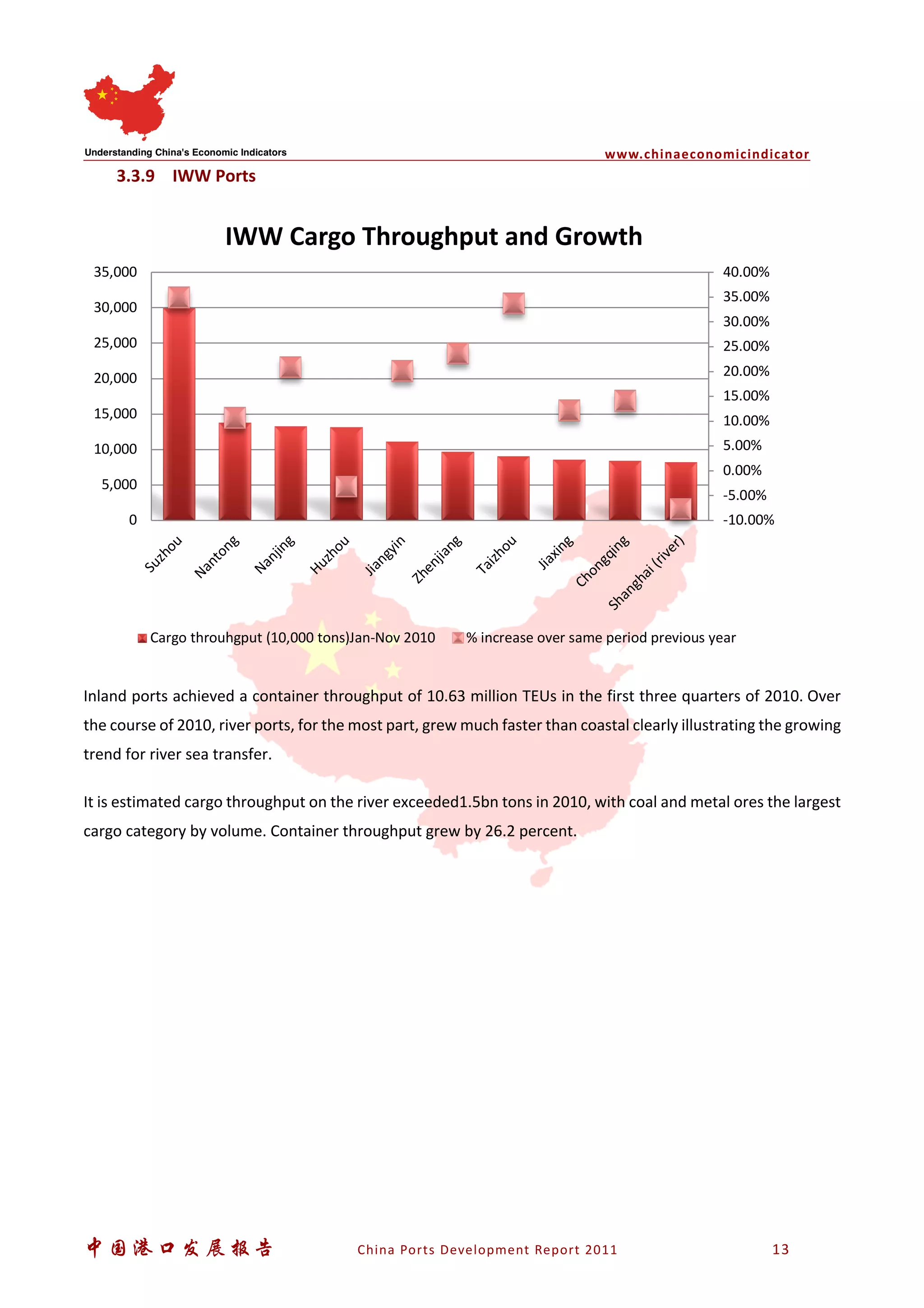
3.3.9 IWW Ports
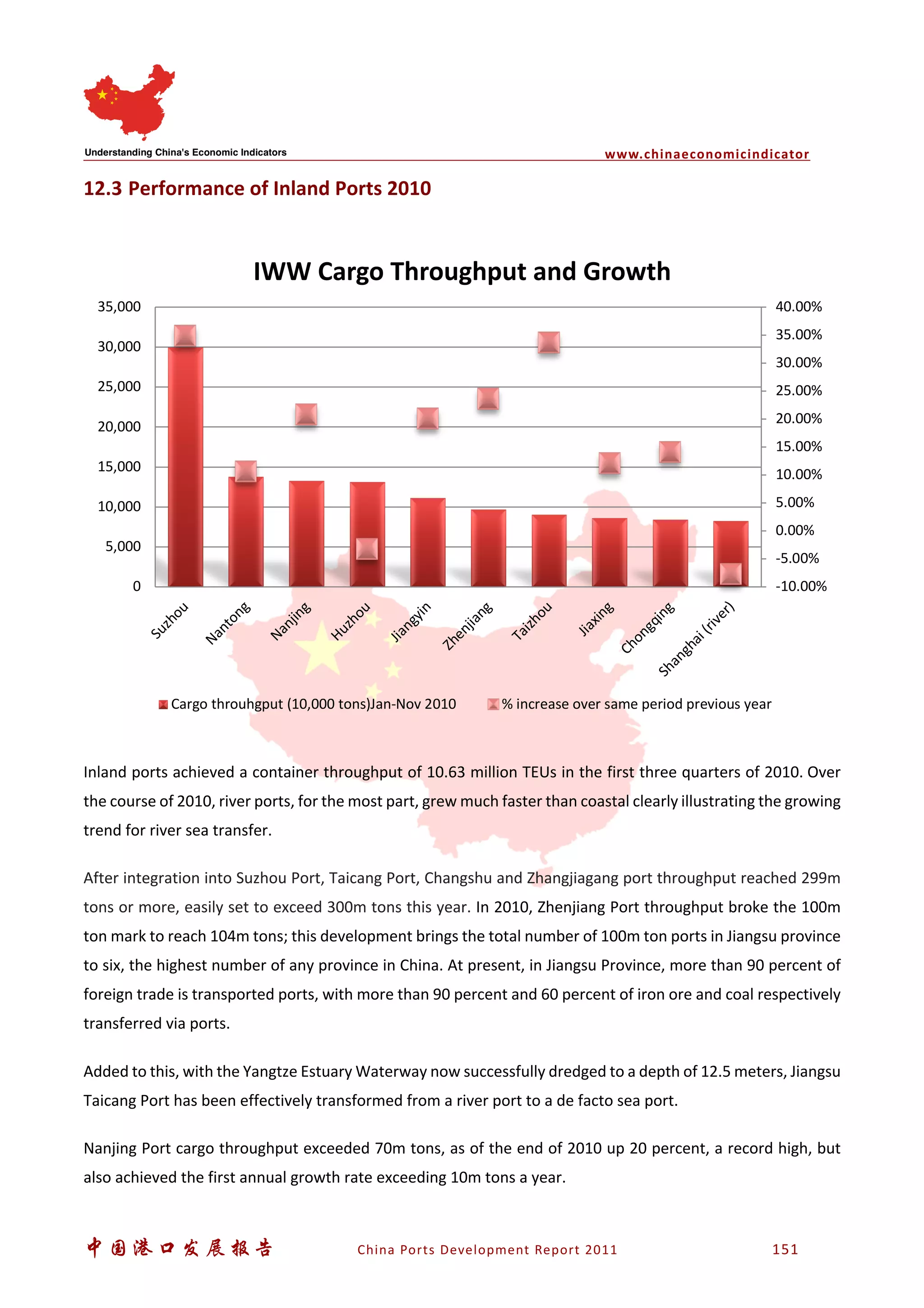
Inland ports achieved a container throughput of 10.63 million TEUs in the first three quarters of 2010. Over
the course of 2010, river ports, for the most part, grew much faster than coastal clearly illustrating the growing
trend for river sea transfer.
It is estimated cargo throughput on the river exceeded1.5bn tons in 2010, with coal and metal ores the largest
cargo category by volume. Container throughput grew by 26.2 percent.
-10.00%
-5.00%
0.00%
5.00%
10.00%
15.00%
20.00%
25.00%
30.00%
35.00%
40.00%
0
5,000
10,000
15,000
20,000
25,000
30,000
35,000
Suzhou
Nantong
Nanjing
Huzhou
Jiangyin
Zhenjiang
Taizhou
Jiaxing
Chongqing
Shanghai(river)
IWW Cargo Throughput and Growth
Cargo throuhgput (10,000 tons)Jan-Nov 2010 % increase over same period previous year
www.chinaeconomicindicator
中国港口发展报告 China Ports Development Report 2011 14
4 The Economic Background
4.1 The Geography of China’s Economic Environment
The Chinese economy is better understood not as a single unit but rather a decentralised collection of several
regional economies that interact with one another less than one might expect. This arrangement—which
differs from other large countries such as the United States—results from China’s transition from a command
to a market economy.
In the 1980s, China initiated economic reforms by transferring control of many state-owned enterprises to
provincial and local authorities. These authorities embarked on experimental reforms that, if proven
successful, were later applied by the national government.
Decentralisation has largely worked; the Chinese have thus far managed the transition to a market economy
relatively smoothly. In contrast, the ‘shock therapy’ method implemented by Russia led to widespread
economic catastrophe in that country and a subsequent devastating drop of living standards for many. Living
standards in China, on the other hand, have continually risen since initial economic reforms were implemented
in the late 1970s.
Yet the consequences of decentralisation have not been entirely positive. During the 1980s and 1990s,
individual Chinese provinces—and in some cases municipalities such as Shanghai—erected barriers to
domestic trade and practised import-substitution as if they were separate countries. This lack of cooperation,
exacerbated by GDP targets, meant that the Chinese economy failed to utilise many comparative advantage
opportunities.
These inefficiencies persisted despite China’s overall integration into the global economy. In essence, regions
within China had closer economic ties with foreign countries than amongst each other.
Such fragmentation has resulted in the apparent lack of major, globally recognized companies emerging from
China, particularly given the size of its economy. Larger Chinese firms have enormous difficulty managing their
parent-subsidiary networks; companies under the same corporate umbrella often fail to cooperate and even
work at cross-purposes.
www.chinaeconomicindicator
中国港口发展报告 China Ports Development Report 2011 15
The underdeveloped domestic mergers and acquisitions (M&A) market also exemplifies the problem with
localisation. Leaders of certain industries often dominate market share in certain individual markets yet have
enormous difficulty consolidating these gains nation-wide.
The absence of major firms, many China-watchers believe, will impede Chinese efforts to compete in a
globalised economy. Building national markets, then, may be necessary.
To do so, the Chinese government can reduce inefficiency by enforcing national standards for road transport
and simplifying the tax system. Establishing a law akin to the Commerce Clause in the United States would also
smooth the path to a truly national economy.
In the meantime, however, China is likely to be defined by its disparate economic regions. The three largest
and most important of these are on the east coast; the Pearl River Delta abutting Hong Kong, the Yangtze River
Delta surrounding Shanghai, and the Bohai Bay region near Beijing.
Emerging markets, many lying further inland, are noted for their strengthening ties to international markets.
For example, north-eastern China, an industrial region once known for its loss-making State-owned
enterprises, has reached out to Russia.
Likewise, southwest China has established important transport links to Southeast Asia and has positioned itself
as China’s gateway to the increasingly vital region. Northwest China has similarly emerged as a key link to the
energy-rich markets of Central Asia. The Shanghai Cooperative, a multi-lateral institution comprising China
and several ex-Soviet central Asian states, exemplifies the growing importance of these ties.
Finally, central China has positioned itself as a bridge linking the developed markets of the east coast with the
rising areas out west. Wuhan, inland China’s largest city and a major stop on the Yangtze River, has the
potential to act as a pivot linking the many disparate spokes in the Chinese wheel.
As these regions maintain a large degree of economic autonomy from Beijing, a further consideration of their
individual characteristics helps illuminate trends of the Chinese economy as a whole.
www.chinaeconomicindicator
中国港口发展报告 China Ports Development Report 2011 16
4.2 Primary economic hubs
4.2.1 The Pearl River Delta (PRD)
Consisting of the area surrounding the Pearl River in Guangdong Province, the Pearl River Delta remains
China’s wealthiest region and the centre of its export-orientated economy. Guangdong's GDP in 2010 hit RMB
4.55 trillion, exceeding the target of 3.35 trillion yuan, making it the first among all provinces in China. The
province has set a target of 9 percent growth rate for the 11th Five-Year Plan (2005-2010).
Last year, Guangdong's foreign trade growth rate was lower than the national average. Last year, the nation
registered a 34.7 percent growth in oreign trade while Guangdong’s import and export value grew by just 28.4
percent. Analysts believe that the growth rate of Guangdong's foreign trade in January this year, which was
higher than the national average, which many analysts believe was due to the law starting point at the end of
last year.
Export commodities, machinery and electronic products and hi-tech exports were higher than the
corresponding increase in total exports, with main labor-intensive products achieving a growth rate upwards
of 30 percent.
4.2.2 The Yangtze River Delta (YRD)
YRD economic zone refers to 16 cities in Shanghai, southern Jiangsu, eastern and northern Zhejiang; Shanghai,
Nanjing, Suzhou, Wuxi, Changzhou, Yangzhou, Zhenjiang, Nantong, Taizhou, Hangzhou, Ningbo, Huzhou,
Jiaxing, Shaoxing, Zhoushan and Taizhou.
The Yangtze River Delta (YRD13 of the 16 major cities in the Yangtze River Delta (YRD) witnessed GDP
exceeding RMB 200bn in 2010; 6 cities in the YRD exceed RMB 500bn in 2010.
The top five were Shanghai with its GDP at RMB 1.6872.42 trillion; Suzhou with RMB 916.891bn, Hangzhou
with RMB 594.582bn, Wuxi with RMB 575.8bn, and Ningbo with RMB 512.582bn with economic performance
greatly aided by the emergence of recovery within the global economy.
The region's industrial production continued to accelerate and its above-scale industrial output value was RMB
14.7392 trillion in 2010, an increase of 26 percent year on year.
4.2.3 Beijing and the Bohai Bay region
Comprising Hebei, Shandong, and Liaoning Provinces as well as the municipalities of Beijing and Tianjin, the
Bohai Bay region is the primary economic hub for north China with Tianjin Port functioning as the primary
www.chinaeconomicindicator
中国港口发展报告 China Ports Development Report 2011 17
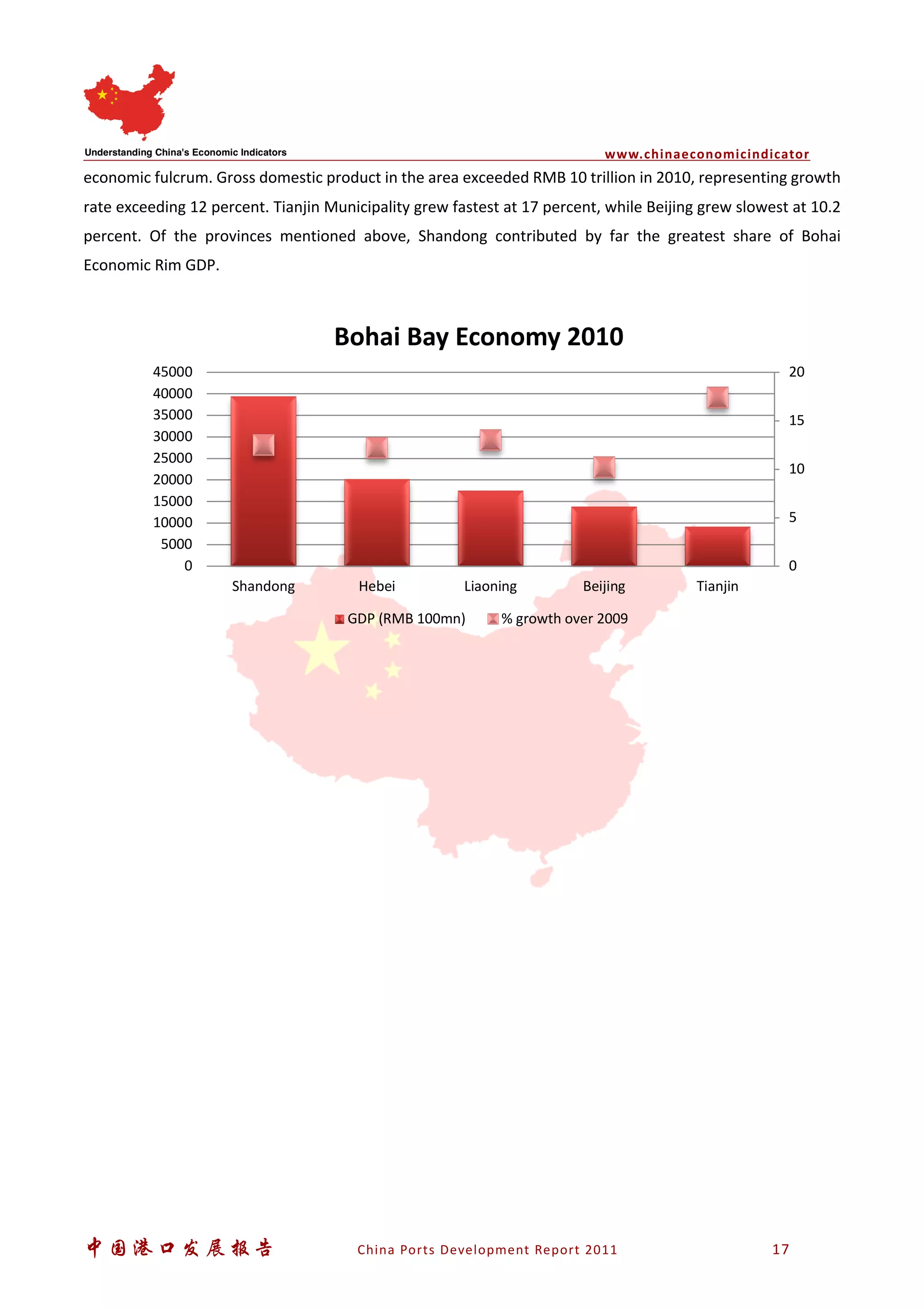
economic fulcrum. Gross domestic product in the area exceeded RMB 10 trillion in 2010, representing growth
rate exceeding 12 percent. Tianjin Municipality grew fastest at 17 percent, while Beijing grew slowest at 10.2
percent. Of the provinces mentioned above, Shandong contributed by far the greatest share of Bohai
Economic Rim GDP.
0
5
10
15
20
0
5000
10000
15000
20000
25000
30000
35000
40000
45000
Shandong Hebei Liaoning Beijing Tianjin
Bohai Bay Economy 2010
GDP (RMB 100mn) % growth over 2009
www.chinaeconomicindicator
中国港口发展报告 China Ports Development Report 2011 18
4.3 China’s main economic regions
4.3.1 The East Coast (and Fujian Province)
4.3.1.1 General Overview
In general, China’s east coast has historically outstripped the interior of the country in almost every economic
indicator. In the days before the Second World War, the east coast was dominated by colonial powers and
hence traded broadly with the world – whereas the interior remained remote and isolated due a lack of
hinterland infrastructure. In the days since reform, the eastern seaboard has regained its mantle as the
economic engine of the country – so much so that the nation’s rulers have feared the consequences of the
country’s growing economic disparity. Home to the three major economic hubs of the nation – the PRD, the
YRD and Bohai Bay – the growth of the east in economic terms has been nothing short of meteoric.
However, for many years, the province of Fujian has lagged behind its more developed cousins on the coast.
The reasons for this underdevelopment are ostensibly two-fold. The first is that the necessity of military
preparedness in the straits of Taiwan meant that the region was weighed down with a vast military presence,
thereby hindering development of non-military infrastructure. The second reason, closely related to the first,
was that the administrative environment and security concerns engendered by the military build-up made the
environment for foreign investment less friendly than many of the province’s neighbouring areas.
This said though, the recent thawing of cross-straits relations is bringing about something of a renaissance in
the region’s prospects. Spurred by what one Chinese official called a ‘narrowing and shallowing’ of the straits,
the central government has earmarked substantial funds for investment in provincial infrastructure aimed at
maximising the province’s proximity to the Mainland’s former adversaries.
4.3.1.2 Logistical Overview
Early deregulation of the investment environment for fixed asset maritime infrastructure investment, most
notably in container handling facilities, led to the rapid growth of the region and the influx of FDI early in the
reform era. This link to the outside world has, however, had some interesting and unique side effects. Regions
along the coast integrated themselves into the global supply chain, and provinces and municipalities
increasingly saw themselves in a regional competition with their neighbours - to the extent that some even
introduced import substitution tariffs.
This regional competition in many ways meant that as China entered the 21st
century, many of its regions were
in fact better integrated into the global, or regional, economies than they were into the national economy. For
www.chinaeconomicindicator
中国港口发展报告 China Ports Development Report 2011 19
instance, it was in many ways easier for firms in Guangzhou to trade with companies in the Americas than it
was for them to trade with companies in, say, Xinjiang in the far northwest of China.
In many ways, the greatest challenge for China in this century is to try and aggregate these disparate regional
economies into a wider national framework. Measures such as the proposed introduction of a national
trucking license and the fuel tax reform (see section 6.16) and the current program of rapid hinterland
infrastructure are aimed at addressing this matter.
4.3.1.3 Key Dynamics
• The primary driving force for development of the east coast has been the region’s proximity to high-class,
foreign invested maritime container terminals.
• This proximity has opened the region to a flood of foreign investment and a subsequent rise in living
standards that has swollen regional domestic demand.
• Fragmentation between regions on the coast remains an issue Beijing is keen to address by linking regions
through administrative as well as infrastructural connections.
• Growing détente across the straits will likely lead to a flood of investment from the island of Taiwan, most
likely in the assembly of high-tech goods from components manufactured on the other side of the straits.
• This growth of investment and trade will likely lead to increased demand for high quality supply chain
solutions in regions traditionally overlooked by many global logistics providers—such as connecting Fujian
and other primary trading ports linked to Taiwan with lower cost pools of workers further inland.
• Growth in trade will likely further spur domestic consumption of Taiwanese produced goods creating
higher demand for consumer good distribution strategies.
4.3.2 Pearl River Delta (PRD)
4.3.2.1 General overview
The PRD Economic Zone (PRDEC), which consists of Guangzhou, Shenzhen, Dongguan, Foshan, Zhongshan,
Zhuhai, Jiangmen and parts of Huizhou and Zhaoqing, has since the start of the ‘Open Door’ policy been China’s
most vibrant economic region. The region is now an important industrial market for all kinds of inputs,
materials, and capital goods as well as a major market for transport and transport related services.
Per capita income has been growing steadily over the past thirty years, hand in hand with consumer
expenditures, making cities such as Shenzhen and Guangzhou among the most prosperous in the Chinese
Mainland. The region’s proximity to Hong Kong, one of the primary catalysts for the region’s early
www.chinaeconomicindicator
中国港口发展报告 China Ports Development Report 2011 20
development means its consumer tastes closely follow those of the west, creating attractive markets for
foreign retailers.
Although the PRDEC accounts for only 0.4 percent of China’s total land mass and less than 4 percent of the
nation’s population, it accounts for more than 10 percent of the country’s GDP, and attracts almost 20 percent
of all inbound FDI.
4.3.2.1.1 The Greater and Pan-PRD Economic cooperation zone
At present Hong Kong companies employ more workers in the PRD region than the entire population of Hong
Kong. With more and more businesses in the PRD straddling the three administrative regions of Guangdong,
Hong Kong and Macao the government has established the Greater Pearl River Delta (GPRD) Economic
Cooperation Zone. The role of which is to integrate Hong Kong and Macao into the wider Chinese economy by
streamlining investment regulation across the entire region and rationalising and integrating logistics
development in the GPRD Area.
Included in the zone are Hong Kong, Macao and nine Guangdong municipalities. The infrastructure projects
spearheading integration include improved road infrastructure, the construction of the Guangzhou terminus
of the national intermodal rail network that will incorporate 18 full containerised rail hubs nationwide, and
increased air freight integration between Hong Kong and Guangzhou Baiyun Airport.
At present Hong Kong is still China's biggest investment conduit. In an effort to stretch the benefits of that
investment further into the southern China hinterland the government has also established the Pan-PRD
Economic Zone. With economic growth and prosperity in the coastal regions far outstripping the west the
government, and business, are keen to move production further inland.
Increasingly as Shenzhen becomes a victim of its own success and land and wage rates rise, forcing the
industrial hinterland further back into China makes sense. Integrating logistics infrastructure in the eight
provinces surrounding the GPRD is hoped to encourage investment into the wider South China region as a
whole.
4.3.2.2 Logistical overview
As with many of China’s primary economic hubs, the PRD has traditionally been more integrated into the global
economy than into the national economy. Hong Kong is perhaps the example par excellence in this respect –
with other cities in the region following to lesser degrees.
In this vein, the logistical structures of the region have for many years been primarily focused on binding the
region into the global system of production. Following Hong Kong’s lead in the sixties and seventies, the PRD
www.chinaeconomicindicator
中国港口发展报告 China Ports Development Report 2011 21
has been quick to build high quality, internationally operated, world class port facilities – primarily in and
around the mouth of the Pearl River. Logistics services in the region have focused primarily on integrating the
region with Hong Kong and providing export services and infrastructure for manufacturing enterprises taking
advantage of the zone’s preferential economic policies.
However, as competition between enterprises has developed, and wage and rent prices have grown as the
region prospered, regional development strategies have begun to look inland at development of hinterland
cargo generation. In part to take advantage of lower cost production bases, in part to reap the benefits of the
government’s ‘Go-West’ strategy, and in part to fill the massive export capacity coming online in the region
and the shortfall created by the global economic slowdown.
4.3.2.3 Key dynamics
• The changing role of Hong Kong – port facilities in Hong Kong are very likely to see their role in the region
diminish as infrastructure across the border increasingly rivals its more expensive neighbour. Also, with
the commencement of direct trading links with the island of Taiwan cargo traditionally transhipped
through the Special Administrative Region is likely to significantly drop off. Added to this, transhipment
business at the port is likely to be additionally affected by the development of deep water ports in
Vietnam–thereby negating much of the current need for transhipment in Hong Kong.
• Shenzhen and Guangzhou airports – freight capacity, better facilities, improved customs clearance
environments, supporting infrastructure networks and improved services at both Shenzhen and
Guangzhou airports are likely to put increased pressure on Hong Kong airport as a lower cost alternative.
By 2015 cargo throughput at Shenzhen airport is planned to reach 2.5m tonnes.
• Ports in the PRD are and will increasingly compete for shares of hinterland cargo by extending their cargo
draw capacity further inland through the expansion of intermodal rail facilities nationwide and dedicated
port-to-city container railways (e.g. Shekou-Changsha). Industrial development on the western banks of
the Pearl River is likely to accelerate as new port facilities on the western shore open up the relatively
underdeveloped and lower cost region to increased access and direct investment.
• Macroeconomic policies to integrate the PRD into the wider southern and southwest regions of China will
likely increase the flow of goods through the PRD gateway to the world.
• Increased GDP and consumer expenditure will continue to make the region an attractive market for
international manufacturers, especially those specialising in high-value consumer goods.
• Development of the Pan-PRD regions – the Pan-PRD region is an economic cooperation zone that includes
www.chinaeconomicindicator
中国港口发展报告 China Ports Development Report 2011 22
the provinces of Sichuan, Yunnan, Guizhou, Hunan, Jiangxi, Fujian, the island and province of Hainan and
the autonomous region of Guangxi.
• The construction of a 50 km sea bridge connecting Hong Kong, Macao, and Hong Kong, commenced in
December 2009, will integrate the Pearl River Delta area to an unprecedented degree upon its completion
in 2015.
4.3.3 The Yangtze River Delta
4.3.3.1 General overview
Beginning in the early twentieth century, Shanghai has been a magnet for foreign financial interests for almost
a century – an interregnum of a few decades of staunch Stalinist policies notwithstanding. This continued
interest has largely been the driving force for the development of the region over the past three decades.
In 1990s, the Chinese government opened the Pudong district of Shanghai to overseas investment, as well as
additional cities along the Yangtze River valley. Since then, the Yangtze River delta has become one of China’s
key economic regions. It consists mainly of 15 cities, including Shanghai, Nanjing, Suzhou, Zhenjiang and Wuxi,
although its scope has recently been widened to include Taizhou City in Zhejiang Province. Yancheng, Huai'an
and Ma'anshan cities in Jiangsu and Anhui provinces are also likely to join the economic grouping.
The region is home to 10 percent of China’s population and it generates just over a fifth of China’s GDP and
about a third of China’s foreign trade. Pudong enjoys many privileges not yet available to other zones. In
addition to reduced duties and income tax, foreign financial institutions have also been allowed to set up in
the region along with a stock exchange. It has therefore become the financial centre of China with 180 Chinese
and foreign-funded financial institutions.
The Chinese government has identified the development of a number of ‘pillar industries’: automotive
(including components and spare parts), microelectronics and computers, household electrical appliances,
pharmaceuticals, optical, mechanical, and electrical products.
High GDP per capita rates within the region continue to ensure that the area remains a major point of interest
for foreign manufacturers looking to capitalise on the increasingly affluent spending habits of China’s
burgeoning middle classes.
www.chinaeconomicindicator
中国港口发展报告 China Ports Development Report 2011 23
4.3.3.2 Logistical overview
As with China’s other major economic hubs, the success of Shanghai to date has been very much dependent
upon two key factors. First is its familiarity with the outside world. Second has been its ability to integrate the
nation’s low cost labour base into global supply chains.
Adding to the logistical importance of the region is its proximity to supporting infrastructure such as Suzhou
port, Taicang, and Ningbo-Zhoushan. This latter port, which recently merged, is tied firmly into the plans for
the Shipping Centre by construction of the Hangzhou Bay Bridge, a 36 km long bridge linking the port with the
city of Shanghai, thus shortening the route by 120 km.
The region’s proximity to the Yangtze River is also of significance given the increasing importance of the river
as a transport artery for development of the western regions. With Wuhan, ‘China’s Detroit’, and the mega-
city of Chongqing upstream the YRD has been increasingly positioning itself as the terminus of what some have
dubbed ‘China’s third coast’.
The 11th
Five-Year Development Plan for Modern Logistics in Jiangxi Province outlines an overall arrangement
for modern logistics: to develop Nanchang, the northern, southern, eastern and western regions of Jiangxi into
five major logistics regions with three-tier nodes.
4.3.3.3 Key dynamics
• Ongoing development of the central government’s stated aim of making Shanghai the financial and
commercial capital of the mainland.
• Completion of the government’s plan to develop Shanghai into a global shipping centre by 2020, with the
ostensible aim of integrating and streamlining services between the disparate ports in the region could
very likely see increased efficiency and throughput volumes.
• The possible introduction of a tax free port zone–similar to that which propelled Hong Kong port to world
status—is likely to make the port a more attractive destination for increased logistics investment in the
future.
• The development of cross straits trade with the island of Taiwan is likely to lead to a swath of new
investment from the island into the YRD hinterland–the lion’s share of which is likely to be in high-tech
intermediate good assembly for domestic consumption and re-export.
• Expansion of both Pudong—Shanghai’s pre-eminent international airport—and Hongqiao—the regional
feeder—are likely to generate tremendous growth in airfreight in the region. This is likely to be especially
www.chinaeconomicindicator
中国港口发展报告 China Ports Development Report 2011 24
true in terms of high-tech components needing to move through the supply chain extremely quickly. In
this sector, growth of intermediary goods cargo from Taiwan is likely to accelerate quickly.
4.3.4 Bohai Bay
4.3.4.1 General Overview
The Tianjin-Beijing Bohai triangle accounts for around nine percent of national GDP, with per capita incomes
well above the national average. The primary driving force behind economic development in the area has been
due to the twin poles of the two cities: Beijing, the seat of political authority, and Tianjin, the capital’s gateway
to the sea and hence the wider world. The region also includes some cities in Hebei, Shandong and Liaoning
provinces, many of which are at different stages of development.
Economic development in the triangle, in contrast to the PRD and to a lesser extent the YRD, has in the past
been restricted by an overall lack of coordination, which has to a large degree been the result of different
administrative regions, each with separate responsibilities. This administrative fragmentation has often meant
that regions within the triangle often see themselves as in competition with neighbouring municipalities and
counties.
The third largest city in China and the industrial capital of the northeast, Tianjin is one of China’s four
municipalities directly under the control of the central government – the others being Shanghai, Chongqing
and Beijing. Located 120 km southwest of Beijing the city is linked to the capital by high-speed train at a
maximum speed of 350 km per hour unveiled in 2008 in time for the opening of the Beijing Olympics. The
introduction of the service has effectively put the city in the commuter belt of the capital, and vice versa,
greatly enhancing economic integration between the two. The shift of passengers from the conventional rail
network has also freed the older network for utilisation as a freight route.
4.3.4.2 Logistical overview
In recent years the government has worked hard to promote the region with aggressive spending on
infrastructure in an attempt to draw investment from the Yangtze and Pearl River Deltas and to rejuvenate
the de-industrialised former heartland of Chinese manufacturing; the northeast. As part of this strategy,
Beijing has earmarked the Bohai Bay as a cornerstone and strategic component of the 11th Five Year Plan,
pinning its hopes on improved logistics access to the region drawing much needed foreign direct investment.
And, looking at how the region is currently faring, it may have worked better than intended.
www.chinaeconomicindicator
中国港口发展报告 China Ports Development Report 2011 25
Observers believe that the global financial crisis will impact Tianjin Port less than ports in the southern coastal
region primarily because Tianjin’s port throughput is less reliant on the purely export driven consumer good
cargoes that many of the southern regions have traditionally relied on.
Tianjin has managed to attract several high-value, high-tech processing industries to its Free Trade Zone. These
include Delixi and other enterprises from Zhejiang, as well as Kingway and ZTE from Shenzhen.
Indeed, in recent years, Tianjin has had tremendous success in attracting such industries to the region, in part
due to the city’s connectivity to Beijing Capital Airport and the air cargo expansions to Tianjin Airport and the
attached processing zone. Furthermore, this expansion has, according to officials at the FTZ, already courted
investment from the likes of Lufthansa, Korean Air, Singapore Temasek Shu-feng, and Taiwan's Arima Air Cargo
Terminals among others.
4.3.4.3 Key dynamics
• More competitive in cost terms than other major economic hubs in China, the region is increasingly being
seen as a softer, easier alternative to the Go-West strategy
• Pools of cheap labour and good quality supporting infrastructure exist to service industries that choose to
relocate there
• Ambitious expansion projects are already underway at Tianjin port, as well as Dalian and other ports in
the region, with the long-term aim of developing a Northeast Shipping Centre to rival the Shanghai
Shipping Centre down the coast.
• High-speed rail links already connect Beijing and Tianjin, greatly enhancing economic integration and
cooperation in the region.
• Tianjin port, among others in the Bohai Rim, is less dependent on direct export goods than many ports in
the south of the country and has proved itself a bulwark against the main impact of the economic
downturn, suffering only a slight fall in throughput figures.
4.3.5 The Southwest
4.3.5.1 General Overview
The region known as southwest China consists of Sichuan, Yunnan, Guangxi, and Guizhou Provinces as well as
Chongqing Municipality. Historically, economic development in Southwest China has suffered from the
region’s mountainous terrain and distance from China’s prosperous coastal region.
Since the announcement of the ‘Go West’ policy in the late 1990s the region has grown in significance both
within China and in respect to the outside world. Chengdu, capital of Sichuan, has established itself as a major
www.chinaeconomicindicator
中国港口发展报告 China Ports Development Report 2011 26
logistics hub in inland China and has attracted multinational firms such as Intel. Nearby Chongqing has major
port facilities on the Yangtze River, a significant advantage in facilitating domestic trade.
Yunnan Province, bordering three Southeast Asian nations, has entered into political and economic
development agreements with the Association of Southeast Asian Nations (ASEAN).
To the east of Yunnan, Guangxi Province contains Southwest China’s only sea coast. Beibu Bay, also known as
the Gulf of Tonkin, has become a nexus of trade between China and Vietnam and has caused the provincial
capital of Nanning to rise in stature. Southwest China’s extensive links with Southeast Asia make it a region
worth watching; China has key trade relationships with its southern neighbours, and arrangements such as
the Greater Mekong Sub region (GMS) are poised to only grow in importance.
According to the Infrastructure Construction Project Plan for the Major Industrial Park in Guangxi North Gulf
Economic Zone (2008-2010), North Gulf plans to build up a Nanning International Logistics Centre, which will
be an international modern logistics zone and a comprehensive city zone serving the China-ASEAN Free Trade
Zone.
4.3.5.2 Logistical Overview
Southwest China has always faced grave challenges in developing a first-class logistics operation. These
problems result from the region’s geographic isolation and relative economic underdevelopment. Travel times
between cities in the southwest—even ones as major as Chengdu—often dwarf those of journeys of similar
lengths conducted elsewhere.
Government investment, coupled with the recognition that the region has important geopolitical uses, have
led to an upgrade in southwest China’s logistics situation. A major logistics centre in Chengdu ranks among
China’s most important, while the construction of a new airport—as well as continued investment in road and
rail infrastructure—in Kunming indicates the growing economic stature of the Yunnan capital.
Elsewhere, Chongqing’s position as the Western nexus on the Yangtze River presents a significant advantage
in the shipment of goods further east. In Guangxi Province’s Beibu Bay, deep-water port construction
continues apace, positioning itself as an important conduit in trade with nearby Vietnam. Guangxi also plans
to make significant improvements to its two largest airports, located in Nanning and Guilin.
When considered as a region, Southwest China’s vast improvements in intermodal transport should decisively
end its historical isolation; if anything, ties to Southeast Asia promise to raise its profile within China
considerably.
www.chinaeconomicindicator
中国港口发展报告 China Ports Development Report 2011 27
4.3.5.3 Key Dynamics
• The rise of multilateral political agreements such as GMS presage increased economic activity between
southwest China and Southeast Asia. Initiatives like the pan-Asian road network and the Kunming-
Singapore rail line illustrate the growing importance of the Sino-SE Asian relationship
• Chengdu’s potential as the economic powerhouse of inland China. Intel’s decision to base a major
production facility in the Sichuan capital—a decision it made after public prevarication—indicates, in a
sense, that Chengdu has arrived.
• Chongqing’s rise as an inland financial capital and the de-facto Western terminus of Yangtze River trade.
• Beibu Bay’s position as the nexus of Sino-Vietnamese trade, a relationship that has continued to grow in
importance.
4.3.6 The Northeast
4.3.6.1 General Overview
China’s northeast, an area historically known as Manchuria, encompasses Heilongjiang, Jilin, and Liaoning
Provinces as well as the eastern half of the Inner Mongolia Autonomous Region. The region is home to more
than 110m people—nearly a 10th
of China’s overall population—as well as the bulk of the country’s heavy
industry.
Market reforms came more slowly to the northeast than to other parts of China owing to the region’s
preponderance of State-owned industries. By 2002, more than 40 percent of these industries were estimated
to be losing money, prompting subsequent calls for reform that began the following year.
The Chinese government envisages the northeast as a lean, productive centre for industry without the vast
inefficiencies that once plagued the region. In addition, the region’s proximity to several foreign countries
suggests enormous potential for extensive links to key markets, not least of which is energy-rich Russia. The
growth of the port of Dalian, located in Liaoning Province, will also factor into the long-term growth strategy
of northeast China.
4.3.6.2 Logistical Overview
Recent years have seen extensive investment into northeast China’s logistics network, mostly centred on the
region’s most prosperous city, Dalian. The city’s ice-free sea port plays a tremendous role in the regional
economy, as transport links to other cities in the northeast emanate from Dalian.
www.chinaeconomicindicator
中国港口发展报告 China Ports Development Report 2011 28
The Dalian Port Group, in association with ProLogis, jointly own a new logistics centre in Shenyang, capital of
Liaoning Province. The two companies are also planning logistics facilities in Changchun, Harbin, and
Manzhouli, bringing further economic development to the region’s hinterland.
North-eastern China has also deepened its ties to countries on its perimeter, most notably Russia. The land
port of Manzhouli facilitates trade between the region and Russia’s Far East, a region rich in natural resource
wealth. Chinese shipments of machinery, electrical appliances, and high-tech goods also pass through the port.
A USD 25bn energy cooperation deal signed in February 2009 between the two countries will only cement
economic ties further.
4.3.6.3 Key Dynamics
• The economic relationship between China and Russia, countries that share a coastline of over 2,000 km,
will be centred in the northeast region. Continued improvements in logistical capabilities in Manzhouli
and along the Tumen River are vital to the region’s strategy.
• Much of the fat from the State-owned enterprises dotting the northeast has been cut, but more remains.
Privatising and downsizing major industries while avoiding mass levels of unemployment will challenge
the region’s leaders.
• The rate of economic development in Dalian, the region’s most prosperous and only major coastal city,
still contrasts sharply with that in the hinterland. Improved transport links—such as a train between Dalian
and Mudanjiang in Heilongjiang Province—could revitalise the traditionally moribund inland parts of the
region.
4.3.7 Northwest China
4.3.7.1 General Overview
The provinces that comprise northwest China occupy a large chunk of China’s land territory yet constitute only
a small fraction of the country’s population; its population density resembles that of neighbouring Siberia and
Mongolia far more than the crowded eastern half of China. A scattered population, combined with a
hardscrabble landscape, have presented enormous logistical challenges to northwest China in the past. In
terms of per capita GDP, the residents of Xinjiang, Tibet, Gansu, Ningxia, and Qinghai Provinces significantly
lag behind their coastal Chinese counterparts. Yet the region’s abundant natural resources and proximity to
several foreign countries have made it a significant component of China’s overall economic strategy.
The northwest region plays a pivotal role in China’s relationship to its central Asian neighbours to the west.
Beijing has signed accords with Kazakhstan to build an oil pipeline and Turkmenistan to pump natural gas into
China. Both will traverse northwest China and head into more populous markets to the east. Much of China’s
www.chinaeconomicindicator
中国港口发展报告 China Ports Development Report 2011 29
domestic reserves of these vital energy resources lie in the northwest, only adding to the region’s role in
supplying the country’s energy needs.
4.3.7.2 Logistical Overview
Logistics and transport networks have much room for improvement in northwest China. Within Xinjiang, the
region’s largest province, the use of third party logistics providers is anaemic, and comprehensive service and
information networks are lacking. The situation elsewhere in the region is scarcely better, though government
investment in modern logistics centres in Ningxia and Tibet are positive signs that capabilities will increase in
the future.
Transport links within the region are also improving; of particular interest here are links to Central Asian
countries to the west. At present, only one rail line exists between China and Central Asia. Feasibility studies
and plans exist to rectify this situation. Kashgar, home of China’s westernmost railway station, may soon have
direct rail links to destinations in Kazakhstan, Uzbekistan, and Pakistan, allowing for cheaper transport of vital
goods across the region.
Likewise, the railway line linking Golmud, Qinghai with Lhasa, Tibet has already brought some logistical
development to China’s poorest region. A new logistics centre in Nagku County, Tibet—the world’s highest in
elevation—could stimulate Tibet’s economy and well as provide access to Qinghai’s mineral reserves.
The importance Beijing places on its relationship with central Asia underscores northwest China’s potential for
economic development. In order for this to happen, though, the region has to realise greater logistical
efficiency.
4.3.7.3 Key Dynamics
• Economic cooperation with Central Asia; China’s thirst for natural resources means that the northwest is
poised to become the nexus of an increasingly important trade relationship
• New investment in logistics centres could significantly reduce logistics costs in a region beset by great
distances and inhospitable terrain
• Kashgar, a historically significant trading centre along the Silk Road, could become a major central Asian
rail hub linking China to emerging markets to its West
• New rail links emanating from Qinghai Province could unleash its economic potential after centuries of
isolation
www.chinaeconomicindicator
中国港口发展报告 China Ports Development Report 2011 30
4.3.8 Central China
4.3.8.1 General Overview
‘Central China’ does not describe an established region so much as a cluster of provinces that defy placement
in China’s more integrated economic areas. Nevertheless, central China—comprising the provinces of Hubei,
Hunan, Shaanxi, Shanxi, Jiangxi, Henan, and Anhui—has a population of approximately 400m, greater than the
population of all but two countries in the world. Though endowed with natural resources and transport
advantages, central China lacks the economic development of the coastal provinces as well as the links to
foreign markets enjoyed by provinces in the northeast, northwest, and southwest of the country.
In 2004, Chinese Premier Wen Jiabao announced the “Rise of Central China”, an initiative calling for increased
development in the region. The major role of the Yangtze River (see section 7.10) in daily life attests to the
many advantages central China offers as a transport hub, particularly in marquee cities such as Wuhan. In
addition, coal production in north-central China—centred round Shanxi Province—has an enormously
significant impact on China’s energy supply.
4.3.8.2 Logistical Overview
Central China’s location astride many of China’s key trade routes presents significant opportunity in logistics.
Transport modes linking China’s natural resource sites in the west to population centres in the east traverse
central China, indicating a need for modern logistical support. The city of Wuhan, central China’s largest, has
established major facilities in road, rail, air, and river freight, and other major capitals have followed suit with
investment in modern logistics centres.
The Three Gorges Dam, the world’s largest public works project, will significantly lower the cost of shipping
goods from Chongqing in southwest China to the Yangtze River Delta in the east. Heightened trade along the
world’s busiest river could have a major effect on the logistical outlook of central China.
Logistical capabilities in the region still lag behind that of the coastal provinces, and even that of some south-
western cities such as Chengdu and Chongqing. However, the region’s relatively well-educated, low-cost
labour force implies a tremendous incentive for logistics providers to base themselves in cities such as Wuhan,
Changsha, and Zhengzhou.
4.3.8.3 Key Dynamics
• The completion of the Three Gorges Dam project will significantly reduce the cost of transporting goods
along the Yangtze River and central Chinese cities located along the river could assume far more important
logistical roles
www.chinaeconomicindicator
中国港口发展报告 China Ports Development Report 2011 31
• Coal production—and its distribution-- in north-central provinces such as Shanxi play a major role in a
country which relies heavily on coal-powered energy resources.
• A city cluster centred on the Hubei capital, Wuhan, intends to pool the region’s resources together in order
to create a new economic region to rival that of the PRD, YRD, and Bohai Bay areas.
4.3.9 The Yangtze River (China’s Third Coast)
4.3.9.1 General Overview
The Yangtze River, longest in Asia and third longest in the world, has been an essential artery for the Middle
Kingdom for centuries. The headwaters, from the glaciers of the Tibetan plateau, flow over 6,000 km to the
mouth of the river and Shanghai. However, in contrast to Chairman Mao Zedong's devotion for great waterway
projects, the last few decades of last century witnessed an almost ambivalent approach to Inland Waterway
(IWW) management in China.
Under-funding caused infrastructure and floating equipment to deteriorate badly and the navigable network
fell from 172,000 km in 1960 to 123,300 km by 2004. Hydropower dams, an inadequate multi-purpose
infrastructure development approach, and a lack of coordination all contributed to the decline.
However, China's central government has decided to turn this around. Starting with a series of policy
commitments and preferential policies, and prompted by straining highway and rail networks, China is hoping
to restore its 'Golden Waterway' to its former glory.
At present, the trunk line of the Yangtze stretches 2,838 km from Shuifu in Yunnan province to the Yangtze
mouth in Shanghai. A major artery, linking western, central and eastern China, the Yangtze is of crucial
importance to the Chinese transport network. Indeed, with 25 percent of the country’s enormous population
living along the 1,500 mile river basin, the Yangtze is already one of the most heavily utilised waterways in the
world.
China's drive to open up the river is not in small part motivated by a desire to attract foreign investment further
inland, thereby stimulating growth in China's vast hinterland. In recent years western development has lagged
woefully behind the more developed eastern seaboard cities and in many ways the government sees the drive
to open up the river as pivotal to its 'Go West' strategy. Currently, 80 percent of China's IWW traffic is on the
Yangtze, and by 2020 the Yangtze is expected to be a fully integrated part of China's port network. In addition
China hopes to be the world’s perennial top ship building nation by 2015, a goal largely unachievable without
the Yangtze River shipyards.
www.chinaeconomicindicator
中国港口发展报告 China Ports Development Report 2011 32
4.3.9.2 Logistical Overview
China's policy to generate an economic corridor stretching westward has already led to huge investment in
supporting infrastructure winding its way out of the river basin, bringing millions of low cost workers online,
opening markets and lower rent property to both foreign and domestic investors. To date, the government
has invested more than CNY 850bn (USD 105 bn) on 60 key projects from airports, rail lines, terminals, and
pipelines to power stations, and broadband installation in the western region.
As an integral part of this strategy the government has moved quickly to improve conditions on the river. At
present the Ministry of Communications is focusing its efforts on dredging, port construction, vessel
standardisation, improving the ship lock capacity of the Three Gorges Dam and improving safety and
connections between the trunk line and the tributaries. In the meantime efforts are being made to digitise the
waterway, modernise traffic control, improve logistics infrastructure at the ports and computerise shipping
data collection and management.
Development of the waterway as a logistics artery is currently focusing on development of three strategic hubs
to open the river. Namely, Chongqing, Wuhan and Nanjing, with the new Shanghai Yangshan mega-port
functioning as the region's deep-water transhipment point.
This long term central government commitment to the Yangtze is likely to promise a potentially bright future
for all three IWW ports. In many ways though the new approach looks like a strategy of picking winners, as
each of the IWW ports chosen have records of performance outstripping many other ports on the river. All
three of the ports are currently investing and expanding strongly to cement their positions spearheading the
project.
With over 100 medium to large scale river ports open to foreign trade straddling the banks of the mighty
waterway, and with traditional hurdles to investment lowering, the time may well be ripe for foreign
investment to take full advantage of the river.
According to the Ministry of Transport, by the end of 2010 the local expressway network around Chongqing
will be 3 times its current size, and Chongqing port is expected to have a throughput capacity of 1.2m TEU.
Chongqing is adjacent to 30 waterways of navigable size and there are 100 IWW ports planned, among them
fifteen with an annual throughput of 500,000 tonnes and twelve on the main Yangtze trunk. Via the ship lock
on the Three Gorges Dam, vessels of up to 10,000 tonnes will be able to reach Chongqing from the coast.
Longtan Port of Nanjing, already the largest inland river port in Asia, is currently working on construction of
Stage 2 of Longtan Port Construction Project which is expected to raise container throughput to 1.4m TEU. In
addition CNY 60m has been invested to improve and regulate channels linking Nanjing to Wuhu, Wuhu to
www.chinaeconomicindicator
中国港口发展报告 China Ports Development Report 2011 33
Anqing, Anqing to Wuhan, Wuhan to Chenglingji and Chenglingji to Yichang. The Regulatory Plan for the
Yangtze River System divides the River into 5 sections – Yichang Dabujie-Chenglingji, Chenglingji-Wuhan,
Wuhan-Anqing, Anqing-Nanjing and Nanjing-Liuhekou – focusing on 42 identified bottleneck stretches in need
of increased regulation. Whilst import volumes grew rapidly at Qingdao, Tianjin, and Ningbo Ports, Shanghai,
Shenzhen, and Nanjing Ports slumped badly as a result of the crisis. By the end of 2010 throughput capacity is
expected to reach 3m TEU making it the largest comprehensive foreign trade port area on the Yangtze River
mainline.
Wuhan port is located on the middle stretches of the Yangtze. North of Guangzhou, east of Chongqing and
west of Shanghai, Wuhan is roughly 1000 km equidistant from all three. The present port area is 122.45 square
km and last year throughput at the port reached 25m tonnes with container throughput exceeding 250,000
TEU.
Under the current five year plan, Wuhan is in the process of developing all of its main five port areas: Dunkou
comprehensive port area, Hanyang container port area, Hankou, which is primarily reserved for passengers,
Yangluo container and bulk port area and Zuoling dangerous goods area. Wuhan Port Group is also investing
CNY 1.4bn (USD 182m) in 8 major projects. The current level of investment is five times as much as it was
during the last five year plan, an amount roughly equal to building another Wuhan Port.
4.3.9.3 Key Dynamics
• As development of the Shanghai Shipping Centre accelerates there will mostly likely be a substantial
increase in the freight utilisation of the waterway—with volumes increasing in both directions.
• As China’s energy and raw materials demand rises, there is likely to be increased demand for barge traffic
to transport materials to industries adjacent to the river.
• As developments to the Three Gorges Dam are completed, transit times will reduce and freight rates
should lower.
• Increased logistical access to the region along the banks of the river should lead to an increase in FDI
across the regional traversed by the waterway.
• As increased navigational aids come online, the river will become increasingly accessible to larger vessels
and more attractive to international operators.
www.chinaeconomicindicator
中国港口发展报告 China Ports Development Report 2011 34
4.4 Key policy developments affecting the Logistics Industry in China
According to details of the 12th
Five-Year-Plan policy will focus on development of IWW infrastructure and
utilisation. In particular development of:
• Legal management and overall legal infrastructure of IWW port and shipping regulation.
• IWW management information technology systems - to this end, local and National government has
introduced policy measures to accelerate electronic port construction and river information service
systems as the starting point to build basic, public information service platforms to promote inter-sectoral
coordination mechanisms.
• Internal structural adjustments to domestic logistics market – promoting nationised standardisations.
• Strengthening market supervision.
• Fixed asset infrastructure investment – increased development of specialised port infrastructure,
construction of high-grade channel networks.
• Security reform – coordinated development of security systems.
• Increased guidance for the maritime industry.
• Improved pilotage, cargo handling industry management policies to promote the implementation of policy
for an international shipping center, study and formulate standards.
• Accelorate structural adjustment water transport with clear targets and major tasks.
• Channel management and conservation program to enhance the level of maintenance and management
of channels.
• Efforts to improve sea transport services and the level of protection.
• Efforts to improve the level of water transport and information technology- development of ten standards
to accelerate the construction of inland waterways, ports and other energy saving industry.
• Development of cross-strait sea transport. Full implementation of the cross-strait shipping agreement to
expand the breadth and depth of exchanges and cooperation with Taiwan; to also strengthen cross-Straits
shipping market and promote cross-Strait passenger roll, cruise transportation.
• Strengthen international cooperation and soft power building industry; with a focus on the United States,
European Union, Japan and other bilateral maritime meetings, supporting inbound cargo.
Other key areas of policy change in 2011 included:
• Reducing market access barriers: The Ministry of Commerce is playing an active role in facilitating the
opening-up of China’s logistics industry to the outside world by compiling The Catalogue of the Guidance
for Foreign Investment and listing the logistics industry as an officially recognised ‘encouraged industry’.
www.chinaeconomicindicator
中国港口发展报告 China Ports Development Report 2011 35
• Tightening of supervision over the logistics market: The Postal Law (revised draft) drafted by the State
Post Bureau has recently passed discussion of the State Council. China’s first Express Service Standard was
announced and came into effect. Moreover, the delivery security systems have been improved with the
issuance of Notice on Tighter Control of Illegal Online Trading Activities, Notice on Tighter Supervision on
Delivery Security, and Announcement on Tighter Control of Delivery Security during the 29th
Olympic
Games. In addition, the Ministry of Commerce has revised the Specific Rules for Administration of
International Freight Forwarding Agency, which improved the recording system for international freight
forwarding companies and enhanced follow-up supervision.
• Further improving the Customs clearance environment: Various types of bonded logistics zones and E-
Ports have been established to improve the efficiency of import and export logistics. According to the
Regulations on Direct Pass System in the Inspection and Quarantine of Import & Export Commodities
announced by the General Administration of Quality Supervision, Inspection and Quarantine, the Customs
clearance procedures have now been simplified, owing to the direct pass system for import and export
commodities and the intensive informatisation infrastructure construction within the inspection and
quarantine framework.
• Increased cooperation in the East Asian region: The Ministry of Transport initiated an annual workshop
on the Sino-Asian Ocean Shipping Agreement, which significantly increases facilitation of transport and
logistics cooperation between China, Japan and South Korea.
4.4.1 Go West
The Go West strategy is China’s ongoing project to open the less developed, western regions of the country to
investment in an effort to ameliorate the effects of income disparity across the nation. The goals of the project
are particularly important for a government concerned with the potential civil disquiet caused by the widening
gap in living standards experienced as the east coast economically outstrips the less developed regions of
China.
In terms of overall success, the Go West strategy is bearing some fruit. Not least with high value, high profile
investments from major multinationals such as Intel—witness the ongoing relocation of thousands of jobs
from east coast facilities to their new Chengdu plant. However, critical issues, like delivering on improved
transport infrastructure and streamlined bureaucracy, remain.
If done correctly, the Go West strategy could work. Among those expected to see the most potential in the Go
West strategy are not necessarily manufacturers hoping to save costs and cut margins on export goods, but
instead companies that are focused both on local as well as export markets – with Intel a case in point.
www.chinaeconomicindicator
中国港口发展报告 China Ports Development Report 2011 36
By locating factories further inland, large scale manufacturers may be able to offset increased transport costs
in the interior, against domestic consumption profits in largely untapped inland markets. Being further inland
also allows access to markets which have not been already inundated with media marketing, which could grant
some with a keen eye for opportunity whole untapped consumer markets. Logistics networks in these areas
are often woefully underdeveloped presenting numerous opportunities for providers with the foresight and
local knowledge to begin servicing these regions.
One of the linchpins of the Go West strategy is the new nationwide fully-intermodal containerised rail network,
which is due for completion soon. This is an extremely important step for China in realising the potential of
the Go West strategy. Another major factor for China is the Inland Waterway (IWW) transport network. In this
respect China is spending a lot of money upgrading facilities along what some have referred to as China’s ‘third
coast’, the Yangtze.
China’s drive to open up the river is not in small part motivated by a desire to attract foreign investment
further inland, thereby stimulating growth in China’s vast hinterland. In recent years, western development
has lagged woefully behind the more developed eastern seaboard cities and in many ways the government
sees the drive to open up the river as pivotal to its ‘Go-West’ strategy.
China’s policy to generate an economic corridor stretching westward has already led to huge investment in
supporting infrastructure winding its way out of the river basin, bringing millions of low cost workers online,
opening markets, and lower rent property to both foreign and domestic investors. To date, the government
has invested more than RMB 950bn (USD 105bn) on 60 key projects from airports, rail lines, terminals, and
pipelines to power stations, and broadband installation in the western region.
4.4.2 Ongoing Policy Goals in the Logistics Sector
The following policy goals are the stated objectives of current policy in the sector and are likely to form the
backbone of the logistics section of the upcoming 12th
Five Year Plan.
• To produce a number of international level logistics enterprises able to compete on a level playing field in
the global environment
• To increase scope, capacity, utilisation, operation, and efficiency of outsource logistics and 3 and 4PL
• To realise an annual growth rate of 10 percent in added value within the sector
• To further lower logistics cost to GDP ratio in line with more developed, mature markets
www.chinaeconomicindicator
中国港口发展报告 China Ports Development Report 2011 37
4.5 The Logistics Stimulus Package
4.5.1 The need for logistics industry stimulus and restructuring plan
According to Chinese government sources the current economic crisis has seriously affected the logistics
industry. Statistics indicate that more than 40 percent of logistics providers have seen profits decline over the
past two years; many have suffered severe losses to the extent that some regional, small and medium-sized
companies have been forced to withdraw from the logistics market altogether.
Statistics from the China Federation of Logistics and Purchasing (CFLP) shows that in 2008 (the year the policy
was formulated and introduced), while the value of China’s social logistics reached RMB 89.89 trillion, up 19.5
percent year on year, this in fact represented a growth rate decline of 6.7 percentage points. The impact of
this decline is had a serious knock-on effect on the domestic economy. However, figures for the 2009 indicate
that this slowdown abated, reaching RMB 1.47 trillion as stimulus measures drove the economy back to target
growth. However, the crisis did create some structural change in the composition of the industry in China.
According to the CFLP, the impact of the financial crisis on the logistics industry would have likely further
deepened had wide ranging government measures not been forthcoming.
4.5.2 Objectives
In the longer term, the Logistics Stimulus and Restructuring Package is likely to have a number of key
implications for the logistics industry in China. Whilst the specifics and final implementation strategy of the
plan have yet to be finalised, details released thus far illustrate that within the overall framework of the
proposal plans include:
I. Comprehensive expansion of logistics network coverage in rural areas for the purpose of dispatch and
delivery of agricultural products and consumer goods to boost agricultural income and living standards,
whilst at the same time reducing the massive levels of on-route wastage and damage.
II. Development of the logistic market will be promoted by encouraging enterprises to outsource logistics
services to specialised logistics providers. It will also create incentive schemes for parcel services and
express delivery providers.
III. Merger and restructuring of small to medium sized companies will be accelerated. Asset restructuring will
be encouraged in order to create modern logistics companies with international scope.
IV. Emphasis for logistics industry development will be especially focused specific strategic areas as follows:
a. energy distribution including petroleum, coal, and major mining products
b. agricultural products
www.chinaeconomicindicator
中国港口发展报告 China Ports Development Report 2011 38
i. development of a system for quality standards
ii. development of cold chain logistics for agro-products
c. establishment of a nation-wide network for distribution of daily consumer goods
d. increased efficiency in dispatching of food, salt, tobacco, and publications
e. centralised pharmaceutical logistics for purchasing and dispatching
f. dangerous chemicals transport will be further regulated, especially in tracking and monitoring
g. auto and auto parts logistics
h. reverse logistics and green logistics, including product and packaging recycling, will be encouraged to
protect the environment
i. postal and express delivery
j. emergency logistics to respond to war, disasters, or epidemics.
www.chinaeconomicindicator
中国港口发展报告 China Ports Development Report 2011 39
4.5.3 The creation and development of 9 distinct logistics zones and 10 Logistics Corridors
Map of China
Source: CIO
www.chinaeconomicindicator
中国港口发展报告 China Ports Development Report 2011 40
9 Logistics Zones
• Beijing, Tianjin centred North China logistics region
• Shenyang, Dalian and Harbin centred Northeast logistics region
• Qingdao centred Shandong Peninsula (Shandong Province) logistics region
• Shanghai, Nanjing, and Ningbo centred Yangtze River Delta logistics region
• Xiamen-Fuzhou centred Southeast coastal logistics region
• Guangzhou and Shenzhen centred Pearl River Delta logistics region
• Wuhan and Zhengzhou centred central logistics region
• Xi’an, Lanzhou, and Urumqi centred northwest logistics region
• Chongqing, Chengdu, and Nanning centred southwest logistics region
Creation and development of 10 logistics corridors:
• Northeast Corridor - connecting the northeast regions to the rest of China
• North-South Eastern Corridor - connecting the south and north of the eastern regions
• North-South Central corridor - connecting south and north of the central region
• East-West Northern Corridor - connecting the eastern coastal region and the northwest region
• East-Southwest Corridor - connecting the eastern coastal regions and southwest regions
• Southwest-Northwest Corridor - connecting the southwest and northwest regions
• Southwest-Ocean Corridor - connecting the southwest region to the ocean
• Yangtze Corridor - connecting the Yangtze river and the Grand Canal
• Coal Corridor - for coal distribution
• And a specialist export and import focused corridor
www.chinaeconomicindicator
中国港口发展报告 China Ports Development Report 2011 41
Beijing-Tianjin Logistics Region Shenyang, Dalian, Harbin Northeast Logistics Region
Yangtze River Delta Logistics Region Pearl River Delta Logistics Region
Source: CIO
www.chinaeconomicindicator
中国港口发展报告 China Ports Development Report 2011 42
www.chinaeconomicindicator
中国港口发展报告 China Ports Development Report 2011 43
Western China – Comprising both the North-western and South-western Logistics Regions
Xiamen-Fuzhou Centred Southeast Coastal Region
(Fujian Province)
Wuhan-Zhengzhou Centred Logistics Region
(Henan and Hubei Provinces)
Source: CIO
www.chinaeconomicindicator
中国港口发展报告 China Ports Development Report 2011 44
4.5.4 Regional developments
In terms of the regional development implications of the plan, the following points have been laid down for
implementation:
• Limits between administrative districts should be eliminated to follow the needs of logistics and economic
development, helping form regional cooperation and cross-regional integration. (This measure is focused
on eliminating many of the inefficiencies prevalent in the intra-provincial sector where a lack of unified
licensing forces upwards of 30 percent of all hinterland trucks to operate empty, largely due to the
absence of US Federal Licensing regulation equivalent legislation.)
• The Yangtze River Delta, Pearl River Delta, North China, the Shandong Peninsula, the Northeast region,
and south-eastern coastal areas will focus on technological innovation, manufacturing logistics,
international logistics, and trade logistics. The development of a few modern logistics companies that can
compete in international arena will be encouraged, presumably through the availability of low cost loans
and access to below market price capital, and implementation of national level regulatory measures.
• The central logistics regions should focus on 3PL and play a role in linking south and north, and east and
west.
• Northwest and southwest logistics regions should speed up reformation and develop modern logistics
management and technology and should rely on resource advantages to shorten gap with central and
eastern areas.
• National and regional logistics links will be determined by the State, whilst local logistics links will be
determined by local government. National logistics links include 21 main cities and 17 cities will serve as
regional logistics hubs.
4.5.5 Main themes
Increased outsourcing of logistics within the domestic manufacturing sector. To enhance efficiency within
the logistics sector, large scale manufacturers, many of which are State, or quasi-State-owned, will be
encouraged to divest their interests in in-house logistics management in favour of increased outsourcing to
professional specialised logistics providers.
Promoting ‘Green Supply Chains’. The final draft of the proposed package is likely to strongly emphasise the
need for development of environmentally friendly technologies and practices within the logistics industry.
Most likely this will take the form of both higher and more stringently applied legislative regulation as well as
increased availability of financing for cleaner technologies and management practices for the larger, State-
owned, logistics providers.
www.chinaeconomicindicator
中国港口发展报告 China Ports Development Report 2011 45
The central government hopes that increased pressure and competition in the industry in the field of
environmentally friendly supply chains and logistics management will create a ‘survival of the fittest’ scenario
in which ‘dirty operators’ or large scale polluters will be forced from the market.
Taxation restructuring. There will all likelihood be a restructuring of related taxation and fees to aid
profitability among ailing enterprises.
• Current gross profit margins within the storage business are around 3-5 percent and transport company’s
are only around 1-3 percent nationwide
• The current crisis has eroded even these fractional margins
• It is hoped that smaller enterprises will benefit greatly from a reform in the taxation laws by granting
increased tax allowances for companies engaged in the logistics industry
Increased efficiency and technological development. Financial assistance will be made available for State-
owned logistics providers and supply chain enterprises to accelerate development of service level through the
creation and implementation of best practice procedures and the application of improved technology.
It is hoped that the increased availability of financing will allow enterprises to improve their levels of logistics
management as well as greatly raise the level of informization within the industry.
Streamlined procedures and regulations. The package will also include a raft of measures to streamline
administrative management such as customs clearance. These measures are aimed at reducing the inefficiency
within supply chains as well as an overall acceleration of cargo handling.
4.5.6 Implications
The proposed plan presents a series of opportunities for logistics providers with established market presence
in China.
Whilst many insiders in the Chinese government privately confided that proposed legislation may in fact make
operation more difficult for foreign invested enterprises in the short term, most were confident that given the
economies of scale and market segmentation prevalent in the country, larger international providers will be
able to leverage their positions and scale to maintain their market share.
The general consensus among policy makers is that in the ensuing reorganisation state-owned enterprises will
remain largely unaffected, as will the international players with the capital to adapt to the changing landscape.
www.chinaeconomicindicator
中国港口发展报告 China Ports Development Report 2011 46
Many involved with the plan do privately confide that the plan may very well make life more difficult for small
to medium scale companies – in part as part of the driving force to accelerate agglomeration of what Beijing
still perceives to be a fragmented industry.
4.5.7 Implementation
Full details of the ‘Departments’ Implementation Program of the Plan for Restructuring and Revitalisation of
the Logistics Industry’ are currently being released.
However, in order to manage smooth implementation of the Plan, the National Development and Reform
Commission (NDRC) has developed the ‘Departments’ Implementation Program of the Plan for Restructuring
and Revitalisation of the Logistics Industry’ on the basis of a consultation process involving over 32
departments of the government including the Ministry of Communications, the Ministry of Railway, Ministry
of Industry and Informatisation, Ministry of Commerce, and the Ministry of Finance among others.
The results of this consultation process will form the blueprint for the overall implementation strategy.
‘The Implementation Program’ defines the leading departments and sub-departments that will be involved of
each part of work. It requires all the Departments and divisions to submit proposals on the annual tasks,
objectives, specific measures and expected results as soon as possible; thereby allowing the NDRC to present
a summary report of recommendations to the State Council General Office.
www.chinaeconomicindicator
中国港口发展报告 China Ports Development Report 2011 47
4.6 Opportunities for foreign logistics providers and supporting industries within
policy development
Given the scope of the program, it is likely to present a series of opportunities for logistics providers and
supporting industries.
One such opportunity is in development of green supply chains. Companies that have experience in developing
environmentally friendly logistics solutions as well as technology are well placed to provide equipment and
help train management in more efficient use of resources. Opportunities in this area will be of special interest
to larger scale enterprises that are capable of leveraging government relationships to develop cooperative
partnerships with the larger State-owned logistics providers that will have access to the special financing
programs the government will provide.
Within the area of skill exchange, the program for the Development of the Greater Mekong Sub-region has
specifically stated the need for external expertise and skills in developing cross border logistics capabilities in
preparation for the opening of the China-ASEAN Free Trade Area (CAFTA).
Explicitly stated aims in preparing for implementation of the CAFTA are as follows:
• To construct a mechanism for dialogue between governments and the private sector and strengthen
interaction between them
• To explore the establishment of a GMS Logistics Association in order to strengthen cooperation between
enterprises and broaden their dialogue with governments
• To further the work of logistics standardisation, including the mobilising application of information
technology
• To enhance logistics personnel training
• To gradually expand the implementation of the Cross-Border Shipping Accord.
• To increase awareness among enterprises and government departments about the Cross-Border Shipping
Accord.
Opportunities in this area will be of special interest to logistics providers based in or with established networks
in the region of Southeast Asia. One such company that has been quick to seize on the potential of the region
has been KART, which recently opened routes from Bangkok to Kunming and is in the process of developing
routes linking south-western China with Bangkok, via Hanoi.
www.chinaeconomicindicator
中国港口发展报告 China Ports Development Report 2011 48
Alongside this there exist numerous opportunities presented by increased encouragement for larger domestic
manufacturers to increase outsourcing logistics services. According to the Ministry of Transport, the primary
focus of competition between State and international logistics providers will likely switch to second and third
tier cities in 2009-10. The need to address the growing markets of China’s interior is heavily reflected in the
plan.
Development of nine new logistics zones presents numerous opportunities for logistics providers, container
handling equipment manufacturers as well as warehousing enterprises and subsidiary service suppliers.
The development of a cold chain distribution network, as part of an overall program to reduce fresh produce
wastage, presents clear opportunities for companies with experience in the field, equipment providers and
for financial houses looking for attractive fixed asset investments in privately run and operated facilities that
meet the national development plan criterion.
An undertaking of the scale necessary to effectively cut the massive levels of wastage on route will
undoubtedly present many and varied opportunities across numerous sectors.
Whilst implementation of the main national level plan will managed by State Council and the NDRC, many
local and regional level aspects of the program will be under the auspices of local government. This greatly
magnifies the opportunities available to companies interested in participating in the plan.
Local and regional level governments often lack the fundamental knowledge necessary for application of
State-level directives and have clear incentives to outsource construction, management or operation of
logistics services and facilities.
Added to this, local and regional governments are often judged at higher levels by their ability to attract FDI
thereby creating incentives for them to create favourable environments for foreign investors. Many local and
regional governments have extensive programmes to attract such investment.
Coupled with the development of 10 new logistics corridors across the country, this represents in many ways
the likely geographic shifting of the centre of economic gravity the Chinese government envisages over the
next two decades.
Heavily influenced by the imperative to open the interior of China to FDI, the plan to create the new corridors
is expected to both increase access to domestic markets as well as bring lower cost labour pools online.
The creation of these corridors creates many opportunities for those with the necessary access to capital to
fund such projects and those with the China teams able to operate projects outside the more developed
www.chinaeconomicindicator
中国港口发展报告 China Ports Development Report 2011 49
eastern coastal regions. Projects of these types represent substantial, long term prospects as China’s interior
regions continue to grow in prosperity.
Indeed, whilst in the past there has been a balance of investment between State and international private
investors in logistics parks and processing zones, there is some evidence that the plan will come down in favour
of private enterprise with preferential policies specifically targeting international players.
www.chinaeconomicindicator
中国港口发展报告 China Ports Development Report 2011 50
4.7 Challenges presented by policy development
Most government officials interviewed did privately confess that the restructuring of the industry would very
likely favour the creation of larger, more capital endowed enterprises - most likely at the expense of medium
and small scale enterprises.
Most were able to confirm that the plan would most likely result in a sustained period of merger and
acquisition activity resulting in a substantial reduction in the number of logistics firms operating in the market.
However, most also believed that larger international firms with high level of capitalisation would see the plan
as an opportunity – not a risk.
Many felt that medium sized enterprises could see themselves squeezed out of the market as international
firms consolidated their market share of the international market and State-owned providers did the same
with the State-owned market.
www.chinaeconomicindicator
中国港口发展报告 China Ports Development Report 2011 51
4.8 Key projects in the Logistics Plan
Main areas of focus within the plan include the following sectors:
• multimodal and transshipment facilities
• logistics parks
• citywide dispatching systems
• logistics projects for bulk commodities such as coal and petroleum (focused in Shanxi, Inner Mongolia and
Shaanxi)
• manufacturers will be encouraged to detach logistics departments and outsource logistics services to
focus on their core business
• implementation standardisation in warehousing, transshipment facilities, and transport equipment
• implementation of information platforms, especially for ports, bulk commodity transaction platforms, and
transport information platforms
• technological innovation and key hi-tech projects
• special logistics systems for emergency response
4.8.1 Policy implementation
In terms of implementation of the policy:
• local government should take the lead
• management systems reform will be deepened
• logistics service should be standardised to fit international norms
• monopolies control of markets will be dismantled and re-regulated
• health and safety procedures will be strengthened across the industry
• relevant laws and policies will be implemented to improve and support the logistics sector
• special considerations will be made for coal, crops, agro products, cold chain, logistics parks, and
emergency logistics.
• key logistics cities will receive financial and legislative support from local, municipal and provincial
governments
• bank loans, stock listings, bonds, joint ventures, or mergers should be encouraged for financing of logistics
companies
• for national and regional key logistics projects, the central government will provide financial support
• statistical monitoring systems for logistics will be improved
• international corporation will be deepened and encouraged, especially with South Korea, ASEAN nations,
and central Asian nations
www.chinaeconomicindicator
中国港口发展报告 China Ports Development Report 2011 52
• logistics personnel training and education will be strengthened through the industrial unions and other
organisations
www.chinaeconomicindicator
中国港口发展报告 China Ports Development Report 2011 53
4.9 Urbanisation and the changing structure of logistics networks
China’s rapid economic growth is occurring alongside a trend that, while receiving far less publicity, could have
equally significant ramifications. This trend is the speed in which Chinese people are urbanising.
China’s urban population is expected to swell by 350m people by the year 2025. That figure is greater than the
present population of the entire United States. By 2030, the number of Chinese living in cities is expected to
surpass 1bn for the first time, and an estimated 221 cities will have populations of 1m or greater. Further
more, this figure is likely to contain upwards of 150m consumers with incomes exceeding USD 40,000 per year.
Urbanisation is likely to present both opportunities and challenges to the logistics industry. The growth of
second and third-tier cities will create new distribution channels within China, particularly if these cities
assume a hub-and-spoke relationship with the country’s largest metropolitan centres.
Food distribution will also be affected. As the proportion of Chinese citizens who practice subsistence farming
dwindles, food supply chain networks will only grow in importance. Far more people in China will rely on better
refrigeration networks to access staple food items. Urban residents also typically consume greater quantities
of processed goods, implying another area of potential market growth.
Can China’s infrastructure development keep pace with the rate of urbanisation? Congestion in cities like
Shanghai have led to enormous transport inefficiencies, as traffic snarls have slowed the movement of goods
into and out of the major cities. One major challenge for China’s city planners is to organise infrastructure
development in a way that accommodates increasing numbers of residents.
Finally, there are environmental concerns. Water and food contamination have led to well-publicised scandals
in China, and as more people move away from the source these issues could only become worse. In addition,
the rise in the standard of living that accompanies urbanisation leads to more consumption, more sewage,
and more waste – thereby leading to massive growth in the waste logistics market. China has tackled these
issues with enthusiasm over the past few years, but will have to redouble its efforts to cope with upcoming
population pressures.
www.chinaeconomicindicator
中国港口发展报告 China Ports Development Report 2011 54
4.10 An Emerging Consumer Class
According to the newly announced policy, China will, during the course of its 12th Five Year Plan, attempt to
focus on re-balancing its trading relationship with the rest of the world. Creating a swath of opportunities for
global manufacturers and all those involved in managing global supply chains.
These factors, coupled with a pro-active approach by Beijing to work with global shippers and logistics
providers may well begin to see this global imbalance redressed.
Since joining the World Trade Organization (WTO) in 2001, China’s foreign trade surplus has grown as it share
of global production processes has expanded. On the logistics front, this has created imbalances in trade flows
affecting transport prices, as carriers are forced to return unlaiden from low-demand regions to high-demand
regions. Something many of China State-owned logistics providers are becoming increasingly tired of.
In the US market, for example, approximately 60 percent of current international container cargo demand is
between ports in the U.S. and ports in Asia. For this Trans-Pacific trade, the greatest demand for vessel capacity
is for imports into ports in the U.S. Total import container shipments to the U.S. are about 1.5 times that of
export. In Trans-Pacific trade however, import TEUs are about twice that of export.
However, developments within China itself and a proactive policy by Beijing may begin to redress this
imbalance.
Conclusions in the report suggest that in just a few years, China will supersede the United States’ overall
consumption rates.
It should be noted that overall expenditure per person will remain lower than the US’s however; a combination
of the country’s population growth rate alongside its expenditure will lead to this aggregate. It is estimated
that in 2015, China will bring to the global arena a total of one hundred and fifty million consumers most of
which will be spending close to forty thousand dollars in annual incomes. These staggering figures indicate
that China will take centre stage as the world’s biggest consumer.
According to guidelines laid out in October of last year, the 12th ‘5-Year-Plan’ will focus on ‘inclusive growth,’
ensuring the benefits of economic growth are spread to a greater proportion of Chinese citizens. The plan’s
key themes are rebalancing the economy, ameliorating social inequality and protecting the environment.
According to the Chinese Government’s 12th Five Year Plan, China is transforming itself from a producer of
low-end products to higher value added goods and from an exporting economy to a consumer market.
www.chinaeconomicindicator
中国港口发展报告 China Ports Development Report 2011 55
4.11 Deliver China
According to economic theory, imbalances in trade flows affect transport prices, because (some) carriers have
to return without cargo from the low-demand region to the high-demand region. Therefore, transport prices
in the high-demand direction have to exceed those in the low-demand direction. This implies that transport
costs, and therefore trade costs, are fundamentally endogenous with respect to trade imbalances.
In the US, for example, approximately 60 percent of current international container cargo demand is between
ports in the U.S. and ports in Asia – referred to as the Trans-Pacific trade. For the Trans-Pacific trade, the
greatest demand for vessel capacity is for imports into ports in the U.S. Total import container shipments to
the U.S. are about 1.5 times the number of export TEU. In the Trans-Pacific trade, however, import TEUs are
about twice the number of export TEU.
Moreover, not all of the physical space on a ship (the “nominal capacity) will be usable space (“effective
capacity”). Factors that contribute to this difference include the number of each size and type of container
equipment (e.g., “high cube” containers will take up more space), the type and weight of cargo, and the
destination of the cargo – all of which can impact where and how the containers can be stowed on the ship.
The single largest factor that affects the difference between the nominal and effective capacity of ships on any
particular service or voyage is the weight of the cargo. Ships, like trucks and trains and planes, have a maximum
cargo weight that cannot be exceeded. On average, U.S. exports, which are primarily raw materials, are
considerably heavier than U.S. imports, which are primarily finished goods. In the Trans-Pacific trade in 2008,
export TEU weighed on average 12 tons and import TEU weighed on average 9 tons. This means that a ship
that is able to carry 4,000 import TEU might only be able to carry 3,000 export TEU because the ship would
actually be “full” from a weight perspective.
Also, while there may be no shortage of physical containers globally, there are situations where an exporter
may encounter a shortage of a specific container type or in a specific location or geographic region. This is due
to equipment imbalances that result from differences in where goods are transported to and from. For
example, there may be a surplus of empty containers in Los Angeles or New York, there may not be a surplus
near a farmer in Kansas.
Locations or regions that have a high volume of both imports and exports generally do not experience
equipment shortages even when the ratio of export volume to import volume increases above historic levels.
Examples of these locations or regions include areas in and around most major ports, as well as some other
major metropolitan areas like Chicago, Dallas and Atlanta.
www.chinaeconomicindicator
中国港口发展报告 China Ports Development Report 2011 56
An exporter, which is seeking to send cargo from an area that has limited import volume, and therefore limited
empty containers available, may have to pay extra for movement of empty containers into that area for loading.
If an exporter commits to a carrier to ship-defined quantities and pays for the repositioning of empty
equipment to its facility, an adequate supply of container equipment can generally be obtained. An exporter
that is unable or unwilling to make such commitments may encounter container equipment shortages in some
geographic regions.
Therefore, the differences of Traffic Volume, Cargo Weight and Shipping Prices have further weakened an
exporter’s (who is based in “unfavourable” region for the shipping line) competitive position on a global level,
and consequently, lowering a country’s export and an even greater trade imbalance.
4.11.1 China 12th Five Year Plan
In October 2010, the Communist Party of China’s Central Committee approved the guiding principles of China’s
12th Five-Year Plan for National Economic and Social Development (2011-2015). The National People’s
Congress will ratify the plan in March 2011. The 12th FYP’s guiding principles will promote the government’s
focus on “inclusive growth,” which means ensuring the benefits of economic growth are spread to a greater
proportion of Chinese citizens. The plan’s key themes are rebalancing the economy, ameliorating social
inequality and protecting the environment.
As summarized by Professor Kay Shimizu of the Weatherhead East Asian Institute of Columbia University. The
most significant part of China's 12th Five-Year Plan is the focus shift from the export-led sectors to increasing
domestic consumer demand by raising Chinese labors' incomes to allow all Chinese residents prosper in this
new era.
Mr. Wei Jianguo, the Secretary General of China Center for International Economic Exchanges, has emphasised
on the importance of import strategy in the 12th
FYP and its role in China’s long-term economic development.
4.11.2 Deliver China
The global maritime logistics industry has boomed on the back of China’s entry to the world economic trading
system and its emergence as the factory of the world. For the most part, the logistics boom has been built on
exports, with a large percentage of containers returning east from the west empty or at best filled with waste
and other recyclable materials.
However, the prosperity created by this first export-led era of Chinese globalization has started to stimulate
the emergence of a growing middle class who are developing a very healthy appetite for “western” products.
www.chinaeconomicindicator
中国港口发展报告 China Ports Development Report 2011 57
This, combined with a weakening dollar and euro, has meant that for the first time in the modern era China
imported more than it exported in the first full quarter of 2010.
A new opportunity is therefore emerging for foreign companies to enter the Chinese market, with significant
ramifications also for global container trade flows and balances.
Between 2007 and 2010, the global economy has suffered from a financially-lead recession, During which we
seen the world exports and imports dropped dramatically, weakened US Dollar and Euro, increased
unemployment and slow/negative growth in GDP infecting almost ever corner of the globe. During the same
period, China achieved on average 10 percent year-on-year GDP growth, over taken Japan became the second
biggest global economic power.
With a population of 1.3 billion, China is the biggest country in the world. Its consumer market has the
potential to be larger than that of North America and Western Europe combined. China has grown to become
a strong force within the global market. This is largely because of its growing consumerism. There is a need to
examine this paradigm shift from a conservative spending power into the consumerism spending culture.
Preliminary research at the GIL indicates that in just a few years, China will supersede the United States' overall
consumption rates. It should be noted that overall expenditure per person will largely remain lower than the
US's however; a combination of the country's population growth rate alongside its expenditure will lead to
this aggregate. It is estimated that in 2015, China will bring to the global arena a total of one hundred and fifty
million consumers most of which will be spending close to forty thousand dollars in annual incomes. These
staggering figures indicate that China will take centre stage as the world's biggest consumer.
4.11.3 Timing/Convergence
There are a number macroeconomic and socio economic factors in play that make the project particularly
timely.
According to the Chinese Government’s 12th Five Year Plan, China is transforming itself from the global factory
for the production of low-end products to producing high value added products and from an exporting
economy to a large consuming market. In order to respond to such a requirement, the GIL has started a new
import orientated research project called Deliver China combining the power of logistics, distribution and
market research to create a “one-stop” solution for Importers to the Chinese market.
We have described the rise of Chinese consumerism above in the context of the market in China being ready.
In addition, with the recent economic meltdown in Western Economies, traditional domestic markets have
slowed enormously and will remain constricted for many years to come as the legacy of financial
www.chinaeconomicindicator
中国港口发展报告 China Ports Development Report 2011 58
mismanagement is remedied. Therefore Western companies from Multi Nationals to SME’s need to look to
global emerging markets to sell their goods and services, the biggest of which is of course China.
Also in the macro economic cycle of globalisation some manufacturers are leaving China for the lower cost
economies such as Vietnam, consequently factory units and associated warehousing are becoming vacant,
these would be ideal for logistics operations for imported goods. Recent meetings and discussions between
the GIL and its members in Shenzhen have quite clearly identified this as an area of opportunity.
While the Chinese consumers display a strong consideration and loyalty to local brands, they are also as keen
in exploring foreign brands if the products are readily accessible within their purchasing channels. Therefore
foreign companies entering the Chinese market have to allocate resources into establishing distribution
channels which is expensive and risky. Alternatively they can form alliances with local companies to ensure
that the products are within close proximity to consumers.
4.11.4 USP’s and Benefits
There have been many initiatives established by Western Governments, Development Agencies and
companies themselves to enter the China market. Some have been successful, the majority not, 95% of those
who have succeeded have been Multi National Companies (MNC’s) with established brands.
These organisations have the scale and budgets required to penetrate this huge market; however for Small
Medium Enterprises (SME’s), which equate to 80 percent of Western Businesses, penetrating the Chinese
market is a daunting and often impossible task. Therefore the Deliver China Strategy is to develop a National
Brand or “Basket” of goods, branded specifically around key elements of the Country of origin. This National
approach will allow high quality SME’s to get their goods to the Chinese shelves.
Furthermore by partnering with established logistics and distribution partners we can ensure that the
imported goods are labelled, packaged and prepared store ready in country and then distributed by a strategic
partner who has the infrastructure, network and relationships to ensure that the goods hit the right shelves
at the right time in the right format. This will give the companies included and the Country selected the best
possible chance of succeeding in the market.
Through a strong local partner instead of creating product differentiation through pricing, importing Countries
can focus on long-term technical and emotional benefits around a strong National Brand.
The emergence of the realisation that Ports are Economic strategists means that now more than ever the
supply chain is aligned to truly deliver a joined up and coherent market entry strategy for Countries wishing
www.chinaeconomicindicator
中国港口发展报告 China Ports Development Report 2011 59
to enter new markets. With Ports at either end of the supply chain integrating deeper and more effectively
into the community and country the flow of goods becomes more efficient.
4.12 Purchasing Managers Index
Despite much of the healthy scepticism abounding at present as to the nature of the global economic recovery,
a number of key indices, such as China’s Purchasing Manager Index (PMI), indicate the Chinese manufacturing
sector is already regaining momentum; perhaps a positive auger of things to come.
China’s economy recorded a Purchasing Managers Index (PMI) figure of 55.4 in January 2011, marking the
eleventh consecutive month in which China’s PMI finished above 50, indicating that within a sample of
industries companies appear to be expanding on a whole.
PMI is based on five main indicators: new orders, inventory levels, production, supply deliveries, and the
employment environment. 17 of the 20 industries sampled recorded PMI levels above 50, with the metals
industry ranking highest and the tobacco industry lowest.
www.chinaeconomicindicator
中国港口发展报告 China Ports Development Report 2011 60
4.13 Regional Market Dynamics
4.13.1 Growth of Intra-Asian Freight Movement
The 1997 financial crisis brought about a radical restructuring of policy and defined key issues with a shift into
more concrete sectors of the material economy – such as manufacturing - and away from speculative markets
such as real estate as viable long-term sources of capital for development. The basic tenets of macroeconomic
development have been reinforced as a result - namely, stability, high savings and investment, expansions in
education and training, and a stronger orientation toward exports.
As a result of the renewed focus on export, transport and developments in the flow of freight have seen
monumental improvements in the APAC region as a whole. In spite of vast improvements on interconnectivity
between nations within the APAC region, several problems still persist, and they are numerous. These
bottlenecks include:
• A lack of simplified, standardized and harmonized documentation and procedures
• A lack of transparency in application of procedures
• Differing freight tariffs between nations
• Poor infrastructure and complex paperwork
• Poor freight tracking
• Outright denial of access to foreign vehicles
• An incompatibility of vehicle weights and dimensions, insurance and driver’s licensing qualifications
• Operational difficulties from differences in the capacity of vehicles used in cross-border traffic
• Inadequacy of transport and cargo handling and storage facilities both at, and in the vicinity of border
regions
• Lack of multimodal transport and logistics services
Even with these impediments to trade, intra-regional freight movements in APAC are growing faster than any
region in the world, with the bulk of freight movements are still being conducted by the larger players such as
China, Japan and Korea. Regional average growth in freight movement terms stands at 7.2 percent of global
trade.
The region does however still need to address intra-regional boundaries as a means of ensuring continued
dynamism in regional trade and investment flows. As a means of addressing these issues, the APAC forum has
stated nations should seek to take advantage of complementarities and build on existing strengths in order to
achieve more efficient and competitive freight movement rates collectively. Among the regional agreements
set into play include, for example, the Greater Mekong Sub-region (GMS) which holds as its mandate, among
www.chinaeconomicindicator
中国港口发展报告 China Ports Development Report 2011 61
others, a need to go beyond tariff and non-tariff barriers on freight transport and into trade facilitation
measures such as conformity of standards and procedures across borders in the APAC region as well as the
GMS.
Another such measure is the China-ASEAN Free Trade Agreement (FTA). In November 2002, the Chinese and
ASEAN leaders signed the Framework Agreement on Comprehensive Economic Cooperation between China
and ASEAN declaring that a China-ASEAN FTA would be set up in 10 years. The process of establishing the
China-ASEAN FTA was thus set in motion.
Starting on January 1, 2004, the two parties began implementing an Early Harvest Plan (EHP), cutting tariffs
on more than 500 products, as part of the effort to facilitate the birth of the FTA. At the Eighth China-ASEAN
Summit convened on November 29, 2004 in Vientiane, capital of Laos, the two parties signed a package of
agreements on trade in goods and dispute settlement, laying down foundations for standardizing tariff cutting
and resolving disputes.
The Framework Agreement on Comprehensive Economic Cooperation between China and ASEAN helped
advance bilateral trade, with the China-ASEAN trade volume crossing the threshold of USD 100bn for the first
time in 2004 and hit USD 130.37bn in 2005.
Starting from July 20, 2005, China and ASEAN began to cut tariffs on more than 7,000 products, which marked
the beginning of the Phase of substantial tariff reduction between China and ASEAN in the run-up to the
establishment of the FTA. Upon full implementation, the China-ASEAN FTA will be the largest FTA in Asia, the
most populous FTA in the world.
4.13.2 Asia’s Decoupling Myth
In general, the Asian region has undergone a significant period of expansion in terms of local, regional and
intraregional trade. Accompanying this expansion of trade has been a tremendous growth of investment and
financial linkages. In particular, since the 1990s, growth in the intra-Asian trade market has been remarkable.
This growth in intra-Asian trade has been seen by some as indication that many Asian nations are
strengthening their regional economic ties in an effort to insulate themselves from the cyclical nature of
dependence upon traditional international trade models. Conversely, the relative decline in Asia’s trade with
international partners, i.e., non-Asian states, has also been seen by some of evidence that Asia’s reliance on
external trading partners is diminishing in real terms.
However, despite the relative decline, the Asia region’s dependence on extra regional economies remains
strong. Export to GDP ratio has continued its upward trend reaching almost 55 percent of GDP in 2005
www.chinaeconomicindicator
中国港口发展报告 China Ports Development Report 2011 62
compared with a global average of 28.5. In terms of incremental export-to-GDP ratio, measured on a year-on-
year basis have also witnessed an upward trend which by implication indicates the increasing importance of
the export sector as an engine of growth across the region as a whole.
The general liberalisation of Asia’s trading environment has led to a broad diversification of its export base. In
addition to this there has been a rapid growth in intra-Asian trade, as exports destined for other Asian nations
rose from 26.2 percent in 1985 to 37.3 percent in 2005. The overall general dynamic of this shift has been to
diminish the importance of the region’s single largest trading partner, the United States, over the twenty-year
period from 23.2 percent in 1985 to 17.6 percent in 2005. Japan and the EU-25 now account for 25.8 percent
of Asia's total export market, much larger than the US share. But taken together, the G3 economies (the major
export destination of global exports, the EU-25, the US and Japan) account for only 43.3 percent of Asia's total
exports, down from 53.2 percent in 1985.
www.chinaeconomicindicator
中国港口发展报告 China Ports Development Report 2011 63
The following charts illustrate the changs in Asian export patterns between 1985 and 2005.
Source: Global Trade Database
ROW
21%
Asia
26%
US
23%
Japan
18%
EU 25
12%
Asian Exports by Destination 1985
ROW
23%
Asia
44%
US
21%
Japan
12%
Asian Exports by Destination 2005
www.chinaeconomicindicator
中国港口发展报告 China Ports Development Report 2011 64
This diversification of geographic spread implies that the economies of Asia are now slightly better insulated
against external demand shock originating from the G3 economies by creating the capacity for mitigating
growth in regional non-G3 Asian markets themselves. This said though, most evidence still suggests that
demand fluctuations in the G3 economies – especially the US – still play a major role in dictating trade pattern
fluctuations in the Asian economies. The table above illustrates the close relationship between US non-oil
imports and Asian growth.
According to data from the Asian Development Bank (ADB), the US accounts for almost 50 percent of the total
G3 non-oil imports and there is a strong correlation between non-oil import trends between all three G3
regions. Furthermore, according to analysis of ADB data, whilst the percentage share of Asian exports destined
for the G3 has consistently fallen over the period 1980-2008, the correlation between growth in G3 non-oil
imports and Asian export growth has in fact risen significantly from a 0.2 decadal average correlation in the
1980s, to a 0.8 correlation on average for the first seven years of the twenty first century.
Despite the G3’s decreasing share of Asian exports as a whole, the increasing correlation between these two
factors is due in large part to the emergence of new dynamic driving inter-Asia trade. Namely, the vertical
integration of production processes spread geographically across the Asia region whose final products are
destined for countries outside the Asia region. In short, much of the growth in inter-Asia trade has been in
intermediate products shipped from one country to another for processing or assembly.
Indeed analysis based data from the Global Trade Analysis Project database confirms in decomposition more
than 70 percent of intra-Asia trade consists of intermediate goods used in the production cycle, and of this
half is driven by demand outside the Asia region. Consequently, around 61.3 percent of total Asian exports in
terms of finished goods are consumed in G3 countries.
Within Asia, the PRC is the largest driver of regional exports, but its final demand accounts for only 6.4 percent
of total Asian trade, which was only half the contribution from Japan and slightly below a quarter of the US.
The results show that the G3 economies are still the main ultimate export destinations for finished goods
leaving Asia, when taking into account the share of intermediate goods trade that is for assembly and
production within the region, but that is eventually shipped out of the region.
Based on these data, it can be estimated that of the total volume of finished goods leaving Asian countries as
exports, around 20 percent are destined for Asian markets with around 60 percent absorbed by G3 countries
and the remainder headed for the rest of the world (ROW).
www.chinaeconomicindicator
中国港口发展报告 China Ports Development Report 2011 65
5 The Chinese Economy and World Trade
5.1 Overview of the Global Economy
The world economy is moving on from a post-crisis bounce-back phase to a slower, but relatively solid growth
period in 2011 and 2012. Global GDP - which expanded by almost 4 percent in 2010 - is expected to slow to
3.3 percent in 2011, according to the World Bank.
Developing country growth of 7 percent in 2010, and 6 percent in 2011 is projected, which is more than twice
the rate projected for high-income countries.
Most low-income countries saw trade gains in 2010 and, overall, their GDP rose 5.3 percent in 2010. This was
supported by a pick-up in commodity prices, and to a lesser extent in remittances and tourism. Their prospects
are projected to strengthen even more, with growth of 6.5 percent in both 2011 and 2012, respectively.
In general, most of the developing world has weathered the financial crisis well, and by the end of 2010, many
emerging market economies had recovered or were close to resuming the growth potential they had attained
prior to the crisis. Strong developing-country domestic demand growth is leading the world economy; however
persistent financial sector problems in some high-income countries are still a threat to growth and require
policy actions.
After the sharp growth deceleration of 2008 and the contraction in 2009, global GDP is estimated to have
increased 3.9 percent in 2010. The pickup in growth among high-income countries - a 6.2 percentage point
improvement in growth rates - was more marked than in developing countries - 5 percentage point increase
in growth rates; but at 7 percent, growth in developing countries was more than twice as strong as in high-
income countries. As a result, low and middle-income countries contributed almost half of global growth - 46
percent - in 2010. Moreover, all of developing country growth was due to increased domestic demand.
Growth in both high-income and developing countries is expected to slow somewhat in 2011, mainly reflecting
the easing already observed in the second half of 2010, before picking up again toward mid 2011, settling at
rates close to their longer-run potential. Global GDP is projected to increase by 3.3 percent and 3.6 percent
during 2011 and 2012, with developing economies expanding by 6 percent or more in each year, more-than
twice the 2.4 and 2.7 percent growth expected for high-income countries.
www.chinaeconomicindicator
中国港口发展报告 China Ports Development Report 2011 66
Year 2003 2004 2005 2006 2007 2008 2009 2010 2011
Global GDP 4.1 5.3 4.9 5.4 5.2 3.4 -2.2 4.6 4.3
Advanced Economies 1.9 3.2 2.5 2.9 2.7 1.0 -3.3 2.6 2.4
Emerging and Developing Economies 6.7 7.7 7.5 8.1 8.3 6.3 1.2 6.8 6.4
Source: Database of the World Economic Outlook, IMF; *2010-11 figures are estimates
-4
-2
0
2
4
6
8
10
2003 2004 2005 2006 2007 2008 2009 2010 2011
Global GDP Growth Rate 2003-2011
Global GDP Advanced Economies Emerging and Developing Economies
www.chinaeconomicindicator
中国港口发展报告 China Ports Development Report 2011 67
5.2 Global Commodity Prices
Primary goods in the global energy markets experienced ups and downs in 2010. Crude oil prices rose in 2010
from an average price of USD 61.92 to USD 85 with prices. The World Bank estimates this average to fall to
80.4 as the 2011 progresses global growth settles to sustainable levels. Coal prices finished 2010 on an upswing
fuelled by a rise in general economic activity. Prices fell precipitously in the wake of the financial crisis and
remained largely stable throughout the first half of 2010.
Source: IMF, GlobalCOAL. (N.b. Crude Oil (petroleum); West Texas Intermediate, USD per barrel; Iron Ore, 67.55% iron content, fine,
contract price to Europe, FOB Ponta da Madeira, US cents per dry metric tonne unit; Coal, Australian thermal coal, 12000- btu/pound,
less than 1% sulfur, 14% ash, FOB Newcastle/Port Kembla, USD per metric tonne)
0
50
100
150
200
250
Jan-06
Mar-06
May-06
Jul-06
Sep-06
Nov-06
Jan-07
Mar-07
May-07
Jul-07
Sep-07
Nov-07
Jan-08
Mar-08
May-08
Jul-08
Sep-08
Nov-08
Jan-09
Mar-09
May-09
Jul-09
Sep-09
Nov-09
Jan-10
Mar-10
May-10
Jul-10
Sep-10
Nov-10
Jan-11
Coal, Iron Ore and Crude Oil commodity prices
Iron Ore Coal Crude Oil
www.chinaeconomicindicator
中国港口发展报告 China Ports Development Report 2011 68
Source: World Bank
-15
-10
-5
0
5
10
15
20
2008 2009 2010 2011 2012
World Trade Volume
World Trade Volume
-40
-30
-20
-10
0
10
20
30
40
50
0
20
40
60
80
100
120
2008 2009 2010 2011 2012
Oil Prices (USD per barrel)
Oil Price (USD per barrel)
www.chinaeconomicindicator
中国港口发展报告 China Ports Development Report 2011 69
Source: World Bank
5.3 Asia Pacific Regional Economic Outlook
In 2010, Asia entered a second year of robust growth with China very much leading the way. Growth in the
first half of 2010 marched ahead of growth in other regions, as global manufacturing continued to rebound
fueling exports and investment in the region. Private consumption remained strong, as labour conditions
continued to improve and confidence remained high despite greater market volatility as a result of global
financial turbulence.
During the second half of 2010, economic activity moderated toward a more sustainable pace, although
remaining robust. In particular, industrial production and export growth rates started to moderate. In light of
this, China’s 12th
Five-Year-Plan has moderated growth targets down for key economic regions toward what it
sees as more sustainable levels based on expected global performance. This in part reflects the maturing of
the global and regional inventory cycle, particularly for the information technology products that are
important for production and exports in many Asian economies.
The short-term baseline outlook for Asia remains positive; growth is expected to settle at more sustainable
but still high levels. Growth is likely to remain particularly strong in the large, domestic-demand-driven
economies of China, India, and Indonesia. A continuing, albeit sluggish, recovery in advanced economies
during 2010–11 is envisaged. Outlooks support firm growth in Asia’s exports, although below the very high
rates of 2009 and 2010. A gradual pace of withdrawal of policy stimulus, sustained improvements in labor
market conditions, and still accommodative financial conditions are expected to sustain private domestic
demand.
-30
-20
-10
0
10
20
30
2008 2009 2010 2011 2012
Non-oil commodities prices (USD)
www.chinaeconomicindicator
中国港口发展报告 China Ports Development Report 2011 70
Reflecting the slowing of export growth and strong domestic demand, Asia’s current account surplus is
projected to decrease to about 3 percent of regional GDP in 2010 and 2011, from about 5 percent in 2007,
making a modest contribution to the narrowing of global imbalances.
The main risk to the outlook is the external environment. While global financial conditions have improved
since June 2010, underlying sovereign and banking vulnerabilities in advanced economies remain a significant
challenge, and concerns linger over the strength of the global recovery. Despite Asia’s strong economic and
policy fundamentals, important trade and financial linkages with advanced economies suggest that a further
deterioration in global financial conditions and a slowing of the global recovery would have important
repercussions for the region. External demand from advanced economies is unlikely to return to precrisis
trends in the foreseeable future.
www.chinaeconomicindicator
中国港口发展报告 China Ports Development Report 2011 71
6 Port Development
6.1 Foreign Trade Throughput 2010
Source: Ministry of Transport (see appendix for datasets)
China's total foreign trade volume is currently estimated to have reached almost USD 3 trillion in 2010, a
historic high, yet the nation's exports are likely to come up against more trade barriers as the world economic
0
5000
10000
15000
20000
25000
30000
Dandong
Dalian
Yingkou
Jinzhou
Qinhuangdao
Tangshan
Tianjin
Huanghua
Yantai
Weihai
Qingdao
Lianyungang
Shanghai
Jiaxing
Ningbo-Zhoushan
Taizhou
Wenzhou
Fuzhou
Putian
Quanzhou
Xiamen
Shantou
Guangzhou
Shenzhen
Zhuhai
Zhongshan
Maoming
Zhanjiang
Beihai
Yinzhou
Haikou
Huizhou
Rizhao
Foreign trade throughput (10,000 tons)
www.chinaeconomicindicator
中国港口发展报告 China Ports Development Report 2011 72
struggles to stage a bullish recovery, according to the Ministry of Commerce. Compared with 2009, the nation's
foreign trade growth in 2010 represents a rise of 31.5 percent, well above the global average level of 11.4
percentage points.
At the same time, China's domestic economic growth and domestic demand expansion led to a growing
demand for imports and exports; while a rapid increase in international commodity prices will likely constrain
commodity import growth to more retional levels.
Meanwhile, in the wake of rapid growth in foreign trade imports, China's trade surplus continued to decline.
According to customs statistics, China's foreign trade surplus amounted to USD 170.412bn from January to
November, a drop of 4.2 percent as compared with the same period in 2009, and a decrease of 33.4 percent
from the same 2008 period. A declining surplus is attributed mainly to a significant rise in the rate of import
growth over export growth. China's exports grew 33 percent to USD 1.42 trillion from January to November,
with imports up 40.3 percent to USD 1.253 trillion.
In its major trading partners, in addition to the European Union (EU), the nation's import growth rate from the
United States, Japan, South Korea and ASEAN are significantly higher than China's export growth rate to these
countries and regions. This shows that China has taken pragmatic, substantial moves to promote the balanced
growth of global trade. China's marked import growth has become a vital, important force to drive the world
economy out of an impasse. In a third trade policy review of China in May, the World Trade Organization
(WTO) highly appreciated its adherence to import expansion.
As a matter of cause, China's higher trade surplus was mainly driven by a rapid import growth. In a foreseeable
future, however, it will remain increasingly difficult to offset trade surplus with import growth. And so a large
surplus or imbalance will remain a cause for trade frictions against China.
Nevertheless, the distribution of China's export destination countries has not changed much. The EU remains
China's largest export market from January to November 2010, and the country's exports to the three major
economies, namely, the U.S., Europe and Japan markets, accounted for 45.5 percent of China's total exports.
If China's export flow through Hong Kong is included, then the developed countries are still China's major
export markets.
This also indicates from a side aspect the need to accelerate the pace of change in China's foreign trade
development model and, only in this way, can China boost the further implementation of exports market
diversification strategy in an effort to disperse or diffuse its export risks.
What especially needs alert is that a rapid recovery of foreign trade situation and export situation in particular
is likely to slow down the pace of foreign trade shift and restructuring. What this means is China intends to
www.chinaeconomicindicator
中国港口发展报告 China Ports Development Report 2011 73
capitalizes on the readjustment of global economy and the new round of technological innovation and press
ahead with changes in the foreign trade development strategy and strategic transfer of the entire economy.
6.1.1 China’s Economy
The following chart illustrates China’s total GDP and its percentage growth rate over the previous year from
2003 to 2011.
Source: National Economic and Social Development Report (2010 estimate; 2011 predicted)
0
2
4
6
8
10
12
14
0
5
10
15
20
25
30
35
40
45
2003 2004 2005 2006 2007 2008 2009 2010 2011
China GDP and annual growth
GDP (in CNY trillion) Growth Rate (%)
www.chinaeconomicindicator
中国港口发展报告 China Ports Development Report 2011 74
0 5 10 15 20
0 10000 20000 30000 40000 50000
Guangdong
Jiangsu
Shandong
Zhejiang
Henan
Hebei
Liaoning
Sichuan
Shanghai
Hunan
Hubei
Fujian
Beijing
Anhui
Inner Mongolia
Shaanxi
Heilongjiang
Guangxi
Jiangxi
Tianjin
Shanxi
Jilin
Chongqing
Yunnan
Xinjiang
Guiyang
Gansu
Hainan
Ningxia
Qinghai
Tibet
Provincial GDP and growth in 2010
GDP (RMB 100mn) % growth over 2009
www.chinaeconomicindicator
中国港口发展报告 China Ports Development Report 2011 75
0.00% 5.00% 10.00% 15.00% 20.00% 25.00%
0 2000 4000 6000 8000 10000 12000 14000 16000
Shanghai
Guangzhou
Tianjin
Chongqing
Wuxi
Foshan
Dalian
Shenyang
Nanjing
Dongguan
Zhengzhou
Changsha
Shijiazhuang
Changchun
Nantong
Zibo
Fuzhou
Shaoxing
Xuzhou
Daqing
Erdos
Dongying
Baotou
Weihai
Anshan
Yancheng
Kunming
Baoding
Jinhua
Taizhou
GDP Growth by City
GDP by city (RMB 100m) Percentage growth over previous year
www.chinaeconomicindicator
中国港口发展报告 China Ports Development Report 2011 76
The following figure shows the relative geographic distribution of GDP by region in 2010.
Source: National Bureau of Statistics of China
6.1.2 Economic Forecasts for 2011
According to a report by the Chinese Academy of Science’s Centre for Forecasting Science (CFFS) published in
January, China’s baseline GDP growth rate is set to slow in 2011 to 9.8 percent, slightly lower than the previous
year’ figure of 10.3.
Of this figure the report estimates investment, consumption and net exports will contribute 5.4 percent, 4.0
percent and 0.4 percent respectively. It also predicts the growth rate for primary industry will reach 4.6
percent, 11.0 percent for the secondary industry, and 9.7 percent for the tertiary sector.
In terms of quarterly growth, China’s economy is likely to be slow out of the gate in the first half year of the
year, growing more rapidly in as the year progresses, partly due to expectations of an improved global financial
environment. However, quarterly variations in growth are unlikely to exceed 1 percent, indicating a relatively
stable development environment.
In the coming year, it is predicted that:
• The contribution of consumption to economic growth will expand, but growth will remain slower than
government goals.
• Total investment in fixed assets of the whole society is expected to reach around RMB 35 trillion;
increasing 25 percent over 2010, with rapid investment growth.
• Contribution of domestic demand to GDP growth is expected to be 96 percent in 2011; making domestic
demand a major driving force of China’s economic growth.
Bohai Economic
Rim
26%
Yangtze River Delta
21%Southeast
Coastal Area
3%
Pearl River Delta
12%
Southwest coastal
area
3%
Rest of
country
35%
Proportion of Total GDP 2010 (%)
www.chinaeconomicindicator
中国港口发展报告 China Ports Development Report 2011 77
• Export and import growth in 2011 is predicted to be lower than 2010.
• CPI for 2011 will reach 3.7 percent.
• Q1 CPI will be highest, slowing later as measures to control inflation take effect.
• Primary factors influencing CPI change will be food and real estate prices; food rising 7.1 percent over
2010 contributing 64 percent of the CPI; housing prices will increase 5.4 percent contributing 19 percent
to the CPI.
• Foreign trade will maintain steady growth in 2011, but growth rates will slow compared with 2010.
• Imports will grow faster than exports, and trade surplus will remain stable over 2010.
• Total imports and exports will reach USD 3.5952 trillion in 2011, an increase of 21 percent;
• Total export volume will reach USD 1.8935 trillion, an increase of 20 percent.
• Total import volume will reach USD 1.7017 trillion, an increase of 22 percent.
• China’s total import and export to the United States is expected to reach USD 464.4bn in 2011 an increase
of 20.5 percent.
• Export volume to the US will reach USD 340bn, an increase of 20 percent.
• Import volume from the US will reach USD 124.5bn, an increase of 21 percent.
• China’s total imports and exports to the EU are expected to reach USD 583bn, an increase of 21.5 percent
• Export volume to the EU will be about USD 376.6bn, an increase of 21 percent.
• Import volume from the EU will be about USD 206.4bn, an increase of 22.5 percent.
The report goes on to state that, given no unforeseen deterioration in the global economic fundamentals, wars
or other major emergencies, it is expected that the bulk commodity futures prices will continue to rise in 2011.
The CRB commodity futures index, which represents the bulk commodity futures, will fluctuate between 530
to 650 points with an average of 584 points, rising about 15.8 percent or so compared over 2010. In detail:
• West Texas Intermediate (WTI) crude oil futures prices are likely to fluctuate between USD 75 to 115 a
barrel giving an average price of USD 90.
• Gold will fluctuate between USD 1250 to 1650 an ounce giving an average price of USD 1, 380.
• LME copper futures will fluctuate between USD 7000 to 11,000 a ton, giving an average price of USD 8,666
a ton.
• CBOT futures of wheat, corn, soybean and other major agricultural products will rise in 2011, with an
increase of about 18 percent to 24 percent compared with the year before.
In addition, demand growth will be slow in real estate, and demand growth of residential real estate will fall
sharply; main demand growth will be in non-residential real estate, including office space and commercial
business space.
In terms of industry growth, it is predicted that automotive, electronic appliance, non-ferrous metal, steel,
coal and oil industry will lead the pack in 2011.
• Annual car sales in China will reach 20 million, an increase of around 11 percent.
www.chinaeconomicindicator
中国港口发展报告 China Ports Development Report 2011 78
• Electronic appliance industry will boom in the first quarter of 2011, and sales of home appliances going
into countryside and trade-in sales will continue rapid growth;
• Non-ferrous metal industry boom will continue through the end of the first quarter, and non-ferrous
metal prices will remain high.
• Steel, oil and coal industry will maintain a downward trend during the first half of 2011, but will rebound
in the second half as domestic growth grows.
www.chinaeconomicindicator
中国港口发展报告 China Ports Development Report 2011 79
The following figure illustrates the relative geographic distribution of national foreign trade by region by
value in 2010.
Source: National Bureau of Statistics of China
6.1.3 Foreign Trade in Decomposition
In bilateral trade with major trading partners between January to November, China-EU bilateral trade value
reached USD 433.88bn, up 33.1 percent. Sino-US trade over the same period amounted to USD 346.89bn, an
increase of 30.2 percent.
Bilateral trade with Japan amounted to USD 267.79bn, up 31.7 percent. Of this figure, exports from Japan
reached USD 109.11bn, up 24.9 percent, with imports from Japan reaching USD 158.68bn, up 36.9 percent;
leaving a trade deficit of USD 49.57bn, an increase of 73.6 percent.
Meanwhile, bilateral trade between China and ASEAN totalled USD 263.01bn, an increase of 40.6 percent. Of
this figure, exports reached USD 124.45bn to ASEAN, an increase of 33.6 percent; imports from ASEAN reached
USD 138.56bn, up 47.5 percent; leaving a trade deficit of USD 14.11bn U.S. dollars, a staggering 17 fold
increase.
The figures also show that from January to November, Guangdong’s import and export value reached USD
705bn, an increase of 30 percent.
Bohai Economic
Rim
24%
Yangtze River
Delta
36%
Southeast Coastal
Area
3%
Pearl River Delta
27%
Southwest coastal
area
1%
Rest of country
9%
Proportion of Foreign Trade by Value 2010 (%)
www.chinaeconomicindicator
中国港口发展报告 China Ports Development Report 2011 80
In the same period, Jiangsu, Shanghai and Beijing reached an import-export value of USD 421bn, USD 333bn
and USD 270bn respectively, up 38.8 percent, 35 percent and 41.8 percent.
In addition, Zhejiang, Shandong and Fujian import and export value reached USD 229.5bn, 170.54bn and
97.33bn respectively, up 36.3 percent, 36.6 percent and 36.8 percent.
In addition, from January to November in central and western regions saw significant growth in foreign trade,
with import and export value reaching USD 6.63bn in Gansu, a growth rate double that of the national average.
Tibet, Yunnan and Jiangxi, import and export value reached USD 6.9bn, 12.1bn and 18.59bn respectively, up
94 percent, 78.5 percent and 67.1, well above the national average growth rates.
In terms of export commodities, from January to November, China’s export of electromechanical products
reached USD 842.74bn, up 32.7 percent over the same period; accounting for 59.2 percent of total exports.
Exports of electrical and electronic products reached USD 350.8bn, up 31 percent; machinery and equipment
exports reached USD 279.59bn, an increase of 33 percent.
The same period, clothing exports reached USD 116.94bn, up 21.2 percent year on year; textile yarn, fabrics
and products exports reached USD 69.68bn, up 29.6 percent; shoe exports reached USD 322.1bn, an increase
of 27.8 percent.
From January to November China imported 560 million tons of iron ore, down 0.9 percent, at an average
import price of USD 126.4 per tonne, up 59.7 percent; imports of plastics in primary forms reached 21.66
million tons, an increase of 0.2 percent, at an average import price of USD 1,814 per ton, up 25.8 percent; steel
imports reached 15.02 million tons, down 7 percent, at an average import price of USD 1,220 per tonne, up
11 percent.
Over the same period, imports of soybeans reached 49.37 million tons, an increase of 30.7 percent, at an
average import price USD 449.4 per tonne, up 2.3 percent. In addition, imports of machinery and electronic
products reached USD 596.88bn, up 36.6 percent; over the same period 725,000 cars were imported.
www.chinaeconomicindicator
中国港口发展报告 China Ports Development Report 2011 81
USD bn % growth over same period previous year
EU 433.8 33.1
US 346.89 30.2
Japan 267.79 24.9
ASEAN 263.01 33.6
Source: General Administration of Customs
0
5
10
15
20
25
30
35
40
0
50
100
150
200
250
300
350
400
450
500
EU US Japan ASEAN
Bilateral trade value with China
USD bn % growth over same period previous year
www.chinaeconomicindicator
中国港口发展报告 China Ports Development Report 2011 82
USDbn % increase of same period previous year
Electromechanical products 842.74 59.2
Electrical and electronic products 350.8 31
Machinery and equipment 279.59 33
Clothing 116.94 21.1
Textile yarn, fabrics and products 69.68 29.6
Shoes 322.1 27.8
Source: General Administration of Customs
0
10
20
30
40
50
60
70
0
100
200
300
400
500
600
700
800
900
Electrom
echanicalproducts
Electricaland
electronicproducts
M
achineryand
equipm
ent
Clothing
Textile
yarn,fabricsand
products
Shoes
National exports by category Jan-Nov 2010
USD bn % increase of same period previous year
www.chinaeconomicindicator
中国港口发展报告 China Ports Development Report 2011 83
Foreign trade in USD bn % growth over same period previous year
Guangdong 704.9 30
Jiangsu 421.8 38.8
Shanghai 333.3 35
Beijing 270.3 41.8
Zhejiang 229.5 36.3
Shandong 170.5 36.6
Fujian 97.33 36.8
Gansu 6.63 66.3
Tibet 6.9 94
Yunnan 12.1 78.5
Jiangxi 18.59 67.1
Source: General Administration of Customs
0
10
20
30
40
50
60
70
80
90
100
0
100
200
300
400
500
600
700
800
Guangdong
Jiangsu
Shanghai
Beijing
Zhejiang
Shandong
Fujian
Gansu
Tibet
Yunnan
Jiangxi
Provincial Foreign Trade Jan-Nov 2010
Foreign trade in USD bn % growth over same period previous year
www.chinaeconomicindicator
中国港口发展报告 China Ports Development Report 2011 84
Imported Goods m tons % change over same period previous year
Iron Ore 560 -0.9
Plastics in primary form 21.66 0.2
Steel 15.02 -7
Soy beans 49.37 30.7
Source: General Administration of Customs
-10
-5
0
5
10
15
20
25
30
35
0
100
200
300
400
500
600
Iron Ore Plastics in primary
form
Steel Soy beans
Imports by category Jan-Nov 2010
m tons % change over same period previous year
www.chinaeconomicindicator
中国港口发展报告 China Ports Development Report 2011 85
6.2 Major Coastal Overview
6.2.1 Development in 2010
Buoyed by global stimulus spending and a nascent economic recovery global shipping business was resurgent
in 2010, with a corresponding feedback into the China port sector. Port throughputs soared in 2010 as the
logistics industry in China scrambled to keep pace with rapidly expanding trade. Driven by growing port sector
activity, the port logistics sector entered a period of restructuring and upgrading.
Latest data from the Ministry of Transport indicates that container throughput at China’s coastal ports reached
1.8 times its 2005 volume, with 4 new ports joining the 100m ton club, bringing China’s total to 22.
As of 2010, 12 of the top 20 container ports and 9 of the top 20 100m+ ton ports were in China.
According to the Ministry of Transport the latest statistics show that in 2010, above-scale port cargo
throughput reached 8.02bn tons with container throughput reaching a staggering 145m TEU, an increase of
15 and 18.8 percent respectively. At present, China's coastal port cargo throughput, container throughput,
throughput of coal and iron ore import volume rank first in the world. As of the end of 2010, China possessed
22 100m ton ports; more than any other country - including Shanghai, Ningbo-Zhoushan, Qinhuangdao, Dalian,
Shenzhen, Guangzhou, Tianjin and Qingdao. Despite this, China has ambitious plans to grow this number
considerably in under the current Five Year-Plan.
Under the plan, ports aiming to gain access to this exclusive club include Taizhou, Wenzhou and Yangzhou
hope to reach 100m tons by the end of this year. In addition to this, Xuzhou and Jingjiang plan to be hot on
their heels with their targets set for 2013 and 2015 respectively.
In the Bohai Bay region, Dandong port throughput is expected to reach 150m tons in 2015. In the Southeast
coastal region Quanzhou hopes to follow Xiamen Port to become Fujian Province’s second and third 100m ton
ports in coming years. Integration of Ningde and Fuzhou, to be achieved in 2012, will create the provinces first.
Shantou Port aims to join the club by 2015.
As has been widely observed, the crisis brought with it the darkest days the shipping industry has seen since
the dawn of the opening and reform era. However, the sector seems to have seized the initiative to use the
slowdown to make wide scale structural adjustments in the management to the operation of port logistics,
paving the way for a smooth expansion into a new period of port growth.
www.chinaeconomicindicator
中国港口发展报告 China Ports Development Report 2011 86
6.2.2 Yangtze River Delta
In 2010, the annual cargo throughput of Shanghai Port exceeded 600m tons, ranking first in the world for the
fourth consecutive year.
With the accelerated pace of port construction along the Yangtze River in 2010, homogenization of business
service environment has become a primary focus for the next stage of development in prepatration for
development of the Shanghai International Shipping Centre.
In addition to this, greater emphasis is being placed on upgrading and improvement of shipping services.
Measures to this end include grerater integration of Ningbo and Jiangsu’s port infrastructure as well as
streamlining procedures for moving transfer cargo through Shanghai port.
Added to this, Jiangsu and Zhejiang Provinces have made extensive efforts to integrate Shanghai Port into their
infrastructure networks through development and integration of road, rail and air networks.
In addition to this, many see the paucity of capital market risk management services and supplementary
shipping services as the weakest link in the development of SISC. With this identified, local governments are
strongly encouraging the development of these sectors in YRD cities to offer assistance to the SISC project.
In respect to development of the SISC, shipping services and risk management of capital market is the
development of Shanghai international shipping centre is a weak link in the Yangtze River Delta.
6.2.3 Pearl River Delta
In 2010, Pearl River Delta’s Guangzhou Port reached a cargo throughput exceeding 400m tons, ranking just
behind Shanghai and Ningbo - Zhoushan.
Over the past couple of decades, Guangdong’s pre-eminent position as the nation’s leading industrial
production base has driven the emergence of a vibrant port industry in the Pearl River Delta; from the large
scale ports at Guangzhou, Shenzhen, Hong Kong, Zhuhai to medium scale ports in Humen, Zhanjiang, Shantou
as well as a host of smaller scale ports throughput the region. This density of port concentration is being used
to drive the regional integration of the surrounding region to spur industrial growth and drive productive
forces further inland brining low cost rents and labour pools online. The main spur of this drive is known as
the Pan-PRD and Greater PRD development programs.
Although this integration progressed slowly, by most standards in 2010, optimizing infrastructure connections
between the ports inn the region and the hinterland will be a driving force behind development of the region’s
www.chinaeconomicindicator
中国港口发展报告 China Ports Development Report 2011 87
port industry under the incoming 11th
Five-Year Plan. This development pattern should ensure continued
growth in the region’s port industry for the foreseeable future.
Meanwhile, river port resources integration efforts are increasing to achieve the advance and retreat,
complementary development. Development of ports in Hubei Province is accelerating with increased
integration of eastern Hubei’s Jingjiang Port with the shipping hubs of the Three Gorges, Wuhan New Port and
other major ports on the Yangtze River mainline.
6.2.4 Bohai Bay
Data for 2010 indicates that ports in the Bohai region, on aggregate grew quicker than the national average.
This growth was in large past driven by Tangshan port where throughput 224m tons; an increase of 42 percent.
The region’s port performance has been resurgent in recent years, initially driven by resource commodities,
with Qingdao and Dalian among the largest oil processing facilities in the country. Likewise, the region’s
proximity to northern China and the northwest have long the Bohai bay ports the primary dispach point for
coal transfer to southern provinces. China’s northwest, the traditional home of much of China’s heavy
industry, has also driven port throughputs in terms of iron ore.
However, in recent years there has been much effort to intice manufacturing back to the region – in part to
boost the economy of the region, in part to allow manufacturing industries to take advantage of lower cost
labour pools and rents as prices rise in the south of the country.
These effors have gone hand in hand with infrastructure development in the region to build the container
handling capacity necessary to handle the foreign trade driving this manufacturing base. To this end in recent
years the Bohai bay ports have seen soaring TEU throughputs, particulary at Tianjin, Qingdao, Yingkou,
Lianyungang and Dalian. The likely outlook for container growth in the region will see throughputs contyinue
to grow at a rate faster than that of the PRD and the YRD largely because of its lower starting base and cheaper
industrial costs.
In general, GDP in the region is growing faster than the rate in the other two major port regions, which
indicates that as consumer tastes develop, container throughput in the region will likely be further driven by
rising domestic consumption.
www.chinaeconomicindicator
中国港口发展报告 China Ports Development Report 2011 88
6.3 Outlook for 2011
6.3.1 Foreign Trade Growth Estimates for 2011
China's foreign trade is expected to maintain steady growth in 2011, but growth will fall compared with 2010.
Overall, imports will fare better than exports, and trade surplus will be essentially flat with 2010. It is predicted
that China's total imports and exports will be about USD 3.6091trillion in 2011, an increase of 21.4 percent
compared with the year before; export volume will be about USD 1.8935 trillion, an increase of 20 percent
compared with the year before; import volume will be about USD 1.7156 trillion, an increase of 23 percent
compared with the year before.
China's imports and exports to the United States are expected to maintain steady growth in 2011, but growth
will fall compared with 2010; growth rate of imports and exports to the United States will be slightly lower
than the total growth throughout the country. China's total import and export value to the United States is
expected to be about USD 464.5bn in 2011 an increase of 20.5 percent compared with the year before; export
volume will be about USD 340bn, an increase of 20 percent compared with the year before; import volume
will be about USD 124.5bn, an increase of 22 percent compared with the year before.
China's imports and exports to the EU are expected to maintain steady growth in 2011, but growth will fall
compared with 2010; the growth rate of imports and exports to the EU will be slightly lower than the total
growth throughout the country. China's total imports and exports to the EU are expected to be about USD
584.7bn, an increase of 21.9 percent compared with the year before; export volume will be about USD 376.6bn,
an increase of 21 percent compared with the year before; import volume will be about USD 201.8bn, an
increase of 23.5 percnet compared with the year before.
In 2011, China's import and export situation is likely to be confronted with certain degree of uncertaintly.
The following aspects should be particularly concerned about the impact on the import and export:
• The world economy as a whole will be in a moderate growth phase in 2011, due to the withdrawal of large-
scale economic stimulus packages; this is likely to create some risk.
• World economic growth in 2011 will be lower than 2010, around 4.2 percednt, which will affect China's
exports in 2011.
• China's GDP growth will remain relatively high in 2011, with the growth rate of around 9.8 percent; business
planning in "The 12th Five Year Plan" addresses the market expansion of both domestic demand and import;
implementation of import promotion policies will effectively drive the development of China's imports.
www.chinaeconomicindicator
中国港口发展报告 China Ports Development Report 2011 89
• In 2010, China's import prices were high, while export prices recovered slowly, and trading conditions
showed marked deterioration.
• In 2011, international bulk commodity prices will face greater rising pressure, and the trend for import
prices is likely to continue, while China's terms of trade may continue to deteriorate, which would have
direct and indirect effects on the trade surplus.
• Pressure of RMB appreciation and the impact of import and export trade frictions should not be ignored.
• Overall, there will be more opportunities than challenges in China's import and export development.
6.3.2 January 2011
According to statistics from the General Administration of Customs, the China port sector made a strong start
in 2011. Based on January’s figure the port industry looks set to reach a new record high this year in terms of
production and transport.
In January, ports above designated size, completed a cargo throughput of 736m tons, an increase of 13.3
percent. Coastal ports completed 514m tons; while river ports reached a throughput of 222m tons.
0
10
20
30
40
50
60
0
1000
2000
3000
4000
5000
6000
7000
Ningbo-ZhoushanShanghaiTianjin
GuangzhouQingdao
DalianTangshan
QinhuangdaoYingkou
RizhouShenzhen
YantaiXiam
en
LianyungangZhenjiangBaybu
BayHuanghuaQuanzhouFuzhou
Port throughput January 2011
Throughput in Jan (10,000 tons) % growth
www.chinaeconomicindicator
中国港口发展报告 China Ports Development Report 2011 90
Source: Ministry of Transport (for more detailed datasets please consult the appendix)
Rapid economic growth drove strong demand for bulk commodities before the New Year celebrations with
iron ore, coal, crude oil grain, and other categories all surging. Container throughput, although strong before
Spring Festival, were less impressive in terms of performance compared to the bulk sector.
In terms of domestic and foreign trade growth went hand in hand, up 13.2 and 13.5 percent respectively;
marking the first time since last May that foreign growth exceeded domestic. Winter heating and the
formation of energy reserves before the holiday helped drive demand; especially in the north where coal and
iron ore were at a record high, boosting cargo throughputs in the region.
In January, continuing to lead the country were China’s 100m ton ports. Yingkou, Yantai, Rizhao, Lianyungang,
Xiamen, Beibu Bay, Suzhou and other ports maintained growth rate between 20-30 percent; through
substantial growth in coal and iron ore, Tangshan Port growth rate reached as high as 54.3 percent, exceeding
the average growth rate 3 times; Ningbo-Zhoushan and Shanghai both exceeded 60m tons of cargo throughput
leading the pack.
-30
-20
-10
0
10
20
30
40
0
500
1000
1500
2000
2500
3000
Suzhou
Nanjing
Nantong
Huzhou
JiangyinChongqingZhenjiang
TaizhouHangzhou
jiaxing(river)
Yueyang
Shanghai(river)
W
uhu
W
uhan
W
uxi
IWW port throughput Jan 2011
Port throughput (10,000 tons) % growth
www.chinaeconomicindicator
中国港口发展报告 China Ports Development Report 2011 91
6.3.2.1 Strong growth of imports
In January, above designated scale ports completed 237m tons of foreign trade cargo throughput, an increase
of 13.5 percent; coastal ports completed of 220m tons, with river ports completing 17m tons. Of this figure
foreign trade cargo throughput exceeded the average growth rate; in particular imports. Customs data show
that gross foreign trade imports in January rose 51 percent over the same period the previous, exceeding
export growth of 13.3 percentage points.
Bulk of foreign trade growth was primarily focused on iron ore, steel, crude oil and food. China's January iron
ore imports reached 68.97m tons, up 47.9 percent; 10.9m tons above the previous monthly surge, reaching
record highs. However, steel ore price rises after the Chinese New Year may see this trend stabilise.
Last year, China's auto production and sales both exceeded 18m. Affected by the substantial overall growth in
oil, crude oil imports in January this year reached 21.8m tons, an increase of 27.5 percent; refined oil reached
3.85m tons, an increase of 15.5 percent.
Source: Ministry of Transport
-60
-40
-20
0
20
40
60
80
0
500
1000
1500
2000
2500
3000
3500
DalianYingkou
QinhuangdaoHuanghuaTangshan
Tianjin
YantaiQingdao
RizhaoShanggai
Lianyungang
Ningbo-Zhoushan
FuzhouQuanzhouXiam
enShenzhen
GuangzhouZhenjiangBeibu
Bay
Foreign trade throughput coastal ports Jan 2011
Foreign trade volume (10,000 tons) % growth over same period 2010
www.chinaeconomicindicator
中国港口发展报告 China Ports Development Report 2011 92
With the impact of steadily rising domestic food prices, the state increased the intensity of foreign food
imports. In January, soybean imports reached 5.14m tons, an increase of 26 percent.
Benefiting from the rising flow of foreign trade the container sector saw strong growth. In January, Yingkou,
Yantai, Lianyungang, Xiamen, Zhanjiang port throughput exceeded 30 percent, with Tangshan recording a
record growth figure of 62 percent. Shanghai, however, with 30.25m tons of foreign trade port cargo
throughput ranks the country first.
6.3.3 Expected growth in container throughput
Source: Ministry of Transport
In January, port container throughput reached 13.505m TEU, up 17.6 percent. Coastal ports completed
12,219,000 TEU, river ports 1,286,000 TEU.
As the year began, the long plagued U.S. economy witnessed unemployment rates declined, and the debt crisis
of major European countries also showed signs of improvement. Coupled to this, growth in emerging
economies remained strong indicating the global economy is gradually warming.
-15
-10
-5
0
5
10
15
20
25
30
35
40
0
50
100
150
200
250
300
Shanghai
Shenzhen
Ningbo-Zhoushan
Qingdao
Guangzhou
Tianjin
Xiam
en
Dalian
YingkouLianyunggang
Suzhou
Foshan
Coastal container throughput Jan 2011
TEU throughput Jan 2011 (10,000) % growth over same period 2010
www.chinaeconomicindicator
中国港口发展报告 China Ports Development Report 2011 93
According to customs statistics, in January China's foreign trade increased by 37.7 percent, to 34.9 percent, a
growth rate exceeding market expectations. Primary drivers for this trend are the appreciation of the RMB
which has driven domestic consumer demand and state promotion of imports to address trade imbalances.
In line with the traditional pre-Chinese New Year mini-peak, monthly container throughput broke the previous
2010 end of year record of over 13m by 280,000 TEU. This figure also greatly exceeded market expectations.
The main emergent trend in the January figure is a rebalancing of port throughputs between north and south.
In January, some of the major container port continued to maintain rapid growth, including Qingdao, Tianjin,
Yingkou, and Suzhou with growth rates above 20 percent; Ningbo-Zhoushan reached as high as 34.6 percent.
Shanghai Port container throughput for the first time exceeded 2.7m TEU.
www.chinaeconomicindicator
中国港口发展报告 China Ports Development Report 2011 94
6.4 Future Development Trends
6.4.1 Dry Port Pairing
A new development trend in the port sector in recent years has been the coupling of inland ‘dry ports’ with
coastal partners. One example of this is the pairing of Tianjin Port with Xi'an International Port District.
Tianjin Port in north China – also commonly referred to as Beijing’s Gateway to the Sea - is the largest
comprehensive port in the region, with an economic hinterland radiating inland to cover some 500m square
kilometres – almost half of China’s total land area. Illustrating Tianjin’s importance to the region roughly 70
percent of all cargo throughput and 50 percent of the value of import and import at the port originates outside
the province of Tianjin.
At present, Xi’an’s International Port District represnts more than RMB 200bn in investment in construction
projects on land area closely integrated with trade and logistics industries to simulate port function. The
International Port District, one of the largest modern integrated logistics park and bonded logistics centres in
the country, relies on Xi'an’s railway container centre and rail transport customs clearance to link the city to
the sea through Tianjin Port.
The development of this dry port ‘twinning’ project is designed to promote development of inland provinces,
with the export oriented economic development model at its core.It also enhances the economic hinterland
of coastal ports with these inland dry port links radiating out to the regional economy. Up to now, Beijing
Tianjin, Shanxi, Shandong, Henan, Hebei, Inner Mongolia, Ningxia, Xinjiang provinces have joined the
poroject creating a network of 16 inland dry ports.
In 2011 and beyond, integration of port resources, expanded logistics services, will become salient features of
port industry development.
After a massive period of investment and construction, China’s current port capacity has effectively reached a
supply-demand eqelibrium with the foreign trade demand, with some pointing to possible overcapcity issues
in the not too distant future. Whilst development of the China port ssector has doubtless been impressive, the
gloable financial crisis did expose the sector’s over-relaince on external demand.
In light of this, the government is currently working on projects to stimulate the domestic demand and work
with global shippers to develop ‘Nationally Branded baskets of products’ that will appeal to China’s emerging
middle class.
www.chinaeconomicindicator
中国港口发展报告 China Ports Development Report 2011 95
Another major development in the China port sector is the emergence of China in the international port
financing arena. In mid-2010, the announcement of the acquiision of shares by Shanghai in the Zeebrugge
terminal in Belgium marked the first step in this international strategy.
Meanwhile, the port enterprises are also actively expanding the port's logistics services to promote rail
transport, River-Sea transport development, the promotion of inland dry port construction, dry-port to sea-
port logistics systems.
Port industry in the future will not only earn money through cargo handling, but also through the extension of
industrial chain and value-added services. As for example, in Shanghai Waigaoqiao’s six terminals have not
only introduced roll on roll off, but have also expanded services to include spare part distribution, testing and
maintenance functions; exemplifying a transition many ports are keen to make, from a traditional port model,
to a moder port services concept of development.
6.4.2 Continued Growth of River Ports
In 2010, growth of river ports in general outstripped growth of coastal ports illustrating the trend toward
IWW-coastal port transfer cargo, a trend likely to continue for the foreseeable future.
www.chinaeconomicindicator
中国港口发展报告 China Ports Development Report 2011 96
7 Bulk Cargo Operations
Dry bulk cargo continues to dominate in terms of China’s port logistics, comprising greater than 60 percent of
China’s total port cargo throughput. 2010 saw rising growth in port throughput as the domestic demand for
commodities continued to grow driven by China’s ongoing competitive advantage in the manufacturing sector.
Coupled to the port throughput growth there was also an accompanying growth in port efficiency.
January to November, witnessed a foreign trade throughput growth of 14.8 percent over the previous year,
accelerating by 6.8 percentage points. The domestic growth rate as high as 16.7 percent, 1.9 percentage points
higher than foreign trade, foreign trade growth rate of the previous year, almost equal.
As the global recession lifted and the effects of RMB 4 trillion of stimulus spending gradually realised, China's
economy began to accelerate. In the first three quarters of 2010, GDP grew 11.9, 11.1 and 9.6 percent. As the
government attempts to apply macro-economic measures to head off the spectre of inflation port throughput
growth is expected to cool to more sustainable levels.
An indicator of economic activity, electricity consumption increased by 30.5 percent year on year, with some
energy-intensive industry production hitting record highs. Coal and iron ore demand was particularly strong,
coupled with a low base in 2009, in the first half of 2010 growth in port cargo throughput reached 19.1 percent;
23.2 percent in Q1.
A vigorous economic development situation in H2 led the government to adopt micro-economic fine tuning
restricting the operation of energy intensive industries; leading to a contraction in demand for coal, iron ore
and other bulk cargo commodities.
In detail, in Q3, total port cargo throughput growth began to decline significantly - especially after the
introduction of key energy-saving and emission reduction measures in September – leading to growth rate as
low as 8.7 percent – the lowest level for 16 months. Coal throughput resumed growth in October however as
the winter approached, with cargo throughput growth rebounding strongly in November to 21.3 percent -
second highest monthly growth rate in 2010.
High growth in recent years at a number of the ports continued, remaining strong in 2010; ports including
Yingkou, Tangshan, Yantai, Rizhao, Nanjing, Suzhou, Jiangyin continued to see double digit growth with some
significantly higher than the national average port growth rate.
Predictions at present estimate fluctuation in the global economy will continue into 2011, although the U.S.
economy is already witnessing improvement in a number of key indices; and the debt crisis in Europe also
showed mild signs of improvement. Recently, the World Bank issued mildly optimistic estimates, calculating
www.chinaeconomicindicator
中国港口发展报告 China Ports Development Report 2011 97
the global economy grew 3.9 percent in 2010; expecting it will continue to grow 3.3 percent in 2011 and 3.6
percent in 2012. In addition to this, the Central Economic Work Conference Committee has recently
downgraded its estimates for GDP growth in China to 8 percent.
Given these conditions, port production is likely to maintain a relatively steady growth rate, with cargo
throughput growth expected to remain at around - although almost certainly slightly lower than - 10 percent.
According to customs statistics, China's iron ore imports in 2010 was 6.19m tons, down 1.48 percent over the
previous year, the first decrease in 12 years.
2010, January to November, China imported a total of 148mn tons of coal, representing a growth of 35 percent
over the same period the previous year.
In 2009, imports of coal and iron ore represented the backbone of foreign import growth; reaching 41.9
percent and 250 percent respectively. Growth rates in both these sectors fell dramatically in 2010, significantly
affecting the oval growth of foreign trade imports.
Part of the reason for this decline is that during the international financial crisis, global commodity prices fell
precipitously. In 2009 iron ore and coal prices dropped, reaching at their lowest rate USD 70 per ton, and USD
62 per ton respectively. This low price coupled with massive stimulus spending on the part of the Chinese
government led to large growth in import volumes. In short, as global prices fell below domestic production
rates China switched to imported commodities leading to huge growth.
In 2010 as the global economy recovered, international commodity prices rebounded; iron ore and coal prices
rose to a high of USD 170 per ton, and USD 130 per ton, more than double the previous year.
As these business costs rose, some turned to domestic procurement of goods, others have been driven to
increase overall production efficiency and promote energy conservation, leading to a cooling of commodity
prices. Iron ore imports from April 2010 onwards for 6 consecutive months saw negative growth. Likewise,
coal imports fell from 16m tons in January to 13.88m tons in November, a decrease of 16.7 percent.
Although iron ore and coal throughput growth slowed, this did not alter the trend of foreign trade cargo
throughput overall. Due to crude oil and grain in particular, as well as the high growth of foreign trade
container sector, leading to sharp growth in foreign trade overall. From January to November, China witnessed
a foreign trade throughput growth of 14.8 percent over the previous year, accelerating by 6.8 percentage
points.
www.chinaeconomicindicator
中国港口发展报告 China Ports Development Report 2011 98
In 2010, domestic trade growth reached as 16.7 percent, 1.9 percentage points higher than foreign trade
percent, foreign trade growth rate of the previous year, almost equal.
In decomposition, coal, metal ores, crude oil, mineral construction materials, and steel remained the most
important water transport goods occupying more than 60 percent of the total national cargo throughput. In
this respect, national port throughputs remain closely linked to infrastructure and national investment.
According to estimates issued by the NDRC, as macro-economic policies take effect in 2011, and emphasis
shifts from ‘capital growth’ to growth maintenance, restructuring, rebalancing, and management of inflation
expectations’ and national monetary policy shifts from ‘moderately liberal’ to ‘normal’ the erratic ups and
downs of 2009/10 are likely to become a thing of the past as growth returns to ‘normal’ trends.
According to figures from the NDRC, coal throughput at major ports in the first 11 months of 2010 reached
511m tons, an increase of 23.1 percent. The NDRC predict this growth rate is unlikely to be maintained in the
coming months largely due to:
• Coal shipments in 2010 has been a record high, compared with the base higher-than-expected in the
coastal economic growth without the context of demand for coal can not be increased significantly.
• Overall coal growth will be limited by the changing structure of industry in China’s major industrial
regions. I.e. a shift from energy intensive low value manufacturing to higher value, less energy
intensive industries.
• As West-East energy transmission projects gain speed, this will mitigate energy import dependency in
eastern regions, limiting growth in coal consumption.
• The current Five Year-Plan will further increase mandatory emission reduction targets, thereby
eliminating certain less energy efficient production processes. Overall, we are likely to witness a
substantial reduction of the GDP:energy unit ratio in the very near future thereby shifting away from
the linear GDP:energy growth model seen in recent years.
For these reasons, although high overall throughput volumes for coal will remain, the overall growth rate will
reduce substantially settling somewhere between 5-10 percent.
As the global economy slumped in 2009, ore imports declined 1.48 percent. However, benefitting from a surge
in domestic investment and the corresponding growth of domestic infrastructure projects, iron ore import
volumes rebounded, but likely to remain within a limited range.
www.chinaeconomicindicator
中国港口发展报告 China Ports Development Report 2011 99
Crude steel output in 2010 reached a national record 620m tons, up 8.2 percent over the previous year;
however this growth rate is down 5 percent from the previous year indicating that domestic production growth
is approaching current potential capacity.
Spurred by the 2011 national target to create 10m new housing units, demand for steel will continue to rise.
8 Coal Transport
8.1.1 Review of Coal Throughput 2010
Source: IMF
In 2010, port throughput of coal reached 164.83m tons of coal in 2010, up 30.99 percent on the previous year
and coal exports declined 15.03 percent for the same period to 19.03m tons, according to the NDRC. The NDRS
confirmed that over the period, Indonesia was the largest coal exporter to China, followed by Australia,
Vietnam, Mongolia and Russia. The five accounted for 84 percent of the nation's coal imports. At the same
time, total coal transport on the rail system reached 1.4bn tons.
Citibank predict China's net coal imports, as a percentage of total coal utilization, will surge to 63 percent this
year, or over 200m tons, due to the nation's strong demand and high dependence on coal as energy. Most
80
90
100
110
120
130
140
150
Jan-10
Feb-10M
ar-10
Apr-10M
ay-10
Jun-10
Jul-10
Aug-10
Sep-10
Oct-10Nov-10
Dec-10
Jan-11
Coal Prices
(Coal, Australian thermal coal, 12000- btu/pound, less than 1% sulfur,
14% ash, FOB Newcastle/Port Kembla, USD per metric tonne)
Price
www.chinaeconomicindicator
中国港口发展报告 China Ports Development Report 2011 100
analysts now agree the strong surge in imports - partly prompted by a demand surge during the harsh winter
months in the first quarter and large price differentials in the second - would set the tone for 2011.
Over the course of 2009, coal imports increased by almost 211 percent to 125.83m tons, according to statistics
from the China National Energy Administration (NEA). Over the same period, China’s coal exports fell 50.7
percent year-on-year to 22.4m tons according to statistics from the General Administration of Customs, with
production up 12.7 percent to 2.96bn tons; making China a net importer of coal on an annualised basis (China’s
net coal import reached 103.43m tons in 2009).
The enormous surge in imported coal for 2009 was due in large part to slumping global prices which created
an economic incentive for State power generators to switch to imported coal as the price fell below that of
domestic production – in the second half of 2009 imported coal prices fell to RMB 100 below that of domestic
production rates. For this reason, coal import growth in 2010 grew slower than 2009.
• The seven loading ports in the northern coast are Qinhuangdao, Tangshan, Tianjin, Huanghua, Qingdao,
Rizhao, and Lianyungang.
• Unloading berths in southern coastal ports include Nanjing, Zhenjiang, Nantong, Suzhou, Shanghai,
Ningbo, Zhoushan, Taizhou, Wenzhou, Fuzhou, Xiamen, Shantou, Shenzhen, Guangzhou, Zhuhai,
Jiangmen, Beihai, Qingzhou, and Haikou. Transport linking these northern and southern ports has
improved greatly in recent years.
• Despite significant advances in 2010, coal transport still mired by logistical problems. Though China’s
overall coal production capacity remains high, logistical weaknesses prevent the country from maximizing
its potential. The high cost of transporting coal from the mines of north-central China to the areas of
greatest demand along the coast has forced the country to rely on imports to fulfil its needs. Investment
in rail infrastructure may go a long way to ameliorate these issues in the coming years.
8.2 Throughput Capacity and Demand Analysis on Coal Ports
8.2.1 Performance and Development of Coal Terminals in China
Whilst China has many coal-rich regions, they are unevenly distributed across Shanxi, Inner Mongolia, Shaanxi,
Ningxia, and other parts of inland northern China. Major coal consumption areas correlate with China’s
economic powerhouse provinces along the eastern and south-eastern coasts, prompting the need for efficient
coal transport across large swathes of land. Coal terminal construction, once non-existent in China, has
accelerated rapidly during the reform and opening era.
www.chinaeconomicindicator
中国港口发展报告 China Ports Development Report 2011 101
Qinhuangdao, China’s first coal port, began in 1983 with a designed annual capacity of 10m tons; in 2008 alone
China built five new loading berths adding a combined 60m tons of throughput capacity. Coal terminals at
major coastal ports in North China have a total of 59 specialised loading berths and a total loading capacity of
545m tons. China’s existing 14 coal terminals of 100,000 ton capacity and above are located at 6 ports with a
combined loading capacity of 366m tons.
www.chinaeconomicindicator
中国港口发展报告 China Ports Development Report 2011 102
The table below illustrates coal berth throughput capacity as of 2010.
Port Name of Berth Main Use
Length of
Berth
(metre)
Capacity
(10,000 ton
class)
Throughput
Capacity
(10,000 ton)
Date Built
Qinghuangdao
Coal Phase III specialised wharf 840 10 3000 1989
Coal Phase IV specialised wharf N/A 10 4000 1997
Coal Phase IV Construction
Enlargement
specialised wharf 495 10 1500 2005
Coal Phase V specialised wharf 1187 15 5000 2006
Cangzhou No. 203 berth specialised wharf 840 10 3000 2004
Tianjin
No.4 Harbour Basin No. 32 –No. 34specialised wharf 850 10 3000 2008
South 9 specialised wharf
1110
20
4300
2002
South 10 specialised wharf 20 2002
Shenhua Coal Port specialised wharf 890 15 4500 2006
Qindao
Qianwan Port Region specialised wharf
566
10
1500
1995
Qianwan Port Region specialised wharf 10 1995
Rizhao
N/A ore and coal 420 20 2300 1999
N/A specialised wharf
844
15
4500
1985
N/A specialised wharf 15 1985
www.chinaeconomicindicator
中国港口发展报告 China Ports Development Report 2011 103
Source: CPHA and MOT
8.2.2 Equilibrium Analysis on Coal Terminal Demand and Capacity
China’s strategy of transporting coal rests on three major channels; the Shanxi Datong-Hebei-Qinhuangdao
Line, the Shanxi Shenchi-Hebei-Huanghua Line and the Jining-Caofeidian Line. In addition the Beijing-
Hangzhou Grand Canal and some ports along the Yangtze River also play an important role in coal transport,
with a total volume of over 40m tons.
By 2009 coal terminals at major coastal ports in North China had more than 60 specialised loading berths with
a total loading capacity in excess of 500m tons. Coal terminals of 100,000 tons and above at the major seven
ports in North China achieved a total loading capacity of 366m tons, able to meet the requirements laid out in
the ‘11th
Five-Year Plan’; the major seven ports in North China—Qinhuangdao, Tangshan, Tianjin, Huanghua,
Qingdao, Rizhao, and Lianyungang—are expected to achieve a loading capacity of 527m tons by the end of the
current Five-Year Plan period.
China’s major ongoing coal terminal project is at the Tangshan Caofeidian Coal Terminal. When finished, the
terminal will consist of 16 coal berths for 50,000 to 100,000 ton vessels with an annual loading capacity of
200m tons. The project, valued at RMB 1.5bn, is to become a key centre for north-to-south coal transport after
construction.
In addition, the Shenhua Group has invested in a Phase 2 Coal Terminal project at the Tianjin Nanjiang Port
Region with a projected annual throughput capacity of 35m tons. Once completed, the terminal will be able
to dispatch 80m tons each year.
8.3 Port Analysis
8.3.1 Guangzhou
Guangdong Province is not only the traditional industrial manufacturing heartland of China, it is also one of its
most energy dependant regions; home to many energy intensive industries. With no exploited coal reserves
in the region, Guangdong is heavily reliant on seaborne domestic coal transmission and international imports.
As the region continues to grow, so must its coal consumption.
Of Guangdong’s annual coal consumption, some 80-85 percent is transmitted by sea, with Guangzhou port
the main point of disembarkation, handling upwards of 60 percent of this volume. In recent year, a growing
proportion of this volume has been accounted for through international imports.
www.chinaeconomicindicator
中国港口发展报告 China Ports Development Report 2011 104
Due to this, Guangzhou is southern China’s largest coal transport and distribution hub feeding a vast hinterland
that encompasses Sichuan, Chongqing, Guizhou and Yunnan in Southwest China; Hunan in Central China; and
Fujian and Jiangxi to the East. For this reason Guangzhou’s coal throughput is very much seen as an economic
barometer for the economy as a whole.
In 2010, monthly coal throughput at the port remained relatively stable fluctuating roughly between 3.5 and
4m tons. Within this dynamo there has been a growing trend for the coal to be used within Guangdong itself,
and in Guangzhou in particular. Added to this, within this overall volume structure, international imports have
formed an increasingly large share of the total.
In general, over the year, coal prices in southern China have some degree of fluctuation. With January, April,
May, September and October representing relative peaks. Other months tended to exert downward pressure
on prices. This is in part explained by higher than expected domestic coal contracts in the summer leading to
better managed reserves during the summer peak. Also, increased rainfall in the summer months buoyed
hydro-power generating capacity in the southwest.
In 2010, international imports of coal at Guangzhou port came primarily from Indonesia, the Philippines,
Vietnam, Australia, Russia, the United States, South Africa, Colombia, and Canada. In 2011,imports from these
countries will further increase in volume. However, overall increase in demand will be less than the
corresponding growth in GDP, foreign trade, and imported coal will fall as a proportion of overall throughput.
8.3.2 Qinhuangdao
Qinhuangdao is by far China’s largest coal port. In 2010 the port completed a throughput of 251m tons, an
increase of 8.5 percent; of this figure 224 tons was coal, represnting an increase of 17.6 percent.
The Datong-Qinhuangdao Railway electrification project, 400m tons in annual the design capacity, provides
55 percent of the total movement of coal in Qinhuangdao Port, greatly accelerated coal transport in the region.
The 12 Five-Year Plan list Qinhuangdao as a key port for the focus of development in coming years. As part of
this development the government has released plans to list the port on the stock market.
Coal throughput capacity growth is expected to reach 6m tons this year, brining the total design capacity 230m
tons by 2012.
Qinhuangdao’s importance as a coal port became evident during the snowstorms that hit south China in early
2008. During the first week in February the port successfully loaded a total of 7.29m tons, a period in which
nearly 10,000 trucks were unloaded daily.
www.chinaeconomicindicator
中国港口发展报告 China Ports Development Report 2011 105
In recent years the port has seen a substantial upgrading of coal loading and unloading efficiency, enabling it
to handle unusual pressures such as the Sichuan earthquake and the Beijing Olympics as well as the usual spike
in power consumption during the summer, and winter months.
To improve the efficiency, Qinhuangdao has integrated its dispatch centre and office facilities, enhancing
information management and general work group management. In addition, in 2010 the port implemented a
system accelerating ship drainage, significantly affecting many aspects of overall efficiency. Road
infrastructure leading to the port and the port hinterland have also been significantly upgraded as well as the
transport network infrastructure efficiency within the port, reducing the wait time for vehicles within the port
and the distance between berth and vehicle loading facilities.
Since the beginning of 2010, these increases in overall efficiency and integration of landside transport
infrastructure have led the port to reach a record number of single day turnarounds for ships at port.
In 2010, Qinhuangdao Port has implemented a long term coal berth rental system enhacing efficiency of bulk
supply.
In addition to this, the port has undertaken bridge construction projects, upgrading of facilities at a large
number of berths, and renovated conveyor belts to operate at higher speeds. The port has also embarked on
a series of projects designed to reduce energy consumption at the port and carbon emissions.
8.3.3 Tianjin
In 2010, Tianjin completed a throughput of 66m tons of coal shipments, an increase of around 12.4m tons.
Tianjin Port in 2010 transit of coal by train into the port accounted for 64.4 percent, 35.5 percent truck.
Tianjin port has a total of 16 coal loading and unloading berths, and an annual handling capacity of 85m tons
of coal.
Located in Nanjiang port region, consisting of Berths 7-10, the Shenhua Coal Terminal is partly invested by
the Shenhua Group. Tianjin Shenhua Coal Terminal Phase I, has a design capacity of 35m tons a year.
Completed in 2009 the new facility added 10m tons of capacity bringing the Nanjiang’s coal capacity to 45m
tons.
8.3.4 Cangzhou-Huanghua
Last year, Huanghua Port, through cooperation with Shenhua Coal Group, implemented a large scale program
to rationalise and maximise efficiency at the port bringing completed coal throughput at the port to 90m tons.
www.chinaeconomicindicator
中国港口发展报告 China Ports Development Report 2011 106
Furthermore, the National Development and Reform Commission officially approved the Huanghua Port Phase
III Construction Project. The project will oversee development of four new 50,000-ton coal loading berths, with
corresponding water and land facilities, with an expected throughput capacity of 50m tons. After completion,
subsequent improvement of rail infrastructure, road network projects and overall upgrading of the coal supply
chain logistics network system capacity is expected to bring Huanghua Port coal throughput capacity to 150m
tons.
8.3.5 Tangshan Port
Analysing the rapid development of Tangshan Port, it is important to separate the port between Kailuan Coal
Terminal, the old Jingtan Port, the national Jingtang port region and the national Caofeidian Coal Terminal.
In 2010, completed coal throughput at Laojingtang Port reached 15m tons; Jingtang Port Region reached
35.5m; Caofeidian reached 41m tons.
According to plans in 2011 Laojingtang, will reach 20m tons; Jingtang will reach 40m tons; and Caofeidian
60m.
8.3.6 Rizhao
In the first nine months of 2010, coal throughput reached 19.942m tons of coal, primarily consisting of imports;
export volume was 7.872 million tons.
A natural deep water harbour in the north, Rizhao Port was designed as a specialized terminal for coal; but its
iron ore throughput is increasing year by year, making coal a declining share of business. However, with
infrastructure improvements in recent years coal throughput is likely to grow quickly in coming years.
Rizhao Port is currently investing in construction projects for a specialized coke wharf; the project includes
construction of a 50,000 and 70,000-ton berth with a designed annual capacity 7.3m tons. The new coke
terminal will rely on the Rizhao-Shanxi railhead.
www.chinaeconomicindicator
中国港口发展报告 China Ports Development Report 2011 107
9 Iron Ore Transport
9.1 Overview of Iron Ore Transport 2010
In 2010, imports of iron ore reached 618m tons; a decrease of 1.48 percent – or 8.99m tons - compared to the
2009 figure of 627.6m tons. Responding to domestic investment, and the growth of infrastructure projects,
iron ore imports rebounded sharply in 2009; however this surge was short lived, with 2010 marking the first
decrease in net iron ore import volume in 12 years.
China consumes more iron ore than any other country in the world. Iron ore imports account for the majority
of the country’s foreign trade throughput volume, and is the second major category handled at ports after
coal. Iron ore is mostly imported by super ore vessels which are typically transhipped or lightened at large ore
terminals before arriving at steel mill wharfs. Certain types, such as India ore, are carried by vessels lighter
than 100,000 tons. The study of iron ore import transport should focus on the capacity and operation of large
ore terminals.
In 2010, Australia Brazil, India, South Africa accounted for more than 80 percent of China’s imports.
The value of iron ore imports in 2010 reached USD 79bn, an average price of USD 128.4 a ton; and increase of
around 60 percent over the previous year – in part explaining the 2010 decrease. Most believe growth will
resume this year – however figures will remain moderate staying shy of double figures.
In 2011, China is set to commence work on 10m units of housing construction; corresponding demand for steel
as steel supports, will rise with many believing that the nations demand for iron may rise by 20m tons. Given
-16.00%
-14.00%
-12.00%
-10.00%
-8.00%
-6.00%
-4.00%
-2.00%
0.00%
2.00%
4.00%
0
5000
10000
15000
20000
25000
30000
Australia Brazil India South Africa
Iron imports by origin
iron ore import volume 2009 iron ore import volume 2010 % increase over 2009
www.chinaeconomicindicator
中国港口发展报告 China Ports Development Report 2011 108
the overall demand structure and a stabilisation in global iron ore prices, most believe growth in iron ore
imports will resume this year – however figures will remain moderate staying shy of double figures.
Iron ore imports skyrocketed in 2009. Iron ore imports grew markedly in 2009, increasing more than 40
percent to 628m tons. Crude steel production likewise grew from 500m to 568m tons during the year. The
growth numbers reflect the surge in infrastructure projects that commenced following the announcement of
the government’s fiscal stimulus package. Another key factor has been China’s urbanisation process, as vast
swathes of the rural population migrate into China’s cities.
Following an analysis by The China Steel Industry Association, statistics revealed that nearly three-quarters of
steel output from major companies derived from the Bohai Bay and Yangtze River regions. This indicates that
iron ore terminals are unevenly distributed, causing potential logistical problems.
Iron ore importers have increasingly voiced concern over ports in the Bohai Bay region freezing during the
winter. This pattern, exacerbated by unseasonably cool weather in the north of China in 2009 and 2010, led
to a drop in iron ore imports during the first months of the year and raises further questions about regional
distribution.
Import growth will prove a positive factor for private and foreign-owned firms. While State-owned companies
continue to control the majority of iron ore imports at approximately 65 percent, imports from privately-
owned and foreign-invested enterprises continued to climb in 2009/10. While government-owned companies
imported around 400m tons during the year—an increase of 14.3 percent from 2008—imports from private
firms nearly doubled while foreign-funded enterprises grew by 96 percent. Most analysts expect this trend to
continue in 2010 and beyond.
New development and reconstruction of iron ore terminals has continued. In June 2008, Bao Steel announced
the launch of a 10m ton manufacturing centre in Zhanjiang. The Phase I project involves an investment of RMB
69.6bn with a total capacity of 10m tons, whilst the long-term capacity goal is 20m tons—to equal that of
Shanghai Bao Steel—and the total investment is to exceed RMB 100bn.
On August 3rd
2008 Jiangsu Rongsheng Heavy Industries signed an agreement with Brazil’s largest mining
company Companhia Vale do Rio Doce (CVRD) to provide 12 large-sized iron ore carriers (at approximately
400,000 tons) valued at USD 1.6bn with the goal of reducing average transport costs through large-sized vessel
transport.
According to the agreement the first consignment of carriers will be delivered in 2011 with the rest due the
following year. This deal is part of CVRD’s USD 59bn investment plan through 2013. In August CVRD also signed
an agreement with Dalian Port Group for port ore transport cooperation. This agreement compels Dalian Port
www.chinaeconomicindicator
中国港口发展报告 China Ports Development Report 2011 109
to provide CVRD with services including unloading, mixing, storage, and re-sorting. In the coming five years
ore throughput at Dalian is expected to increase by 5m to 10m tons.
Due to adjustments in the steel plant distribution pattern, China plans to construct 12 super-large iron ore
vessels with a capacity of 400,000 tons, which will in turn triggering new changes in the ore terminal
distribution pattern.
www.chinaeconomicindicator
中国港口发展报告 China Ports Development Report 2011 110
9.2 Throughput Capacity and Demand Analysis on Iron Ore Ports
9.2.1 Performance and Development of Iron Ore Terminals in China
The Beilun Ore Transhipment Terminal was the first modern 100,000 tonnage transhipment terminal in China.
Begun in 1979 as the key support project for the Shanghai Baosteel Group, the terminal marked the prelude
to the high-speed development of China’s ore terminals upon its completion in 1982. By 2010, more than 35
berths of 100,000 tons or above have been built. Furthermore, an optimised port pattern for iron ore transport
has been formed. This pattern consists of:
• a receiving and unloading port cluster in the Bohai Rim which includes six major ports at Dalian, Yingkou,
Tangshan, Tianjin, Qingdao, and Rizhao and supported by three ports at Qinhuangdao, Yantai, and Jinzhou;
• a transport system in the Yangtze River Delta comprised of the coastal ports at Ningbo, Zhoushan, and
Shanghai as well as inland river ports at Nanjing, Zhenjiang, Nantong, and Zhangjiagang
• an additional receiving and unloading port cluster in the coastal area of South China focussing on the
specialised berths at Zhanjiang and Fangcheng Ports—receiving first/mother vessels—and complemented
by the general bulk cargo berths at Shenzhen, Zhuhai and Guangzhou which received transhipped/second
vessels.
www.chinaeconomicindicator
中国港口发展报告 China Ports Development Report 2011 111
The table below illustrate iron ore ports above 10,000 ton class (10,000 ton class included)
Port Name of Berth Main use
Depth
of water
Length
of berth
Capacity
Throughput
Capacity
Built Date
Dalian Dagushan Peninsula ore specialized berth -23 436 30
2300
2004
Dalian Dagushan Peninsula trans-shipment berth -18.6 450 15 2006
Yingkou Bayuquan No. 16 general bulk cargo berth -15.5 340 20 195 2006
Yingkou Bayuquan No. 17 general bulk cargo berth -20 405 20 1200 2004
Yingkou Bayuquan No. 26 general bulk cargo berth -16 330 10 400 2002
Tangshan Caofeidian No. 1
bulk ore specialized
berth
-25
808
25 1500 2005
Tangshan Caofeidian No. 2
bulk ore specialized
berth
-25 25 1500 2005
Tianjin Beijiang No. 25 No. 26 ore port -19 466 10 600 1999
Tianjin Nanjiang No. 11 general bulk cargo berth -20.8 431 20 1400 2004
Tianjin Nanjiang No. 12 bulk cargo berth -20.8 375 20 1000 2006
Qingdao No. 65 general ore berth -14.1 300 10 1020 1993
Qingdao No. 76 general ore berth -21 420 20 2300 1999
Qingdao No. 87 general ore berth -14.1 315 15 800 2005
Rizhao East No. 10 ore berth -20.5 381 20
3500
2005
Rizhao East No. 11. ore berth -24.5 391 30 2005
Qinhuangdao No. 301 ore port -17 409.66 20 2000 2003
www.chinaeconomicindicator
中国港口发展报告 China Ports Development Report 2011 112
Yantai No. 63, 64 general bulk cargo berth -16 209+20920
680
2001
Yantai No. 65, 66 general bulk cargo berth -20 304+30420 2007
Ningbo Beilun ore No. 1 ore uploading berth -18.2 351 10
3000
1982
Ningbo Beilun ore No. 2 ore sand port -20.5 360 20 1994
Baoshan Steel No. 1,2 raw material port -12.5 621 20 3720 1999
Baoshan Steel No. 8,9 raw material port -12.5 621 20 2200 1999
Majishan Phase 1 ore uploading berth -24.2 456 25 1000 2002
Majishan Phase 2 ore uploading berth -24.2 465 30 3000 2007
Shanghai Luojin No. 1 ore uploading port -12.5
770
20
2200 2007
Shanghai Luojin No. 2 ore uploading port -12.5 20
Lianyungang
Miaoling Port Region
No. 34
ore berth -16.5 315 10 700 2004
Nantong Langshan Phase 3 ore port -15.2
710
10
1500
2006
Nantong Langshan Phase 4 ore port -15.2 10 2006
Fangcheng No. 18
loading and uploading
ore port
-19.5 462 20 1500 2007
Zhanjiang Xiashan Port Region ore port -18.9 360 20 1500 2005
Xiamen
Haicang Port Region
No. 7
general bulk cargo berth -17.5 325 12 95 2007
Source: Compiled from CPHA and MOT Statistics
www.chinaeconomicindicator
中国港口发展报告 China Ports Development Report 2011 113
The above 34 ore terminals have a total berth-line of 13.12 km and an average length of about 386 metres per
berth. These terminals have a designed aggregate throughput capacity of 370.9m tons and an average if 10.9m
metres per berth. More specifically, the 18 ore berths at 8 ports in North China have a total terminal line of
7,284 metres (average 404 metres/berth) and a throughput capacity of 204m tons (average 10.3m
tons/berth); the 13 ore berths at 5 ports in the Yangtze River Delta have a total terminal line of 4,692 metres
(average 361 metres/berth) and a throughput capacity of 136m tons (average 10.46m tons/berth); the 3 ore
berths at 3 ports in South China have a total terminal line of 1,147 metres (average 382 metres/berth) and a
throughput capacity of 31m tons (average 10.3m tons/berth).
9.2.2 Equilibrium Analysis on Iron Ore Terminal Demand and Capacity
The gap between the quantity of iron ore imported and that processed by ports reflects the volume of iron
ore transhipped by second vessels to steel mill wharfs, accounting for about 16.5 percent of total ore imports.
This suggests that 100,000 tonnage ore terminals in China cannot fully serve large-scale vessels and that a
large amount of imported ore must be handled at smaller terminals and transported by lighter vessels.
Additionally we can conclude that the gap between demand and supply at Chinese coastal ports remains
relatively large.
In China imported iron ore is mainly transported by water, meaning that the geographic distribution of China’s
steel mills have an important influence on iron ore terminal layout. In order to determine whether the
distribution of iron ore port terminals is optimised it is first necessary to consider whether the distribution
pattern of ore terminals is matched with that of steel mills. China has around 1,200 steel companies, including
70 large and medium-sized steel companies. Thus far a basic pattern of domestic large-scale iron and steel
groups have emerged. These include Anshan & Benxi Iron and Steel Group in north-eastern China, the New
Shougang-Jingtang Steel Group and Hebei Iron & Steel Group in North China, Baosteel and Sha Gang Group in
eastern China and the Wuhan Iron & Steel Group in central and south-western China. China’ iron ore terminal
distribution pattern should be in accordance with that of iron and steel companies.
Northern Chinese ports receive and unload roughly two-thirds of China’s iron ore imports, though super-scale
ore terminals have a limited receiving capacity whereas ports farther south have an excess capacity, indicating
a better equilibrium could be met. Within the Yangtze River Delta, ports handle roughly a quarter of China’s
iron ore imports, mainly at Ningbo-Zhoushan. Ports within the Pearl River Delta handle the remaining portion,
though normally general ports rather than specialised terminals are used.
www.chinaeconomicindicator
中国港口发展报告 China Ports Development Report 2011 114
9.2.2.1 The Modernisation Process of Iron Ore Terminals
The process of modernising China’s iron ore terminals over the past 27 years has led to the formation of two
types of terminals: general bulk cargo, and specialised ore. As large-scale vessels are more and more popular
for foreign trade ore transport, port and terminal operators began emphasising large-scale terminal
development. General bulk cargo berths built before 2006 that are navigable for 100,000 tonnage vehicles
may berth large vessels with the approval of the Ministry of Transport. These terminals include the 64, 65, and
66 berths at Yantai Port as well as the 1, 2, and 8 berths at Baosteel Raw Material Terminal. Both berths have
been approved as 200,000 tonnage berths. Because a single quay length is only around 220 metres—shorter
than the length of a 100,000 tonnage vessel—operators can only connect two berths to anchor a 200,000 ton
vessel to a 100,000 ton vessel
An additional category is newly-built, large-scale specialised ore terminals. These are mainly 200,000 tonnage
or above and are equipped with the most advanced facilities including specialised ore terminals at Dalian Port,
Caofeidian Terminal at Jingtang Port, Rizhao Port and Baosteel Majishan Port. The loading and unloading
operations at these berths are highly efficient, with an annual throughput capacity of 10m tons per berth. At
present the annual throughput capacity of 100,000 (or above) tonnage ore terminals in China reaches 370.9m
tons, a number expected to reach 450m tons with the completion of ore terminal projects at Taicang,
Zhoushan, Liuheng, and Lianyungang in 2010.
www.chinaeconomicindicator
中国港口发展报告 China Ports Development Report 2011 115
9.3 Port Analysis
9.3.1 Rizhao Port (Bohai Bay)
Iron ore has been the largest import by category at Rizhao Port since 2005, and throughput figures have grown
considerably over the past year. In January 2010 iron ore imports at the port reached 11.1m tons, an increase
of over 44 percent from the same month in 2009. Improvements at Rizhao Port include the October 2008
construction of a Phase II terminal of the ore terminal, including the successful trial run of a new heavy loading
system capable of handling the loading operation of 70 large carriages simultaneously and containing a
maximum unloading capacity of 9,000 tons an hour and a maximum loading capacity of 4,200 tons per hour.
9.3.2 Tangshan Port (Bohai Bay)
Tangshan Port processed 47.3m tons of iron ore imports in 2008, an increase of 34.5 percent year-on-year.
Within Tangshan the Jingtang Port Region handled 16.43m while the Caofeidian Port Region—which consists
of two ore berths with a combined annual capacity of more than 15m tons—handled 30.88m. Caofeidian Phase
2 will build two new 250,000 ton ore terminals with a planned capacity of 30m tons following the relocation
of the Capital Steel ports to bring Tangshan’s overall capacity to 60m once finished.
9.3.3 Ningbo-Zhoushan Port (YRD)
Ningbo-Zhoushan Port processed 72.25m tons of imported iron ore in 2008, an increase of 17.1 percent from
2007. Ningbo Port handled 40.72m of the total whilst Zhoushan the remaining 31.53. As is the situation across
China, iron ore imports grew markedly in 2009, reaching a combined 140.88m tons. The throughput share for
Ningbo and Zhoushan remained roughly equivalent. Of this amount Ningbo handled 40.72m whilst Zhoushan
handled the remaining 31.53m.
9.3.4 Xiamen Port
Xiamen Port, the largest in Fujian Province, has become the largest ore material logistics centre in Asia, a trend
that is likely to accelerate once the Haixi Steel and Ore Material Logistics Centre begins service. In addition,
the Haicang Bonded Port Region will become the largest and most developed National Taiwanese Investment
Zone on the Chinese mainland when finished; the area began construction in September 2008.
9.3.5 Tianjin Port (Bohai Bay)
Tianjin Port processed 57.86m tons of iron ore 2008, up 23.7 percent from 2007. In late 2008 Tianjin Port and
the Hong Kong Yuanhang Group formed a joint-venture called Tianjin Port Yuanhang International Ore
Terminal intended to establish, manage, and operate Tianjin Port’s 300,000 ton specialised iron ore berth.
www.chinaeconomicindicator
中国港口发展报告 China Ports Development Report 2011 116
Endowed with a coastline of 400 metres, the berth has a planned annual throughput capacity of 23m tons and
will be able to handle the loading and unloading operations of 300,000 ton iron ore carriers once completed.
The project received an estimated total investment of RMB 2.94bn and is expected to be completed by the
end of 2010.
www.chinaeconomicindicator
中国港口发展报告 China Ports Development Report 2011 117
10 Oil Products Transport
10.1 Key trends and features in oil transport
China dependence on imported oil deepened in 2010 as imports grew 17.5 percent reaching a record 4.79m
barrels a day in December. However, growth is expected to slow to 10 percent as the economy shifts toward
a more sustainable level of growth and new refineries come online.
China's oil demand hit record highs last year, with apparent oil demand rising 13.9 percent from a year earlier
to a record high of 9.34m barrels per day in November. Real demand growth may mitigate in 2011 as stockpiles
built since 2006 begin to fill improving capacity to cope with potential supply bottlenecks.
In 2009, China's crude oil imports rose to 51.29 percent marking the first year China’s dependency on imported
oil exceeded 50 percent. China’s appetite for oil may ease this year as the government takes steps to tackle
inflation and work on expanding refineries slows.
China, the world’s biggest oil consumer behind the US, is expected to import 5.1m barrels a day in 2011, up
6.3 percent over 2010. That said, China will still account for more than a third of world demand growth in
2011, according to the International Energy Agency, with consumption expected to increase by 500,000 barrels
a day compared with a global rate of 1.4 million barrels a day.
www.chinaeconomicindicator
中国港口发展报告 China Ports Development Report 2011 118
Due to the country’s rapidly increasing demand, increased oil imports are likely to continue while the country
steps up exploration and development of natural gas as a substitute.
Analysts believe that by 2020, nearly 65 percent of the oil consumed in China will have to be imported. China's
oil dependency reached 45 percent in 2006 and has grown at two percent every year since then. The country
first became a net importer of crude oil in 1993.
0
50
100
150
200
250
300
350
400
450
2000 2010
Composition of Crude Oil
Consuption 2000-2010
Crude Oil Import (m tons) Domestic Production (m tons)
www.chinaeconomicindicator
中国港口发展报告 China Ports Development Report 2011 119
The following charts illustrate crude oil imports as a proportion of total oil consumption 2000 and 2010.
Source: NBS
In 2010 China relied on three nations above all as sources of its imported oil—Saudi Arabia, Angola, and Iran.
Beijing’s increasing economic relations with the latter country has led to tension with countries like the United
States.
10.2 Throughput Capacity and Demand Analysis of Oil Terminals
Before 1990 port construction in China was only intended to meet domestic oil transport needs, leading to the
relatively small size of terminals; most were in the 30,000 tonnage to 50,000 tonnage range. Yet as the Chinese
economy grew rapidly and a great number enjoyed vastly improved living standards, societal demand for oil
maintained a rapid growth trend, prompting China to rapidly develop oil handling facilities.
While imports reached 70m tons by 2000, very few ports in China—namely Ningbo Suanshan, Zhoushan
Aoshan, Huizhou and Maoming had large enough terminals to accommodate the needs of the country’s
petrochemical businesses. Thus since the dawn of the 21st
century China has made a concerted effort to
construct 300,000 tonnage terminals, greatly increasing capacity.
Large-scale oil terminals are evenly distributed across China’s major economic regions with four unloading
terminals in the Bohai Bay region (unloading capacity 80.8m tons), four unloading terminals in the Yangtze
River Delta (unloading capacity 84m tons), and four unloading terminals in South China’s Fujian, Guangdong,
and Hainan Provinces with a combined unloading capacity of 54m tons.
0
10
20
30
40
50
60
70
80
2000 2010 2015 2020
% of oil imported to meet domestic consumption
www.chinaeconomicindicator
中国港口发展报告 China Ports Development Report 2011 120
10.2.1.1 Development of national oil reserve
The National Plan for Mineral Resources (2008-2015) calls for China to increase reserves of oil, rare coal
resources, and key mineral resources in an effort to secure a consistent energy supply. China’s strategic oil
reserve is estimated to have reached 145.9m barrels in 2010 with an eventual goal of 511.9m barrels. The plan
also calls for better use of underground resources, including investigating the proper area for building large-
scale underground oil reserve bases in the southeast of the country.
10.2.1 Equilibrium Analysis on Oil Terminal Demand & Capacity
For the past several years China has accelerated construction of 200,000 tonnage crude oil terminals in an
effort to meet rising demand. By and large, capacity now meets demand and the even distribution of the
terminals throughout the coastal region attests to China’s strong infrastructure in this aspect. In terms of
second carriage transport, the loading and unloading volume in general doubles the import volume, and is
handled at small oil terminals owned by oil distribution enterprises. Few of the 200,000 tonnage terminals in
China are publically owned whilst many are exclusively for use of petrochemical companies.
In response the State Council approved the National Petroleum Reserve Centre in 2007. The Phase I project
calls for the establishment of four national oil reserve bases located at Zhenhai and Zhoushan, Zhejiang
Province; Huangdao, Shandong Province; and Dalian, Liaoning Province. Recently Zhenhai Base has begun
operations with the others slated to begin soon. The Phase II project, the site selection for the strategic oil
reserve bases, has been completed. The Phase III project, strategic oil reserve depots, is under planning.
The development of China’s economy and national oil reserve bases calls for an annual increase in crude oil
imports in order to meet the persistent demand growth rate of 10 to 15 percent. Several ports throughout
China are reportedly building 300,000 tonnage terminals including Yingkou, Dalian, and Quanzhou Ports. In
addition China presently plans to launch new projects at Zhoushan Aoshan, Ningbo Daxie, Qinzhou Port, and
Zhuhai Gaolan. Once construction of these projects is completed terminal capacity is expected to meet
demand needs for the foreseeable future.
www.chinaeconomicindicator
中国港口发展报告 China Ports Development Report 2011 121
10.3 Port Analysis
10.3.1 Ningbo-Zhoushan Port
Crude oil throughput at Ningbo-Zhoushan totalled 84.4m tons in 2008 before reaching 93.225m tons in 2009,
an increase of 10.4 percent. These figures make it the largest crude oil port in the country. In 2009 the
Sinochem-Xingzhong Oil Staging (Zhoushan) Co. completed construction of a 300,000 ton oil terminal which is
now the largest in the country. The terminal has a planned capacity of 18m tons including a 15m ton unloading
capacity.
10.3.2 Qingdao Port
Qingdao Port is the second-largest crude oil port in China having handled 33.23m tons in 2008, a figure that
rose to 35.89m tons in 2009. A 300,000 ton crude oil terminal, in operation since the end of 2008, has a
throughput capacity of 18m tons.
10.3.3 Dalian Port
Dalian is a vital oil and chemical port in North China as well as the transshipment centre for oil and liquid
chemicals for all of Northeast Asia. In 2008 crude oil throughput at Dalian increased 19.8 percent to 27.42m
tons, whilst the following year Dalian throughput climbed slightly to 28.3m.
10.3.4 Tianjin Port
No port experienced faster oil throughput growth in 2008 than Tianjin at 34.7 percent—a trend that continued
well into 2009. A newly-established 300,000 ton crude oil terminal at the Nanjiang Port Region No. 30 indicates
that further throughput growth at Tianjin is likely. The USD 1.3bn project was a joint-investment involving
China PetroChemical Co. and Tianjin Port Group, established to support a national ethylene project.
www.chinaeconomicindicator
中国港口发展报告 China Ports Development Report 2011 122
Port
Ton Class
(10,000 ton)
Throughput
Capacity
(10,000 ton)
Date Started
Operation
Remarks
Dalian Dagushan 30(37.5) 2280 Sept 2004
berth 510 metres, water depth alongside 25 metres,
efficiency 1200 cubic metres/hour
Tianjin 30 2000 Aug 2008 berth 468metres ,water depth alongside 25 metres
Qindao Huang Island
oil loading
20 1700 1990
port length 498 metres, water depth alongside 21.3
metres
Qingdao 30(45) 1800 Dec 2008 port length 520 metres, water depth alongside 24 metres
Caofeidian 30(45) 2000 2008
crude oil accept and uploading capacity 12000 cubic
metres/hour
Zhoushan Daishan 25 2500 1996 storage 1.58 million cubic metres
Zhoushan Cezi Island 30 2000 2006 port length 510m with investment RMB 730m
Ningbo Zhenhai
Suanshan
25 2000 1994
port length 522 metres and water depth alongside is 22.5
metres
Ningbo Daxie Shihua25 1900 2006
port length is 485m and water depth alongside 25metres
storage tank 830,000 cubic metres
Huizhou Mabianzhou 30 1200 2007 port length 490 metres and storage 80,000 cubic metres
Guangdong Maomin 25 1200 1994 single point mooring and uploading system
Zhenjiang 30 1500 2002
port length 470 metres and water depth alongside 18.6
metres
Yangpu Port 30 1500 2007 uploading efficiency 9000 tons/hour
www.chinaeconomicindicator
中国港口发展报告 China Ports Development Report 2011 123
Source: Compiled from CPHA and MOT statistics
11 Container Transport
11.1 Overview 2010
Source: China Ports and Harbours Association.
Container transport in 2010 is undoubtedly the biggest highlight of the port transportation and production. It
is widely acknowledged that the international financial crisis devastated the container transport industry;
despite previously gloomy predictions, the WTO now estimates that global trade grew 13.5 percent in 2010.
Container throughput in China reached 145m TEU in 2010, a staggering 18.8 percent increase over 2009.
Clarksons shipping consultancy, initially estimated global container volume growth of 3.5 percent in 2010 but
now acknowledge the growth rate was in fact closer to 12 percent, a growth rate far exceeding expectations.
According to customs statistics, China's foreign trade and import-export growth in 2010 reached 38.7 percent,
31.7 respectively; both record highs.
0
5
10
15
20
25
30
35
0
500
1000
1500
2000
2500
3000
3500
Shanghai
Shenzhen
Ningbo-Zhoushan
Guangzhou
Qingdao
Tianjin
Xiam
en
Dalian
Lianyungang
Yingkou
Top ten container port throughputs 2010
TEU 2010 (10,000 TEU) % increase over 2009
www.chinaeconomicindicator
中国港口发展报告 China Ports Development Report 2011 124
Driven by the nascent economic recovery, throughputs grew in all major container market; Europe, US and
Japan. Benefit from the rapid growth of foreign trade, port container throughput in 2010 reached 145m TEU,
exceeding pre-financial crisis levels to a new record; the growth rate reached 18.8 percent, reversing the
negative figures from 2009.
11.1.1.1 Impact of the financial crisis
While the financial crisis that hit the global economy during the second half of 2008 was particularly cruel to
the Chinese container port sector, there were ominous signs well before the full effects of the economic storm
became known. After a nearly 20 percent appreciation in the exchange rate of the RMB since the summer of
2005, soaring fuel prices and inflation and rising costs, figures released by China Customs in April 2008 showed
the first decline in foreign trade growth for three years. This slowdown had an immediate impact on China
international container trade sector with ports in numerous regions reporting disappointing figures for the
Chinese New Year period.
As the global economy lurched into an ever deeper malaise and the spending power of the world’s primary
consumer blocks – the US, the EU and Japan – fell precipitously, the impact was quick to reverberate back
through the global supply chains impacting both shipping lines as well as the international container ports that
fed them.
In 2008, as the already slow period lurched into the full blown financial crisis, only four of the sixteen Chinese
ports to exceed 1m TEU reported higher growth rates than from 2007: Tianjin, Dalian, Yingkou, and Yantai.
The other twelve saw their growth rates decline; in Shanghai, Shenzhen, and Qingdao growth fell below 10
percent and Zhongshan and Foshan ports actually experienced negative growth. These sixteen ports—which
account for 87.9 percent of China’s national throughput total—handled a combined 113.07m TEU that year.
While the Pearl River Delta region was certainly hit hardest, in truth no region was spared. In the Yangtze River
Delta, growth in Shanghai Port dropped a reported 10.4 percent while at Ningbo-Zhoushan the fall was even
more startling—to 17 percent from 38.4 percent. Farther north, in the Bohai Bay area, Qingdao Port reported
a decline in growth to 8.3 percent from 27 percent. In response to this slowdown, in the latter months of that
year, Beijing was quick to react unveiling a raft of measures, including an aggressive fiscal spending program
and the re-introduction of VAT exceptions for a host of export categories.
In general, the south of the country was hit hardest, with port further north faring much better. At least part
of the reason for this is that ports further north depend less on the lower value exports that tend to be the
mainstay of certainly Guangdong’s economy. Tianjin, for example, was boosted by the fact that much of its
www.chinaeconomicindicator
中国港口发展报告 China Ports Development Report 2011 125
exports originate in the Binhai Free-Trade Zone, which tend to produce higher-tech products and the fact that
its portfolio of shipping routes is less dependant on China-Europe or US routes.
In the first half of 2009, the Chinese economy began to stabilise as the effects of the economic stimulus
package began to be felt. In turn the export container shipping market began to recover. In June 2009, Chinese
export container freight index hit its lowest point and began to rise by the beginning of July, reaching 808.23
on July 31st.
Despite this rebound in the second half of the year, driven by both increased domestic and international
demand, volumes began to rise again. China registered a 2009 throughput of 121m TEU, a 6 percent drop from
the previous year. Of this figure, coastal ports handled 109m TEU while inland ports handled the remaining
12m TEU. These two figures represented declines of 5.9 percent and 7.4 percent, respectively. If not for a
fourth quarter surge in throughput numbers, these numbers would be even gloomier.
As volumes continued to rise, approaching 2008 levels as the year ended, a many ports experienced a frantic
rush for capacity as the Chinese New Year approached. Many vessels to Europe and America were overbooked
from mid-December, leading to a corresponding rise in rates. The China Containerized Freight Index (CCFI)
rose 7.7 percent in a month to stand at 1,081.67 points on Feb 5, 2010, reflecting the turnaround in
international seaborne trade.
The shipment spike amid the price hikes partly arose from the export boom on the back of the shaky recovery
of major Western economies. It was also a result of the intention of shipping firms to lift prices via a curb on
capacity and the reduction of the ships' service speed during what is traditionally a slow season. It is estimated
that prices for outbound container containers doubled in the month from December. The Ministry of
Commerce now estimates that export volume in the country, which has now overtaken Germany as the
world's largest exporter, reached leap 20 percent year-on-year in January, after a rise of 17.2 percent in
December. The same estimates predict that China will post 22 percent export growth in 2010.
The IMF expects global GDP growth in 2011 to slow from 4.8 percent to 4.2 percent; 2.2 percent in advanced
economies, and 6.4 percent for developing countries. With the world economic recovery, world trade will rise
moderately, although the growth outlook is not yet clear. Clarkson is more optimistic, with an expected high
volume for the China container port sector, estimating 2011 will reach 154m TEUs, an increase of almost 10
percent. This growth, however, remains significantly lower than 2010.
According to the Ministry of Commerce’s estimates for 2011, China's foreign trade growth will fall to 10
percent mainly due to the high base last year. Western and Japanese economic growth remains uncertain with
www.chinaeconomicindicator
中国港口发展报告 China Ports Development Report 2011 126
the possibility of increased international trade friction; the possibility of greater Yuan appreciation; and rising
resource prices and labour costs all of which may affect overall competitiveness.
11.2 Port Throughput Capacity and Demand Analysis
11.2.1 Performance and Development of Container Terminals in China
According to the China Ports & Harbours Association there are over 90 terminals for container operations in
China located at 45 ports nationwide. Container port performance depends on a variety of factors including
geographical location, water conditions, weather, freight source location, and container line development.
The table below illustrates the performance of major container terminals in China at the start of 2010.
Unit: Metres/10,000 TEUs
Terminal Operator Name Length
Throughput
per 100
metres
Productivity
per crane
Yingkou Container Terminal Co. Ltd. 590 16.12 15.85
Jinzhou New Times Container Co. Ltd. 533 12.19 8.13
Dalian Port Container Terminal Co. Ltd 1380 12.012 16.57
Dalian Container Terminal Co. Ltd 1855 14.07 16.31
Tianjin Port No.1 Harbour Operating Company 360 3.23 2
Tianjin Orient Container Terminals Co. Ltd. 1137 11.04 12.55
Tianjin Port No.2 Harbour Operating Company 366 14.22 13.01
Tianjin Port Container Terminal Co. Ltd. 1223 18.3 16.07
Yantai Raising Dragon International Container Terminal Co. Ltd. 730 1.78 2.17
Yantai Global Terminal Co. Ltd. 573 6.25 8.95
www.chinaeconomicindicator
中国港口发展报告 China Ports Development Report 2011 127
Yantai Container Terminal Co. 583 15.14 14.71
Qingdao Yuangang International Container Terminal Co. Ltd. 1437 7.65 22
Qingdao Qianwan Container Terminal Co. Ltd. 3400 25.63 25.63
Dalian New Oriental International Container Terminal Co. Ltd. 1660 17.86 12.89
Shanghai Container Terminals Ltd. 2281 15.93 19.12
Shanghai Port China Shipping Container Lines Co. Ltd. 231 16.29 18.81
Shanghai Shendong International Container Terminal Co. Ltd. 3000 18.79 16.58
Shanghai Hudong Container Terminal Co. Ltd. 1437 25.1 18.97
Shanghai Mingdong Container Terminal Co. Ltd. 1300 23.74 20.58
Shanghai Pudong International Container Terminal Co. Ltd. 900 32.67 26.73
SIPG Zhengdong Container Terminal Co. 1634 35.22 23.98
Ningbo Beilun Second Container Terminals Co. Ltd. 1258 29.46 23.13
Ningbo Port Group Zhenhai Gangbu Co. Ltd. 1437 1.76 8.43
CMICT Ningbo Daxie Co. Ltd. 1170 9.32 12.11
Ningbo Far East Terminal Operating Co. Ltd. 385 23.47 11.29
Ningbo Gangji Terminal Operating Co. Ltd. 1700 15.82 13.45
Ningbo Beilun International Container Terminal Co. Ltd. 900 22.89 18.73
Zhejiang Shihang Zhapu Port Co. Ltd. 932 0.93 10.05
Wenzhou Jinyang Container Terminal Co. Ltd. 582 4.93 9.57
www.chinaeconomicindicator
中国港口发展报告 China Ports Development Report 2011 128
Fuzhou Mawei Port Service Co. 200 7.01 7.01
Fuzhou Qingzhou Container Co. Ltd. 519 12.03 15.62
Quanzhou Pacific Container Terminal Co. Ltd. 1297 7.38 6.83
Jinjiang Pacific Port Development Co. Ltd. 248 10.08 8.34
Xiamen Port Group Haitian Container Terminal Co. Ltd. 3312 8.47 9.04
Xiamen New World Xiangyu terminals Co. Ltd. 976 7.38 8
Xiamen Port Development Co. Ltd. Dongdu Office 350 12.65 11.07
China Merchants Zhangzhou Port Service Co. Ltd. 1620 2.23 9.05
Guangzhou Nansha Seaport Container Terminal Co. Ltd. 1437 13.92 12.5
Guangzhou Container Terminal Co. Ltd. 1299 11.44 9.91
Guangzhou Nansha Port Service Co. Ltd. 2100 21.14 24.66
China Merchants Shenzhen Port Service Co. Ltd. 3204 4.81 7.01
Shekou Container Co. Ltd. 2550 16.1 15.8
Yantian International Container Terminal Co. Ltd. 6092 15.9 13.45
Shenzhen Chiwan Container Terminal Co. Ltd. 3387 16.67 15.26
Zhanjiang Port China Shipping Container Lines Co. Ltd. 396 6.07 8.01
Haikou Port Container Terminal Co. Ltd. 396 8.75 6.93
Nantong Port Container Terminal Co. 440 9.1 10.01
Zhangjiagang Yongjia Container Terminal Co. Ltd. 1437 4.95 11.85
www.chinaeconomicindicator
中国港口发展报告 China Ports Development Report 2011 129
Zhenjiang Port Container Co. 628 3.06 4.81
Nanjing Longtan Container Terminal Co. Ltd. 910 12.61 19.12
Changsha Jixing Container Terminal Co. Ltd. 320 2.94 4.71
Wuhan Container Terminal Co. Ltd. 582 5.73 11.12
Wuhan International Container Terminal Co. Ltd. 270 5.92 5.12
Total 68944 14.37 15.06
Source: Compiled from CPHA statistics
www.chinaeconomicindicator
中国港口发展报告 China Ports Development Report 2011 130
In 2010, the 53 largest container terminals in China together operate more than 665 cranes with a total berth
line length approaching 70,000 metres. Individual cranes at the above terminals handled an average of
150,600 TEU, with the maximum figure equalling 267,300 TEU and the minimum a mere 20,000 TEU. This
disparity attests to the large differences that still exist in terms of equipment utilisation.
In terms of terminal operation volume, the average throughput/100 metres of the above terminals reached
143,700 TEU in 2009, with a maximum figure of 352,200 and a minimum of less than 10,000 TEU.
www.chinaeconomicindicator
中国港口发展报告 China Ports Development Report 2011 131
The table below shows throughput per 100 metres of China’s major container terminals at the beginning of
2010.
Throughput
TEU/100 metres
Terminal
No.
Throughput
(10000 TEUs)
Berth
Length
(metres)
Port
> 200,000 TEUs 9 3521.3 13,314 Shanghai, Ningbo, Qingdao etc.
143,700-200,000 TEUs 11 3882.18 25,297 Shanghai, Ningbo, Shenzhen, Tianjin, Yingkou
100,000-143,700 TEUs 11 1264.4 10,034 Fuzhou, Dalian, Guangzhou, Xiamen, Tianjin, Nanjing
50000-100000 TEUs 12 865.1 11,049 Fuzhou, Xiamen, Qingdao, Dalian, Ningbo, Wuhan etc.
< 50000 TEUs 10 375.1 11,250
Zhangzhou, Changsha, Zhenjiang, Zhangjiagang, Wuhan
etc.
Source: Compiled from CPHA statistics
In general cranes can complete 150,000 moves annually, or in other words 200,000 TEU. Throughput/100M
therefore indicates the degree of equipment utilisation. 20 of the 53 terminals cited above produced at
143,700 TEU/100M or better, contributing a total of 74.03m TEU and contributing 75 percent of total container
throughput with only 53 percent of the total berth-line resources. Consequently the other 47 percent of berth-
line resources contributed only 25 percent of total throughput.
11.2.2 Equilibrium Analysis on Container Terminal Demand and Throughput Capacity
The construction of container terminals in China has restarted in order to keep pace with the fast growth of
container throughput. In 2008-9 the nation completed building or reconstruction of more than 25 container
berths with a throughput capacity of over 16m TEU as projects were postponed or slow-tracked over the
period, thereby just falling short of the 17m TEU growth of 2007. Recent data suggests that China’s container
terminal capacity is keeping up with the growth of port throughput.
In 2009 there were 251 specialised container berths in China with a combined container throughput of 117.5m
TEU and an average berth throughput capacity of 468,000 TEU. These numbers do not include multi-functional
terminals at inland river ports and some coastal ports whose totals contribute to the total container
www.chinaeconomicindicator
中国港口发展报告 China Ports Development Report 2011 132
throughput volume. Given China’s total 2009 throughput of around 121m TEU, the country’s container port
capacity shortages are likely to re-emerge as an issue as demand returns to and ultimately exceeds pre-crash
levels.
Container terminal construction requires significant investment. Most ports have accelerated container
terminal construction in an effort to keep up with predicted international container transport growth, as port
operators are unwilling to lose customers due to insufficient capacity. Over-development carries its own risk;
should terminals be over-developed, insufficient demand will cause a large waste of resources and intense,
often price based, competition. Both situations are not unfamiliar in the recent history of Chinese port
development.
Thus port managers and researchers must answer the following questions. How can they evaluate the supply-
demand equilibrium of the container terminal market? How can they maintain a reasonable speed of container
terminal development? And how can they decide the right time to launch terminal construction projects?
These issues can be discussed both theoretically and practically.
Theoretically speaking, the throughput capacity of container terminals has several features.
• Objectivity. Terminal throughput capacity is the nature of port production, and relies upon more than the
simple will of the people to change.
• Terminal throughput capacity refers to the maximum freight volume which can be handled by a terminal
with reasonable and advanced techniques under a certain condition- such as vessel type, equipment,
freight type, transport arrangement- within a certain period.
• Flexibility. Terminal throughput capacity will change alongside its surrounding environment, including
factors such as the large-scale trend of vessel development, the amount of equipment available, and
operation efficiency. Changes of these factors require a new evaluation of terminal throughput capacity.
• Cask effect (weakest link effect). Terminal production consists of multiple activities such as
loading/unloading, transport, yard operations, consolidation and distribution. Because each of these
activities has its own capacity, overall terminal capacity is restricted by the link with the minimum capacity.
Terminal throughput capacity and port production have a close relationship, with the former greatly
influencing the latter. When a given terminal has a higher throughput volume than its designed capacity, its
overall capacity is likely underestimated. This derives from, for example, a port operator failing to adjust and
evaluate capacity in respect to changes in the operating condition. Port operators must then evaluate terminal
throughput capacity on a regular basis so as to make daily operation more practical.
www.chinaeconomicindicator
中国港口发展报告 China Ports Development Report 2011 133
Likewise while analysing terminal loading/unloading production and throughput capacity equilibrium, one
needs to understand throughput capacity on a regional as well as a national level.
The Following chart illustrates 2010 Container Development in China (Region & Port)
Port Terminal No. Berth Length (metres)
Throughput
(Jan-Nov 09)
(in 10,000 TEUs)
Throughput
per 100 metres
Throughput
per crane
Total 53 68,944 8,951.88 14.37 15.06
Bohai Rim 13 14,167 2,268.68 14.94 16.66
Inc.: Tianjin 4 3,086 794.76 13.31 12.83
Dalian 2 3,235 415.83 13.19 16.4
Qingdao 2 4,837 939.59 20.29 21.81
Yantai 3 1,886 118.5 7.27 8.57
Yangtze River Delta 16 20,807 3,487.35 18.79 17.93
Inc.: Shanghai 7 10,783 2,255.10 23.22 20.19
Ningbo-Zhoushan 6 6,850 958.18 15.62 15.98
Lianyungang 1 1,660 274.07 17.83 12.89
West Coast of Taiwan Strait 7 6,902 535.85 8.60 8.86
Inc.: Xiamen 3 4,638 424.95 8.55 9.02
Fuzhou 2 719 110.90 10.64 13.08
Pearl River Delta 9 22,085 2,660.00 13.36 13.85
www.chinaeconomicindicator
中国港口发展报告 China Ports Development Report 2011 134
Inc.: Shenzhen 4 15,233 1,649.26 13.77 13.36
Guangzhou 3 4,836 1,010.74 16.39 16.16
Source: Compiled from CPHA statistics
As shown in the above table, throughput per 100 metres averaged 147,300 TEU and throughput handled per
crane averaged 150,600 TEU. The performance of terminals in the Bohai Rim and the YRD region rates were
above this average, yet even still performances vary greatly amongst individual ports. For example, throughput
per 100 metres at Shanghai Port reached 232,200 TEU and that of Qingdao registered 202,900 TEU. Ports such
as Lianyungang and Guangzhou also enjoy a high average throughput per unit berth-line. These regions and
ports therefore are most suitable for container terminal construction.
An additional new feature of national container transport is that domestic-trade container volume growth is
far higher than foreign-trade volume growth, a trend expected to widen in the future. Port operators have
therefore begun taking domestic-trade container volume and development features into consideration in
building new terminal berths.
www.chinaeconomicindicator
中国港口发展报告 China Ports Development Report 2011 135
11.3 Port Analysis
11.3.1 Shanghai
In 2010, Shanghai Port handled 29.05m TEUs, exceeding both Singapore and Hong Kong to emerge as the
world's largest container port. Foreign trade throughput January to November reached 276m tons. In January,
TEU throughput reached 2.7m, a growth rate of 20.4 percent over the same period the previous year.
In recent years, Shanghai has been actively developing the Shanghai International Shipping Centre project,
which will see substantial development of hardware facilities at the port, various shipping-related services,
such as a special registration system for ships, introduction of foreign shipping companies in local operation
and development of the cruise industry, as well as ship brokerage and ship finance services.
The Waigaoqiao Port Region remains Shanghai’s largest, while the Yangshan Deepwater Port—for which
around half was transshipped by water transport—is Shanghai’s second largest.
Shanghai Port currently accounts for about a fifth of China’s entire foreign trade throughput. Phase 4 of the
Yangshan Deepwater Port project, which begun in 2002, is presently under construction. By the year 2012,
Shanghai Yangshan port will boast a 10 km long quay length, over 30 deepwater container berths, and a
projected annual output of over 13m TEU.
During the financial crisis, Shanghai Port registered a container throughput of 25m TEU in 2009 a drop of 3m
over the previous year, or 10.7 percent; import and export volume through Shanghai to and from the three
-15
-10
-5
0
5
10
15
20
25
0
5,000
10,000
15,000
20,000
25,000
30,000
35,000
2006 2007 2008 2009 2010
Shanghai container throughput 2006-10
Shanghai TEU throughput % growth over previous year
www.chinaeconomicindicator
中国港口发展报告 China Ports Development Report 2011 136
major economies, saw a large deceline. In contrast, export volumes through Shanghai to Latin America, Africa
and other emerging economies performance was relatively well.
11.3.2 Shenzhen
Shenzhen Port, one of China's busiest ports, saw its container throughput in 2010 hit a record high of 22.51m
TEUs, an increase of 23.34 percent over 2009, according to Transport Commission of Shenzhen Municipality;
770,000 TEUs higher than the port’s historical high. January to November the port registered a foreign trade
volume of 156m tons. In January, container throughput reached 2.06m, an increase of 16.1 percent over the
previous January.
Shenzhen Port consists of the following major areas: Shekou, Chiwan, Mawan, Yantian and Dachan Bay. The
former three, all in part invested by China Merchants Holding International, have joined together to cope with
the current financial crisis and in order to forge the present expansion of the Qianhai Bay Bonded Port Region.
By the year 2010, Shenzhen port container throughput is projected to reach 26m TEU and 38m TEU by 2020,
at which point 67 new container berths will have been added.
Shenzhen Port was hit hard by the financial crisis. Container throughput fell universally at the port, dropping
nearly 20 percent at both Chiwan and Shekou, both results of Shenzhen’s heavy reliance on foreign trade
flows. The outlook though over the next several years remains positive as container throughput at the port is
projected to grow again in 2010 and beyond.
Container throughput statistics were universally grim for all parts of Shenzhen Port in 2009. Yantian District
fell 11.4 percent to 8.6m TEU, Chiwan fell 19.39 percent to 4.76m TEU, and Shekou dropped 18.07 percent to
-20
-15
-10
-5
0
5
10
15
20
25
30
0
5,000
10,000
15,000
20,000
25,000
2006 2007 2008 2009 2010
Shenzhen container throughput 2006-10
Shenzhen TEU throughput % growth over previous year
www.chinaeconomicindicator
中国港口发展报告 China Ports Development Report 2011 137
4.66m TEU. These figures are expected to improve markedly in 2010 as the foreign trade volume at Shenzhen
Port expands.
2008 marked a negative year for Shenzhen’s processing trade as imports fell 17.7 percent to USD 3.36bn. Hong
Kong remains Shenzhen’s largest trading partner and export market, with bilateral trade holding largely steady
at USD 88.17bn. In 2009, according to Shenzhen Customs, foreign trade value fell to USD 352.673bn, down
10.13 percent over 2008; with exports USD 216.921bn, down 9.24 percent and imports of USD 135.752bn,
down 11.51 percent.
www.chinaeconomicindicator
中国港口发展报告 China Ports Development Report 2011 138
11.3.1 Guangzhou
In 2010, Guangzhou Port achieved a cargo throughput of 411m tons ranking third in the country; with TEU
throughput reaching 12.55m TEUs, an increase of 12.3 percent over 2009, making it the country’s fourth
largest container port. January to November, foreign trade throughput at the port reached 81m tons. In
January, container throughput reached 1.028 adecrease of 6.5 percent over the previous year.
Guangzhou Port, the largest comprehensive Port in South China has sustained its growth on the back on the
vast industrial growth of Guangdong Province in general. It now ranks among the top ten ports in the world,
having overtaken more well-established ports such as Rotterdam.
Last year, Guangdong's foreign trade growth rate was lower than the national average. Last year, the nation
registered a 34.7 percent growth in oreign trade while Guangdong’s import and export value grew by just 28.4
percent. Analysts believe that the growth rate of Guangdong's foreign trade in January this year, which was
higher than the national average, which many analysts believe was due to the law starting point at the end of
last year.
Export commodities, machinery and electronic products and hi-tech exports were higher than the
corresponding increase in total exports, with main labor-intensive products achieving a growth rate upwards
of 30 percent.
During the 11th
five-year plan the port invested about RMB 24bn in establishing twenty 10,000 DWT
navigational channels and 39 deepwater berths in order to expand capacity by 69.24m tonnes and 6.04m TEU.
0
5
10
15
20
25
30
35
40
45
0
2,000
4,000
6,000
8,000
10,000
12,000
14,000
2006 2007 2008 2009 2010
Guangzhou container throughput 2006-2010
Guangzhou TEU throughput % growth over previous year
www.chinaeconomicindicator
中国港口发展报告 China Ports Development Report 2011 139
Guangzhou Port Group has also invested in over RMB 10bn in establishing 14 specialised deepwater bulk and
container berths (50,000-150,000 DWT), including Nanshan Phase 1 and Phase 2. In general, Guangzhou
weathered the financial crisis better than its cousins to the south in Shenzhen showing better 2009 growth
figures than many of its counterparts, growing 4.9 percent to 11.19m TEU through the year. This is in large
part due to the fact that the port is much less depenadant on the trans-pacific consumer good container trade
that forms the backbone of many other major terminals in the Pearl River Terminal.
10 of Guangzhou’s 19 berths with a 10,000 ton capacity are located at the Nansha Phase I and Phase II
terminals. This district has successfully attracted nine of the world’s Top 10 container line companies to
establish operations there, and the port’s list of infrastructure development projects in planning indicate its
bright future.
www.chinaeconomicindicator
中国港口发展报告 China Ports Development Report 2011 140
11.3.2 Qingdao
Container throughput at Qingdao expanded 20.5 percent in 2010 to reach 12.01m TEU. January to November,
foreign trade throughput at the port reached 236m. In January, TEU throughput reached 1.12m, an increase
of 20.5 percent over the previous January.
The port was also one of the few ports to maintain positive growth figures in 2009; attributing growth to a
decision to offer free stack service for empty containers as well as using containers to deliver bulk cargo, such
as steel.
Qingdao Port, formed by the Old Port Region, Huangdao Oil Port Region and Qianwan New Port, currently
consists of 72 berths and 15 world-class ports for containers, iron ore, crude oil, coal and grain.
In 2008, Qingdao Port invested RMB 2.35bn in building five 10,000 DWT dock berths. At the end of 2010, 19
container berths in the Qianwan bonded Port Region were in operation with an annual container capacity of
11.5m TEU.
Infrastructure improvements are intended to help Qingdao Port become an international maritime centre in
northeast Asia within the next 2 or 3 years.
In 2009, Qingdao Qianwan Container Terminal, a joint venture of Maersk, DP World, COSCO and Port of
Qingdao extended the partnership to Hong Kong-based Pan-Asia Investment Group and China Merchants
Group (Hong Kong). The extended joint venture invested USD 1.4bn for the fourth stage of Qianwan dock,
including 10 deep-water berths and expanding the total dock length to 3.41 km.
0
5
10
15
20
25
0
2,000
4,000
6,000
8,000
10,000
12,000
14,000
2006 2007 2008 2009 2010
Qingdao container throughput 2006-10
Qingdao Qingdao
www.chinaeconomicindicator
中国港口发展报告 China Ports Development Report 2011 141
11.3.3 Ningbo-Zhoushan
Statistics for 2010 indicate that container port throughput in 2010 reached 13.1m TEU for Ningbo-Zhoushan
Port; an increase of 25.1 percent. Foreign trade throughput at the port reached 255m tons between January
and November. In January, TEU throughput reached 1.31m TEUs, an increase of 34.6 percent over last January.
In 2010, Ningbo-Zhoushan Port seized the opportunity rebounding trade to increase routes and
infrastructure. In terms of route expansion, by the end of 2010, a Ningbo serviced a total of 228 routes
representing a net increase of 12 over 2009; more than doubling the total number ocean routes. Much of the
port’s cargo expansion is thanks to efforts to consolidate cargo hold over the hinterlands of Zhejiang, and
southern Jiangxi.
Development and construction of rail transport in Ningbo in 2010 saw great progress in 2010. Through
establishment of the Jiangxi-Ningbo railway transport public service platform, the port hinterland continued
to expand in depth to the interior.
2010, rail-sea transport volume reached 28,000 TEUs, 16 times the 2009 volume. In addition, since the
beginning of 2010, various units of Ningbo Port have made efforts to streamline and optimise the port’s ‘soft
operating environment’; this has also played an important factor in the driving continued growth.
There are 19 Port Regions in Ningbo-Zhoushan Harbour, eight of which are located in Ningbo with the other
eleven belonging to Zhoushan. At present, the port is the biggest iron ore transhipment base in China and in
an agreement with Shanghai Harbour is set to be the main trade port for containers and transport. Overall,
Ningbo-Zhoushan is to receive an investment of RMB 58.9bn over the next five years.
-10
-5
0
5
10
15
20
25
30
35
40
0
2,000
4,000
6,000
8,000
10,000
12,000
14,000
2006 2007 2008 2009 2010
Ningbo-Zhoushan container throughput 2006-10
Ningbi-Zhoushan TEU throughput % growth over previous year
www.chinaeconomicindicator
中国港口发展报告 China Ports Development Report 2011 142
In 2009, Ningbo Port achieved a total foreign trade volume of USD 116.92bn, down 16.7 percent over the
previous year. Mechanical and electrical products and high-tech exports dropped by 21.7 percent and 30.1
percent respectively; imports of electromechanical products and high-tech products dropped by 18.2 percent
and 15.0 percent. Processing trade imports and exports amounted to USD 13.97bn, down 23.5 percent;
general trade import and export volume fell to USD 44.21bn, down 4.7 percent.
www.chinaeconomicindicator
中国港口发展报告 China Ports Development Report 2011 143
11.3.4 Tianjin Port
In 2010, Tianjin Port throughput reached a total of 400m tons of cargo throughput; with annual container
volume reaching 12.01m TEUs. Foreign trade throughput reached 188m tons between January and November.
In January the port achieved a container throughput of 927,000 TEU, a growth rate of 21.5 percent over the
same period the previous year.
Tianjin Port is an artificial port and plays a crucial role in China’s shipping industry due to its proximity to
Beijing. In recent years the government has worked hard to promote the region with aggressive spending on
infrastructure in an attempt to draw investment from the Yangtze and Pearl River Deltas with Tianjin Port and
the adjacent Binhai Free Trade Zone at the heart of the strategy.
Tianjin Port is currently accessible to more than 180 countries and regions via more than 500 ports around the
world. As such Tianjin Port has become the economic centre of the region, and a logistics hub linking together
a logistics network consisting of 10 Provinces and municipalities
Under the previous 5-Year-Plan, Tianjin Port increased infrastructure investment to complete construction of
13 container berths, adding an additional container capacity of 7.4m TEUs greatly enhancing port container
handling capacity.
This year, Tianjin Port, driven by the global economic recovery, will further intensify efforts to develop routes,
with a total of 28 new routes bringing the total to 115.
-5
0
5
10
15
20
25
0
2,000
4,000
6,000
8,000
10,000
12,000
14,000
2006 2007 2008 2009 2010
Tianjin container throughput 2006-10
Tianjin TEU throughput % growth over previous year
www.chinaeconomicindicator
中国港口发展报告 China Ports Development Report 2011 144
According to Tianjin Port Group, Tianjin is currently in the process of realising a RMB 27.3bn (USD 3.4bn)
investment in 30 major ongoing construction projects including completion of a 200,000 DWT vessel lane
raising the status of the port to the 200,000 DWT level and speeding up development of the southern Port
Region's deep water berths.
At present, construction and improvements are being carried out at six terminals. Construction is nearing
completion on 20 new container berths which have raised Tianjin’s annual TEU throughput to 12m. In addition
to this, supporting infrastructure, including the new high-speed rail link, linking the city with the capital at a
breakneck 350 km/h have all added to the attractiveness of the region from a investor’s perspective boding
well for future port throughput development.
In general, Tianjin has weathered the financial crisis far better than its southern counterparts largely because
Tianjin’s port throughput is less reliant on the purely export driven consumer good cargoes in part due to the
higher value, high-tech processing industries that Tianjin has managed to attract to its Free Trade Zone.
Recently the port revealed that the port will invest the equivalent of RMB 121bn on upgrading facilities in
the next five years and is aiming at a container throughput of 20m TEU and an overall volume of 600m
tonnes by 2015.
In the coming years, the port plans to deepen its navigation channel, upgrade handling facilities to raise
throughput and further develop distribution and other services.
11.3.5 Xiamen Port
-10
-5
0
5
10
15
20
25
30
0
1,000
2,000
3,000
4,000
5,000
6,000
7,000
2006 2007 2008 2009 2010
Xiamen container throguhput 2006-10
Xiamen TEU throughput % growth over previous year
www.chinaeconomicindicator
中国港口发展报告 China Ports Development Report 2011 145
In 2010, container throughput at Xiamen port reached 5.82m TEUs, an increase of 24.34 percent. Foreign trade
throughput reached 547,000 tons between January and November, an increase of 16.5 percent. In January,
TEU throughput reached 547,000 TEU, an increase of 16.5 percen over the same period the previous year
The largest container terminal in Fujian Province, Xiamen has undoubtedly benefitted greatly from the advent
of direct cross-Straits trade – to the dextriment of Hong Kong.
In the last five years, Xiamen cargo throughput has grown 192 percent. Over the same period, container
throughput at the port has grown 74 percent brining the port from 24th
largest world-wide to 19th
.
To remain cometative, Xiamen is investing heavily in developing inland ‘dry port’ zones in the cities of
Nanchang, Ganzhou and Longyan with direct access to the port consolidating its regional position with the
hinterland cargo generation regions.
In coming years, ease of access to mainland labour pools by Taiwanese hi-tech manufacturing firms is likely to
drive continued growth at the port as Fujian is integrated into the manufacturing cycle of Taiwanese exports.
Prior to direct cross-Straits Taiwanese manufacturers were forced to tranship through Hong Kong asnd make
use of the PRD industrial base. Fujian offers the option of accessing cheaper rents and lower labour costs.
www.chinaeconomicindicator
中国港口发展报告 China Ports Development Report 2011 146
11.3.6 Dalian Port
In 2010, Dalian Port achieved a TEU throughput of 5.24m, an increase of an increase of 14.54 percent over the
previous year. January to November the port recorded a foreign trade throughput of 99m tons. In January
container throughput reached 480,000 TEU, an increase of 13.3 percent over the previous January.
Dalian Port is a natural deepwater port and is China’s largest port for bulk grain and oil import and exports.
The port has over 80 modern berths for containers, crude oil, refined oil, grain, coal, chemical products, and
other goods. The container transport activity of Dalian Port is mainly in the Dayao Bay Port Region, which is
one of the four major international deepwater transit ports in China and bears more than 90 percent of the
foreign trade container transport of Northeast China. Container terminals along the south shore of Dayao Bay
are being built and 18 container berths at Dayao Bay are expected to be completed by the end of 2010, giving
Dalian port a handling capacity of 10m TEU.
11.3.7 Lianyungang Port
In 2010 Lianyungang conatainer throughput reached 3.87m TEUs, an increase of 25.41 percent over 2009.
Between January and November, foreign trade throughput reached 70m tons. In January, TEU throughput
reached 350,000 TEU, an increase of 12 percent over the previous January.
0
5
10
15
20
25
0
1,000
2,000
3,000
4,000
5,000
6,000
2006 2007 2008 2009 2010
Dalian container throughput 2006-10
Dalian TEU thoughput % growth over previous year
www.chinaeconomicindicator
中国港口发展报告 China Ports Development Report 2011 147
Lianyungang, located in northern Jiangsu Province, is a fast-growing port that focuses on containers and the
large cargo transit business. Lianyungang is also positioning itself as a regional international hub port linking
Qingdao, Shanghai, Japan, Korea and Central Asia through a transcontinental railroad. Maoyao, Miaoling and
Xugou are main running Port Regions in Lianyungang, which has a total of 35 berths for containers, gains, coal,
ore and chemicals. The port also has over 40 container courses to Europe, America, the Middle East, Northeast
Asia and Southeast Asia. Lianyungang port container terminal handling capacity is projected to reach 3.4m TEU
in 2010 and 8m in 2020.
11.3.8 Suzhou Port
Suzhou Port was formed by the amalgamation of three previously separate ports – Taicang, Zhangjiagang and
Changshu. The port currently consists of three areas, each of which has their own distinguished features. The
Taicang Port Region is the main container trade port in Jiangsu Province, the Changshu port specialises in steel
imports, while the Zhangjiagang port is the region’s largest waterage lumber import base. Like other parts of
the region, Suzhou is expected to invest significant sums—around RMB 13.5bn—as part of the 11th
Five-Year
Plan. Port container terminal handling capacity is projected to reach 4.5m TEU in 2010 and 12m in 2020.
11.3.9 Yingkou Port
In 2010, Yingkou port achieved a container throughput of 3.33m TEU, an increase of 31.55 percent. Between
January and November, foreign trade throughput at the port reached 45m tons. In January, container
throughput reached 398,000 TEU, an increase of 28.7 percent over the previous January.
Yingkou Port is located at the checkpoint of the Bohai Economic Sphere and the northeast economic region
and is the nearest outgoing sea port to the northeast three provinces and the Inner Mongolia hinterland. This
location confers many advantages on the port, as it services a region growing in economic significance. In June
2009 the Xianrendao Port Region at Yingkou opened and a 300,000 DWT crude oil terminal officially began
construction.
11.3.10 Yantai Port
Yantai Port spreads along Jiaodong Peninsula’s 200 km coastline and includes four areas: the Zhifu Bay Port
Region, Western Port Region, Penglai Port Region and the Longkou Port Region. Most recently the Western
Port Region has been the site of significant investment, a RMB 1.5bn project covering a 500 square km water
area and a port industrial park of 26 square km.
11.3.11 Quanzhou Port
Quanzhou Port is located in the southeast of Fujian Province and now has four Port Regions: Meizhou Bay,
Quanzhou Bay, Shenhu Bay and Weitou Bay. According to the general plan, the Quanzhou Bay Port Region will
www.chinaeconomicindicator
中国港口发展报告 China Ports Development Report 2011 148
be developed into a modern logistics port for container, general and bulk cargo, as well as passenger and
tourism services. The South Meizhou Bay Port Region is a new project under construction and when completed
will be a major oil and chemical industrial base and a multi-functional international transhipment trading port
in China. Shenhu Bay and Weitou Bay Port Regions will provide services for local economic development. By
2010, Quanzhou Port will have built 37 berths of 10,000 DWT capacity, handling cargos of over 100m tonnes
and 2m TEU. By 2020, the port is projected to have 80 berths of 10,000 DWT, handling cargos of over 200m
tonnes and 10m TEU.
11.3.12 Fuzhou Port
Fuzhou Port, also in Fujian Province, consists of 118 productive berths and is significant due to its position
directly opposite the island of Taiwan. The merger of Fuzhou and Ningde Port came into effect at the end of
2009. Local officials hope the port consolidation allows for more effective resource allocation and that the port
will surpass 100m tonnes earlier than expected by the end of 2010.
11.3.13 Zhongshan Port
Zhongshan Port, located in Guangdong Province, is undergoing a major renovation at the moment; by the
end of 2010, the port will add two more berths while by 2020 Zhongshan will consist of nine 1,000 DWT
berths with a total loading and unloading capacity of 4.5m tonnes. In accordance with Zhongshan’s 11th
Five-Year Plan, by 2010 Zhongshan port cargo throughput is projected to reach 40m tonnes and container
throughput is projected to exceed 2m TEU.
www.chinaeconomicindicator
中国港口发展报告 China Ports Development Report 2011 149
12 Inland Ports
12.1 Introduction
In stark contrast to Mao's devotion for great waterway projects, the last few decades of last century witnessed
an almost ambivalent approach to inland waterway (IWW) management in China.
Underfunding caused infrastructure and floating equipment to deteriorate badly and the navigable network
fell from 172,000km in 1960 to around 125,000km by 2010. Hydropower dams, an inadequate multi-purpose
infrastructure development approach, and a lack of overall coordination between administrative organs have
all contributed to the decline.
This said though, in the first few years of the twenty-first century, as China’s fragmented administrative
structure impeded development of road transport networks, IWW transport was identified as a vital
component of China’s national comprehensive transport system and the integrated utilization of water
resources, as well as a strategic resource for the sustainable development of the economy.
In part a drive to open the vast hinterland of China to investment and in part an effort to maximize cost
efficient, relatively environmentally friendly transport networks the State Council approved the National Plan
for Inland Waterways and Ports.
The plan outlines the blueprint for IWW development highlighting the relative inefficiency of road transport in
Provincial China and the relative low environmental impact of IWW transport compared with the highway
network.
12.2 Content of the National Plan for Inland Waterways and Ports
Under the Plan, inland waterways are classified into two categories; higher-classed waterways, i.e. Class 3 and
above, which are navigable to vessels of up to 1,000 dwt; of which at present there are altogether over 10,000
km of waterway; and other-classed waterways, i.e. Class 4, which are navigable to vessels of up to 500 dwt.
Under the auspices of the ‘11th
Five-Year Plan’, the Phase 3 deepwater channel of the Yangtze River estuary will
connect the 12.5 metre-deepwater channel to Taicang Port, thereby enhancing the river system’s mainstream-
branch shipping capabilities.
Other areas earmarked for development under the plan include the development of mainstream-branch direct
shipping, sea-river shipping and container transportation, and increased development of specialized
transportation systems for coal, ore, container, oil and gas, roll-on/roll-off vehicles all of which would greatly
www.chinaeconomicindicator
中国港口发展报告 China Ports Development Report 2011 150
benefit from improved IWW access to China’s interior.
In addition, China has also focused on the water transportation development in the non-waterborne network
areas and minority areas, as well as inland port development and technological reform, so as to facilitate the
upgrading of inland port industry.
Under the IWW development plan, the Yangtze River, the Pearl River, the Beijing-Hangzhou Grand Canal and
Huaihe River, Heilongjiang River, and Song-Liao waterways will form the main trunk of the network. With the
Xijiang River, the sub-networks of the Yangtze and the Pearl River Deltas, combining with 18 other main and
branch river systems completing a network of waterways navigable to 1,000 dwt vessels covering 20 provinces
and administrative regions, connecting 56 cities of population 500,000 and above.
The 18 major inland waterways include the Minjiang River, the Jialingjiang River, the Wujiang River, the
Xiangjiang River, the Yuanshui River, the Hanjiang River, the Jianghan Canal, the Ganjiang River, the Xinjiang
River, the Heyu Route, the Huaihe River, the Shayinghe River, the Youjiang River, the Beipanjiang-Hongshuihe
River, the Liujiang-Qianjiang River, the Heilongjiang River, the Songhuajiang River, and the Minjiang River.
The overall layout of the network will ultimately create two West-East Arteries – the Yangtze and Xijing River
Systems; One North-East Artery - the Beijing-Hangzhou Grand Canal; and two regional sub-networks – the
Pearl and Yangtze River Deltas.
12.2.1 A port network of 28 major inland ports
• 16 ports on the Yangtze River: Luzhou Port, Chongqing Port, Yichang Port, Jingzhou Port, Wuhan Port,
Huangshi Port, Changsha Port, Yueyang Port, Nanchang Port, Jiujiang Port, Wuhu Port, Anqing Port,
Ma'anshan Port, Hefei Port, Huzhou Port and Jiaxing Inland Port.
• 5 ports on the Pearl River: Nanning Port, Guigang Port, Wuzhou Port, Zhaoqing Port and Foshan Port.
• 5 ports on the Beijing-Hangzhou Grand Canal and the Huaihe River: Ji'ning Port, Xuzhou Port, Wuxi Port,
Hangzhou Port and Bengbu Port.
• And 2 ports on the Heilongjiang River and the Songhuajiang River waters: Harbin Port and Jiamusi Port.
• China’s inland ports are classified into three levels, namely, main ports, regional critical ports and standard
ports.
www.chinaeconomicindicator
中国港口发展报告 China Ports Development Report 2011 151
12.3 Performance of Inland Ports 2010
Inland ports achieved a container throughput of 10.63 million TEUs in the first three quarters of 2010. Over
the course of 2010, river ports, for the most part, grew much faster than coastal clearly illustrating the growing
trend for river sea transfer.
After integration into Suzhou Port, Taicang Port, Changshu and Zhangjiagang port throughput reached 299m
tons or more, easily set to exceed 300m tons this year. In 2010, Zhenjiang Port throughput broke the 100m
ton mark to reach 104m tons; this development brings the total number of 100m ton ports in Jiangsu province
to six, the highest number of any province in China. At present, in Jiangsu Province, more than 90 percent of
foreign trade is transported ports, with more than 90 percent and 60 percent of iron ore and coal respectively
transferred via ports.
Added to this, with the Yangtze Estuary Waterway now successfully dredged to a depth of 12.5 meters, Jiangsu
Taicang Port has been effectively transformed from a river port to a de facto sea port.
Nanjing Port cargo throughput exceeded 70m tons, as of the end of 2010 up 20 percent, a record high, but
also achieved the first annual growth rate exceeding 10m tons a year.
-10.00%
-5.00%
0.00%
5.00%
10.00%
15.00%
20.00%
25.00%
30.00%
35.00%
40.00%
0
5,000
10,000
15,000
20,000
25,000
30,000
35,000
Suzhou
Nantong
Nanjing
Huzhou
Jiangyin
Zhenjiang
Taizhou
Jiaxing
ChongqingShanghai(river)
IWW Cargo Throughput and Growth
Cargo throuhgput (10,000 tons)Jan-Nov 2010 % increase over same period previous year
www.chinaeconomicindicator
中国港口发展报告 China Ports Development Report 2011 152
Nanjing has opened up this year, Anhui container transport routes to South Korea to open the container near
Nanjing foreign international routes.
Sea to river coal transport showed good development prospects, as Nanjing Port Group, National Electric
Power Group and Sinopec Group continue implementation of their strategic cooperation, namely construction
of the State Power Fuel Logistics base in Nanjing and the China Petrochemical Chemical Coal Logistics Base.
Up river, port development momentum is fierce with rapid acceleration of river port-based bonded logistics
zones and joint development zones. In line with this the Chongqing and Wuhan shipping centres have speeded
up construction; Jiangsu Zhangjiagang bonded port zone, Taicang and Jiangyin bonded logistics centres and
other listed operations; Chongqing, two - Cuntan Bonded Port operation, Shipping Exchange has been
launched.
By the end of the year, navigable inland waterway in China reached 150,000 km. The length of classed
waterway exceeded 62,000 km, accounting for almost 50 percent of the total, among which almost 9000 km
are of class 3, accounting for around 7 percent of the total.
-30
-20
-10
0
10
20
30
40
0
500
1000
1500
2000
2500
3000
Suzhou
Nanjing
Nantong
Huzhou
JiangyinChongqingZhenjiang
TaizhouHangzhou
jiaxing(river)
Yueyang
Shanghai(river)
W
uhu
W
uhan
W
uxi
IWW port throughput Jan 2011
Port throughput (10,000 tons) % growth
www.chinaeconomicindicator
中国港口发展报告 China Ports Development Report 2011 153
12.4 Yangtze River
12.4.1 Yangtze River Overview1
The Yangtze River, over 6300km long, is the longest waterway in China and flows through 7 provinces and 2
municipalities across the western, central and eastern regions of China, with main tributaries stretching both
north and south of the river basin.
The Yangtze River carries 80 percent of the nation’s IWW freight transport volume, making the Yangtze River
the world's busiest river with the largest cargo transport volume.
The 7 provinces and 2 municipalities that the Yangtze River flows through enjoy abundant resources and
concentrated industries. The area has established industry belts and clusters along the river, accounting for
over 41 percent of the nation’s total economy. In particular, the region’s steel output accounts for up to 36
percent of the nation’s total; petrochemicals 28 percent; automotive and part manufacturing 47 percent;
installed capacity of thermal power 16 percent.
Given the uneven economic development caused by economic and geographical differences across the eastern,
central and western regions, the upper, middle and lower reaches of the Yangtze River have distinct and
unique industrial patterns. To be specific, the upper reaches tend to be characterized by mining resources,
mechanical and agricultural products; the central reaches are characterized by agricultural product processing,
petrochemicals, forging, automotive parts and assembly and building materials; while the lower stream
depends on equipment manufacturing, electronics, IT and hi-tech industries.
Major ports along the Yangtze River include: Yibin, Luzhou, Chongqing, Yichang, Zhicheng, Jingzhou, Chenglingji,
Honghu, Wuhan, Huangshi, Jiujiang, Changsha, Anqing Chizhou, Tongling, Wuhu and Ma’anshan.
1 A full listing of Yangtze river port througputs is available in the appendix of this report
www.chinaeconomicindicator
中国港口发展报告 China Ports Development Report 2011 154
12.4.2 Review of 20102
In 2010, foreign trade cargo throughput reached new high, with imports far exceeding export growth
rate. Driven by the growth in foreign trade, Yangtze River port foreign trade cargo throughput reached 169m
tons, an increase of 16.5 percent. Of this figure, foreign trade exports reached 45.915m tons, an increase of
44.1 percent, accounting for 27.2 percent of foreign trade throughput; imports reached 122.85 million tons,
an increase of 8.7 percent, accounting for 72.8 percent of foreign trade throughput.
It is predicted that in 2010, Yangtze River port cargo throughput will reach 1.55bn tons, an increase of 12
percent.
In decomposition, cargo throughput breaks down as such: Coal represented the largest proportion at 22.5
percent; metal ores in second place, at 21.5 percent; mine construction materials, was third at 13.8 percent;
iron and steel took fourth place at 7.6 percent; Cement fifth, at 5.8 percent; oil, gas and products, ranked sixth,
accounting for 5.5 percent.
By geographic distribution, the upper section of the river completed 113.736m tons, accounting for 8.2
percent; the middle section completed 134.551m tons, accounting for 9.7 percent; the downstream section
completed 1.13bn tons, accounting for 82.1 percent.
Compared with the previous year, Sichuan, Chongqing, Hunan and Jiangsu’s proportion rose, with Jiangsu and
Chongqing rising substantially; Hubei, Jiangxi, and Anhui’s proportion decreased, with Anhui decreasing
greatly.
Last year, the number of the Yangtze River 100m ton ports increased to 5, from the previous year’s total of
one. All of these ports in Jiangsu Province and among them, Zhenjiang Port ranks first.
For a full listing of Yangtze River port througputs, please see the appendix.
2 A full listing of Yangtze river port througputs is available in the appendix of this report
www.chinaeconomicindicator
中国港口发展报告 China Ports Development Report 2011 155
Coal
29%
Metal ores
28%
Mine
construction
materials
18%
Iron and steel
10%
Cement
8%
Oil, gas and products
7%
Yangtze River Cargo Composition
Upper
8%
Middle
10%
Lower
82%
Geographic Distribution of Cargo Throughput
www.chinaeconomicindicator
中国港口发展报告 China Ports Development Report 2011 156
12.4.2.1 Container traffic
The period also witnessed rapid growth in container throughput, largely driven by increased internal trade. In
2010, Yangtze River port container throughput reached 9,083,000 TEU, an increase of 26.2 percent. Of this
figure, foreign trade container throughput reached 3.6m TEU, up 19.4 percent; representing 39.6 percent of
total; domestic container throughput reached 5.483 TEU, an increase of 31.2 percent, representing 60.4
percent of the total Yangtze container throughput.
In part this rise in container throughput is driven by the transformation development mode in China, a shifting
in industrial structure with a shift toward higher value-added products. This shift has facilited increased
demand for intermediate good transmission as higher value-added goods tend to be more geographically
distributed in their production process due to an increased specialisation in production processes.
Secondly, container throughput growth has been driven by a substantial growth in imports and exports in
general, driven by stimulus spending and nascent economic recovery. This growth includes finished products,
high-tech products, import and export of raw materials and specialist equipment.
12.4.2.2 Coal
Last year, large-scale ports along the Yangtze handled a throughput of 311m tons of coal, an increase of 37.3
percent. Main reasons for this increase include a general growth of energy demand, resulting in increased
demand for coal. Secondly, extreme weather conditions drove demand for both domestic and industrial
heating led to demand growth at coal fired power stations; in addition to this, drought conditions in Southwest
China led to a shortage of hydropower, further driving thermal power demand. Also, a number of new power
plants along the river have been put into production, increasing coal demand significantly. Added to this, new
coal storage facilities on the river have greatly increased the efficiency of coal transport on the river.
12.4.2.3 Oil
Last year, Yangtze River port throughput of oil, gas and related products reached 76.307m tons, an increase
of 14.7 percent.
12.4.2.4 Iron Ore
Yangtze River port throughput of iron ore reached 298m tons, an increase of 19.6 percent, over 2009; this
growth however represents a growth rate decrease of 6.3 percentage points. As direct river to sea transport
creating increasingly competitive cost structures for steel producers, more and more companies are realising
the value of river transport with steel throughput reaching 106m tons, an increase of 7.6 percent. However,
www.chinaeconomicindicator
中国港口发展报告 China Ports Development Report 2011 157
with major steel mills along the Yangtze River increasingly affected by the dramatic rise of iron ore prices, the
growth rate of iron ore slowed as the year drew to a close.
12.4.3 Outlook for 2011
Estimates from the Yangtze River Management Authority estimate transportation and production will
continue to show steady growth.
In 2011, the internal driving force of economic growth in China will remain strong at 8 percent. Externally, the
trend of overall economic recovery will continue, particularly in emerging markets and developing countries,
economic growth remains relatively strong. However, the debt crisis in Europe, trade friction, increases in the
uncertainties of foreign trade, labor prices, export tax rebates, and exchange rate changes may lead export
growth to be lower than expected.
With increased growth for river-sea transfer rates and the general growth of imports and exports creates a
huge potential for container throughput growth at Yangtze ports in 2011.
In terms of coal, despite the fact the overall national picture looks very much like stabilising at a growth rate
below 10 percent – in part due to structural shifts in the Chinese industry, imposed emission targets and
increased efficiency – this overall levelling of growth is unlikely to create a growth ceiling on river transport of
coal as natural efficieny and cost advantages will continue to drive growth for the foreseeable future.
Despite continued strong demand in the steel sector driven by domestic real estate and auto sector growth,
rising process in the sector coupled with a domestic production squeezes will likely mean a continued
narrowing of steel throughput growth rates.
It is predicted that the Yangtze River is expected to reach a total cargo throughput of 1.55bn tons, an increase
of 12 percent; in terms of foreign trade, container throughput is expected to reach 200m tons, 11m TEU,
representing year on year growth of almost 20 percent; coal and iron ore throughput is likely to reach a
throughput of 380m tons and 3.5m tons, an increase of 22 percent and 18 percent respecively.
www.chinaeconomicindicator
中国港口发展报告 China Ports Development Report 2011 158
12.4.3.1 Channel Regulation
Apart from the Phase 3 project of deepwater channel regulation at the Yangtze River estuary, China will
continue increase investment for large-scale regulation along the bottleneck stretches of the River.
The Regulatory Plan for the Yangtze River System divides the River into 5 sections – Yichang Dabujie-Chenglingji,
Chenglingji-Wuhan, Wuhan-Anqing, Anqing-Nanjing and Nanjing-Liuhekou – focusing on 42 identified
bottleneck stretches in need of increased regulation.
The middle and lower reaches of the River, starting from Yichang in Hubei Province and ending at Liuhekou in
Jiangsu Province, totalling a distance of 1645 km. The Yichang-Wuhan section has historically been a bottleneck
for navigation, due to its sand riverbed which causes frequent changes in the channel. After implementing
regulation projects at Jiepai, Nianziwan and Luohuzhou channels the Yangtze River Waterway Bureau has now
turned its attention to improving regulation of the middle and lower reaches, which is planned for completed
by 2013.
At present, many regulation projects have been launched, including Jiangwu, Upper Zhangnan and Taiziji
channels in the lower reach; as well as Daijiazhou Phase 1, Yaojian Phase 1 and Shashi Phase 1 at the middle
reach.
12.4.4 Yangtze River Major Ports
12.4.4.1 Luzhou Port (Sichuan Province)
In 2010, total port cargo throughput reached 17.72m tons, up 52 percent over 2009. Of this figure, container
throughput reached 7024 TEU, an increase of 16 percent over the previous year; coal throughput reached
8.416m tons, up 12 percent over 2009; iron ore throughput reached 167,700 tons, 38 percent over the same
period last year; crude oil throughput reached 546,400 tons, up 38 percent over 2009; mine construction
material throughput reached 6,491,600 tons, up 374 percent over 2009.
As the largest port in Sichuan Province, Luzhou Port is the most convenient sea-going channel in the Sichuan,
North Yunnan and Guizhou regions as well as the nearest major logistics centre on the upper reach of the
Yangtze River.
With 166 berths, Luzhou Port achieved a cargo throughput of 11.128 m tons in 2008, up 9.4 percent on year;
in 2009, Luzhou Port achieved a cargo throughput of 11.64 m tons in 2009, up 3.8 percent on 2008.
Sichuan Province, at present, handles about 700,000 TEUs for export and import annually, which are
transported to coastal ports like Shanghai, Qingdao, Tianjin, Shenzhen and Lianyungang by train or to the ports
www.chinaeconomicindicator
中国港口发展报告 China Ports Development Report 2011 159
in the lower reach of the River through ports in Sichuan and Chongqing. The development of container terminal
at Luzhou Port has been an enormous spur to the river-sea container shipping business between Sichuan and
Shanghai.
Thus far, China Changjiang National Shipping, China Shipping, CMAL Chongqing, Chongqing Pacific Ocean
International Logistics, and COSCO have established Luzhou-Shanghai container liners (20 shuttles per week)
and developed a close relationship with ports in the lower reach of the River as well as ports in East China and
North China. In 2008, container throughput at the port reached 66.2 thousand TEUs; in 2009, container
throughput at the port fell to 60.681 thousand TEUs.
As the primary river-sea hub in the in the Province, Luzhou Port has become increasingly important in Sichuan’s
economic development. It benefits the surrounding areas to a distance of between 360km and 500km,
covering most areas in South, West and North Sichuan, Yunnan and Guizhou. The development of Luzhou Port
has also promoted the development of cargo sectors such as chemicals, heavy machinery and energy industries,
which are currently developing into modern industry belts on both sides of the Yangtze River. Luzhou Port
International Container Terminal has been under construction since 2007, and has an estimated annual
throughput design capacity of up to 1 m TEUs.
12.4.4.2 Chongqing Port (Chongqing Municipality)
In 2010, Chongqing Port achieved a cargo throughput of 28.85m tons in the year, up 32 percent on 2009;
container throughput reached 482,900 TEUs, up almost 20 percent over 2009. In 2009, Chongqing port cargo
throughput reached 26.443 m tons and a container throughput of 402,670 TEUs; up 22 percent and down
almost 17 percent respectively.
Of the port’s total, 40 percent of container throughput was contributed by Yunnan, Guizhou and Sichuan
Provinces. The rapid development of Chongqing Port has been instrumental in facilitating the process of
developing Chongqing into an economy centre on the upper reaches of the Yangtze River.
In recent years, Chongqing has integrated three major ports on the upper reaches of the Yangtze River –
namely Chongqing Port, Fuling Port and Wanzhou Port – into a new port group named Chongqing Port Logistics
Group with total assets of RMB 5.3bn. The organization is divided into four main arms – port operations,
shipping, trade logistics and trade and comprehensive) and formed five companies (port operation, shipping,
logistics, trade and investment). The aim is to build the largest and the most competitive modern logistics
group in West China, making Chongqing Port the largest comprehensive transshipment port and container
hub port on the upper reach of the Yangtze River.
On November 12, 2008, the State Council approved establishment of the Chongqing Cuntan Bonded Port
www.chinaeconomicindicator
中国港口发展报告 China Ports Development Report 2011 160
Region as part of the further development of Chongqing Port. The port group has now become a listed
company which is likely to improve financial performance, enhance profitability. According to the
government’s logistics development plan for Chongqing Port, the port will achieve a cargo throughput of over
60 m tons and a container throughput of 1.5 m TEUs by the end of 2010.
Chongqing municipal government plans to invest RMB 40bn for port and terminal construction projects,
including the construction project of the 68km long channel near Jialing Jiangcaojie, vessel standardisation, as
well as the key port projects including Cuntan Container Terminal Phase 2 and Fuling Huangqi Terminal.
According to the Ministry of Transport by the end of 2010 the local expressway network around Chongqing
will be 3 times its current size, and Chongqing port is expected to have a throughput capacity of 1.2m TEU.
Chongqing is adjacent to 30 waterways of navigable size and there are 100 IWW ports planned, among them
fifteen with an annual throughput of 500,000 tonnes and twelve on the main Yangtze trunk. Via the ship lock
on the Three Gorges Dam, vessels of up to 10,000 tonnes can now reach Chongqing from the coast.
At present, the Chongqing port has 114 berths, a 160,000 square metre warehouse yard, a 25.6 km long port
railway, 257 sets of various material handling machines, 142 barges, and the largest roll-on roll-off operation
line in Southwest China. This, along with an annual turnover of 14m tonnes, makes Chongqing port the biggest
and busiest along the upper reaches of the Yangtze River.
According to a report by the Chongqing Academy of Social Science entitled ‘The Industry Planning Research
for Donggang Industrial Park’, the Chongqing Municipal Government in 2007 chose a new port location at the
Chayuan New Zone in Nan’an District. On April 21st
, 2008, the Chongqing Nan’an Municipal Government signed
a letter of intent for cooperation with SIPG for the construction of the Chongqing Port Chayuan Operation
Area Project.
As part of this RMB 2.4bn project, 2.3 km of waterfront will be utilised and 13 new berths of 3000 DWT capacity
are to be built, including 12 multi-functional berths and 1 roll-on-roll-off berth. After completion of the project,
throughput is expected to reach 170,000 TEU annually starting in 2011.
Elsewhere, the Chongqing Cuntan Container Co. invested RMB 700m in a project, of which the first stage funds
the construction of 2 container terminals and 1 roll-on roll-off terminal. This Phase was completed in 2009.
12.4.4.3 Nanjing Port
By the end of 2010 overall throughput is expected to reach 3m TEU.
In 2010, cargo throughut at Nanjin Port reached 132m tons, an increase of 20.8 percent.
www.chinaeconomicindicator
中国港口发展报告 China Ports Development Report 2011 161
At present, more than 25 percent of the containers along the Yangtze River come in and go out through Nanjing,
a number that will only increase as the development of transit shipments solidify Nanjing port’s status as the
key transit hub in the upper Yangtze area.
Nanjing Port is the most favourable port along the Yangtze River for transmitting containers. At present, more
than a quarter of containers along the Yangtze River transit through Nanjing; as the port has become a key
transit point to the upper stream area of the Yangtze.
The Longtan Port Region is at the heart of Nanjing Port. Out of the seven total planned Phases of the project,
Phases 1-3 have been completed. These include the container port region, general cargo port region, and the
bulk cargo port region.
The RMB 2.4bn Longtan Port Phase 4, completed at the end of 2010, consists of 5 container berths and an
annual throughput capacity of 1.2m TEU. Completion of the project brought Nanjing port an additional 11
container terminals and an annual container handling capacity of 3m TEU.
Under the 12th
Five Year-Plan, Nanjing port is set to become the international shipping and logistics center of
the Yangtze River.
Under an agreement signed by Nanjing and Sinotrans CSC Group, the Yangtze Estuary Waterway will be
improved to reach a depth of 12.5 meters all the way to Nanjing, meaning 50,000 ton-class seagoing vessels
will reach. The primary purpose of this is to link the port with Shanghai for transhipment significantly reducing
freight costs to the port.
In early 2008, the Nanjing port opened new container routes to Japan and Korea.
12.4.4.4 Hubei Province: Wuhan Port, Jingzhou Port, Yichang Port, and Huangshi Port
Wuhan Port, Jingzhou Port, Yichang Port and Huangshi Port are the four major ports in Hubei Province, playing
an important role in regional economic development.
Cargo throughput at Wuhan, Jingzhou, Yichang, and Huangshi Ports collectively reached 48.3 m tons in 2008.
In 2009 this figure fell to 43.5 m tons, down 9.93 percent. In decomposition 2009 throughput at Wuhan,
Jingzhou, Yichang and Huangshi reached 30.029 m tons (down 5.24 percent on year), 3.77 m tons (up 16.9
percent), 6.53 m tons (down 7.8 percent) and 3.21 m tons (down 50 percent) respectively. In 2009, Wuhan
port achieved a container throughput of 314,950 TEUs.
www.chinaeconomicindicator
中国港口发展报告 China Ports Development Report 2011 162
The break bulk cargo terminal in Wuxue Port, Guosheng comprehensive terminal in Huangzhou Port,
Xinyegang terminal extension project in Huangshi Port and Xinhuaxin cement terminal in Huangshi Port, which
are all in Wuhan, began construction in 2009. The total annual throughput of the 4 terminals is expected to be
15 m tons with the investment of RMB 392 m.
The break bulk cargo terminal in Wuxue Port is to have two 3000-DWT berths, with the annual throughput of
700,000 tons (including 20,000 TEU). The Guosheng comprehensive terminal in Huangzhou Port is to have one
3000-DWT bulk cargo loading berth, two 3000-DWT bulk cargo unloading berths and one 1000-DWT chemical
and dangerous cargo unloading berth, with an annual throughput of 2,350,000 tons.
Xinyegang terminal extension project is to build a 5000-DWT bulk cargo berth with the annual throughput of
1,900,000 tons. Xinhuaxin cement terminal in Huangshi Port is to have three 3000-DWT berths with the annual
throughput of 10,000,000 tons.
Once these four terminals are completed, the Provincial government will prioritise development the traffic
network infrastructure agglomeration in Wuhan to facilitate integration of local facilities.
Wuhan Port Group Co. was jointly established by SIPG and the State-owned Assets Supervision and
Administration Commission of Wuhan. Wuhan Port is Hubei’s transshipment hub in the upper and middle
reaches of the Yangtze River. In 2009, Wuhan port achieved a container throughput of 314,950 TEUs, 30
percent of which was deadweight cargo from Wuhan.
In addition, COSCO have recently launched a new service – Wuhan-Yangshan direct shipping, triggering further
economic development along the Yangtze River and further improving the strategic position of Wuhan Port as
a key hub port in Central China.
During the current ‘11th
Five-Year Plan’ period, Wuhan Port will invest RMB 1.4bn to accelerate the
development of the new Port Region and the reconstruction of the original Port Region. 16 projects have been
launched recently and another 42 projects will be launched in the next five years. The 16 projects include
Yangsi Port Container Terminal Phase 2, Hanyang Container Terminal Phase 2, Yangluo Container Terminal
Phase 2, the 800,000 tonnage ethylene terminal and Huanggang Tangjiadu Terminal.
Wuhan port is comprised of the Hanyang, Hankou, Yangluo, Dunkou, Qingshan, and Zuoling port zones,
comprising a total area of 122.45 square km. Within this port complex are 43 berths with a total length of
5,868 metres with a maximum berthing capacity of 5,000 tonnes. In addition, Wuhan port has a maximum
hoisting capacity of 50 tonnes and has a throughput potential of 30m tonnes. Last year, throughput at the port
reached 25m tonnes with container throughput exceeding 250,000 TEU. The port specialises in containers,
coal, iron and steel, peteroluem, ore, and crops as well as passenger transshipment.
www.chinaeconomicindicator
中国港口发展报告 China Ports Development Report 2011 163
Wuhan port is located on the middle stretches of the Yangtze. Roughly 1000 km equidistant north of
Guangzhou, east of Chongqing, west of Shanghai, southwest of Beijing - as such it in many ways functions as
the capital of central China.
Under the current five year plan, Wuhan is in the process of developing all of its main five Port Regions: Dunkou
comprehensive Port Region, Hanyang container Port Region, Hankou, which is primarily reserved for
passengers, Yangluo container and bulk Port Region and Zuoling dangerous goods area. Wuhan Port Group is
also investing RMB 1.4bn (USD 182m) in 8 major projects. The current level of investment is five times as much
as it was during the last five year plan, an amount roughly equal to building another Wuhan Port.
Yichang Port is not only an important port for Yichang, but also a key gateway for the eastern area of Chongqing
and the western area of Hubei. According to the General Plan of Yichang Port, the Yunchi Terminal Project,
which was started in October 2007, now has an annual container throughput capacity of 100,000 TEUs. Once
completed in 2010, the annual container throughput capacity can reach 400,000 TEUs. As Yichang Port is
accessible by water, road and rail transportation, the port will focus primarily on the movement of containers,
coal, roll-on/roll-off as well as passenger transport; and secondarily, actively promote general and bulk cargo
transportation in terms of oil products, raw materials and mining material by speeding up the development of
oil, chemical and bulk cargo and passenger terminals.
Jingzhou Port is an import transshipment centre for bulk cargo and containers in the north-western area of
the region, meeting the import, export and transshipment needs for oil products, coal, mining materials (ore),
and grain, steel and machine products to the surrounding hinterland. Jingzhou Port has recently launched an
expansion and construction project at its terminals. Its container terminal is planned to have an annual
throughput capacity of 100,000 TEUs after the completion of the projects.
Huangshi Port is the most import platform and gateway for the economy and trade development in the eastern
area of the region, focusing on metal ore, steel and cement. The general plan for the port is to develop both
the Urban Port Region and Xingpanzhou Port Region.
12.4.4.5 Hunan Province: Yueyang Port and Changsha Port
Yueyang Port and Changsha Port are the two most important modern ports in Hunan Province, which are also
major inland ports in China. As the national Class 1 port for foreign trade, Yueyang Port plays a key role in
developing the export-oriented economy in Hunan Province. The port has 41 operation areas in its 11 Port
Regions, with 53 berths able to accommodate up to 1000 tonnage vessels. Changsha Port is located beside the
Xiangjiang River. It has 14 berths capable of accommodating up to 1000 tonnage vessels.
In particular, the cargo throughput of Yueyang Port reached 55 m tons in 2008, up 34.15 percent on year,
www.chinaeconomicindicator
中国港口发展报告 China Ports Development Report 2011 164
rising to 65 m tons in 2009, up 9 percent, accounting for one third of the province’s total volume. In 2009,
Changsha Port achieved a cargo throughput of 4.36 m tons in 2009, an increase of more than 45 percent over
the previous year. Changsha Port also exceeded the 100,000 TEUs for the first time.
Yueyang Port is located near Dongting Lake, connecting various rivers and lakes. It is also well accessible by
rail and road. Therefore, most materials from Hunan as well as the upper and middle reaches of the Yangtze
River will be transshipped at Yueyang Port. The major cargo categories are oil, coal, ore, steel and grain.
Yueyang Chenglingji (also known as Songyanghu New Port) is one of the first approved cross-strait direct
shipping ports and is the only direct shipping port in Hunan.
Changsha City is the primary hinterland of Changsha Port. Hubei Province plans to establish Xianing Port
Region as Changsha Port’s central area. The Phase 1 project has started operation. The port also established a
joint venture with SIPG – Changsha Jixing Container Terminal Co. Ltd. Xianing New Port Project has three
Phases, planning to build 14 freight berths. The designed cargo throughput capacity of the port is 10 m tons.
12.4.4.6 Jiangxi Province: Jiujiang Port and Nanchang Port
Jiujiang Port and Nanchang Port are the two key gateways in the area. In 2009 Jiujiang Port cargo throughput
reached 7.46m tons, up 35.4 percent over 2008; cargo throughput at Nanchang Port reached 11m tons, an
increase of 108 percent.
Jiujiang Port is the only transshipment port for river-sea and water-land transportation in Jiangxi Province,
which is situated at the convergence of the Beijing-Kowloon Railway, Fuzhou-Yinchuan Expressway and
Ganjiang River. The port now has 68 berths. With the implementation of the national strategic plan for the
development of the central region, Jiujiang Port achieved great progress in terms of cargo and container
throughput, with an average annual growth rate of 30 percent and 62 percent, respectively, playing an
increasingly important role in fuel, ore, building material and container transportation.
According to the General Plan of Jiujiang Port approved by the Ministry of Transportation in March 2008, the
port will be developed into a comprehensive port which focusing on containers, building materials, ore and
fuel transportation, providing passenger services as well as warehousing, transshipment, repackaging,
distribution and other modern logistics and trade services.
As an investor, SIPG participated in the reform of Jiujiang Port in 2007 and built the container terminal in the
western Port Region. The Phase 1 project started operation in December 2008, with 2 container berths of 5000
tonnage-class. The annual throughput capacity is designed to be 300,000 TEUs. The Phase 1 project of the
logistics park at the port covers an area of 15 hectares, which can handle 1.29 m tons of containerised cargo
and 0.86 m ton of non-containerized cargo.
www.chinaeconomicindicator
中国港口发展报告 China Ports Development Report 2011 165
Nanchang Port is located at the lower reaches of the Ganjiang River where the Wu River, Hsin River, Rao River,
Xiu River and Poyang Lake converge. The port now has four public Port Regions, with 47 terminals and 97
berths, providing services for Shanghai, Jiangsu, Zhejiang, Anhui and Hubei among others.
12.4.4.7 Anhui Province: Ma’anshan Port, Wuhu Port, Anqing Port, and Hefei Port
Total cargo throughput of ports in Anhui Province amounted to 265 m tons, down 2.9 percent over the previous
year. Of this figure Wuhu Port accounted for 57.09 m tons a rise of 3.5 percent; Ma’an shan accounted for
almost 38 m tons, up 46.6 percent; and Anqing Port accounted for 8.654 m tons, up 61.5 percent.
Ma’anshan Port is located in Ma’anshan City on the south bank of the lower reach of the Yangtze River,
neighbouring Wuhu and Nanjing. The port has 44 berths, among which 13 5000 tonnage-class. The designed
annual throughput capacity totals 31.2 m tons, enabling the port to be the most important ore import port
and ore product export port for Angang Steel Co. Ltd.
Wuhu Port is the first Class 1 port opened to foreign trade in Anhui Province. It is located at the convergence
of the Qingyi River, Yuncao River and Yangtze River. The port mainly provides transshipment services for coal,
foreign trade containers, bulk cargo and general cargo, as well as roll-on/roll-off and logistics distribution
services. Wuhu Port now has 166 berths, including 9 berths of 10000 tonnage-class and 25 of 5000 tonnage-
class. In 2008, the port achieved a cargo throughput of 15.19 m tons and a container throughput of 164,100
TEUs.
Wuhu Port has the largest coal terminal along the Yangtze River and the largest foreign trade terminal in Anhui
Province. The coal transshipment demand mainly comes from the power plants and companies along the River
and in Anhui Province. The foreign trade demand is mainly contributed by shippers in the central and northern
part of Anhui Province. To be specific, timber and steel are the major bulk cargoes imported through the port,
while ore and electrolytic coppers are a major export. In recent years the local government has attached great
importance to Yuxikou Coal Distribution Centre Project and Zhujiaqiao Container Terminal Phase 1 Project,
including the construction of 2 container terminals of 5000 tonnage-class with a designed annual container
throughput capacity of 100,000 TEUs. The annual throughput capacity of Yuxikou Coal DC is designed to be 3
m tons.
Anqing Port is the only deepwater inland port on the north bank of the Yangtze River in Anhui Province. The
port is divided into 4 areas: Central Port Region, Xusong Port Region, Huayang Port Region and Zongyang Port
Region. There are 220 berths available at the port, including 1 berth of 5000 tonnage-class and 3 container
berths. The general throughput capacity of the port is planned to reach 30 m tons per year.
Hefei Port is the major hub port in Hefei and the surrounding area and the largest water freight distribution
www.chinaeconomicindicator
中国港口发展报告 China Ports Development Report 2011 166
centre in the central area of Anhui Province. The port’s hinterland has developed economy, strong industry
and abundant agricultural resources. The port has 4 operation areas: Hefei New Port Region, Daxingji Port
Region, Feidongcuozhen Port Region and Feixishangpai Port Region. There are 13 berths at the port, 2 of which
are 1000 tonnage-class.
In 2009, Hefei Port achieved a cargo throughput of around 10 m tons, a figure which remains essentially static
over the previous year. At present, the Phase 1 project of Hefei Comprehensive Terminal is under construction,
which is a comprehensive Port Region focusing on general cargo and modern logistics. The project includes 4
general cargo berths of 1000 tonnage-class and related facilities. In addition, Hefei-Yuxikou channel regulation
project will be launched soon. After the regulation project, the channel will be suitable for 500 tonnage to
1000 tonnage vessels all year.
12.4.4.8 Zhejiang Province: Huzhou Port and Jiaxing Inland Port
Huzhou Port throughput in 2009 reached 49.45 m tons up 14 percent over 2008. In 2009, total port cargo
throughput Jiaxing reached 34.847 m tons, an increase of almost 23 percent; container throughput rose to
200.38 thousand TEUs, up 100 percent year on year. In 2008 Jiaxing achieved a TEU throughput increase of
172 percent over 2007.
Huzhou Port is divided into 5 Port Regions, Wuxing, Nanxun, Changxing, Deqing and Anji, with 446 terminal
operators and 1,125 berths. The largest berthing capacity reaches 1000 tonnage.
Jiaxing Inland Port is the key logistics centre and water-land intermodal transportation hub in Jiaxing. With the
rapid economic and social development in Jiaxing as well as the Yangtze River Delta region in general, Jiaxing
Inland Port achieved steady throughput growth and is developing its inland container transportation. The port
is divided into 6 Port Regions, Suburban, Haining, Haiyan Inland, Pinghu, Jiashan and Tongxiang, providing
transport services for domestic trade containers, the import and export of liquid bulk cargo and grain industries
in Jiaxing. The port also provides inland transshipment service for some sea ports.
www.chinaeconomicindicator
中国港口发展报告 China Ports Development Report 2011 167
12.5 Pearl River Waters
12.5.1 Major Ports in the Region
The Pearl River is the fourth largest river in China. The inland waterway network that makes up the Pearl
constitute 36,000 km of waterways, which primarily consist of the Xijiang River, the Beijiang River and the
Dongjiang River. The year-round navigable channel is 12,000km long. The Pearl River ranks second in the nation
in terms of water transportation volume behind the Yangtze River. The Xijiang River is the mainstream of the
Pearl River Waters, which flows through Yunnan, Guizhou, Guangxi and Guangdong with a length of 2,217 km.
In particular, 868 km of its mainstream is navigable all year. The drainage area of the Xijiang River is about
350,000 square km, making up 77.8 percent of the Pearl River’s total drainage area.
Major ports in the Pearl River include Nanning, Guigang and Wuzhou in Guangxi and Zhaoqing, Foshan,
Guangzhou and Zhongshan in Guangdong. Nanning Port has 99 terminals and berths in its four Port Regions –
Nanning Urban Port Region, Long’an County Port Region, Yongning County Port Region and Heng County Port
Region. Beida Container Terminal is the first vertical stacked container terminal in Nanning. Guigang Port is
divided into four areas, i.e. Chengbei, Chengnan, Guiping and Pingnan. There are 171 berths at the port,
including 3 berths of 2000 tonnage-class, 12 berths of 1000 tonnage-class and 156 berths of 500 tonnage-class.
Zhaoqing Port has 153 terminals, including 4 container terminals with over 10,000 ton throughput capacity, 11
berths, 140 bulk cargo terminals and 7 oil and dangerous goods terminals. Zhaoqing New Port was established
at the end of 2007 and is located on the lower reaches of the Xijiang River with 10 berths of 5000 tonnage-
class and 2 berths of 1000 tonnage-class.
Wuzhou Port has 3 comprehensive terminals; Hexi, Fumin and Lijiazhuang, which has attracted 35 shipping
companies and 28 terminal operators.
12.5.1.1 Regional Port Throughput
In 2008, total cargo throughput in the Pearl River reached 360 m tons, with total container throughput of 6.2
m TEU. In 2009, total cargo throughput for the whole river fell to 272 million tons, down 24 percent.
Of this figure, major ports in the Pearl River system handled in excess of 140m tons. Foreign trade throughput
reached 35.37 m tons, up 2.2 percent on year but 8.2 percentage points lower than that of 2007. The container
throughput of major ports totalled 4.328 m TEUs, down 1.8 percent on year; 14.4 percentage points lower
than that of 2007.
Cargo volume on the Pearl River fell in 2009 to 272 m tons, a fall of almost 26 percent; although cargo turnover
www.chinaeconomicindicator
中国港口发展报告 China Ports Development Report 2011 168
rose to rose to 51.433 billion tons km, from 46.029bn ton-km the previous year. Despite this fall in aggregate
annual cargo volume, this figure belies a substantial rise in cargo volumes as the year drew to a close.
Due to the global financial crisis of 2008, many regional companies reduced production lines, transferred or
closed, which brought about a negative growth in power consumption. The demand for bulk cargo like coal,
steel, oil and gas etc., shrank sharply. As a result, import and export growth slowed down in Guangdong
Province, which in turn caused a slowdown in port throughput growth. In particular, foreign trade cargo
throughput volume dropped significantly in the period. In 2009, the growth of the region’s water freight
volume recovered by the end of the year to exceed pre-crash levels.
Water transportation has become an indispensable part of the regional transportation system. 33 percent of
incoming coal, 50 percent of the imported oil and gas, and 66 percent of the imported grain are transported
through inland waterways. In addition, 22 percent of Hong Kong maritime container throughput is shipped
through the Pearl River waterways.
The regional water transportation system and the industries alongside now far more integrated and better
coordinated than in previous years attracting many new industries. The region is now famous for its industrial
parks and manufacturing bases for building materials, sugar refining, paper, chemical, ceramic, electric
appliances and electronic products.
In 2009, Guangzhou Port developed container feeder barge services in the PRD region and the Xijiang River
waters. This new development greatly increased overall efficiency, benefiting both shipping companies and
port operators. In addition, with the improvement of the waterway system in Guangdong and Guangxi, the
Pearl River System will become increasingly important in the development of China-ASEAN Free Trade Area
and the regional cooperation of the Pan-Beibu Gulf Economic Zone, the Greater Mekong Sub-region (GMS) and
the Pan-PRD region.
12.5.2 Regional Port Performance
According to the national plan for the development of the Pearl River ports, a series of projects have been or
will be launched, including the capacity expansion project of Xijiang River channel; the regulation project of
Guigang-Zhaoqing and the construction of Guiping Second-Line Shiplock; the all-round development of high-
classed network in the PRD region; the regulation project of Shunde Channel, Hongqili Channel, the Lower
Channel of the Dongjiang River, Baini Channel, Dongping Channel and Yamen Channel; the construction of
shipping-power-generating hubs of Youjiang Naji, Yuliang, Laokou; the recovery project of the Hongshuihe
River; as well as additional berth construction at Nanning, Guigang, Wuzhou, Zhaoqing and Foshan among
others.
www.chinaeconomicindicator
中国港口发展报告 China Ports Development Report 2011 169
In November, 2008, Guangdong and Guangxi signed an agreement on accelerating the joint development of
Xijiang Golden Channel. This was another strategic movement for the opening and development of the Beibu
Gulf Economic Zone and regional cooperation between the two provinces.
12.5.2.1 Guangxi Zhuang Autonomous Region
According to the ‘11th
Five-Year Plan’ for Guangxi’s water transportation development, the region will invest in
RMB 5bn over the five years for inland waterway infrastructure construction, including 291 km new Class 2
channel and 420 km Class 3 channel. By the end of 2010, the length of the regional navigable channel reached
5591 km, including 291 km Class 2 channel and 700 km Class 3 channel. The throughput capacity of inland
ports will be expanded by 30 m tons, thus the regional port throughput capacity will reach 61 m tons.
As the leading port along the Xijiang River, Nanning Port is the hub port connecting the Beibu Gulf port cluster,
Xijiang Channel and Nanning-Kunming Railway. The Nanning-Guangzhou section of the Xijiang Channel is now
navigable for 1000 tonnage vessels. With the port throughput growth and the urban development of Nanning,
major port operation areas in the urban area will be removed soon, replaced by Liujing Port Region currently
under construction.
Connecting Southwest China and South China, Guigang Port is the major transshipment port for sea-going
cargos. It is a key gateway for the development of regional export-oriented economy, economic cooperation
with Guangdong, Hong Kong and Macau and the logistics system development of China-ASEAN Free Trade Area.
Guigang is focusing on bulk cargo and container transportation by better integration and utilization of port
resources and further development of its transportation system. The port has established Luopowan Operation
Area for container and general cargo, and Mao’ershan Area for bulk cargo operation. So far, Guigang has
established various inland transportation lines across the Pearl River System, including ‘feeder barge’ lines to
Guangzhou Port, scheduled container liners to Nansha, Hong Kong and Shenzhen, domestic container lines to
Huangpu and regular freight lines to ports in the PRD, Hong Kong and Macau.
Wuzhou Port has combined the industry development of Wuzhou City with the regional development. The
current priority is to accelerate the regulation projects of the Guijiang River, the Xijiang River and the Guigang-
Zhaoqing Class 2 channel; as well as optimize the utilization of water resource and upgrade channel class in
the region. Wuzhou Port contains 3 Port Regions, i.e. Central Port Region, Cangwu Port Region and Tengxian
Port Region.
12.5.2.2 Guangdong Province
Guangdong’s key inland waterway development project—the regulation of the 168 km ‘Zhaoqing-Tiger
Leaping Gorge’ channel navigable for 3,000 ton vessels—has been completed. The regulation of the 171 km
www.chinaeconomicindicator
中国港口发展报告 China Ports Development Report 2011 170
Zhaoqing-Jieshou channel is presently under construction. The Guigang-Zhaoqing Class 2 Channel, a project
jointly organised by Guangxi and Guangdong Provinces, will enable 2,000 ton vessels to reach the Pearl River
estuary. When completed the channel will connect Zhaoqing Port to the coast more directly thus improving
the competitive advantage of its logistics industry. Development of the waterway is a key component in the
development of the Pan-Pearl River Economic Region.
Four of the six navigable waterways cross Zhaoqing are the Xijiang River, the Suijiang River, the Beijiang River
with a navigable length of 529 km. The Zhaoqing section of the Xijiang, classified as a Class 1 and Class 2
channel, extends over 218 km and accounts for 35.1 percent of Guangdong’s total channel length. Supported
by the local government, Zhaoqing is making better use of its Xijiang Golden Channel advantage in order to
develop port logistics with the aim of developing Zhaoqing into a logistics centre along the Xijiang River and
correspondingly accelerate the development of the local economy. Annual throughput at Zhaoqing Port is
projected to reach 15m tons by 2011.
Pan-Pearl River Delta Economic Region
Source: CIO
www.chinaeconomicindicator
中国港口发展报告 China Ports Development Report 2011 171
Foshan Port has developed a shipping network of 391 berths using its optimised port location and advanced
vessel technology. The port is well connected to various other transport nodes.
12.6 The Beijing-Hangzhou Grand Canal and Huaihe River Waters
12.6.1 Major Ports in the Region
12.6.1.1 The Beijing-Hangzhou Grand Canal
The 1794-km long Beijing-Hangzhou Grand Canal starts from Beijng (Zhuojun) in the north and ends at
Hangzhou (Yuhang) in the south, flowing through Beijing, Tianjin as well as Hebei, Shandong, Jiangsu and
Zhejiang, connecting five water systems – the Haihe River, the Yellow River, the Huaihe River, the Yangtze River
and the Qiantang River. The Grand Canal has 1442 km of navigable channel, among which 877 km is navigable
all the year. Currently, the major navigable section of the Grand Canal is the 833-km long section south of the
Yellow River, which mainly goes through Shandong, Jiangsu and Zhejiang. Therefore, major ports along the
Grand Canal are clustered in the above three provinces.
12.6.1.2 The Huaihe River Waters
The Huaihe River starts from the Tongbo Mountain at the southern part of Henan Province. The mainstream
extends over 1000 km, flowing from west to east through the south area of Henan, the central area of Anhui
and Jiangsu into Hongze Lake for flood regulation; and then the mainstream flows into the Yangtze River at
Yangzhou Sanjiangying. The Huaihe River Waters have various branches, including 4 branches with a drainage
area of above 10,000 square metres, 16 branches with a drainage area of above 2000 square metres, and 21
branches with a drainage area of above 1000 square metres.
Major ports in the Beijing-Hangzhou Grand Canal and Huaihe River Waters are: Jining Port in Shandong
Province, Bengbu Port in Anhui Province, Xuzhou Port and Wuxi Port in Jiangsu Province, as well as Hangzhou
Port in Zhejiang Province.
12.6.2 Regional Port Performance
12.6.2.1 The Shandong Section of the Beijing-Hangzhou Grand Canal
At present, Jining and Zaozhuang are two major inland ports in Shandong Province. The navigable channels,
ports and water transportation operations are concentrated at the Jining-Tai’erzhuang section of the Grand
Canal and its branches. There is a complex river network in the province and the length of regional inland
www.chinaeconomicindicator
中国港口发展报告 China Ports Development Report 2011 172
waterways accumulate to 2,182 km and the length of navigable waterways totalled 1012 km. Waterways of
Class 4 and above take up 12.8 percent of the total length of the waterways. Shandong Province also has 17
inland ports, among which 12 ports are in Jining, 3 in Zaozhuang, with a throughput capacity of 17.70 m tons.
In addition, the whole Jining-Tai’erzhuang section of the Grand Canal meets the requirement of the Class 3
navigation standard.
Located to the west of Jining City in the southern area of Shandong Province, Jining Port is situated at the
convergence point of Jiangsu, Shandong, Hebei and Anhui. The port contains 10 operation areas. There are 5
berths of 300 tonnage-class, which are equipped with belt conveyor and loading systems mainly for coal
transportation. So far, a general terminal has been built at Guozhuang Port Region, with a designed throughput
capacity of 300,000 tons. The port also started to develop container transportation and currently handles
around 30 TEUs a year.
12.6.2.2 The Jiangsu Section of the Beijing-Hangzhou Grand Canal
The Jiangsu Province section of the Beijing-Hangzhou is 690 km long, with the total length of navigable
channels in the province around 24,000 km. Xuzhou Port and Wuxi Port are the two major inland ports in the
province.
12.6.2.3 Xuzhou Port
Situated at the convergence of Jiangsu, Shandong, Henan and Anhui, Xuzhou Port is a key water-land
transportation hub connecting North, South, East and West China. With such a strategic location, the port has
formed a comprehensive system of rail, road, water, air and pipe transportation. Xuzhou Port is also a key
energy transshipment centre (especially for transporting coal from north to south) in East China and a strategic
logistics centre in the Yangtze River Delta. The port is primarily made up of 4 operation areas, i.e. Wanzhai,
Pizhou, Shuanglou and Mengjiagou, with 333 terminals of all kinds and 719 berths. The port’s coal
transshipment volume accounts for over 15 percent of the total consumption volume in Jiangsu Province.
Jiangsu Coal Exchange Market under the port is one of the top 4 coal markets in China, making coal the most
important cargo category to Xuzhou Port. Of cargo throughput of Xuzhou Port in 2009 over 90 percent was
bulk cargo – coal, mining materials, cement and non-metallic ore.
12.6.2.4 Wuxi Port
Wuxi Port is an important inland port in Jiangsu Province, which is also one of the national Class 2 ports. The
port has 30 berths of 500 tonnage-class and 75 berths of 200 tonnage-class along the 2000 metre long main
channel of the Beijing-Hangzhou Grand Canal, operating 8 direct container liners per week to Shanghai
Yangshan Port where goods are transshipped to major ports in the world.
www.chinaeconomicindicator
中国港口发展报告 China Ports Development Report 2011 173
The port was severly impacted by the the international financial crisis in 2009, however throughput has since
rebounded significantly.
12.6.2.5 The Anhui Section of the Beijing-Hangzhou Grand Canal
Anhui Province has launched a regulation project for the 41.04 km long section of the Wuhu-Shanghai Canal
in accordance with the restricted Class 3 double-channel standard. Once the project is completed, the canal
will be navigable for 1000 tonnage vessels. The Canal connects Anhui and the upper and middle reaches of the
Yangtze River directly to Jiangsu, Zhejiang and Shanghai, which saves over 100 km voyage mileage.
Bengbu Port is the largest port along the Huaihe River. It is the main gateway of the Beijing-Hangzhou Grand
Canal and Huaihe River waters. At present, the port is divided into 4 areas – Central, Huaiyuan, Wuhe and
Guzhen, with 58 berths.
12.6.2.6 The Zhejiang Section of the Beijing-Hangzhou Grand Canal
The Zhejiang section of the Beijing-Hangzhou Grand Canal is 100 km long and flows through Hangzhou, Huzhou
and Jiaxing, with 94 berths alongside. There are more than 20 bridges over the 14.7 km long Hangzhou section
of the Grand Canal creating a bottleneck section for large vessels. The old canal can no longer satisfy the fast-
growing demand for freight transportation. Therefore, Zhejiang Province is planning to build a second channel
for the Hangzhou section of the Grand Canal, which is 39.6 km long, beginning from Qiantang River and
meeting the Grand Canal at Wulong Bridge in Deqing County. The second channel will be built according to the
Class 3 channel standard, so that it can replace the Hangzhou section of the Grand Canal for freight
transportation and the capacity could be increased by 40 percent. The original canal will be preserved as a
historical cultural heritage site, focusing on tourism development.
Hangzhou Port is divided in to 9 areas, i.e. Qiantangjiang, Canal, Xiaoshan, Yuhang, Fuyang, Tonglu, Jiande,
Chun’an and Lin’an.
www.chinaeconomicindicator
中国港口发展报告 China Ports Development Report 2011 174
12.7 The Heilongjiang River and Song-Liao Waters
12.7.1 Major Ports in the Region
The Heilongjiang River and Song-Liao Waters contain four river systems: the Heilongjiang, Songhua, Usuli, and
Suifen Rivers. The length of the regional navigable waterways total 5,057 km. There are also 356 berths in the
region, of which 297 are along the Songhua, 55 along the Heilongjiang, and two each along the Nenjiang and
Usuli Rivers.
At present there are 15 waterway ports opened in the province, including Heihe, Wuyuan, Xunke, Huma, Jiayin,
Luobei, Mohe and Sunwu along the Heilongjiang River, Harbin, Jamus, Tongjiang, Fujin, Huazhuan and Suibin
along the Songhua River and Raohe along the Usuli River.
12.7.2 Regional Port Performance and Future Plans
In 2009, the cargo volume in the Heilongjiang River Waters reached 13 m tons; the cargo turnover totalled 795
million ton-km
Located on the middle reach of the Songhuajiang River, Harbin Port is the largest water-land hub port on the
Heilongjiang waters, connecting Russian ports through the Heilongjiang River. The port covers a land area of
1,328,400 square metres and a water area of 640,000 square metres. The port has 16 terminal operators, 44
berths and a 4108 metre long berth line. With a maximum berthing capacity of 1000 tons, the port’s annual
throughput capacity is designed to be 7.87 m tons and the annual passenger throughput capacity is 100,000
person-times.
Jamus Port is situated on the lower reach of the Songhuajiang River, from where vessels can access Harbin Port
by voyaging 444 km along the Songhuajiang River; or reach the Heilongjiang River by voyaging downwards 254
km along the River. As the second largest water-land hub port on the Heilongjiang waters, the port covers a
land area of 563,000 square metres and a water area of 802,500 square metres. The port has 34 terminal
operators, 53 berths and a 3989 metre long berth line. With a maximum berthing capacity of 1000 tons, the
port’s annual throughput capacity is designed to be 3.568 m tons.
www.chinaeconomicindicator
中国港口发展报告 China Ports Development Report 2011 175
www.chinaeconomicindicator
中国港口发展报告 China Ports Development Report 2011 176
13 Port Developments
13.1 Infrastructure Overview
Data indicates that in the last five years, China constructed 661 deep-water berths bringing the national total
to 1774. Over the same period China added 300m tons of additional capacity, to reach 5.51bn tons, greatly
improving the distribution systems for coal, oil, ore, container and grain.
By 2010, China possessed 413 ports; of these 413, 87 ports achieved a throughput above 2m tons; and 36
above 10m tons. Collectively these 413 operate some 31,429 productive terminal berths; 1554 of which are
classified as 10,000 ton and above. China’s coastal ports constitute more than 5320 of the national total of
productive berths; of which 1261 are classified as 10,000 ton and above.
Total Productive Berths 2010
Total berths 31429
Coastal 5320
IWW 26109
IWW
Below 10,000 DWT Class 29875
Above 10,000 Class 1554
10,000-30,000 DWT Class 682
30,000-50,000 DWT Class 276
50,000-10,000 DWT Class 427
Above 100,000 DWT Class 169
Coastal ports
Below 10,000 DWT Class 4059
Above 10,000 DWT Class 1261
10,000-30,000 DWT Class 533
30,000-50,000 DWT Class 193
50,000-100,000 DWT Class 371
Above 100,00 DWT Class 164
www.chinaeconomicindicator
中国港口发展报告 China Ports Development Report 2011 177
17%
83%
Distribution of Productive Berths
Coastal IWW
44%
18%
27%
11%
Large Scale IWW Berths
10,000-30,000 DWT Class 30,000-50,000 DWT Class
50,000-10,000 DWT Class Above 100,000 DWT Class
42%
15%
30%
13%
Large Scale Coastal Berths
10,000-30,000 DWT Class 30,000-50,000 DWT Class
50,000-100,000 DWT Class Above 100,00 DWT Class
www.chinaeconomicindicator
中国港口发展报告 China Ports Development Report 2011 178
13.2 Structure of port investment
At present, there are three primary modes of investment in China’s ports:
• First, domestic capital cooperates with port enterprises or builds and operates by itself; for example,
Shenhua Group invested over RMB5 billion in Huanghua, Hebei to build a large coal export port; Baosteel
Group built up a 250,000-ton ore transfer terminal, which is the largest of its kind in China, in Zhoushan,
Zhejiang.
• Second, joint venture; for example, Port Hutchison Whampoa invested in Shanghai, Shenzhen Yantian,
Ningbo Beilun, Shantou, Zhuhai, Jiangmen, Xiamen and Nanhai ports; Singapore PSA in Dalian, Fuzhou
and Guangzhou ports; British P&O in Qingdao and Shenzhen Shekou ports. In addition, China Merchants
Holdings (International), Maersk, Encinal Terminals, Port Modern Terminals, Port Pacific Basin, Port Swire
(Tai Koo), Kerry Properties (Port), Port Henderson, and Masahiro Trading Company Limited also invested
in Chinese ports to operate container terminals.
• Third, private capital participates in port construction and operation through shareholding structure
reform or acquisition of state-owned capital. As China’s private enterprises are in general weak, private
capital investment is mainly concentrated in small and medium-sized coastal ports and inland ports. In
large ports, private capital mainly focuses on businesses such as warehousing, freight forwarding,
container truck transportation, customs clearance, and packaging. A large part of China’s import and
export goods is loaded and unloaded at private terminals, and about 60% of the loading and unloading
equipment in coastal ports is owned and operated by private enterprises.
www.chinaeconomicindicator
中国港口发展报告 China Ports Development Report 2011 179
13.3 Overview of port development
The annual increase in the handling capacity of coastal ports exceeded 500m tons from 2005 to 2010,
prompted by a surge in transport demand and thus coastal port construction. The development of industries
such as petrochemicals, steel, electricity power generation, grain, and oil in the years after 2002 has led to a
surge in related port infrastructure construction.
13.3.1 Attempts to Rationalise the Pattern of Terminals in Port Regions
The aims of improving and expanding coastal ports include converting pontoon terminals into fixed terminals,
upgrading berthing, and building infrastructure in order to specialise operations. Terminals that fail to adapt
to development goals or lag behind modern ports are occasionally removed from urban areas, thus reducing
the number of old berths in a particular area.
13.3.2 Construction of Container Terminals
These are the projects were due for completion in 2010:
• Zhoushan Port Jintang Port Region Dapukou Container Terminal Project
• Fuzhou Port Jiangyin Port Region Berths No. 4 and 5
• Shantou Port Guang’ao Port Region Phase I Construction Project
• Yantian Port Extension Project Phase III
• Zhanjiang Port Baoman Port Region Project Phase I
• Huizhou Port International Container Terminal Project (scheduled for completion in 2010)
• Shenzhen Dachan Bay Port Container Terminal Phase II
• Tianjin Port Beigangchi Container Terminal Project
Projects commenced in 2010 and beyond include:
• Shenzhen Yantian Port Central Container Terminal Project Phase I
• Shenzhen Yantian Port Western Operating Area Container Terminal Project
• Wuhu Port New Container, and General Cargo Terminal
www.chinaeconomicindicator
中国港口发展报告 China Ports Development Report 2011 180
• Jinzhou Port Second Basin Container Terminal Project Phase III
13.3.3 Coal Terminal Construction
2008 and 2010 were years of significant achievements for coal terminal construction. Recently, northern
Chinese coastal ports, 5 coal loading berths were built, adding a capacity of 60m tons. In addition, 5 unloading
berths and 3 re-loading berths were built in the southern coastal area, increasing capacity by 36m tons and
15m tons respectively. As part of infrastructure realignment Shanghai Port transferred coal terminals from the
Huangpu River to areas alongside the Yangtze River, relocating three unloading berths with a capacity of 6.4m
tons. Coal unloading berths also increased capacity by 29.6m tons.
In 2010, coal terminal projects under construction included:
• Nantong Port Datang Lvsi Power Plant Coal Terminal Project
• Shantou Port Haimen Power Plant Coal Terminal Project Phase I
• Huizhou Port Daya Bay Power Plant Coal Terminal Project
• Humen Port Haichang Coal Terminal Project Phase I
• Jiangmen Port Taishan Power Plant Coal Terminal Expansion Project
• Ningbo Port Zhenhai Port Region No. 4 Specialised Coal Transfer Berth
Projects commenced in 2010 and beyond include:
• Guangzhou Port Nansha Coal Power Plant 70,000 ton Berth Expansion Project
• Humen Port Haichang Coal Terminal Phase II
• Huizhou Quanwan Port Coal Terminal Project
• Wuhu Port Yuxikou 3m ton Coal Terminal Extension Project
• Tianjin Port Nanjiang Port Region Shenhua Coal Terminal Project Phase II
• Caofeidian Port Coal Terminal 3 Project
• Jinzhou Port Coal Terminal Specialization Project
www.chinaeconomicindicator
中国港口发展报告 China Ports Development Report 2011 181
13.3.4 Crude Oil Terminal Construction
Coastal port construction of crude oil terminals reached its peak in 2008, as six 100,000 ton crude oil unloading
berths were put into operation, increasing capacity by 76.5m tons. Completion of two crude oil terminal
projects at Tangshan and Qinzhou ports increased capacity in Hebei and Guangxi Provinces. The completion
of the Mabian crude oil terminals makes Huizhou Port the largest crude oil operating area in the entire coastal
region. The port contains four crude oil unloading berths with a total capacity in excess of 50m tons.
Following the construction of the Ningbo-Shanghai-Nanjing crude oil pipeline, the Chenshan crude oil terminal
at Jiaxing Port was transformed from a crude oil unloading port to an oil product loading-unloading and storage
port. This change saw the removal of two 45,000 ton berths from the crude oil transport system with a capacity
of 2.5m tons. 2008 saw the construction of 4 crude oil loading-unloading berths with a combined capacity of
74m tons. The main projects of crude oil terminal construction are:
In 2010, major crude oil terminals under construction included:
• Dalian Port 300,000 ton Crude Oil Terminal Project
• Yingkou Port Xianren Island Port Region Crude Oil Terminal Project
• Rizhao Port Crude Oil Terminal Project
• Zhoushan Port Aoshan Port Region 300,000 ton Crude Oil Terminal Project
• Ningbo Port Daxie Zhongyou Crude Oil Terminal Project
• Quanzhou Port Qinglanshan Crude Oil Terminals Project
• Tianjin Port 50,000 and 100,000 ton Crude Oil Berths
• Zhanjiang Port 80,000 ton Petrochemical Terminal, two 5,000 ton and one 20,000 ton Crude Oil Berths
• Qinzhou Port 300,000 ton Crude Oil Berth
• Xiamen Mineral Terminal Ocean Petrochemical Terminal (scheduled for completion in 2010)
• Yantai Port Western Oil Terminal Project (scheduled for completion in 2010)
Projects commenced in 2010 and beyond include:
• Zhanjiang Port Eastern Island Oil Terminal Port Project
www.chinaeconomicindicator
中国港口发展报告 China Ports Development Report 2011 182
• Beihai port Weizhou Crude Oil Terminal and Associated Works Project
• Tianjin Port Nanjiang Port Region No.29 300,00 ton Crude Oil Terminal Project
• Dalian Port Changxing Island Guanghui Oil Terminal Project
• Yingkou Port Xianren Island Port Region 300,000 ton Crude Oil Terminal Project
By 2009 there were 24 crude oil terminals with handling capacities in excess of 100,000 tons operating along
China’s coastline. In sum, annual loading-unloading throughput has the potential to reach 280m tons. Within
the Bohai Rim the ports of Dalian, Tianjin, and Qingdao—as well as smaller ports at Qinhuangdao, Jinzhou,
Tangshan, and Rizhao dominated crude oil shipment. Within the Yangtze River Delta the key port remained
Ningbo-Zhoushan, while ports in Jiaxing, Shanghai, and Nanjing offered support. In the southern coastal area
key crude oil transhipment ports included Quanzhou, Huizhou, Maoming, Zhanjiang, Qinzhou, and Yangpu.
13.3.5 Iron Ore Terminals
With the extension project of the Baosteel ore terminal in the Luojing Port Region, Shanghai Port achieved
completion by 2009 the following projects:
• The extension project of the ore yard at Rizhao Port was basically completed
• The ore terminal project at Lianyungang port was nearly completed
• The project of the Wugang ore terminal at the Taicang Port Region at Suzhou port had entered the Phase
of device testing and heavy load testing.
• The auxiliary project of the Liangshan Port Region ore berth project, Phase III at Nantong port was
completed in 2009
Projects scheduled for commencement in 2010 and beyond include:
• Zhuhai Gaolan Port Region 150,000 ton Ore Terminal Project
• Tianjin Port Nanjiang Port Region New Specialized Ore Terminal Project
• Caofeidian Port Ore Terminal Phase II Project
• Qingdao Port Dongjiakou Ore Terminal Engineering Construction Project
• Zhoushan Liangtan Island Large Scale Iron Ore Transfer Terminal Project
www.chinaeconomicindicator
中国港口发展报告 China Ports Development Report 2011 183
In mid-2009 Tianjin Port collaborated with Ocean Line Holdings Limited and began construction of the Nanjiang
No. 26, 300,000 ton specialised ore berth. The berth will be 400m in length and will have a designed
throughput of 2.3m tons. With a co-investment of an estimated RMB 290m, the berth is to have an iron-ore
carrier capacity of 300,000 tons upon its completion in 2011.
By 2009, 32 berths capable of loading and unloading 100,000 tons of iron ore and 330m tons altogether were
in operation across China. Key iron ore loading and unloading ports in the Bohai Rim include the major ports
of Dalian, Yingkou, Tangshan, Tianjin, Qingdao, Rizhao alongside smaller ports such as Qinhuangdao, Yantai,
and Jinzhou. Within the Yangtze River Delta iron ore distribution is dominated by Ningbo-Zhoushan, Shanghai,
Nanjing, Zhenjiang, Nantong, and Zhangjiagang.
In southern Chinese ports iron ore transport is dominated by specialised berths at Zhanjiang and Fangcheng’s
berths along with bulk cargo berths at Shenzhen, Zhuhai, and Guangzhou.
13.3.6 Bulk Terminal Projects
Bulk terminal projects scheduled for commencement in 2010 and beyond include:
• Zhanjiang Port Xiashan Port Region Bulk Cargo Terminal Project
• Qinzhou Port 5000 ton Bulk Terminal Expansion Project Phase II
• Huanghua Port Comprehensive Port Region Bulk Cargo Terminal Project
• Ningbo Port Guangming Bulk Terminal Engineering Project (scheduled for completion in 2010)
13.3.7 Multi-Purpose Terminals
Multi-purpose terminal projects scheduled for commencement in 2010 and beyond include:
• Quanzhou Weitou Port No. 2 berth 50,000 ton Multi-Purpose terminal
• Zhuhai Gaolan Port Region 5000 ton Multi-Purpose Warehouse and Storage Yard Project
• Jingzhou Port Libu Port Region Integrated Terminal Project Phase I
• Sichuan Luzhou Port Multi-Purpose Terminal Engineering Project Phase II
• Nantong Port Comprehensive Terminal Project
www.chinaeconomicindicator
中国港口发展报告 China Ports Development Report 2011 184
13.3.8 Liquid Chemical Terminals
Liquid chemical terminal projects scheduled for commencement in 2010 and beyond include:
• Jiangmen Port Xinhui Port Region Chemical Terminal Port Project
• Wuhan New Port Liquid Chemical, New City Chemical Engineering and Petrochemical Terminal Projects
• Tianjin Port Petrochemical Terminal Project
• Caofeidian Port 50,000 ton Liquid Chemical Terminal Project
• Dalian Songmu Island Mingyuan Liquid Chemical Terminal Project
• Ningbo Port 20,000 ton Liquid Chemical Terminal Engineering Project
• Qingdao Port Liquid Chemical Terminal Project
13.3.9 Construction of Emerging Transport System Terminals
Automotive Ro-Ro Terminals
In response to increasing car imports, Chinese ports have accelerated construction of ro-ro terminals. Thus
far, Dalian, Yingkou, Tianjin, Shanghai, and Guangzhou ports have built their own.
Tianjin port completed the Beigangchi ro-ro terminal in 2008, a project financed to the tune of RMB 756m by
Tianjin port, Nippon Yusen Kaisha and Wallenius & Wilhelmsen. With an annual throughput of 500,000 autos
the terminal, measuring 565 metres and 75 metres, can accommodate two ro-ro vessels weighing 50,000 tons
each.
Within the Yangtze River area several ro-ro terminals were under construction by 2009. These include:
• The Chery ro-ro terminal Phase I at Wuhu Port
• Foeryan commercial automotive ro-ro terminal at Chongqing Port
In southern China a project constructing a 5,000 ton ro-ro terminal in Nanan, Fujian Province was completed
in 2009. The terminal has an annual cargo throughput of 366,000 tons and covers a land area of 170,000 square
metres. The terminal is capable of berthing 5,000 ton vessels.
LNG
www.chinaeconomicindicator
中国港口发展报告 China Ports Development Report 2011 185
Completed LNG projects by 2009 included:
• An LNG receiving station at Yangshan Deep Water Port at the Shanghai international shipping centre with
an annual capacity of 6m tons. The problem consists of two Phases. The initial Phase, with a designed
capacity of 300m tons, is comprised of a LNG receiving station, a special LNG wharf and a seabed pipelines
project. The overall investment equals RMB 4.59bn.
• Phase I of a project at the Xiuyu Port Region, Putian, north of Meizhou Bay in Fujian Province. This project
includes a LNG receiving station with an annual capacity of 2.6m tons, a LNG transmission pipeline, and a
LNG power plant. Since its inception the project has supplied natural gas to 5 different cities.
LNG projects still under construction:
• A Xitaiyangsha Shoal LNG terminal at Yangkou Port. A LNG single-berth 120,000 to 160,000 cubic metre
shipping terminal project is on the agenda. After Phase I construction capacity will equal 3.5m tons per
year while following Phase II construction capacity will rise to 6m.
• A Gaolan LNG receiving station in Zhuhai won NDRC approval in 2008
• A feasibility report on a LNG receiving station project in the Beilun District of Ningbo has been submitted
and approved
Cruise Terminals
China’s first large-scale cruise terminal opened in Xiamen in 2006. With a wharf length of 463 metres, it can
accommodate ships weighing up to 140,000 tons. The Shanghai Port International Cruise Terminal, which
opened in 2008, hosted in the inaugural Seatrade All Asia Crude Convention. Its centre for passenger transport,
located in the north Bund area, has become the new landmark building for the world cruise industry.
Other cruise terminal projects include:
• Phase I of Sanya Phoenix Island International Cruise Terminal launched in 2002 with a total investment
of RMB 38.19m. One berth at the 10,000 ton level was put into operation in November 2006. Phase II,
which includes a 50,000 ton and a 250,000 ton level berth, is currently under construction and is
expected to be completed by the end of 2010.
• Construction begun on the Tianjin Port International Cruise Homeport in August 2008. Upon
completion it will be able to accommodate the biggest cruise liners in the world.
www.chinaeconomicindicator
中国港口发展报告 China Ports Development Report 2011 186
• The Shanghai Wusongkou International Cruise Terminal is under construction. Upon its expected
completion in late 2010 the terminal will be capable of accommodating three 100,000-150,000 ton
cruise liners at the same time.
13.3.10 Additional Miscellaneous Port Projects
Projects currently under construction include:
• Jiangyin Port Berth 15-17 Project (scheduled for completion in 2010)
• Zhongshan Port Expansion Project Phase II
• Grand Canal Harbour East Pier Siyang Engineering Project (scheduled for completion in 2010)
• Dalian Dayaowan Port Project Phase III
• Qingdao Qianwan Port Terminal Project Phase IV
• Rizhoa Port Shijiu Western Port Region Project Phase III
• Shaoxing City Port Region Berth Project
• Jiaxing Zhapu Port Inland Waterway Project (scheduled for completion in 2010)
• Shaoxing City Port Region Berth Project
• Qingdao Qianwan Port Terminal Project Phase IV
• Rizhoa Port Shijiu Western Port Region Project Phase III
• Zhongshan Port Expansion Project Phase II
• Grand Canal Harbour East Pier Siyang Engineering Project (scheduled for completion in 2010)
• Dalian Dayaowan Port Project Phase III
• Jiangyin Port Berth 15-17 Project (scheduled for completion in2010)
Projects scheduled for commencement in 2010 and beyond:
• Guangzhou Nansha Port Food Product and General-Purpose Pier Project
www.chinaeconomicindicator
中国港口发展报告 China Ports Development Report 2011 187
• Fangchenggang East Bay No. 403-407 Hydraulic Engineering Berth Project
• Qinzhou Port Dalanping No. 3-8 Berths Hydraulic Engineering Project
• Wuhan New Port Sanjiang Port Region Miscellaneous Steel Component Pier Berths 1 and 2
• Tianjin Port Beigangchi Mixed Cargo Terminal Project
• Zhenjiang Port Yangzhong Port Region Changwang Operating Area Engineering Project Phase I
• Wuxi Port Suburban Port Region Hudai Operating Area Terminal Engineering Project
• Changzhou Port Luan County Port Region Terminal Berth No. 1 Engineering Project
• Rizhao Port Lanshan Port Region Tonghai Port Industry Terminal Reconstruction Engineering Project
• Zhangjiagang Port Heavy Equipment Terminal Engineering Project
• Jiaxing Port Haiyan Port Region Area C Multi-Purpose Terminals No. 1 and 2 Engineering Construction
Project
• Wuhan New Port Baihushan Port Region Huashan Pier Phase I
• Fuzhou Kemen Operating Area No. 4 and No. 5 berths
13.3.11 Development of Inland Ports 2009
At present, altogether, inland waterways currently exceed 123,000 km in length, of which 7 percent is capable
of navigating vessels over 1,000 tons.
More than 250 inland berths were also built over the last two years, raising China’s total number to 25,931
and increasing handling capacity by 73.36m tons. Of the newly built ports 8 comprised over 10,000 ton berths,
bringing the total to 249. In addition, RMB 60m has been invested to improve and regulate channels linking
Nanjing to Wuhu, Wuhu to Anqing, Anqing to Wuhan, Wuhan to Chenglingji and Chenglingji to Yichang.
Sichuan Province
• In an attempt to become a direct river-sea transport hub, Luzhou Port invested further to its container
terminal project Phase I and launched its Phase II and Phase III projects
• Within the Chengdu Economic Zone, Leshan Port has become Chengdu Port, one that has the potential to
www.chinaeconomicindicator
中国港口发展报告 China Ports Development Report 2011 188
become the leading port of the upper reaches of the Yangtze River.
Chongqing
• Assorted projects include the Cuntan container terminal Phase I and Phase II, the Nantuokou container
terminal in Wanzhou District, the Hongxigou renovation and expansion project, the Maoertuo cergo
expansion project and the Jiangnan container project Phase I
Elsewhere along the Yangtze
• Ports of Yichang, Jingzhou, Wuhan, and Huangshi in Hubei Province as well as the ports of Yueyang and
Changsha in Hunan Province all received significant upgrades
• Jiangxi Province’s Jiujiang government established a company in cooperation with SIPG.
Within the Pearl River delta area the Xi River expansion project continued whilst the governments of
Guangdong and Guangxi Provinces agreed to build a ‘golden channel’ intending to boost the Beibu Gulf’s
economic prospects in late 2008.
Nanning Port has established itself as a pivot centre linking other ports in the Beibu Gulf region with Xi River
channels and the Nanning-Kunming railway. The port of Guigang along the Xi River is similarly noted as an
important logistics centre in the just implemented China-ASEAN free-trade agreement. Projects under
construction at Guigang include:
• Luobo Bay operating area Phase II
• Maoershan operating area Phase II
• A specialised white sand berth for the Taiwan Cement Corp.
The Wuzhou city government has identified improving and upgrading conditions in the Gui and Xi rivers as a
catalyst for developing its local port and its local economy as a whole. Wuzhou Port has aspirations to be a
major inland port in China.
Within Guangdong Province, the ports of Zhaoqing and Foshan have experienced increased handling capacity
in the past year following the completion of a 168-km waterway project.
In accordance with the planning of the Beijing-Hangzhou Grand Canal Waterway Improvement, as compiled
by the Ministry of Transport, Shandong, Jiangsu, Anhui, and Zhejiang provinces have pledged to invest heavily
in inland waterway transport infrastructure in the coming years.
www.chinaeconomicindicator
中国港口发展报告 China Ports Development Report 2011 189
14 Appendix
14.1 Coastal Port Foreign Trade Throughput Jan-Nov 2011 (10,000 tons)
Port
Foreign trade
throughput
(10,000 tons) Port
Foreign
trade
throughput
(10,000
tons) Port
Foreign trade
throughput
(10,000 tons)
Dandong 410 Lianyungang 7,058.46 Guangzhou 8,181.43
Dalian 9,912.50 Shanghai 27,661.00 Shenzhen 15,635.83
Yingkou 4,502.41 Jiaxing 411.4 Zhuhai 1,483.47
Jinzhou 629.74
Ningbo -
Zhoushan 25,563.04 Zhongshan 666.53
Qinhuangdao 1,609.30 Taizhou 889.98 Maoming 963.41
Tangshan 10,371.00 Wenzhou 175.31 Zhanjiang 4,341.04
Tianjin 18,883.00 Fuzhou 2,466.28 Beihai 644.92
Huanghua 468.75 Putian 407.41 Yinzhou 1,017.70
Yantai 5,211.18 Quanzhou 1,724.67 Haikou 74.3
Weihai 1,017.30 Xiamen 6,342.37 Huizhou 1,924.70
Qingdao 23,627.00 Shantou 900.98 Rizhao 13,900.20
www.chinaeconomicindicator
中国港口发展报告 China Ports Development Report 2011 190
14.2 Yangtze River Mainline Port Throughputs Jan-Nov 2010
Port Name
Goods Total
(tons)
Foreign Total
(tons)
Total container
(TEU)
November Jan-Nov Nov Jan-Nov Nov Jan-Nov
Changtong Port Co., Ltd., Sichuan 9.52 79.56 2.51 19.7 8.03 63.83
Chongqing Port Logistics Group Co.,
Ltd. 257.4 2885.47 22.94 236.64 46.29 455.81
Yichang Port Group Co., Ltd. 78.08 722.75 3.84 23.89 5.02 45.84
Jinzhou Port Company 47.14 403.73 2.42 23.42 5.77 50.97
Yueyang Chenglingji Port Co., Ltd. 83.98 536.78 0 0 1.84 26.78
Honghu Port Tongda Industrial
Company 1.94 37.3 0 0 0 0
Wuhan Port Group Co., Ltd. 324.43 3461.25 17.43 197.87 34.99 348.56
Huangshi Port Group 28.52 294.05 1.3 12.99 1.6 15
Wuxue Port Authority 7.43 93.89 0 0 0 0
Jiujiang Port Group Ltd. 80.72 809.86 11.82 97.91 13.62 106.92
Anqing Port Transportation Holdings
Limited 80.2 778.8 0.62 8.68 1.34 13.35
Chizhou Port Corporation 32.13 345.66 3.21 40.54 0.38 5.64
Tongling Port (Group) Co., Ltd. 44.6 490.38 4.47 37.73 0.93 15.4
Wuhu Port Co., Ltd. 96.69 956.94 11.52 128.68 12.13 130.36
Maanshan Port (Group) Co., Ltd. 173.96 1802.69 1.27 12.26 0.34 1.98
Nanjing Port Group 703.36 6579.63 56.68 559.41 128.03 1279.96
Zhenjiang Port Group Co., Ltd. 518.53 4934.84 112.04 1142.22 25.72 233.71
Yangzhou Port Group Co., Ltd. 252.95 2618.28 33.71 340.38 24.28 264.97
Taizhou Port Co., Ltd. 366.42 3921.48 31.58 345.01 9.02 91.09
Jiangsu Jiangyin Port Group Co., Ltd. 173.84 1554.69 47.3 462.07 0 0
Zhangjiagang Port Group Co., Ltd. 523.55 5682.23 100.17 1275.35 103.03 999.1
Nantong Port Group Co., Ltd. 483.38 5076.02 183.17 2088.57 34.61 358.05
Changzhou Yangtze River Port Co., Ltd. 72 727.07 14.79 128.92 0 0
Changshu Xinghua Port Co., Ltd. 86.93 909.38 60.7 610.36 8.41 85.22
Taicang International Container
Terminal Co., Ltd. 135.87 1292.46 53.29 472.45 53.87 533.81
Total 4663.57 46995.18 776.78 8265.03 519.24 5126.35
www.chinaeconomicindicator
中国港口发展报告 China Ports Development Report 2011 191
14.3 Small Scale and IWW Port Throughput
Port Name
Cargo throughput
(10,000 tons)
Foreign Trade Cargo
throughput (10,000
tons)
Container throughput
(1,000 TEU)
Nov Jan-Nov Nov Jan-Nov Nov Jan-Nov
Coastal
Ningde 165 1261 84 455
Zhangzhou 147 1061 1 46
Shanwei 46 450 3 28 2.8 35.8
Humen 491 4,472 111 1143 14.6 229.1
Jiangmen 290 2,766 10 132 20.5 229.82
Yangjiang 72 700 32 207 0.3
Yangpu 243 2523 112 1284 20.8 188.1
Basuo 73 803 21 216
Heilongjiang River
Harbin 8 58
Jiamusi 1 67
Grand Canal water
Jining 407 4,024
Xuzhou 578 5,710.00
Lianyungang
(river) 75 750
Suqian 141 1266
Huaian 385 3,853.00 3.1 31.7
Yangzhou (river) 253 2,525.00
Zhenjiang (river) 33 461
Changzhou 259 2,870.00 13 282 9.5 99.4
Wuxi 705 6,708.00 1 8 1.3 16.3
Jiaxing (river) 814 8,552.00 0.4 1
Huzhou 1,297.00 13,096.00
Hangzhou 869 7,871
Yangtze River
Shanghai (River) 820 8,185
Hefei 252 1,884
Huainan 115 940
www.chinaeconomicindicator
中国港口发展报告 China Ports Development Report 2011 192
Bozhou 63 348
Fuyang 88 324
Chuzhou 203 2023
Chaohu 412 3917
Nanchang 104 1055 2 25 3.5 45.6
Changsha 342 3737 5 74 5.4 75.5
Xiangtan 65 732
Zhuzhou 38 525
Yueyang 721 7400 19 112 12.1 110.3
Pearl River
Liuzhou 1 189
Laibin 81 483 1.9 18.7
Nanning 42 444 1.1 7.8
Guigang 299 3505 1 18 5.9 64.5
Wuzhou 157 1,320.00 4 47 20.9 176.2
Zhaoqing 129 1408 11 130 37.2 396.5
Foshan 463 4885 180 2037 244.4 2753.2
Zhongshan (river) 230 2,590.00 20 220 40 389.6
Jiangmen (river) 169 1,659.00 23 278 36.5 397.2
Humen (river) 61 696 1 12 21.6 225.4
Kaiping Sanbu 4 32 2 26 3 28.4
Taishan public 2 30 2 30 2 21.3
Huizhou (river) 11 124 2 22 3.5 38.6
Guangzhou
Xintang 35 353 3 37 3.2 31.7
Guangzhou Wuhe 37 433 4 48 8.5 98.6
Panyu 32 430 2 1 11.5
www.chinaeconomicindicator
中国港口发展报告 China Ports Development Report 2011 193
14.4 Coastal Port Container Throughput 2010, and Increase Over 2009
Port TEU throughput 2010 % increase over 2009
Shanghai 2906.9 16.26
Shenzhen 2250.97 23.34
Ningbo-Zhoushan 1314.4 25.14
Guangzhou 1255 12.3
Qingdao 1201.2 17.04
Tianjin 1201.2 15.84
Xiamen 582 24.34
Dalian 524.2 14.54
Lianyungang 387 25.41
Yingkou 333.8 31.55
Source: CPHA
www.chinaeconomicindicator
中国港口发展报告 China Ports Development Report 2011 194
14.5 Coastal Port Container Throughput 2006-10
Port 2006 2007 2008 2009 2010
Shanghai TEU throughput 21,719 26,152 28,006 25,002
29069
% growth over previous year 20.4 7.1 -10.7 16.26
Shenzhen TEU throughput 18,469 20,813 21,416 18,250
22509.7
% growth over previous year 12.7 2.9 -14.7
23.34
Guangzhou TEU throughput 6,600 9,206 11,001 11,190
12550
% growth over previous year 39.5 19.5 4.9 12.3
Ningbi-Zhoushan TEU
throughput
7,068 9,427 10,934 10,501
13144
% growth over previous year 33.4 16 -3.9 25.14
Qingdao TEU throughput 7,702 9,462 10,024 10,260 12012
% growth over previous year 22.9 5.9 2.4 17.04
Tianjin TEU throughput 5,950 7,033 8,503 8,700
12012
% growth over previous year 18.2 20.9 -1.3 15.84
Xiamen TEU throughput 4,013 4,523 5,035 4,680 5820
% growth over previous year 12.7 11.3 -7.5 24.34
Dalian TEU thoughput 3,212 3,696 4,526 4,550 5242
% growth over previous year 15.1 22.4 0.7 14.54
Source:
www.chinaeconomicindicator
中国港口发展报告 China Ports Development Report 2011 195
14.6 Coastal Port Throughput January 2011
Port Throughput in Jan (10,000 tons) % growth
Ningbo-Zhoushan 6107 5.2
Shanghai 5385 9.7
Tianjin 3562 11.8
Guangzhou 3444 3.9
Qingdao 3236 15
Dalian 2993 15.8
Tangshan 2688 54.3
Qinhuangdao 2437 8.5
Yingkou 2391 24.7
Rizhou 2163 19.4
Shenzhen 2064 9.7
Yantai 1565 23.9
Xiamen 1342 19.9
Lianyungang 1265 23.8
Zhenjiang 1165 7.1
Baybu Bay 1129 20.6
Huanghua 952 31.1
Quanzhou 630 6.9
Fuzhou 610 3.2
Source:
www.chinaeconomicindicator
中国港口发展报告 China Ports Development Report 2011 196
14.7 IWW Port Throughput January 2011
Port Port throughput (10,000 tons) % growth
Suzhou 2820 25.4
Nanjing 1380 15.2
Nantong 1260 -0.2
Huzhou 1098 -18.8
Jiangyin 1080 13.1
Chongqing 925 18.9
Zhenjiang 920 10.7
Taizhou 850 15
Hangzhou 801 16.5
jiaxing (river) 782 -1.5
Yueyang 771 28.1
Shanghai (river) 710 -12
Wuhu 590 10
Wuhan 590 21.1
Wuxi 456 -25.4
Source:
14.8 Coastal Port Container Throughput (10,000 TEU) January 2011
Port TEU throughput Jan 2011 (10,000) % growth over same period 2010
Shanghai 270 20.4
Shenzhen 206.2 16.1
Ningbo-Zhoushan 131.03 34.6
Qingdao 112.66 20.5
Guangzhou 102.8 -6.5
Tianjin 92.7 21.5
Xiamen 54.71 16.5
Dalian 48 13.3
Yingkou 39.8 28.7
Lianyunggang 35.02 12
Suzhou 38.1 32.67
Foshan 24.03 -9.7
www.chinaeconomicindicator
中国港口发展报告 China Ports Development Report 2011 197
14.9 Foreign Trade Throughput Coastal Ports January 2011
Port Foreign trade volume (10,000 tons) % growth over same period 2010
Dalian 1025 3.4
Yingkou 528 23
Qinhuangdao 100 -51
Huanghua 63 39.3
Tangshan 1322 62
Tianjin 1855 9.7
Yantai 725 30.5
Qingdao 2405 9.5
Rizhao 1557 16.9
Shanggai 3025 18.5
Lianyungang 810 31.6
Ningbo-Zhoushan 2661 3.4
Fuzhou 246 7.2
Quanzhou 104 -35
Xiamen 721 33
Shenzhen 1627 16.8
Guangzhou 757 -8
Zhenjiang 450 29.6
Beibu Bay 676 17.1
www.chinaeconomicindicator
中国港口发展报告 China Ports Development Report 2011 198
14.10 Iron Ore Import Volume by Origin
iron ore
import
volume
2009
iron ore
import
volume
2010
%
increase
over 2009
Australia 26198.06 26547.79 1.33%
Brazil 14259.16 13092.11 -8.18%
India 10750.01 9676.93 -9.98%
South
Africa 3414.63 2955 -13.46%
www.chinaeconomicindicator
中国港口发展报告 China Ports Development Report 2011 199
15 Disclaimer
To the best of our knowledge, the information contained in this report is accurate. However, China Economic
Indicator is not responsible for actions taken based on information herein. Readers are strongly urged to
exercise all possible due diligence before entering into any business arrangement.

CEI China Port Development Report 210

  • 2.
    www.chinaeconomicindicator 中国港口发展报告 China PortsDevelopment Report 2011 2 1 Table of Contents 1 TABLE OF CONTENTS...........................................................................................................................2 2 CHINA ECONOMIC INDICATOR ........................................................ ERROR! BOOKMARK NOT DEFINED. 3 EXECUTIVE SUMMARY........................................................................................................................8 3.1 CHINA AND THE GLOBAL ECONOMY ............................................................................................................8 3.2 GLOBAL COMMODITIES ............................................................................................................................9 3.3 PORT DEVELOPMENT .............................................................................................................................10 3.3.1 REGIONAL DEVELOPMENT ...........................................................................................................................10 3.3.2 FOREIGN TRADE OUTLOOK FOR 2011 ...........................................................................................................11 3.3.3 PORT DEVELOPMENT..................................................................................................................................11 3.3.4 BULK CARGO.............................................................................................................................................11 3.3.5 COAL .......................................................................................................................................................12 3.3.6 IRON ORE.................................................................................................................................................12 3.3.7 OIL..........................................................................................................................................................12 3.3.8 CONTAINER CARGO....................................................................................................................................12 3.3.9 IWW PORTS.............................................................................................................................................13 4 THE ECONOMIC BACKGROUND .........................................................................................................14 4.1 THE GEOGRAPHY OF CHINA’S ECONOMIC ENVIRONMENT ..............................................................................14 4.2 PRIMARY ECONOMIC HUBS......................................................................................................................16 4.2.1 THE PEARL RIVER DELTA (PRD)....................................................................................................................16 4.2.2 THE YANGTZE RIVER DELTA (YRD)................................................................................................................16 4.2.3 BEIJING AND THE BOHAI BAY REGION ............................................................................................................16 4.3 CHINA’S MAIN ECONOMIC REGIONS...........................................................................................................18 4.3.1 THE EAST COAST (AND FUJIAN PROVINCE) .....................................................................................................18 4.3.2 PEARL RIVER DELTA (PRD)..........................................................................................................................19 4.3.3 THE YANGTZE RIVER DELTA .........................................................................................................................22 4.3.4 BOHAI BAY ...............................................................................................................................................24 4.3.5 THE SOUTHWEST .......................................................................................................................................25 4.3.6 THE NORTHEAST........................................................................................................................................27 4.3.7 NORTHWEST CHINA ...................................................................................................................................28 4.3.8 CENTRAL CHINA.........................................................................................................................................30 4.3.9 THE YANGTZE RIVER (CHINA’S THIRD COAST) .................................................................................................31 4.4 KEY POLICY DEVELOPMENTS AFFECTING THE LOGISTICS INDUSTRY IN CHINA .......................................................34 4.4.1 GO WEST .................................................................................................................................................35 4.4.2 ONGOING POLICY GOALS IN THE LOGISTICS SECTOR.........................................................................................36 4.5 THE LOGISTICS STIMULUS PACKAGE ..........................................................................................................37 4.5.1 THE NEED FOR LOGISTICS INDUSTRY STIMULUS AND RESTRUCTURING PLAN...........................................................37 4.5.2 OBJECTIVES...............................................................................................................................................37 4.5.3 THE CREATION AND DEVELOPMENT OF 9 DISTINCT LOGISTICS ZONES AND 10 LOGISTICS CORRIDORS.........................39
  • 3.
    www.chinaeconomicindicator 中国港口发展报告 China PortsDevelopment Report 2011 3 4.5.4 REGIONAL DEVELOPMENTS ..........................................................................................................................44 4.5.5 MAIN THEMES...........................................................................................................................................44 4.5.6 IMPLICATIONS ...........................................................................................................................................45 4.5.7 IMPLEMENTATION......................................................................................................................................46 4.6 OPPORTUNITIES FOR FOREIGN LOGISTICS PROVIDERS AND SUPPORTING INDUSTRIES WITHIN POLICY DEVELOPMENT.....47 4.7 CHALLENGES PRESENTED BY POLICY DEVELOPMENT.......................................................................................50 4.8 KEY PROJECTS IN THE LOGISTICS PLAN........................................................................................................51 4.8.1 POLICY IMPLEMENTATION ...........................................................................................................................51 4.9 URBANISATION AND THE CHANGING STRUCTURE OF LOGISTICS NETWORKS.........................................................53 4.10 AN EMERGING CONSUMER CLASS.............................................................................................................54 4.11 DELIVER CHINA ....................................................................................................................................55 4.11.1 CHINA 12TH FIVE YEAR PLAN.......................................................................................................................56 4.11.2 DELIVER CHINA..........................................................................................................................................56 4.11.3 TIMING/CONVERGENCE ..............................................................................................................................57 4.11.4 USP’S AND BENEFITS..................................................................................................................................58 4.12 PURCHASING MANAGERS INDEX ..............................................................................................................59 4.13 REGIONAL MARKET DYNAMICS................................................................................................................60 4.13.1 GROWTH OF INTRA-ASIAN FREIGHT MOVEMENT ............................................................................................60 4.13.2 ASIA’S DECOUPLING MYTH..........................................................................................................................61 5 THE CHINESE ECONOMY AND WORLD TRADE ...................................................................................65 5.1 OVERVIEW OF THE GLOBAL ECONOMY.......................................................................................................65 5.2 GLOBAL COMMODITY PRICES ..................................................................................................................67 5.3 ASIA PACIFIC REGIONAL ECONOMIC OUTLOOK ............................................................................................69 6 PORT DEVELOPMENT........................................................................................................................71 6.1 FOREIGN TRADE THROUGHPUT 2010........................................................................................................71 6.1.1 CHINA’S ECONOMY ....................................................................................................................................73 6.1.2 ECONOMIC FORECASTS FOR 2011 ................................................................................................................76 6.1.3 FOREIGN TRADE IN DECOMPOSITION.............................................................................................................79 6.2 MAJOR COASTAL OVERVIEW ...................................................................................................................85 6.2.1 DEVELOPMENT IN 2010..............................................................................................................................85 6.2.2 YANGTZE RIVER DELTA................................................................................................................................86 6.2.3 PEARL RIVER DELTA....................................................................................................................................86 6.2.4 BOHAI BAY ...............................................................................................................................................87 6.3 OUTLOOK FOR 2011..............................................................................................................................88 6.3.1 FOREIGN TRADE GROWTH ESTIMATES FOR 2011 ............................................................................................88 6.3.2 JANUARY 2011 .........................................................................................................................................89 6.3.3 EXPECTED GROWTH IN CONTAINER THROUGHPUT............................................................................................92 6.4 FUTURE DEVELOPMENT TRENDS...............................................................................................................94 6.4.1 DRY PORT PAIRING ....................................................................................................................................94 6.4.2 CONTINUED GROWTH OF RIVER PORTS..........................................................................................................95 7 BULK CARGO OPERATIONS................................................................................................................96
  • 4.
    www.chinaeconomicindicator 中国港口发展报告 China PortsDevelopment Report 2011 4 8 COAL TRANSPORT.............................................................................................................................99 8.1.1 REVIEW OF COAL THROUGHPUT 2010 ..........................................................................................................99 8.2 THROUGHPUT CAPACITY AND DEMAND ANALYSIS ON COAL PORTS ................................................................100 8.2.1 PERFORMANCE AND DEVELOPMENT OF COAL TERMINALS IN CHINA .................................................................100 8.2.2 EQUILIBRIUM ANALYSIS ON COAL TERMINAL DEMAND AND CAPACITY ..............................................................103 8.3 PORT ANALYSIS ..................................................................................................................................103 8.3.1 GUANGZHOU ..........................................................................................................................................103 8.3.2 QINHUANGDAO.......................................................................................................................................104 8.3.3 TIANJIN..................................................................................................................................................105 8.3.4 CANGZHOU-HUANGHUA...........................................................................................................................105 8.3.5 TANGSHAN PORT.....................................................................................................................................106 8.3.6 RIZHAO ..................................................................................................................................................106 9 IRON ORE TRANSPORT....................................................................................................................107 9.1 OVERVIEW OF IRON ORE TRANSPORT 2010 .............................................................................................107 9.2 THROUGHPUT CAPACITY AND DEMAND ANALYSIS ON IRON ORE PORTS ..........................................................110 9.2.1 PERFORMANCE AND DEVELOPMENT OF IRON ORE TERMINALS IN CHINA ...........................................................110 9.2.2 EQUILIBRIUM ANALYSIS ON IRON ORE TERMINAL DEMAND AND CAPACITY ........................................................113 9.3 PORT ANALYSIS ..................................................................................................................................115 9.3.1 RIZHAO PORT (BOHAI BAY) .......................................................................................................................115 9.3.2 TANGSHAN PORT (BOHAI BAY) ..................................................................................................................115 9.3.3 NINGBO-ZHOUSHAN PORT (YRD)...............................................................................................................115 9.3.4 XIAMEN PORT .........................................................................................................................................115 9.3.5 TIANJIN PORT (BOHAI BAY) .......................................................................................................................115 10 OIL PRODUCTS TRANSPORT............................................................................................................117 10.1 KEY TRENDS AND FEATURES IN OIL TRANSPORT ..........................................................................................117 10.2 THROUGHPUT CAPACITY AND DEMAND ANALYSIS OF OIL TERMINALS.............................................................119 10.2.1 EQUILIBRIUM ANALYSIS ON OIL TERMINAL DEMAND & CAPACITY ....................................................................120 10.3 PORT ANALYSIS ..................................................................................................................................121 10.3.1 NINGBO-ZHOUSHAN PORT ........................................................................................................................121 10.3.2 QINGDAO PORT.......................................................................................................................................121 10.3.3 DALIAN PORT..........................................................................................................................................121 10.3.4 TIANJIN PORT..........................................................................................................................................121 11 CONTAINER TRANSPORT.................................................................................................................123 11.1 OVERVIEW 2010 ................................................................................................................................123 11.2 PORT THROUGHPUT CAPACITY AND DEMAND ANALYSIS ..............................................................................126 11.2.1 PERFORMANCE AND DEVELOPMENT OF CONTAINER TERMINALS IN CHINA.........................................................126 11.2.2 EQUILIBRIUM ANALYSIS ON CONTAINER TERMINAL DEMAND AND THROUGHPUT CAPACITY..................................131 11.3 PORT ANALYSIS ..................................................................................................................................135 11.3.1 SHANGHAI ..............................................................................................................................................135 11.3.2 SHENZHEN..............................................................................................................................................136 11.3.1 GUANGZHOU ..........................................................................................................................................138
  • 5.
    www.chinaeconomicindicator 中国港口发展报告 China PortsDevelopment Report 2011 5 11.3.2 QINGDAO...............................................................................................................................................140 11.3.3 NINGBO-ZHOUSHAN ................................................................................................................................141 11.3.4 TIANJIN PORT..........................................................................................................................................143 11.3.5 XIAMEN PORT .........................................................................................................................................144 11.3.6 DALIAN PORT..........................................................................................................................................146 11.3.7 LIANYUNGANG PORT ................................................................................................................................146 11.3.8 SUZHOU PORT.........................................................................................................................................147 11.3.9 YINGKOU PORT........................................................................................................................................147 11.3.10 YANTAI PORT ......................................................................................................................................147 11.3.11 QUANZHOU PORT................................................................................................................................147 11.3.12 FUZHOU PORT.....................................................................................................................................148 11.3.13 ZHONGSHAN PORT...............................................................................................................................148 12 INLAND PORTS................................................................................................................................149 12.1 INTRODUCTION ..................................................................................................................................149 12.2 CONTENT OF THE NATIONAL PLAN FOR INLAND WATERWAYS AND PORTS........................................................149 12.2.1 A PORT NETWORK OF 28 MAJOR INLAND PORTS ............................................................................................150 12.3 PERFORMANCE OF INLAND PORTS 2010..................................................................................................151 12.4 YANGTZE RIVER..................................................................................................................................153 12.4.1 YANGTZE RIVER OVERVIEW .......................................................................................................................153 12.4.2 REVIEW OF 2010.....................................................................................................................................154 12.4.3 OUTLOOK FOR 2011 ................................................................................................................................157 12.4.4 YANGTZE RIVER MAJOR PORTS ..................................................................................................................158 12.5 PEARL RIVER WATERS..........................................................................................................................167 12.5.1 MAJOR PORTS IN THE REGION....................................................................................................................167 12.5.2 REGIONAL PORT PERFORMANCE.................................................................................................................168 12.6 THE BEIJING-HANGZHOU GRAND CANAL AND HUAIHE RIVER WATERS ...........................................................171 12.6.1 MAJOR PORTS IN THE REGION....................................................................................................................171 12.6.2 REGIONAL PORT PERFORMANCE.................................................................................................................171 12.7 THE HEILONGJIANG RIVER AND SONG-LIAO WATERS ..................................................................................174 12.7.1 MAJOR PORTS IN THE REGION....................................................................................................................174 12.7.2 REGIONAL PORT PERFORMANCE AND FUTURE PLANS.....................................................................................174 13 PORT DEVELOPMENTS....................................................................................................................176 13.1 INFRASTRUCTURE OVERVIEW.................................................................................................................176 13.2 STRUCTURE OF PORT INVESTMENT ..........................................................................................................178 13.3 OVERVIEW OF PORT DEVELOPMENT.........................................................................................................179 13.3.1 ATTEMPTS TO RATIONALISE THE PATTERN OF TERMINALS IN PORT REGIONS ......................................................179 13.3.2 CONSTRUCTION OF CONTAINER TERMINALS .................................................................................................179 13.3.3 COAL TERMINAL CONSTRUCTION................................................................................................................180 13.3.4 CRUDE OIL TERMINAL CONSTRUCTION ........................................................................................................181 13.3.5 IRON ORE TERMINALS...............................................................................................................................182 13.3.6 BULK TERMINAL PROJECTS ........................................................................................................................183
  • 6.
    www.chinaeconomicindicator 中国港口发展报告 China PortsDevelopment Report 2011 6 13.3.7 MULTI-PURPOSE TERMINALS.....................................................................................................................183 13.3.8 LIQUID CHEMICAL TERMINALS....................................................................................................................184 13.3.9 CONSTRUCTION OF EMERGING TRANSPORT SYSTEM TERMINALS......................................................................184 13.3.10 ADDITIONAL MISCELLANEOUS PORT PROJECTS ...................................................................................186 13.3.11 DEVELOPMENT OF INLAND PORTS 2009............................................................................................187 14 APPENDIX.......................................................................................................................................189 14.1 COASTAL PORT FOREIGN TRADE THROUGHPUT JAN-NOV 2011 (10,000 TONS) ...............................................189 14.2 YANGTZE RIVER MAINLINE PORT THROUGHPUTS JAN-NOV 2010 .................................................................190 14.3 SMALL SCALE AND IWW PORT THROUGHPUT...........................................................................................191 14.4 COASTAL PORT CONTAINER THROUGHPUT 2010, AND INCREASE OVER 2009 ..................................................193 14.5 COASTAL PORT CONTAINER THROUGHPUT 2006-10...................................................................................194 14.6 COASTAL PORT THROUGHPUT JANUARY 2011...........................................................................................195 14.7 IWW PORT THROUGHPUT JANUARY 2011...............................................................................................196 14.8 COASTAL PORT CONTAINER THROUGHPUT (10,000 TEU) JANUARY 2011 ......................................................196 14.9 FOREIGN TRADE THROUGHPUT COASTAL PORTS JANUARY 2011 ...................................................................197 14.10 IRON ORE IMPORT VOLUME BY ORIGIN................................................................................................198 15 DISCLAIMER....................................................................................................................................199
  • 7.
    www.chinaeconomicindicator 中国港口发展报告 China PortsDevelopment Report 2011 7 2 China Economic Indicator China Economic Indicator gathers business intelligence and provides analysis as well as general business services for international organisations working or interested in the Greater China and East Asia markets. Business services include company establishment, customised research, sales and marketing, and client representation. Our researchers and analysts collectively have decades of experience on the ground in Mainland China, both living and working; not just in the developed east, but throughout the vast hinterland that represents the real opportunities in the coming decades. In addition, all of our researchers and analysts, Western and Chinese, are fluent and literate in both Mandarin Chinese and English. China Economic Indicator can help you understand the most dynamic and challenging market in the world as well as provide strategic, on the ground practical assistance in entering the market either through translation, relationship building, company incorporation, market research, or sales and marketing. Previous clients have included the Terminal Operators Conference (TOC), Transport Intelligence, Airline Cargo Management, Informa publications such as Cargo Systems and International Freight Weekly, China Federation of Logistics and Purchasing (CFLP) and the China Ports and Harbours Association, among others. For more information contact info@chinaintelligenceonline.com Or visit us online at www.chinaeconomicindicator Follow us on Twitter at @sintelligence
  • 8.
    www.chinaeconomicindicator 中国港口发展报告 China PortsDevelopment Report 2011 8 3 Executive Summary 3.1 China and the Global Economy The global economy moved into a phase of growth in 2010 driven by massive fiscal stimulus around the world. This recovery led to a much higher than expected rebound in global trade. As the world moves to a more ‘normal’ phase of growth as stimulus measures are withdrawn, the economy will settle the trade volumes following. China’s economy remains fragmented, especially in terms of its interaction with the outside world in terms of foreign trade. Regional development in China is often better understood in relation to its primary trading partners. The impact of the financial crisis best illustrates this with the most severe effects felt in the regions most closely linked to the trading blocks of Europe and the US. Regions more closely linked to developing markets and neighboring countries much less severely affected. This fragmentation is a product of the way in which China implemented modernization strategies at the dawn of the reform era. At present, government strategy in many arenas is focused on consolidating ‘national market’, integrating regulatory environments, and developing national logistics networks capable of competing on a national stage alongside established international players. To this end, the government is offering swaths of both soft and hard financing initiatives to the leading State-owned logistics operators. China’s economy still remains dominated by the main three economic hubs, which also represent the three primary port clusters. Of these three economic, and port, regions Beijing and the Bohai Bay is now the fastest -4 -2 0 2 4 6 8 10 2003 2004 2005 2006 2007 2008 2009 2010 2011 Global GDP Growth Rate 2003-2011 Global GDP Advanced Economies Emerging and Developing Economies
  • 9.
    www.chinaeconomicindicator 中国港口发展报告 China PortsDevelopment Report 2011 9 growing in both throughput and GDP. This said, river traffic growth outstripped coastal growth indicating a rise in transfer traffic as industry relocates further toward the hinterland in line with the ‘Go-West’ strategy and rising disposable incomes inland. In 2010, China’s economy continued to grow impressively. In part buoyed by massive domestic stimulus spending; in part by a nascent global economic recovery. Foreign trade volume is estimated to have reached almost USD 3 trillion in 2010. Compared with 2009, the nation's foreign trade growth in 2010 represents a rise of 31.5 percent, well above the global average level of 11.4 percentage points. Import growth rate over the period was greater than export growth rate. As GDP continues to grow, so does China’s emerging consumer class. It is estimated that by 2015 China will be home to 150m consumers with levels of income close to USD 40,000/year. This will make China one of the largest consumer markets in the world. Building on this, and in line with Beijing’s desire to address trade imbalances and optimize logistics’ chain efficiency the government is actively working to promote consumer interest in foreign products. This project will work closely with manufacturers, shippers and logistics providers. Despite a massive growth in regional trade development in Asia over the past 30 years, the financial crisis highlighted China’s dependence on the developed markets of Europe, the US and Japan. This dependence unmasked the fact that much of the growth of inter-Asian trade over the past few decades has been driven by the geographic distribution of manufacturing chains across the region. 3.2 Global Commodities Global commodity prices ended the year on a surge leading a reduction in the rate of growth for coal, and a net contraction in iron ore imports. High prices and measures by China to restrict energy intensive industries and introduce emission control measures will most likely restrict commodity growth in 2011 to single figures.
  • 10.
    www.chinaeconomicindicator 中国港口发展报告 China PortsDevelopment Report 2011 10 In 2011, China’s baseline GDP growth rate is set to slow in 2011 to 9.8 percent, slightly lower than the previous year’ figure of 10.3. Of this figure the report estimates investment, consumption and net exports will contribute 5.4 percent, 4.0 percent and 0.4 percent respectively. It also predicts the growth rate for primary industry will reach 4.6 percent, 11.0 percent for the secondary industry, and 9.7 percent for the tertiary sector. 3.3 Port Development Buoyed by global stimulus spending and a nascent economic recovery global shipping business was resurgent in 2010, with a corresponding feedback into the China port sector. Port throughputs soared in 2010 as the logistics industry in China scrambled to keep pace with rapidly expanding trade. Driven by growing port sector activity, the port logistics sector entered a period of restructuring and upgrading. Statistics indicate that container throughput at China’s coastal ports reached 1.8 times its 2005 volume; and 4 new ports joined the 100m ton club, bringing China’s total to 22. 3.3.1 Regional Development In 2010, the annual cargo throughput of Shanghai Port exceeded 600m tons, ranking first in the world for the fourth consecutive year. In 2010, Pearl River Delta’s Guangzhou Port reached a cargo throughput exceeding 400m tons, ranking just behind Shanghai and Ningbo - Zhoushan. 0 50 100 150 200 250 Jan-06 Apr-06 Jul-06 Oct-06 Jan-07 Apr-07 Jul-07 Oct-07 Jan-08 Apr-08 Jul-08 Oct-08 Jan-09 Apr-09 Jul-09 Oct-09 Jan-10 Apr-10 Jul-10 Oct-10 Jan-11 Coal, Iron Ore and Crude Oil commodity prices Iron Ore Coal Crude Oil
  • 11.
    www.chinaeconomicindicator 中国港口发展报告 China PortsDevelopment Report 2011 11 Data for 2010 indicates that ports in the Bohai region, on aggregate grew quicker than the national average. This growth was in large past driven by Tangshan port where throughput 224m tons; an increase of 42 percent. 3.3.2 Foreign Trade Outlook for 2011 In January, ports above designated size, completed a cargo throughput of 736m tons, an increase of 13.3 percent. Coastal ports completed 514m tons; while river ports reached a throughput of 222m tons. In January, port container throughput reached 13.505m TEU, up 17.6 percent. Coastal ports completed 12,219,000 TEU, river ports 1,286,000 TEU. China's foreign trade is expected to maintain steady growth in 2011, but growth will fall compared with 2010. Overall, imports will fare better than exports, and trade surplus will be essentially flat with 2010. 3.3.3 Port Development The annual increase in the handling capacity of coastal ports exceeded 500m tons from 2005 to 2010, prompted by a surge in transport demand and thus coastal port construction. The development of industries such as petrochemicals, steel, electricity power generation, grain, and oil in the years after 2002 has led to a surge in related port infrastructure construction. By 2010, China possessed 413 ports; of these 413, 87 ports achieved a throughput above 2m tons; and 36 above 10m tons. Collectively these 413 operate some 31,429 productive terminal berths; 1554 of which are classified as 10,000 ton and above. China’s coastal ports constitute more than 5320 of the national total of productive berths; of which 1261 are classified as 10,000 ton and above. In general, river throughput growth tends to be higher than coastal throughput growth indicating the increasing importance of the hinterland in economic development and the growth of transfer business. Another noticeable trend into the future will be the ‘pairing’ of inland dry ports with coastal neighbours to further drive hinterland development. 3.3.4 Bulk Cargo Dry bulk cargo continues to dominate in terms of China’s port logistics, comprising greater than 60 percent of China’s total port cargo throughput. 2010 saw rising growth in port throughput as the domestic demand for commodities continued to grow driven by China’s ongoing competitive advantage in the manufacturing sector. Coupled to the port throughput growth there was also an accompanying growth in port efficiency.
  • 12.
    www.chinaeconomicindicator 中国港口发展报告 China PortsDevelopment Report 2011 12 3.3.5 Coal In 2010, port throughput of coal reached 164.83m tons of coal in 2010, up 30.99 percent on the previous year and coal exports declined 15.03 percent for the same period to 19.03m tons, according to the NDRC. 3.3.6 Iron Ore Responding to domestic investment, and the growth of infrastructure projects, iron ore imports rebounded sharply in 2009; however this surge was short lived, with 2010 marking the first decrease in net iron ore import volume in 12 years. 3.3.7 Oil China dependence on imported oil deepened in 2010 as imports grew 17.5 percent reaching a record 4.79m barrels a day in December. However, growth is expected to slow to 10 percent as the economy shifts toward a more sustainable level of growth and new refineries come online. 3.3.8 Container Cargo Container transport in 2010 is undoubtedly the biggest highlight of the port transportation and production. It is widely acknowledged that the international financial crisis devastated the container transport industry; despite previously gloomy predictions, the WTO now estimates that global trade grew 13.5 percent in 2010. Container throughput in China reached 145m TEU in 2010, a staggering 18.8 percent increase over 2009. 0 5 10 15 20 25 30 35 0 500 1000 1500 2000 2500 3000 3500 Shanghai Shenzhen Ningbo-Zhoushan Guangzhou Qingdao Tianjin Xiam en Dalian Lianyungang Yingkou Top ten container port throughputs 2010 TEU 2010 (10,000 TEU) % increase over 2009
  • 13.
    www.chinaeconomicindicator 中国港口发展报告 China PortsDevelopment Report 2011 13 3.3.9 IWW Ports Inland ports achieved a container throughput of 10.63 million TEUs in the first three quarters of 2010. Over the course of 2010, river ports, for the most part, grew much faster than coastal clearly illustrating the growing trend for river sea transfer. It is estimated cargo throughput on the river exceeded1.5bn tons in 2010, with coal and metal ores the largest cargo category by volume. Container throughput grew by 26.2 percent. -10.00% -5.00% 0.00% 5.00% 10.00% 15.00% 20.00% 25.00% 30.00% 35.00% 40.00% 0 5,000 10,000 15,000 20,000 25,000 30,000 35,000 Suzhou Nantong Nanjing Huzhou Jiangyin Zhenjiang Taizhou Jiaxing Chongqing Shanghai(river) IWW Cargo Throughput and Growth Cargo throuhgput (10,000 tons)Jan-Nov 2010 % increase over same period previous year
  • 14.
    www.chinaeconomicindicator 中国港口发展报告 China PortsDevelopment Report 2011 14 4 The Economic Background 4.1 The Geography of China’s Economic Environment The Chinese economy is better understood not as a single unit but rather a decentralised collection of several regional economies that interact with one another less than one might expect. This arrangement—which differs from other large countries such as the United States—results from China’s transition from a command to a market economy. In the 1980s, China initiated economic reforms by transferring control of many state-owned enterprises to provincial and local authorities. These authorities embarked on experimental reforms that, if proven successful, were later applied by the national government. Decentralisation has largely worked; the Chinese have thus far managed the transition to a market economy relatively smoothly. In contrast, the ‘shock therapy’ method implemented by Russia led to widespread economic catastrophe in that country and a subsequent devastating drop of living standards for many. Living standards in China, on the other hand, have continually risen since initial economic reforms were implemented in the late 1970s. Yet the consequences of decentralisation have not been entirely positive. During the 1980s and 1990s, individual Chinese provinces—and in some cases municipalities such as Shanghai—erected barriers to domestic trade and practised import-substitution as if they were separate countries. This lack of cooperation, exacerbated by GDP targets, meant that the Chinese economy failed to utilise many comparative advantage opportunities. These inefficiencies persisted despite China’s overall integration into the global economy. In essence, regions within China had closer economic ties with foreign countries than amongst each other. Such fragmentation has resulted in the apparent lack of major, globally recognized companies emerging from China, particularly given the size of its economy. Larger Chinese firms have enormous difficulty managing their parent-subsidiary networks; companies under the same corporate umbrella often fail to cooperate and even work at cross-purposes.
  • 15.
    www.chinaeconomicindicator 中国港口发展报告 China PortsDevelopment Report 2011 15 The underdeveloped domestic mergers and acquisitions (M&A) market also exemplifies the problem with localisation. Leaders of certain industries often dominate market share in certain individual markets yet have enormous difficulty consolidating these gains nation-wide. The absence of major firms, many China-watchers believe, will impede Chinese efforts to compete in a globalised economy. Building national markets, then, may be necessary. To do so, the Chinese government can reduce inefficiency by enforcing national standards for road transport and simplifying the tax system. Establishing a law akin to the Commerce Clause in the United States would also smooth the path to a truly national economy. In the meantime, however, China is likely to be defined by its disparate economic regions. The three largest and most important of these are on the east coast; the Pearl River Delta abutting Hong Kong, the Yangtze River Delta surrounding Shanghai, and the Bohai Bay region near Beijing. Emerging markets, many lying further inland, are noted for their strengthening ties to international markets. For example, north-eastern China, an industrial region once known for its loss-making State-owned enterprises, has reached out to Russia. Likewise, southwest China has established important transport links to Southeast Asia and has positioned itself as China’s gateway to the increasingly vital region. Northwest China has similarly emerged as a key link to the energy-rich markets of Central Asia. The Shanghai Cooperative, a multi-lateral institution comprising China and several ex-Soviet central Asian states, exemplifies the growing importance of these ties. Finally, central China has positioned itself as a bridge linking the developed markets of the east coast with the rising areas out west. Wuhan, inland China’s largest city and a major stop on the Yangtze River, has the potential to act as a pivot linking the many disparate spokes in the Chinese wheel. As these regions maintain a large degree of economic autonomy from Beijing, a further consideration of their individual characteristics helps illuminate trends of the Chinese economy as a whole.
  • 16.
    www.chinaeconomicindicator 中国港口发展报告 China PortsDevelopment Report 2011 16 4.2 Primary economic hubs 4.2.1 The Pearl River Delta (PRD) Consisting of the area surrounding the Pearl River in Guangdong Province, the Pearl River Delta remains China’s wealthiest region and the centre of its export-orientated economy. Guangdong's GDP in 2010 hit RMB 4.55 trillion, exceeding the target of 3.35 trillion yuan, making it the first among all provinces in China. The province has set a target of 9 percent growth rate for the 11th Five-Year Plan (2005-2010). Last year, Guangdong's foreign trade growth rate was lower than the national average. Last year, the nation registered a 34.7 percent growth in oreign trade while Guangdong’s import and export value grew by just 28.4 percent. Analysts believe that the growth rate of Guangdong's foreign trade in January this year, which was higher than the national average, which many analysts believe was due to the law starting point at the end of last year. Export commodities, machinery and electronic products and hi-tech exports were higher than the corresponding increase in total exports, with main labor-intensive products achieving a growth rate upwards of 30 percent. 4.2.2 The Yangtze River Delta (YRD) YRD economic zone refers to 16 cities in Shanghai, southern Jiangsu, eastern and northern Zhejiang; Shanghai, Nanjing, Suzhou, Wuxi, Changzhou, Yangzhou, Zhenjiang, Nantong, Taizhou, Hangzhou, Ningbo, Huzhou, Jiaxing, Shaoxing, Zhoushan and Taizhou. The Yangtze River Delta (YRD13 of the 16 major cities in the Yangtze River Delta (YRD) witnessed GDP exceeding RMB 200bn in 2010; 6 cities in the YRD exceed RMB 500bn in 2010. The top five were Shanghai with its GDP at RMB 1.6872.42 trillion; Suzhou with RMB 916.891bn, Hangzhou with RMB 594.582bn, Wuxi with RMB 575.8bn, and Ningbo with RMB 512.582bn with economic performance greatly aided by the emergence of recovery within the global economy. The region's industrial production continued to accelerate and its above-scale industrial output value was RMB 14.7392 trillion in 2010, an increase of 26 percent year on year. 4.2.3 Beijing and the Bohai Bay region Comprising Hebei, Shandong, and Liaoning Provinces as well as the municipalities of Beijing and Tianjin, the Bohai Bay region is the primary economic hub for north China with Tianjin Port functioning as the primary
  • 17.
    www.chinaeconomicindicator 中国港口发展报告 China PortsDevelopment Report 2011 17 economic fulcrum. Gross domestic product in the area exceeded RMB 10 trillion in 2010, representing growth rate exceeding 12 percent. Tianjin Municipality grew fastest at 17 percent, while Beijing grew slowest at 10.2 percent. Of the provinces mentioned above, Shandong contributed by far the greatest share of Bohai Economic Rim GDP. 0 5 10 15 20 0 5000 10000 15000 20000 25000 30000 35000 40000 45000 Shandong Hebei Liaoning Beijing Tianjin Bohai Bay Economy 2010 GDP (RMB 100mn) % growth over 2009
  • 18.
    www.chinaeconomicindicator 中国港口发展报告 China PortsDevelopment Report 2011 18 4.3 China’s main economic regions 4.3.1 The East Coast (and Fujian Province) 4.3.1.1 General Overview In general, China’s east coast has historically outstripped the interior of the country in almost every economic indicator. In the days before the Second World War, the east coast was dominated by colonial powers and hence traded broadly with the world – whereas the interior remained remote and isolated due a lack of hinterland infrastructure. In the days since reform, the eastern seaboard has regained its mantle as the economic engine of the country – so much so that the nation’s rulers have feared the consequences of the country’s growing economic disparity. Home to the three major economic hubs of the nation – the PRD, the YRD and Bohai Bay – the growth of the east in economic terms has been nothing short of meteoric. However, for many years, the province of Fujian has lagged behind its more developed cousins on the coast. The reasons for this underdevelopment are ostensibly two-fold. The first is that the necessity of military preparedness in the straits of Taiwan meant that the region was weighed down with a vast military presence, thereby hindering development of non-military infrastructure. The second reason, closely related to the first, was that the administrative environment and security concerns engendered by the military build-up made the environment for foreign investment less friendly than many of the province’s neighbouring areas. This said though, the recent thawing of cross-straits relations is bringing about something of a renaissance in the region’s prospects. Spurred by what one Chinese official called a ‘narrowing and shallowing’ of the straits, the central government has earmarked substantial funds for investment in provincial infrastructure aimed at maximising the province’s proximity to the Mainland’s former adversaries. 4.3.1.2 Logistical Overview Early deregulation of the investment environment for fixed asset maritime infrastructure investment, most notably in container handling facilities, led to the rapid growth of the region and the influx of FDI early in the reform era. This link to the outside world has, however, had some interesting and unique side effects. Regions along the coast integrated themselves into the global supply chain, and provinces and municipalities increasingly saw themselves in a regional competition with their neighbours - to the extent that some even introduced import substitution tariffs. This regional competition in many ways meant that as China entered the 21st century, many of its regions were in fact better integrated into the global, or regional, economies than they were into the national economy. For
  • 19.
    www.chinaeconomicindicator 中国港口发展报告 China PortsDevelopment Report 2011 19 instance, it was in many ways easier for firms in Guangzhou to trade with companies in the Americas than it was for them to trade with companies in, say, Xinjiang in the far northwest of China. In many ways, the greatest challenge for China in this century is to try and aggregate these disparate regional economies into a wider national framework. Measures such as the proposed introduction of a national trucking license and the fuel tax reform (see section 6.16) and the current program of rapid hinterland infrastructure are aimed at addressing this matter. 4.3.1.3 Key Dynamics • The primary driving force for development of the east coast has been the region’s proximity to high-class, foreign invested maritime container terminals. • This proximity has opened the region to a flood of foreign investment and a subsequent rise in living standards that has swollen regional domestic demand. • Fragmentation between regions on the coast remains an issue Beijing is keen to address by linking regions through administrative as well as infrastructural connections. • Growing détente across the straits will likely lead to a flood of investment from the island of Taiwan, most likely in the assembly of high-tech goods from components manufactured on the other side of the straits. • This growth of investment and trade will likely lead to increased demand for high quality supply chain solutions in regions traditionally overlooked by many global logistics providers—such as connecting Fujian and other primary trading ports linked to Taiwan with lower cost pools of workers further inland. • Growth in trade will likely further spur domestic consumption of Taiwanese produced goods creating higher demand for consumer good distribution strategies. 4.3.2 Pearl River Delta (PRD) 4.3.2.1 General overview The PRD Economic Zone (PRDEC), which consists of Guangzhou, Shenzhen, Dongguan, Foshan, Zhongshan, Zhuhai, Jiangmen and parts of Huizhou and Zhaoqing, has since the start of the ‘Open Door’ policy been China’s most vibrant economic region. The region is now an important industrial market for all kinds of inputs, materials, and capital goods as well as a major market for transport and transport related services. Per capita income has been growing steadily over the past thirty years, hand in hand with consumer expenditures, making cities such as Shenzhen and Guangzhou among the most prosperous in the Chinese Mainland. The region’s proximity to Hong Kong, one of the primary catalysts for the region’s early
  • 20.
    www.chinaeconomicindicator 中国港口发展报告 China PortsDevelopment Report 2011 20 development means its consumer tastes closely follow those of the west, creating attractive markets for foreign retailers. Although the PRDEC accounts for only 0.4 percent of China’s total land mass and less than 4 percent of the nation’s population, it accounts for more than 10 percent of the country’s GDP, and attracts almost 20 percent of all inbound FDI. 4.3.2.1.1 The Greater and Pan-PRD Economic cooperation zone At present Hong Kong companies employ more workers in the PRD region than the entire population of Hong Kong. With more and more businesses in the PRD straddling the three administrative regions of Guangdong, Hong Kong and Macao the government has established the Greater Pearl River Delta (GPRD) Economic Cooperation Zone. The role of which is to integrate Hong Kong and Macao into the wider Chinese economy by streamlining investment regulation across the entire region and rationalising and integrating logistics development in the GPRD Area. Included in the zone are Hong Kong, Macao and nine Guangdong municipalities. The infrastructure projects spearheading integration include improved road infrastructure, the construction of the Guangzhou terminus of the national intermodal rail network that will incorporate 18 full containerised rail hubs nationwide, and increased air freight integration between Hong Kong and Guangzhou Baiyun Airport. At present Hong Kong is still China's biggest investment conduit. In an effort to stretch the benefits of that investment further into the southern China hinterland the government has also established the Pan-PRD Economic Zone. With economic growth and prosperity in the coastal regions far outstripping the west the government, and business, are keen to move production further inland. Increasingly as Shenzhen becomes a victim of its own success and land and wage rates rise, forcing the industrial hinterland further back into China makes sense. Integrating logistics infrastructure in the eight provinces surrounding the GPRD is hoped to encourage investment into the wider South China region as a whole. 4.3.2.2 Logistical overview As with many of China’s primary economic hubs, the PRD has traditionally been more integrated into the global economy than into the national economy. Hong Kong is perhaps the example par excellence in this respect – with other cities in the region following to lesser degrees. In this vein, the logistical structures of the region have for many years been primarily focused on binding the region into the global system of production. Following Hong Kong’s lead in the sixties and seventies, the PRD
  • 21.
    www.chinaeconomicindicator 中国港口发展报告 China PortsDevelopment Report 2011 21 has been quick to build high quality, internationally operated, world class port facilities – primarily in and around the mouth of the Pearl River. Logistics services in the region have focused primarily on integrating the region with Hong Kong and providing export services and infrastructure for manufacturing enterprises taking advantage of the zone’s preferential economic policies. However, as competition between enterprises has developed, and wage and rent prices have grown as the region prospered, regional development strategies have begun to look inland at development of hinterland cargo generation. In part to take advantage of lower cost production bases, in part to reap the benefits of the government’s ‘Go-West’ strategy, and in part to fill the massive export capacity coming online in the region and the shortfall created by the global economic slowdown. 4.3.2.3 Key dynamics • The changing role of Hong Kong – port facilities in Hong Kong are very likely to see their role in the region diminish as infrastructure across the border increasingly rivals its more expensive neighbour. Also, with the commencement of direct trading links with the island of Taiwan cargo traditionally transhipped through the Special Administrative Region is likely to significantly drop off. Added to this, transhipment business at the port is likely to be additionally affected by the development of deep water ports in Vietnam–thereby negating much of the current need for transhipment in Hong Kong. • Shenzhen and Guangzhou airports – freight capacity, better facilities, improved customs clearance environments, supporting infrastructure networks and improved services at both Shenzhen and Guangzhou airports are likely to put increased pressure on Hong Kong airport as a lower cost alternative. By 2015 cargo throughput at Shenzhen airport is planned to reach 2.5m tonnes. • Ports in the PRD are and will increasingly compete for shares of hinterland cargo by extending their cargo draw capacity further inland through the expansion of intermodal rail facilities nationwide and dedicated port-to-city container railways (e.g. Shekou-Changsha). Industrial development on the western banks of the Pearl River is likely to accelerate as new port facilities on the western shore open up the relatively underdeveloped and lower cost region to increased access and direct investment. • Macroeconomic policies to integrate the PRD into the wider southern and southwest regions of China will likely increase the flow of goods through the PRD gateway to the world. • Increased GDP and consumer expenditure will continue to make the region an attractive market for international manufacturers, especially those specialising in high-value consumer goods. • Development of the Pan-PRD regions – the Pan-PRD region is an economic cooperation zone that includes
  • 22.
    www.chinaeconomicindicator 中国港口发展报告 China PortsDevelopment Report 2011 22 the provinces of Sichuan, Yunnan, Guizhou, Hunan, Jiangxi, Fujian, the island and province of Hainan and the autonomous region of Guangxi. • The construction of a 50 km sea bridge connecting Hong Kong, Macao, and Hong Kong, commenced in December 2009, will integrate the Pearl River Delta area to an unprecedented degree upon its completion in 2015. 4.3.3 The Yangtze River Delta 4.3.3.1 General overview Beginning in the early twentieth century, Shanghai has been a magnet for foreign financial interests for almost a century – an interregnum of a few decades of staunch Stalinist policies notwithstanding. This continued interest has largely been the driving force for the development of the region over the past three decades. In 1990s, the Chinese government opened the Pudong district of Shanghai to overseas investment, as well as additional cities along the Yangtze River valley. Since then, the Yangtze River delta has become one of China’s key economic regions. It consists mainly of 15 cities, including Shanghai, Nanjing, Suzhou, Zhenjiang and Wuxi, although its scope has recently been widened to include Taizhou City in Zhejiang Province. Yancheng, Huai'an and Ma'anshan cities in Jiangsu and Anhui provinces are also likely to join the economic grouping. The region is home to 10 percent of China’s population and it generates just over a fifth of China’s GDP and about a third of China’s foreign trade. Pudong enjoys many privileges not yet available to other zones. In addition to reduced duties and income tax, foreign financial institutions have also been allowed to set up in the region along with a stock exchange. It has therefore become the financial centre of China with 180 Chinese and foreign-funded financial institutions. The Chinese government has identified the development of a number of ‘pillar industries’: automotive (including components and spare parts), microelectronics and computers, household electrical appliances, pharmaceuticals, optical, mechanical, and electrical products. High GDP per capita rates within the region continue to ensure that the area remains a major point of interest for foreign manufacturers looking to capitalise on the increasingly affluent spending habits of China’s burgeoning middle classes.
  • 23.
    www.chinaeconomicindicator 中国港口发展报告 China PortsDevelopment Report 2011 23 4.3.3.2 Logistical overview As with China’s other major economic hubs, the success of Shanghai to date has been very much dependent upon two key factors. First is its familiarity with the outside world. Second has been its ability to integrate the nation’s low cost labour base into global supply chains. Adding to the logistical importance of the region is its proximity to supporting infrastructure such as Suzhou port, Taicang, and Ningbo-Zhoushan. This latter port, which recently merged, is tied firmly into the plans for the Shipping Centre by construction of the Hangzhou Bay Bridge, a 36 km long bridge linking the port with the city of Shanghai, thus shortening the route by 120 km. The region’s proximity to the Yangtze River is also of significance given the increasing importance of the river as a transport artery for development of the western regions. With Wuhan, ‘China’s Detroit’, and the mega- city of Chongqing upstream the YRD has been increasingly positioning itself as the terminus of what some have dubbed ‘China’s third coast’. The 11th Five-Year Development Plan for Modern Logistics in Jiangxi Province outlines an overall arrangement for modern logistics: to develop Nanchang, the northern, southern, eastern and western regions of Jiangxi into five major logistics regions with three-tier nodes. 4.3.3.3 Key dynamics • Ongoing development of the central government’s stated aim of making Shanghai the financial and commercial capital of the mainland. • Completion of the government’s plan to develop Shanghai into a global shipping centre by 2020, with the ostensible aim of integrating and streamlining services between the disparate ports in the region could very likely see increased efficiency and throughput volumes. • The possible introduction of a tax free port zone–similar to that which propelled Hong Kong port to world status—is likely to make the port a more attractive destination for increased logistics investment in the future. • The development of cross straits trade with the island of Taiwan is likely to lead to a swath of new investment from the island into the YRD hinterland–the lion’s share of which is likely to be in high-tech intermediate good assembly for domestic consumption and re-export. • Expansion of both Pudong—Shanghai’s pre-eminent international airport—and Hongqiao—the regional feeder—are likely to generate tremendous growth in airfreight in the region. This is likely to be especially
  • 24.
    www.chinaeconomicindicator 中国港口发展报告 China PortsDevelopment Report 2011 24 true in terms of high-tech components needing to move through the supply chain extremely quickly. In this sector, growth of intermediary goods cargo from Taiwan is likely to accelerate quickly. 4.3.4 Bohai Bay 4.3.4.1 General Overview The Tianjin-Beijing Bohai triangle accounts for around nine percent of national GDP, with per capita incomes well above the national average. The primary driving force behind economic development in the area has been due to the twin poles of the two cities: Beijing, the seat of political authority, and Tianjin, the capital’s gateway to the sea and hence the wider world. The region also includes some cities in Hebei, Shandong and Liaoning provinces, many of which are at different stages of development. Economic development in the triangle, in contrast to the PRD and to a lesser extent the YRD, has in the past been restricted by an overall lack of coordination, which has to a large degree been the result of different administrative regions, each with separate responsibilities. This administrative fragmentation has often meant that regions within the triangle often see themselves as in competition with neighbouring municipalities and counties. The third largest city in China and the industrial capital of the northeast, Tianjin is one of China’s four municipalities directly under the control of the central government – the others being Shanghai, Chongqing and Beijing. Located 120 km southwest of Beijing the city is linked to the capital by high-speed train at a maximum speed of 350 km per hour unveiled in 2008 in time for the opening of the Beijing Olympics. The introduction of the service has effectively put the city in the commuter belt of the capital, and vice versa, greatly enhancing economic integration between the two. The shift of passengers from the conventional rail network has also freed the older network for utilisation as a freight route. 4.3.4.2 Logistical overview In recent years the government has worked hard to promote the region with aggressive spending on infrastructure in an attempt to draw investment from the Yangtze and Pearl River Deltas and to rejuvenate the de-industrialised former heartland of Chinese manufacturing; the northeast. As part of this strategy, Beijing has earmarked the Bohai Bay as a cornerstone and strategic component of the 11th Five Year Plan, pinning its hopes on improved logistics access to the region drawing much needed foreign direct investment. And, looking at how the region is currently faring, it may have worked better than intended.
  • 25.
    www.chinaeconomicindicator 中国港口发展报告 China PortsDevelopment Report 2011 25 Observers believe that the global financial crisis will impact Tianjin Port less than ports in the southern coastal region primarily because Tianjin’s port throughput is less reliant on the purely export driven consumer good cargoes that many of the southern regions have traditionally relied on. Tianjin has managed to attract several high-value, high-tech processing industries to its Free Trade Zone. These include Delixi and other enterprises from Zhejiang, as well as Kingway and ZTE from Shenzhen. Indeed, in recent years, Tianjin has had tremendous success in attracting such industries to the region, in part due to the city’s connectivity to Beijing Capital Airport and the air cargo expansions to Tianjin Airport and the attached processing zone. Furthermore, this expansion has, according to officials at the FTZ, already courted investment from the likes of Lufthansa, Korean Air, Singapore Temasek Shu-feng, and Taiwan's Arima Air Cargo Terminals among others. 4.3.4.3 Key dynamics • More competitive in cost terms than other major economic hubs in China, the region is increasingly being seen as a softer, easier alternative to the Go-West strategy • Pools of cheap labour and good quality supporting infrastructure exist to service industries that choose to relocate there • Ambitious expansion projects are already underway at Tianjin port, as well as Dalian and other ports in the region, with the long-term aim of developing a Northeast Shipping Centre to rival the Shanghai Shipping Centre down the coast. • High-speed rail links already connect Beijing and Tianjin, greatly enhancing economic integration and cooperation in the region. • Tianjin port, among others in the Bohai Rim, is less dependent on direct export goods than many ports in the south of the country and has proved itself a bulwark against the main impact of the economic downturn, suffering only a slight fall in throughput figures. 4.3.5 The Southwest 4.3.5.1 General Overview The region known as southwest China consists of Sichuan, Yunnan, Guangxi, and Guizhou Provinces as well as Chongqing Municipality. Historically, economic development in Southwest China has suffered from the region’s mountainous terrain and distance from China’s prosperous coastal region. Since the announcement of the ‘Go West’ policy in the late 1990s the region has grown in significance both within China and in respect to the outside world. Chengdu, capital of Sichuan, has established itself as a major
  • 26.
    www.chinaeconomicindicator 中国港口发展报告 China PortsDevelopment Report 2011 26 logistics hub in inland China and has attracted multinational firms such as Intel. Nearby Chongqing has major port facilities on the Yangtze River, a significant advantage in facilitating domestic trade. Yunnan Province, bordering three Southeast Asian nations, has entered into political and economic development agreements with the Association of Southeast Asian Nations (ASEAN). To the east of Yunnan, Guangxi Province contains Southwest China’s only sea coast. Beibu Bay, also known as the Gulf of Tonkin, has become a nexus of trade between China and Vietnam and has caused the provincial capital of Nanning to rise in stature. Southwest China’s extensive links with Southeast Asia make it a region worth watching; China has key trade relationships with its southern neighbours, and arrangements such as the Greater Mekong Sub region (GMS) are poised to only grow in importance. According to the Infrastructure Construction Project Plan for the Major Industrial Park in Guangxi North Gulf Economic Zone (2008-2010), North Gulf plans to build up a Nanning International Logistics Centre, which will be an international modern logistics zone and a comprehensive city zone serving the China-ASEAN Free Trade Zone. 4.3.5.2 Logistical Overview Southwest China has always faced grave challenges in developing a first-class logistics operation. These problems result from the region’s geographic isolation and relative economic underdevelopment. Travel times between cities in the southwest—even ones as major as Chengdu—often dwarf those of journeys of similar lengths conducted elsewhere. Government investment, coupled with the recognition that the region has important geopolitical uses, have led to an upgrade in southwest China’s logistics situation. A major logistics centre in Chengdu ranks among China’s most important, while the construction of a new airport—as well as continued investment in road and rail infrastructure—in Kunming indicates the growing economic stature of the Yunnan capital. Elsewhere, Chongqing’s position as the Western nexus on the Yangtze River presents a significant advantage in the shipment of goods further east. In Guangxi Province’s Beibu Bay, deep-water port construction continues apace, positioning itself as an important conduit in trade with nearby Vietnam. Guangxi also plans to make significant improvements to its two largest airports, located in Nanning and Guilin. When considered as a region, Southwest China’s vast improvements in intermodal transport should decisively end its historical isolation; if anything, ties to Southeast Asia promise to raise its profile within China considerably.
  • 27.
    www.chinaeconomicindicator 中国港口发展报告 China PortsDevelopment Report 2011 27 4.3.5.3 Key Dynamics • The rise of multilateral political agreements such as GMS presage increased economic activity between southwest China and Southeast Asia. Initiatives like the pan-Asian road network and the Kunming- Singapore rail line illustrate the growing importance of the Sino-SE Asian relationship • Chengdu’s potential as the economic powerhouse of inland China. Intel’s decision to base a major production facility in the Sichuan capital—a decision it made after public prevarication—indicates, in a sense, that Chengdu has arrived. • Chongqing’s rise as an inland financial capital and the de-facto Western terminus of Yangtze River trade. • Beibu Bay’s position as the nexus of Sino-Vietnamese trade, a relationship that has continued to grow in importance. 4.3.6 The Northeast 4.3.6.1 General Overview China’s northeast, an area historically known as Manchuria, encompasses Heilongjiang, Jilin, and Liaoning Provinces as well as the eastern half of the Inner Mongolia Autonomous Region. The region is home to more than 110m people—nearly a 10th of China’s overall population—as well as the bulk of the country’s heavy industry. Market reforms came more slowly to the northeast than to other parts of China owing to the region’s preponderance of State-owned industries. By 2002, more than 40 percent of these industries were estimated to be losing money, prompting subsequent calls for reform that began the following year. The Chinese government envisages the northeast as a lean, productive centre for industry without the vast inefficiencies that once plagued the region. In addition, the region’s proximity to several foreign countries suggests enormous potential for extensive links to key markets, not least of which is energy-rich Russia. The growth of the port of Dalian, located in Liaoning Province, will also factor into the long-term growth strategy of northeast China. 4.3.6.2 Logistical Overview Recent years have seen extensive investment into northeast China’s logistics network, mostly centred on the region’s most prosperous city, Dalian. The city’s ice-free sea port plays a tremendous role in the regional economy, as transport links to other cities in the northeast emanate from Dalian.
  • 28.
    www.chinaeconomicindicator 中国港口发展报告 China PortsDevelopment Report 2011 28 The Dalian Port Group, in association with ProLogis, jointly own a new logistics centre in Shenyang, capital of Liaoning Province. The two companies are also planning logistics facilities in Changchun, Harbin, and Manzhouli, bringing further economic development to the region’s hinterland. North-eastern China has also deepened its ties to countries on its perimeter, most notably Russia. The land port of Manzhouli facilitates trade between the region and Russia’s Far East, a region rich in natural resource wealth. Chinese shipments of machinery, electrical appliances, and high-tech goods also pass through the port. A USD 25bn energy cooperation deal signed in February 2009 between the two countries will only cement economic ties further. 4.3.6.3 Key Dynamics • The economic relationship between China and Russia, countries that share a coastline of over 2,000 km, will be centred in the northeast region. Continued improvements in logistical capabilities in Manzhouli and along the Tumen River are vital to the region’s strategy. • Much of the fat from the State-owned enterprises dotting the northeast has been cut, but more remains. Privatising and downsizing major industries while avoiding mass levels of unemployment will challenge the region’s leaders. • The rate of economic development in Dalian, the region’s most prosperous and only major coastal city, still contrasts sharply with that in the hinterland. Improved transport links—such as a train between Dalian and Mudanjiang in Heilongjiang Province—could revitalise the traditionally moribund inland parts of the region. 4.3.7 Northwest China 4.3.7.1 General Overview The provinces that comprise northwest China occupy a large chunk of China’s land territory yet constitute only a small fraction of the country’s population; its population density resembles that of neighbouring Siberia and Mongolia far more than the crowded eastern half of China. A scattered population, combined with a hardscrabble landscape, have presented enormous logistical challenges to northwest China in the past. In terms of per capita GDP, the residents of Xinjiang, Tibet, Gansu, Ningxia, and Qinghai Provinces significantly lag behind their coastal Chinese counterparts. Yet the region’s abundant natural resources and proximity to several foreign countries have made it a significant component of China’s overall economic strategy. The northwest region plays a pivotal role in China’s relationship to its central Asian neighbours to the west. Beijing has signed accords with Kazakhstan to build an oil pipeline and Turkmenistan to pump natural gas into China. Both will traverse northwest China and head into more populous markets to the east. Much of China’s
  • 29.
    www.chinaeconomicindicator 中国港口发展报告 China PortsDevelopment Report 2011 29 domestic reserves of these vital energy resources lie in the northwest, only adding to the region’s role in supplying the country’s energy needs. 4.3.7.2 Logistical Overview Logistics and transport networks have much room for improvement in northwest China. Within Xinjiang, the region’s largest province, the use of third party logistics providers is anaemic, and comprehensive service and information networks are lacking. The situation elsewhere in the region is scarcely better, though government investment in modern logistics centres in Ningxia and Tibet are positive signs that capabilities will increase in the future. Transport links within the region are also improving; of particular interest here are links to Central Asian countries to the west. At present, only one rail line exists between China and Central Asia. Feasibility studies and plans exist to rectify this situation. Kashgar, home of China’s westernmost railway station, may soon have direct rail links to destinations in Kazakhstan, Uzbekistan, and Pakistan, allowing for cheaper transport of vital goods across the region. Likewise, the railway line linking Golmud, Qinghai with Lhasa, Tibet has already brought some logistical development to China’s poorest region. A new logistics centre in Nagku County, Tibet—the world’s highest in elevation—could stimulate Tibet’s economy and well as provide access to Qinghai’s mineral reserves. The importance Beijing places on its relationship with central Asia underscores northwest China’s potential for economic development. In order for this to happen, though, the region has to realise greater logistical efficiency. 4.3.7.3 Key Dynamics • Economic cooperation with Central Asia; China’s thirst for natural resources means that the northwest is poised to become the nexus of an increasingly important trade relationship • New investment in logistics centres could significantly reduce logistics costs in a region beset by great distances and inhospitable terrain • Kashgar, a historically significant trading centre along the Silk Road, could become a major central Asian rail hub linking China to emerging markets to its West • New rail links emanating from Qinghai Province could unleash its economic potential after centuries of isolation
  • 30.
    www.chinaeconomicindicator 中国港口发展报告 China PortsDevelopment Report 2011 30 4.3.8 Central China 4.3.8.1 General Overview ‘Central China’ does not describe an established region so much as a cluster of provinces that defy placement in China’s more integrated economic areas. Nevertheless, central China—comprising the provinces of Hubei, Hunan, Shaanxi, Shanxi, Jiangxi, Henan, and Anhui—has a population of approximately 400m, greater than the population of all but two countries in the world. Though endowed with natural resources and transport advantages, central China lacks the economic development of the coastal provinces as well as the links to foreign markets enjoyed by provinces in the northeast, northwest, and southwest of the country. In 2004, Chinese Premier Wen Jiabao announced the “Rise of Central China”, an initiative calling for increased development in the region. The major role of the Yangtze River (see section 7.10) in daily life attests to the many advantages central China offers as a transport hub, particularly in marquee cities such as Wuhan. In addition, coal production in north-central China—centred round Shanxi Province—has an enormously significant impact on China’s energy supply. 4.3.8.2 Logistical Overview Central China’s location astride many of China’s key trade routes presents significant opportunity in logistics. Transport modes linking China’s natural resource sites in the west to population centres in the east traverse central China, indicating a need for modern logistical support. The city of Wuhan, central China’s largest, has established major facilities in road, rail, air, and river freight, and other major capitals have followed suit with investment in modern logistics centres. The Three Gorges Dam, the world’s largest public works project, will significantly lower the cost of shipping goods from Chongqing in southwest China to the Yangtze River Delta in the east. Heightened trade along the world’s busiest river could have a major effect on the logistical outlook of central China. Logistical capabilities in the region still lag behind that of the coastal provinces, and even that of some south- western cities such as Chengdu and Chongqing. However, the region’s relatively well-educated, low-cost labour force implies a tremendous incentive for logistics providers to base themselves in cities such as Wuhan, Changsha, and Zhengzhou. 4.3.8.3 Key Dynamics • The completion of the Three Gorges Dam project will significantly reduce the cost of transporting goods along the Yangtze River and central Chinese cities located along the river could assume far more important logistical roles
  • 31.
    www.chinaeconomicindicator 中国港口发展报告 China PortsDevelopment Report 2011 31 • Coal production—and its distribution-- in north-central provinces such as Shanxi play a major role in a country which relies heavily on coal-powered energy resources. • A city cluster centred on the Hubei capital, Wuhan, intends to pool the region’s resources together in order to create a new economic region to rival that of the PRD, YRD, and Bohai Bay areas. 4.3.9 The Yangtze River (China’s Third Coast) 4.3.9.1 General Overview The Yangtze River, longest in Asia and third longest in the world, has been an essential artery for the Middle Kingdom for centuries. The headwaters, from the glaciers of the Tibetan plateau, flow over 6,000 km to the mouth of the river and Shanghai. However, in contrast to Chairman Mao Zedong's devotion for great waterway projects, the last few decades of last century witnessed an almost ambivalent approach to Inland Waterway (IWW) management in China. Under-funding caused infrastructure and floating equipment to deteriorate badly and the navigable network fell from 172,000 km in 1960 to 123,300 km by 2004. Hydropower dams, an inadequate multi-purpose infrastructure development approach, and a lack of coordination all contributed to the decline. However, China's central government has decided to turn this around. Starting with a series of policy commitments and preferential policies, and prompted by straining highway and rail networks, China is hoping to restore its 'Golden Waterway' to its former glory. At present, the trunk line of the Yangtze stretches 2,838 km from Shuifu in Yunnan province to the Yangtze mouth in Shanghai. A major artery, linking western, central and eastern China, the Yangtze is of crucial importance to the Chinese transport network. Indeed, with 25 percent of the country’s enormous population living along the 1,500 mile river basin, the Yangtze is already one of the most heavily utilised waterways in the world. China's drive to open up the river is not in small part motivated by a desire to attract foreign investment further inland, thereby stimulating growth in China's vast hinterland. In recent years western development has lagged woefully behind the more developed eastern seaboard cities and in many ways the government sees the drive to open up the river as pivotal to its 'Go West' strategy. Currently, 80 percent of China's IWW traffic is on the Yangtze, and by 2020 the Yangtze is expected to be a fully integrated part of China's port network. In addition China hopes to be the world’s perennial top ship building nation by 2015, a goal largely unachievable without the Yangtze River shipyards.
  • 32.
    www.chinaeconomicindicator 中国港口发展报告 China PortsDevelopment Report 2011 32 4.3.9.2 Logistical Overview China's policy to generate an economic corridor stretching westward has already led to huge investment in supporting infrastructure winding its way out of the river basin, bringing millions of low cost workers online, opening markets and lower rent property to both foreign and domestic investors. To date, the government has invested more than CNY 850bn (USD 105 bn) on 60 key projects from airports, rail lines, terminals, and pipelines to power stations, and broadband installation in the western region. As an integral part of this strategy the government has moved quickly to improve conditions on the river. At present the Ministry of Communications is focusing its efforts on dredging, port construction, vessel standardisation, improving the ship lock capacity of the Three Gorges Dam and improving safety and connections between the trunk line and the tributaries. In the meantime efforts are being made to digitise the waterway, modernise traffic control, improve logistics infrastructure at the ports and computerise shipping data collection and management. Development of the waterway as a logistics artery is currently focusing on development of three strategic hubs to open the river. Namely, Chongqing, Wuhan and Nanjing, with the new Shanghai Yangshan mega-port functioning as the region's deep-water transhipment point. This long term central government commitment to the Yangtze is likely to promise a potentially bright future for all three IWW ports. In many ways though the new approach looks like a strategy of picking winners, as each of the IWW ports chosen have records of performance outstripping many other ports on the river. All three of the ports are currently investing and expanding strongly to cement their positions spearheading the project. With over 100 medium to large scale river ports open to foreign trade straddling the banks of the mighty waterway, and with traditional hurdles to investment lowering, the time may well be ripe for foreign investment to take full advantage of the river. According to the Ministry of Transport, by the end of 2010 the local expressway network around Chongqing will be 3 times its current size, and Chongqing port is expected to have a throughput capacity of 1.2m TEU. Chongqing is adjacent to 30 waterways of navigable size and there are 100 IWW ports planned, among them fifteen with an annual throughput of 500,000 tonnes and twelve on the main Yangtze trunk. Via the ship lock on the Three Gorges Dam, vessels of up to 10,000 tonnes will be able to reach Chongqing from the coast. Longtan Port of Nanjing, already the largest inland river port in Asia, is currently working on construction of Stage 2 of Longtan Port Construction Project which is expected to raise container throughput to 1.4m TEU. In addition CNY 60m has been invested to improve and regulate channels linking Nanjing to Wuhu, Wuhu to
  • 33.
    www.chinaeconomicindicator 中国港口发展报告 China PortsDevelopment Report 2011 33 Anqing, Anqing to Wuhan, Wuhan to Chenglingji and Chenglingji to Yichang. The Regulatory Plan for the Yangtze River System divides the River into 5 sections – Yichang Dabujie-Chenglingji, Chenglingji-Wuhan, Wuhan-Anqing, Anqing-Nanjing and Nanjing-Liuhekou – focusing on 42 identified bottleneck stretches in need of increased regulation. Whilst import volumes grew rapidly at Qingdao, Tianjin, and Ningbo Ports, Shanghai, Shenzhen, and Nanjing Ports slumped badly as a result of the crisis. By the end of 2010 throughput capacity is expected to reach 3m TEU making it the largest comprehensive foreign trade port area on the Yangtze River mainline. Wuhan port is located on the middle stretches of the Yangtze. North of Guangzhou, east of Chongqing and west of Shanghai, Wuhan is roughly 1000 km equidistant from all three. The present port area is 122.45 square km and last year throughput at the port reached 25m tonnes with container throughput exceeding 250,000 TEU. Under the current five year plan, Wuhan is in the process of developing all of its main five port areas: Dunkou comprehensive port area, Hanyang container port area, Hankou, which is primarily reserved for passengers, Yangluo container and bulk port area and Zuoling dangerous goods area. Wuhan Port Group is also investing CNY 1.4bn (USD 182m) in 8 major projects. The current level of investment is five times as much as it was during the last five year plan, an amount roughly equal to building another Wuhan Port. 4.3.9.3 Key Dynamics • As development of the Shanghai Shipping Centre accelerates there will mostly likely be a substantial increase in the freight utilisation of the waterway—with volumes increasing in both directions. • As China’s energy and raw materials demand rises, there is likely to be increased demand for barge traffic to transport materials to industries adjacent to the river. • As developments to the Three Gorges Dam are completed, transit times will reduce and freight rates should lower. • Increased logistical access to the region along the banks of the river should lead to an increase in FDI across the regional traversed by the waterway. • As increased navigational aids come online, the river will become increasingly accessible to larger vessels and more attractive to international operators.
  • 34.
    www.chinaeconomicindicator 中国港口发展报告 China PortsDevelopment Report 2011 34 4.4 Key policy developments affecting the Logistics Industry in China According to details of the 12th Five-Year-Plan policy will focus on development of IWW infrastructure and utilisation. In particular development of: • Legal management and overall legal infrastructure of IWW port and shipping regulation. • IWW management information technology systems - to this end, local and National government has introduced policy measures to accelerate electronic port construction and river information service systems as the starting point to build basic, public information service platforms to promote inter-sectoral coordination mechanisms. • Internal structural adjustments to domestic logistics market – promoting nationised standardisations. • Strengthening market supervision. • Fixed asset infrastructure investment – increased development of specialised port infrastructure, construction of high-grade channel networks. • Security reform – coordinated development of security systems. • Increased guidance for the maritime industry. • Improved pilotage, cargo handling industry management policies to promote the implementation of policy for an international shipping center, study and formulate standards. • Accelorate structural adjustment water transport with clear targets and major tasks. • Channel management and conservation program to enhance the level of maintenance and management of channels. • Efforts to improve sea transport services and the level of protection. • Efforts to improve the level of water transport and information technology- development of ten standards to accelerate the construction of inland waterways, ports and other energy saving industry. • Development of cross-strait sea transport. Full implementation of the cross-strait shipping agreement to expand the breadth and depth of exchanges and cooperation with Taiwan; to also strengthen cross-Straits shipping market and promote cross-Strait passenger roll, cruise transportation. • Strengthen international cooperation and soft power building industry; with a focus on the United States, European Union, Japan and other bilateral maritime meetings, supporting inbound cargo. Other key areas of policy change in 2011 included: • Reducing market access barriers: The Ministry of Commerce is playing an active role in facilitating the opening-up of China’s logistics industry to the outside world by compiling The Catalogue of the Guidance for Foreign Investment and listing the logistics industry as an officially recognised ‘encouraged industry’.
  • 35.
    www.chinaeconomicindicator 中国港口发展报告 China PortsDevelopment Report 2011 35 • Tightening of supervision over the logistics market: The Postal Law (revised draft) drafted by the State Post Bureau has recently passed discussion of the State Council. China’s first Express Service Standard was announced and came into effect. Moreover, the delivery security systems have been improved with the issuance of Notice on Tighter Control of Illegal Online Trading Activities, Notice on Tighter Supervision on Delivery Security, and Announcement on Tighter Control of Delivery Security during the 29th Olympic Games. In addition, the Ministry of Commerce has revised the Specific Rules for Administration of International Freight Forwarding Agency, which improved the recording system for international freight forwarding companies and enhanced follow-up supervision. • Further improving the Customs clearance environment: Various types of bonded logistics zones and E- Ports have been established to improve the efficiency of import and export logistics. According to the Regulations on Direct Pass System in the Inspection and Quarantine of Import & Export Commodities announced by the General Administration of Quality Supervision, Inspection and Quarantine, the Customs clearance procedures have now been simplified, owing to the direct pass system for import and export commodities and the intensive informatisation infrastructure construction within the inspection and quarantine framework. • Increased cooperation in the East Asian region: The Ministry of Transport initiated an annual workshop on the Sino-Asian Ocean Shipping Agreement, which significantly increases facilitation of transport and logistics cooperation between China, Japan and South Korea. 4.4.1 Go West The Go West strategy is China’s ongoing project to open the less developed, western regions of the country to investment in an effort to ameliorate the effects of income disparity across the nation. The goals of the project are particularly important for a government concerned with the potential civil disquiet caused by the widening gap in living standards experienced as the east coast economically outstrips the less developed regions of China. In terms of overall success, the Go West strategy is bearing some fruit. Not least with high value, high profile investments from major multinationals such as Intel—witness the ongoing relocation of thousands of jobs from east coast facilities to their new Chengdu plant. However, critical issues, like delivering on improved transport infrastructure and streamlined bureaucracy, remain. If done correctly, the Go West strategy could work. Among those expected to see the most potential in the Go West strategy are not necessarily manufacturers hoping to save costs and cut margins on export goods, but instead companies that are focused both on local as well as export markets – with Intel a case in point.
  • 36.
    www.chinaeconomicindicator 中国港口发展报告 China PortsDevelopment Report 2011 36 By locating factories further inland, large scale manufacturers may be able to offset increased transport costs in the interior, against domestic consumption profits in largely untapped inland markets. Being further inland also allows access to markets which have not been already inundated with media marketing, which could grant some with a keen eye for opportunity whole untapped consumer markets. Logistics networks in these areas are often woefully underdeveloped presenting numerous opportunities for providers with the foresight and local knowledge to begin servicing these regions. One of the linchpins of the Go West strategy is the new nationwide fully-intermodal containerised rail network, which is due for completion soon. This is an extremely important step for China in realising the potential of the Go West strategy. Another major factor for China is the Inland Waterway (IWW) transport network. In this respect China is spending a lot of money upgrading facilities along what some have referred to as China’s ‘third coast’, the Yangtze. China’s drive to open up the river is not in small part motivated by a desire to attract foreign investment further inland, thereby stimulating growth in China’s vast hinterland. In recent years, western development has lagged woefully behind the more developed eastern seaboard cities and in many ways the government sees the drive to open up the river as pivotal to its ‘Go-West’ strategy. China’s policy to generate an economic corridor stretching westward has already led to huge investment in supporting infrastructure winding its way out of the river basin, bringing millions of low cost workers online, opening markets, and lower rent property to both foreign and domestic investors. To date, the government has invested more than RMB 950bn (USD 105bn) on 60 key projects from airports, rail lines, terminals, and pipelines to power stations, and broadband installation in the western region. 4.4.2 Ongoing Policy Goals in the Logistics Sector The following policy goals are the stated objectives of current policy in the sector and are likely to form the backbone of the logistics section of the upcoming 12th Five Year Plan. • To produce a number of international level logistics enterprises able to compete on a level playing field in the global environment • To increase scope, capacity, utilisation, operation, and efficiency of outsource logistics and 3 and 4PL • To realise an annual growth rate of 10 percent in added value within the sector • To further lower logistics cost to GDP ratio in line with more developed, mature markets
  • 37.
    www.chinaeconomicindicator 中国港口发展报告 China PortsDevelopment Report 2011 37 4.5 The Logistics Stimulus Package 4.5.1 The need for logistics industry stimulus and restructuring plan According to Chinese government sources the current economic crisis has seriously affected the logistics industry. Statistics indicate that more than 40 percent of logistics providers have seen profits decline over the past two years; many have suffered severe losses to the extent that some regional, small and medium-sized companies have been forced to withdraw from the logistics market altogether. Statistics from the China Federation of Logistics and Purchasing (CFLP) shows that in 2008 (the year the policy was formulated and introduced), while the value of China’s social logistics reached RMB 89.89 trillion, up 19.5 percent year on year, this in fact represented a growth rate decline of 6.7 percentage points. The impact of this decline is had a serious knock-on effect on the domestic economy. However, figures for the 2009 indicate that this slowdown abated, reaching RMB 1.47 trillion as stimulus measures drove the economy back to target growth. However, the crisis did create some structural change in the composition of the industry in China. According to the CFLP, the impact of the financial crisis on the logistics industry would have likely further deepened had wide ranging government measures not been forthcoming. 4.5.2 Objectives In the longer term, the Logistics Stimulus and Restructuring Package is likely to have a number of key implications for the logistics industry in China. Whilst the specifics and final implementation strategy of the plan have yet to be finalised, details released thus far illustrate that within the overall framework of the proposal plans include: I. Comprehensive expansion of logistics network coverage in rural areas for the purpose of dispatch and delivery of agricultural products and consumer goods to boost agricultural income and living standards, whilst at the same time reducing the massive levels of on-route wastage and damage. II. Development of the logistic market will be promoted by encouraging enterprises to outsource logistics services to specialised logistics providers. It will also create incentive schemes for parcel services and express delivery providers. III. Merger and restructuring of small to medium sized companies will be accelerated. Asset restructuring will be encouraged in order to create modern logistics companies with international scope. IV. Emphasis for logistics industry development will be especially focused specific strategic areas as follows: a. energy distribution including petroleum, coal, and major mining products b. agricultural products
  • 38.
    www.chinaeconomicindicator 中国港口发展报告 China PortsDevelopment Report 2011 38 i. development of a system for quality standards ii. development of cold chain logistics for agro-products c. establishment of a nation-wide network for distribution of daily consumer goods d. increased efficiency in dispatching of food, salt, tobacco, and publications e. centralised pharmaceutical logistics for purchasing and dispatching f. dangerous chemicals transport will be further regulated, especially in tracking and monitoring g. auto and auto parts logistics h. reverse logistics and green logistics, including product and packaging recycling, will be encouraged to protect the environment i. postal and express delivery j. emergency logistics to respond to war, disasters, or epidemics.
  • 39.
    www.chinaeconomicindicator 中国港口发展报告 China PortsDevelopment Report 2011 39 4.5.3 The creation and development of 9 distinct logistics zones and 10 Logistics Corridors Map of China Source: CIO
  • 40.
    www.chinaeconomicindicator 中国港口发展报告 China PortsDevelopment Report 2011 40 9 Logistics Zones • Beijing, Tianjin centred North China logistics region • Shenyang, Dalian and Harbin centred Northeast logistics region • Qingdao centred Shandong Peninsula (Shandong Province) logistics region • Shanghai, Nanjing, and Ningbo centred Yangtze River Delta logistics region • Xiamen-Fuzhou centred Southeast coastal logistics region • Guangzhou and Shenzhen centred Pearl River Delta logistics region • Wuhan and Zhengzhou centred central logistics region • Xi’an, Lanzhou, and Urumqi centred northwest logistics region • Chongqing, Chengdu, and Nanning centred southwest logistics region Creation and development of 10 logistics corridors: • Northeast Corridor - connecting the northeast regions to the rest of China • North-South Eastern Corridor - connecting the south and north of the eastern regions • North-South Central corridor - connecting south and north of the central region • East-West Northern Corridor - connecting the eastern coastal region and the northwest region • East-Southwest Corridor - connecting the eastern coastal regions and southwest regions • Southwest-Northwest Corridor - connecting the southwest and northwest regions • Southwest-Ocean Corridor - connecting the southwest region to the ocean • Yangtze Corridor - connecting the Yangtze river and the Grand Canal • Coal Corridor - for coal distribution • And a specialist export and import focused corridor
  • 41.
    www.chinaeconomicindicator 中国港口发展报告 China PortsDevelopment Report 2011 41 Beijing-Tianjin Logistics Region Shenyang, Dalian, Harbin Northeast Logistics Region Yangtze River Delta Logistics Region Pearl River Delta Logistics Region Source: CIO
  • 42.
  • 43.
    www.chinaeconomicindicator 中国港口发展报告 China PortsDevelopment Report 2011 43 Western China – Comprising both the North-western and South-western Logistics Regions Xiamen-Fuzhou Centred Southeast Coastal Region (Fujian Province) Wuhan-Zhengzhou Centred Logistics Region (Henan and Hubei Provinces) Source: CIO
  • 44.
    www.chinaeconomicindicator 中国港口发展报告 China PortsDevelopment Report 2011 44 4.5.4 Regional developments In terms of the regional development implications of the plan, the following points have been laid down for implementation: • Limits between administrative districts should be eliminated to follow the needs of logistics and economic development, helping form regional cooperation and cross-regional integration. (This measure is focused on eliminating many of the inefficiencies prevalent in the intra-provincial sector where a lack of unified licensing forces upwards of 30 percent of all hinterland trucks to operate empty, largely due to the absence of US Federal Licensing regulation equivalent legislation.) • The Yangtze River Delta, Pearl River Delta, North China, the Shandong Peninsula, the Northeast region, and south-eastern coastal areas will focus on technological innovation, manufacturing logistics, international logistics, and trade logistics. The development of a few modern logistics companies that can compete in international arena will be encouraged, presumably through the availability of low cost loans and access to below market price capital, and implementation of national level regulatory measures. • The central logistics regions should focus on 3PL and play a role in linking south and north, and east and west. • Northwest and southwest logistics regions should speed up reformation and develop modern logistics management and technology and should rely on resource advantages to shorten gap with central and eastern areas. • National and regional logistics links will be determined by the State, whilst local logistics links will be determined by local government. National logistics links include 21 main cities and 17 cities will serve as regional logistics hubs. 4.5.5 Main themes Increased outsourcing of logistics within the domestic manufacturing sector. To enhance efficiency within the logistics sector, large scale manufacturers, many of which are State, or quasi-State-owned, will be encouraged to divest their interests in in-house logistics management in favour of increased outsourcing to professional specialised logistics providers. Promoting ‘Green Supply Chains’. The final draft of the proposed package is likely to strongly emphasise the need for development of environmentally friendly technologies and practices within the logistics industry. Most likely this will take the form of both higher and more stringently applied legislative regulation as well as increased availability of financing for cleaner technologies and management practices for the larger, State- owned, logistics providers.
  • 45.
    www.chinaeconomicindicator 中国港口发展报告 China PortsDevelopment Report 2011 45 The central government hopes that increased pressure and competition in the industry in the field of environmentally friendly supply chains and logistics management will create a ‘survival of the fittest’ scenario in which ‘dirty operators’ or large scale polluters will be forced from the market. Taxation restructuring. There will all likelihood be a restructuring of related taxation and fees to aid profitability among ailing enterprises. • Current gross profit margins within the storage business are around 3-5 percent and transport company’s are only around 1-3 percent nationwide • The current crisis has eroded even these fractional margins • It is hoped that smaller enterprises will benefit greatly from a reform in the taxation laws by granting increased tax allowances for companies engaged in the logistics industry Increased efficiency and technological development. Financial assistance will be made available for State- owned logistics providers and supply chain enterprises to accelerate development of service level through the creation and implementation of best practice procedures and the application of improved technology. It is hoped that the increased availability of financing will allow enterprises to improve their levels of logistics management as well as greatly raise the level of informization within the industry. Streamlined procedures and regulations. The package will also include a raft of measures to streamline administrative management such as customs clearance. These measures are aimed at reducing the inefficiency within supply chains as well as an overall acceleration of cargo handling. 4.5.6 Implications The proposed plan presents a series of opportunities for logistics providers with established market presence in China. Whilst many insiders in the Chinese government privately confided that proposed legislation may in fact make operation more difficult for foreign invested enterprises in the short term, most were confident that given the economies of scale and market segmentation prevalent in the country, larger international providers will be able to leverage their positions and scale to maintain their market share. The general consensus among policy makers is that in the ensuing reorganisation state-owned enterprises will remain largely unaffected, as will the international players with the capital to adapt to the changing landscape.
  • 46.
    www.chinaeconomicindicator 中国港口发展报告 China PortsDevelopment Report 2011 46 Many involved with the plan do privately confide that the plan may very well make life more difficult for small to medium scale companies – in part as part of the driving force to accelerate agglomeration of what Beijing still perceives to be a fragmented industry. 4.5.7 Implementation Full details of the ‘Departments’ Implementation Program of the Plan for Restructuring and Revitalisation of the Logistics Industry’ are currently being released. However, in order to manage smooth implementation of the Plan, the National Development and Reform Commission (NDRC) has developed the ‘Departments’ Implementation Program of the Plan for Restructuring and Revitalisation of the Logistics Industry’ on the basis of a consultation process involving over 32 departments of the government including the Ministry of Communications, the Ministry of Railway, Ministry of Industry and Informatisation, Ministry of Commerce, and the Ministry of Finance among others. The results of this consultation process will form the blueprint for the overall implementation strategy. ‘The Implementation Program’ defines the leading departments and sub-departments that will be involved of each part of work. It requires all the Departments and divisions to submit proposals on the annual tasks, objectives, specific measures and expected results as soon as possible; thereby allowing the NDRC to present a summary report of recommendations to the State Council General Office.
  • 47.
    www.chinaeconomicindicator 中国港口发展报告 China PortsDevelopment Report 2011 47 4.6 Opportunities for foreign logistics providers and supporting industries within policy development Given the scope of the program, it is likely to present a series of opportunities for logistics providers and supporting industries. One such opportunity is in development of green supply chains. Companies that have experience in developing environmentally friendly logistics solutions as well as technology are well placed to provide equipment and help train management in more efficient use of resources. Opportunities in this area will be of special interest to larger scale enterprises that are capable of leveraging government relationships to develop cooperative partnerships with the larger State-owned logistics providers that will have access to the special financing programs the government will provide. Within the area of skill exchange, the program for the Development of the Greater Mekong Sub-region has specifically stated the need for external expertise and skills in developing cross border logistics capabilities in preparation for the opening of the China-ASEAN Free Trade Area (CAFTA). Explicitly stated aims in preparing for implementation of the CAFTA are as follows: • To construct a mechanism for dialogue between governments and the private sector and strengthen interaction between them • To explore the establishment of a GMS Logistics Association in order to strengthen cooperation between enterprises and broaden their dialogue with governments • To further the work of logistics standardisation, including the mobilising application of information technology • To enhance logistics personnel training • To gradually expand the implementation of the Cross-Border Shipping Accord. • To increase awareness among enterprises and government departments about the Cross-Border Shipping Accord. Opportunities in this area will be of special interest to logistics providers based in or with established networks in the region of Southeast Asia. One such company that has been quick to seize on the potential of the region has been KART, which recently opened routes from Bangkok to Kunming and is in the process of developing routes linking south-western China with Bangkok, via Hanoi.
  • 48.
    www.chinaeconomicindicator 中国港口发展报告 China PortsDevelopment Report 2011 48 Alongside this there exist numerous opportunities presented by increased encouragement for larger domestic manufacturers to increase outsourcing logistics services. According to the Ministry of Transport, the primary focus of competition between State and international logistics providers will likely switch to second and third tier cities in 2009-10. The need to address the growing markets of China’s interior is heavily reflected in the plan. Development of nine new logistics zones presents numerous opportunities for logistics providers, container handling equipment manufacturers as well as warehousing enterprises and subsidiary service suppliers. The development of a cold chain distribution network, as part of an overall program to reduce fresh produce wastage, presents clear opportunities for companies with experience in the field, equipment providers and for financial houses looking for attractive fixed asset investments in privately run and operated facilities that meet the national development plan criterion. An undertaking of the scale necessary to effectively cut the massive levels of wastage on route will undoubtedly present many and varied opportunities across numerous sectors. Whilst implementation of the main national level plan will managed by State Council and the NDRC, many local and regional level aspects of the program will be under the auspices of local government. This greatly magnifies the opportunities available to companies interested in participating in the plan. Local and regional level governments often lack the fundamental knowledge necessary for application of State-level directives and have clear incentives to outsource construction, management or operation of logistics services and facilities. Added to this, local and regional governments are often judged at higher levels by their ability to attract FDI thereby creating incentives for them to create favourable environments for foreign investors. Many local and regional governments have extensive programmes to attract such investment. Coupled with the development of 10 new logistics corridors across the country, this represents in many ways the likely geographic shifting of the centre of economic gravity the Chinese government envisages over the next two decades. Heavily influenced by the imperative to open the interior of China to FDI, the plan to create the new corridors is expected to both increase access to domestic markets as well as bring lower cost labour pools online. The creation of these corridors creates many opportunities for those with the necessary access to capital to fund such projects and those with the China teams able to operate projects outside the more developed
  • 49.
    www.chinaeconomicindicator 中国港口发展报告 China PortsDevelopment Report 2011 49 eastern coastal regions. Projects of these types represent substantial, long term prospects as China’s interior regions continue to grow in prosperity. Indeed, whilst in the past there has been a balance of investment between State and international private investors in logistics parks and processing zones, there is some evidence that the plan will come down in favour of private enterprise with preferential policies specifically targeting international players.
  • 50.
    www.chinaeconomicindicator 中国港口发展报告 China PortsDevelopment Report 2011 50 4.7 Challenges presented by policy development Most government officials interviewed did privately confess that the restructuring of the industry would very likely favour the creation of larger, more capital endowed enterprises - most likely at the expense of medium and small scale enterprises. Most were able to confirm that the plan would most likely result in a sustained period of merger and acquisition activity resulting in a substantial reduction in the number of logistics firms operating in the market. However, most also believed that larger international firms with high level of capitalisation would see the plan as an opportunity – not a risk. Many felt that medium sized enterprises could see themselves squeezed out of the market as international firms consolidated their market share of the international market and State-owned providers did the same with the State-owned market.
  • 51.
    www.chinaeconomicindicator 中国港口发展报告 China PortsDevelopment Report 2011 51 4.8 Key projects in the Logistics Plan Main areas of focus within the plan include the following sectors: • multimodal and transshipment facilities • logistics parks • citywide dispatching systems • logistics projects for bulk commodities such as coal and petroleum (focused in Shanxi, Inner Mongolia and Shaanxi) • manufacturers will be encouraged to detach logistics departments and outsource logistics services to focus on their core business • implementation standardisation in warehousing, transshipment facilities, and transport equipment • implementation of information platforms, especially for ports, bulk commodity transaction platforms, and transport information platforms • technological innovation and key hi-tech projects • special logistics systems for emergency response 4.8.1 Policy implementation In terms of implementation of the policy: • local government should take the lead • management systems reform will be deepened • logistics service should be standardised to fit international norms • monopolies control of markets will be dismantled and re-regulated • health and safety procedures will be strengthened across the industry • relevant laws and policies will be implemented to improve and support the logistics sector • special considerations will be made for coal, crops, agro products, cold chain, logistics parks, and emergency logistics. • key logistics cities will receive financial and legislative support from local, municipal and provincial governments • bank loans, stock listings, bonds, joint ventures, or mergers should be encouraged for financing of logistics companies • for national and regional key logistics projects, the central government will provide financial support • statistical monitoring systems for logistics will be improved • international corporation will be deepened and encouraged, especially with South Korea, ASEAN nations, and central Asian nations
  • 52.
    www.chinaeconomicindicator 中国港口发展报告 China PortsDevelopment Report 2011 52 • logistics personnel training and education will be strengthened through the industrial unions and other organisations
  • 53.
    www.chinaeconomicindicator 中国港口发展报告 China PortsDevelopment Report 2011 53 4.9 Urbanisation and the changing structure of logistics networks China’s rapid economic growth is occurring alongside a trend that, while receiving far less publicity, could have equally significant ramifications. This trend is the speed in which Chinese people are urbanising. China’s urban population is expected to swell by 350m people by the year 2025. That figure is greater than the present population of the entire United States. By 2030, the number of Chinese living in cities is expected to surpass 1bn for the first time, and an estimated 221 cities will have populations of 1m or greater. Further more, this figure is likely to contain upwards of 150m consumers with incomes exceeding USD 40,000 per year. Urbanisation is likely to present both opportunities and challenges to the logistics industry. The growth of second and third-tier cities will create new distribution channels within China, particularly if these cities assume a hub-and-spoke relationship with the country’s largest metropolitan centres. Food distribution will also be affected. As the proportion of Chinese citizens who practice subsistence farming dwindles, food supply chain networks will only grow in importance. Far more people in China will rely on better refrigeration networks to access staple food items. Urban residents also typically consume greater quantities of processed goods, implying another area of potential market growth. Can China’s infrastructure development keep pace with the rate of urbanisation? Congestion in cities like Shanghai have led to enormous transport inefficiencies, as traffic snarls have slowed the movement of goods into and out of the major cities. One major challenge for China’s city planners is to organise infrastructure development in a way that accommodates increasing numbers of residents. Finally, there are environmental concerns. Water and food contamination have led to well-publicised scandals in China, and as more people move away from the source these issues could only become worse. In addition, the rise in the standard of living that accompanies urbanisation leads to more consumption, more sewage, and more waste – thereby leading to massive growth in the waste logistics market. China has tackled these issues with enthusiasm over the past few years, but will have to redouble its efforts to cope with upcoming population pressures.
  • 54.
    www.chinaeconomicindicator 中国港口发展报告 China PortsDevelopment Report 2011 54 4.10 An Emerging Consumer Class According to the newly announced policy, China will, during the course of its 12th Five Year Plan, attempt to focus on re-balancing its trading relationship with the rest of the world. Creating a swath of opportunities for global manufacturers and all those involved in managing global supply chains. These factors, coupled with a pro-active approach by Beijing to work with global shippers and logistics providers may well begin to see this global imbalance redressed. Since joining the World Trade Organization (WTO) in 2001, China’s foreign trade surplus has grown as it share of global production processes has expanded. On the logistics front, this has created imbalances in trade flows affecting transport prices, as carriers are forced to return unlaiden from low-demand regions to high-demand regions. Something many of China State-owned logistics providers are becoming increasingly tired of. In the US market, for example, approximately 60 percent of current international container cargo demand is between ports in the U.S. and ports in Asia. For this Trans-Pacific trade, the greatest demand for vessel capacity is for imports into ports in the U.S. Total import container shipments to the U.S. are about 1.5 times that of export. In Trans-Pacific trade however, import TEUs are about twice that of export. However, developments within China itself and a proactive policy by Beijing may begin to redress this imbalance. Conclusions in the report suggest that in just a few years, China will supersede the United States’ overall consumption rates. It should be noted that overall expenditure per person will remain lower than the US’s however; a combination of the country’s population growth rate alongside its expenditure will lead to this aggregate. It is estimated that in 2015, China will bring to the global arena a total of one hundred and fifty million consumers most of which will be spending close to forty thousand dollars in annual incomes. These staggering figures indicate that China will take centre stage as the world’s biggest consumer. According to guidelines laid out in October of last year, the 12th ‘5-Year-Plan’ will focus on ‘inclusive growth,’ ensuring the benefits of economic growth are spread to a greater proportion of Chinese citizens. The plan’s key themes are rebalancing the economy, ameliorating social inequality and protecting the environment. According to the Chinese Government’s 12th Five Year Plan, China is transforming itself from a producer of low-end products to higher value added goods and from an exporting economy to a consumer market.
  • 55.
    www.chinaeconomicindicator 中国港口发展报告 China PortsDevelopment Report 2011 55 4.11 Deliver China According to economic theory, imbalances in trade flows affect transport prices, because (some) carriers have to return without cargo from the low-demand region to the high-demand region. Therefore, transport prices in the high-demand direction have to exceed those in the low-demand direction. This implies that transport costs, and therefore trade costs, are fundamentally endogenous with respect to trade imbalances. In the US, for example, approximately 60 percent of current international container cargo demand is between ports in the U.S. and ports in Asia – referred to as the Trans-Pacific trade. For the Trans-Pacific trade, the greatest demand for vessel capacity is for imports into ports in the U.S. Total import container shipments to the U.S. are about 1.5 times the number of export TEU. In the Trans-Pacific trade, however, import TEUs are about twice the number of export TEU. Moreover, not all of the physical space on a ship (the “nominal capacity) will be usable space (“effective capacity”). Factors that contribute to this difference include the number of each size and type of container equipment (e.g., “high cube” containers will take up more space), the type and weight of cargo, and the destination of the cargo – all of which can impact where and how the containers can be stowed on the ship. The single largest factor that affects the difference between the nominal and effective capacity of ships on any particular service or voyage is the weight of the cargo. Ships, like trucks and trains and planes, have a maximum cargo weight that cannot be exceeded. On average, U.S. exports, which are primarily raw materials, are considerably heavier than U.S. imports, which are primarily finished goods. In the Trans-Pacific trade in 2008, export TEU weighed on average 12 tons and import TEU weighed on average 9 tons. This means that a ship that is able to carry 4,000 import TEU might only be able to carry 3,000 export TEU because the ship would actually be “full” from a weight perspective. Also, while there may be no shortage of physical containers globally, there are situations where an exporter may encounter a shortage of a specific container type or in a specific location or geographic region. This is due to equipment imbalances that result from differences in where goods are transported to and from. For example, there may be a surplus of empty containers in Los Angeles or New York, there may not be a surplus near a farmer in Kansas. Locations or regions that have a high volume of both imports and exports generally do not experience equipment shortages even when the ratio of export volume to import volume increases above historic levels. Examples of these locations or regions include areas in and around most major ports, as well as some other major metropolitan areas like Chicago, Dallas and Atlanta.
  • 56.
    www.chinaeconomicindicator 中国港口发展报告 China PortsDevelopment Report 2011 56 An exporter, which is seeking to send cargo from an area that has limited import volume, and therefore limited empty containers available, may have to pay extra for movement of empty containers into that area for loading. If an exporter commits to a carrier to ship-defined quantities and pays for the repositioning of empty equipment to its facility, an adequate supply of container equipment can generally be obtained. An exporter that is unable or unwilling to make such commitments may encounter container equipment shortages in some geographic regions. Therefore, the differences of Traffic Volume, Cargo Weight and Shipping Prices have further weakened an exporter’s (who is based in “unfavourable” region for the shipping line) competitive position on a global level, and consequently, lowering a country’s export and an even greater trade imbalance. 4.11.1 China 12th Five Year Plan In October 2010, the Communist Party of China’s Central Committee approved the guiding principles of China’s 12th Five-Year Plan for National Economic and Social Development (2011-2015). The National People’s Congress will ratify the plan in March 2011. The 12th FYP’s guiding principles will promote the government’s focus on “inclusive growth,” which means ensuring the benefits of economic growth are spread to a greater proportion of Chinese citizens. The plan’s key themes are rebalancing the economy, ameliorating social inequality and protecting the environment. As summarized by Professor Kay Shimizu of the Weatherhead East Asian Institute of Columbia University. The most significant part of China's 12th Five-Year Plan is the focus shift from the export-led sectors to increasing domestic consumer demand by raising Chinese labors' incomes to allow all Chinese residents prosper in this new era. Mr. Wei Jianguo, the Secretary General of China Center for International Economic Exchanges, has emphasised on the importance of import strategy in the 12th FYP and its role in China’s long-term economic development. 4.11.2 Deliver China The global maritime logistics industry has boomed on the back of China’s entry to the world economic trading system and its emergence as the factory of the world. For the most part, the logistics boom has been built on exports, with a large percentage of containers returning east from the west empty or at best filled with waste and other recyclable materials. However, the prosperity created by this first export-led era of Chinese globalization has started to stimulate the emergence of a growing middle class who are developing a very healthy appetite for “western” products.
  • 57.
    www.chinaeconomicindicator 中国港口发展报告 China PortsDevelopment Report 2011 57 This, combined with a weakening dollar and euro, has meant that for the first time in the modern era China imported more than it exported in the first full quarter of 2010. A new opportunity is therefore emerging for foreign companies to enter the Chinese market, with significant ramifications also for global container trade flows and balances. Between 2007 and 2010, the global economy has suffered from a financially-lead recession, During which we seen the world exports and imports dropped dramatically, weakened US Dollar and Euro, increased unemployment and slow/negative growth in GDP infecting almost ever corner of the globe. During the same period, China achieved on average 10 percent year-on-year GDP growth, over taken Japan became the second biggest global economic power. With a population of 1.3 billion, China is the biggest country in the world. Its consumer market has the potential to be larger than that of North America and Western Europe combined. China has grown to become a strong force within the global market. This is largely because of its growing consumerism. There is a need to examine this paradigm shift from a conservative spending power into the consumerism spending culture. Preliminary research at the GIL indicates that in just a few years, China will supersede the United States' overall consumption rates. It should be noted that overall expenditure per person will largely remain lower than the US's however; a combination of the country's population growth rate alongside its expenditure will lead to this aggregate. It is estimated that in 2015, China will bring to the global arena a total of one hundred and fifty million consumers most of which will be spending close to forty thousand dollars in annual incomes. These staggering figures indicate that China will take centre stage as the world's biggest consumer. 4.11.3 Timing/Convergence There are a number macroeconomic and socio economic factors in play that make the project particularly timely. According to the Chinese Government’s 12th Five Year Plan, China is transforming itself from the global factory for the production of low-end products to producing high value added products and from an exporting economy to a large consuming market. In order to respond to such a requirement, the GIL has started a new import orientated research project called Deliver China combining the power of logistics, distribution and market research to create a “one-stop” solution for Importers to the Chinese market. We have described the rise of Chinese consumerism above in the context of the market in China being ready. In addition, with the recent economic meltdown in Western Economies, traditional domestic markets have slowed enormously and will remain constricted for many years to come as the legacy of financial
  • 58.
    www.chinaeconomicindicator 中国港口发展报告 China PortsDevelopment Report 2011 58 mismanagement is remedied. Therefore Western companies from Multi Nationals to SME’s need to look to global emerging markets to sell their goods and services, the biggest of which is of course China. Also in the macro economic cycle of globalisation some manufacturers are leaving China for the lower cost economies such as Vietnam, consequently factory units and associated warehousing are becoming vacant, these would be ideal for logistics operations for imported goods. Recent meetings and discussions between the GIL and its members in Shenzhen have quite clearly identified this as an area of opportunity. While the Chinese consumers display a strong consideration and loyalty to local brands, they are also as keen in exploring foreign brands if the products are readily accessible within their purchasing channels. Therefore foreign companies entering the Chinese market have to allocate resources into establishing distribution channels which is expensive and risky. Alternatively they can form alliances with local companies to ensure that the products are within close proximity to consumers. 4.11.4 USP’s and Benefits There have been many initiatives established by Western Governments, Development Agencies and companies themselves to enter the China market. Some have been successful, the majority not, 95% of those who have succeeded have been Multi National Companies (MNC’s) with established brands. These organisations have the scale and budgets required to penetrate this huge market; however for Small Medium Enterprises (SME’s), which equate to 80 percent of Western Businesses, penetrating the Chinese market is a daunting and often impossible task. Therefore the Deliver China Strategy is to develop a National Brand or “Basket” of goods, branded specifically around key elements of the Country of origin. This National approach will allow high quality SME’s to get their goods to the Chinese shelves. Furthermore by partnering with established logistics and distribution partners we can ensure that the imported goods are labelled, packaged and prepared store ready in country and then distributed by a strategic partner who has the infrastructure, network and relationships to ensure that the goods hit the right shelves at the right time in the right format. This will give the companies included and the Country selected the best possible chance of succeeding in the market. Through a strong local partner instead of creating product differentiation through pricing, importing Countries can focus on long-term technical and emotional benefits around a strong National Brand. The emergence of the realisation that Ports are Economic strategists means that now more than ever the supply chain is aligned to truly deliver a joined up and coherent market entry strategy for Countries wishing
  • 59.
    www.chinaeconomicindicator 中国港口发展报告 China PortsDevelopment Report 2011 59 to enter new markets. With Ports at either end of the supply chain integrating deeper and more effectively into the community and country the flow of goods becomes more efficient. 4.12 Purchasing Managers Index Despite much of the healthy scepticism abounding at present as to the nature of the global economic recovery, a number of key indices, such as China’s Purchasing Manager Index (PMI), indicate the Chinese manufacturing sector is already regaining momentum; perhaps a positive auger of things to come. China’s economy recorded a Purchasing Managers Index (PMI) figure of 55.4 in January 2011, marking the eleventh consecutive month in which China’s PMI finished above 50, indicating that within a sample of industries companies appear to be expanding on a whole. PMI is based on five main indicators: new orders, inventory levels, production, supply deliveries, and the employment environment. 17 of the 20 industries sampled recorded PMI levels above 50, with the metals industry ranking highest and the tobacco industry lowest.
  • 60.
    www.chinaeconomicindicator 中国港口发展报告 China PortsDevelopment Report 2011 60 4.13 Regional Market Dynamics 4.13.1 Growth of Intra-Asian Freight Movement The 1997 financial crisis brought about a radical restructuring of policy and defined key issues with a shift into more concrete sectors of the material economy – such as manufacturing - and away from speculative markets such as real estate as viable long-term sources of capital for development. The basic tenets of macroeconomic development have been reinforced as a result - namely, stability, high savings and investment, expansions in education and training, and a stronger orientation toward exports. As a result of the renewed focus on export, transport and developments in the flow of freight have seen monumental improvements in the APAC region as a whole. In spite of vast improvements on interconnectivity between nations within the APAC region, several problems still persist, and they are numerous. These bottlenecks include: • A lack of simplified, standardized and harmonized documentation and procedures • A lack of transparency in application of procedures • Differing freight tariffs between nations • Poor infrastructure and complex paperwork • Poor freight tracking • Outright denial of access to foreign vehicles • An incompatibility of vehicle weights and dimensions, insurance and driver’s licensing qualifications • Operational difficulties from differences in the capacity of vehicles used in cross-border traffic • Inadequacy of transport and cargo handling and storage facilities both at, and in the vicinity of border regions • Lack of multimodal transport and logistics services Even with these impediments to trade, intra-regional freight movements in APAC are growing faster than any region in the world, with the bulk of freight movements are still being conducted by the larger players such as China, Japan and Korea. Regional average growth in freight movement terms stands at 7.2 percent of global trade. The region does however still need to address intra-regional boundaries as a means of ensuring continued dynamism in regional trade and investment flows. As a means of addressing these issues, the APAC forum has stated nations should seek to take advantage of complementarities and build on existing strengths in order to achieve more efficient and competitive freight movement rates collectively. Among the regional agreements set into play include, for example, the Greater Mekong Sub-region (GMS) which holds as its mandate, among
  • 61.
    www.chinaeconomicindicator 中国港口发展报告 China PortsDevelopment Report 2011 61 others, a need to go beyond tariff and non-tariff barriers on freight transport and into trade facilitation measures such as conformity of standards and procedures across borders in the APAC region as well as the GMS. Another such measure is the China-ASEAN Free Trade Agreement (FTA). In November 2002, the Chinese and ASEAN leaders signed the Framework Agreement on Comprehensive Economic Cooperation between China and ASEAN declaring that a China-ASEAN FTA would be set up in 10 years. The process of establishing the China-ASEAN FTA was thus set in motion. Starting on January 1, 2004, the two parties began implementing an Early Harvest Plan (EHP), cutting tariffs on more than 500 products, as part of the effort to facilitate the birth of the FTA. At the Eighth China-ASEAN Summit convened on November 29, 2004 in Vientiane, capital of Laos, the two parties signed a package of agreements on trade in goods and dispute settlement, laying down foundations for standardizing tariff cutting and resolving disputes. The Framework Agreement on Comprehensive Economic Cooperation between China and ASEAN helped advance bilateral trade, with the China-ASEAN trade volume crossing the threshold of USD 100bn for the first time in 2004 and hit USD 130.37bn in 2005. Starting from July 20, 2005, China and ASEAN began to cut tariffs on more than 7,000 products, which marked the beginning of the Phase of substantial tariff reduction between China and ASEAN in the run-up to the establishment of the FTA. Upon full implementation, the China-ASEAN FTA will be the largest FTA in Asia, the most populous FTA in the world. 4.13.2 Asia’s Decoupling Myth In general, the Asian region has undergone a significant period of expansion in terms of local, regional and intraregional trade. Accompanying this expansion of trade has been a tremendous growth of investment and financial linkages. In particular, since the 1990s, growth in the intra-Asian trade market has been remarkable. This growth in intra-Asian trade has been seen by some as indication that many Asian nations are strengthening their regional economic ties in an effort to insulate themselves from the cyclical nature of dependence upon traditional international trade models. Conversely, the relative decline in Asia’s trade with international partners, i.e., non-Asian states, has also been seen by some of evidence that Asia’s reliance on external trading partners is diminishing in real terms. However, despite the relative decline, the Asia region’s dependence on extra regional economies remains strong. Export to GDP ratio has continued its upward trend reaching almost 55 percent of GDP in 2005
  • 62.
    www.chinaeconomicindicator 中国港口发展报告 China PortsDevelopment Report 2011 62 compared with a global average of 28.5. In terms of incremental export-to-GDP ratio, measured on a year-on- year basis have also witnessed an upward trend which by implication indicates the increasing importance of the export sector as an engine of growth across the region as a whole. The general liberalisation of Asia’s trading environment has led to a broad diversification of its export base. In addition to this there has been a rapid growth in intra-Asian trade, as exports destined for other Asian nations rose from 26.2 percent in 1985 to 37.3 percent in 2005. The overall general dynamic of this shift has been to diminish the importance of the region’s single largest trading partner, the United States, over the twenty-year period from 23.2 percent in 1985 to 17.6 percent in 2005. Japan and the EU-25 now account for 25.8 percent of Asia's total export market, much larger than the US share. But taken together, the G3 economies (the major export destination of global exports, the EU-25, the US and Japan) account for only 43.3 percent of Asia's total exports, down from 53.2 percent in 1985.
  • 63.
    www.chinaeconomicindicator 中国港口发展报告 China PortsDevelopment Report 2011 63 The following charts illustrate the changs in Asian export patterns between 1985 and 2005. Source: Global Trade Database Source: Global Trade Database ROW 21% Asia 26% US 23% Japan 18% EU 25 12% Asian Exports by Destination 1985 ROW 23% Asia 44% US 21% Japan 12% Asian Exports by Destination 2005
  • 64.
    www.chinaeconomicindicator 中国港口发展报告 China PortsDevelopment Report 2011 64 This diversification of geographic spread implies that the economies of Asia are now slightly better insulated against external demand shock originating from the G3 economies by creating the capacity for mitigating growth in regional non-G3 Asian markets themselves. This said though, most evidence still suggests that demand fluctuations in the G3 economies – especially the US – still play a major role in dictating trade pattern fluctuations in the Asian economies. The table above illustrates the close relationship between US non-oil imports and Asian growth. According to data from the Asian Development Bank (ADB), the US accounts for almost 50 percent of the total G3 non-oil imports and there is a strong correlation between non-oil import trends between all three G3 regions. Furthermore, according to analysis of ADB data, whilst the percentage share of Asian exports destined for the G3 has consistently fallen over the period 1980-2008, the correlation between growth in G3 non-oil imports and Asian export growth has in fact risen significantly from a 0.2 decadal average correlation in the 1980s, to a 0.8 correlation on average for the first seven years of the twenty first century. Despite the G3’s decreasing share of Asian exports as a whole, the increasing correlation between these two factors is due in large part to the emergence of new dynamic driving inter-Asia trade. Namely, the vertical integration of production processes spread geographically across the Asia region whose final products are destined for countries outside the Asia region. In short, much of the growth in inter-Asia trade has been in intermediate products shipped from one country to another for processing or assembly. Indeed analysis based data from the Global Trade Analysis Project database confirms in decomposition more than 70 percent of intra-Asia trade consists of intermediate goods used in the production cycle, and of this half is driven by demand outside the Asia region. Consequently, around 61.3 percent of total Asian exports in terms of finished goods are consumed in G3 countries. Within Asia, the PRC is the largest driver of regional exports, but its final demand accounts for only 6.4 percent of total Asian trade, which was only half the contribution from Japan and slightly below a quarter of the US. The results show that the G3 economies are still the main ultimate export destinations for finished goods leaving Asia, when taking into account the share of intermediate goods trade that is for assembly and production within the region, but that is eventually shipped out of the region. Based on these data, it can be estimated that of the total volume of finished goods leaving Asian countries as exports, around 20 percent are destined for Asian markets with around 60 percent absorbed by G3 countries and the remainder headed for the rest of the world (ROW).
  • 65.
    www.chinaeconomicindicator 中国港口发展报告 China PortsDevelopment Report 2011 65 5 The Chinese Economy and World Trade 5.1 Overview of the Global Economy The world economy is moving on from a post-crisis bounce-back phase to a slower, but relatively solid growth period in 2011 and 2012. Global GDP - which expanded by almost 4 percent in 2010 - is expected to slow to 3.3 percent in 2011, according to the World Bank. Developing country growth of 7 percent in 2010, and 6 percent in 2011 is projected, which is more than twice the rate projected for high-income countries. Most low-income countries saw trade gains in 2010 and, overall, their GDP rose 5.3 percent in 2010. This was supported by a pick-up in commodity prices, and to a lesser extent in remittances and tourism. Their prospects are projected to strengthen even more, with growth of 6.5 percent in both 2011 and 2012, respectively. In general, most of the developing world has weathered the financial crisis well, and by the end of 2010, many emerging market economies had recovered or were close to resuming the growth potential they had attained prior to the crisis. Strong developing-country domestic demand growth is leading the world economy; however persistent financial sector problems in some high-income countries are still a threat to growth and require policy actions. After the sharp growth deceleration of 2008 and the contraction in 2009, global GDP is estimated to have increased 3.9 percent in 2010. The pickup in growth among high-income countries - a 6.2 percentage point improvement in growth rates - was more marked than in developing countries - 5 percentage point increase in growth rates; but at 7 percent, growth in developing countries was more than twice as strong as in high- income countries. As a result, low and middle-income countries contributed almost half of global growth - 46 percent - in 2010. Moreover, all of developing country growth was due to increased domestic demand. Growth in both high-income and developing countries is expected to slow somewhat in 2011, mainly reflecting the easing already observed in the second half of 2010, before picking up again toward mid 2011, settling at rates close to their longer-run potential. Global GDP is projected to increase by 3.3 percent and 3.6 percent during 2011 and 2012, with developing economies expanding by 6 percent or more in each year, more-than twice the 2.4 and 2.7 percent growth expected for high-income countries.
  • 66.
    www.chinaeconomicindicator 中国港口发展报告 China PortsDevelopment Report 2011 66 Year 2003 2004 2005 2006 2007 2008 2009 2010 2011 Global GDP 4.1 5.3 4.9 5.4 5.2 3.4 -2.2 4.6 4.3 Advanced Economies 1.9 3.2 2.5 2.9 2.7 1.0 -3.3 2.6 2.4 Emerging and Developing Economies 6.7 7.7 7.5 8.1 8.3 6.3 1.2 6.8 6.4 Source: Database of the World Economic Outlook, IMF; *2010-11 figures are estimates -4 -2 0 2 4 6 8 10 2003 2004 2005 2006 2007 2008 2009 2010 2011 Global GDP Growth Rate 2003-2011 Global GDP Advanced Economies Emerging and Developing Economies
  • 67.
    www.chinaeconomicindicator 中国港口发展报告 China PortsDevelopment Report 2011 67 5.2 Global Commodity Prices Primary goods in the global energy markets experienced ups and downs in 2010. Crude oil prices rose in 2010 from an average price of USD 61.92 to USD 85 with prices. The World Bank estimates this average to fall to 80.4 as the 2011 progresses global growth settles to sustainable levels. Coal prices finished 2010 on an upswing fuelled by a rise in general economic activity. Prices fell precipitously in the wake of the financial crisis and remained largely stable throughout the first half of 2010. Source: IMF, GlobalCOAL. (N.b. Crude Oil (petroleum); West Texas Intermediate, USD per barrel; Iron Ore, 67.55% iron content, fine, contract price to Europe, FOB Ponta da Madeira, US cents per dry metric tonne unit; Coal, Australian thermal coal, 12000- btu/pound, less than 1% sulfur, 14% ash, FOB Newcastle/Port Kembla, USD per metric tonne) 0 50 100 150 200 250 Jan-06 Mar-06 May-06 Jul-06 Sep-06 Nov-06 Jan-07 Mar-07 May-07 Jul-07 Sep-07 Nov-07 Jan-08 Mar-08 May-08 Jul-08 Sep-08 Nov-08 Jan-09 Mar-09 May-09 Jul-09 Sep-09 Nov-09 Jan-10 Mar-10 May-10 Jul-10 Sep-10 Nov-10 Jan-11 Coal, Iron Ore and Crude Oil commodity prices Iron Ore Coal Crude Oil
  • 68.
    www.chinaeconomicindicator 中国港口发展报告 China PortsDevelopment Report 2011 68 Source: World Bank -15 -10 -5 0 5 10 15 20 2008 2009 2010 2011 2012 World Trade Volume World Trade Volume -40 -30 -20 -10 0 10 20 30 40 50 0 20 40 60 80 100 120 2008 2009 2010 2011 2012 Oil Prices (USD per barrel) Oil Price (USD per barrel)
  • 69.
    www.chinaeconomicindicator 中国港口发展报告 China PortsDevelopment Report 2011 69 Source: World Bank 5.3 Asia Pacific Regional Economic Outlook In 2010, Asia entered a second year of robust growth with China very much leading the way. Growth in the first half of 2010 marched ahead of growth in other regions, as global manufacturing continued to rebound fueling exports and investment in the region. Private consumption remained strong, as labour conditions continued to improve and confidence remained high despite greater market volatility as a result of global financial turbulence. During the second half of 2010, economic activity moderated toward a more sustainable pace, although remaining robust. In particular, industrial production and export growth rates started to moderate. In light of this, China’s 12th Five-Year-Plan has moderated growth targets down for key economic regions toward what it sees as more sustainable levels based on expected global performance. This in part reflects the maturing of the global and regional inventory cycle, particularly for the information technology products that are important for production and exports in many Asian economies. The short-term baseline outlook for Asia remains positive; growth is expected to settle at more sustainable but still high levels. Growth is likely to remain particularly strong in the large, domestic-demand-driven economies of China, India, and Indonesia. A continuing, albeit sluggish, recovery in advanced economies during 2010–11 is envisaged. Outlooks support firm growth in Asia’s exports, although below the very high rates of 2009 and 2010. A gradual pace of withdrawal of policy stimulus, sustained improvements in labor market conditions, and still accommodative financial conditions are expected to sustain private domestic demand. -30 -20 -10 0 10 20 30 2008 2009 2010 2011 2012 Non-oil commodities prices (USD) Non-oil commodities prices (USD)
  • 70.
    www.chinaeconomicindicator 中国港口发展报告 China PortsDevelopment Report 2011 70 Reflecting the slowing of export growth and strong domestic demand, Asia’s current account surplus is projected to decrease to about 3 percent of regional GDP in 2010 and 2011, from about 5 percent in 2007, making a modest contribution to the narrowing of global imbalances. The main risk to the outlook is the external environment. While global financial conditions have improved since June 2010, underlying sovereign and banking vulnerabilities in advanced economies remain a significant challenge, and concerns linger over the strength of the global recovery. Despite Asia’s strong economic and policy fundamentals, important trade and financial linkages with advanced economies suggest that a further deterioration in global financial conditions and a slowing of the global recovery would have important repercussions for the region. External demand from advanced economies is unlikely to return to precrisis trends in the foreseeable future.
  • 71.
    www.chinaeconomicindicator 中国港口发展报告 China PortsDevelopment Report 2011 71 6 Port Development 6.1 Foreign Trade Throughput 2010 Source: Ministry of Transport (see appendix for datasets) China's total foreign trade volume is currently estimated to have reached almost USD 3 trillion in 2010, a historic high, yet the nation's exports are likely to come up against more trade barriers as the world economic 0 5000 10000 15000 20000 25000 30000 Dandong Dalian Yingkou Jinzhou Qinhuangdao Tangshan Tianjin Huanghua Yantai Weihai Qingdao Lianyungang Shanghai Jiaxing Ningbo-Zhoushan Taizhou Wenzhou Fuzhou Putian Quanzhou Xiamen Shantou Guangzhou Shenzhen Zhuhai Zhongshan Maoming Zhanjiang Beihai Yinzhou Haikou Huizhou Rizhao Foreign trade throughput (10,000 tons) Foreign trade throughput (10,000 tons)
  • 72.
    www.chinaeconomicindicator 中国港口发展报告 China PortsDevelopment Report 2011 72 struggles to stage a bullish recovery, according to the Ministry of Commerce. Compared with 2009, the nation's foreign trade growth in 2010 represents a rise of 31.5 percent, well above the global average level of 11.4 percentage points. At the same time, China's domestic economic growth and domestic demand expansion led to a growing demand for imports and exports; while a rapid increase in international commodity prices will likely constrain commodity import growth to more retional levels. Meanwhile, in the wake of rapid growth in foreign trade imports, China's trade surplus continued to decline. According to customs statistics, China's foreign trade surplus amounted to USD 170.412bn from January to November, a drop of 4.2 percent as compared with the same period in 2009, and a decrease of 33.4 percent from the same 2008 period. A declining surplus is attributed mainly to a significant rise in the rate of import growth over export growth. China's exports grew 33 percent to USD 1.42 trillion from January to November, with imports up 40.3 percent to USD 1.253 trillion. In its major trading partners, in addition to the European Union (EU), the nation's import growth rate from the United States, Japan, South Korea and ASEAN are significantly higher than China's export growth rate to these countries and regions. This shows that China has taken pragmatic, substantial moves to promote the balanced growth of global trade. China's marked import growth has become a vital, important force to drive the world economy out of an impasse. In a third trade policy review of China in May, the World Trade Organization (WTO) highly appreciated its adherence to import expansion. As a matter of cause, China's higher trade surplus was mainly driven by a rapid import growth. In a foreseeable future, however, it will remain increasingly difficult to offset trade surplus with import growth. And so a large surplus or imbalance will remain a cause for trade frictions against China. Nevertheless, the distribution of China's export destination countries has not changed much. The EU remains China's largest export market from January to November 2010, and the country's exports to the three major economies, namely, the U.S., Europe and Japan markets, accounted for 45.5 percent of China's total exports. If China's export flow through Hong Kong is included, then the developed countries are still China's major export markets. This also indicates from a side aspect the need to accelerate the pace of change in China's foreign trade development model and, only in this way, can China boost the further implementation of exports market diversification strategy in an effort to disperse or diffuse its export risks. What especially needs alert is that a rapid recovery of foreign trade situation and export situation in particular is likely to slow down the pace of foreign trade shift and restructuring. What this means is China intends to
  • 73.
    www.chinaeconomicindicator 中国港口发展报告 China PortsDevelopment Report 2011 73 capitalizes on the readjustment of global economy and the new round of technological innovation and press ahead with changes in the foreign trade development strategy and strategic transfer of the entire economy. 6.1.1 China’s Economy The following chart illustrates China’s total GDP and its percentage growth rate over the previous year from 2003 to 2011. Source: National Economic and Social Development Report (2010 estimate; 2011 predicted) 0 2 4 6 8 10 12 14 0 5 10 15 20 25 30 35 40 45 2003 2004 2005 2006 2007 2008 2009 2010 2011 China GDP and annual growth GDP (in CNY trillion) Growth Rate (%)
  • 74.
    www.chinaeconomicindicator 中国港口发展报告 China PortsDevelopment Report 2011 74 0 5 10 15 20 0 10000 20000 30000 40000 50000 Guangdong Jiangsu Shandong Zhejiang Henan Hebei Liaoning Sichuan Shanghai Hunan Hubei Fujian Beijing Anhui Inner Mongolia Shaanxi Heilongjiang Guangxi Jiangxi Tianjin Shanxi Jilin Chongqing Yunnan Xinjiang Guiyang Gansu Hainan Ningxia Qinghai Tibet Provincial GDP and growth in 2010 GDP (RMB 100mn) % growth over 2009
  • 75.
    www.chinaeconomicindicator 中国港口发展报告 China PortsDevelopment Report 2011 75 0.00% 5.00% 10.00% 15.00% 20.00% 25.00% 0 2000 4000 6000 8000 10000 12000 14000 16000 Shanghai Guangzhou Tianjin Chongqing Wuxi Foshan Dalian Shenyang Nanjing Dongguan Zhengzhou Changsha Shijiazhuang Changchun Nantong Zibo Fuzhou Shaoxing Xuzhou Daqing Erdos Dongying Baotou Weihai Anshan Yancheng Kunming Baoding Jinhua Taizhou GDP Growth by City GDP by city (RMB 100m) Percentage growth over previous year
  • 76.
    www.chinaeconomicindicator 中国港口发展报告 China PortsDevelopment Report 2011 76 The following figure shows the relative geographic distribution of GDP by region in 2010. Source: National Bureau of Statistics of China 6.1.2 Economic Forecasts for 2011 According to a report by the Chinese Academy of Science’s Centre for Forecasting Science (CFFS) published in January, China’s baseline GDP growth rate is set to slow in 2011 to 9.8 percent, slightly lower than the previous year’ figure of 10.3. Of this figure the report estimates investment, consumption and net exports will contribute 5.4 percent, 4.0 percent and 0.4 percent respectively. It also predicts the growth rate for primary industry will reach 4.6 percent, 11.0 percent for the secondary industry, and 9.7 percent for the tertiary sector. In terms of quarterly growth, China’s economy is likely to be slow out of the gate in the first half year of the year, growing more rapidly in as the year progresses, partly due to expectations of an improved global financial environment. However, quarterly variations in growth are unlikely to exceed 1 percent, indicating a relatively stable development environment. In the coming year, it is predicted that: • The contribution of consumption to economic growth will expand, but growth will remain slower than government goals. • Total investment in fixed assets of the whole society is expected to reach around RMB 35 trillion; increasing 25 percent over 2010, with rapid investment growth. • Contribution of domestic demand to GDP growth is expected to be 96 percent in 2011; making domestic demand a major driving force of China’s economic growth. Bohai Economic Rim 26% Yangtze River Delta 21%Southeast Coastal Area 3% Pearl River Delta 12% Southwest coastal area 3% Rest of country 35% Proportion of Total GDP 2010 (%)
  • 77.
    www.chinaeconomicindicator 中国港口发展报告 China PortsDevelopment Report 2011 77 • Export and import growth in 2011 is predicted to be lower than 2010. • CPI for 2011 will reach 3.7 percent. • Q1 CPI will be highest, slowing later as measures to control inflation take effect. • Primary factors influencing CPI change will be food and real estate prices; food rising 7.1 percent over 2010 contributing 64 percent of the CPI; housing prices will increase 5.4 percent contributing 19 percent to the CPI. • Foreign trade will maintain steady growth in 2011, but growth rates will slow compared with 2010. • Imports will grow faster than exports, and trade surplus will remain stable over 2010. • Total imports and exports will reach USD 3.5952 trillion in 2011, an increase of 21 percent; • Total export volume will reach USD 1.8935 trillion, an increase of 20 percent. • Total import volume will reach USD 1.7017 trillion, an increase of 22 percent. • China’s total import and export to the United States is expected to reach USD 464.4bn in 2011 an increase of 20.5 percent. • Export volume to the US will reach USD 340bn, an increase of 20 percent. • Import volume from the US will reach USD 124.5bn, an increase of 21 percent. • China’s total imports and exports to the EU are expected to reach USD 583bn, an increase of 21.5 percent • Export volume to the EU will be about USD 376.6bn, an increase of 21 percent. • Import volume from the EU will be about USD 206.4bn, an increase of 22.5 percent. The report goes on to state that, given no unforeseen deterioration in the global economic fundamentals, wars or other major emergencies, it is expected that the bulk commodity futures prices will continue to rise in 2011. The CRB commodity futures index, which represents the bulk commodity futures, will fluctuate between 530 to 650 points with an average of 584 points, rising about 15.8 percent or so compared over 2010. In detail: • West Texas Intermediate (WTI) crude oil futures prices are likely to fluctuate between USD 75 to 115 a barrel giving an average price of USD 90. • Gold will fluctuate between USD 1250 to 1650 an ounce giving an average price of USD 1, 380. • LME copper futures will fluctuate between USD 7000 to 11,000 a ton, giving an average price of USD 8,666 a ton. • CBOT futures of wheat, corn, soybean and other major agricultural products will rise in 2011, with an increase of about 18 percent to 24 percent compared with the year before. In addition, demand growth will be slow in real estate, and demand growth of residential real estate will fall sharply; main demand growth will be in non-residential real estate, including office space and commercial business space. In terms of industry growth, it is predicted that automotive, electronic appliance, non-ferrous metal, steel, coal and oil industry will lead the pack in 2011. • Annual car sales in China will reach 20 million, an increase of around 11 percent.
  • 78.
    www.chinaeconomicindicator 中国港口发展报告 China PortsDevelopment Report 2011 78 • Electronic appliance industry will boom in the first quarter of 2011, and sales of home appliances going into countryside and trade-in sales will continue rapid growth; • Non-ferrous metal industry boom will continue through the end of the first quarter, and non-ferrous metal prices will remain high. • Steel, oil and coal industry will maintain a downward trend during the first half of 2011, but will rebound in the second half as domestic growth grows.
  • 79.
    www.chinaeconomicindicator 中国港口发展报告 China PortsDevelopment Report 2011 79 The following figure illustrates the relative geographic distribution of national foreign trade by region by value in 2010. Source: National Bureau of Statistics of China 6.1.3 Foreign Trade in Decomposition In bilateral trade with major trading partners between January to November, China-EU bilateral trade value reached USD 433.88bn, up 33.1 percent. Sino-US trade over the same period amounted to USD 346.89bn, an increase of 30.2 percent. Bilateral trade with Japan amounted to USD 267.79bn, up 31.7 percent. Of this figure, exports from Japan reached USD 109.11bn, up 24.9 percent, with imports from Japan reaching USD 158.68bn, up 36.9 percent; leaving a trade deficit of USD 49.57bn, an increase of 73.6 percent. Meanwhile, bilateral trade between China and ASEAN totalled USD 263.01bn, an increase of 40.6 percent. Of this figure, exports reached USD 124.45bn to ASEAN, an increase of 33.6 percent; imports from ASEAN reached USD 138.56bn, up 47.5 percent; leaving a trade deficit of USD 14.11bn U.S. dollars, a staggering 17 fold increase. The figures also show that from January to November, Guangdong’s import and export value reached USD 705bn, an increase of 30 percent. Bohai Economic Rim 24% Yangtze River Delta 36% Southeast Coastal Area 3% Pearl River Delta 27% Southwest coastal area 1% Rest of country 9% Proportion of Foreign Trade by Value 2010 (%)
  • 80.
    www.chinaeconomicindicator 中国港口发展报告 China PortsDevelopment Report 2011 80 In the same period, Jiangsu, Shanghai and Beijing reached an import-export value of USD 421bn, USD 333bn and USD 270bn respectively, up 38.8 percent, 35 percent and 41.8 percent. In addition, Zhejiang, Shandong and Fujian import and export value reached USD 229.5bn, 170.54bn and 97.33bn respectively, up 36.3 percent, 36.6 percent and 36.8 percent. In addition, from January to November in central and western regions saw significant growth in foreign trade, with import and export value reaching USD 6.63bn in Gansu, a growth rate double that of the national average. Tibet, Yunnan and Jiangxi, import and export value reached USD 6.9bn, 12.1bn and 18.59bn respectively, up 94 percent, 78.5 percent and 67.1, well above the national average growth rates. In terms of export commodities, from January to November, China’s export of electromechanical products reached USD 842.74bn, up 32.7 percent over the same period; accounting for 59.2 percent of total exports. Exports of electrical and electronic products reached USD 350.8bn, up 31 percent; machinery and equipment exports reached USD 279.59bn, an increase of 33 percent. The same period, clothing exports reached USD 116.94bn, up 21.2 percent year on year; textile yarn, fabrics and products exports reached USD 69.68bn, up 29.6 percent; shoe exports reached USD 322.1bn, an increase of 27.8 percent. From January to November China imported 560 million tons of iron ore, down 0.9 percent, at an average import price of USD 126.4 per tonne, up 59.7 percent; imports of plastics in primary forms reached 21.66 million tons, an increase of 0.2 percent, at an average import price of USD 1,814 per ton, up 25.8 percent; steel imports reached 15.02 million tons, down 7 percent, at an average import price of USD 1,220 per tonne, up 11 percent. Over the same period, imports of soybeans reached 49.37 million tons, an increase of 30.7 percent, at an average import price USD 449.4 per tonne, up 2.3 percent. In addition, imports of machinery and electronic products reached USD 596.88bn, up 36.6 percent; over the same period 725,000 cars were imported.
  • 81.
    www.chinaeconomicindicator 中国港口发展报告 China PortsDevelopment Report 2011 81 USD bn % growth over same period previous year EU 433.8 33.1 US 346.89 30.2 Japan 267.79 24.9 ASEAN 263.01 33.6 Source: General Administration of Customs 0 5 10 15 20 25 30 35 40 0 50 100 150 200 250 300 350 400 450 500 EU US Japan ASEAN Bilateral trade value with China USD bn % growth over same period previous year
  • 82.
    www.chinaeconomicindicator 中国港口发展报告 China PortsDevelopment Report 2011 82 USDbn % increase of same period previous year Electromechanical products 842.74 59.2 Electrical and electronic products 350.8 31 Machinery and equipment 279.59 33 Clothing 116.94 21.1 Textile yarn, fabrics and products 69.68 29.6 Shoes 322.1 27.8 Source: General Administration of Customs 0 10 20 30 40 50 60 70 0 100 200 300 400 500 600 700 800 900 Electrom echanicalproducts Electricaland electronicproducts M achineryand equipm ent Clothing Textile yarn,fabricsand products Shoes National exports by category Jan-Nov 2010 USD bn % increase of same period previous year
  • 83.
    www.chinaeconomicindicator 中国港口发展报告 China PortsDevelopment Report 2011 83 Foreign trade in USD bn % growth over same period previous year Guangdong 704.9 30 Jiangsu 421.8 38.8 Shanghai 333.3 35 Beijing 270.3 41.8 Zhejiang 229.5 36.3 Shandong 170.5 36.6 Fujian 97.33 36.8 Gansu 6.63 66.3 Tibet 6.9 94 Yunnan 12.1 78.5 Jiangxi 18.59 67.1 Source: General Administration of Customs 0 10 20 30 40 50 60 70 80 90 100 0 100 200 300 400 500 600 700 800 Guangdong Jiangsu Shanghai Beijing Zhejiang Shandong Fujian Gansu Tibet Yunnan Jiangxi Provincial Foreign Trade Jan-Nov 2010 Foreign trade in USD bn % growth over same period previous year
  • 84.
    www.chinaeconomicindicator 中国港口发展报告 China PortsDevelopment Report 2011 84 Imported Goods m tons % change over same period previous year Iron Ore 560 -0.9 Plastics in primary form 21.66 0.2 Steel 15.02 -7 Soy beans 49.37 30.7 Source: General Administration of Customs -10 -5 0 5 10 15 20 25 30 35 0 100 200 300 400 500 600 Iron Ore Plastics in primary form Steel Soy beans Imports by category Jan-Nov 2010 m tons % change over same period previous year
  • 85.
    www.chinaeconomicindicator 中国港口发展报告 China PortsDevelopment Report 2011 85 6.2 Major Coastal Overview 6.2.1 Development in 2010 Buoyed by global stimulus spending and a nascent economic recovery global shipping business was resurgent in 2010, with a corresponding feedback into the China port sector. Port throughputs soared in 2010 as the logistics industry in China scrambled to keep pace with rapidly expanding trade. Driven by growing port sector activity, the port logistics sector entered a period of restructuring and upgrading. Latest data from the Ministry of Transport indicates that container throughput at China’s coastal ports reached 1.8 times its 2005 volume, with 4 new ports joining the 100m ton club, bringing China’s total to 22. As of 2010, 12 of the top 20 container ports and 9 of the top 20 100m+ ton ports were in China. According to the Ministry of Transport the latest statistics show that in 2010, above-scale port cargo throughput reached 8.02bn tons with container throughput reaching a staggering 145m TEU, an increase of 15 and 18.8 percent respectively. At present, China's coastal port cargo throughput, container throughput, throughput of coal and iron ore import volume rank first in the world. As of the end of 2010, China possessed 22 100m ton ports; more than any other country - including Shanghai, Ningbo-Zhoushan, Qinhuangdao, Dalian, Shenzhen, Guangzhou, Tianjin and Qingdao. Despite this, China has ambitious plans to grow this number considerably in under the current Five Year-Plan. Under the plan, ports aiming to gain access to this exclusive club include Taizhou, Wenzhou and Yangzhou hope to reach 100m tons by the end of this year. In addition to this, Xuzhou and Jingjiang plan to be hot on their heels with their targets set for 2013 and 2015 respectively. In the Bohai Bay region, Dandong port throughput is expected to reach 150m tons in 2015. In the Southeast coastal region Quanzhou hopes to follow Xiamen Port to become Fujian Province’s second and third 100m ton ports in coming years. Integration of Ningde and Fuzhou, to be achieved in 2012, will create the provinces first. Shantou Port aims to join the club by 2015. As has been widely observed, the crisis brought with it the darkest days the shipping industry has seen since the dawn of the opening and reform era. However, the sector seems to have seized the initiative to use the slowdown to make wide scale structural adjustments in the management to the operation of port logistics, paving the way for a smooth expansion into a new period of port growth.
  • 86.
    www.chinaeconomicindicator 中国港口发展报告 China PortsDevelopment Report 2011 86 6.2.2 Yangtze River Delta In 2010, the annual cargo throughput of Shanghai Port exceeded 600m tons, ranking first in the world for the fourth consecutive year. With the accelerated pace of port construction along the Yangtze River in 2010, homogenization of business service environment has become a primary focus for the next stage of development in prepatration for development of the Shanghai International Shipping Centre. In addition to this, greater emphasis is being placed on upgrading and improvement of shipping services. Measures to this end include grerater integration of Ningbo and Jiangsu’s port infrastructure as well as streamlining procedures for moving transfer cargo through Shanghai port. Added to this, Jiangsu and Zhejiang Provinces have made extensive efforts to integrate Shanghai Port into their infrastructure networks through development and integration of road, rail and air networks. In addition to this, many see the paucity of capital market risk management services and supplementary shipping services as the weakest link in the development of SISC. With this identified, local governments are strongly encouraging the development of these sectors in YRD cities to offer assistance to the SISC project. In respect to development of the SISC, shipping services and risk management of capital market is the development of Shanghai international shipping centre is a weak link in the Yangtze River Delta. 6.2.3 Pearl River Delta In 2010, Pearl River Delta’s Guangzhou Port reached a cargo throughput exceeding 400m tons, ranking just behind Shanghai and Ningbo - Zhoushan. Over the past couple of decades, Guangdong’s pre-eminent position as the nation’s leading industrial production base has driven the emergence of a vibrant port industry in the Pearl River Delta; from the large scale ports at Guangzhou, Shenzhen, Hong Kong, Zhuhai to medium scale ports in Humen, Zhanjiang, Shantou as well as a host of smaller scale ports throughput the region. This density of port concentration is being used to drive the regional integration of the surrounding region to spur industrial growth and drive productive forces further inland brining low cost rents and labour pools online. The main spur of this drive is known as the Pan-PRD and Greater PRD development programs. Although this integration progressed slowly, by most standards in 2010, optimizing infrastructure connections between the ports inn the region and the hinterland will be a driving force behind development of the region’s
  • 87.
    www.chinaeconomicindicator 中国港口发展报告 China PortsDevelopment Report 2011 87 port industry under the incoming 11th Five-Year Plan. This development pattern should ensure continued growth in the region’s port industry for the foreseeable future. Meanwhile, river port resources integration efforts are increasing to achieve the advance and retreat, complementary development. Development of ports in Hubei Province is accelerating with increased integration of eastern Hubei’s Jingjiang Port with the shipping hubs of the Three Gorges, Wuhan New Port and other major ports on the Yangtze River mainline. 6.2.4 Bohai Bay Data for 2010 indicates that ports in the Bohai region, on aggregate grew quicker than the national average. This growth was in large past driven by Tangshan port where throughput 224m tons; an increase of 42 percent. The region’s port performance has been resurgent in recent years, initially driven by resource commodities, with Qingdao and Dalian among the largest oil processing facilities in the country. Likewise, the region’s proximity to northern China and the northwest have long the Bohai bay ports the primary dispach point for coal transfer to southern provinces. China’s northwest, the traditional home of much of China’s heavy industry, has also driven port throughputs in terms of iron ore. However, in recent years there has been much effort to intice manufacturing back to the region – in part to boost the economy of the region, in part to allow manufacturing industries to take advantage of lower cost labour pools and rents as prices rise in the south of the country. These effors have gone hand in hand with infrastructure development in the region to build the container handling capacity necessary to handle the foreign trade driving this manufacturing base. To this end in recent years the Bohai bay ports have seen soaring TEU throughputs, particulary at Tianjin, Qingdao, Yingkou, Lianyungang and Dalian. The likely outlook for container growth in the region will see throughputs contyinue to grow at a rate faster than that of the PRD and the YRD largely because of its lower starting base and cheaper industrial costs. In general, GDP in the region is growing faster than the rate in the other two major port regions, which indicates that as consumer tastes develop, container throughput in the region will likely be further driven by rising domestic consumption.
  • 88.
    www.chinaeconomicindicator 中国港口发展报告 China PortsDevelopment Report 2011 88 6.3 Outlook for 2011 6.3.1 Foreign Trade Growth Estimates for 2011 China's foreign trade is expected to maintain steady growth in 2011, but growth will fall compared with 2010. Overall, imports will fare better than exports, and trade surplus will be essentially flat with 2010. It is predicted that China's total imports and exports will be about USD 3.6091trillion in 2011, an increase of 21.4 percent compared with the year before; export volume will be about USD 1.8935 trillion, an increase of 20 percent compared with the year before; import volume will be about USD 1.7156 trillion, an increase of 23 percent compared with the year before. China's imports and exports to the United States are expected to maintain steady growth in 2011, but growth will fall compared with 2010; growth rate of imports and exports to the United States will be slightly lower than the total growth throughout the country. China's total import and export value to the United States is expected to be about USD 464.5bn in 2011 an increase of 20.5 percent compared with the year before; export volume will be about USD 340bn, an increase of 20 percent compared with the year before; import volume will be about USD 124.5bn, an increase of 22 percent compared with the year before. China's imports and exports to the EU are expected to maintain steady growth in 2011, but growth will fall compared with 2010; the growth rate of imports and exports to the EU will be slightly lower than the total growth throughout the country. China's total imports and exports to the EU are expected to be about USD 584.7bn, an increase of 21.9 percent compared with the year before; export volume will be about USD 376.6bn, an increase of 21 percent compared with the year before; import volume will be about USD 201.8bn, an increase of 23.5 percnet compared with the year before. In 2011, China's import and export situation is likely to be confronted with certain degree of uncertaintly. The following aspects should be particularly concerned about the impact on the import and export: • The world economy as a whole will be in a moderate growth phase in 2011, due to the withdrawal of large- scale economic stimulus packages; this is likely to create some risk. • World economic growth in 2011 will be lower than 2010, around 4.2 percednt, which will affect China's exports in 2011. • China's GDP growth will remain relatively high in 2011, with the growth rate of around 9.8 percent; business planning in "The 12th Five Year Plan" addresses the market expansion of both domestic demand and import; implementation of import promotion policies will effectively drive the development of China's imports.
  • 89.
    www.chinaeconomicindicator 中国港口发展报告 China PortsDevelopment Report 2011 89 • In 2010, China's import prices were high, while export prices recovered slowly, and trading conditions showed marked deterioration. • In 2011, international bulk commodity prices will face greater rising pressure, and the trend for import prices is likely to continue, while China's terms of trade may continue to deteriorate, which would have direct and indirect effects on the trade surplus. • Pressure of RMB appreciation and the impact of import and export trade frictions should not be ignored. • Overall, there will be more opportunities than challenges in China's import and export development. 6.3.2 January 2011 According to statistics from the General Administration of Customs, the China port sector made a strong start in 2011. Based on January’s figure the port industry looks set to reach a new record high this year in terms of production and transport. In January, ports above designated size, completed a cargo throughput of 736m tons, an increase of 13.3 percent. Coastal ports completed 514m tons; while river ports reached a throughput of 222m tons. 0 10 20 30 40 50 60 0 1000 2000 3000 4000 5000 6000 7000 Ningbo-ZhoushanShanghaiTianjin GuangzhouQingdao DalianTangshan QinhuangdaoYingkou RizhouShenzhen YantaiXiam en LianyungangZhenjiangBaybu BayHuanghuaQuanzhouFuzhou Port throughput January 2011 Throughput in Jan (10,000 tons) % growth
  • 90.
    www.chinaeconomicindicator 中国港口发展报告 China PortsDevelopment Report 2011 90 Source: Ministry of Transport (for more detailed datasets please consult the appendix) Rapid economic growth drove strong demand for bulk commodities before the New Year celebrations with iron ore, coal, crude oil grain, and other categories all surging. Container throughput, although strong before Spring Festival, were less impressive in terms of performance compared to the bulk sector. In terms of domestic and foreign trade growth went hand in hand, up 13.2 and 13.5 percent respectively; marking the first time since last May that foreign growth exceeded domestic. Winter heating and the formation of energy reserves before the holiday helped drive demand; especially in the north where coal and iron ore were at a record high, boosting cargo throughputs in the region. In January, continuing to lead the country were China’s 100m ton ports. Yingkou, Yantai, Rizhao, Lianyungang, Xiamen, Beibu Bay, Suzhou and other ports maintained growth rate between 20-30 percent; through substantial growth in coal and iron ore, Tangshan Port growth rate reached as high as 54.3 percent, exceeding the average growth rate 3 times; Ningbo-Zhoushan and Shanghai both exceeded 60m tons of cargo throughput leading the pack. -30 -20 -10 0 10 20 30 40 0 500 1000 1500 2000 2500 3000 Suzhou Nanjing Nantong Huzhou JiangyinChongqingZhenjiang TaizhouHangzhou jiaxing(river) Yueyang Shanghai(river) W uhu W uhan W uxi IWW port throughput Jan 2011 Port throughput (10,000 tons) % growth
  • 91.
    www.chinaeconomicindicator 中国港口发展报告 China PortsDevelopment Report 2011 91 6.3.2.1 Strong growth of imports In January, above designated scale ports completed 237m tons of foreign trade cargo throughput, an increase of 13.5 percent; coastal ports completed of 220m tons, with river ports completing 17m tons. Of this figure foreign trade cargo throughput exceeded the average growth rate; in particular imports. Customs data show that gross foreign trade imports in January rose 51 percent over the same period the previous, exceeding export growth of 13.3 percentage points. Bulk of foreign trade growth was primarily focused on iron ore, steel, crude oil and food. China's January iron ore imports reached 68.97m tons, up 47.9 percent; 10.9m tons above the previous monthly surge, reaching record highs. However, steel ore price rises after the Chinese New Year may see this trend stabilise. Last year, China's auto production and sales both exceeded 18m. Affected by the substantial overall growth in oil, crude oil imports in January this year reached 21.8m tons, an increase of 27.5 percent; refined oil reached 3.85m tons, an increase of 15.5 percent. Source: Ministry of Transport -60 -40 -20 0 20 40 60 80 0 500 1000 1500 2000 2500 3000 3500 DalianYingkou QinhuangdaoHuanghuaTangshan Tianjin YantaiQingdao RizhaoShanggai Lianyungang Ningbo-Zhoushan FuzhouQuanzhouXiam enShenzhen GuangzhouZhenjiangBeibu Bay Foreign trade throughput coastal ports Jan 2011 Foreign trade volume (10,000 tons) % growth over same period 2010
  • 92.
    www.chinaeconomicindicator 中国港口发展报告 China PortsDevelopment Report 2011 92 With the impact of steadily rising domestic food prices, the state increased the intensity of foreign food imports. In January, soybean imports reached 5.14m tons, an increase of 26 percent. Benefiting from the rising flow of foreign trade the container sector saw strong growth. In January, Yingkou, Yantai, Lianyungang, Xiamen, Zhanjiang port throughput exceeded 30 percent, with Tangshan recording a record growth figure of 62 percent. Shanghai, however, with 30.25m tons of foreign trade port cargo throughput ranks the country first. 6.3.3 Expected growth in container throughput Source: Ministry of Transport In January, port container throughput reached 13.505m TEU, up 17.6 percent. Coastal ports completed 12,219,000 TEU, river ports 1,286,000 TEU. As the year began, the long plagued U.S. economy witnessed unemployment rates declined, and the debt crisis of major European countries also showed signs of improvement. Coupled to this, growth in emerging economies remained strong indicating the global economy is gradually warming. -15 -10 -5 0 5 10 15 20 25 30 35 40 0 50 100 150 200 250 300 Shanghai Shenzhen Ningbo-Zhoushan Qingdao Guangzhou Tianjin Xiam en Dalian YingkouLianyunggang Suzhou Foshan Coastal container throughput Jan 2011 TEU throughput Jan 2011 (10,000) % growth over same period 2010
  • 93.
    www.chinaeconomicindicator 中国港口发展报告 China PortsDevelopment Report 2011 93 According to customs statistics, in January China's foreign trade increased by 37.7 percent, to 34.9 percent, a growth rate exceeding market expectations. Primary drivers for this trend are the appreciation of the RMB which has driven domestic consumer demand and state promotion of imports to address trade imbalances. In line with the traditional pre-Chinese New Year mini-peak, monthly container throughput broke the previous 2010 end of year record of over 13m by 280,000 TEU. This figure also greatly exceeded market expectations. The main emergent trend in the January figure is a rebalancing of port throughputs between north and south. In January, some of the major container port continued to maintain rapid growth, including Qingdao, Tianjin, Yingkou, and Suzhou with growth rates above 20 percent; Ningbo-Zhoushan reached as high as 34.6 percent. Shanghai Port container throughput for the first time exceeded 2.7m TEU.
  • 94.
    www.chinaeconomicindicator 中国港口发展报告 China PortsDevelopment Report 2011 94 6.4 Future Development Trends 6.4.1 Dry Port Pairing A new development trend in the port sector in recent years has been the coupling of inland ‘dry ports’ with coastal partners. One example of this is the pairing of Tianjin Port with Xi'an International Port District. Tianjin Port in north China – also commonly referred to as Beijing’s Gateway to the Sea - is the largest comprehensive port in the region, with an economic hinterland radiating inland to cover some 500m square kilometres – almost half of China’s total land area. Illustrating Tianjin’s importance to the region roughly 70 percent of all cargo throughput and 50 percent of the value of import and import at the port originates outside the province of Tianjin. At present, Xi’an’s International Port District represnts more than RMB 200bn in investment in construction projects on land area closely integrated with trade and logistics industries to simulate port function. The International Port District, one of the largest modern integrated logistics park and bonded logistics centres in the country, relies on Xi'an’s railway container centre and rail transport customs clearance to link the city to the sea through Tianjin Port. The development of this dry port ‘twinning’ project is designed to promote development of inland provinces, with the export oriented economic development model at its core.It also enhances the economic hinterland of coastal ports with these inland dry port links radiating out to the regional economy. Up to now, Beijing Tianjin, Shanxi, Shandong, Henan, Hebei, Inner Mongolia, Ningxia, Xinjiang provinces have joined the poroject creating a network of 16 inland dry ports. In 2011 and beyond, integration of port resources, expanded logistics services, will become salient features of port industry development. After a massive period of investment and construction, China’s current port capacity has effectively reached a supply-demand eqelibrium with the foreign trade demand, with some pointing to possible overcapcity issues in the not too distant future. Whilst development of the China port ssector has doubtless been impressive, the gloable financial crisis did expose the sector’s over-relaince on external demand. In light of this, the government is currently working on projects to stimulate the domestic demand and work with global shippers to develop ‘Nationally Branded baskets of products’ that will appeal to China’s emerging middle class.
  • 95.
    www.chinaeconomicindicator 中国港口发展报告 China PortsDevelopment Report 2011 95 Another major development in the China port sector is the emergence of China in the international port financing arena. In mid-2010, the announcement of the acquiision of shares by Shanghai in the Zeebrugge terminal in Belgium marked the first step in this international strategy. Meanwhile, the port enterprises are also actively expanding the port's logistics services to promote rail transport, River-Sea transport development, the promotion of inland dry port construction, dry-port to sea- port logistics systems. Port industry in the future will not only earn money through cargo handling, but also through the extension of industrial chain and value-added services. As for example, in Shanghai Waigaoqiao’s six terminals have not only introduced roll on roll off, but have also expanded services to include spare part distribution, testing and maintenance functions; exemplifying a transition many ports are keen to make, from a traditional port model, to a moder port services concept of development. 6.4.2 Continued Growth of River Ports In 2010, growth of river ports in general outstripped growth of coastal ports illustrating the trend toward IWW-coastal port transfer cargo, a trend likely to continue for the foreseeable future.
  • 96.
    www.chinaeconomicindicator 中国港口发展报告 China PortsDevelopment Report 2011 96 7 Bulk Cargo Operations Dry bulk cargo continues to dominate in terms of China’s port logistics, comprising greater than 60 percent of China’s total port cargo throughput. 2010 saw rising growth in port throughput as the domestic demand for commodities continued to grow driven by China’s ongoing competitive advantage in the manufacturing sector. Coupled to the port throughput growth there was also an accompanying growth in port efficiency. January to November, witnessed a foreign trade throughput growth of 14.8 percent over the previous year, accelerating by 6.8 percentage points. The domestic growth rate as high as 16.7 percent, 1.9 percentage points higher than foreign trade, foreign trade growth rate of the previous year, almost equal. As the global recession lifted and the effects of RMB 4 trillion of stimulus spending gradually realised, China's economy began to accelerate. In the first three quarters of 2010, GDP grew 11.9, 11.1 and 9.6 percent. As the government attempts to apply macro-economic measures to head off the spectre of inflation port throughput growth is expected to cool to more sustainable levels. An indicator of economic activity, electricity consumption increased by 30.5 percent year on year, with some energy-intensive industry production hitting record highs. Coal and iron ore demand was particularly strong, coupled with a low base in 2009, in the first half of 2010 growth in port cargo throughput reached 19.1 percent; 23.2 percent in Q1. A vigorous economic development situation in H2 led the government to adopt micro-economic fine tuning restricting the operation of energy intensive industries; leading to a contraction in demand for coal, iron ore and other bulk cargo commodities. In detail, in Q3, total port cargo throughput growth began to decline significantly - especially after the introduction of key energy-saving and emission reduction measures in September – leading to growth rate as low as 8.7 percent – the lowest level for 16 months. Coal throughput resumed growth in October however as the winter approached, with cargo throughput growth rebounding strongly in November to 21.3 percent - second highest monthly growth rate in 2010. High growth in recent years at a number of the ports continued, remaining strong in 2010; ports including Yingkou, Tangshan, Yantai, Rizhao, Nanjing, Suzhou, Jiangyin continued to see double digit growth with some significantly higher than the national average port growth rate. Predictions at present estimate fluctuation in the global economy will continue into 2011, although the U.S. economy is already witnessing improvement in a number of key indices; and the debt crisis in Europe also showed mild signs of improvement. Recently, the World Bank issued mildly optimistic estimates, calculating
  • 97.
    www.chinaeconomicindicator 中国港口发展报告 China PortsDevelopment Report 2011 97 the global economy grew 3.9 percent in 2010; expecting it will continue to grow 3.3 percent in 2011 and 3.6 percent in 2012. In addition to this, the Central Economic Work Conference Committee has recently downgraded its estimates for GDP growth in China to 8 percent. Given these conditions, port production is likely to maintain a relatively steady growth rate, with cargo throughput growth expected to remain at around - although almost certainly slightly lower than - 10 percent. According to customs statistics, China's iron ore imports in 2010 was 6.19m tons, down 1.48 percent over the previous year, the first decrease in 12 years. 2010, January to November, China imported a total of 148mn tons of coal, representing a growth of 35 percent over the same period the previous year. In 2009, imports of coal and iron ore represented the backbone of foreign import growth; reaching 41.9 percent and 250 percent respectively. Growth rates in both these sectors fell dramatically in 2010, significantly affecting the oval growth of foreign trade imports. Part of the reason for this decline is that during the international financial crisis, global commodity prices fell precipitously. In 2009 iron ore and coal prices dropped, reaching at their lowest rate USD 70 per ton, and USD 62 per ton respectively. This low price coupled with massive stimulus spending on the part of the Chinese government led to large growth in import volumes. In short, as global prices fell below domestic production rates China switched to imported commodities leading to huge growth. In 2010 as the global economy recovered, international commodity prices rebounded; iron ore and coal prices rose to a high of USD 170 per ton, and USD 130 per ton, more than double the previous year. As these business costs rose, some turned to domestic procurement of goods, others have been driven to increase overall production efficiency and promote energy conservation, leading to a cooling of commodity prices. Iron ore imports from April 2010 onwards for 6 consecutive months saw negative growth. Likewise, coal imports fell from 16m tons in January to 13.88m tons in November, a decrease of 16.7 percent. Although iron ore and coal throughput growth slowed, this did not alter the trend of foreign trade cargo throughput overall. Due to crude oil and grain in particular, as well as the high growth of foreign trade container sector, leading to sharp growth in foreign trade overall. From January to November, China witnessed a foreign trade throughput growth of 14.8 percent over the previous year, accelerating by 6.8 percentage points.
  • 98.
    www.chinaeconomicindicator 中国港口发展报告 China PortsDevelopment Report 2011 98 In 2010, domestic trade growth reached as 16.7 percent, 1.9 percentage points higher than foreign trade percent, foreign trade growth rate of the previous year, almost equal. In decomposition, coal, metal ores, crude oil, mineral construction materials, and steel remained the most important water transport goods occupying more than 60 percent of the total national cargo throughput. In this respect, national port throughputs remain closely linked to infrastructure and national investment. According to estimates issued by the NDRC, as macro-economic policies take effect in 2011, and emphasis shifts from ‘capital growth’ to growth maintenance, restructuring, rebalancing, and management of inflation expectations’ and national monetary policy shifts from ‘moderately liberal’ to ‘normal’ the erratic ups and downs of 2009/10 are likely to become a thing of the past as growth returns to ‘normal’ trends. According to figures from the NDRC, coal throughput at major ports in the first 11 months of 2010 reached 511m tons, an increase of 23.1 percent. The NDRC predict this growth rate is unlikely to be maintained in the coming months largely due to: • Coal shipments in 2010 has been a record high, compared with the base higher-than-expected in the coastal economic growth without the context of demand for coal can not be increased significantly. • Overall coal growth will be limited by the changing structure of industry in China’s major industrial regions. I.e. a shift from energy intensive low value manufacturing to higher value, less energy intensive industries. • As West-East energy transmission projects gain speed, this will mitigate energy import dependency in eastern regions, limiting growth in coal consumption. • The current Five Year-Plan will further increase mandatory emission reduction targets, thereby eliminating certain less energy efficient production processes. Overall, we are likely to witness a substantial reduction of the GDP:energy unit ratio in the very near future thereby shifting away from the linear GDP:energy growth model seen in recent years. For these reasons, although high overall throughput volumes for coal will remain, the overall growth rate will reduce substantially settling somewhere between 5-10 percent. As the global economy slumped in 2009, ore imports declined 1.48 percent. However, benefitting from a surge in domestic investment and the corresponding growth of domestic infrastructure projects, iron ore import volumes rebounded, but likely to remain within a limited range.
  • 99.
    www.chinaeconomicindicator 中国港口发展报告 China PortsDevelopment Report 2011 99 Crude steel output in 2010 reached a national record 620m tons, up 8.2 percent over the previous year; however this growth rate is down 5 percent from the previous year indicating that domestic production growth is approaching current potential capacity. Spurred by the 2011 national target to create 10m new housing units, demand for steel will continue to rise. 8 Coal Transport 8.1.1 Review of Coal Throughput 2010 Source: IMF In 2010, port throughput of coal reached 164.83m tons of coal in 2010, up 30.99 percent on the previous year and coal exports declined 15.03 percent for the same period to 19.03m tons, according to the NDRC. The NDRS confirmed that over the period, Indonesia was the largest coal exporter to China, followed by Australia, Vietnam, Mongolia and Russia. The five accounted for 84 percent of the nation's coal imports. At the same time, total coal transport on the rail system reached 1.4bn tons. Citibank predict China's net coal imports, as a percentage of total coal utilization, will surge to 63 percent this year, or over 200m tons, due to the nation's strong demand and high dependence on coal as energy. Most 80 90 100 110 120 130 140 150 Jan-10 Feb-10M ar-10 Apr-10M ay-10 Jun-10 Jul-10 Aug-10 Sep-10 Oct-10Nov-10 Dec-10 Jan-11 Coal Prices (Coal, Australian thermal coal, 12000- btu/pound, less than 1% sulfur, 14% ash, FOB Newcastle/Port Kembla, USD per metric tonne) Price
  • 100.
    www.chinaeconomicindicator 中国港口发展报告 China PortsDevelopment Report 2011 100 analysts now agree the strong surge in imports - partly prompted by a demand surge during the harsh winter months in the first quarter and large price differentials in the second - would set the tone for 2011. Over the course of 2009, coal imports increased by almost 211 percent to 125.83m tons, according to statistics from the China National Energy Administration (NEA). Over the same period, China’s coal exports fell 50.7 percent year-on-year to 22.4m tons according to statistics from the General Administration of Customs, with production up 12.7 percent to 2.96bn tons; making China a net importer of coal on an annualised basis (China’s net coal import reached 103.43m tons in 2009). The enormous surge in imported coal for 2009 was due in large part to slumping global prices which created an economic incentive for State power generators to switch to imported coal as the price fell below that of domestic production – in the second half of 2009 imported coal prices fell to RMB 100 below that of domestic production rates. For this reason, coal import growth in 2010 grew slower than 2009. • The seven loading ports in the northern coast are Qinhuangdao, Tangshan, Tianjin, Huanghua, Qingdao, Rizhao, and Lianyungang. • Unloading berths in southern coastal ports include Nanjing, Zhenjiang, Nantong, Suzhou, Shanghai, Ningbo, Zhoushan, Taizhou, Wenzhou, Fuzhou, Xiamen, Shantou, Shenzhen, Guangzhou, Zhuhai, Jiangmen, Beihai, Qingzhou, and Haikou. Transport linking these northern and southern ports has improved greatly in recent years. • Despite significant advances in 2010, coal transport still mired by logistical problems. Though China’s overall coal production capacity remains high, logistical weaknesses prevent the country from maximizing its potential. The high cost of transporting coal from the mines of north-central China to the areas of greatest demand along the coast has forced the country to rely on imports to fulfil its needs. Investment in rail infrastructure may go a long way to ameliorate these issues in the coming years. 8.2 Throughput Capacity and Demand Analysis on Coal Ports 8.2.1 Performance and Development of Coal Terminals in China Whilst China has many coal-rich regions, they are unevenly distributed across Shanxi, Inner Mongolia, Shaanxi, Ningxia, and other parts of inland northern China. Major coal consumption areas correlate with China’s economic powerhouse provinces along the eastern and south-eastern coasts, prompting the need for efficient coal transport across large swathes of land. Coal terminal construction, once non-existent in China, has accelerated rapidly during the reform and opening era.
  • 101.
    www.chinaeconomicindicator 中国港口发展报告 China PortsDevelopment Report 2011 101 Qinhuangdao, China’s first coal port, began in 1983 with a designed annual capacity of 10m tons; in 2008 alone China built five new loading berths adding a combined 60m tons of throughput capacity. Coal terminals at major coastal ports in North China have a total of 59 specialised loading berths and a total loading capacity of 545m tons. China’s existing 14 coal terminals of 100,000 ton capacity and above are located at 6 ports with a combined loading capacity of 366m tons.
  • 102.
    www.chinaeconomicindicator 中国港口发展报告 China PortsDevelopment Report 2011 102 The table below illustrates coal berth throughput capacity as of 2010. Port Name of Berth Main Use Length of Berth (metre) Capacity (10,000 ton class) Throughput Capacity (10,000 ton) Date Built Qinghuangdao Coal Phase III specialised wharf 840 10 3000 1989 Coal Phase IV specialised wharf N/A 10 4000 1997 Coal Phase IV Construction Enlargement specialised wharf 495 10 1500 2005 Coal Phase V specialised wharf 1187 15 5000 2006 Cangzhou No. 203 berth specialised wharf 840 10 3000 2004 Tianjin No.4 Harbour Basin No. 32 –No. 34specialised wharf 850 10 3000 2008 South 9 specialised wharf 1110 20 4300 2002 South 10 specialised wharf 20 2002 Shenhua Coal Port specialised wharf 890 15 4500 2006 Qindao Qianwan Port Region specialised wharf 566 10 1500 1995 Qianwan Port Region specialised wharf 10 1995 Rizhao N/A ore and coal 420 20 2300 1999 N/A specialised wharf 844 15 4500 1985 N/A specialised wharf 15 1985
  • 103.
    www.chinaeconomicindicator 中国港口发展报告 China PortsDevelopment Report 2011 103 Source: CPHA and MOT 8.2.2 Equilibrium Analysis on Coal Terminal Demand and Capacity China’s strategy of transporting coal rests on three major channels; the Shanxi Datong-Hebei-Qinhuangdao Line, the Shanxi Shenchi-Hebei-Huanghua Line and the Jining-Caofeidian Line. In addition the Beijing- Hangzhou Grand Canal and some ports along the Yangtze River also play an important role in coal transport, with a total volume of over 40m tons. By 2009 coal terminals at major coastal ports in North China had more than 60 specialised loading berths with a total loading capacity in excess of 500m tons. Coal terminals of 100,000 tons and above at the major seven ports in North China achieved a total loading capacity of 366m tons, able to meet the requirements laid out in the ‘11th Five-Year Plan’; the major seven ports in North China—Qinhuangdao, Tangshan, Tianjin, Huanghua, Qingdao, Rizhao, and Lianyungang—are expected to achieve a loading capacity of 527m tons by the end of the current Five-Year Plan period. China’s major ongoing coal terminal project is at the Tangshan Caofeidian Coal Terminal. When finished, the terminal will consist of 16 coal berths for 50,000 to 100,000 ton vessels with an annual loading capacity of 200m tons. The project, valued at RMB 1.5bn, is to become a key centre for north-to-south coal transport after construction. In addition, the Shenhua Group has invested in a Phase 2 Coal Terminal project at the Tianjin Nanjiang Port Region with a projected annual throughput capacity of 35m tons. Once completed, the terminal will be able to dispatch 80m tons each year. 8.3 Port Analysis 8.3.1 Guangzhou Guangdong Province is not only the traditional industrial manufacturing heartland of China, it is also one of its most energy dependant regions; home to many energy intensive industries. With no exploited coal reserves in the region, Guangdong is heavily reliant on seaborne domestic coal transmission and international imports. As the region continues to grow, so must its coal consumption. Of Guangdong’s annual coal consumption, some 80-85 percent is transmitted by sea, with Guangzhou port the main point of disembarkation, handling upwards of 60 percent of this volume. In recent year, a growing proportion of this volume has been accounted for through international imports.
  • 104.
    www.chinaeconomicindicator 中国港口发展报告 China PortsDevelopment Report 2011 104 Due to this, Guangzhou is southern China’s largest coal transport and distribution hub feeding a vast hinterland that encompasses Sichuan, Chongqing, Guizhou and Yunnan in Southwest China; Hunan in Central China; and Fujian and Jiangxi to the East. For this reason Guangzhou’s coal throughput is very much seen as an economic barometer for the economy as a whole. In 2010, monthly coal throughput at the port remained relatively stable fluctuating roughly between 3.5 and 4m tons. Within this dynamo there has been a growing trend for the coal to be used within Guangdong itself, and in Guangzhou in particular. Added to this, within this overall volume structure, international imports have formed an increasingly large share of the total. In general, over the year, coal prices in southern China have some degree of fluctuation. With January, April, May, September and October representing relative peaks. Other months tended to exert downward pressure on prices. This is in part explained by higher than expected domestic coal contracts in the summer leading to better managed reserves during the summer peak. Also, increased rainfall in the summer months buoyed hydro-power generating capacity in the southwest. In 2010, international imports of coal at Guangzhou port came primarily from Indonesia, the Philippines, Vietnam, Australia, Russia, the United States, South Africa, Colombia, and Canada. In 2011,imports from these countries will further increase in volume. However, overall increase in demand will be less than the corresponding growth in GDP, foreign trade, and imported coal will fall as a proportion of overall throughput. 8.3.2 Qinhuangdao Qinhuangdao is by far China’s largest coal port. In 2010 the port completed a throughput of 251m tons, an increase of 8.5 percent; of this figure 224 tons was coal, represnting an increase of 17.6 percent. The Datong-Qinhuangdao Railway electrification project, 400m tons in annual the design capacity, provides 55 percent of the total movement of coal in Qinhuangdao Port, greatly accelerated coal transport in the region. The 12 Five-Year Plan list Qinhuangdao as a key port for the focus of development in coming years. As part of this development the government has released plans to list the port on the stock market. Coal throughput capacity growth is expected to reach 6m tons this year, brining the total design capacity 230m tons by 2012. Qinhuangdao’s importance as a coal port became evident during the snowstorms that hit south China in early 2008. During the first week in February the port successfully loaded a total of 7.29m tons, a period in which nearly 10,000 trucks were unloaded daily.
  • 105.
    www.chinaeconomicindicator 中国港口发展报告 China PortsDevelopment Report 2011 105 In recent years the port has seen a substantial upgrading of coal loading and unloading efficiency, enabling it to handle unusual pressures such as the Sichuan earthquake and the Beijing Olympics as well as the usual spike in power consumption during the summer, and winter months. To improve the efficiency, Qinhuangdao has integrated its dispatch centre and office facilities, enhancing information management and general work group management. In addition, in 2010 the port implemented a system accelerating ship drainage, significantly affecting many aspects of overall efficiency. Road infrastructure leading to the port and the port hinterland have also been significantly upgraded as well as the transport network infrastructure efficiency within the port, reducing the wait time for vehicles within the port and the distance between berth and vehicle loading facilities. Since the beginning of 2010, these increases in overall efficiency and integration of landside transport infrastructure have led the port to reach a record number of single day turnarounds for ships at port. In 2010, Qinhuangdao Port has implemented a long term coal berth rental system enhacing efficiency of bulk supply. In addition to this, the port has undertaken bridge construction projects, upgrading of facilities at a large number of berths, and renovated conveyor belts to operate at higher speeds. The port has also embarked on a series of projects designed to reduce energy consumption at the port and carbon emissions. 8.3.3 Tianjin In 2010, Tianjin completed a throughput of 66m tons of coal shipments, an increase of around 12.4m tons. Tianjin Port in 2010 transit of coal by train into the port accounted for 64.4 percent, 35.5 percent truck. Tianjin port has a total of 16 coal loading and unloading berths, and an annual handling capacity of 85m tons of coal. Located in Nanjiang port region, consisting of Berths 7-10, the Shenhua Coal Terminal is partly invested by the Shenhua Group. Tianjin Shenhua Coal Terminal Phase I, has a design capacity of 35m tons a year. Completed in 2009 the new facility added 10m tons of capacity bringing the Nanjiang’s coal capacity to 45m tons. 8.3.4 Cangzhou-Huanghua Last year, Huanghua Port, through cooperation with Shenhua Coal Group, implemented a large scale program to rationalise and maximise efficiency at the port bringing completed coal throughput at the port to 90m tons.
  • 106.
    www.chinaeconomicindicator 中国港口发展报告 China PortsDevelopment Report 2011 106 Furthermore, the National Development and Reform Commission officially approved the Huanghua Port Phase III Construction Project. The project will oversee development of four new 50,000-ton coal loading berths, with corresponding water and land facilities, with an expected throughput capacity of 50m tons. After completion, subsequent improvement of rail infrastructure, road network projects and overall upgrading of the coal supply chain logistics network system capacity is expected to bring Huanghua Port coal throughput capacity to 150m tons. 8.3.5 Tangshan Port Analysing the rapid development of Tangshan Port, it is important to separate the port between Kailuan Coal Terminal, the old Jingtan Port, the national Jingtang port region and the national Caofeidian Coal Terminal. In 2010, completed coal throughput at Laojingtang Port reached 15m tons; Jingtang Port Region reached 35.5m; Caofeidian reached 41m tons. According to plans in 2011 Laojingtang, will reach 20m tons; Jingtang will reach 40m tons; and Caofeidian 60m. 8.3.6 Rizhao In the first nine months of 2010, coal throughput reached 19.942m tons of coal, primarily consisting of imports; export volume was 7.872 million tons. A natural deep water harbour in the north, Rizhao Port was designed as a specialized terminal for coal; but its iron ore throughput is increasing year by year, making coal a declining share of business. However, with infrastructure improvements in recent years coal throughput is likely to grow quickly in coming years. Rizhao Port is currently investing in construction projects for a specialized coke wharf; the project includes construction of a 50,000 and 70,000-ton berth with a designed annual capacity 7.3m tons. The new coke terminal will rely on the Rizhao-Shanxi railhead.
  • 107.
    www.chinaeconomicindicator 中国港口发展报告 China PortsDevelopment Report 2011 107 9 Iron Ore Transport 9.1 Overview of Iron Ore Transport 2010 In 2010, imports of iron ore reached 618m tons; a decrease of 1.48 percent – or 8.99m tons - compared to the 2009 figure of 627.6m tons. Responding to domestic investment, and the growth of infrastructure projects, iron ore imports rebounded sharply in 2009; however this surge was short lived, with 2010 marking the first decrease in net iron ore import volume in 12 years. China consumes more iron ore than any other country in the world. Iron ore imports account for the majority of the country’s foreign trade throughput volume, and is the second major category handled at ports after coal. Iron ore is mostly imported by super ore vessels which are typically transhipped or lightened at large ore terminals before arriving at steel mill wharfs. Certain types, such as India ore, are carried by vessels lighter than 100,000 tons. The study of iron ore import transport should focus on the capacity and operation of large ore terminals. In 2010, Australia Brazil, India, South Africa accounted for more than 80 percent of China’s imports. The value of iron ore imports in 2010 reached USD 79bn, an average price of USD 128.4 a ton; and increase of around 60 percent over the previous year – in part explaining the 2010 decrease. Most believe growth will resume this year – however figures will remain moderate staying shy of double figures. In 2011, China is set to commence work on 10m units of housing construction; corresponding demand for steel as steel supports, will rise with many believing that the nations demand for iron may rise by 20m tons. Given -16.00% -14.00% -12.00% -10.00% -8.00% -6.00% -4.00% -2.00% 0.00% 2.00% 4.00% 0 5000 10000 15000 20000 25000 30000 Australia Brazil India South Africa Iron imports by origin iron ore import volume 2009 iron ore import volume 2010 % increase over 2009
  • 108.
    www.chinaeconomicindicator 中国港口发展报告 China PortsDevelopment Report 2011 108 the overall demand structure and a stabilisation in global iron ore prices, most believe growth in iron ore imports will resume this year – however figures will remain moderate staying shy of double figures. Iron ore imports skyrocketed in 2009. Iron ore imports grew markedly in 2009, increasing more than 40 percent to 628m tons. Crude steel production likewise grew from 500m to 568m tons during the year. The growth numbers reflect the surge in infrastructure projects that commenced following the announcement of the government’s fiscal stimulus package. Another key factor has been China’s urbanisation process, as vast swathes of the rural population migrate into China’s cities. Following an analysis by The China Steel Industry Association, statistics revealed that nearly three-quarters of steel output from major companies derived from the Bohai Bay and Yangtze River regions. This indicates that iron ore terminals are unevenly distributed, causing potential logistical problems. Iron ore importers have increasingly voiced concern over ports in the Bohai Bay region freezing during the winter. This pattern, exacerbated by unseasonably cool weather in the north of China in 2009 and 2010, led to a drop in iron ore imports during the first months of the year and raises further questions about regional distribution. Import growth will prove a positive factor for private and foreign-owned firms. While State-owned companies continue to control the majority of iron ore imports at approximately 65 percent, imports from privately- owned and foreign-invested enterprises continued to climb in 2009/10. While government-owned companies imported around 400m tons during the year—an increase of 14.3 percent from 2008—imports from private firms nearly doubled while foreign-funded enterprises grew by 96 percent. Most analysts expect this trend to continue in 2010 and beyond. New development and reconstruction of iron ore terminals has continued. In June 2008, Bao Steel announced the launch of a 10m ton manufacturing centre in Zhanjiang. The Phase I project involves an investment of RMB 69.6bn with a total capacity of 10m tons, whilst the long-term capacity goal is 20m tons—to equal that of Shanghai Bao Steel—and the total investment is to exceed RMB 100bn. On August 3rd 2008 Jiangsu Rongsheng Heavy Industries signed an agreement with Brazil’s largest mining company Companhia Vale do Rio Doce (CVRD) to provide 12 large-sized iron ore carriers (at approximately 400,000 tons) valued at USD 1.6bn with the goal of reducing average transport costs through large-sized vessel transport. According to the agreement the first consignment of carriers will be delivered in 2011 with the rest due the following year. This deal is part of CVRD’s USD 59bn investment plan through 2013. In August CVRD also signed an agreement with Dalian Port Group for port ore transport cooperation. This agreement compels Dalian Port
  • 109.
    www.chinaeconomicindicator 中国港口发展报告 China PortsDevelopment Report 2011 109 to provide CVRD with services including unloading, mixing, storage, and re-sorting. In the coming five years ore throughput at Dalian is expected to increase by 5m to 10m tons. Due to adjustments in the steel plant distribution pattern, China plans to construct 12 super-large iron ore vessels with a capacity of 400,000 tons, which will in turn triggering new changes in the ore terminal distribution pattern.
  • 110.
    www.chinaeconomicindicator 中国港口发展报告 China PortsDevelopment Report 2011 110 9.2 Throughput Capacity and Demand Analysis on Iron Ore Ports 9.2.1 Performance and Development of Iron Ore Terminals in China The Beilun Ore Transhipment Terminal was the first modern 100,000 tonnage transhipment terminal in China. Begun in 1979 as the key support project for the Shanghai Baosteel Group, the terminal marked the prelude to the high-speed development of China’s ore terminals upon its completion in 1982. By 2010, more than 35 berths of 100,000 tons or above have been built. Furthermore, an optimised port pattern for iron ore transport has been formed. This pattern consists of: • a receiving and unloading port cluster in the Bohai Rim which includes six major ports at Dalian, Yingkou, Tangshan, Tianjin, Qingdao, and Rizhao and supported by three ports at Qinhuangdao, Yantai, and Jinzhou; • a transport system in the Yangtze River Delta comprised of the coastal ports at Ningbo, Zhoushan, and Shanghai as well as inland river ports at Nanjing, Zhenjiang, Nantong, and Zhangjiagang • an additional receiving and unloading port cluster in the coastal area of South China focussing on the specialised berths at Zhanjiang and Fangcheng Ports—receiving first/mother vessels—and complemented by the general bulk cargo berths at Shenzhen, Zhuhai and Guangzhou which received transhipped/second vessels.
  • 111.
    www.chinaeconomicindicator 中国港口发展报告 China PortsDevelopment Report 2011 111 The table below illustrate iron ore ports above 10,000 ton class (10,000 ton class included) Port Name of Berth Main use Depth of water Length of berth Capacity Throughput Capacity Built Date Dalian Dagushan Peninsula ore specialized berth -23 436 30 2300 2004 Dalian Dagushan Peninsula trans-shipment berth -18.6 450 15 2006 Yingkou Bayuquan No. 16 general bulk cargo berth -15.5 340 20 195 2006 Yingkou Bayuquan No. 17 general bulk cargo berth -20 405 20 1200 2004 Yingkou Bayuquan No. 26 general bulk cargo berth -16 330 10 400 2002 Tangshan Caofeidian No. 1 bulk ore specialized berth -25 808 25 1500 2005 Tangshan Caofeidian No. 2 bulk ore specialized berth -25 25 1500 2005 Tianjin Beijiang No. 25 No. 26 ore port -19 466 10 600 1999 Tianjin Nanjiang No. 11 general bulk cargo berth -20.8 431 20 1400 2004 Tianjin Nanjiang No. 12 bulk cargo berth -20.8 375 20 1000 2006 Qingdao No. 65 general ore berth -14.1 300 10 1020 1993 Qingdao No. 76 general ore berth -21 420 20 2300 1999 Qingdao No. 87 general ore berth -14.1 315 15 800 2005 Rizhao East No. 10 ore berth -20.5 381 20 3500 2005 Rizhao East No. 11. ore berth -24.5 391 30 2005 Qinhuangdao No. 301 ore port -17 409.66 20 2000 2003
  • 112.
    www.chinaeconomicindicator 中国港口发展报告 China PortsDevelopment Report 2011 112 Yantai No. 63, 64 general bulk cargo berth -16 209+20920 680 2001 Yantai No. 65, 66 general bulk cargo berth -20 304+30420 2007 Ningbo Beilun ore No. 1 ore uploading berth -18.2 351 10 3000 1982 Ningbo Beilun ore No. 2 ore sand port -20.5 360 20 1994 Baoshan Steel No. 1,2 raw material port -12.5 621 20 3720 1999 Baoshan Steel No. 8,9 raw material port -12.5 621 20 2200 1999 Majishan Phase 1 ore uploading berth -24.2 456 25 1000 2002 Majishan Phase 2 ore uploading berth -24.2 465 30 3000 2007 Shanghai Luojin No. 1 ore uploading port -12.5 770 20 2200 2007 Shanghai Luojin No. 2 ore uploading port -12.5 20 Lianyungang Miaoling Port Region No. 34 ore berth -16.5 315 10 700 2004 Nantong Langshan Phase 3 ore port -15.2 710 10 1500 2006 Nantong Langshan Phase 4 ore port -15.2 10 2006 Fangcheng No. 18 loading and uploading ore port -19.5 462 20 1500 2007 Zhanjiang Xiashan Port Region ore port -18.9 360 20 1500 2005 Xiamen Haicang Port Region No. 7 general bulk cargo berth -17.5 325 12 95 2007 Source: Compiled from CPHA and MOT Statistics
  • 113.
    www.chinaeconomicindicator 中国港口发展报告 China PortsDevelopment Report 2011 113 The above 34 ore terminals have a total berth-line of 13.12 km and an average length of about 386 metres per berth. These terminals have a designed aggregate throughput capacity of 370.9m tons and an average if 10.9m metres per berth. More specifically, the 18 ore berths at 8 ports in North China have a total terminal line of 7,284 metres (average 404 metres/berth) and a throughput capacity of 204m tons (average 10.3m tons/berth); the 13 ore berths at 5 ports in the Yangtze River Delta have a total terminal line of 4,692 metres (average 361 metres/berth) and a throughput capacity of 136m tons (average 10.46m tons/berth); the 3 ore berths at 3 ports in South China have a total terminal line of 1,147 metres (average 382 metres/berth) and a throughput capacity of 31m tons (average 10.3m tons/berth). 9.2.2 Equilibrium Analysis on Iron Ore Terminal Demand and Capacity The gap between the quantity of iron ore imported and that processed by ports reflects the volume of iron ore transhipped by second vessels to steel mill wharfs, accounting for about 16.5 percent of total ore imports. This suggests that 100,000 tonnage ore terminals in China cannot fully serve large-scale vessels and that a large amount of imported ore must be handled at smaller terminals and transported by lighter vessels. Additionally we can conclude that the gap between demand and supply at Chinese coastal ports remains relatively large. In China imported iron ore is mainly transported by water, meaning that the geographic distribution of China’s steel mills have an important influence on iron ore terminal layout. In order to determine whether the distribution of iron ore port terminals is optimised it is first necessary to consider whether the distribution pattern of ore terminals is matched with that of steel mills. China has around 1,200 steel companies, including 70 large and medium-sized steel companies. Thus far a basic pattern of domestic large-scale iron and steel groups have emerged. These include Anshan & Benxi Iron and Steel Group in north-eastern China, the New Shougang-Jingtang Steel Group and Hebei Iron & Steel Group in North China, Baosteel and Sha Gang Group in eastern China and the Wuhan Iron & Steel Group in central and south-western China. China’ iron ore terminal distribution pattern should be in accordance with that of iron and steel companies. Northern Chinese ports receive and unload roughly two-thirds of China’s iron ore imports, though super-scale ore terminals have a limited receiving capacity whereas ports farther south have an excess capacity, indicating a better equilibrium could be met. Within the Yangtze River Delta, ports handle roughly a quarter of China’s iron ore imports, mainly at Ningbo-Zhoushan. Ports within the Pearl River Delta handle the remaining portion, though normally general ports rather than specialised terminals are used.
  • 114.
    www.chinaeconomicindicator 中国港口发展报告 China PortsDevelopment Report 2011 114 9.2.2.1 The Modernisation Process of Iron Ore Terminals The process of modernising China’s iron ore terminals over the past 27 years has led to the formation of two types of terminals: general bulk cargo, and specialised ore. As large-scale vessels are more and more popular for foreign trade ore transport, port and terminal operators began emphasising large-scale terminal development. General bulk cargo berths built before 2006 that are navigable for 100,000 tonnage vehicles may berth large vessels with the approval of the Ministry of Transport. These terminals include the 64, 65, and 66 berths at Yantai Port as well as the 1, 2, and 8 berths at Baosteel Raw Material Terminal. Both berths have been approved as 200,000 tonnage berths. Because a single quay length is only around 220 metres—shorter than the length of a 100,000 tonnage vessel—operators can only connect two berths to anchor a 200,000 ton vessel to a 100,000 ton vessel An additional category is newly-built, large-scale specialised ore terminals. These are mainly 200,000 tonnage or above and are equipped with the most advanced facilities including specialised ore terminals at Dalian Port, Caofeidian Terminal at Jingtang Port, Rizhao Port and Baosteel Majishan Port. The loading and unloading operations at these berths are highly efficient, with an annual throughput capacity of 10m tons per berth. At present the annual throughput capacity of 100,000 (or above) tonnage ore terminals in China reaches 370.9m tons, a number expected to reach 450m tons with the completion of ore terminal projects at Taicang, Zhoushan, Liuheng, and Lianyungang in 2010.
  • 115.
    www.chinaeconomicindicator 中国港口发展报告 China PortsDevelopment Report 2011 115 9.3 Port Analysis 9.3.1 Rizhao Port (Bohai Bay) Iron ore has been the largest import by category at Rizhao Port since 2005, and throughput figures have grown considerably over the past year. In January 2010 iron ore imports at the port reached 11.1m tons, an increase of over 44 percent from the same month in 2009. Improvements at Rizhao Port include the October 2008 construction of a Phase II terminal of the ore terminal, including the successful trial run of a new heavy loading system capable of handling the loading operation of 70 large carriages simultaneously and containing a maximum unloading capacity of 9,000 tons an hour and a maximum loading capacity of 4,200 tons per hour. 9.3.2 Tangshan Port (Bohai Bay) Tangshan Port processed 47.3m tons of iron ore imports in 2008, an increase of 34.5 percent year-on-year. Within Tangshan the Jingtang Port Region handled 16.43m while the Caofeidian Port Region—which consists of two ore berths with a combined annual capacity of more than 15m tons—handled 30.88m. Caofeidian Phase 2 will build two new 250,000 ton ore terminals with a planned capacity of 30m tons following the relocation of the Capital Steel ports to bring Tangshan’s overall capacity to 60m once finished. 9.3.3 Ningbo-Zhoushan Port (YRD) Ningbo-Zhoushan Port processed 72.25m tons of imported iron ore in 2008, an increase of 17.1 percent from 2007. Ningbo Port handled 40.72m of the total whilst Zhoushan the remaining 31.53. As is the situation across China, iron ore imports grew markedly in 2009, reaching a combined 140.88m tons. The throughput share for Ningbo and Zhoushan remained roughly equivalent. Of this amount Ningbo handled 40.72m whilst Zhoushan handled the remaining 31.53m. 9.3.4 Xiamen Port Xiamen Port, the largest in Fujian Province, has become the largest ore material logistics centre in Asia, a trend that is likely to accelerate once the Haixi Steel and Ore Material Logistics Centre begins service. In addition, the Haicang Bonded Port Region will become the largest and most developed National Taiwanese Investment Zone on the Chinese mainland when finished; the area began construction in September 2008. 9.3.5 Tianjin Port (Bohai Bay) Tianjin Port processed 57.86m tons of iron ore 2008, up 23.7 percent from 2007. In late 2008 Tianjin Port and the Hong Kong Yuanhang Group formed a joint-venture called Tianjin Port Yuanhang International Ore Terminal intended to establish, manage, and operate Tianjin Port’s 300,000 ton specialised iron ore berth.
  • 116.
    www.chinaeconomicindicator 中国港口发展报告 China PortsDevelopment Report 2011 116 Endowed with a coastline of 400 metres, the berth has a planned annual throughput capacity of 23m tons and will be able to handle the loading and unloading operations of 300,000 ton iron ore carriers once completed. The project received an estimated total investment of RMB 2.94bn and is expected to be completed by the end of 2010.
  • 117.
    www.chinaeconomicindicator 中国港口发展报告 China PortsDevelopment Report 2011 117 10 Oil Products Transport 10.1 Key trends and features in oil transport China dependence on imported oil deepened in 2010 as imports grew 17.5 percent reaching a record 4.79m barrels a day in December. However, growth is expected to slow to 10 percent as the economy shifts toward a more sustainable level of growth and new refineries come online. China's oil demand hit record highs last year, with apparent oil demand rising 13.9 percent from a year earlier to a record high of 9.34m barrels per day in November. Real demand growth may mitigate in 2011 as stockpiles built since 2006 begin to fill improving capacity to cope with potential supply bottlenecks. In 2009, China's crude oil imports rose to 51.29 percent marking the first year China’s dependency on imported oil exceeded 50 percent. China’s appetite for oil may ease this year as the government takes steps to tackle inflation and work on expanding refineries slows. China, the world’s biggest oil consumer behind the US, is expected to import 5.1m barrels a day in 2011, up 6.3 percent over 2010. That said, China will still account for more than a third of world demand growth in 2011, according to the International Energy Agency, with consumption expected to increase by 500,000 barrels a day compared with a global rate of 1.4 million barrels a day.
  • 118.
    www.chinaeconomicindicator 中国港口发展报告 China PortsDevelopment Report 2011 118 Due to the country’s rapidly increasing demand, increased oil imports are likely to continue while the country steps up exploration and development of natural gas as a substitute. Analysts believe that by 2020, nearly 65 percent of the oil consumed in China will have to be imported. China's oil dependency reached 45 percent in 2006 and has grown at two percent every year since then. The country first became a net importer of crude oil in 1993. 0 50 100 150 200 250 300 350 400 450 2000 2010 Composition of Crude Oil Consuption 2000-2010 Crude Oil Import (m tons) Domestic Production (m tons)
  • 119.
    www.chinaeconomicindicator 中国港口发展报告 China PortsDevelopment Report 2011 119 The following charts illustrate crude oil imports as a proportion of total oil consumption 2000 and 2010. Source: NBS In 2010 China relied on three nations above all as sources of its imported oil—Saudi Arabia, Angola, and Iran. Beijing’s increasing economic relations with the latter country has led to tension with countries like the United States. 10.2 Throughput Capacity and Demand Analysis of Oil Terminals Before 1990 port construction in China was only intended to meet domestic oil transport needs, leading to the relatively small size of terminals; most were in the 30,000 tonnage to 50,000 tonnage range. Yet as the Chinese economy grew rapidly and a great number enjoyed vastly improved living standards, societal demand for oil maintained a rapid growth trend, prompting China to rapidly develop oil handling facilities. While imports reached 70m tons by 2000, very few ports in China—namely Ningbo Suanshan, Zhoushan Aoshan, Huizhou and Maoming had large enough terminals to accommodate the needs of the country’s petrochemical businesses. Thus since the dawn of the 21st century China has made a concerted effort to construct 300,000 tonnage terminals, greatly increasing capacity. Large-scale oil terminals are evenly distributed across China’s major economic regions with four unloading terminals in the Bohai Bay region (unloading capacity 80.8m tons), four unloading terminals in the Yangtze River Delta (unloading capacity 84m tons), and four unloading terminals in South China’s Fujian, Guangdong, and Hainan Provinces with a combined unloading capacity of 54m tons. 0 10 20 30 40 50 60 70 80 2000 2010 2015 2020 % of oil imported to meet domestic consumption % of oil imported to meet domestic consumption
  • 120.
    www.chinaeconomicindicator 中国港口发展报告 China PortsDevelopment Report 2011 120 10.2.1.1 Development of national oil reserve The National Plan for Mineral Resources (2008-2015) calls for China to increase reserves of oil, rare coal resources, and key mineral resources in an effort to secure a consistent energy supply. China’s strategic oil reserve is estimated to have reached 145.9m barrels in 2010 with an eventual goal of 511.9m barrels. The plan also calls for better use of underground resources, including investigating the proper area for building large- scale underground oil reserve bases in the southeast of the country. 10.2.1 Equilibrium Analysis on Oil Terminal Demand & Capacity For the past several years China has accelerated construction of 200,000 tonnage crude oil terminals in an effort to meet rising demand. By and large, capacity now meets demand and the even distribution of the terminals throughout the coastal region attests to China’s strong infrastructure in this aspect. In terms of second carriage transport, the loading and unloading volume in general doubles the import volume, and is handled at small oil terminals owned by oil distribution enterprises. Few of the 200,000 tonnage terminals in China are publically owned whilst many are exclusively for use of petrochemical companies. In response the State Council approved the National Petroleum Reserve Centre in 2007. The Phase I project calls for the establishment of four national oil reserve bases located at Zhenhai and Zhoushan, Zhejiang Province; Huangdao, Shandong Province; and Dalian, Liaoning Province. Recently Zhenhai Base has begun operations with the others slated to begin soon. The Phase II project, the site selection for the strategic oil reserve bases, has been completed. The Phase III project, strategic oil reserve depots, is under planning. The development of China’s economy and national oil reserve bases calls for an annual increase in crude oil imports in order to meet the persistent demand growth rate of 10 to 15 percent. Several ports throughout China are reportedly building 300,000 tonnage terminals including Yingkou, Dalian, and Quanzhou Ports. In addition China presently plans to launch new projects at Zhoushan Aoshan, Ningbo Daxie, Qinzhou Port, and Zhuhai Gaolan. Once construction of these projects is completed terminal capacity is expected to meet demand needs for the foreseeable future.
  • 121.
    www.chinaeconomicindicator 中国港口发展报告 China PortsDevelopment Report 2011 121 10.3 Port Analysis 10.3.1 Ningbo-Zhoushan Port Crude oil throughput at Ningbo-Zhoushan totalled 84.4m tons in 2008 before reaching 93.225m tons in 2009, an increase of 10.4 percent. These figures make it the largest crude oil port in the country. In 2009 the Sinochem-Xingzhong Oil Staging (Zhoushan) Co. completed construction of a 300,000 ton oil terminal which is now the largest in the country. The terminal has a planned capacity of 18m tons including a 15m ton unloading capacity. 10.3.2 Qingdao Port Qingdao Port is the second-largest crude oil port in China having handled 33.23m tons in 2008, a figure that rose to 35.89m tons in 2009. A 300,000 ton crude oil terminal, in operation since the end of 2008, has a throughput capacity of 18m tons. 10.3.3 Dalian Port Dalian is a vital oil and chemical port in North China as well as the transshipment centre for oil and liquid chemicals for all of Northeast Asia. In 2008 crude oil throughput at Dalian increased 19.8 percent to 27.42m tons, whilst the following year Dalian throughput climbed slightly to 28.3m. 10.3.4 Tianjin Port No port experienced faster oil throughput growth in 2008 than Tianjin at 34.7 percent—a trend that continued well into 2009. A newly-established 300,000 ton crude oil terminal at the Nanjiang Port Region No. 30 indicates that further throughput growth at Tianjin is likely. The USD 1.3bn project was a joint-investment involving China PetroChemical Co. and Tianjin Port Group, established to support a national ethylene project.
  • 122.
    www.chinaeconomicindicator 中国港口发展报告 China PortsDevelopment Report 2011 122 Port Ton Class (10,000 ton) Throughput Capacity (10,000 ton) Date Started Operation Remarks Dalian Dagushan 30(37.5) 2280 Sept 2004 berth 510 metres, water depth alongside 25 metres, efficiency 1200 cubic metres/hour Tianjin 30 2000 Aug 2008 berth 468metres ,water depth alongside 25 metres Qindao Huang Island oil loading 20 1700 1990 port length 498 metres, water depth alongside 21.3 metres Qingdao 30(45) 1800 Dec 2008 port length 520 metres, water depth alongside 24 metres Caofeidian 30(45) 2000 2008 crude oil accept and uploading capacity 12000 cubic metres/hour Zhoushan Daishan 25 2500 1996 storage 1.58 million cubic metres Zhoushan Cezi Island 30 2000 2006 port length 510m with investment RMB 730m Ningbo Zhenhai Suanshan 25 2000 1994 port length 522 metres and water depth alongside is 22.5 metres Ningbo Daxie Shihua25 1900 2006 port length is 485m and water depth alongside 25metres storage tank 830,000 cubic metres Huizhou Mabianzhou 30 1200 2007 port length 490 metres and storage 80,000 cubic metres Guangdong Maomin 25 1200 1994 single point mooring and uploading system Zhenjiang 30 1500 2002 port length 470 metres and water depth alongside 18.6 metres Yangpu Port 30 1500 2007 uploading efficiency 9000 tons/hour
  • 123.
    www.chinaeconomicindicator 中国港口发展报告 China PortsDevelopment Report 2011 123 Source: Compiled from CPHA and MOT statistics 11 Container Transport 11.1 Overview 2010 Source: China Ports and Harbours Association. Container transport in 2010 is undoubtedly the biggest highlight of the port transportation and production. It is widely acknowledged that the international financial crisis devastated the container transport industry; despite previously gloomy predictions, the WTO now estimates that global trade grew 13.5 percent in 2010. Container throughput in China reached 145m TEU in 2010, a staggering 18.8 percent increase over 2009. Clarksons shipping consultancy, initially estimated global container volume growth of 3.5 percent in 2010 but now acknowledge the growth rate was in fact closer to 12 percent, a growth rate far exceeding expectations. According to customs statistics, China's foreign trade and import-export growth in 2010 reached 38.7 percent, 31.7 respectively; both record highs. 0 5 10 15 20 25 30 35 0 500 1000 1500 2000 2500 3000 3500 Shanghai Shenzhen Ningbo-Zhoushan Guangzhou Qingdao Tianjin Xiam en Dalian Lianyungang Yingkou Top ten container port throughputs 2010 TEU 2010 (10,000 TEU) % increase over 2009
  • 124.
    www.chinaeconomicindicator 中国港口发展报告 China PortsDevelopment Report 2011 124 Driven by the nascent economic recovery, throughputs grew in all major container market; Europe, US and Japan. Benefit from the rapid growth of foreign trade, port container throughput in 2010 reached 145m TEU, exceeding pre-financial crisis levels to a new record; the growth rate reached 18.8 percent, reversing the negative figures from 2009. 11.1.1.1 Impact of the financial crisis While the financial crisis that hit the global economy during the second half of 2008 was particularly cruel to the Chinese container port sector, there were ominous signs well before the full effects of the economic storm became known. After a nearly 20 percent appreciation in the exchange rate of the RMB since the summer of 2005, soaring fuel prices and inflation and rising costs, figures released by China Customs in April 2008 showed the first decline in foreign trade growth for three years. This slowdown had an immediate impact on China international container trade sector with ports in numerous regions reporting disappointing figures for the Chinese New Year period. As the global economy lurched into an ever deeper malaise and the spending power of the world’s primary consumer blocks – the US, the EU and Japan – fell precipitously, the impact was quick to reverberate back through the global supply chains impacting both shipping lines as well as the international container ports that fed them. In 2008, as the already slow period lurched into the full blown financial crisis, only four of the sixteen Chinese ports to exceed 1m TEU reported higher growth rates than from 2007: Tianjin, Dalian, Yingkou, and Yantai. The other twelve saw their growth rates decline; in Shanghai, Shenzhen, and Qingdao growth fell below 10 percent and Zhongshan and Foshan ports actually experienced negative growth. These sixteen ports—which account for 87.9 percent of China’s national throughput total—handled a combined 113.07m TEU that year. While the Pearl River Delta region was certainly hit hardest, in truth no region was spared. In the Yangtze River Delta, growth in Shanghai Port dropped a reported 10.4 percent while at Ningbo-Zhoushan the fall was even more startling—to 17 percent from 38.4 percent. Farther north, in the Bohai Bay area, Qingdao Port reported a decline in growth to 8.3 percent from 27 percent. In response to this slowdown, in the latter months of that year, Beijing was quick to react unveiling a raft of measures, including an aggressive fiscal spending program and the re-introduction of VAT exceptions for a host of export categories. In general, the south of the country was hit hardest, with port further north faring much better. At least part of the reason for this is that ports further north depend less on the lower value exports that tend to be the mainstay of certainly Guangdong’s economy. Tianjin, for example, was boosted by the fact that much of its
  • 125.
    www.chinaeconomicindicator 中国港口发展报告 China PortsDevelopment Report 2011 125 exports originate in the Binhai Free-Trade Zone, which tend to produce higher-tech products and the fact that its portfolio of shipping routes is less dependant on China-Europe or US routes. In the first half of 2009, the Chinese economy began to stabilise as the effects of the economic stimulus package began to be felt. In turn the export container shipping market began to recover. In June 2009, Chinese export container freight index hit its lowest point and began to rise by the beginning of July, reaching 808.23 on July 31st. Despite this rebound in the second half of the year, driven by both increased domestic and international demand, volumes began to rise again. China registered a 2009 throughput of 121m TEU, a 6 percent drop from the previous year. Of this figure, coastal ports handled 109m TEU while inland ports handled the remaining 12m TEU. These two figures represented declines of 5.9 percent and 7.4 percent, respectively. If not for a fourth quarter surge in throughput numbers, these numbers would be even gloomier. As volumes continued to rise, approaching 2008 levels as the year ended, a many ports experienced a frantic rush for capacity as the Chinese New Year approached. Many vessels to Europe and America were overbooked from mid-December, leading to a corresponding rise in rates. The China Containerized Freight Index (CCFI) rose 7.7 percent in a month to stand at 1,081.67 points on Feb 5, 2010, reflecting the turnaround in international seaborne trade. The shipment spike amid the price hikes partly arose from the export boom on the back of the shaky recovery of major Western economies. It was also a result of the intention of shipping firms to lift prices via a curb on capacity and the reduction of the ships' service speed during what is traditionally a slow season. It is estimated that prices for outbound container containers doubled in the month from December. The Ministry of Commerce now estimates that export volume in the country, which has now overtaken Germany as the world's largest exporter, reached leap 20 percent year-on-year in January, after a rise of 17.2 percent in December. The same estimates predict that China will post 22 percent export growth in 2010. The IMF expects global GDP growth in 2011 to slow from 4.8 percent to 4.2 percent; 2.2 percent in advanced economies, and 6.4 percent for developing countries. With the world economic recovery, world trade will rise moderately, although the growth outlook is not yet clear. Clarkson is more optimistic, with an expected high volume for the China container port sector, estimating 2011 will reach 154m TEUs, an increase of almost 10 percent. This growth, however, remains significantly lower than 2010. According to the Ministry of Commerce’s estimates for 2011, China's foreign trade growth will fall to 10 percent mainly due to the high base last year. Western and Japanese economic growth remains uncertain with
  • 126.
    www.chinaeconomicindicator 中国港口发展报告 China PortsDevelopment Report 2011 126 the possibility of increased international trade friction; the possibility of greater Yuan appreciation; and rising resource prices and labour costs all of which may affect overall competitiveness. 11.2 Port Throughput Capacity and Demand Analysis 11.2.1 Performance and Development of Container Terminals in China According to the China Ports & Harbours Association there are over 90 terminals for container operations in China located at 45 ports nationwide. Container port performance depends on a variety of factors including geographical location, water conditions, weather, freight source location, and container line development. The table below illustrates the performance of major container terminals in China at the start of 2010. Unit: Metres/10,000 TEUs Terminal Operator Name Length Throughput per 100 metres Productivity per crane Yingkou Container Terminal Co. Ltd. 590 16.12 15.85 Jinzhou New Times Container Co. Ltd. 533 12.19 8.13 Dalian Port Container Terminal Co. Ltd 1380 12.012 16.57 Dalian Container Terminal Co. Ltd 1855 14.07 16.31 Tianjin Port No.1 Harbour Operating Company 360 3.23 2 Tianjin Orient Container Terminals Co. Ltd. 1137 11.04 12.55 Tianjin Port No.2 Harbour Operating Company 366 14.22 13.01 Tianjin Port Container Terminal Co. Ltd. 1223 18.3 16.07 Yantai Raising Dragon International Container Terminal Co. Ltd. 730 1.78 2.17 Yantai Global Terminal Co. Ltd. 573 6.25 8.95
  • 127.
    www.chinaeconomicindicator 中国港口发展报告 China PortsDevelopment Report 2011 127 Yantai Container Terminal Co. 583 15.14 14.71 Qingdao Yuangang International Container Terminal Co. Ltd. 1437 7.65 22 Qingdao Qianwan Container Terminal Co. Ltd. 3400 25.63 25.63 Dalian New Oriental International Container Terminal Co. Ltd. 1660 17.86 12.89 Shanghai Container Terminals Ltd. 2281 15.93 19.12 Shanghai Port China Shipping Container Lines Co. Ltd. 231 16.29 18.81 Shanghai Shendong International Container Terminal Co. Ltd. 3000 18.79 16.58 Shanghai Hudong Container Terminal Co. Ltd. 1437 25.1 18.97 Shanghai Mingdong Container Terminal Co. Ltd. 1300 23.74 20.58 Shanghai Pudong International Container Terminal Co. Ltd. 900 32.67 26.73 SIPG Zhengdong Container Terminal Co. 1634 35.22 23.98 Ningbo Beilun Second Container Terminals Co. Ltd. 1258 29.46 23.13 Ningbo Port Group Zhenhai Gangbu Co. Ltd. 1437 1.76 8.43 CMICT Ningbo Daxie Co. Ltd. 1170 9.32 12.11 Ningbo Far East Terminal Operating Co. Ltd. 385 23.47 11.29 Ningbo Gangji Terminal Operating Co. Ltd. 1700 15.82 13.45 Ningbo Beilun International Container Terminal Co. Ltd. 900 22.89 18.73 Zhejiang Shihang Zhapu Port Co. Ltd. 932 0.93 10.05 Wenzhou Jinyang Container Terminal Co. Ltd. 582 4.93 9.57
  • 128.
    www.chinaeconomicindicator 中国港口发展报告 China PortsDevelopment Report 2011 128 Fuzhou Mawei Port Service Co. 200 7.01 7.01 Fuzhou Qingzhou Container Co. Ltd. 519 12.03 15.62 Quanzhou Pacific Container Terminal Co. Ltd. 1297 7.38 6.83 Jinjiang Pacific Port Development Co. Ltd. 248 10.08 8.34 Xiamen Port Group Haitian Container Terminal Co. Ltd. 3312 8.47 9.04 Xiamen New World Xiangyu terminals Co. Ltd. 976 7.38 8 Xiamen Port Development Co. Ltd. Dongdu Office 350 12.65 11.07 China Merchants Zhangzhou Port Service Co. Ltd. 1620 2.23 9.05 Guangzhou Nansha Seaport Container Terminal Co. Ltd. 1437 13.92 12.5 Guangzhou Container Terminal Co. Ltd. 1299 11.44 9.91 Guangzhou Nansha Port Service Co. Ltd. 2100 21.14 24.66 China Merchants Shenzhen Port Service Co. Ltd. 3204 4.81 7.01 Shekou Container Co. Ltd. 2550 16.1 15.8 Yantian International Container Terminal Co. Ltd. 6092 15.9 13.45 Shenzhen Chiwan Container Terminal Co. Ltd. 3387 16.67 15.26 Zhanjiang Port China Shipping Container Lines Co. Ltd. 396 6.07 8.01 Haikou Port Container Terminal Co. Ltd. 396 8.75 6.93 Nantong Port Container Terminal Co. 440 9.1 10.01 Zhangjiagang Yongjia Container Terminal Co. Ltd. 1437 4.95 11.85
  • 129.
    www.chinaeconomicindicator 中国港口发展报告 China PortsDevelopment Report 2011 129 Zhenjiang Port Container Co. 628 3.06 4.81 Nanjing Longtan Container Terminal Co. Ltd. 910 12.61 19.12 Changsha Jixing Container Terminal Co. Ltd. 320 2.94 4.71 Wuhan Container Terminal Co. Ltd. 582 5.73 11.12 Wuhan International Container Terminal Co. Ltd. 270 5.92 5.12 Total 68944 14.37 15.06 Source: Compiled from CPHA statistics
  • 130.
    www.chinaeconomicindicator 中国港口发展报告 China PortsDevelopment Report 2011 130 In 2010, the 53 largest container terminals in China together operate more than 665 cranes with a total berth line length approaching 70,000 metres. Individual cranes at the above terminals handled an average of 150,600 TEU, with the maximum figure equalling 267,300 TEU and the minimum a mere 20,000 TEU. This disparity attests to the large differences that still exist in terms of equipment utilisation. In terms of terminal operation volume, the average throughput/100 metres of the above terminals reached 143,700 TEU in 2009, with a maximum figure of 352,200 and a minimum of less than 10,000 TEU.
  • 131.
    www.chinaeconomicindicator 中国港口发展报告 China PortsDevelopment Report 2011 131 The table below shows throughput per 100 metres of China’s major container terminals at the beginning of 2010. Throughput TEU/100 metres Terminal No. Throughput (10000 TEUs) Berth Length (metres) Port > 200,000 TEUs 9 3521.3 13,314 Shanghai, Ningbo, Qingdao etc. 143,700-200,000 TEUs 11 3882.18 25,297 Shanghai, Ningbo, Shenzhen, Tianjin, Yingkou 100,000-143,700 TEUs 11 1264.4 10,034 Fuzhou, Dalian, Guangzhou, Xiamen, Tianjin, Nanjing 50000-100000 TEUs 12 865.1 11,049 Fuzhou, Xiamen, Qingdao, Dalian, Ningbo, Wuhan etc. < 50000 TEUs 10 375.1 11,250 Zhangzhou, Changsha, Zhenjiang, Zhangjiagang, Wuhan etc. Source: Compiled from CPHA statistics In general cranes can complete 150,000 moves annually, or in other words 200,000 TEU. Throughput/100M therefore indicates the degree of equipment utilisation. 20 of the 53 terminals cited above produced at 143,700 TEU/100M or better, contributing a total of 74.03m TEU and contributing 75 percent of total container throughput with only 53 percent of the total berth-line resources. Consequently the other 47 percent of berth- line resources contributed only 25 percent of total throughput. 11.2.2 Equilibrium Analysis on Container Terminal Demand and Throughput Capacity The construction of container terminals in China has restarted in order to keep pace with the fast growth of container throughput. In 2008-9 the nation completed building or reconstruction of more than 25 container berths with a throughput capacity of over 16m TEU as projects were postponed or slow-tracked over the period, thereby just falling short of the 17m TEU growth of 2007. Recent data suggests that China’s container terminal capacity is keeping up with the growth of port throughput. In 2009 there were 251 specialised container berths in China with a combined container throughput of 117.5m TEU and an average berth throughput capacity of 468,000 TEU. These numbers do not include multi-functional terminals at inland river ports and some coastal ports whose totals contribute to the total container
  • 132.
    www.chinaeconomicindicator 中国港口发展报告 China PortsDevelopment Report 2011 132 throughput volume. Given China’s total 2009 throughput of around 121m TEU, the country’s container port capacity shortages are likely to re-emerge as an issue as demand returns to and ultimately exceeds pre-crash levels. Container terminal construction requires significant investment. Most ports have accelerated container terminal construction in an effort to keep up with predicted international container transport growth, as port operators are unwilling to lose customers due to insufficient capacity. Over-development carries its own risk; should terminals be over-developed, insufficient demand will cause a large waste of resources and intense, often price based, competition. Both situations are not unfamiliar in the recent history of Chinese port development. Thus port managers and researchers must answer the following questions. How can they evaluate the supply- demand equilibrium of the container terminal market? How can they maintain a reasonable speed of container terminal development? And how can they decide the right time to launch terminal construction projects? These issues can be discussed both theoretically and practically. Theoretically speaking, the throughput capacity of container terminals has several features. • Objectivity. Terminal throughput capacity is the nature of port production, and relies upon more than the simple will of the people to change. • Terminal throughput capacity refers to the maximum freight volume which can be handled by a terminal with reasonable and advanced techniques under a certain condition- such as vessel type, equipment, freight type, transport arrangement- within a certain period. • Flexibility. Terminal throughput capacity will change alongside its surrounding environment, including factors such as the large-scale trend of vessel development, the amount of equipment available, and operation efficiency. Changes of these factors require a new evaluation of terminal throughput capacity. • Cask effect (weakest link effect). Terminal production consists of multiple activities such as loading/unloading, transport, yard operations, consolidation and distribution. Because each of these activities has its own capacity, overall terminal capacity is restricted by the link with the minimum capacity. Terminal throughput capacity and port production have a close relationship, with the former greatly influencing the latter. When a given terminal has a higher throughput volume than its designed capacity, its overall capacity is likely underestimated. This derives from, for example, a port operator failing to adjust and evaluate capacity in respect to changes in the operating condition. Port operators must then evaluate terminal throughput capacity on a regular basis so as to make daily operation more practical.
  • 133.
    www.chinaeconomicindicator 中国港口发展报告 China PortsDevelopment Report 2011 133 Likewise while analysing terminal loading/unloading production and throughput capacity equilibrium, one needs to understand throughput capacity on a regional as well as a national level. The Following chart illustrates 2010 Container Development in China (Region & Port) Port Terminal No. Berth Length (metres) Throughput (Jan-Nov 09) (in 10,000 TEUs) Throughput per 100 metres Throughput per crane Total 53 68,944 8,951.88 14.37 15.06 Bohai Rim 13 14,167 2,268.68 14.94 16.66 Inc.: Tianjin 4 3,086 794.76 13.31 12.83 Dalian 2 3,235 415.83 13.19 16.4 Qingdao 2 4,837 939.59 20.29 21.81 Yantai 3 1,886 118.5 7.27 8.57 Yangtze River Delta 16 20,807 3,487.35 18.79 17.93 Inc.: Shanghai 7 10,783 2,255.10 23.22 20.19 Ningbo-Zhoushan 6 6,850 958.18 15.62 15.98 Lianyungang 1 1,660 274.07 17.83 12.89 West Coast of Taiwan Strait 7 6,902 535.85 8.60 8.86 Inc.: Xiamen 3 4,638 424.95 8.55 9.02 Fuzhou 2 719 110.90 10.64 13.08 Pearl River Delta 9 22,085 2,660.00 13.36 13.85
  • 134.
    www.chinaeconomicindicator 中国港口发展报告 China PortsDevelopment Report 2011 134 Inc.: Shenzhen 4 15,233 1,649.26 13.77 13.36 Guangzhou 3 4,836 1,010.74 16.39 16.16 Source: Compiled from CPHA statistics As shown in the above table, throughput per 100 metres averaged 147,300 TEU and throughput handled per crane averaged 150,600 TEU. The performance of terminals in the Bohai Rim and the YRD region rates were above this average, yet even still performances vary greatly amongst individual ports. For example, throughput per 100 metres at Shanghai Port reached 232,200 TEU and that of Qingdao registered 202,900 TEU. Ports such as Lianyungang and Guangzhou also enjoy a high average throughput per unit berth-line. These regions and ports therefore are most suitable for container terminal construction. An additional new feature of national container transport is that domestic-trade container volume growth is far higher than foreign-trade volume growth, a trend expected to widen in the future. Port operators have therefore begun taking domestic-trade container volume and development features into consideration in building new terminal berths.
  • 135.
    www.chinaeconomicindicator 中国港口发展报告 China PortsDevelopment Report 2011 135 11.3 Port Analysis 11.3.1 Shanghai In 2010, Shanghai Port handled 29.05m TEUs, exceeding both Singapore and Hong Kong to emerge as the world's largest container port. Foreign trade throughput January to November reached 276m tons. In January, TEU throughput reached 2.7m, a growth rate of 20.4 percent over the same period the previous year. In recent years, Shanghai has been actively developing the Shanghai International Shipping Centre project, which will see substantial development of hardware facilities at the port, various shipping-related services, such as a special registration system for ships, introduction of foreign shipping companies in local operation and development of the cruise industry, as well as ship brokerage and ship finance services. The Waigaoqiao Port Region remains Shanghai’s largest, while the Yangshan Deepwater Port—for which around half was transshipped by water transport—is Shanghai’s second largest. Shanghai Port currently accounts for about a fifth of China’s entire foreign trade throughput. Phase 4 of the Yangshan Deepwater Port project, which begun in 2002, is presently under construction. By the year 2012, Shanghai Yangshan port will boast a 10 km long quay length, over 30 deepwater container berths, and a projected annual output of over 13m TEU. During the financial crisis, Shanghai Port registered a container throughput of 25m TEU in 2009 a drop of 3m over the previous year, or 10.7 percent; import and export volume through Shanghai to and from the three -15 -10 -5 0 5 10 15 20 25 0 5,000 10,000 15,000 20,000 25,000 30,000 35,000 2006 2007 2008 2009 2010 Shanghai container throughput 2006-10 Shanghai TEU throughput % growth over previous year
  • 136.
    www.chinaeconomicindicator 中国港口发展报告 China PortsDevelopment Report 2011 136 major economies, saw a large deceline. In contrast, export volumes through Shanghai to Latin America, Africa and other emerging economies performance was relatively well. 11.3.2 Shenzhen Shenzhen Port, one of China's busiest ports, saw its container throughput in 2010 hit a record high of 22.51m TEUs, an increase of 23.34 percent over 2009, according to Transport Commission of Shenzhen Municipality; 770,000 TEUs higher than the port’s historical high. January to November the port registered a foreign trade volume of 156m tons. In January, container throughput reached 2.06m, an increase of 16.1 percent over the previous January. Shenzhen Port consists of the following major areas: Shekou, Chiwan, Mawan, Yantian and Dachan Bay. The former three, all in part invested by China Merchants Holding International, have joined together to cope with the current financial crisis and in order to forge the present expansion of the Qianhai Bay Bonded Port Region. By the year 2010, Shenzhen port container throughput is projected to reach 26m TEU and 38m TEU by 2020, at which point 67 new container berths will have been added. Shenzhen Port was hit hard by the financial crisis. Container throughput fell universally at the port, dropping nearly 20 percent at both Chiwan and Shekou, both results of Shenzhen’s heavy reliance on foreign trade flows. The outlook though over the next several years remains positive as container throughput at the port is projected to grow again in 2010 and beyond. Container throughput statistics were universally grim for all parts of Shenzhen Port in 2009. Yantian District fell 11.4 percent to 8.6m TEU, Chiwan fell 19.39 percent to 4.76m TEU, and Shekou dropped 18.07 percent to -20 -15 -10 -5 0 5 10 15 20 25 30 0 5,000 10,000 15,000 20,000 25,000 2006 2007 2008 2009 2010 Shenzhen container throughput 2006-10 Shenzhen TEU throughput % growth over previous year
  • 137.
    www.chinaeconomicindicator 中国港口发展报告 China PortsDevelopment Report 2011 137 4.66m TEU. These figures are expected to improve markedly in 2010 as the foreign trade volume at Shenzhen Port expands. 2008 marked a negative year for Shenzhen’s processing trade as imports fell 17.7 percent to USD 3.36bn. Hong Kong remains Shenzhen’s largest trading partner and export market, with bilateral trade holding largely steady at USD 88.17bn. In 2009, according to Shenzhen Customs, foreign trade value fell to USD 352.673bn, down 10.13 percent over 2008; with exports USD 216.921bn, down 9.24 percent and imports of USD 135.752bn, down 11.51 percent.
  • 138.
    www.chinaeconomicindicator 中国港口发展报告 China PortsDevelopment Report 2011 138 11.3.1 Guangzhou In 2010, Guangzhou Port achieved a cargo throughput of 411m tons ranking third in the country; with TEU throughput reaching 12.55m TEUs, an increase of 12.3 percent over 2009, making it the country’s fourth largest container port. January to November, foreign trade throughput at the port reached 81m tons. In January, container throughput reached 1.028 adecrease of 6.5 percent over the previous year. Guangzhou Port, the largest comprehensive Port in South China has sustained its growth on the back on the vast industrial growth of Guangdong Province in general. It now ranks among the top ten ports in the world, having overtaken more well-established ports such as Rotterdam. Last year, Guangdong's foreign trade growth rate was lower than the national average. Last year, the nation registered a 34.7 percent growth in oreign trade while Guangdong’s import and export value grew by just 28.4 percent. Analysts believe that the growth rate of Guangdong's foreign trade in January this year, which was higher than the national average, which many analysts believe was due to the law starting point at the end of last year. Export commodities, machinery and electronic products and hi-tech exports were higher than the corresponding increase in total exports, with main labor-intensive products achieving a growth rate upwards of 30 percent. During the 11th five-year plan the port invested about RMB 24bn in establishing twenty 10,000 DWT navigational channels and 39 deepwater berths in order to expand capacity by 69.24m tonnes and 6.04m TEU. 0 5 10 15 20 25 30 35 40 45 0 2,000 4,000 6,000 8,000 10,000 12,000 14,000 2006 2007 2008 2009 2010 Guangzhou container throughput 2006-2010 Guangzhou TEU throughput % growth over previous year
  • 139.
    www.chinaeconomicindicator 中国港口发展报告 China PortsDevelopment Report 2011 139 Guangzhou Port Group has also invested in over RMB 10bn in establishing 14 specialised deepwater bulk and container berths (50,000-150,000 DWT), including Nanshan Phase 1 and Phase 2. In general, Guangzhou weathered the financial crisis better than its cousins to the south in Shenzhen showing better 2009 growth figures than many of its counterparts, growing 4.9 percent to 11.19m TEU through the year. This is in large part due to the fact that the port is much less depenadant on the trans-pacific consumer good container trade that forms the backbone of many other major terminals in the Pearl River Terminal. 10 of Guangzhou’s 19 berths with a 10,000 ton capacity are located at the Nansha Phase I and Phase II terminals. This district has successfully attracted nine of the world’s Top 10 container line companies to establish operations there, and the port’s list of infrastructure development projects in planning indicate its bright future.
  • 140.
    www.chinaeconomicindicator 中国港口发展报告 China PortsDevelopment Report 2011 140 11.3.2 Qingdao Container throughput at Qingdao expanded 20.5 percent in 2010 to reach 12.01m TEU. January to November, foreign trade throughput at the port reached 236m. In January, TEU throughput reached 1.12m, an increase of 20.5 percent over the previous January. The port was also one of the few ports to maintain positive growth figures in 2009; attributing growth to a decision to offer free stack service for empty containers as well as using containers to deliver bulk cargo, such as steel. Qingdao Port, formed by the Old Port Region, Huangdao Oil Port Region and Qianwan New Port, currently consists of 72 berths and 15 world-class ports for containers, iron ore, crude oil, coal and grain. In 2008, Qingdao Port invested RMB 2.35bn in building five 10,000 DWT dock berths. At the end of 2010, 19 container berths in the Qianwan bonded Port Region were in operation with an annual container capacity of 11.5m TEU. Infrastructure improvements are intended to help Qingdao Port become an international maritime centre in northeast Asia within the next 2 or 3 years. In 2009, Qingdao Qianwan Container Terminal, a joint venture of Maersk, DP World, COSCO and Port of Qingdao extended the partnership to Hong Kong-based Pan-Asia Investment Group and China Merchants Group (Hong Kong). The extended joint venture invested USD 1.4bn for the fourth stage of Qianwan dock, including 10 deep-water berths and expanding the total dock length to 3.41 km. 0 5 10 15 20 25 0 2,000 4,000 6,000 8,000 10,000 12,000 14,000 2006 2007 2008 2009 2010 Qingdao container throughput 2006-10 Qingdao Qingdao
  • 141.
    www.chinaeconomicindicator 中国港口发展报告 China PortsDevelopment Report 2011 141 11.3.3 Ningbo-Zhoushan Statistics for 2010 indicate that container port throughput in 2010 reached 13.1m TEU for Ningbo-Zhoushan Port; an increase of 25.1 percent. Foreign trade throughput at the port reached 255m tons between January and November. In January, TEU throughput reached 1.31m TEUs, an increase of 34.6 percent over last January. In 2010, Ningbo-Zhoushan Port seized the opportunity rebounding trade to increase routes and infrastructure. In terms of route expansion, by the end of 2010, a Ningbo serviced a total of 228 routes representing a net increase of 12 over 2009; more than doubling the total number ocean routes. Much of the port’s cargo expansion is thanks to efforts to consolidate cargo hold over the hinterlands of Zhejiang, and southern Jiangxi. Development and construction of rail transport in Ningbo in 2010 saw great progress in 2010. Through establishment of the Jiangxi-Ningbo railway transport public service platform, the port hinterland continued to expand in depth to the interior. 2010, rail-sea transport volume reached 28,000 TEUs, 16 times the 2009 volume. In addition, since the beginning of 2010, various units of Ningbo Port have made efforts to streamline and optimise the port’s ‘soft operating environment’; this has also played an important factor in the driving continued growth. There are 19 Port Regions in Ningbo-Zhoushan Harbour, eight of which are located in Ningbo with the other eleven belonging to Zhoushan. At present, the port is the biggest iron ore transhipment base in China and in an agreement with Shanghai Harbour is set to be the main trade port for containers and transport. Overall, Ningbo-Zhoushan is to receive an investment of RMB 58.9bn over the next five years. -10 -5 0 5 10 15 20 25 30 35 40 0 2,000 4,000 6,000 8,000 10,000 12,000 14,000 2006 2007 2008 2009 2010 Ningbo-Zhoushan container throughput 2006-10 Ningbi-Zhoushan TEU throughput % growth over previous year
  • 142.
    www.chinaeconomicindicator 中国港口发展报告 China PortsDevelopment Report 2011 142 In 2009, Ningbo Port achieved a total foreign trade volume of USD 116.92bn, down 16.7 percent over the previous year. Mechanical and electrical products and high-tech exports dropped by 21.7 percent and 30.1 percent respectively; imports of electromechanical products and high-tech products dropped by 18.2 percent and 15.0 percent. Processing trade imports and exports amounted to USD 13.97bn, down 23.5 percent; general trade import and export volume fell to USD 44.21bn, down 4.7 percent.
  • 143.
    www.chinaeconomicindicator 中国港口发展报告 China PortsDevelopment Report 2011 143 11.3.4 Tianjin Port In 2010, Tianjin Port throughput reached a total of 400m tons of cargo throughput; with annual container volume reaching 12.01m TEUs. Foreign trade throughput reached 188m tons between January and November. In January the port achieved a container throughput of 927,000 TEU, a growth rate of 21.5 percent over the same period the previous year. Tianjin Port is an artificial port and plays a crucial role in China’s shipping industry due to its proximity to Beijing. In recent years the government has worked hard to promote the region with aggressive spending on infrastructure in an attempt to draw investment from the Yangtze and Pearl River Deltas with Tianjin Port and the adjacent Binhai Free Trade Zone at the heart of the strategy. Tianjin Port is currently accessible to more than 180 countries and regions via more than 500 ports around the world. As such Tianjin Port has become the economic centre of the region, and a logistics hub linking together a logistics network consisting of 10 Provinces and municipalities Under the previous 5-Year-Plan, Tianjin Port increased infrastructure investment to complete construction of 13 container berths, adding an additional container capacity of 7.4m TEUs greatly enhancing port container handling capacity. This year, Tianjin Port, driven by the global economic recovery, will further intensify efforts to develop routes, with a total of 28 new routes bringing the total to 115. -5 0 5 10 15 20 25 0 2,000 4,000 6,000 8,000 10,000 12,000 14,000 2006 2007 2008 2009 2010 Tianjin container throughput 2006-10 Tianjin TEU throughput % growth over previous year
  • 144.
    www.chinaeconomicindicator 中国港口发展报告 China PortsDevelopment Report 2011 144 According to Tianjin Port Group, Tianjin is currently in the process of realising a RMB 27.3bn (USD 3.4bn) investment in 30 major ongoing construction projects including completion of a 200,000 DWT vessel lane raising the status of the port to the 200,000 DWT level and speeding up development of the southern Port Region's deep water berths. At present, construction and improvements are being carried out at six terminals. Construction is nearing completion on 20 new container berths which have raised Tianjin’s annual TEU throughput to 12m. In addition to this, supporting infrastructure, including the new high-speed rail link, linking the city with the capital at a breakneck 350 km/h have all added to the attractiveness of the region from a investor’s perspective boding well for future port throughput development. In general, Tianjin has weathered the financial crisis far better than its southern counterparts largely because Tianjin’s port throughput is less reliant on the purely export driven consumer good cargoes in part due to the higher value, high-tech processing industries that Tianjin has managed to attract to its Free Trade Zone. Recently the port revealed that the port will invest the equivalent of RMB 121bn on upgrading facilities in the next five years and is aiming at a container throughput of 20m TEU and an overall volume of 600m tonnes by 2015. In the coming years, the port plans to deepen its navigation channel, upgrade handling facilities to raise throughput and further develop distribution and other services. 11.3.5 Xiamen Port -10 -5 0 5 10 15 20 25 30 0 1,000 2,000 3,000 4,000 5,000 6,000 7,000 2006 2007 2008 2009 2010 Xiamen container throguhput 2006-10 Xiamen TEU throughput % growth over previous year
  • 145.
    www.chinaeconomicindicator 中国港口发展报告 China PortsDevelopment Report 2011 145 In 2010, container throughput at Xiamen port reached 5.82m TEUs, an increase of 24.34 percent. Foreign trade throughput reached 547,000 tons between January and November, an increase of 16.5 percent. In January, TEU throughput reached 547,000 TEU, an increase of 16.5 percen over the same period the previous year The largest container terminal in Fujian Province, Xiamen has undoubtedly benefitted greatly from the advent of direct cross-Straits trade – to the dextriment of Hong Kong. In the last five years, Xiamen cargo throughput has grown 192 percent. Over the same period, container throughput at the port has grown 74 percent brining the port from 24th largest world-wide to 19th . To remain cometative, Xiamen is investing heavily in developing inland ‘dry port’ zones in the cities of Nanchang, Ganzhou and Longyan with direct access to the port consolidating its regional position with the hinterland cargo generation regions. In coming years, ease of access to mainland labour pools by Taiwanese hi-tech manufacturing firms is likely to drive continued growth at the port as Fujian is integrated into the manufacturing cycle of Taiwanese exports. Prior to direct cross-Straits Taiwanese manufacturers were forced to tranship through Hong Kong asnd make use of the PRD industrial base. Fujian offers the option of accessing cheaper rents and lower labour costs.
  • 146.
    www.chinaeconomicindicator 中国港口发展报告 China PortsDevelopment Report 2011 146 11.3.6 Dalian Port In 2010, Dalian Port achieved a TEU throughput of 5.24m, an increase of an increase of 14.54 percent over the previous year. January to November the port recorded a foreign trade throughput of 99m tons. In January container throughput reached 480,000 TEU, an increase of 13.3 percent over the previous January. Dalian Port is a natural deepwater port and is China’s largest port for bulk grain and oil import and exports. The port has over 80 modern berths for containers, crude oil, refined oil, grain, coal, chemical products, and other goods. The container transport activity of Dalian Port is mainly in the Dayao Bay Port Region, which is one of the four major international deepwater transit ports in China and bears more than 90 percent of the foreign trade container transport of Northeast China. Container terminals along the south shore of Dayao Bay are being built and 18 container berths at Dayao Bay are expected to be completed by the end of 2010, giving Dalian port a handling capacity of 10m TEU. 11.3.7 Lianyungang Port In 2010 Lianyungang conatainer throughput reached 3.87m TEUs, an increase of 25.41 percent over 2009. Between January and November, foreign trade throughput reached 70m tons. In January, TEU throughput reached 350,000 TEU, an increase of 12 percent over the previous January. 0 5 10 15 20 25 0 1,000 2,000 3,000 4,000 5,000 6,000 2006 2007 2008 2009 2010 Dalian container throughput 2006-10 Dalian TEU thoughput % growth over previous year
  • 147.
    www.chinaeconomicindicator 中国港口发展报告 China PortsDevelopment Report 2011 147 Lianyungang, located in northern Jiangsu Province, is a fast-growing port that focuses on containers and the large cargo transit business. Lianyungang is also positioning itself as a regional international hub port linking Qingdao, Shanghai, Japan, Korea and Central Asia through a transcontinental railroad. Maoyao, Miaoling and Xugou are main running Port Regions in Lianyungang, which has a total of 35 berths for containers, gains, coal, ore and chemicals. The port also has over 40 container courses to Europe, America, the Middle East, Northeast Asia and Southeast Asia. Lianyungang port container terminal handling capacity is projected to reach 3.4m TEU in 2010 and 8m in 2020. 11.3.8 Suzhou Port Suzhou Port was formed by the amalgamation of three previously separate ports – Taicang, Zhangjiagang and Changshu. The port currently consists of three areas, each of which has their own distinguished features. The Taicang Port Region is the main container trade port in Jiangsu Province, the Changshu port specialises in steel imports, while the Zhangjiagang port is the region’s largest waterage lumber import base. Like other parts of the region, Suzhou is expected to invest significant sums—around RMB 13.5bn—as part of the 11th Five-Year Plan. Port container terminal handling capacity is projected to reach 4.5m TEU in 2010 and 12m in 2020. 11.3.9 Yingkou Port In 2010, Yingkou port achieved a container throughput of 3.33m TEU, an increase of 31.55 percent. Between January and November, foreign trade throughput at the port reached 45m tons. In January, container throughput reached 398,000 TEU, an increase of 28.7 percent over the previous January. Yingkou Port is located at the checkpoint of the Bohai Economic Sphere and the northeast economic region and is the nearest outgoing sea port to the northeast three provinces and the Inner Mongolia hinterland. This location confers many advantages on the port, as it services a region growing in economic significance. In June 2009 the Xianrendao Port Region at Yingkou opened and a 300,000 DWT crude oil terminal officially began construction. 11.3.10 Yantai Port Yantai Port spreads along Jiaodong Peninsula’s 200 km coastline and includes four areas: the Zhifu Bay Port Region, Western Port Region, Penglai Port Region and the Longkou Port Region. Most recently the Western Port Region has been the site of significant investment, a RMB 1.5bn project covering a 500 square km water area and a port industrial park of 26 square km. 11.3.11 Quanzhou Port Quanzhou Port is located in the southeast of Fujian Province and now has four Port Regions: Meizhou Bay, Quanzhou Bay, Shenhu Bay and Weitou Bay. According to the general plan, the Quanzhou Bay Port Region will
  • 148.
    www.chinaeconomicindicator 中国港口发展报告 China PortsDevelopment Report 2011 148 be developed into a modern logistics port for container, general and bulk cargo, as well as passenger and tourism services. The South Meizhou Bay Port Region is a new project under construction and when completed will be a major oil and chemical industrial base and a multi-functional international transhipment trading port in China. Shenhu Bay and Weitou Bay Port Regions will provide services for local economic development. By 2010, Quanzhou Port will have built 37 berths of 10,000 DWT capacity, handling cargos of over 100m tonnes and 2m TEU. By 2020, the port is projected to have 80 berths of 10,000 DWT, handling cargos of over 200m tonnes and 10m TEU. 11.3.12 Fuzhou Port Fuzhou Port, also in Fujian Province, consists of 118 productive berths and is significant due to its position directly opposite the island of Taiwan. The merger of Fuzhou and Ningde Port came into effect at the end of 2009. Local officials hope the port consolidation allows for more effective resource allocation and that the port will surpass 100m tonnes earlier than expected by the end of 2010. 11.3.13 Zhongshan Port Zhongshan Port, located in Guangdong Province, is undergoing a major renovation at the moment; by the end of 2010, the port will add two more berths while by 2020 Zhongshan will consist of nine 1,000 DWT berths with a total loading and unloading capacity of 4.5m tonnes. In accordance with Zhongshan’s 11th Five-Year Plan, by 2010 Zhongshan port cargo throughput is projected to reach 40m tonnes and container throughput is projected to exceed 2m TEU.
  • 149.
    www.chinaeconomicindicator 中国港口发展报告 China PortsDevelopment Report 2011 149 12 Inland Ports 12.1 Introduction In stark contrast to Mao's devotion for great waterway projects, the last few decades of last century witnessed an almost ambivalent approach to inland waterway (IWW) management in China. Underfunding caused infrastructure and floating equipment to deteriorate badly and the navigable network fell from 172,000km in 1960 to around 125,000km by 2010. Hydropower dams, an inadequate multi-purpose infrastructure development approach, and a lack of overall coordination between administrative organs have all contributed to the decline. This said though, in the first few years of the twenty-first century, as China’s fragmented administrative structure impeded development of road transport networks, IWW transport was identified as a vital component of China’s national comprehensive transport system and the integrated utilization of water resources, as well as a strategic resource for the sustainable development of the economy. In part a drive to open the vast hinterland of China to investment and in part an effort to maximize cost efficient, relatively environmentally friendly transport networks the State Council approved the National Plan for Inland Waterways and Ports. The plan outlines the blueprint for IWW development highlighting the relative inefficiency of road transport in Provincial China and the relative low environmental impact of IWW transport compared with the highway network. 12.2 Content of the National Plan for Inland Waterways and Ports Under the Plan, inland waterways are classified into two categories; higher-classed waterways, i.e. Class 3 and above, which are navigable to vessels of up to 1,000 dwt; of which at present there are altogether over 10,000 km of waterway; and other-classed waterways, i.e. Class 4, which are navigable to vessels of up to 500 dwt. Under the auspices of the ‘11th Five-Year Plan’, the Phase 3 deepwater channel of the Yangtze River estuary will connect the 12.5 metre-deepwater channel to Taicang Port, thereby enhancing the river system’s mainstream- branch shipping capabilities. Other areas earmarked for development under the plan include the development of mainstream-branch direct shipping, sea-river shipping and container transportation, and increased development of specialized transportation systems for coal, ore, container, oil and gas, roll-on/roll-off vehicles all of which would greatly
  • 150.
    www.chinaeconomicindicator 中国港口发展报告 China PortsDevelopment Report 2011 150 benefit from improved IWW access to China’s interior. In addition, China has also focused on the water transportation development in the non-waterborne network areas and minority areas, as well as inland port development and technological reform, so as to facilitate the upgrading of inland port industry. Under the IWW development plan, the Yangtze River, the Pearl River, the Beijing-Hangzhou Grand Canal and Huaihe River, Heilongjiang River, and Song-Liao waterways will form the main trunk of the network. With the Xijiang River, the sub-networks of the Yangtze and the Pearl River Deltas, combining with 18 other main and branch river systems completing a network of waterways navigable to 1,000 dwt vessels covering 20 provinces and administrative regions, connecting 56 cities of population 500,000 and above. The 18 major inland waterways include the Minjiang River, the Jialingjiang River, the Wujiang River, the Xiangjiang River, the Yuanshui River, the Hanjiang River, the Jianghan Canal, the Ganjiang River, the Xinjiang River, the Heyu Route, the Huaihe River, the Shayinghe River, the Youjiang River, the Beipanjiang-Hongshuihe River, the Liujiang-Qianjiang River, the Heilongjiang River, the Songhuajiang River, and the Minjiang River. The overall layout of the network will ultimately create two West-East Arteries – the Yangtze and Xijing River Systems; One North-East Artery - the Beijing-Hangzhou Grand Canal; and two regional sub-networks – the Pearl and Yangtze River Deltas. 12.2.1 A port network of 28 major inland ports • 16 ports on the Yangtze River: Luzhou Port, Chongqing Port, Yichang Port, Jingzhou Port, Wuhan Port, Huangshi Port, Changsha Port, Yueyang Port, Nanchang Port, Jiujiang Port, Wuhu Port, Anqing Port, Ma'anshan Port, Hefei Port, Huzhou Port and Jiaxing Inland Port. • 5 ports on the Pearl River: Nanning Port, Guigang Port, Wuzhou Port, Zhaoqing Port and Foshan Port. • 5 ports on the Beijing-Hangzhou Grand Canal and the Huaihe River: Ji'ning Port, Xuzhou Port, Wuxi Port, Hangzhou Port and Bengbu Port. • And 2 ports on the Heilongjiang River and the Songhuajiang River waters: Harbin Port and Jiamusi Port. • China’s inland ports are classified into three levels, namely, main ports, regional critical ports and standard ports.
  • 151.
    www.chinaeconomicindicator 中国港口发展报告 China PortsDevelopment Report 2011 151 12.3 Performance of Inland Ports 2010 Inland ports achieved a container throughput of 10.63 million TEUs in the first three quarters of 2010. Over the course of 2010, river ports, for the most part, grew much faster than coastal clearly illustrating the growing trend for river sea transfer. After integration into Suzhou Port, Taicang Port, Changshu and Zhangjiagang port throughput reached 299m tons or more, easily set to exceed 300m tons this year. In 2010, Zhenjiang Port throughput broke the 100m ton mark to reach 104m tons; this development brings the total number of 100m ton ports in Jiangsu province to six, the highest number of any province in China. At present, in Jiangsu Province, more than 90 percent of foreign trade is transported ports, with more than 90 percent and 60 percent of iron ore and coal respectively transferred via ports. Added to this, with the Yangtze Estuary Waterway now successfully dredged to a depth of 12.5 meters, Jiangsu Taicang Port has been effectively transformed from a river port to a de facto sea port. Nanjing Port cargo throughput exceeded 70m tons, as of the end of 2010 up 20 percent, a record high, but also achieved the first annual growth rate exceeding 10m tons a year. -10.00% -5.00% 0.00% 5.00% 10.00% 15.00% 20.00% 25.00% 30.00% 35.00% 40.00% 0 5,000 10,000 15,000 20,000 25,000 30,000 35,000 Suzhou Nantong Nanjing Huzhou Jiangyin Zhenjiang Taizhou Jiaxing ChongqingShanghai(river) IWW Cargo Throughput and Growth Cargo throuhgput (10,000 tons)Jan-Nov 2010 % increase over same period previous year
  • 152.
    www.chinaeconomicindicator 中国港口发展报告 China PortsDevelopment Report 2011 152 Nanjing has opened up this year, Anhui container transport routes to South Korea to open the container near Nanjing foreign international routes. Sea to river coal transport showed good development prospects, as Nanjing Port Group, National Electric Power Group and Sinopec Group continue implementation of their strategic cooperation, namely construction of the State Power Fuel Logistics base in Nanjing and the China Petrochemical Chemical Coal Logistics Base. Up river, port development momentum is fierce with rapid acceleration of river port-based bonded logistics zones and joint development zones. In line with this the Chongqing and Wuhan shipping centres have speeded up construction; Jiangsu Zhangjiagang bonded port zone, Taicang and Jiangyin bonded logistics centres and other listed operations; Chongqing, two - Cuntan Bonded Port operation, Shipping Exchange has been launched. By the end of the year, navigable inland waterway in China reached 150,000 km. The length of classed waterway exceeded 62,000 km, accounting for almost 50 percent of the total, among which almost 9000 km are of class 3, accounting for around 7 percent of the total. -30 -20 -10 0 10 20 30 40 0 500 1000 1500 2000 2500 3000 Suzhou Nanjing Nantong Huzhou JiangyinChongqingZhenjiang TaizhouHangzhou jiaxing(river) Yueyang Shanghai(river) W uhu W uhan W uxi IWW port throughput Jan 2011 Port throughput (10,000 tons) % growth
  • 153.
    www.chinaeconomicindicator 中国港口发展报告 China PortsDevelopment Report 2011 153 12.4 Yangtze River 12.4.1 Yangtze River Overview1 The Yangtze River, over 6300km long, is the longest waterway in China and flows through 7 provinces and 2 municipalities across the western, central and eastern regions of China, with main tributaries stretching both north and south of the river basin. The Yangtze River carries 80 percent of the nation’s IWW freight transport volume, making the Yangtze River the world's busiest river with the largest cargo transport volume. The 7 provinces and 2 municipalities that the Yangtze River flows through enjoy abundant resources and concentrated industries. The area has established industry belts and clusters along the river, accounting for over 41 percent of the nation’s total economy. In particular, the region’s steel output accounts for up to 36 percent of the nation’s total; petrochemicals 28 percent; automotive and part manufacturing 47 percent; installed capacity of thermal power 16 percent. Given the uneven economic development caused by economic and geographical differences across the eastern, central and western regions, the upper, middle and lower reaches of the Yangtze River have distinct and unique industrial patterns. To be specific, the upper reaches tend to be characterized by mining resources, mechanical and agricultural products; the central reaches are characterized by agricultural product processing, petrochemicals, forging, automotive parts and assembly and building materials; while the lower stream depends on equipment manufacturing, electronics, IT and hi-tech industries. Major ports along the Yangtze River include: Yibin, Luzhou, Chongqing, Yichang, Zhicheng, Jingzhou, Chenglingji, Honghu, Wuhan, Huangshi, Jiujiang, Changsha, Anqing Chizhou, Tongling, Wuhu and Ma’anshan. 1 A full listing of Yangtze river port througputs is available in the appendix of this report
  • 154.
    www.chinaeconomicindicator 中国港口发展报告 China PortsDevelopment Report 2011 154 12.4.2 Review of 20102 In 2010, foreign trade cargo throughput reached new high, with imports far exceeding export growth rate. Driven by the growth in foreign trade, Yangtze River port foreign trade cargo throughput reached 169m tons, an increase of 16.5 percent. Of this figure, foreign trade exports reached 45.915m tons, an increase of 44.1 percent, accounting for 27.2 percent of foreign trade throughput; imports reached 122.85 million tons, an increase of 8.7 percent, accounting for 72.8 percent of foreign trade throughput. It is predicted that in 2010, Yangtze River port cargo throughput will reach 1.55bn tons, an increase of 12 percent. In decomposition, cargo throughput breaks down as such: Coal represented the largest proportion at 22.5 percent; metal ores in second place, at 21.5 percent; mine construction materials, was third at 13.8 percent; iron and steel took fourth place at 7.6 percent; Cement fifth, at 5.8 percent; oil, gas and products, ranked sixth, accounting for 5.5 percent. By geographic distribution, the upper section of the river completed 113.736m tons, accounting for 8.2 percent; the middle section completed 134.551m tons, accounting for 9.7 percent; the downstream section completed 1.13bn tons, accounting for 82.1 percent. Compared with the previous year, Sichuan, Chongqing, Hunan and Jiangsu’s proportion rose, with Jiangsu and Chongqing rising substantially; Hubei, Jiangxi, and Anhui’s proportion decreased, with Anhui decreasing greatly. Last year, the number of the Yangtze River 100m ton ports increased to 5, from the previous year’s total of one. All of these ports in Jiangsu Province and among them, Zhenjiang Port ranks first. For a full listing of Yangtze River port througputs, please see the appendix. 2 A full listing of Yangtze river port througputs is available in the appendix of this report
  • 155.
    www.chinaeconomicindicator 中国港口发展报告 China PortsDevelopment Report 2011 155 Coal 29% Metal ores 28% Mine construction materials 18% Iron and steel 10% Cement 8% Oil, gas and products 7% Yangtze River Cargo Composition Upper 8% Middle 10% Lower 82% Geographic Distribution of Cargo Throughput
  • 156.
    www.chinaeconomicindicator 中国港口发展报告 China PortsDevelopment Report 2011 156 12.4.2.1 Container traffic The period also witnessed rapid growth in container throughput, largely driven by increased internal trade. In 2010, Yangtze River port container throughput reached 9,083,000 TEU, an increase of 26.2 percent. Of this figure, foreign trade container throughput reached 3.6m TEU, up 19.4 percent; representing 39.6 percent of total; domestic container throughput reached 5.483 TEU, an increase of 31.2 percent, representing 60.4 percent of the total Yangtze container throughput. In part this rise in container throughput is driven by the transformation development mode in China, a shifting in industrial structure with a shift toward higher value-added products. This shift has facilited increased demand for intermediate good transmission as higher value-added goods tend to be more geographically distributed in their production process due to an increased specialisation in production processes. Secondly, container throughput growth has been driven by a substantial growth in imports and exports in general, driven by stimulus spending and nascent economic recovery. This growth includes finished products, high-tech products, import and export of raw materials and specialist equipment. 12.4.2.2 Coal Last year, large-scale ports along the Yangtze handled a throughput of 311m tons of coal, an increase of 37.3 percent. Main reasons for this increase include a general growth of energy demand, resulting in increased demand for coal. Secondly, extreme weather conditions drove demand for both domestic and industrial heating led to demand growth at coal fired power stations; in addition to this, drought conditions in Southwest China led to a shortage of hydropower, further driving thermal power demand. Also, a number of new power plants along the river have been put into production, increasing coal demand significantly. Added to this, new coal storage facilities on the river have greatly increased the efficiency of coal transport on the river. 12.4.2.3 Oil Last year, Yangtze River port throughput of oil, gas and related products reached 76.307m tons, an increase of 14.7 percent. 12.4.2.4 Iron Ore Yangtze River port throughput of iron ore reached 298m tons, an increase of 19.6 percent, over 2009; this growth however represents a growth rate decrease of 6.3 percentage points. As direct river to sea transport creating increasingly competitive cost structures for steel producers, more and more companies are realising the value of river transport with steel throughput reaching 106m tons, an increase of 7.6 percent. However,
  • 157.
    www.chinaeconomicindicator 中国港口发展报告 China PortsDevelopment Report 2011 157 with major steel mills along the Yangtze River increasingly affected by the dramatic rise of iron ore prices, the growth rate of iron ore slowed as the year drew to a close. 12.4.3 Outlook for 2011 Estimates from the Yangtze River Management Authority estimate transportation and production will continue to show steady growth. In 2011, the internal driving force of economic growth in China will remain strong at 8 percent. Externally, the trend of overall economic recovery will continue, particularly in emerging markets and developing countries, economic growth remains relatively strong. However, the debt crisis in Europe, trade friction, increases in the uncertainties of foreign trade, labor prices, export tax rebates, and exchange rate changes may lead export growth to be lower than expected. With increased growth for river-sea transfer rates and the general growth of imports and exports creates a huge potential for container throughput growth at Yangtze ports in 2011. In terms of coal, despite the fact the overall national picture looks very much like stabilising at a growth rate below 10 percent – in part due to structural shifts in the Chinese industry, imposed emission targets and increased efficiency – this overall levelling of growth is unlikely to create a growth ceiling on river transport of coal as natural efficieny and cost advantages will continue to drive growth for the foreseeable future. Despite continued strong demand in the steel sector driven by domestic real estate and auto sector growth, rising process in the sector coupled with a domestic production squeezes will likely mean a continued narrowing of steel throughput growth rates. It is predicted that the Yangtze River is expected to reach a total cargo throughput of 1.55bn tons, an increase of 12 percent; in terms of foreign trade, container throughput is expected to reach 200m tons, 11m TEU, representing year on year growth of almost 20 percent; coal and iron ore throughput is likely to reach a throughput of 380m tons and 3.5m tons, an increase of 22 percent and 18 percent respecively.
  • 158.
    www.chinaeconomicindicator 中国港口发展报告 China PortsDevelopment Report 2011 158 12.4.3.1 Channel Regulation Apart from the Phase 3 project of deepwater channel regulation at the Yangtze River estuary, China will continue increase investment for large-scale regulation along the bottleneck stretches of the River. The Regulatory Plan for the Yangtze River System divides the River into 5 sections – Yichang Dabujie-Chenglingji, Chenglingji-Wuhan, Wuhan-Anqing, Anqing-Nanjing and Nanjing-Liuhekou – focusing on 42 identified bottleneck stretches in need of increased regulation. The middle and lower reaches of the River, starting from Yichang in Hubei Province and ending at Liuhekou in Jiangsu Province, totalling a distance of 1645 km. The Yichang-Wuhan section has historically been a bottleneck for navigation, due to its sand riverbed which causes frequent changes in the channel. After implementing regulation projects at Jiepai, Nianziwan and Luohuzhou channels the Yangtze River Waterway Bureau has now turned its attention to improving regulation of the middle and lower reaches, which is planned for completed by 2013. At present, many regulation projects have been launched, including Jiangwu, Upper Zhangnan and Taiziji channels in the lower reach; as well as Daijiazhou Phase 1, Yaojian Phase 1 and Shashi Phase 1 at the middle reach. 12.4.4 Yangtze River Major Ports 12.4.4.1 Luzhou Port (Sichuan Province) In 2010, total port cargo throughput reached 17.72m tons, up 52 percent over 2009. Of this figure, container throughput reached 7024 TEU, an increase of 16 percent over the previous year; coal throughput reached 8.416m tons, up 12 percent over 2009; iron ore throughput reached 167,700 tons, 38 percent over the same period last year; crude oil throughput reached 546,400 tons, up 38 percent over 2009; mine construction material throughput reached 6,491,600 tons, up 374 percent over 2009. As the largest port in Sichuan Province, Luzhou Port is the most convenient sea-going channel in the Sichuan, North Yunnan and Guizhou regions as well as the nearest major logistics centre on the upper reach of the Yangtze River. With 166 berths, Luzhou Port achieved a cargo throughput of 11.128 m tons in 2008, up 9.4 percent on year; in 2009, Luzhou Port achieved a cargo throughput of 11.64 m tons in 2009, up 3.8 percent on 2008. Sichuan Province, at present, handles about 700,000 TEUs for export and import annually, which are transported to coastal ports like Shanghai, Qingdao, Tianjin, Shenzhen and Lianyungang by train or to the ports
  • 159.
    www.chinaeconomicindicator 中国港口发展报告 China PortsDevelopment Report 2011 159 in the lower reach of the River through ports in Sichuan and Chongqing. The development of container terminal at Luzhou Port has been an enormous spur to the river-sea container shipping business between Sichuan and Shanghai. Thus far, China Changjiang National Shipping, China Shipping, CMAL Chongqing, Chongqing Pacific Ocean International Logistics, and COSCO have established Luzhou-Shanghai container liners (20 shuttles per week) and developed a close relationship with ports in the lower reach of the River as well as ports in East China and North China. In 2008, container throughput at the port reached 66.2 thousand TEUs; in 2009, container throughput at the port fell to 60.681 thousand TEUs. As the primary river-sea hub in the in the Province, Luzhou Port has become increasingly important in Sichuan’s economic development. It benefits the surrounding areas to a distance of between 360km and 500km, covering most areas in South, West and North Sichuan, Yunnan and Guizhou. The development of Luzhou Port has also promoted the development of cargo sectors such as chemicals, heavy machinery and energy industries, which are currently developing into modern industry belts on both sides of the Yangtze River. Luzhou Port International Container Terminal has been under construction since 2007, and has an estimated annual throughput design capacity of up to 1 m TEUs. 12.4.4.2 Chongqing Port (Chongqing Municipality) In 2010, Chongqing Port achieved a cargo throughput of 28.85m tons in the year, up 32 percent on 2009; container throughput reached 482,900 TEUs, up almost 20 percent over 2009. In 2009, Chongqing port cargo throughput reached 26.443 m tons and a container throughput of 402,670 TEUs; up 22 percent and down almost 17 percent respectively. Of the port’s total, 40 percent of container throughput was contributed by Yunnan, Guizhou and Sichuan Provinces. The rapid development of Chongqing Port has been instrumental in facilitating the process of developing Chongqing into an economy centre on the upper reaches of the Yangtze River. In recent years, Chongqing has integrated three major ports on the upper reaches of the Yangtze River – namely Chongqing Port, Fuling Port and Wanzhou Port – into a new port group named Chongqing Port Logistics Group with total assets of RMB 5.3bn. The organization is divided into four main arms – port operations, shipping, trade logistics and trade and comprehensive) and formed five companies (port operation, shipping, logistics, trade and investment). The aim is to build the largest and the most competitive modern logistics group in West China, making Chongqing Port the largest comprehensive transshipment port and container hub port on the upper reach of the Yangtze River. On November 12, 2008, the State Council approved establishment of the Chongqing Cuntan Bonded Port
  • 160.
    www.chinaeconomicindicator 中国港口发展报告 China PortsDevelopment Report 2011 160 Region as part of the further development of Chongqing Port. The port group has now become a listed company which is likely to improve financial performance, enhance profitability. According to the government’s logistics development plan for Chongqing Port, the port will achieve a cargo throughput of over 60 m tons and a container throughput of 1.5 m TEUs by the end of 2010. Chongqing municipal government plans to invest RMB 40bn for port and terminal construction projects, including the construction project of the 68km long channel near Jialing Jiangcaojie, vessel standardisation, as well as the key port projects including Cuntan Container Terminal Phase 2 and Fuling Huangqi Terminal. According to the Ministry of Transport by the end of 2010 the local expressway network around Chongqing will be 3 times its current size, and Chongqing port is expected to have a throughput capacity of 1.2m TEU. Chongqing is adjacent to 30 waterways of navigable size and there are 100 IWW ports planned, among them fifteen with an annual throughput of 500,000 tonnes and twelve on the main Yangtze trunk. Via the ship lock on the Three Gorges Dam, vessels of up to 10,000 tonnes can now reach Chongqing from the coast. At present, the Chongqing port has 114 berths, a 160,000 square metre warehouse yard, a 25.6 km long port railway, 257 sets of various material handling machines, 142 barges, and the largest roll-on roll-off operation line in Southwest China. This, along with an annual turnover of 14m tonnes, makes Chongqing port the biggest and busiest along the upper reaches of the Yangtze River. According to a report by the Chongqing Academy of Social Science entitled ‘The Industry Planning Research for Donggang Industrial Park’, the Chongqing Municipal Government in 2007 chose a new port location at the Chayuan New Zone in Nan’an District. On April 21st , 2008, the Chongqing Nan’an Municipal Government signed a letter of intent for cooperation with SIPG for the construction of the Chongqing Port Chayuan Operation Area Project. As part of this RMB 2.4bn project, 2.3 km of waterfront will be utilised and 13 new berths of 3000 DWT capacity are to be built, including 12 multi-functional berths and 1 roll-on-roll-off berth. After completion of the project, throughput is expected to reach 170,000 TEU annually starting in 2011. Elsewhere, the Chongqing Cuntan Container Co. invested RMB 700m in a project, of which the first stage funds the construction of 2 container terminals and 1 roll-on roll-off terminal. This Phase was completed in 2009. 12.4.4.3 Nanjing Port By the end of 2010 overall throughput is expected to reach 3m TEU. In 2010, cargo throughut at Nanjin Port reached 132m tons, an increase of 20.8 percent.
  • 161.
    www.chinaeconomicindicator 中国港口发展报告 China PortsDevelopment Report 2011 161 At present, more than 25 percent of the containers along the Yangtze River come in and go out through Nanjing, a number that will only increase as the development of transit shipments solidify Nanjing port’s status as the key transit hub in the upper Yangtze area. Nanjing Port is the most favourable port along the Yangtze River for transmitting containers. At present, more than a quarter of containers along the Yangtze River transit through Nanjing; as the port has become a key transit point to the upper stream area of the Yangtze. The Longtan Port Region is at the heart of Nanjing Port. Out of the seven total planned Phases of the project, Phases 1-3 have been completed. These include the container port region, general cargo port region, and the bulk cargo port region. The RMB 2.4bn Longtan Port Phase 4, completed at the end of 2010, consists of 5 container berths and an annual throughput capacity of 1.2m TEU. Completion of the project brought Nanjing port an additional 11 container terminals and an annual container handling capacity of 3m TEU. Under the 12th Five Year-Plan, Nanjing port is set to become the international shipping and logistics center of the Yangtze River. Under an agreement signed by Nanjing and Sinotrans CSC Group, the Yangtze Estuary Waterway will be improved to reach a depth of 12.5 meters all the way to Nanjing, meaning 50,000 ton-class seagoing vessels will reach. The primary purpose of this is to link the port with Shanghai for transhipment significantly reducing freight costs to the port. In early 2008, the Nanjing port opened new container routes to Japan and Korea. 12.4.4.4 Hubei Province: Wuhan Port, Jingzhou Port, Yichang Port, and Huangshi Port Wuhan Port, Jingzhou Port, Yichang Port and Huangshi Port are the four major ports in Hubei Province, playing an important role in regional economic development. Cargo throughput at Wuhan, Jingzhou, Yichang, and Huangshi Ports collectively reached 48.3 m tons in 2008. In 2009 this figure fell to 43.5 m tons, down 9.93 percent. In decomposition 2009 throughput at Wuhan, Jingzhou, Yichang and Huangshi reached 30.029 m tons (down 5.24 percent on year), 3.77 m tons (up 16.9 percent), 6.53 m tons (down 7.8 percent) and 3.21 m tons (down 50 percent) respectively. In 2009, Wuhan port achieved a container throughput of 314,950 TEUs.
  • 162.
    www.chinaeconomicindicator 中国港口发展报告 China PortsDevelopment Report 2011 162 The break bulk cargo terminal in Wuxue Port, Guosheng comprehensive terminal in Huangzhou Port, Xinyegang terminal extension project in Huangshi Port and Xinhuaxin cement terminal in Huangshi Port, which are all in Wuhan, began construction in 2009. The total annual throughput of the 4 terminals is expected to be 15 m tons with the investment of RMB 392 m. The break bulk cargo terminal in Wuxue Port is to have two 3000-DWT berths, with the annual throughput of 700,000 tons (including 20,000 TEU). The Guosheng comprehensive terminal in Huangzhou Port is to have one 3000-DWT bulk cargo loading berth, two 3000-DWT bulk cargo unloading berths and one 1000-DWT chemical and dangerous cargo unloading berth, with an annual throughput of 2,350,000 tons. Xinyegang terminal extension project is to build a 5000-DWT bulk cargo berth with the annual throughput of 1,900,000 tons. Xinhuaxin cement terminal in Huangshi Port is to have three 3000-DWT berths with the annual throughput of 10,000,000 tons. Once these four terminals are completed, the Provincial government will prioritise development the traffic network infrastructure agglomeration in Wuhan to facilitate integration of local facilities. Wuhan Port Group Co. was jointly established by SIPG and the State-owned Assets Supervision and Administration Commission of Wuhan. Wuhan Port is Hubei’s transshipment hub in the upper and middle reaches of the Yangtze River. In 2009, Wuhan port achieved a container throughput of 314,950 TEUs, 30 percent of which was deadweight cargo from Wuhan. In addition, COSCO have recently launched a new service – Wuhan-Yangshan direct shipping, triggering further economic development along the Yangtze River and further improving the strategic position of Wuhan Port as a key hub port in Central China. During the current ‘11th Five-Year Plan’ period, Wuhan Port will invest RMB 1.4bn to accelerate the development of the new Port Region and the reconstruction of the original Port Region. 16 projects have been launched recently and another 42 projects will be launched in the next five years. The 16 projects include Yangsi Port Container Terminal Phase 2, Hanyang Container Terminal Phase 2, Yangluo Container Terminal Phase 2, the 800,000 tonnage ethylene terminal and Huanggang Tangjiadu Terminal. Wuhan port is comprised of the Hanyang, Hankou, Yangluo, Dunkou, Qingshan, and Zuoling port zones, comprising a total area of 122.45 square km. Within this port complex are 43 berths with a total length of 5,868 metres with a maximum berthing capacity of 5,000 tonnes. In addition, Wuhan port has a maximum hoisting capacity of 50 tonnes and has a throughput potential of 30m tonnes. Last year, throughput at the port reached 25m tonnes with container throughput exceeding 250,000 TEU. The port specialises in containers, coal, iron and steel, peteroluem, ore, and crops as well as passenger transshipment.
  • 163.
    www.chinaeconomicindicator 中国港口发展报告 China PortsDevelopment Report 2011 163 Wuhan port is located on the middle stretches of the Yangtze. Roughly 1000 km equidistant north of Guangzhou, east of Chongqing, west of Shanghai, southwest of Beijing - as such it in many ways functions as the capital of central China. Under the current five year plan, Wuhan is in the process of developing all of its main five Port Regions: Dunkou comprehensive Port Region, Hanyang container Port Region, Hankou, which is primarily reserved for passengers, Yangluo container and bulk Port Region and Zuoling dangerous goods area. Wuhan Port Group is also investing RMB 1.4bn (USD 182m) in 8 major projects. The current level of investment is five times as much as it was during the last five year plan, an amount roughly equal to building another Wuhan Port. Yichang Port is not only an important port for Yichang, but also a key gateway for the eastern area of Chongqing and the western area of Hubei. According to the General Plan of Yichang Port, the Yunchi Terminal Project, which was started in October 2007, now has an annual container throughput capacity of 100,000 TEUs. Once completed in 2010, the annual container throughput capacity can reach 400,000 TEUs. As Yichang Port is accessible by water, road and rail transportation, the port will focus primarily on the movement of containers, coal, roll-on/roll-off as well as passenger transport; and secondarily, actively promote general and bulk cargo transportation in terms of oil products, raw materials and mining material by speeding up the development of oil, chemical and bulk cargo and passenger terminals. Jingzhou Port is an import transshipment centre for bulk cargo and containers in the north-western area of the region, meeting the import, export and transshipment needs for oil products, coal, mining materials (ore), and grain, steel and machine products to the surrounding hinterland. Jingzhou Port has recently launched an expansion and construction project at its terminals. Its container terminal is planned to have an annual throughput capacity of 100,000 TEUs after the completion of the projects. Huangshi Port is the most import platform and gateway for the economy and trade development in the eastern area of the region, focusing on metal ore, steel and cement. The general plan for the port is to develop both the Urban Port Region and Xingpanzhou Port Region. 12.4.4.5 Hunan Province: Yueyang Port and Changsha Port Yueyang Port and Changsha Port are the two most important modern ports in Hunan Province, which are also major inland ports in China. As the national Class 1 port for foreign trade, Yueyang Port plays a key role in developing the export-oriented economy in Hunan Province. The port has 41 operation areas in its 11 Port Regions, with 53 berths able to accommodate up to 1000 tonnage vessels. Changsha Port is located beside the Xiangjiang River. It has 14 berths capable of accommodating up to 1000 tonnage vessels. In particular, the cargo throughput of Yueyang Port reached 55 m tons in 2008, up 34.15 percent on year,
  • 164.
    www.chinaeconomicindicator 中国港口发展报告 China PortsDevelopment Report 2011 164 rising to 65 m tons in 2009, up 9 percent, accounting for one third of the province’s total volume. In 2009, Changsha Port achieved a cargo throughput of 4.36 m tons in 2009, an increase of more than 45 percent over the previous year. Changsha Port also exceeded the 100,000 TEUs for the first time. Yueyang Port is located near Dongting Lake, connecting various rivers and lakes. It is also well accessible by rail and road. Therefore, most materials from Hunan as well as the upper and middle reaches of the Yangtze River will be transshipped at Yueyang Port. The major cargo categories are oil, coal, ore, steel and grain. Yueyang Chenglingji (also known as Songyanghu New Port) is one of the first approved cross-strait direct shipping ports and is the only direct shipping port in Hunan. Changsha City is the primary hinterland of Changsha Port. Hubei Province plans to establish Xianing Port Region as Changsha Port’s central area. The Phase 1 project has started operation. The port also established a joint venture with SIPG – Changsha Jixing Container Terminal Co. Ltd. Xianing New Port Project has three Phases, planning to build 14 freight berths. The designed cargo throughput capacity of the port is 10 m tons. 12.4.4.6 Jiangxi Province: Jiujiang Port and Nanchang Port Jiujiang Port and Nanchang Port are the two key gateways in the area. In 2009 Jiujiang Port cargo throughput reached 7.46m tons, up 35.4 percent over 2008; cargo throughput at Nanchang Port reached 11m tons, an increase of 108 percent. Jiujiang Port is the only transshipment port for river-sea and water-land transportation in Jiangxi Province, which is situated at the convergence of the Beijing-Kowloon Railway, Fuzhou-Yinchuan Expressway and Ganjiang River. The port now has 68 berths. With the implementation of the national strategic plan for the development of the central region, Jiujiang Port achieved great progress in terms of cargo and container throughput, with an average annual growth rate of 30 percent and 62 percent, respectively, playing an increasingly important role in fuel, ore, building material and container transportation. According to the General Plan of Jiujiang Port approved by the Ministry of Transportation in March 2008, the port will be developed into a comprehensive port which focusing on containers, building materials, ore and fuel transportation, providing passenger services as well as warehousing, transshipment, repackaging, distribution and other modern logistics and trade services. As an investor, SIPG participated in the reform of Jiujiang Port in 2007 and built the container terminal in the western Port Region. The Phase 1 project started operation in December 2008, with 2 container berths of 5000 tonnage-class. The annual throughput capacity is designed to be 300,000 TEUs. The Phase 1 project of the logistics park at the port covers an area of 15 hectares, which can handle 1.29 m tons of containerised cargo and 0.86 m ton of non-containerized cargo.
  • 165.
    www.chinaeconomicindicator 中国港口发展报告 China PortsDevelopment Report 2011 165 Nanchang Port is located at the lower reaches of the Ganjiang River where the Wu River, Hsin River, Rao River, Xiu River and Poyang Lake converge. The port now has four public Port Regions, with 47 terminals and 97 berths, providing services for Shanghai, Jiangsu, Zhejiang, Anhui and Hubei among others. 12.4.4.7 Anhui Province: Ma’anshan Port, Wuhu Port, Anqing Port, and Hefei Port Total cargo throughput of ports in Anhui Province amounted to 265 m tons, down 2.9 percent over the previous year. Of this figure Wuhu Port accounted for 57.09 m tons a rise of 3.5 percent; Ma’an shan accounted for almost 38 m tons, up 46.6 percent; and Anqing Port accounted for 8.654 m tons, up 61.5 percent. Ma’anshan Port is located in Ma’anshan City on the south bank of the lower reach of the Yangtze River, neighbouring Wuhu and Nanjing. The port has 44 berths, among which 13 5000 tonnage-class. The designed annual throughput capacity totals 31.2 m tons, enabling the port to be the most important ore import port and ore product export port for Angang Steel Co. Ltd. Wuhu Port is the first Class 1 port opened to foreign trade in Anhui Province. It is located at the convergence of the Qingyi River, Yuncao River and Yangtze River. The port mainly provides transshipment services for coal, foreign trade containers, bulk cargo and general cargo, as well as roll-on/roll-off and logistics distribution services. Wuhu Port now has 166 berths, including 9 berths of 10000 tonnage-class and 25 of 5000 tonnage- class. In 2008, the port achieved a cargo throughput of 15.19 m tons and a container throughput of 164,100 TEUs. Wuhu Port has the largest coal terminal along the Yangtze River and the largest foreign trade terminal in Anhui Province. The coal transshipment demand mainly comes from the power plants and companies along the River and in Anhui Province. The foreign trade demand is mainly contributed by shippers in the central and northern part of Anhui Province. To be specific, timber and steel are the major bulk cargoes imported through the port, while ore and electrolytic coppers are a major export. In recent years the local government has attached great importance to Yuxikou Coal Distribution Centre Project and Zhujiaqiao Container Terminal Phase 1 Project, including the construction of 2 container terminals of 5000 tonnage-class with a designed annual container throughput capacity of 100,000 TEUs. The annual throughput capacity of Yuxikou Coal DC is designed to be 3 m tons. Anqing Port is the only deepwater inland port on the north bank of the Yangtze River in Anhui Province. The port is divided into 4 areas: Central Port Region, Xusong Port Region, Huayang Port Region and Zongyang Port Region. There are 220 berths available at the port, including 1 berth of 5000 tonnage-class and 3 container berths. The general throughput capacity of the port is planned to reach 30 m tons per year. Hefei Port is the major hub port in Hefei and the surrounding area and the largest water freight distribution
  • 166.
    www.chinaeconomicindicator 中国港口发展报告 China PortsDevelopment Report 2011 166 centre in the central area of Anhui Province. The port’s hinterland has developed economy, strong industry and abundant agricultural resources. The port has 4 operation areas: Hefei New Port Region, Daxingji Port Region, Feidongcuozhen Port Region and Feixishangpai Port Region. There are 13 berths at the port, 2 of which are 1000 tonnage-class. In 2009, Hefei Port achieved a cargo throughput of around 10 m tons, a figure which remains essentially static over the previous year. At present, the Phase 1 project of Hefei Comprehensive Terminal is under construction, which is a comprehensive Port Region focusing on general cargo and modern logistics. The project includes 4 general cargo berths of 1000 tonnage-class and related facilities. In addition, Hefei-Yuxikou channel regulation project will be launched soon. After the regulation project, the channel will be suitable for 500 tonnage to 1000 tonnage vessels all year. 12.4.4.8 Zhejiang Province: Huzhou Port and Jiaxing Inland Port Huzhou Port throughput in 2009 reached 49.45 m tons up 14 percent over 2008. In 2009, total port cargo throughput Jiaxing reached 34.847 m tons, an increase of almost 23 percent; container throughput rose to 200.38 thousand TEUs, up 100 percent year on year. In 2008 Jiaxing achieved a TEU throughput increase of 172 percent over 2007. Huzhou Port is divided into 5 Port Regions, Wuxing, Nanxun, Changxing, Deqing and Anji, with 446 terminal operators and 1,125 berths. The largest berthing capacity reaches 1000 tonnage. Jiaxing Inland Port is the key logistics centre and water-land intermodal transportation hub in Jiaxing. With the rapid economic and social development in Jiaxing as well as the Yangtze River Delta region in general, Jiaxing Inland Port achieved steady throughput growth and is developing its inland container transportation. The port is divided into 6 Port Regions, Suburban, Haining, Haiyan Inland, Pinghu, Jiashan and Tongxiang, providing transport services for domestic trade containers, the import and export of liquid bulk cargo and grain industries in Jiaxing. The port also provides inland transshipment service for some sea ports.
  • 167.
    www.chinaeconomicindicator 中国港口发展报告 China PortsDevelopment Report 2011 167 12.5 Pearl River Waters 12.5.1 Major Ports in the Region The Pearl River is the fourth largest river in China. The inland waterway network that makes up the Pearl constitute 36,000 km of waterways, which primarily consist of the Xijiang River, the Beijiang River and the Dongjiang River. The year-round navigable channel is 12,000km long. The Pearl River ranks second in the nation in terms of water transportation volume behind the Yangtze River. The Xijiang River is the mainstream of the Pearl River Waters, which flows through Yunnan, Guizhou, Guangxi and Guangdong with a length of 2,217 km. In particular, 868 km of its mainstream is navigable all year. The drainage area of the Xijiang River is about 350,000 square km, making up 77.8 percent of the Pearl River’s total drainage area. Major ports in the Pearl River include Nanning, Guigang and Wuzhou in Guangxi and Zhaoqing, Foshan, Guangzhou and Zhongshan in Guangdong. Nanning Port has 99 terminals and berths in its four Port Regions – Nanning Urban Port Region, Long’an County Port Region, Yongning County Port Region and Heng County Port Region. Beida Container Terminal is the first vertical stacked container terminal in Nanning. Guigang Port is divided into four areas, i.e. Chengbei, Chengnan, Guiping and Pingnan. There are 171 berths at the port, including 3 berths of 2000 tonnage-class, 12 berths of 1000 tonnage-class and 156 berths of 500 tonnage-class. Zhaoqing Port has 153 terminals, including 4 container terminals with over 10,000 ton throughput capacity, 11 berths, 140 bulk cargo terminals and 7 oil and dangerous goods terminals. Zhaoqing New Port was established at the end of 2007 and is located on the lower reaches of the Xijiang River with 10 berths of 5000 tonnage- class and 2 berths of 1000 tonnage-class. Wuzhou Port has 3 comprehensive terminals; Hexi, Fumin and Lijiazhuang, which has attracted 35 shipping companies and 28 terminal operators. 12.5.1.1 Regional Port Throughput In 2008, total cargo throughput in the Pearl River reached 360 m tons, with total container throughput of 6.2 m TEU. In 2009, total cargo throughput for the whole river fell to 272 million tons, down 24 percent. Of this figure, major ports in the Pearl River system handled in excess of 140m tons. Foreign trade throughput reached 35.37 m tons, up 2.2 percent on year but 8.2 percentage points lower than that of 2007. The container throughput of major ports totalled 4.328 m TEUs, down 1.8 percent on year; 14.4 percentage points lower than that of 2007. Cargo volume on the Pearl River fell in 2009 to 272 m tons, a fall of almost 26 percent; although cargo turnover
  • 168.
    www.chinaeconomicindicator 中国港口发展报告 China PortsDevelopment Report 2011 168 rose to rose to 51.433 billion tons km, from 46.029bn ton-km the previous year. Despite this fall in aggregate annual cargo volume, this figure belies a substantial rise in cargo volumes as the year drew to a close. Due to the global financial crisis of 2008, many regional companies reduced production lines, transferred or closed, which brought about a negative growth in power consumption. The demand for bulk cargo like coal, steel, oil and gas etc., shrank sharply. As a result, import and export growth slowed down in Guangdong Province, which in turn caused a slowdown in port throughput growth. In particular, foreign trade cargo throughput volume dropped significantly in the period. In 2009, the growth of the region’s water freight volume recovered by the end of the year to exceed pre-crash levels. Water transportation has become an indispensable part of the regional transportation system. 33 percent of incoming coal, 50 percent of the imported oil and gas, and 66 percent of the imported grain are transported through inland waterways. In addition, 22 percent of Hong Kong maritime container throughput is shipped through the Pearl River waterways. The regional water transportation system and the industries alongside now far more integrated and better coordinated than in previous years attracting many new industries. The region is now famous for its industrial parks and manufacturing bases for building materials, sugar refining, paper, chemical, ceramic, electric appliances and electronic products. In 2009, Guangzhou Port developed container feeder barge services in the PRD region and the Xijiang River waters. This new development greatly increased overall efficiency, benefiting both shipping companies and port operators. In addition, with the improvement of the waterway system in Guangdong and Guangxi, the Pearl River System will become increasingly important in the development of China-ASEAN Free Trade Area and the regional cooperation of the Pan-Beibu Gulf Economic Zone, the Greater Mekong Sub-region (GMS) and the Pan-PRD region. 12.5.2 Regional Port Performance According to the national plan for the development of the Pearl River ports, a series of projects have been or will be launched, including the capacity expansion project of Xijiang River channel; the regulation project of Guigang-Zhaoqing and the construction of Guiping Second-Line Shiplock; the all-round development of high- classed network in the PRD region; the regulation project of Shunde Channel, Hongqili Channel, the Lower Channel of the Dongjiang River, Baini Channel, Dongping Channel and Yamen Channel; the construction of shipping-power-generating hubs of Youjiang Naji, Yuliang, Laokou; the recovery project of the Hongshuihe River; as well as additional berth construction at Nanning, Guigang, Wuzhou, Zhaoqing and Foshan among others.
  • 169.
    www.chinaeconomicindicator 中国港口发展报告 China PortsDevelopment Report 2011 169 In November, 2008, Guangdong and Guangxi signed an agreement on accelerating the joint development of Xijiang Golden Channel. This was another strategic movement for the opening and development of the Beibu Gulf Economic Zone and regional cooperation between the two provinces. 12.5.2.1 Guangxi Zhuang Autonomous Region According to the ‘11th Five-Year Plan’ for Guangxi’s water transportation development, the region will invest in RMB 5bn over the five years for inland waterway infrastructure construction, including 291 km new Class 2 channel and 420 km Class 3 channel. By the end of 2010, the length of the regional navigable channel reached 5591 km, including 291 km Class 2 channel and 700 km Class 3 channel. The throughput capacity of inland ports will be expanded by 30 m tons, thus the regional port throughput capacity will reach 61 m tons. As the leading port along the Xijiang River, Nanning Port is the hub port connecting the Beibu Gulf port cluster, Xijiang Channel and Nanning-Kunming Railway. The Nanning-Guangzhou section of the Xijiang Channel is now navigable for 1000 tonnage vessels. With the port throughput growth and the urban development of Nanning, major port operation areas in the urban area will be removed soon, replaced by Liujing Port Region currently under construction. Connecting Southwest China and South China, Guigang Port is the major transshipment port for sea-going cargos. It is a key gateway for the development of regional export-oriented economy, economic cooperation with Guangdong, Hong Kong and Macau and the logistics system development of China-ASEAN Free Trade Area. Guigang is focusing on bulk cargo and container transportation by better integration and utilization of port resources and further development of its transportation system. The port has established Luopowan Operation Area for container and general cargo, and Mao’ershan Area for bulk cargo operation. So far, Guigang has established various inland transportation lines across the Pearl River System, including ‘feeder barge’ lines to Guangzhou Port, scheduled container liners to Nansha, Hong Kong and Shenzhen, domestic container lines to Huangpu and regular freight lines to ports in the PRD, Hong Kong and Macau. Wuzhou Port has combined the industry development of Wuzhou City with the regional development. The current priority is to accelerate the regulation projects of the Guijiang River, the Xijiang River and the Guigang- Zhaoqing Class 2 channel; as well as optimize the utilization of water resource and upgrade channel class in the region. Wuzhou Port contains 3 Port Regions, i.e. Central Port Region, Cangwu Port Region and Tengxian Port Region. 12.5.2.2 Guangdong Province Guangdong’s key inland waterway development project—the regulation of the 168 km ‘Zhaoqing-Tiger Leaping Gorge’ channel navigable for 3,000 ton vessels—has been completed. The regulation of the 171 km
  • 170.
    www.chinaeconomicindicator 中国港口发展报告 China PortsDevelopment Report 2011 170 Zhaoqing-Jieshou channel is presently under construction. The Guigang-Zhaoqing Class 2 Channel, a project jointly organised by Guangxi and Guangdong Provinces, will enable 2,000 ton vessels to reach the Pearl River estuary. When completed the channel will connect Zhaoqing Port to the coast more directly thus improving the competitive advantage of its logistics industry. Development of the waterway is a key component in the development of the Pan-Pearl River Economic Region. Four of the six navigable waterways cross Zhaoqing are the Xijiang River, the Suijiang River, the Beijiang River with a navigable length of 529 km. The Zhaoqing section of the Xijiang, classified as a Class 1 and Class 2 channel, extends over 218 km and accounts for 35.1 percent of Guangdong’s total channel length. Supported by the local government, Zhaoqing is making better use of its Xijiang Golden Channel advantage in order to develop port logistics with the aim of developing Zhaoqing into a logistics centre along the Xijiang River and correspondingly accelerate the development of the local economy. Annual throughput at Zhaoqing Port is projected to reach 15m tons by 2011. Pan-Pearl River Delta Economic Region Source: CIO
  • 171.
    www.chinaeconomicindicator 中国港口发展报告 China PortsDevelopment Report 2011 171 Foshan Port has developed a shipping network of 391 berths using its optimised port location and advanced vessel technology. The port is well connected to various other transport nodes. 12.6 The Beijing-Hangzhou Grand Canal and Huaihe River Waters 12.6.1 Major Ports in the Region 12.6.1.1 The Beijing-Hangzhou Grand Canal The 1794-km long Beijing-Hangzhou Grand Canal starts from Beijng (Zhuojun) in the north and ends at Hangzhou (Yuhang) in the south, flowing through Beijing, Tianjin as well as Hebei, Shandong, Jiangsu and Zhejiang, connecting five water systems – the Haihe River, the Yellow River, the Huaihe River, the Yangtze River and the Qiantang River. The Grand Canal has 1442 km of navigable channel, among which 877 km is navigable all the year. Currently, the major navigable section of the Grand Canal is the 833-km long section south of the Yellow River, which mainly goes through Shandong, Jiangsu and Zhejiang. Therefore, major ports along the Grand Canal are clustered in the above three provinces. 12.6.1.2 The Huaihe River Waters The Huaihe River starts from the Tongbo Mountain at the southern part of Henan Province. The mainstream extends over 1000 km, flowing from west to east through the south area of Henan, the central area of Anhui and Jiangsu into Hongze Lake for flood regulation; and then the mainstream flows into the Yangtze River at Yangzhou Sanjiangying. The Huaihe River Waters have various branches, including 4 branches with a drainage area of above 10,000 square metres, 16 branches with a drainage area of above 2000 square metres, and 21 branches with a drainage area of above 1000 square metres. Major ports in the Beijing-Hangzhou Grand Canal and Huaihe River Waters are: Jining Port in Shandong Province, Bengbu Port in Anhui Province, Xuzhou Port and Wuxi Port in Jiangsu Province, as well as Hangzhou Port in Zhejiang Province. 12.6.2 Regional Port Performance 12.6.2.1 The Shandong Section of the Beijing-Hangzhou Grand Canal At present, Jining and Zaozhuang are two major inland ports in Shandong Province. The navigable channels, ports and water transportation operations are concentrated at the Jining-Tai’erzhuang section of the Grand Canal and its branches. There is a complex river network in the province and the length of regional inland
  • 172.
    www.chinaeconomicindicator 中国港口发展报告 China PortsDevelopment Report 2011 172 waterways accumulate to 2,182 km and the length of navigable waterways totalled 1012 km. Waterways of Class 4 and above take up 12.8 percent of the total length of the waterways. Shandong Province also has 17 inland ports, among which 12 ports are in Jining, 3 in Zaozhuang, with a throughput capacity of 17.70 m tons. In addition, the whole Jining-Tai’erzhuang section of the Grand Canal meets the requirement of the Class 3 navigation standard. Located to the west of Jining City in the southern area of Shandong Province, Jining Port is situated at the convergence point of Jiangsu, Shandong, Hebei and Anhui. The port contains 10 operation areas. There are 5 berths of 300 tonnage-class, which are equipped with belt conveyor and loading systems mainly for coal transportation. So far, a general terminal has been built at Guozhuang Port Region, with a designed throughput capacity of 300,000 tons. The port also started to develop container transportation and currently handles around 30 TEUs a year. 12.6.2.2 The Jiangsu Section of the Beijing-Hangzhou Grand Canal The Jiangsu Province section of the Beijing-Hangzhou is 690 km long, with the total length of navigable channels in the province around 24,000 km. Xuzhou Port and Wuxi Port are the two major inland ports in the province. 12.6.2.3 Xuzhou Port Situated at the convergence of Jiangsu, Shandong, Henan and Anhui, Xuzhou Port is a key water-land transportation hub connecting North, South, East and West China. With such a strategic location, the port has formed a comprehensive system of rail, road, water, air and pipe transportation. Xuzhou Port is also a key energy transshipment centre (especially for transporting coal from north to south) in East China and a strategic logistics centre in the Yangtze River Delta. The port is primarily made up of 4 operation areas, i.e. Wanzhai, Pizhou, Shuanglou and Mengjiagou, with 333 terminals of all kinds and 719 berths. The port’s coal transshipment volume accounts for over 15 percent of the total consumption volume in Jiangsu Province. Jiangsu Coal Exchange Market under the port is one of the top 4 coal markets in China, making coal the most important cargo category to Xuzhou Port. Of cargo throughput of Xuzhou Port in 2009 over 90 percent was bulk cargo – coal, mining materials, cement and non-metallic ore. 12.6.2.4 Wuxi Port Wuxi Port is an important inland port in Jiangsu Province, which is also one of the national Class 2 ports. The port has 30 berths of 500 tonnage-class and 75 berths of 200 tonnage-class along the 2000 metre long main channel of the Beijing-Hangzhou Grand Canal, operating 8 direct container liners per week to Shanghai Yangshan Port where goods are transshipped to major ports in the world.
  • 173.
    www.chinaeconomicindicator 中国港口发展报告 China PortsDevelopment Report 2011 173 The port was severly impacted by the the international financial crisis in 2009, however throughput has since rebounded significantly. 12.6.2.5 The Anhui Section of the Beijing-Hangzhou Grand Canal Anhui Province has launched a regulation project for the 41.04 km long section of the Wuhu-Shanghai Canal in accordance with the restricted Class 3 double-channel standard. Once the project is completed, the canal will be navigable for 1000 tonnage vessels. The Canal connects Anhui and the upper and middle reaches of the Yangtze River directly to Jiangsu, Zhejiang and Shanghai, which saves over 100 km voyage mileage. Bengbu Port is the largest port along the Huaihe River. It is the main gateway of the Beijing-Hangzhou Grand Canal and Huaihe River waters. At present, the port is divided into 4 areas – Central, Huaiyuan, Wuhe and Guzhen, with 58 berths. 12.6.2.6 The Zhejiang Section of the Beijing-Hangzhou Grand Canal The Zhejiang section of the Beijing-Hangzhou Grand Canal is 100 km long and flows through Hangzhou, Huzhou and Jiaxing, with 94 berths alongside. There are more than 20 bridges over the 14.7 km long Hangzhou section of the Grand Canal creating a bottleneck section for large vessels. The old canal can no longer satisfy the fast- growing demand for freight transportation. Therefore, Zhejiang Province is planning to build a second channel for the Hangzhou section of the Grand Canal, which is 39.6 km long, beginning from Qiantang River and meeting the Grand Canal at Wulong Bridge in Deqing County. The second channel will be built according to the Class 3 channel standard, so that it can replace the Hangzhou section of the Grand Canal for freight transportation and the capacity could be increased by 40 percent. The original canal will be preserved as a historical cultural heritage site, focusing on tourism development. Hangzhou Port is divided in to 9 areas, i.e. Qiantangjiang, Canal, Xiaoshan, Yuhang, Fuyang, Tonglu, Jiande, Chun’an and Lin’an.
  • 174.
    www.chinaeconomicindicator 中国港口发展报告 China PortsDevelopment Report 2011 174 12.7 The Heilongjiang River and Song-Liao Waters 12.7.1 Major Ports in the Region The Heilongjiang River and Song-Liao Waters contain four river systems: the Heilongjiang, Songhua, Usuli, and Suifen Rivers. The length of the regional navigable waterways total 5,057 km. There are also 356 berths in the region, of which 297 are along the Songhua, 55 along the Heilongjiang, and two each along the Nenjiang and Usuli Rivers. At present there are 15 waterway ports opened in the province, including Heihe, Wuyuan, Xunke, Huma, Jiayin, Luobei, Mohe and Sunwu along the Heilongjiang River, Harbin, Jamus, Tongjiang, Fujin, Huazhuan and Suibin along the Songhua River and Raohe along the Usuli River. 12.7.2 Regional Port Performance and Future Plans In 2009, the cargo volume in the Heilongjiang River Waters reached 13 m tons; the cargo turnover totalled 795 million ton-km Located on the middle reach of the Songhuajiang River, Harbin Port is the largest water-land hub port on the Heilongjiang waters, connecting Russian ports through the Heilongjiang River. The port covers a land area of 1,328,400 square metres and a water area of 640,000 square metres. The port has 16 terminal operators, 44 berths and a 4108 metre long berth line. With a maximum berthing capacity of 1000 tons, the port’s annual throughput capacity is designed to be 7.87 m tons and the annual passenger throughput capacity is 100,000 person-times. Jamus Port is situated on the lower reach of the Songhuajiang River, from where vessels can access Harbin Port by voyaging 444 km along the Songhuajiang River; or reach the Heilongjiang River by voyaging downwards 254 km along the River. As the second largest water-land hub port on the Heilongjiang waters, the port covers a land area of 563,000 square metres and a water area of 802,500 square metres. The port has 34 terminal operators, 53 berths and a 3989 metre long berth line. With a maximum berthing capacity of 1000 tons, the port’s annual throughput capacity is designed to be 3.568 m tons.
  • 175.
  • 176.
    www.chinaeconomicindicator 中国港口发展报告 China PortsDevelopment Report 2011 176 13 Port Developments 13.1 Infrastructure Overview Data indicates that in the last five years, China constructed 661 deep-water berths bringing the national total to 1774. Over the same period China added 300m tons of additional capacity, to reach 5.51bn tons, greatly improving the distribution systems for coal, oil, ore, container and grain. By 2010, China possessed 413 ports; of these 413, 87 ports achieved a throughput above 2m tons; and 36 above 10m tons. Collectively these 413 operate some 31,429 productive terminal berths; 1554 of which are classified as 10,000 ton and above. China’s coastal ports constitute more than 5320 of the national total of productive berths; of which 1261 are classified as 10,000 ton and above. Total Productive Berths 2010 Total berths 31429 Coastal 5320 IWW 26109 IWW Below 10,000 DWT Class 29875 Above 10,000 Class 1554 10,000-30,000 DWT Class 682 30,000-50,000 DWT Class 276 50,000-10,000 DWT Class 427 Above 100,000 DWT Class 169 Coastal ports Below 10,000 DWT Class 4059 Above 10,000 DWT Class 1261 10,000-30,000 DWT Class 533 30,000-50,000 DWT Class 193 50,000-100,000 DWT Class 371 Above 100,00 DWT Class 164
  • 177.
    www.chinaeconomicindicator 中国港口发展报告 China PortsDevelopment Report 2011 177 17% 83% Distribution of Productive Berths Coastal IWW 44% 18% 27% 11% Large Scale IWW Berths 10,000-30,000 DWT Class 30,000-50,000 DWT Class 50,000-10,000 DWT Class Above 100,000 DWT Class 42% 15% 30% 13% Large Scale Coastal Berths 10,000-30,000 DWT Class 30,000-50,000 DWT Class 50,000-100,000 DWT Class Above 100,00 DWT Class
  • 178.
    www.chinaeconomicindicator 中国港口发展报告 China PortsDevelopment Report 2011 178 13.2 Structure of port investment At present, there are three primary modes of investment in China’s ports: • First, domestic capital cooperates with port enterprises or builds and operates by itself; for example, Shenhua Group invested over RMB5 billion in Huanghua, Hebei to build a large coal export port; Baosteel Group built up a 250,000-ton ore transfer terminal, which is the largest of its kind in China, in Zhoushan, Zhejiang. • Second, joint venture; for example, Port Hutchison Whampoa invested in Shanghai, Shenzhen Yantian, Ningbo Beilun, Shantou, Zhuhai, Jiangmen, Xiamen and Nanhai ports; Singapore PSA in Dalian, Fuzhou and Guangzhou ports; British P&O in Qingdao and Shenzhen Shekou ports. In addition, China Merchants Holdings (International), Maersk, Encinal Terminals, Port Modern Terminals, Port Pacific Basin, Port Swire (Tai Koo), Kerry Properties (Port), Port Henderson, and Masahiro Trading Company Limited also invested in Chinese ports to operate container terminals. • Third, private capital participates in port construction and operation through shareholding structure reform or acquisition of state-owned capital. As China’s private enterprises are in general weak, private capital investment is mainly concentrated in small and medium-sized coastal ports and inland ports. In large ports, private capital mainly focuses on businesses such as warehousing, freight forwarding, container truck transportation, customs clearance, and packaging. A large part of China’s import and export goods is loaded and unloaded at private terminals, and about 60% of the loading and unloading equipment in coastal ports is owned and operated by private enterprises.
  • 179.
    www.chinaeconomicindicator 中国港口发展报告 China PortsDevelopment Report 2011 179 13.3 Overview of port development The annual increase in the handling capacity of coastal ports exceeded 500m tons from 2005 to 2010, prompted by a surge in transport demand and thus coastal port construction. The development of industries such as petrochemicals, steel, electricity power generation, grain, and oil in the years after 2002 has led to a surge in related port infrastructure construction. 13.3.1 Attempts to Rationalise the Pattern of Terminals in Port Regions The aims of improving and expanding coastal ports include converting pontoon terminals into fixed terminals, upgrading berthing, and building infrastructure in order to specialise operations. Terminals that fail to adapt to development goals or lag behind modern ports are occasionally removed from urban areas, thus reducing the number of old berths in a particular area. 13.3.2 Construction of Container Terminals These are the projects were due for completion in 2010: • Zhoushan Port Jintang Port Region Dapukou Container Terminal Project • Fuzhou Port Jiangyin Port Region Berths No. 4 and 5 • Shantou Port Guang’ao Port Region Phase I Construction Project • Yantian Port Extension Project Phase III • Zhanjiang Port Baoman Port Region Project Phase I • Huizhou Port International Container Terminal Project (scheduled for completion in 2010) • Shenzhen Dachan Bay Port Container Terminal Phase II • Tianjin Port Beigangchi Container Terminal Project Projects commenced in 2010 and beyond include: • Shenzhen Yantian Port Central Container Terminal Project Phase I • Shenzhen Yantian Port Western Operating Area Container Terminal Project • Wuhu Port New Container, and General Cargo Terminal
  • 180.
    www.chinaeconomicindicator 中国港口发展报告 China PortsDevelopment Report 2011 180 • Jinzhou Port Second Basin Container Terminal Project Phase III 13.3.3 Coal Terminal Construction 2008 and 2010 were years of significant achievements for coal terminal construction. Recently, northern Chinese coastal ports, 5 coal loading berths were built, adding a capacity of 60m tons. In addition, 5 unloading berths and 3 re-loading berths were built in the southern coastal area, increasing capacity by 36m tons and 15m tons respectively. As part of infrastructure realignment Shanghai Port transferred coal terminals from the Huangpu River to areas alongside the Yangtze River, relocating three unloading berths with a capacity of 6.4m tons. Coal unloading berths also increased capacity by 29.6m tons. In 2010, coal terminal projects under construction included: • Nantong Port Datang Lvsi Power Plant Coal Terminal Project • Shantou Port Haimen Power Plant Coal Terminal Project Phase I • Huizhou Port Daya Bay Power Plant Coal Terminal Project • Humen Port Haichang Coal Terminal Project Phase I • Jiangmen Port Taishan Power Plant Coal Terminal Expansion Project • Ningbo Port Zhenhai Port Region No. 4 Specialised Coal Transfer Berth Projects commenced in 2010 and beyond include: • Guangzhou Port Nansha Coal Power Plant 70,000 ton Berth Expansion Project • Humen Port Haichang Coal Terminal Phase II • Huizhou Quanwan Port Coal Terminal Project • Wuhu Port Yuxikou 3m ton Coal Terminal Extension Project • Tianjin Port Nanjiang Port Region Shenhua Coal Terminal Project Phase II • Caofeidian Port Coal Terminal 3 Project • Jinzhou Port Coal Terminal Specialization Project
  • 181.
    www.chinaeconomicindicator 中国港口发展报告 China PortsDevelopment Report 2011 181 13.3.4 Crude Oil Terminal Construction Coastal port construction of crude oil terminals reached its peak in 2008, as six 100,000 ton crude oil unloading berths were put into operation, increasing capacity by 76.5m tons. Completion of two crude oil terminal projects at Tangshan and Qinzhou ports increased capacity in Hebei and Guangxi Provinces. The completion of the Mabian crude oil terminals makes Huizhou Port the largest crude oil operating area in the entire coastal region. The port contains four crude oil unloading berths with a total capacity in excess of 50m tons. Following the construction of the Ningbo-Shanghai-Nanjing crude oil pipeline, the Chenshan crude oil terminal at Jiaxing Port was transformed from a crude oil unloading port to an oil product loading-unloading and storage port. This change saw the removal of two 45,000 ton berths from the crude oil transport system with a capacity of 2.5m tons. 2008 saw the construction of 4 crude oil loading-unloading berths with a combined capacity of 74m tons. The main projects of crude oil terminal construction are: In 2010, major crude oil terminals under construction included: • Dalian Port 300,000 ton Crude Oil Terminal Project • Yingkou Port Xianren Island Port Region Crude Oil Terminal Project • Rizhao Port Crude Oil Terminal Project • Zhoushan Port Aoshan Port Region 300,000 ton Crude Oil Terminal Project • Ningbo Port Daxie Zhongyou Crude Oil Terminal Project • Quanzhou Port Qinglanshan Crude Oil Terminals Project • Tianjin Port 50,000 and 100,000 ton Crude Oil Berths • Zhanjiang Port 80,000 ton Petrochemical Terminal, two 5,000 ton and one 20,000 ton Crude Oil Berths • Qinzhou Port 300,000 ton Crude Oil Berth • Xiamen Mineral Terminal Ocean Petrochemical Terminal (scheduled for completion in 2010) • Yantai Port Western Oil Terminal Project (scheduled for completion in 2010) Projects commenced in 2010 and beyond include: • Zhanjiang Port Eastern Island Oil Terminal Port Project
  • 182.
    www.chinaeconomicindicator 中国港口发展报告 China PortsDevelopment Report 2011 182 • Beihai port Weizhou Crude Oil Terminal and Associated Works Project • Tianjin Port Nanjiang Port Region No.29 300,00 ton Crude Oil Terminal Project • Dalian Port Changxing Island Guanghui Oil Terminal Project • Yingkou Port Xianren Island Port Region 300,000 ton Crude Oil Terminal Project By 2009 there were 24 crude oil terminals with handling capacities in excess of 100,000 tons operating along China’s coastline. In sum, annual loading-unloading throughput has the potential to reach 280m tons. Within the Bohai Rim the ports of Dalian, Tianjin, and Qingdao—as well as smaller ports at Qinhuangdao, Jinzhou, Tangshan, and Rizhao dominated crude oil shipment. Within the Yangtze River Delta the key port remained Ningbo-Zhoushan, while ports in Jiaxing, Shanghai, and Nanjing offered support. In the southern coastal area key crude oil transhipment ports included Quanzhou, Huizhou, Maoming, Zhanjiang, Qinzhou, and Yangpu. 13.3.5 Iron Ore Terminals With the extension project of the Baosteel ore terminal in the Luojing Port Region, Shanghai Port achieved completion by 2009 the following projects: • The extension project of the ore yard at Rizhao Port was basically completed • The ore terminal project at Lianyungang port was nearly completed • The project of the Wugang ore terminal at the Taicang Port Region at Suzhou port had entered the Phase of device testing and heavy load testing. • The auxiliary project of the Liangshan Port Region ore berth project, Phase III at Nantong port was completed in 2009 Projects scheduled for commencement in 2010 and beyond include: • Zhuhai Gaolan Port Region 150,000 ton Ore Terminal Project • Tianjin Port Nanjiang Port Region New Specialized Ore Terminal Project • Caofeidian Port Ore Terminal Phase II Project • Qingdao Port Dongjiakou Ore Terminal Engineering Construction Project • Zhoushan Liangtan Island Large Scale Iron Ore Transfer Terminal Project
  • 183.
    www.chinaeconomicindicator 中国港口发展报告 China PortsDevelopment Report 2011 183 In mid-2009 Tianjin Port collaborated with Ocean Line Holdings Limited and began construction of the Nanjiang No. 26, 300,000 ton specialised ore berth. The berth will be 400m in length and will have a designed throughput of 2.3m tons. With a co-investment of an estimated RMB 290m, the berth is to have an iron-ore carrier capacity of 300,000 tons upon its completion in 2011. By 2009, 32 berths capable of loading and unloading 100,000 tons of iron ore and 330m tons altogether were in operation across China. Key iron ore loading and unloading ports in the Bohai Rim include the major ports of Dalian, Yingkou, Tangshan, Tianjin, Qingdao, Rizhao alongside smaller ports such as Qinhuangdao, Yantai, and Jinzhou. Within the Yangtze River Delta iron ore distribution is dominated by Ningbo-Zhoushan, Shanghai, Nanjing, Zhenjiang, Nantong, and Zhangjiagang. In southern Chinese ports iron ore transport is dominated by specialised berths at Zhanjiang and Fangcheng’s berths along with bulk cargo berths at Shenzhen, Zhuhai, and Guangzhou. 13.3.6 Bulk Terminal Projects Bulk terminal projects scheduled for commencement in 2010 and beyond include: • Zhanjiang Port Xiashan Port Region Bulk Cargo Terminal Project • Qinzhou Port 5000 ton Bulk Terminal Expansion Project Phase II • Huanghua Port Comprehensive Port Region Bulk Cargo Terminal Project • Ningbo Port Guangming Bulk Terminal Engineering Project (scheduled for completion in 2010) 13.3.7 Multi-Purpose Terminals Multi-purpose terminal projects scheduled for commencement in 2010 and beyond include: • Quanzhou Weitou Port No. 2 berth 50,000 ton Multi-Purpose terminal • Zhuhai Gaolan Port Region 5000 ton Multi-Purpose Warehouse and Storage Yard Project • Jingzhou Port Libu Port Region Integrated Terminal Project Phase I • Sichuan Luzhou Port Multi-Purpose Terminal Engineering Project Phase II • Nantong Port Comprehensive Terminal Project
  • 184.
    www.chinaeconomicindicator 中国港口发展报告 China PortsDevelopment Report 2011 184 13.3.8 Liquid Chemical Terminals Liquid chemical terminal projects scheduled for commencement in 2010 and beyond include: • Jiangmen Port Xinhui Port Region Chemical Terminal Port Project • Wuhan New Port Liquid Chemical, New City Chemical Engineering and Petrochemical Terminal Projects • Tianjin Port Petrochemical Terminal Project • Caofeidian Port 50,000 ton Liquid Chemical Terminal Project • Dalian Songmu Island Mingyuan Liquid Chemical Terminal Project • Ningbo Port 20,000 ton Liquid Chemical Terminal Engineering Project • Qingdao Port Liquid Chemical Terminal Project 13.3.9 Construction of Emerging Transport System Terminals Automotive Ro-Ro Terminals In response to increasing car imports, Chinese ports have accelerated construction of ro-ro terminals. Thus far, Dalian, Yingkou, Tianjin, Shanghai, and Guangzhou ports have built their own. Tianjin port completed the Beigangchi ro-ro terminal in 2008, a project financed to the tune of RMB 756m by Tianjin port, Nippon Yusen Kaisha and Wallenius & Wilhelmsen. With an annual throughput of 500,000 autos the terminal, measuring 565 metres and 75 metres, can accommodate two ro-ro vessels weighing 50,000 tons each. Within the Yangtze River area several ro-ro terminals were under construction by 2009. These include: • The Chery ro-ro terminal Phase I at Wuhu Port • Foeryan commercial automotive ro-ro terminal at Chongqing Port In southern China a project constructing a 5,000 ton ro-ro terminal in Nanan, Fujian Province was completed in 2009. The terminal has an annual cargo throughput of 366,000 tons and covers a land area of 170,000 square metres. The terminal is capable of berthing 5,000 ton vessels. LNG
  • 185.
    www.chinaeconomicindicator 中国港口发展报告 China PortsDevelopment Report 2011 185 Completed LNG projects by 2009 included: • An LNG receiving station at Yangshan Deep Water Port at the Shanghai international shipping centre with an annual capacity of 6m tons. The problem consists of two Phases. The initial Phase, with a designed capacity of 300m tons, is comprised of a LNG receiving station, a special LNG wharf and a seabed pipelines project. The overall investment equals RMB 4.59bn. • Phase I of a project at the Xiuyu Port Region, Putian, north of Meizhou Bay in Fujian Province. This project includes a LNG receiving station with an annual capacity of 2.6m tons, a LNG transmission pipeline, and a LNG power plant. Since its inception the project has supplied natural gas to 5 different cities. LNG projects still under construction: • A Xitaiyangsha Shoal LNG terminal at Yangkou Port. A LNG single-berth 120,000 to 160,000 cubic metre shipping terminal project is on the agenda. After Phase I construction capacity will equal 3.5m tons per year while following Phase II construction capacity will rise to 6m. • A Gaolan LNG receiving station in Zhuhai won NDRC approval in 2008 • A feasibility report on a LNG receiving station project in the Beilun District of Ningbo has been submitted and approved Cruise Terminals China’s first large-scale cruise terminal opened in Xiamen in 2006. With a wharf length of 463 metres, it can accommodate ships weighing up to 140,000 tons. The Shanghai Port International Cruise Terminal, which opened in 2008, hosted in the inaugural Seatrade All Asia Crude Convention. Its centre for passenger transport, located in the north Bund area, has become the new landmark building for the world cruise industry. Other cruise terminal projects include: • Phase I of Sanya Phoenix Island International Cruise Terminal launched in 2002 with a total investment of RMB 38.19m. One berth at the 10,000 ton level was put into operation in November 2006. Phase II, which includes a 50,000 ton and a 250,000 ton level berth, is currently under construction and is expected to be completed by the end of 2010. • Construction begun on the Tianjin Port International Cruise Homeport in August 2008. Upon completion it will be able to accommodate the biggest cruise liners in the world.
  • 186.
    www.chinaeconomicindicator 中国港口发展报告 China PortsDevelopment Report 2011 186 • The Shanghai Wusongkou International Cruise Terminal is under construction. Upon its expected completion in late 2010 the terminal will be capable of accommodating three 100,000-150,000 ton cruise liners at the same time. 13.3.10 Additional Miscellaneous Port Projects Projects currently under construction include: • Jiangyin Port Berth 15-17 Project (scheduled for completion in 2010) • Zhongshan Port Expansion Project Phase II • Grand Canal Harbour East Pier Siyang Engineering Project (scheduled for completion in 2010) • Dalian Dayaowan Port Project Phase III • Qingdao Qianwan Port Terminal Project Phase IV • Rizhoa Port Shijiu Western Port Region Project Phase III • Shaoxing City Port Region Berth Project • Jiaxing Zhapu Port Inland Waterway Project (scheduled for completion in 2010) • Shaoxing City Port Region Berth Project • Qingdao Qianwan Port Terminal Project Phase IV • Rizhoa Port Shijiu Western Port Region Project Phase III • Zhongshan Port Expansion Project Phase II • Grand Canal Harbour East Pier Siyang Engineering Project (scheduled for completion in 2010) • Dalian Dayaowan Port Project Phase III • Jiangyin Port Berth 15-17 Project (scheduled for completion in2010) Projects scheduled for commencement in 2010 and beyond: • Guangzhou Nansha Port Food Product and General-Purpose Pier Project
  • 187.
    www.chinaeconomicindicator 中国港口发展报告 China PortsDevelopment Report 2011 187 • Fangchenggang East Bay No. 403-407 Hydraulic Engineering Berth Project • Qinzhou Port Dalanping No. 3-8 Berths Hydraulic Engineering Project • Wuhan New Port Sanjiang Port Region Miscellaneous Steel Component Pier Berths 1 and 2 • Tianjin Port Beigangchi Mixed Cargo Terminal Project • Zhenjiang Port Yangzhong Port Region Changwang Operating Area Engineering Project Phase I • Wuxi Port Suburban Port Region Hudai Operating Area Terminal Engineering Project • Changzhou Port Luan County Port Region Terminal Berth No. 1 Engineering Project • Rizhao Port Lanshan Port Region Tonghai Port Industry Terminal Reconstruction Engineering Project • Zhangjiagang Port Heavy Equipment Terminal Engineering Project • Jiaxing Port Haiyan Port Region Area C Multi-Purpose Terminals No. 1 and 2 Engineering Construction Project • Wuhan New Port Baihushan Port Region Huashan Pier Phase I • Fuzhou Kemen Operating Area No. 4 and No. 5 berths 13.3.11 Development of Inland Ports 2009 At present, altogether, inland waterways currently exceed 123,000 km in length, of which 7 percent is capable of navigating vessels over 1,000 tons. More than 250 inland berths were also built over the last two years, raising China’s total number to 25,931 and increasing handling capacity by 73.36m tons. Of the newly built ports 8 comprised over 10,000 ton berths, bringing the total to 249. In addition, RMB 60m has been invested to improve and regulate channels linking Nanjing to Wuhu, Wuhu to Anqing, Anqing to Wuhan, Wuhan to Chenglingji and Chenglingji to Yichang. Sichuan Province • In an attempt to become a direct river-sea transport hub, Luzhou Port invested further to its container terminal project Phase I and launched its Phase II and Phase III projects • Within the Chengdu Economic Zone, Leshan Port has become Chengdu Port, one that has the potential to
  • 188.
    www.chinaeconomicindicator 中国港口发展报告 China PortsDevelopment Report 2011 188 become the leading port of the upper reaches of the Yangtze River. Chongqing • Assorted projects include the Cuntan container terminal Phase I and Phase II, the Nantuokou container terminal in Wanzhou District, the Hongxigou renovation and expansion project, the Maoertuo cergo expansion project and the Jiangnan container project Phase I Elsewhere along the Yangtze • Ports of Yichang, Jingzhou, Wuhan, and Huangshi in Hubei Province as well as the ports of Yueyang and Changsha in Hunan Province all received significant upgrades • Jiangxi Province’s Jiujiang government established a company in cooperation with SIPG. Within the Pearl River delta area the Xi River expansion project continued whilst the governments of Guangdong and Guangxi Provinces agreed to build a ‘golden channel’ intending to boost the Beibu Gulf’s economic prospects in late 2008. Nanning Port has established itself as a pivot centre linking other ports in the Beibu Gulf region with Xi River channels and the Nanning-Kunming railway. The port of Guigang along the Xi River is similarly noted as an important logistics centre in the just implemented China-ASEAN free-trade agreement. Projects under construction at Guigang include: • Luobo Bay operating area Phase II • Maoershan operating area Phase II • A specialised white sand berth for the Taiwan Cement Corp. The Wuzhou city government has identified improving and upgrading conditions in the Gui and Xi rivers as a catalyst for developing its local port and its local economy as a whole. Wuzhou Port has aspirations to be a major inland port in China. Within Guangdong Province, the ports of Zhaoqing and Foshan have experienced increased handling capacity in the past year following the completion of a 168-km waterway project. In accordance with the planning of the Beijing-Hangzhou Grand Canal Waterway Improvement, as compiled by the Ministry of Transport, Shandong, Jiangsu, Anhui, and Zhejiang provinces have pledged to invest heavily in inland waterway transport infrastructure in the coming years.
  • 189.
    www.chinaeconomicindicator 中国港口发展报告 China PortsDevelopment Report 2011 189 14 Appendix 14.1 Coastal Port Foreign Trade Throughput Jan-Nov 2011 (10,000 tons) Port Foreign trade throughput (10,000 tons) Port Foreign trade throughput (10,000 tons) Port Foreign trade throughput (10,000 tons) Dandong 410 Lianyungang 7,058.46 Guangzhou 8,181.43 Dalian 9,912.50 Shanghai 27,661.00 Shenzhen 15,635.83 Yingkou 4,502.41 Jiaxing 411.4 Zhuhai 1,483.47 Jinzhou 629.74 Ningbo - Zhoushan 25,563.04 Zhongshan 666.53 Qinhuangdao 1,609.30 Taizhou 889.98 Maoming 963.41 Tangshan 10,371.00 Wenzhou 175.31 Zhanjiang 4,341.04 Tianjin 18,883.00 Fuzhou 2,466.28 Beihai 644.92 Huanghua 468.75 Putian 407.41 Yinzhou 1,017.70 Yantai 5,211.18 Quanzhou 1,724.67 Haikou 74.3 Weihai 1,017.30 Xiamen 6,342.37 Huizhou 1,924.70 Qingdao 23,627.00 Shantou 900.98 Rizhao 13,900.20
  • 190.
    www.chinaeconomicindicator 中国港口发展报告 China PortsDevelopment Report 2011 190 14.2 Yangtze River Mainline Port Throughputs Jan-Nov 2010 Port Name Goods Total (tons) Foreign Total (tons) Total container (TEU) November Jan-Nov Nov Jan-Nov Nov Jan-Nov Changtong Port Co., Ltd., Sichuan 9.52 79.56 2.51 19.7 8.03 63.83 Chongqing Port Logistics Group Co., Ltd. 257.4 2885.47 22.94 236.64 46.29 455.81 Yichang Port Group Co., Ltd. 78.08 722.75 3.84 23.89 5.02 45.84 Jinzhou Port Company 47.14 403.73 2.42 23.42 5.77 50.97 Yueyang Chenglingji Port Co., Ltd. 83.98 536.78 0 0 1.84 26.78 Honghu Port Tongda Industrial Company 1.94 37.3 0 0 0 0 Wuhan Port Group Co., Ltd. 324.43 3461.25 17.43 197.87 34.99 348.56 Huangshi Port Group 28.52 294.05 1.3 12.99 1.6 15 Wuxue Port Authority 7.43 93.89 0 0 0 0 Jiujiang Port Group Ltd. 80.72 809.86 11.82 97.91 13.62 106.92 Anqing Port Transportation Holdings Limited 80.2 778.8 0.62 8.68 1.34 13.35 Chizhou Port Corporation 32.13 345.66 3.21 40.54 0.38 5.64 Tongling Port (Group) Co., Ltd. 44.6 490.38 4.47 37.73 0.93 15.4 Wuhu Port Co., Ltd. 96.69 956.94 11.52 128.68 12.13 130.36 Maanshan Port (Group) Co., Ltd. 173.96 1802.69 1.27 12.26 0.34 1.98 Nanjing Port Group 703.36 6579.63 56.68 559.41 128.03 1279.96 Zhenjiang Port Group Co., Ltd. 518.53 4934.84 112.04 1142.22 25.72 233.71 Yangzhou Port Group Co., Ltd. 252.95 2618.28 33.71 340.38 24.28 264.97 Taizhou Port Co., Ltd. 366.42 3921.48 31.58 345.01 9.02 91.09 Jiangsu Jiangyin Port Group Co., Ltd. 173.84 1554.69 47.3 462.07 0 0 Zhangjiagang Port Group Co., Ltd. 523.55 5682.23 100.17 1275.35 103.03 999.1 Nantong Port Group Co., Ltd. 483.38 5076.02 183.17 2088.57 34.61 358.05 Changzhou Yangtze River Port Co., Ltd. 72 727.07 14.79 128.92 0 0 Changshu Xinghua Port Co., Ltd. 86.93 909.38 60.7 610.36 8.41 85.22 Taicang International Container Terminal Co., Ltd. 135.87 1292.46 53.29 472.45 53.87 533.81 Total 4663.57 46995.18 776.78 8265.03 519.24 5126.35
  • 191.
    www.chinaeconomicindicator 中国港口发展报告 China PortsDevelopment Report 2011 191 14.3 Small Scale and IWW Port Throughput Port Name Cargo throughput (10,000 tons) Foreign Trade Cargo throughput (10,000 tons) Container throughput (1,000 TEU) Nov Jan-Nov Nov Jan-Nov Nov Jan-Nov Coastal Ningde 165 1261 84 455 Zhangzhou 147 1061 1 46 Shanwei 46 450 3 28 2.8 35.8 Humen 491 4,472 111 1143 14.6 229.1 Jiangmen 290 2,766 10 132 20.5 229.82 Yangjiang 72 700 32 207 0.3 Yangpu 243 2523 112 1284 20.8 188.1 Basuo 73 803 21 216 Heilongjiang River Harbin 8 58 Jiamusi 1 67 Grand Canal water Jining 407 4,024 Xuzhou 578 5,710.00 Lianyungang (river) 75 750 Suqian 141 1266 Huaian 385 3,853.00 3.1 31.7 Yangzhou (river) 253 2,525.00 Zhenjiang (river) 33 461 Changzhou 259 2,870.00 13 282 9.5 99.4 Wuxi 705 6,708.00 1 8 1.3 16.3 Jiaxing (river) 814 8,552.00 0.4 1 Huzhou 1,297.00 13,096.00 Hangzhou 869 7,871 Yangtze River Shanghai (River) 820 8,185 Hefei 252 1,884 Huainan 115 940
  • 192.
    www.chinaeconomicindicator 中国港口发展报告 China PortsDevelopment Report 2011 192 Bozhou 63 348 Fuyang 88 324 Chuzhou 203 2023 Chaohu 412 3917 Nanchang 104 1055 2 25 3.5 45.6 Changsha 342 3737 5 74 5.4 75.5 Xiangtan 65 732 Zhuzhou 38 525 Yueyang 721 7400 19 112 12.1 110.3 Pearl River Liuzhou 1 189 Laibin 81 483 1.9 18.7 Nanning 42 444 1.1 7.8 Guigang 299 3505 1 18 5.9 64.5 Wuzhou 157 1,320.00 4 47 20.9 176.2 Zhaoqing 129 1408 11 130 37.2 396.5 Foshan 463 4885 180 2037 244.4 2753.2 Zhongshan (river) 230 2,590.00 20 220 40 389.6 Jiangmen (river) 169 1,659.00 23 278 36.5 397.2 Humen (river) 61 696 1 12 21.6 225.4 Kaiping Sanbu 4 32 2 26 3 28.4 Taishan public 2 30 2 30 2 21.3 Huizhou (river) 11 124 2 22 3.5 38.6 Guangzhou Xintang 35 353 3 37 3.2 31.7 Guangzhou Wuhe 37 433 4 48 8.5 98.6 Panyu 32 430 2 1 11.5
  • 193.
    www.chinaeconomicindicator 中国港口发展报告 China PortsDevelopment Report 2011 193 14.4 Coastal Port Container Throughput 2010, and Increase Over 2009 Port TEU throughput 2010 % increase over 2009 Shanghai 2906.9 16.26 Shenzhen 2250.97 23.34 Ningbo-Zhoushan 1314.4 25.14 Guangzhou 1255 12.3 Qingdao 1201.2 17.04 Tianjin 1201.2 15.84 Xiamen 582 24.34 Dalian 524.2 14.54 Lianyungang 387 25.41 Yingkou 333.8 31.55 Source: CPHA
  • 194.
    www.chinaeconomicindicator 中国港口发展报告 China PortsDevelopment Report 2011 194 14.5 Coastal Port Container Throughput 2006-10 Port 2006 2007 2008 2009 2010 Shanghai TEU throughput 21,719 26,152 28,006 25,002 29069 % growth over previous year 20.4 7.1 -10.7 16.26 Shenzhen TEU throughput 18,469 20,813 21,416 18,250 22509.7 % growth over previous year 12.7 2.9 -14.7 23.34 Guangzhou TEU throughput 6,600 9,206 11,001 11,190 12550 % growth over previous year 39.5 19.5 4.9 12.3 Ningbi-Zhoushan TEU throughput 7,068 9,427 10,934 10,501 13144 % growth over previous year 33.4 16 -3.9 25.14 Qingdao TEU throughput 7,702 9,462 10,024 10,260 12012 % growth over previous year 22.9 5.9 2.4 17.04 Tianjin TEU throughput 5,950 7,033 8,503 8,700 12012 % growth over previous year 18.2 20.9 -1.3 15.84 Xiamen TEU throughput 4,013 4,523 5,035 4,680 5820 % growth over previous year 12.7 11.3 -7.5 24.34 Dalian TEU thoughput 3,212 3,696 4,526 4,550 5242 % growth over previous year 15.1 22.4 0.7 14.54 Source:
  • 195.
    www.chinaeconomicindicator 中国港口发展报告 China PortsDevelopment Report 2011 195 14.6 Coastal Port Throughput January 2011 Port Throughput in Jan (10,000 tons) % growth Ningbo-Zhoushan 6107 5.2 Shanghai 5385 9.7 Tianjin 3562 11.8 Guangzhou 3444 3.9 Qingdao 3236 15 Dalian 2993 15.8 Tangshan 2688 54.3 Qinhuangdao 2437 8.5 Yingkou 2391 24.7 Rizhou 2163 19.4 Shenzhen 2064 9.7 Yantai 1565 23.9 Xiamen 1342 19.9 Lianyungang 1265 23.8 Zhenjiang 1165 7.1 Baybu Bay 1129 20.6 Huanghua 952 31.1 Quanzhou 630 6.9 Fuzhou 610 3.2 Source:
  • 196.
    www.chinaeconomicindicator 中国港口发展报告 China PortsDevelopment Report 2011 196 14.7 IWW Port Throughput January 2011 Port Port throughput (10,000 tons) % growth Suzhou 2820 25.4 Nanjing 1380 15.2 Nantong 1260 -0.2 Huzhou 1098 -18.8 Jiangyin 1080 13.1 Chongqing 925 18.9 Zhenjiang 920 10.7 Taizhou 850 15 Hangzhou 801 16.5 jiaxing (river) 782 -1.5 Yueyang 771 28.1 Shanghai (river) 710 -12 Wuhu 590 10 Wuhan 590 21.1 Wuxi 456 -25.4 Source: 14.8 Coastal Port Container Throughput (10,000 TEU) January 2011 Port TEU throughput Jan 2011 (10,000) % growth over same period 2010 Shanghai 270 20.4 Shenzhen 206.2 16.1 Ningbo-Zhoushan 131.03 34.6 Qingdao 112.66 20.5 Guangzhou 102.8 -6.5 Tianjin 92.7 21.5 Xiamen 54.71 16.5 Dalian 48 13.3 Yingkou 39.8 28.7 Lianyunggang 35.02 12 Suzhou 38.1 32.67 Foshan 24.03 -9.7
  • 197.
    www.chinaeconomicindicator 中国港口发展报告 China PortsDevelopment Report 2011 197 14.9 Foreign Trade Throughput Coastal Ports January 2011 Port Foreign trade volume (10,000 tons) % growth over same period 2010 Dalian 1025 3.4 Yingkou 528 23 Qinhuangdao 100 -51 Huanghua 63 39.3 Tangshan 1322 62 Tianjin 1855 9.7 Yantai 725 30.5 Qingdao 2405 9.5 Rizhao 1557 16.9 Shanggai 3025 18.5 Lianyungang 810 31.6 Ningbo-Zhoushan 2661 3.4 Fuzhou 246 7.2 Quanzhou 104 -35 Xiamen 721 33 Shenzhen 1627 16.8 Guangzhou 757 -8 Zhenjiang 450 29.6 Beibu Bay 676 17.1
  • 198.
    www.chinaeconomicindicator 中国港口发展报告 China PortsDevelopment Report 2011 198 14.10 Iron Ore Import Volume by Origin iron ore import volume 2009 iron ore import volume 2010 % increase over 2009 Australia 26198.06 26547.79 1.33% Brazil 14259.16 13092.11 -8.18% India 10750.01 9676.93 -9.98% South Africa 3414.63 2955 -13.46%
  • 199.
    www.chinaeconomicindicator 中国港口发展报告 China PortsDevelopment Report 2011 199 15 Disclaimer To the best of our knowledge, the information contained in this report is accurate. However, China Economic Indicator is not responsible for actions taken based on information herein. Readers are strongly urged to exercise all possible due diligence before entering into any business arrangement.