Modern Logistics in China
Concept of “Wu Liu”
Modern Logistics Industry
 Started from late 1990’s
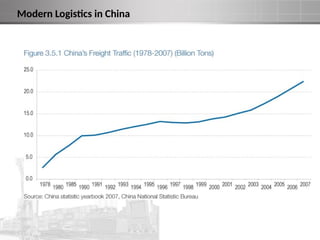
 China’s logistics industry experienced rapid growth since
China’s opening up and reform in 1978.
 In 2007, the nation’s total social logistics value reached
RMB 74.8 trillion, up 25.5% over 2006 (mainly boosted by the
logistics demand of industrial goods, imports and exports).
Modern Logistics in China
Understanding of modern Logistics by people
 Still a lot think logistics is transportation & warehousing
Logistics Human Resource
 By 2010, market demand for logistics professionals with
education of diploma or above: 300,000-400,000.
 People working in the industry that need training: >1 million
 Logisticians have been listed as among 12 professionals that are
in high shortage in China
In Shanghai itself, there has been a shortage of Logistics
professionals as large as 500,000.
Modern Logistics in China
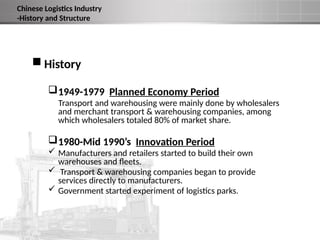
 History
1949-1979 Planned Economy Period
Transport and warehousing were mainly done by wholesalers
and merchant transport & warehousing companies, among
which wholesalers totaled 80% of market share.
1980-Mid 1990’s Innovation Period
 Manufacturers and retailers started to build their own
warehouses and fleets.
 Transport & warehousing companies began to provide
services directly to manufacturers.
 Government started experiment of logistics parks.
Chinese Logistics Industry
-History and Structure
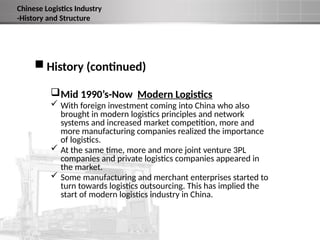
 History (continued)
Mid 1990’s-Now Modern Logistics
 With foreign investment coming into China who also
brought in modern logistics principles and network
systems and increased market competition, more and
more manufacturing companies realized the importance
of logistics.
 At the same time, more and more joint venture 3PL
companies and private logistics companies appeared in
the market.
 Some manufacturing and merchant enterprises started to
turn towards logistics outsourcing. This has implied the
start of modern logistics industry in China.
Chinese Logistics Industry
-History and Structure
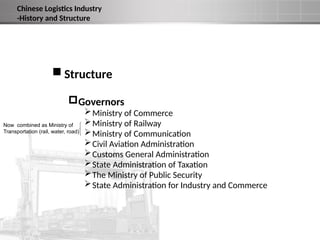
 Structure
Governors
Ministry of Commerce
Ministry of Railway
Ministry of Communication
Civil Aviation Administration
Customs General Administration
State Administration of Taxation
The Ministry of Public Security
State Administration for Industry and Commerce
Chinese Logistics Industry
-History and Structure
Now combined as Ministry of
Transportation (rail, water, road)
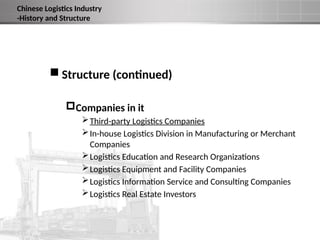
 Structure (continued)
Companies in it
Third-party Logistics Companies
In-house Logistics Division in Manufacturing or Merchant
Companies
Logistics Education and Research Organizations
Logistics Equipment and Facility Companies
Logistics Information Service and Consulting Companies
Logistics Real Estate Investors
Chinese Logistics Industry
-History and Structure
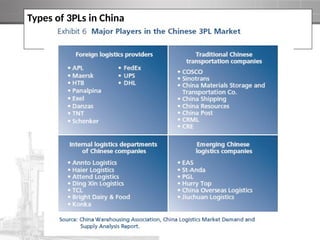
Types of 3PLs in China
 Central Policies
Current Policies
 Transport Related Policies
 Distribution Related Policies
 Foreign Investment Policies
 Taxation Policies
 Import & Export Policies
 Custom’s Regulations
 Inspection Regulations, etc.
Chinese Logistics Industry
-Policies
 Central Policies
 Nine ministries jointly announced <recommendations on promoting the
development of Chinese Logistics Industry>(2004).
 It says government will improve logistics development
environment from three areas: administration, taxation
and regulation of market system.
 It also announced 7 measures to be executed.
 National Development & Reform Commission, 13 government ministries,
2 associations: Ministerial Associate Meeting System (2005).
 Logistics has been set to be one of the 10 strategic industries that need
to be greatly developed (2009).
Chinese Logistics Industry
-Policies
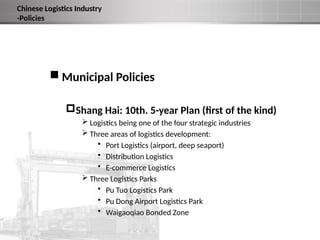
 Municipal Policies
Shang Hai: 10th. 5-year Plan (first of the kind)
 Logistics being one of the four strategic industries
 Three areas of logistics development:
• Port Logistics (airport, deep seaport)
• Distribution Logistics
• E-commerce Logistics
 Three Logistics Parks
• Pu Tuo Logistics Park
• Pu Dong Airport Logistics Park
• Waigaoqiao Bonded Zone
Chinese Logistics Industry
-Policies
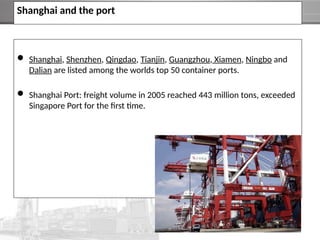
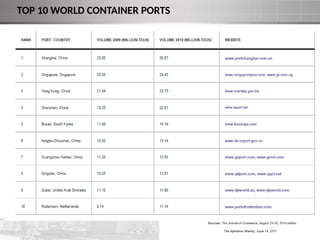
 Shanghai, Shenzhen, Qingdao, Tianjin, Guangzhou, Xiamen, Ningbo and
Dalian are listed among the worlds top 50 container ports.
 Shanghai Port: freight volume in 2005 reached 443 million tons, exceeded
Singapore Port for the first time.
Shanghai and the port
TOP 10 WORLD CONTAINER PORTS
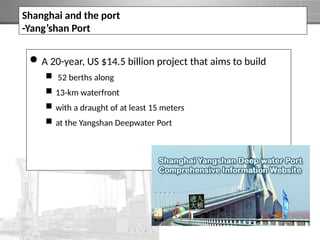
A 20-year, US $14.5 billion project that aims to build
 52 berths along
 13-km waterfront
 with a draught of at least 15 meters
 at the Yangshan Deepwater Port
Shanghai and the port
-Yang’shan Port
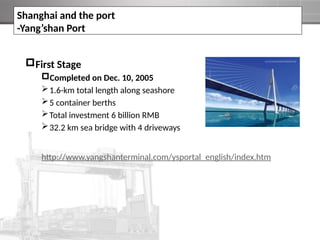
First Stage
Completed on Dec. 10, 2005
1.6-km total length along seashore
5 container berths
Total investment 6 billion RMB
32.2 km sea bridge with 4 driveways
http://www.yangshanterminal.com/ysportal_english/index.htm
Shanghai and the port
-Yang’shan Port
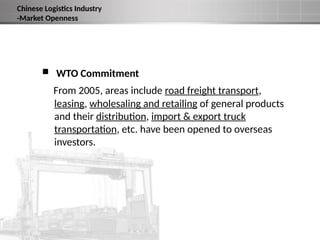
 WTO Commitment
From 2005, areas include road freight transport,
leasing, wholesaling and retailing of general products
and their distribution, import & export truck
transportation, etc. have been opened to overseas
investors.
Chinese Logistics Industry
-Market Openness
Chinese Logistics Industry
-Market Openness
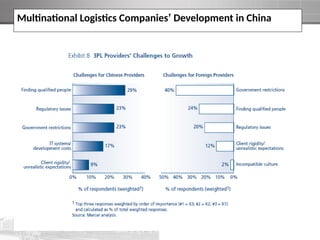
Multinational Logistics Companies’ Development in China
The Impact of Economic Crisis
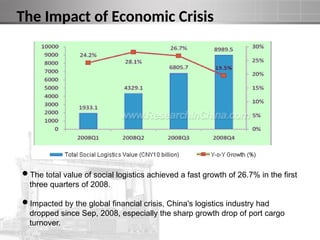
The total value of social logistics achieved a fast growth of 26.7% in the first
three quarters of 2008.
Impacted by the global financial crisis, China's logistics industry had
dropped since Sep, 2008, especially the sharp growth drop of port cargo
turnover.
The Impact of Economic Crisis
With the further influences of global economic crisis,
China’s logistics industry will step in the period of slow
growth and structural adjustment, which will also create
new development opportunities for some 3PLs.
In conclusion, China’s logistics industry has great
potential. The growth of total social logistics value
will be no less than 20%.

day 1 2 Case Study Chinese Logistics.pptx

  • 2.
    Modern Logistics inChina Concept of “Wu Liu” Modern Logistics Industry  Started from late 1990’s  China’s logistics industry experienced rapid growth since China’s opening up and reform in 1978.  In 2007, the nation’s total social logistics value reached RMB 74.8 trillion, up 25.5% over 2006 (mainly boosted by the logistics demand of industrial goods, imports and exports).
  • 3.
  • 4.
  • 5.
    Modern Logistics inChina Understanding of modern Logistics by people  Still a lot think logistics is transportation & warehousing Logistics Human Resource  By 2010, market demand for logistics professionals with education of diploma or above: 300,000-400,000.  People working in the industry that need training: >1 million  Logisticians have been listed as among 12 professionals that are in high shortage in China In Shanghai itself, there has been a shortage of Logistics professionals as large as 500,000.
  • 6.
  • 7.
     History 1949-1979 PlannedEconomy Period Transport and warehousing were mainly done by wholesalers and merchant transport & warehousing companies, among which wholesalers totaled 80% of market share. 1980-Mid 1990’s Innovation Period  Manufacturers and retailers started to build their own warehouses and fleets.  Transport & warehousing companies began to provide services directly to manufacturers.  Government started experiment of logistics parks. Chinese Logistics Industry -History and Structure
  • 8.
     History (continued) Mid1990’s-Now Modern Logistics  With foreign investment coming into China who also brought in modern logistics principles and network systems and increased market competition, more and more manufacturing companies realized the importance of logistics.  At the same time, more and more joint venture 3PL companies and private logistics companies appeared in the market.  Some manufacturing and merchant enterprises started to turn towards logistics outsourcing. This has implied the start of modern logistics industry in China. Chinese Logistics Industry -History and Structure
  • 9.
     Structure Governors Ministry ofCommerce Ministry of Railway Ministry of Communication Civil Aviation Administration Customs General Administration State Administration of Taxation The Ministry of Public Security State Administration for Industry and Commerce Chinese Logistics Industry -History and Structure Now combined as Ministry of Transportation (rail, water, road)
  • 10.
     Structure (continued) Companiesin it Third-party Logistics Companies In-house Logistics Division in Manufacturing or Merchant Companies Logistics Education and Research Organizations Logistics Equipment and Facility Companies Logistics Information Service and Consulting Companies Logistics Real Estate Investors Chinese Logistics Industry -History and Structure
  • 11.
    Types of 3PLsin China
  • 12.
     Central Policies CurrentPolicies  Transport Related Policies  Distribution Related Policies  Foreign Investment Policies  Taxation Policies  Import & Export Policies  Custom’s Regulations  Inspection Regulations, etc. Chinese Logistics Industry -Policies
  • 13.
     Central Policies Nine ministries jointly announced <recommendations on promoting the development of Chinese Logistics Industry>(2004).  It says government will improve logistics development environment from three areas: administration, taxation and regulation of market system.  It also announced 7 measures to be executed.  National Development & Reform Commission, 13 government ministries, 2 associations: Ministerial Associate Meeting System (2005).  Logistics has been set to be one of the 10 strategic industries that need to be greatly developed (2009). Chinese Logistics Industry -Policies
  • 14.
     Municipal Policies ShangHai: 10th. 5-year Plan (first of the kind)  Logistics being one of the four strategic industries  Three areas of logistics development: • Port Logistics (airport, deep seaport) • Distribution Logistics • E-commerce Logistics  Three Logistics Parks • Pu Tuo Logistics Park • Pu Dong Airport Logistics Park • Waigaoqiao Bonded Zone Chinese Logistics Industry -Policies
  • 15.
     Shanghai, Shenzhen,Qingdao, Tianjin, Guangzhou, Xiamen, Ningbo and Dalian are listed among the worlds top 50 container ports.  Shanghai Port: freight volume in 2005 reached 443 million tons, exceeded Singapore Port for the first time. Shanghai and the port
  • 16.
    TOP 10 WORLDCONTAINER PORTS
  • 17.
    A 20-year, US$14.5 billion project that aims to build  52 berths along  13-km waterfront  with a draught of at least 15 meters  at the Yangshan Deepwater Port Shanghai and the port -Yang’shan Port
  • 18.
    First Stage Completed onDec. 10, 2005 1.6-km total length along seashore 5 container berths Total investment 6 billion RMB 32.2 km sea bridge with 4 driveways http://www.yangshanterminal.com/ysportal_english/index.htm Shanghai and the port -Yang’shan Port
  • 19.
     WTO Commitment From2005, areas include road freight transport, leasing, wholesaling and retailing of general products and their distribution, import & export truck transportation, etc. have been opened to overseas investors. Chinese Logistics Industry -Market Openness
  • 20.
  • 21.
  • 22.
  • 23.
    The Impact ofEconomic Crisis The total value of social logistics achieved a fast growth of 26.7% in the first three quarters of 2008. Impacted by the global financial crisis, China's logistics industry had dropped since Sep, 2008, especially the sharp growth drop of port cargo turnover.
  • 24.
    The Impact ofEconomic Crisis With the further influences of global economic crisis, China’s logistics industry will step in the period of slow growth and structural adjustment, which will also create new development opportunities for some 3PLs.
  • 25.
    In conclusion, China’slogistics industry has great potential. The growth of total social logistics value will be no less than 20%.