by Lindsay Illich
 Curry College
    CEA 2012
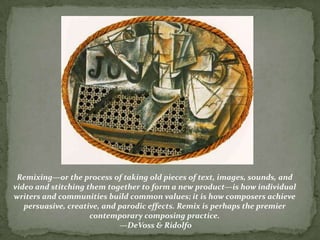
Remixing—or the process of taking old pieces of text, images, sounds, and
video and stitching them together to form a new product—is how individual
writers and communities build common values; it is how composers achieve
   persuasive, creative, and parodic effects. Remix is perhaps the premier
                     contemporary composing practice.
                             —DeVoss & Ridolfo
Sampling
Today, sampling is practiced in new media culture when
any software users including creative industry
professionals as well as average consumers apply cut/copy
& paste in diverse software applications; for professionals
this could mean 3-D modeling software like Maya (used to
develop animations in films like Spiderman or Lord of the
Rings );[1] and for average persons it could mean Microsoft
Word, often used to write texts like this one. Cut/copy &
paste is a vital new media feature in the development of
Remix. In Web 2.0 applications cut/copy & paste is a
necessary element to develop mashups; yet the cultural
model of mashups is not limited to software, but spans
across media.

Eduardo Navas
“Regressive and Reflexive Mashups in Sampling Culture”
Sampling as a Metaphor for Thinking and Writing

In a DJ’s world, making a new song requires samples from other songs. To
sample from a song is to borrow a few bars of melody or a bass line.


You can see how this translates to composing: written texts are culled, shaped,
patterned on prior knowledge, which itself includes knowledge of genre,
quotes, ideas, what things you’ve heard. Essentially, a writer brings the vast
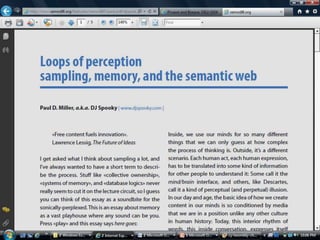
sum of memory, what DJ Spooky calls “a vast playhouse” and, later an “archive.”
On the meta-level, the world wide web represents a culture’s memory out of
which new artifacts are made.


Ultimately, says DJ Spooky, “as an artist you’re only as good as your archive.
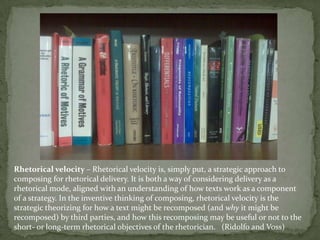
Rhetorical velocity – Rhetorical velocity is, simply put, a strategic approach to
composing for rhetorical delivery. It is both a way of considering delivery as a
rhetorical mode, aligned with an understanding of how texts work as a component
of a strategy. In the inventive thinking of composing, rhetorical velocity is the
strategic theorizing for how a text might be recomposed (and why it might be
recomposed) by third parties, and how this recomposing may be useful or not to the
short- or long-term rhetorical objectives of the rhetorician. (Ridolfo and Voss)
What’s in your archive?
lindsay_illich@hotmail.com
    lillich0511@curry.edu

CEA 2012

  • 1.
    by Lindsay Illich Curry College CEA 2012
  • 2.
    Remixing—or the processof taking old pieces of text, images, sounds, and video and stitching them together to form a new product—is how individual writers and communities build common values; it is how composers achieve persuasive, creative, and parodic effects. Remix is perhaps the premier contemporary composing practice. —DeVoss & Ridolfo
  • 3.
    Sampling Today, sampling ispracticed in new media culture when any software users including creative industry professionals as well as average consumers apply cut/copy & paste in diverse software applications; for professionals this could mean 3-D modeling software like Maya (used to develop animations in films like Spiderman or Lord of the Rings );[1] and for average persons it could mean Microsoft Word, often used to write texts like this one. Cut/copy & paste is a vital new media feature in the development of Remix. In Web 2.0 applications cut/copy & paste is a necessary element to develop mashups; yet the cultural model of mashups is not limited to software, but spans across media. Eduardo Navas “Regressive and Reflexive Mashups in Sampling Culture”
  • 5.
    Sampling as aMetaphor for Thinking and Writing In a DJ’s world, making a new song requires samples from other songs. To sample from a song is to borrow a few bars of melody or a bass line. You can see how this translates to composing: written texts are culled, shaped, patterned on prior knowledge, which itself includes knowledge of genre, quotes, ideas, what things you’ve heard. Essentially, a writer brings the vast sum of memory, what DJ Spooky calls “a vast playhouse” and, later an “archive.” On the meta-level, the world wide web represents a culture’s memory out of which new artifacts are made. Ultimately, says DJ Spooky, “as an artist you’re only as good as your archive.
  • 6.
    Rhetorical velocity –Rhetorical velocity is, simply put, a strategic approach to composing for rhetorical delivery. It is both a way of considering delivery as a rhetorical mode, aligned with an understanding of how texts work as a component of a strategy. In the inventive thinking of composing, rhetorical velocity is the strategic theorizing for how a text might be recomposed (and why it might be recomposed) by third parties, and how this recomposing may be useful or not to the short- or long-term rhetorical objectives of the rhetorician. (Ridolfo and Voss)
  • 7.
  • 8.
    lindsay_illich@hotmail.com lillich0511@curry.edu