MADE BY -
Isha Sharma 22bcon1350
Anish kushwaha 22bcon760
SUBMITTED TO -
Dr. Kapil Sharma
INTRODUCTION
The Bhagavad Gita is a sacred Hindu
text that offers insights on managing
life effectively. It teaches us how to
lead a balanced life, overcome
challenges, and achieve our goals. This
presentation will explore some of the
key teachings of the Bhagavad Gita
and how they can be applied to
manage our lives.
BACKGROU
ND
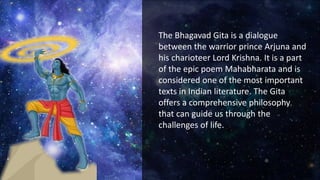
The Bhagavad Gita is a dialogue
between the warrior prince Arjuna and
his charioteer Lord Krishna. It is a part
of the epic poem Mahabharata and is
considered one of the most important
texts in Indian literature. The Gita
offers a comprehensive philosophy
that can guide us through the
challenges of life.
KEY
CONCEPTS
The Bhagavad Gita teaches us several key concepts that can help us
manage our lives effectively. These concepts include:
• Dharma: The duty or righteousness of an individual in their social and
spiritual roles.
• Karma: The law of cause and effect, where every action has consequences
that determine one's future.
• Yoga: The path of self-realization through spiritual practice, meditation,
and detachment from material desires.
• Atman: The eternal soul or essence of an individual that is connected to
the universal spirit or Brahman.
Chapter 1 -
Arjuna's
Dilemma
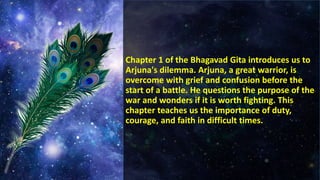
Chapter 1 of the Bhagavad Gita introduces us to
Arjuna's dilemma. Arjuna, a great warrior, is
overcome with grief and confusion before the
start of a battle. He questions the purpose of the
war and wonders if it is worth fighting. This
chapter teaches us the importance of duty,
courage, and faith in difficult times.
Chapter 2 - Self-
Knowledge
Chapter 2 of the Bhagavad Gita is one of the
most important chapters. Lord Krishna
teaches Arjuna about self-knowledge,
which is the key to liberation. He explains
that the soul is eternal and that it is our
true identity. This chapter teaches us the
importance of self-awareness, detachment,
and action without attachment.
Chapter 3 - Performance of
Action
Chapter 3 of the Bhagavad Gita teaches us about the
performance of action. Lord Krishna explains that performing
one's duty is necessary for the maintenance of the world. He
also explains that performing action without attachment is
the path to liberation. This chapter teaches us the
importance of doing our duty without expecting any results.
Action
Chapter 4 -
Knowledge of
Action and
Inaction
Chapter 4 of the Bhagavad Gita
teaches us about the knowledge of
action and inaction. Lord Krishna
explains that true action is that which
is performed without attachment,
while inaction is that which is
performed with attachment. This
chapter teaches us the importance of
selfless action and surrendering to
God.

Chapter 5 -
Renunciatio
n of Action
Chapter 5 of the Bhagavad Gita
teaches us about the renunciation
of action. Lord Krishna explains
that true renunciation is not the
renunciation of action, but the
renunciation of the desire for the
fruits of action. This chapter
teaches us the importance of
detachment and selfless action.
Chapter 6 -
Self-Control
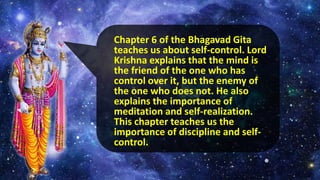
Chapter 6 of the Bhagavad Gita
teaches us about self-control. Lord
Krishna explains that the mind is
the friend of the one who has
control over it, but the enemy of
the one who does not. He also
explains the importance of
meditation and self-realization.
This chapter teaches us the
importance of discipline and self-
control.
Chapter 7 -
Knowledge of
God
Chapter 7 of the Bhagavad Gita
teaches us about the knowledge of
God. Lord Krishna explains that he
is the source of everything and that
everything else is temporary. He
also explains the importance of
surrendering to him. This chapter
teaches us the importance of
devotion and surrender.
Chapter 8 -
Attaining the
Supreme
Chapter 8 of the Bhagavad Gita teaches us
how to attain the Supreme. Lord Krishna
explains that at the time of death, one's
thoughts determine one's next
destination. By thinking of God and
chanting his name, we can attain
liberation and reach the Supreme. This
chapter also teaches us the importance of
meditation and surrendering to God.
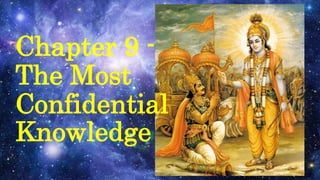
Chapter 9 -
The Most
Confidential
Knowledge
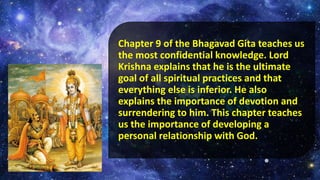
Chapter 9 of the Bhagavad Gita teaches us
the most confidential knowledge. Lord
Krishna explains that he is the ultimate
goal of all spiritual practices and that
everything else is inferior. He also
explains the importance of devotion and
surrendering to him. This chapter teaches
us the importance of developing a
personal relationship with God.
Chapter 10 -
The Opulence
of the Absolute
Chapter 10 of the Bhagavad Gita
teaches us about the opulence of the
Absolute. Lord Krishna explains his
divine qualities and his role as the
source of everything. He also explains
that those who are devoted to him
attain him. This chapter teaches us the
importance of recognizing God's
greatness and developing devotion
towards him.
Chapter 11 - The Universal
Form
Chapter 11 of the Bhagavad
Gita is a pivotal chapter.
Lord Krishna reveals his
universal form(Vishvarupa)
to Arjuna, which shows his
divine nature and power.
This chapter teaches us the
importance of recognizing
God's omnipotence and
surrendering to him.
Chapter 12 - Devotional
Service
Chapter 12 of the Bhagavad Gita teaches us about
devotional service. Lord Krishna explains that those
who are devoted to him with faith and love are dear
to him. He also explains the different levels of
devotion and the benefits of being devoted to him.
This chapter teaches us the importance of
developing devotion towards God and serving him
with love.
Chapter 13 - Nature and
the Soul
Chapter 13 of the Bhagavad Gita explains
the relationship between nature and the
soul. Lord Krishna explains that the soul is
distinct from the body and the mind, and
that we should strive to realize our true
nature.This chapter teaches us the
importance of self-awareness and self-
realization.
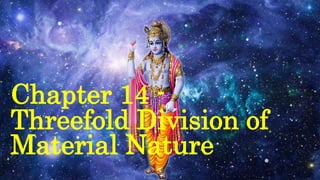
Chapter 14 -
Threefold Division of
Material Nature
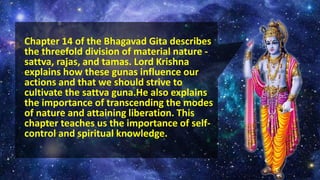
Chapter 14 of the Bhagavad Gita describes
the threefold division of material nature -
sattva, rajas, and tamas. Lord Krishna
explains how these gunas influence our
actions and that we should strive to
cultivate the sattva guna.He also explains
the importance of transcending the modes
of nature and attaining liberation. This
chapter teaches us the importance of self-
control and spiritual knowledge.
Chapter 15 -
The Supreme
Spirit
Chapter 15 of the Bhagavad
Gita describes the Supreme
Spirit or Brahman. Lord Krishna
explains that Brahman is the
eternal and indestructible
essence that pervades
everything and that we should
strive to realize our connection
to it.
Chapter 16 -
Divine and Demonic
Nature
Chapter 16 of the Bhagavad Gita teaches
us about the divine and demoniac
natures. Lord Krishna explains the
characteristics of those who have divine
qualities and those who have demoniac
qualities. He also explains the importance
of cultivating divine qualities and avoiding
demoniac qualities. This chapter teaches
us the importance of developing positive
qualities and avoiding negative ones.
Chapter 17 -
The Threefold
Division of Faith
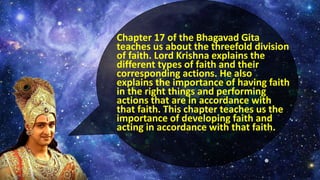
Chapter 17 of the Bhagavad Gita
teaches us about the threefold division
of faith. Lord Krishna explains the
different types of faith and their
corresponding actions. He also
explains the importance of having faith
in the right things and performing
actions that are in accordance with
that faith. This chapter teaches us the
importance of developing faith and
acting in accordance with that faith.
Chapter 18 -
Conclusion -
The
Perfection of
Renunciation
Chapter 18 of the Bhagavad Gita is the
concluding chapter. Lord Krishna
summarizes the teachings of the
previous chapters and explains the
ultimate goal of life - attaining
liberation and realizing the true
nature of the self. He also explains the
different paths of yoga and their
corresponding results. This chapter
teaches us the importance of
renunciation, self-realization, and
attaining the ultimate goal of life.
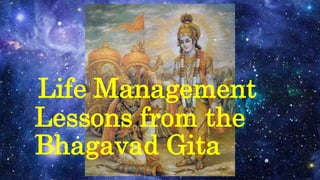
Life Management
Lessons from the
Bhagavad Gita
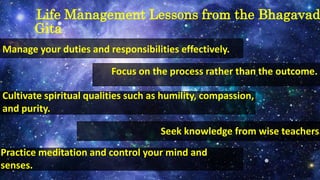
Life Management Lessons from the Bhagavad
Gita
Manage your duties and responsibilities effectively.
Focus on the process rather than the outcome.
Cultivate spiritual qualities such as humility, compassion,
and purity.
Seek knowledge from wise teachers.
Practice meditation and control your mind and
senses.
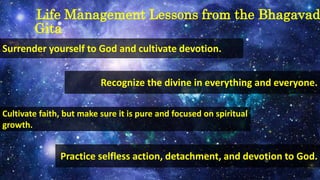
Life Management Lessons from the Bhagavad
Gita
Surrender yourself to God and cultivate devotion.
Recognize the divine in everything and everyone.
Cultivate faith, but make sure it is pure and focused on spiritual
growth.
Practice selfless action, detachment, and devotion to God.
Conclusion
on
In conclusion, the Bhagavad Gita is a timeless text that
teaches us about the nature of the self, the ultimate goal of
life, and the path to attain it. Its teachings on life
management are relevant even in today's world. By focusing
on our duty, developing self-control, cultivating positive
qualities, and developing a personal relationship with God,
we can improve our lives and become better individuals. The
Bhagavad Gita is a valuable guide that can help us navigate
the challenges of life and find inner peace and happiness

CE sem2.pptx

  • 1.
    MADE BY - IshaSharma 22bcon1350 Anish kushwaha 22bcon760 SUBMITTED TO - Dr. Kapil Sharma
  • 3.
    INTRODUCTION The Bhagavad Gitais a sacred Hindu text that offers insights on managing life effectively. It teaches us how to lead a balanced life, overcome challenges, and achieve our goals. This presentation will explore some of the key teachings of the Bhagavad Gita and how they can be applied to manage our lives.
  • 4.
  • 5.
    The Bhagavad Gitais a dialogue between the warrior prince Arjuna and his charioteer Lord Krishna. It is a part of the epic poem Mahabharata and is considered one of the most important texts in Indian literature. The Gita offers a comprehensive philosophy that can guide us through the challenges of life.
  • 6.
  • 7.
    The Bhagavad Gitateaches us several key concepts that can help us manage our lives effectively. These concepts include: • Dharma: The duty or righteousness of an individual in their social and spiritual roles. • Karma: The law of cause and effect, where every action has consequences that determine one's future. • Yoga: The path of self-realization through spiritual practice, meditation, and detachment from material desires. • Atman: The eternal soul or essence of an individual that is connected to the universal spirit or Brahman.
  • 8.
  • 9.
    Chapter 1 ofthe Bhagavad Gita introduces us to Arjuna's dilemma. Arjuna, a great warrior, is overcome with grief and confusion before the start of a battle. He questions the purpose of the war and wonders if it is worth fighting. This chapter teaches us the importance of duty, courage, and faith in difficult times.
  • 10.
    Chapter 2 -Self- Knowledge
  • 11.
    Chapter 2 ofthe Bhagavad Gita is one of the most important chapters. Lord Krishna teaches Arjuna about self-knowledge, which is the key to liberation. He explains that the soul is eternal and that it is our true identity. This chapter teaches us the importance of self-awareness, detachment, and action without attachment.
  • 12.
    Chapter 3 -Performance of Action
  • 13.
    Chapter 3 ofthe Bhagavad Gita teaches us about the performance of action. Lord Krishna explains that performing one's duty is necessary for the maintenance of the world. He also explains that performing action without attachment is the path to liberation. This chapter teaches us the importance of doing our duty without expecting any results. Action
  • 14.
    Chapter 4 - Knowledgeof Action and Inaction
  • 15.
    Chapter 4 ofthe Bhagavad Gita teaches us about the knowledge of action and inaction. Lord Krishna explains that true action is that which is performed without attachment, while inaction is that which is performed with attachment. This chapter teaches us the importance of selfless action and surrendering to God.

  • 16.
  • 17.
    Chapter 5 ofthe Bhagavad Gita teaches us about the renunciation of action. Lord Krishna explains that true renunciation is not the renunciation of action, but the renunciation of the desire for the fruits of action. This chapter teaches us the importance of detachment and selfless action.
  • 18.
  • 19.
    Chapter 6 ofthe Bhagavad Gita teaches us about self-control. Lord Krishna explains that the mind is the friend of the one who has control over it, but the enemy of the one who does not. He also explains the importance of meditation and self-realization. This chapter teaches us the importance of discipline and self- control.
  • 20.
  • 21.
    Chapter 7 ofthe Bhagavad Gita teaches us about the knowledge of God. Lord Krishna explains that he is the source of everything and that everything else is temporary. He also explains the importance of surrendering to him. This chapter teaches us the importance of devotion and surrender.
  • 22.
  • 23.
    Chapter 8 ofthe Bhagavad Gita teaches us how to attain the Supreme. Lord Krishna explains that at the time of death, one's thoughts determine one's next destination. By thinking of God and chanting his name, we can attain liberation and reach the Supreme. This chapter also teaches us the importance of meditation and surrendering to God.
  • 24.
    Chapter 9 - TheMost Confidential Knowledge
  • 25.
    Chapter 9 ofthe Bhagavad Gita teaches us the most confidential knowledge. Lord Krishna explains that he is the ultimate goal of all spiritual practices and that everything else is inferior. He also explains the importance of devotion and surrendering to him. This chapter teaches us the importance of developing a personal relationship with God.
  • 26.
    Chapter 10 - TheOpulence of the Absolute
  • 27.
    Chapter 10 ofthe Bhagavad Gita teaches us about the opulence of the Absolute. Lord Krishna explains his divine qualities and his role as the source of everything. He also explains that those who are devoted to him attain him. This chapter teaches us the importance of recognizing God's greatness and developing devotion towards him.
  • 28.
    Chapter 11 -The Universal Form
  • 29.
    Chapter 11 ofthe Bhagavad Gita is a pivotal chapter. Lord Krishna reveals his universal form(Vishvarupa) to Arjuna, which shows his divine nature and power. This chapter teaches us the importance of recognizing God's omnipotence and surrendering to him.
  • 30.
    Chapter 12 -Devotional Service
  • 31.
    Chapter 12 ofthe Bhagavad Gita teaches us about devotional service. Lord Krishna explains that those who are devoted to him with faith and love are dear to him. He also explains the different levels of devotion and the benefits of being devoted to him. This chapter teaches us the importance of developing devotion towards God and serving him with love.
  • 32.
    Chapter 13 -Nature and the Soul
  • 33.
    Chapter 13 ofthe Bhagavad Gita explains the relationship between nature and the soul. Lord Krishna explains that the soul is distinct from the body and the mind, and that we should strive to realize our true nature.This chapter teaches us the importance of self-awareness and self- realization.
  • 34.
    Chapter 14 - ThreefoldDivision of Material Nature
  • 35.
    Chapter 14 ofthe Bhagavad Gita describes the threefold division of material nature - sattva, rajas, and tamas. Lord Krishna explains how these gunas influence our actions and that we should strive to cultivate the sattva guna.He also explains the importance of transcending the modes of nature and attaining liberation. This chapter teaches us the importance of self- control and spiritual knowledge.
  • 36.
    Chapter 15 - TheSupreme Spirit
  • 37.
    Chapter 15 ofthe Bhagavad Gita describes the Supreme Spirit or Brahman. Lord Krishna explains that Brahman is the eternal and indestructible essence that pervades everything and that we should strive to realize our connection to it.
  • 38.
    Chapter 16 - Divineand Demonic Nature
  • 39.
    Chapter 16 ofthe Bhagavad Gita teaches us about the divine and demoniac natures. Lord Krishna explains the characteristics of those who have divine qualities and those who have demoniac qualities. He also explains the importance of cultivating divine qualities and avoiding demoniac qualities. This chapter teaches us the importance of developing positive qualities and avoiding negative ones.
  • 40.
    Chapter 17 - TheThreefold Division of Faith
  • 41.
    Chapter 17 ofthe Bhagavad Gita teaches us about the threefold division of faith. Lord Krishna explains the different types of faith and their corresponding actions. He also explains the importance of having faith in the right things and performing actions that are in accordance with that faith. This chapter teaches us the importance of developing faith and acting in accordance with that faith.
  • 42.
    Chapter 18 - Conclusion- The Perfection of Renunciation
  • 43.
    Chapter 18 ofthe Bhagavad Gita is the concluding chapter. Lord Krishna summarizes the teachings of the previous chapters and explains the ultimate goal of life - attaining liberation and realizing the true nature of the self. He also explains the different paths of yoga and their corresponding results. This chapter teaches us the importance of renunciation, self-realization, and attaining the ultimate goal of life.
  • 44.
  • 45.
    Life Management Lessonsfrom the Bhagavad Gita Manage your duties and responsibilities effectively. Focus on the process rather than the outcome. Cultivate spiritual qualities such as humility, compassion, and purity. Seek knowledge from wise teachers. Practice meditation and control your mind and senses.
  • 46.
    Life Management Lessonsfrom the Bhagavad Gita Surrender yourself to God and cultivate devotion. Recognize the divine in everything and everyone. Cultivate faith, but make sure it is pure and focused on spiritual growth. Practice selfless action, detachment, and devotion to God.
  • 47.
  • 48.
    on In conclusion, theBhagavad Gita is a timeless text that teaches us about the nature of the self, the ultimate goal of life, and the path to attain it. Its teachings on life management are relevant even in today's world. By focusing on our duty, developing self-control, cultivating positive qualities, and developing a personal relationship with God, we can improve our lives and become better individuals. The Bhagavad Gita is a valuable guide that can help us navigate the challenges of life and find inner peace and happiness