www.oeko.de
Common Reporting Tables (CRTs) for
GHG Inventories
Structure of CRTs and Reporting Software
Lorenz Moosmann
OECD CCXG Global Forum
15 September 2020
2
www.oeko.de
Contents of the presentation
● Building upon CRF tables, what elements of CRTs can be improved
to promote …
‒ TACCC principles?
‒ the technical expert review?
● How can reporting software facilitate the reporting of information on
national GHG inventories through CRTs?
● Conclusions on CRTs and electronic reporting
CRTs for GHG Inventories │Lorenz Moosmann│CCXG│15 September 2020
3
www.oeko.de
What elements of CRTs can be improved to promote
TACCC principles? (I)
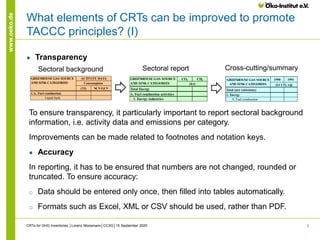
● Transparency
To ensure transparency, it particularly important to report sectoral background
information, i.e. activity data and emissions per category.
Improvements can be made related to footnotes and notation keys.
● Accuracy
In reporting, it has to be ensured that numbers are not changed, rounded or
truncated. To ensure accuracy:
o Data should be entered only once, then filled into tables automatically.
o Formats such as Excel, XML or CSV should be used, rather than PDF.
CRTs for GHG Inventories │Lorenz Moosmann│CCXG│15 September 2020
(TJ) NCV/GCV
1.A. Fuel combustion
Liquid fuels
GREENHOUSE GAS SOURCE
AND SINK CATEGORIES
ACTIVITY DATA
Consumption
CO2 CH4
Total Energy
A. Fuel combustion activities
1. Energy industries
GREENHOUSE GAS SOURCE
AND SINK CATEGORIES (kt)
1990 1991
Total (net emissions)
1. Energy
A. Fuel combustion
(kt CO2 eq)
GREENHOUSE GAS SOURCE
AND SINK CATEGORIES
Sectoral background Sectoral report Cross-cutting/summary
4
www.oeko.de
What elements of CRTs can be improved to promote
TACCC principles? (II)
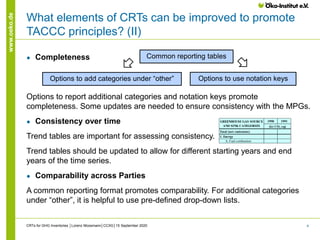
● Completeness
Options to report additional categories and notation keys promote
completeness. Some updates are needed to ensure consistency with the MPGs.
● Consistency over time
Trend tables are important for assessing consistency.
Trend tables should be updated to allow for different starting years and end
years of the time series.
● Comparability across Parties
A common reporting format promotes comparability. For additional categories
under “other”, it is helpful to use pre-defined drop-down lists.
CRTs for GHG Inventories │Lorenz Moosmann│CCXG│15 September 2020
Common reporting tables
Options to add categories under “other” Options to use notation keys
1990 1991
Total (net emissions)
1. Energy
A. Fuel combustion
(kt CO2 eq)
GREENHOUSE GAS SOURCE
AND SINK CATEGORIES
5
www.oeko.de
What elements of CRTs can be improved to promote
the technical expert review?
In order to facilitate the technical expert review …
● CRTs need to follow a common format. There may be some differences, e.g.
Parties may add certain categories, but the overall format should be as
standardised as possible.
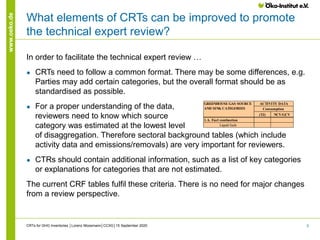
● For a proper understanding of the data,
reviewers need to know which source
category was estimated at the lowest level
of disaggregation. Therefore sectoral background tables (which include
activity data and emissions/removals) are very important for reviewers.
● CTRs should contain additional information, such as a list of key categories
or explanations for categories that are not estimated.
The current CRF tables fulfil these criteria. There is no need for major changes
from a review perspective.
CRTs for GHG Inventories │Lorenz Moosmann│CCXG│15 September 2020
(TJ) NCV/GCV
1.A. Fuel combustion
Liquid fuels
GREENHOUSE GAS SOURCE
AND SINK CATEGORIES
ACTIVITY DATA
Consumption
6
www.oeko.de
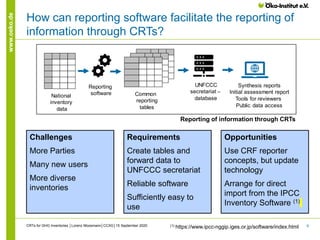
How can reporting software facilitate the reporting of
information through CRTs?
(1) https://www.ipcc-nggip.iges.or.jp/software/index.htmlCRTs for GHG Inventories │Lorenz Moosmann│CCXG│15 September 2020
Opportunities
Use CRF reporter
concepts, but update
technology
Arrange for direct
import from the IPCC
Inventory Software (1)
Requirements
Create tables and
forward data to
UNFCCC secretariat
Reliable software
Sufficiently easy to
use
Challenges
More Parties
Many new users
More diverse
inventories
Reporting of information through CRTs
National
inventory
data
Common
reporting
tables
UNFCCC
secretariat –
database
Synthesis reports
Initial assessment report
Tools for reviewers
Public data access
Reporting
software
7
www.oeko.de
Conclusions
CRTs for GHG Inventories │Lorenz Moosmann│CCXG│15 September 2020
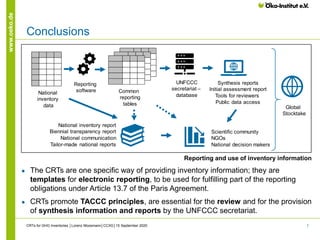
● The CRTs are one specific way of providing inventory information; they are
templates for electronic reporting, to be used for fulfilling part of the reporting
obligations under Article 13.7 of the Paris Agreement.
● CRTs promote TACCC principles, are essential for the review and for the provision
of synthesis information and reports by the UNFCCC secretariat.
Reporting and use of inventory information
National inventory report
Biennial transparency report
National communication
Tailor-made national reports
Scientific community
NGOs
National decision makers
Global
Stocktake
National
inventory
data
Common
reporting
tables
UNFCCC
secretariat –
database
Synthesis reports
Initial assessment report
Tools for reviewers
Public data access
Reporting
software

CCXG Forum, September 2020, Lorenz Moosmann

  • 1.
    www.oeko.de Common Reporting Tables(CRTs) for GHG Inventories Structure of CRTs and Reporting Software Lorenz Moosmann OECD CCXG Global Forum 15 September 2020
  • 2.
    2 www.oeko.de Contents of thepresentation ● Building upon CRF tables, what elements of CRTs can be improved to promote … ‒ TACCC principles? ‒ the technical expert review? ● How can reporting software facilitate the reporting of information on national GHG inventories through CRTs? ● Conclusions on CRTs and electronic reporting CRTs for GHG Inventories │Lorenz Moosmann│CCXG│15 September 2020
  • 3.
    3 www.oeko.de What elements ofCRTs can be improved to promote TACCC principles? (I) ● Transparency To ensure transparency, it particularly important to report sectoral background information, i.e. activity data and emissions per category. Improvements can be made related to footnotes and notation keys. ● Accuracy In reporting, it has to be ensured that numbers are not changed, rounded or truncated. To ensure accuracy: o Data should be entered only once, then filled into tables automatically. o Formats such as Excel, XML or CSV should be used, rather than PDF. CRTs for GHG Inventories │Lorenz Moosmann│CCXG│15 September 2020 (TJ) NCV/GCV 1.A. Fuel combustion Liquid fuels GREENHOUSE GAS SOURCE AND SINK CATEGORIES ACTIVITY DATA Consumption CO2 CH4 Total Energy A. Fuel combustion activities 1. Energy industries GREENHOUSE GAS SOURCE AND SINK CATEGORIES (kt) 1990 1991 Total (net emissions) 1. Energy A. Fuel combustion (kt CO2 eq) GREENHOUSE GAS SOURCE AND SINK CATEGORIES Sectoral background Sectoral report Cross-cutting/summary
  • 4.
    4 www.oeko.de What elements ofCRTs can be improved to promote TACCC principles? (II) ● Completeness Options to report additional categories and notation keys promote completeness. Some updates are needed to ensure consistency with the MPGs. ● Consistency over time Trend tables are important for assessing consistency. Trend tables should be updated to allow for different starting years and end years of the time series. ● Comparability across Parties A common reporting format promotes comparability. For additional categories under “other”, it is helpful to use pre-defined drop-down lists. CRTs for GHG Inventories │Lorenz Moosmann│CCXG│15 September 2020 Common reporting tables Options to add categories under “other” Options to use notation keys 1990 1991 Total (net emissions) 1. Energy A. Fuel combustion (kt CO2 eq) GREENHOUSE GAS SOURCE AND SINK CATEGORIES
  • 5.
    5 www.oeko.de What elements ofCRTs can be improved to promote the technical expert review? In order to facilitate the technical expert review … ● CRTs need to follow a common format. There may be some differences, e.g. Parties may add certain categories, but the overall format should be as standardised as possible. ● For a proper understanding of the data, reviewers need to know which source category was estimated at the lowest level of disaggregation. Therefore sectoral background tables (which include activity data and emissions/removals) are very important for reviewers. ● CTRs should contain additional information, such as a list of key categories or explanations for categories that are not estimated. The current CRF tables fulfil these criteria. There is no need for major changes from a review perspective. CRTs for GHG Inventories │Lorenz Moosmann│CCXG│15 September 2020 (TJ) NCV/GCV 1.A. Fuel combustion Liquid fuels GREENHOUSE GAS SOURCE AND SINK CATEGORIES ACTIVITY DATA Consumption
  • 6.
    6 www.oeko.de How can reportingsoftware facilitate the reporting of information through CRTs? (1) https://www.ipcc-nggip.iges.or.jp/software/index.htmlCRTs for GHG Inventories │Lorenz Moosmann│CCXG│15 September 2020 Opportunities Use CRF reporter concepts, but update technology Arrange for direct import from the IPCC Inventory Software (1) Requirements Create tables and forward data to UNFCCC secretariat Reliable software Sufficiently easy to use Challenges More Parties Many new users More diverse inventories Reporting of information through CRTs National inventory data Common reporting tables UNFCCC secretariat – database Synthesis reports Initial assessment report Tools for reviewers Public data access Reporting software
  • 7.
    7 www.oeko.de Conclusions CRTs for GHGInventories │Lorenz Moosmann│CCXG│15 September 2020 ● The CRTs are one specific way of providing inventory information; they are templates for electronic reporting, to be used for fulfilling part of the reporting obligations under Article 13.7 of the Paris Agreement. ● CRTs promote TACCC principles, are essential for the review and for the provision of synthesis information and reports by the UNFCCC secretariat. Reporting and use of inventory information National inventory report Biennial transparency report National communication Tailor-made national reports Scientific community NGOs National decision makers Global Stocktake National inventory data Common reporting tables UNFCCC secretariat – database Synthesis reports Initial assessment report Tools for reviewers Public data access Reporting software