PROCEDURES TO BE
FOLLOWED DURING CROWD
DISPERSAL
MR. AVINASH C
ASSISTANT PROFESSOR
DEPARTMENT OF CRIMINOLOGY
• Bonafede acts of Executive Magistrate, Police Officers, Officers and other
members of the armed forces, and persons acting in compliance with requisition
made under section 129 or 130 CrPC, are outside the category of offence.
• Section 129 CrPC gives the power to disperse an unlawful assembly by force to
any Executive Magistrate or Officer in charge of a police station, or in the
absence of the officer in charge of police station to any police officer not below
the rank of sub-inspector.
• Section 197 CrPC gives protection to public servants for acts done under the
lawful discharge of their duty. The right of private defence, however, should be
exercise with utmost caution.
• If an officer below the rank of sub-inspector uses force (e.g. fires upon an
unlawful assembly to disperse it), his action has no legality, as it is not covered
by section 129 CrPC
• The use of force to disperse an unlawful assembly would be dictated by the
circumstances existing and can range from a simple arrest to the use of firearms.
• However, Force should be used with the limited objective of restoring order,
preventing crime and arresting offenders.
• Though the quantum of force to be used in the dispersal of unlawful assemblies
has not been defined in any law, the practice and rules that have evolved have
followed the following principles:
1. No more force should be used than is necessary;
2. It should not be used as a punitive measure;
3. It must cease immediately the objective is gained.
• The minimum necessary force to achieve the desired objective should be used,
which is the dispersal of the unlawful assembly and arrest of some of its
members and to prevent or control disturbances.
• No punitive or repressive considerations should affect this action.
• Any officer incharge of a police station, or a police officer of higher rank
who has the power, independent of the Magistrate (i.e. in his absence), to call
upon an unlawful assembly to disperse, and use force if necessary to disperse it.
• In case a Magistrate is present, such assembly will not be commanded to disperse
without the order of the Magistrate (this does not apply to Honorary Magistrate).
• But in case a police gazetted officer(DC, SP, DSP) is present and no Magistrate
having first class powers is present, such officer may act independently.
• In other circumstances, the officer having the powers of the in charge of a police
station shall act on his own responsibility but Should communicate his report to the
senior Magistrate accessible.
• In case an officer lower in rank than the officer in charge of the police station
has to deal with an unlawful assembly, he should, if time and circumstances
permit, send for an officer empowered to act under section 129 Cr.P.C.
• If circumstances do not permit the officer to await the arrival of the competent
officer, he should take whatever action is necessary to prevent the offence
through the requisite use of force.
• Once a Magistrate has decided that force has to be used to disperse the
assembly, the amount of force to be used wilt be decided by the Police Officer.
• The crowd should, before force is used, be persuaded to disperse. A warning
that force will be used to disperse the assembly must be given before force is
used.
• Once the order to disperse is defied, or the attitude of the crowd is threatening,
force should be used to disperse the crowd.
• The effectiveness of the force depends upon the determination of its use,
direction against the most defiant section of the crowd and it's absolute control.
• The manner of force used will depend upon the circumstances, i.e. the
strength and attitude of the crowd and the strength of the police party.
• Crowd Dispersal Order Video 1 and 2
• Usage of non lethal weapons like Cane charge and tear smoke should, as a rule,
precede firing.
• FIREARMS are used to disperse crowds only in extreme and very exceptional
circumstances where there is imminent and extreme danger to life and
property.
• The responsible police officer, whether acting under the orders of the Magistrate
or independently, when considering the use of fire arms necessary, shall, unless
circumstances make this impossible, warn the crowd to disperse, and only on
that failing should fire with live ammunition.
• Orders for firing should be obtained from a Magistrate if he is present.
• As soon as it appears that the use of firearms may become necessary, a
detachment should be put in readiness to take action without loss of time the
moment orders are given to open fire.
• The police officer will specify the number of rounds to be fired and will give
precise orders to the particular men who are to fire and shall also specify the
target.
• The officer should ensure proper fire control. The aim should be kept low (at
the legs to avoid injuries) and towards the most threatening part of the crowd.
Fire should cease as soon as the crowd disperses.
• The force armed with weapons should not be allowed to go close to the
crowd could be overwhelmed and the arms snatched. While accompanying
processions the armed force at the front and rear should move a little
distance ahead and be the procession.
• The rounds fired should be sealed immediately and the magistrate and police
officer should immediately draw up a full report stating the number of rounds
fired the circumstances under which firing was resorted to, and the number of
casualties.
• Those injured in the police action should be given first aid and sent to hospital
immediately.
• Other points that should be kept in mind are:
1. Firing should never be conducted over the head of a mob with live
ammunition. This can result in injuries to innocent persons at the end of the
bullet's trajectory.
2. It also emboldens the crowd, as it feels that the law enforcing agency is
hesitant about inflicting casualty on the crowd.
DEMONSTRATION
• Gun Firing Video
NON LETHAL WEAPONS
ACTIVE DENIAL
SYSTEM:
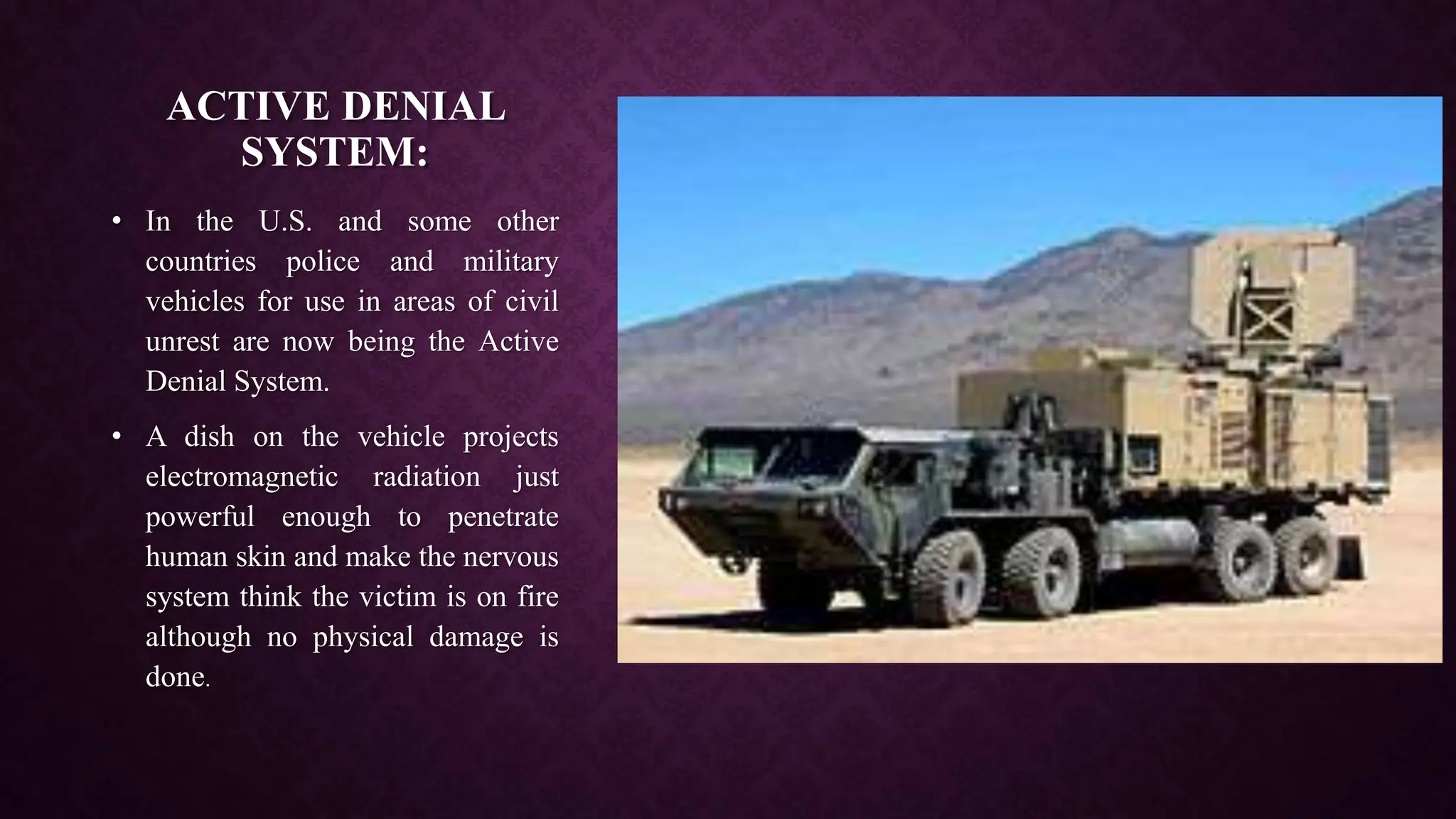
• In the U.S. and some other
countries police and military
vehicles for use in areas of civil
unrest are now being the Active
Denial System.
• A dish on the vehicle projects
electromagnetic radiation just
powerful enough to penetrate
human skin and make the nervous
system think the victim is on fire
although no physical damage is
done.
LONG RANGE
ACOUSTIC DEVICE:
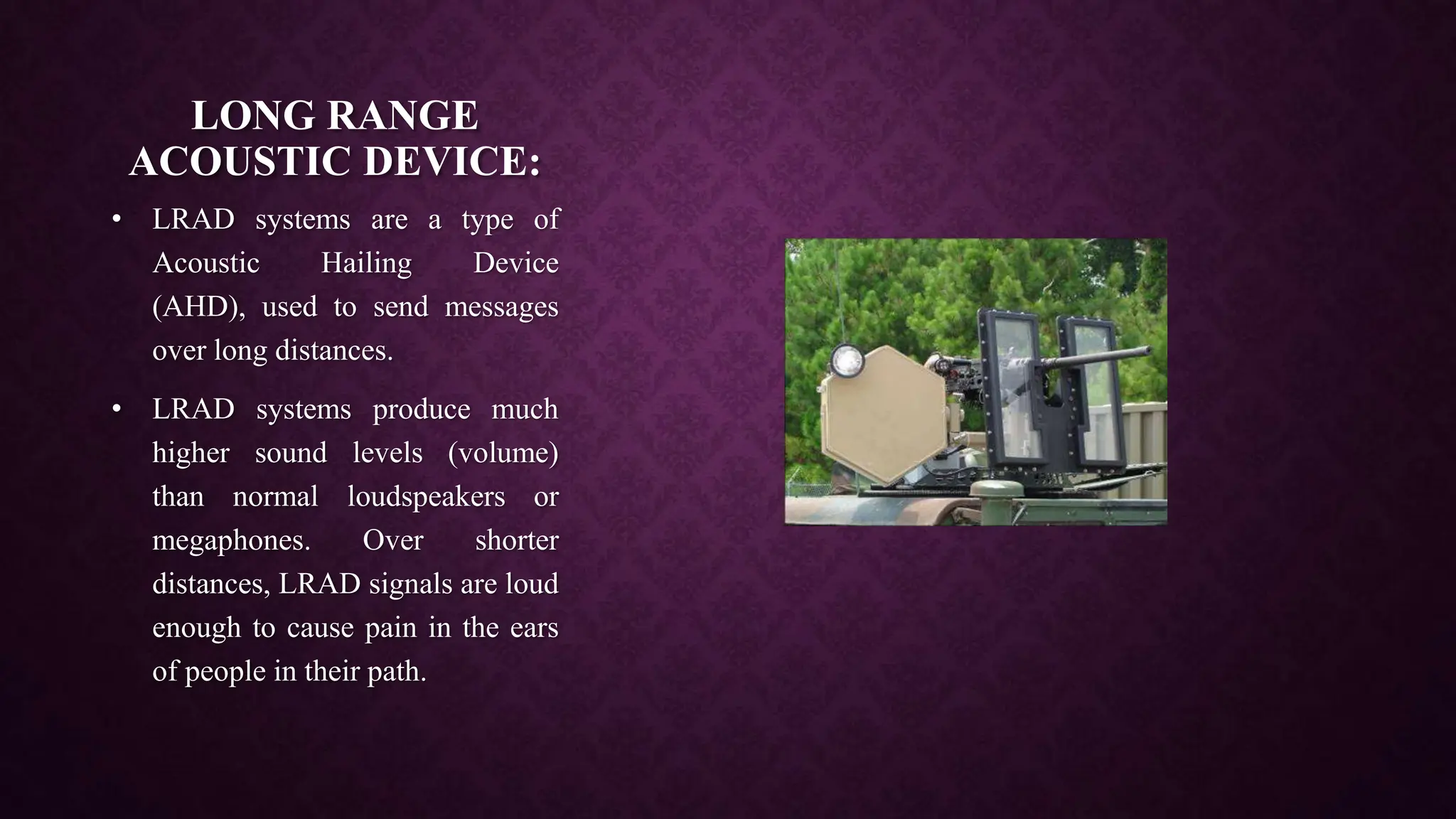
• LRAD systems are a type of
Acoustic Hailing Device
(AHD), used to send messages
over long distances.
• LRAD systems produce much
higher sound levels (volume)
than normal loudspeakers or
megaphones. Over shorter
distances, LRAD signals are loud
enough to cause pain in the ears
of people in their path.
TELESCOPIC BATON:
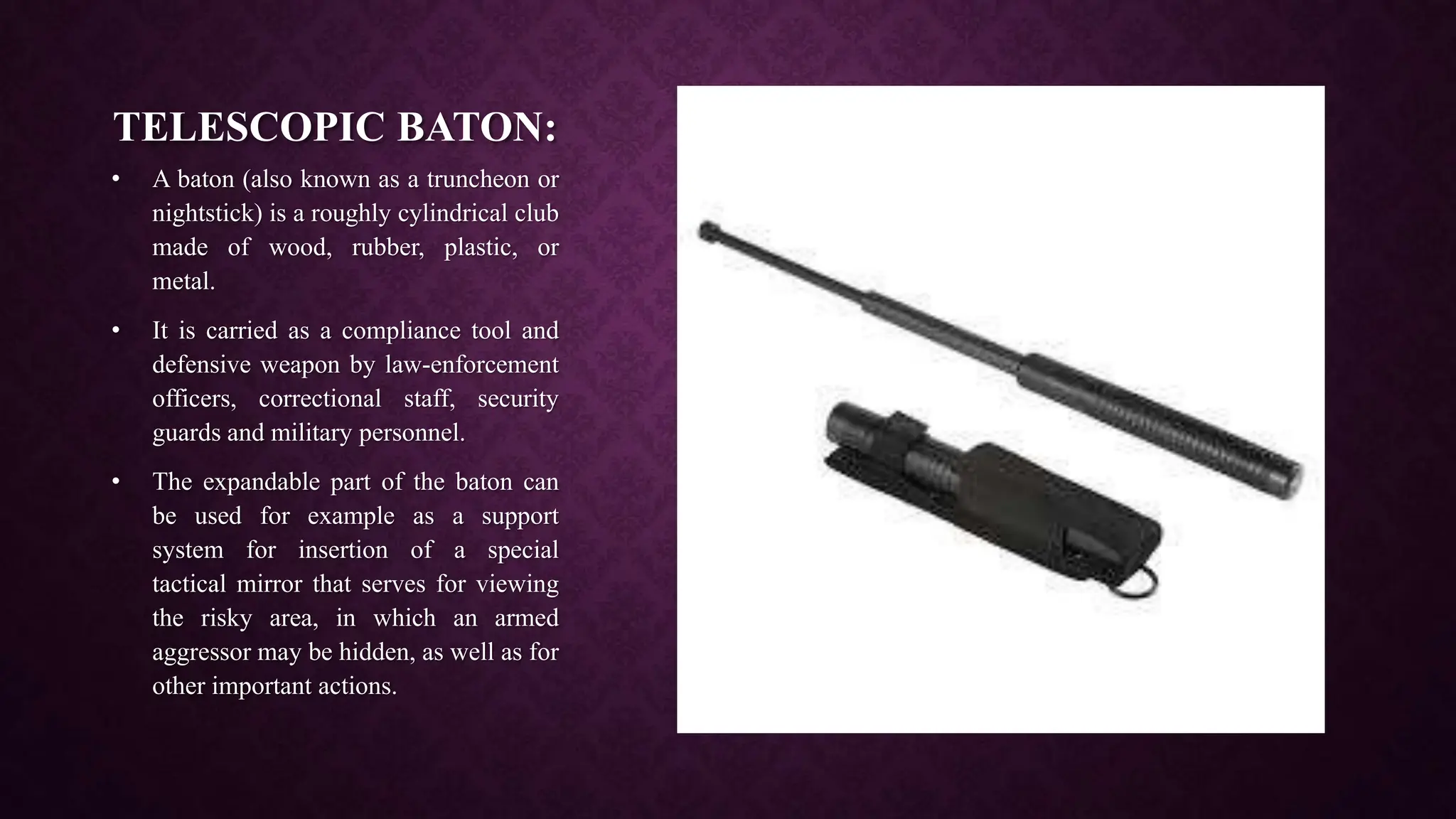
• A baton (also known as a truncheon or
nightstick) is a roughly cylindrical club
made of wood, rubber, plastic, or
metal.
• It is carried as a compliance tool and
defensive weapon by law-enforcement
officers, correctional staff, security
guards and military personnel.
• The expandable part of the baton can
be used for example as a support
system for insertion of a special
tactical mirror that serves for viewing
the risky area, in which an armed
aggressor may be hidden, as well as for
other important actions.
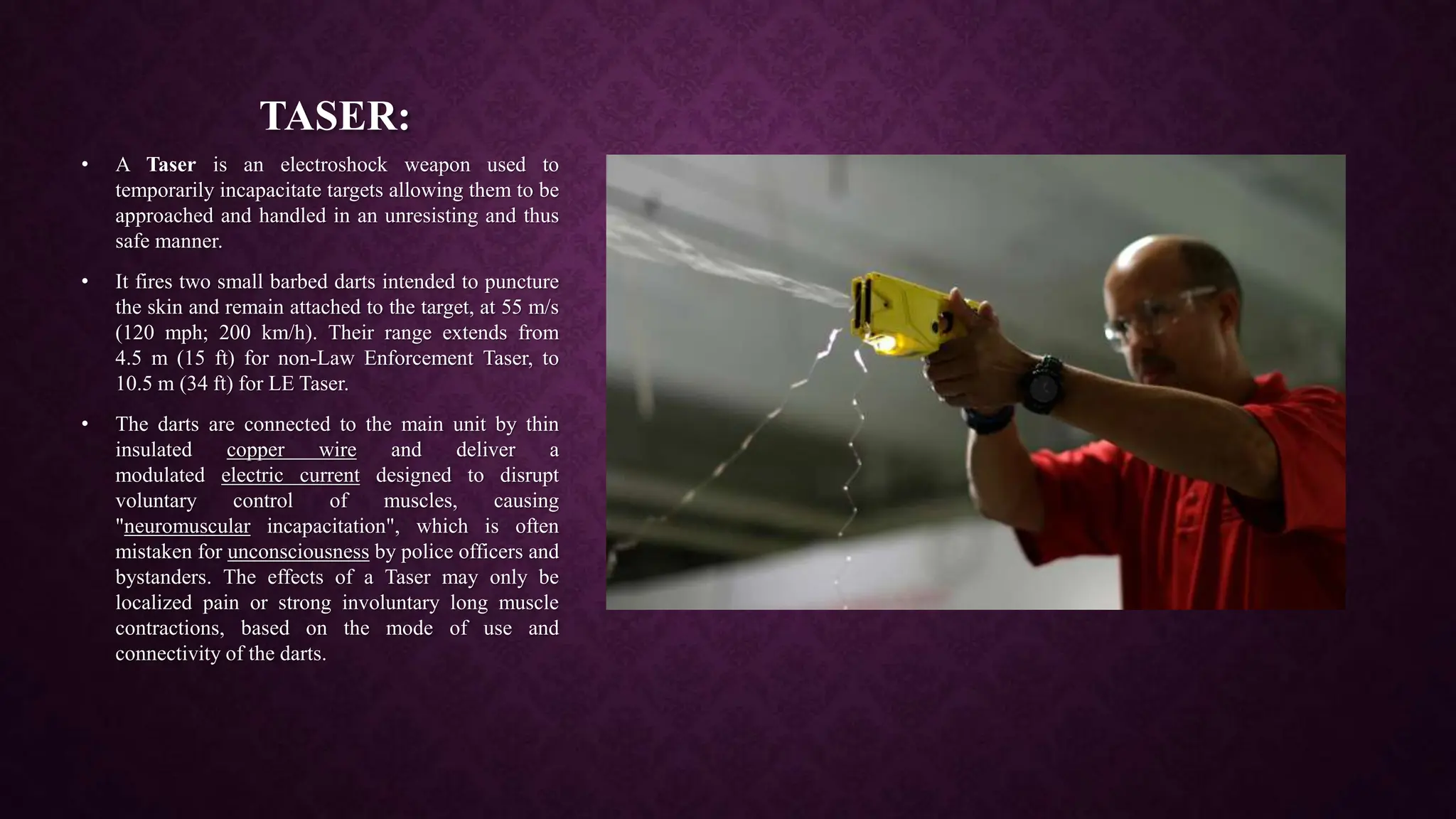
TASER:
• A Taser is an electroshock weapon used to
temporarily incapacitate targets allowing them to be
approached and handled in an unresisting and thus
safe manner.
• It fires two small barbed darts intended to puncture
the skin and remain attached to the target, at 55 m/s
(120 mph; 200 km/h). Their range extends from
4.5 m (15 ft) for non-Law Enforcement Taser, to
10.5 m (34 ft) for LE Taser.
• The darts are connected to the main unit by thin
insulated copper wire and deliver a
modulated electric current designed to disrupt
voluntary control of muscles, causing
"neuromuscular incapacitation", which is often
mistaken for unconsciousness by police officers and
bystanders. The effects of a Taser may only be
localized pain or strong involuntary long muscle
contractions, based on the mode of use and
connectivity of the darts.
PEPPER SPRAY:
• The active ingredient in pepper
spray is oleoresin capsicum (OC),
an acrid irritant chemical derived
from Cayenne Pepper plants.
• This is delivered through a
cartridge (paintball) which
explodes on impact. For it to be
effective it must come in contact
with the eye, nose or lips causing
the same effect as chilies.
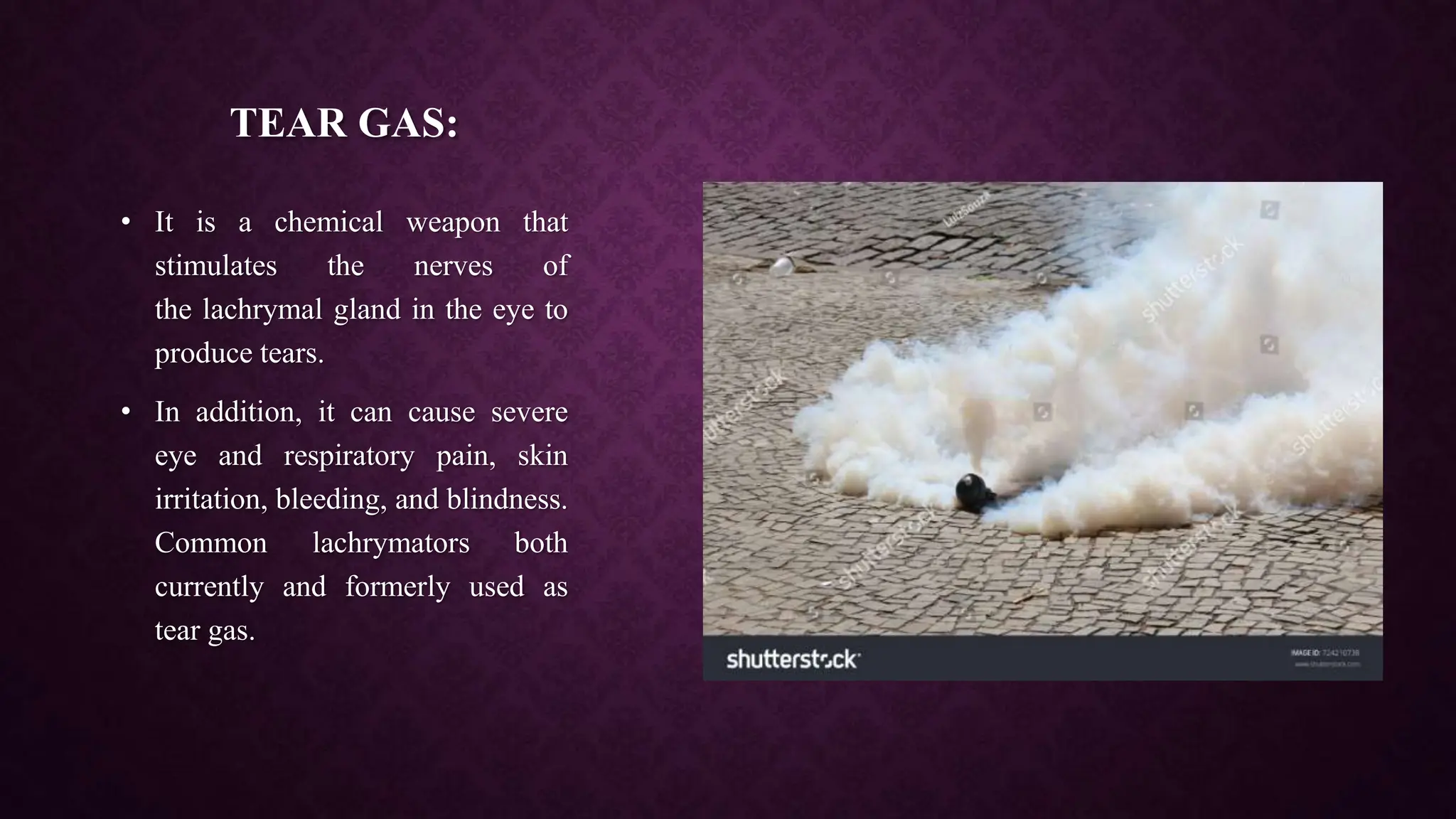
TEAR GAS:
• It is a chemical weapon that
stimulates the nerves of
the lachrymal gland in the eye to
produce tears.
• In addition, it can cause severe
eye and respiratory pain, skin
irritation, bleeding, and blindness.
Common lachrymators both
currently and formerly used as
tear gas.
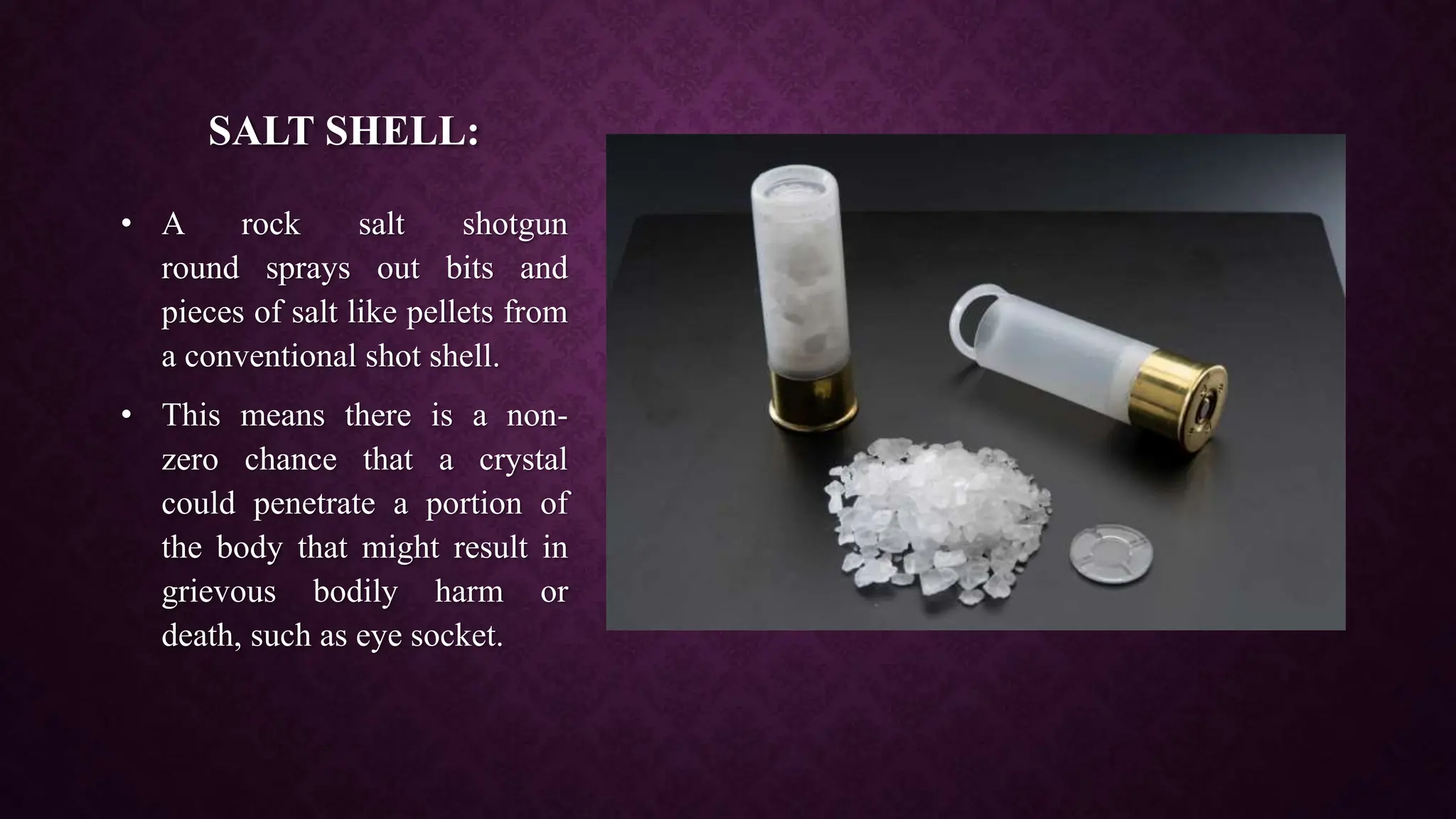
SALT SHELL:
• A rock salt shotgun
round sprays out bits and
pieces of salt like pellets from
a conventional shot shell.
• This means there is a non-
zero chance that a crystal
could penetrate a portion of
the body that might result in
grievous bodily harm or
death, such as eye socket.
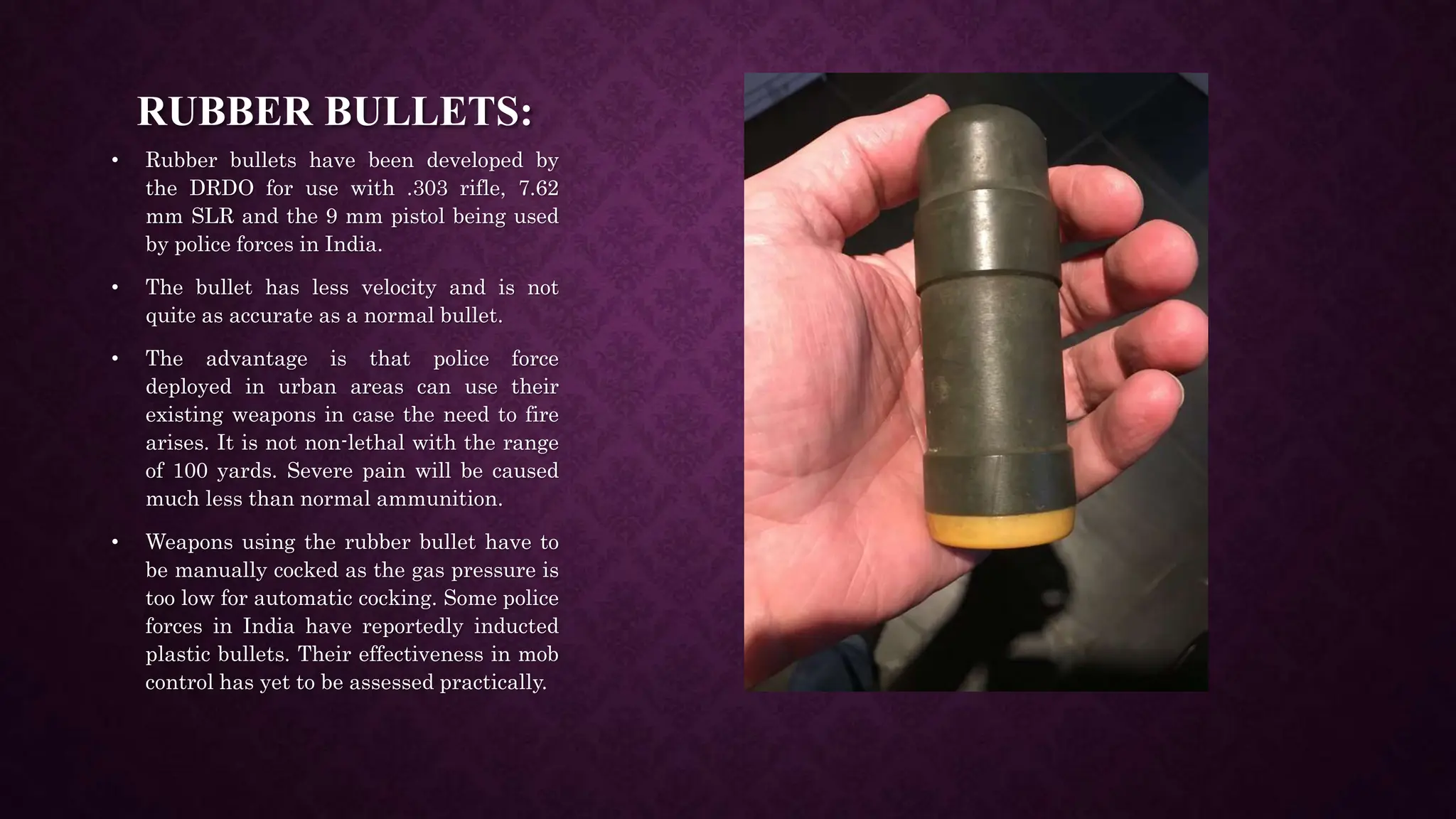
RUBBER BULLETS:
• Rubber bullets have been developed by
the DRDO for use with .303 rifle, 7.62
mm SLR and the 9 mm pistol being used
by police forces in India.
• The bullet has less velocity and is not
quite as accurate as a normal bullet.
• The advantage is that police force
deployed in urban areas can use their
existing weapons in case the need to fire
arises. It is not non-lethal with the range
of 100 yards. Severe pain will be caused
much less than normal ammunition.
• Weapons using the rubber bullet have to
be manually cocked as the gas pressure is
too low for automatic cocking. Some police
forces in India have reportedly inducted
plastic bullets. Their effectiveness in mob
control has yet to be assessed practically.
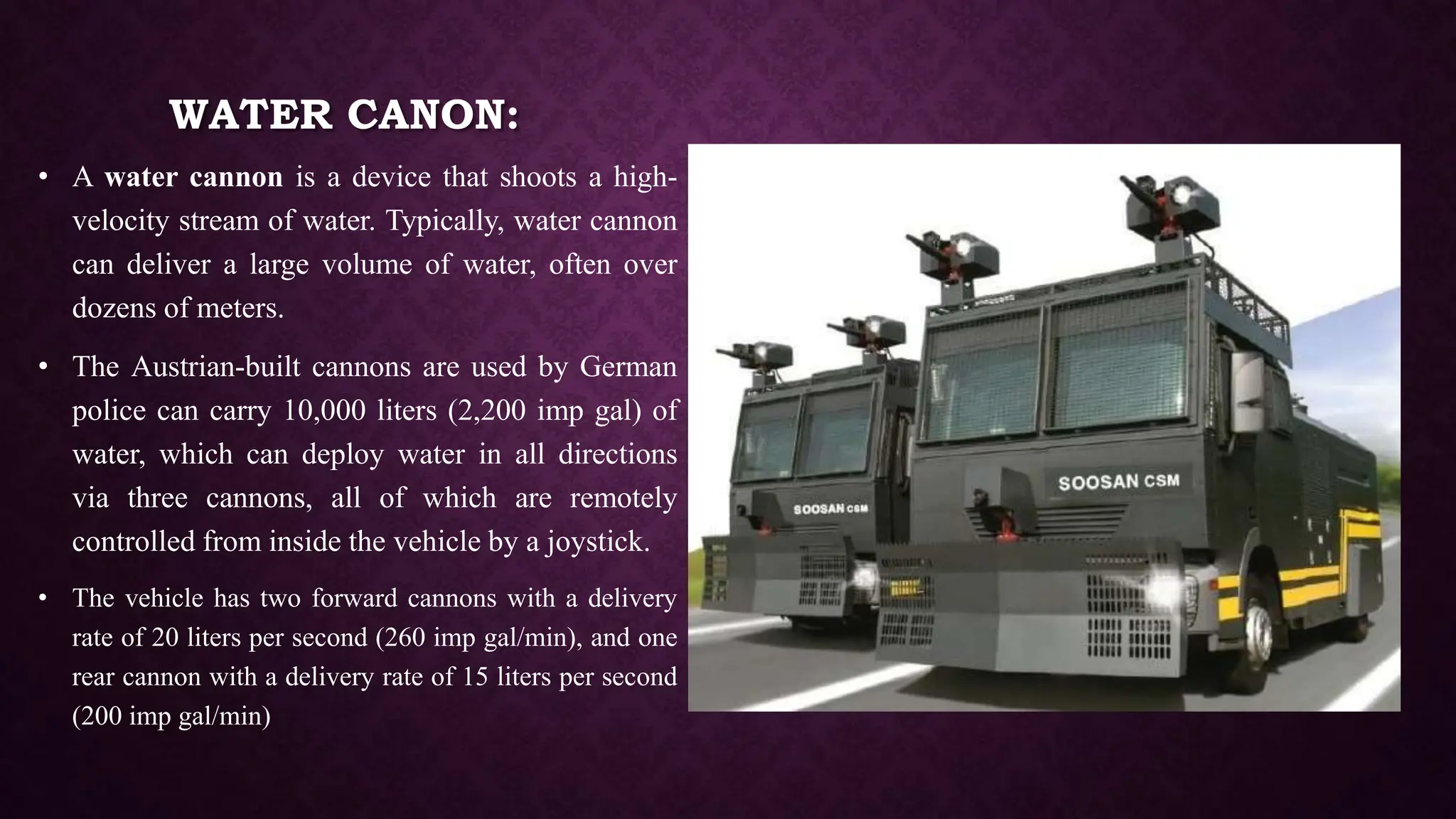
WATER CANON:
• A water cannon is a device that shoots a high-
velocity stream of water. Typically, water cannon
can deliver a large volume of water, often over
dozens of meters.
• The Austrian-built cannons are used by German
police can carry 10,000 liters (2,200 imp gal) of
water, which can deploy water in all directions
via three cannons, all of which are remotely
controlled from inside the vehicle by a joystick.
• The vehicle has two forward cannons with a delivery
rate of 20 liters per second (260 imp gal/min), and one
rear cannon with a delivery rate of 15 liters per second
(200 imp gal/min)
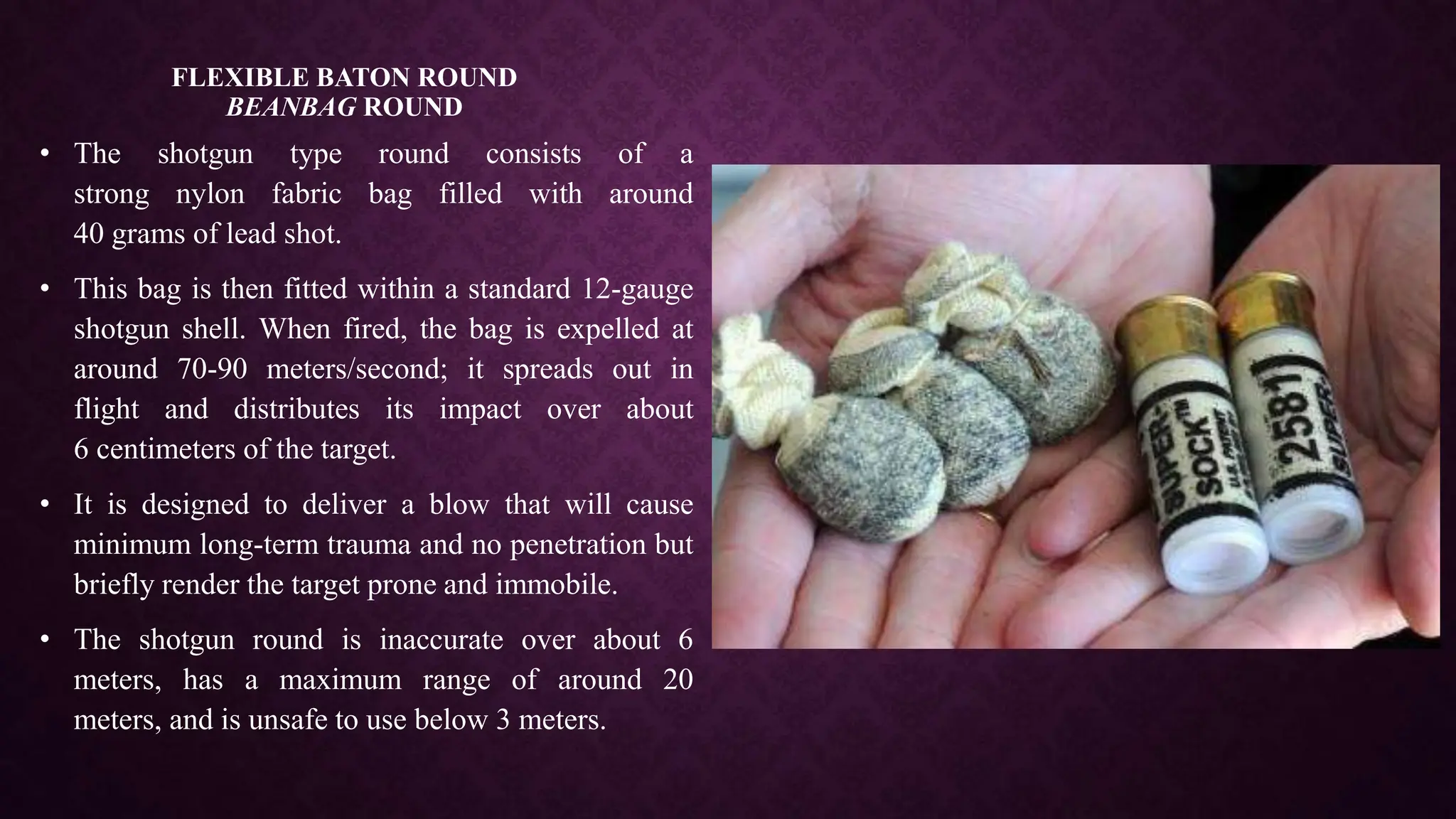
FLEXIBLE BATON ROUND
BEANBAG ROUND
• The shotgun type round consists of a
strong nylon fabric bag filled with around
40 grams of lead shot.
• This bag is then fitted within a standard 12-gauge
shotgun shell. When fired, the bag is expelled at
around 70-90 meters/second; it spreads out in
flight and distributes its impact over about
6 centimeters of the target.
• It is designed to deliver a blow that will cause
minimum long-term trauma and no penetration but
briefly render the target prone and immobile.
• The shotgun round is inaccurate over about 6
meters, has a maximum range of around 20
meters, and is unsafe to use below 3 meters.
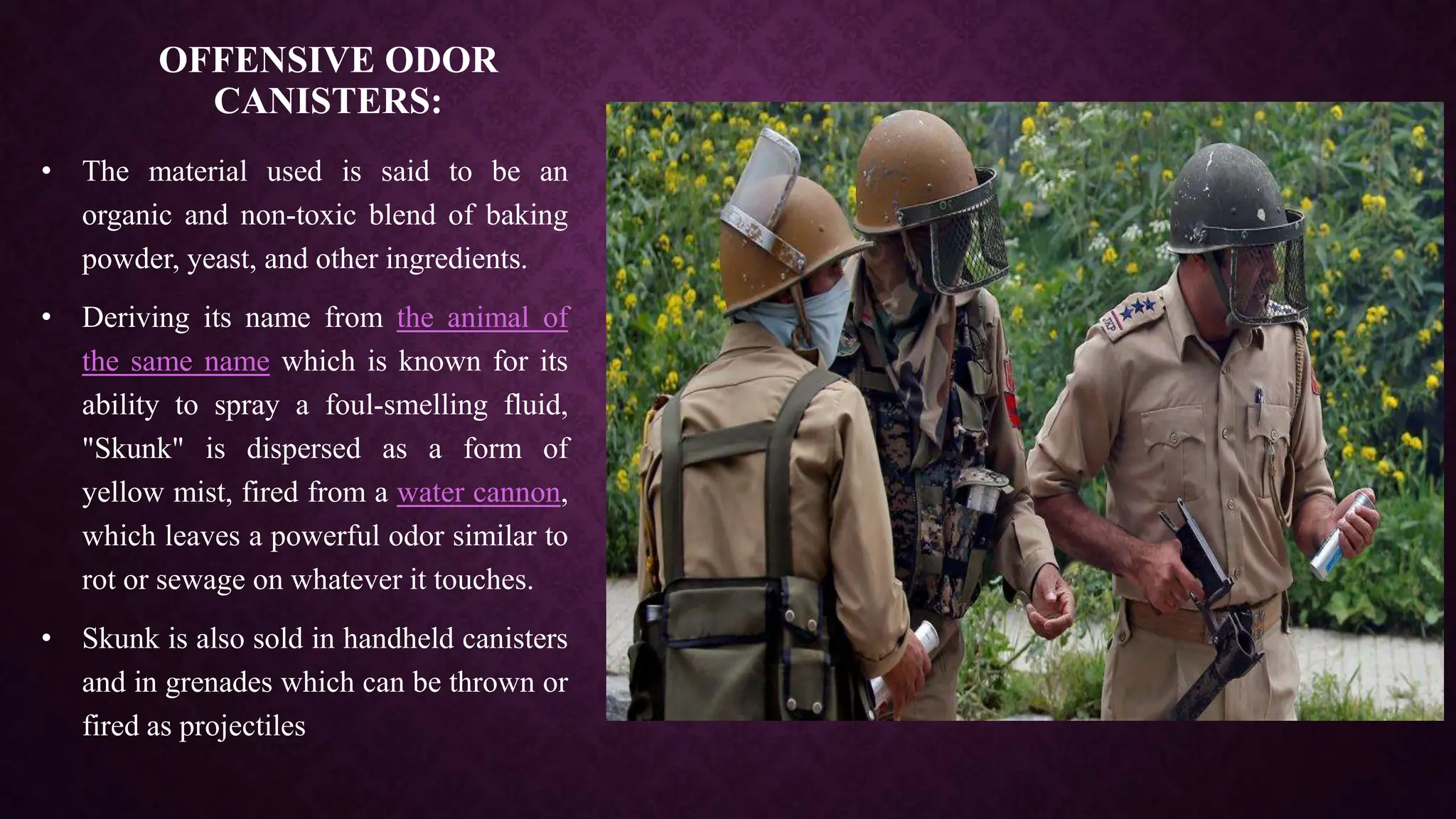
OFFENSIVE ODOR
CANISTERS:
• The material used is said to be an
organic and non-toxic blend of baking
powder, yeast, and other ingredients.
• Deriving its name from the animal of
the same name which is known for its
ability to spray a foul-smelling fluid,
"Skunk" is dispersed as a form of
yellow mist, fired from a water cannon,
which leaves a powerful odor similar to
rot or sewage on whatever it touches.
• Skunk is also sold in handheld canisters
and in grenades which can be thrown or
fired as projectiles
TRAINED POLICE DOGS
• A dog that is specifically trained to assist police and other law-enforcement
personnel, Their duties includes searching for drugs and explosives, locating
missing people, finding crime scene evidence, protecting people,
and attacking criminals who are fleeing from or attacking police officers. Police dogs
must remember several verbal cues and hand gestures.
• In India, the National Security Guard inducted the Belgian Malinois into its K-9
Unit, Border Security Force, and Central Reserve Police Force use Rajapalayam as
guard dogs to support the Force on the borders of Kashmir.
• For regional security, the Delhi Police has recruited many of the city's street dogs to
be trained for security purposes.[29] The Bengal Police uses German
Shepherds, Labrador Retrievers, and the Indian pariah dog in its bomb-sniffing
squad
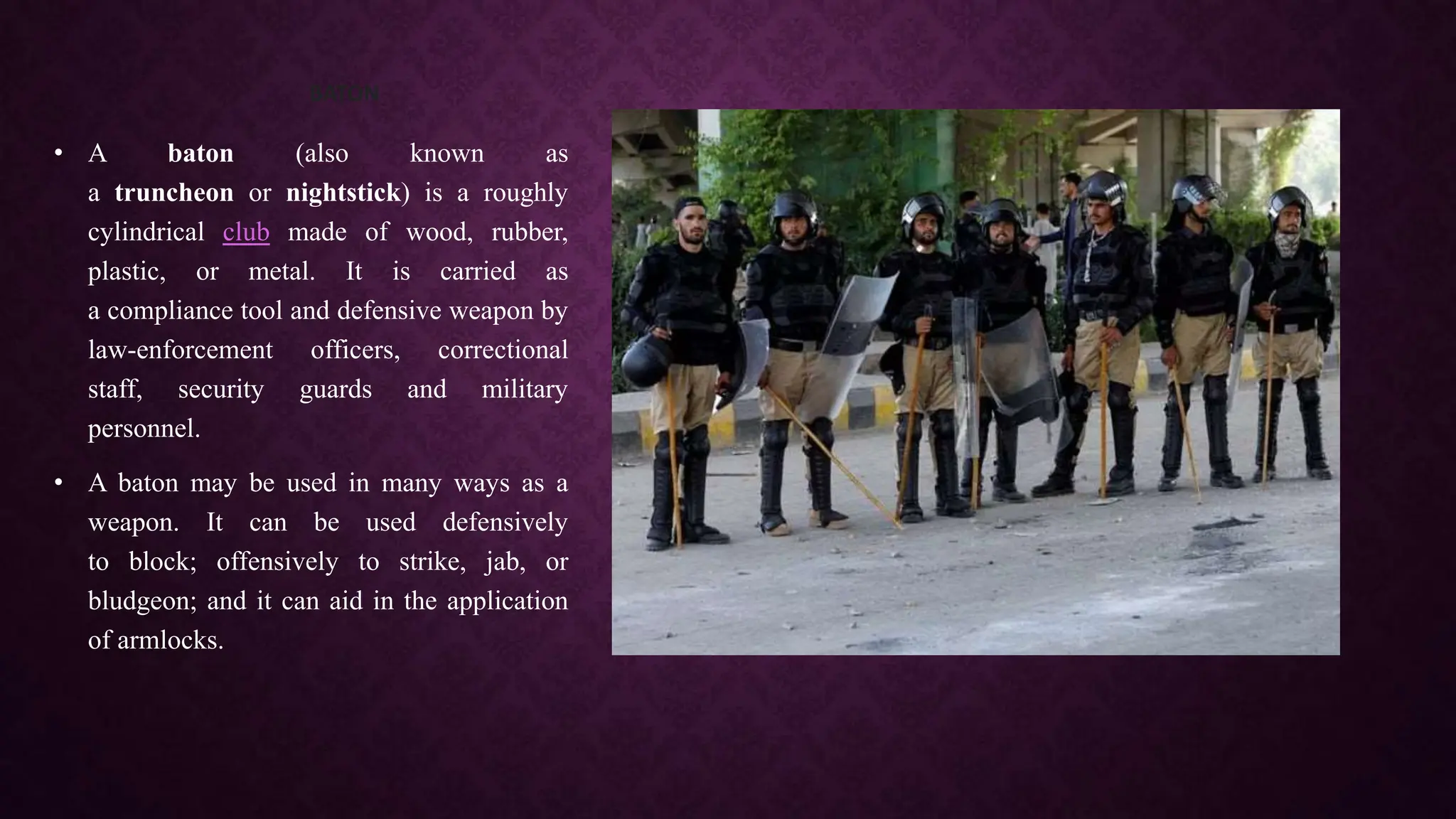
BATON
• A baton (also known as
a truncheon or nightstick) is a roughly
cylindrical club made of wood, rubber,
plastic, or metal. It is carried as
a compliance tool and defensive weapon by
law-enforcement officers, correctional
staff, security guards and military
personnel.
• A baton may be used in many ways as a
weapon. It can be used defensively
to block; offensively to strike, jab, or
bludgeon; and it can aid in the application
of armlocks.
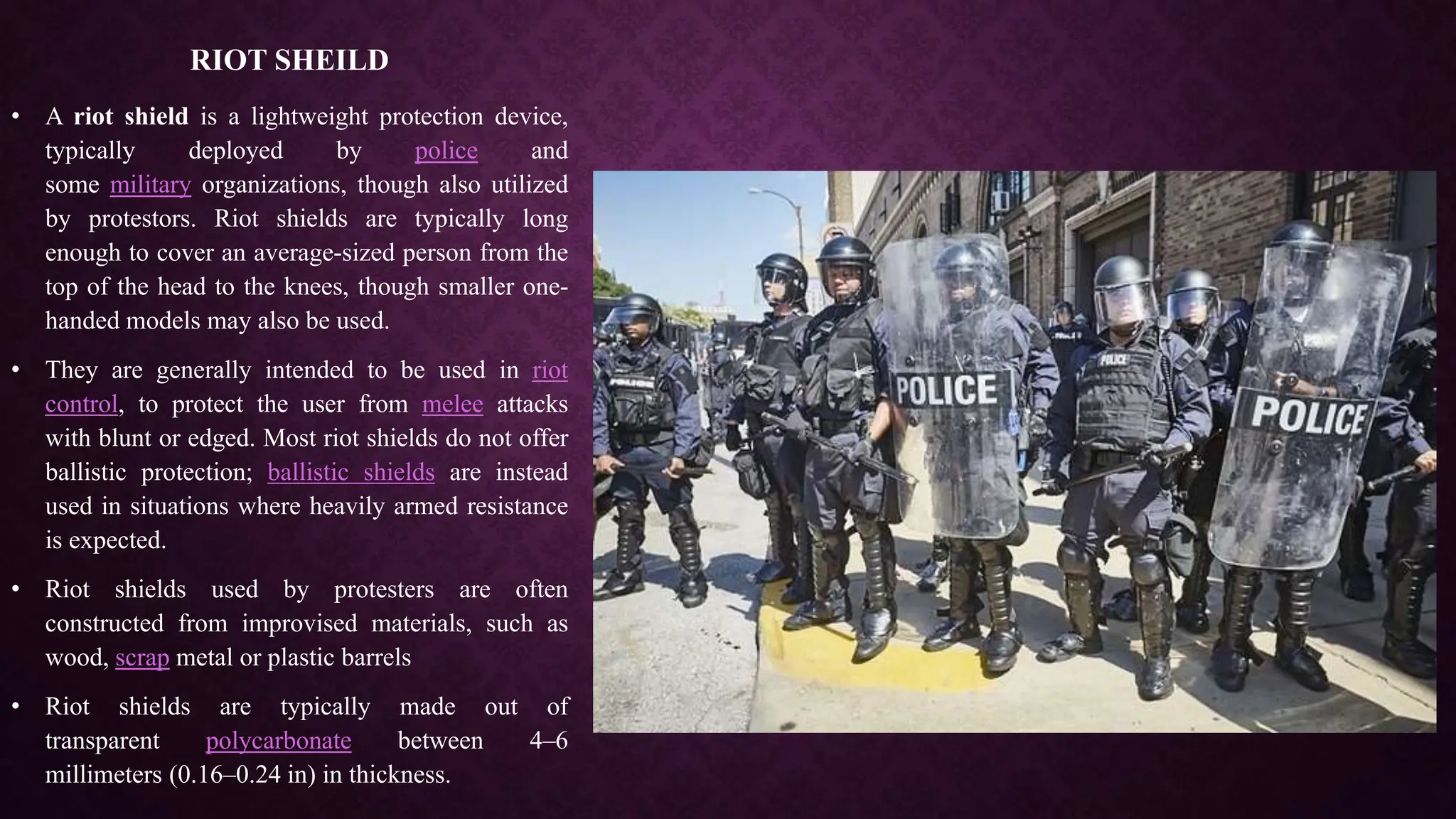
RIOT SHEILD
• A riot shield is a lightweight protection device,
typically deployed by police and
some military organizations, though also utilized
by protestors. Riot shields are typically long
enough to cover an average-sized person from the
top of the head to the knees, though smaller one-
handed models may also be used.
• They are generally intended to be used in riot
control, to protect the user from melee attacks
with blunt or edged. Most riot shields do not offer
ballistic protection; ballistic shields are instead
used in situations where heavily armed resistance
is expected.
• Riot shields used by protesters are often
constructed from improvised materials, such as
wood, scrap metal or plastic barrels
• Riot shields are typically made out of
transparent polycarbonate between 4–6
millimeters (0.16–0.24 in) in thickness.
CC&RM - Unit 02. CRIME CONTROL AND RESEARCH

CC&RM - Unit 02. CRIME CONTROL AND RESEARCH

  • 1.
    PROCEDURES TO BE FOLLOWEDDURING CROWD DISPERSAL MR. AVINASH C ASSISTANT PROFESSOR DEPARTMENT OF CRIMINOLOGY
  • 2.
    • Bonafede actsof Executive Magistrate, Police Officers, Officers and other members of the armed forces, and persons acting in compliance with requisition made under section 129 or 130 CrPC, are outside the category of offence. • Section 129 CrPC gives the power to disperse an unlawful assembly by force to any Executive Magistrate or Officer in charge of a police station, or in the absence of the officer in charge of police station to any police officer not below the rank of sub-inspector.
  • 3.
    • Section 197CrPC gives protection to public servants for acts done under the lawful discharge of their duty. The right of private defence, however, should be exercise with utmost caution. • If an officer below the rank of sub-inspector uses force (e.g. fires upon an unlawful assembly to disperse it), his action has no legality, as it is not covered by section 129 CrPC
  • 4.
    • The useof force to disperse an unlawful assembly would be dictated by the circumstances existing and can range from a simple arrest to the use of firearms. • However, Force should be used with the limited objective of restoring order, preventing crime and arresting offenders.
  • 5.
    • Though thequantum of force to be used in the dispersal of unlawful assemblies has not been defined in any law, the practice and rules that have evolved have followed the following principles: 1. No more force should be used than is necessary; 2. It should not be used as a punitive measure; 3. It must cease immediately the objective is gained.
  • 6.
    • The minimumnecessary force to achieve the desired objective should be used, which is the dispersal of the unlawful assembly and arrest of some of its members and to prevent or control disturbances. • No punitive or repressive considerations should affect this action. • Any officer incharge of a police station, or a police officer of higher rank who has the power, independent of the Magistrate (i.e. in his absence), to call upon an unlawful assembly to disperse, and use force if necessary to disperse it.
  • 7.
    • In casea Magistrate is present, such assembly will not be commanded to disperse without the order of the Magistrate (this does not apply to Honorary Magistrate). • But in case a police gazetted officer(DC, SP, DSP) is present and no Magistrate having first class powers is present, such officer may act independently. • In other circumstances, the officer having the powers of the in charge of a police station shall act on his own responsibility but Should communicate his report to the senior Magistrate accessible.
  • 8.
    • In casean officer lower in rank than the officer in charge of the police station has to deal with an unlawful assembly, he should, if time and circumstances permit, send for an officer empowered to act under section 129 Cr.P.C. • If circumstances do not permit the officer to await the arrival of the competent officer, he should take whatever action is necessary to prevent the offence through the requisite use of force. • Once a Magistrate has decided that force has to be used to disperse the assembly, the amount of force to be used wilt be decided by the Police Officer.
  • 9.
    • The crowdshould, before force is used, be persuaded to disperse. A warning that force will be used to disperse the assembly must be given before force is used. • Once the order to disperse is defied, or the attitude of the crowd is threatening, force should be used to disperse the crowd. • The effectiveness of the force depends upon the determination of its use, direction against the most defiant section of the crowd and it's absolute control. • The manner of force used will depend upon the circumstances, i.e. the strength and attitude of the crowd and the strength of the police party.
  • 10.
    • Crowd DispersalOrder Video 1 and 2
  • 11.
    • Usage ofnon lethal weapons like Cane charge and tear smoke should, as a rule, precede firing. • FIREARMS are used to disperse crowds only in extreme and very exceptional circumstances where there is imminent and extreme danger to life and property. • The responsible police officer, whether acting under the orders of the Magistrate or independently, when considering the use of fire arms necessary, shall, unless circumstances make this impossible, warn the crowd to disperse, and only on that failing should fire with live ammunition. • Orders for firing should be obtained from a Magistrate if he is present.
  • 12.
    • As soonas it appears that the use of firearms may become necessary, a detachment should be put in readiness to take action without loss of time the moment orders are given to open fire. • The police officer will specify the number of rounds to be fired and will give precise orders to the particular men who are to fire and shall also specify the target. • The officer should ensure proper fire control. The aim should be kept low (at the legs to avoid injuries) and towards the most threatening part of the crowd. Fire should cease as soon as the crowd disperses.
  • 13.
    • The forcearmed with weapons should not be allowed to go close to the crowd could be overwhelmed and the arms snatched. While accompanying processions the armed force at the front and rear should move a little distance ahead and be the procession. • The rounds fired should be sealed immediately and the magistrate and police officer should immediately draw up a full report stating the number of rounds fired the circumstances under which firing was resorted to, and the number of casualties.
  • 14.
    • Those injuredin the police action should be given first aid and sent to hospital immediately. • Other points that should be kept in mind are: 1. Firing should never be conducted over the head of a mob with live ammunition. This can result in injuries to innocent persons at the end of the bullet's trajectory. 2. It also emboldens the crowd, as it feels that the law enforcing agency is hesitant about inflicting casualty on the crowd.
  • 15.
  • 16.
  • 17.
    ACTIVE DENIAL SYSTEM: • Inthe U.S. and some other countries police and military vehicles for use in areas of civil unrest are now being the Active Denial System. • A dish on the vehicle projects electromagnetic radiation just powerful enough to penetrate human skin and make the nervous system think the victim is on fire although no physical damage is done.
  • 18.
    LONG RANGE ACOUSTIC DEVICE: •LRAD systems are a type of Acoustic Hailing Device (AHD), used to send messages over long distances. • LRAD systems produce much higher sound levels (volume) than normal loudspeakers or megaphones. Over shorter distances, LRAD signals are loud enough to cause pain in the ears of people in their path.
  • 19.
    TELESCOPIC BATON: • Abaton (also known as a truncheon or nightstick) is a roughly cylindrical club made of wood, rubber, plastic, or metal. • It is carried as a compliance tool and defensive weapon by law-enforcement officers, correctional staff, security guards and military personnel. • The expandable part of the baton can be used for example as a support system for insertion of a special tactical mirror that serves for viewing the risky area, in which an armed aggressor may be hidden, as well as for other important actions.
  • 20.
    TASER: • A Taseris an electroshock weapon used to temporarily incapacitate targets allowing them to be approached and handled in an unresisting and thus safe manner. • It fires two small barbed darts intended to puncture the skin and remain attached to the target, at 55 m/s (120 mph; 200 km/h). Their range extends from 4.5 m (15 ft) for non-Law Enforcement Taser, to 10.5 m (34 ft) for LE Taser. • The darts are connected to the main unit by thin insulated copper wire and deliver a modulated electric current designed to disrupt voluntary control of muscles, causing "neuromuscular incapacitation", which is often mistaken for unconsciousness by police officers and bystanders. The effects of a Taser may only be localized pain or strong involuntary long muscle contractions, based on the mode of use and connectivity of the darts.
  • 21.
    PEPPER SPRAY: • Theactive ingredient in pepper spray is oleoresin capsicum (OC), an acrid irritant chemical derived from Cayenne Pepper plants. • This is delivered through a cartridge (paintball) which explodes on impact. For it to be effective it must come in contact with the eye, nose or lips causing the same effect as chilies.
  • 22.
    TEAR GAS: • Itis a chemical weapon that stimulates the nerves of the lachrymal gland in the eye to produce tears. • In addition, it can cause severe eye and respiratory pain, skin irritation, bleeding, and blindness. Common lachrymators both currently and formerly used as tear gas.
  • 23.
    SALT SHELL: • Arock salt shotgun round sprays out bits and pieces of salt like pellets from a conventional shot shell. • This means there is a non- zero chance that a crystal could penetrate a portion of the body that might result in grievous bodily harm or death, such as eye socket.
  • 24.
    RUBBER BULLETS: • Rubberbullets have been developed by the DRDO for use with .303 rifle, 7.62 mm SLR and the 9 mm pistol being used by police forces in India. • The bullet has less velocity and is not quite as accurate as a normal bullet. • The advantage is that police force deployed in urban areas can use their existing weapons in case the need to fire arises. It is not non-lethal with the range of 100 yards. Severe pain will be caused much less than normal ammunition. • Weapons using the rubber bullet have to be manually cocked as the gas pressure is too low for automatic cocking. Some police forces in India have reportedly inducted plastic bullets. Their effectiveness in mob control has yet to be assessed practically.
  • 25.
    WATER CANON: • Awater cannon is a device that shoots a high- velocity stream of water. Typically, water cannon can deliver a large volume of water, often over dozens of meters. • The Austrian-built cannons are used by German police can carry 10,000 liters (2,200 imp gal) of water, which can deploy water in all directions via three cannons, all of which are remotely controlled from inside the vehicle by a joystick. • The vehicle has two forward cannons with a delivery rate of 20 liters per second (260 imp gal/min), and one rear cannon with a delivery rate of 15 liters per second (200 imp gal/min)
  • 26.
    FLEXIBLE BATON ROUND BEANBAGROUND • The shotgun type round consists of a strong nylon fabric bag filled with around 40 grams of lead shot. • This bag is then fitted within a standard 12-gauge shotgun shell. When fired, the bag is expelled at around 70-90 meters/second; it spreads out in flight and distributes its impact over about 6 centimeters of the target. • It is designed to deliver a blow that will cause minimum long-term trauma and no penetration but briefly render the target prone and immobile. • The shotgun round is inaccurate over about 6 meters, has a maximum range of around 20 meters, and is unsafe to use below 3 meters.
  • 27.
    OFFENSIVE ODOR CANISTERS: • Thematerial used is said to be an organic and non-toxic blend of baking powder, yeast, and other ingredients. • Deriving its name from the animal of the same name which is known for its ability to spray a foul-smelling fluid, "Skunk" is dispersed as a form of yellow mist, fired from a water cannon, which leaves a powerful odor similar to rot or sewage on whatever it touches. • Skunk is also sold in handheld canisters and in grenades which can be thrown or fired as projectiles
  • 28.
    TRAINED POLICE DOGS •A dog that is specifically trained to assist police and other law-enforcement personnel, Their duties includes searching for drugs and explosives, locating missing people, finding crime scene evidence, protecting people, and attacking criminals who are fleeing from or attacking police officers. Police dogs must remember several verbal cues and hand gestures. • In India, the National Security Guard inducted the Belgian Malinois into its K-9 Unit, Border Security Force, and Central Reserve Police Force use Rajapalayam as guard dogs to support the Force on the borders of Kashmir. • For regional security, the Delhi Police has recruited many of the city's street dogs to be trained for security purposes.[29] The Bengal Police uses German Shepherds, Labrador Retrievers, and the Indian pariah dog in its bomb-sniffing squad
  • 29.
    BATON • A baton(also known as a truncheon or nightstick) is a roughly cylindrical club made of wood, rubber, plastic, or metal. It is carried as a compliance tool and defensive weapon by law-enforcement officers, correctional staff, security guards and military personnel. • A baton may be used in many ways as a weapon. It can be used defensively to block; offensively to strike, jab, or bludgeon; and it can aid in the application of armlocks.
  • 30.
    RIOT SHEILD • Ariot shield is a lightweight protection device, typically deployed by police and some military organizations, though also utilized by protestors. Riot shields are typically long enough to cover an average-sized person from the top of the head to the knees, though smaller one- handed models may also be used. • They are generally intended to be used in riot control, to protect the user from melee attacks with blunt or edged. Most riot shields do not offer ballistic protection; ballistic shields are instead used in situations where heavily armed resistance is expected. • Riot shields used by protesters are often constructed from improvised materials, such as wood, scrap metal or plastic barrels • Riot shields are typically made out of transparent polycarbonate between 4–6 millimeters (0.16–0.24 in) in thickness.