CROWD PSYCHOLOGY
&
CROWD CONTROL
Large gathering of
individuals in one place in close
physical proximity to one
another with a tendency to
develop psychological
interaction.
DEFINITION
(i) Intelligence
(ii) Action plan
(iii) Prepared to take decision
(iv) Communicate it to Subordinates and
prepared for action.
(v) Prevention of Crowd.
(vi) If gathered, disperse it as soon as
possible.
(vii) If not possible, they should not be
allowed to get violent.
GUIDELINES FOR COMMANDERS
(viii) Leaders to be identified,
persuasion and counseling resorted
to.
(ix) The Crowd once violent, be isolated
& kept away from vital
installations.
(x) If force has to be used, it should be
minimum.
(xi) Every one should be fairly &
impartially treated.
(xii) Chances of escape to be provided.
3. TYPE OF CROWD
i) Casual crowds:-
Casual crowds are
those formed by people
whose attention has been
temporarily focused on a
common object, as Crowd
at a scene of traffic
accident or fire.
ii)Expressive Crowds.
Expressive Crowds are
formed by those whose activity
is an end in itself and who seek
personal relief from tension, as
group of merry-makers at Holi
or New Year Eve.
iii.Conventional Crowds:-
Conventional
Crowds are gatherings of
people with a central focus
and similar ends. Examples
sports audiences, political
rallies, religious or social
gatherings, etc.
iv. Aggressive Crowds:-
Aggressive Crowds are
gatherings of people with a
common objective, to which
their activity is directed, in a
violent or potentially violent
manner. Political and
communal demonstrations
are examples of Aggressive
Crowds.
CHARACTERISTICS
OF CROWD
i) Collective mind.
The crowds acquires a
collective mind. The
individual in a crowd acts as
he would like to in a state of
complete isolation, free from
the restraints of conscience.
ii. Lower level of intelligence:-
There is relatively lower level
of intelligence in the crowds
than in the individuals
forming the crowd because
“the unconscious” plays a
part in determining their
“conscious” behaviour.
iii. More Emotional:-
The individual in the
crowds becomes more
emotional and
participates in activities
such as shouting, cheers,
laughter and other forms
of exaggerated
iv. Follow up:-
The individual in the
crowd tends to do what
others are doing in the
crowd and tends to accept
the commands of leader
without questioning.
v. Sense of Power :-
The individual in the
crowd feels a sense of
power derived out of sheer
numbers of the crowd.
vi. Sense of Anonymity :-
The crowd individual has
a sense of anonymity.
vi. Sense of Irresponsibility:-
The removal of restraint is
followed by a consequent
sense on irresponsibility.
vii. Power of Reasoning:-
The power of reasoning of
individual in the crowd is at a
relatively lower level.
i) Aim.
a) What was the aim of crowd
when it
gathered ?
b) What it became after gathering
?
MUST KNOW
ABOUT CROWD
Nature
a) What is the nature of crowd
? Peaceful, excited,
aggressive or violent crowd .
b) Is there any leader
present?
c) What is the attitude of
leader
COMPLAINTS/ PROBLEMS OF
CROWD
• Essential to know about the
problem of crowd because nature
of crowd mostly depend upon it,
say death of child due to some
motor accident.
• Always try to find out the reason
behind discontentment.
• Whether sufficient measure has
been taken to solve the problem or
Traffic control
• Traffic must be controlled /
regulated near the place of
gathering.
• Unwanted people be disallowed to
stay near-by to decrease chances of
collateral damage.
• Mode of transport being used by
crowd must be kept under watch
i) Hold talk with crowd.
ii) Understand & appreciate the
logic of Crowd.
iii) Take help from the influential
people.
iv) Maintain patience and polite
atmosphere.
METHOD TO CONTROL
THE CROWD
v) Understand and solve problem of
crowd.
vi) Control destructive mentality.
vii) Show your strength / power to
control the crowd.
viii) Take crowd in confidence.
Unlawful assembly :-
Definition :-
Section 141 of IPC “ an assembly of
5 or more persons is designated as
unlawful assembly, if the common object
of that assembly is :–
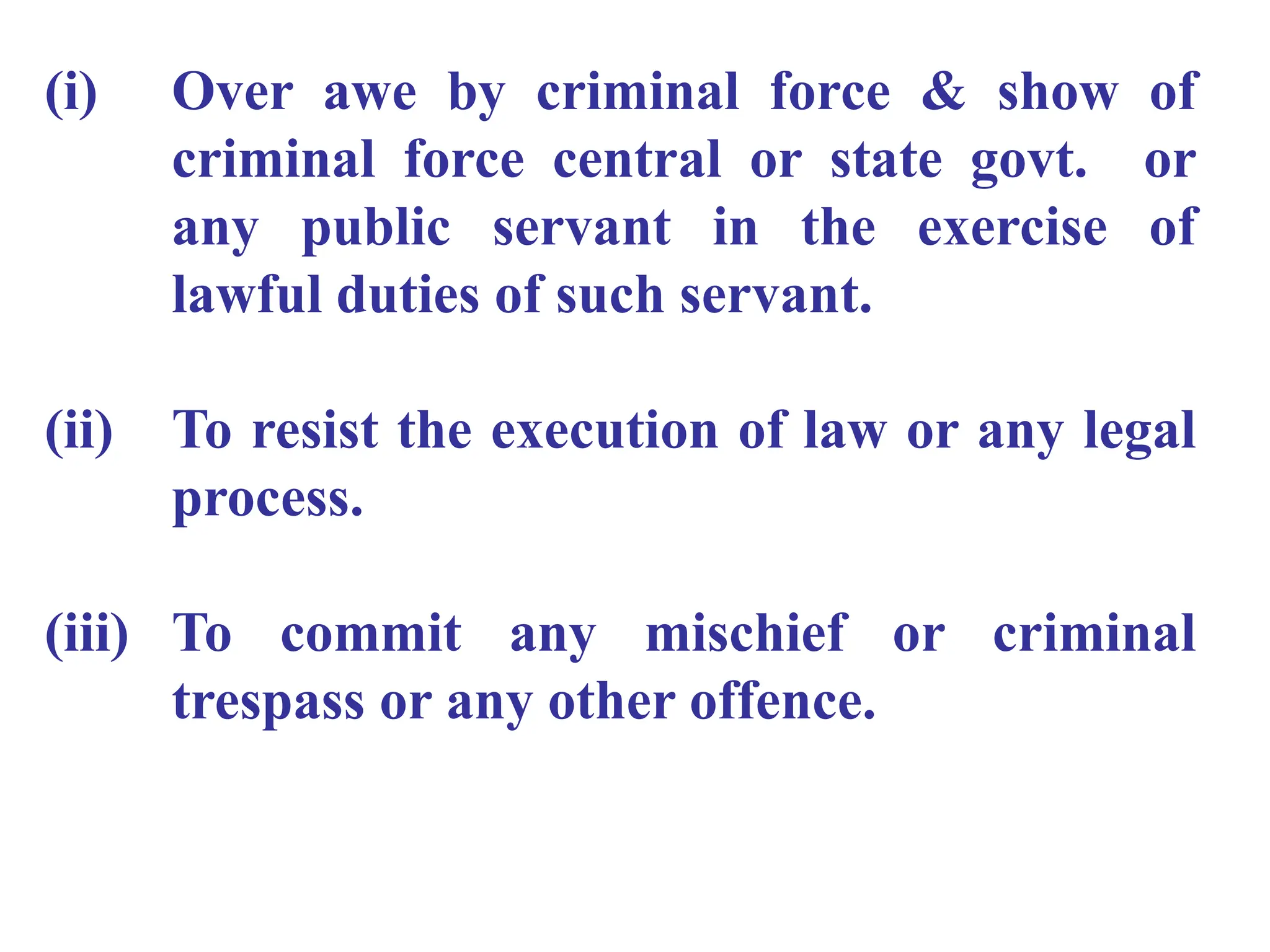
(i) Over awe by criminal force & show of
criminal force central or state govt. or
any public servant in the exercise of
lawful duties of such servant.
(ii) To resist the execution of law or any legal
process.
(iii) To commit any mischief or criminal
trespass or any other offence.
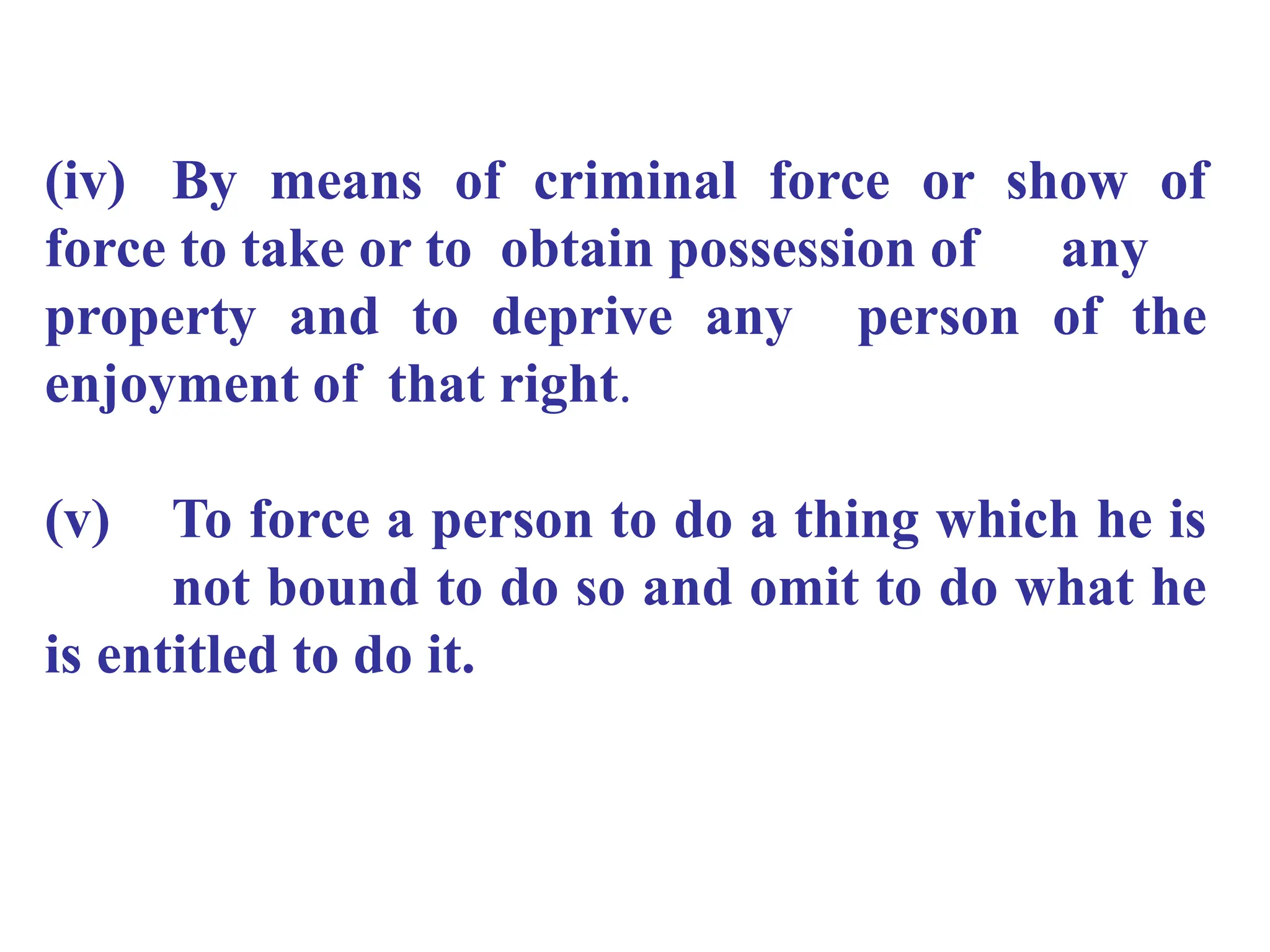
(iv) By means of criminal force or show of
force to take or to obtain possession of any
property and to deprive any person of the
enjoyment of that right.
(v) To force a person to do a thing which he is
not bound to do so and omit to do what he
is entitled to do it.
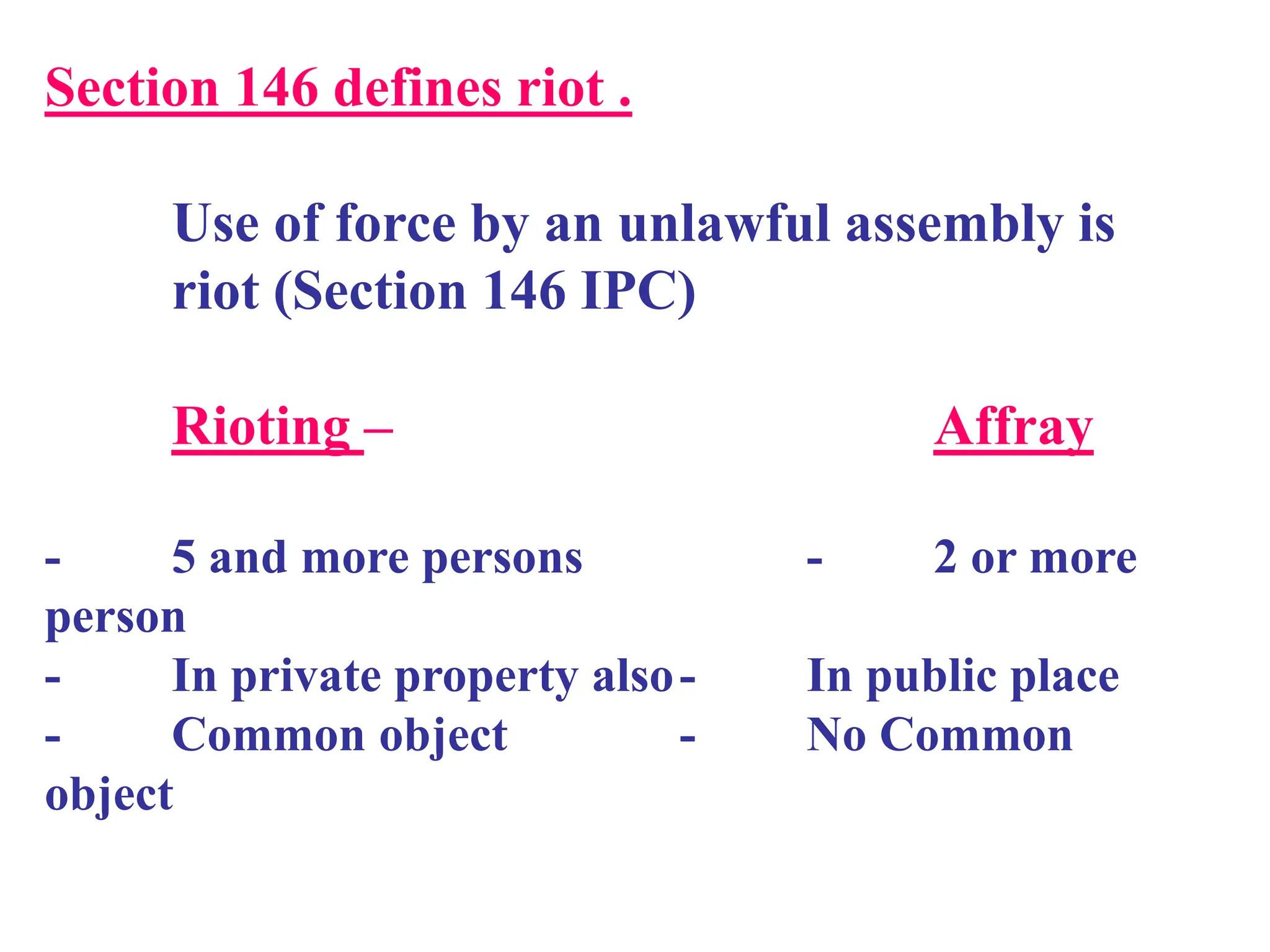
Section 146 defines riot .
Use of force by an unlawful assembly is
riot (Section 146 IPC)
Rioting – Affray
- 5 and more persons - 2 or more
person
- In private property also- In public place
- Common object - No Common
object
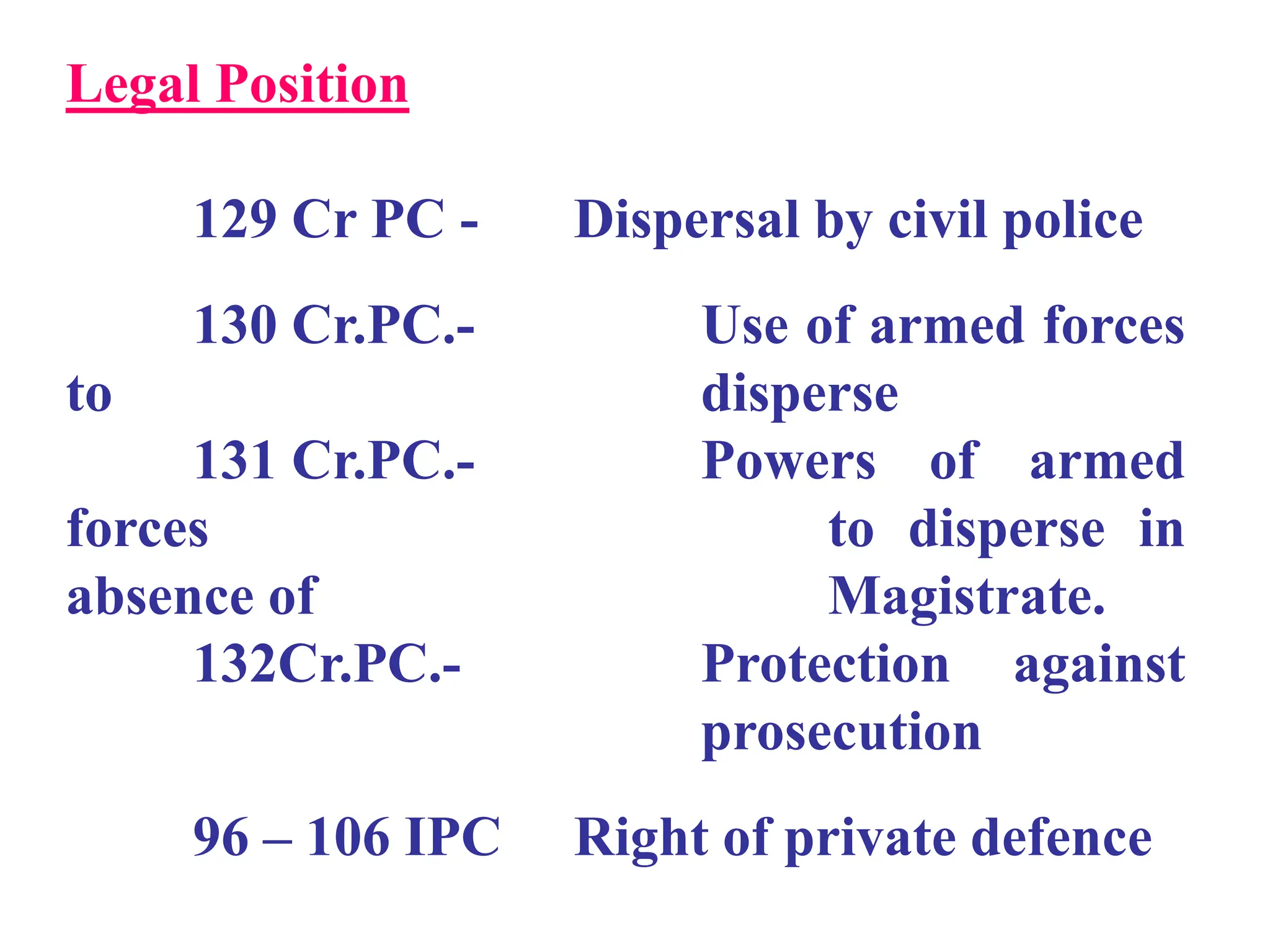
Legal Position
129 Cr PC - Dispersal by civil police
130 Cr.PC.- Use of armed forces
to disperse
131 Cr.PC.- Powers of armed
forces to disperse in
absence of Magistrate.
132Cr.PC.- Protection against
prosecution
96 – 106 IPC Right of private defence
Rules for use of force.
(i) No more force should be used than is
necessary.
(ii) Force should not be punitive
measures.
(iii) it must cease once objective is
achieved.
Sequence of force:-
(i) Persuasion , warning and appeal
(ii) Tear gas
(iii) Cane Charge
(iv) Fire arms
Equipments:- Tear smoke gun, shields &
protective clothing.
Who can order dispersal ?
• Any megistrate or officer in charge of a
police station
• Commisioned/Gazetted officer of an
armed forces
• JCO/SO is not empowered to disperse
unlawful assembly on his own except:-
– Exercising right of private defence
Methods
Troops ordered to disperse mob will not
use police methods but will use weapons
and tactics they are trained with
Methods
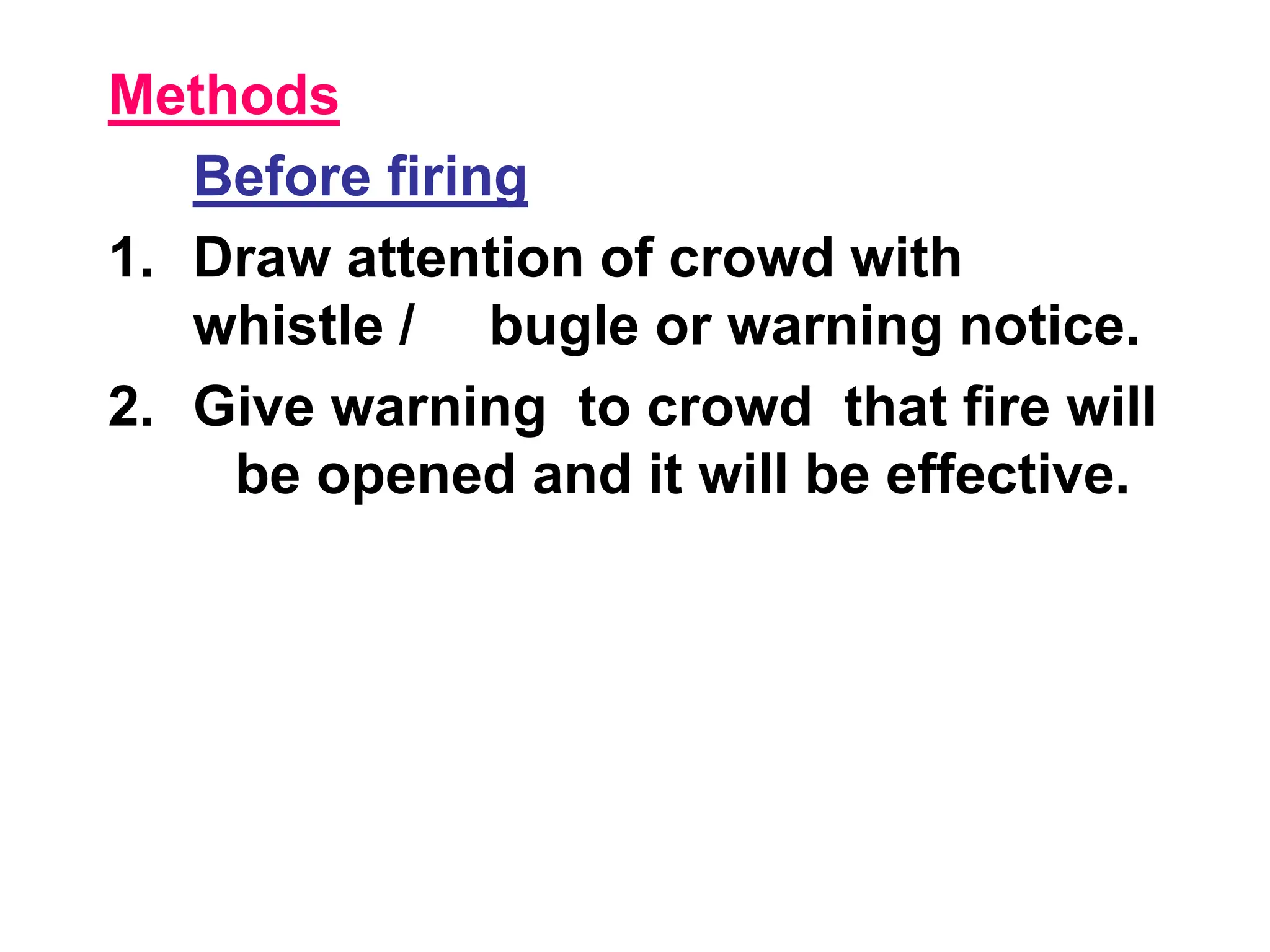
Before firing
1. Draw attention of crowd with
whistle / bugle or warning notice.
2. Give warning to crowd that fire will
be opened and it will be effective.
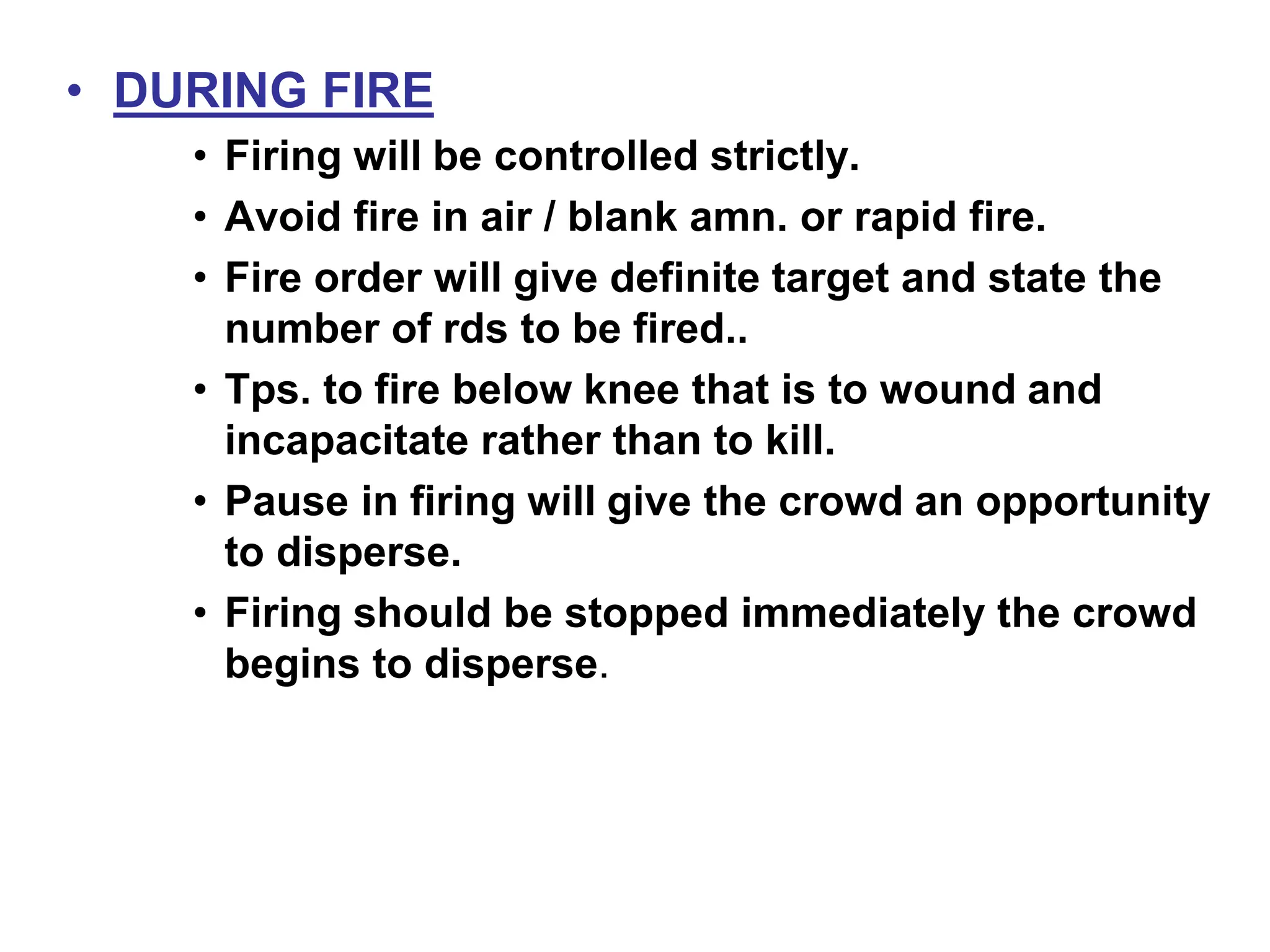
• DURING FIRE
• Firing will be controlled strictly.
• Avoid fire in air / blank amn. or rapid fire.
• Fire order will give definite target and state the
number of rds to be fired..
• Tps. to fire below knee that is to wound and
incapacitate rather than to kill.
• Pause in firing will give the crowd an opportunity
to disperse.
• Firing should be stopped immediately the crowd
begins to disperse.
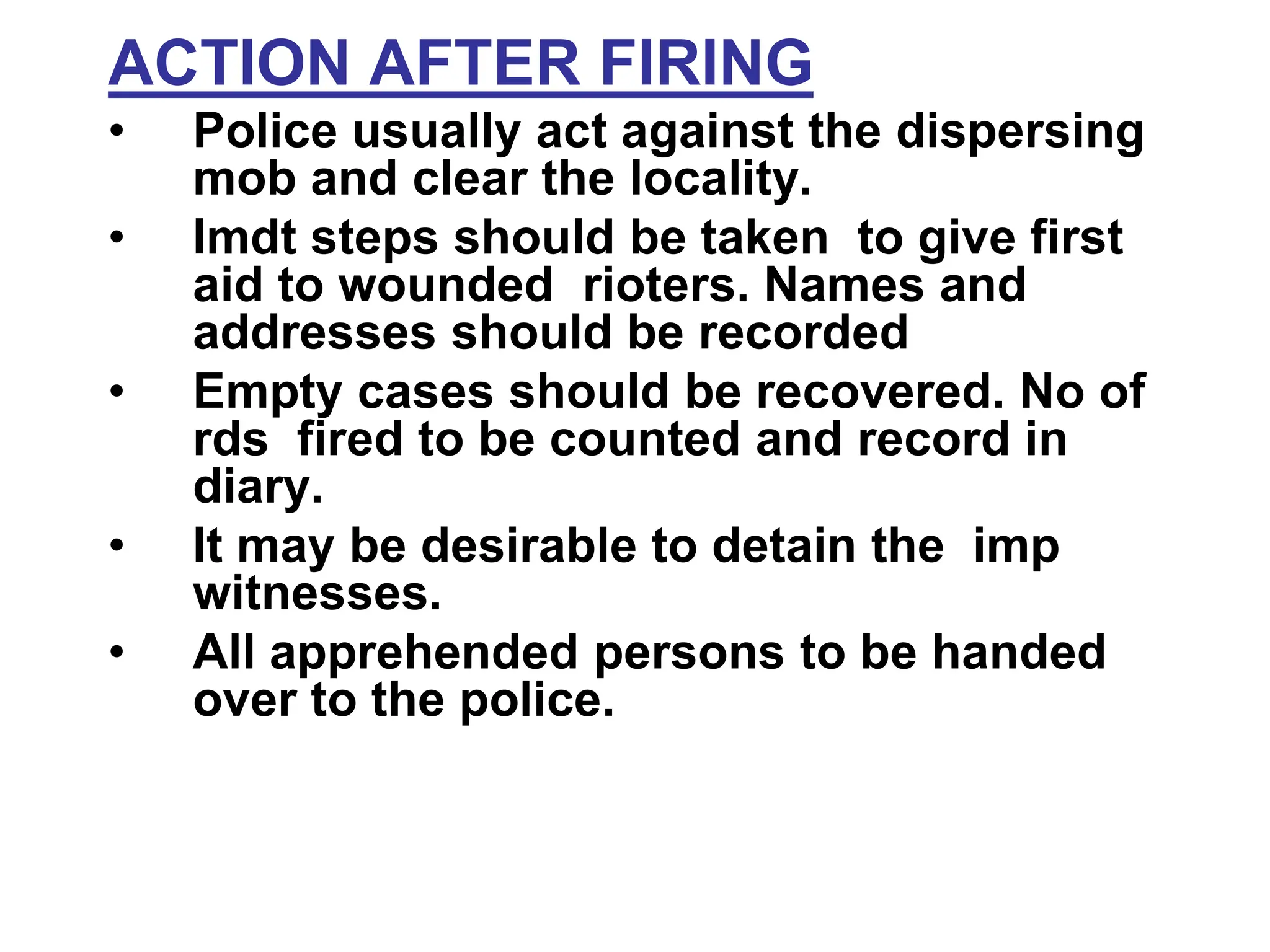
ACTION AFTER FIRING
• Police usually act against the dispersing
mob and clear the locality.
• Imdt steps should be taken to give first
aid to wounded rioters. Names and
addresses should be recorded
• Empty cases should be recovered. No of
rds fired to be counted and record in
diary.
• It may be desirable to detain the imp
witnesses.
• All apprehended persons to be handed
over to the police.
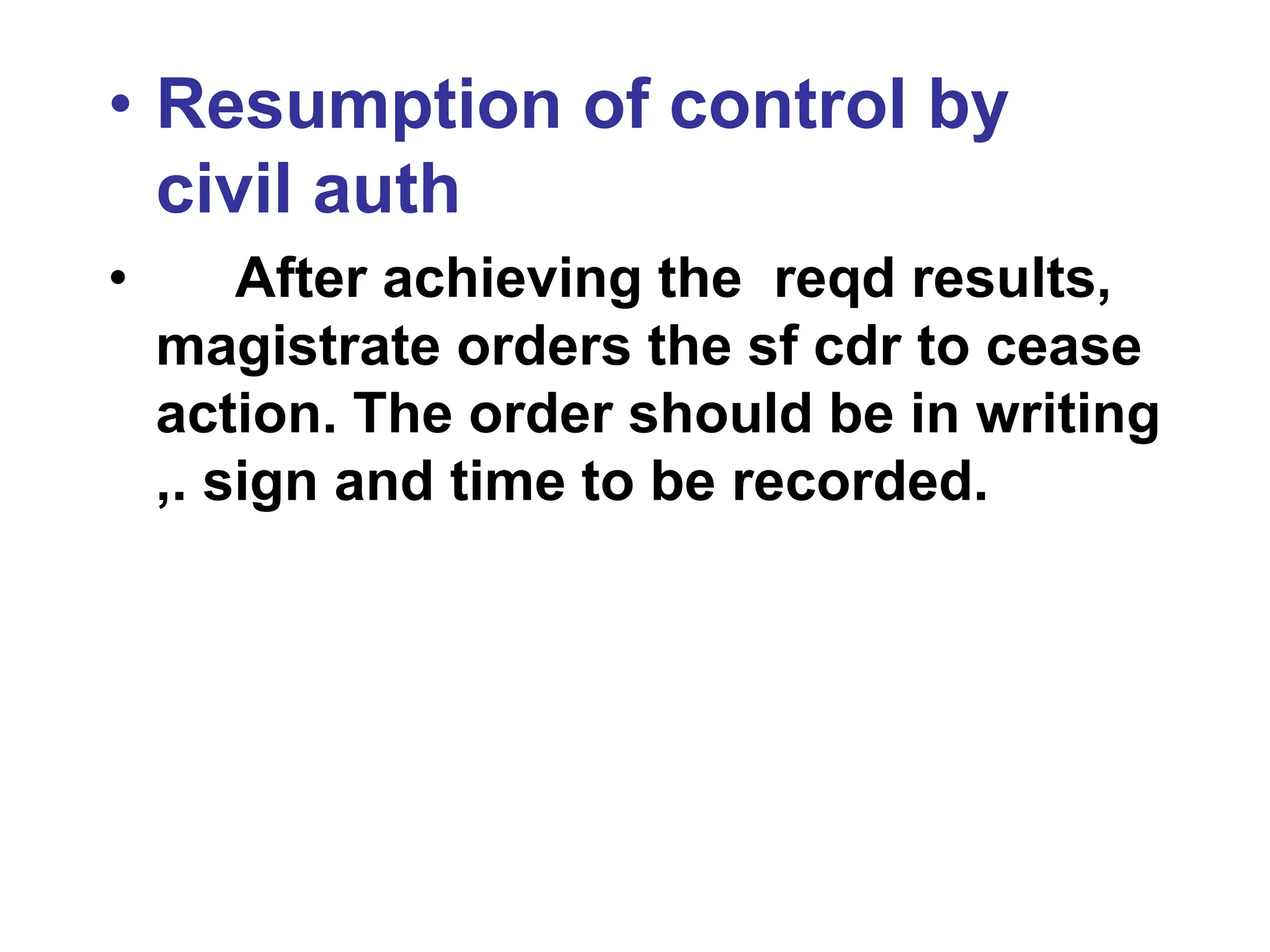
• Resumption of control by
civil auth
• After achieving the reqd results,
magistrate orders the sf cdr to cease
action. The order should be in writing
,. sign and time to be recorded.
Maintenance of diary
• It is essential to maintain a minute
to minute and item by item diary of
event. It should be written in ink
• Fundamental principles of itbp
actions
– Our Object Is Not To Kill But To Temp
Incapacitate.
• Be Impartial.
• Use Mini Force.
• Never load single rd at least one charger to
be loaded.
• Never use blank amn. Never open fire in air.
Never use rapid fire.
• Never use lmg if rifle will suffice.
• Never aim at head, always aim below the
knee.
• Shoot for effect
• Stop fire, the movement crowd get disperse.
• Never allow crowd to approach so near that
hand to hand combat is possible.
Disposn Of Tps
• Sentries always in pair.
• Detachments sould not be less than a
section.
• Do not posn men in a building
underneat the window.
• In gullies put sentries over the roof so
that they can protect sentries in gullies.
• Every veh must have at least a pair of
rifle man to escort driver.
ACTION BEFORE LEAVING BARRACKS
• Ensure That Your Tps Are Aware About The Aid To
Civil Auth.
• See That Your Section Is As Per Auth Str.
• Check All Arms, Amn Tear Smk Etc Carried By Each
Man.. The Diarist Must Record All Wpns And take
sign of witness too..
• Set auto wpn on single shot.
• Recording/ diary material has taken
• Take map of the area to be deployed.
• Synchronise watch with diarist
• Brief men about latest sit and use of mini force.
• List of magistrate who will be on duty.
thanks

Crowd Control with all details how to control

  • 1.
  • 2.
    Large gathering of individualsin one place in close physical proximity to one another with a tendency to develop psychological interaction. DEFINITION
  • 3.
    (i) Intelligence (ii) Actionplan (iii) Prepared to take decision (iv) Communicate it to Subordinates and prepared for action. (v) Prevention of Crowd. (vi) If gathered, disperse it as soon as possible. (vii) If not possible, they should not be allowed to get violent. GUIDELINES FOR COMMANDERS
  • 4.
    (viii) Leaders tobe identified, persuasion and counseling resorted to. (ix) The Crowd once violent, be isolated & kept away from vital installations. (x) If force has to be used, it should be minimum. (xi) Every one should be fairly & impartially treated. (xii) Chances of escape to be provided.
  • 5.
    3. TYPE OFCROWD i) Casual crowds:- Casual crowds are those formed by people whose attention has been temporarily focused on a common object, as Crowd at a scene of traffic accident or fire.
  • 6.
    ii)Expressive Crowds. Expressive Crowdsare formed by those whose activity is an end in itself and who seek personal relief from tension, as group of merry-makers at Holi or New Year Eve.
  • 7.
    iii.Conventional Crowds:- Conventional Crowds aregatherings of people with a central focus and similar ends. Examples sports audiences, political rallies, religious or social gatherings, etc.
  • 8.
    iv. Aggressive Crowds:- AggressiveCrowds are gatherings of people with a common objective, to which their activity is directed, in a violent or potentially violent manner. Political and communal demonstrations are examples of Aggressive Crowds.

  • 9.
    CHARACTERISTICS OF CROWD i) Collectivemind. The crowds acquires a collective mind. The individual in a crowd acts as he would like to in a state of complete isolation, free from the restraints of conscience.
  • 10.
    ii. Lower levelof intelligence:- There is relatively lower level of intelligence in the crowds than in the individuals forming the crowd because “the unconscious” plays a part in determining their “conscious” behaviour.
  • 11.
    iii. More Emotional:- Theindividual in the crowds becomes more emotional and participates in activities such as shouting, cheers, laughter and other forms of exaggerated
  • 12.
    iv. Follow up:- Theindividual in the crowd tends to do what others are doing in the crowd and tends to accept the commands of leader without questioning.
  • 13.
    v. Sense ofPower :- The individual in the crowd feels a sense of power derived out of sheer numbers of the crowd. vi. Sense of Anonymity :- The crowd individual has a sense of anonymity.
  • 14.
    vi. Sense ofIrresponsibility:- The removal of restraint is followed by a consequent sense on irresponsibility. vii. Power of Reasoning:- The power of reasoning of individual in the crowd is at a relatively lower level.
  • 15.
    i) Aim. a) Whatwas the aim of crowd when it gathered ? b) What it became after gathering ? MUST KNOW ABOUT CROWD
  • 16.
    Nature a) What isthe nature of crowd ? Peaceful, excited, aggressive or violent crowd . b) Is there any leader present? c) What is the attitude of leader
  • 17.
    COMPLAINTS/ PROBLEMS OF CROWD •Essential to know about the problem of crowd because nature of crowd mostly depend upon it, say death of child due to some motor accident. • Always try to find out the reason behind discontentment. • Whether sufficient measure has been taken to solve the problem or
  • 18.
    Traffic control • Trafficmust be controlled / regulated near the place of gathering. • Unwanted people be disallowed to stay near-by to decrease chances of collateral damage. • Mode of transport being used by crowd must be kept under watch
  • 19.
    i) Hold talkwith crowd. ii) Understand & appreciate the logic of Crowd. iii) Take help from the influential people. iv) Maintain patience and polite atmosphere. METHOD TO CONTROL THE CROWD
  • 20.
    v) Understand andsolve problem of crowd. vi) Control destructive mentality. vii) Show your strength / power to control the crowd. viii) Take crowd in confidence.
  • 21.
    Unlawful assembly :- Definition:- Section 141 of IPC “ an assembly of 5 or more persons is designated as unlawful assembly, if the common object of that assembly is :–
  • 22.
    (i) Over aweby criminal force & show of criminal force central or state govt. or any public servant in the exercise of lawful duties of such servant. (ii) To resist the execution of law or any legal process. (iii) To commit any mischief or criminal trespass or any other offence.
  • 23.
    (iv) By meansof criminal force or show of force to take or to obtain possession of any property and to deprive any person of the enjoyment of that right. (v) To force a person to do a thing which he is not bound to do so and omit to do what he is entitled to do it.
  • 24.
    Section 146 definesriot . Use of force by an unlawful assembly is riot (Section 146 IPC) Rioting – Affray - 5 and more persons - 2 or more person - In private property also- In public place - Common object - No Common object
  • 25.
    Legal Position 129 CrPC - Dispersal by civil police 130 Cr.PC.- Use of armed forces to disperse 131 Cr.PC.- Powers of armed forces to disperse in absence of Magistrate. 132Cr.PC.- Protection against prosecution 96 – 106 IPC Right of private defence
  • 26.
    Rules for useof force. (i) No more force should be used than is necessary. (ii) Force should not be punitive measures. (iii) it must cease once objective is achieved.
  • 27.
    Sequence of force:- (i)Persuasion , warning and appeal (ii) Tear gas (iii) Cane Charge (iv) Fire arms Equipments:- Tear smoke gun, shields & protective clothing.
  • 28.
    Who can orderdispersal ? • Any megistrate or officer in charge of a police station • Commisioned/Gazetted officer of an armed forces • JCO/SO is not empowered to disperse unlawful assembly on his own except:- – Exercising right of private defence
  • 29.
    Methods Troops ordered todisperse mob will not use police methods but will use weapons and tactics they are trained with
  • 30.
    Methods Before firing 1. Drawattention of crowd with whistle / bugle or warning notice. 2. Give warning to crowd that fire will be opened and it will be effective.
  • 31.
    • DURING FIRE •Firing will be controlled strictly. • Avoid fire in air / blank amn. or rapid fire. • Fire order will give definite target and state the number of rds to be fired.. • Tps. to fire below knee that is to wound and incapacitate rather than to kill. • Pause in firing will give the crowd an opportunity to disperse. • Firing should be stopped immediately the crowd begins to disperse.
  • 32.
    ACTION AFTER FIRING •Police usually act against the dispersing mob and clear the locality. • Imdt steps should be taken to give first aid to wounded rioters. Names and addresses should be recorded • Empty cases should be recovered. No of rds fired to be counted and record in diary. • It may be desirable to detain the imp witnesses. • All apprehended persons to be handed over to the police.
  • 33.
    • Resumption ofcontrol by civil auth • After achieving the reqd results, magistrate orders the sf cdr to cease action. The order should be in writing ,. sign and time to be recorded.
  • 34.
    Maintenance of diary •It is essential to maintain a minute to minute and item by item diary of event. It should be written in ink
  • 35.
    • Fundamental principlesof itbp actions – Our Object Is Not To Kill But To Temp Incapacitate. • Be Impartial. • Use Mini Force. • Never load single rd at least one charger to be loaded. • Never use blank amn. Never open fire in air. Never use rapid fire. • Never use lmg if rifle will suffice. • Never aim at head, always aim below the knee. • Shoot for effect • Stop fire, the movement crowd get disperse. • Never allow crowd to approach so near that hand to hand combat is possible.
  • 36.
    Disposn Of Tps •Sentries always in pair. • Detachments sould not be less than a section. • Do not posn men in a building underneat the window. • In gullies put sentries over the roof so that they can protect sentries in gullies. • Every veh must have at least a pair of rifle man to escort driver.
  • 37.
    ACTION BEFORE LEAVINGBARRACKS • Ensure That Your Tps Are Aware About The Aid To Civil Auth. • See That Your Section Is As Per Auth Str. • Check All Arms, Amn Tear Smk Etc Carried By Each Man.. The Diarist Must Record All Wpns And take sign of witness too.. • Set auto wpn on single shot. • Recording/ diary material has taken • Take map of the area to be deployed. • Synchronise watch with diarist • Brief men about latest sit and use of mini force. • List of magistrate who will be on duty.
  • 38.