tScuba.com
1			 ©SilentScuba 2010 Rev. 1.0
CCR Cave Diving “Almost Simplified”
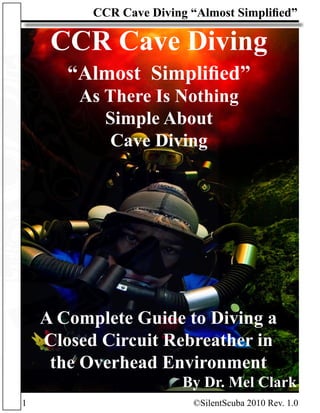
CCR Cave Diving
“Almost Simplified”
As There Is Nothing
Simple About
Cave Diving
A Complete Guide to Diving a
Closed Circuit Rebreather in
the Overhead Environment
By Dr. Mel Clark
2								 ©SilentScuba 2010 Rev. 1.0
www.Silent
CCR Cave Diving “Almost Simplified”
www.Silent
Table of Contents
Chapter #1 Introduction						
•	 Introduction.........................................
	 CCR rules............................................•	
	 Cave rules............................................•	
	 CCR cave rules....................................•	
	 Acknowledgements.............................•	
							
Chapter #2 The Cave Diving Environment
	 Cave Types..........................................•	
	 Dissolution..........................................•	
	 Coral....................................................•	
	 Sea.......................................................•	
	 Lava.....................................................•	
	 Glacial.................................................•	
	 Cave Descriptive Terminology............•	
	 Speleotherm.........................................•	
	 Vadose cave.........................................•	
	 Phreatic cave.......................................•	
	 Spring..................................................•	
	 Siphon.................................................•	
	 No flow................................................•	
	 Sinks....................................................•	
	 Sump...................................................•	
	 Characteristics of Caves......................•	
	 Bottom conditions...............................•	
	 Sand.....................................................•	
	 Mud.....................................................•	
	 Clay.....................................................•	
	 Water Make Up...................................•	
	 Tannic water........................................•	
	 Hydrogen sulfide.................................•	
	 Haloclines............................................•	
	 Water Contamination...........................•	
1
2
5
5
5
5
7
8
8
9
9
9
9
9
9
10
10
10
10
10
11
12
12
12
12
13
13
14
14
14
14
15
tScuba.comtScuba.com
3			 ©SilentScuba 2010 Rev. 1.0
CCR Cave Diving “Almost Simplified”
Chapter #3 CCR Cave Diving Equipment
	 CCR...................................................•	
	 Off-board gas....................................•	
	 Harness & BCD................................•	
	 Weights.............................................•	
	 Bailout and stage cylinders...............•	
	 Bailout regulators..............................•	
	 Lights................................................•	
	 Reels/spools......................................•	
	 Markers..............................................•	
	 Directional.........................................•	
	 Non-directional..................................•	
	 Tools..................................................•	
	 Mask and fins....................................•	
Chapter #4 Cave Diving Hazards Exposed
	 Springs..............................................•	
	 Siphons.............................................•	
	 Tidal flow..........................................•	
	 No flow.............................................•	
	 Restrictions.......................................•	
	 Minor.................................................•	
	 Moderate...........................................•	
	 Major.................................................•	
	 Poor visibility....................................•	
	 Line traps..........................................•	
	 Cave visibility...................................•	
	 Haloclines.........................................•	
	 Tannic water hydrogen sulfide..........•	
	 Entanglement....................................•	
	 Entrapment........................................•	
	 Depth.................................................•	
	 Distance............................................•	
	 Guideline breakage...........................•	
	 Equipment failure.............................•	
	 Other divers.......................................•	
	 Psychological cave hazards.............•	
	 Over confidence................................•	
	 Reasons for cave diving fatalities.....•	
	 Trained cave diver deaths..................•	
	 Non-trained cave diver deaths...........•	
17
19
19
20
20
21
22
24
25
28
28
28
29
30
32
33
34
34
35
35
35
35
35
37
37
37
38
38
39
40
40
40
40
40
40
41
42
42
43
43
www.shearwaterresearch.com
604-669-9958
4								 ©SilentScuba 2010 Rev. 1.0
www.Silent
CCR Cave Diving “Almost Simplified”
www.Silent
Chapter #5 Cave Diving Skills
	 Pre-Dive.................................................................•	
	 Build and confirmation..........................................•	
	 Site evaluation and CCR equipment confirmation.•	
	 Turn points evaluation and dive plan.....................•	
	 In water check and equipment matching................•	
	 Communication......................................................•	
	 Command signals...................................................•	
	 Handsignals............................................................•	
	 Number signals.......................................................•	
	 Lightsignals............................................................•	
	 Written communication..........................................•	
	 Touch communication............................................•	
	 Cave navigation......................................................•	
	 Mainline.................................................................•	
	 Off-shoot line.........................................................•	
	 Jump.......................................................................•	
	 Gap.........................................................................•	
	 T-intersection..........................................................•	
	 Primary reel............................................................•	
	 Safety reel..............................................................•	
	 Jump/gap reel.........................................................•	
	 Line trap.................................................................•	
	 Tie-off.....................................................................•	
	 Placement...............................................................•	
	 Cookies or clothes pins..........................................•	
	 Two line arrows pointing in the same direction.....•	
	 Two line arrows pointing in opposite directions....•	
	 Line skills...............................................................•	
	 Team positioning....................................................•	
	 Making jumps........................................................•	
	 Working around lines.............................................•	
	 Traverse..................................................................•	
	 Circuits...................................................................•	
	 Exiting and passing................................................•	
	 Swimming..............................................................•	
	 Modified frog kick.................................................•	
	 Modified flutter kick...............................................•	
	 Pull and glide.........................................................•	
	 Shuffle kick............................................................•	
	 Cave diving awareness...........................................•	
45
47
47
47
48
48
49
50
50
53
55
56
56
58
58
59
59
60
60
61
61
62
62
62
63
64
64
65
66
67
68
71
71
72
73
73
74
74
75
75
76
Ad Space #2
tScuba.comtScuba.com
5			 ©SilentScuba 2010 Rev. 1.0
CCR Cave Diving “Almost Simplified”
Chapter #6 Cave Diving Adverse Situation
	 Cave Specific Adverse Situation.....................................•	
	 Lost line...........................................................................•	
	 Broken line......................................................................•	
	 Inadvertent jump.............................................................•	
	 Loss of navigational awareness.......................................•	
	 Blackout situations..........................................................•	
	 Lost buddy.......................................................................•	
	 Lost light.........................................................................•	
	 Line entanglement...........................................................•	
	 Entrapment.......................................................................•	
	 CCR failure.....................................................................•	
	 Loss of buoyancy device.................................................•	
	 Sharing air.......................................................................•	
	 CCR Specific Adverse Situations “A Brief Overview”...•	
	 Feeling funny...................................................................•	
	 The first response.............................................................•	
	 BOascent.........................................................................•	
	 The three H’s...................................................................•	
	 Hyperoxia........................................................................•	
	 Hypoxia............................................................................•	
	 Hypercapnia.....................................................................•	
	 Floods..............................................................................•	
	 SCR mode.......................................................................•	
	 Off-board gas..................................................................•	
	 Open loop........................................................................•	
	 Boom...............................................................................•	
	 What if game...................................................................•	
	 Oxygen cell issues...........................................................•	
	 PO2issues........................................................................•	
	 Display issues..................................................................•	
	 OC BO supply issues.......................................................•	
	 Buddy rescue/recovery....................................................•	
	 Omitted decompression...................................................•	
78
79
79
81
82
83
84
85
87
88
89
89
91
92
93
93
94
95
97
98
98
100
101
102
103
104
104
105
105
106
107
109
109
112
Ad Space #3
6								 ©SilentScuba 2010 Rev. 1.0
www.Silent
CCR Cave Diving “Almost Simplified”
www.Silent
Chapter #7 Cave Dive Planning
	 Cave Specific Dive Planning...........................•	
	 Site deposition.................................................•	
	 Dive objectives................................................•	
	 Four CCR turn around points..........................•	
	 On-board oxygen.............................................•	
	 On-board diluent..............................................•	
	 Scrubber...........................................................•	
	 Bailout gas.......................................................•	
	 Stage gas..........................................................•	
	 Mixed teams....................................................•	
	 Cave Non-specific Dive Planning...................•	
	 Oxygen toxicity...............................................•	
	 Inert gas loading calculations..........................•	
	 Example CCR dive plan mainly one depth.....•	
	 Example CCR dive plan mainly two depths....•	
Chapter #8 Cave Psychology and Survival
	 Stressors on a dive...........................................•	
	 Distance...........................................................•	
	 Confinement.....................................................•	
	 Physical stress..................................................•	
	 Doubting navigation.........................................•	
	 Time pressure...................................................•	
	 Task loading.....................................................•	
	 High flow.........................................................•	
	 Peer pressure....................................................•	
	 Ego pressure.....................................................•	
	 Dealing with stress...........................................•	
	 Recognizing stress in your buddy....................•	
	 Choosing your buddy.......................................•	
	 Final thoughts..................................................•	
References..................................................................
About the author.........................................................
114
115
115
116
116
117
119
119
120
126
128
129
129
131
134
135
138
139
140
140
140
140
140
141
141
141
141
142
143
144
144
148
149
Ad Space #4
tScuba.comtScuba.com
7			 ©SilentScuba 2010 Rev. 1.0
CCR Cave Diving “Almost Simplified”
Chapter 1: Introduction
						
Introduction
Course overview
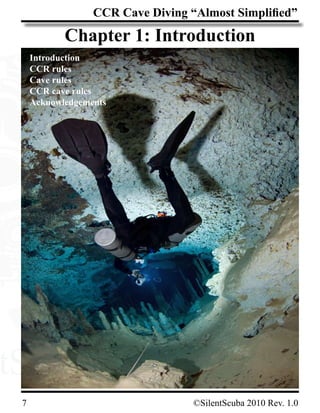
Photo by Curt Bowen
Introduction
CCR rules
Cave rules
CCR cave rules
Acknowledgements
8								 ©SilentScuba 2010 Rev. 1.0
www.Silent
Chapter 2 : The Cave Environment
www.Silent
Chapter 2: The Cave Environment
Cave Types
	 Dissolution
	 Coral
	 Sea
	 Lava
	 Glacial
	 Mines and other manmade
Cave Descriptive Terminology
	 Speleotherm
	 Vadose cave
	 Phreatic cave
	 Spring
	 Siphon
	 No flow
	 Sinks
	 Sump
Characteristics of Caves
	 Bottom conditions
	 Sand
	 Mud
	 Clay
	 Organic & biological material
Water Make Up
	 Tannic water
	 Hydrogen sulfide
	 Haloclines
Hydrogen sulfide
Haloclines
Water Contamination
tScuba.comtScuba.com
9			 ©SilentScuba 2010 Rev. 1.0
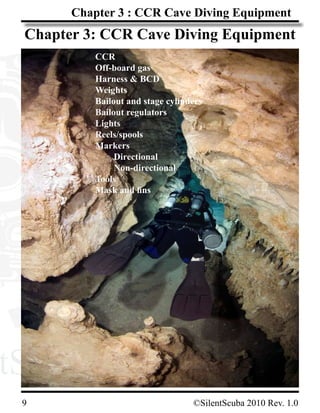
Chapter 3 : CCR Cave Diving Equipment
Chapter 3: CCR Cave Diving Equipment
CCR
Off-board gas
Harness & BCD
Weights
Bailout and stage cylinders
Bailout regulators
Lights
Reels/spools
Markers
	 Directional
	 Non-directional
Tools
Mask and fins
10								 ©SilentScuba 2010 Rev. 1.0
www.Silent
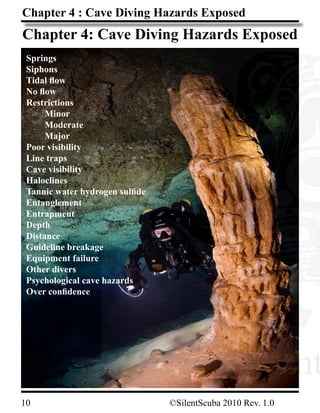
Chapter 4 : Cave Diving Hazards Exposed
www.Silent
Chapter 4: Cave Diving Hazards Exposed
Springs
Siphons
Tidal flow
No flow
Restrictions
	 Minor
	 Moderate
	 Major
Poor visibility
Line traps
Cave visibility
Haloclines
Tannic water hydrogen sulfide
Entanglement
Entrapment
Depth
Distance
Guideline breakage
Equipment failure
Other divers
Psychological cave hazards
Over confidence
tScuba.comtScuba.com
11			 ©SilentScuba 2010 Rev. 1.0
Chapter 5 : Cave Diving Skills
Chapter 5: Cave Diving Skills
Pre-Dive
	 Build and confirmation
	 Site evaluation and CCR equipment confirmation
	 Turn points evaluation and dive plan
In water check and equipment matching
Communication
Command signals
Hand signals
Number signals
Light signals
Written communication
Touch communication
Cave navigation
	 Mainline
	 Off-shoot line
	 Jump
	 Gap
	 T-intersection
	 Primary reel
	 Safety reel
Jump/gap reel
	 Line trap
	 Tie-off
	 Placement
	 Cookies or clothes pins
Two line arrows pointing in the same
direction
Two line arrows pointing in opposite
directions
Line skills
Team positioning
Making jumps
Working around lines
Traverse
Circuits
Exiting and passing
Swimming
	 Modified frog kick
	 Modified flutter kick
	 Pull and glide
	 Shuffle kick
Cave diving awareness
12								 ©SilentScuba 2010 Rev. 1.0
www.Silent
Chapter 6 : Cave Diving Adverse Situation
www.Silent
Chapter 6: Cave Diving Adverse Situation
Cave Specific Adverse Situation
	 Lost line
	 Broken line
	 Inadvertent jump
	 Loss of navigational awareness
	 Blackout situations
	 Lost buddy	
	 Lost light
	 Line entanglement
	 Entrapment
	 Loss of buoyancy device
	 Sharing air
CCR Specific Adverse Situations “A Brief Overview”
	 Feeling funny
	 The first response
	 BO ascent
	 The three H’s
		 Hyperoxia
		 Hypoxia
		 Hypercapnis
	 Floods
	 SCR mode
	 Off-board gas
	 Open loop
	 Boom
What if game
	 Oxygen cell issues
	 PO2 issues
	 Display issues
	 OC BO supply issues
Buddy rescue/recovery
Omitted decompression
tScuba.comtScuba.com
13			 ©SilentScuba 2010 Rev. 1.0
Chapter 7 : Cave Dive Planning
Chapter 7: Cave Dive Planning
Cave Specific Dive Planning
	 Site deposition
	 Dive objectives
	 Four CCR turn around points
		 On-board oxygen
		 On-board diluent
		 Scrubber
		 Bailout gas
Stage gas
Mixed teams
Cave Non-specific Dive Planning
	 Oxygen toxicity
	 Inert gas loading calculations
		 Example CCR dive plan mainly one depth
		 Example CCR dive plan mainly two depths
14								 ©SilentScuba 2010 Rev. 1.0
www.Silent
Chapter 8 : Cave Psychology and Survival
www.Silent
Chapter 8:Cave Psychology and Survival
Stressors on a dive
	 Distance
	 Confinement
	 Physical stress
	 Doubting navigation
	 Time pressure
	 Task loading
	 High flow
	 Peer pressure
	 Ego pressure
Dealing with stress
Recognizing stress in your buddy
Choosing your buddy
Final thoughts
tScuba.comtScuba.com
15			 ©SilentScuba 2010 Rev. 1.0
Chapter 2 : The Cave Environment
Other characteristics the diver needs to understand is the water make up. Tannic water has a
reddish color to it. When the tannic level is high this water is next to impossible to see through.
Tannis comes from decomposing roots and bark. They also make for incredible photo oppor-
tunities. Hydrogen sulfide is a yellowish / brown layer in the water and usually occurs at the
interface between fresh and marine water layers. For hydrogen sulfide to be made, the layer
must be anoxic meaning there is no oxygen left in the water, then bacteria which are anaerobic
degrade plant and animal sediment producing the gas hydrogen sulfide. This gas is highly flam-
mable and quite toxic. As a diver passing through a hydrogen sulfide layer you are really at little
risk of the toxic effects as you are not breathing it in. Even so, I never hang around too long in
this layer. Some divers report a rotten egg like smell. Also, any brass you have will turn black
after being exposed to a hydrogen sulfide layer.  In very high concentration, the hydrogen sul-
fide can burn your skin. If you surface in a hydrogen sulfide filled air space do not breathe the
gas, stay on your CCR. This is always solid advice when unsure of the air environment found
in air pockets in cave systems. Angelita Cenote in Mexico and Hospital Hole sink in the Weeki
Wachee river in Florida, are good examples of dive sites with a hydrogen sulfide layer. Sink
holes near the coast are most likely to have hydrogen sulfide due to the salt water intrusion.
As a diver you need to be most concerned with haloclines. A halocline is the interface between
salt and fresh water. The fresh water has a lower density and will sit on top of the more dense
salt water layer. There is a distinct interface between the two layers making it look like a mir-
ror in some cases. The thickness of the interface can range from inches to feet. This interface
when disturbed can completely distort visibility. When you encounter a halocline it is best to
swim above or below the interface so you don’t distort the visibility. If this is not possible then
swimming in a more side by side manner will allow the following divers to have some visibility.
The nice thing about the halocline is it settles relatively quickly and visibility will be restored.
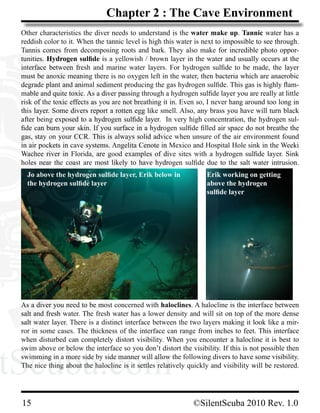
Jo above the hydrogen sulfide layer, Erik below in
the hydrogen sulfide layer
Erik working on getting
above the hydrogen
sulfide layer
16								 ©SilentScuba 2010 Rev. 1.0
www.Silent
Chapter 3 : CCR Cave Diving Equipment
www.Silent
Markers
There are two main types of markers, directional and non-directional. A directional marker
points to the direction of the exit. The directional markers are called line arrows. Line arrows are
installed on permanent lines in the cave, they can also be marked with the distance to the nearest
air hole or exit. Divers will also carry at least three line arrows on each dive.All of your line arrows
need to be permanently marked to identify they are yours. Line arrows are employed at jumps,
line intersections or end of the line where navigational errors could occur. They take the guessing
out of the equation on exiting when used correctly. They can also be used in an emergency such
as in a lost line situation. In this case the diver would attach a line arrow to the permanent line
pointing in the direction they are exiting when they re-locate the line. This is important since their
buddy may stumble along this arrow and now they know one of two things; their buddy is ahead
of them and is safely exiting, or their buddy is lost and heading in the wrong direction, in this case
the buddy diver will need to access their turn points and decide to go after them or retreat. Emer-
gency use of line markers will be covered in Chapter 6, Cave Diving Adverse Situation Skills.
Another use for your line arrows is when you install a jump off a mainline and there is no arrow
already there then you must place an arrow on the main line pointing in the exit direction. This
arrow will help you know the correct way out and will also serve to hold your jump line in place.
Non-directional markers do not point towards an exit,
they serve to mark points such as maximum penetration
distances and help the diver complete circuits. Non-di-
rectional markers can also be used to mark the exit side
of confusing intersections and permanent line arrows.
The use of markers will be covered in Chapter 5, Cave
Diving Skills. Cookies and clothespins are considered
non-directional markers. Each diver should carry at least
one non-directional marker but this will depend on the
diving location. Mexican caves have many intersections
where the diver will require non-directional markers
and in this case a minimum of six should be carried.
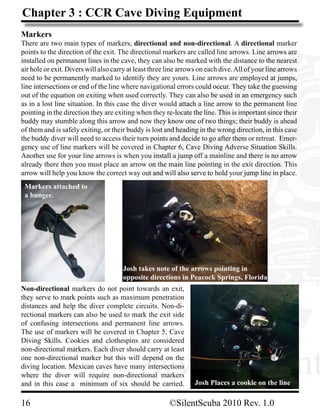
Josh takes note of the arrows pointing in
opposite directions in Peacock Springs, Florida
Josh Places a cookie on the line
Markers attached to
a bungee.
tScuba.comtScuba.com
17			 ©SilentScuba 2010 Rev. 1.0
Chapter 5 : Cave Diving Skills
18								 ©SilentScuba 2010 Rev. 1.0
www.Silent
Chapter 5 : Cave Diving Skills
tScuba.comAd Space #22

CCR Cave Diving

  • 1.
    tScuba.com 1 ©SilentScuba 2010Rev. 1.0 CCR Cave Diving “Almost Simplified” CCR Cave Diving “Almost Simplified” As There Is Nothing Simple About Cave Diving A Complete Guide to Diving a Closed Circuit Rebreather in the Overhead Environment By Dr. Mel Clark
  • 2.
    2 ©SilentScuba 2010Rev. 1.0 www.Silent CCR Cave Diving “Almost Simplified” www.Silent Table of Contents Chapter #1 Introduction • Introduction......................................... CCR rules............................................• Cave rules............................................• CCR cave rules....................................• Acknowledgements.............................• Chapter #2 The Cave Diving Environment Cave Types..........................................• Dissolution..........................................• Coral....................................................• Sea.......................................................• Lava.....................................................• Glacial.................................................• Cave Descriptive Terminology............• Speleotherm.........................................• Vadose cave.........................................• Phreatic cave.......................................• Spring..................................................• Siphon.................................................• No flow................................................• Sinks....................................................• Sump...................................................• Characteristics of Caves......................• Bottom conditions...............................• Sand.....................................................• Mud.....................................................• Clay.....................................................• Water Make Up...................................• Tannic water........................................• Hydrogen sulfide.................................• Haloclines............................................• Water Contamination...........................• 1 2 5 5 5 5 7 8 8 9 9 9 9 9 9 10 10 10 10 10 11 12 12 12 12 13 13 14 14 14 14 15
  • 3.
    tScuba.comtScuba.com 3 ©SilentScuba 2010Rev. 1.0 CCR Cave Diving “Almost Simplified” Chapter #3 CCR Cave Diving Equipment CCR...................................................• Off-board gas....................................• Harness & BCD................................• Weights.............................................• Bailout and stage cylinders...............• Bailout regulators..............................• Lights................................................• Reels/spools......................................• Markers..............................................• Directional.........................................• Non-directional..................................• Tools..................................................• Mask and fins....................................• Chapter #4 Cave Diving Hazards Exposed Springs..............................................• Siphons.............................................• Tidal flow..........................................• No flow.............................................• Restrictions.......................................• Minor.................................................• Moderate...........................................• Major.................................................• Poor visibility....................................• Line traps..........................................• Cave visibility...................................• Haloclines.........................................• Tannic water hydrogen sulfide..........• Entanglement....................................• Entrapment........................................• Depth.................................................• Distance............................................• Guideline breakage...........................• Equipment failure.............................• Other divers.......................................• Psychological cave hazards.............• Over confidence................................• Reasons for cave diving fatalities.....• Trained cave diver deaths..................• Non-trained cave diver deaths...........• 17 19 19 20 20 21 22 24 25 28 28 28 29 30 32 33 34 34 35 35 35 35 35 37 37 37 38 38 39 40 40 40 40 40 40 41 42 42 43 43 www.shearwaterresearch.com 604-669-9958
  • 4.
    4 ©SilentScuba 2010Rev. 1.0 www.Silent CCR Cave Diving “Almost Simplified” www.Silent Chapter #5 Cave Diving Skills Pre-Dive.................................................................• Build and confirmation..........................................• Site evaluation and CCR equipment confirmation.• Turn points evaluation and dive plan.....................• In water check and equipment matching................• Communication......................................................• Command signals...................................................• Handsignals............................................................• Number signals.......................................................• Lightsignals............................................................• Written communication..........................................• Touch communication............................................• Cave navigation......................................................• Mainline.................................................................• Off-shoot line.........................................................• Jump.......................................................................• Gap.........................................................................• T-intersection..........................................................• Primary reel............................................................• Safety reel..............................................................• Jump/gap reel.........................................................• Line trap.................................................................• Tie-off.....................................................................• Placement...............................................................• Cookies or clothes pins..........................................• Two line arrows pointing in the same direction.....• Two line arrows pointing in opposite directions....• Line skills...............................................................• Team positioning....................................................• Making jumps........................................................• Working around lines.............................................• Traverse..................................................................• Circuits...................................................................• Exiting and passing................................................• Swimming..............................................................• Modified frog kick.................................................• Modified flutter kick...............................................• Pull and glide.........................................................• Shuffle kick............................................................• Cave diving awareness...........................................• 45 47 47 47 48 48 49 50 50 53 55 56 56 58 58 59 59 60 60 61 61 62 62 62 63 64 64 65 66 67 68 71 71 72 73 73 74 74 75 75 76 Ad Space #2
  • 5.
    tScuba.comtScuba.com 5 ©SilentScuba 2010Rev. 1.0 CCR Cave Diving “Almost Simplified” Chapter #6 Cave Diving Adverse Situation Cave Specific Adverse Situation.....................................• Lost line...........................................................................• Broken line......................................................................• Inadvertent jump.............................................................• Loss of navigational awareness.......................................• Blackout situations..........................................................• Lost buddy.......................................................................• Lost light.........................................................................• Line entanglement...........................................................• Entrapment.......................................................................• CCR failure.....................................................................• Loss of buoyancy device.................................................• Sharing air.......................................................................• CCR Specific Adverse Situations “A Brief Overview”...• Feeling funny...................................................................• The first response.............................................................• BOascent.........................................................................• The three H’s...................................................................• Hyperoxia........................................................................• Hypoxia............................................................................• Hypercapnia.....................................................................• Floods..............................................................................• SCR mode.......................................................................• Off-board gas..................................................................• Open loop........................................................................• Boom...............................................................................• What if game...................................................................• Oxygen cell issues...........................................................• PO2issues........................................................................• Display issues..................................................................• OC BO supply issues.......................................................• Buddy rescue/recovery....................................................• Omitted decompression...................................................• 78 79 79 81 82 83 84 85 87 88 89 89 91 92 93 93 94 95 97 98 98 100 101 102 103 104 104 105 105 106 107 109 109 112 Ad Space #3
  • 6.
    6 ©SilentScuba 2010Rev. 1.0 www.Silent CCR Cave Diving “Almost Simplified” www.Silent Chapter #7 Cave Dive Planning Cave Specific Dive Planning...........................• Site deposition.................................................• Dive objectives................................................• Four CCR turn around points..........................• On-board oxygen.............................................• On-board diluent..............................................• Scrubber...........................................................• Bailout gas.......................................................• Stage gas..........................................................• Mixed teams....................................................• Cave Non-specific Dive Planning...................• Oxygen toxicity...............................................• Inert gas loading calculations..........................• Example CCR dive plan mainly one depth.....• Example CCR dive plan mainly two depths....• Chapter #8 Cave Psychology and Survival Stressors on a dive...........................................• Distance...........................................................• Confinement.....................................................• Physical stress..................................................• Doubting navigation.........................................• Time pressure...................................................• Task loading.....................................................• High flow.........................................................• Peer pressure....................................................• Ego pressure.....................................................• Dealing with stress...........................................• Recognizing stress in your buddy....................• Choosing your buddy.......................................• Final thoughts..................................................• References.................................................................. About the author......................................................... 114 115 115 116 116 117 119 119 120 126 128 129 129 131 134 135 138 139 140 140 140 140 140 141 141 141 141 142 143 144 144 148 149 Ad Space #4
  • 7.
    tScuba.comtScuba.com 7 ©SilentScuba 2010Rev. 1.0 CCR Cave Diving “Almost Simplified” Chapter 1: Introduction Introduction Course overview Photo by Curt Bowen Introduction CCR rules Cave rules CCR cave rules Acknowledgements
  • 8.
    8 ©SilentScuba 2010Rev. 1.0 www.Silent Chapter 2 : The Cave Environment www.Silent Chapter 2: The Cave Environment Cave Types Dissolution Coral Sea Lava Glacial Mines and other manmade Cave Descriptive Terminology Speleotherm Vadose cave Phreatic cave Spring Siphon No flow Sinks Sump Characteristics of Caves Bottom conditions Sand Mud Clay Organic & biological material Water Make Up Tannic water Hydrogen sulfide Haloclines Hydrogen sulfide Haloclines Water Contamination
  • 9.
    tScuba.comtScuba.com 9 ©SilentScuba 2010Rev. 1.0 Chapter 3 : CCR Cave Diving Equipment Chapter 3: CCR Cave Diving Equipment CCR Off-board gas Harness & BCD Weights Bailout and stage cylinders Bailout regulators Lights Reels/spools Markers Directional Non-directional Tools Mask and fins
  • 10.
    10 ©SilentScuba 2010Rev. 1.0 www.Silent Chapter 4 : Cave Diving Hazards Exposed www.Silent Chapter 4: Cave Diving Hazards Exposed Springs Siphons Tidal flow No flow Restrictions Minor Moderate Major Poor visibility Line traps Cave visibility Haloclines Tannic water hydrogen sulfide Entanglement Entrapment Depth Distance Guideline breakage Equipment failure Other divers Psychological cave hazards Over confidence
  • 11.
    tScuba.comtScuba.com 11 ©SilentScuba 2010Rev. 1.0 Chapter 5 : Cave Diving Skills Chapter 5: Cave Diving Skills Pre-Dive Build and confirmation Site evaluation and CCR equipment confirmation Turn points evaluation and dive plan In water check and equipment matching Communication Command signals Hand signals Number signals Light signals Written communication Touch communication Cave navigation Mainline Off-shoot line Jump Gap T-intersection Primary reel Safety reel Jump/gap reel Line trap Tie-off Placement Cookies or clothes pins Two line arrows pointing in the same direction Two line arrows pointing in opposite directions Line skills Team positioning Making jumps Working around lines Traverse Circuits Exiting and passing Swimming Modified frog kick Modified flutter kick Pull and glide Shuffle kick Cave diving awareness
  • 12.
    12 ©SilentScuba 2010Rev. 1.0 www.Silent Chapter 6 : Cave Diving Adverse Situation www.Silent Chapter 6: Cave Diving Adverse Situation Cave Specific Adverse Situation Lost line Broken line Inadvertent jump Loss of navigational awareness Blackout situations Lost buddy Lost light Line entanglement Entrapment Loss of buoyancy device Sharing air CCR Specific Adverse Situations “A Brief Overview” Feeling funny The first response BO ascent The three H’s Hyperoxia Hypoxia Hypercapnis Floods SCR mode Off-board gas Open loop Boom What if game Oxygen cell issues PO2 issues Display issues OC BO supply issues Buddy rescue/recovery Omitted decompression
  • 13.
    tScuba.comtScuba.com 13 ©SilentScuba 2010Rev. 1.0 Chapter 7 : Cave Dive Planning Chapter 7: Cave Dive Planning Cave Specific Dive Planning Site deposition Dive objectives Four CCR turn around points On-board oxygen On-board diluent Scrubber Bailout gas Stage gas Mixed teams Cave Non-specific Dive Planning Oxygen toxicity Inert gas loading calculations Example CCR dive plan mainly one depth Example CCR dive plan mainly two depths
  • 14.
    14 ©SilentScuba 2010Rev. 1.0 www.Silent Chapter 8 : Cave Psychology and Survival www.Silent Chapter 8:Cave Psychology and Survival Stressors on a dive Distance Confinement Physical stress Doubting navigation Time pressure Task loading High flow Peer pressure Ego pressure Dealing with stress Recognizing stress in your buddy Choosing your buddy Final thoughts
  • 15.
    tScuba.comtScuba.com 15 ©SilentScuba 2010Rev. 1.0 Chapter 2 : The Cave Environment Other characteristics the diver needs to understand is the water make up. Tannic water has a reddish color to it. When the tannic level is high this water is next to impossible to see through. Tannis comes from decomposing roots and bark. They also make for incredible photo oppor- tunities. Hydrogen sulfide is a yellowish / brown layer in the water and usually occurs at the interface between fresh and marine water layers. For hydrogen sulfide to be made, the layer must be anoxic meaning there is no oxygen left in the water, then bacteria which are anaerobic degrade plant and animal sediment producing the gas hydrogen sulfide. This gas is highly flam- mable and quite toxic. As a diver passing through a hydrogen sulfide layer you are really at little risk of the toxic effects as you are not breathing it in. Even so, I never hang around too long in this layer. Some divers report a rotten egg like smell. Also, any brass you have will turn black after being exposed to a hydrogen sulfide layer. In very high concentration, the hydrogen sul- fide can burn your skin. If you surface in a hydrogen sulfide filled air space do not breathe the gas, stay on your CCR. This is always solid advice when unsure of the air environment found in air pockets in cave systems. Angelita Cenote in Mexico and Hospital Hole sink in the Weeki Wachee river in Florida, are good examples of dive sites with a hydrogen sulfide layer. Sink holes near the coast are most likely to have hydrogen sulfide due to the salt water intrusion. As a diver you need to be most concerned with haloclines. A halocline is the interface between salt and fresh water. The fresh water has a lower density and will sit on top of the more dense salt water layer. There is a distinct interface between the two layers making it look like a mir- ror in some cases. The thickness of the interface can range from inches to feet. This interface when disturbed can completely distort visibility. When you encounter a halocline it is best to swim above or below the interface so you don’t distort the visibility. If this is not possible then swimming in a more side by side manner will allow the following divers to have some visibility. The nice thing about the halocline is it settles relatively quickly and visibility will be restored. Jo above the hydrogen sulfide layer, Erik below in the hydrogen sulfide layer Erik working on getting above the hydrogen sulfide layer
  • 16.
    16 ©SilentScuba 2010Rev. 1.0 www.Silent Chapter 3 : CCR Cave Diving Equipment www.Silent Markers There are two main types of markers, directional and non-directional. A directional marker points to the direction of the exit. The directional markers are called line arrows. Line arrows are installed on permanent lines in the cave, they can also be marked with the distance to the nearest air hole or exit. Divers will also carry at least three line arrows on each dive.All of your line arrows need to be permanently marked to identify they are yours. Line arrows are employed at jumps, line intersections or end of the line where navigational errors could occur. They take the guessing out of the equation on exiting when used correctly. They can also be used in an emergency such as in a lost line situation. In this case the diver would attach a line arrow to the permanent line pointing in the direction they are exiting when they re-locate the line. This is important since their buddy may stumble along this arrow and now they know one of two things; their buddy is ahead of them and is safely exiting, or their buddy is lost and heading in the wrong direction, in this case the buddy diver will need to access their turn points and decide to go after them or retreat. Emer- gency use of line markers will be covered in Chapter 6, Cave Diving Adverse Situation Skills. Another use for your line arrows is when you install a jump off a mainline and there is no arrow already there then you must place an arrow on the main line pointing in the exit direction. This arrow will help you know the correct way out and will also serve to hold your jump line in place. Non-directional markers do not point towards an exit, they serve to mark points such as maximum penetration distances and help the diver complete circuits. Non-di- rectional markers can also be used to mark the exit side of confusing intersections and permanent line arrows. The use of markers will be covered in Chapter 5, Cave Diving Skills. Cookies and clothespins are considered non-directional markers. Each diver should carry at least one non-directional marker but this will depend on the diving location. Mexican caves have many intersections where the diver will require non-directional markers and in this case a minimum of six should be carried. Josh takes note of the arrows pointing in opposite directions in Peacock Springs, Florida Josh Places a cookie on the line Markers attached to a bungee.
  • 17.
    tScuba.comtScuba.com 17 ©SilentScuba 2010Rev. 1.0 Chapter 5 : Cave Diving Skills
  • 18.
    18 ©SilentScuba 2010Rev. 1.0 www.Silent Chapter 5 : Cave Diving Skills
  • 19.