
BY: PARAM TANDON
BLS/LL.B 5th YEAR
Dr. D. Y. PATIL COLLEGE OF LAW
MUMBAI
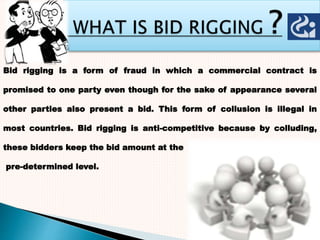
Bid rigging is a form of fraud in which a commercial contract is
promised to one party even though for the sake of appearance several
other parties also present a bid. This form of collusion is illegal in
most countries. Bid rigging is anti-competitive because by colluding,
these bidders keep the bid amount at the
pre-determined level.
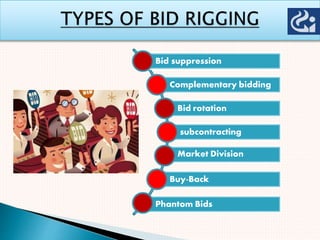
Bid suppression
Complementary bidding
Bid rotation
subcontracting
Market Division
Buy-Back
Phantom Bids
Increases the
cost to the
consumers.
Potential
wastage of
tax payer can
be significant
Pushes up
contract
prices by 20
to 30 percent
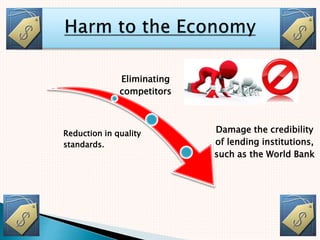
Eliminating
competitors
Reduction in quality
standards.
Damage the credibility
of lending institutions,
such as the World Bank
 Receive identical bids or close amount of number from different companies
 There is some indication of a physical alteration of bids,
particularly at the last minute
 The range of bids shows a clear gap between the winner
and all others
 All companies submit high bids when the cost for work are less on paper
 Qualified bidders do not bid especially if they initially took steps to bid
 If a contract is re-bid because all initial bids are unacceptable, the bidders
come back in the same order or some bidders fail to re-bid
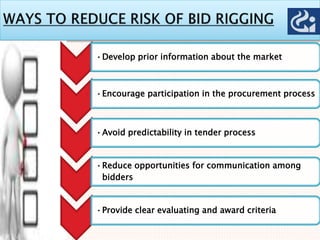
•Develop prior information about the market
•Encourage participation in the procurement process
•Avoid predictability in tender process
•Reduce opportunities for communication among
bidders
•Provide clear evaluating and award criteria
THE COMPETITION ACT,
2002
IF SECTION
3(3)(d) VIOLATED
SECTION
27(b)
₹ PENALTY UPTO 10% OF
AVERAGE TURNOVER
OF 3 PRECEDING
FINANCIAL YEARS
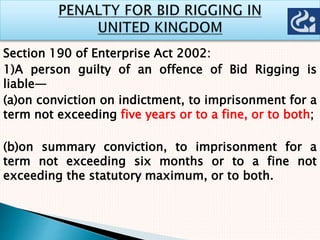
Section 190 of Enterprise Act 2002:
1)A person guilty of an offence of Bid Rigging is
liable—
(a)on conviction on indictment, to imprisonment for a
term not exceeding five years or to a fine, or to both;
(b)on summary conviction, to imprisonment for a
term not exceeding six months or to a fine not
exceeding the statutory maximum, or to both.
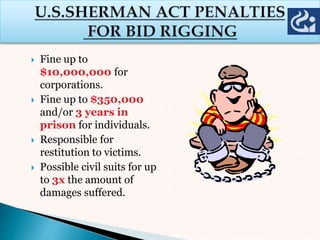
 Fine up to
$10,000,000 for
corporations.
 Fine up to $350,000
and/or 3 years in
prison for individuals.
 Responsible for
restitution to victims.
 Possible civil suits for up
to 3x the amount of
damages suffered.
According to Indonesia’s competition law,
• The Commission can impose civil fines up to Rupiah 25
billion (US$2.7mn) for violations of the law or criminal
fines.
• up toRupiah 100 billion (US$2.3bn) and a prison term
of up to six months, as sanctions for bid rigging.
Participants in illegal bid
rigging are sentenced to
a maximum two-year
prison term or fined a
maximum Y2.5 million.
ANTI-MONOPOLY LAW
• No limit on fines
• Jail term up to 14 years for individuals(S.
47(2))
• Victims have a statutory right to sue
perpetrators to recover damages caused by
bid-rigging (s. 36)
• Criminal record may be registered with
the Canadian Police Information Centre
(CPIC)
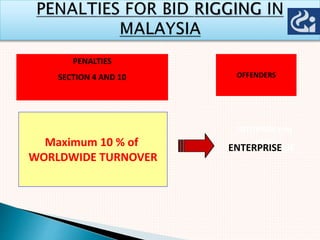
Maximum 10 % of
WORLDWIDE TURNOVER
ENTERPRISE (any
entity)
PENALTIES
SECTION 4 AND 10 OFFENDERS
ENTERPRISEISE
 Non-compliance has serious consequences:
• Fines up to 10% of annual worldwide turnover
• Liability in damages under national law
• Voiding of contract
• Criminal liability
• Substantial expenditure of time and money
• Bad publicity
• Investigations by other competition
authorities
INDIA
•MONETRY FINE
•NO
IMORISONMENT
U.S.
•MONETRY FINE
•IMPRISONMENT
U.K.
•MONETRY FINE
•IMPRISONMENT,
OR BOTH
INDONESIA
•MONETRY FINE
•IMPRISONMENT
JAPAN
•MONETRY FINE
•IMPRISONMENT
CANADA
•MONETRY FINE( NO
LIMIT)
•IMPRISONMENT
•RECOVERY TO VICTIM
•CRIMINAL RECORD
MALASIA
•MONETRY FINE
• NO
IMPRISONMENT
EU
•MONETRY FINE
•CRIMINAL
LIABILITY
BID RIGGING
PENALTIES
COMPARISON
FINE
cci presentation7

cci presentation7

  • 1.
    BY: PARAM TANDON BLS/LL.B5th YEAR Dr. D. Y. PATIL COLLEGE OF LAW MUMBAI
  • 2.
    Bid rigging isa form of fraud in which a commercial contract is promised to one party even though for the sake of appearance several other parties also present a bid. This form of collusion is illegal in most countries. Bid rigging is anti-competitive because by colluding, these bidders keep the bid amount at the pre-determined level.
  • 3.
    Bid suppression Complementary bidding Bidrotation subcontracting Market Division Buy-Back Phantom Bids
  • 4.
    Increases the cost tothe consumers. Potential wastage of tax payer can be significant Pushes up contract prices by 20 to 30 percent
  • 5.
    Eliminating competitors Reduction in quality standards. Damagethe credibility of lending institutions, such as the World Bank
  • 6.
     Receive identicalbids or close amount of number from different companies  There is some indication of a physical alteration of bids, particularly at the last minute  The range of bids shows a clear gap between the winner and all others  All companies submit high bids when the cost for work are less on paper  Qualified bidders do not bid especially if they initially took steps to bid  If a contract is re-bid because all initial bids are unacceptable, the bidders come back in the same order or some bidders fail to re-bid
  • 7.
    •Develop prior informationabout the market •Encourage participation in the procurement process •Avoid predictability in tender process •Reduce opportunities for communication among bidders •Provide clear evaluating and award criteria
  • 10.
    THE COMPETITION ACT, 2002 IFSECTION 3(3)(d) VIOLATED SECTION 27(b) ₹ PENALTY UPTO 10% OF AVERAGE TURNOVER OF 3 PRECEDING FINANCIAL YEARS
  • 11.
    Section 190 ofEnterprise Act 2002: 1)A person guilty of an offence of Bid Rigging is liable— (a)on conviction on indictment, to imprisonment for a term not exceeding five years or to a fine, or to both; (b)on summary conviction, to imprisonment for a term not exceeding six months or to a fine not exceeding the statutory maximum, or to both.
  • 12.
     Fine upto $10,000,000 for corporations.  Fine up to $350,000 and/or 3 years in prison for individuals.  Responsible for restitution to victims.  Possible civil suits for up to 3x the amount of damages suffered.
  • 13.
    According to Indonesia’scompetition law, • The Commission can impose civil fines up to Rupiah 25 billion (US$2.7mn) for violations of the law or criminal fines. • up toRupiah 100 billion (US$2.3bn) and a prison term of up to six months, as sanctions for bid rigging.
  • 14.
    Participants in illegalbid rigging are sentenced to a maximum two-year prison term or fined a maximum Y2.5 million. ANTI-MONOPOLY LAW
  • 15.
    • No limiton fines • Jail term up to 14 years for individuals(S. 47(2)) • Victims have a statutory right to sue perpetrators to recover damages caused by bid-rigging (s. 36) • Criminal record may be registered with the Canadian Police Information Centre (CPIC)
  • 16.
    Maximum 10 %of WORLDWIDE TURNOVER ENTERPRISE (any entity) PENALTIES SECTION 4 AND 10 OFFENDERS ENTERPRISEISE
  • 17.
     Non-compliance hasserious consequences: • Fines up to 10% of annual worldwide turnover • Liability in damages under national law • Voiding of contract • Criminal liability • Substantial expenditure of time and money • Bad publicity • Investigations by other competition authorities
  • 18.
    INDIA •MONETRY FINE •NO IMORISONMENT U.S. •MONETRY FINE •IMPRISONMENT U.K. •MONETRYFINE •IMPRISONMENT, OR BOTH INDONESIA •MONETRY FINE •IMPRISONMENT JAPAN •MONETRY FINE •IMPRISONMENT CANADA •MONETRY FINE( NO LIMIT) •IMPRISONMENT •RECOVERY TO VICTIM •CRIMINAL RECORD MALASIA •MONETRY FINE • NO IMPRISONMENT EU •MONETRY FINE •CRIMINAL LIABILITY BID RIGGING PENALTIES COMPARISON FINE