WIPO Information Seminar on Rights Management Information: Accessing Creativity in a Network Environment Geneva, 2007-09-17 Emerging Fields of Application for RMI: Search Engines and Users Mike Linksvayer Vice President, Creative Commons Original photo by Mia Garlick Licensed under CC Attribution-ShareAlike 2.0
Creative Commons .ORG Nonprofit organization, launched to public December 2002 HQ in San Francisco Science Commons division in Boston ~60 international jurisdiction projects, coordinated from Berlin Foundation, corporate, and individual funding
Enabling Reasonable Copyright Space between ignoring copyright and ignoring fair use & public good Legal and technical tools enabling a “Some Rights Reserved” model Like “free software” or “open source” for content/media But with more restrictive options Media is more diverse and at least a decade behind software
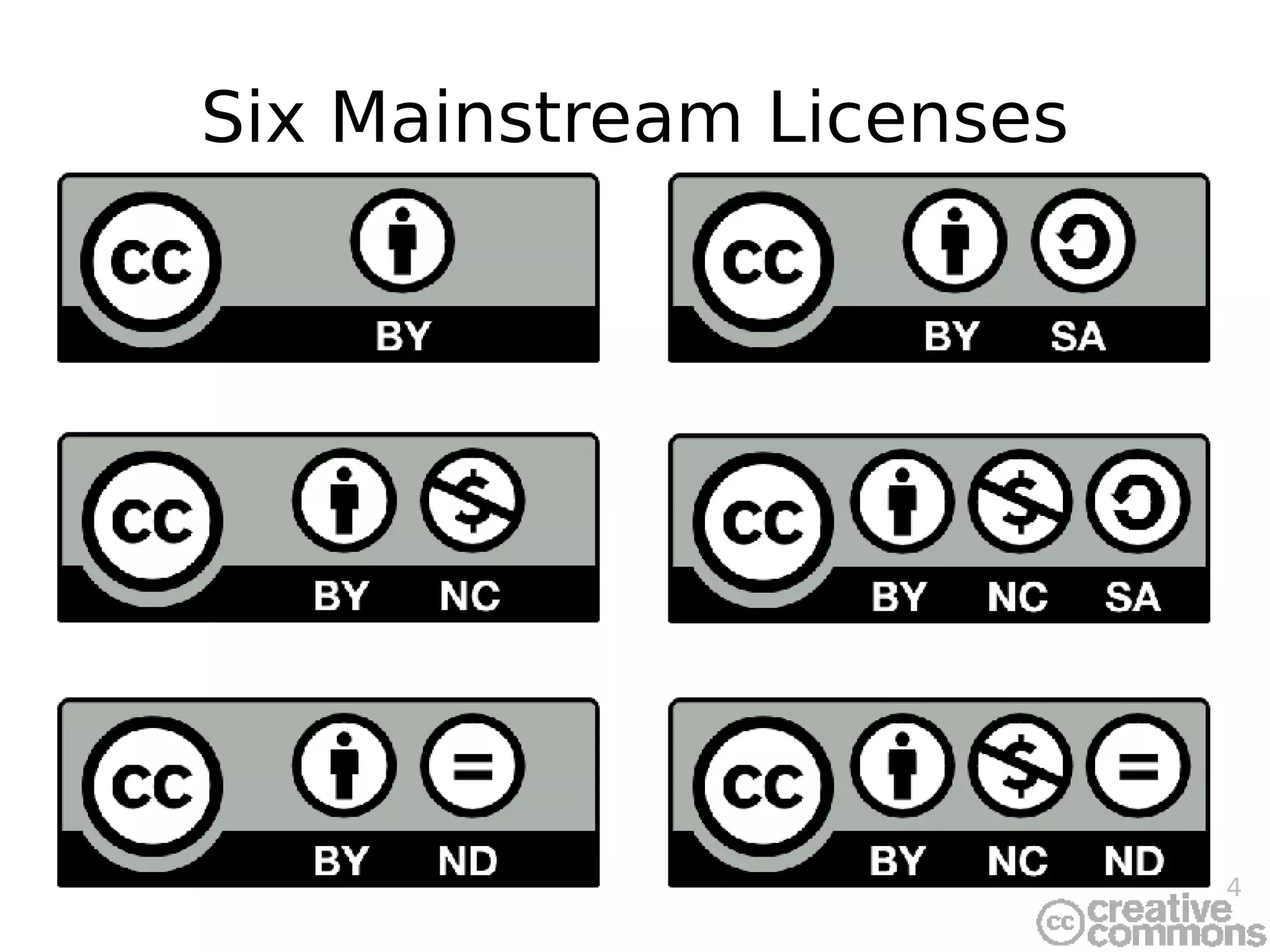
Six Mainstream Licenses
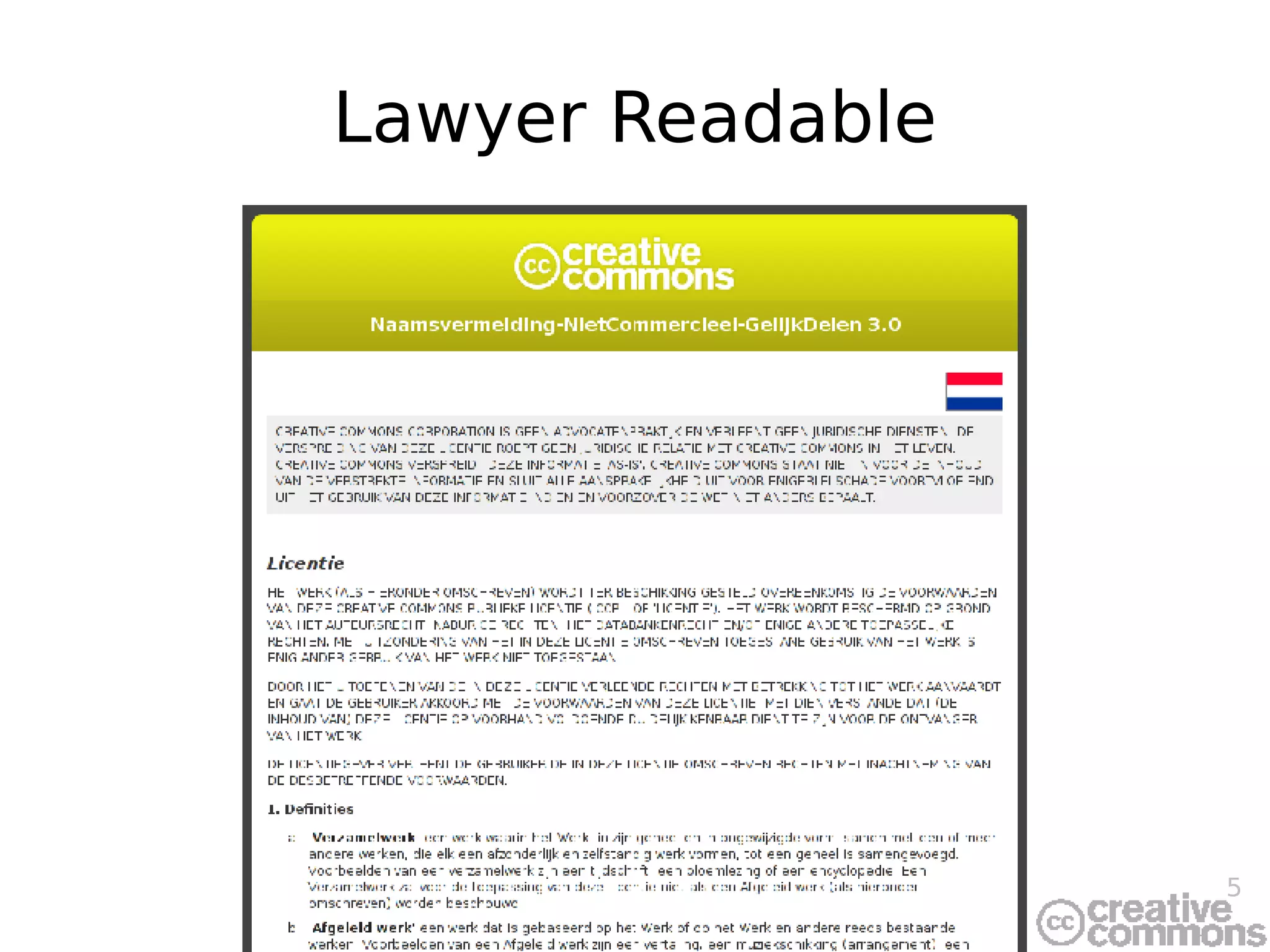
Lawyer Readable
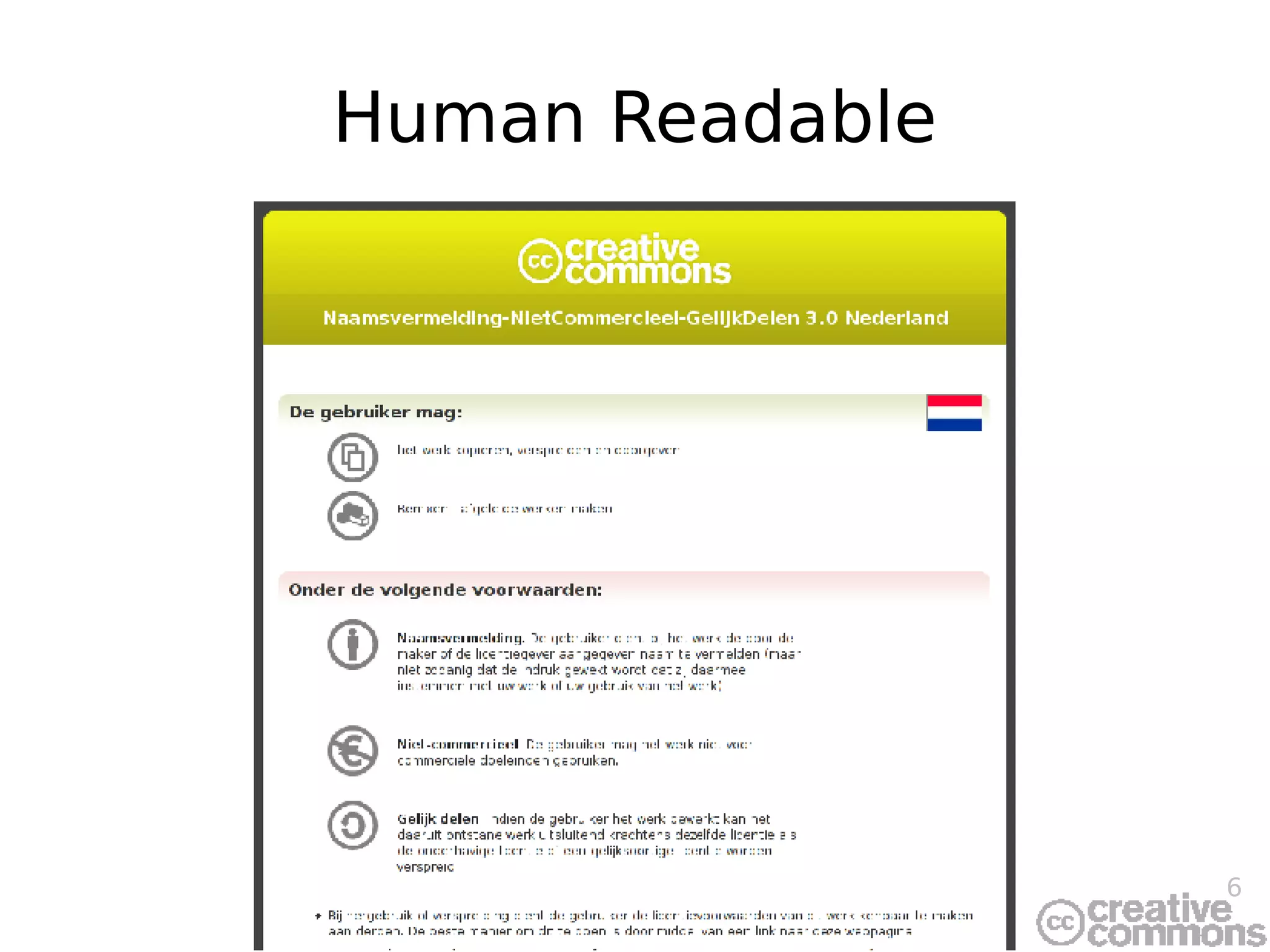
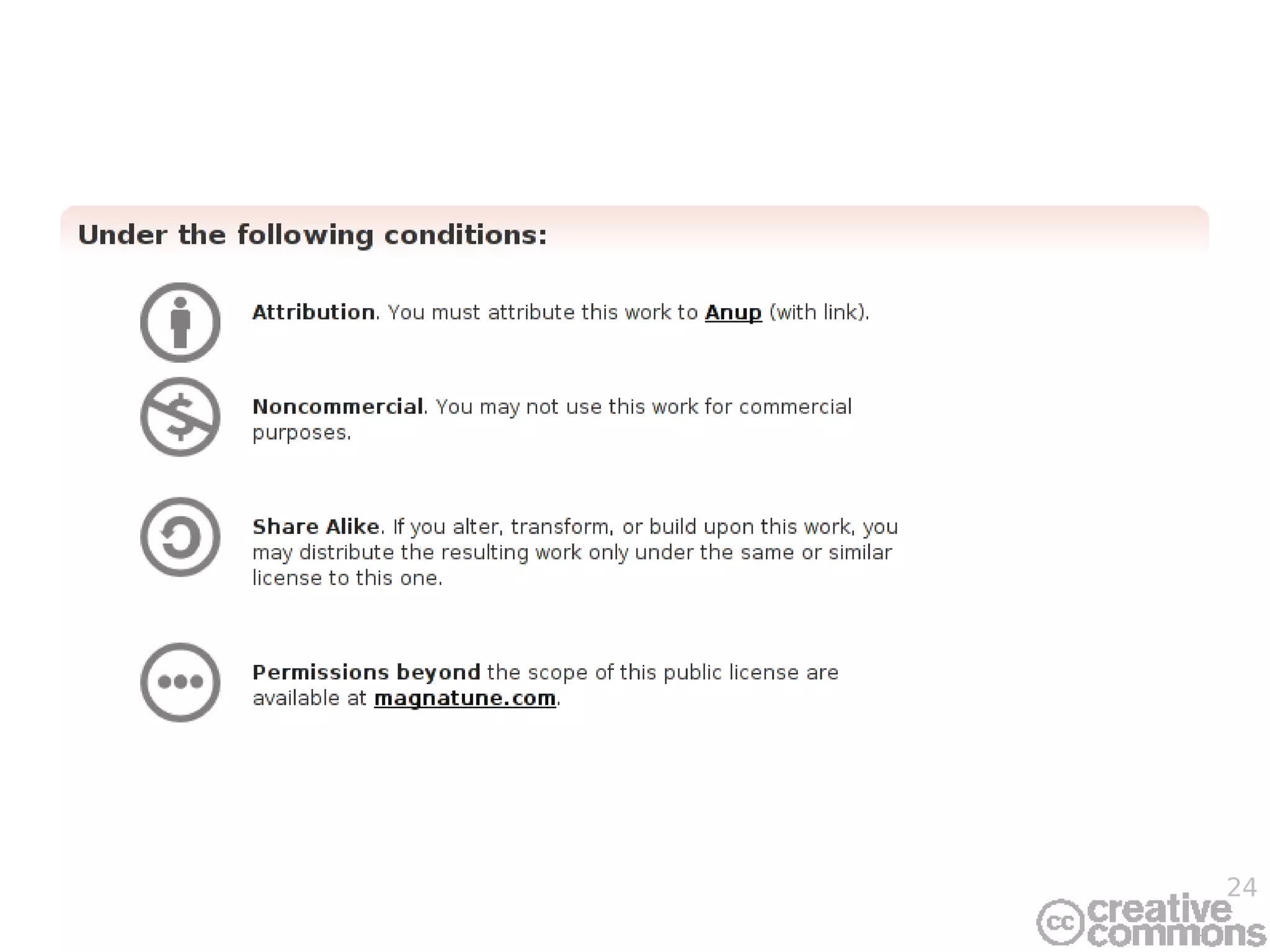
Human Readable
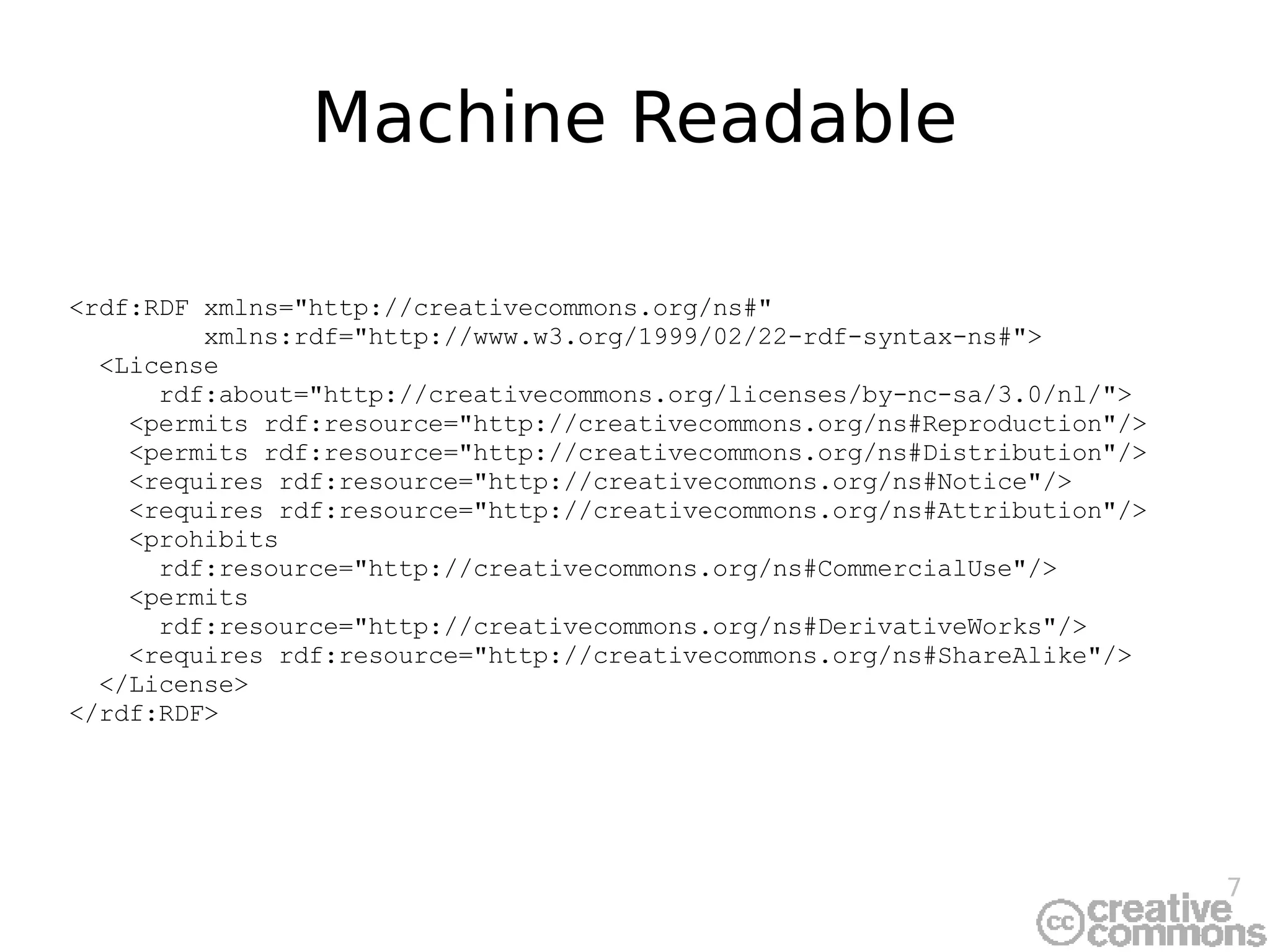
Machine Readable <rdf:RDF xmlns=&quot;http://creativecommons.org/ns#&quot; xmlns:rdf=&quot;http://www.w3.org/1999/02/22-rdf-syntax-ns#&quot;> <License rdf:about=&quot;http://creativecommons.org/licenses/by-nc-sa/3.0/nl/&quot;> <permits rdf:resource=&quot;http://creativecommons.org/ns#Reproduction&quot;/> <permits rdf:resource=&quot;http://creativecommons.org/ns#Distribution&quot;/> <requires rdf:resource=&quot;http://creativecommons.org/ns#Notice&quot;/> <requires rdf:resource=&quot;http://creativecommons.org/ns#Attribution&quot;/> <prohibits rdf:resource=&quot;http://creativecommons.org/ns#CommercialUse&quot;/> <permits rdf:resource=&quot;http://creativecommons.org/ns#DerivativeWorks&quot;/> <requires rdf:resource=&quot;http://creativecommons.org/ns#ShareAlike&quot;/> </License> </rdf:RDF>
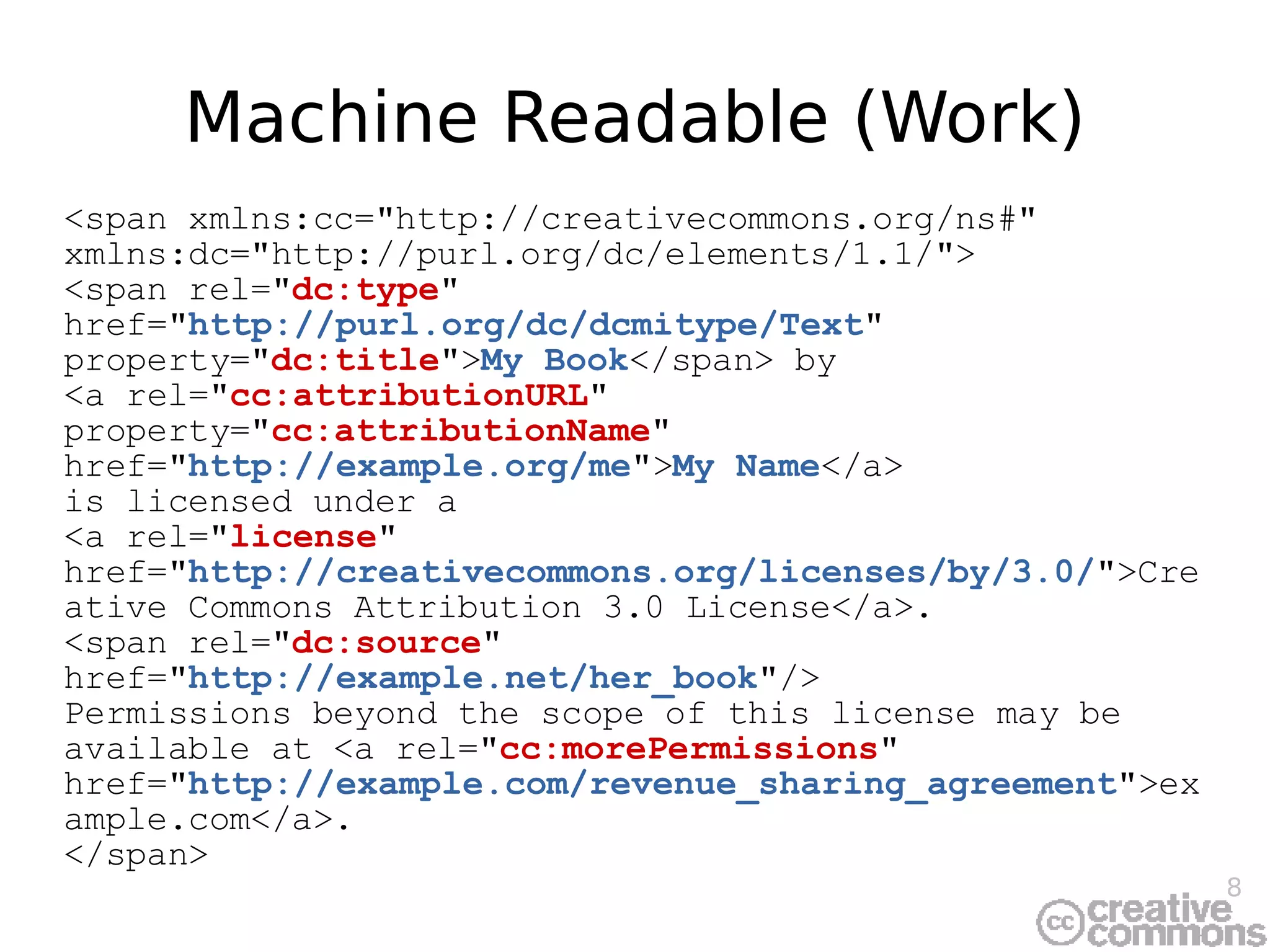
Machine Readable (Work) <span xmlns:cc=&quot;http://creativecommons.org/ns#&quot; xmlns:dc=&quot;http://purl.org/dc/elements/1.1/&quot;> <span rel=&quot; dc:type &quot; href=&quot; http://purl.org/dc/dcmitype/Text &quot;  property=&quot; dc:title &quot; > My Book </span> by  <a  rel=&quot; cc:attributionURL &quot; property=&quot; cc:attributionName &quot; href=&quot; http://example.org/me &quot;> My Name </a>  is licensed under a  <a  rel=&quot; license &quot; href=&quot; http://creativecommons.org/licenses/by/3.0/ &quot; >Creative Commons Attribution 3.0 License</a>.  <span  rel=&quot; dc:source &quot; href=&quot; http://example.net/her_book &quot; /> Permissions beyond the scope of this license may be available at <a  rel=&quot; cc:morePermissions &quot; href=&quot; http://example.com/revenue_sharing_agreement &quot;>example.com</a>. </span>
Rights Description vs. Rights Management Copy/use promotion vs. copy/use protection Encourage fans vs. discourage casual pirates Resource management vs. customer management Web content model vs. 20 th  century content model Not  necessarily  mutually exclusive
DRM Opportunity Cost Publishers did not create consumer value with new technologies Did everything to prevent others from doing so Inadvertently handed dominant position to Apple/iTunes “Compliance” has costs ... be careful in your cost/benefit analysis ... worry about creating inadvertent monopolies
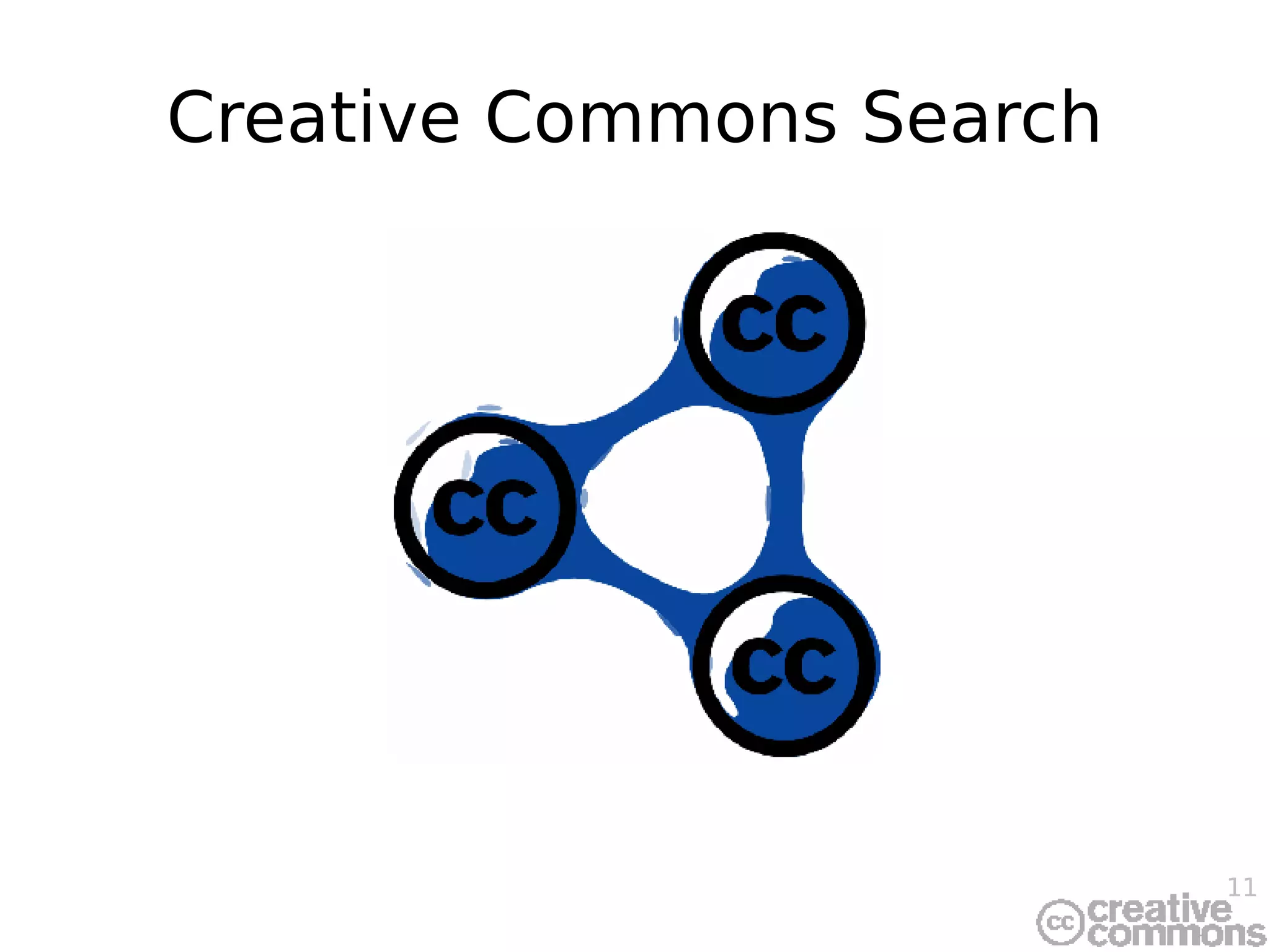
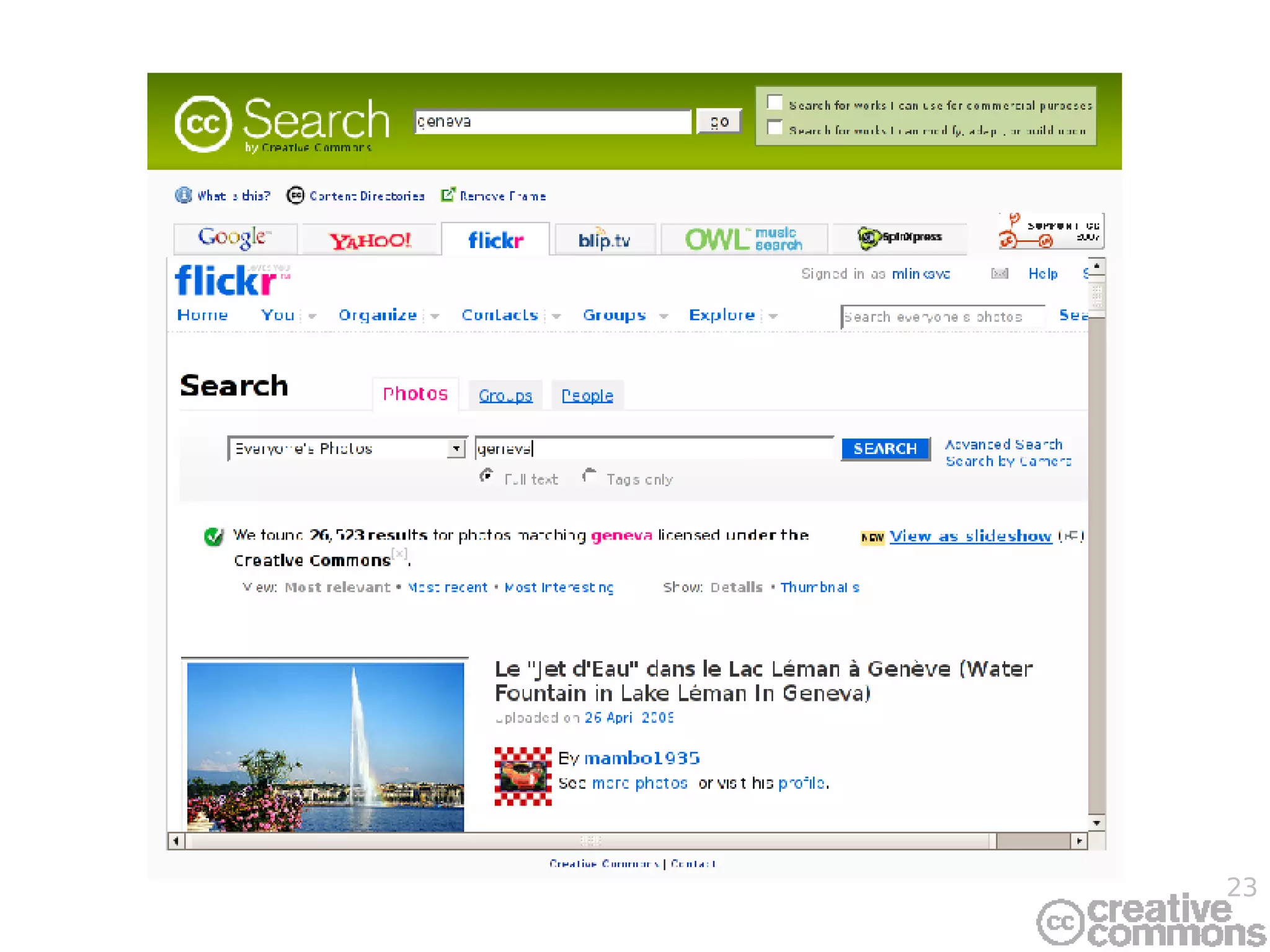
Creative Commons Search
Why Semantic Web? Small organization, no central registration for every license Decentralization; let a thousand search engines bloom; web as database Take advantage of SemWeb tools as they develop CC launches with RDF metadata, December 2002
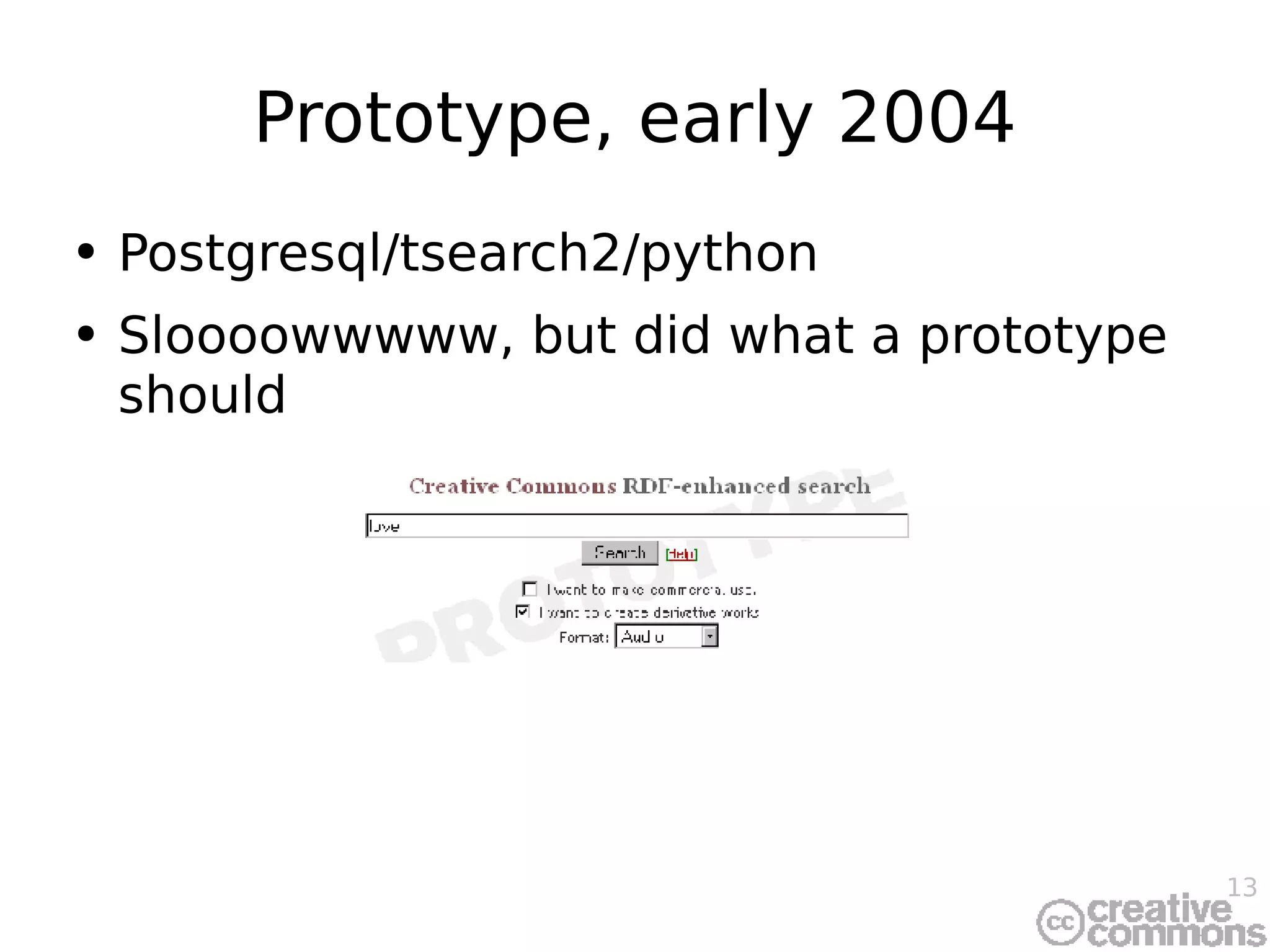
Prototype, early 2004 Postgresql/tsearch2/python Sloooowwwww, but did what a prototype should
Nutch, late 2004 Nutch aims to provide open source search software enabling services comparable to existing web scale search engines Creative Commons plugin only ~500 lines of code
 
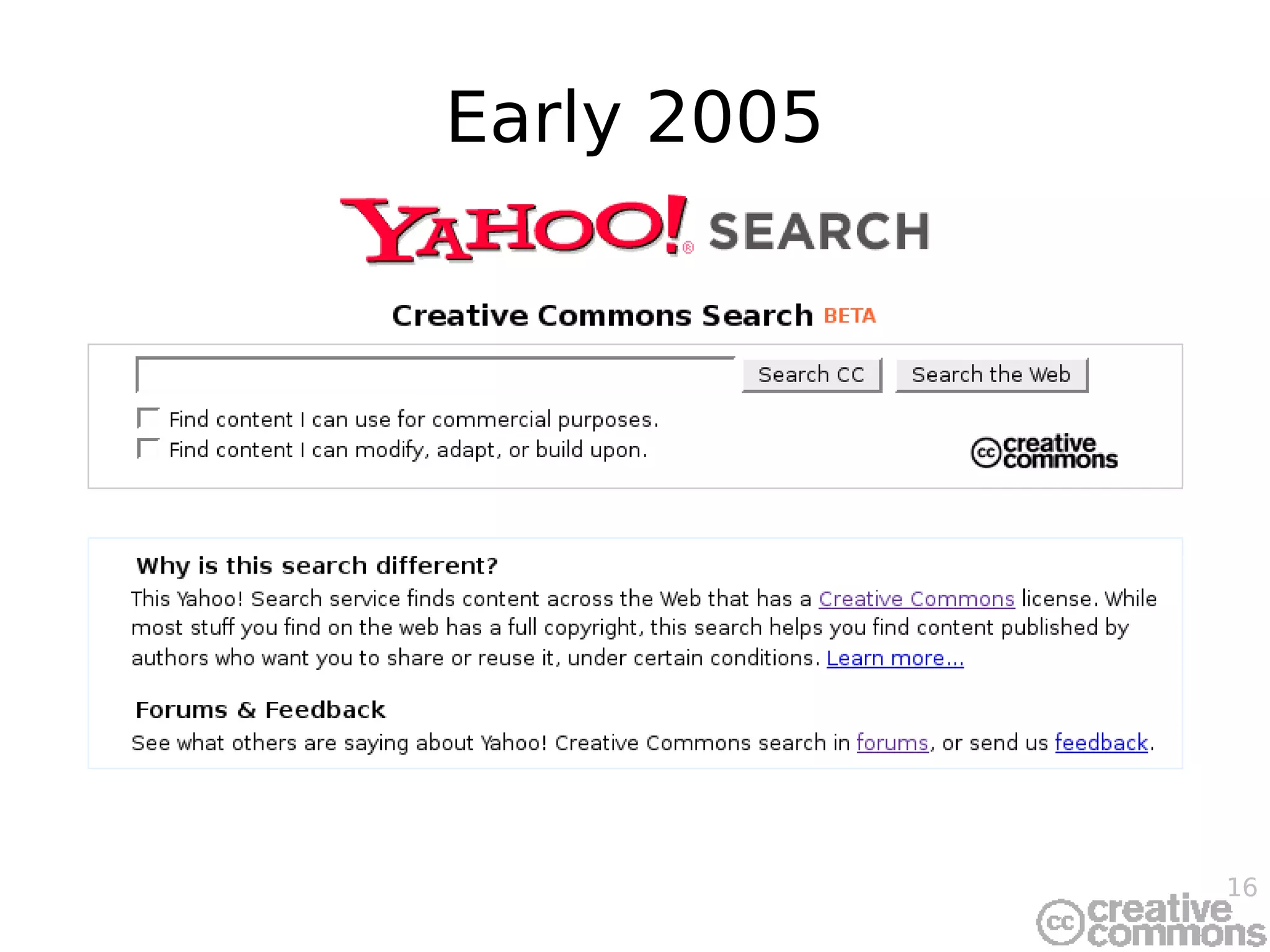
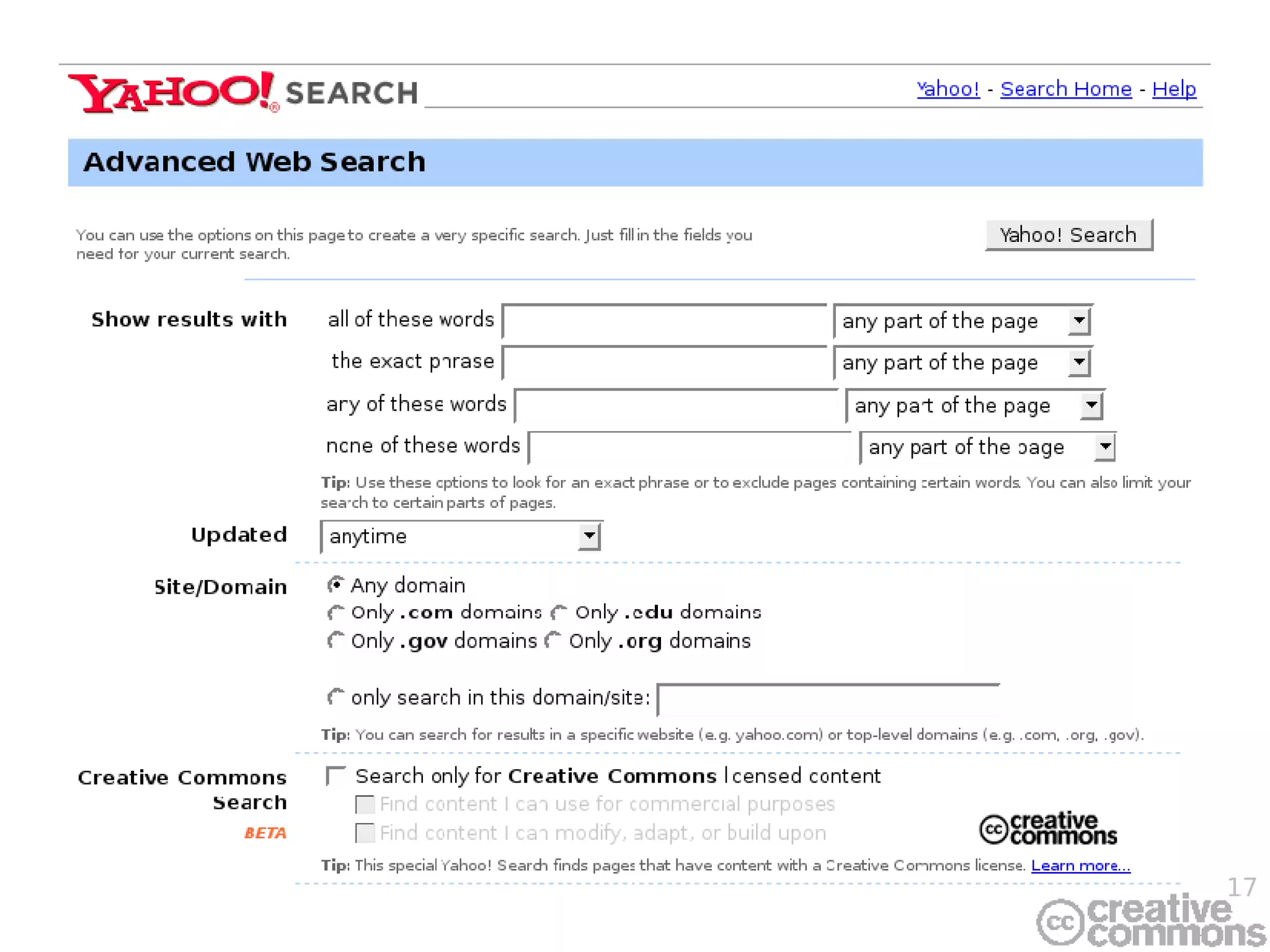
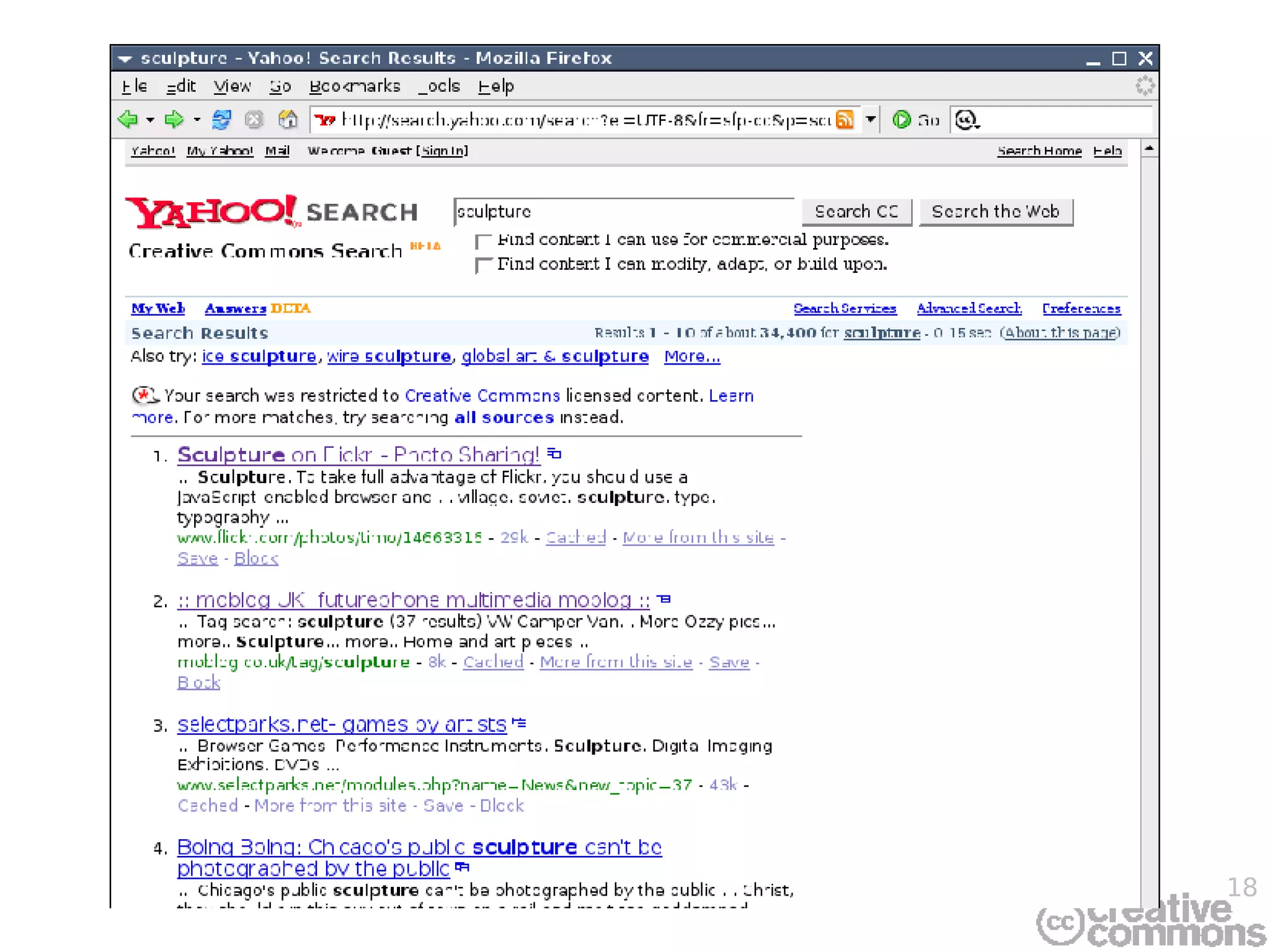
Early 2005
 
 
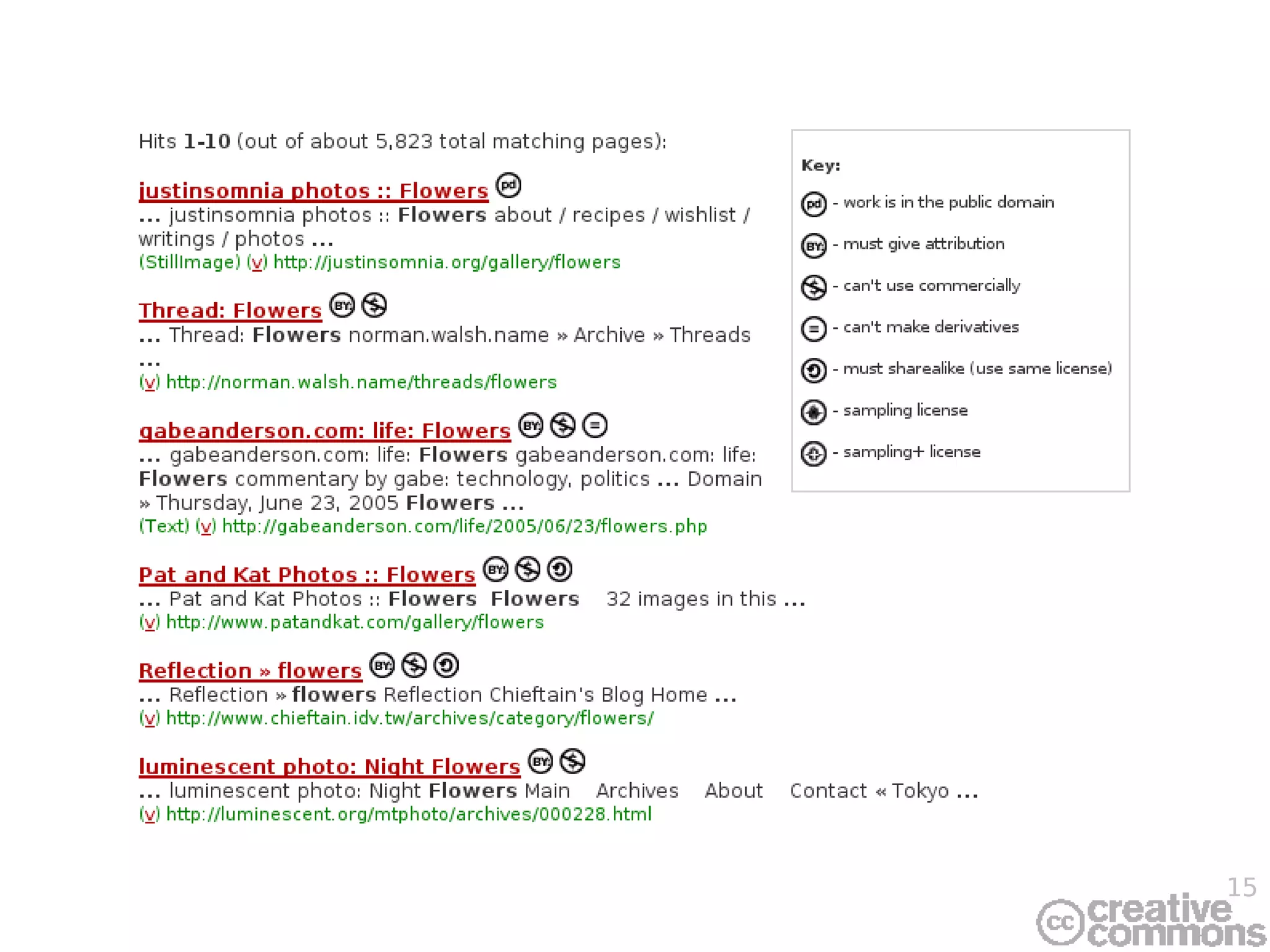
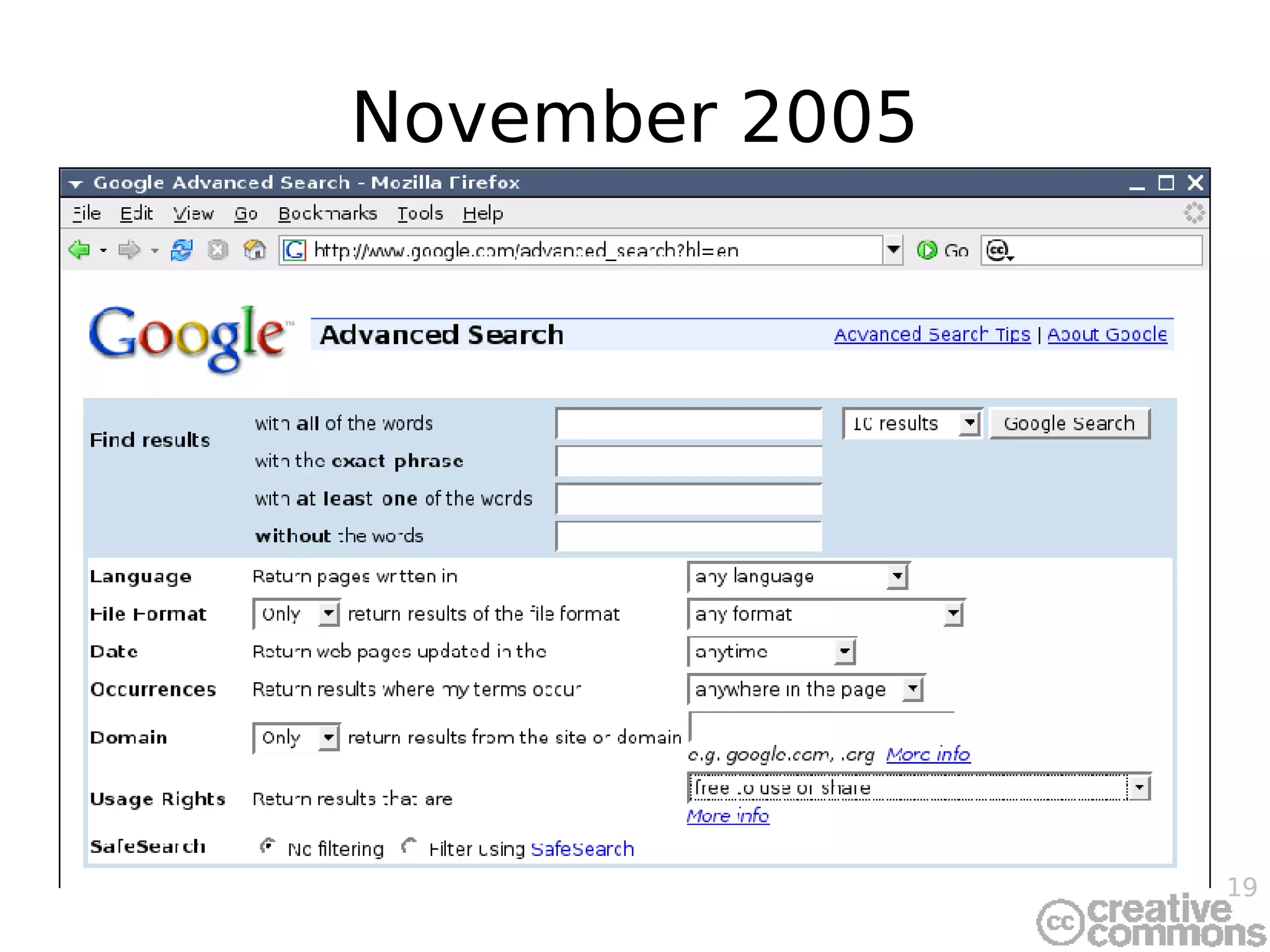
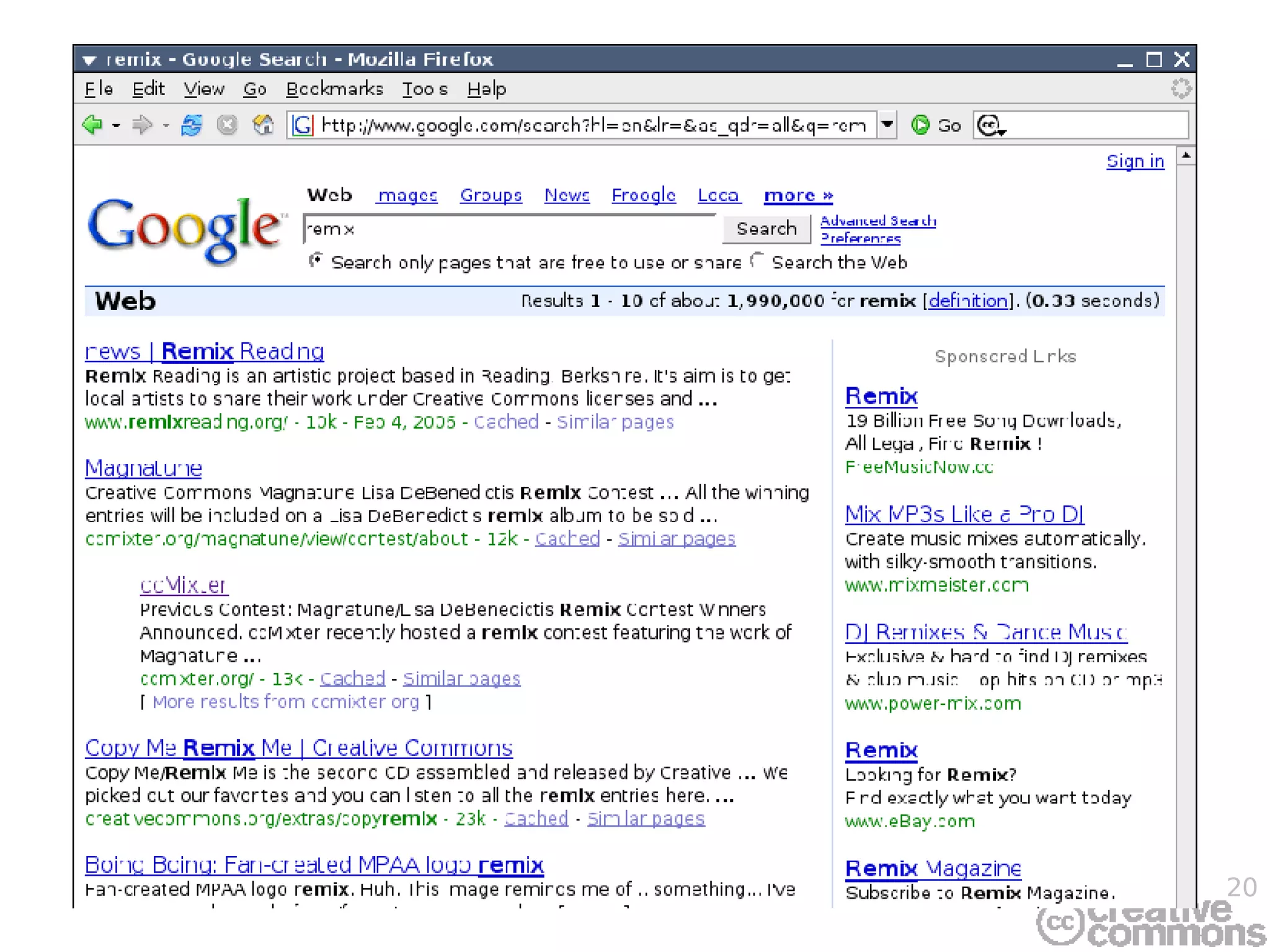
November 2005
 
2006 Intensive work (and debate) on improving CC metadata: microformats (web) RDFa (web) XMP (embedding) Atom (syndication) and extended metadata: machine-readable attribution commerce integration
2006 (continued) Highlight multiple CC search options at search.creativecommons.org Demonstrate improved and extended metadata at labs.creativecommons.org
 
 
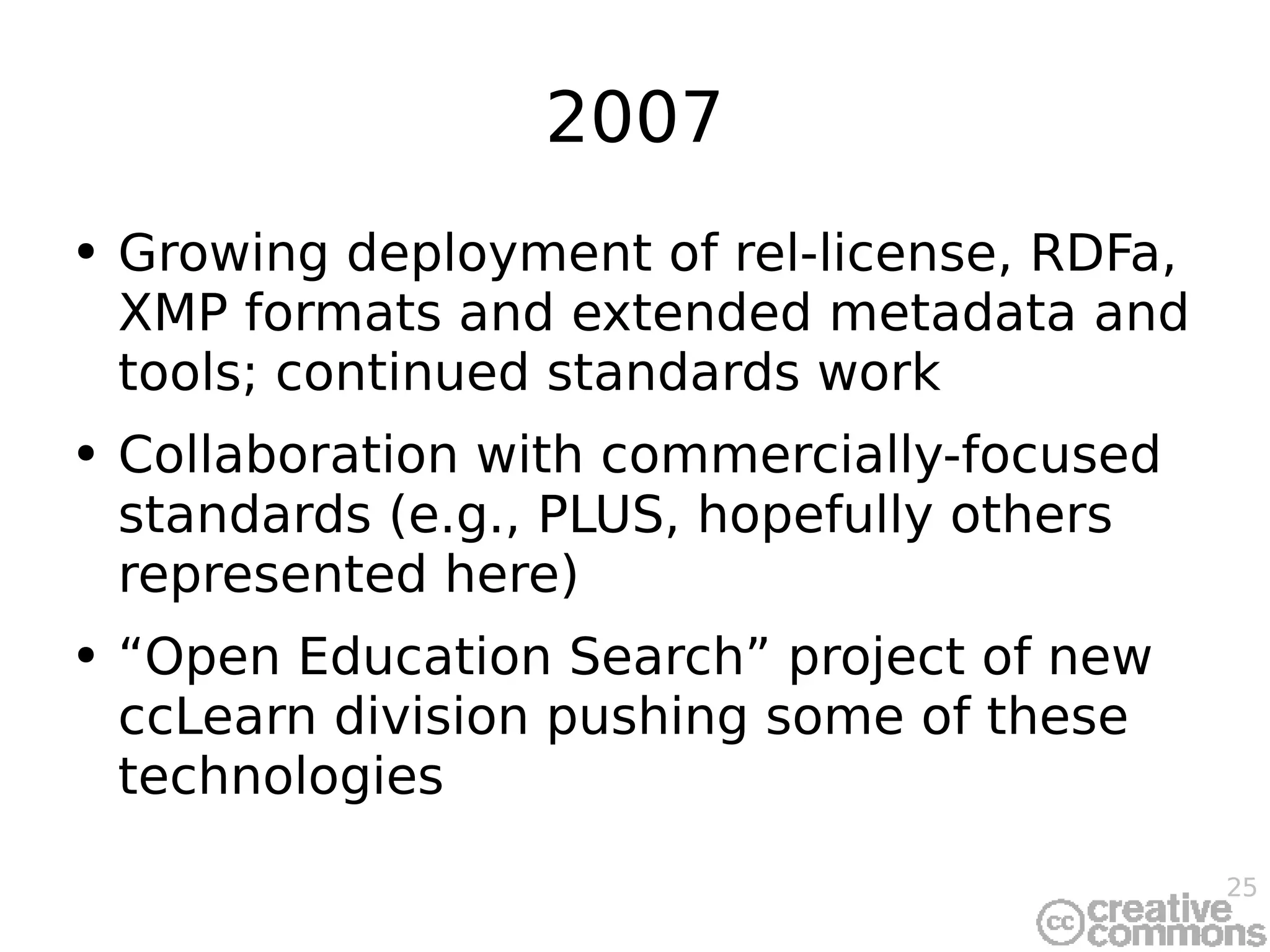
2007 Growing deployment of rel-license, RDFa, XMP formats and extended metadata and tools; continued standards work Collaboration with commercially-focused standards (e.g., PLUS, hopefully others represented here) “Open Education Search” project of new ccLearn division pushing some of these technologies
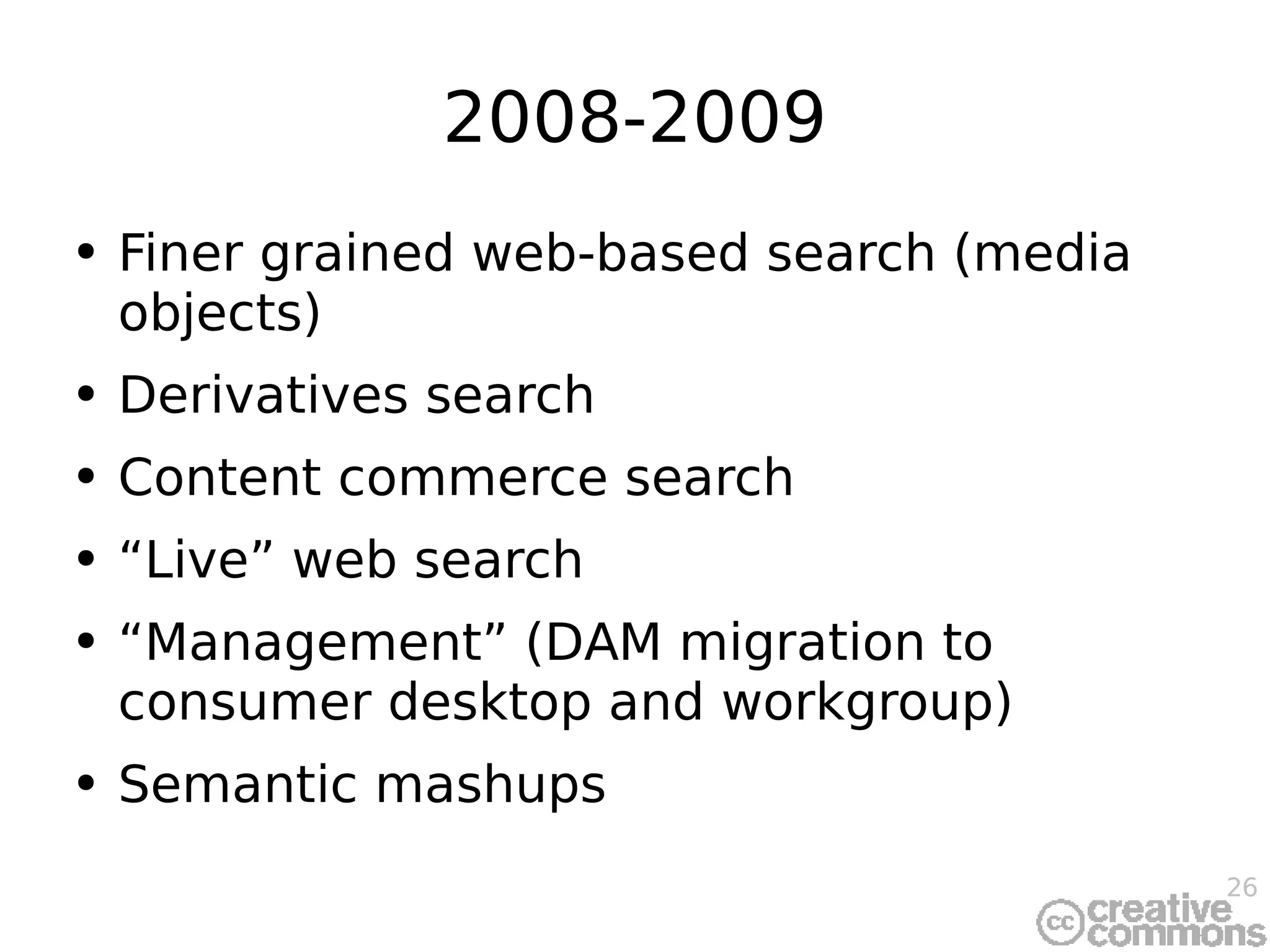
2008-2009 Finer grained web-based search (media objects) Derivatives search Content commerce search “Live” web search “Management” (DAM migration to consumer desktop and workgroup) Semantic mashups
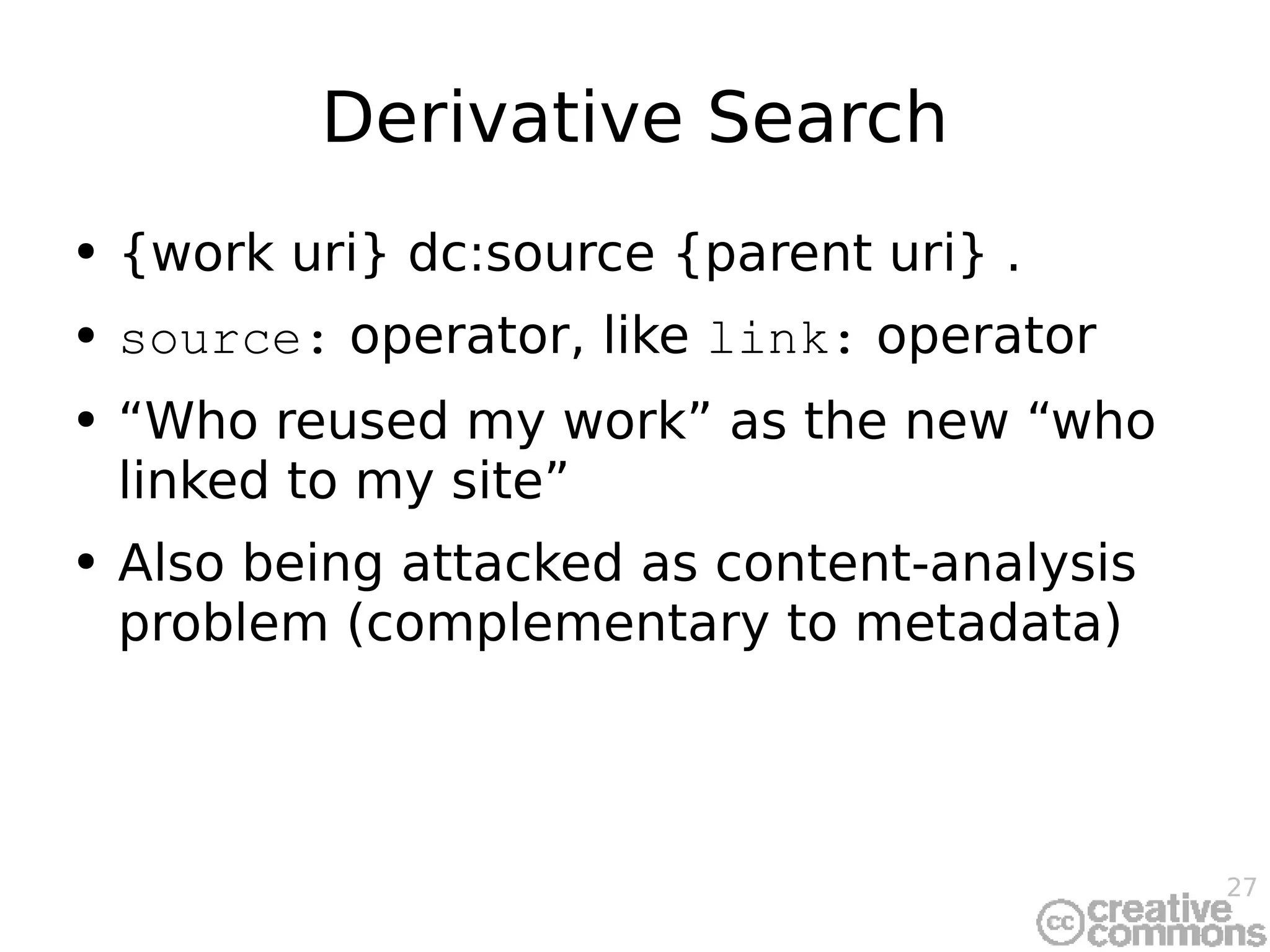
Derivative Search {work uri} dc:source {parent uri} . source:  operator, like  link:  operator “Who reused my work” as the new “who linked to my site” Also being attacked as content-analysis problem (complementary to metadata)
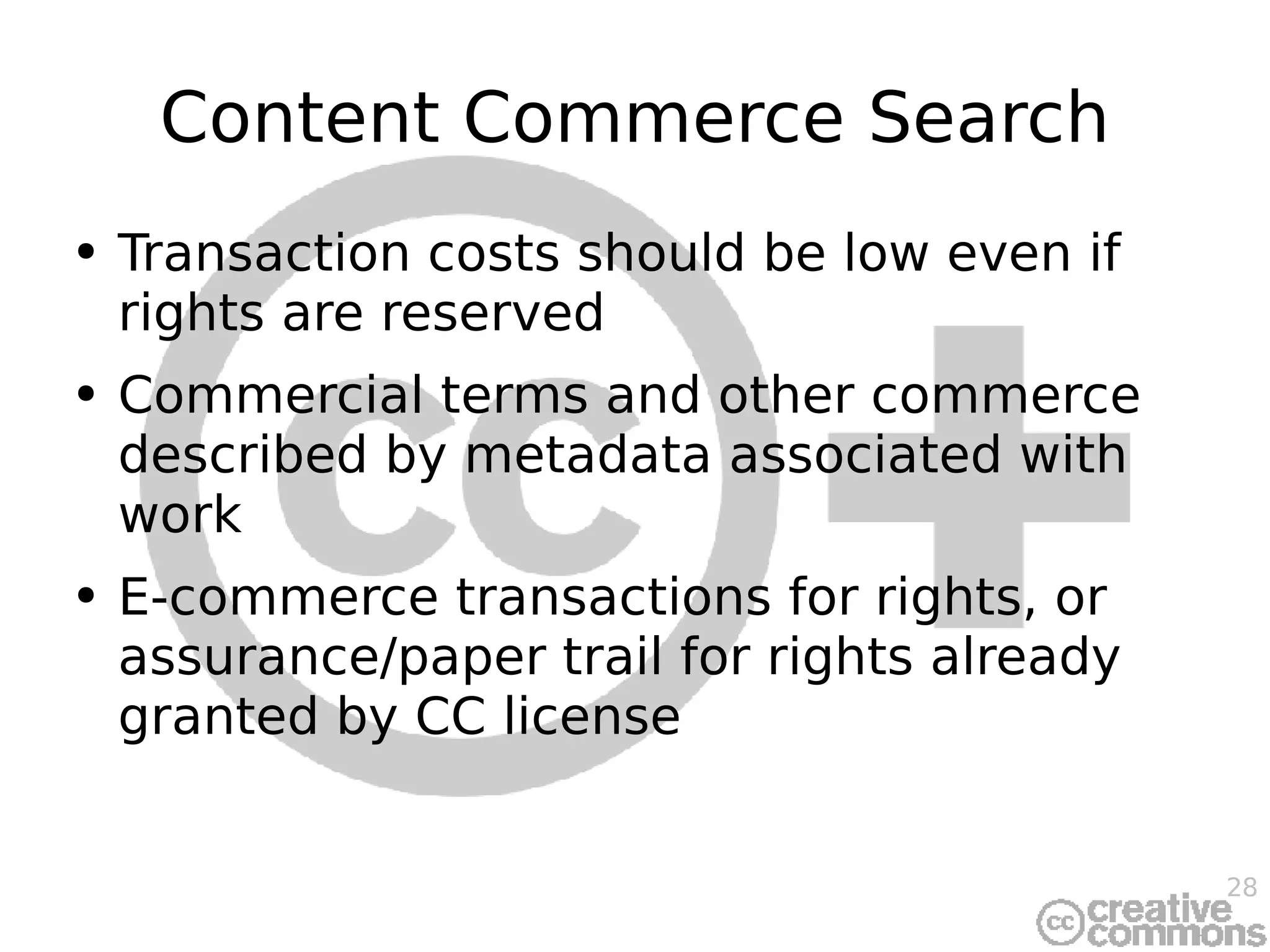
Content Commerce Search Transaction costs should be low even if rights are reserved Commercial terms and other commerce described by metadata associated with work E-commerce transactions for rights, or assurance/paper trail for rights already granted by CC license
“Live” web search Feeds are explicitly metadata-rich Existing blog search ignores metadata Web search will become more like blog search and vice versa?
Digital Asset Management License-aware desktop search Content creation and media player integration Everyone needs DAM, not only media houses CC created  liblicense  enabling integration on Linux; Mac and Windows forthcoming
Take Aways RMI must increase consumer value; CC license awareness is one means to this end Never underestimate the open web Never overestimate what metadata can accomplish
Take It Away! License http://creativecommons.org/licenses/by-sa/3.0/ Attribution Author: Mike Linksvayer Link: http://creativecommons.org Questions? [email_address] Original photo by Uri Sharf Licensed under CC Attribution-ShareAlike 2.0

Emerging Fields of Application for RMI: Search Engines and Users

  • 1.
    WIPO Information Seminaron Rights Management Information: Accessing Creativity in a Network Environment Geneva, 2007-09-17 Emerging Fields of Application for RMI: Search Engines and Users Mike Linksvayer Vice President, Creative Commons Original photo by Mia Garlick Licensed under CC Attribution-ShareAlike 2.0
  • 2.
    Creative Commons .ORGNonprofit organization, launched to public December 2002 HQ in San Francisco Science Commons division in Boston ~60 international jurisdiction projects, coordinated from Berlin Foundation, corporate, and individual funding
  • 3.
    Enabling Reasonable CopyrightSpace between ignoring copyright and ignoring fair use & public good Legal and technical tools enabling a “Some Rights Reserved” model Like “free software” or “open source” for content/media But with more restrictive options Media is more diverse and at least a decade behind software
  • 4.
  • 5.
  • 6.
  • 7.
    Machine Readable <rdf:RDFxmlns=&quot;http://creativecommons.org/ns#&quot; xmlns:rdf=&quot;http://www.w3.org/1999/02/22-rdf-syntax-ns#&quot;> <License rdf:about=&quot;http://creativecommons.org/licenses/by-nc-sa/3.0/nl/&quot;> <permits rdf:resource=&quot;http://creativecommons.org/ns#Reproduction&quot;/> <permits rdf:resource=&quot;http://creativecommons.org/ns#Distribution&quot;/> <requires rdf:resource=&quot;http://creativecommons.org/ns#Notice&quot;/> <requires rdf:resource=&quot;http://creativecommons.org/ns#Attribution&quot;/> <prohibits rdf:resource=&quot;http://creativecommons.org/ns#CommercialUse&quot;/> <permits rdf:resource=&quot;http://creativecommons.org/ns#DerivativeWorks&quot;/> <requires rdf:resource=&quot;http://creativecommons.org/ns#ShareAlike&quot;/> </License> </rdf:RDF>
  • 8.
    Machine Readable (Work)<span xmlns:cc=&quot;http://creativecommons.org/ns#&quot; xmlns:dc=&quot;http://purl.org/dc/elements/1.1/&quot;> <span rel=&quot; dc:type &quot; href=&quot; http://purl.org/dc/dcmitype/Text &quot; property=&quot; dc:title &quot; > My Book </span> by <a rel=&quot; cc:attributionURL &quot; property=&quot; cc:attributionName &quot; href=&quot; http://example.org/me &quot;> My Name </a> is licensed under a <a rel=&quot; license &quot; href=&quot; http://creativecommons.org/licenses/by/3.0/ &quot; >Creative Commons Attribution 3.0 License</a>. <span rel=&quot; dc:source &quot; href=&quot; http://example.net/her_book &quot; /> Permissions beyond the scope of this license may be available at <a rel=&quot; cc:morePermissions &quot; href=&quot; http://example.com/revenue_sharing_agreement &quot;>example.com</a>. </span>
  • 9.
    Rights Description vs.Rights Management Copy/use promotion vs. copy/use protection Encourage fans vs. discourage casual pirates Resource management vs. customer management Web content model vs. 20 th century content model Not necessarily mutually exclusive
  • 10.
    DRM Opportunity CostPublishers did not create consumer value with new technologies Did everything to prevent others from doing so Inadvertently handed dominant position to Apple/iTunes “Compliance” has costs ... be careful in your cost/benefit analysis ... worry about creating inadvertent monopolies
  • 11.
  • 12.
    Why Semantic Web?Small organization, no central registration for every license Decentralization; let a thousand search engines bloom; web as database Take advantage of SemWeb tools as they develop CC launches with RDF metadata, December 2002
  • 13.
    Prototype, early 2004Postgresql/tsearch2/python Sloooowwwww, but did what a prototype should
  • 14.
    Nutch, late 2004Nutch aims to provide open source search software enabling services comparable to existing web scale search engines Creative Commons plugin only ~500 lines of code
  • 15.
  • 16.
  • 17.
  • 18.
  • 19.
  • 20.
  • 21.
    2006 Intensive work(and debate) on improving CC metadata: microformats (web) RDFa (web) XMP (embedding) Atom (syndication) and extended metadata: machine-readable attribution commerce integration
  • 22.
    2006 (continued) Highlightmultiple CC search options at search.creativecommons.org Demonstrate improved and extended metadata at labs.creativecommons.org
  • 23.
  • 24.
  • 25.
    2007 Growing deploymentof rel-license, RDFa, XMP formats and extended metadata and tools; continued standards work Collaboration with commercially-focused standards (e.g., PLUS, hopefully others represented here) “Open Education Search” project of new ccLearn division pushing some of these technologies
  • 26.
    2008-2009 Finer grainedweb-based search (media objects) Derivatives search Content commerce search “Live” web search “Management” (DAM migration to consumer desktop and workgroup) Semantic mashups
  • 27.
    Derivative Search {workuri} dc:source {parent uri} . source: operator, like link: operator “Who reused my work” as the new “who linked to my site” Also being attacked as content-analysis problem (complementary to metadata)
  • 28.
    Content Commerce SearchTransaction costs should be low even if rights are reserved Commercial terms and other commerce described by metadata associated with work E-commerce transactions for rights, or assurance/paper trail for rights already granted by CC license
  • 29.
    “Live” web searchFeeds are explicitly metadata-rich Existing blog search ignores metadata Web search will become more like blog search and vice versa?
  • 30.
    Digital Asset ManagementLicense-aware desktop search Content creation and media player integration Everyone needs DAM, not only media houses CC created liblicense enabling integration on Linux; Mac and Windows forthcoming
  • 31.
    Take Aways RMImust increase consumer value; CC license awareness is one means to this end Never underestimate the open web Never overestimate what metadata can accomplish
  • 32.
    Take It Away!License http://creativecommons.org/licenses/by-sa/3.0/ Attribution Author: Mike Linksvayer Link: http://creativecommons.org Questions? [email_address] Original photo by Uri Sharf Licensed under CC Attribution-ShareAlike 2.0