The 20 something's
The 20 something’s…They’ve just spent the best part of 20 years living with their parents and educating themselves in preparation for their entry into the ‘real world’. During their time in their 20s many New Zealanders will graduate from university and have to get their first ‘real’ job, start contemplating marriage and children, come to terms with new responsibilities, and many will realise the real world is tougher, more competitive and less forgiving than they had imagined.  Needless to say, a lot of change goes on in these 10 years – which makes this such a fascinating topic to research.
The 20 something’s…The current breed of 20 something's were born between 1982, the year Michael Jackson released Thriller, and 1991 the final year the first Gulf War.This generation was brought up in a dynamic and ever changing world with the widespread proliferation of new media, the dissolution of the Soviet Union, Dolly the Sheep, The Fresh Prince of Bel-Air, Mariah Carey, Nirvana, Super Mario Brothers, and Chernobyl. So with this background, what is important to this current group of 20 something’s? What can we learn from them? How can we reach them? Are there any sub currents running through this age group? CB Youth thought we’d have a look…
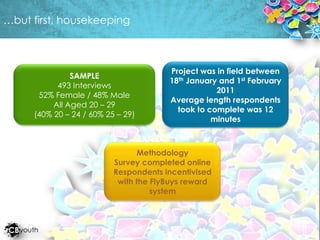
…but first, housekeepingProject was in field between 18th January and 1st February 2011Average length respondents took to complete was 12 minutesSAMPLE493 Interviews52% Female / 48% MaleAll Aged 20 – 29(40% 20 – 24 / 60% 25 – 29)MethodologySurvey completed onlineRespondents incentivised with the FlyBuys reward system
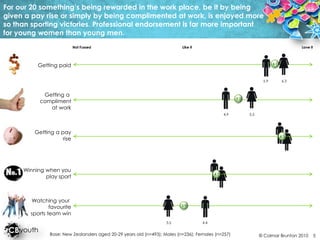
For our 20 something’s being rewarded in the work place, be it by being given a pay rise or simply by being complimented at work, is enjoyed more so than sporting victories. Professional endorsement is far more important for young women than young men.Love itNot FussedLike it6.1Getting paid5.96.3Getting a complimentat work5.24.95.5Getting a payrise6.3Winning when youplay sport4.7Watching your favouritesports team win3.93.54.4Base: New Zealanders aged 20-29 years old (n=493); Males (n=236); Females (n=257)
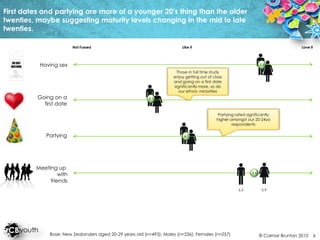
First dates and partying are more of a younger 20’s thing than the older twenties, maybe suggesting maturity levels changing in the mid to late twenties. Love itNot FussedLike itHaving sex5.8Those in full time study enjoy getting out of class and going on a first date significantly more, so do our ethnic minoritiesGoing on afirst date3.1Partying rated significantly higher amongst our 20-24yo respondentsPartying4.0Meeting up withfriends5.65.35.9Base: New Zealanders aged 20-29 years old (n=493); Males (n=236); Females (n=257)
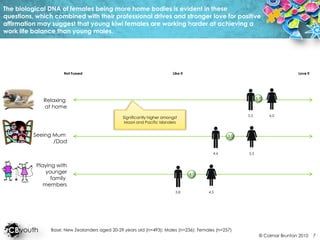
The biological DNA of females being more home bodies is evident in these questions, which combined with their professional drives and stronger love for positive affirmation may suggest that young kiwi females are working harder at achieving a work life balance than young males.Love itNot FussedLike it5.7Relaxing at homeSignificantly higher amongst Maori and Pacific Islanders5.56.0Seeing Mum /Dad5.04.65.5Playing withyoungerfamily members4.13.84.5Base: New Zealanders aged 20-29 years old (n=493); Males (n=236); Females (n=257)
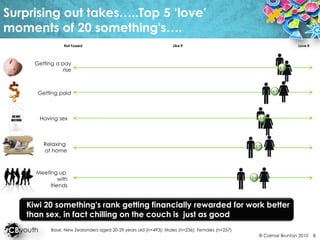
Surprising out takes…..Top 5 ‘love’ moments of 20 something's….Love itNot FussedLike itGetting a payrise6.36.1Getting paidHaving sex5.8Relaxing at home5.7Meeting up withfriends5.6Kiwi 20 something's rank getting financially rewarded for work better than sex, in fact chilling on the couch is  just as goodBase: New Zealanders aged 20-29 years old (n=493); Males (n=236); Females (n=257)
Making the effort to do the right thing…Some research suggests that youth care about a raft of social issues such as the environment, government, community, family etc.The following questions ask how much they care. Do they actively participate and make an effort or do they just care when asked.We’ve tried to look beyond the attitude and examine the behaviour.Base: New Zealanders aged 20-29 years old (n=493)
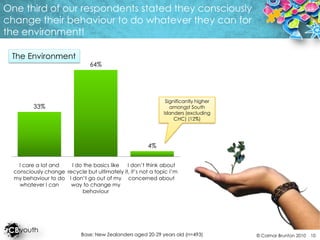
One third of our respondents stated they consciously change their behaviour to do whatever they can for the environment! The EnvironmentSignificantly higher amongst South Islanders (excluding CHC) (12%)Base: New Zealanders aged 20-29 years old (n=493)
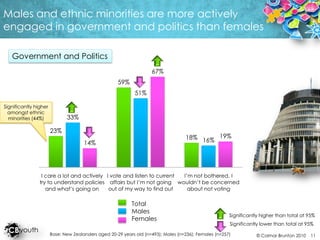
Males and ethnic minorities are more actively engaged in government and politics than females Government and PoliticsSignificantly higher amongst ethnic minorities (44%)TotalMalesFemalesSignificantly higher than total at 95%Significantly lower than total at 95%Base: New Zealanders aged 20-29 years old (n=493); Males (n=236); Females (n=257)
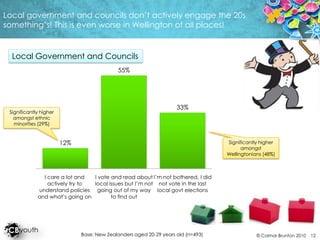
Local government and councils don’t actively engage the 20s something’s! This is even worse in Wellington of all places!Local Government and CouncilsSignificantly higher amongst ethnic minorities (29%)Significantly higher amongst Wellingtonians (48%)Base: New Zealanders aged 20-29 years old (n=493)
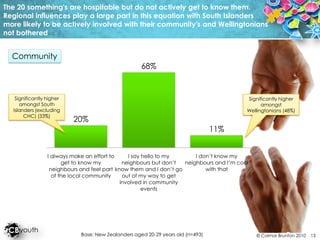
The 20 something's are hospitable but do not actively get to know them.Regional influences play a large part in this equation with South Islandersmore likely to be actively involved with their community's and Wellingtoniansnot botheredCommunitySignificantly higher amongst Wellingtonians (48%)Significantly higher amongst South Islanders (excluding CHC) (33%)Base: New Zealanders aged 20-29 years old (n=493)
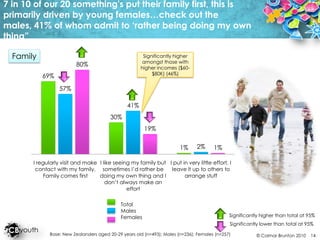
7 in 10 of our 20 something's put their family first, this is primarily driven by young females…check out the males, 41% of whom admit to ‘rather being doing my own thing”FamilySignificantly higher amongst those with higher incomes ($60-$80K) (46%)TotalMalesFemalesSignificantly higher than total at 95%Significantly lower than total at 95%Base: New Zealanders aged 20-29 years old (n=493); Males (n=236); Females (n=257)
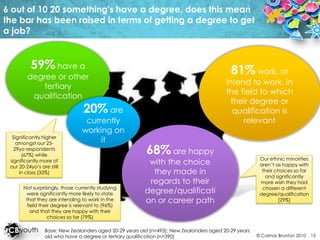
6 out of 10 20 something's have a degree, does this mean the bar has been raised in terms of getting a degree to get a job? 59% have a degree or other tertiary qualification81% work, or intend to work, in the field to which their degree or qualification is relevant20% are currently working on it68% are happy with the choice they made in regards to their degree/qualification or career pathSignificantly higher amongst our 25-29yo respondents (67%) while significantly more of our 20-24yo’s are still in class (33%)Our ethnic minorities aren’t as happy with their choices so far and significantly more wish they had chosen a different degree/qualification (29%)Not surprisingly, those currently studying were significantly more likely to state that they are intending to work in the field their degree is relevant to (96%) and that they are happy with their choices so far (79%)Base: New Zealanders aged 20-29 years old (n=493); New Zealanders aged 20-29 years old who have a degree or tertiary qualification (n=390)
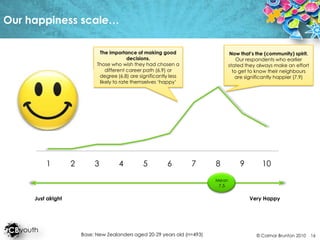
Our happiness scale…Now that’s the (community) spirit.Our respondents who earlier stated they always make an effort to get to know their neighbours are significantly happier (7.9)The importance of making good decisions.Those who wish they had chosen a different career path (6.9) or degree (6.8) are significantly less likely to rate themselves ‘happy’Mean7.5Very HappyJust alrightBase: New Zealanders aged 20-29 years old (n=493)
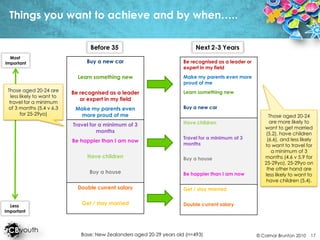
Things you want to achieve and by when…..Next 2-3 YearsBefore 35Most ImportantThose aged 20-24 are less likely to want to travel for a minimum of 3 months (5.4 v 6.3 for 25-29yo)Those aged 20-24 are more likely to want to get married (5.2), have children (6.6), and less likely to want to travel for a minimum of 3 months (4.6 v 5.9 for 25-29yo). 25-29yo on the other hand are less likely to want to have children (5.4).Less ImportantBase: New Zealanders aged 20-29 years old (n=493)
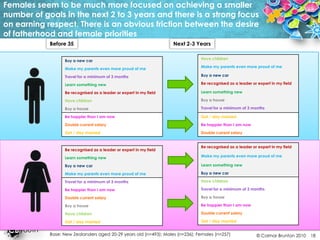
Females seem to be much more focused on achieving a smaller number of goals in the next 2 to 3 years and there is a strong focus on earning respect. There is an obvious friction between the desire of fatherhood and female prioritiesBefore 35Next 2-3 YearsBase: New Zealanders aged 20-29 years old (n=493); Males (n=236); Females (n=257)
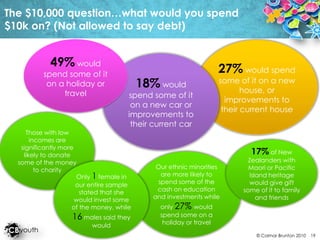
The $10,000 question…what would you spend $10k on? (Not allowed to say debt)49% would spend some of it on a holiday or travel27%would spend some of it on a new house, or improvements to their current house18% would spend some of it on a new car or improvements to their current carThose with low incomes are significantly more likely to donate some of the money to charity17% of New Zealanders with Maori or Pacific Island heritage would give gift some of it to family and friendsOur ethnic minorities are more likely to spend some of the cash on education and investments while only 27%would spend some on a holiday or travelOnly 1 female in our entire sample stated that she would invest some of the money, while 16 males said they would
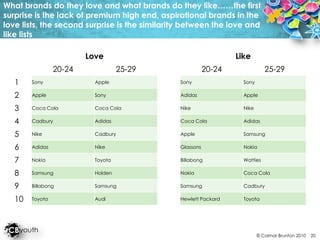
What brands do they love and what brands do they like……the first surprise is the lack of premium high end, aspirational brands in the love lists, the second surprise is the similarity between the love and like lists
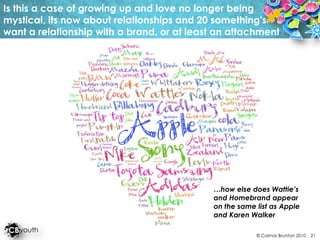
Is this a case of growing up and love no longer being mystical, its now about relationships and 20 something's want a relationship with a brand, or at least an attachment…how else does Wattie’s and Homebrand appear on the same list as Apple and Karen Walker
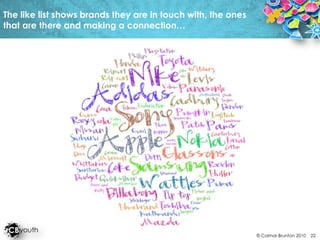
The like list shows brands they are in touch with, the ones that are there and making a connection…
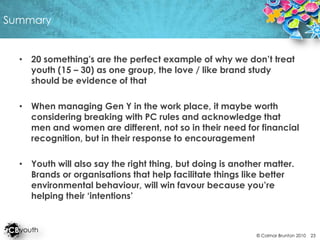
Summary20 something's are the perfect example of why we don’t treat youth (15 – 30) as one group, the love / like brand study should be evidence of that
When managing Gen Y in the work place, it maybe worth considering breaking with PC rules and acknowledge that men and women are different, not so in their need for financial recognition, but in their response to encouragement
Youth will also say the right thing, but doing is another matter. Brands or organisations that help facilitate things like better environmental behaviour, will win favour because you’re helping their ‘intentions’SummaryEducation is becoming challenging and expensive, a degree is no longer a unique achievement and some companies are looking for masters or post grads. This is potentially a game changer and may contribute to the hunger or appearance that they fee they deserve more money

CByouth 20 Somethings Presentation Final

  • 1.
  • 2.
    The 20 something’s…They’vejust spent the best part of 20 years living with their parents and educating themselves in preparation for their entry into the ‘real world’. During their time in their 20s many New Zealanders will graduate from university and have to get their first ‘real’ job, start contemplating marriage and children, come to terms with new responsibilities, and many will realise the real world is tougher, more competitive and less forgiving than they had imagined. Needless to say, a lot of change goes on in these 10 years – which makes this such a fascinating topic to research.
  • 3.
    The 20 something’s…Thecurrent breed of 20 something's were born between 1982, the year Michael Jackson released Thriller, and 1991 the final year the first Gulf War.This generation was brought up in a dynamic and ever changing world with the widespread proliferation of new media, the dissolution of the Soviet Union, Dolly the Sheep, The Fresh Prince of Bel-Air, Mariah Carey, Nirvana, Super Mario Brothers, and Chernobyl. So with this background, what is important to this current group of 20 something’s? What can we learn from them? How can we reach them? Are there any sub currents running through this age group? CB Youth thought we’d have a look…
  • 4.
    …but first, housekeepingProjectwas in field between 18th January and 1st February 2011Average length respondents took to complete was 12 minutesSAMPLE493 Interviews52% Female / 48% MaleAll Aged 20 – 29(40% 20 – 24 / 60% 25 – 29)MethodologySurvey completed onlineRespondents incentivised with the FlyBuys reward system
  • 5.
    For our 20something’s being rewarded in the work place, be it by being given a pay rise or simply by being complimented at work, is enjoyed more so than sporting victories. Professional endorsement is far more important for young women than young men.Love itNot FussedLike it6.1Getting paid5.96.3Getting a complimentat work5.24.95.5Getting a payrise6.3Winning when youplay sport4.7Watching your favouritesports team win3.93.54.4Base: New Zealanders aged 20-29 years old (n=493); Males (n=236); Females (n=257)
  • 6.
    First dates andpartying are more of a younger 20’s thing than the older twenties, maybe suggesting maturity levels changing in the mid to late twenties. Love itNot FussedLike itHaving sex5.8Those in full time study enjoy getting out of class and going on a first date significantly more, so do our ethnic minoritiesGoing on afirst date3.1Partying rated significantly higher amongst our 20-24yo respondentsPartying4.0Meeting up withfriends5.65.35.9Base: New Zealanders aged 20-29 years old (n=493); Males (n=236); Females (n=257)
  • 7.
    The biological DNAof females being more home bodies is evident in these questions, which combined with their professional drives and stronger love for positive affirmation may suggest that young kiwi females are working harder at achieving a work life balance than young males.Love itNot FussedLike it5.7Relaxing at homeSignificantly higher amongst Maori and Pacific Islanders5.56.0Seeing Mum /Dad5.04.65.5Playing withyoungerfamily members4.13.84.5Base: New Zealanders aged 20-29 years old (n=493); Males (n=236); Females (n=257)
  • 8.
    Surprising out takes…..Top5 ‘love’ moments of 20 something's….Love itNot FussedLike itGetting a payrise6.36.1Getting paidHaving sex5.8Relaxing at home5.7Meeting up withfriends5.6Kiwi 20 something's rank getting financially rewarded for work better than sex, in fact chilling on the couch is just as goodBase: New Zealanders aged 20-29 years old (n=493); Males (n=236); Females (n=257)
  • 9.
    Making the effortto do the right thing…Some research suggests that youth care about a raft of social issues such as the environment, government, community, family etc.The following questions ask how much they care. Do they actively participate and make an effort or do they just care when asked.We’ve tried to look beyond the attitude and examine the behaviour.Base: New Zealanders aged 20-29 years old (n=493)
  • 10.
    One third ofour respondents stated they consciously change their behaviour to do whatever they can for the environment! The EnvironmentSignificantly higher amongst South Islanders (excluding CHC) (12%)Base: New Zealanders aged 20-29 years old (n=493)
  • 11.
    Males and ethnicminorities are more actively engaged in government and politics than females Government and PoliticsSignificantly higher amongst ethnic minorities (44%)TotalMalesFemalesSignificantly higher than total at 95%Significantly lower than total at 95%Base: New Zealanders aged 20-29 years old (n=493); Males (n=236); Females (n=257)
  • 12.
    Local government andcouncils don’t actively engage the 20s something’s! This is even worse in Wellington of all places!Local Government and CouncilsSignificantly higher amongst ethnic minorities (29%)Significantly higher amongst Wellingtonians (48%)Base: New Zealanders aged 20-29 years old (n=493)
  • 13.
    The 20 something'sare hospitable but do not actively get to know them.Regional influences play a large part in this equation with South Islandersmore likely to be actively involved with their community's and Wellingtoniansnot botheredCommunitySignificantly higher amongst Wellingtonians (48%)Significantly higher amongst South Islanders (excluding CHC) (33%)Base: New Zealanders aged 20-29 years old (n=493)
  • 14.
    7 in 10of our 20 something's put their family first, this is primarily driven by young females…check out the males, 41% of whom admit to ‘rather being doing my own thing”FamilySignificantly higher amongst those with higher incomes ($60-$80K) (46%)TotalMalesFemalesSignificantly higher than total at 95%Significantly lower than total at 95%Base: New Zealanders aged 20-29 years old (n=493); Males (n=236); Females (n=257)
  • 15.
    6 out of10 20 something's have a degree, does this mean the bar has been raised in terms of getting a degree to get a job? 59% have a degree or other tertiary qualification81% work, or intend to work, in the field to which their degree or qualification is relevant20% are currently working on it68% are happy with the choice they made in regards to their degree/qualification or career pathSignificantly higher amongst our 25-29yo respondents (67%) while significantly more of our 20-24yo’s are still in class (33%)Our ethnic minorities aren’t as happy with their choices so far and significantly more wish they had chosen a different degree/qualification (29%)Not surprisingly, those currently studying were significantly more likely to state that they are intending to work in the field their degree is relevant to (96%) and that they are happy with their choices so far (79%)Base: New Zealanders aged 20-29 years old (n=493); New Zealanders aged 20-29 years old who have a degree or tertiary qualification (n=390)
  • 16.
    Our happiness scale…Nowthat’s the (community) spirit.Our respondents who earlier stated they always make an effort to get to know their neighbours are significantly happier (7.9)The importance of making good decisions.Those who wish they had chosen a different career path (6.9) or degree (6.8) are significantly less likely to rate themselves ‘happy’Mean7.5Very HappyJust alrightBase: New Zealanders aged 20-29 years old (n=493)
  • 17.
    Things you wantto achieve and by when…..Next 2-3 YearsBefore 35Most ImportantThose aged 20-24 are less likely to want to travel for a minimum of 3 months (5.4 v 6.3 for 25-29yo)Those aged 20-24 are more likely to want to get married (5.2), have children (6.6), and less likely to want to travel for a minimum of 3 months (4.6 v 5.9 for 25-29yo). 25-29yo on the other hand are less likely to want to have children (5.4).Less ImportantBase: New Zealanders aged 20-29 years old (n=493)
  • 18.
    Females seem tobe much more focused on achieving a smaller number of goals in the next 2 to 3 years and there is a strong focus on earning respect. There is an obvious friction between the desire of fatherhood and female prioritiesBefore 35Next 2-3 YearsBase: New Zealanders aged 20-29 years old (n=493); Males (n=236); Females (n=257)
  • 19.
    The $10,000 question…whatwould you spend $10k on? (Not allowed to say debt)49% would spend some of it on a holiday or travel27%would spend some of it on a new house, or improvements to their current house18% would spend some of it on a new car or improvements to their current carThose with low incomes are significantly more likely to donate some of the money to charity17% of New Zealanders with Maori or Pacific Island heritage would give gift some of it to family and friendsOur ethnic minorities are more likely to spend some of the cash on education and investments while only 27%would spend some on a holiday or travelOnly 1 female in our entire sample stated that she would invest some of the money, while 16 males said they would
  • 20.
    What brands dothey love and what brands do they like……the first surprise is the lack of premium high end, aspirational brands in the love lists, the second surprise is the similarity between the love and like lists
  • 21.
    Is this acase of growing up and love no longer being mystical, its now about relationships and 20 something's want a relationship with a brand, or at least an attachment…how else does Wattie’s and Homebrand appear on the same list as Apple and Karen Walker
  • 22.
    The like listshows brands they are in touch with, the ones that are there and making a connection…
  • 23.
    Summary20 something's arethe perfect example of why we don’t treat youth (15 – 30) as one group, the love / like brand study should be evidence of that
  • 24.
    When managing GenY in the work place, it maybe worth considering breaking with PC rules and acknowledge that men and women are different, not so in their need for financial recognition, but in their response to encouragement
  • 25.
    Youth will alsosay the right thing, but doing is another matter. Brands or organisations that help facilitate things like better environmental behaviour, will win favour because you’re helping their ‘intentions’SummaryEducation is becoming challenging and expensive, a degree is no longer a unique achievement and some companies are looking for masters or post grads. This is potentially a game changer and may contribute to the hunger or appearance that they fee they deserve more money