Presentation at the 16th Annual Meeting of the OECD Working Party of
Parliamentary Budget Officials and Independent Fiscal Institutions
June 18, 2024
Julie Topoleski
Director of Labor, Income Security, and Long-Term Analysis
CBO’s Immigration Projections
For more information about the Organisation for Economic Co-operation and Development (OECD) and this meeting, see https://tinyurl.com/2c4xskkf. Several slides in this
presentation reprise graphics presented in Congressional Budget Office, The Demographic Outlook: 2024 to 2054 (January 2024), www.cbo.gov/publication/59697.
1
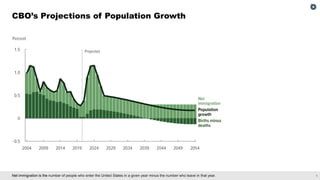
Net immigration is the number of people who enter the United States in a given year minus the number who leave in that year.
CBO’s Projections of Population Growth
2
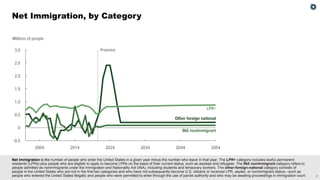
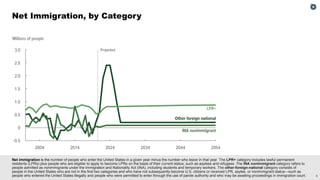
Net immigration is the number of people who enter the United States in a given year minus the number who leave in that year. The LPR+ category includes lawful permanent
residents (LPRs) plus people who are eligible to apply to become LPRs on the basis of their current status, such as asylees and refugees. The INA nonimmigrant category refers to
people admitted as nonimmigrants under the Immigration and Nationality Act (INA), including students and temporary workers. The other-foreign-national category consists of
people in the United States who are not in the first two categories and who have not subsequently become U.S. citizens or received LPR, asylee, or nonimmigrant status—such as
people who entered the United States illegally and people who were permitted to enter through the use of parole authority and who may be awaiting proceedings in immigration court.
Net Immigration, by Category
3
Why Immigration Projections
Are Important
4
Potential GDP is the maximum sustainable output of the economy. The labor force participation rate is the percentage of the civilian noninstitutionalized population age 16 or older
that is in the labor force. Total factor productivity is the average real (inflation-adjusted) output per unit of combined labor and capital services. The noncyclical rate of
unemployment is the rate of unemployment resulting from all sources except changes in aggregate demand.
A surge in immigration affects every aspect of the economy through changes in demand
and supply.
An increase in immigration boosts the overall demand for goods and services.
In the long run, potential gross domestic product (GDP) is affected by changes in:
▪ The civilian noninstitutionalized population age 16 or older,
▪ Investment and capital services,
▪ The labor force participation rate,
▪ Total factor productivity in the nonfarm business sector, and
▪ The noncyclical rate of unemployment.
Additionally, a surge in immigration increases long-term interest rates, modestly
increases inflation, and slightly increases the unemployment rate by initially reducing
tightness in the labor market.
Immigration’s Effects on CBO’s Baseline Economic Projections
5
Changes in the size of the U.S. population and in its age and sex composition
significantly affect the federal budget.
Increases in immigration result in increases in revenues. For example, the number of
people who are employed and paying taxes on their wages depends on the size of the
population ages 25 to 54.
Increases in immigration also result in additional federal spending. For example, the
number of beneficiaries of some federal programs (including Social Security and
Medicare) depends on the size of the population age 65 or older.
In CBO’s estimation, the net effect of increased immigration is to reduce federal deficits.
Immigration’s Effects on the Federal Budget
6
Counting immigrants is difficult.
▪ Immigrants may not be observable in census, survey, or administrative data.
▪ Data on some groups are scarce.
▪ Data may be inconsistent across sources.
Measuring or estimating immigrants’ demographic characteristics is difficult but matters for
estimating effects on the budget and the economy.
Measuring or estimating how long immigrants stay once they arrive is also difficult.
Challenges in Projecting Immigration
7
Changes in CBO’s
Immigration Projections
8
Net immigration is the number of people who enter the United States in a given year minus the number who leave in that year. The LPR+ category includes lawful permanent
residents (LPRs) plus people who are eligible to apply to become LPRs on the basis of their current status, such as asylees and refugees. The INA nonimmigrant category refers to
people admitted as nonimmigrants under the Immigration and Nationality Act (INA), including students and temporary workers. The other-foreign-national category consists of
people in the United States who are not in the first two categories and who have not subsequently become U.S. citizens or received LPR, asylee, or nonimmigrant status—such as
people who entered the United States illegally and people who were permitted to enter through the use of parole authority and who may be awaiting proceedings in immigration court.
Net Immigration, by Category
9
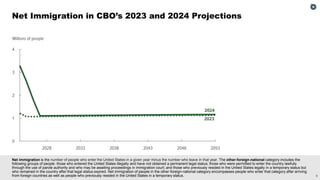
Net immigration is the number of people who enter the United States in a given year minus the number who leave in that year. The other-foreign-national category includes the
following groups of people: those who entered the United States illegally and have not obtained a permanent legal status; those who were permitted to enter the country lawfully
through the use of parole authority and who may be awaiting proceedings in immigration court; and those who previously resided in the United States legally in a temporary status but
who remained in the country after that legal status expired. Net immigration of people in the other-foreign-national category encompasses people who enter that category after arriving
from foreign countries as well as people who previously resided in the United States in a temporary status.
Net Immigration in CBO’s 2023 and 2024 Projections
10
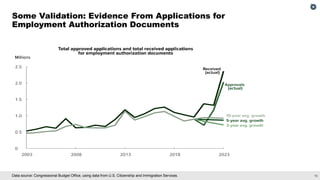
Data source: Congressional Budget Office, using data from U.S. Citizenship and Immigration Services.
Some Validation: Evidence From Applications for
Employment Authorization Documents
11
▪ Think broadly about sources of data.
▪ Validate the estimates.
▪ Be transparent about data sources, methods, and assumptions.
▪ Engage with the research community and outside experts in academia.
Things to Consider

CBO's Immigration Projections - Presentation

  • 1.
    Presentation at the16th Annual Meeting of the OECD Working Party of Parliamentary Budget Officials and Independent Fiscal Institutions June 18, 2024 Julie Topoleski Director of Labor, Income Security, and Long-Term Analysis CBO’s Immigration Projections For more information about the Organisation for Economic Co-operation and Development (OECD) and this meeting, see https://tinyurl.com/2c4xskkf. Several slides in this presentation reprise graphics presented in Congressional Budget Office, The Demographic Outlook: 2024 to 2054 (January 2024), www.cbo.gov/publication/59697.
  • 2.
    1 Net immigration isthe number of people who enter the United States in a given year minus the number who leave in that year. CBO’s Projections of Population Growth
  • 3.
    2 Net immigration isthe number of people who enter the United States in a given year minus the number who leave in that year. The LPR+ category includes lawful permanent residents (LPRs) plus people who are eligible to apply to become LPRs on the basis of their current status, such as asylees and refugees. The INA nonimmigrant category refers to people admitted as nonimmigrants under the Immigration and Nationality Act (INA), including students and temporary workers. The other-foreign-national category consists of people in the United States who are not in the first two categories and who have not subsequently become U.S. citizens or received LPR, asylee, or nonimmigrant status—such as people who entered the United States illegally and people who were permitted to enter through the use of parole authority and who may be awaiting proceedings in immigration court. Net Immigration, by Category
  • 4.
  • 5.
    4 Potential GDP isthe maximum sustainable output of the economy. The labor force participation rate is the percentage of the civilian noninstitutionalized population age 16 or older that is in the labor force. Total factor productivity is the average real (inflation-adjusted) output per unit of combined labor and capital services. The noncyclical rate of unemployment is the rate of unemployment resulting from all sources except changes in aggregate demand. A surge in immigration affects every aspect of the economy through changes in demand and supply. An increase in immigration boosts the overall demand for goods and services. In the long run, potential gross domestic product (GDP) is affected by changes in: ▪ The civilian noninstitutionalized population age 16 or older, ▪ Investment and capital services, ▪ The labor force participation rate, ▪ Total factor productivity in the nonfarm business sector, and ▪ The noncyclical rate of unemployment. Additionally, a surge in immigration increases long-term interest rates, modestly increases inflation, and slightly increases the unemployment rate by initially reducing tightness in the labor market. Immigration’s Effects on CBO’s Baseline Economic Projections
  • 6.
    5 Changes in thesize of the U.S. population and in its age and sex composition significantly affect the federal budget. Increases in immigration result in increases in revenues. For example, the number of people who are employed and paying taxes on their wages depends on the size of the population ages 25 to 54. Increases in immigration also result in additional federal spending. For example, the number of beneficiaries of some federal programs (including Social Security and Medicare) depends on the size of the population age 65 or older. In CBO’s estimation, the net effect of increased immigration is to reduce federal deficits. Immigration’s Effects on the Federal Budget
  • 7.
    6 Counting immigrants isdifficult. ▪ Immigrants may not be observable in census, survey, or administrative data. ▪ Data on some groups are scarce. ▪ Data may be inconsistent across sources. Measuring or estimating immigrants’ demographic characteristics is difficult but matters for estimating effects on the budget and the economy. Measuring or estimating how long immigrants stay once they arrive is also difficult. Challenges in Projecting Immigration
  • 8.
  • 9.
    8 Net immigration isthe number of people who enter the United States in a given year minus the number who leave in that year. The LPR+ category includes lawful permanent residents (LPRs) plus people who are eligible to apply to become LPRs on the basis of their current status, such as asylees and refugees. The INA nonimmigrant category refers to people admitted as nonimmigrants under the Immigration and Nationality Act (INA), including students and temporary workers. The other-foreign-national category consists of people in the United States who are not in the first two categories and who have not subsequently become U.S. citizens or received LPR, asylee, or nonimmigrant status—such as people who entered the United States illegally and people who were permitted to enter through the use of parole authority and who may be awaiting proceedings in immigration court. Net Immigration, by Category
  • 10.
    9 Net immigration isthe number of people who enter the United States in a given year minus the number who leave in that year. The other-foreign-national category includes the following groups of people: those who entered the United States illegally and have not obtained a permanent legal status; those who were permitted to enter the country lawfully through the use of parole authority and who may be awaiting proceedings in immigration court; and those who previously resided in the United States legally in a temporary status but who remained in the country after that legal status expired. Net immigration of people in the other-foreign-national category encompasses people who enter that category after arriving from foreign countries as well as people who previously resided in the United States in a temporary status. Net Immigration in CBO’s 2023 and 2024 Projections
  • 11.
    10 Data source: CongressionalBudget Office, using data from U.S. Citizenship and Immigration Services. Some Validation: Evidence From Applications for Employment Authorization Documents
  • 12.
    11 ▪ Think broadlyabout sources of data. ▪ Validate the estimates. ▪ Be transparent about data sources, methods, and assumptions. ▪ Engage with the research community and outside experts in academia. Things to Consider