The Caveman’s Guide  to the  Dewey Decimal System
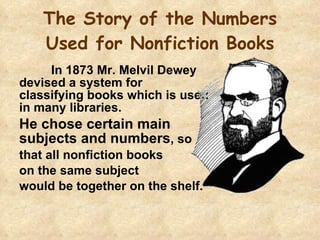
The Story of the Numbers Used for Nonfiction Books In 1873 Mr. Melvil Dewey devised a system for classifying books which is used in many libraries.  He chose certain main subjects and numbers , so  that all nonfiction books  on the same subject would be together on the shelf.    
The Dewey Decimal System The system groups books by topic by dividing them into 10 basic categories.
Dewey’s Plan Who knows he might have imagined  himself to be a Caveman!  What would man ask?
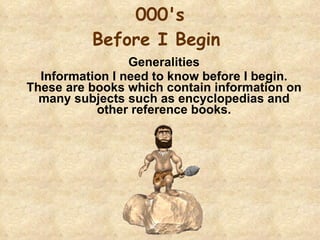
000's Before I Begin  Generalities Information I need to know before I begin. These are books which contain information on many subjects such as encyclopedias and other reference books.
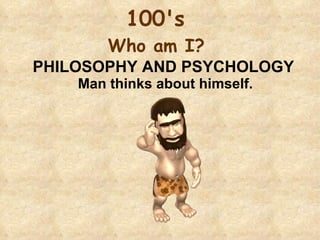
100's  Who am I?  PHILOSOPHY AND PSYCHOLOGY   Man thinks about himself.
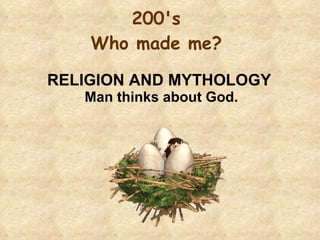
200's  Who made me?  RELIGION AND MYTHOLOGY  Man thinks about God.
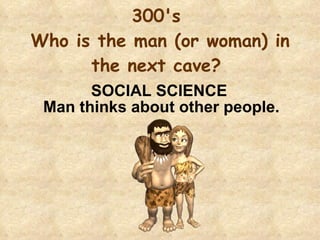
300's  Who is the man (or woman) in the next cave?    SOCIAL SCIENCE  Man thinks about other people.
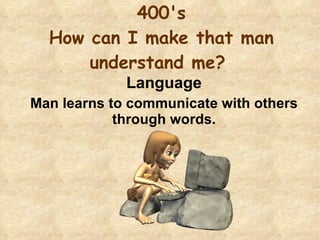
400's How can I make that man understand me?  Language Man learns to communicate with others through words.
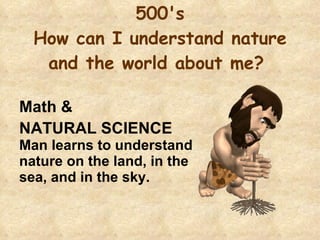
500's How can I understand nature and the world about me?  Math &  NATURAL SCIENCE  Man learns to understand nature on the land, in the sea, and in the sky.
600's How can I use what I know about nature?  APPLIED SCIENCE AND USEFUL ARTS (Technology )   Primitive man learned about fire and how to make weapons.  He learned through the ages about the wheel, about medicine, planting crops, cooking food, building bridges, and how to make all the things we use.
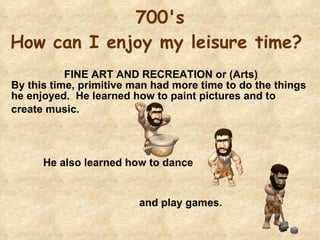
700's How can I enjoy my leisure time?    FINE ART AND RECREATION or (Arts)  By this time, primitive man had more time to do the things he enjoyed.  He learned how to paint pictures and to  create music.   He also learned how to dance  and play games.
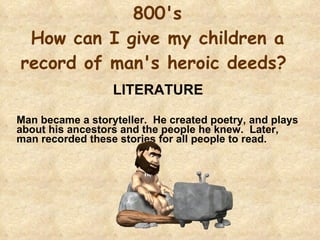
800's How can I give my children a record of man's heroic deeds?  LITERATURE  Man became a storyteller.  He created poetry, and plays about his ancestors and the people he knew.  Later, man recorded these stories for all people to read.
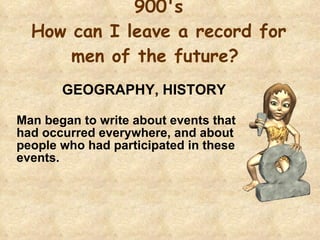
900's How can I leave a record for men of the future?  GEOGRAPHY, HISTORY Man began to write about events that had occurred everywhere, and about people who had participated in these events.
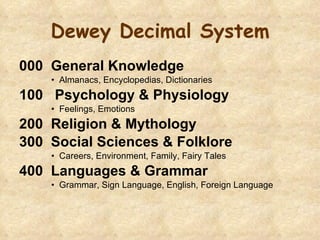
Dewey Decimal System 000  General Knowledge Almanacs, Encyclopedias, Dictionaries 100  Psychology & Physiology Feelings, Emotions 200  Religion & Mythology 300  Social Sciences & Folklore Careers, Environment, Family, Fairy Tales 400  Languages & Grammar Grammar, Sign Language, English, Foreign Language
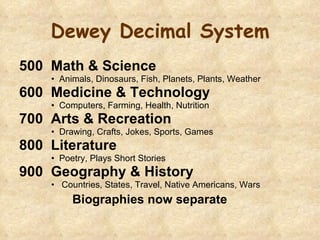
Dewey Decimal System 500  Math & Science Animals, Dinosaurs, Fish, Planets, Plants, Weather 600  Medicine & Technology Computers, Farming, Health, Nutrition 700  Arts & Recreation Drawing, Crafts, Jokes, Sports, Games 800  Literature Poetry, Plays Short Stories 900  Geography & History Countries, States, Travel, Native Americans, Wars Biographies now separate
Works Cited Druce, Arden. "Complete Library Skills Activities Program ."  School Library        Journal  (Feb. 1961)  

Caveman dewey

  • 1.
    The Caveman’s Guide to the Dewey Decimal System
  • 2.
    The Story ofthe Numbers Used for Nonfiction Books In 1873 Mr. Melvil Dewey devised a system for classifying books which is used in many libraries.  He chose certain main subjects and numbers , so that all nonfiction books on the same subject would be together on the shelf.   
  • 3.
    The Dewey DecimalSystem The system groups books by topic by dividing them into 10 basic categories.
  • 4.
    Dewey’s Plan Whoknows he might have imagined himself to be a Caveman! What would man ask?
  • 5.
    000's Before IBegin Generalities Information I need to know before I begin. These are books which contain information on many subjects such as encyclopedias and other reference books.
  • 6.
    100's Whoam I? PHILOSOPHY AND PSYCHOLOGY Man thinks about himself.
  • 7.
    200's Whomade me? RELIGION AND MYTHOLOGY Man thinks about God.
  • 8.
    300's Whois the man (or woman) in the next cave? SOCIAL SCIENCE Man thinks about other people.
  • 9.
    400's How canI make that man understand me? Language Man learns to communicate with others through words.
  • 10.
    500's How canI understand nature and the world about me? Math & NATURAL SCIENCE Man learns to understand nature on the land, in the sea, and in the sky.
  • 11.
    600's How canI use what I know about nature? APPLIED SCIENCE AND USEFUL ARTS (Technology ) Primitive man learned about fire and how to make weapons.  He learned through the ages about the wheel, about medicine, planting crops, cooking food, building bridges, and how to make all the things we use.
  • 12.
    700's How canI enjoy my leisure time? FINE ART AND RECREATION or (Arts) By this time, primitive man had more time to do the things he enjoyed.  He learned how to paint pictures and to create music.  He also learned how to dance and play games.
  • 13.
    800's How canI give my children a record of man's heroic deeds? LITERATURE Man became a storyteller.  He created poetry, and plays about his ancestors and the people he knew.  Later, man recorded these stories for all people to read.
  • 14.
    900's How canI leave a record for men of the future? GEOGRAPHY, HISTORY Man began to write about events that had occurred everywhere, and about people who had participated in these events.
  • 15.
    Dewey Decimal System000 General Knowledge Almanacs, Encyclopedias, Dictionaries 100 Psychology & Physiology Feelings, Emotions 200 Religion & Mythology 300 Social Sciences & Folklore Careers, Environment, Family, Fairy Tales 400 Languages & Grammar Grammar, Sign Language, English, Foreign Language
  • 16.
    Dewey Decimal System500 Math & Science Animals, Dinosaurs, Fish, Planets, Plants, Weather 600 Medicine & Technology Computers, Farming, Health, Nutrition 700 Arts & Recreation Drawing, Crafts, Jokes, Sports, Games 800 Literature Poetry, Plays Short Stories 900 Geography & History Countries, States, Travel, Native Americans, Wars Biographies now separate
  • 17.
    Works Cited Druce,Arden. "Complete Library Skills Activities Program ." School Library       Journal (Feb. 1961)