CAUTI
Definition
It is defined as the presence of significant
bacteriuria in a catheterized or recently
catheterized patient with signs and
symptoms relatable to the urinary tract.
CA-ASB (Catheter associated
asymptomatic bacteriuria) is a CAUTI
without signs and symptoms localising to
the urinary tract.
Risk Factors
1. Device related
2. Patient related
3. Caregiver related
Device Related Risk Factors
- Presence and duration of catheterization
- Type of catherization
- Long term indwelling catheters
- Type of catheter material
-Silicone better than latex
Patient Related Risk Factors
- Female gender
- Serious underlying illnesses
- Age > 50 years
- Diabetes mellitus
- Elevated creatinine (AKI)
- Poor personal hygiene
- Urethral Colonization
- Fecal incontinence
Caregiver Related Risk Factors
- Emergency catheter insertion
- Improper technique/failure of adherence
to aseptic technique
Bacteria implicated in CAUTI
In short term catheterized patients:
- E. coli
- Others, Klebsiella, Serratia, Citrobacter, Enterobacter,
Pseudomonas, Acinetobacter, CoNS, Enterococcus
- Candiduria, rare and its significance is doubtful.
In long term catheterized patients:
- usually polymicrobial
- Above mentioned organisms + Proteus, Providencia,
Morganella etc
Pathogenesis
the four major
portals of entry
Source of flora/spread of flora:
- Extraluminal spread:
- Accounts for 2/3rd
of cases
- Patients endogenous flora, hands of
the HCW is asepsis is not maintained
(NOTE: usually the flushing action of urine prevents
extraluminal migration)
- Intraluminal spread:
- Accounts for 1/3rd
of cases
- Reflux of urine from the bag/tubing system
Struvite stones
Why does an indwelling catheter
increase the risk of a UTI?
Presence of a urinary catheter is the single most
important risk factor for a UTI
The risk is directly proportional to the duration of
catherization
Urethral pressure – decreases mucosal blood
flow, urothelial mucosal disruption, impaired
mucin secretion
Incomplete emptying – pooling around the
balloon serving as a nidus of infection
Biofilm formation on the catheter surface
Diagnosis
Prevention
Measures prior to Catheterization:
Regular training of HCWs on insertion and maintenance
Choosing the correct catheter
- Appropriate indications
- Material
- Size
- Alternatives to indwelling catheters
Measures during catheterization: PROPER TECHNIQUE
Measures after catheterization:
Closed drainage system:
Bag below bladder, above the floor
Legs bags
Emptying, alcohol swab for outlet
Hand hygiene and PPE
Meatal care – soap and water 2/3 times a day
Removal of catheter
Bladder irrigation – only when indicated not routine
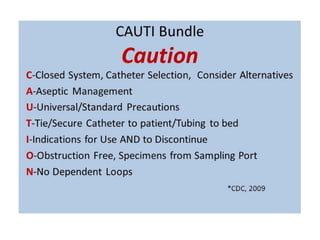
Care Bundle for UTI
CAUTI.ppt...................................

CAUTI.ppt...................................

  • 1.
  • 2.
    Definition It is definedas the presence of significant bacteriuria in a catheterized or recently catheterized patient with signs and symptoms relatable to the urinary tract. CA-ASB (Catheter associated asymptomatic bacteriuria) is a CAUTI without signs and symptoms localising to the urinary tract.
  • 3.
    Risk Factors 1. Devicerelated 2. Patient related 3. Caregiver related Device Related Risk Factors - Presence and duration of catheterization - Type of catherization - Long term indwelling catheters - Type of catheter material -Silicone better than latex Patient Related Risk Factors - Female gender - Serious underlying illnesses - Age > 50 years - Diabetes mellitus - Elevated creatinine (AKI) - Poor personal hygiene - Urethral Colonization - Fecal incontinence Caregiver Related Risk Factors - Emergency catheter insertion - Improper technique/failure of adherence to aseptic technique
  • 4.
    Bacteria implicated inCAUTI In short term catheterized patients: - E. coli - Others, Klebsiella, Serratia, Citrobacter, Enterobacter, Pseudomonas, Acinetobacter, CoNS, Enterococcus - Candiduria, rare and its significance is doubtful. In long term catheterized patients: - usually polymicrobial - Above mentioned organisms + Proteus, Providencia, Morganella etc
  • 5.
  • 7.
    Source of flora/spreadof flora: - Extraluminal spread: - Accounts for 2/3rd of cases - Patients endogenous flora, hands of the HCW is asepsis is not maintained (NOTE: usually the flushing action of urine prevents extraluminal migration) - Intraluminal spread: - Accounts for 1/3rd of cases - Reflux of urine from the bag/tubing system
  • 8.
  • 9.
    Why does anindwelling catheter increase the risk of a UTI? Presence of a urinary catheter is the single most important risk factor for a UTI The risk is directly proportional to the duration of catherization Urethral pressure – decreases mucosal blood flow, urothelial mucosal disruption, impaired mucin secretion Incomplete emptying – pooling around the balloon serving as a nidus of infection Biofilm formation on the catheter surface
  • 10.
  • 12.
    Prevention Measures prior toCatheterization: Regular training of HCWs on insertion and maintenance Choosing the correct catheter - Appropriate indications - Material - Size - Alternatives to indwelling catheters Measures during catheterization: PROPER TECHNIQUE
  • 13.
    Measures after catheterization: Closeddrainage system: Bag below bladder, above the floor Legs bags Emptying, alcohol swab for outlet Hand hygiene and PPE Meatal care – soap and water 2/3 times a day Removal of catheter Bladder irrigation – only when indicated not routine
  • 14.

Editor's Notes

  • #3 Latex catheters cause more urethritis, stricture formation and obstruction.