1
Introduction to Earthquakes
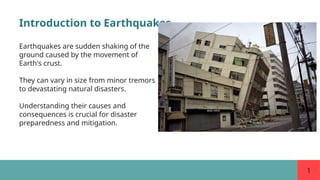
Earthquakesare sudden shaking of the
ground caused by the movement of
Earth's crust.
They can vary in size from minor tremors
to devastating natural disasters.
Understanding their causes and
consequences is crucial for disaster
preparedness and mitigation.
4.
2
What Are Earthquakes?
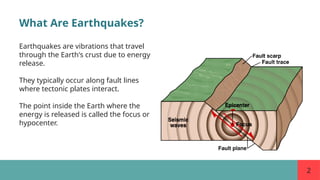
Earthquakesare vibrations that travel
through the Earth's crust due to energy
release.
They typically occur along fault lines
where tectonic plates interact.
The point inside the Earth where the
energy is released is called the focus or
hypocenter.
5.
3
Causes of Earthquakes- Tectonic Plate Movements
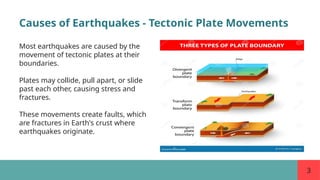
Most earthquakes are caused by the
movement of tectonic plates at their
boundaries.
Plates may collide, pull apart, or slide
past each other, causing stress and
fractures.
These movements create faults, which
are fractures in Earth's crust where
earthquakes originate.
6.
4
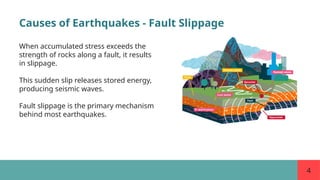
Causes of Earthquakes- Fault Slippage
When accumulated stress exceeds the
strength of rocks along a fault, it results
in slippage.
This sudden slip releases stored energy,
producing seismic waves.
Fault slippage is the primary mechanism
behind most earthquakes.
7.
5
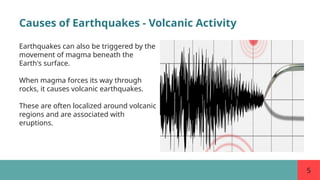
Causes of Earthquakes- Volcanic Activity
Earthquakes can also be triggered by the
movement of magma beneath the
Earth's surface.
When magma forces its way through
rocks, it causes volcanic earthquakes.
These are often localized around volcanic
regions and are associated with
eruptions.
8.
6
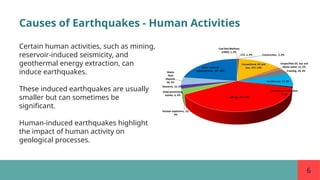
Causes of Earthquakes- Human Activities
Certain human activities, such as mining,
reservoir-induced seismicity, and
geothermal energy extraction, can
induce earthquakes.
These induced earthquakes are usually
smaller but can sometimes be
significant.
Human-induced earthquakes highlight
the impact of human activity on
geological processes.
9.
7
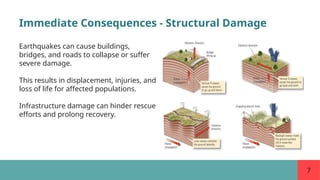
Immediate Consequences -Structural Damage
Earthquakes can cause buildings,
bridges, and roads to collapse or suffer
severe damage.
This results in displacement, injuries, and
loss of life for affected populations.
Infrastructure damage can hinder rescue
efforts and prolong recovery.
10.
8
Immediate Consequences -Tsunamis
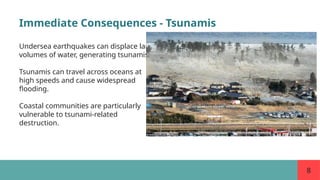
Undersea earthquakes can displace large
volumes of water, generating tsunamis.
Tsunamis can travel across oceans at
high speeds and cause widespread
flooding.
Coastal communities are particularly
vulnerable to tsunami-related
destruction.
11.
9
Long-term Consequences -Economic Impact
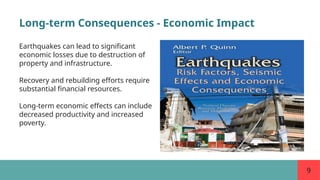
Earthquakes can lead to significant
economic losses due to destruction of
property and infrastructure.
Recovery and rebuilding efforts require
substantial financial resources.
Long-term economic effects can include
decreased productivity and increased
poverty.
12.
10
Long-term Consequences -Social and Psychological
Effects
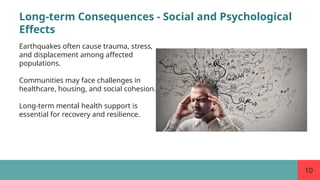
Earthquakes often cause trauma, stress,
and displacement among affected
populations.
Communities may face challenges in
healthcare, housing, and social cohesion.
Long-term mental health support is
essential for recovery and resilience.
13.
11
Environmental Consequences
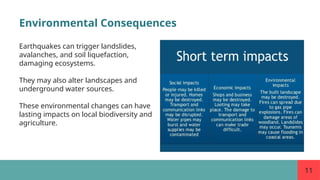
Earthquakes cantrigger landslides,
avalanches, and soil liquefaction,
damaging ecosystems.
They may also alter landscapes and
underground water sources.
These environmental changes can have
lasting impacts on local biodiversity and
agriculture.
14.
12
Conclusion
Earthquakes are naturalphenomena
primarily caused by tectonic movements
and fault slippage.
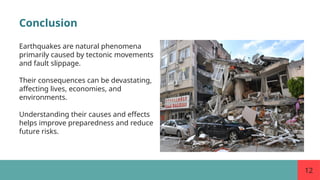
Their consequences can be devastating,
affecting lives, economies, and
environments.
Understanding their causes and effects
helps improve preparedness and reduce
future risks.