





Catalyst Roadmap to
Initial Public Offering
SMI & SME IPO Handbook
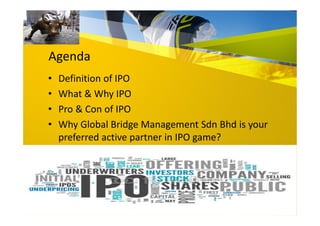
Agenda
• Definition of IPO
• What & Why IPO
• Pro & Con of IPO
• Why Global Bridge Management Sdn Bhd is your
preferred active partner in IPO game?
Definition of IPO
What does “going public” or IPO (“Initial
Public Offering”) mean?
• It is the process of offering securities —
generally common stock — of a
privately owned company for sale to the
general public. The first time these
securities are offered is referred to as an
initial public offering, or IPO.
Source: PWC
The Pro of IPO
• Increased cash and long-term capital—Funds are
obtained to support growth, increase working capital,
invest in plant and equipment, expand research and
development, and retire debt, among other goals.
• Increased market value—The value of public companies
tends to be higher than that of comparable private
companies due in part to increased liquidity, available
information, and a readily ascertainable value.
• Mergers/Acquisitions—These activities may be achieved
with stock consideration and thus conserve cash.
• Growth strategies—Shareholders may achieve improved
liquidity and greater shareholder value. Subject to certain
restrictions and practical market limitations, shareholders
may, over time, sell their stock in the public market.
Alternatively, existing stock may be used as collateral to
secure personal loans.
The Pro of IPO
• Ability to attract and keep key personnel—If a
company is publicly owned, employee incentive
and benefit plans are usually established in the
form of stock ownership arrangements to
attract and keep key personnel. Stock option
plans, for example, may be more attractive to
officers and other key personnel than generous
salary arrangements due to the significant
upside potential.
• Increased prestige/reputation—The visibility
for shareholders and their company is usually
enhanced. For example, a regional company
may more easily expand nationally following a
stock offering due to the increased visibility.
The Opposed of IPO
• Increased expenses—Many factors play a role in determining the cost of an IPO,
but in all cases the costs of going public are significant. These costs will generally
include underwriting fees (generally 5-7 percent of the gross proceeds), fees
related to legal and accounting advisors, and printing costs. In addition, there
are other fees such as the SEC/SC filing fee, the exchange listing fee (NASDAQ or
NYSE or Bursa Malaysia), and any Blue Sky filing fees. Most expenses directly
related to the offering in a complete IPO are reflected as an offset to the
proceeds received and a reduction of additional paid-in-capital. IPO start-up
costs are therefore not expensed in the statement of operations. However, if the
IPO is not completed, such costs are generally expensed.
• Ongoing expenses—Public companies are required to report and certify
financial information on a quarterly and annual basis. There will be ongoing
expenses related to these changes such as the expense of independent auditors.
Administrative and investor relations costs include those related to quarterly
reports, proxy materials, annual reports, transfer agents, and public relations. A
public company will now be paying premiums for directors’ and officers’ liability
insurance as well. Furthermore, compliance-related costs could also increase
primarily in relation to the GST certification requirements.
• Loss of control—If more than 50 percent of a company’s shares are sold to just a
few outside individuals, the original owners could lose control of the company.
If, however, the shares held by the public are widely distributed, management
and the board of directors may maintain effective control, even though they
own less than 50 percent of the shares. Many companies structure their
offerings so that after an initial offering, the founder(s) still has control, and
after subsequent offerings the entire management team maintains control.
The Opposed of IPO
• Loss of privacy—The registration statement and subsequent reporting require
disclosure of many facets of a company’s business, operations, and finances that may
never before have been known outside the company. Some sensitive areas of
disclosure that will be available to competitors, customers, and employees include:
1) extensive financial information (e.g., financial position, sales, cost of sales, gross
profit, net income, business segment data, related-party transactions, borrowings,
cash flows, major customers, and assessment of internal controls); 2) the
compensation of officers and directors, including cash compensation, stock option
plans, and deferred compensation plans; and 3) the security holdings of officers,
directors, and major shareholders (insiders).
• Pressure for performance—In a private company, the business owner/ manager is
free to operate independently. However, once the company becomes publicly
owned, the owner acquires as many partners as the company has shareholders and
is accountable to all of them. Shareholders expect steady growth in areas such as
sales, profits, market share, and product innovation. Thus, in a publicly held
company, management is under constant pressure to balance short-term demands
for growth with strategies that achieve long-term goals. The inability to meet
analysts’ expectations of short-term earnings can dramatically hurt the marketplace’s
long-term valuation of a company.
• Restrictions on insider sales—Stock sales by insiders are usually limited. Most
underwriters require that a company’s existing shareholders enter into contractual
agreements to refrain from selling their stock during a specified time following the
IPO, typically 180 days. This is called the “lock-up” or moratorium period.
How can Global Bridge Management Sdn
Bhd assist the potential SME and SMI to
en route to corporate IPO via special
formulated catalyst solution?
- Pre Listing Process
- During Listing Process
- Post Listing Process
Beginning early to position your company to go public will save
fee and, most importantly, time. The sooner you are ready to
enter the market, the more flexibility you will have to be
prepared to move on an opportune market and the greater
proceeds and market valuation that favorable market condition
provide. By engaging external advisors earlier in the IPO process,
companies get an objective and professional mechanism for
assessing the state of readiness for life as a public company.
Pre-Listing Process
Preliminary Assessment & Diagnostic for IPO
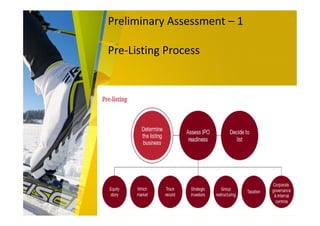
Preliminary Assessment – 1
Pre-Listing Process
Preliminary Assessment – 2
Pre-Listing Process
1. Identify 20 potential well-established SMI & SME companies
to join the “Catalyst Entrepreneur Pathway to Listing”
programme; (“CEPAT”) ANNUALLY;
2. Every identified SMI & SME shall be given first priority to
apply for minimum funding of RM20 million from various
financial institution under various scheme over the period;
3. Every identified SMI & SME shall be assigned one Reporting
Accountant for the minimum duration when the programme
commence and until listing;
4. Assist readiness for a public listing, identify potential listing
concerns, review accounting implication on group
restructuring and suggest necessary actions;
5. Provide strategic advice on capital market alternatives and
fund raising possibilities and introduce strategic investors like
private equities and venture capital;
Preliminary Assessment – 3
Pre-Listing Process
6. Provide a wide range of tax services to achieve greater tax
efficiency for the business under the proposed listing and
operation structure, and for the owners;
7. To advice on the regulatory requirements and process for an
IPO and develop together with you a viable strategy to
handle the listing process;
8. Review key internal control procedures in relation to financial
reporting process and provide recommendations to enhance
the relevant processes.
9. A readiness evaluation can address deal-structuring,
including tax planning, and assess:
Corporate structure, Board structure and board subcommittees,
Board and senior management capabilities; Corporate
governance arrangements and Stock exchange listing eligibility
issues.
Listing Process
Preparation to en route to corporate floatation
Preparation is the secret to success
While the planning process for an IPO can start the day a
company is incorporated or as late as three months
before a public offering, we recommend that an orderly
plan can be executed over a one to two year period. This
window gives a private company time to think, act, and
perform as a public company.
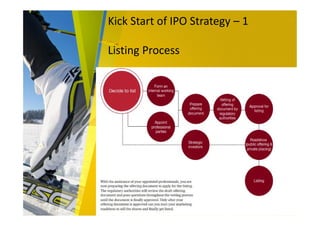
Kick Start of IPO Strategy – 1
Listing Process
Kick Start of IPO Strategy – 2
Listing Process
1. To act as your auditors and carry out periodic audit/review
and report to shareholders, director and audit committee;
2. To assist your company in identifying and executing merger
and acquisition opportunities;
3. To provide updates on the latest developments and changes
on accounting standards, financial reporting, corporate
governance, listing rules and other applicable regulatory
matters;
4. To act as internal control and corporate governance
consultant and carry out review to provide enhancement
comments;
5. To act as reporting accountant for on-going capital market
transactions, such as issues, major acquisitions and other
transaction.
Kick Start of IPO Strategy – 2
Listing Process
6. To assist your company to build an effective and caliber
management team;
7. To assist to formulate the budgetary control system and
performance measurement such as projection, forecast,
investment framework and articulate the variances and
remedy for improvement;
8. To advice on the appointment of independent member to
your board of directors;
9. To provide advice how to create and set up an audit
committee;
10. To assist to evaluate corporate governance principles and
practices;
Kick Start of IPO Strategy – 3
Listing Process
11. To assist in building up relationship with an investment
banking firm, law firm, accounting advisors, and independent
auditor;
12. To assist to establish incentive compensation plans;
13. To assist to up to date the audited accounts and resolve
potential disclosure and accounting issues;
14. To assist to draft the “Management Discussion and Analysis”
15. To assist to set up the IPO team called Due Diligence Working
Group “DDWG”
Post Listing
Continuous Compliance & Disclosure Strategy
Post IPO Strategy – 1
Post-Listing Process
Post IPO Strategy – 2
Post-Listing Process
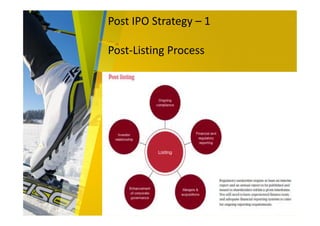
1. To act as your consultants on ongoing compliance such as
Listing Requirement, quarterly announcement and Annual
Report presentation;
2. Maintain and create for better investor relationship;
3. Continuous enhancement of corporate governance;
4. Financial and regulatory reporting.
Introduction to Global Bridge Management Sdn Bhd
Why should you appoint us as your IPO consultant
About Global Bridge Management
1. Like any other major strategic undertaking, taking a company
public requires careful planning to ensure success. The
process requires thought around two main facets of
operating as a public company. First, the company must
prepare its management team and business units to begin
acting and functioning as a public company, both internally
and externally, in advance of entering the capital markets.
Second, it must identify qualified advisors and key managers
to form the going-public team.
2. Accountants play a vital role in advising a company as it
navigates the complex lifecycle of a capital market
transaction, from the identification of an entry strategy to the
public registration and offering processes and subsequent
management of ongoing public company financial reporting
obligations. In addition, the post-Sarbanes-Oxley (if overseas
listing) and disclosure-based like Malaysia regulatory
environment has raised the bar on the amount of advance
preparation and careful planning necessary to complete a
successful IPO in the US or Malaysia capital markets.
About Global Bridge Management
3. The risks and consequences of encountering material
weaknesses or a breakdown of internal controls are significant.
For these reasons, companies often seek advice and assistance
from accountants who specialize in such transactions.
4. Global’s IPO Team Services provide experienced advice to a
company as it moves through the life cycle of the IPO process
and the post-IPO financial reporting obligations. The firm’s
IPO advisors work closely with the company’s management
as they go through the all-consuming process that is the IPO.
5. Management can leverage Global’s extensive experience in
capital-raising activities combined with its deep technical
accounting knowledge and focus on bigger picture issues and
the deal. Your Global engagement team will be chosen
specifically to meet your unique needs and will be supported
by resources that bring the technical, industry, private and
public company, and IPO transaction expertise required to
keep you ahead of the curve and prepared for potential
issues you could face as a publicly held entity.
Catalyst to IPO

Catalyst to IPO

  • 1.
    Catalyst Roadmap to InitialPublic Offering SMI & SME IPO Handbook
  • 2.
    Agenda • Definition ofIPO • What & Why IPO • Pro & Con of IPO • Why Global Bridge Management Sdn Bhd is your preferred active partner in IPO game?
  • 3.
    Definition of IPO Whatdoes “going public” or IPO (“Initial Public Offering”) mean? • It is the process of offering securities — generally common stock — of a privately owned company for sale to the general public. The first time these securities are offered is referred to as an initial public offering, or IPO. Source: PWC
  • 4.
    The Pro ofIPO • Increased cash and long-term capital—Funds are obtained to support growth, increase working capital, invest in plant and equipment, expand research and development, and retire debt, among other goals. • Increased market value—The value of public companies tends to be higher than that of comparable private companies due in part to increased liquidity, available information, and a readily ascertainable value. • Mergers/Acquisitions—These activities may be achieved with stock consideration and thus conserve cash. • Growth strategies—Shareholders may achieve improved liquidity and greater shareholder value. Subject to certain restrictions and practical market limitations, shareholders may, over time, sell their stock in the public market. Alternatively, existing stock may be used as collateral to secure personal loans.
  • 5.
    The Pro ofIPO • Ability to attract and keep key personnel—If a company is publicly owned, employee incentive and benefit plans are usually established in the form of stock ownership arrangements to attract and keep key personnel. Stock option plans, for example, may be more attractive to officers and other key personnel than generous salary arrangements due to the significant upside potential. • Increased prestige/reputation—The visibility for shareholders and their company is usually enhanced. For example, a regional company may more easily expand nationally following a stock offering due to the increased visibility.
  • 6.
    The Opposed ofIPO • Increased expenses—Many factors play a role in determining the cost of an IPO, but in all cases the costs of going public are significant. These costs will generally include underwriting fees (generally 5-7 percent of the gross proceeds), fees related to legal and accounting advisors, and printing costs. In addition, there are other fees such as the SEC/SC filing fee, the exchange listing fee (NASDAQ or NYSE or Bursa Malaysia), and any Blue Sky filing fees. Most expenses directly related to the offering in a complete IPO are reflected as an offset to the proceeds received and a reduction of additional paid-in-capital. IPO start-up costs are therefore not expensed in the statement of operations. However, if the IPO is not completed, such costs are generally expensed. • Ongoing expenses—Public companies are required to report and certify financial information on a quarterly and annual basis. There will be ongoing expenses related to these changes such as the expense of independent auditors. Administrative and investor relations costs include those related to quarterly reports, proxy materials, annual reports, transfer agents, and public relations. A public company will now be paying premiums for directors’ and officers’ liability insurance as well. Furthermore, compliance-related costs could also increase primarily in relation to the GST certification requirements. • Loss of control—If more than 50 percent of a company’s shares are sold to just a few outside individuals, the original owners could lose control of the company. If, however, the shares held by the public are widely distributed, management and the board of directors may maintain effective control, even though they own less than 50 percent of the shares. Many companies structure their offerings so that after an initial offering, the founder(s) still has control, and after subsequent offerings the entire management team maintains control.
  • 7.
    The Opposed ofIPO • Loss of privacy—The registration statement and subsequent reporting require disclosure of many facets of a company’s business, operations, and finances that may never before have been known outside the company. Some sensitive areas of disclosure that will be available to competitors, customers, and employees include: 1) extensive financial information (e.g., financial position, sales, cost of sales, gross profit, net income, business segment data, related-party transactions, borrowings, cash flows, major customers, and assessment of internal controls); 2) the compensation of officers and directors, including cash compensation, stock option plans, and deferred compensation plans; and 3) the security holdings of officers, directors, and major shareholders (insiders). • Pressure for performance—In a private company, the business owner/ manager is free to operate independently. However, once the company becomes publicly owned, the owner acquires as many partners as the company has shareholders and is accountable to all of them. Shareholders expect steady growth in areas such as sales, profits, market share, and product innovation. Thus, in a publicly held company, management is under constant pressure to balance short-term demands for growth with strategies that achieve long-term goals. The inability to meet analysts’ expectations of short-term earnings can dramatically hurt the marketplace’s long-term valuation of a company. • Restrictions on insider sales—Stock sales by insiders are usually limited. Most underwriters require that a company’s existing shareholders enter into contractual agreements to refrain from selling their stock during a specified time following the IPO, typically 180 days. This is called the “lock-up” or moratorium period.
  • 8.
    How can GlobalBridge Management Sdn Bhd assist the potential SME and SMI to en route to corporate IPO via special formulated catalyst solution? - Pre Listing Process - During Listing Process - Post Listing Process
  • 9.
    Beginning early toposition your company to go public will save fee and, most importantly, time. The sooner you are ready to enter the market, the more flexibility you will have to be prepared to move on an opportune market and the greater proceeds and market valuation that favorable market condition provide. By engaging external advisors earlier in the IPO process, companies get an objective and professional mechanism for assessing the state of readiness for life as a public company.
  • 10.
  • 11.
    Preliminary Assessment –1 Pre-Listing Process
  • 12.
    Preliminary Assessment –2 Pre-Listing Process 1. Identify 20 potential well-established SMI & SME companies to join the “Catalyst Entrepreneur Pathway to Listing” programme; (“CEPAT”) ANNUALLY; 2. Every identified SMI & SME shall be given first priority to apply for minimum funding of RM20 million from various financial institution under various scheme over the period; 3. Every identified SMI & SME shall be assigned one Reporting Accountant for the minimum duration when the programme commence and until listing; 4. Assist readiness for a public listing, identify potential listing concerns, review accounting implication on group restructuring and suggest necessary actions; 5. Provide strategic advice on capital market alternatives and fund raising possibilities and introduce strategic investors like private equities and venture capital;
  • 13.
    Preliminary Assessment –3 Pre-Listing Process 6. Provide a wide range of tax services to achieve greater tax efficiency for the business under the proposed listing and operation structure, and for the owners; 7. To advice on the regulatory requirements and process for an IPO and develop together with you a viable strategy to handle the listing process; 8. Review key internal control procedures in relation to financial reporting process and provide recommendations to enhance the relevant processes. 9. A readiness evaluation can address deal-structuring, including tax planning, and assess: Corporate structure, Board structure and board subcommittees, Board and senior management capabilities; Corporate governance arrangements and Stock exchange listing eligibility issues.
  • 14.
    Listing Process Preparation toen route to corporate floatation
  • 15.
    Preparation is thesecret to success While the planning process for an IPO can start the day a company is incorporated or as late as three months before a public offering, we recommend that an orderly plan can be executed over a one to two year period. This window gives a private company time to think, act, and perform as a public company.
  • 16.
    Kick Start ofIPO Strategy – 1 Listing Process
  • 17.
    Kick Start ofIPO Strategy – 2 Listing Process 1. To act as your auditors and carry out periodic audit/review and report to shareholders, director and audit committee; 2. To assist your company in identifying and executing merger and acquisition opportunities; 3. To provide updates on the latest developments and changes on accounting standards, financial reporting, corporate governance, listing rules and other applicable regulatory matters; 4. To act as internal control and corporate governance consultant and carry out review to provide enhancement comments; 5. To act as reporting accountant for on-going capital market transactions, such as issues, major acquisitions and other transaction.
  • 18.
    Kick Start ofIPO Strategy – 2 Listing Process 6. To assist your company to build an effective and caliber management team; 7. To assist to formulate the budgetary control system and performance measurement such as projection, forecast, investment framework and articulate the variances and remedy for improvement; 8. To advice on the appointment of independent member to your board of directors; 9. To provide advice how to create and set up an audit committee; 10. To assist to evaluate corporate governance principles and practices;
  • 19.
    Kick Start ofIPO Strategy – 3 Listing Process 11. To assist in building up relationship with an investment banking firm, law firm, accounting advisors, and independent auditor; 12. To assist to establish incentive compensation plans; 13. To assist to up to date the audited accounts and resolve potential disclosure and accounting issues; 14. To assist to draft the “Management Discussion and Analysis” 15. To assist to set up the IPO team called Due Diligence Working Group “DDWG”
  • 20.
  • 21.
    Post IPO Strategy– 1 Post-Listing Process
  • 22.
    Post IPO Strategy– 2 Post-Listing Process 1. To act as your consultants on ongoing compliance such as Listing Requirement, quarterly announcement and Annual Report presentation; 2. Maintain and create for better investor relationship; 3. Continuous enhancement of corporate governance; 4. Financial and regulatory reporting.
  • 23.
    Introduction to GlobalBridge Management Sdn Bhd Why should you appoint us as your IPO consultant
  • 24.
    About Global BridgeManagement 1. Like any other major strategic undertaking, taking a company public requires careful planning to ensure success. The process requires thought around two main facets of operating as a public company. First, the company must prepare its management team and business units to begin acting and functioning as a public company, both internally and externally, in advance of entering the capital markets. Second, it must identify qualified advisors and key managers to form the going-public team. 2. Accountants play a vital role in advising a company as it navigates the complex lifecycle of a capital market transaction, from the identification of an entry strategy to the public registration and offering processes and subsequent management of ongoing public company financial reporting obligations. In addition, the post-Sarbanes-Oxley (if overseas listing) and disclosure-based like Malaysia regulatory environment has raised the bar on the amount of advance preparation and careful planning necessary to complete a successful IPO in the US or Malaysia capital markets.
  • 25.
    About Global BridgeManagement 3. The risks and consequences of encountering material weaknesses or a breakdown of internal controls are significant. For these reasons, companies often seek advice and assistance from accountants who specialize in such transactions. 4. Global’s IPO Team Services provide experienced advice to a company as it moves through the life cycle of the IPO process and the post-IPO financial reporting obligations. The firm’s IPO advisors work closely with the company’s management as they go through the all-consuming process that is the IPO. 5. Management can leverage Global’s extensive experience in capital-raising activities combined with its deep technical accounting knowledge and focus on bigger picture issues and the deal. Your Global engagement team will be chosen specifically to meet your unique needs and will be supported by resources that bring the technical, industry, private and public company, and IPO transaction expertise required to keep you ahead of the curve and prepared for potential issues you could face as a publicly held entity.