Page 1
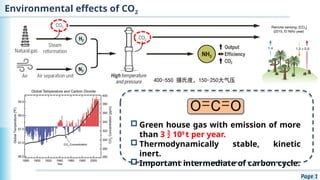
 Green house gas with emission of more
than 3  109
t per year.
 Thermodynamically stable, kinetic
inert.
 Important intermediate of carbon cycle.
C O
O
Environmental effects of CO2
Page 2
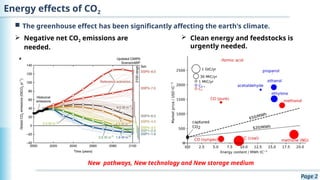
 The greenhouse effect has been significantly affecting the earth's climate.
 Negative net CO2 emissions are
needed.
 Clean energy and feedstocks is
urgently needed.
New pathways, New technology and New storage medium
Energy effects of CO2
Page 3
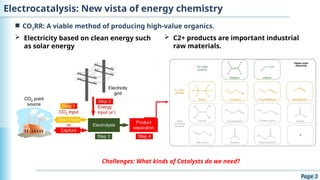
Electrocatalysis: New vista of energy chemistry
 CO2RR: A viable method of producing high-value organics.
 Electricity based on clean energy such
as solar energy
 C2+ products are important industrial
raw materials.
Challenges: What kinds of Catalysts do we need?
Page 4
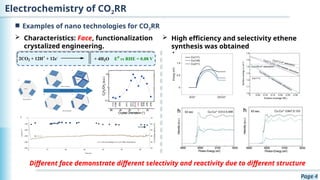
Electrochemistry of CO2RR
 Examples of nano technologies for CO2RR
 Characteristics: Face, functionalization
crystalized engineering.
 High efficiency and selectivity ethene
synthesis was obtained
Different face demonstrate different selectivity and reactivity due to different structure
2CO2 + 12H+
+ 12e-
+ 4H2O E0
vs RHE = 0.08 V
Page 5
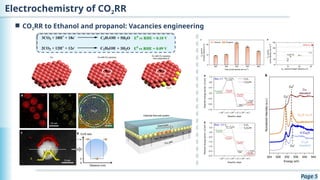
 CO2RR to Ethanol and propanol: Vacancies engineering
Electrochemistry of CO2RR
3CO2 + 18H+
+ 18e-
+ 5H2O E0
vs RHE = 0.10 V
C3H7OH
2CO2 + 12H+
+ 12e-
+ 3H2O E0
vs RHE = 0.09 V
C2H5OH
Page 6
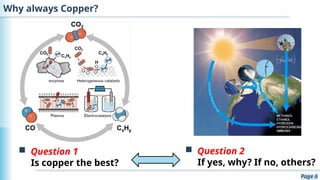
 Question 2
If yes, why? If no, others?
 Question 1
Is copper the best?
Why always Copper?
Page 7
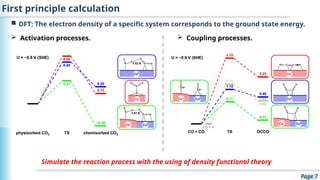
First principle calculation
 DFT: The electron density of a specific system corresponds to the ground state energy.
Simulate the reaction process with the using of density functional theory
 Activation processes.  Coupling processes.
Page 8
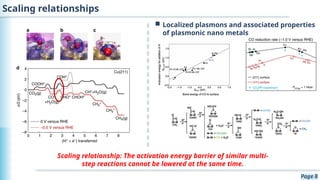
 Localized plasmons and associated properties
of plasmonic nano metals
Scaling relationship: The activation energy barrier of similar multi-
step reactions cannot be lowered at the same time.
Scaling relationships
Page 9
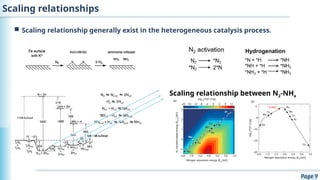
Scaling relationships
Scaling relationship between N2-NHx
Hydrogenation
 Scaling relationship generally exist in the heterogeneous catalysis process.
Page 10
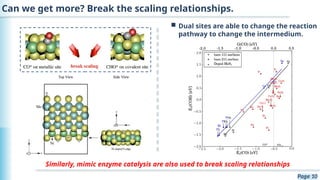
Can we get more? Break the scaling relationships.
 Dual sites are able to change the reaction
pathway to change the intermedium.
Similarly, mimic enzyme catalysis are also used to break scaling relationships
Page 11
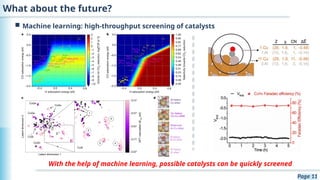
What about the future?
 Machine learning: high-throughput screening of catalysts
With the help of machine learning, possible catalysts can be quickly screened
Page 12
Summary and References
1. Hong X, et al. ACS Catalysis, 2016.
2. Xiao H, et al. Proceedings of the National
Academy of Sciences, 2017.
3. Zhong M, et al. Nature, 2020.
4. Liu X, et al. Nature Communications, 2017.
5. Zhuang T T, et al. Nature Catalysis, 2018.
6. Ross M B, et al. Nature Catalysis, 2019.
7. Wang Y, et al. Nature Catalysis, 2020.
8. Li F, et al. Nature Catalysis, 2020.
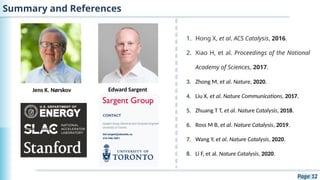
Jens K. Nørskov Edward Sargent

Catalyst design for carbon dioxide reduction.pptx

  • 1.
    Page 1  Greenhouse gas with emission of more than 3  109 t per year.  Thermodynamically stable, kinetic inert.  Important intermediate of carbon cycle. C O O Environmental effects of CO2
  • 2.
    Page 2  Thegreenhouse effect has been significantly affecting the earth's climate.  Negative net CO2 emissions are needed.  Clean energy and feedstocks is urgently needed. New pathways, New technology and New storage medium Energy effects of CO2
  • 3.
    Page 3 Electrocatalysis: Newvista of energy chemistry  CO2RR: A viable method of producing high-value organics.  Electricity based on clean energy such as solar energy  C2+ products are important industrial raw materials. Challenges: What kinds of Catalysts do we need?
  • 4.
    Page 4 Electrochemistry ofCO2RR  Examples of nano technologies for CO2RR  Characteristics: Face, functionalization crystalized engineering.  High efficiency and selectivity ethene synthesis was obtained Different face demonstrate different selectivity and reactivity due to different structure 2CO2 + 12H+ + 12e- + 4H2O E0 vs RHE = 0.08 V
  • 5.
    Page 5  CO2RRto Ethanol and propanol: Vacancies engineering Electrochemistry of CO2RR 3CO2 + 18H+ + 18e- + 5H2O E0 vs RHE = 0.10 V C3H7OH 2CO2 + 12H+ + 12e- + 3H2O E0 vs RHE = 0.09 V C2H5OH
  • 6.
    Page 6  Question2 If yes, why? If no, others?  Question 1 Is copper the best? Why always Copper?
  • 7.
    Page 7 First principlecalculation  DFT: The electron density of a specific system corresponds to the ground state energy. Simulate the reaction process with the using of density functional theory  Activation processes.  Coupling processes.
  • 8.
    Page 8  Localizedplasmons and associated properties of plasmonic nano metals Scaling relationship: The activation energy barrier of similar multi- step reactions cannot be lowered at the same time. Scaling relationships
  • 9.
    Page 9 Scaling relationships Scalingrelationship between N2-NHx Hydrogenation  Scaling relationship generally exist in the heterogeneous catalysis process.
  • 10.
    Page 10 Can weget more? Break the scaling relationships.  Dual sites are able to change the reaction pathway to change the intermedium. Similarly, mimic enzyme catalysis are also used to break scaling relationships
  • 11.
    Page 11 What aboutthe future?  Machine learning: high-throughput screening of catalysts With the help of machine learning, possible catalysts can be quickly screened
  • 12.
    Page 12 Summary andReferences 1. Hong X, et al. ACS Catalysis, 2016. 2. Xiao H, et al. Proceedings of the National Academy of Sciences, 2017. 3. Zhong M, et al. Nature, 2020. 4. Liu X, et al. Nature Communications, 2017. 5. Zhuang T T, et al. Nature Catalysis, 2018. 6. Ross M B, et al. Nature Catalysis, 2019. 7. Wang Y, et al. Nature Catalysis, 2020. 8. Li F, et al. Nature Catalysis, 2020. Jens K. Nørskov Edward Sargent