Using Web Behavior to Improve Catalog Response
Rates
1
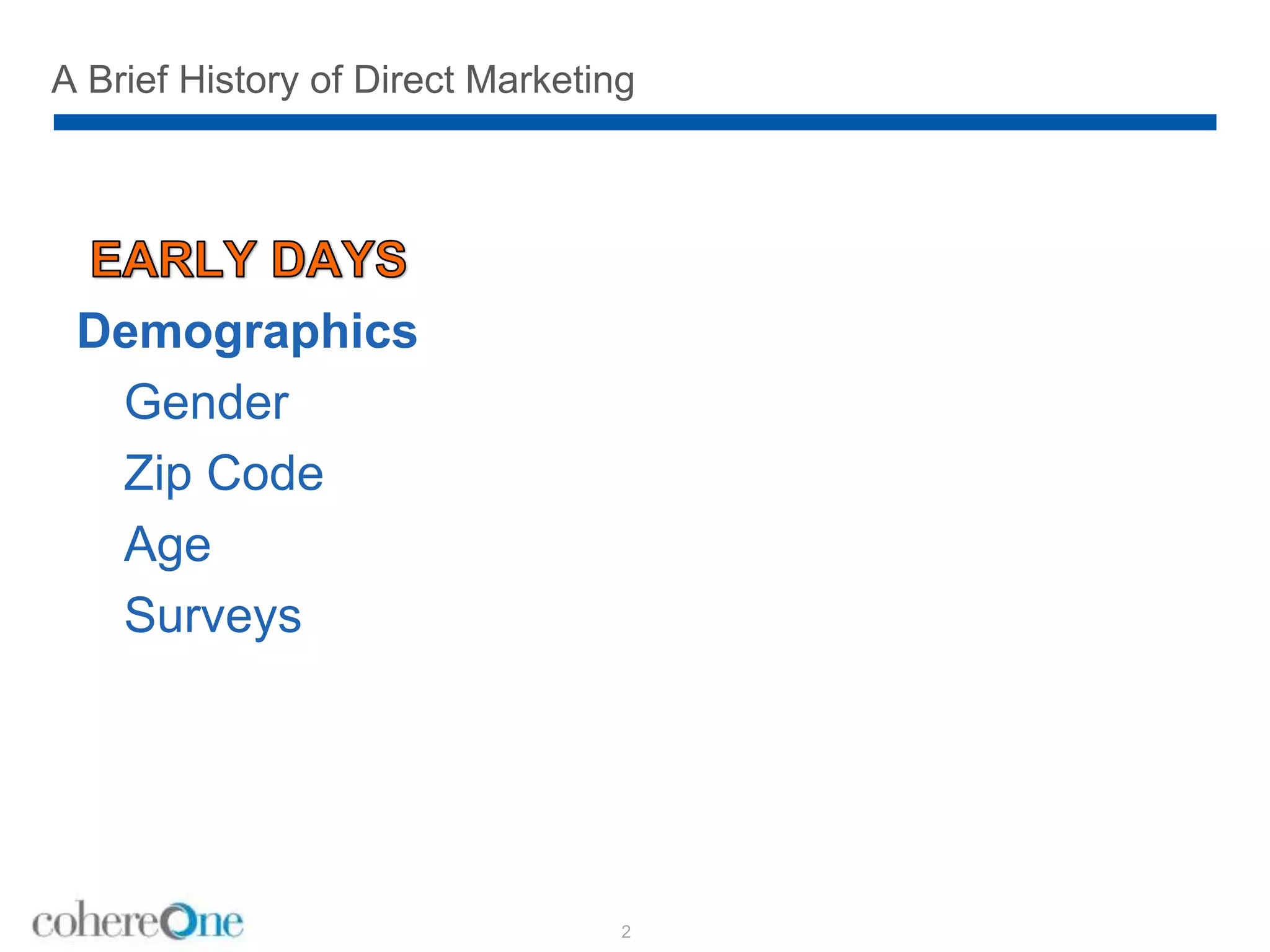
A Brief History of Direct Marketing
Demographics
Gender
Zip Code
Age
Surveys
2
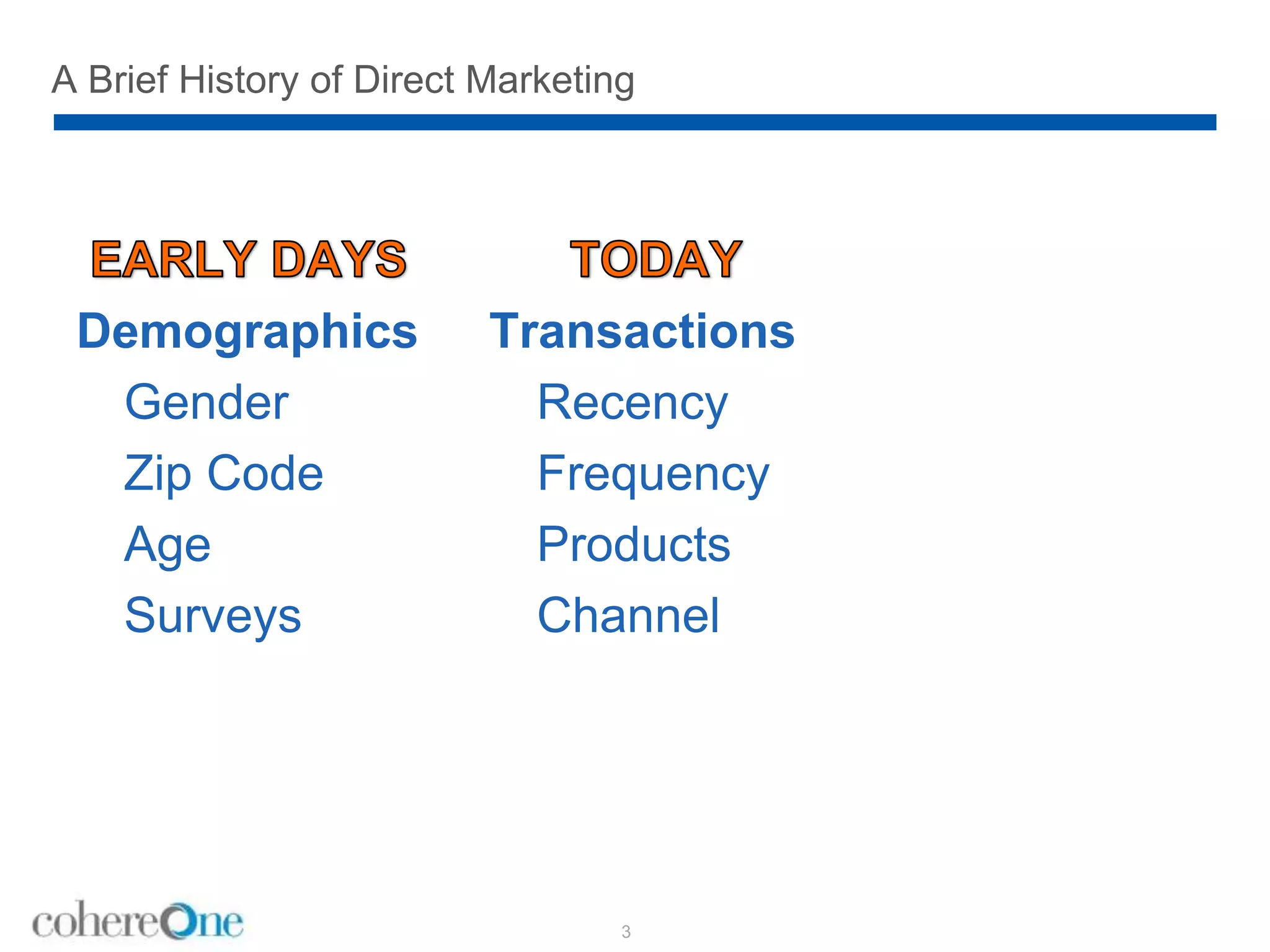
A Brief History of Direct Marketing
Demographics
Gender
Zip Code
Age
Surveys
Transactions
Recency
Frequency
Products
Channel
3
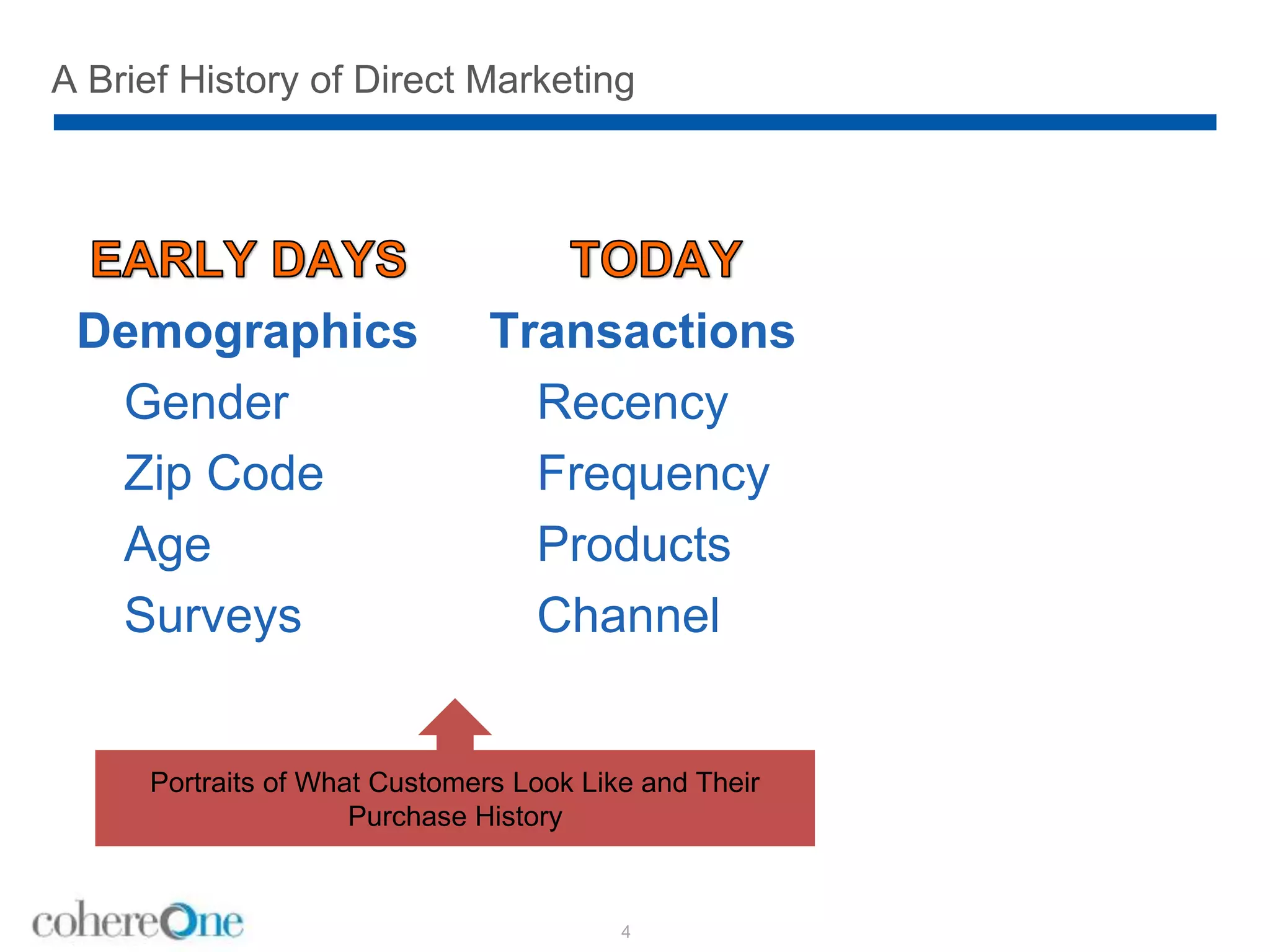
A Brief History of Direct Marketing
Demographics
Gender
Zip Code
Age
Surveys
Transactions
Recency
Frequency
Products
Channel
4
Portraits of What Customers Look Like and Their
Purchase History
A Brief History of Direct Marketing
Demographics
Gender
Zip Code
Age
Surveys
Transactions
Recency
Frequency
Products
Channel
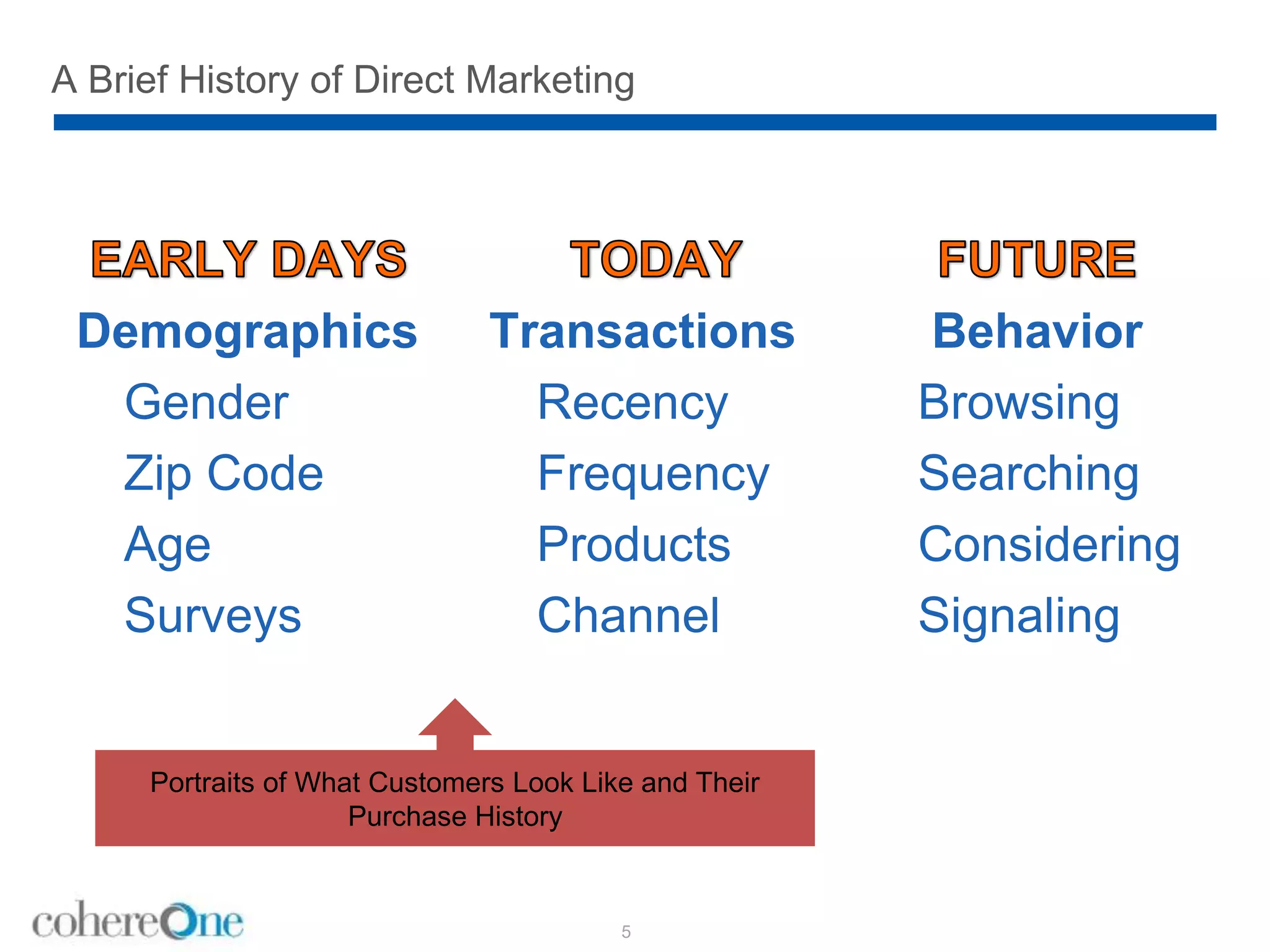
5
Behavior
Browsing
Searching
Considering
Signaling
Portraits of What Customers Look Like and Their
Purchase History
A Brief History of Direct Marketing
Demographics
Gender
Zip Code
Age
Surveys
Transactions
Recency
Frequency
Products
Channel
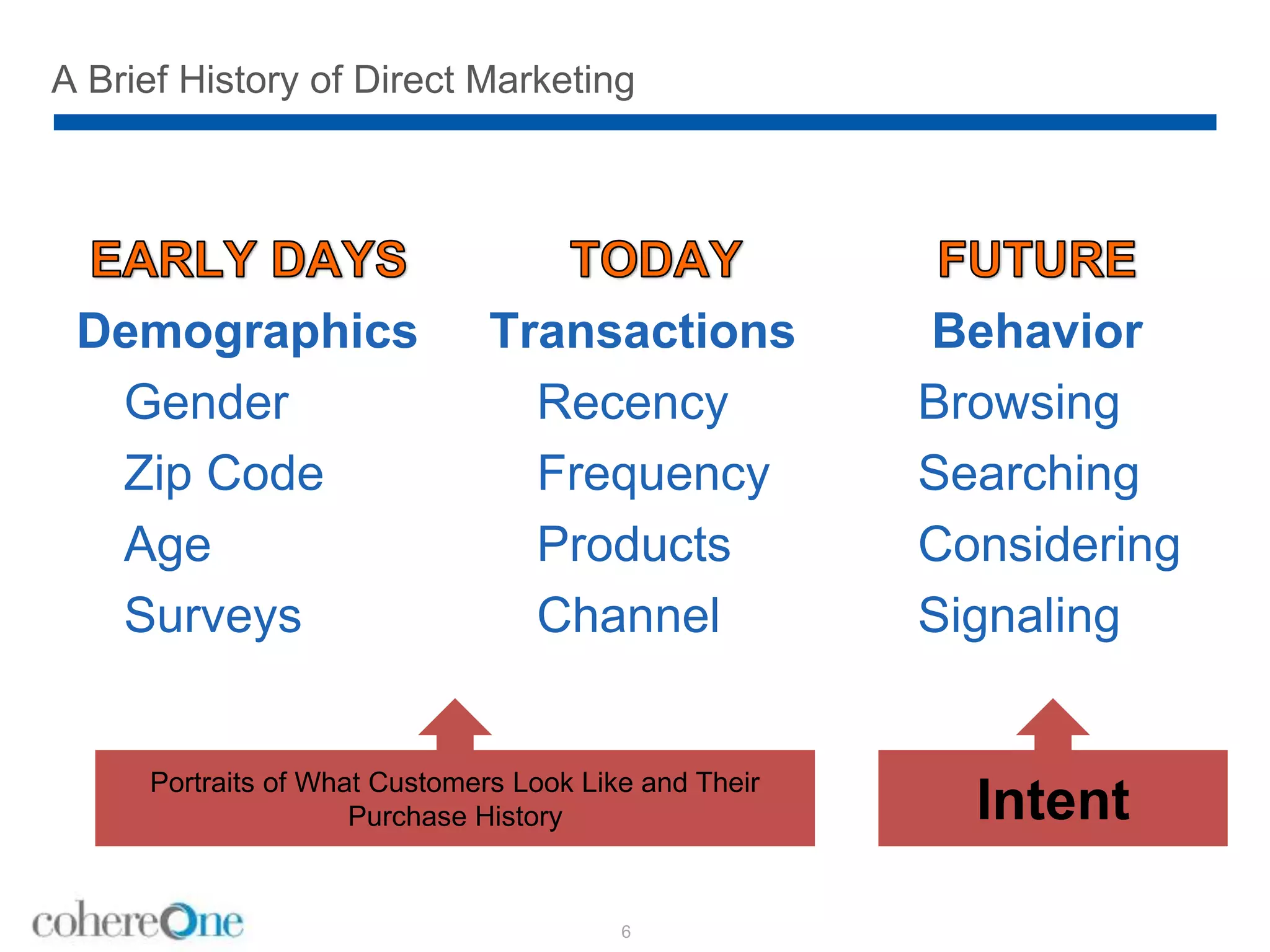
6
Behavior
Browsing
Searching
Considering
Signaling
Portraits of What Customers Look Like and Their
Purchase History Intent
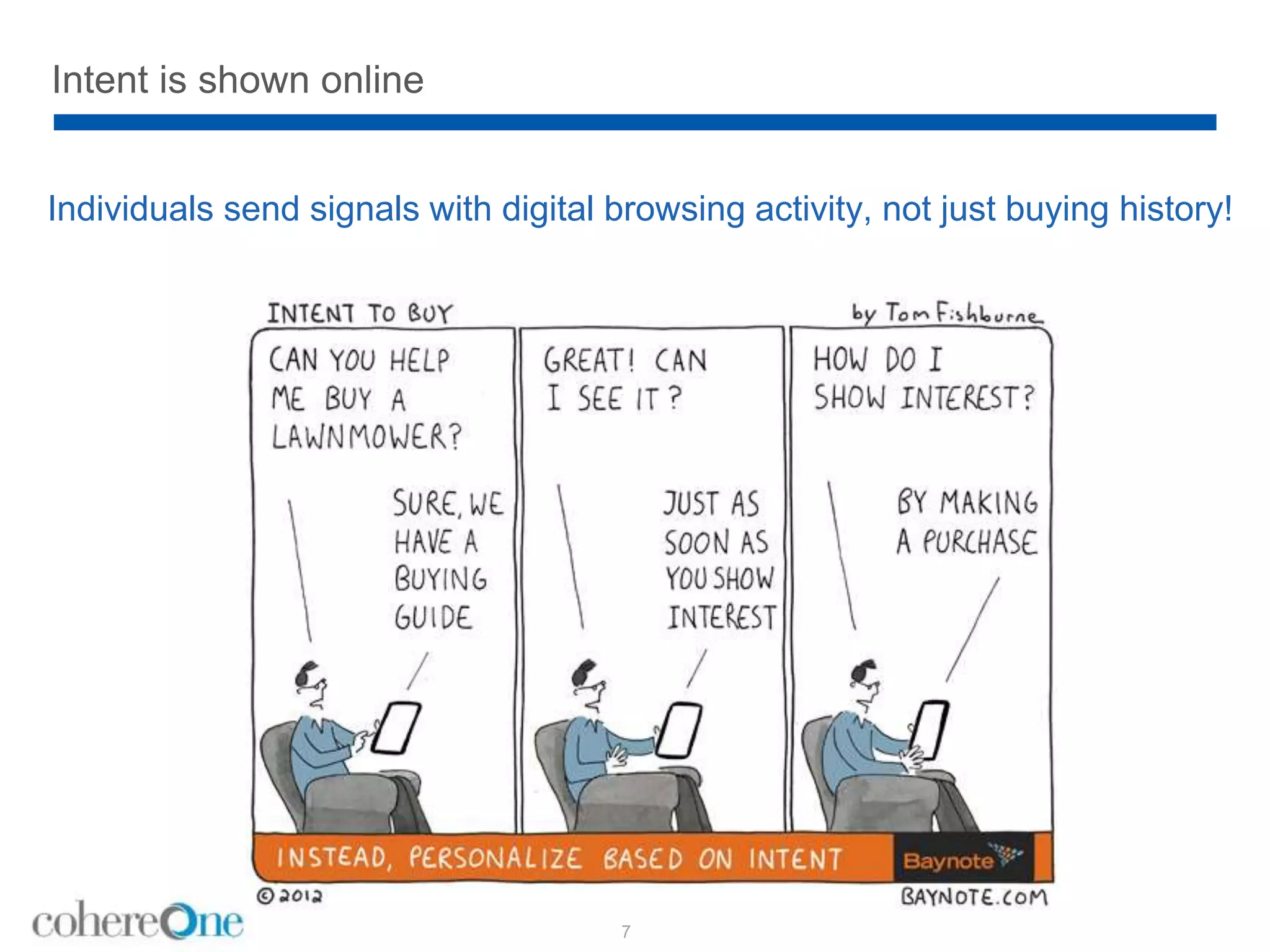
Intent is shown online
Individuals send signals with digital browsing activity, not just buying history!
7
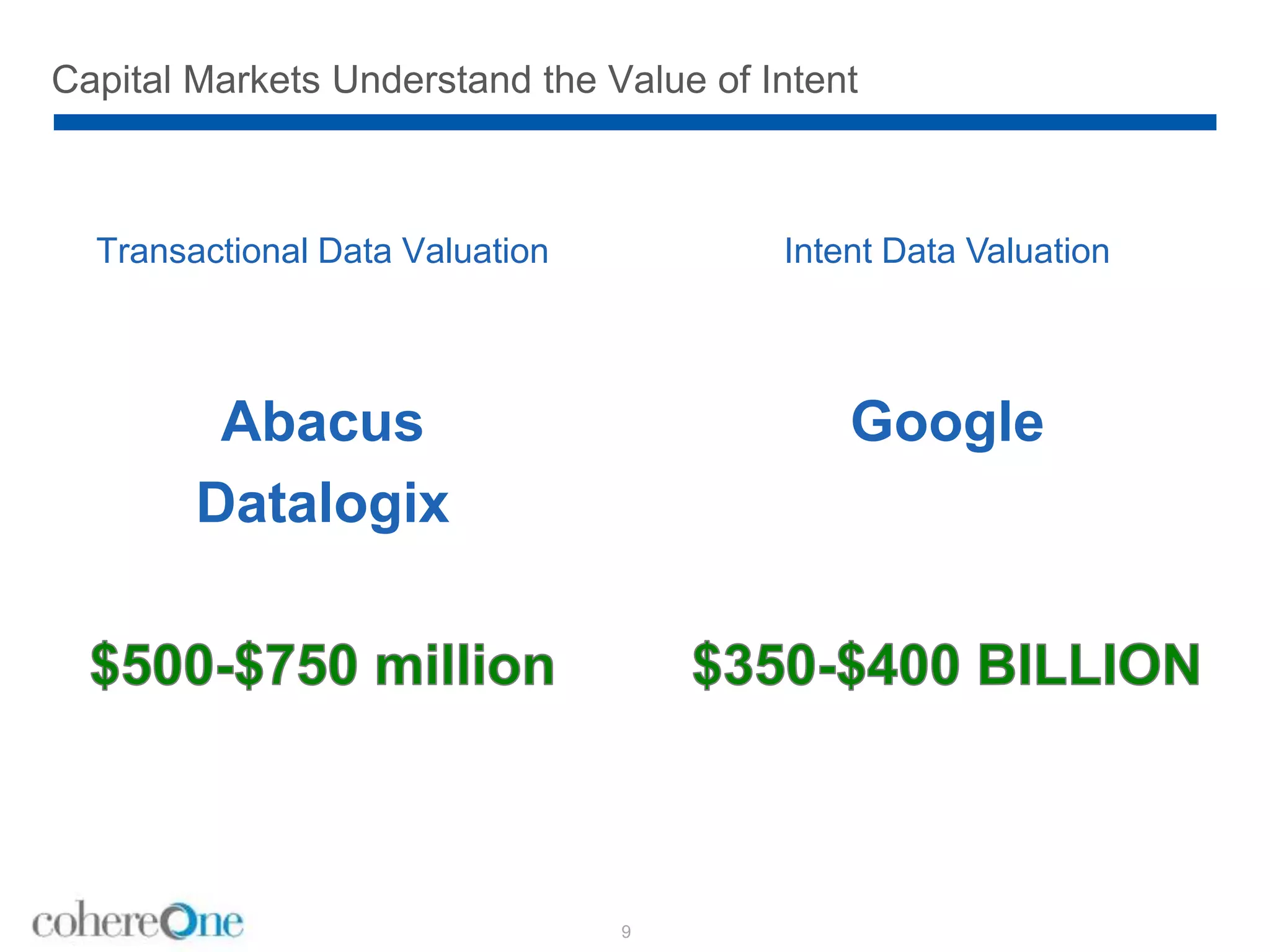
Capital Markets Understand the Value of Intent
Transactional Data Valuation
Abacus
Datalogix
8
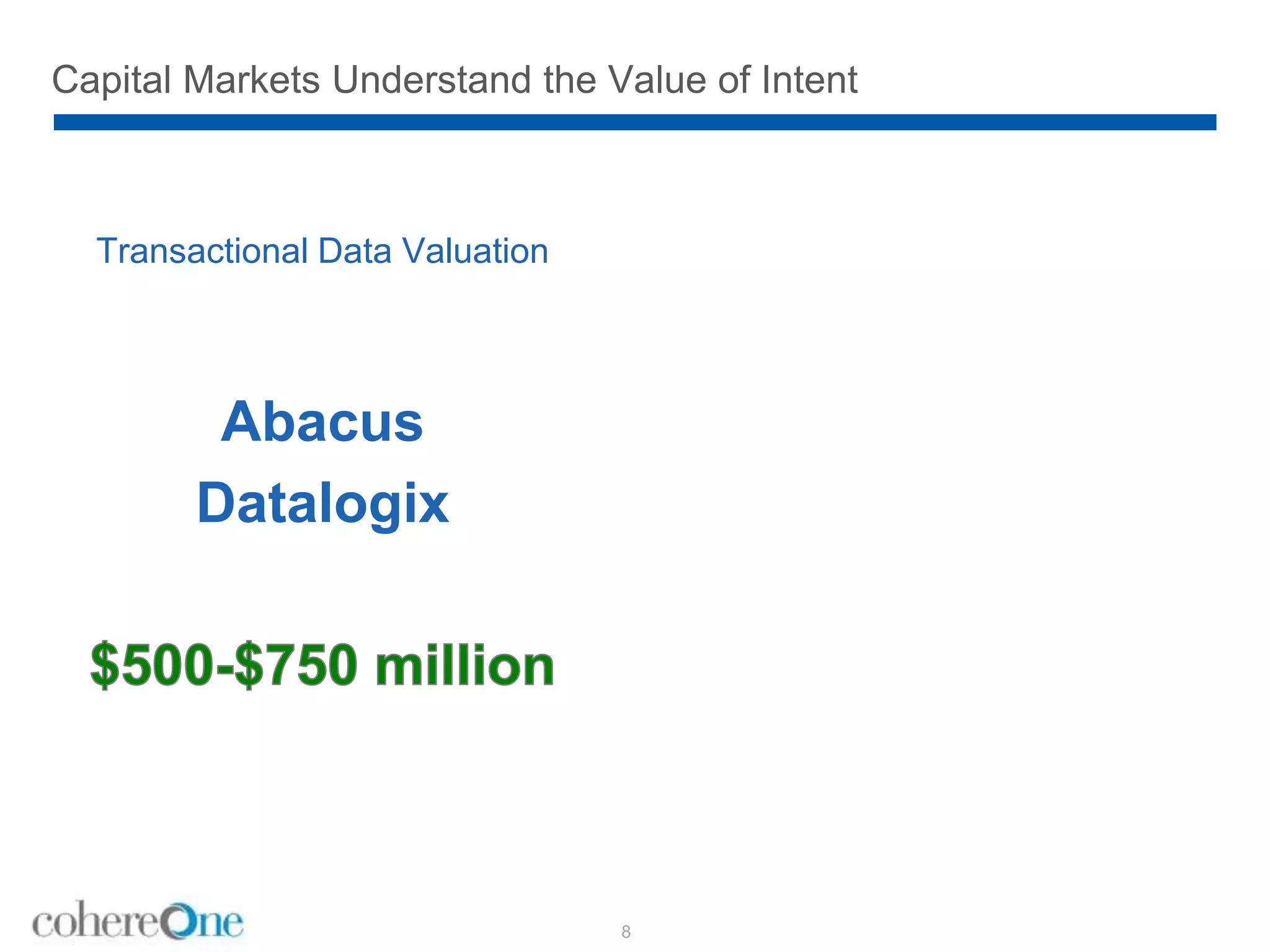
Capital Markets Understand the Value of Intent
Transactional Data Valuation
Abacus
Datalogix
9
Intent Data Valuation
Google
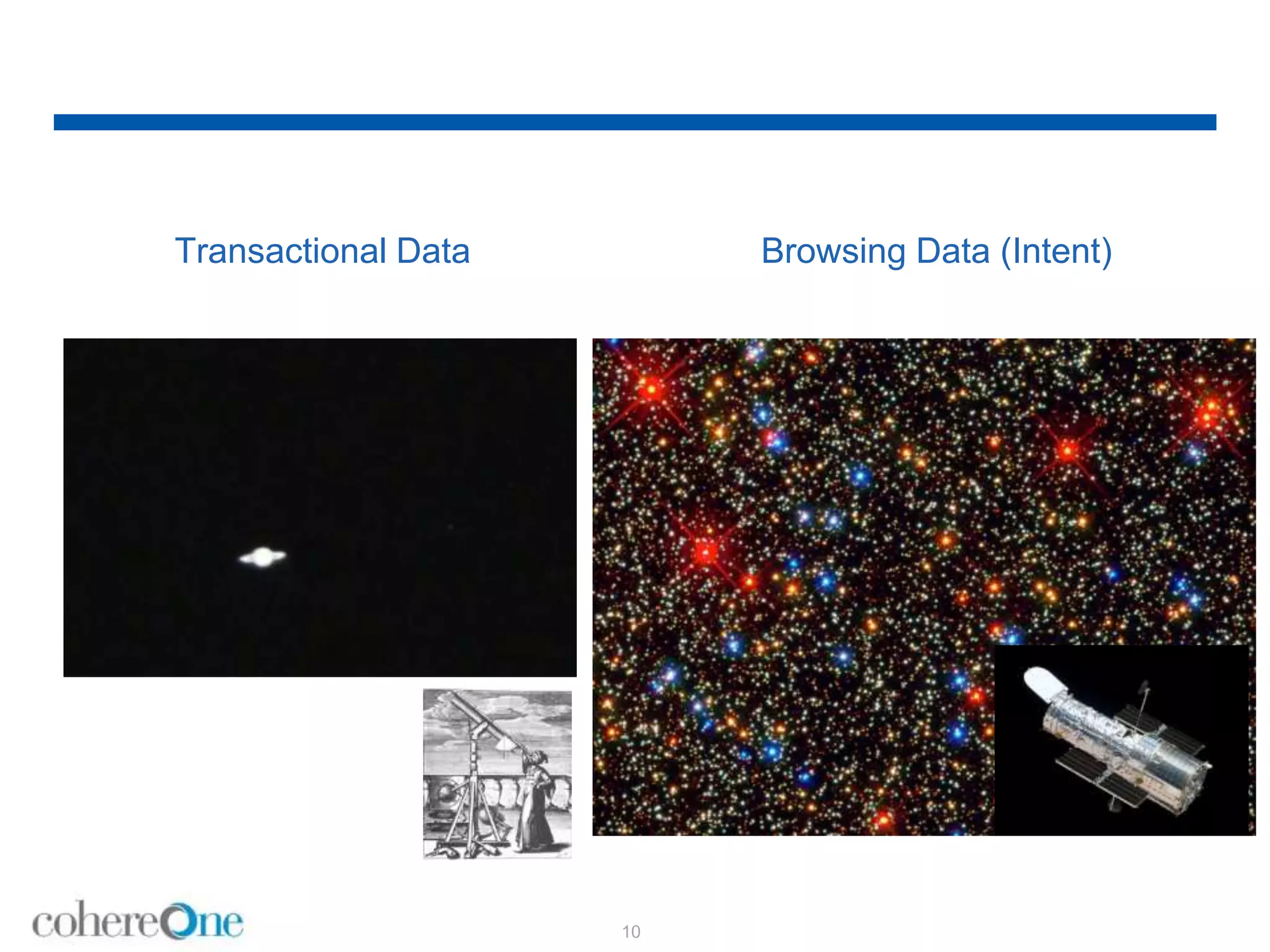
Transactional Data
10
Browsing Data (Intent)
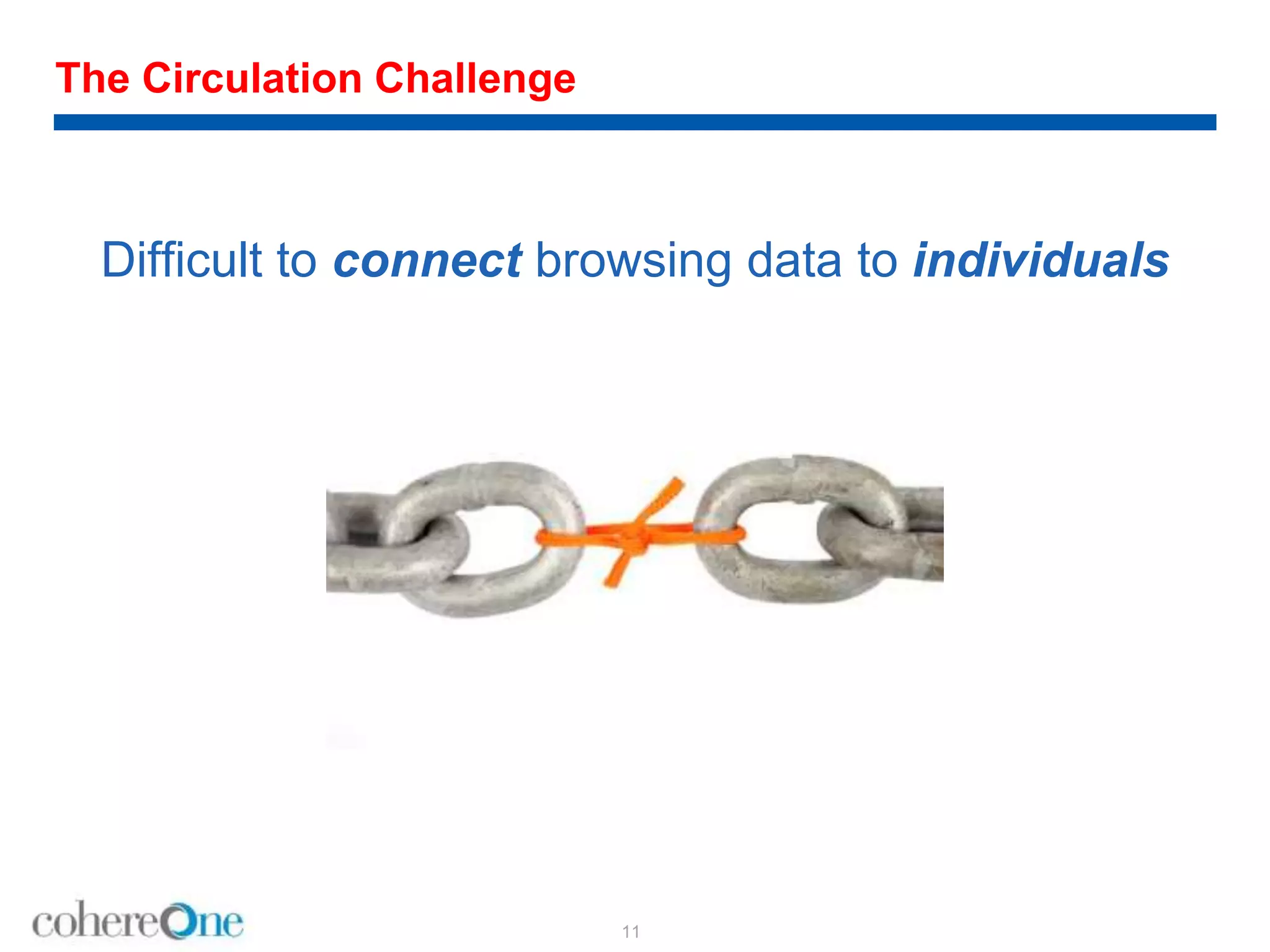
The Circulation Challenge
Difficult to connect browsing data to individuals
11
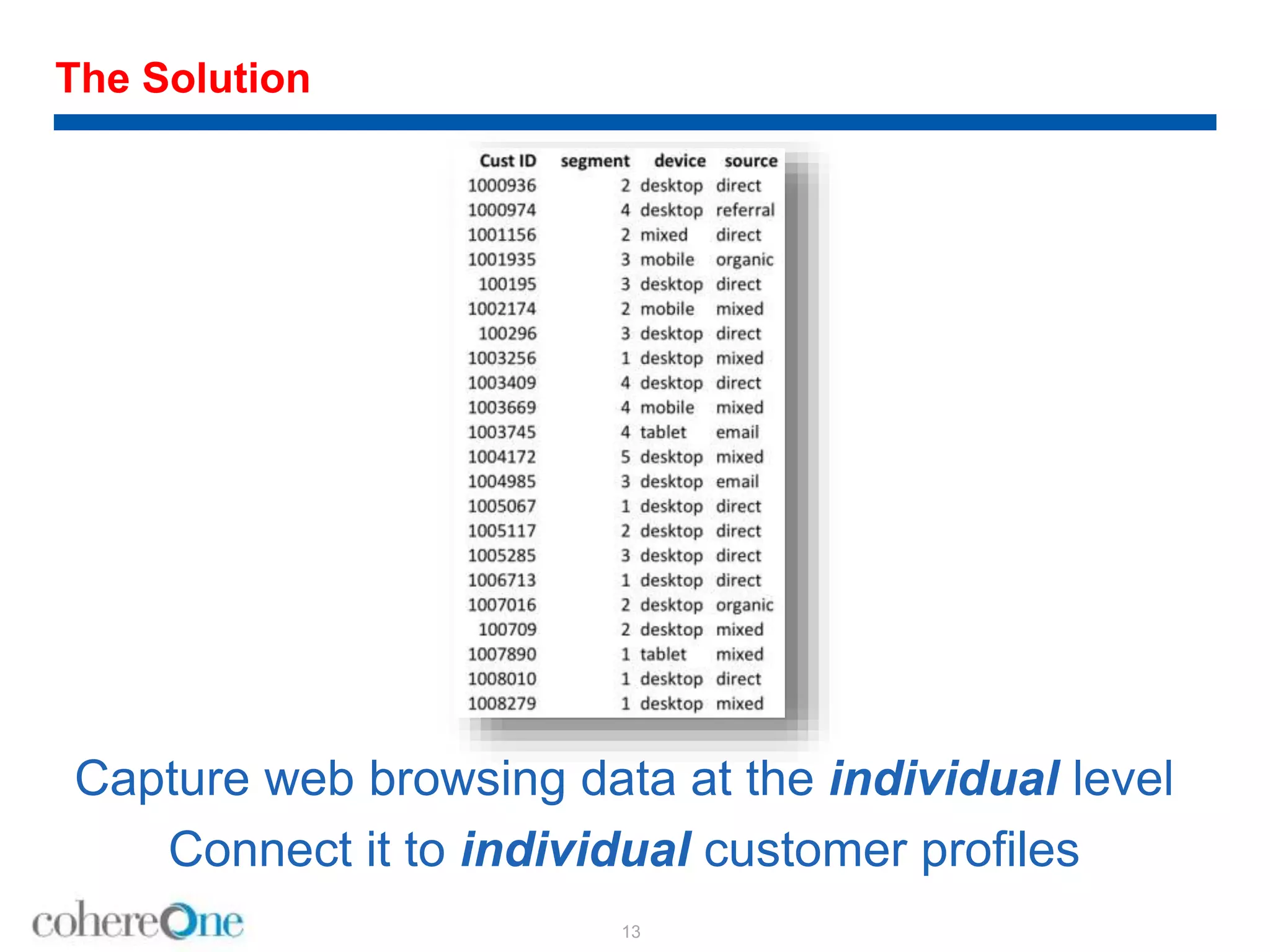
The Solution
Capture web browsing data at the individual level
Connect it to individual customer profiles
12
The Solution
Capture web browsing data at the individual level
Connect it to individual customer profiles
13
Circulation Applications
4 Strategies for Browsing Behavior
14
Circulation Applications
4 Strategies for Browsing Behavior
Supercharge reactivation
15
Circulation Applications
4 Strategies for Browsing Behavior
Supercharge reactivation
Reduce Catalog Mailings
16
Circulation Applications
4 Strategies for Browsing Behavior
Supercharge reactivation
Reduce Catalog Mailings
Source of Prospects
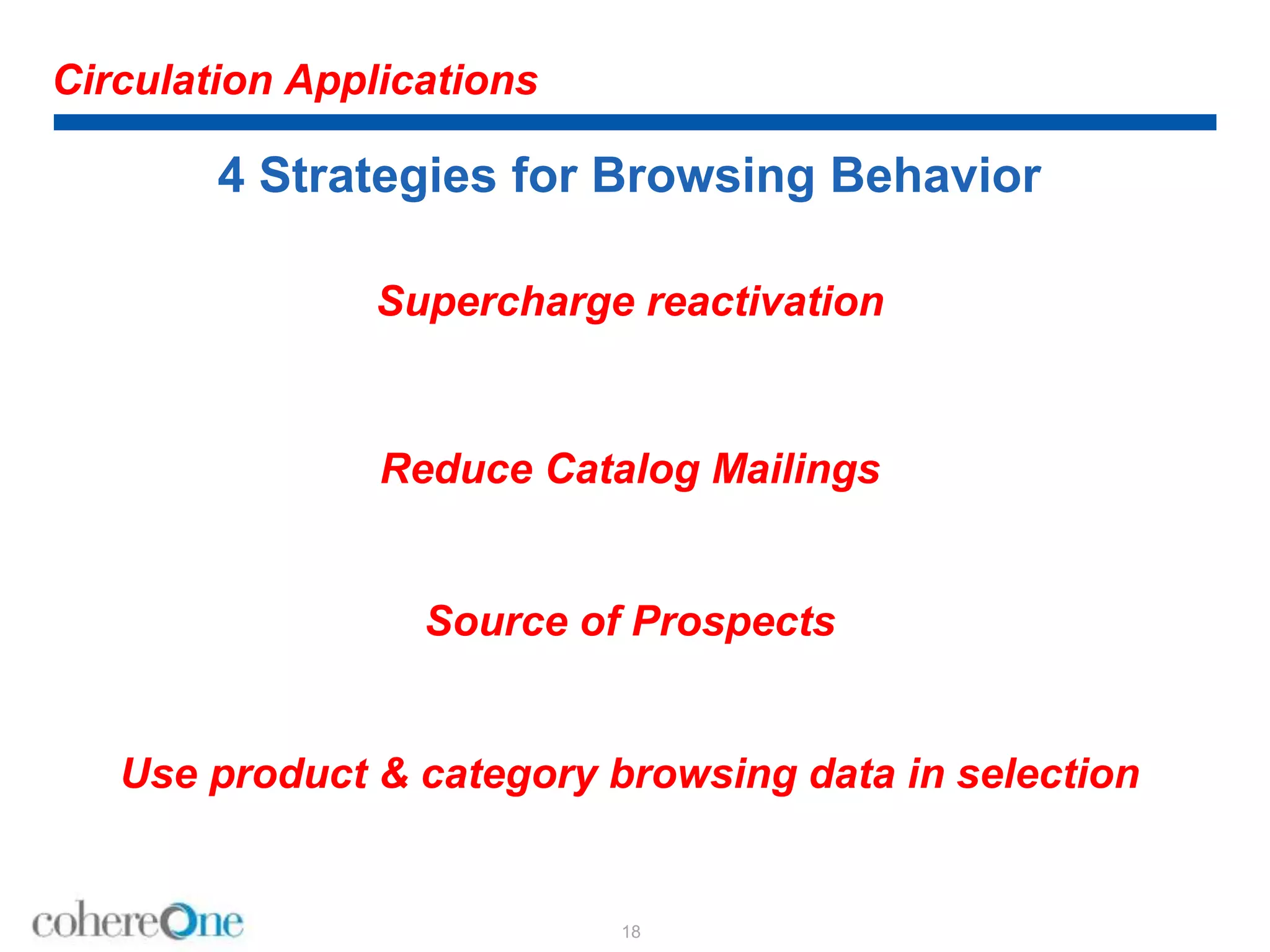
17
Circulation Applications
4 Strategies for Browsing Behavior
Supercharge reactivation
Reduce Catalog Mailings
Source of Prospects
Use product & category browsing data in selection
18
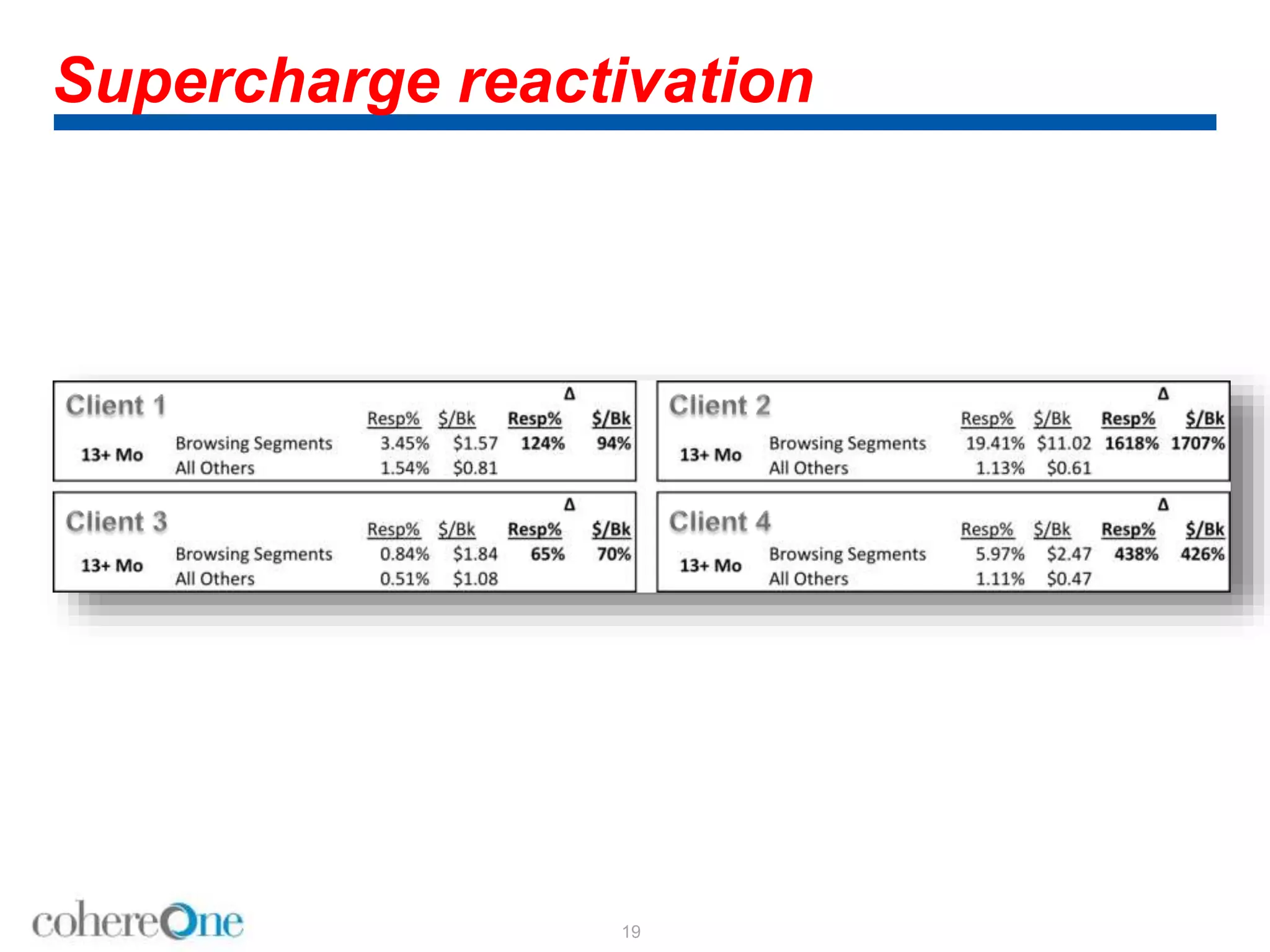
Supercharge reactivation
19
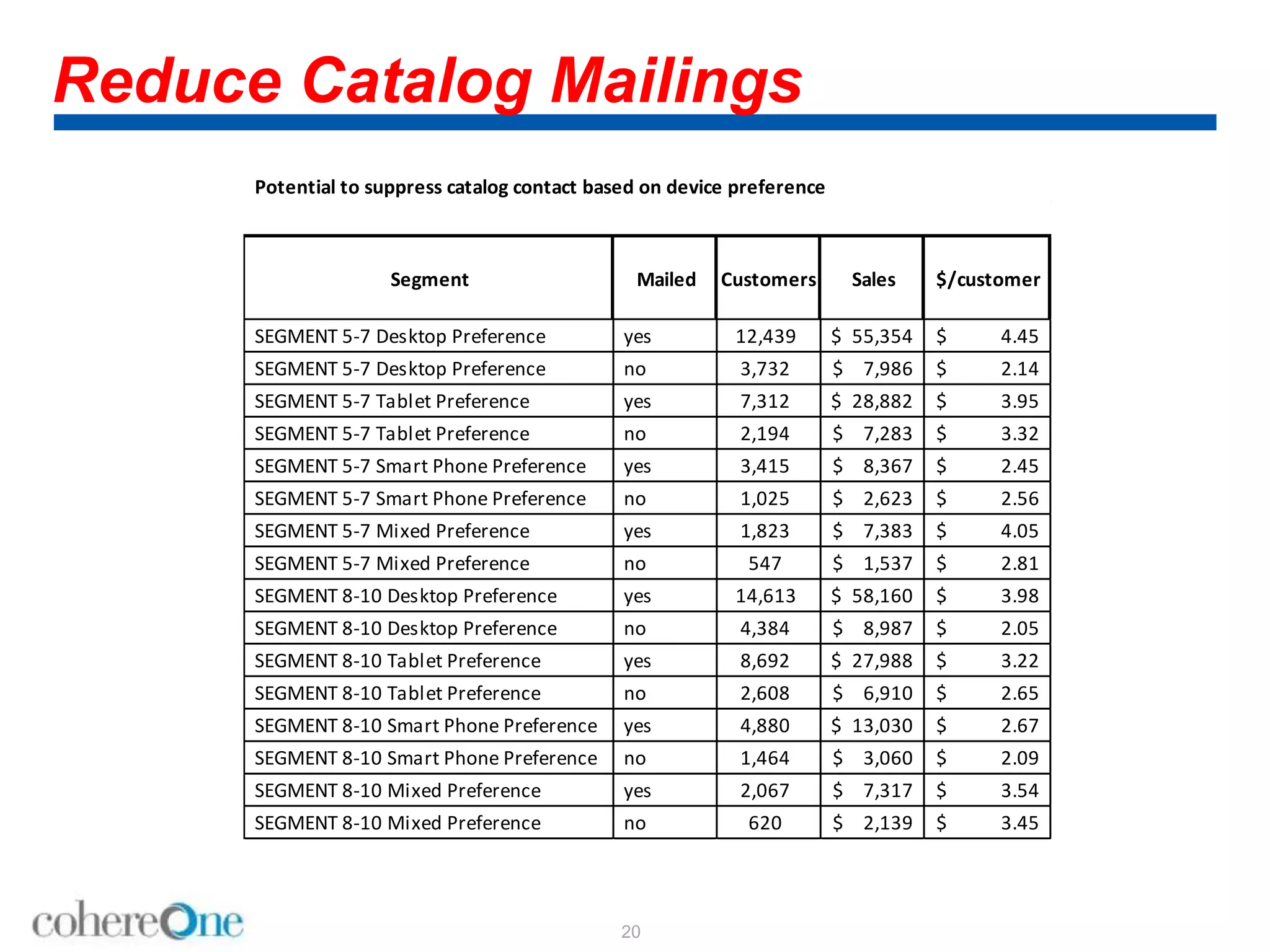
Reduce Catalog Mailings
20
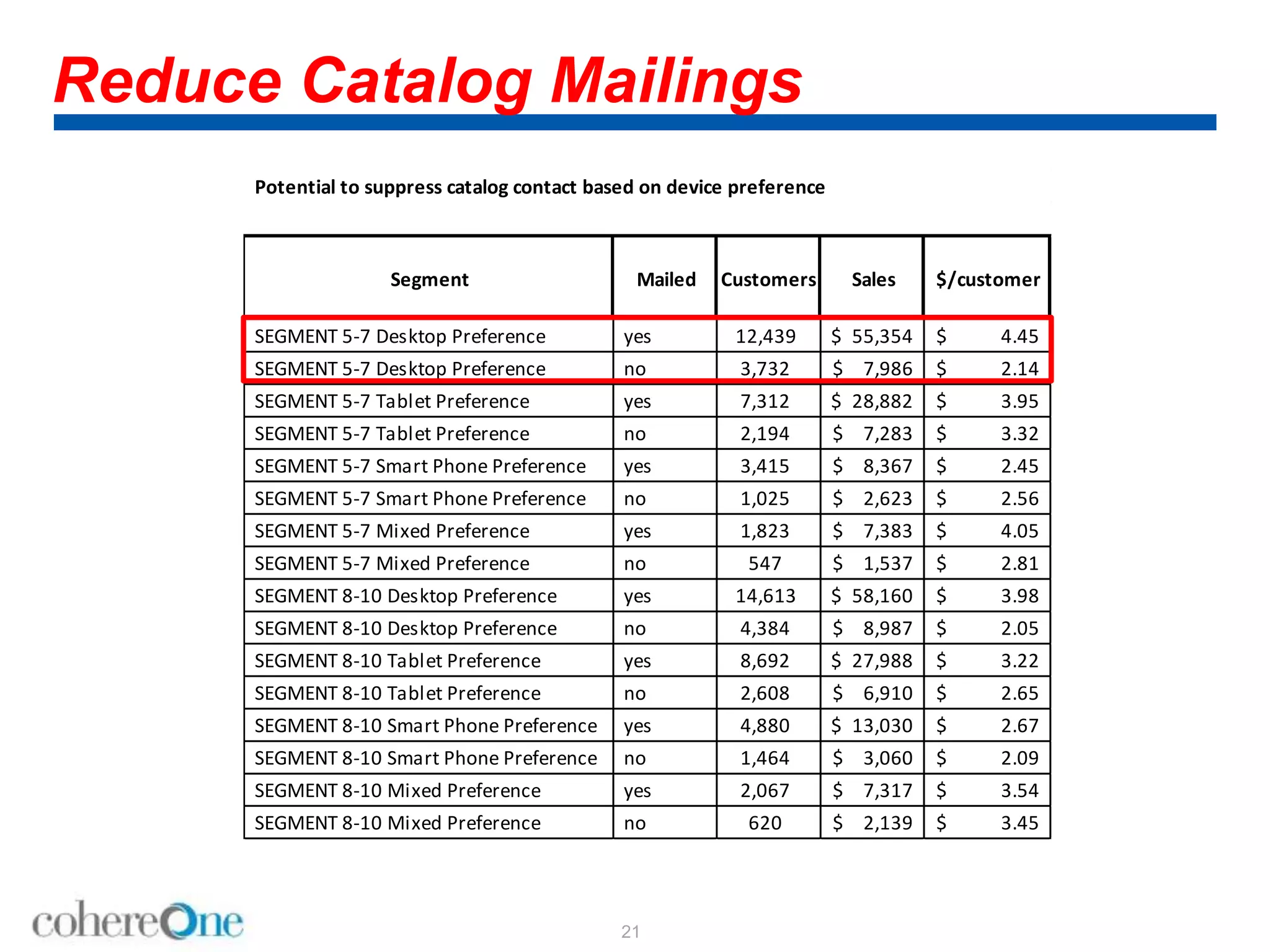
Potential to suppress catalog contact based on device preference
Segment Mailed Customers Sales $/customer
SEGMENT 5-7 Desktop Preference yes 12,439 55,354$ 4.45$
SEGMENT 5-7 Desktop Preference no 3,732 7,986$ 2.14$
SEGMENT 5-7 Tablet Preference yes 7,312 28,882$ 3.95$
SEGMENT 5-7 Tablet Preference no 2,194 7,283$ 3.32$
SEGMENT 5-7 Smart Phone Preference yes 3,415 8,367$ 2.45$
SEGMENT 5-7 Smart Phone Preference no 1,025 2,623$ 2.56$
SEGMENT 5-7 Mixed Preference yes 1,823 7,383$ 4.05$
SEGMENT 5-7 Mixed Preference no 547 1,537$ 2.81$
SEGMENT 8-10 Desktop Preference yes 14,613 58,160$ 3.98$
SEGMENT 8-10 Desktop Preference no 4,384 8,987$ 2.05$
SEGMENT 8-10 Tablet Preference yes 8,692 27,988$ 3.22$
SEGMENT 8-10 Tablet Preference no 2,608 6,910$ 2.65$
SEGMENT 8-10 Smart Phone Preference yes 4,880 13,030$ 2.67$
SEGMENT 8-10 Smart Phone Preference no 1,464 3,060$ 2.09$
SEGMENT 8-10 Mixed Preference yes 2,067 7,317$ 3.54$
SEGMENT 8-10 Mixed Preference no 620 2,139$ 3.45$
Reduce Catalog Mailings
21
Potential to suppress catalog contact based on device preference
Segment Mailed Customers Sales $/customer
SEGMENT 5-7 Desktop Preference yes 12,439 55,354$ 4.45$
SEGMENT 5-7 Desktop Preference no 3,732 7,986$ 2.14$
SEGMENT 5-7 Tablet Preference yes 7,312 28,882$ 3.95$
SEGMENT 5-7 Tablet Preference no 2,194 7,283$ 3.32$
SEGMENT 5-7 Smart Phone Preference yes 3,415 8,367$ 2.45$
SEGMENT 5-7 Smart Phone Preference no 1,025 2,623$ 2.56$
SEGMENT 5-7 Mixed Preference yes 1,823 7,383$ 4.05$
SEGMENT 5-7 Mixed Preference no 547 1,537$ 2.81$
SEGMENT 8-10 Desktop Preference yes 14,613 58,160$ 3.98$
SEGMENT 8-10 Desktop Preference no 4,384 8,987$ 2.05$
SEGMENT 8-10 Tablet Preference yes 8,692 27,988$ 3.22$
SEGMENT 8-10 Tablet Preference no 2,608 6,910$ 2.65$
SEGMENT 8-10 Smart Phone Preference yes 4,880 13,030$ 2.67$
SEGMENT 8-10 Smart Phone Preference no 1,464 3,060$ 2.09$
SEGMENT 8-10 Mixed Preference yes 2,067 7,317$ 3.54$
SEGMENT 8-10 Mixed Preference no 620 2,139$ 3.45$
Reduce Catalog Mailings
22
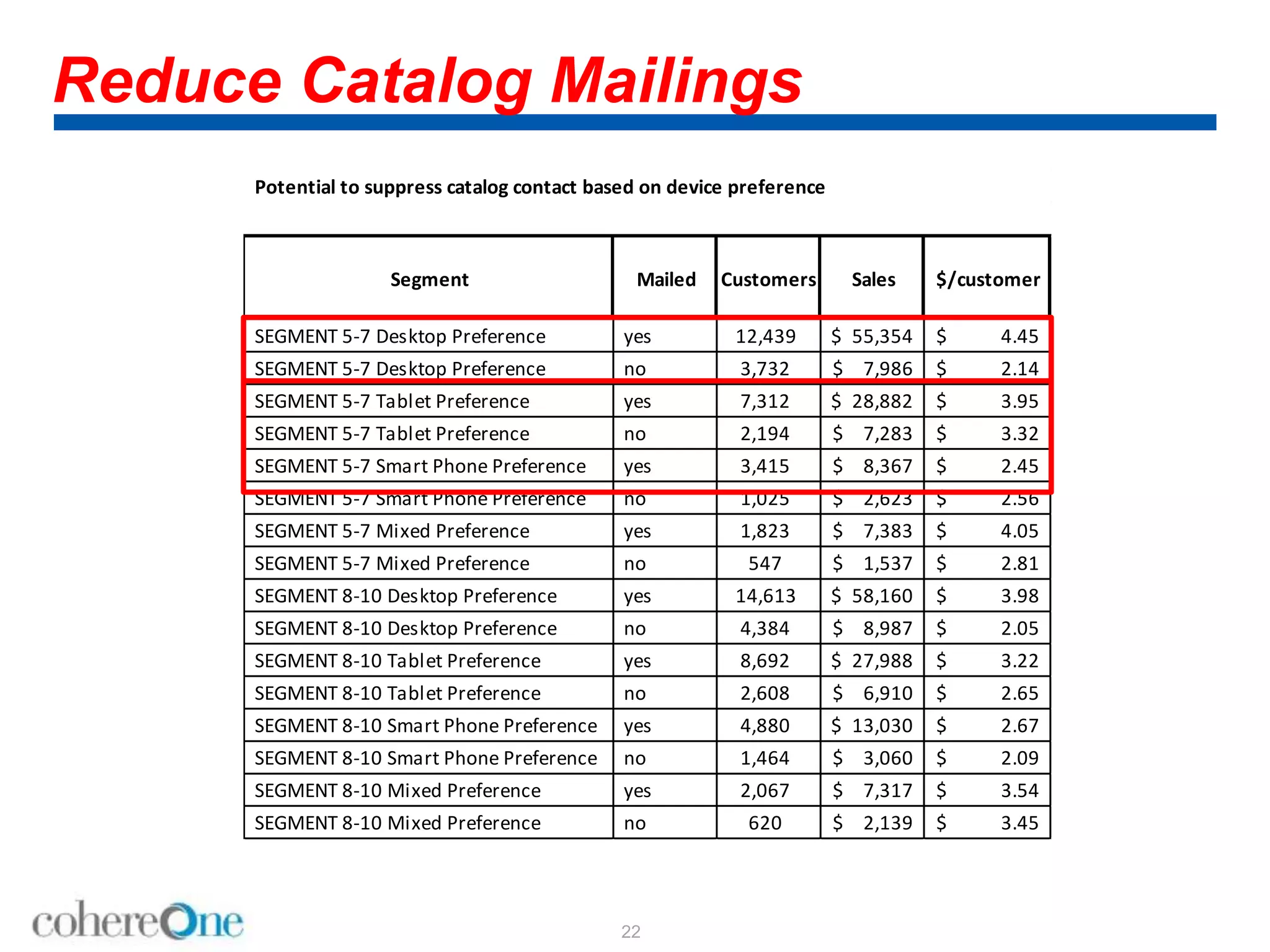
Potential to suppress catalog contact based on device preference
Segment Mailed Customers Sales $/customer
SEGMENT 5-7 Desktop Preference yes 12,439 55,354$ 4.45$
SEGMENT 5-7 Desktop Preference no 3,732 7,986$ 2.14$
SEGMENT 5-7 Tablet Preference yes 7,312 28,882$ 3.95$
SEGMENT 5-7 Tablet Preference no 2,194 7,283$ 3.32$
SEGMENT 5-7 Smart Phone Preference yes 3,415 8,367$ 2.45$
SEGMENT 5-7 Smart Phone Preference no 1,025 2,623$ 2.56$
SEGMENT 5-7 Mixed Preference yes 1,823 7,383$ 4.05$
SEGMENT 5-7 Mixed Preference no 547 1,537$ 2.81$
SEGMENT 8-10 Desktop Preference yes 14,613 58,160$ 3.98$
SEGMENT 8-10 Desktop Preference no 4,384 8,987$ 2.05$
SEGMENT 8-10 Tablet Preference yes 8,692 27,988$ 3.22$
SEGMENT 8-10 Tablet Preference no 2,608 6,910$ 2.65$
SEGMENT 8-10 Smart Phone Preference yes 4,880 13,030$ 2.67$
SEGMENT 8-10 Smart Phone Preference no 1,464 3,060$ 2.09$
SEGMENT 8-10 Mixed Preference yes 2,067 7,317$ 3.54$
SEGMENT 8-10 Mixed Preference no 620 2,139$ 3.45$
Browsers as Prospects
23
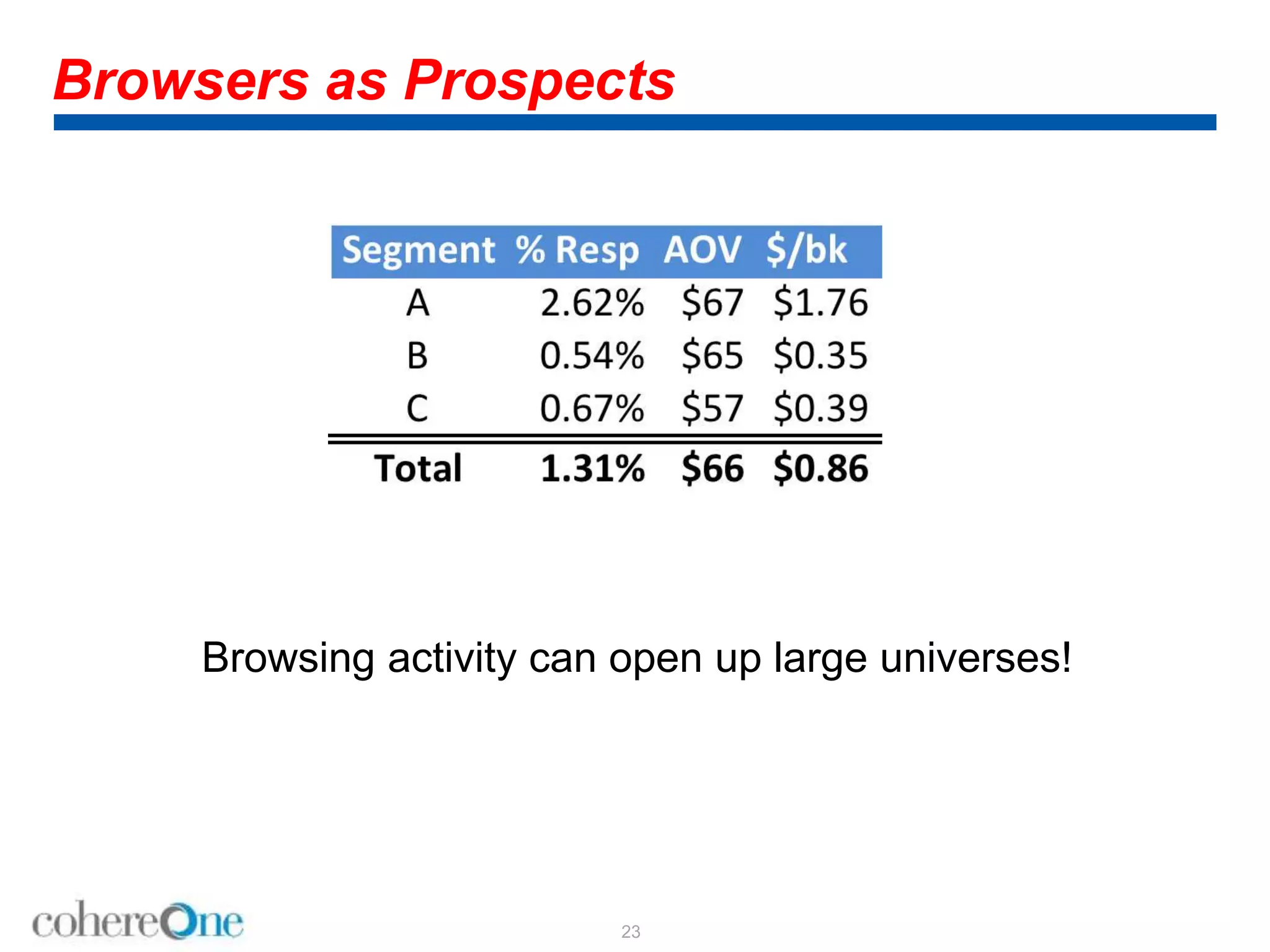
Browsing activity can open up large universes!
Browsers as Prospects
24
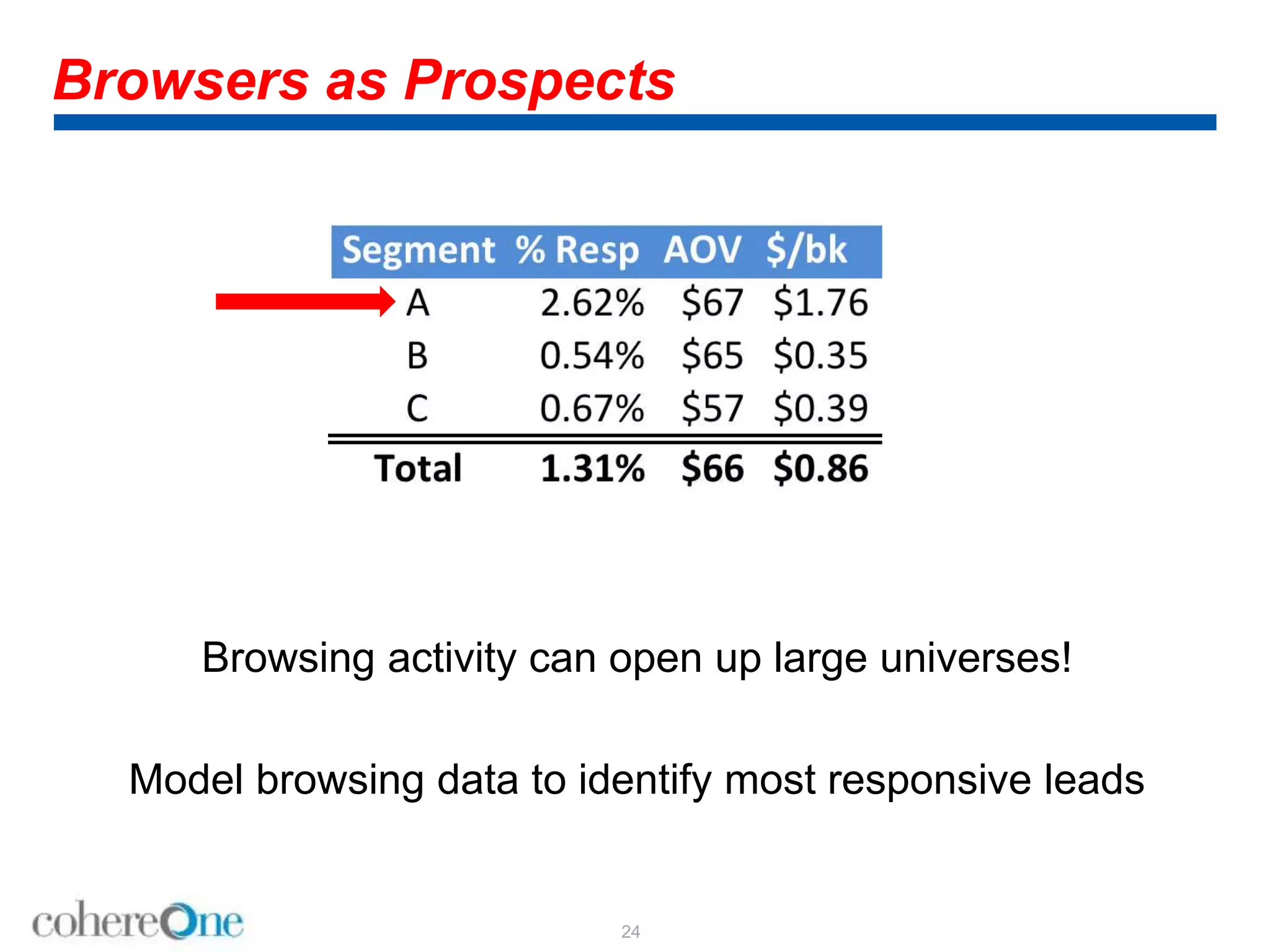
Browsing activity can open up large universes!
Model browsing data to identify most responsive leads
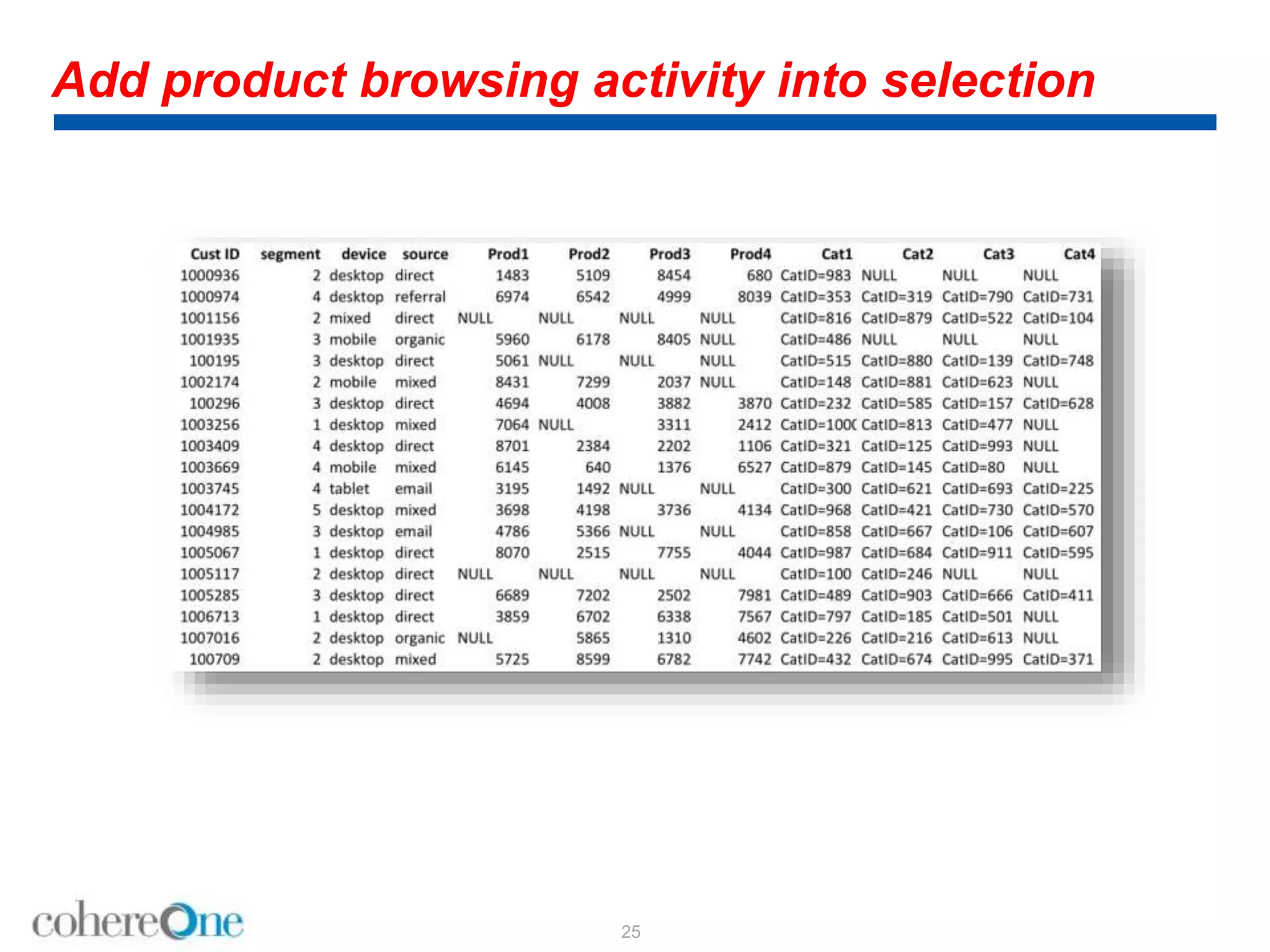
Add product browsing activity into selection
25
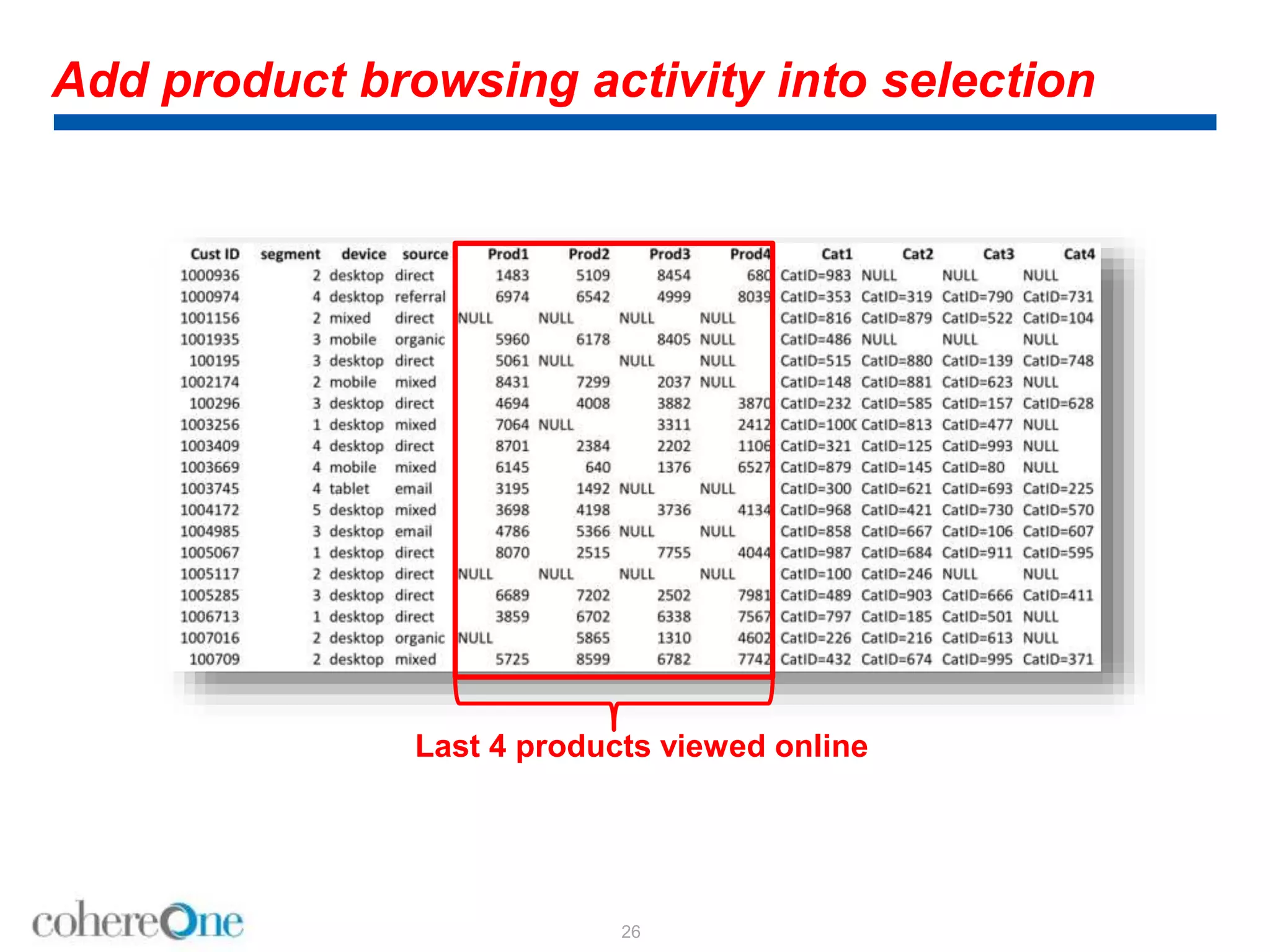
Add product browsing activity into selection
26
Last 4 products viewed online
TWO CASE STUDIES
27
Case Study #1 – Women’s Fashion Apparel
28
Company profile
 Multichannel retailer with an established brand for over 40 years
 Target customer: Affluent women in her 50’s and 60’s
 Revenues in 2014: $25 million
 Estimated Catalog Circulation in 2014: 10 million
 Promotion/Channel: Catalog, Online, 3rd Party, Wholesale
 Seasonality: Spring, Summer, Fall, Winter
Business Situation
 Retailer sells women’s apparel direct to customers
• Ecommerce website and print catalog marketing channels
 Retailer sells women’s apparel indirectly
• 3rd Party Marketplace (i.e. Amazon) and Wholesale
 Catalog is the primary demand driver in the business
• Accounts for 80%-90% of direct demand
Case Study #1 – Women’s Fashion Apparel
29
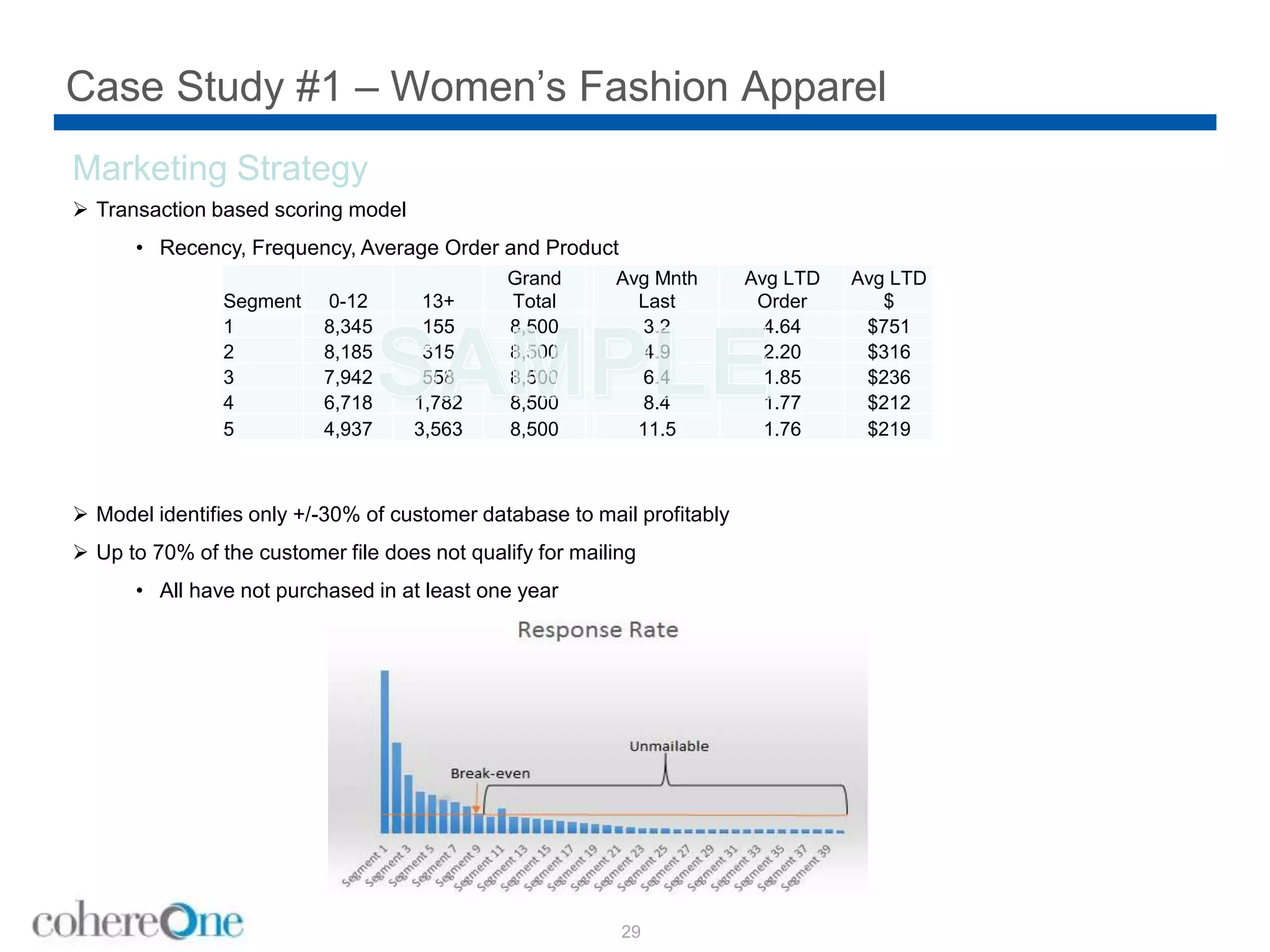
Marketing Strategy
 Transaction based scoring model
• Recency, Frequency, Average Order and Product
 Model identifies only +/-30% of customer database to mail profitably
 Up to 70% of the customer file does not qualify for mailing
• All have not purchased in at least one year
Segment 0-12 13+
Grand
Total
Avg Mnth
Last
Avg LTD
Order
Avg LTD
$
1 8,345 155 8,500 3.2 4.64 $751
2 8,185 315 8,500 4.9 2.20 $316
3 7,942 558 8,500 6.4 1.85 $236
4 6,718 1,782 8,500 8.4 1.77 $212
5 4,937 3,563 8,500 11.5 1.76 $219
Case Study #1 – Women’s Fashion Apparel
30
Solution
 Capture individual browsing activity on ecommerce site
 Combine with the transactional history at the individual customer level
 Customer’s digital behavior is utilized when developing audiences for catalog mailings
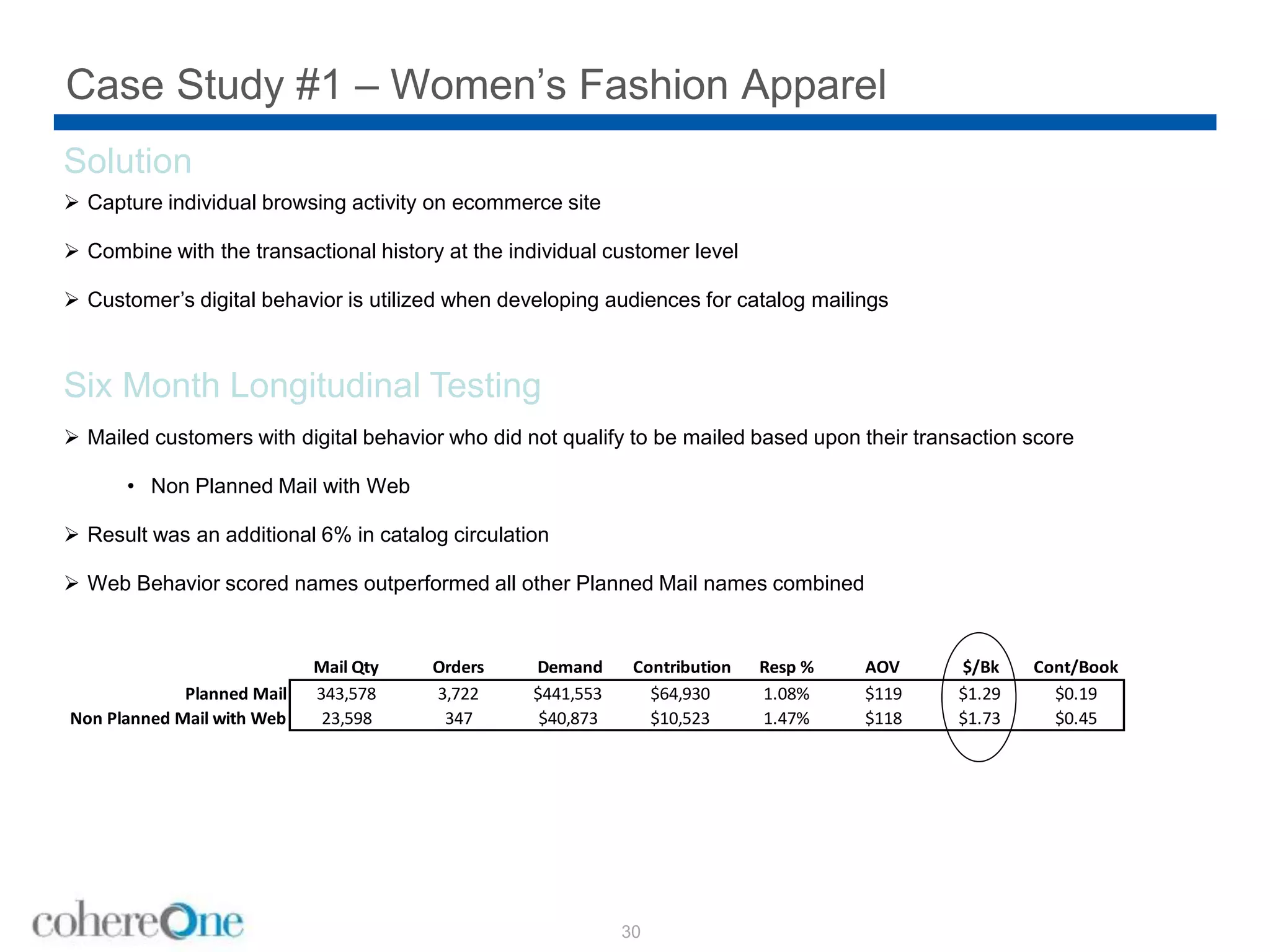
Six Month Longitudinal Testing
 Mailed customers with digital behavior who did not qualify to be mailed based upon their transaction score
• Non Planned Mail with Web
 Result was an additional 6% in catalog circulation
 Web Behavior scored names outperformed all other Planned Mail names combined
Mail Qty Orders Demand Contribution Resp % AOV $/Bk Cont/Book
Planned Mail 343,578 3,722 $441,553 $64,930 1.08% $119 $1.29 $0.19
Non Planned Mail with Web 23,598 347 $40,873 $10,523 1.47% $118 $1.73 $0.45
Case Study #2 – Workwear
31
Company profile
 Multichannel retailer - Market leader the past 30 years
 Target customer: 35-50 years of age who is buying personally, for use at work
 Revenues in 2014: $30 million
 Estimated Catalog Circulation in 2014: 9 million
 Promotion/Channel: Catalog, Online, 3rd Party
 Seasonality: Spring, Summer, Fall, Holiday, Winter
Business Situation
 Retailer sells workwear, both private label and national brands
• Ecommerce website and print catalog marketing channels
 Retailer sells indirectly
• 3rd Party Marketplace (i.e. Amazon)
 Catalog is the primary demand driver in the business
• Accounts for 70%-80% of direct demand
Case Study #2 – Workwear
32
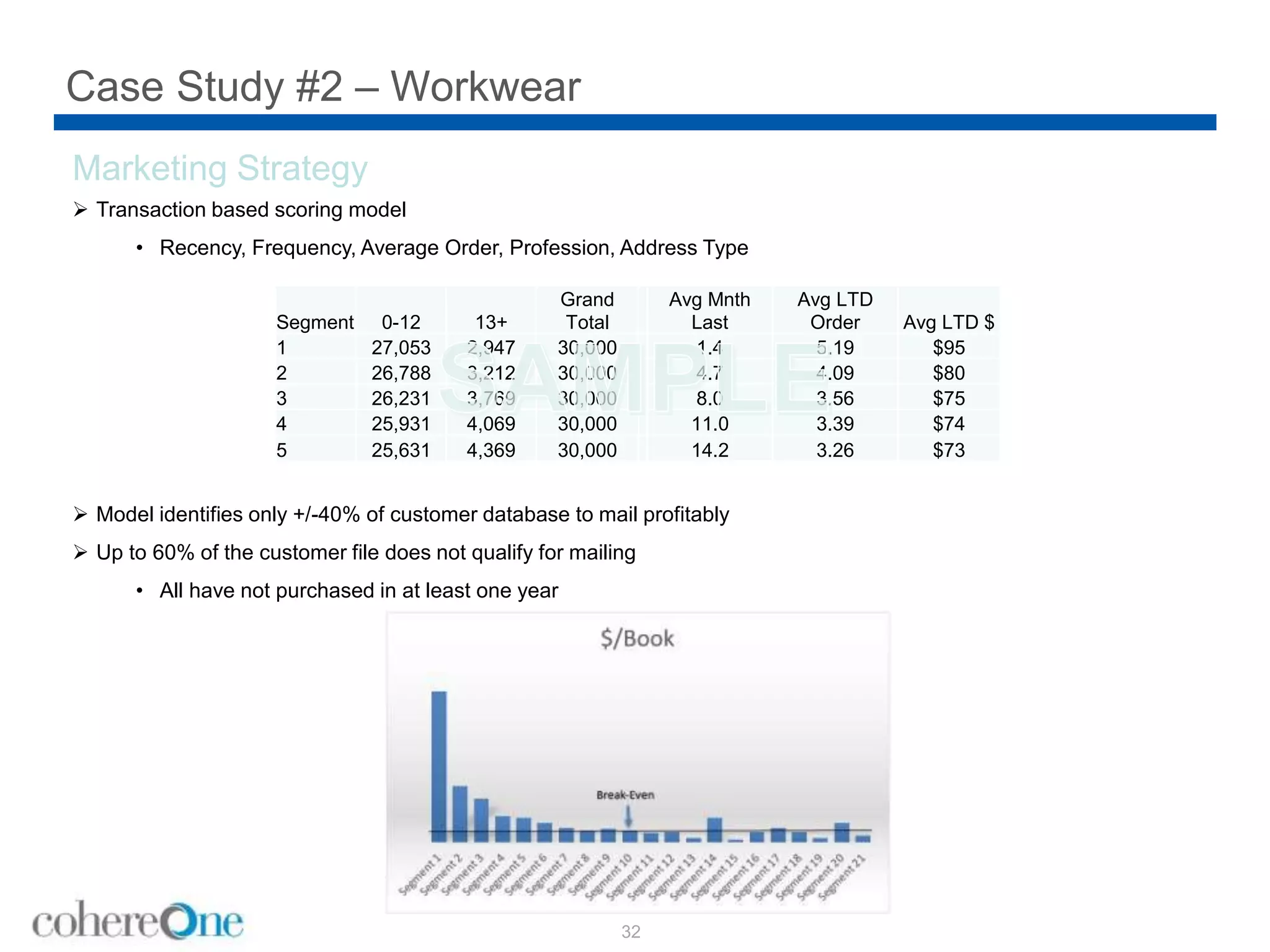
Marketing Strategy
 Transaction based scoring model
• Recency, Frequency, Average Order, Profession, Address Type
 Model identifies only +/-40% of customer database to mail profitably
 Up to 60% of the customer file does not qualify for mailing
• All have not purchased in at least one year
Segment 0-12 13+
Grand
Total
Avg Mnth
Last
Avg LTD
Order Avg LTD $
1 27,053 2,947 30,000 1.4 5.19 $95
2 26,788 3,212 30,000 4.7 4.09 $80
3 26,231 3,769 30,000 8.0 3.56 $75
4 25,931 4,069 30,000 11.0 3.39 $74
5 25,631 4,369 30,000 14.2 3.26 $73
Case Study #2 – Workwear
33
Solution
 Capture individual browsing activity on ecommerce site
 Combine with the transactional history at the individual customer level
 Customer’s digital behavior is utilized when developing audiences for catalog mailings
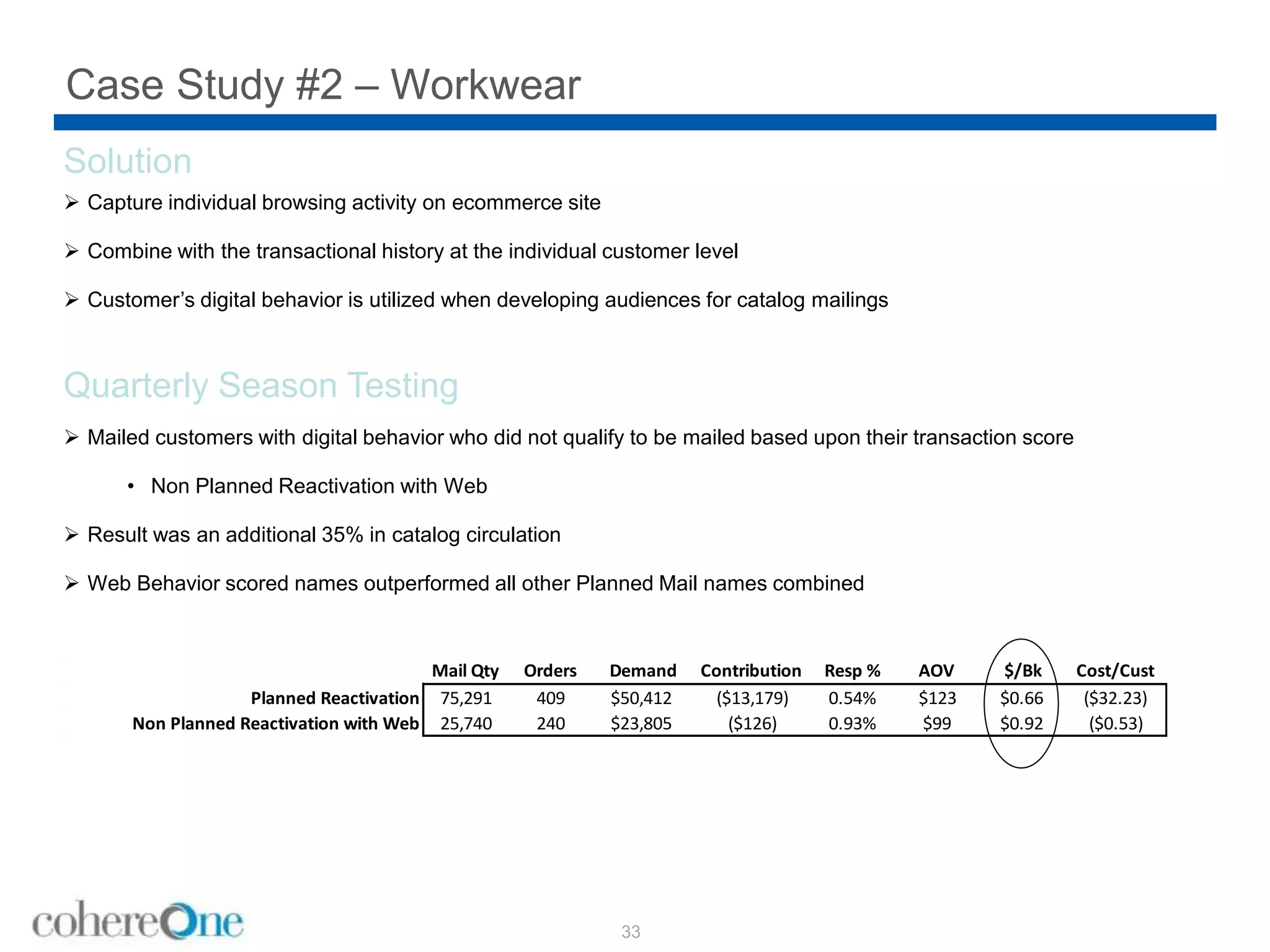
Quarterly Season Testing
 Mailed customers with digital behavior who did not qualify to be mailed based upon their transaction score
• Non Planned Reactivation with Web
 Result was an additional 35% in catalog circulation
 Web Behavior scored names outperformed all other Planned Mail names combined
Mail Qty Orders Demand Contribution Resp % AOV $/Bk Cost/Cust
Planned Reactivation 75,291 409 $50,412 ($13,179) 0.54% $123 $0.66 ($32.23)
Non Planned Reactivation with Web 25,740 240 $23,805 ($126) 0.93% $99 $0.92 ($0.53)
Thank you!
Questions
34
Travis Seaton, VP Client Services
tseaton@cohereone.com
Jude Hoffner, VP Digital Products
jhoffner@cohereone.com

Catalog University Pub talk: Leveraging browsing behavior to improve catalog circulation planning

  • 1.
    Using Web Behaviorto Improve Catalog Response Rates 1
  • 2.
    A Brief Historyof Direct Marketing Demographics Gender Zip Code Age Surveys 2
  • 3.
    A Brief Historyof Direct Marketing Demographics Gender Zip Code Age Surveys Transactions Recency Frequency Products Channel 3
  • 4.
    A Brief Historyof Direct Marketing Demographics Gender Zip Code Age Surveys Transactions Recency Frequency Products Channel 4 Portraits of What Customers Look Like and Their Purchase History
  • 5.
    A Brief Historyof Direct Marketing Demographics Gender Zip Code Age Surveys Transactions Recency Frequency Products Channel 5 Behavior Browsing Searching Considering Signaling Portraits of What Customers Look Like and Their Purchase History
  • 6.
    A Brief Historyof Direct Marketing Demographics Gender Zip Code Age Surveys Transactions Recency Frequency Products Channel 6 Behavior Browsing Searching Considering Signaling Portraits of What Customers Look Like and Their Purchase History Intent
  • 7.
    Intent is shownonline Individuals send signals with digital browsing activity, not just buying history! 7
  • 8.
    Capital Markets Understandthe Value of Intent Transactional Data Valuation Abacus Datalogix 8
  • 9.
    Capital Markets Understandthe Value of Intent Transactional Data Valuation Abacus Datalogix 9 Intent Data Valuation Google
  • 10.
  • 11.
    The Circulation Challenge Difficultto connect browsing data to individuals 11
  • 12.
    The Solution Capture webbrowsing data at the individual level Connect it to individual customer profiles 12
  • 13.
    The Solution Capture webbrowsing data at the individual level Connect it to individual customer profiles 13
  • 14.
    Circulation Applications 4 Strategiesfor Browsing Behavior 14
  • 15.
    Circulation Applications 4 Strategiesfor Browsing Behavior Supercharge reactivation 15
  • 16.
    Circulation Applications 4 Strategiesfor Browsing Behavior Supercharge reactivation Reduce Catalog Mailings 16
  • 17.
    Circulation Applications 4 Strategiesfor Browsing Behavior Supercharge reactivation Reduce Catalog Mailings Source of Prospects 17
  • 18.
    Circulation Applications 4 Strategiesfor Browsing Behavior Supercharge reactivation Reduce Catalog Mailings Source of Prospects Use product & category browsing data in selection 18
  • 19.
  • 20.
    Reduce Catalog Mailings 20 Potentialto suppress catalog contact based on device preference Segment Mailed Customers Sales $/customer SEGMENT 5-7 Desktop Preference yes 12,439 55,354$ 4.45$ SEGMENT 5-7 Desktop Preference no 3,732 7,986$ 2.14$ SEGMENT 5-7 Tablet Preference yes 7,312 28,882$ 3.95$ SEGMENT 5-7 Tablet Preference no 2,194 7,283$ 3.32$ SEGMENT 5-7 Smart Phone Preference yes 3,415 8,367$ 2.45$ SEGMENT 5-7 Smart Phone Preference no 1,025 2,623$ 2.56$ SEGMENT 5-7 Mixed Preference yes 1,823 7,383$ 4.05$ SEGMENT 5-7 Mixed Preference no 547 1,537$ 2.81$ SEGMENT 8-10 Desktop Preference yes 14,613 58,160$ 3.98$ SEGMENT 8-10 Desktop Preference no 4,384 8,987$ 2.05$ SEGMENT 8-10 Tablet Preference yes 8,692 27,988$ 3.22$ SEGMENT 8-10 Tablet Preference no 2,608 6,910$ 2.65$ SEGMENT 8-10 Smart Phone Preference yes 4,880 13,030$ 2.67$ SEGMENT 8-10 Smart Phone Preference no 1,464 3,060$ 2.09$ SEGMENT 8-10 Mixed Preference yes 2,067 7,317$ 3.54$ SEGMENT 8-10 Mixed Preference no 620 2,139$ 3.45$
  • 21.
    Reduce Catalog Mailings 21 Potentialto suppress catalog contact based on device preference Segment Mailed Customers Sales $/customer SEGMENT 5-7 Desktop Preference yes 12,439 55,354$ 4.45$ SEGMENT 5-7 Desktop Preference no 3,732 7,986$ 2.14$ SEGMENT 5-7 Tablet Preference yes 7,312 28,882$ 3.95$ SEGMENT 5-7 Tablet Preference no 2,194 7,283$ 3.32$ SEGMENT 5-7 Smart Phone Preference yes 3,415 8,367$ 2.45$ SEGMENT 5-7 Smart Phone Preference no 1,025 2,623$ 2.56$ SEGMENT 5-7 Mixed Preference yes 1,823 7,383$ 4.05$ SEGMENT 5-7 Mixed Preference no 547 1,537$ 2.81$ SEGMENT 8-10 Desktop Preference yes 14,613 58,160$ 3.98$ SEGMENT 8-10 Desktop Preference no 4,384 8,987$ 2.05$ SEGMENT 8-10 Tablet Preference yes 8,692 27,988$ 3.22$ SEGMENT 8-10 Tablet Preference no 2,608 6,910$ 2.65$ SEGMENT 8-10 Smart Phone Preference yes 4,880 13,030$ 2.67$ SEGMENT 8-10 Smart Phone Preference no 1,464 3,060$ 2.09$ SEGMENT 8-10 Mixed Preference yes 2,067 7,317$ 3.54$ SEGMENT 8-10 Mixed Preference no 620 2,139$ 3.45$
  • 22.
    Reduce Catalog Mailings 22 Potentialto suppress catalog contact based on device preference Segment Mailed Customers Sales $/customer SEGMENT 5-7 Desktop Preference yes 12,439 55,354$ 4.45$ SEGMENT 5-7 Desktop Preference no 3,732 7,986$ 2.14$ SEGMENT 5-7 Tablet Preference yes 7,312 28,882$ 3.95$ SEGMENT 5-7 Tablet Preference no 2,194 7,283$ 3.32$ SEGMENT 5-7 Smart Phone Preference yes 3,415 8,367$ 2.45$ SEGMENT 5-7 Smart Phone Preference no 1,025 2,623$ 2.56$ SEGMENT 5-7 Mixed Preference yes 1,823 7,383$ 4.05$ SEGMENT 5-7 Mixed Preference no 547 1,537$ 2.81$ SEGMENT 8-10 Desktop Preference yes 14,613 58,160$ 3.98$ SEGMENT 8-10 Desktop Preference no 4,384 8,987$ 2.05$ SEGMENT 8-10 Tablet Preference yes 8,692 27,988$ 3.22$ SEGMENT 8-10 Tablet Preference no 2,608 6,910$ 2.65$ SEGMENT 8-10 Smart Phone Preference yes 4,880 13,030$ 2.67$ SEGMENT 8-10 Smart Phone Preference no 1,464 3,060$ 2.09$ SEGMENT 8-10 Mixed Preference yes 2,067 7,317$ 3.54$ SEGMENT 8-10 Mixed Preference no 620 2,139$ 3.45$
  • 23.
    Browsers as Prospects 23 Browsingactivity can open up large universes!
  • 24.
    Browsers as Prospects 24 Browsingactivity can open up large universes! Model browsing data to identify most responsive leads
  • 25.
    Add product browsingactivity into selection 25
  • 26.
    Add product browsingactivity into selection 26 Last 4 products viewed online
  • 27.
  • 28.
    Case Study #1– Women’s Fashion Apparel 28 Company profile  Multichannel retailer with an established brand for over 40 years  Target customer: Affluent women in her 50’s and 60’s  Revenues in 2014: $25 million  Estimated Catalog Circulation in 2014: 10 million  Promotion/Channel: Catalog, Online, 3rd Party, Wholesale  Seasonality: Spring, Summer, Fall, Winter Business Situation  Retailer sells women’s apparel direct to customers • Ecommerce website and print catalog marketing channels  Retailer sells women’s apparel indirectly • 3rd Party Marketplace (i.e. Amazon) and Wholesale  Catalog is the primary demand driver in the business • Accounts for 80%-90% of direct demand
  • 29.
    Case Study #1– Women’s Fashion Apparel 29 Marketing Strategy  Transaction based scoring model • Recency, Frequency, Average Order and Product  Model identifies only +/-30% of customer database to mail profitably  Up to 70% of the customer file does not qualify for mailing • All have not purchased in at least one year Segment 0-12 13+ Grand Total Avg Mnth Last Avg LTD Order Avg LTD $ 1 8,345 155 8,500 3.2 4.64 $751 2 8,185 315 8,500 4.9 2.20 $316 3 7,942 558 8,500 6.4 1.85 $236 4 6,718 1,782 8,500 8.4 1.77 $212 5 4,937 3,563 8,500 11.5 1.76 $219
  • 30.
    Case Study #1– Women’s Fashion Apparel 30 Solution  Capture individual browsing activity on ecommerce site  Combine with the transactional history at the individual customer level  Customer’s digital behavior is utilized when developing audiences for catalog mailings Six Month Longitudinal Testing  Mailed customers with digital behavior who did not qualify to be mailed based upon their transaction score • Non Planned Mail with Web  Result was an additional 6% in catalog circulation  Web Behavior scored names outperformed all other Planned Mail names combined Mail Qty Orders Demand Contribution Resp % AOV $/Bk Cont/Book Planned Mail 343,578 3,722 $441,553 $64,930 1.08% $119 $1.29 $0.19 Non Planned Mail with Web 23,598 347 $40,873 $10,523 1.47% $118 $1.73 $0.45
  • 31.
    Case Study #2– Workwear 31 Company profile  Multichannel retailer - Market leader the past 30 years  Target customer: 35-50 years of age who is buying personally, for use at work  Revenues in 2014: $30 million  Estimated Catalog Circulation in 2014: 9 million  Promotion/Channel: Catalog, Online, 3rd Party  Seasonality: Spring, Summer, Fall, Holiday, Winter Business Situation  Retailer sells workwear, both private label and national brands • Ecommerce website and print catalog marketing channels  Retailer sells indirectly • 3rd Party Marketplace (i.e. Amazon)  Catalog is the primary demand driver in the business • Accounts for 70%-80% of direct demand
  • 32.
    Case Study #2– Workwear 32 Marketing Strategy  Transaction based scoring model • Recency, Frequency, Average Order, Profession, Address Type  Model identifies only +/-40% of customer database to mail profitably  Up to 60% of the customer file does not qualify for mailing • All have not purchased in at least one year Segment 0-12 13+ Grand Total Avg Mnth Last Avg LTD Order Avg LTD $ 1 27,053 2,947 30,000 1.4 5.19 $95 2 26,788 3,212 30,000 4.7 4.09 $80 3 26,231 3,769 30,000 8.0 3.56 $75 4 25,931 4,069 30,000 11.0 3.39 $74 5 25,631 4,369 30,000 14.2 3.26 $73
  • 33.
    Case Study #2– Workwear 33 Solution  Capture individual browsing activity on ecommerce site  Combine with the transactional history at the individual customer level  Customer’s digital behavior is utilized when developing audiences for catalog mailings Quarterly Season Testing  Mailed customers with digital behavior who did not qualify to be mailed based upon their transaction score • Non Planned Reactivation with Web  Result was an additional 35% in catalog circulation  Web Behavior scored names outperformed all other Planned Mail names combined Mail Qty Orders Demand Contribution Resp % AOV $/Bk Cost/Cust Planned Reactivation 75,291 409 $50,412 ($13,179) 0.54% $123 $0.66 ($32.23) Non Planned Reactivation with Web 25,740 240 $23,805 ($126) 0.93% $99 $0.92 ($0.53)
  • 34.
    Thank you! Questions 34 Travis Seaton,VP Client Services tseaton@cohereone.com Jude Hoffner, VP Digital Products jhoffner@cohereone.com