“E-Branding and Online Advertising”
Presenter Details-
PROF. PRAKASH SINGH
PhD. Scholar(University of Pune )
Assistant Professor(ASM’s IIBR,Pune)
Brand V
• There are millions of products and services all
over the world, each claims to be the best among
their category.
• But, every product is not equally popular.
Consumer doesn't remember every product, only
few products are remembered by their name,
logo, or slogan.
• Such products generate desired emotions in the
mind of consumer.
• It is branding that makes product popular and
known in the market; branding is not an activity
that can be done overnight, it might takes
months and even years to create a loyal and
reputed brand.
• According to Philip Kotler - “Brand is a name,
term, sign, symbol, design, or a combination
of them, intended to identify the goods or
services of one seller or group of sellers and to
differentiate them from those of competitors”
To a consumer, brand means and
signifies:
• Source of product
• Delegating responsibility to the manufacturer
of product
• Lower risk
• Less search cost
• Quality symbol
• Deal or pact with the product manufacturer
• Symbolic device
“Brand Building is
too long
and
time consuming
process.”
V
Lunarpages Case Study:
An Overview
• What is Lunarpages?
Lunarpage is a hosting provider company located in
California. Founded in 1998,the company services over
1,50,000 customers all over the world.
• In 2003, Lunarpages wanted to redesign their website to
increase customer conversion rates and create a strong brand
• So, they contacted the Ceonex company
Lunarpages Case Study:
The Challenge
• Ceonex noticed several significant problems with Lunarpages
old site that needed to be solved.
– Lack of strong and memorable brand
– Unprofessional image
– Lack of depth
Lunarpages Case Study:
Solution
• Ceonex’s primary mission was to create a best brand identity
to bring difference and value to what Lunarpages could offer
– Powerful core theme
– Appropriate colors, images, and logo
– Comprehensive company branding
Lunarpages Case Study:
Results
• The creation of a best brand and professional image has
resulted in significant business benefits for Lunarpages
– Customer base more than tripled in 15 months
– Customer conversion rate doubled
– Consistent 15% monthly revenue increase
– Overall 25% decrease in customer turnover
Digital Influence on India
• Youngest planet of the world-
India has 125 millions internet
users in 2012 and by 2016 it will
be above 330 millions.
• 2/3 lives in small towns and
villages.
• 23% of Urban Indian have
access to internet and 9% are
influenced by the internet while
making decision what to buy.
V
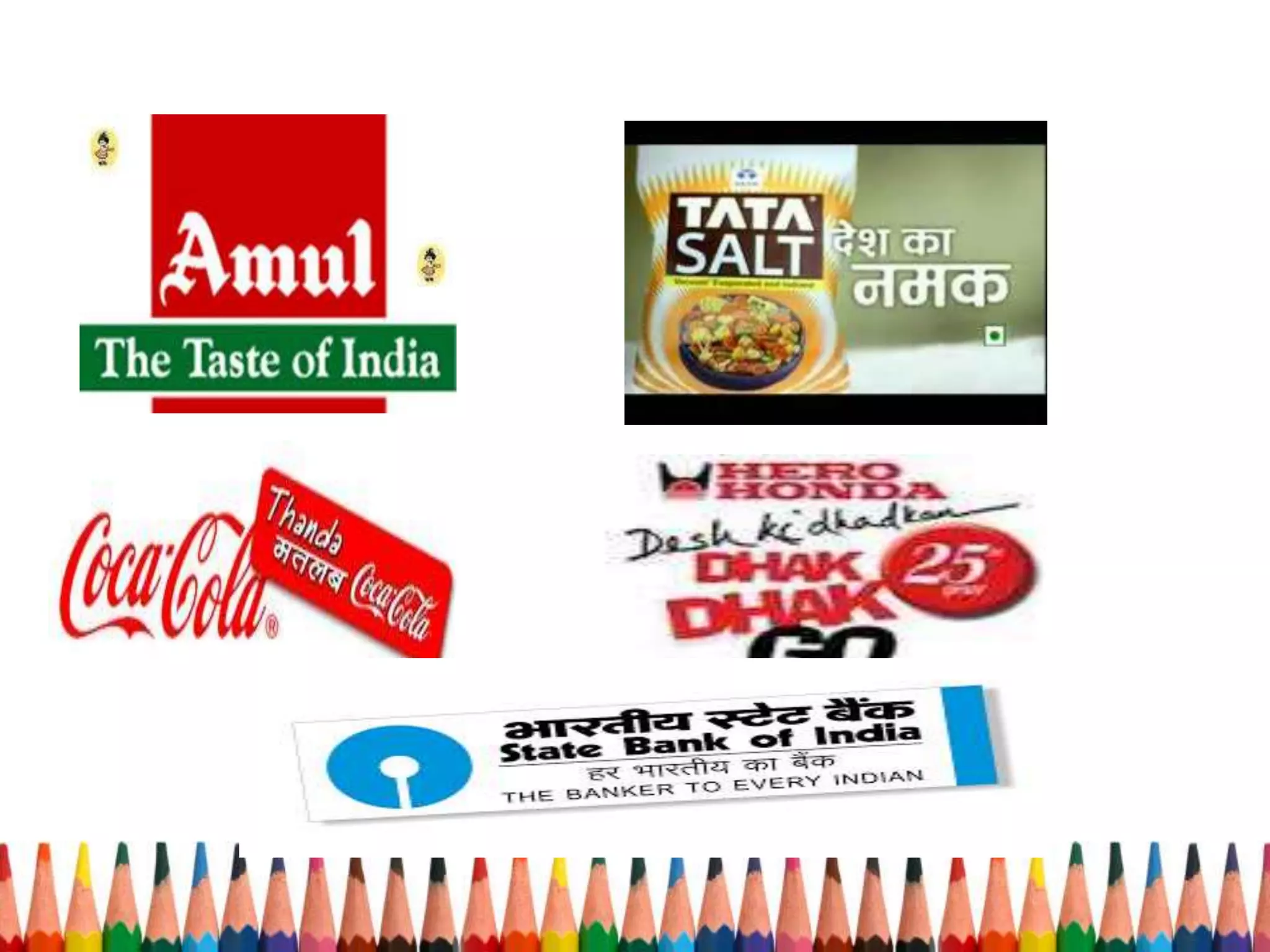
Consumers connect with a brand by
identifying the name ,slogan or logo.
People remember what they SEE
better then what they hear or read.
Creating a Strong Brand on the Internet
• Awareness
– Acquaintance with brand
– Ability to recognize and recall
• Familiarity
– Knowledge of product, features, and services offered
• Positive Imagery
– Done by marketing programs
– Favorable brand association
• Completed Transaction
– Beginning of relationship
– Brand Building
• >You want to become the default reference in a
consumer's mind.
• >You want to become synonymous with your niche.
• >When someone says "chocolate", many Europeans
immediately think Nestlé because, in a sense, they
"own" the brand.
14
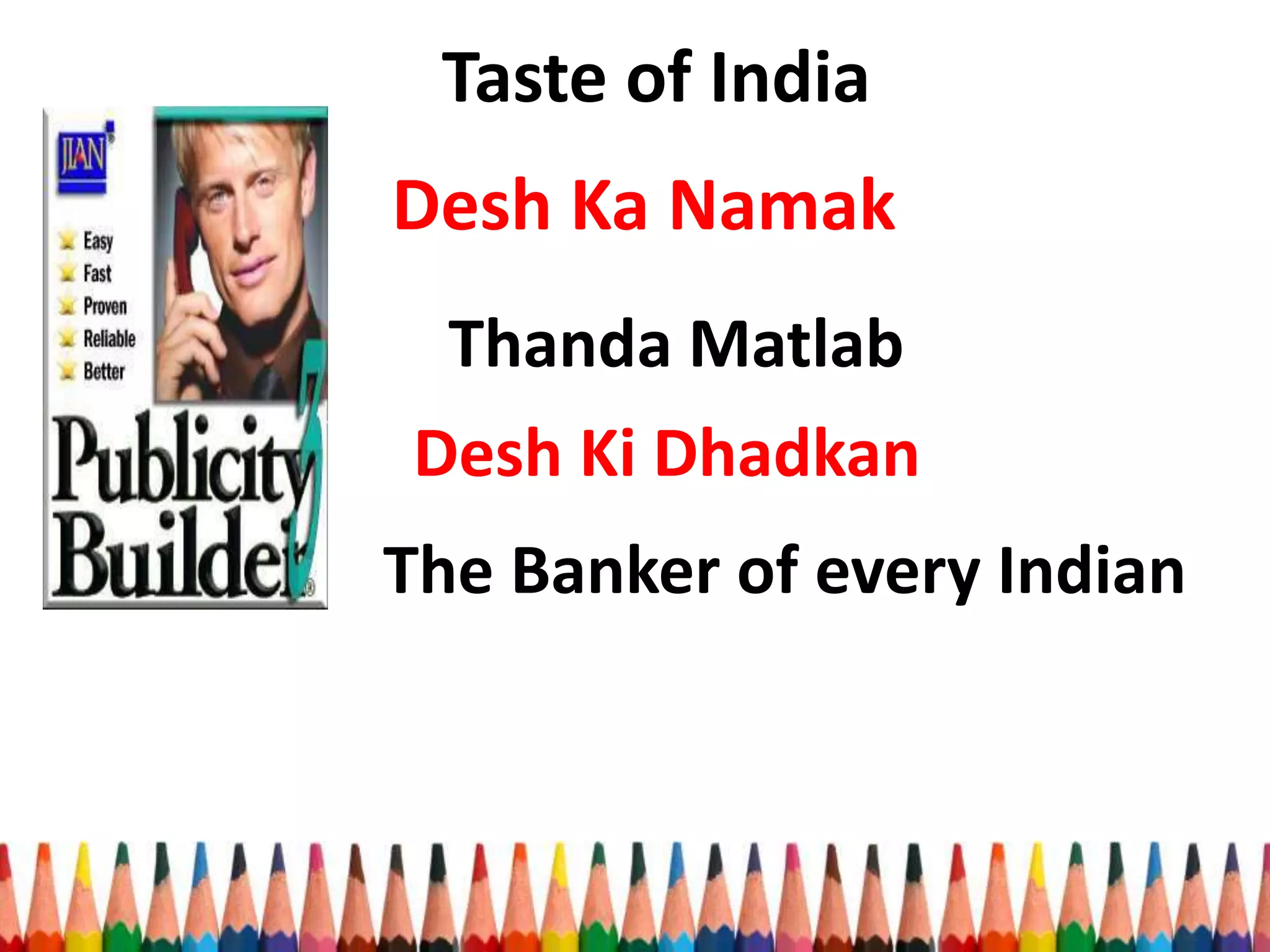
Desh Ka Namak
Taste of India
Thanda Matlab
Desh Ki Dhadkan
The Banker of every Indian
> Brand Association
You must create an association
between yourself and the person
you want to influence, the results
they want to have.
Your brand needs a
face, a representative,
a personality.
13
15
Brands are built on what people are
saying about you, not what you're
saying about yourself. People say
good things about you when
> you have a great
product and
> you get people to
spread the word about
it
•Let your customers co-create your brand
through the stories they tell one another.
•Branding is not what you say but what you
do.
Time to make your brand a verb
• Search It
• Photocopy/Xerox
• Photo Editing
• Chatting
• Video Calling
Time to make your brand a verb
• Google It
• Xerox It.
• Photoshop my photo
• Whatsapp me
• Skype your family.
Internet Tools
• Personalization Tools
– Customer Database
– Customer Control
• Collaborative Tools
• Purchase-process streamlining tools
– Stored personal information
– Avoid filling out forms
• Self-service tools
– My Account page
– Personalized services
• Do-it-yourself product design tools
• Dynamic-pricing tools
Amazon.com – Personalization Tools
• Customer database –Amazon has info about
customers
– Knows your name when you sign on
– Can reach you by e-mail & “snail mail
• Customer control – customers can influence
content on Amazon.com
– “Improve your Recommendations” capability
– Customization of your own page
Amazon.com – Collaborative Tools
• Customer-supplies book reviews & ratings
• High publicity collaborations
– Amazon & Doonsbury comic artist teamed up in
1998
– Visitors to the site got to complete the unfinished
comic
Amazon.com – Purchase process streamlining tools
• 1-click payment system
– Stores payment information
– Customers can avoid filling out forms each time
they make a purchase on Amazon.com
• Wish list
– Stores the products you want to buy for another
visit
Amazon.com – Self Service Tools
• My account page
• Offers customer-specific services
– Order tracking
• When was your order shipped?
• Arrival estimate
– Ability to change personal information
E-Branding
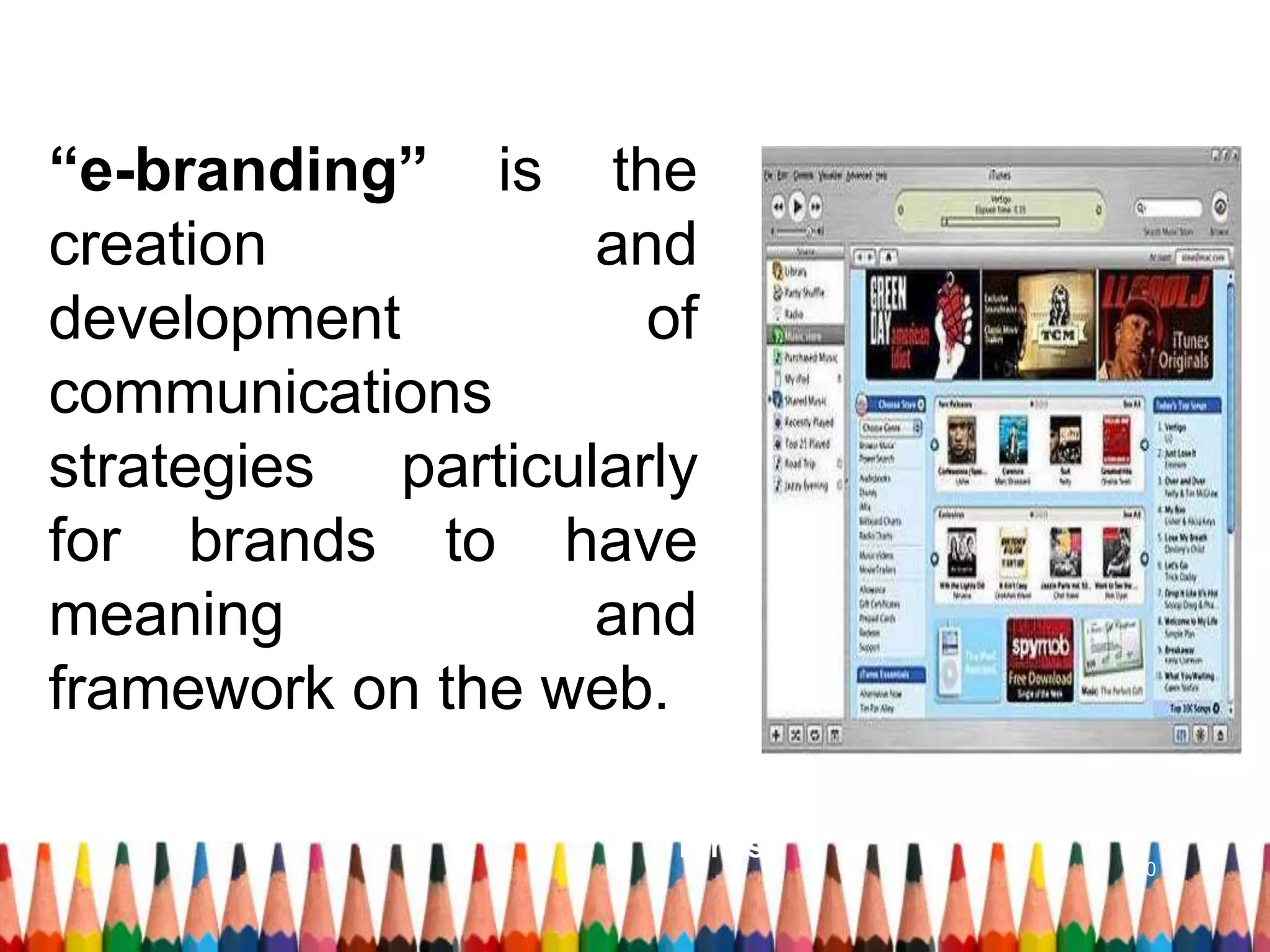
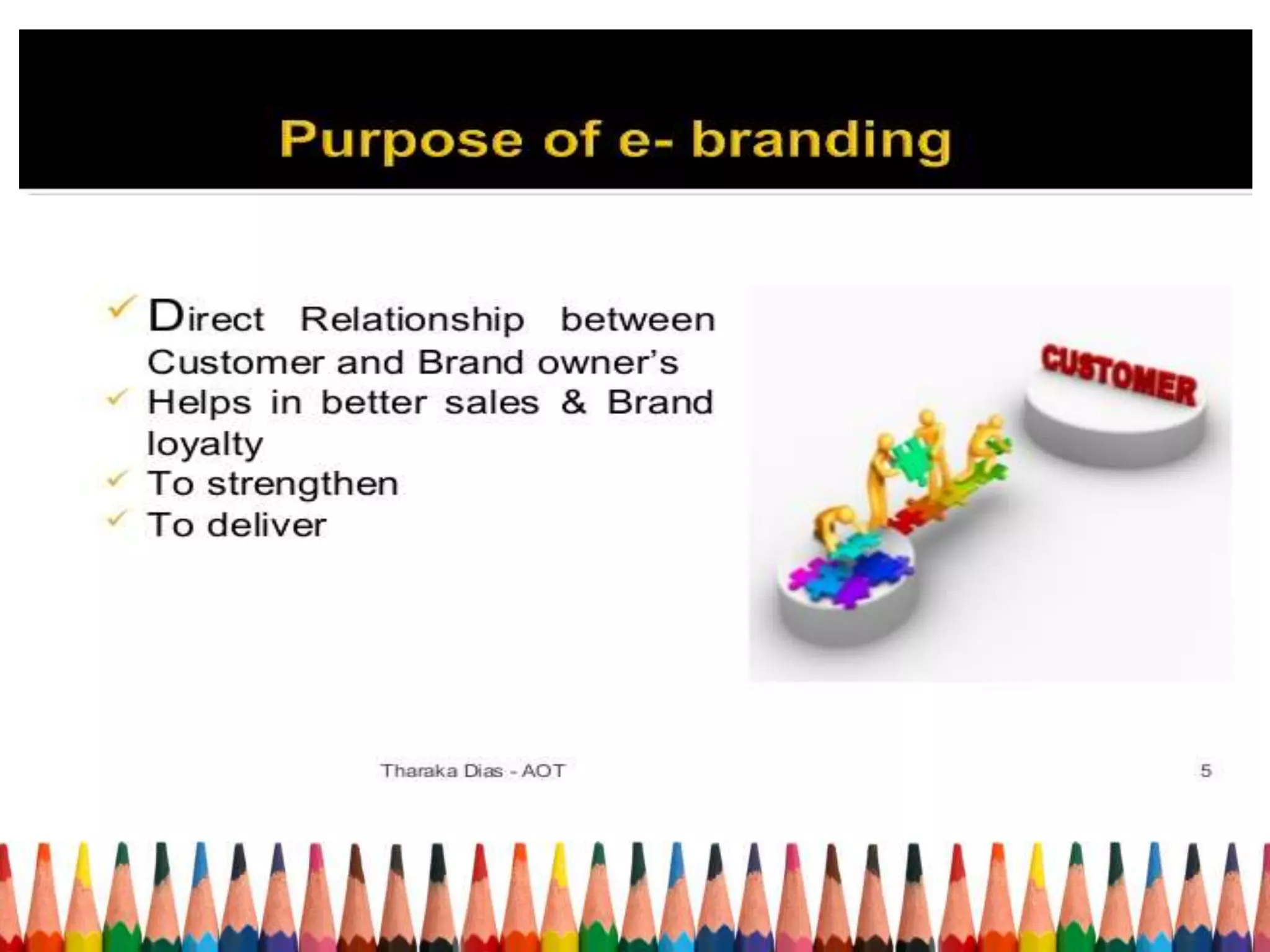
“e-branding” is the
creation and
development of
communications
strategies particularly
for brands to have
meaning and
framework on the web.
The US shopfront of Apple's
iTunes
10
V
6 C’s 0f Customer Motivation
6 C’s of customer motivation to help define the
online value proposition (OVP) are as follows:-
1. Content- Relevant, more detailed, in-depth
information to support buying process.
2. Customization- Personalization of content
according to individuals or groups.
3. Community- Social networks, site review
4. Convenience-Easily find, any time
purchase,24/7 availability of service
5. Choice-A wider choice of products and
suppliers.
6. Cost Reduction- Low cost place of purchase
E –Branding by Today’s Companies
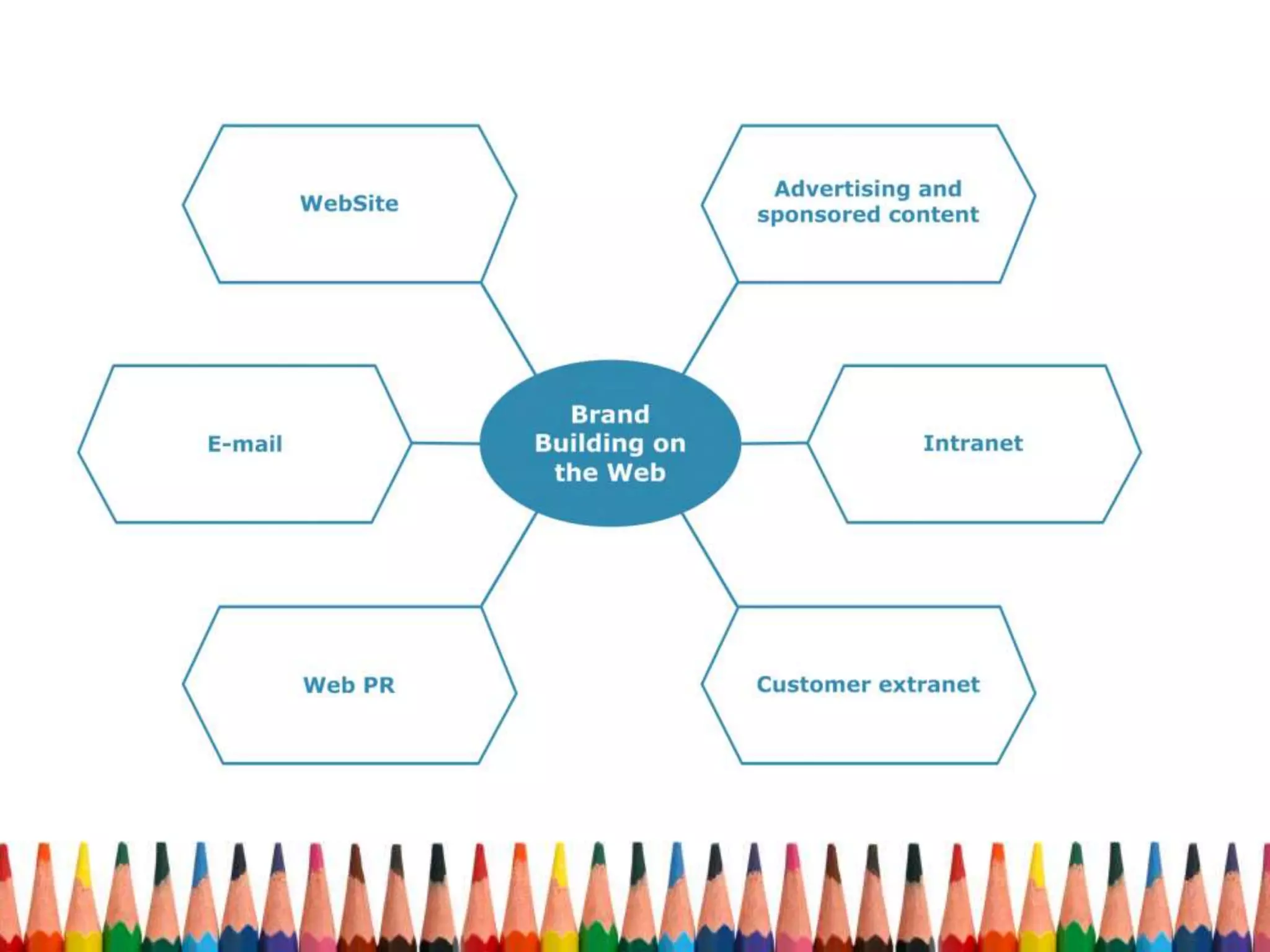
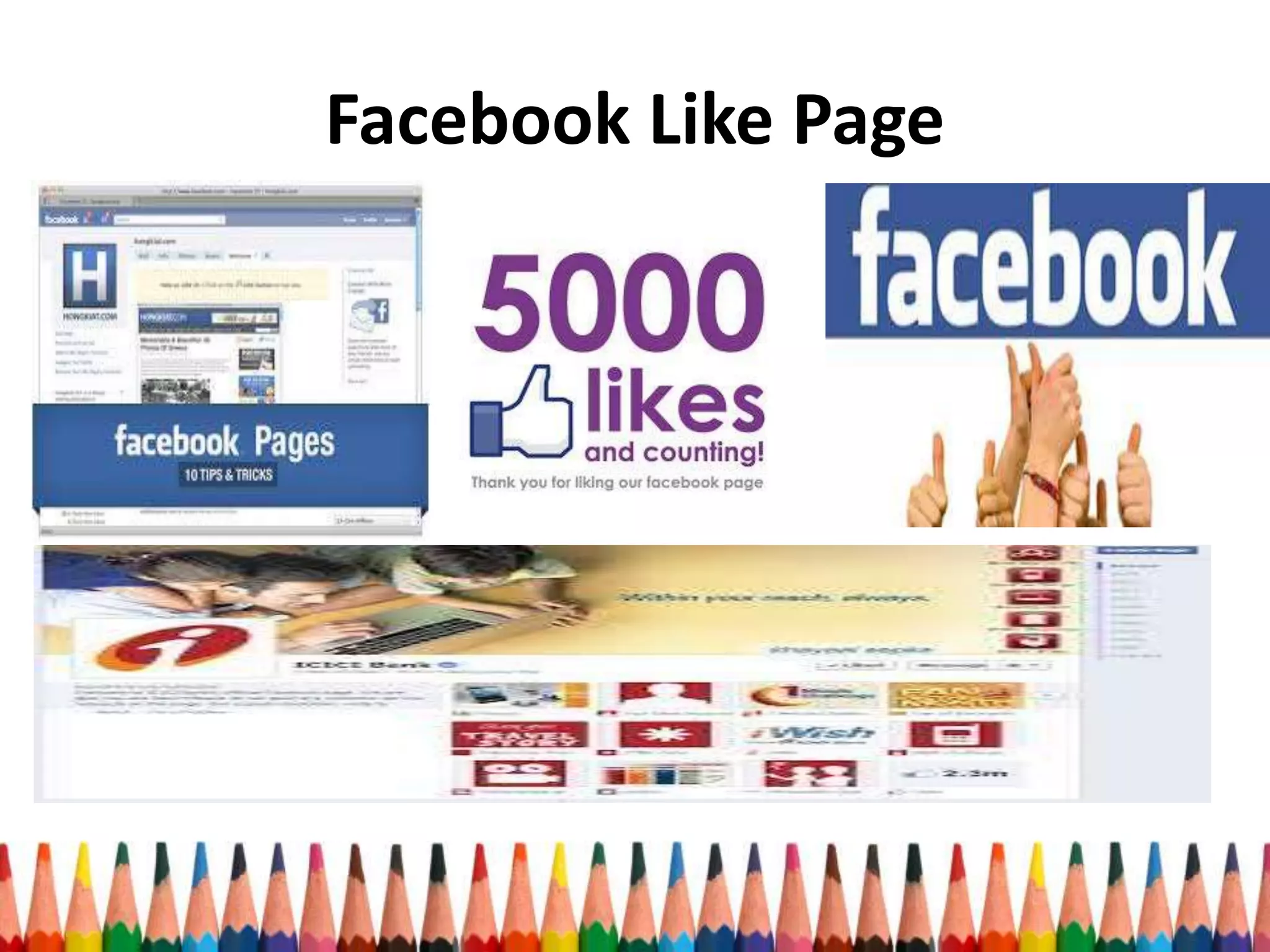
• Like Pages
• Review & Rating
• Live Chat
• Gaming
Facebook Like Page
LinkedIn Page
Online Review
Live Chat
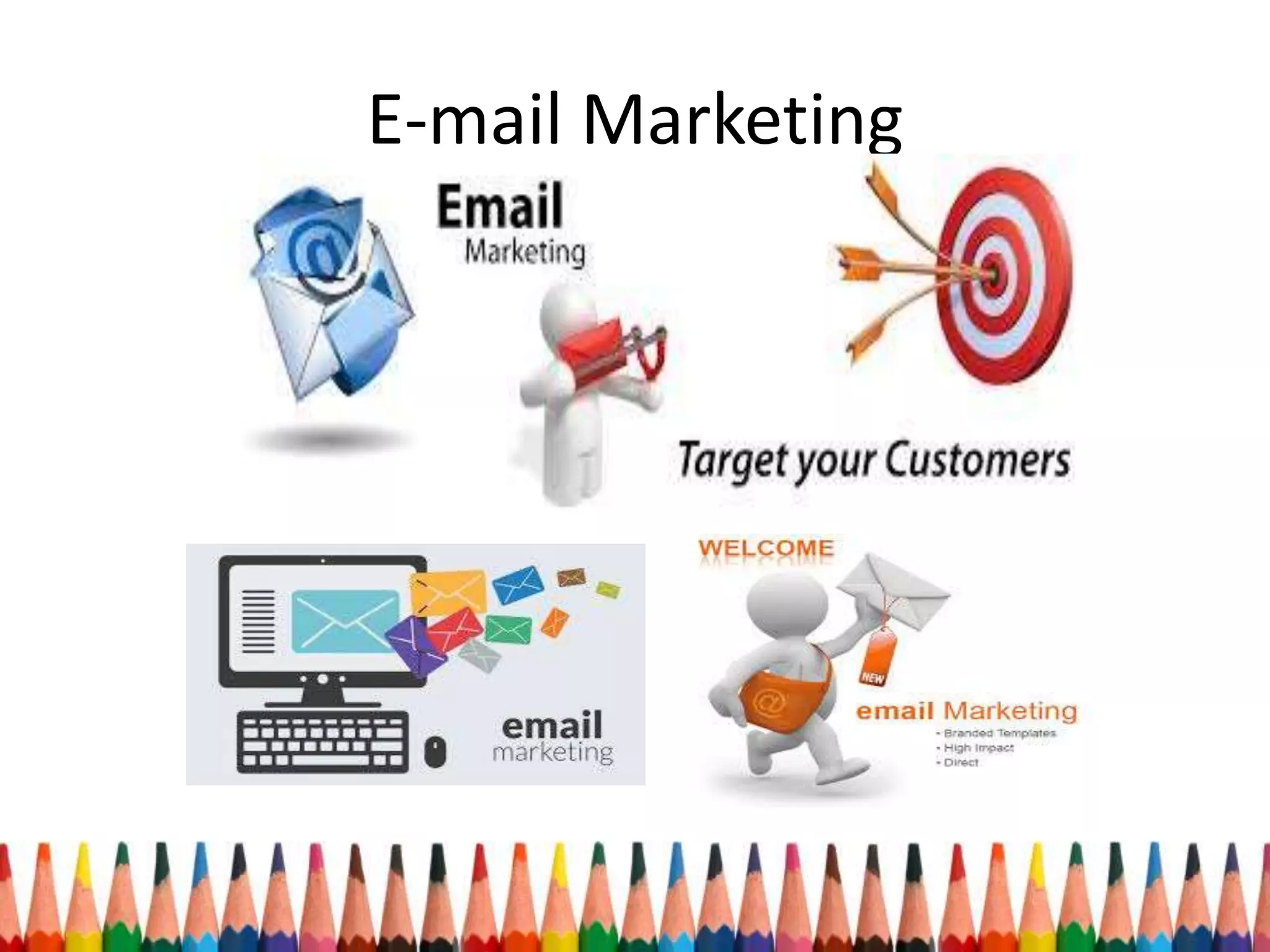
E-mail Marketing
Gaming
Advertising
Any paid form of non personal presentation
of goods ,idea and services by any identified
sponsors is known as Advertising.
V
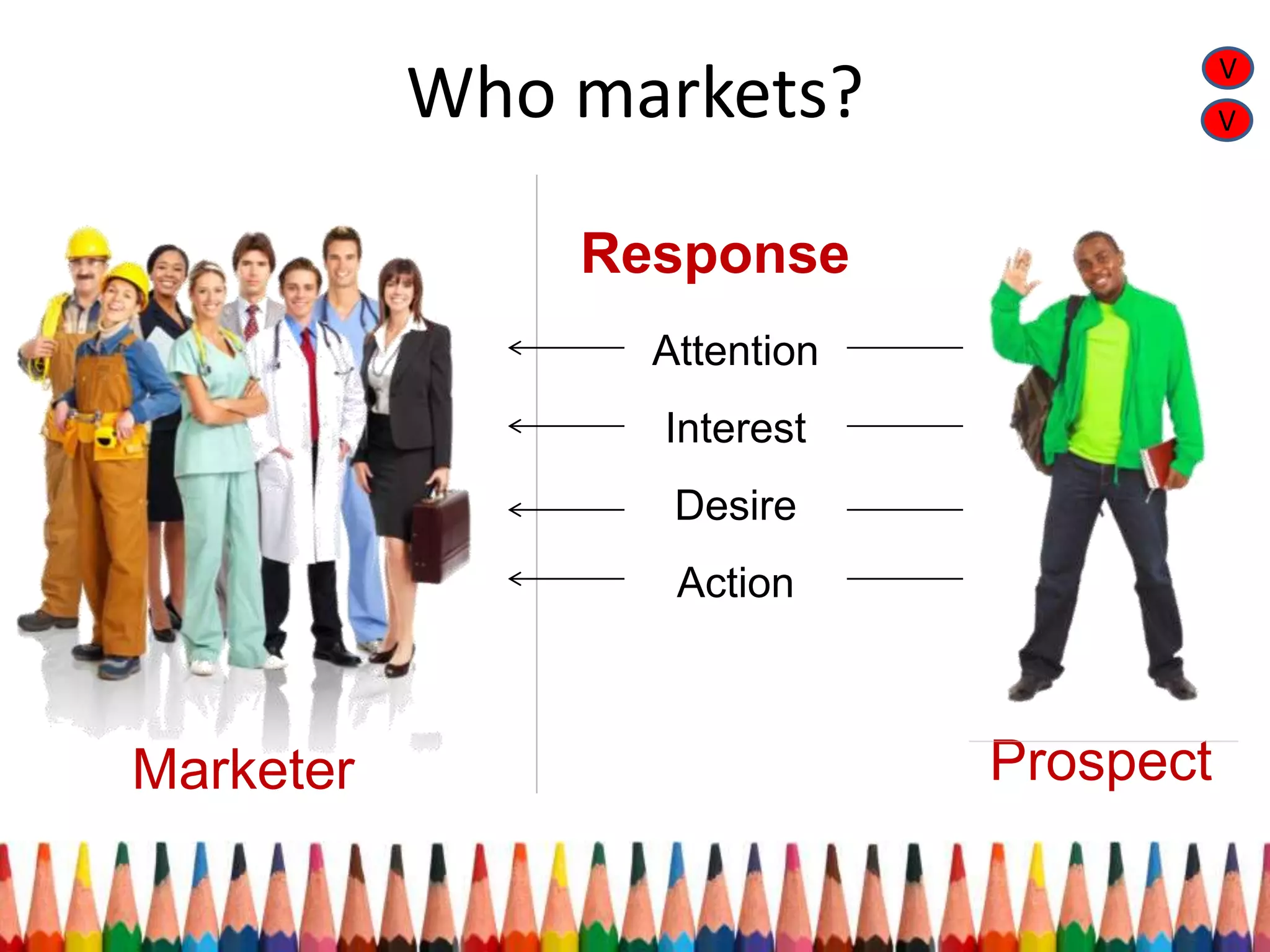
Who markets?
Marketer Prospect
Attention
Interest
Desire
Action
Response
V
V
5 Key Players in Advertising
1. Advertiser
2. Advertising Agency
3. Media
4. Supplier
5. Audience
6 M’s of Advertising
1. Mission
2. Media
3. Message
4. Money
5. Market
6. Measurement
Online Advertising
• Online advertising is a form
of promotion that uses the
Internet and World Wide Web
for the expressed purpose of
delivering marketing messages
to attract customers. Examples
of online advertising include
contextual ads on search
engine results pages, banner
ads, Rich Media Ads, Social
network advertising, online
classified advertising,
advertising networks and e-
mail marketing, including e-
mail spam.
Contd…
• Online advertising
(otherwise known as
sponsored links on websites
like Google) is a quick and
effective way of promoting
your website and generating
targeted website traffic.
• It’s the advertising which
uses Internet as a media to
communicate.
Competitive Advantage over
Traditional Advertising
• immediate publishing of
information and content
• not limited by geography
or time
• efficiency of advertiser's
investment
• customization of
advertisements
• payment is usually
relative with audiences'
response
Ethics in Online Advertising
• Flashing banners will
distract the users
• Misleading images
designed to look like
error messages from the
operating system
• Lead to sites with
malicious software or
adult material
Contd…
Unethical Advertising Methods
• Privacy
– Hosting the banner images on
its servers and using third-
party cookies, the advertising
company is able to track the
browsing of users across these
two sites.
• Malware
– external applications which
alter system settings . E.g.
spawn pop-ups
– insert advertisements into
non-affiliated web pages
Revenue Models
• CPM (Cost Per Mille), also called "Cost Per Thousand (CPT), is where
advertisers pay for exposure of their message to a specific audience. "Per
mille" means per thousand impressions, or loads of an advertisement.
• CPV (Cost Per Visitor) or (Cost per View in the case of Pop Ups and
Unders) is where advertisers pay for the delivery of a Targeted Visitor to
the advertisers website.
• CPC (Cost Per Click) is also known as Pay per click (PPC). Advertisers
pay each time a user clicks on their listing and is redirected to their website.
They do not actually pay for the listing, but only when the listing is clicked
on.
Contd…
• CPA (Cost Per Action) or (Cost Per Acquisition) advertising is
performance based and is common in the affiliate marketing sector of the
business. In this payment scheme, the publisher takes all the risk of running
the ad, and the advertiser pays only for the amount of users who complete a
transaction, such as a purchase or sign-up.
– CPL (Cost Per Lead)
– CPO (Cost Per Order)
– CPE (Cost Per Engagement)
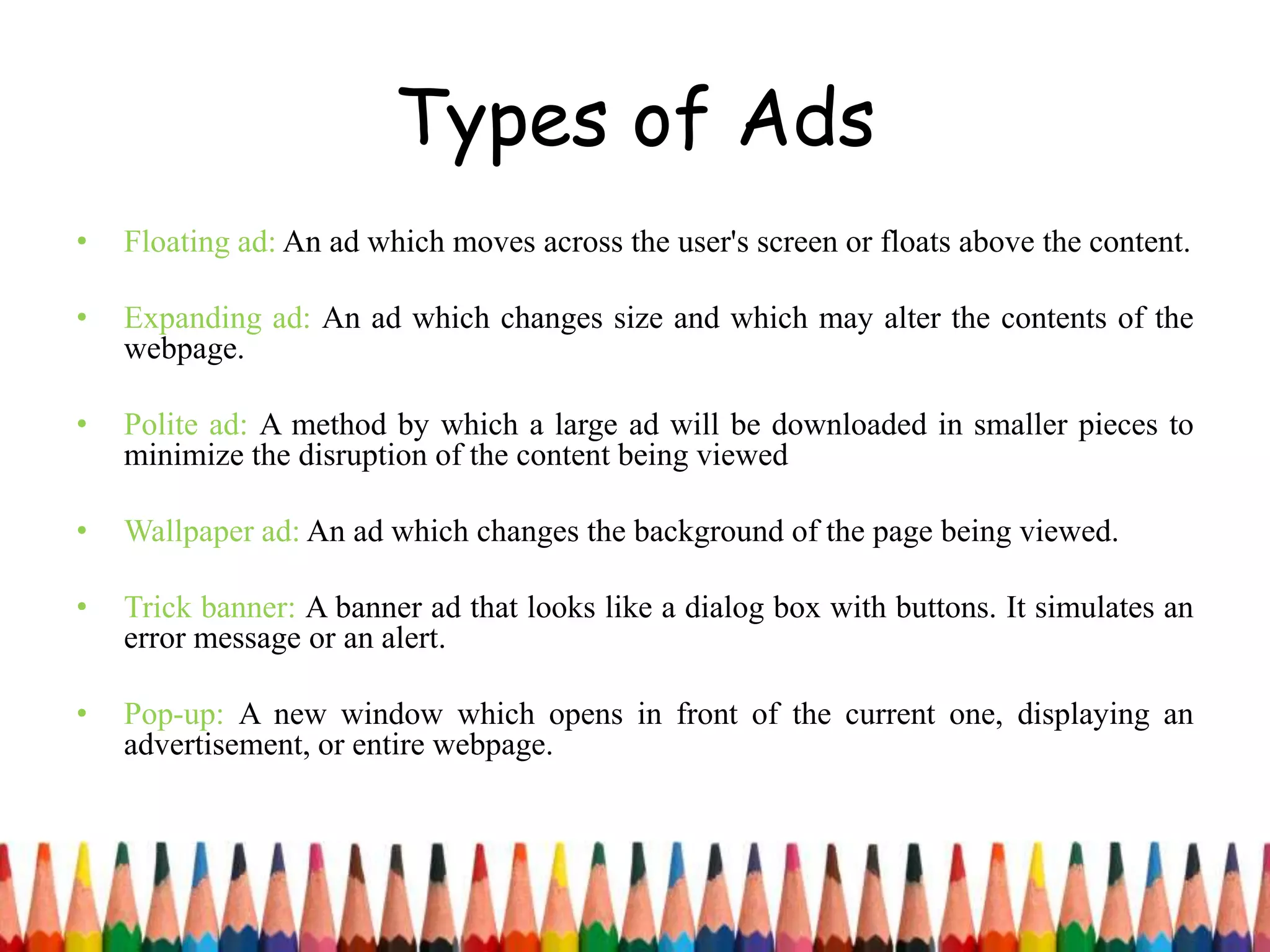
Types of Ads
• Floating ad: An ad which moves across the user's screen or floats above the content.
• Expanding ad: An ad which changes size and which may alter the contents of the
webpage.
• Polite ad: A method by which a large ad will be downloaded in smaller pieces to
minimize the disruption of the content being viewed
• Wallpaper ad: An ad which changes the background of the page being viewed.
• Trick banner: A banner ad that looks like a dialog box with buttons. It simulates an
error message or an alert.
• Pop-up: A new window which opens in front of the current one, displaying an
advertisement, or entire webpage.
Contd…
• Pop-under: Similar to a Pop-Up except that the window is loaded or sent
behind the current window so that the user does not see it until they close
one or more active windows.
• Video ad: similar to a banner ad, except that instead of a static or animated
image, actual moving video clips are displayed. This is the kind of
advertising most prominent in television, and many advertisers will use the
same clips for both television and online advertising.
• Map ad: text or graphics linked from, and appearing in or over, a location
on an electronic map such as on Google Maps.
• Mobile ad: an SMS text or multi-media message sent to a cell phone.
• In addition, ads containing streaming video or streaming audio are
becoming very popular with advertisers.
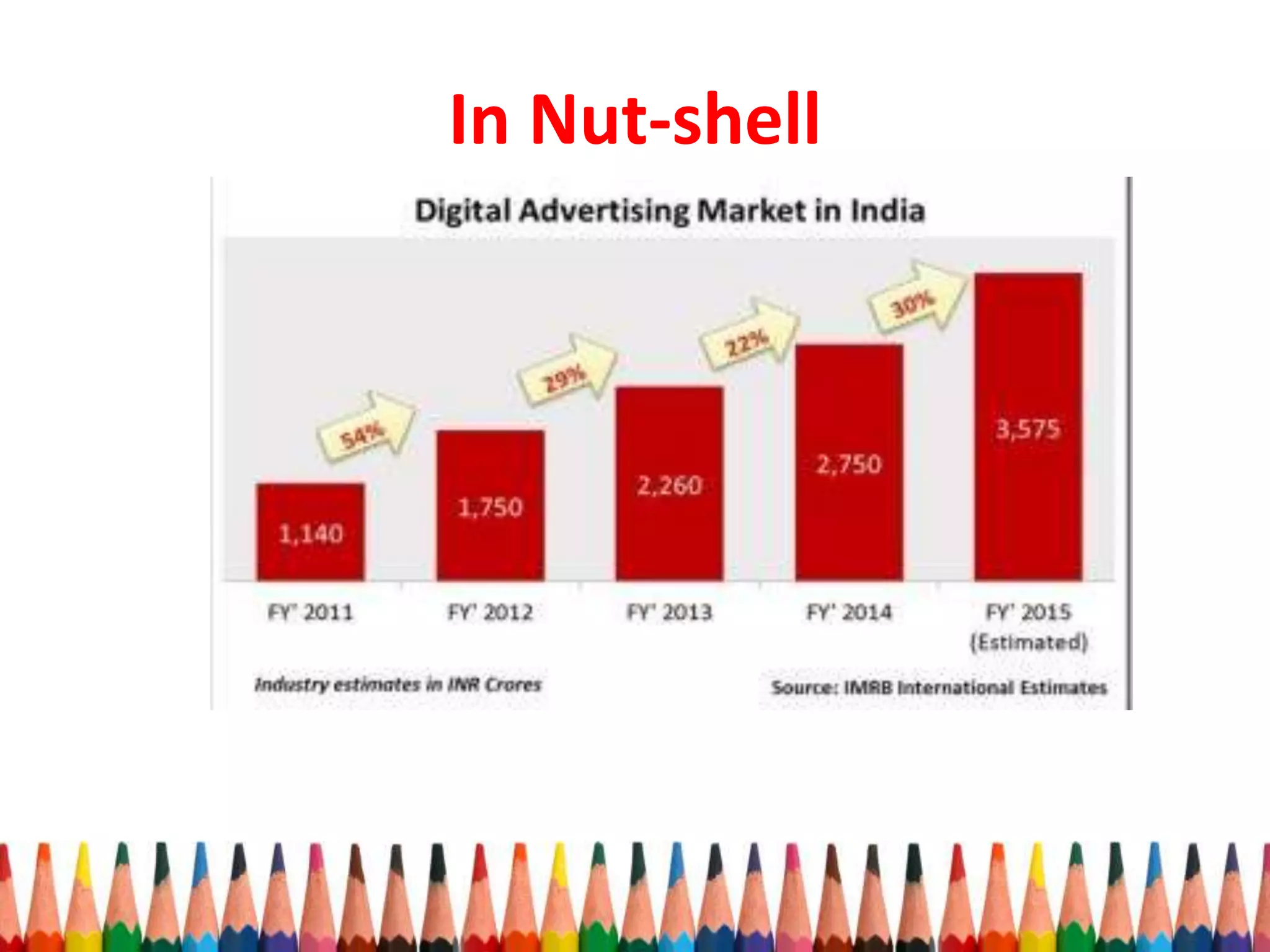
In Nut-shell
Conclusion
Internet is changing the way of advertising as people
use to watch T.V on T.V but now-a-days are using
internet to watch T.V
Companies are focusing more on digital marketing to
create brand awareness.
Hence ,Internet is changing the face of advertising.
V
Mobile- 888 888 4030
E mail Id- phdpsingh@gmail.com
Website-www.prakashsingh.co.in

E branding and Online advertising

  • 1.
    “E-Branding and OnlineAdvertising” Presenter Details- PROF. PRAKASH SINGH PhD. Scholar(University of Pune ) Assistant Professor(ASM’s IIBR,Pune)
  • 2.
  • 3.
    • There aremillions of products and services all over the world, each claims to be the best among their category. • But, every product is not equally popular. Consumer doesn't remember every product, only few products are remembered by their name, logo, or slogan. • Such products generate desired emotions in the mind of consumer. • It is branding that makes product popular and known in the market; branding is not an activity that can be done overnight, it might takes months and even years to create a loyal and reputed brand.
  • 4.
    • According toPhilip Kotler - “Brand is a name, term, sign, symbol, design, or a combination of them, intended to identify the goods or services of one seller or group of sellers and to differentiate them from those of competitors”
  • 5.
    To a consumer,brand means and signifies: • Source of product • Delegating responsibility to the manufacturer of product • Lower risk • Less search cost • Quality symbol • Deal or pact with the product manufacturer • Symbolic device
  • 6.
    “Brand Building is toolong and time consuming process.” V
  • 7.
    Lunarpages Case Study: AnOverview • What is Lunarpages? Lunarpage is a hosting provider company located in California. Founded in 1998,the company services over 1,50,000 customers all over the world. • In 2003, Lunarpages wanted to redesign their website to increase customer conversion rates and create a strong brand • So, they contacted the Ceonex company
  • 8.
    Lunarpages Case Study: TheChallenge • Ceonex noticed several significant problems with Lunarpages old site that needed to be solved. – Lack of strong and memorable brand – Unprofessional image – Lack of depth
  • 9.
    Lunarpages Case Study: Solution •Ceonex’s primary mission was to create a best brand identity to bring difference and value to what Lunarpages could offer – Powerful core theme – Appropriate colors, images, and logo – Comprehensive company branding
  • 10.
    Lunarpages Case Study: Results •The creation of a best brand and professional image has resulted in significant business benefits for Lunarpages – Customer base more than tripled in 15 months – Customer conversion rate doubled – Consistent 15% monthly revenue increase – Overall 25% decrease in customer turnover
  • 11.
    Digital Influence onIndia • Youngest planet of the world- India has 125 millions internet users in 2012 and by 2016 it will be above 330 millions. • 2/3 lives in small towns and villages. • 23% of Urban Indian have access to internet and 9% are influenced by the internet while making decision what to buy. V
  • 12.
    Consumers connect witha brand by identifying the name ,slogan or logo. People remember what they SEE better then what they hear or read.
  • 13.
    Creating a StrongBrand on the Internet • Awareness – Acquaintance with brand – Ability to recognize and recall • Familiarity – Knowledge of product, features, and services offered • Positive Imagery – Done by marketing programs – Favorable brand association • Completed Transaction – Beginning of relationship – Brand Building
  • 14.
    • >You wantto become the default reference in a consumer's mind. • >You want to become synonymous with your niche. • >When someone says "chocolate", many Europeans immediately think Nestlé because, in a sense, they "own" the brand. 14
  • 16.
    Desh Ka Namak Tasteof India Thanda Matlab Desh Ki Dhadkan The Banker of every Indian
  • 17.
    > Brand Association Youmust create an association between yourself and the person you want to influence, the results they want to have. Your brand needs a face, a representative, a personality. 13
  • 18.
    15 Brands are builton what people are saying about you, not what you're saying about yourself. People say good things about you when > you have a great product and > you get people to spread the word about it
  • 19.
    •Let your customersco-create your brand through the stories they tell one another. •Branding is not what you say but what you do.
  • 20.
    Time to makeyour brand a verb • Search It • Photocopy/Xerox • Photo Editing • Chatting • Video Calling
  • 21.
    Time to makeyour brand a verb • Google It • Xerox It. • Photoshop my photo • Whatsapp me • Skype your family.
  • 22.
    Internet Tools • PersonalizationTools – Customer Database – Customer Control • Collaborative Tools • Purchase-process streamlining tools – Stored personal information – Avoid filling out forms • Self-service tools – My Account page – Personalized services • Do-it-yourself product design tools • Dynamic-pricing tools
  • 23.
    Amazon.com – PersonalizationTools • Customer database –Amazon has info about customers – Knows your name when you sign on – Can reach you by e-mail & “snail mail • Customer control – customers can influence content on Amazon.com – “Improve your Recommendations” capability – Customization of your own page
  • 24.
    Amazon.com – CollaborativeTools • Customer-supplies book reviews & ratings • High publicity collaborations – Amazon & Doonsbury comic artist teamed up in 1998 – Visitors to the site got to complete the unfinished comic
  • 25.
    Amazon.com – Purchaseprocess streamlining tools • 1-click payment system – Stores payment information – Customers can avoid filling out forms each time they make a purchase on Amazon.com • Wish list – Stores the products you want to buy for another visit
  • 26.
    Amazon.com – SelfService Tools • My account page • Offers customer-specific services – Order tracking • When was your order shipped? • Arrival estimate – Ability to change personal information
  • 27.
  • 28.
    “e-branding” is the creationand development of communications strategies particularly for brands to have meaning and framework on the web. The US shopfront of Apple's iTunes 10
  • 29.
  • 34.
    6 C’s 0fCustomer Motivation 6 C’s of customer motivation to help define the online value proposition (OVP) are as follows:- 1. Content- Relevant, more detailed, in-depth information to support buying process. 2. Customization- Personalization of content according to individuals or groups. 3. Community- Social networks, site review
  • 35.
    4. Convenience-Easily find,any time purchase,24/7 availability of service 5. Choice-A wider choice of products and suppliers. 6. Cost Reduction- Low cost place of purchase
  • 36.
    E –Branding byToday’s Companies • Like Pages • Review & Rating • Live Chat • Gaming
  • 37.
  • 38.
  • 39.
  • 40.
  • 41.
  • 42.
  • 44.
    Advertising Any paid formof non personal presentation of goods ,idea and services by any identified sponsors is known as Advertising. V
  • 46.
  • 47.
    5 Key Playersin Advertising 1. Advertiser 2. Advertising Agency 3. Media 4. Supplier 5. Audience
  • 48.
    6 M’s ofAdvertising 1. Mission 2. Media 3. Message 4. Money 5. Market 6. Measurement
  • 49.
    Online Advertising • Onlineadvertising is a form of promotion that uses the Internet and World Wide Web for the expressed purpose of delivering marketing messages to attract customers. Examples of online advertising include contextual ads on search engine results pages, banner ads, Rich Media Ads, Social network advertising, online classified advertising, advertising networks and e- mail marketing, including e- mail spam.
  • 50.
    Contd… • Online advertising (otherwiseknown as sponsored links on websites like Google) is a quick and effective way of promoting your website and generating targeted website traffic. • It’s the advertising which uses Internet as a media to communicate.
  • 51.
    Competitive Advantage over TraditionalAdvertising • immediate publishing of information and content • not limited by geography or time • efficiency of advertiser's investment • customization of advertisements • payment is usually relative with audiences' response
  • 52.
    Ethics in OnlineAdvertising • Flashing banners will distract the users • Misleading images designed to look like error messages from the operating system • Lead to sites with malicious software or adult material
  • 53.
    Contd… Unethical Advertising Methods •Privacy – Hosting the banner images on its servers and using third- party cookies, the advertising company is able to track the browsing of users across these two sites. • Malware – external applications which alter system settings . E.g. spawn pop-ups – insert advertisements into non-affiliated web pages
  • 54.
    Revenue Models • CPM(Cost Per Mille), also called "Cost Per Thousand (CPT), is where advertisers pay for exposure of their message to a specific audience. "Per mille" means per thousand impressions, or loads of an advertisement. • CPV (Cost Per Visitor) or (Cost per View in the case of Pop Ups and Unders) is where advertisers pay for the delivery of a Targeted Visitor to the advertisers website. • CPC (Cost Per Click) is also known as Pay per click (PPC). Advertisers pay each time a user clicks on their listing and is redirected to their website. They do not actually pay for the listing, but only when the listing is clicked on.
  • 55.
    Contd… • CPA (CostPer Action) or (Cost Per Acquisition) advertising is performance based and is common in the affiliate marketing sector of the business. In this payment scheme, the publisher takes all the risk of running the ad, and the advertiser pays only for the amount of users who complete a transaction, such as a purchase or sign-up. – CPL (Cost Per Lead) – CPO (Cost Per Order) – CPE (Cost Per Engagement)
  • 56.
    Types of Ads •Floating ad: An ad which moves across the user's screen or floats above the content. • Expanding ad: An ad which changes size and which may alter the contents of the webpage. • Polite ad: A method by which a large ad will be downloaded in smaller pieces to minimize the disruption of the content being viewed • Wallpaper ad: An ad which changes the background of the page being viewed. • Trick banner: A banner ad that looks like a dialog box with buttons. It simulates an error message or an alert. • Pop-up: A new window which opens in front of the current one, displaying an advertisement, or entire webpage.
  • 57.
    Contd… • Pop-under: Similarto a Pop-Up except that the window is loaded or sent behind the current window so that the user does not see it until they close one or more active windows. • Video ad: similar to a banner ad, except that instead of a static or animated image, actual moving video clips are displayed. This is the kind of advertising most prominent in television, and many advertisers will use the same clips for both television and online advertising. • Map ad: text or graphics linked from, and appearing in or over, a location on an electronic map such as on Google Maps. • Mobile ad: an SMS text or multi-media message sent to a cell phone. • In addition, ads containing streaming video or streaming audio are becoming very popular with advertisers.
  • 60.
  • 64.
    Conclusion Internet is changingthe way of advertising as people use to watch T.V on T.V but now-a-days are using internet to watch T.V Companies are focusing more on digital marketing to create brand awareness. Hence ,Internet is changing the face of advertising. V
  • 65.
    Mobile- 888 8884030 E mail Id- phdpsingh@gmail.com Website-www.prakashsingh.co.in

Editor's Notes

  • #47 Marketers are individuals, groups, associations, companies, etc. that seek a response, such as attention, a purchase, donation, vote, etc., from another party which is called the prospect.